
CHAPTER X
On 3 May 1382, a few days after the collapse of the talks at Tournai, Philip Van Artevelde gambled the fate of Ghent on a single desperate stroke. About 4,000 men from Ghent appeared without warning outside the walls of Bruges. They were led by Philip himself and his two principal lieutenants, Peter Van den Bossche and Francis Ackerman. They had left Ghent on the previous day and had marched unseen through the night. Most of them were citizen soldiers. But there was also a small corps of German and English mercenaries and an artillery train. It was the day on which the Brugeois traditionally stopped work early to take part in the procession of the Holy Blood and to drink themselves senseless. Towards the end of the afternoon the army of Ghent halted in a large meadow south-west of the town known as Beverhoutsveld. The Count of Flanders was in the castle on the eastern side of the town when the news was brought to him. There was a hurried conference with the guild leaders and the captain of the town. The captain wanted to close the gates and take his time to organise the defence. But the Count favoured a more aggressive response. So the trumpeters passed through the crowded streets to call men to arms.
Towards the end of the afternoon Louis de Mâle led his army, a mixed crowd of experienced soldiers and armed townsmen out of the gates. They moved forward without order or discipline, ‘full of meat and wine’. It was an unseasonally warm day and the sun was already low in the sky, shining into their faces as they marched. The army of Ghent was waiting in battle order. Their archers were drawn up at the front together with the artillery. As the horde of Bruges approached, the archers and cannon simultaneously opened fire. The Count’s army reeled before the shock. Its front lines thinned out as men and horses fell to the ground beneath the volley of missiles. Then the men of Ghent advanced in a body and began to slaughter the Brugeois. The Count’s own company was surrounded and Louis himself briefly unhorsed. At this point some of the Brugeois deserted to the other side. They were almost certainly the members of the weavers’ and fullers’ guilds, men who had supported the cause of Ghent in 1379. In the confusion the whole mass turned and fled towards the town, pursued by the victorious men of Ghent. When they reached the gate the enemy pressed in after them. The cloth-workers appeared on the streets to welcome them. ‘Tout un!’, they shouted. Louis de Mâle managed to escape from the press of men and find his way back to the castle. There he tried to organise a counter-attack. In the market-place, under the shadow of the great belfry of the cloth-hall, the loyal guilds, the butchers, fishmongers, cutlers and furriers gathered in their lines to defend their town. The Count led his men-at-arms through the streets to reinforce them. But before he could reach the market-place the men of Ghent and cloth-workers of Bruges invaded the square. The Count’s allies were massacred. His troops were forced to turn back. Louis himself took refuge in a hovel built into the city walls. That night he escaped through a window, swam the moat and made off on foot into the open country.1
In spite of the support he had received from the cloth-workers Philip Van Artevelde treated Bruges as a conquered city. A garrison was installed. Two captains, Peter Van den Bossche and a dyer called Peter de Winter, were appointed as governors. On the day after the battle the inhabitants were assembled in the great open space in front of the monastery of St. Catherine, outside the walls, and made to swear an oath of loyalty towards the new regime. A heavy indemnity was laid upon the town and many prominent inhabitants were rounded up and sent off to Ghent as hostages for its payment. Three of the gates were demolished together with thirty feet of wall on either side and the spoil used to fill up the ditches. The men of Ghent sacked the Count’s residence in the castle. For three days they went through the streets looting the houses of the rich and those associated with Louis’s government. But their main objective was the food stores. Grain, flour, wine and salted meat was seized and loaded into hundreds of carts to relieve the hunger of Ghent.
The political consequences of the battle were dramatic. The blockade of Ghent was broken. In Ypres the cloth-workers took over the town and sent their submission to Philip Van Artevelde. He was received there as a hero. The whole of the maritime region to the west followed the lead of Ypres. Courtrai threw out the Count’s officers. By the end of May 1382 Louis de Mâle’s government had collapsed in most of Flemish-speaking Flanders. After a number of adventures Louis de Mâle eventually reached the French-speaking city of Lille. From here he withdrew at about the beginning of June to his castle at Hesdin in Picardy.2
Louis de Mâle’s officers retained control of the three Walloon-speaking castleries of southern Flanders. But the only places in the Flemish-speaking regions which were still held by his partisans were the two towns of Oudenaarde and Dendermonde. They were minor places, but of incomparable strategic value for they enabled Louis to close the River Scheldt to navigation on both sides of Ghent. The focal point of the struggle which followed was Oudenaarde. The town had suffered more than any place in Flanders in the three years since the civil war began. Repeatedly fought over, it had been battered by artillery, its walls partially demolished and its trade ruined. Much of its population had abandoned it and migrated elsewhere. Louis sent a corps of 450 elite soldiers under a Flemish nobleman called Daniel de Halewyn to hold the husk of walls, buildings and frightened inhabitants. Halewyn and his companions prepared to fight to the end. They demolished every building outside the walls within arrow-shot. They sent away most of their horses. Women and those too old or young to fight were expelled. Stores were laid in. Ghent threw all its strength against the town. Early in June 1382 a vast army appeared outside the walls, raised from the citizens of Ghent and its subject towns. It was stiffened with a corps of professional mercenaries including some 300 English archers, most of them deserters from the garrison of Calais drawn by the high rates of pay on offer. They invested Oudenaarde from both sides of the Scheldt. Bridges of boats were thrown across the river upstream and down to seal off access by water. Siege engines were sited around the walls and hurled great stones into the town. Gunpowder artillery was placed in front of the main gates, including a huge ‘bombard’ whose roar could be heard more than twenty miles away. Across Flanders the struggle took on all the savagery of a class war. The Count’s supporters were proscribed. Many of them fled to the Walloon regions or France. The rural mansions of the nobility and the rich were attacked and burned by raiding parties from the towns. At the Count’s castle at Mâle the mob of Bruges were shown the cradle in which Louis had been nursed as a baby and the font in the chapel in which he had been baptised. They smashed them into small pieces and sent them off as trophies to Ghent.3
The collapse of Louis de Mâle’s government in Flanders occurred just as the English Parliament was about to assemble at Westminster. It opened up a strategic opportunity barely dreamed of when Philip Van Artevelde’s emissaries had been in England. Yet it also provoked a bitter debate, which was to continue in one form or another for the next three years, between those who wanted to grasp the opportunity of intervening in Flanders and those, associated with John of Gaunt, who were determined that any English army available for service overseas should be used to shore up the position of the Earl of Cambridge in Portugal. The Portuguese Chancellor, Lourenço Fogaça, an engaging diplomat and a firm anglophile, had recently arrived in England to add his own voice to the clamour for a southern strategy. He was once described by his master as a man with ‘the cross of St. George graven on his heart’.4
When Richard Scrope stood up on 8 May 1382 to deliver the traditional address he told the assembly of the plan to send the young King abroad with an army of 6,000 men but he was no more precise about the army’s destination than ‘France’. This must have added to the suspicions of an assembly which had learned to distrust the government’s military enterprises and had already washed its hands of the Duke of Lancaster’s Castilian ambitions. In the event it did not matter. The Commons were unwilling to contemplate any grant of war taxation at all except for purely defensive purposes. The discussion turned mainly on a plan to borrow £60,000 on the security of a Parliamentary guarantee, a variant of the scheme which Parliament had already rejected when John of Gaunt proposed it in February. It was a difficult time at which to borrow money, let alone such a great sum. The knights invited the Lords to appoint a commission of merchants to advise them. Fourteen merchants were nominated, half of them Londoners. They included John Philpot, the former mayor who had been involved in a number of previous royal loans, and the rich grocer Nicholas Brembre. They were more pessimistic than the financiers who had considered the question in March. They declared that the money could not be raised even with a Parliamentary guarantee. They reminded the Commons of the fate of the bankers who had bailed out the government in previous financial crises: Pole, Wesenham, Walwain, Chiriton. All of these princely merchants of the last generation had been rewarded with persecution and bankruptcy. The most that their successors would do was guarantee the repayment of such loans as the Parliamentary peers and knights might care to make out of their own pockets. The peers and knights did not take the hint and the projected loan was abandoned.
The government tried to find money by other methods. They raised a modest loan from the London branch of a Genoese banking house. They offered discounts to exporters for paying the wool tax in advance. They sold off yet more of Richard II’s jewels. Even with these expedients the English government’s total receipts in the six-month period from April to September came to less than £22,000, one of the lowest figures for any corresponding period since the 1330s. By the time Parliament was dissolved on 22 May 1382, it was clear that no offensive operations would be possible for several months. The Council appointed three representatives to report the disappointing outcome to the leaders of the rebellion in Flanders. They left at the end of the month. As for Fogaça, he remained in England, buying horses and weaponry in London and confecting plans with John of Gaunt to send a second army to Castile in the following year if not in this one.5
Balked in the direction of England, Philip Van Artevelde proferred an olive branch to the government of France. He wrote a ‘mild and friendly’ letter to Charles VI inviting him to order the Count of Flanders to return to his domains and govern them ‘in justice’. Failing that, Van Artevelde proposed that the French King should take the county into his own hands and appoint a royal governor. The French King’s councillors laughed at his impertinence when the letter was read to them, and the messenger who delivered it was thrown into prison. Yet Van Artevelde’s assumption that the French government might help him was by no means absurd. Louis de Mâle had a firm ally in his son-in-law, Philip of Burgundy, who had promised him his support soon after his withdrawal to France. But in spite of his dominant position in the King’s Council there was a heavy weight of consensus against him. Louis de Mâle had never been a popular figure at the French court. There were still plenty of influential noblemen who found a certain satisfaction in his misfortunes. They were strongly opposed to allowing France to become involved in a ferocious and apparently endless civil war against rich and populous towns which had shown themselves to be resourceful antagonists. Some of these men also took the view, for which there was much to be said, that Louis’s intransigence towards Ghent had contributed largely to his problems and that France could play a more productive role by broking a settlement.6
The French ministers were of course aware of the English government’s intrigues with Philip Van Artevelde in March, for the Count must surely have told them, but at this stage they took the threat of English intervention lightly. They no doubt learned about the debates in Parliament in May. The forthcoming peace conference was the main focus of attention. After successive postponements it was now due to open on 20 June. John of Gaunt was still expected to attend and the Duke of Burgundy had been nominated as the head of the French delegation. No one seems to have been very sanguine about the prospect of a permanent peace. But great hopes were invested in the fall-back proposal for a twelve-year truce, which had been one of the ideas discussed during the preliminaries in March.7 This had obvious attractions for the French. It would indefinitely defer the thorny issues which had frustrated previous conferences. It would make it unnecessary for them to surrender territory as the price of peace. And it would leave the English King with no more than the insignificant ribbon of land that he still held in the south-west. Some thought was given to what would happen if the conference failed but current French military planning did not contemplate a campaign in Flanders. The government had resolved as long ago as April 1381 that the King would lead an army into the south as soon as money could be found to pay for it. Their main priorities were to suppress opposition to the Duke of Berry’s authority among the cities of Languedoc and to apply pressure to the English in the march of Gascony. This remained their position after the expulsion of Louis de Mâle from the Flemish regions of Flanders and indeed throughout the summer of 1382.
In spite of the great expectations which had built up around it the peace conference came to nothing. At the last moment the English downgraded the negotiations by announcing that John of Gaunt would not, after all, be coming. Instead it was the familiar and competent but less august figure of John Gilbert, Bishop of Hereford, who appeared at Calais. He, according to the malicious Thomas Walsingham, was a man who ‘liked blather better than truth’. The Duke of Burgundy accordingly remained at court and sent less impressive personages to represent France in his place. Gilbert’s instructions have not survived but it is plain that he had very little authority. The discussions appear to have broken down over the issue of Castile. John of Trastámara had made it clear to the latest French ambassador to visit his court that he would not agree to any truce unless it extended to Castile. But that was unacceptable to John of Gaunt. It would have halted the operations of the Earl of Cambridge in Portugal at the very moment when the long-delayedinvasion of Castile was expected to start and would have obstructed preparations for the second army which Gaunt was bent on sending out in the following spring.
Faced with this impasse Richard II’s Council was forced to decide whether it would back John of Gaunt’s plans or not. At about the beginning of July 1382 they met at Westminster to try to give some clear direction to English diplomatic and military planning. John Gilbert returned from Picardy, leaving his fellow ambassadors to carry on the argument with the French. Fogaça was still at Westminster pressing for intervention in Castile at the earliest possible moment. There is no surviving record of the outcome but there are good reasons to believe that John of Gaunt’s allies prevailed. The Council appears to have decided that their first priority would be to send Gaunt with an army to Gascony in the spring of 1383, provided that Parliament could be persuaded to vote funds for it. Gaunt planned to cross the Pyrenean passes into Castile while his brother and King Fernando launched a simultaneous invasion from Portugal. The Council proposed to keep open the alternative strategy in the north, partly no doubt because the Commons’ hostility to Gaunt’s Castilian ambitions was well known; and partly because the more optimistic among them thought that it might be possible to run with both projects at once. After the meeting had closed a herald was sent into the siege lines at Oudenaarde to propose that Philip Van Artevelde should come to England in person to concert plans. Fogaça sailed for Portugal to report to Fernando. These decisions went some way to resolve the division among Richard II’s advisers between the partisans of a northern and a southern strategy by conceding something to each. But they condemned the conference in Picardy to failure. John Gilbert returned to the march of Picardy with nothing to offer. The ceasefire was extended to October 1382, effectively writing off the campaigning season for that year, but nothing more could be agreed.8
*
Unknown to the English Council the future of the Anglo-Portuguese alliance on which the southern strategy depended had already become extremely uncertain. In Portugal the war with Castile was proving to be destructive and unpopular. With the coming of spring some eighty Castilian sailing ships and oared barges had appeared in the Tagus and begun to blockade Lisbon. Every day Castilian men-at-arms and Basque mountain troops landed from the ships to plunder and burn. They sacked the suburbs of Lisbon. They destroyed the fine mansions of the King and the nobility which stood along the banks of the river from Lisbon to Santarém. They launched large-scale mounted raids across the Ribatejo opposite the city. Much of this was cattle country which was rapidly denuded of its herds. There was no Portuguese fleet to resist them. It was more than a month before there was any organised defence even on land.9
Away in the east the English army passed six months, from January to June, by the Castilian frontier. Fernando had given strict instructions that the English were not to raid into Castile for fear of provoking a counter-attack for which his army was not prepared. His orders were not consistently obeyed. Early in the year ‘Canon’ Robesart led some 800 men across the Guadiana and into the foothills of the Sierra Morena. Another raiding force in the spring briefly penetrated into Castile north of Badajoz, supported by Portuguese frontier troops. But for most of the time the English sat unpaid and bored in their winter quarters waiting for orders and staring at the great featureless plain of the Alemtejo. Since they could not support themselves at the expense of their enemies they had little choice but to live off their hosts. Their encampments were situated in the richest agricultural region of Portugal. The English ranged through it, breaking into houses, stealing cattle, raping women. They tortured those who hid their goods and killed those who resisted them. An English chronicler, who presumably got his information from men serving with the army, reported that his countrymen treated the Portuguese ‘like worthless serfs’. The Portuguese King repeatedly complained to the Earl of Cambridge. But although the Earl issued orders that the offences were to stop he was not a man to make his wishes respected. After the outrages which had occurred around Lisbon the previous autumn relations between English and Portuguese sank to new lows. Englishmen travelling on their own were attacked and murdered. They were given poisoned bread to eat. Town gates were closed in their faces. Some of these were stormed by undisciplined mobs of English soldiers as if they were enemy strongholds.10
In the spring of 1382, at a critical stage of the preparations for invading Castile, a court scandal gravely weakened the Portuguese government. John of Gaunt’s Galician retainer Juan Fernández Andeiro had taken advantage of his return to Portugal with the English army to resume his affair with the Queen, Leonora Teles. With the King visibly ailing and only intermittently capable of directing affairs, Leonora had become the dominant voice in the Portuguese government. Most of Don Fernando’s councillors and professional advisers and much of the court nobility were by now her clients and protégés. Andeiro moved into residence at court and began to receive lavish grants on his mistress’s nomination. When, in the spring of 1382, it became obvious that the Queen was pregnant the gossip surrounding her relationship with Andeiro could no longer be contained. In about March 1382 the Portuguese court moved to Evora, a substantial city dating from Roman times standing at the edge of the Alemtejo. As a result of some indiscreet words of Andeiro the truth about his affair with Leonora became known to one of her ladies-in-waiting, who was married to the King’s private secretary, Gonçalo Vasques de Azevedo. She repeated the story to her husband and he let a hint of what he had learned drop in the Queen’s presence. Vasques was a venal man who owed much to Leonora’s favour. But he was also close to the King, having served as confidential adviser to both Fernando and his father before him. Leonora panicked. She seems to have thought that she was about to be denounced and disgraced. So she attempted what amounted to a coup d’état. She prevailed on Fernando to order Vasques’s arrest. The King’s half-brother, John of Avis, who was the only other member of the royal Council with the stature and independence to stand up to her, was arrested at the same time. The sick King was then packed off to the castle of Vimieiro, a day’s ride away, leaving Leonora and Andeiro in control of Evora. The two prisoners were taken to the citadel under armed guard and loaded with chains while the Queen plotted their execution on trumped-up charges of treason.
Leonora might have got away with the destruction of Gonçalo Vasques but she had overreached herself in attacking John of Avis, who was a considerable figure in Portugal. John was the bastard son of the previous King of Portugal, Don Pedro. His father had appointed him at the age of six as Master of the military order of Avis, an office which gave him control of the order’s great wealth and assured him of a substantial position independent of the factions at court. Now twenty-five years old, John was a popular figure in the cities and among the nobility. The noblemen about the court protested. The captain of Evora refused to carry out the executions without the King’s personal warrant. Even the Earl of Cambridge, who had originally refused to become involved, was induced to intervene on the prisoners’ behalf. After three weeks both men were released. It is unclear how much Fernando ever knew about his wife’s conduct. Leonora eventually bought the complicity of Gonçalo Vasques. As for John of Avis, he withdrew from court, a confirmed enemy of the Queen, and joined the Earl of Cambridge on the eastern march. An uneasy calm descended on Evora.11
Shortly afterwards discipline finally collapsed in the English army. The long months of inactivity had been bad for the men’s morale. Many of them died during the winter from malnutrition and disease, and heavy casualties were suffered in a succession of violent incidents with the Portuguese. The army’s numbers had fallen to about a thousand men, a third of its original strength. The survivors were angry about their pay. They had received nothing since the autumn of the previous year. It was far from clear whether their wages were a Portuguese responsibility or an English one. Fernando appears to have accepted responsibility in principle but declined to pay, ostensibly because they had ignored his prohibition against raiding into Castile, in fact because he was struggling to raise his own army and did not have the money. At about the end of May 1382 malicious reports began to circulate among the men that the Earl of Cambridge had received the money to pay them but failed to distribute it. This provoked a serious mutiny in a large section of the army encamped around the town of Estremoz. A mass meeting was called. A surprising leader emerged in the shape of Sir John Sotherey, the seventeen-year-old bastard son of Edward III and Alice Perrers. He persuaded his fellows to confront the Earl in his quarters and if they received no satisfaction to turn their arms against the King of Portugal. The men formed up around Sotherey. They unfurled the banner of St. George and marched in warlike array on Vila Viçosa, crying out ‘A Sotherey! A Sotherey, the brave bastard!’ As they approached the town they were met on the road by the marshal of the army, Sir Matthew Gournay, and two of his captains. The ringleaders were brought before the Earl in his quarters. He had nothing to offer them. But they were eventually persuaded to send a delegation of three men to petition the King of Portugal. Fernando was alarmed by the prospect of an uncontrolled English army marauding across his realm. He received the representatives of the men and promised that they would receive some money within a fortnight. To make good his promise the King’s officers had to plunder the silver from church treasuries. ‘You see what a little trouble-making will do,’ Sotherey is said have remarked when the delegates returned with the news.12
In fact the mutineers had destroyed the last shreds of goodwill which the English enjoyed in Portugal. Fernando himself remained loyal to the alliance in spite of the difficulties that it had brought him. He too had ‘the cross of St. George graven on his heart’, as he later told Lourenço Fogaça but he was no longer in control of events. His councillors had unanimously objected to the English alliance when it was first made for reasons that had been largely borne out by events. A few noblemen, like John of Avis and the future Constable of Portugal Nun’ Alvarez Pereira, enjoyed war with a relish that they had learned from their English mentors. But most of the Portuguese nobility regarded the conflict with Castile as pointless and damaging. The prime mover behind the English alliance had been the Queen, who had persuaded herself that the English offered a better guarantee than the Castilians of her daughter’s succession to the throne. This calculation had never been very realistic and it seemed particularly threadbare now. The Earl of Cambridge’s army was a shadow of what it had been and arguably represented a greater threat to Portugal than to Castile. John of Gaunt’s promised army of reinforcement had been postponed to the following year with no assurance that it would come even then. Andeiro could see all this. He was the author of the Anglo-Portuguese treaty in 1380 but he had shed whatever loyalty he had once felt for John of Gaunt when he tied his fortunes to the Queen’s. In June Leonora was already looking for an alternative match for her much betrothed daughter. The campaign against Castile would probably have been abandoned before it started but for the Portuguese government’s fear of the English army on their soil and the uncertainties arising from the Queen’s pregnancy. What if the child was a boy? Unless Fernando repudiated him, he would displace Beatrice as the heiress of Portugal and all the carefully laid plans of the past two years would fall away.13
The fortress-town of Elvas stood on a hillside crowned by a powerful thirteenth-century fortress overlooking the plain of the Alemtejo. Ten miles of wheat fields and olive groves separated it from the River Guadiana and the Castilian city of Badajoz. It was here that the English and Portuguese armies finally joined forces on 6 July 1382. The King was now very ill. His distended belly made it painful for him to move and difficult to receive visitors. He installed himself with his household in the citadel while the Earl of Cambridge occupied the Dominican convent in the lower town. Their followers were kept well apart. The Portuguese troops encamped around the base of the town while the English spread themselves along the road to Badajoz. Estimates of their strength varied but the English appear to have had about 1,000 men at their disposal plus the usual pages and camp-followers, and the Portuguese about 6,000 men equally divided between cavalry and infantry. John of Trastámara’s army was substantially larger: about 5,000 men-at-arms including some French companies, in addition to about 1,500 light horse and a horde of archers and infantry. But they were still more than a hundred miles away at Ciudad Rodrigo in the north.14
Although there were no Castilian troops opposite them apart from the garrison of Badajoz, the Anglo-Portuguese army made no attempt to enter Castile. Instead their leaders took up a Castilian proposal to fight an arranged battle on the frontier as soon as John of Trastámara arrived with his army. He did not reach Badajoz until 31 July. In the early hours of the morning the whole of the Anglo-Portuguese army advanced towards the frontier to meet him. The appointed place was a flat expanse of open ground by the small hamlet of Caia, three miles west of Badajoz. They drew themselves up in their battle lines, the English in the van and the Portuguese behind. Don Fernando stirred himself to appear on the battlefield and began to confer knighthoods on ambitious young men, English and Portuguese, until it was pointed out to him that he was not entitled to do so, never having taken knighthood himself. The Earl of Cambridge dubbed him on the field so that he could repeat the process properly. It was a day rich in symbols. In the front line Sir Thomas Symonds unfurled John of Gaunt’s Castilian banner as the English stood behind him roaring out: ‘Castile and León for King John, son of Edward of England.’ Then they brought forward the banner presented by Pope Urban VI to mark the crusade against the Castilian adherents of the Avignon Pope. On the opposite side of the field no one stirred. The King of Castile was represented by a solitary pavilion which had been erected that morning by his officers. Shortly they were seen to dismantle it and withdraw towards Badajoz. The Anglo-Portuguese waited in line for several hours. Then, in the early afternoon, they withdrew to Elvas. Although they did not yet know it the campaign was over.15
On 19 July 1382 the Queen had given birth to a baby boy who died four days later. The child was generally assumed to be Andeiro’s, but the King marked the birth and death with extravagant displays of joy and sorrow. Beatrice was once again an heiress. For the more calculating men about the Queen the event paved the way for the reconciliation with Castile which must have been planned within her circle for weeks. The probability is that the first approach was made while the Castilian army was on its way south to Badajoz at the end of July, and that the abortive arranged battle at Caia was no more than a charade for the benefit of the English. What is clear is that, shortly after the retreat from Caia, the Constable of the Portuguese army, accompanied by Gonçalo Vasques de Azevedo, brought a formal proposal into John of Trastámara’s headquarters. Ten days of intensive negotiation followed. The Portuguese emissaries received their instructions by word of mouth. To avoid attracting the attention of the English they travelled by night with a single squire for an escort. The precise source of their instructions is something of a mystery. Fernando later told the English that he had had nothing to do with the negotiations. This statement was received as mere subterfuge, designed to hide his embarrassment, but it may well have been true. There is a weary, resigned quality about many of Don Fernando’s pronouncements at this time. He was certainly not incoherent or incapable of following what was going on about him, but he was racked with pain and quite unable to stand up to the Queen and his household officers. For his part, John of Trastámara had good reasons to make peace with Portugal in spite of the numerical superiority of his army and the enthusiasm of his leading captains. He did not wish to risk a battle against an English army even in its present sorry state. Moreover, after maintaining an army and a fleet in almost continuous service for more than a year, he was in serious financial difficulty. He could probably not have kept his army in being for much longer anyway.16
The treaty between Castile and Portugal was finally concluded in the early hours of 10 August 1382. The terms were extremely favourable to Portugal. It was agreed that Beatrice’s engagement to the Earl of Cambridge’s son would be repudiated and that instead she would be betrothed to the Castilian King’s second son, the Infante Fernando. Since he was barely a year old Leonora was assured of a long regency after her husband’s death, with some prospect of Castilian support against her internal enemies. The Castilians agreed to restore all that they had gained during the war, including the fortress of Almeida, the whole of the Portuguese fleet captured at Saltes and all prisoners of war in their hands. The English army was to be bundled out of Portugal as soon as possible. John agreed to make available ships of his own fleet to carry them back to England. The English knew nothing about any of this until, on the morning of 10 August, the trumpeters passed through their lines proclaiming the peace. They were astonished. They cried out that they had been betrayed. Men were seen flinging their helmets to the ground and striking them with their axes. The Earl of Cambridge angrily declared that the treaty was not binding on him. If he had not lost so much of his army, he said, he would have carried on against the Castilians on his own. As it was there was nothing he could do. During the following weeks Portugal completed its diplomatic realignment by repudiating the obedience of the Roman Pope and declaring itself for Avignon. The Earl took a frigid leave of the King. Some of his Gascon men-at-arms and English archers decided to stay behind and take service with the Portuguese. Most of the Castilian exiles who had come with him to Portugal also stayed and some of them later made their own peace with the Trastámaran dynasty. Sir John Sotherey, the leader of the mutineers at Vila Viçosa, fled rather than face disgrace in England. Two years later he was tracked down in Aragon and kidnapped by the English government’s resident agent there, but he appears to have died before he could be sent home. The rest of the English army followed the Earl of Cambridge west to the small port of Almada at the mouth of the Tagus opposite Lisbon to await their passage to England.17
*
The diplomatic conference in Picardy came to a close at the beginning of August 1382 while the furtive negotiations for the treaty of Badajoz were still in progress. The French, who had expected more from it than the English, reacted angrily to what they regarded as a grave breach of faith. In about the middle of August 1382 Charles VI’s Council met, probably in the royal castle at Compiègne on the Oise north of Paris. They resolved to go ahead with the long-standing plan, which had been suspended during the conference, to send an army to Languedoc and invade the English duchy of Aquitaine. There is no evidence of dissent or even serious debate. If the Duke of Burgundy would have preferred a punitive expedition against Ghent he certainly did not press the point. Charles VI, who was to assume the nominal command of the army, received the Oriflamme at Saint-Denis on 18 August. A week later the decision was announced in Paris at one of those theatrical gatherings which lent weight to so many of the great moments of the Valois monarchs. The young King sat in the great hall of the palace on the Île de la Cité. His uncles the Dukes of Burgundy and Bourbon, the Constable Olivier de Clisson, the leading citizens of Paris and a crowd of councillors, lawyers and prelates, gathered round the steps of the throne as Philip of Burgundy declared that the English had rejected both peace and truce in spite of the generous territorial concessions which had been made to them. The King, Philip said, intended to defend his realm and carry the war to the English in Aquitaine. The army was summoned to muster on the Loire at Orléans on 20 September.18
Freed from the constraints of the peace conference and still ignorant of the disaster unfolding in Portugal, the English ministers pressed ahead with their preparations for the expedition of John of Gaunt to Gascony and Castile. Charles of Navarre’s old mercenary captain Bertucat d’Albret was sent to Pamplona to persuade him to open the Pyrenean passes to Gaunt’s army. Geraud de Menta, the veteran of so many fruitless diplomatic missions to Barcelona, was instructed to make yet another attempt to interest the cautious King of Aragon. On 9 August 1382 writs were issued for the election of a new Parliament, the third in a year, which was expected to approve these plans and to make a grant of taxation to pay for them. Both countries seemed to be moving towards a decisive trial of arms in south-western France, the first major campaign there since 1377.19
John of Gaunt passed the month of September 1382 on his estates in Yorkshire while at Westminster the assiduous lobbying for a southern strategy in which he and his supporters had been engaged for most of the year was undone by events. In the middle of the month Lourenço Fogaça returned to England, accompanied by a squire from the English army in Portugal. They brought with them the embarrassing news of the treaty of Badajoz. The Duke’s reaction when the news was brought to him in the north was an obstinate refusal to face facts. He would not accept that the fiasco cast any doubt on the feasibility of his ambitions in Castile. He would not even accept that the Portuguese alliance was at an end or that the Earl of Cambridge’s days in Portugal were numbered. Instead he set about recruiting reinforcements and endeavoured to stiffen his brother’s resolve. Fogaça, who never accepted his country’s diplomatic volte-face and knew Don Fernando’s private views, may well have encouraged him in this. But to most observers it must have been obvious that the case for sending an army across the Pyrenees had been much weakened by the fate of the other arm of the pincer in which Gaunt had hoped to crush the Castilian King. As the fortunes of the southern strategy waned those of northern one flourished. The Council had maintained contact with Philip Van Artevelde. Although the captain of Ghent was unable to come to England there had been busy diplomatic traffic across the Channel throughout the summer. Three councillors of Ghent were atWestminster in late September. A draft treaty between England and the rebel towns was ready by the end of the month. The Council, which had hitherto been dealing only with the agents of Ghent, invited him to send a delegation representing all three of the great towns of Flanders to conclude the matter.20
At this point a new element was injected into the situation by one of the most unusual and controversial personalities of the late fourteenth century. Henry Despenser, Bishop of Norwich, was a worldly and flamboyant prelate then in his early forties. He belonged to one of the great military families of England and, as his contemporary, the chronicler Thomas Walsingham, observed, he was cut out to be a soldier rather than a priest. In the 1360s he had in fact briefly fought by the side of his brother Edward, then a professional captain in Italy. Two decades later Walsingham described him leading the gentry of Norfolk into battle during the Peasants’ Revolt, wearing a steel helmet and body armour and laying about him right and left with a double-edged sword, ‘gnashing his teeth like a great boar’. Despenser was by all accounts a man of rather wooden intelligence. There is good reason to believe that his intervention in the war with France was really the doing of his chaplain, Henry Bowet, a cunning and ambitious clerical politician who ultimately rose to be Archbishop of York. In March 1381, when Bowet was in Rome on a routine diplomatic mission for the government, he persuaded Urban VI to issue two papal bulls in favour of the Bishop, empowering him to proclaim a crusade at a moment of his own choosing against supporters of the Avignon Pope anywhere in Europe. He was authorised to grant the indulgences of a crusader in the Holy Land to volunteers who were willing to enlist for a full year or make a suitable financial contribution. He was allowed to dispense clerks who volunteered from their obligations of residence and to release them from the authority of any of their superiors who might object. A third bull, issued more recently, conferred on him extensive disciplinary powers over the English Church for the purpose of forwarding the enterprise.
Despenser had hitherto made no use of these instruments and it is quite possible that the English government knew nothing about them. But on 17 September 1382, sensing that his moment had come, he declared himself to be Pope Urban’s nuncio in England. He published his bulls to every diocesan bishop and had them nailed up on church doors and public places across the country. Despenser (or more probably Bowet) perceived that the best way to obtain support for his crusade was to adopt the northern strategy. Some of Richard II’s Council had been advocating it for months. The Commons, with their traditional concern for the wool trade and the Flemish markets, were more likely to contribute to the cost. So he proposed to the government to recruit an army of crusaders and lead them into Flanders via Calais. The irony of leading an Urbanist crusade against the Count of Flanders, one of the leading Urbanist princes of northern Europe, was not lost on contemporaries. Once Despenser had occupied Flanders he proposed with the support of the rebellious Flemish towns to invade schismatic France. He promised to keep his army in the field for a full year. But the most attractive part of his offer was that the taxpayer would have to meet only part of the cost of the enterprise. Many of the participants would be serving without pay for the salvation of their souls. By selling crusading indulgences the Bishop expected to be able to make a substantial financial contribution to the cost of the others.21
*
Bishop Despenser’s proposal was most unwelcome to John of Gaunt. It reignited all the old strategic divisions which had apparently been laid to rest in the summer and threatened the prospect of getting Parliamentary approval for his plans in Castile. Behind his difficulties lay the beginnings of a significant shift of power which made it increasingly difficult for Gaunt to impose his will on the English government. In the absence of any formal arrangements for a minority or a regency Gaunt’s influence depended on the continued passivity of the boy King. By 1382 this passivity could no longer be taken for granted. Richard II was fifteen years old, a year past the age which tradition was beginning to recognise as the age of majority for rulers. His own personality, wilful, self-conscious, impulsive, keen to impress, was already beginning to make itself felt beyond the confines of his household. The Peasants’ Revolt, in which he had played a prominent role largely of his own making, had matured him. It had also dramatically brought home to him the significance of his own status as King. In January 1382 Richard took another step towards emancipation when he married Anne of Bohemia, the sister of the German Emperor Wenceslas. The match, which was a considerable personal success in spite of its unpopularity in the country, had been arranged mainly by Richard’s household officers with the strong personal support of the King himself. It brought him a degree of emotional independence and a larger and more organised household, both developments which encouraged him to take control of affairs into his own hands. It also distanced him from his uncles and the great magnates who had dominated his early years. In July 1382 the King astonished the political community by dismissing the Chancellor, Sir Richard Scrope, a friend and former steward of John of Gaunt, who had refused to give effect to what he regarded as feckless royal grants in favour of Richard’s friends.22
This was one of a number of incidents which made the role of Richard’s friends more noticeable. Foremost among them were two men of conspicuous ability who were destined to play a major part in the political controversies of the following years: Sir Simon Burley and Sir Michael Pole. Burley was a former retainer of the Black Prince who had made and lost a fortune in the wars of Poitou before becoming the boy King’s tutor and mentor and ultimately his vice-chamberlain. Pole was the son of the famous wool merchant of Hull who had been the old King’s principal banker in the early years of the war. He was another man who had made his career as a professional soldier in France. Now in his early fifties, he had served with the Black Prince and John of Gaunt in Gascony. Pole had been assigned to the royal household by Parliament in 1381 to ‘advise and govern’ the King and he quickly acquired a strong personal influence over him. Burley and Pole had a vested interest in the effective exercise of power by the King and became notorious for their willingness to use it in their own financial interests. But they were also intensely loyal to Richard. They brought to his counsels an intelligence and a detachment from past controversies that enabled them to see the issues more clearly, perhaps, than the King’s uncles or the great magnates who had dominated the government at the beginning of the reign. Neither Richard nor his advisers had yet developed the pronounced views about the war which they would hold later, but they were far less inclined than before to defer to the opinions of the Duke of Lancaster.23
Although Burley and Pole were for the time being Richard’s preeminent political advisers there were other men about the King, less involved in the day-to-day conduct of government, whose role was becoming important. Some of them were knights of his household, the kind of men who had been the executants of royal policy for generations and whose comparatively modest origins made them dependent on royal favour. Some of them were young noblemen of Richard’s own age: men like Ralph Stafford, the fifteen-year-old son of the Earl of Stafford, who was probably closer to the King than anyone until his premature death in 1385; or the sixteen-year-old Thomas Mowbray, later Earl of Nottingham. More significant because he was more ambitious than these two, and at twenty rather older, was Robert de Vere, Earl of Oxford, who had ridden with Richard to Mile End in 1381 and shortly became his inseparable companion. These and other immature young men fed the King’s self-confidence and lapped up honours and grants at his hand.
The relations between the Crown and the nobility were critical to the political stability of late medieval England and depended in large measure on the even-handed distribution of the patronage of the Crown. The use of that patronage to build up power and wealth for a handful of privileged individuals and their dependents was bound to make enemies among older men excluded from favour. In the 1380s these resentments burned with special bitterness in the breast of Richard’s uncle, the ambitious and assertive Earl of Buckingham. One of the most prominent men in the kingdom by right of birth, Buckingham was condemned to watch impotently as his views were ignored and lesser men’s claims on Richard’s largesse were satisfied in offensive abundance. For different reasons the cliquishness of the King’s circle also had the effect of progressively isolating John of Gaunt. He had become a lonely figure by 1382. His great wealth made it unnecessary for him to forge alliances among his fellow magnates. His very qualities repelled friendship. As an astute contemporary remarked, the English nobility were frightened and jealous at the spectacle of Gaunt’s ‘great power, sure judgment and outstanding intellect’.24 Nowhere was this fear and jealousy more strongly felt than among Richard II’s inner circle. While the King lived in Gaunt’s shadow he could not truly reign. Richard’s own isolation from his contemporaries and his emotional instability make it hard to identify any consistent theme in his behaviour but his occasional outbursts against his uncles were to become more frequent and more violent.
*
Towards the end of September 1382 the French court left Paris and travelled south towards Orléans, the assembly point of the army of Aquitaine. At about the same time they began to receive reports of intense diplomatic activity in England and Flanders. Louis de Mâle had his agents among the Flemish community in London. Some at least of the Flemings’ discussions with English agents had occurred in Bruges, a porous, international town, where few things remained secret for long. At Montargis, the pleasure palace of Charles V east of Orléans, the King’s Council met to consider the implications of these reports. In some ways the debate mirrored the one which had occurred at Westminster three months before. The Duke of Burgundy, who had hitherto been obliged to go along with the Council’s southern strategy, was now seriously alarmed for his wife’s inheritance in Flanders. He pleaded for French intervention in the county in support of Louis de Mâle. He urged on those present the principle that a lord should support his vassal. To those who recalled Louis’s past disloyalties he replied that the Count was ready to make amends and serve the King as he ought. His audience remained sceptical and reluctant to change their plans so late in the day. For the moment the Duke was overborne by the consensus around him. The Council believed that the best course was to send a commission of councillors into Flanders to try to offer terms to the men of Ghent and broker a settlement with Louis de Mâle. The muster at Orléans was postponed until the situation became clearer. But the King’s advisers resolved, ‘firmly’ according to the most authoritative report, to go ahead with their original plan to attack the English in the south-west.25
When Parliament assembled at Westminster, on 8 October 1382, the opening address was delivered by the new Chancellor, Bishop Braybrooke of London. Braybrooke was a convenient placeman with none of his predecessor’s parliamentary skills. His lacklustre performance was evidently regarded as falling well short of the occasion, for it was followed by a fiery oration in the White Hall by John Gilbert, Bishop of Hereford. England, said Gilbert, had never been in so much danger from its enemies. Without vigorous measures the kingdom was ‘on the point of being conquered and left at the mercy of its foes and the nation and language of England utterly destroyed’. Two ‘noble paths’ offered an escape from the perils around them, each blessed by the Pope with the indulgences of a crusade. The ‘path of Flanders’, proposed by the Bishop of Norwich, was a ‘fine and broad’ avenue into France offering the chance to inflict grave damage on the enemy in alliance with the Flemish towns provided that the effort could be sustained for long enough. The ‘path of Portugal’, on the other hand, offered the prospect of ending the war altogether by forcing England’s enemies to battle and putting John of Gaunt on the Castilian throne. There was no better way of bringing the issue with France to a decision. The Duke, according to Gilbert, was ready to take an army of 2,000 men-at-arms and 2,000 archers to Spain. The cost would come to £43,000 assuming that double rates were paid to the men and that the campaign lasted six months. This sum, Gilbert proposed, would initially be raised from taxation. But provided that Gaunt survived it would all be repaid in due course from his assets in England.
The very fact that such a debate was occurring was symptomatic of the paralysis of the King’s Council. There was no precedent for a major strategic decision of this kind being laid before both houses of Parliament. The outcome was deadlock. In the Lords the views of John of Gaunt prevailed. The peers advised that an army of 4,000 men was not large enough but they accepted the argument that the ‘path of Portugal’ could decide the war with France. They also thought that it was essential to go to the aid of the Earl of Cambridge. They obviously had an altogether unrealistic idea of Cambridge’s situation. The Commons took a different view. With some trepidation, remembering the rebellion of 1381, they voted a subsidy of one tenth and fifteenth, suggesting ways of reducing the share of the burden borne by the peasantry. Although they did not restrict the use of the funds they made it clear that they preferred the ‘path of Flanders’. The autonomy of Flanders, they said, was an essential interest of England. It was also easier to support by force of arms. An expeditionary army would have a shorter sea passage. The draw of the crusading indulgence would be a powerful aid to recruitment among Englishmen and foreigners alike. It would be a great deal cheaper. Finally there would be indirect benefits for other fronts. An English invasion of Flanders would force the French government to cancel its plans to invade Gascony and deter them from providing military assistance to Castile.26
The Commons were shrewder in their assessment of the strategic position than the Lords but neither assembly had reckoned with the speed of the French reaction. In the first few days of October 1382 the commissioners whom the French royal Council had appointed to reason with the Flemings arrived in Tournai on the march of Flanders. It was an impressive group, led by Mile de Dormans, Chancellor of France, and Arnaud de Corbie, First President of the Parlement. From Tournai they addressed letters to the three great towns asking for safe-conducts. They had come, they said, on behalf of the King to make peace between the Flemings and their Count and to discover whether there was any sub stance in the rumours that they were negotiating an alliance with England. They forwarded a conciliatory letter from Charles VI. Philip Van Artevelde received this missive in Ghent. He travelled to Oudenaarde, where the siege was now entering its fifth month, to consult the captains of the Flemish army. Together they committed themselves to the course which was to lead them to disaster. They did not recognise the olive branch for what it was. They seem to have realised that an outright rejection risked provoking a French invasion but they were confident in the ability of the great horde of men gathered outside Oudenaarde to resist. They persuaded themselves that the English, who were in fact deeply divided on the merits of a Flemish alliance, were so desperate for access to the Flemish market that they would send an expeditionary army to Flanders on any terms. They also believed that they had more time than they really did. Philip Van Artevelde wrote to the French commissioners from Ghent that he would not negotiate with them unless they first procured the surrender of the Count’s garrisons at Oudenaarde and Dendermonde and reopened the River Scheldt to navigation. The commissioners replied with incredulity that they were only seeking a safe-conduct to discuss such matters. But Philip repeated his refusal. ‘Believe us when we say that we mean it,’ Van Artevelde wrote to them on 14 October, ‘for although we are poor and humble men we know how to speak like princes.’
On the same day the Flemish delegation which was to seal the articles of agreement in England received its instructions. Philip showed no sign of realising that he depended for survival on English support. The delegates were instructed to offer the English a military alliance on land and sea but only on exacting terms. Among other things they were to require the extradition of all exiles who had fled to England from the revolutionary governments of the towns. They were to insist on the removal of the English wool staple from Calais to Bruges for three years and thereafter to a place appointed by Ghent. Finally they were to demand the repayment of no less than £140,000 which the Flemish towns were believed to have lent to Edward III in 1340 in the time of Philip’s father. Power had evidently gone to Philip’s head. Three days after receiving this document, on 17 October, the Flemish delegates left for England.27
Opinion on the French royal Council was now turning rapidly against the Flemings. Between 5 and 10 October 1382 the King left Montargis and began to head north. At some stage reports must have reached him of the proceedings at Westminster, where the English government had been quite open about the state of their negotiations with Philip Van Artevelde. In about the middle of October the court reached Compiègne, north of Paris. There they received Philip Van Artevelde’s intemperate letters. This time there appears to have been little if any argument in the Council. The attack on Aquitaine was cancelled. The assembly of the army was moved from Orléans to Péronne and Corbie in northern Picardy and fixed for the end of October. In order to block the passage of troops from England a subsidiary force was sent to Thérouanne, in the wedge of territory between the pale of Calais and the ditch of the Aa which marked the western extremity of Flanders. From the siege lines at Oudenaarde Philip Van Artevelde breathed defiance. Writing to the councillors who had been at Tournai, he declared that there would never be peace in Flanders while the Count tried to strangle the commerce of Ghent by maintaining his garrisons on the Scheldt. If the French army invaded, the Flemings would defeat them as they had done before. Van Artevelde was thinking, as perhaps others were, of 1302, the annus mirabilis of Flemish endeavour, when the great towns had destroyed the chivalry of France at the battle of Courtrai.28
The ambassadors of the three great towns of Flanders arrived at Westminster on about 25 October 1382. They received a warm welcome in the streets of London, where support for Ghent was running high. The politicians were more equivocal. The Commons’ support for the ‘path of Flanders’ had shifted opinion within the Council and fortified the opponents of the ‘path of Portugal’. But John of Gaunt was fighting a rearguard action with the support of his brothers and a number of other magnates. The Flemings, who seem to have been largely unconscious of these divisions, were received by the Council shortly after their arrival. Two of the King’s uncles, Lancaster and Buckingham, were present, together with the Earls of Salisbury and Kent, Simon Burley and the Steward of the royal household, John Montague, as well as a number of other councillors. It must have been a difficult meeting for John of Gaunt but his position was eased by the extravagant demands which Philip Van Artevelde had instructed the ambassadors to make. The councillors were taken aback by the suggestion that the English should pay £140,000 for the privilege of sending military assistance to Flanders. They began to smile as the ambassadors’ message was being read out. When the Flemings left the room they burst out laughing. Early in November the Flemings were escorted to Dover. They took with them another draft treaty for submission to the captain of Ghent, without the offending provisions. They got no further than Calais. When they reached the English enclave they found that their route home was already blocked by the French army assembling on the march of Flanders.29
Charles VI arrived with his entourage at Arras on 1 November 1382 and installed himself in the monastery of St. Nicholas, beyond the northern suburbs of the town. There he received Louis de Mâle, who performed the act of homage which this proud man had not proffered to a King of France for thirty years. The King was only fourteen years old but, like Richard II in England, he was already more than a richly dressed doll who presided at Council meetings mouthing assent to his tutors’ summary of decisions. In the course of a brief childhood dominated by the rituals and symbols of military life, Charles had learned to love the trappings of war. He was fascinated by armour and weaponry and obsessed with jousts and tournaments. A miniature suit of chain mail was made for him every year as he grew, with a steel helmet enamelled with gold fleurs de lys. It was characteristic of him that he had insisted, in spite of the objections of some of his Council, on taking part personally in the campaign against the Flemings. ‘If I am to reign in power and glory,’ he said, ‘I must learn the profession of arms.’ Charles had been too young at his father’s death to have experienced the frustrations of a subordinate position at the royal court. Like most infant kings he had been brought up to an exalted idea of the royal majesty, which could be uncomfortable for the experienced commanders and administrators who governed in his name. It could also generate intense, uncompromising anger against rebellious subjects of whose lives and motives he knew almost nothing.30
In the plain south of Arras the Marshals’ officers were beginning to take the musters of the largest army to be assembled by France since 1356. It was a remarkable feat of military logistics. Companies of men-at-arms continued to arrive during the first three weeks of November, bringing its effective strength to nearly 10,000 men. They came from every part of France. The Duke of Burgundy, the strongest proponent and main beneficiary of the campaign, contributed more than a fifth of the army from the territory of his duchy and from his retainers among the French nobility. He had taxed his subjects, borrowed heavily from moneylenders and melted down his gold and silver plate to pay their wages. Of the whole force 6,500 were men-at-arms, with more than 2,000 pikemen and about 1,200 archers and crossbowmen. To the north, at Lille, a second, smaller army was being assembled by the officers of Louis de Mâle from the French-speaking castleries of southern Flanders and the ranks of the exiled nobility of the county as well as from his allies among the neighbouring principalities of the Low Countries.31
These were above all cavalry armies, recruited from the nobility. The anger and fear provoked among these men by the defiance of Ghent had proved to be a powerful recruiting agent. Although the King’s Council had drawn on selected towns for infantry and bowmen their numbers were kept to a minimum. They were uncomfortably aware of the hostility to the whole enterprise in the cities of northern France, where there was strong fellow-feeling for the men of Ghent. The stories of some of the men arriving at the musters bore out their concerns. In the village of Attichy, near Compiègne, the local lord’s demand for the traditional cart and team to take his equipment to the army was obstructed by local men who protested that the men of Ghent were ‘no enemies of the King but allies of Paris and Rouen’. The company of the Marshal of Burgundy was attacked by a mob as it passed through Reims on the way to join the army and prevented from going any further. The arrival during the autumn of commissioners charged with exacting supplementary aides aggravated the grievance of men like these. In Paris, now denuded of troops, tensions were running high. Leagues were being formed in every quarter to organise resistance to the collectors. Plans were laid to take over the streets and kill the King’s officers. Spies and delators reported plots to storm the Louvre and the castle of Vincennes. ‘Wait and see how the King fares in Flanders,’ said Nicholas Flamenc, an old conspirator who had been a ringleader of the lynch mobs of 1358; ‘if Ghent prevails, as we all hope, then will be the time to rise.’32
Outside Oudenaarde Philip Van Artevelde was planning his own campaign. The best estimates of his strength suggest that he had between 30,000 and 40,000 men under arms, a vast host but consisting almost entirely of raw, urban levies. The two captains of Bruges, Peter Van den Bossche and Peter de Winter, were detailed to hold the line of the River Lys. The eastern end of this sector was defended by the walled town of Courtrai and the western one petered out into the marsh and dense forest beyond Merville. All the bridges over the river were broken except for those at Comines and Warneton, which carried the two roads leading north from Lille. Peter Van den Bossche set up his headquarters at Comines and concentrated the bulk of his forces there. De Winter’s men guarded the crossing at Warneton. A curtain of troops was left to contain the garrison of Oudenaarde. Meanwhile Van Artevelde formed the rest of his forces into a great field army in the valley of the Scheldt west of Lille. His main problem was the loyalty of the other towns. Probably only Courtrai could be counted on. Bruges and Ypres were divided communities, ruled by commissioners from Ghent with the support of the cloth-workers’ guilds. In the last days before the French invaded Van Artevelde visited both towns to rally his supporters and raise morale among the frightened inhabitants. As the crisis approached he became increasingly hysterical. He spent five days haranguing the populace of Ypres in the market-place. He told them that the French would never succeed in crossing the River Lys. He promised that help was on its way from England. Like the French King’s ministers he had no idea of the time required to recruit an army in England and ship it across the Channel.33
The French army’s strategy was devised by the Constable, Olivier de Clisson. His objective was to engage the Flemings as early as possible. Daniel Halewyn’s garrison at Oudenaarde was at the end of its endurance. The season was late. Heavy rainfall made the going difficult for the French army’s horses and supply trains. The army could probably not have withstood a prolonged campaign. So, spurning suggestions that he should take the long way round by Saint-Omer, Clisson decided to force the crossing of the Lys at Comines. On 12 November 1382 the French army moved north from Arras. At about the same time the troops of Louis de Mâle advanced from Lille and attempted to seize the bridge. This operation turned out disastrously. Louis’s men, commanded by his bastard son, achieved complete surprise and successfully stormed the bridge, but the Flemings counter-attacked in overwhelming force, recovered the bridge and slaughtered most of the attackers. As a result, when the vanguard of the French army reached the river a few days later, they found the bridge broken and the far bank guarded by a considerable force supported by a corps of archers and a battery of artillery. There was nowhere that the river could be forded. The French found some small boats moored by the south bank, which served the water-mills built in the middle of the stream. After dusk on 19 November 1382 they launched a frontal assault across the river. The task was entrusted to about 600 men led by the lord of Sempy, an experienced veteran who had commanded on the march of Calais for many years and knew the ground well. His men reached the opposite bank, five men to a boat. They formed up on the far side and rushed the flank of the Flemish defenders. The Flemings were taken by surprise and fled in the confusion. The French took possession of the broken stumps of the bridge and set about repairing it. They had already built an improvised timber carriage-way across the stream when the Flemings counter-attacked in the early hours of the morning. The Flemings came on several thousand strong, led by Peter Van den Bossche himself and a female standard-bearer bearing the cross of St. George. Sempy held them off for long enough to enable Clisson to bring reinforcements across the bridge to support him. The Flemings were defeated inhand-to-hand fighting and put to flight with heavy losses. The standard-bearer was killed. Van den Bossche was seriously wounded in the head and shoulder and had to be carried back to Bruges in a litter. Clisson’s troops lost a tenth of their strength, but the crossing had been secured. In the course of 20 November the whole French army crossed over into Flanders. Ypres opened its gates without a fight. On 23 November Charles VI entered the town. The commissioners of Ghent, delivered up to the vengeance of the King, were summarily executed outside the gates.34
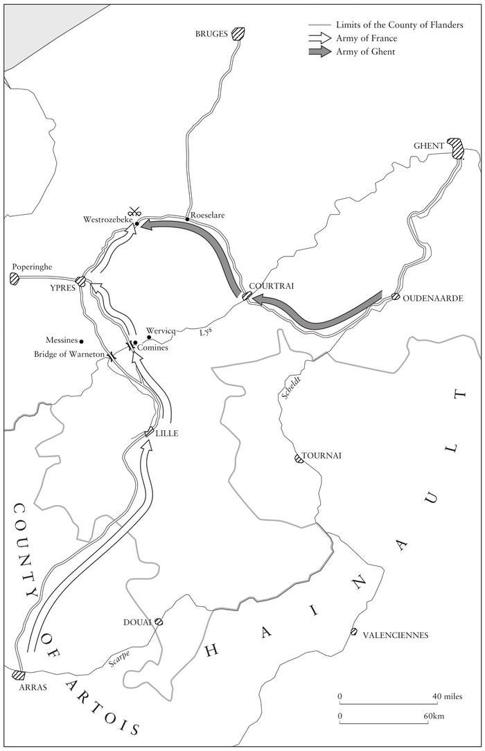
17 The Roosebeke campaign, November 1382
The Flemings had believed Van Artevelde’s claims that the French army could be held south of the Lys. As the news arrived of the defeat at Comines panic spread through the villages and towns of western Flanders. The first reports were quickly followed by advance detachments of the French army, which fanned out across the country, fired by anger against people whom they had learned to hate as anglophiles, Urbanists and revolutionaries. The towns sent delegations before the King bearing the keys of their gates. Everywhere the inhabitants declared their French allegiance with white crosses sown onto their clothes. It was useless. The soldiers looted and burned everywhere they went. Three substantial clothmaking towns, Poperinghe, Wervicq and Messines, were sacked in the first forty-eight hours.
The destruction of Poperinghe, a town of some 4,000 souls, set new standards of brutality. The Duke of Bourbon’s division arrived outside the walls shortly after midnight on 24 November and fell on the night watch, which was guarding the barricades at the main gate. They killed as many as they could catch while the rest fled through the streets waking their fellow citizens. The inhabitants grabbed as much of their plate and cloth as they could carry and made for the other gates while the soldiers spread through the town breaking open and looting houses. Then they lit fires systematically across the town before withdrawing to Ypres with their booty. As they left a fresh horde of soldiers arrived, mostly Flemish noblemen in the service of Louis de Mâle. The flames were already taking hold as the newcomers passed through the town breaking into every house that could still be entered in search of loot. A graphic account was given a few weeks later at a popular shrine in Touraine by a Welsh pilgrim who had fought with the French army. He had arrived at Poperinghe with Bourbon’s men and got trapped by the fires. He described the streets and open spaces, filled with soldiers shouting and panic-stricken townsmen running about looking for a way out of the inferno. The narrator took refuge in the cellar of a burning house. When he emerged the next morning the whole area was a desert of charred wood and cinders with a few of the larger buildings still standing, engulfed by flames. He followed behind a stream of people making their way through the intense heat towards a gate and, passing into the open country outside, threw himself into the river. Emerging from the water on the opposite bank he found himself surrounded by the frightened and angry inhabitants of the town who had passed the night in the meadows watching the destruction of their homes. He fled for his life, pursued by a furious crowd of refugees with pikes and axes.35
Philip Van Artevelde was in Ghent when the news came that the French had crossed the Lys. He left at once to rejoin the army at Oudenaarde. An English herald (the former Chandos Herald, biographer of the Black Prince) succeeded in making his way there from Calais under cover of his immunity, bearing news of the current state of discussions with Richard II’s Council. For the first time Van Artevelde realised that there was no chance of help arriving from England in time. If he had been wise he would now have fought a defensive campaign in the boggy terrain around Oudenaarde, grinding down his enemy over the winter months. But the battle of Beverhoutsveld had swelled Van Artevelde’s confidence and sapped what wisdom he had ever had. He put his host in marching order and advanced west to seek out the French army in the plain north of Ypres. On 20 and 21 November 1382 the Flemings left Courtrai. On the 25th they passed through Roeselare. Towards dusk they halted on a high ridge overlooking the road from Ypres, just south of the village of Westrozebeke, which the French called Roosebeke. The place lay about six miles north of the French encampment. Here they began to dig themselves in. On the following day, 26 November, the French, many of whom had been hurriedly recalled from plundering raids across western Flanders, formed up in battle order and advanced north towards the enemy. A steady drizzle fell as they came to a halt in the sodden plain in front of the Flemish positions. A group of Louis de Mâle’s Flemish-speaking knights passed through the whole length of the Flemish camp in disguise to reconnoitre the enemy’s positions. They reported that there were about 40,000 men in the Flemish host. Apart from about sixty English archers they were untrained townsmen in disorderly formations with rough weapons. They were occupying a strong position on rising ground, their flanks protected by woodland and thick hedges and their front by a line of trenches. But there was no natural protection for the Flemish army from behind. In spite of their superiority of position and their vastly greater numbers Clisson resolved upon a frontal attack on the following morning.
In the early hours of 27 November the French moved slowly forward in three divisions. The vanguard was commanded by the Constable and the Marshals. The largest division was in the centre. It included the King, riding with his three uncles and the lord of Coucy. They were surrounded by a personal bodyguard of 400 men including the Welsh companies of Jack Wyn. The rearguard was taken up by the companies from the western provinces, Artois, Picardy and Normandy. A contemporary described the eerie sound of metal on metal as the links of ten thousand tunics of chain mail shifted against each other and steel helmets clinked against shoulder armour. At the foot of the ridge on which the Flemings were standing the French halted, dismounted and sent their horses to the rear. About a thousand feet now separated the two armies but each was concealed by a thick mist. Arrows and other missiles were hurled aimlessly into the opposing lines. Then, as the King’s standard-bearer unfurled the Oriflamme, the mist suddenly lifted and the bright winter sun lit up the two armies. The first French division pounded up the slope of the ridge to assail the Flemings. Van Artevelde had drawn up his men in a single mass with his strength concentrated in the centre around a banner of St. George. Their ordered formation and strict line discipline were far more impressive than the French had been led to expect. Several batteries of artillery covered the ground by which the French were approaching. A hail of arrows and metal shot struck the first groups to reach the crest. Several prominent knights fell dead. The centre of Clisson’s line was forced back and began to retreat down the slope, but the French men-at-arms were still advancing at the wings. Then the second French division, commanded by the Duke of Bourbon and the lord of Coucy, outflanked the Flemings and fell on their unprotected rear. Many years later the Duke of Bourbon’s standard-bearer recalled seeing the two divisional commanders swing their axes left and right through the dense ranks of the enemy. The King and the Duke of Burgundy had withdrawn from their division to a nearby hillock. They watched as the wings of the French first line enveloped the Flemings and the men of Coucy and Bourbon crushed them from behind.
The French now began a methodical massacre of their enemy. The Flemings panicked. Their line broke and they disintegrated into a terrified, formless mass, fleeing wherever they could find an opening. Enguerrand de Coucy organised companies of men-at-arms in pursuit squads to chase those who had managed to get away from the mêlée. They hacked them to the ground as they fled across the fields. A group of several hundred Flemings tried to rally in a copse of woodland, only to be surrounded and cut down like their fellows. The slaughter continued until nightfall. The battle had lasted less than two hours. As always in medieval battles, most of the casualties were suffered in the final stages and almost all on the defeated side. The macabre count of bodies organised by the heralds after it was over found only about a hundred French casualties but no fewer than 27,500 Flemish dead according to the Florentine Buonaccorso Pitti, who was present at the battle. Nine-tenths of the Flemings’ corpses bore no wounds. They had been crushed to death in the press of the defeated army, drowned as they tried to cross a large pond in their rear or smothered face down in the mud as their companions trampled over them in the bid to get away. About 3,000 Flemings were found wounded but alive on the battlefield. They were finished off with knives or axes as they lay on the ground. A handful of prominent Flemish survivors were taken prisoner and later beheaded on the orders of the Count of Flanders. The body of Philip Van Artevelde was found in a ditch, smothered beneath the corpses of his bodyguards. The body was identified by a wounded Flemish prisoner and brought to the fourteen-year-old King. He had it hanged by the neck from a nearby tree. Later it was delivered up to Louis de Mâle, who sent it to Ypres to be broken on the wheel in the marketplace together with the bodies of two of his lieutenants. Some, even among Louis’s supporters, believed that greater honour was due to men however lowly born who had died in battle.36
The battle of Roosebeke was followed by the collapse of the rebellion throughout Flanders. At Oudenaarde most of the soldiers manning the Flemish siege lines abandoned their posts as soon as the news arrived. A sortie by the garrison dispersed the rest. Courtrai was sacked by the troops of Louis de Mâle on the day of the battle. Bruges, the richest city of Flanders, would have suffered the same fate but for the intervention of the Count. He persuaded the King to receive the town’s submission, but on exacting terms: an indemnity of 120,000 francs, an undertaking to make good the damage done to the Count’s property in the town and a promise to sever all relations with the English. It was Louis’s only act of mercy. There was no amnesty for the friends of Van Artevelde’s regime. In the public places of the towns the train of executions continued for several months as Van Artevelde’s friends and supporters were rounded up and hanged, beheaded, buried alive or broken on the wheel by the officers of Louis de Mâle: 92 victims at Bruges, 55 at Ypres, 28 at Oudenaarde, 16 at Aalst, 32 at Dender monde, 17 at Bergues and so on.37
On 1 December 1382 the King and his principal advisers entered Courtrai while the French army encamped in the fields beyond the walls. They remained there for more than two weeks while desultory negotiations began with the men of Ghent and plans were laid for a siege of the town. Ghent had lost much of its male population in the battle. It had lost all its allies in Flanders. It was vulnerable to the reimposition of the blockade. For several days after the battle the inhabitants did not know what to do. Their first instinct was to submit even on the bleak terms offered by the French. The French leaders and the aristocratic exiles around the Count hated Ghent with a passion which even now can shock those who read the venomous verses penned by Eustache Deschamps against that ‘root of treason … of Cain and Judas born’. Yet, as December wore on, the French threat to Ghent began to seem less credible. It was very cold. The heavy rain flooded the plain around the town and turned the valleys of the Lys and the Scheldt into basins of mud. The horses suffered badly. The captains of the army, many of whom were serving on credit, wanted to go home. Inside the beleaguered town the citizens recovered their self-confidence after the first impact of the disaster. Reports of the executions and confiscations in the rest of Flanders served as a reminder of the fate which awaited the town’s most prominent citizens and stiffened their resolve. Peter Van den Bossche, still suffering from the wounds received at the bridge of Comines, arrived from Bruges in a litter a few days after the battle. He took over the role of Van Artevelde and began to organise the defence.
In about the middle of December 1382 the French King’s Council resolved to abandon the campaign and pay off most of the army. As soon as this news reached Ghent the town’s leaders broke off negotiations. On 18 December the French withdrew from Courtrai to pass Christmas in the more congenial atmosphere of Tournai. Their last act before leaving was to take down the spurs and armour pieces stripped from the bodies of French knights killed at the battle of Courtrai, eighty years before, which were still hanging in the church of Notre-Dame. This famous battle, one of the most humiliating defeats suffered by French arms in the middle ages, had achieved a symbolic importance in the minds of both sides. Now it was avenged. As the King and his entourage departed, the troops entered through the newly demolished gateways and completed the devastation begun by the Count of Flanders’s men three weeks before. The town was systematically pillaged. Those of the inhabitants who had not managed to hide or flee were murdered in the streets and houses. Most of the built-up area was left in flames.38
Ghent fought on for nearly three years after the battle of Roosebeke but it fought alone. Politically the French victory was complete. French sovereignty over Flanders became a reality for the first time in more than a century. The Count, although nominally restored to his former authority, withdrew to the francophone castleries of the south. In Flandre flamengeante power was shared between his officers and the ministers of the King of France. The terms of Bruges’s submission, which served as the model for those granted to other towns, provided that the Brugeois would ‘acknowledge the King of France as their sovereign and obey him and his lieutenants, bailiffs, officers and sergeants … in the same way as the subjects of other peers of France are bound to do.’ The appellate jurisdiction of the Parlement of Paris in Flanders, which had been a dead letter for most of the fourteenth century, was restored. The French took control of most of the major garrisons. They appointed their own captains at Bruges and its two outports of Sluys and Damme. Aardenburg, then a seaport on the broad estuary of the River Zwyn, received a garrison of 200 Bretons. Courtrai was placed under the command of a protégé of the Duke of Burgundy. Ypres and Gravelines became part of the military command of the lord of Sempy and were incorporated in the ring of French fortresses around Calais.39
One of the first acts of the French government after its victory was to extend the trade embargo against England into Flanders where it had never previously been applied. All dealings with the English were forbidden. The decision, followed shortly by the withdrawal of the merchants of the Hanseatic ports, was profoundly damaging to the Flemish cloth industry. It was a commercial disaster for Bruges, which had become the cross-roads of north European trade. The flourishing English commercial community in Flanders was destroyed overnight. John Salomon, the doyen of the English merchants at Bruges, who had lived there for a quarter of a century and served as the English government’s shipbroker and paymaster in Flanders, loaded all his goods and money into ships at Sluys and fled to London as the French entered the town. Others, who moved less fast, lost all their stock and property as English assets were confiscated by the Crown and bestowed on the Constable of France. At least four Englishmen in Bruges were executed as supporters of the regime of Ghent. With the Calais staple cut off from Flanders and all the ports of the county in French hands, the wool trade between England and the Low Countries virtually ceased until, in the spring, the English managed to establish an informal staple port for their exports at Middelburg in Zeeland. This enabled the trade to be carried on via Antwerp. But volumes were well down on previous years and prices were low.40
The French occupation of Flanders, following on the submission of the Duke of Brittany the year before, was a major strategic reverse for England. It brought all the maritime provinces of France north of the Gironde under effective French control for the first time in nearly half a century. It put an end to an alliance which had been one of the sheet-anchors of English policy since the outset of the war. It also touched the English population more closely than any of the successive misfortunes of recent years. The Flemish towns had been not only allies but major markets for English exports and shipping and banking centres of European importance. Perhaps no other event so potently symbolised the new international alignment of Flanders than its nominal conversion to the cause of the Avignon Pope. Clement VII had every reason to shower largesse on the messenger who brought him the first report of the battle. Charles VI gave the inhabitants of Bruges ‘five or six days to think about it’ before submitting to his command that they recognise Clement VII. The men of Ypres were told by the King’s spokesman that it was ‘proper for them to think as the King thought’ on such a matter. The rest of Flanders was given until Easter to declare themselves for a cause which had become one of the main tools of France’s foreign policy and the badge of its system of alliances.41
*
The battle of Roosebeke proved to be an equally fateful moment for France. The defeat of Ghent was a severe set-back to radical politicians in the French towns, who had emerged as the chief internal enemies of the monarchy. They had been counting on a French defeat in Flanders in order to pursue their campaign against war taxation. The outcome of the battle dashed their hopes and enabled the King’s ministers to avenge all the humiliations of the past two years. About a third of the army was retained about the King after the rest had been disbanded. They accompanied him south across the plain of Picardy, making for Paris.
On 11 January 1383 Charles VI and his uncles appeared outside the capital at the Porte Saint-Denis with about 2,000 soldiers wearing full body armour, arrayed in divisions as if for battle. The leading citizens had gathered outside the gate to receive them as tradition demanded. They were curtly ordered to return to their homes. The troops threw aside the chains and barriers across the gateway and marched in with drawn swords, led by the Constable, the Admiral and the two Marshals. Detachments occupied the principal buildings, public places and road crossings. This was not an operation of war. It was a political demonstration, calculated to overawe the inhabitants of France’s most intensely political city. Troops of soldiers passed through the streets, arresting all those who were thought to have organised or encouraged resistance to the new taxes of the previous year. The principal opposition politicians were taken to the cells of the Châtelet, where they found themselves rubbing shoulders with a mass of small-time agitators and others who had had the misfortune to provoke the grudges of the King’s uncles. The proscriptions extended to malcontents and demagogues, some of whom had last challenged the Crown as long ago as 1358. The Parlement, which had tried to play a moderating role in the arguments, fell under special suspicion. One of its presidents was arrested together with two prominent advocates. One of these was Jean des Marets, advocate to three successive kings of France and councillor of the Duke of Anjou, who had aroused the ire of the Duke of Burgundy by speaking too well for the citizens of Paris during their negotiations with the government.
The executions began on the following day. The first victims were two drapers and a jeweller. They were followed to the scaffold at intervals of a few days by groups of six or eight victims at a time. Jean des Marets was beheaded, in spite of the widespread sympathy which was felt for him at court. According to Froissart he refused to express contrition for his acts, declaring from the scaffold that he had done nothing to deserve his fate. Several prisoners committed suicide in their cells before their time came. Meanwhile the customary rituals of civic humiliation were put in hand. The principal gates of Paris were taken off their hinges and thrown to the ground. A section of wall was demolished by the Porte Saint-Antoine. Nearby, the Bastille was redesigned to resist attack from the city side and provide royal forces with a means of entering the city ‘even against its inhabitants’ will’. The chains which were traditionally piled up at street corners to be stretched across the streets in times of trouble had become a symbol of the Parisians’ possession of their own city. They were confiscated and carried off to Vincennes. Soldiers were billeted on the inhabitants. Every citizen was ordered to surrender his armour and weapons. On 17 January 1383 the King entered the great hall of the palace on the island to announce the suppression of most of the civic institutions of the capital: the offices of the Provost of the Merchants and the échevins were abolished and their functions transferred to the King’s Provost. The masters of the city guilds and thequarteniers, cinquanteniers and dixeniers who commanded the citizen militia were dismissed. The activities of the religious confraternities, pillars of the capital’s communal life, were indefinitely suspended. Heavy fines were levied on prominent citizens, assessed at a level designed to pay the outstanding accounts of the captains who had fought in Flanders.42
The object of the repression was not just revenge, welcome as that was to the Duke of Burgundy who had personally endured the pretensions of the Parisians in the spring of 1382. The government was determined to make taxation a royal prerogative, unfettered by any requirement of consent. A majority of the royal Council had apparently objected to this policy but the Duke of Burgundy and his aristocratic allies overruled them. It was the principal theme of the tremendous oration listing the sins of the Parisians which was delivered by the Chancellor, Pierre d’Orgemont, on 1 March from the marble steps of the palace before a great crowd of citizens, one from every household of the city. The prime count in the charge against them was that they had refused to consent to the taxes required for the defence of the realm. Their refusal was now labelled treason. It would have been difficult to devise a more radical or explicit repudiation of the traditional consensual basis for royal taxation. The Chancellor’s recitation was followed by a characteristic piece of political theatre, in which the royal princes fell to their knees to beg the child King to pardon his erring subjects. Charles pardoned them. But the Chancellor had made the point which mattered and the King’s officers were already acting on it. On 20 January 1383 the aides and the gabelle had been reimposed in Paris by royal proclamation at rates even higher than those previously in force.43
Proceedings very similar to those in Paris were conducted by special commissioners and local baillis in most of the major cities of the north. At Rouen the King’s officers arrived in March with a military escort commanded by the Admiral of France. Three hundred citizens were pulled out of their houses and thrown into prison. Those who were thought to have organised resistance to the taxes were summarily executed. At Amiens an oligarchy of the richest citizens was given control of the municipal institutions. Proscriptions and executions were ordered at Reims, Châlons, Troyes and Sens, all places where riots had attended the government’s attempts to collect war taxes in 1381 and 1382. The King himself presided over the punishment of Orléans for offences against the Crown which went back to the civil wars of the 1350s. All of these visitations were followed by ritual pardons, heavy fines, forced loans and the reinstatement of the aides by royal proclamation. Languedoc did not have to wait long before meeting the same fate. There was no invasion of the south and no campaign of executions there, but the Estates of Languedoc were summoned to Lyon in July 1383 to hear the King’s commissioners announce the reimposition of the aides and the suppression of all the self-governing consulates of the towns. Early in the following year they recovered their consulates but were made to submit to a fine of 800,000 francs for acts of rebellion going back to the tax strikes of 1378. This enormous sum, equivalent to a hearth tax of six francs a year on every taxable household for the next four years, represented a crushing burden, made worse by the fact that its collection was concentrated in a handful of cities such as Toulouse and Carcassonne which were thought to bear most of the blame for recent opposition to royal policies. The principle of taxation by royal command, which had never quite been acknowledged under Charles V, was now overtly established throughout the realm. Meetings of the Estates-General of Languedoc became less frequent and more compliant. Those of Languedoil would not meet at all until 1413 and only infrequently thereafter.44
*
The Earl of Cambridge arrived in England with the remnants of his army a few days before the battle of Roosebeke. The men returned in Castilian ships, in poor health, without mounts or equipment, bringing with them their tales of mutiny and betrayal. They were also sadly reduced in numbers. Forty-one large ships had carried them to Portugal but only twelve were required to bring them back. John of Gaunt had been counting on Cambridge to cling to his foothold in Portugal while he planned his next move against Castile. He was furious. He washed his hands of the returning army and refused to meet their outstanding wage bills.
Even now the Duke of Lancaster’s cup of bitterness was not yet full. The treaty of Badajoz proved to be only the first stage of a closer alliance between Portugal and Castile. During the winter of 1382—3 Fernando’s health continued to deteriorate. He ceased to take even an intermittent part in the direction of his government, which was conducted in his name by Leonora Teles with the aid of a small coterie of close advisers: her lover, Juan Fernández Andeiro; her brother, João Afonso Telo, Admiral of Portugal; Gonçalo Vasques de Azevedo, the King’s confidant and now the Queen’s; the Constable, Alvaro Perez de Castro, who had helped him to negotiate the treaty of Badajoz; and Martin, Bishop of Lisbon, the de facto leader of the Clementist party in Portugal. Several of these men were in fact Castilians: ecclesiastics like the Bishop of Lisbon or old emperogilados like Andeiro and Castro who had supported King Pedro’s cause in Castile until his death and then made new careers as exiles at the court of Portugal. All of them owed their positions to the Queen’s patronage. All were desperate to find a way of holding on to power after Don Fernando’s death.
In October 1382 they hit upon a radical solution. The Queen of Castile had recently died. Their plan was that John of Trastámara should himself marry Princess Beatrice in place of his infant son. John, they reasoned, was far more likely to apply the resources of his realm in defending Beatrice’s interests if he were her husband than if he were only her prospective father-in-law. In particular he could be expected to restrain the ambitions of Inez de Castro’s sons, both of whom were living in his realm. Moreover, since John had two sons by his first marriage, his descendants by his two marriages would found distinct dynasties ruling in Castile and Portugal. In November 1382 Juan Fernández Andeiro led a magnificent embassy to Castile to present the Queen’s proposals to John of Trastámara. Wind of these events probably reached England early in 1383, when yet another emissary of Fernando’s arrived at Westminster to wring his hands before the King’s ministers. He was shortly followed by Florimond, lord of Lesparre, a Gascon prisoner of war in Castile, bearing proposals from John of Trastámara himself for a peace conference at which the Lancastrian claims to his kingdom might be bought out.45
*
On 21 December 1382 Bishop Despenser formally took the cross at St. Paul’s Cross in London. Shortly afterwards his commissioners began to tour the provinces, preaching and granting absolution to all who signed up to fight in his army or contributed to the cost. A national sales campaign was launched, supported by meretricious marketing and mendacious claims for the indulgences which went well beyond anything authorised by the Pope’s bulls. The number of crusade preachers was swollen by imposters and confidence tricksters who forged their commissions and pocketed their receipts. The results were spectacular. A horde of men came forward, gentlemen, monks and priests, ruffians, peasants, apprentices and tradesmen, rich and poor, all buying paradise. According to Froissart, however, professional men-at-arms held back. ‘Soldiers never go to war without money up front,’ he observed; ‘they cannot live on pardons.’ But the Bishop’s chests were filled with coin, gold and silver, and jewellery contributed by the faithful. He could afford to pay them.46
The King’s ministers, as ever responding to events as they happened, were in a quandary. They were vitally affected by the fortunes of the Flemish rebels and by English mercantile interests in the Low Countries. Moreover, with the demise of the ‘path of Portugal’ the ‘path of Flanders’ was the only aggressive strategy open to them. But in the Council’s view the Bishop of Norwich was the wrong man for the job. They had serious misgivings about the sort of amateur soldiers which he was likely to recruit and about his own suitability as a commander. They were also concerned about allowing him to roam over the continent free of any direct political control by the King’s officers. So, on about 12 December 1382, a week after authorising the Bishop’s recruitment campaign, the Council tried to upstage him. They announced that the King would raise his own army and lead it to Flanders in person. The object would be to relieve the blockade of Ghent and expel the French from Flanders. The government’s plan must have been to absorb the crusaders into the ranks of the royal army. They probably hoped to appropriate the Bishop’s funds as well. This scheme was endorsed by the lay and ecclesiastical magnates and a great body of military men at a Great Council which met in January 1383. A knight was sent to Ghent with a message that help would soon be on its way. A committee of representatives of Ghent and exiles from Bruges and Ypres established itself in London to support the enterprise. Francis Ackerman, one of Ghent’s three captains, had appointed himself ‘Admiral of Flanders’. He arrived in England at the beginning of January with a squadron of nine ships raised in the harbours of the Vier Ambachten, and put them at the disposal of the English government. Meanwhile, Peter Van den Bossche in Ghent was planning to seize a port in western Flanders by which contact could be maintained with England and troops and supplies brought to the city. On 26 January 1383 a large force of citizens and mercenaries of Ghent fell on Aardenburg, then an important harbour town in the estuary of the Zwyn opposite Sluys. They took it by assault three days later, massacring its French garrison.47
The Council’s plan to make the invasion of Flanders a royal enterprise had much to be said for it, but it foundered on two obstacles. The first was the opposition of the King. Richard did not share Charles VI’s enthusiasm for war and was reluctant to go. Without him there was no one who could take the command out of Despenser’s hands as of right. The second problem was money. The single tenth and fifteenth voted by the Commons in the autumn was not enough to support the army of 6,000 men which the Council had in mind. The Great Council advised that without a fresh Parliamentary grant it could not be done. Yet the chances of another grant seemed remote given the ill grace with which the last one had been approved. And so it proved.
When Parliament met at Westminster on 23 February 1383 competing proposals were put before them by the Council and the Bishop of Norwich. The Council tried to drum up support for a royal expedition funded by fresh taxation. The Bishop offered to lead his own army into Flanders, financing the campaign from the funds raised by the sale of indulgences together with the proceeds of the taxes voted in the previous Parliament. In its final form Despenser’s proposal was to raise an army of 5,000 men and to keep them in the field for a full year. As soon as the subsidy was paid over to him an advance guard of 2,000 men would leave to relieve the blockade of Ghent. The rest would follow in the spring to occupy the rest of Flanders. The Bishop’s pretensions caused intense irritation among the Lords, most of whom supported the Council’s proposals. Despenser was testily cross-examined by his fellow peers. They declared that if France were to be conquered by English arms it should be conquered for the King, not the Church. They thought that it was asking for trouble for a bishop with limited military experience to exercise a major command. If the crusade went ahead Despenser should at least be made to delegate his military functions to a suitable lay commander. The Lords were the King’s traditional advisers on such matters but their views were rejected root and branch in the Commons. They felt as strongly as anyone about the French occupation of Flanders but they thought that if the Bishop of Norwich was willing to recover Flanders without asking for further funds he should be allowed to do so. Finance, however, was not the only factor in their minds. A vocal faction in the Commons, led by the Archbishop of Canterbury’s brothers Philip and Peter Courtenay and supported from the streets by the mobs of the city, was openly contemptuous of the military skills of the King’s uncles and doubted the Council’s good faith. They suspected (probably rightly) that the royal army which the Council was proposing was really intended to serve the ambitions of John of Gaunt in Castile. They were determined to have nothing to do with it. Not content with commending Bishop Despenser’s enterprise, the Commons demanded that the King and all three of his uncles should remain in England to watch the border with Scotland. For good measure they added that in their view the Castilian King’s offer of negotiations should be accepted. John of Gaunt became increasingly ill-tempered as the session continued and eventually walked out in disgust.48
Without the funds to finance its own plans the Council was obliged to submit to the Commons’ will. A week after Parliament closed the Exchequer paid over nearly £30,000 to the Bishop’s commissioners from the proceeds of the last Parliamentary subsidy. The rest was paid in stages over the following weeks. Despenser even managed to escape any real supervision over his military command. With obvious reluctance he had told the Lords that he would accept a royal lieutenant with ultimate authority over all military matters. He would put forward four names, he said, from which the King might choose one, but in the document ultimately agreed there was a proviso that if he could not reach agreement with the nominated lieutenant then ‘the King will be content in such a case for the said Bishop to have the governance and disposition of the army … in all respects.’ Despenser had no intention of making any agreement which would enable someone else to supplant him and in the event no royal lieutenant was ever appointed. Instead Despenser nominated four men as his lay captains: Sir Hugh Calveley, Sir William Farringdon, Sir William Elmham and Sir Thomas Trivet. They were later joined by Sir Robert Knolles, who had lost none of his appetite for fighting although he must by now have been in his sixties. These were all experienced professional soldiers whose presence in the army must have done something to inspire confidence among critics of the enterprise. But none of them had the rank to dominate Despenser.49
On 2 April 1383 the final act of Portugal’s reconciliation with Castile was played out at the royal manor at Salvaterra de Magos on the left bank of the Tagus. The marriage treaty between the two countries was sealed in the hall as Fernando languished, ill and unseen in another part of the building. It was a remarkable document. The Princess Beatrice was to be married to John of Trastámara as soon as the ceremonies could be organised. When Fernando died they would reign jointly as King and Queen of Portugal. The real beneficiaries of the treaty were to be the Queen and her lover. Under the terms of the agreement neither John nor his child-bride was to have any control over the government, which was to be carried on by Leonora until they had an heir who survived to the age of fourteen. The most elaborate provisions were included to secure the autonomy of Portugal and the independence of its institutions. Leonora’s chief Portuguese rival, the Infante João, openly declared that the marriage could not have been approved by Fernando. He also thought that it would be profoundly unpopular in the cities of Portugal. He was probably right on both counts. But Don João was completely dependent on John of Trastámara and could do nothing. He was rewarded for his candour by being lured to the royal castle of Ciudad Rodrigo, where he was arrested and his movements restricted on the orders of the King. On 17 May 1383 Beatrice was married to the Castilian King in the cathedral of Badajoz amid extravagant celebrations which cost so much that John was obliged to anticipate half a year’s taxation to pay for them. As for Fernando, he declined to attend. He mustered just enough energy to send a personal emissary to carry yet more apologies to John of Gaunt in England.50
On 17 March 1383 messengers were despatched to all the county towns of England summoning the crusaders to make for the coast at Sandwich. Exactly two months later about 8,000 men had reached Calais and another 3,000 or so were gathering by the Kent and Essex coasts. It was a sign of the enthusiasm which had driven recruitment in England that most of these men were volunteers serving without pay and that archers greatly outnumbered men-at-arms, perhaps by as much as three to one. On 16 May 1383 the Bishop of Norwich hurriedly crossed the Channel to open the campaign, fearing, it was said, that if he hung around for too long the Council would relieve him of his command.51
Despenser’s strategy was largely determined by the agents of the Flemish rebels. A large Flemish mission had arrived in England at the beginning of March, thirteen merchants of Ghent and various exiles from Bruges. Seven of them stayed in London to advise the Council while the other six accompanied the Bishop on his adventure. Despenser’s first priority was to break the French blockade around Ghent. So, on 19 May 1383, without waiting for the rest of the army to arrive, he led his troops out of Calais and along the coast road to Gravelines. It was perhaps unfortunate for Despenser that his enterprise began with a series of spectacular successes, for hubris was a large part of the explanation for the disasters which followed. On 20 May Bourbourg, a major fortress guarding the road to Bruges beyond the River Aa, surrendered without striking a blow. Gravelines was defended by its inhabitants, supported by a large Breton garrison, but it fell to the first assault. In the harbour the crusaders captured seven large cargo ships as well as a large number of fishing smacks. So many horses were taken that they were going for a shilling apiece. Dunkirk, the next town along the coast, was invested by land and sea but surrendered rather than suffer the same fate. The army entered the town, probably early on the morning of 25 May.
The French King’s ministers had had at least six months’ warning of what was afoot but they do not seem to have taken Despenser’s crusade seriously until the last moment and had taken no steps to recruit an army. The defence was left to local forces. They were organised by one of Louis de Mâle’s bastard sons, Louis de Hase, and by the lord of Dixmude, who was the principal territorial magnate of south-western Flanders. These two men assembled an army which was by all accounts substantially larger than Despenser’s. But it was of very uneven quality. The core of their force consisted of aristocratic retainers of the Count of Flanders and about 1,900 French garrison troops stationed in Flanders. The rest were raw local levies from the franc of Bruges and the nearby towns of Ypres, Furnes and Bergues. At least one of its captains was secretly in touch with Despenser. Even those who were loyal had doubts about their men. Many of them were Urbanists and others had more sympathy for the English than for their new French masters.
On 25 May 1383 the Bastard of Flanders advanced across the flat scrubland south of Dunkirk a few hours after the English had occupied the town. Despenser and Calveley marched their men out of the gates and drew them up in battle order beneath the walls. A banner with the papal crossed keys was carried aloft in front of them and another with Despenser’s family arms. A herald was sent across to parley with the approaching horde and perhaps persuade them to come over to their side. But he was seized and killed by a group of Flemish knights before he reached the enemy line, a rare breach of the convention which protected heralds from violence in wartime. Watching this incident from their lines the English at once attacked. The Flemings came forward in a disorderly mass to meet them. Few of them reached the English lines. They were cut down in thousands by dense volleys of arrows from the English archers. The urban troops in the Flemish ranks fled. The professional soldiers behind them tried to hold their ground but they were by now heavily outnumbered. Their line broke and they were overwhelmed. A violent thunderstorm broke out as the English finished off the survivors. The English claimed to have taken ten thousand lives. Priests, monks and friars, the chronicler Thomas Walsingham recorded with satisfaction, inflicted more casualties than any other group. Within a few days most of the walled places of the region had submitted, including the fortress of Cassell and the towns of Nieuport, Poperinghe, and Bergues. Meanwhile Sir Thomas Trivet arrived from England with the rest of Despenser’s professional troops. In Paris Charles VI’s ministers were appalled. The whole work of Roosebeke was being undone before their eyes. On 27 May, two days after the battle of Dunkirk, they ordered the recruitment of a fresh army in northern France, the second to invade Flanders in a year.52
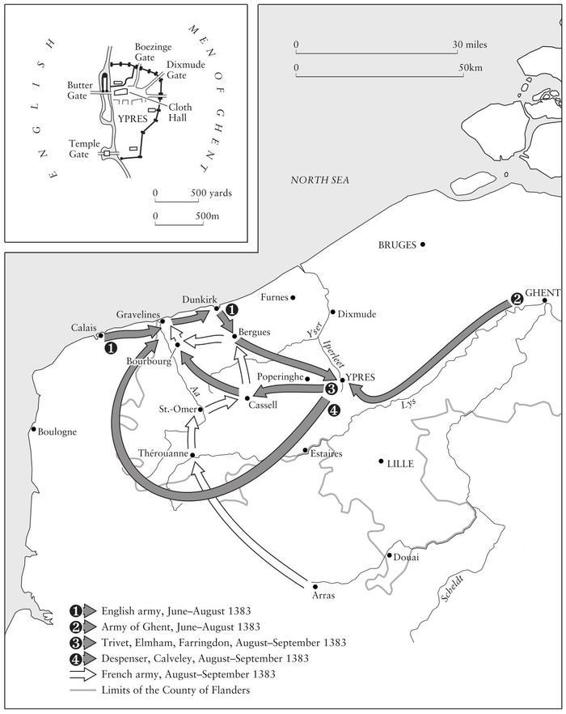
18 The Norwich crusade, May—September 1383
Early on the morning of 9 June 1383 the English army appeared outside the western gates of Ypres. The decision to attack this large and populous city had been pressed on Despenser by the representatives of Ghent and Peter Van den Bossche. Peter arrived almost simultaneously from the east with a large force of his own to support the Bishop’s operations. Failure would one day make the decision controversial but at the time it was supported by all Despenser’s English advisers for good political and strategic reasons. Ypres was the major cross-roads of eastern Flanders. Its occupation by an English army would not only have opened up road communications between Ghent and the English base at Calais but would have barred the most convenient route for a French army entering Flanders. The English tried to rush the gates. But the men of Ypres had been expecting an attack for some days and they were ready. The great bell of the Cloth Hall rang out the alarm as soon as the English were seen approaching. The first English company to reach the Butter Gate was greeted with a cannonade. Further south an assault was launched in force against the Temple Gate, which was beaten off. On the following day the English launched simultaneous assaults against several gates, this time with the support of the contingents of Ghent. They succeeded no better. On 11 June Despenser and Van den Bossche disposed their forces around the town and settled down for a long siege.53
Ypres was a substantial town defended by a continuous circuit of walls and towers and two concentric lines of ditches. The Bishop had been told that the garrison was weak and its stores low. He probably also expected some support from the town’s largely Urbanist population and its powerful guilds of cloth-workers. The events of the previous year, however, had shaken support for Ghent and England. The inhabitants of the surrounding country had been brought into the town with all the food and animals that they could bring. Known sympathisers of Ghent had been rounded up and driven out. Huge stocks of grain had been accumulated and a strict regime of price control instituted. The English arrived to find the ditches flooded. The town’s extensive suburbs, where much of its industry was concentrated, were partially demolished, a sacrifice which would finally ruin its once-great cloth trade. In the town, gaps in the defences had been hurriedly patched up. Carpenters laboured to reinforce the ramparts with projecting timber structures from which rocks could be hurled down on assault parties. Cannon, firing pebbles or grapeshot, were sited on top of all the principal gateways. The defence was directed by a Flemish nobleman, Peter Van der Zype, with a company recruited largely from Flemish retainers of the Duke of Burgundy. But the backbone of the resistance was the local patriciate, the nobility of the surrounding region and the population of the town, who had been armed and drilled for days before the English arrived. They manned their stations with fierce determination.54
Although the bulk of the besieging army had crossed the Channel with Despenser it was the men of Ghent who took the leading role in the siege. They were far better equipped than their allies and had more experience of conducting siege operations in the difficult, marshy terrain of eastern Flanders. The few buildings which were still standing outside Ypres were fortified and armed with artillery. Trenches were dug around the town and reinforced by improvised timber forts at regular intervals. Mines were dug towards the walls. Immense stone-throwers were constructed in front of the main gateways, which progressively reduced them to rubble. Teams of water engineers laboured to divert the local streams away from the town and drain the ditches protecting the walls. Labour and materials were requisitioned across western Flanders. Great timber pontoons were constructed to enable assault parties to reach the base of the walls. The defenders did their best to obstruct these efforts. Sortie parties set fire to the enemy’s siege works. The mines were captured and destroyed. Repair crews worked through the night to make good the damage before dawn brought a renewed barrage of rocks crashing into the walls and gates. But the advance of the besiegers seemed inexorable. Within two weeks the flow of supplies into the town had been cut off. Both rings of ditches had been drained and partially filled with timber and rubble. The main fighting occurred in the northern sector around the Dixmude and the Boezinge gates. At dawn on 24 June, midsummer day, seven pontoons were dragged into place between the two gates. The English swarmed across them and tried to fight their way over the walls with scaling ladders. They were met with a barrage of flanking fire from cannon mounted on both gateways and suffered terrible casualties before the retreat was eventually sounded. It was the first recorded occasion that these weapons had played a decisive part in the defence of a walled stronghold. A few days after this reverse the English tried again. The assault parties approached the walls from north and south. This time they were protected from the rain of missiles and grapeshot by four huge timber shelters on wheels. But they had not reached the base of the walls before sorties from the town attacked their shelters and forced them to retreat. Five hundred men were lost in this attack.55
The failure of these assaults proved to be the turning point of the campaign. The besiegers had suffered heavy casualties on the walls. Over the following weeks many more succumbed to disease as dysentery took hold in their lines, where at least 20,000 men were concentrated in the usual insanitary conditions. Supplies were rapidly exhausted. To make matters worse reports of the easy victories and golden spoils in the first week of the campaign had tempted large numbers of fresh men from England to take the cross and join the army. They had heard reports that Ypres was about to fall and wanted to be in on the sack. The great majority of these men were useless mouths: London servants and apprentices, roughs and criminals, absconding clergymen, men with no experience of war. Many of them arrived without weapons. They brought no more food than they needed for their passage. Despenser was quite unable to manage the situation. Morale collapsed. Sharp words were exchanged between the Bishop and his men and sharper ones were muttered in corners. Quarrels broke out about the distribution of booty. The Bishop was reported to have appropriated three barrels of gold for his own use. Sir Thomas Trivet, one of the few captains who succeeded in making money during the siege, had almost certainly got it by long-range raiding into northern France but was widely believed to have been trafficking with the defenders. The new arrivals from England, intensely disappointed by what they found in Despenser’s camp, deserted in their thousands. Many of the original troops made off with them. Damaging stories began to circulate in England about Despenser’s incompetence and the divisions among his men.56
Meanwhile the English army’s position was becoming increasingly insecure as the French pressed forward with their own plans to reinvade Flanders. At the end of June, after a month of intensive recruitment, the French government proclaimed the arrière-ban. The troops were ordered to assemble at local mustering centres across France in the last week of July. At Westminster these developments were followed with dismay, mingled with a certain satisfaction among those who had always regarded the Bishop of Norwich as an interfering amateur. At about the end of June the Council made another attempt to wrest control of the army from him. They offered to send out the Earl of Arundel as a royal lieutenant and invited Despenser to transfer the command to him. But Despenser, ever jealous of his authority and distrustful of his captains, sent an evasive answer which was interpreted as a refusal. Arundel remained in England.57
In the last week of July 1383 the Bishop of Norwich, conscious of the progress of French preparations, turned to negotiation. He declared a local truce and sent a messenger into the town to offer terms to the defenders. Their lives and property would be safe if they surrendered, he said. Otherwise the whole town would be reduced to ashes and its inhabitants killed. ‘Kill your captains! Think of the future!’ Despenser’s Flemish allies yelled across the empty ditches. The delegates of the town came out to the Bishop’s tents to be plied with wine and cherries and treated by turns to flattering speeches and hectoring threats. Inside the walls, conditions were deteriorating. The defenders were exhausted. Their stores were running out. The few streams which still entered the town had become stagnant and foul. The streets stank with sewage. At length a provisional agreement appears to have been reached by which the town agreed to surrender on 20 August unless it was relieved by the King of France before that date. But either the townsmen refused to ratify it or their captains repudiated it. What is clear is that on 30 July 1383 discussions were abruptly broken off. The Bishop raised his arm as the townsmen left him and excommunicated them in the name of the Roman Pope. The provost of the abbey of St. Martin, who was as good an Urbanist as Despenser, responded by appealing to the same Pope against the legate’s acts. As the delegation re-entered the town the Bishop’s banners were being unfurled to show that the truce had ended.58
On 2 August 1383 Charles VI received the Oriflamme from the abbot of Saint-Denis and on the following morning set out for the north, accompanied by the Duke of Burgundy and the troops of his household. An advance guard was sent ahead under the command of the Admiral of France, Jean de Vienne, with 600 men-at-arms and some companies of Genoese crossbowmen to secure the crossings of the Lys. The rest of the army received orders to be at Arras by 22 August. From Avignon Clement VII promised them indulgences to match the pardons distributed by his rival. On the day the King left Paris the English hurled themselves against the walls of Ypres in a final attempt to capture the place before the French arrived. The assault, which had been in preparation for much of the previous month, engaged the whole of the Anglo-Flemish army. Five gateways were attacked at once. The men-at-arms approached with scaling ladders, covered from the rear by dense cohorts of archers and protected from above by wheeled timber shelters. Fire wagons, stuffed with wool and powdered sulphur, were pushed forward against the gates. The defenders, unable to break the shelters with stones, sallied from the gates to attack the fire wagons with lances, axes and swords. The crews of the wagons were driven back in hand-to-hand fighting and their loads tipped into the ditches. Terrible casualties were once more inflicted by the cannon mounted on the gates, which fired co-ordinated barrages of shot into the attackers’ lines. Repeatedly forced back from the gates, the English and their Flemish allies renewed their attacks on six successive days. Towards the end they succeeded in getting a great wheeled siege tower, fitted with a trebuchet and heavy iron bombard known as the Canterbury Gun, up against one of the gate towers. But they were unable to fight their way over the walls. On 8 August, after several hours of desperate fighting, the final assault was called off.59
A council of war was held in the Bishop’s tents on the following morning. It was an acrimonious occasion. The English had borne the brunt of the assaults and their losses had been heavy. Jean de Vienne was reported to have reached the Lys, just fifteen miles south, with the advance guard of the French army. The King of France had left Senlis two days before. The captains of Ghent wanted to press the attack on Ypres. They believed that the defenders had reached the limit of their endurance. But the English had had enough. They were determined to abandon the siege. Unfortunately they were unable to agree on an alternative strategy. Bishop Despenser wanted to confront the French King on the Lys. Sir Hugh Calveley had worked out a bold scheme for attacking the van of the French army by night. Peter Van den Bossche refused to participate in this scheme and the three other English captains on the Bishop’s council, Trivet, Elmham and Farringdon, all advised against it. Their main concern was that their line of retreat to the coast might be cut off by the advancing French army. They regarded Calveley’s plan as suicidal. In the end everyone stuck to his own view. On the following morning, 10 August, the army broke up in disorder. The stores were burned and the siege works abandoned, together with the artillery and much of the booty. Peter Van den Bossche left in disgust for Ghent, taking most of the Flemish contingent with him. The volunteers who had enlisted for the sake of the crusading indulgences were dismissed to make their way back to England as best they could. Trivet, Elmham and Farringdon withdrew west with the bulk of the professional companies and established their headquarters in the fortress of Bourbourg, south of Gravelines. As for Bishop Despenser, he marched south to the Lys, accompanied by Calveley, the rest of the Flemings and the handful of English companies whom he could persuade to go with him. They hovered about Jean de Vienne’s force, daring them to attack. Then they put away their standards and retreated to the coast.60
In England the King’s uncles, Lancaster and Buckingham, were alarmed for the fate of the army and the defence of Calais. They were determined to take over the enterprise from the hapless Bishop of Norwich before the latest reverses turned into a rout. Nothing, however, could be done quickly in England in August. The King and his councillors were at their pleasures, scattered across the country. John of Gaunt, who had passed most of the summer on the Scottish border, received the news of Charles VI’s advance at his castle at Pontefract in the Midlands. He summoned his military retinue on his own initiative on 22 August. At Westminster steps were taken to charter merchantmen, the fastest way to get troops across the Channel. On 24 August Gaunt and Buckingham wrote to Richard, who was in Yorkshire, urging him to come south and assume the command of a fresh expeditionary army in person.61
In the plain north of Arras the French army was already gathering for the invasion of Flanders. It was the largest armed force that the French Crown had raised for a generation and more than twice the size of the army which had fought at Roosebeke the year before. A new enthusiasm for royal service had been generated by the victories and loot of 1382. The rates of pay offered for men-at-arms were considerably increased, making military service a paying proposition for the first time in many years for men who were neither great noblemen nor full-time soldiers. According to the Marshals’ reckoning 16,000 men-at-arms appeared at the musters in addition to some 6,000 infantry and archers, enough, as a contemporary remarked, to subdue ‘many barbaric nations’. Allowing for pages and varlets the army’s total strength must have been well over 30,000. They came from every part of France and the francophone territories of the Empire. The fog of smoke from so many camp fires and the clutter of carts and animals filling the plain made it impossible for the young King to review his men as he had planned. The banners of seven dukes and twenty-seven counts could be seen floating above the mass of men. In a great show of unity the King was joined by all three of his uncles who were in France. Even John de Montfort was there, making his first appearance in a French army after a lifetime in the service of England.62
On 25 August 1383 the whole host of France moved slowly out of its encampments and marched north. A week later, on 1 September, the van of the army reached the River Aa in a confused mass of men, horses and baggage carts, shrouded by a thick autumnal mist. They began to cross into Flanders. The English had patched up their quarrels well enough to attempt some sort of defence. They created a line of improvised forts in churches, castles and monasteries on the north side of the Aa to hold up the French advance. They drew up the rest of their forces in battle order a short distance away on the southern slopes of Mont Cassell, the steep hill rising nearly 600 feet above the coastal plain of Flanders, which served as the anchor of the region’s defence from classical times to the First World War. But their courage failed them when they saw the strength of the enemy army. They set fire to the town of Cassell and, fighting off the townsmen who tried to stop them, they withdrew under cover of night towards the coast. The French rapidly mopped up the isolated English garrisons of the Aa valley and advanced north in pursuit, heading for Dunkirk. Sir Robert Knolles with 500 English and about 1,000 Flemish troops fought a vigorous rearguard action while his companions hurriedly prepared to defend the two principal strongholds of the district, Bourbourg and Gravelines. On 7 September the French King arrived outside Bergues, then a substantial river port handling much of the wool trade of western Flanders. Knolles toyed with the idea of defending this place but, finding himself surrounded on three sides, he set fire to the timber houses of the town and ordered his men to make off. As they struggled, laden with booty, out of the gates the French came over the walls. Most of Knolles’s Flemish auxiliaries and much of the population of the town were either burned to death or cut down in the streets. The fall of Bergues opened up the road to Dunkirk. The French occupied the port without resistance on the following day, thus enabling supplies for their army to be brought in by sea.63
In England the fifteen-year-old King reacted to the stream of dismal tidings from Flanders in the erratic way that would soon become familiar to his subjects. Having done nothing in response to his uncles’ messages for more than two weeks he panicked as the unfolding disasters were reported to him. When the news of the French occupation of Dunkirk was brought to him at his dinner table in the town of Daventry, near Northampton, he kicked away the table, called for his horse and rode post-haste to London to meet his Council. At St. Albans the Abbot was woken in the middle of the night to find him a change of mount, ‘as if he planned to slay the King of France that very night’ said the waspish Thomas Walsingham, who witnessed the scene. On the following day, 12 September 1383, the King of France encamped with his host in the meadows outside Bourbourg, where most of the English companies had taken refuge. Richard II, having recovered from his ride, was presiding over an emergency session of the Council at Westminster. It was a difficult meeting. Richard’s ardour had cooled overnight. The plans of his uncles to send him to Flanders encountered resistance among his other advisers. There was no time to recruit an army big enough to confront the host of Charles VI with credit. It would be wrong, they said, to expose the King to ridicule by sending him overseas with anything less. Instead it was decided to reinforce the garrison of Calais and its outlying forts and to send Lancaster and Buckingham to rescue the Bishop of Norwich with whatever troops could be found in time. A messenger was sent over the Channel with letters urging Despenser to hold out until they could arrive. Meanwhile the two royal dukes established their headquarters on the Isle of Thanet in north Kent, while their marshals mustered their men and the London merchant John Philpot struggled to find ships to carry them. But they had not anticipated the speed with which the Bishop of Norwich’s enterprise would collapse.64
Bourbourg was a small town with powerful walls and a water-filled moat. Its compactness made it comparatively easy for even a small garrison to defend, let alone the force of some 3,000 men which was crammed into it in September 1383. The captain of the town was an officer of the Calais garrison called William Hoo but real command was exercised by the triumvirate of knights, Trivet, Elmham and Farringdon, who had served on Despenser’s council before abandoning him at Ypres. They returned a curt answer to the summons to surrender which was addressed to them on the first day by the herald of the King of France. The assault came that evening. It began with a heavy artillery bombardment. Volleys of arrows tipped with burning pitch set fire to the thatched roofs of the houses in the town. The French advanced to the edge of the ditch dragging timber and stones to construct a makeshift causeway to the foot of the walls. These men suffered terrible casualties from the archers on the walls above. As darkness began to fall the Bretons of John de Montfort’s retinue came forward with their scaling ladders. They reached the summit of the walls, only to be thrown back in bloody hand-to-hand fighting. The Duke of Brittany’s banner was wrested from his standard-bearer at the edge of the battlements and taken into the town. As the Bretons fell back others took their place only to be forced back in their turn. By the time the attack was called off some 500 French soldiers lay dead in the ditch.
On the following morning John de Montfort advised the leaders of the French army to strike a deal with the garrison. The French captains had no desire to become bogged down in a long siege in the marshes of coastal Flanders at the onset of winter. John for his part did not believe that Bourbourg could be taken by storm. He was also concerned by the threat in the French army’s rear from the troops of Despenser and Calveley in Gravelines, only five miles away. On 14 September 1383 Montfort negotiated a treaty with the garrison. Its terms were extremely favourable to them. It was agreed to proclaim a truce for three days. At the end of that time, on the 17th, the captains of Bourbourg would surrender the place to the French and do their best to bring about the surrender of Gravelines as well. They were to be allowed to take away their booty and even their prisoners, who included many of the more wealthy inhabitants of the town. On top of that, by a secret side agreement the Duke of Brittany paid them a lump sum of 28,000 gold francs (£4,700) for their complaisance.65
After the surrender of Bourbourg most of its garrison made for Calais. They found themselves refused admittance to the town and forced to wait, hungry and exposed, on the beaches for events to determine their fate. Meanwhile their captains repaired to Gravelines in accordance with their agreement with John de Montfort, to urge upon Bishop Despenser the wisdom of surrendering the town. By his own account Despenser was prepared to fight. When the French army appeared before the walls, on 19 September 1383, he defied the French herald’s summons to surrender, declaring that he had acquired the place at much cost in blood and cash and had bound himself to hold it for Pope Urban and King Richard. But his men would not support him. They had lost all interest in continuing the campaign, which they regarded as doomed. They were not prepared to wait for John of Gaunt to cross the Channel. There was also concern about the fate of the men huddled on Calais beach, who would be defenceless if the French turned on them. Shortly the leaders from Bourbourg took the issue out of the Bishop’s hands. A brief truce was negotiated so that Despenser could call on the English government to relieve him, but without waiting for it to expire the captains struck another deal with the Duke of Brittany. They agreed to surrender Gravelines for 10,000 gold francs (£1,700), which was said to be the value of the provisions left in the town. On about 23 September the English demolished the fortifications of Gravelines and marched out of the gates with their gains. The inhabitants, whom the French regarded as traitors, were abandoned to their fate. They were massacred by the Bretons of John de Montfort, who began to sack the town as soon as the English left. Within a few hours much of it had been reduced to ashes. Shortly afterwards Charles VI disbanded his army and turned south.66
The campaign was followed by bitter recriminations on both sides. The leading figures in the French army were profoundly dissatisfied by the lack of any decisive engagement. They believed that the deal struck with the English garrisons of Bourbourg and Gravelines had cheated them of a valuable haul of ransoms. The Florentine merchant Buonaccorso Pitti, who had volunteered to serve with the French army for adventure and loot, spoke for many of these men when he complained that they had left with ‘heavy losses and little honour’. More than one voice accused John de Montfort of colluding with his English friends to let them escape. The accusation, magnified by rumour and malice, was destined to haunt him for years. But the terms were approved by the Duke of Burgundy for sound reasons of policy. Philip was a politician and a diplomat with little interest in military glory. The campaign had been one of the most expensive ever fought by the French Crown, costing well over 2,000,000 livres (£400,000). The treasury was out of cash in spite of the reimposition of the aides and heavy borrowing. The fear of provoking another taxpayers’ revolt was still a powerful restraint on the French government’s acts. It was cheaper to buy out Despenser’s captains than to keep the French army in the field and essential to do so before the Duke of Lancaster’s army could arrive to reopen the campaign on more equal terms.67
Philip also had an eye to his own interests. The men of Ghent were still holding out against the French occupation of Flanders. While Charles VI and his uncles had been preoccupied with operations at Bourbourg they had taken advantage of the situation to recapture the strategic town of Oudenaarde and re-establish their control over the upper valley of the Scheldt. The manner of their entry into Oudenaarde spoke volumes about the continuing resilience of the Flemish opposition. A small force of men under the command of Francis Ackerman had been let into the town at night by the citizens. The garrison was massacred. Every Frenchman who could be found within the walls was hunted down and killed, together with their supporters among the Flemish population. The English were widely believed to have inspired this coup. English merchants were the first on the scene to exploit the buyer’s market for looted objects. And, once in possession, the first act of the leaders of Ghent was to make another appeal to England for military assistance. In spite of the humiliating outcome of the Bishop of Norwich’s crusade England still seemed to be the key to the pacification of Flanders. Within days of the fall of Gravelines messengers were on their way to Westminster bearing the Duke of Burgundy’s proposals for an immediate truce and an invitation to a fresh diplomatic conference on the march of Calais.68
In October Despenser’s army returned in small groups to England. They encountered a glacial reception. John of Gaunt, still smarting from the rejection of his southern strategy by Parliament, had nursed hopes to the very end that they might be diverted to Gascony and used to mount another attempt upon Castile. He and his friends were infuriated by the thought that an opportunity had been lost for the sake of an enterprise which had proved to be a waste of money and effort, all for reasons that they had predicted. Gaunt’s own plans had been no more realistic than Despenser’s but his anger was widely shared. The public, which had applauded Despenser’s adventure and generously contributed to its cost, found it hard to understand its inglorious end. Anger turned to outrage when the terms of surrender and the scale of the bribery became known, as they soon did. When Parliament opened at Westminster, on 26 October 1383, the debacle in Flanders dominated all discussion. The Commons made it a condition of their grant of a fresh subsidy that those responsible for the disaster should be brought to book. As a result the main business of the session proved to be the long and acrimonious trial of Despenser himself, together with his chaplain Henry Bowet, his campaign treasurer, the three principal captains on his council, Trivet, Elmham and Farringdon, and several lesser figures who were thought to have disgraced themselves in one way or another. It was an unedifying spectacle. The defendants had been incompetent and dishonest but they were being tried as scapegoats for the failure of a misconceived plan which had been supported by most of the political community. Bowet, who was charged with being involved in the receipt of the French bribes, managed to establish an alibi and was acquitted, although as the real author of the scheme he was in a sense more guilty than anyone. The campaign treasurer and the military men were all sentenced to be imprisoned at the King’s pleasure. Despenser defended himself with verve in the face of constant heckling, bandying points with the prosecutors. He blamed his captains, the men of Ghent and the government at home, everyone in fact but himself. As a bishop he was immune from punishment but the temporal assets of his see were confiscated and he himself returned to the humdrum business of diocesan administration for the remaining twenty-three years of his life. Of all the participants in the affair only Calveley and Knolles, those aged heroes of the 1350s, emerged with their reputations intact.69
Notes
1 Istore, ii, 204—5, 246—7, 257—8; ‘Chron. Com. Fland.’, 239—41; Cron. Tournay, 242—3; ‘Chron. Pays-Bas’, 275; Vlaamsche kron., 34—6; Gr. chron., iii, 15—17; Chron. r. St.-Denis, i, 118, 168—70; Chron. premiers Valois, 302—3; Walsingham, Chron. Maj., i, 604—8 (based on reports of English merchants); Froissart, Chron. (SHF), x, 220—34 (much embellished). Louis’s English troop: *Chron. rimée, 103.
2 Istore, ii, 177—8, 205—6, 247—8; Cron. Tournay, 244—5; ‘Chron. Com. Fland.’, 240, 241; Vlaamsche kron., 36—8; *Chron. rimée, 104. Outports: Froissart, Chron. (SHF), x, 236. Ypres: Dixmude, Merkw. Geb., 12.
3 Froissart, Chron. (SHF), x, 244—9,, 259—61, 272—3; Istore, ii, 178, 206, 258; Cron. Tournay, 243—4; Chron. r. St.-Denis, i, 170—2.
4 CCR 1381—5, 53; Lopes, Crón. D. Fernando, 559.
5 Parliament: Parl. Rolls, vi, 269—70, 271—2 (1—4, 9—11); CCR 1381—5, 133—4. Finance: Steel (1954), 46, 436, 455; Foed., iv, 147. Flanders: PRO E101/319/2. Fogaça: Dipl. Corr., 19, 192; Foed., iv, 149.
6 Chronographia, iii, 34—5; Froissart, Chron. (SHF), x, 238—9, 250—1, 261; Istore, ii, 207, 248—9.
7 Jurades de Bergerac, i, 75 (news-letter from seneschal of Périgord); *Froissart, Chron. (KL), xviii, 543—5 (misdated 1376); Foed., iv, 147—8; Le Fèvre, Journal, 37.
8 Conference: PRO E101/319/4; Walsingham, Chron. Maj., i, 806; Chron. r. St.-Denis, i, 124—6. Charles VI’s ambassador Jean de Rye was in Castile at the end of 1381: ACA reg. 1271, fol. 174. Gilbert was in London from 29 June to 6 July: PRO E101/319/4. The decision must have been made during that week. Gaunt left London for the Midlands before 11 July and did not return until Oct.: Goodman (1992), 93. Richard II’s letter of 26 Aug. to Peter IV of Aragon shows that the government had decided to support Gaunt’s plans by that date: Dipl. Corr., 19. Oudenaarde: PRO E101/318/9; E403/490, m. 9 (11 July); cf. Rek. Gent, 306. Fogaça: Foed., iv, 149. Cease-fire: Chron. r. St.-Denis, i, 124—6.
9 ACA reg. 1274, fol. 27vo; Lopes, Crón. D. Fernando, 475—6.
10 Froissart, Chron. (SHF), x, 159—64; Lopes, Crón. D. Fernando, 466—7, 519—21; Walsingham, Chron. Maj., i, 656.
11 Lopes, Crón. D. Fernando, 471—2, 487—520, 523. On John of Avis: Lopes, Crón. D. Pedro, 93, 275, 277—8.
12 Lopes, Crón. D. Fernando, 470; cf. Ayala, Crón., ii, 157 (giving an estimate of 2,000 in July); Froissart, Chron. (SHF), x, 184—91. Treasuries: Provas casa r. portuguesa, i, 388.
13 Lopes, Crón. D. Fernando, 559; Ayala, Crón., ii, 156, 204—5.
14 Lopes, Crón. D. Fernando, 523—4; Ayala, Crón., ii, 157. Strengths: ibid., and Lopes, Crón. D. Fernando, 470, 531—2. John’s itinerary: Suarez Fernandez (1977), i, 398.
15 Froissart, Chron. (SHF), x, 192—3; Lopes, Crón. D. Fernando, 531—2.
16 Lopes, Crón. D. Fernando, 523—4, 534—6, 561; Ayala, Crón., ii, 158—60; Suarez Fernandez (1977), i, 97—101.
17 Quadro elementar, i, 248—9; Lopes, Crón. D. Fernando, 541—4. Exiles: Russell, 343n1. Sotherey: PRO E403/505, m. 12 (24 Nov.).
18 PRO E101/319/4; Chron. r. St.-Denis, i, 174—8; Chronographia, iii, 38—9; Chron. premiers Valois, 304—5; Chron. r. St.-Denis, i, 178. Date of Council of Compiègne: ‘Séjours’, 416; Itin. Ph. le Hardi, 152. Muster: BN PO 2987, Vienne/52.
19 Foed., iv, 153; Dipl. Corr., 19—20; CCR 1381—5, 210—11.
20 Gaunt: Goodman (1992), 93; PRO E403/490, mm. 13, 14, 15 (13 Sept.). Fogaça: PRO E403/493, m. 3 (30 Oct.); CPR 1381—5, 191, 216. Flanders: PRO E101/319/2, 6; Rek. Gent, 344; Rek. Gent, 329; Parl. Rolls, vi, 280 (3); Walsinghman, Chron. Maj., i, 624; Foed., iv, 153.
21 Walsingham, Chron. Maj., i, 490—4, 626; Froissart, Chron. (SHF), xi, 91; Dipl. corr., 10—11, 187; Wykeham, Reg., ii, 198—211.
22 Walsingham, Chron. Maj., i, 572, 620—4.
23 Burley: Saul (1997), 113—14. Pole: ODNB, xliv, 709—10; Parl. Rolls, vi, 226 (38).
24 Westminster Chron., 112.
25 ‘Séjours’, 417; Istore, ii, 207; Gr. chron., iii, 18. Helchin: ‘Chron. Pays-Bas’, 276; Froissart, Chron. (SHF), x, 249—50. Postponement: BN PO 2987, Vienne/52.
26 Parl. Rolls, vi, 281—4, 289, 296—7 (9—13, 15, 23, 46).
27 Gr. chron., iii, 20—3; *Cron. Tournay, 357—8; Froissart, Chron. (SHF), x, 274—5; Cartul. Artevelde, 364—5, 368—70; Rek. Gent, 330, *462.
28 Gr. chron., iii, 23; Chronographia, iii, 39; *Rek. Gent, 461—3. Troops: BN Clair. 15/996, 19/1303, 36/2740, 58/4427, 60/4623, etc. Dates: ‘Séjours’, 417; AD Côte d’Or B1460, fols. 143—3vo.
29 PRO E403/493, mm. 3, 4 (25, 31 Oct., 4 Nov.); C76/67, m. 22; Froissart, Chron. (SHF), x, 264, 267—9, xi, 27—8, 68—9; Westminster Chron., 30.
30 ‘Séjours’, 417; Istore, ii, 209—10; Chronographia, iii, 39. On Charles: Chron. r. St.-Denis, i, 22—4; Comptes Écurie, i, 38; Gr. chron., iii, 23; Istore, ii, 210—11; Froissart, Chron. (SHF), x, 254 (quotation).
31 Gr. chron., iii, 24—5; Pitti, Cron., 60—1; Ayala, Crón., ii, 164; Chronographia, iii, 40—1; Istore, ii, 211. Burgundy contingent: AD Côte d’Or B1460, fols. 144—58. His finances: BN Coll. Bourgogne 53, fols. 3vo, 4, 222; Inv. mobiliers Bourgogne, ii, nos. 594—721.
32 *Froissart, Chron. (KL), x, 467—8; *Mirot (1905)[1], 162—4, 166n2, 170—5; *Dumay, 169—70, 170—1; Froissart, Chron. (SHF), xi, 32—3. For Nicholas’s past: Gr. chron., i, 221, iii, 43; Chron. r. St.-Denis, i, 240.
33 Froissart, Chron. (SHF), x, 286—8, 291—3. Ypres struggles: *Rek. Gent, 454—7; Rek. Baljuws, 275—7.
34 Gr. chron., iii, 25—30; Istore, ii, 211—13, 249—50; Chron. r. St.-Denis, i, 192—202; Froissart, Chron. (SHF), xi, 1—5, 8—26, 28—32, 33—5; Chronographia, iii, 41—2; Chron. Bourbon, 168—9; Dixmude, Merkw. Geb., 14; Cron. Tournay, 248; ‘Séjours’, 417; Vandenpeerenboom, vii, 395—9.
35 Gr. chron., iii, 27—8; Istore, ii, 213; Chron. Bourbon, 169—70; Liv. mirac. Ste.-Catherine, no. 58.
36 Froissart, Chron. (SHF), xi, 27—8, 38—9, 41—59; Rek. Gent, 331, 335; Istore, ii, 180—1, 214—16, 250—3; Cron. Tournay, 249—52; Chron. Bourbon, 170—4; Chron. premiers Valois, 306—7; Pitti, Cron., 60—2; Ayala, Crón., ii, 164—5; Gr. chron., iii, 30—1; Chron. r. St.-Denis, i, 208—28; Chronographia, iii, 43—6. Bodyguard: BN Fr. n.a. 20528, fols. 129, 135. Broken on wheel: Rek. Baljuws, 286.
37 Cron. Tournay, 254; Froissart, Chron. (SHF), xi, 59, 61—4; Chron. premiers Valois, 307; Chron. r. St.-Denis, i, 224; Gr. chron., iii, 31—2, 34—5; Pitti, Cron., 62; *Chron. rimée, 106—9; Hanserecesse, ii, 309—10; Cron. Tournay, 252—3; Rek. Baljuws, 104—6, 114, 240, 245, 250, 287—9, 433—4, 489—90, 492, 497—8, 533—4, 536—7, 544.
38 Gr. chron., iii, 33—8; Froissart, Chron. (SHF), xi, 61—2, 66—8, 69—70, 72—3; *Froissart, Chron. (KL), x, 494—6; Chron. r. St.-Denis, i, 228—30; Istore, ii, 181, 217—18, 253; Cron. Tournay, 253, 254; Deschamps: Oeuvres, i, 201—2, cf. 92—7. The Duke of Burgundy paid off his troops on 20 December: AD Côte d’Or B1460, fol. 143vo.
39 *Chron. rimée, 106—9. Cf. *Froissart, Chron. (KL), x, 495; Froissart, Chron. (SHF), xi, 73—4, 112—13; Cron. Tournay, 257; Walsingham, Chron. Maj., i, 672 (Gravelines).
40 Hanserecesse, ii, 309; Walsingham, Chron. Maj., i, 652; Froissart, Chron. (SHF), xi, 83—5; *Lefranc, 440; Rek. Baljuws, 104, 105 (executions). On the English community: Nicholas (1979). Staple: CCR 1381—5, 185, 188, 265; Groot Charterboek der Graven van Holland en Zeeland, ed. F. van Mieris, iii (1755), 383—4 (misdated); Bronnen tot de Geschiedenis van den Handel met Engeland, ed. H.J. Smit, i (1928), 345—7. Total exports of wool to all destinations fell in 1382—3 by about a quarter: Carus-Wilson & Coleman, 51. Prices: Lloyd (1973), 46.
41 ‘Ann. Arch. Datini’, xii, 32; *Chron. rimée, 107; Gr. chron., iii, 29, 37; Froissart, Chron. (SHF), xi, 73.
42 Gr. chron., iii, 39—53; Chron. r. St.-Denis, i, 230—48; Chronographia, iii, 47—52; Pitti, Cron., 66—7; Chron. premiers Valois, 308—11; Froissart, Chron. (SHF), xi, 74—81; Chron. Bourbon, 175—9; Ord., vi, 685—8; Mirot (1905)[1], 179—95.
43 Chron. r. St.-Denis, i, 242, 246—8; Gr. chron., iii, 44, 48—52; Ord., vii, 746—51.
44 Chron. r. St.-Denis, i, 248—54; Mirot (1905)[1], 196—7, 201; Froissart, Chron. (SHF), xi, 81—2; Hist. gén. Lang., ix, 914, x, 124—5; *Rouquette, 497—8; Inv. AC Toulouse, 474; Dognon, 616—18; Lehoux, ii, 154—6; Rey (1965), i, 166—7, 324—5.
45 CPR 1381—5, 256; Foed., iv, 156; *Perroy (1933), 408; *Dias Arnaut, 336—48; PRO E403/493, m. 14 (13 Feb.); Parl. Rolls, vi, 318 (22). In his will of 1398, Gaunt ordered that debts arising from the campaign should not be paid: *Armitage-Smith, 422.
46 Walsingham, Chron. Maj., i, 662—4; Knighton, Chron., 324, 330—2; Westminster Chron., 32—6; Eulogium, iii, 356—7; Froissart, Chron. (SHF), xi, 87. Imposters: Foed., iv, 163. Recruits: see the letters of protection at PRO C76/67, mm. 16—18.
47 Foed., iv, 157—8; Parl. Rolls, vi, 309—10 (3); Istore, ii, 218, 221, 254, 281. Ackerman: Foed., iv, 158—8; PRO E403/493, m. 18 (18 Mar.), E403/496, mm. 4, 8 (1 May, 8 July); Rek. Gent, 345; *Chron. rimée, 110—11. Aardenburg: ‘Chron. Com. Fland.’, 242; Froissart, Chron. (SHF), xi, 82—3.
48 Parl. Rolls, vi, 309—10, 311—13 (3, 9—11), 316—18 (20—22), 332 (18); Westminster Chron., 32—4, 34—6; Walsingham, Chron. Maj., i, 662; Eulogium, iii, 356.
49 Parl. Rolls, vi, 317—18 (20—1); Walsingham, Chron. Maj., i, 664—6; *Russell, 567. Money: PRO E403/493, m. 17 (17 Mar.), E403/496, m. 6 (9 May); Lunt, ii, 543.
50 Lopes, Crón. D. Fernando, 547, 559, 561—80; *Dias Arnaut, 357—95. Cost: Col. doc. Murcia, xi, nos. 124, 133.
51 PRO E403/499, m. 21 (31 Mar.); Walsingham, Chron. Maj., i, 670—2; Foed., iv, 164, 165; ‘Medieval Treatise’, 359—60; Walsingham, Chron. Maj., i, 670—2. The estimates in Gr. chron., iii, 53 (8,000 at the start of the campaign, based on French reconnaissance) and Froissart, Chron. (SHF), xi, 114 (3,000 waiting in England in early June), are broadly in line with the 8,000 archers and 3,500 men-at-arms reported by Richard II’s ambassador to the King of Aragon: *Russell, 567.
52 ‘Medieval Treatise’, 360—1; Walsingham, Chron. Maj., i, 672—84; Westminster Chron., 38—40; Hist. Vitae, 77—8; Istore, ii, 282—3, 285—6, 293—4; ‘Chron. Com. Fland.’, 242; Dixmude, Merkw. Geb., 17—18; Froissart, Chron. (SHF), xi, 95—7, 102—11; Cron. Tournay, 258—9; BN Fr. 25705/44, 45. Flemish mission: PRO E403/496, mm. 5, 6, 12, 14 (7, 9 May, 14, 29 July); E403/499, mm. 12, 13 (13 Dec., 9 Jan.). All thirteen receive payments from the Exchequer for their expenses up to 10 April, but only seven thereafter. I infer that the other six are those referred to as advising Despenser on campaign: see Froissart, Chron. (SHF), xi, 94 and Parl. Rolls, vi, 333 (19).
53 Istore, ii, 287—8, 294—6, 309, 310—11; Dixmude, Merkw. Geb., 18. Decision: Parl. Rolls, vi, 333 (19); Walsingham, Chron. Maj., i, 686.
54 Istore, ii, 286—7, 288—9, 290, 293—4, 305, 308—9, 309—10; Froissart, Chron. (SHF), xi, 112; Dixmude, Merkw. Geb., 18; Vandenpeereboom, v, 4—8.
55 Istore, ii, 288—9, 296—9, 311—15; Walsingham, Chron. Maj., i, 690—2.
56 Parl. Rolls, vi, 333—4 (19); Walsingham, Chron. Maj., i, 686, 688, 692; Westminster Chron., 44; Mems. London, 479—80.
57 BL Add. Chart. 3345, 6749; BN Fr. 25705/47, 49, 50; BN Fr. 32510, fols. 250—251vo; BN Clair. 67/72; Parl. Rolls, vi, 334 (19, 20); Westminster Chron., 40.
58 Istore, ii, 289—91, 299—301, 316. Provisional agreement: *Perroy (1933), 407.
59 Gr. chron., iii, 55; Itin. Ph. le Hardi, 159; Istore, ii, 284, 301—5, 316—20, 332; Chronographia, ii, 57; Walsingham, Chron. Maj., i, 692—4; Knighton, Chron., 326.
60 Parl. Rolls, vi, 334 (19), 336—7 (22); Istore, ii, 291, 305—6, 320; Walsingham, Chron. Maj., i, 694—6; Westminster Chron., 44; Froissart, Chron. (SHF), xi, 122—3.
61 John of G. Reg. (1379—83), no. 909; PRO E403/496, m. 15, 16 (15, 25 Sept.); Westminster Chron., 48.
62 Chron. r. St.-Denis, i, 262; Chronographia, ii, 57; Gr. chron., iii, 55—6; Istore., ii, 324—7. Numbers partially confirmed by the war treasurers’ accounts: BN Fr. 7858, fols. 221—253vo; Fr. 32510, fols. 250—70.
63 Itin. Ph. le Hardi, 159—60; ‘Séjours’, 420—1; Chronographia, ii, 57—8; Gr. chron., iii, 56—9; Istore, ii, 323—4, 327—8; Pitti, Cron., 69—70; Parl. Rolls, vi, 331 (17).
64 Walsingham, Chron. Maj., i, 702—4; Foed., vii, 408—11; Westminster Chron., 48; Parl. Rolls, vi, 337 (23); PRO C76/68, mm. 21, 20, 19, 18; E403/496, m. 15 (15 Sept.); E403/499, m. 17 (3 Mar.); E101/39/29. Bourbourg: Itin. Ph. le Hardi, 160.
65 Pitti, Cron., 70—1; Walsingham, Chron. Maj., i, 696—700; Knighton, Chron., 326—8; Gr. chron., iii, 59—60; Istore, ii, 335; Froissart, Chron. (SHF), xi, 136—8, 145—50; Chron. Bourbon, 186—7; Itin. Ph. le Hardi, 160. Agreement: John IV, Actes, no. 462. Prisoners: Rec. ord. Pays-Bas, ii, no. 372. Payments: Westminster Chron., 45—6; Parl. Rolls, vi, 338—41 (24—5); Bibl. Arsenal MS 4522, fols. 4—4vo.
66 Parl. Rolls, vi, 328—30 (15), 336—41 (22—5); John IV, Actes, no. 463; Walsingham, Chron. Maj., i, 700—2; Westminster Chron., 46; Gr. chron., iii, 60—1; Istore, ii, 330. Chronology: Morice, Preuves, ii, 471—2 (retainer for the defence of the frontier at the end of the campaign); Itin. Ph. le Hardi, 160.
67 Pitti, Cron., 70; Chron. r. St.-Denis, i, 284—94; Froissart, Chron. (SHF), xi, 149—50; Chron. Bourbon, 187. The total paid out by Guillaume d’Enfernet, the principal paymaster of the army, was 1,550,848 livres: Bibl. Arsenal MS 4522 (Preuves), fol. 10vo. The expenditure of the other war treasurer, Jean le Flament, is not known but was certainly smaller: see BN Fr. 32510, fols. 260—270. Borrowing: see BN PO 322, de Besames/2; 495, Bray/17; 1090, Eury/4; 1243, Frere/3; 1725, de Linières/15; 2289, Picquet/3; 2957, Venderesse/2.
68 Istore, ii, 329—30; Cron. Tournay, 261—2; ‘Chron. Pays-Bas’, 280—1; Walsingham, Chron. Maj., i, 710—12; Foed., vii, 412, 417; Parl. Rolls, vi, 337 (23); Westminster Chron., 48—50.
69 Westminster Chron., 522; PRO E403/499, m. 9 (9 Oct.); *Russell, 567; Dipl. Corr., 194—5; *Perroy (1933), 407—8; Parl. Rolls, vi, 327 (13), 328—41 (15—25); CCR 1381—5, 350, 351, 351—2, 368—9; CPR 1381—5, 368—9; CFR, x, 33—4.