
CHAPTER XI
Richard II, now fifteen years of age, was already showing himself to be an erratic ruler, by turns diffident and impulsive. But his most consistent trait was his intense loyalty to individuals whom he trusted. The King’s principal minister at this stage was Michael Pole, who had been appointed as Chancellor of England in March 1383. Pole’s administration was the first since the King’s accession which he could properly regard as his own. Pole was an intelligent and diligent man with a clear conception of where England’s interests lay. He understood the limits of England’s power better than most of his contemporaries. Addressing the assembled Lords and Commons at the opening of the Parliament of October 1383, he laid bare the problems posed by the war with compelling candour. England, he pointed out, was at war with ‘three of the greatest nations of Christendom, France, Castile and now Flanders as well’. The English had traditionally treated attack as the best form of defence and there was much to be said for fighting on the enemy’s territory. It was the best guarantee against invasion. It was more profitable and more honourable for those who fought in English armies. It was also the only way of achieving England’s aggressive war aims. Yet it was impossibly expensive. The essential problem, as he would point out in the following year, was an economic one. It lay in the multitude of England’s enemies and their ‘great strength and wealth compared with the weakness and poverty of this realm’.1
The facts which lay behind these statements were not spelled out but they hardly needed to be. Each of England’s two principal enemies, France and Castile, had public revenues considerably exceeding those of England. With the re-establishment of the French tax system Charles VI’s ministers were now deploying armies with a payroll strength of fifteen or twenty thousand men year after year, three or four times the largest field armies of the previous reign. The French annexation of Flanders had more than doubled their shipping resources and made it possible for them to contemplate major seaborne expeditions for the first time since the 1340s. While France’s military and naval resources were increasing exponentially, England’s capacity for offensive operations was in steep decline. Buckingham’s campaign had been one of England’s most costly military undertakings since 1369 but the payroll strength of his army had been only about 5,000. Another expedition on that scale would not have been nearly enough to confront the enlarged armies of France. In current conditions the exercise could not have been repeated anyway. Well over half of Buckingham’s transports had been hired in the ports of the Low Countries, mostly in Flanders, which was now closed to English agents, or in Holland and Zeeland whose rulers were no longer willing to antagonise the mighty Duke of Burgundy. Nor was the money there to pay for it. The English government’s revenues were just about enough to support the permanent garrisons on the coast of France and in the Scottish march. There was nothing left over for offensive operations. At least two Parliamentary subsidies would have been required to fund another continental campaign on the scale of Buckingham’s. But in the three years since the disastrous poll tax of 1380 the Parliamentary Commons had granted only one, in October 1382. In November 1383 they would grant another but only after the King had declared that none of them would be allowed to leave Winchester until they had agreed. The option of fighting a purely defensive war did not exist. Once the English abandoned large-scale offensive operations on the continent there would be nothing to stop the enemy from turning their vast resources to the invasion of England itself.
These problems had been developing for some years but became critical in the autumn of 1383 as a result of the deterioration of relations with Scotland, which threatened to open a new front in England’s rear, the worst nightmare that could be imagined as Pole told Parliament. The current truce with the Scots, which had been in force since 1370, was due to expire on 2 February 1384. Medieval truces were notoriously fragile but this one had held remarkably well. Since the death of Edward III, however, things had become more difficult. The Scottish cross-border raids of 1380 had marked a change of mood which was noticed and taken seriously in England. Expenditure on border castles was increased. John of Gaunt was appointed as the King’s lieutenant on the border, a notable mark of the priority now accorded to England’s northern frontier. Gaunt established cordial personal relations with many of the leading Scottish lords of the march, something which the great English families of the border had never succeeded in doing. He spent long periods each year in the north trying to maintaining order by a mixture of diplomacy and intimidation. As time went on this delicate balance became increasingly difficult to sustain.2
In about 1381 Robert II’s eldest son John, Earl of Carrick, who had been the chief Scottish representative at many of the march days with England, became his father’s lieutenant on the marches. Carrick could hardly have been more different from his cautious and vacillating father. He was an ambitious politician with all the impatience for power of the middle-aged heir, and he was determined to build up a power-base for himself on the Scottish march. He forged a close political alliance with the Douglases, now the dominant figures on the march and much the most aggressive proponents of war with England. By 1383 the political pressure on the Scottish King from the marcher lords had become irresistible. In June 1383 there was a heavy Scottish raid into Northumberland which ended with the capture and partial destruction of the castle of Wark on the Tweed. This incident was patched up by the Duke of Lancaster at a march day in the following month, but it was the last time that this well-tried technique worked. At the time William Wardlaw, Bishop of Glasgow, the Scottish King’s long-standing diplomatic adviser, was in France. At Orléans in April he had renewed the ancient alliance between the two kingdoms and secretly agreed with the French government to reopen the war with England as soon as the truce expired in the following year. In return France was to support the Scots with experienced commanders, a thousand men-at-arms, equipment for another thousand and a cash subsidy of 40,000 gold francs (£6,700). Once they had resolved not to renew the truce the Scots rapidly lost interest in enforcing the law of the march. In November 1383 there was another heavy raid into Northumberland which captured no castles but did serious damage to towns and villages across the county. The English captains on the border warned the government at Westminster that the Scottish raiding activity was intensifying. Unless firm steps were taken to reinforce the border they could not answer for the security of the north.3
Pole believed that peace with France had become indispensable. For the next three years his view became the corner-stone of English policy. In this he was supported by the King and by an increasingly influential group of courtiers and ministers who were convinced that the war could not be won. They resented the entanglements in Flanders and Castile that seemed to be artificially prolonging it. They found allies in some surprising quarters. According to Froissart, who was well informed about affairs at Richard’s court, they included a number of prominent professional soldiers who had borne much of the burden of the last decade of fighting, among them the vice-chamberlain Simon Burley and two of the disgraced leaders of Despenser’s crusade, Thomas Trivet and William Elmham, both of whom were shortly released from the Tower and restored to favour. The government was also able to forge an alliance with the great London wool merchants. They had been vocal in their support of Despenser’s enterprise, but they were also among the first to recognise that the defeat in Flanders was likely to be permanent. The London grocer Nicholas Brembre, who became Mayor of London in 1383 with the support of the court, was a stalwart supporter of the government. Even with these allies, however, neither the King nor his principal minister were entirely free agents. The nobility resented their progressive exclusion from power and their diminished role in the King’s counsels as Richard came to rely increasingly on his own intimates. Many of these disaffected men still hankered after the brilliance of Edward III’s golden years. The King’s growing estrangement from his uncles, Lancaster and Buckingham, now largely bereft of influence, was symbolic of a larger shift of power. In the autumn Parliament of 1383 there was an angry protest in the Lords against the narrowness of the King’s circle. The anger tended to merge with a more general frustration provoked by the government’s conduct of foreign policy and the visible signs of England’s military and diplomatic decline. Richard brushed their objections aside. But as England’s misfortunes accumulated they became more difficult to ignore.4
During the winter of 1383—4 the Council embarked on a policy of progressively withdrawing from continental commitments, negotiating with France and concentrating their military resources against Scotland. At the beginning of October they accepted the Duke of Burgundy’s invitation to participate in a fresh diplomatic conference. The French messengers brought preliminary proposals with them which were regarded in England as surprisingly favourable in the circumstances. Pole even called them ‘handsome’. Both sides appointed impressive delegations to represent them. Ghent’s appeals for help, which reached Westminster shortly afterwards, were ignored and their representatives in London were sent packing. Meanwhile the Council cancelled the next march day on the Scottish border and declined to receive the ambassadors whom the King of Scotland had sent to London with his explanations and proposals. Instead the Earl of Buckingham was sent northward to stand on the border with an army of 3,000 men.5
The ‘handsome’ proposals apparently made by the Duke of Burgundy have not survived, and although the diplomatic conference which followed was the most important since the proceedings at Bruges in the 1370s almost nothing is known about it. It opened shortly before Christmas at Leulinghem, an unprepossessing mining village south of Calais. The village church, which was to serve as a conference centre for successive Anglo-French exchanges over the following years, was a modest building with a thatched roof standing in the middle of country devastated by the raids of the Calais garrison and long ago abandoned by its inhabitants. Its sole advantage was that its location avoided disputes about diplomatic precedence. It stood at the edge of the English-occupied county of Guines and had an entrance on each side by which the opposing delegations could enter simultaneously, each negotiating on its own territory. The Duke of Berry led for France. John of Gaunt, who for all his declining influence was still the only man in England with the stature to negotiate on equal terms with the French royal princes, was the leader of the English embassy. The Count of Flanders attended as part of the French delegation. So did John de Montfort, whose ambiguous past enabled him to present himself as a friend of both sides, who proved to be a skilful moderator.
In January 1384 the delegates reached a provisional agreement about terms for a final peace. They were recorded in a draft treaty together with a number of matters which it had not been possible to agree and had to be reserved for further discussion. Oblique references to the contents of this document suggest that the French had offered the return of at least some of the provinces of Aquitaine reconquered since 1369 on the basis that the enlarged duchy would be ceded to John of Gaunt. He would hold it as a fief of the French Crown. This was somewhat similar to the proposal which the French government had aired at the Bruges conference a decade before. The English reaction is not recorded, but they certainly did not reject it out of hand, as they had in 1375, and there is some evidence that they accepted it in principle. It was a major advance on a point which had frustrated every previous attempt to negotiate an end to the war. The matters reserved for further discussion are more difficult to identify but the main one appears to have been John of Gaunt’s continuing claim to the throne of Castile. This, the French declared, would have to be discussed with John of Trastámara. The Castilian King had four representatives at the conference but they were without instructions. So the delegates agreed to disperse to consult their governments and allies and to reassemble on 1 June 1384. To cover the position until then they put their seals to a truce covering the whole of France, including Flanders, and the seas around both countries. More controversially Ghent was protected by the truce after a prolonged and ill-tempered debate which nearly wrecked the conference. The truce was to last for eight months until 1 October 1384.6
Within days of the delegates putting their seals to the truce the ground moved beneath them. Louis de Mâle, Count of Flanders, died suddenly at Saint-Omer on 30 January 1384. Louis’s death led to a major change in the political geography of Europe. He was succeeded as ruler of Flanders and Artois by his daughter, Margaret, and her husband, Philip Duke of Burgundy. The couple also inherited Louis’s right to the succession of the neighbouring duchy of Brabant, which was effectively a protectorate of Flanders. These territories now passed irrevocably into the orbit of a French state already dominated by the Duke of Burgundy. On 7 February Philip procured an order for the payment to himself of 100,000 francs (about £16,600) out of the French royal treasury to meet the cost of taking possession of his new dominions.7 For the next five years the Low Countries would remain the chief focus of French foreign policy as the Duke ruthlessly deployed France’s wealth and military strength in support of his efforts to build a brilliant new principality for himself in north-west Europe. The shift in French priorities was bound to create fresh occasions for conflict with England, whose interests were directly engaged by the fortunes of the Low Countries. The control by a hostile power of the coastal regions of the North Sea posed much the same threat to England’s security in the 1380s as it would do later in the reigns of Queen Elizabeth and George III. Philip of Burgundy understood perfectly that the economies of Flanders and England were inextricably linked and had always shared his father-in-law’s instinct that in the longer term peace with England was indispensable. The immediate problem was that England’s championship of the urban revolutions in Flanders and her alliance with Ghent were a direct challenge to his power in Flanders. The English garrisons in Calais and its surrounding forts, technically part of Philip’s new county of Artois, were a permanent threat to the prosperity of the surrounding region and a base for future military intervention in the Low Countries. Until he had secured his grip on his new dominions Philip could not take the accommodating line on peace with England which had characterised his diplomatic activity before the revolt of the Flemish towns.
At the end of April 1384 the Duke and Duchess of Burgundy rode through the Flemish-speaking regions of Flanders to make their ceremonial entries into Ypres and Bruges and receive the submissions of the smaller towns on their route. Only Ghent continued to hold out against Louis de Mâle’s successor. Ghent was protected by the truce of Leulinghem, but Philip had no intention of allowing that to prevent him from subduing the recalcitrant town. His first acts showed where his instincts lay. Preliminary survey work was ordered for the Groot Kasteel of Sluys, which would start to rise from the ground on either side of the Zwyn later that year and ultimately cost Philip nearly 200,000 francs (about £33,000). These immense fortifications (the Groot Kasteel had a flooded moat, sixteen towers and walls twelve feet thick and fifty feet high) were designed to secure Philip’s possession of the principal harbour of Flanders and to stop supplies coming in by sea for Ghent. On 10 May Philip issued a general pardon to all those who had participated in the rebellion against Louis de Mâle in return for a special tax at the enormous rate of 14,000 francs each month to pay for the subjugation of Ghent. On 17 May 1384 Oudenaarde, Ghent’s vital outpost on the upper Scheldt, was surprised by a joint force of French and Flemish soldiers commanded by a Flemish nobleman. They employed the old trick of blocking a gateway with laden carts and then rushing the entrance before the defenders realised that they were under attack. Within a short time the attackers had taken over the town and planted the banners of Flanders and Burgundy in the market-place. The Ghent garrison was massacred. Philip probably sanctioned this blatant breach of the truce in spite of his denials.8
*
For the Scots the truce which their allies had agreed at Leulinghem could not have come at a worse time. The English were in the process of assembling more than 4,500 men in the north in addition to several hundred garrison troops and the horde of borderers raised by the wardens of the march. To meet this threat the Scots had been counting on receiving substantial financial and military assistance from France under the terms agreed at Orléans the previous April. Instead they lost the support of their ally a week before their own truce with England was due to expire. In the closing moments of the Leulinghem conference the Duke of Berry had promised to send an embassy to persuade the Scottish King to accede to the truce. But although the ambassadors were nominated almost immediately they had to wait several weeks in Paris for their instructions while other more pressing matters occupied the attention of the French royal Council. In the meantime open war broke out on the Scottish border.
In the circumstances the Scots did better than might have been expected. The men mainly responsible for the Scottish operations on the march were Sir Archibald Douglas and George Dunbar, Earl of March. Seeing that the English field army was concentrated in the eastern march they gathered the border lords from the whole length of the march and struck in the west. On 27 January 1384, a few days before the truce expired, they fell on Lochmaben. The old Bohun castle on its wooded promontory jutting into the south end of the loch was the last vestige of the fifty-year-old English presence in Annandale. It was a powerful fortress with a keep and fortified entrance bridge, which had been largely rebuilt in the last years of Edward III’s reign, but it was poorly supplied and garrisoned and surrounded by territory controlled by Archibald Douglas. The demoralised garrison surrendered on 4 February after a siege of barely a week. The castle was partly demolished and made indefensible. The lowlanders then invaded Cumberland, burning part of Penrith and briefly attacking Carlisle.
The ambassadors sent by the King of France to extend the truce to Scotland finally left Paris in the middle of March. By this time it suited the English to delay their mission. They were detained at Westminster for several weeks while their hosts prepared their response to the loss of Lochmaben. This proved to be slow in coming and lumbering in execution. On 24 March 1384 John of Gaunt arrived at Newcastle with his brothers the Earls of Cambridge and Buckingham. A week later the three princes crossed the Tweed with some 4,000 men and marched on Edinburgh. The inhabitants of the Scottish capital abandoned it to the enemy, taking with them everything that they could carry. On 10 April the English army occupied the city without opposition and advanced north towards the retreating Scots as darkness fell. John of Gaunt stood his men in battle order throughout the night in temperatures so cold that several of the men and many of their horses died of exposure. But in the morning it was found that the Scots had stolen away across the Firth of Forth. In about mid-April the campaign was abandoned and the Duke retreated into England. It had been an embarrassing failure. Gaunt had not forced the Scots to terms. Nor had he deterred them from vigorously prosecuting the northern war in future. As soon as he left Scotland William, Earl of Douglas, overran Teviotdale, one of the few regions of lowland Scotland where the English still had partisans. The only remaining English enclaves in the Scottish lowlands were now the areas within sight of their three surviving garrisons at Jedburgh, Roxburgh and Berwick.9
*
On 22 October 1383 King Fernando of Portugal had finally died in Lisbon at the age of thirty-eight. His last recorded words were an appeal for God’s forgiveness for the condition in which he left his kingdom. In accordance with the treaty sealed at Salvaterra de Magos in April, Princess Beatrice was now proclaimed Queen of Portugal and Leonora Teles became regent. Leonora was little loved in Portugal but for a brief moment she seemed invulnerable. Her government had the merit of legitimacy and it was supported by the whole political establishment, including almost all of the nobility, the higher clergy and the councillors of the dead King. It could also count on political and military assistance from Castile. Yet it was destined to last for less than three months. Ironically the agent of its destruction was John of Trastámara. He had probably never intended to be bound by the restrictions in the treaty even at the time it was made. Its terms reduced him to a titular sovereign while real power was enjoyed by Leonora and her manipulative lover. A vocal minority on his council regarded these provisions as dishonourable and urged him to take possession of his wife’s kingdom at once. It soon became clear that John himself was of their mind. He sent a representative to attend the dead King’s funeral with instructions to call for declarations of allegiance from the leading magnates of the kingdom. He quartered the arms of Portugal with his own. He issued orders directly to Leonora’s garrison commanders and began to recruit troops in both kingdoms. During November 1383 it dawned on many people that the Castilian King intended to annex Portugal to his Crown.10
John of Trastámara’s menacing attitude gravely undermined Leonora’s government. It also provoked an immediate rebellion in the main cities of Portugal, where the prospect of a Castilian dynasty aroused strong passions and Inez de Castro’s son Don João had many friends and allies. The main centre of opposition from the outset was Lisbon. Like most great European cities Lisbon was an oligarchy ruled by a small body of rich, conservative merchants whose natural inclination was to support Leonora. But the mass of the population had loathed the Queen ever since her marriage to Fernando a decade before. In the last few years the population of the capital had been swelled by migration and radicalised by economic depression. The densely crowded streets could produce violent, highly politicised mobs as readily as those of Paris, London or Florence. Its newly built walls gave them the confidence to defy any external power whether Portuguese or Castilian. There were demonstrations in the capital against the regent and her Castilian advisers as soon as the King’s death was announced. The leading merchants of the city were forced to follow. They proclaimed their support for Don João and began to organise opposition to Leonora’s government.11
Shortly they acquired a more formidable leader. John, the Master of Avis, the young illegitimate half-brother of the late King, had initially pledged his support like the rest of his class to Beatrice and John of Trastámara. But he was no friend of Leonora and had been a marked man since Leonora’s failed coup d’état of 1382. He believed, probably rightly, that Andeiro was out to kill him. John of Avis made contact with the leaders of the opposition in Lisbon. He recruited supporters among the gang leaders who controlled the mob. On 6 December 1383 he forced his way into Leonora’s apartment in the royal palace with a band of armed men and murdered Andeiro before her eyes, while a great crowd gathered outside the building baying support. John of Avis had not foreseen that his pre-emptive attack on Leonora and her lover would lead to a political revolution. He thought that any organised resistance to the Castilians was hopeless and had planned to flee to England to take service as a mercenary with Richard II. But events quickly moved out of his control. When the news of Andeiro’s death spread through the capital the streets exploded into violence. The bishop, a Castilian and a Clementist as well as one of Leonora’s closest confidants, was lynched in his own cathedral and his body thrown from the top of a tower. The Jewish quarter was pillaged. Known friends of Castile and supporters of the regent fled for their lives. Leonora herself withdrew to Santarém, the strongest fortress in the Tagus valley. From there she addressed a panicked appeal for support to her son-in-law in Castile.
In fact John of Trastámara had already entered Portugal. On about 13 December 1383 he established himself in the northern fortress town of Guarda with a small military retinue while an army was urgently recruited for his service in Castile and among his aristocratic supporters in Portugal. In Lisbon the city council met three days later on 16 December 1383 in the chapter house of the Dominican convent. They were profoundly suspicious of popular movements. All their instincts were for Beatrice and Leonora, and they were terrified of the prospect of armed intervention by the King of Castile, but their hand was forced by an intimidating crowd of citizens gathered in the open space outside the monastery. The Master of Avis was proclaimed ‘regent and protector’ of Portugal. Leonora’s garrison in the citadel of Lisbon surrendered within a few days.12
To begin with John of Avis declared himself to be holding office on behalf of Don João. One of his first acts was to write to the exiled prince in Castile acknowledging him as King. Don João was in no position to respond. He received the Master’s missive in the heavily guarded citadel of Toledo, to which he had been confined on John of Trastámara’s orders as soon as it was known that King Fernando was on his deathbed. John himself described it as a necessary betrayal but regretted it to the end of his days. It was not the last. At the beginning of January 1384 the Castilian King advanced from Guarda to Santarém with about 1,000 men-at-arms at his back. Leonora Teles had begged him to come and she greeted him as a saviour. But John had no interest in propping up the unpopular regent. After a brief and brutal negotiation in his pavilion the hapless Leonora was forced to resign her office. The King took possession of her treasury, put his own troops into the citadel and assumed the functions of government himself. Shortly afterwards Leonora was bundled off to the Franciscan convent of Tordesillas in Castile, the traditional place of banishment for powerful women who had crossed the Castilian kings.13
Each side in this new conflagration at once appealed to its natural patron beyond its borders. In the third week of January a French embassy led by an experienced diplomat, Jean le Fèvre, Bishop of Chartres, caught up with the King of Castile at Santarém after spending the best part of six weeks on their travels. Le Fèvre’s main task was to interest John of Trastámara in the diplomatic conference at Leulinghem, but the probability is that he was also instructed to discuss naval co-operation between France and Castile in the event that peace negotiations failed. His staff included a French knight, Jacques de Montmor, who had made a speciality of fighting at sea. The ambassadors found John preoccupied with plans to lay siege to Lisbon, for which he would need all his ships. He was in no mood to discuss proposals for a permanent peace. John appointed his councillor, the chronicler Pedro Lopez de Ayala, to represent him at the peace conference. However, by the time Ayala set out in February the conference at Leulinghem was over. He crossed with a messenger sent post-haste from Paris with a copy of the truce. There is no evidence that John ever ratified it.14
For his part the Master of Avis appealed for English support as soon as he had taken control of Lisbon. He despatched one of his squires to England, accompanied by a Bristol cloth merchant with business interests in Portugal. The lowly status of these ambassadors is eloquent evidence of the Master’s lack of aristocratic support in the first days of his revolution. They made contact with the English court by February 1384 but their appeals for assistance seem to have fallen on deaf ears. In March, however, John of Avis was able to replace them with more substantial figures. Lourenço Fogaça, Don Fernando’s Chancellor, had initially served under the regency of Leonora like the rest of his caste, but he defected to the Master of Avis after witnessing the Castilian King’s brutal seizure of power at Santarém and agreed to return once more to England to represent the pretender. He was accompanied by another recent convert, Fernando Afonso de Albuquerque, Master of the Portuguese military order of Santiago, a former protégé of Leonora Teles, who, like Fogaça, had been outraged by the proceedings at Santarém. Their instructions were to press for a fresh English expeditionary force to be sent to Portugal. In the meantime they were to raise whatever mercenaries they could hire in England on their own credit. In return they were authorised to offer Portuguese support for the Duke of Lancaster’s claims in Castile and the service of a Portuguese galley fleet in northern waters.15
Fogaça and Albuquerque left Lisbon at the end of March 1384 at a time when their exact status was uncertain and the outlook for the man who had appointed them was bleak. John of Avis directly controlled only Lisbon and the territory on the opposite bank of the Tagus. In addition there were independent risings in his favour in Oporto, Portugal’s second port, and in a number of towns of the Alemtejo including Evora. There were thirteen war galleys in the harbour at Lisbon but few experienced crews to man them. The royal treasury was empty and the rebels were obliged to resort to moneylenders and coinage operations to make ends meet. A handful of prominent figures had rallied to John’s cause after the events at Santarém in January 1384 but apart from Fogaça and Albuquerque the only man of real consequence among them was the 23-year-old Nun’ Alvarez Pereira. He became the Master’s principal military adviser. Few could have foreseen at the time that he would become the only military genius that Portugal has produced. The nationalist movement drew its support from the mercantile classes, the maritime cities and the urban mobs, while ranged against them were all the interest groups which had traditionally exercised power in Portugal: the Church, the civil service and the nobility. The Portuguese nobility may have been dismayed by John of Trastámara’s willingness to ride roughshod over the country’s institutions and to tear up a treaty which he had sealed less than a year before, but they liked the alternatives still less. They feared and suspected urban revolutions. They were disturbed by signs of rebellion among the peasantry of the open country. Above all they wanted to safeguard their property by supporting what seemed likely to be the winning side. No fewer than fifty-four garrisoned towns and castles had declared for the Castilian King by the spring of 1384. Almost all of the nobility acknowledged him. Many of them brought their retainers to serve in his army. John of Trastámara appeared to have overwhelming strength on his side.
In March 1384 the Castilian King marched on Lisbon from Santarém with the modest forces he had with him. By now they must have numbered about 2,000 men-at-arms including the French companies still in his service. In Castile another army was being recruited to swell his numbers. In spite of the patchy response of his over-taxed subjects, by the end of May the Castilian King had some 5,000 men-at-arms and 1,000 light horse encamped around Lisbon in addition to ‘numberless’ crossbowmen and infantry. A vast victualling operation was under way to supply this host by sea from Seville. As many as forty Castilian galleys lay off the city, blocking the mouth of the Tagus.16
*
On 5 May 1384 the English Parliament met in the unfamiliar surroundings of the great hall of the bishop’s palace at Salisbury. The main business of the session was the draft treaty which had been provisionally agreed at Leulinghem in January. The government was not required to submit its treaties to the scrutiny of Parliament, as Chancellor Pole pointed out in his opening address, but Pole made it perfectly clear why he was doing it. Whatever the outcome of the current negotiations with France Pole wanted Parliament to accept responsibility for the financial consequences. Over the past year the Treasury had been able to get by only by deferring payments to captains of companies and borrowing against future revenues from Italian bankers in London and war contractors like Knolles and Philpot. If peace was made the debts accumulated from past campaigns would still have to be met. On the other hand if the talks failed considerable sums of money would be required to defend England against the fleets of Castile and now Flanders, and against invasion from Scotland and France. The most interesting feature of Pole’s account of the situation was that it went without saying that there would be no money to finance offensive operations on the continent even if the desired subsidy was granted. The government was now budgeting for a purely defensive war.17
There was another, unspoken reason why Pole was determined to consult Parliament. The draft treaty was controversial. Richard’s ministers were not secure enough to force the terms through on their own responsibility. Their judgment was borne out in the event, for when the document was laid before Parliament it provoked acrimonious debate in both houses which continued for more than a fortnight. In the Lords the debates degenerated into undignified squabbling in which arguments about the merits of the treaty were overlaid by strong personal antagonisms. The Earl of Arundel had been prominent in the Councils and campaigns of Richard’s first three years. He felt more than anyone the loss of influence which, like other prominent noblemen, he had suffered since 1380. He was also one of the largest wool exporters in England with a strong personal interest in the fate of Flanders. Always an outspoken advocate of an aggressive war policy, Arundel made an intemperate speech blaming the decay of England’s strength on bad government and warning of crippling losses and imminent national collapse. The sixteen-year-old King, who was present, took this as a personal attack. White with anger he turned on Arundel. ‘Liar! Go to Hell!’ he shouted. There was a hushed silence, which was eventually broken by John of Gaunt. He rose to his feet and made an emollient speech which for the time being placated both men, but the tensions persisted.
Shortly afterwards there was an extraordinary incident in the Earl of Oxford’s rooms as another day’s proceedings were about to begin. An Irish Carmelite friar called John Latimer, who had been saying mass before the King, approached him after the service and said that he had information proving that the Duke of Lancaster was plotting to depose him and seize the throne. The King responded by ordering Gaunt to be summarily executed. He was made to back down by the shocked protests of the other noblemen who were present and eventually acknowledged that the accusations against Gaunt were unfounded. The evidence, such as it is, suggests that Latimer was mad. But the Duke’s friends believed that he had been put up to it by Richard’s courtiers. Latimer was later seized by some of Lancaster’s retainers, who tried to make him implicate those who were behind him. They took him off to Salisbury castle, where he was so badly tortured that he later died of his injuries.18
At the conclusion of the debates, the most that the Lords could be persuaded to say about the negotiations with France was that ‘considering all the issues and difficulties, if they were in the King’s position they would be more inclined to peace than war’. They refused to comment on the particular terms which were before them. At first the Commons would not express even this guarded opinion. An honourable peace, they said, would be the ‘most noble and gracious aid and comfort that could be devised’ but they would not presume to assess the merits of this one. In any event, they added, the territorial settlement in France was nothing to do with England or them. To some extent this answer reflected a reluctance to take responsibility for a decision of such consequence. But it is also clear that the Commons were as divided as the Lords. They enquired about the possibility of deferring the issue between the two nations by settling upon a long truce. The King’s spokesman (presumably Pole) testily informed them that the French would not agree to that because it would not be acceptable to their allies. A choice had to be made, he said, between peace and war. Which was it to be? The Commons protested that they could not understand the obscure legal language in which some of the terms were drafted. They then offered some tentative criticisms. They had misgivings about the proposal that Richard should do homage for territory in Aquitaine and thought that he should certainly refuse to hold Calais as a fief of France. This was not what the King’s ministers wanted to hear. The only terms on offer, they said, were those of the draft treaty. Remember, they added, the ‘multitude of wars waged on every side against this small kingdom … the great strength and wealth of their enemies and the weakness and poverty of their own kingdom.’ But the Commons would do no more than associate themselves with the mealy-mouthed answer already given by the Lords.
The proceedings in Parliament had revealed how desperate Richard II’s ministers were to make peace with France even on terms which conceded the issue of sovereignty. But it was equally clear that the compromise negotiated at Leulinghem commanded at best lukewarm support among the English political community and that there was strong opposition to the idea of making concessions on Calais. Neither the Commons nor the convocation of the clergy of Canterbury (which was meeting across the close in the cathedral) were willing to face up to the financial implications of their position. The Commons initially hoped to limit their support to allowing the collection of the half-subsidy conditionally granted in the previous November. Only when the King threatened to send judicial commissions into the provinces to boost his revenue from fines and forfeitures did they agree to vote another half-subsidy. Even this was deferred to the following year and conditional on the country being still at war. The clergy after ‘much deliberation and speech-making’ followed suit. These two grants between them added a mere £25,000 to the government’s revenues for the year.19
*
In Edinburgh another acrimonious debate was taking place between the partisans of peace and war. A small troop of French men-at-arms, about twenty strong, landed in May 1384 in the small east coast port of Montrose in Angus, hoping to take advantage of the fact that the truce had not yet been proclaimed in Scotland. They had come to fight as volunteers in Scottish service without official sanction from the French government, but there was little doubt that they had its tacit consent. Their leaders, Geoffrey de Charny and Jean de Blaisy, were both prominent royal officials and they had embarked at Sluys, a port which was tightly controlled by Philip of Burgundy’s officers. Their arrival coincided with the long-delayed appearance of Charles VI’s ambassadors bearing the text of the truce and the French King’s invitation to accede to it.
Robert II wanted to comply. The French were obviously not going to honour their promise of 1,000 men-at-arms. Without the protection of the truce his realm would be exposed to the full weight of England’s revenge. But the Scottish lords of the march were furious. Sir Archibald Douglas had always favoured a more aggressive strategy against England. His cousin James, who had succeeded to the Douglas earldom in April, was described as an ‘energetic knight, ever an enemy of England’. He became the leading advocate of a war policy in the councils of the Scottish King. According to Froissart, not always a reliable source for Scottish affairs but well-informed about this period, the Douglases and their allies argued that the truce of Leulinghem had been made without their consent. They pointed out that it had not protected them when they needed it in April. Now that they had tasted blood and pushed the English back they wanted to carry on what they had begun. When the King rejected their advice they withdrew from his council to confer with the French knights in the church of St. Giles in Edinburgh. There they agreed to fight on regardless of Robert’s views. At the beginning of June they mounted a powerful raid across the eastern march into Northumberland. The French company rode with them. Robert II wrung his hands and sent a herald to Westminster to disavow the acts of his subjects. In point of form the Scottish King got his way. Scotland finally acceded to the truce on 7 July 1384. Sir Archibald Douglas was one of the commissioners appointed to execute the instrument, which he did with gritted teeth in the parish church at Ayton, north of Berwick. But neither he nor his fellow borderers had the slightest intention of observing it. One of his fellow commissioners at Ayton was his cousin, Douglas of Dalkeith. Within days he was leading a major raid against Berwick which resulted in the burning of part of the town. He wrote to Richard II claiming to be retaliating against similar outrages committed by the English, adding that Berwick was part of Scotland anyway. The pattern of heavy raids across the border at intervals of six to eight weeks was extended into the autumn as if nothing had happened.20
For a quarter of a century the English had made their plans against France on the assumption that they could count on the relative quiescence of the Scottish border. Now much of the military manpower of England beyond the Trent had once again to be assigned to the defence of the north as it had been in the early part of Edward III’s reign. The Scottish march, which had cost less than £1,000 to defend in the last year of Edward III’s reign, was consuming more than £20,000 a year by the end of 1384, roughly the same as Calais. On top of this came heavy expenditure on repairing and modernising the defences of Berwick, Carlisle and the royal castles on the march, most of which had been badly neglected in the long years of half-peace. For Richard II’s ministers the events of 1384 marked a grave military and financial set-back. 21 For the French the short campaign in June was a reminder of strategic possibilities that they had almost forgotten and which they would exploit far more energetically in the following year. ‘You have seen the manner and condition of our country but you have not seen the full extent of our power,’ the Scots told Geoffrey de Charny and Jean de Blaisy as they departed, according to Froissart. Scotland, they added,
is of all countries the one which the English fear most, for as you have seen we can ride deep into their country without having to face the perils of a sea crossing … If we had but a thousand lances of French knights and squires, with the people that we already have here we should do such a deed in England that it should be spoken of forty years after.22
The diplomatic conference reopened on the march of Calais more than two months late in the first week of August 1384. The Duke of Lancaster once again led the English delegation, accompanied this time by his brother the Earl of Buckingham. Their instructions appear to have been to obtain an agreement on something like the terms agreed in January. The Duke of Berry was still the senior representative of the King of France. Reports from his entourage suggest that he was full of optimism about the outcome. But Berry was no longer in control. The dominant figure in the French delegation was his brother Philip of Burgundy, who had not been present in January. He had his own objectives. The proceedings opened with a series of ill-tempered exchanges which set the tone for what followed. The French insisted that the conference should begin with low-level meetings between councillors at Leulinghem while the principals on either side remained in their headquarters at Boulogne and Calais. The English delegation, who were furious at having been made to kick their heels for several weeks in Calais waiting for the French to turn up, regarded this proposal as another delaying tactic. The status of the various allies gave rise to venomous bickering. The English wanted to negotiate directly with their French opposite numbers and then sort out the allies later. They delayed issuing safe-conducts for the ambassadors of Scotland and Castile. They particularly objected to the presence of the Scots. The French would probably have been willing to push the Scots to one side and virtually told them so. But they were not willing to negotiate without the Castilians, whose quarrel with John of Gaunt they regarded as their own. For their part the French objected to the presence of the representatives of Ghent, who were there as allies of England but were regarded by the Duke of Burgundy as rebellious subjects.23
While these preliminaries were being argued out a great throng of courtiers, clerks, servants and followers milled around Boulogne waiting for something to happen. The poet Eustache Deschamps, who was on the staff of the French delegation, took the opportunity to visit Calais accompanied by an English knight of his acquaintance. He was dismayed by what he saw. Here was a French town populated by Englishmen, where it was impossible to sleep at night for the biting of fleas and the sound of crashing waves, braying horses and mewling babies. He was abused as a French ‘wine bibber’. Soldiers watching out for spies stopped him in the street and demanded to see his papers. By the end of his visit the few words of English he had picked up included ‘Franche dogue’, ‘goday’ and ‘commidre’ [come ’ere]. The English, he reminded himself, had tails. Four centuries before Hogarth and Sterne Calais was already the meeting point of alien cultures.24
The journal of the Bishop of Bayeux, which is the main source for the diplomatic gatherings of these years, has a gap corresponding to the last three weeks of the conference. As a result all that is known for certain about the rest of the discussions is that they ended in failure. However, the account which Michael Pole later gave to the English Parliament is consistent with all the other evidence. According to him the conference never moved beyond the preparatory discussions. The French councillors would not negotiate on the basis of the draft provisionally agreed in January. Nor would they agree to a direct meeting between the principals. As a result the sessions were taken up with procedural wrangling and filibustering and the royal princes never met. The main bone of contention was Calais. The draft treaty of January had conceded the town and its dependent forts to England but left open the question whether it would be held as a fief of France or as (so to speak) an annexe of the city of London. In August and September, however, the French appear to have insisted on its complete surrender. The Duke of Burgundy had good reason to regard Calais in English hands as a serious threat to his interests, but it was an issue on which the English political community felt just as strongly, as they had shown during the Salisbury Parliament. Philip must have known that there was no prospect of their agreeing to surrender Calais, nor did he ever insist on it again. Why should he have wanted to wreck the conference in 1384 by making such an obviously unacceptable demand? The most plausible hypothesis (but it is no more than that) is that he was concerned about the position of Ghent. Philip’s authority in Flanders and Brabant depended on putting an end to the five-year rebellion of the town. He evidently believed that he had to do it before accounts were settled between England and France. To some extent he misread the situation. Philip failed to see the weakness of his enemies, as adversaries commonly do in wartime, and did not realise how desperate the English were for peace. The upshot was that John of Gaunt and his colleagues had to content themselves with an extension of the truce for another seven months until 1 May 1385.
As in January, it proved difficult to find a formula that covered the position of Ghent during the truce while respecting Philip’s refusal to treat the rebels like a sovereign power. Ultimately the town was excluded from the truce. Instead, a separate declaration was executed by the Duke of Berry, who promised that his brother would take no measures against the men of Ghent during the truce provided that they showed a similar restraint on their side. The exact legal status of this document was never clear. The ambassadors of Scotland and Castile sealed the truce along with those of France. The position of the nationalists in Portugal was passed over in silence. The French said that they were not ruling out the possibility of further peace talks during the truce. In reality the arrangements were regarded on all sides as no more than a pause to prepare for the resumption of the war in earnest.25
For once the public pronouncements of Richard II’s ministers departed from the stock phrases which had become usual in English propaganda. They were intensely disappointed by the outcome, very much as the French had been in 1382. John of Gaunt reported to the Council at the end of September that the French had obviously been intent on war. But the councillors were at a loss to know what to do about it. A Great Council had already been arranged for 11 October. Parliament was summoned to meet at Westminster a month later in November. Both assemblies met in an atmosphere of crisis. In his opening address to Parliament Chancellor Pole deployed all the arguments which had traditionally been used to justify emergency grants of taxation. He told the assembled peers and Commons that the King had resolved to take the field against his enemies in person and needed to do so in proper state, though he was not specific about the destination of the King’s expedition. He reminded his audience that they were surrounded by ‘deadly enemies, all in league with one another’: ‘the French with their great resources of manpower, the Castilians with their galley fleet, the Flemings with their many large ships and the Scots who can invade the kingdom across a land border at will.’ The peers continued their deliberations until shortly before Christmas. We know nothing of their debates except that they were acrimonious and inconclusive. As for the Commons, they were shocked into making the largest grant since the notorious poll tax of 1380. The half-subsidy outstanding from the Salisbury Parliament was revoked. In its place two tenths and fifteenths were voted, the first to be collected in March 1385 and the second in June. Together with the clerical subsidy which was voted a few days later this amounted to rather more than £100,000. The second subsidy was subject to the usual conditions and one unusual one. The King, said the Commons, must take the field in person as his Chancellor had promised. Otherwise the grant would be void.26
During the sittings of the English Parliament there was an unpleasant reminder of the truths uttered by Pole in his opening address. The Scottish Parliament was in session at the same time. They too had to consider what to do when the truce expired in May. But they were more single-minded about it than the English, with their more complex dilemmas, could ever be. Robert II, who had never been cut out to be a war leader, was made to surrender much of his power to his heir, the Earl of Carrick. The surrender, ostensibly limited to the administration of justice, in practice made Carrick the ruler of Scotland. The conduct of the war on the border passed to the lords of the march, in particular to Carrick himself and the Douglases. At the beginning of December 1384, in spite of the truce, the Scots captured Berwick castle for the second time since the accession of Richard II. There were reports that the deputy who held the castle for the Earl of Northumberland had taken a bribe to let the invaders in. Rumours of this sort commonly circulated after any humiliating reverse. But John of Gaunt took the chance to press a personal vendetta against the Earl of Northumberland, who was sitting among the peers at Westminster. Gaunt had him arraigned before the Lords for dereliction of duty and sent north to recover the place on pain of forfeiture of his assets. Berwick castle had been considerably strengthened since the last time it had fallen to Scottish raiders in 1379. Rather than take the risk of an unsuccessful assault Northumberland paid 2,000 marks out of his own pocket to buy the invaders out.27
Unfortunately for Richard’s ministers the double subsidy voted by the Commons created expectations which were hard to live up to. Even a double subsidy would no longer pay for a continental campaign if substantial forces had to be maintained on the Scottish border as well. In fact receipts from the new grant were partly offset by a steep decline in customs revenues, which was probably due to the rigorous enforcement of the boycott on English goods in the new domains of the Duke of Burgundy. Pole’s opening address to Parliament had revealed a man terrified by the threat of encirclement by Flanders, Castile and Scotland. His view was widely shared. The Council was not willing to denude England of troops at such a moment. So the promised continental army was quietly dropped.28
*
Lisbon had held out on dwindling rations through the summer as John of Trastámara reinforced his army on land. The Castilian fleet beat off attempts to relieve the city by sea from Oporto and progressively tightened the blockade in the Tagus. But the besiegers were unable to make any impression on the walls of the city; and in spite of the straits to which the defenders were reduced time was on their side. The financial strain on the Castilian treasury of keeping these great forces in the field month after month was becoming intolerable. As the summer wore on the besiegers began to suffer even worse privations than their enemies. Food became increasingly difficult to find as the men exhausted the supplies within foraging range, the common problem of large-scale siege operations in the fourteenth century. Disease, another perennial hazard of medieval sieges, took a heavy toll on weakened men working in hot weather. ‘Plague’ (probably dysentery or typhus) spread rapidly through the confined and insanitary Castilian encampments and the ships of the fleet. By the beginning of September 1384 the Castilians were losing more than 200 men a day to disease. Some of John of Trastámara’s best captains succumbed, including the famous Castilian admiral, Fernán Sánchez de Tovar. John, who believed that the city was on the point of defeat, refused to raise the siege until finally his wife Beatrice showed signs of having contracted the disease. On 3 September he bowed to the advice of his council and abandoned the campaign. The Castilians burned their tents and withdrew. A permanent force was left in Portugal to contain the supporters of John of Avis. They were put into winter quarters in garrison towns to the north and west of Lisbon. The galleys withdrew to their dockyards in Seville. John himself returned to Castile, promising to be back with even larger forces in the spring.29
For the time being the most that the English government could do to support the Master of Avis was encourage men to sign up as volunteers. The two Portuguese ambassadors were allowed to recruit men-at-arms and archers at their own expense in England. To pay their advances they borrowed money from a syndicate of London merchants organised by the Mayor, Sir Nicholas Brembre, and from a group of moneyed courtiers. They appear to have had authority to offer the goods of Portuguese merchants in England as security as well as guarantees from the cities of Lisbon and Oporto. These transactions and the rather shadowy character of the security were destined to generate unpleasant disputes when the loans went unpaid and the creditors began to seize Portuguese ships and cargoes. But they enabled Fogaça and Albuquerque to recruit a substantial force of mercenaries among the mass of unemployed professional soldiers loitering around London. Most of them were men who no longer had much prospect of profitable employment in France: English and Gascon soldiers of fortune with a motley gathering of Dutch, German, Italian, Portuguese and even Castilian adventurers. At least six shi-loads of troops sailed for Portugal in the course of the winter. In the spring Portuguese merchantmen calling at English ports were being requisitioned by the Admirals’ officers to carry more. In addition to the recruitment campaign in England, to which Richard’s government had agreed, a fair number of English soldiers doing tedious garrison duty in Calais, Cherbourg and Brest deserted their posts and made their way overland to Bordeaux to take ship to Portugal. We cannot know how many Englishmen fought in Portugal in 1385 but the English records and the accounts of their doings in Portugal suggest that there must have been at least 1,000 including a significant number of archers.30
John of Trastámara received prompt and on the whole accurate reports about the activities of Fogaça and Albuquerque from Castilian merchants in England. Over the winter he appealed once more to the French King for support. He wrote directly to several prominent captains in France to ask them to come to his aid. The French King’s ministers were in no position to organise an expeditionary force but, like Richard II’s Council, they did what they could to encourage volunteers. Jean de Rye, one of Charles VI’s chamberlains and a veteran of Castilian affairs, was at the court of John of Trastámara in the new year on another fruitless quest for the loan of galleys. He stayed behind to serve with his company in the coming campaign, although he was over sixty years old. He also took an active part in arranging for mercenaries to be recruited for the Castilian King’s service in France. A number of Breton companies, said to be 800 strong, were recruited by the joint efforts of Jean de Rye and a Poitevin captain called Geoffrey de Parthenay. More Bretons were raised by the son of the King of Navarre. John of Trastámara’s recruiting agents crossed the Rhône, hiring men-at-arms from among the companies of brigands operating in Provence. Even in Béarn, where Gaston de Foix was overtly hostile to the whole enterprise, 300 men-at-arms were found to go to the aid of the King of Castile including Froissart’s informant the Bascot de Mauléon. ‘Either you will return impoverished in rags and covered in fleas,’ Gaston told them after a farewell banquet in the castle of Orthez, ‘or you will all be killed or captured.’31
*
In Ghent Peter Van den Bossche and Francis Ackerman were struggling to hold the town together after the disaster at Roosebeke. They refused to contemplate surrender, which would almost certainly have entailed their own execution. They were also by instinct committed to the English alliance and to the survival of the wool trade with England. Ackerman, like Van Artevelde before him, drew a pension from the English Treasury. The growing difficulty in provisioning the town had undermined his authority during the summer. More moderate spirits were beginning to suggest an accommodation with the Duke of Burgundy. But Ackerman had lost none of his power to move the crowd. On 12 July 1384 he summoned a large armed mob led by the weavers and their allies to the Grain Market, near the town hall. He spoke darkly of the traitors within who had taken the Duke of Burgundy’s money to deliver up the town. When he had whipped up their temper, he and Peter Van den Bossche led them to the house of Rees Van Herzele, an urban nobleman who had become the leader of the peace party. The mob beat him to death and raised up Richard II’s standard in the market-place.32
Desperate to provoke another English military intervention Ackerman resolved to place Ghent under the direct authority of the King of England. At the end of the summer messengers were sent urgently to England to put this proposal before the English ministers. In October Richard II’s ministers, still furious about the outcome of the peace conference, agreed. They undertook direct responsibility for the defence of Ghent and promised to appoint an English Ruwaert (or Governor). Ackerman had asked for a prince of the King’s blood, but that would have entailed a firmer political commitment and a larger army than the English government was willing to contemplate. Instead Richard appointed Sir John Bourchier, a competent but unremarkable soldier in late middle age who had been one of Knolles’s captains in the campaign of 1370. Froissart thought him ‘adequate’, which is a fair summary of his talents. Bourchier embarked with a wool convoy from Harwich in early November, accompanied by 100 English men-at-arms and 300 archers. He reached Ghent shortly afterwards via Middelburg under the noses of Philip of Burgundy’s spies.33
*
Louis of Anjou died on 20 September 1384 in a chamber overlooking the Adriatic from the keep of Bari. He had been in southern Italy for two years, penned to the eastern seaboard of the kingdom he had come to conquer, outmanoeuvred by a cunning adversary, perennially starved of funds and forgotten by most of France. Many of those who remembered him would have agreed with the verdict of the poor wretch arrested after an evening in a drinking house in Orléans, who had called Louis ‘dead and damned’. ‘What did he think he was doing down there, looting and pillaging, draining us of cash and trying to grab someone else’s country?’ At the time of his death Louis still had a substantial army in the field, including important companies of French and Gascons. Another army, commanded by Enguerrand de Coucy, had left France in July and was currently in Tuscany on its way south. Over the next few weeks desperate efforts were made by Louis of Anjou’s widow and Bernabò Visconti, despot of Milan, to salvage Louis’s quixotic enterprise for the benefit of his younger son.34
Philip of Burgundy was no more interested in diverting France’s resources into Italy than he had been in organising an expeditionary army to rescue John of Trastámara in Castile. His eyes were fixed on the north. He and his brother Berry stood by as Louis’s army disintegrated over the winter. They actively obstructed the valiant efforts of Louis’s widow to keep his project alive. ‘Forget all these little ventures and do something that will live in history for ever,’ Philip is supposed to have declared. In Paris plans were being laid for a double invasion of England in the following year. An advance guard would sail for Scotland in the spring and invade the north of England in conjunction with the Scots. Jean de Vienne, the Admiral of France, was designated as the commander of this force. He was to be followed by a much larger army under the nominal command of Charles VI himself, whose precise landing point was not disclosed and may not yet have been decided. Although the political initiative had come from the Duke of Burgundy there are good reasons for regarding the Constable, Olivier de Clisson, as the main author of the invasion plan. According to Froissart he told Jean de Vienne that he would rather meet the whole strength of the enemy in their own land than half of it in his homeland, ‘as my master, Henry of Lancaster, used to say, who brought me up in my youth’. What made this a feasible strategy in 1385, apart from England’s declining capacity to make war in France, was the acquisition of direct control over Flanders, with its long coast-line on the North Sea, its convenient harbours and its vast shipping resources. Clisson’s project was by far the most ambitious conceived by the French government since the beginning of the war half a century before. It had all the features which the English chronicler Thomas Walsingham regarded as hallmarks of the French military method: ‘expense, shrewdness, forethought and planning’.35
Of these four it was expense which counted most. The restored aides and gabelle, now re-established as permanent taxes, brought in about 2,000,000 livres a year to the French Treasury net of collection costs. On top of these, on 19 October 1384, Charles VI announced a special, supplementary levy ‘for the passage of the sea’. The taille (as it came to be called) was an ad hoc tax not a permanent one. But it was collected like the aides and the gabelle by the King’s order without the authority of any assembly of the general or provincial estates. It was an impressive demonstration of the new-found power and self-confidence of the French Crown after the crushing of the urban insurrections. Over the next five years, until the suspension of the war in 1389, successivetailleswould bring the French government’s total revenues from taxation up to an average of about 3,000,000 livres tournois (or £600,000 sterling) a year. The corresponding figure for England, taking customs revenues and Parliamentary and clerical subsidies together, was less than a sixth of that sum. The disproportion between the resources of the two nations had never been greater.36
In the second week of February 1385 all the mutual antagonisms and strategic arguments which had divided the English nobility over the past two years came to a head. The occasion was a Great Council which met in the Benedictine abbey of Waltham, a royal foundation some fifteen miles north of London. The assembly had been summoned to consider the French invasion plans, rumours of which had by now reached England. Early reports suggested that a fleet of 600 transports was being prepared to carry an ‘enormous’ army to England. Even experienced professional soldiers were heard to say that resistance was hopeless. The proceedings opened with a fierce invective by John of Gaunt against the defensive strategy of the government. His anger owed its intensity to a number of factors: irritation with the King and his entourage; loyalty to England’s traditional strategy of fighting overseas; fury and embarrassment at the way that the French had cheated him at the conference on the march of Calais. Gaunt was not opposed to peace with France, but since peace was not available on acceptable terms he was determined that the English should take the war to the French. The best way to frustrate the French invasion plans, in his view, was to launch a pre-emptive invasion of France. He was appalled by the prospect of fighting the enemy on English soil, turning it into the kind of wasteland with which he had become familiar on the marches of Scotland and Calais. The Duke was supported in these opinions by his brothers the Earls of Buckingham and Cambridge. They stood for the memory of Edward III and shared the old King’s indifference to the constraints of finance and logistics. It was grand but no longer realistic. According to Froissart it was the Earl of Salisbury, a veteran of Edward’s reign who had fought at Crécy when John of Gaunt was six years old, who defended the government’s strategy of concentrating England’s resources on the defence of its coasts. Gaunt and his brothers found to their dismay that the assembly was with Salisbury, with hardly a single exception. It was a turning point. Seeing that their arguments were getting nowhere the three princes walked out in high dudgeon, declaring as they left that they would give no assistance or manpower to the King unless he agreed to fight in France. In their absence the rest of the Council endorsed the strategy of Richard’s ministers.37
The Waltham conference was followed by a complete breakdown of relations between the King and his uncles. Richard’s friends regarded John of Gaunt’s outburst as disloyal and hatched a plot to have him arrested and arraigned before the Great Council. When this was frustrated there was another plot to assassinate him at a tournament which was due to be held at Westminster on 13 and 14 February. Well-informed contemporaries, including some members of the royal Council, believed that Richard had lent his support to these schemes. In the event the Duke was forewarned and stayed away. A few days after this incident, on 24 February 1385, Gaunt appeared before the King at the royal manor of Sheen. He arrived with a detachment of soldiers and entered the hall wearing armour under his robes. There he openly accused Richard of having been party to the plot against his life, roundly condemned the King’s friends and called for the removal from court of the Earl of Salisbury, who had crossed him at Waltham, and the youthful Earls of Nottingham and Oxford, who were visibly the dominant figures of Richard’s circle. The plot against John of Gaunt won him many sympathisers among those who had previously been indifferent or resentful. The Archbishop of Canterbury, Gaunt’s old enemy William Courtenay, spoke for these people when he told the King to his face that it was unworthy of his office to scheme against his own uncle. The King responded with a volley of abuse and a threat to confiscate the Archbishop’s temporalities. Later that day Richard drew his sword on the Archbishop as their barges passed on the Thames and had to be restrained by those around him. It was the Queen Mother who intervened to restore harmony and avert what looked like an incipient civil war. The Black Prince’s formidable widow, once reputed the most beautiful woman in Europe, now at fifty-six so obese that she could hardly move, was probably the only person in England who could have performed this office. It was the last time that she would do so.38
*
The French royal Council met to make its detailed plans for the invasion of England in March 1385, about three weeks after the tempestuous gathering of the English magnates at Waltham. The sixteen-year-old King presided but it was the Duke of Burgundy who assumed the direction of affairs. The two French armies which were to carry out the invasion were both ordered to muster at Arras and then to proceed to Sluys for embarkation. The French had by now resolved to land both armies in Scotland about three months apart. Jean de Vienne was confirmed as commander of the advance guard and was assigned a force of 1,000 men-at-arms and 600 crossbowmen. He was ordered to be ready by late April. The main force commanded by Clisson (referred to in the French administrative records as the ‘second army’) was to muster in mid-July. There is no reliable evidence of its projected strength but the preparations made during the summer suggest a force of some five or six thousand mounted men including bowmen. The plan was to join forces with the Scots and mount a major invasion of England from the north at the end of the summer. Meanwhile it would be necessary to suppress the operations of the English and their allies in France. About 1,400 men were assigned to the Duke of Bourbon for a chevauchée on the northern march of Gascony. Another 2,500 were to be recruited by Philip in Burgundy and Flanders to guard the march of Calais and the coast of Flanders and maintain the blockade of Ghent. The rest of France’s military manpower was to be retained in France to defend the country against a pre-emptive attack from England.39
An elaborate supply operation was already in progress. A purchasing and shipping organisation was set up at Harfleur and Sluys. Victuals, mainly wine, dried vegetables, meat and the inevitable ‘biscuit’ distributed to men at sea, were brought down the Seine and the Somme to be accumulated in great depots at the river mouths. Local commissioners toured the markets requisitioning supplies from traders and growers. Throughout western France the government’s buying agents were busy acquiring equipment: carts, mobile grain mills, barrels, tools, palisading for field-works, cloth for uniforms, gangways and hoists for loading horses, large quantities of armour, swords, crossbow bolts, cannon and gunpowder. Convoys of barges and coasters carried all this material along the coast and through the Flemish canals to Sluys for trans-shipment onto the invasion fleets. The roads of western Flanders had to be resurfaced to take the wear of so many heavily laden carts. Nothing on this scale had been seen before in France.40
The plans for requisitioning ocean-going transports are less well recorded, but since both armies were taking horses with them a very large number of ships was required. More than 180 were needed to carry Jean de Vienne’s army alone. The second army would require many more. Where were they to come from? The French royal fleet had not been employed in major operations for several years and its ships were by now in a dilapidated state. Only two royal galleys were found fit to serve in the invasion fleet. There were some Scottish ships, perhaps as many as twenty-five. A number of German vessels were hired or requisitioned in French ports. One large sailing ship was bought by the Duke of Burgundy in Middelburg, because his agents there told him that otherwise it would be sold to a syndicate of Englishmen. The King of Castile had refused to supply the services of his galley fleet, which was committed to the war in Portugal, but at least thirty Castilian merchant men in Flemish ports joined the fleet. More than 120 ships were requisitioned in Normandy, Picardy and La Rochelle. But most of the transport fleet must have been found from the merchant marine of Flanders with its impressive numbers of large sailing cogs and ocean-going barges. Olivier de Clisson no doubt recalled the last French invasion project in 1369, which he had opposed on the ground that France had insufficient experience of amphibious warfare. It had failed partly because the Flemings declined to help. Fifteen years later the appearance of several hundred Flemish ships in a new French invasion fleet marked a major shift in the balance of naval power in northern Europe.41
The cost of all this effort strained even the tax-rich government of France, which was forced to resort to a variety of fresh financial expedients in order to make ends meet. In April 1385 the King ordered the issue of a new devalued coinage. There were sound economic reasons for this decision but its timing suggests that the government’s main concern was to boost the languishing profits of the mints. It was reported to have been ‘wonderfully profitable’ to the Crown. Very shortly afterwards Charles VI’s ministers substantially increased the rate of the taille. To tide the war treasurers over until these new sources of revenue came in, commissioners were appointed to raise a forced loan from prominent officials, courtiers and churchmen. The loan was an impressive demonstration of the new-found solidarity of the French governing elites. Only the first of a number of rolls of creditors survives but that records loans to the Crown exceeding 300,000 francs (or £60,000). The Constable, Olivier de Clisson lent the enormous sum of 80,000 francs (about £13,300) out of his own pocket. The chronicler of Charles VI records that these loans were subsequently repaid from revenue, ‘a circumstance almost unheard of’.42
On 12 April 1385 the French court marked another milestone in the process by which the principalities of the Low Countries were reduced to satellites of France. A double marriage was celebrated in the cathedral church of Cambrai. Philip of Burgundy’s heir John married the daughter of the regent of Hainault and Holland, and his eldest daughter Margaret married the regent’s son, William of Bavaria. The matches, which had been negotiated over several months, created a close alliance between the houses of Burgundy and the Bavarian Wittelsbachs. It also removed the last vestiges of English influence at the court of Hainault, a humiliating snub for John of Gaunt, who had been negotiating to marry William to one of his own daughters. Ultimately, in the next century, it would bring the francophone principality of Hainault and the Dutch-speaking territories of Holland and Zeeland into a consolidated Burgundian principality embracing substantially all of modern Belgium and Holland. The ceremonies were followed by a magnificent banquet in the bishop’s palace and a tournament in the market square, in which Charles VI joined in with knights from France, the Low Countries, Castile and Scotland. Canon Robesart, a Hainaulter by upbringing, an Englishman by adoption, mingled with the courtiers, defending as best he could the interests of Richard II and informally canvassing proposals for a diplomatic solution to fifty years of war. The current truce had less than three weeks to run.43
On 19 April 1385, as the revellers dispersed, the diplomatic conference briefly resumed on the march of Picardy. It is difficult to believe that either side took the proceedings seriously. Neither John of Gaunt nor the Earl of Buckingham would have anything to do with them. The Englishmen present made it clear that their main priority was to get back to England in time for the Garter festivities at Windsor on St. George’s Day. On the French side the Duke of Burgundy did not appear but directed the proceedings from the distance of Arras. The business was entrusted to those workhorses of past negotiations, the Bishops of Hereford and Bayeux, neither of whom had authority to discuss more than an extension of the truce. Although wrapped up in diplomatic obscurities the essence of the deal proposed by the Bishop of Bayeux was that there should be a long truce of at least four years between the three principal belligerents, England, France and Castile. Territorial claims would be left in abeyance. The other belligerents would be abandoned to their fates. The Duke of Burgundy would have a free hand to deal with Ghent, while the English would have a free hand to deal with the Scots. Portugal would be left at the mercy of Castile. A Great Council was assembled in London to consider this cynical scheme but it proved to be of no interest and was formally rejected in the middle of May. The series of diplomatic conferences which had begun three years before in the aftermath of the Peasants’ Revolt and the rising of the Parisian maillotins finally came to an end. The first acts of war had already occurred.44
*
The first target of the French was Ghent. The town, having lost control of the Scheldt, was now dependent mainly on supplies brought in by sea. These had to be landed on the south shore of the Hondt and brought in by a network of tracks and waterways across the Vier Ambachten. The Duke of Burgundy maintained large garrisons at Biervliet and Aardenburg. They attacked the convoys of carts and barges carrying supplies to Ghent and horribly mutilated their drivers. Their operations were assisted by the general breakdown of order in northern Flanders. Armed bands of robbers and cut-throats, drawn from the thousands made destitute by six years of civil war, roamed across the region indiscriminately robbing and killing all whom they came upon. The men of Ghent planted forts across the region, whose garrisons challenged and occasionally defeated both raiders and brigands. Sir John Bourchier’s English company mounted their own patrols and scored several notable successes. But the French gradually tightened their blockade. Although the town had laid in large quantities of foodstuffs during the winter truce, these were rapidly running out. In desperation Francis Ackerman tried to lay siege to the harbour town of Biervliet without success. He led a large force of townsmen on a reckless night-time expedition against Aardenburg at the end of May. They surreptitiously crossed the ditch and planted their scaling ladders against the walls, and had just begun to climb them when the alarm was raised and the attackers driven off. After this incident Ackerman decided to renew his appeal to England. He needed more professional troops to help him break through the ring of hostile forces around the town. In early June 1385 two agents left Ghent to make the increasingly hazardous voyage to London. The senior of them was an anglophile clergyman called William Van Coudenberghe, who had represented the revolutionary government on previous missions to the English court and was known to be held in high regard there. It was his task to persuade the English government that the fate of Ghent depended on them.45
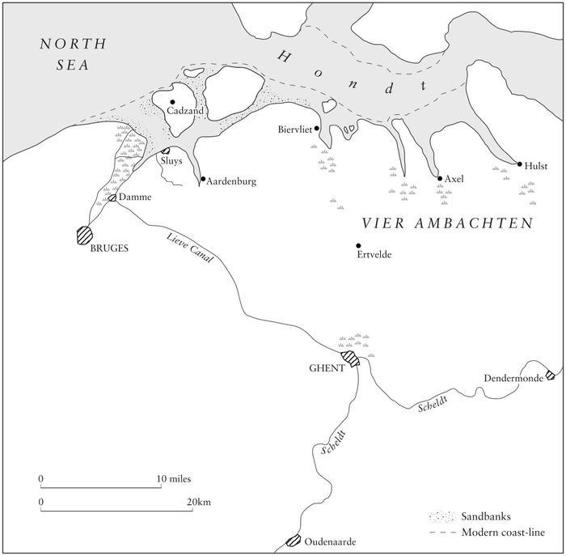
19 Sluys, Damme and the Vier Ambachten, 1385
Richard II’s councillors were at their wits’ end to find the means of defending their own country. England’s naval resources were now at their lowest point in living memory. The defence of the Channel was in the hands of commercial syndicates of privateers. Their operations consisted mainly of aimless cruises directed at defenceless coastal settlements and isolated merchantmen at sea. In the face of the threatened invasion, the Council resolved in February 1385 to break with the policy of the past few years and to return to organised naval campaigns, supported by requisitioning. What was envisaged was nothing less than a direct attack on the French invasion fleet’s base at Sluys. At the end of April, just before the truce expired, nearly eighty ships and barges sailed from Orwell and Harwich with 3,500 seamen and nearly 2,000 soldiers on board. Thirty of the ships were requisitioned merchantmen. The rest appear to have been furnished by Robert Parys’s syndicate. The command was taken by Sir Thomas Percy, veteran of many French campaigns, who was now serving as Admiral of the North.46
In the fourteenth century, before the silt closed the rivers of Flanders to navigation and the engineers drained the ground, the estuary of the Zwyn was a long, shallow inlet from the North Sea, bounded by the island of Cadzand on the north and by desolate mud-flats on the south. A channel, about a mile wide, broadened out into a large inland lagoon opposite the town of Sluys, providing a perfect natural anchorage. The English Admirals sailed directly for the mouth of the estuary. On 12 May 1385 they penetrated through the channel to the harbour and attacked the mass of shipping gathered in the anchorage. Several ships were captured or burned. Most seem to have been trading vessels. Some belonged to neutrals. Not long after, the English launched fire-ships on the tide towards the massed transports of the French invasion fleet waiting in the lagoon but the French succeeded in fending them off. The chronicler Thomas Walsingham sourly put these disappointing results down to idleness, timidity and bickering. This was unfair but it was probably a widely held view. A second English fleet, consisting of privateers from the west country ports of Plymouth, Dartmouth and Fowey, had better success. They set out in late May to harass the long French line of supply from the Seine to the Zwyn. They sank at least four French supply vessels in the Seine estuary and captured another four, including one magnificently fitted-out vessel which the English persuaded themselves was the flagship of the Constable of France.47
The English fleets failed to prevent Jean de Vienne’s army of Scotland from sailing. The French Admiral arrived at Sluys in the first week of May 1385. His army, which mustered in the town on the following day, finally comprised 1,315 men-at-arms with 300 French and Genoese crossbowmen and some 200 ‘gros varlets’. With the usual hangers-on they must have numbered some 2,500 men altogether. They brought with them their horses, 600 suits of light armour with helmets and lance tips to help equip the Scots, and 50,000 livres in gold florins, the first part of the subsidy to be paid to Robert II and the lords of the Scottish march. They also brought mining equipment and field artillery: seven ‘portable’ cannon together with stocks of gunpowder, cannonballs and lead shot, and a hundred ‘fire-throwing irons’, which appear to have been a primitive form of arquebus. Having arrived punctually at Sluys they were compelled to sit on the quayside for a fortnight while storms and the enemy fleet standing off the coast combined to pen them into the harbour. But, on about 22 May 1385, the flotilla sailed out of the estuary on a light wind past the foundations of Philip of Burgundy’s Groot Kasteel, evading the English Admirals lying in wait for them, and broke out into the open sea. About three days later they landed at Leith and Dunbar and made for Edinburgh.48
The English Great Council met on 4 June 1385 in the presence of the King. The scene was the Benedictine abbey of Reading. The discussions were dominated by the news from Scotland. The English had originally intended to ignore the Scots, leaving them to be contained by the Duke of Lancaster and the wardens of the north, but these plans were swept aside when the English discovered that both of the French armies of the summer were destined for Scotland. The current situation in the north was that a separate truce covering the Scottish march had been agreed between the Earl of Northumberland and Sir Archibald Douglas, which was due to expire on 15 July. It looked as if the Franco-Scottish invasion of England would begin some time after that date. The magnates gathered at Reading decided to raise the largest army on the Scottish march that could be recruited. The muster was fixed for 14 July at Newcastle. The seventeen-year-old King proposed to take command in person, his first experience of military operations. The idea seems to have been to invade Scotland as soon as the truce expired and before Olivier de Clisson could reach the northern kingdom with the main body of the French army.49
The emissaries of Ghent must have reached England with Ackerman’s appeal for help shortly after the Great Council had closed. Their arrival evidently caused some embarrassment among the King’s ministers. They did not doubt the urgency of the situation around the town or the importance of maintaining the threat from Ghent in the French army’s rear but their hands were tied by the decision which had just been made at Reading. They replied that no reinforcements could be sent to the Low Countries until the Scottish campaign was over. But they committed themselves to helping later in the season. The King’s half-brother, Sir Thomas Holand, was the kind of man that Ackerman and his allies had asked for the year before. He had been retained for the Scottish campaign, but he was ordered to be ready to lead a force of men to Ghent as soon as the army of Scotland had returned. Thirty sailing ships and fourteen barges were requisitioned in readiness for his departure.50
These decisions raised a number of problems which seem to have been barely considered at Reading. The foremost of them was finance. The threat of a Franco-Scottish invasion finally put paid to the possibility of the King leading an expedition to the continent. This meant that he had to abandon the second of the two subsidies granted by Parliament, which was conditional upon his undertaking a continental campaign. The decision to raise an army to invade Scotland therefore provoked an immediate financial crisis. A six-week campaign could be expected to cost about £20,000. Within days the captains would be appearing at the Exchequer to claim their advances. The Council decided to address the problem by issuing its demands for military service in Scotland in the form of a summons of the feudal levy. This enabled them to demand payment of scutage, an archaic fine in lieu of service which was traditionally paid by those who held land by knight service but did not fight. It had not been demanded for more than half a century. The demand may have been made as the prelude to a round of financial horse-trading. In the event the demand for scutage was dropped. In return the captains agreed to forfeit the regards (or recruitment bonuses) to which they were traditionally entitled. Some of the leading magnates also helped by furnishing part of their retinues on credit. These compromises did something to relieve the government’s penury but at the expense of every other front. Creditors and war contractors with assignments from the customs revenues found their claims rejected throughout the summer as the Exchequer scrambled for cash to meet the demands of the new army. The garrisons of Calais and Berwick went short. So did Sir John Bourchier’s company at Ghent.51
On 10 July 1385 Charles VI of France received the Oriflamme from the Abbot of Saint-Denis before setting out to join his army at Arras. Richard II had already reached Nottingham on his way north. The English King left behind him a caretaker administration at Westminster, comprising the handful of councillors whose age or profession prevented them from taking part in the Scottish campaign: Archbishop Courtenay, the Bishops of London and Winchester, John Lord Cobham, Sir Robert Knolles and the Mayor of London, Nicholas Brembre. They were charged with making contingency plans for keeping the sea and defending the English coasts. The defence of the Thames estuary and north Kent was left to the Londoners to organise and pay for. Southampton, the favoured target of French raiders, was told to see to its own defence. The county levies were arrayed in Suffolk after a squadron of French ships had been reported off Orfordness. There was no attempt to organise coast-guards, to array troops inland or to set up warning beacons on hill-tops, precautions that had routinely been taken in the years when England was threatened by coastal raiders. If Olivier de Clisson had had the information and the flexibility to switch his destination at the last moment Richard II’s kingdom would have been caught defenceless.52
In Edinburgh Jean de Vienne was encountering unexpected difficulties. He had arrived keen to take the initiative and anxious to start raiding across the border. He found the Scots unco-operative. They were determined to wait until the expiry of the local truce on the march and they needed time to make their own preparations. There were also wearing disputes about strategy, which reflected the allies’ contrasting experiences of war. The French wanted a sustained campaign which would tie down significant English forces. They wanted to attack the major walled towns and castles of the English borderlands. They believed in careful advance planning and disciplined movement. The Scots wanted to fight the kind of campaign which they had always fought, involving fast movement by formless hordes of men, maximum physical destruction and the capture of valuable cattle. They were not inclined to suffer the risks and casualties of assaulting fixed defences or the delays associated with siege warfare. Many of these differences are reflected in an elaborate treaty governing the conduct of the coming campaign, which was sealed in Edinburgh on 1 July by the leading captains of both allies. Walled places were to be assaulted only by agreement between the captains of each army and after a careful reconnaissance to assess the risks. Ordinances of war were promulgated providing for the resolution of disputes between French and Scottish soldiers. Rules were formulated for keeping discipline in the ranks and resolving arguments about plunder. The document, which was drawn up in French, had all the hallmarks of French practice and French administrative order. It appointed 23 July 1385 as the date for the opening of the campaign.53
The delay made the French soldiers restless and provoked a certain amount of friction with the Scots. The French knights who provided Froissart with his information were taken aback by the primitiveness of the country in which they found themselves. ‘What Prussian march is this to which our Admiral has taken us?’ they asked. They were amazed to find that Edinburgh, which had been described to them as the Paris of the north, had no more than 400 houses. They were unimpressed by the ‘red-faced and bleary-eyed’ King Robert. They found his subjects a ‘savage race’ without courtesy or chivalry and his country bare of everything that made life sweet. The beds were hard and the buildings mean. There was no wine. They hated the beer and rye bread. Those who had lost their horses during the sea passage from Sluys found it impossible to buy adequate replacements in Scotland without paying six or ten times the price in France. Writing to the French royal Council Jean de Vienne observed that Scotland seemed to have ‘nothing in it but wild beasts, forests and mountains’. The resentment was mutual. For although the leaders of the French expeditionary force were warmly welcomed by the Douglases and the Morays, men who inhabited the same mental world as they did, ordinary Scots viewed their presence with undisguised hostility. They wondered what a foreign corps of just 1,600 men could do for them that they could not do for themselves. They complained that the French could not speak their language. They objected to their habit of riding several men abreast through fields of growing corn instead of keeping to beaten paths. The Scots treated the newcomers like enemies who would pillage and burn their property like the English. They refused to sell them food and set upon their foragers in isolated places.54
On 8 July 1385 Jean de Vienne persuaded Robert II to bring forward the opening of hostilities. He was allowed to lead a mounted raid across the east march into Northumberland, anticipating by a few days the expiry of the truce. The French troops rode south from Edinburgh with white St. Andrew’s crosses on large black patches crudely sown onto their tunics. About 3,000 Scots joined them. Crossing the Tweed east of Melrose abbey the French caught their first glimpse of the savagery of the northern war. For several miles on either side of the border they saw nothing but uncultivated wasteland, inhabited only by a few wretches who had been unable to escape in time. The Scots fell on these stragglers and cut their throats. The combined force conducted a cautious reconnaissance around Roxburgh before renouncing the task of assaulting it as impossible. They then rode east down the Tweed into Northumberland and came before Wark. The castle of Wark stood on a steep ridge on the south bank of the river, overlooking one of the principal fords. It was an old fortress, dating from the twelfth century, which had been neglected for years and had already suffered serious damage in earlier Scottish raids. There was an acrimonious argument between the French and Scots about whether to attack the place. This ended with the French assaulting the walls on their own as the Scots stood by and watched. After suffering heavy casualties they succeeded on the second day of the attack in forcing the defenders from the parapets with crossbow fire and carrying the walls from scaling ladders. The raiders took the captain prisoner, massacred the garrison and did as much damage as they could to the buildings before abandoning the castle. A few years later it was reported to be ‘worthless on account of war damage’. The capture of Wark proved to be the only notable achievement of this raid. The whole affair generated much ill feeling between the French and the Scottish corps. Shortly they went their separate ways. The Scots withdrew across the border while the French, accompanied only by the Earl of Douglas and his men, pressed on eastward towards Berwick and then south along the coast road, destroying towers and fortified houses and wasting the lands of the Earl of Northumberland. They penetrated into England as far as Morpeth. There, in the last few days of July, they learned that Richard II had reached Newcastle. They turned back and made for Edinburgh.55
The presence of the English King had proved to be a powerful recruiting agent. When, on 30 July 1385, Richard marched north out of Newcastle he was accompanied by the largest army to be raised in England since the Crécy campaign of 1346. There were nearly 14,000 men, two-thirds of them archers. The roll call included the retinues of every English earl and almost all the more prominent English captains who were still capable of fighting. With pages and supporters, there must have been between 20,000 and 25,000 men. They marched in battle order in the traditional three battalions. The Duke of Lancaster, who led by far the largest retinue, took his position in the vanguard, accompanied by his brother the Earl of Buckingham and the Marshal of England, Thomas Mowbray, Earl of Nottingham. The King marched in the centre of the next battalion with his uncle the Earl of Cambridge and the Earl of Warwick on the wings. The rear was taken up by the men of the north, led by the contingents of Percy, Neville and Clifford, and by the Bishop of Durham, a prominent figure with his crozier in his hand and the banner of St. Cuthbert, patron of the north, at his side. On 6 August the English army entered Scotland and the King unfurled his banner. In the small town of Hoselaw in Teviotdale Richard marked his entry on to Scottish soil by bestowing new honours on his favourites and relatives. Edmund Langley, Earl of Cambridge, became Duke of York. Thomas of Woodstock, Earl of Buckingham, became Duke of Gloucester. Robert de Vere, Earl of Oxford, became Marquis of Dublin, the first time that this title had been used in England. Michael Pole was made Earl of Suffolk and Simon Burley became Earl of Huntingdon. John, Lord Neville of Raby, became Earl of Cumberland. John of Gaunt’s eldest son Henry Bolingbroke was named Earl of Derby. No fewer than 300 men received knighthood at the King’s hands. Richard probably hoped to win goodwill among the nobility by these creations in much the same way as his grandfather Edward III had done by his lavish peerage creations at the outset of the war in 1337.56
The following days made a mockery of this ambition. The English advanced through Lothian across a six-mile front towards Edinburgh. The inhabitants of Lothian fled in the path of the approaching mass of men, taking all their foodstuffs with them and destroying what they could not carry. The Scottish and French soldiers retreated before them, refusing to offer battle but harassing their flanks, picking off stragglers and foragers. Unable to come to grips with their enemy, the English turned to destruction. They burned everything in their way. They trampled down the growing corn. Prisoners who fell into their hands were put to death. The usual immunity accorded to monastic buildings was refused on the ground that they were occupied by Clementists. Melrose, the greatest Cistercian foundation in Scotland, was spared for the moment but Dryburgh and Newbattle were almost entirely destroyed. On 11 August, after five days’ march, the English reached Edinburgh. They found it completely deserted apart from the garrison of the castle. The Scots looked down impotently from the castle walls as the invaders torched the houses and churches of the town. Only Holyrood Abbey was spared at the special request of John of Gaunt, who had been sheltered there during his exile in Scotland in 1381.
By now, however, Richard’s army was beginning to suffer from hunger. There had been no time to organise a proper supply train. The foragers found nothing to take. Disease began to spread among weakened men, aided by the hot weather. It was a repetition of the misfortunes of John of Gaunt’s invasion of the previous year. Gaunt urged the King to press on across the Firth of Forth. Since the bulk of the Scottish forces with their French auxiliaries were retreating south through the forest of Ettrick, Gaunt’s plan suggests, like so much else about this campaign, that his main object was to pre-empt a French descent between the Firth of Tay and the Moray Firth, where the most suitable landing places were to be found.
Richard, however, had had enough. He turned on his uncle, abusing him to his face and accusing him of treason. It was all very well, he is reported to have said, for great lords like him who had brought wagons of food for themselves. The rest of the army would starve. Was Gaunt deliberately trying to destroy him? ‘I shall return home with my men,’ Richard declared. ‘But I am one of your men,’ the Duke replied. ‘I see no evidence of that,’ the King said. The army turned back by the way that it had come. At Melrose they found that the soldiers who had been left to protect the abbey from pillagers had all been murdered. Richard responded by having the church and conventual buildings reduced to a mass of charred stumps. The English army returned to Newcastle on 20 August 1385, where it disbanded. They had passed less than two weeks in Scotland without either taming the Scots or contributing anything to the destruction of Jean de Vienne’s army. The task of defending the north against the inevitable Scottish retaliation was passed to the Percy Earl of Northumberland, with just 1,200 men based at Berwick plus the garrisons of Roxburgh and Carlisle.57
The Scots’ retaliation had already begun. While the English had been arguing strategy in Edinburgh the Scots had crossed the defenceless western march into Cumberland. On about 15 August 1385 King Robert’s second son Robert, Earl of Fife, led his men at low tide across the treacherous sands at the head of the Solway Firth accompanied by Jean de Vienne and his French corps, the borderers of the Earls of Douglas and March and Sir Archibald Douglas and ‘the whole youth and flower of Scotland’s chivalry’. A screen of men was left to invest the city of Carlisle and burn its suburbs and outlying villages while the rest of the horde rode on south through Cumberland and Westmoreland, penetrating well beyond Penrith into territory which had not been raided from Scotland for several decades. Terrible damage was done to the region. The tax records for years to come told the same tale of depopulation and destruction of crops, buildings and animals. The Scots staggered back towards the border, bowed beneath the weight of their loot. Froissart’s French informants told him with calculated ambiguity that the spoil from just four English towns was worth more than all the wealth of Scotland. On their way back they came before Carlisle, the principal walled city of the west march. Jean de Vienne had probably always had this place in mind as the main objective of the campaign. On 7 September his men brought up their artillery against the gates and assaulted the walls from scaling ladders. The walls of Carlisle were weak and in disrepair but the town had a strong garrison and had recut its ditches before the enemy arrived. The assault was beaten back. Several French prisoners were taken. The invaders had run out of time. The Earl of Northumberland’s son, Sir Henry Percy, appeared across the Pennines with an army of borderers from the eastern march. The French and Scots made off. According to Froissart, the French were close to starvation. They began to seize food belonging to the inhabitants of the Scottish Lowlands. This provoked angry argument and fighting between French and Scottish troops. The campaign, which had once seemed so promising, ended with a whimper as a half-hearted attempt was made to capture Roxburgh. It was the last opportunity that Jean de Vienne would have to achieve a notable success in Scotland. The facts are obscure but it seems that, as at Wark, the Scots would not join in an assault. The Admiral responded that if the fortress was taken by French efforts it must be held in the name of Charles VI. The Scots indignantly rejected this idea. Both corps shortly left the field in disgust.58
*
The sailing of the second French army had been fixed for 1 August 1385. In the course of July more ships joined the invasion fleet gathered in the anchorage at Sluys. Banners fluttered in the wind from several hundred masts. The larger hulls, which had been reserved for the leading captains of the army, were brightly painted in their colours. The immense quantity of food and equipment commandeered during the summer had reached the port and was in the process of being loaded. The preparations were almost complete when the project received a mortal blow from an unexpected quarter. On 15 July Francis Ackerman and Peter Van den Bossche left Ghent by night with a small force of 1,300 men including Sir John Bourchier and his company to disrupt the invasion preparations. They reconnoitred the defences of Bruges and Sluys but found them too well guarded. At Damme, however, they had better fortune. The river port of Damme, half-way between Sluys and Bruges, marked the limit of the navigable section of the River Zwyn. Silt had progressively closed its harbour to ocean-going vessels and the town was a shadow of what it had once been. But it remained an important distribution centre for the grain and victualling trades. It was also the nodal point of the canal system in western Flanders. The place was protected by a modern circuit of walls and ditches but the captain was away in Bruges and no proper watch was being kept in his absence. Ackerman’s men crossed the water-filled ditches, scaled the walls and took possession of the town before the garrison knew they were there. The inhabitants were massacred. French troops from Bruges, Sluys and Aardenburg soon appeared outside. They tried to recover the place before the invaders could organise its defence. They rushed the barriers beyond the gates. But they were driven back. In the following days they launched a succession of assaults, all of which failed. Shortly a relief force arrived from Ghent to drive off the assailants. By the end of July 1385 Damme was defended by a garrison from Ghent several thousand strong. The artillery already in the town was deployed on the walls and more was brought in from Ghent. A cornucopia of supplies was found in the warehouses of the port to sustain the defenders through a long siege.59
On the day that Damme fell the French court was at Amiens celebrating the marriage of their seventeen-year-old King. The bride, Isabelle of Bavaria, who was two years younger than he was, had been brought from Germany by her uncle to be submitted to Charles’s inspection. The meeting, sudden betrothal and hastily arranged marriage, all carefully stage-managed by the Duke of Burgundy and accomplished in the space of three days, was perhaps as near to a love-match as a king of France could be allowed to come. Charles did not have long to enjoy his bride’s company. The first reports of the capture of Damme reached Amiens on the following day, 18 July. The implications did not take long to sink in. The presence of a large army from Ghent four miles from Bruges and seven from Sluys in a region readily accessible from England was a grave threat to the embarkations as well as to the wider interests of the Duke of Burgundy. And, as a contemporary tartly noted, ‘whatever touches the Duke of Burgundy, the King makes it his business to do.’ The army of invasion was redirected to Damme and the passage to England was deferred until it had been recovered. On 21 July the Queen was led off to the castle of Creil in the valley of the Oise, while Charles VI and his uncle marched away with the Constable and the household officers to Arras to join the rest of the army. On 31 July the whole French army was encamped in the flat landscape around Damme.60
Richard II’s councillors at Westminster learned of the capture of Damme a few days after the French did. They appreciated its significance at once. The longer Damme held out the harder it would be for the French invasion fleet to sail this season. At the end of July, therefore, the caretaker administration desperately tried to fit out an expeditionary force to disrupt and prolong the French siege. The Admirals’ fleet in the North Sea had reached the end of its indentured service and was on its way home. So Knolles and Brembre, together with the rich London financier William Walworth, set about requisitioning a new fleet in the west country. They proposed to embark troops for Flanders on this fleet as soon as they could be found. Providentially six Portuguese galleys armed with guns, the first fruits of Richard II’s alliance with John of Avis, had just arrived in the west country to support the defence of England. It was a generous gesture in view of the limited scale of English assistance to Portugal to date and the fact that no treaty between them had yet been ratified. The galleys were brought round the coast to London and their masters plied with gifts. Plans were devised to send them into the Zwyn to burn part of the French fleet. A Dutch pilot who knew the waters of the estuary was hired to guide them in. A barge was chartered in Southampton and despatched to scout about the mouth of the Zwyn and report on the progress of French operations. There was no money in the government’s coffers to pay for any of this. The cost appears to have been advanced by Brembre himself.61
The French commanders at Damme knew that the town had to be recaptured quickly if the invasion project was to be saved. They threw assault parties against the walls almost every day, sustaining terrible casualties in the process. They built great stone-throwers which battered the walls, gradually reducing whole sections to rubble. The defenders under Ackerman’s command fought back furiously. They waited until the ladder parties had almost reached the summit before throwing them off into the ditches. They fought them off with axes and swords from the parapets. Their cannon let loose a murderous fire from the flanks. The English archers on the ramparts shot dense volleys of arrows into the approaching French cohorts. Conditions in the French lines were appalling. Damme was sited on marshy, low-lying ground. It was hot. The stink of death and excrement and the buzzing of flies was everywhere. The town ditch was filled with sewage. The French men-at-arms sickened and died or withdrew to recover in Bruges. Charles VI left for the cleaner air of the Château de Mâle, leaving his tents behind to conceal his departure. The valiant resistance of the defenders of Damme gradually roused the ancient friends and fellow-travellers of Ghent in western Flanders. In Bruges tensions rose on the streets. The gates were watched for strangers and men of low degree who were ‘not knights, squires or clergy or other persons of substance or repute’. At Sluys there were riots against the French. Some of the inhabitants were detected trying to organise a general rising to kill the garrison in their beds at night and then break the dykes and set fire to the French fleet.62
Inside Damme supplies, too prodigally distributed at the outset, were beginning to run out. Ackerman sent frantic appeals to the English and to his fellow citizens in Ghent. The English were already doing their best but their relief force was unlikely to be ready for some time. From Ghent, which was only some twenty miles away, Ackerman might have expected more. But the townsmen had fallen to quarrelling among themselves. Many believed that their rebellion was doomed and the enterprise at Damme hopeless. They included the richest citizens: men of property whose estates beyond the town had been wasted by the war; leading grain shippers and victuallers, whose ruin had been completed by the French raids in the Vier Ambachten. These men wanted to throw themselves on the mercy of Charles VI and the Duke of Burgundy. They kept their voices low for fear of Peter Van den Bossche’s informers but without Ackerman’s demagogic skills to whip up the fear and anger of the crowd the revolutionaries steadily lost ground. In Damme Ackerman sensed his party’s power slipping away. He determined to abandon his men in the town and escape. On the night of 16 August 1385 he had one of the gates opened and rode out with his principal lieutenants and a large part of the garrison including Bourchier’s English company. He told the watch that they going to reconnoitre the French siege lines. Instead his men picked their way past the encampments of the besiegers without being noticed. When they reached open ground they rode off as fast as possible for Ghent.
Those who were left behind fought on for a time, sustained by the knowledge that they could expect no mercy from the French. On 26 August they too tried to escape. They sent a parlementaire into the French lines to propose talks. A brief cease-fire was ordered while this was considered. That night the defenders stole out of the town across the marshes to the east. They were accompanied by many of the inhabitants. But they were seen by the watchmen in the French lines, who sounded the alarm. A large number of French knights in the lines rushed for their weapons, mounted their horses and gave chase through the night. Several hundred people are said to have been cut down and killed in this murderous man-hunt. The rest of the French army waited until daybreak. On 27 August they assaulted the walls, pouring over the parapets and through the gates, killing everyone they found in the streets with a weapon in his hands and setting fire to much of the town. When order was restored about 200 men of Ghent were found still in Damme. They were led off to Bruges and beheaded outside the town jail.63
At the end of August 1385 it might still have been possible to mount the invasion of England. But the Duke of Burgundy’s first priority was to follow up his victory while the men of Ghent were in disarray. On 1 September he marched east with the army, bringing the King in his baggage train. That evening they established their headquarters in the castle of Ertvelde about seven miles north of Ghent. The fires of the army encamped around the village could be plainly seen from the walls of the town. Olivier de Clisson rode up to the gates to reconnoitre the defences. He devised a plan to attack the citadel and force a way into the town but the defenders opened the sluices of the canals and flooded the low-lying ground around the walls. The French discovered what Louis de Mâle had painfully learned in the last five years of his life. Ghent could not be taken by assault and starving it out would be a very long process. For more than a week they systematically wasted the Vier Ambachten. Villages, forts, mills were all destroyed. The dykes along the coast were broken, submerging much of the cultivable land. The soldiers killed all who did not flee in time except for those who seemed worth a ransom. But the Duke of Burgundy would not allow even these to live. He had every one of them beheaded in front of the King and his principal officers. Their dignity as they went to their deaths impressed even their executioners. ‘The King of France could put every Fleming to death,’ one of them told Charles to his face, ‘and their desiccated bones would still rise up to fight him.’64
The capture of Damme and the Duke of Burgundy’s attempt on Ghent saved England from a French invasion. The sailing of the army had now been held up for nearly six weeks. The army paymasters were running out of cash. The supplies which had been stored for the fleet in Sluys had been diverted to feed the army during the siege of Damme and those on the ships were rotting. To replace them would take time. It would also cost money which the French royal Treasury did not expect to have until the final instalment of the taille was received in October. By then the autumn gales would have begun. On 10 September 1385 the French royal Council met in the King’s presence at Ertvelde and decided that the invasion would have to be put off to the following year. The stores were unloaded from the ships at Sluys. Those that were still usable were deposited for the winter in the newly built cellars of Philip of Burgundy’s Groot Kasteel. The army was paid off two days later.65
It was a grave reverse but worse was to follow. The requisitioned ships of Normandy and Picardy sailed for their home ports in the course of September. Many of these ships took the opportunity to load cargoes in Sluys. The first convoy sailed into a storm in the Channel on 13 September 1385. Nine sailing ships and both serviceable galleys were driven onto the shore near Calais and fell into the hands of the English together with some 500 of their crews. This was probably the first news that the English received that the invasion plan had been abandoned. The following convoys had to run the gauntlet of English attacks from both sides of the Channel. On 16 September a fleet of English sailing ships and oared barges waiting at Calais intercepted a convoy of about eighty sail and captured about a quarter of them. Two days later the same fleet, reinforced this time by the captures of the past few days and supported by the ships of the Cinque Ports, attacked another convoy of forty-five sail. Most of these vessels escaped but three of them were captured after a sea-fight lasting five hours: two large and magnificent sailing ships with fortified hulls and topmasts, which had been assigned to serve as flagships for Charles VI and Clisson, and a great Baltic cog which was found to be carrying 5,000 francs in cash. Sir William Beauchamp, the captain of Calais, who was mainly responsible for these operations, was credited with forty-eight prizes in the space of two weeks.66
The cancellation of the invasion left Jean de Vienne and his men stranded in Scotland. The end of their adventure was as acrimonious as the beginning. The French Admiral wrote to Charles VI and Philip of Burgundy to say that he was willing to winter in Scotland until the new army of invasion arrived in the following year, provided that reinforcements, supplies and money for their wages were sent out from France. But his men had grown to loathe Scotland and its inhabitants. They said that by next summer they would have starved to death if they were not murdered in their beds by the natives. They insisted on going home. They then found that the Scots would not let them leave until they had satisfied those who claimed to have suffered damage at their hands. These included not just those whose timber or foodstuffs had been taken by the French or whose grain had been trodden beneath the hooves of their horses, but the bulk of the Scottish men-at-arms, who claimed to have been fighting for the French King’s account and demanded war wages and compensation for horses lost on the campaign. The men-at-arms were eventually satisfied with their share of the 50,000 francs subsidy which Jean de Vienne had brought with him to Scotland. Ten thousand francs of this was paid to Robert II. Six thousand francs was retained to compensate the French soldiers for the horses lost during their passage to Scotland. The rest was distributed according to their deserts among Robert’s ministers and the leading Scottish captains by a joint commission of French and Scottish knights. The other claimants had to wait until the French government paid the value of their claims to Robert II’s agents in Bruges. The French eventually left in groups towards the end of the year as shipping became available. They returned without money or horses but full of tales of the rudeness, ingratitude and greed of the Scots.67
The French government learned some painful lessons from the events of the summer of 1385. One of them was forcefully pointed out by Jean de Vienne when in due course he reported on his mission to the French royal Council. Successive kings of France had greatly overrated the power of the Scots, the Admiral thought. In his view the country’s resources were no greater than those of a single French province like Artois or a minor principality like Savoy. He had seen their whole military array, he said, and it included no more than about 500 properly equipped men-at-arms. There were up to 30,000 more who would come when summoned but they were poorly armed and trained and would flee at the first sight of an English army. By comparison, having stood on a hillside and watched the host of Richard II march through Lothian, he reckoned England’s strength in men-at-arms at about 6,000. The main problem, however, was that the devastated wastes of the Scottish lowlands were incapable of supporting a French army of any size. If Clisson had ever reached Scotland in the summer, said Jean de Vienne, his troops would have ended up fighting against the Scots or starving them out of their homes. The Admiral strongly advised against another attempt to land a large army in Scotland and in fact the French never again tried to attack England through Scotland until the beginning of the eighteenth century. For their part the Scots gave up hope of fighting a major campaign in England with their French allies. When they learned that the French army of invasion had been disbanded they entered into negotiations with the English King’s representatives on the march and agreed a local truce until 1 July 1386. With successive extensions this truce lasted until the summer of 1388. For practical purposes Scotland was out of the war for the next two years.68
The other lesson which the French learned was that it was unsafe to attempt the invasion of England without first securing complete control over Flanders. The Duke of Burgundy realised now that he could not capture Ghent by force. He would therefore have to make concessions of a kind which did not come easily to a man of his authoritarian instincts. Even before his withdrawal from Ertvelde Philip had arranged for the King to write an emollient letter to those in Ghent who were thought to be opposed to the die-hards in the town’s government. Charles offered to confirm the town’s charters and privileges if its citizens would surrender to him and undertook to grant an amnesty for all acts done during the six-year civil war. One of Philip’s Flemish-speaking staff covertly installed himself in the Franciscan nunnery at Gentbrugge, beneath the eastern rampart of the town, to work on sympathisers among the citizens. By the end of September 1385 a group of guildsmen, led by a grain shipper and a butcher, was already engaged in secret discussions in Paris with the Duke and other members of the French royal Council.69
Notes
1 Parl. Rolls, vi, 323—4 (4), 371 (18).
2 John of G. Reg., nos. 564, 643.
3 Carrick: Wyntoun, Oryg. Cron., iii, 9; Exch. R. Scotland, ii, 554, 587, 621—2; Foed., vii, 403—4; John of G. Reg. (1379—83), no. 1186; Rot. Scot., ii, 38; M. Brown, 69—70. Raids: Westminster Chron., 40—2, 50; Walsingham, Chron. Maj., i, 706, 714; Foed., vii, 403—4. Orléans agreement: Foed., iv, 167—8, vii, 406—7; ‘Voyage de N. de Bosc’, 332—3;Parl. Rec. Scot., 131—2; ‘Séjours’, 419 (date).
4 Froissart, Chron. (SHF), xii, 6—7; Westminster Chron., 54, 62; Nightingale, 279—81; Ormrod (1999), 161—2.
5 Foed., vii, 412—15, 417—18; Westminster Chron., 48—50, 54—6, 524; Parl. Rolls, vi, 337 (23); Walsingham, Chron. Maj., i, 712—14; PRO E364/18, m. 3 (Montagu).
6 ‘Voyage de N. de Bosc’, 328—30; BN Fr. 7619, fols. 191—192vo; Westminster Chron., 48—50, 524; Gr. chron., iii, 61; Parl. Rolls, vi, 371 (17); Cron. Tournay, 263; Hist. gén. Lang., x, 1691—2 (proposal to make Gaunt Duke of Aquitaine; cf. Deschamps, Oeuvres, iii, 63); Istore, ii, 331, 336; Froissart, Chron. (SHF), xi, 154—6 (conflates the sessions of Jan. and Aug.—Sept. 1384); Foed., vii, 418—22. Dates: PRO E364/17, m. 2 (Beauchamp), m. 5 (Bp. Hereford, Skirlaw, Sheppey), m. 5d (Holand); BN PO 549/Bueil, 97. Leulinghem: Chron. r. St.-Denis, i, 343, ii, 74—6.
7 Gr. chron., iii, 62; Plancher, iii, 73—4. Brabant: Laurent & Quicke, 81—6.
8 AD Côte-d’Or B11751; Vandepeereboom, ii, 324—37; Inv. Arch. Bruges, iii, no. 658; Rec. Ord. Pays-Bas, i, no. 27. Groot Kasteel: Inv. mobiliers Bourgogne, ii, nos. 1069, 1071, 1084; Inv. AD Nord, i (2), 352—3; Nieuwenhuysen, ii, 436—41; Paviot (1995)[1], 281—3. Topography: R. Laurent, 135—42. Oudenaarde: Cron. Tournay, 264; ‘Chron. Com. Fland.’, 244; Istore, ii, 350, 363; Froissart, Chron. (SHF), xi, 179—81.
9 PRO E364/18, m. 3 (Montagu, Northumberland); E101/40/5; Fordun, Chron., 383; Westminster Chron., 58; Bower, Scotichron., vii, 394—6; Wyntoun, Oryg. Cron., iii, 18—19; Knighton, Chron., 332—4. On Lochmaben: Cal. Doc. Scot., iv, nos. 223, 231; Northern Petitions, no. 113. French embassy: Foed., vii, 423; BN PO 1246/Fresnel 5, 7;Doc.Clos des Galées, i, nos. 1191, 1193; ‘Voyage de N. de Bosc’, 333; Froissart, Chron. (SHF), xi, 165, 166—8, 173. Gaunt raid: Walsingham, Chron. Maj., i, 718—22; Westminster Chron., 66; Knighton, Chron., 334; Bower, Scotichron., vii, 396, 402; Parl. Rec. Scot., 133, 134. Cambridge’s participation: Parl. Rolls, vi, 365 (9). The English had withdrawn to Northumberland by 23 Apr.: Foed., vii, 425.
10 Lopes, Crón. D. Fernando, 591—3, 601—3, 611—12; Ayala, Crón., ii, 175—8, 181—2.
11 Ayala, Crón., ii, 182—3; Lopes, Crón. D. Fernando, 593—7, 602—3, 605—10; Crón. D. João, i, 5, 10—13.
12 Lopes, Crón. D. João, i, 3—40, 46—50, 54—5, 69—72, 104—5; Ayala, Crón., ii, 175, 179—81, 183—4, 187. John of Trastámara at Guarda: Suarez Fernandez (1977), i, 169.
13 Lopes, Crón. D. João, i, 50—1, 110—13, 141—2; Ayala, Crón., ii, 176, 187—8, 189, 192—3; Santarém, Quadro elementar, i, 262.
14 Le Fèvre, Journal, 51, 53, 54; Foed., vii, 439—41; Ayala, Crón., ii, 189—90; *Lopes de Meneses, 248; BN PO 2087/Nade 3; BN PO 2030/Montmaur 11. On Montmor: *Gr. chron., iii, 163—76; Doc. Clos des Galées, i, nos. 868, 1344, 1459, 1460, 1483—4, 1501, 1547.
15 Lopes, Crón. D. João, i, 83—4, ii, 181; CCR 1381—5, 358.
16 Ayala, Crón., ii, 189—90, 193—8; Lopes, Crón. D. João, i, 86—91, 116—23, 184—95; Col. doc. Murcia, xi, nos. 143, 146—7.
17 Parl. Rolls, vi, 362—3 (3—4).
18 Parl. Rolls, vi, 365 (9); Westminster Chron., 66—80; Walsingham, Chron. Maj., i, 722—6. Arundel’s wool interests: Goodman (1971), 109, 114.
19 Parl. Rolls, vi, 365—6, 370—1 (10, 16—18); Westminster Chron., 82—4.
20 Froissart, Chron. (SHF), xi, 166—74, 170—1; Cron. Tournay, 262 (‘par licensse du Roi’); Walsingham, Chron. Maj., i, 728; Westminster Chron., 86, 100; Rot. Scot., ii, 63; Excerpta Historica, 142—4; PRO SC1/56/96 (Sept.). Charny: Gall. Reg., ii, no. 5871. Blaisy: *Froissart, Chron. (KL), xx, 329; Hist. gén. Lang., x, 1812, 1814. James, Earl of Douglas: Bower, Scotichron., vii, 402. Truce: PRO E403/502, m. 10 (2 July); Foed., vii, 434—5; Froissart, Chron. (SHF), xi, 169—70, 171—5.
21 Rot. Scot., ii, 66—8; Parl. Rolls, vii, 25 (33). Cost (Edward III): PRO E101/68/6 (140, 142); E101/73/1 (21); E364/9, m. 14 (Stapleton); E364/10, m. 5 (Percy); E364/13, m. 5 (Musgrave); E364/25, m. 3 (Curwen); Kirby, 138. Cost (1384): BL Cotton Chart. 16/64. The cost fell slightly in 1385—6: PRO E101/68/239, 242; E101/73/2 (29—35); E364/22, m. 5d (Despenser & Drayton); E364/23, m. 7 (Tempest & Talbot); E364/32, m. 5d (Swinburne); E364/33, m. 3 (Swinburne). Castles: Brown, Colvin & Taylor, 568—9, 599, 819—20.
22 Froissart, Chron. (SHF), xi, 176.
23 ‘Voyage de N. de Bosc’, 331—41; *Hist. gén. Lang., x, 1691—2.
24 Deschamps, Oeuvres, iv, 55, v, 48—9, 79—80. Cf. Instructions for British Servicemen in France (issued by the Foreign Office, 1944): ‘The French are more polite than most of us. Remember to call them “Monsieur, Madame, Mademoiselle”, not just “Oy!”.’
25 Parl. Rolls, vi, 384—5 (4); Foed., vii, 441—3, 444—5; Westminster Chron., 88, 98; Deschamps, Oeuvres, iii, 62—4; Froissart, Chron. (SHF), xi, 154 (conflates the sessions of Jan. and Aug.—Sept. 1384); ‘Voyage de N. de Bosc’, 342. The treatment of Calais in the draft treaty can be inferred from Parl. Rolls, vi, 371 (17).
26 Foed., vii, 444; Westminster Chron., 98, 104. Great Council: PRO E403/502, m. 12 (15 July); E403/505, m. 1 (4 Oct.). Parliament: CCR 1381—5, 586—7, 599—600; Parl. Rolls, vi, 384 (2), 386—7 (10). Clerical subsidy: Rec. Convoc., iv, 82. Ibid., iv, 81 records that Parliament was still in session on 17 Dec., after the Commons had received their expenses.
27 Carrick: Acts Parl. Scot., i, 186. Berwick: Westminster Chron., 104; Walsingham, Chron. Maj., i, 734.
28 Wool exports in 1384—5 were 57% of those in the preceding year, and 68% of the five-year average: Carus-Wilson & Coleman, 51—2. For the effect on revenue, see Ormrod (1999), 177 (Fig. 8.7).
29 Ayala, Crón., ii, 195—6, 199—200; Lopes, Crón. D. João, i, 220—31, 271—6, 268—71, 288, 290—3; *Sandoval, 58—60; Col. doc. Murcia, xi, nos. 143—4, 148—9, 153; ACA reg. 1289, fol. 28vo—29.
30 Foed., vii, 436; Lopes, Crón. D. João, i, 84; CCR 1381—5, 549—50, 552; CCR 1385—9, 22, 31; CPR 1385—9, 9. Recruits: Froissart, Chron. (SHF), xii, 138; Lopes, Crón. D. João, i, 84, ii, 11—12; Foed., vii, 453, 455, 472—3. Russell, 369—73, 375—6, 385 under-estimates their number. PRO C81/1018—1033 and PRO C76/69 record 182 letters of protection issued between Aug. 1384 and Mar. 1385 to men-at-arms recruited for Portugal. A few defaulted. Letters of protection were not usually sought by landless men, or even by all landed ones. No letters were issued to archers, who were certainly recruited in considerable numbers.
31 Col. doc. Murcia, xi, nos. 148 (p. 297), 189 (‘los omes de armas quel rey de Francia, nuestro hermano, nos enbia en ayuda nuestra’); Froissart, Chron. (SHF), xii, 124—7; Ayala, Crón., ii, 201, 203—4, 232, 237; Chron. r. St.-Denis, i, 438—40; ACA reg. 1749, fols. 100, 142; ‘Ann. Arch. Datini’, xii, 81.
32 Brandon, ‘Chron.’, 2—3; ‘Chron. Com. Fland.’, 244—5; Froissart, Chron. (SHF), xi, 182, 311. Pension: PRO E403/499, m. 13 (8 Jan.), E403/505, mm. 12, 16 (24 Nov., 20 Dec.). On Van Herzele: Haegeman, 78.
33 Foed., vii, 448—9; Froissart, Chron. (SHF), xi, 182—3; PRO E403/505, m. 12 (1 Dec.), E403/508, m. 18 (15 July); C76/69, m. 14; Haegeman, 145n120, 146n123; Brandon, ‘Chron.’, 5.
34 Valois (1896—1902), ii, 81—6, 91—112; Le Fèvre, Journal, 56, 60—7, 73—4, 77, 78—80, 87; Choix de pièces, i, 58—9; Durrieu (1880)[1].
35 Chron. Bourbon, 181—2; *Terrier de Loray, PJ nos. 89—90; *Plancher, ii, PJ no. 112 (relating to the subsidy granted by the Estates of Burgundy in Nov. 1384: see ibid., iii, PJ nos. 81, 84 and BN Coll. Bourgogne 53, fol. 34); Froissart, Chron. (SHF), xi, 281 (Clisson quote); Walsingham, Chron. Maj., i, 764.
36 Rey (1965), i, 261—2, 325—6, 390—404. Taille: *Bréard, PJ. no. 58 (pp. 100—3); Doc. Clos des Galées, i, no. 1198.
37 PRO E403/505, m. 19 (11, 16 Feb.); Westminster Chron., 110—12; Froissart, Chron. (SHF), xiii, 16. ‘600 transports’: Walsingham, Chron. Maj., i, 752.
38 Hist. Vitae, 85—6; Walsingham, Chron. Maj., i, 750, 754—6; Westminster Chron., 110, 114—16.
39 Chron. r. St.-Denis, i, 348—50. Date: see the itineraries of the main participants, Itin. Ph. le Hardi, 175—6; Lehoux, iii, 467; Troubat, ii, 796; Jean de Vienne’s appointment was formally made on 16 March: *Terrier de Loray, PJ no. 92; and Louis de Bourbon’s on the 17th: see below. Vienne’s army: Terrier de Loray, PJ nos. 90, 92. His payroll strength of 1,615 mounted men was carried on 183 ships, a ratio of 8.3 men per ship: see Terrier de Loray, PJ., nos. 101, 104, 111, 115, 116. The same ratio for the 600 ships assigned, according to English reports, to the second army (Walsingham, Chron. Maj., i, 752) indicates a payroll strength of about 5,300 mounted men. For their destination, see Froissart, Chron. (SHF), xi, 240, 281 and Cron. Tournay, 276. Their information is borne out by the absence of any special equipment, such as was constructed in 1386, for landing on a hostile coast; and by the almost complete absence of preparations to defend the English coast: see below. Bourbon: Titres Bourbon, no. 3602; Chron. Bourbon, 136—7. Flanders and Ghent: Froissart, Chron. (SHF), xi, 199—200; Cron. Tournay, 274—5; Inv. mobiliers Bourgogne, ii, nos. 840—1040.
40 Doc. Clos des Galées, i, nos. 1203—5, 1207, 1209, 1213—29, 1231—51, 1253—5, 1257—85, 1288—93, 1296—1309, 1312—40, 1350—4, 1355—61; *Bréard, PJ. nos. 64, 74, 77; *Terrier de Loray, PJ. no. 98, Mirot (1915), 275—85.
41 Terrier de Loray, PJ no. 115; Walsingham, Chron. Maj., i, 752, 770; Roncière, ii, 71—2; Doc. Clos des Galées, i, nos. 1237, 1285, 1294, 1306—8, 1310, 1313, 1342—3, 1354, ii, no. 72; Inv. AD Nord, vii, 209; Ayala, Crón., ii, 203—4; Mirot (1915), 272—3.
42 Ord., vii, 123—4, 759; Chron. r. St.-Denis, i, 346—8; Juvénal, Hist., 45; BN Fr. 7619, fols. 229—231vo; *Palmer (1968)[3), 422—5; Chron. r. St.-Denis, i, 350.
43 Laurent & Quicke, 118—36; Vaughan, 86—8. Festivities: Froissart, Chron. (SHF), xi, 193—5; Istore, ii, 384—6; ‘Voyage de N. de Bosc’, 345.
44 ‘Voyage de N. de Bosc’, 343—7; Itin. Ph. le Hardi, 176—7; Foed., iv, 466, 470. Great Council: PRO E403/508, mm. 6, 9 (9, 18 May).
45 Froissart, Chron. (SHF), xi, 199—202, 218—21; Brandon, ‘Chron.’, 5—6; Walsingham, Chron. Maj., i, 738. Biervliet: BN Clair. 48/3561, 79/6221. London mission: Brandon, ‘Chron.’, 6; PRO E403/508, m. 17 (8 July). On Coudenberghe: Perroy (1930).
46 PRO E101/40/9; E101/68/10 (240, 241); E364/20, m. 5 (Raddington), m. 7 (Percy); C76/69, mm. 12, 10; E403/510, m. 10 (17 Nov.); CPR 1385—9, 73.
47 Hanserecesse, iii, nos. 198, (esp. para. 7), 200, 203—5, 403, 407—8; Chron. r. St.-Denis, i, 360—2; PRO E403/508, m. 7 (12 May); E364/35, m. 2d (Hannay & Warblington); Walsingham, Chron. Maj., i, 752—4. Topography: R. Laurent, 2—5, 90—6, 136—43.
48 *Terrier de Loray, PJ., nos. 101, 104, 110—11, 115, 116; Doc. Clos des Galées, i, nos. 1207, 1252, 1264, 1275; Inv. mobiliers Bourgogne, ii, nos. 1178—83; Fordun, Chron., 383; Chron. r. St.-Denis, i, 360—2; Walsingham, Chron. Maj., i, 752—4; Bower, Scotichron., vii, 402—3; Froissart, Chron. (SHF), xi, 213; Cron. Tournay, 273.
49 Westminster Chron., 120; PRO E403/508, m. 2 (19 Apr.); Rot. Scot., ii, 70—1, 73; Foed., vii, 473, 474—5. Cf. Richard’s itinerary in Saul (1997), 470.
50 Cron. Tournay, 275, 280; Brandon, ‘Chron.’, 6; PRO C76/70, m. 39; E364/30, m. 4 (Hereford); E403/508, m. 18 (15 July).
51 Foed., vii, 471—2, 473, 474—5. Scutage: PRO E403/508, mm. 12, 18 (15 June, 11 July); Parl. Rolls, vii, 26 (40); Lewis (1958); Palmer (1968)[2]; Steel (1954), 51—2.
52 Richard’s itinerary in Saul (1997), 470; PRO E403/508, m. 22 (18 Sept.); E403/510, mm. 6, 22 (31 Oct., 18 Sept.); Cal. Letter Books H, 269—71; CCR 1381—5, 551; CCR 1385—9, 6; Foed., vii, 474.
53 Chron. r. St.-Denis, i, 364—6; Acts Parl. Scot., i, 554—5.
54 Froissart, Chron. (SHF), xi, 214—18, 253—4, 275—6; Chron. r. St.-Denis, i, 364. Lost horses: Foed., vii, 485.
55 Chron. r. St.-Denis, i, 366—8; Froissart, Chron. (SHF), xi, 255—8; Bower, Scotichron., vii, 404. Crosses: Acts. Parl. Scot., i, 555. On Wark: Cal. Inq. P.M., xvi, no. 871; Cal. Doc. Scot., iv, no. 318. The French were in Edinburgh on 3 Aug.: *Terrier de Loray, PJ. no. 104.
56 Westminster Chron., 124—6; *Armitage-Smith, 437—8; Foed., vii, 481—4; Knighton, Chron., 336—8; Hist. Vitae, 89; Palmer (1971)[3], 489—90. Itinerary: Saul (1997), 470.
57 Westminster Chron., 126—30; Walsingham, Chron. Maj., i, 760—4; Knighton, Chron., 336—8; Hist. Vitae, 88—9; Fordun, Chron., 383; Wyntoun, Oryg. Cron., iii, 28—9; Bower, Scotichron., vii, 406, 408. Itinerary: Saul (1997), 470. The Scots were at Carlisle on 15 August: Northern Petitions, no. 84. Defence of north: PRO E403/510, m. 20 (7 Jan.).
58 Northern Petitions, no. 84; Bower, Scotichron., vii, 404, 408—10; Knighton, Chron., 336; Wyntoun, Oryg. Cron., iii, 29—30; Reg. crim. Châtelet, i, 382—3, 386—7; Froissart, Chron. (SHF), xi, 267—9, 270—1, 274—5. Carlisle: Brown, Colvin & Taylor, 599; Northern Petitions, no. 84; Rot. Parl., iii, 30 (1); CCR 1381—5, 542; CPR 1385—9, 42—3, 110; PRO E159/162 (brev. dir. bar.), Mich., m. 16d. Destruction: PRO E159/164 (brev. dir. bar.), Mich., m. 11d.; E159/166 (recorda), Mich., m. 20; CPR 1385—9, 25—6; CPR 1385—9, 230.
59 Preparations: *Puiseux, 22—3; Doc. Clos des Galées, i, nos. 1228, 1256, 1285, 1348, 1385, ii, no. 72. Damme: Cron. Tournay, 272; Brandon, ‘Chron.’, 6; ‘Chron. Com. Fland.’, 244—5; Froissart, Chron. (SHF), xi, 232—5, 240. Topography: R. Laurent, 111—15.
60 Chronographia, iii, 75—6; Froissart, Chron. (SHF), xi, 237—9, 248; Cron. Tournay, 272, 273—4; *Puiseux, 22—3; ‘Séjours’, 428; Itin. Ph. le Hardi, 180. Quotation: Chron. Bourbon, 147. Marriage: Froissart, Chron. (SHF), xi, 223—32, 235—7; Chron. r. St.-Denis, i, 356—60.
61 PRO E101/40/11; E403/510, m. 6 (31 Oct.); C76/70, m. 39; Westminster Chron., 128; Walsingham, Chron. Maj., i, 768.
62 Istore, ii, 386; Chron. r. St.-Denis, i, 372—4; Cron. Tournay, 274—6; Froissart, Chron. (SHF), xi, 239—41, 243; Inv. Arch. Bruges, iii, 18; Doc. Clos des Galées, i, no. 1461; ‘Chron. Pays-Bas’, 282.
63 Cron. Tournay, 276—8; ‘Chron. Com. Fland.’, 245—6; Istore, ii, 386; Chron. r. St.-Denis, i, 374—8; Froissart, Chron. (SHF), xi, 243—6, 282—5; Chronographia, iii, 76; Chron. premiers Valois, 312.
64 Chron. premiers Valois, 312; Chron. r. St.-Denis, i, 380—4; Froissart, Chron. (SHF), xi, 246—7; Cron. Tournay, 278; Brandon, ‘Chron.’, 7, Cochon, Chron., 177—8; Inv. AD Nord, ii, 135 (dykes).
65 *Puiseux, 22—3; Doc. Clos des Galées, i, no. 1356, ii, nos. 70—1; Froissart, Chron. (SHF), xi, 247—8.
66 Westminster Chron., 134—6; Walsingham, Chron. Maj., i, 768—70 (my translation differs from the editor’s); Knighton, Chron., 338—40. Loss of galleys confirmed by Doc. Clos des Galées, i, no. 1461.
67 Cron. Tournay, 273; Froissart, Chron. (SHF), xi, 276—80. Subsidy: Foed., vii, 484—6; Inv. doc. Écosse, 30.
68 Froissart, Chron. (SHF), xi, 280—1. Truces: Rot. Scot., ii, 75, 84, 93; Foed., vii, 526—7; PRO E101/675/56.
69 *Froissart, Chron. (KL), x, 562—3, 571—2; Froissart, Chron. (SHF), xi, 286—9; Istore, ii, 372—5; Brandon, ‘Chron.’, 7—8.