
CHAPTER XIV
When, in May 1389, Charles VI announced his intention of visiting the three southern seneschalsies of his kingdom, the event focussed attention on a region which had been a political backwater for a decade.1 The Duke of Anjou had left Languedoc in the spring of 1379 to attend to the affairs of Brittany. After that he had had very little to do with the government of the province until he was finally relieved of it in April 1380. Anjou had been a formidable figure there for sixteen years. His equally formidable successor Bertrand du Guesclin had died on his way south to take up his duties. The disappearance of these two men left a void which was never filled. In Languedoc and the neighbouring provinces of the march, power fell into the hands of a succession of ambitious local potentates operating in alliance with the Anglo-Gascon companies. The conquest of what remained of the English duchy came to a halt.
The foremost of these potentates were the Counts of Armagnac and Foix. For many years the prolonged vendetta between these two powerful southern families had been one of the major sources of political instability in the region. Gaston III Count of Foix (known as Gaston Phoebus) was a subtle politician who had inherited his territories at the age of twelve in 1343 and had governed them since his fifteenth year. He was a man of many contradictions: the cerebral ruler, dictating staccato letters to four secretaries; the urbane host presiding over one of the most famous small courts of Europe; the obsessive miser hoarding coin in the keep at Orthez; the heavily built man of action who collected fine books and wrote in exquisite French a prayer book and a treatise on hawking; the cautious politician, given to sudden outbursts of uncontrollable rage. These were all different aspects of the same enigmatic figure. Here was a man who passed a lifetime in building up a great autonomous principality only to murder with his own hands the son who was destined to inherit it. Gaston Phoebus’s domains comprised three distinct blocks of territory in the Pyrenees: the viscounty of Béarn and adjoining areas of southern Gascony in the west; the small territory of Nebouzan around Saint-Gaudens further east; and the county of Foix at the headwaters of the Ariège south of Toulouse. In addition to these he had inherited from his mother a substantial block of territory between the valleys of the Tarn and the Agout, north-east of Toulouse, including much of the southern Albigeois. Most of Gaston Phoebus’s territories were mountainous and poor. But they produced large numbers of hardy mountain troops for his armies. His demesne revenues were small, but he waxed rich on the profits of his wars and the patronage of the free companies. He learned quicker than most French noblemen of his time that cash had become a sounder investment than land. His accumulating chests of coin enabled him to engage in a lucrative traffic in prisoners of war and to lend money at interest to needy princes and captains as well as to seize his own political opportunities when they arose.2
Much of Gaston Phoebus’s long reign was animated by the ambition to create a consolidated Pyrenean state along the southern flank of Gascony and Languedoc. The chief obstacles in his way were the counts of Armagnac and their long-standing protégés the counts of Comminges. Between them these two noble houses possessed most of the territory which separated the scattered fractions of Gaston’s Pyrenean empire. The counts of Comminges were also Gaston’s chief adversaries in the Albigeois. In 1375 the last of the male line of the house of Comminges died, leaving a ten-year-old girl as his sole heiress. Open war broke out between the Counts of Armagnac and Foix for the hand of the heiress. Gaston Phoebus invaded Comminges with a mixed army of his own subjects and Gascon routiers from the garrisons of the Pyrenees. Sir Thomas Felton, the English Seneschal of Gascony, weighed in on his side. The Count of Armagnac counter-attacked with his own army, also largely recruited from professional routiers. In 1378, after three years of fighting, Armagnac seized the young heiress and forcibly married her to his eldest son. Her guardian, the dowager Countess, who had tried to stop him, was taken away under guard and locked up in what Armagnac described as a ‘delectable place’ in his domains.3
When eventually peace was restored in March 1379 Armagnac appeared to have won. The real victor, however, was Gaston Phoebus. He was, it is true, obliged to acquiesce in his rival’s possession of the Comminges inheritance. But he was allowed to retain a number of strategic positions which he had occupied in Comminges itself and also obtained effective possession for the first time of his mother’s dower lands in southern Albigeois. Shortly after the peace had been sealed he consolidated his position by annexing the whole of the territory of Bigorre lying immediately east of Béarn. His dream of controlling a single consolidated block of territory across the northern face of the Pyrenees was all but achieved, but the cost of his triumph was a decade of tension and instability in southern France. Gaston’s garrisons now looked out on three fronts at those of the Count of Armagnac: in the Gave de Pau on the northern march of Béarn, in the upper valley of the Garonne where Foix merged into Comminges, and on the Tarn. ‘Ah, Sire Jean,’ said the knight who accompanied Froissart on the road to Orthez some years later, ‘what fine skirmishes and tough fights I have seen around here between the men of Armagnac and Foix, for in those days there was not a town or castle that they had not stuffed withmen-at-arms to harass and despoil each other.’4
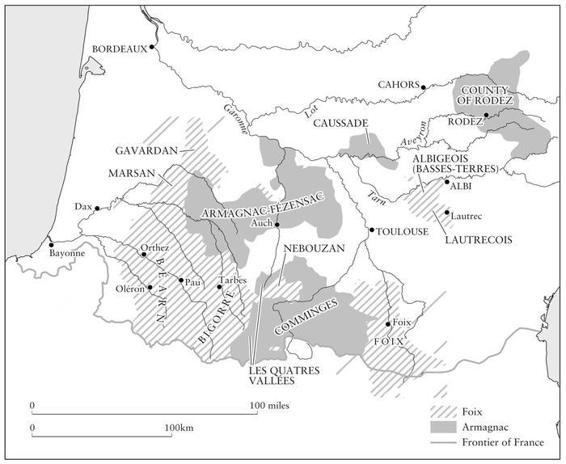
25 Principal territories of the Counts of Armagnac and Foix, 1375—1382
The Comminges war had been fought against a background of mounting routier activity across the whole of southern and central France. In the late 1370s there were several hundred routier garrisons operating in the region. Most of them were small gangs with no more than a local reach who moved on or were bought out relatively quickly. The main threat to the life of the region did not come from them but from larger garrisons working in mutually supporting groups and capable of combining to field substantial mounted armies. The largest operation of this kind was conducted from Carlat in the Cantal. In 1379 this place, together with its extensive network of satellite garrisons, was home to as many as thirteen substantial Gascon companies. They were capable of mounting raids several hundred strong into the surrounding provinces of Périgord, Quercy, Rouergue and Auvergne and were more or less immune from interference by the officers of the French government. The one serious attempt to recapture Carlat, in 1377, was abandoned when Bertrand du Guesclin, summoned from the north to offer his advice, pronounced it to be impregnable. Similar networks of routier garrisons operated on a smaller scale in Quercy and Limousin. Several attempts were made by the provincial authorities to buy out these places. But they all failed for the same reason: the routier captains’ price was more than the regional assemblies could raise from local taxpayers, and more distant taxpayers declined to assist. A plausible contemporary estimate had it that the total strength of the free companies operating in southern France at the end of the decade was between ten and twelve thousand men, of whom perhaps three thousand were trained men-at-arms.
The effect on the region was catastrophic. Its internal trade dried up. Fields out of sight of walled places were abandoned to weeds and brambles. Refugees and beggars crowded into the towns. Delegations sent to participate in provincial assemblies travelled by night with armed escorts and were sent on their way with public prayers for their safety. By the end of the 1370s the first symptoms reappeared of the vicious circle which had destroyed so much of provincial France in the 1350s. War damage destroyed the tax base, thereby preventing provincial communities from defending themselves and exposing them to fresh attacks. Auvergne, its Estates declared in 1379:
has been reduced to such a state of poverty and destitution that its walled towns and castles can no longer be defended. These places are ill-manned and so feeble that any substantial force could conquer them. Two-thirds of the open country is abandoned and uninhabited and the rest will soon be in the same state.
The mountains of Auvergne and their western foothills were the worst affected regions. But conditions were not much better in Périgord, Quercy or Rouergue.5
The routier war acquired a new and more formidable aspect once the Duke of Anjou had left for the north. The government of Languedoc was left to drift. Tax exhaustion drastically reduced its revenues. The settlement of the Comminges war and the treaty between Castile and Navarre, which occurred almost simultaneously in March 1379, released large numbers of footloose bands of soldiers back onto the market. They shortly acquired an impressive leader in the person of Bertucat d’Albret. Bertucat returned from Navarre with his followers in the spring of 1379 and quickly regained his old ascendency over the Gascon companies of the march. These included most of the routier garrisons in Quercy, which were commanded by his long-standing lieutenants, as well as Carlat and its satellites, which had been founded back in 1373 by his old brother-in-arms Bernard de la Salle. Under Bertucat’s direction they achieved a level of co-ordination which had not been seen since the days of Séguin de Badefol in the 1360s.
Bertucat’s first act was to cash in all his existing positions in order to move the companies into new and less exhausted territory. In this endeavour he found a ready collaborator in John II, Count of Armagnac. Armagnac had close links with the companies. One of the captains at Carlat was his bastard half-brother Bernard. Several other captains had been employed by him in the Comminges war. He made a series of agreements with the provincial assemblies of the region by which he undertook to arrange the evacuation of allroutier garrisons of Auvergne and the Gascon march and to guarantee the region against further incursions. At the end of August 1379 the Count struck a deal with Bertucat to buy out all the garrisons associated with him in Quercy and the Cantal for a lump sum, payable in instalments, taking a commission, a financing profit and a charge for his military services. Armagnac probably hoped to make a profit out of this deal. But his real purpose was to create a new routier army to deploy against the Count of Foix.6
The Count of Armagnac raised the first instalments due to the companies without too much difficulty. He successfully induced them to leave their strongholds and directed them to concentrate in the valley of the Tarn near Montauban. The ultimate objective was probably Gaston Phoebus’s garrisons in the Albigeois, two days’ march upstream from Montauban. However, Armagnac quickly found, as others had before him, that such dangerous auxiliaries were hard to control. There is some evidence that he was unable to raise the remaining instalments of the money he had promised them. But for whatever reason, towards the end of 1379 Bertucat took matters into his own hands. He withdrew from Armagnac’s service and led the combined companies off on a pillaging campaign across southern France which lasted some six months. Passing swiftly through the valleys of the Tarn and the Agout Bertucat fell on the coastal plain of Languedoc in the middle of December. Within a few weeks his men had occupied at least six walled places around Béziers and Narbonne and plundered much of the rich region by the Mediterranean until they were finally bought out by the cities of Bas-Languedoc. Then, retreating north through the granite hills of the Cevennes, they invaded the Gevaudan at the end of March 1380 and seized the castle of Montferrand and the great square keep of Châteauneuf-de-Randon, lying east and west of the cathedral city of Mende. The old castle of Chaliers, dominating the valley of the Truyère south of Saint-Flour, followed about six weeks later. From there they flowed back into Auvergne.7
Re-established in their old hunting grounds in central France Bertucat’s companies found allies among a new generation of captains, some of whom would be famous figures in the following years. Six miles south of Limoges the impressive ruins of the thirteenth-century fortress of Chalusset can still be seen standing on a spur of rock above a bend in the River Briance. In April 1380 Chalusset was occupied by Perrot de Fontans, known as ‘Le Béarnais’ (or Perrot de Béarn). This place shortly became one of the largestroutier garrisons in France with 500 men-at-arms on its strength. They were capable of deploying up to 300 cavalry on a single raid. Perrot himself waxed rich on the profits. His grandiose fortified mansion and exquisite gardens at Brassempouy in the southern Landes of Gascony were visible symbols of his prosperity. Perrot’s long-standing companion-in-arms Mérigot Marchès acquired even greater notoriety. In 1380 he was established at Le Roc de la Borde in Auvergne. From here he extended his operations into Bas-Limousin and the great corridor of the Dordogne by which the traffic of soldiers and booty passed constantly between Gascony and Auvergne. He took over the existing routier garrison of Charlus-Champagnac above the gorges of the upper Dordogne. Later in the year he joined forces with Perrot de Béarn to capture the castle of Mercoeur, the treasury and principal residence of the Dauphin of Auvergne, who was then serving with the French army in Brittany. By Mérigot’s own account this coup yielded 30,000 livres of spoil.8

26 Principal routier garrisons, 1379—1392
A few of the new strongholds which the companies occupied at the end of the 1370s were recaptured by Bertrand du Guesclin on his march south in the spring of 1380 to take up his appointment as Captain of Languedoc. They included the recently occupied fortresses of Châteauneuf-de-Randon and Chaliers. But the Constable’s premature death in July 1380 beneath the walls of Châteauneuf-de-Randon left Languedoc to be governed by a caretaker administration run by a commission of royal officials with limited military experience. The companies saw that their moment had come. In October 1380, while the King’s uncles quarrelled in Paris, the provinces of the Massif Central were overrun by a fresh tide of mounted companies coming up the river valleys from the west. Strategically placed hill-towns and castles were taken over as bases for pillaging and further conquests. Two of these places became major hubs of routier operations in central France. Carlat, whose walls had been left intact after its abandonment at the end of the previous year, was reoccupied on 6 October 1380 by its old commander, Garcie-Arnaud, bastard of Caupenne. Four days later Perrot de Galard, a routier captain from Périgord, captured Le Saillant, a large twelfth-century keep protected by a strong, modern curtain wall three miles north of Saint-Flour in southern Auvergne. There is a fair amount of circumstantial evidence that Bertucat d’Albret was directing events. He appeared at Le Saillant within three weeks of its capture. Within a short time both fortresses had acquired a new network of satellite garrisons. Outsiders such as Mérigot Marchès moved in from neighbouring regions to take their share of the spoils. Saint-Flour, the principal city of the region, had already been brought to the edge of destruction by the companies of the 1350s and 1360s. It was now destined to suffer the same ordeal for the second time in a generation. Travellers bound for the city reported that the whole country was under the routiers’ control for twenty miles around. Early in the following year the citizens informed the government in Paris that their casualties had been so heavy that they could longer permanently man their walls. Aurillac, the largest town of the Cantal, suffered almost as much as Saint-Flour. Further afield mounted raiding parties from Auvergne penetrated into the Rhône valley, the Toulousain and Bas-Languedoc. At Nîmes the tocsin sounded regularly for the first time since the 1360s.9
The Count of Armagnac was generally blamed for this disaster. He had certainly failed the communities under his protection. Their taxpayers had paid him a fortune to rid them of the companies, all to no avail. But rumour had it that he was guilty of more than negligence. It was said that he had actually connived in the routier offensive of 1380 and particularly in the recovery of Carlat, in return for a share of the loot. There is no way of verifying these reports. But it was certainly true that the companies who had pillaged Bas-Languedoc included several whose captains had been retained by Armagnac in the past, a fact which must have confirmed the growing sentiment that the Count was the enemy. As early as the autumn of 1379 Albi, and probably other cities of Languedoc, were appealing for protection to the Count of Foix.10
Gaston Phoebus seized the opportunity to advance his own strategic interest. In October 1380 the Bascot de Mauléon, a routier captain who had been associated on and off with Gaston Phoebus for a quarter of a century, surprised Thuriès, a powerful castle dominating the gorges of the River Viaur north of Albi in territory traditionally controlled by the Count of Armagnac. The Bascot later told Froissart that he and his companions had got into the gatehouse dressed as women, one of many tall stories which the chronicler had from this boastful Gascon. The place was immediately besieged by the royal seneschal, but after some weeks he was obliged to withdraw empty-handed. Armagnac responded by putting Perrot de Galard’s company into the fortress of Terssac on the Tarn west of Albi. The bastard of Savoy, another prominent routier captain who had once been one of the captains of Carlat, was sent to occupy other strongholds of the region in Armagnac’s name. Other companies piled in after them, proclaiming their nominal allegiance to one or other count. Between them they transformed the Albigeois into a battleground. The Bascot de Mauléon claimed to have made 100,000 francs from pillage and patis over the three years that he held Thuriès.11
*
It was in these circumstances that in November 1380 the Duke of Berry was nominated as royal Lieutenant in Languedoc. The news caused consternation in the south. The cities of Languedoc had only recently got rid of the Duke of Anjou on the understanding that his successor would be a man without Anjou’s expensive status and ambitions. Berry represented the worst of all worlds. The people of Languedoc, said Froissart, had heard that he was ‘an extravagant spender who took money and gold wherever he could find it’.12He was quite as magnificent as Anjou but without Anjou’s energy and judgment or his charismatic personality. Berry’s appointment was unfortunate for another reason. His wife was the Count of Armagnac’s sister and he himself was a close ally of the house of Armagnac. It had been an axiom of royal policy during the reign of Charles V that one of the main functions of the King’s Lieutenant in Languedoc was to maintain a balance between the two great feudatories of the region. This had never been more important than it was in 1380. With this legacy the Duke of Berry would have faced formidable problems in Languedoc whatever he did. But he made his position much worse by remaining in Paris until well into the following year. In his absence the Count of Foix made his own bid for power.
January 1381 was a time of intense political activity in Languedoc. The caretaker administration had summoned assemblies in each of the three seneschalsies to consider the government’s demands for a reinstatement of royal taxes. The towns were still suffering from the fiscal legacy of the Duke of Anjou. Their representatives resented Berry’s appointment, distrusted the provisional government of the province and doubted its ability, perhaps even its willingness to confront the companies. As a result the commissioners met with a complete refusal everywhere, except in the seneschalsy of Nîmes, which granted a hearth tax at the derisory rate of four gros. The commissioners claimed, technically correctly, that Charles V’s dying decree did not apply to the aides. But when they tried to collect them they met with furious protests. The Duke of Berry’s representative in the province was beaten up by a mob in the streets of Narbonne. Behind the scenes, at the provincial assemblies and in the consulates of the towns, the agents of the Count of Foix were actively drumming up support for an alternative government under his own control.
The crisis came during the deliberations of the Estates of the seneschalsy of Toulouse. The Count of Foix was represented there by one of his councillors, Aimery de Roquefort. Aimery openly denounced the administration in front of the assembly. Holding up his instructions he declared that Gaston Phoebus was willing to take charge of the defence of Languedoc personally in return for a grant equal to the wages of 400 men-at-arms and a loan of 200,000 francs. With this, he declared, Gaston Phoebus would lead 1,000 men-at-arms against the companies ‘whether French or English, from God or Satan’ and would give them such a drubbing that they would not dare to steal so much as a capon. After much debate the assembly resolved to call on the King to appoint Gaston Phoebus as his Lieutenant. They would have no one else, they said. If the Duke of Berry insisted on exercising his office they would resist him by force. A delegation was sent to Paris to deliver this unpalatable message.13
Gaston Phoebus did not wait for the answer. The thousand men were already on their way. On about 15 January 1381 he appeared outside the walls of Toulouse at the head of a mixed army of Béarnais and Gascon mercenaries. He was welcomed into the city and nominated by the citizens as their captain. Within a short time he had established effective control over the whole of the Toulousain and much of the neighbouring seneschalsy of Carcassonne and had installed his own garrisons at strategic points across the region. From Mazères on the border of Foix, where he established his headquarters, Gaston Phoebus wrote to the King declaring that he would obey any Lieutenant that he chose to send except for the Duke of Berry. ‘Whoever advised you to appoint your uncle as Lieutenant in Languedoc advised you very poorly,’ he wrote. At the end of April delegates drawn from all three seneschalsies of Languedoc gathered in Gaston Phoebus’s presence at Mazères. There they agreed to pay him the subsidy which they had denied to the commissioners of the King of France.14
In Paris the King’s Council followed these events with dismay. Paralysed by the tax strike in both north and south they were unable to intervene. They could not even supply an escort to enable the Duke of Berry to appear with suitable dignity in his new lieutenancy. Berry eventually left the capital for Auvergne in the middle of February 1381 to raise what troops he could find in his own domains. The Council announced that another army would march south to join him in the summer under the nominal command of the King. The thirteen-year-old Charles was already sufficiently conscious of his royal dignity to express outrage at the conduct of the Count of Foix and rebellious towns of Languedoc. He received the Oriflamme from the abbot of Saint-Denis at the beginning of April, surrounded by the pomp of the royal court. It was all bluff. Tax revenues did not resume their halting flow until the following year. For the moment there was no money with which to fight a civil war in Languedoc. Privately the Council had already decided to offer Gaston Phoebus whatever he wanted provided that he would recognise the authority of the Duke of Berry.15
The Duke of Berry arrived at Le Puy in June 1381. There he gathered around him about 2,500 men with whom to invade his own lieutenancy. Apart a small personal retinue the army was composed entirely of routiers in the employment of the Count of Armagnac. In about the last week of June the Duke entered Albi. From here he sent his ambassadors forward to open negotiations with the man who had declared just five months before that he would never tolerate his presence as Lieutenant in Languedoc. Gaston Phoebus now showed all the cunning for which he was famous. He had at least 2,000 and probably nearer 3,000 men under arms, but challenging the government by force of arms was an irrevocable step which he had no intention of taking if he could secure his political position by other means. So he did a deal with the Duke of Berry which gave him most of what he wanted. He recognised Berry as Lieutenant. In return he received an ample pension, a promise that the Duke’s service would include as many of his own men as Armagnac’s and an undertaking that Armagnac’s interests would never be favoured over his own. The Duke ratified these terms on 15 July 1381 at Revel, a small walled town east of Toulouse. On the following day, desperately short of money, he discharged all of Armagnac’s companies. They withdrew northward, burning and looting as they went, apparently intending to join Armagnac’s garrisons in the Albigeois. But five days later, on 21 July, they were ambushed on the banks of the Tarn at Rabastens by the army of Gaston Phoebus under the command of Aimery de Roquefort. Most of Armagnac’s captains were taken prisoner. Their followers were massacred. Some 300 survivors were caught and hanged or drowned in the river. The rest deserted and dispersed into the hills.16
In theory Gaston Phoebus had done nothing against the King’s Lieutenant. The army which he had defeated had been paid off and was in the service of his enemy. But the Duke was furious. The battle left the Count of Foix the arbiter of Languedoc’s fortunes. He commanded the only large organised military force in the province. His political position in the south was much stronger than Berry’s. Most of the cities of Languedoc were still refusing to receive the Duke within their walls. The Viscount of Narbonne, who had declared for the Duke, found his authority repudiated by the citizens and his garrison in the city attacked with artillery. When the authorities of Béziers proposed to receive the Duke in September 1381 a furious mob attacked the town hall, killed most of the consuls and left the building in flames. Even in Rouergue, at the heart of Armagnac’s territory, the consuls of Saint-Antonin were swept aside by a mob which took over the citadel, proclaimed their support for the Count of Foix and admitted a garrison sent to their assistance by the rebellious city of Toulouse. The Duke of Berry’s nakedness was there for all to see when the two men met at the beginning of August. He appeared with his modest household retinue while the Count of Foix was accompanied by a clattering escort of 2,000 mounted men.17
On 22 September 1381 Gaston Phoebus presided over another meeting of the Estates of the three seneschalsies of Languedoc. It was held like the last one in his own town of Mazères. Here he set about mediating between the province and the man assigned to govern it. The compromise which emerged from their deliberations can hardly have been welcome to the Duke, but he had little choice but to accept it. There was to be no more piecemeal intimidation of small local assemblies or individual towns. In future taxes would be collected only with the consent of the Estates of all three seneschalsies. The proceeds were to be spent on what amounted to a standing army to be recruited from ‘known residents’, not routiers, and controlled by the consulates of the towns. These men were to be deployed against the companies only. An elaborate scheme of mutual military support was devised for reporting and dealing with incidents as they occurred. The whole system was to be supported by taxpayers at a rate of up to one man-at-arms, one crossbowman and one mounted infantryman for every thirty households. This, according to the current census of taxable households, should have produced up to 3,000 men from across the whole province. There was no disguising the effect of these conditions. They limited the new Lieutenant’s tax revenues to the cost of local defence. There would be no more question of supporting a princely household or mounting aggressive campaigns against the surviving English territories in Gascony. After prolonged negotiations the Duke of Berry submitted shortly after Christmas 1381. In the new year the Duke himself was able to preside over the Estates at Béziers. It was not a triumphal occasion. The representatives of Toulouse declined to appear. The rest, after prolonged debate and with obvious ill grace, conceded a modest hearth tax of one and a half francs per hearth (equivalent to about 45,000 francs) to support operations against the companies. Even this proved almost impossible to collect.18
The main loser by these events was the Count of Armagnac. He lost much of his territorial power and almost all his political influence. Militarily he never recovered from the disaster at Rabastens. For a year after the battle a destructive guerilla war was fought out between the partisans of the two counts in the Albigeois and the Toulousain. Not until June 1382 was an uneasy peace forced on the rivals by the Estates-General. The Estates promised to find 40,000 francs to buy out some twenty companies ofroutiersoperating in Languedoc and the Rhône valley, most of them associated with either Armagnac or Foix. Over the next few months the companies gradually dispersed or withdrew into the Massif Central. By this time Armagnac had been brought to the edge of ruin. He even contemplated throwing in his lot with the King of England. Some deaths are for the best, the lord of Albret wrote when the Count died in 1384. If he had lived any longer he would finally have destroyed the fortunes of his house.19
*
The English King’s officers in Bordeaux were idle spectators of most of these events. The financial travails of the English government during the 1380s were felt very hard in Gascony. The English Exchequer continued to pay the wages of the Seneschal’s personal retinue, which was never more than 200 strong. But otherwise English revenues made little contribution to the defence of Gascony after 1379. Times were difficult in Bordeaux. Much of the hinterland on which the city had depended was now under French occupation. Wine production was reviving but prices were weak. Hemmed in against the sea the English Seneschals had little manpower and no money. Their local revenues had declined to less than £1,400 sterling a year of which barely £400 was available for war expenditure. John Lord Neville, who held office from 1378 to 1381, was the last Seneschal of the fourteenth century who was able to deploy a field army, however small, or even to maintain significant garrisons. Even he was no longer able to do this by the end of his term of office. Writing to the King in April 1380 Neville pleaded for cash. He had captured the artillery depot left by the Duke of Anjou in 1377. He had won over the lords of twenty-three castles, he said, and was negotiating with the captains of thirty more. Like every commander in his position he claimed to be on the verge of great conquests if only funds could be found to pay for them. His pleas fell on deaf ears. After his recall to England the defence of the Gascon march was left to the citizens of the towns, who manned their own walls; and to the owners and captains of nearby castles, who supported themselves by preying on the inhabitants whom they were supposed to protect. The survival of the English duchy was due less to its own efforts than to the immobility of the Duke of Berry’s government in Languedoc. At his trial in Paris in 1391 the Limousin captain Mérigot Marchès gave it as his opinion that the French could have conquered the entire territory if they had been prepared to keep 1,200 men-at-arms and 300 crossbowmen in the field for a year. There were at least a hundred castles which would have surrendered without even putting up a fight.20
Having no army to speak of the English King’s officers in Bordeaux were entirely dependent for offensive operations on irregulars. The Seneschals maintained a large routier company of their own which was based at Fronsac, a powerful fortress on the north bank of the Dordogne, just west of Libourne. The captain of Fronsac was always either the Seneschal himself or one of the principal English officers of his council. The garrison, which appears to have been at least partly composed of Englishmen, drew no wages from the Constable of Bordeaux, instead taking their reward from the loot of Périgord, Angoumois and Saintonge. A handful of English adventurers who had settled in the duchy made a career out of the border war. Henry Green, the English captain of Puyguilhem in northern Périgord, controlled six garrisons in addition to his own, whose reach extended to the Dordogne and beyond. Fronsac and Puyguilhem, however, were exceptions. Generally the English worked through the Gascon companies operating beyond the march. The nobility of the Bordelais recruited their own companies in the hope of recovering lands which they had lost to the French or supplementing their diminished incomes by the profits of war. Raymond de Montaut and his nephew Amanieu, who were substantial territorial magnates on the north-east march, maintained a large garrison at Mussidan on the River Isle from which they raided across much of southern Périgord. Another company, whose leader cannot be identified, recovered the walled town of Saint-Macaire, one of the sentinels of Bordeaux on the Garonne in 1382. Further upstream in the Agenais the Caumonts, the Graillys and the lords of Lesparre had a joint company which progressively infiltrated the province. By 1384 they had established a permanent base for themselves in the important river port of Port-Sainte-Marie and were collecting the tolls of the Garonne and the Lot.21
Further afield Gascon companies created networks of mutually supporting garrisons in all the provinces which the Black Prince had ruled at the height of his fame, except Poitou. They represented an important military presence in regions which the English no longer administered but still claimed as their own. Most of them had close connections with the English government in Bordeaux. Perrot de Béarn was well enough known there for the Seneschal of Gascony to call him one of ‘your men’ when reporting his doings to Richard II. Mérigot Marchès had served as the squire of an English knight at the siege of Limoges in 1370. He had knelt in homage before John of Gaunt ‘hands within hands’. A routier band which did not have at least a nominal allegiance to the King of England was unusual enough to call for comment. Geoffrey Tête-Noir, one of the few Breton captains still operating in southern France, established himself in about 1378 in the old Plantagenet castle of Ventadour in Bas-Limousin and survived there for more than a decade building his own network of satellite garrisons. In a world filled with black deeds, Tête-Noir’s band acquired a uniquely villainous reputation. The moralist Philippe de Mézières singled him out as the archetypal low-born brute who assumed the status of a knight without ever being one, a man whose skill, cruelty, cunning and sheer boldness brought him to ‘great power and vile tyranny’. Tête-Noir may well have been worse than his peers but it is clear that the main reason why he was regarded as beyond the pale was precisely that he disclaimed any political allegiance at all. He never professed to be anything other than a bandit, fighting, says Froissart, ‘against English and French interests alike’.22
As their resources dried up the English King’s ministers at Westminster and Bordeaux made increasing use of the companies. In the spring of 1381 Bertucat d’Albret visited England to negotiate with John of Gaunt and Richard II’s ministers. In broad terms Bertucat’s proposal was that he should be granted the enormous inheritance of his cousin Bérard d’Albret, lord of Langoiran, who had recently been killed in an ambush leaving no heirs. Most of this property lay in French-occupied territory in the Bordelais. In addition Bertucat wanted to take over the even more extensive territories which had once been held by the lords of Caumont, comprising scattered domains lying between the Garonne and the Dordogne. They were currently occupied by the Beauforts of Limeuil, who had received them from the Duke of Anjou after their reconquest in the early 1370s. In return Bertucat proposed to use his companies to conquer these places and to make trouble for the French elsewhere. He also claimed to be in a position to procure the surrender of Bergerac and La Rochelle. How serious these claims were is hard to say, but Bertucat was certainly in league with the captain of Bergerac and appears to have had allies in La Rochelle. The English government was extremely interested. They granted him a string of strategic towns and castles along the lower course of the Dordogne in addition to the coveted lordships on the condition that he recaptured them. Like everything that Bertucat did, this was a commercial venture. To finance the reconquest he borrowed heavily from the London branches of the Italian banks and a syndicate of city financiers with interests in the wine trade. These debts were eventually secured on the proceeds of a royal licence to export wine by sea from French-occupied territories in the Dordogne valley.23
Bertucat returned to Gascony early in 1382 and set to work. An army of mercenaries was recruited in Bordeaux. The plan was to overrun Entre-Deux-Mers, the district immediately east of the city where Bérard d’Albret’s former domains were concentrated. He would then move into the Dordogne valley. There was evidently some resistance in the Entre-Deux-Mers but it was muted.
Whether by accident or design Bertucat d’Albret’s return from England marked the beginning of a fresh surge of routier activity across the whole of southern France. The largest concentration of routier companies remained the ten to fifteen garrisons associated with Carlat, which had always looked to Bertucat d’Albret for direction. They worked together as a single federated company and exercised almost total control over a large swathe of territory in Auvergne and the Cantal extending south into Rouergue and the Gevaudan and east into the Velay. Closely associated with them were the garrisons of at least eight castles in the neighbouring province of Quercy which had been occupied by Bertucat’s own companies and were commanded by two of his lieutenants: Noli Barbe or Barbet, captain of Pinsac on the Dordogne, and Bernard Douat, whose main base was at Montvalent a short distance upriver. North of the vast territory ransomed by the confederation of Carlat there were two distinct groups of garrisons operating from Bas-Limousin who co-operated with the captain of Carlat when it suited them. One group was controlled by Perrot de Béarn and Mérigot Marchès, who generally worked closely together; the other by the Bretons of Geoffrey Tête-Noir at Ventadour. Between them these captains controlled some forty major garrisons on the western slopes of the Massif Central in addition to a large number of minor keeps, church towers and fortified farmhouses which served as local depots and collection centres. Operating on a much smaller scale and over a shorter range there were approximately fifty or sixty garrisons active in the provinces bordering on the Gascon march, in the Agenais, Périgord, Angoumois and Saintonge.24
The only organised attempt at defence on the French side was in Auvergne, where the French Marshal Louis de Sancerre struggled to contain the rising tide of brigandage. His difficulties perfectly illustrated the unequal task faced by organised armies in forcing well-prepared guerillas out of remote mountain fortresses spread across a vast and inhospitable terrain. The Marshal arrived in Auvergne in July 1382 but he was obliged to spend much of his time haggling with the communities of the province about money and military service before he could do anything. The campaign, when eventually it got under way, was a disaster. Arriving at Saint-Flour in August, Sancerre announced his intention of dealing with the four garrisons closest to the town. But he was unable to raise more than 400 men. Two castles were captured but the routiers ambushed the army as it approached the third and destroyed its siege train, forcing Sancerre to withdraw. Le Saillant, the fourth and largest of the occupied fortresses, was not even attacked.
Sancerre’s departure from the region was the signal for a fresh explosion of routier activity. On 18 October 1382 Gascon companies captured the castle of the bishops of Clermont at Alleuze, an incident which for years afterwards was regarded as symptomatic of the problems of defending the French countryside against the free companies. Before the landscape was softened by the construction of the Grandval reservoir, Alleuze stood on a high cliff overlooking the gorges of the River Truyère south of Saint-Flour. Its four tall circular towers still dominate the country for miles around. It would have been impregnable if the bishops had not persistently declined to spend money on repairs or garrison troops. In 1382 Alleuze was defended by a man who had passed most of his career in the accounts department of the bishop’s household, assisted by two peasant servants with no experience of war, one of whom was reputed to be a hundred years old. As the bailli’s lieutenant observed, it was ‘a good fortress but useless’. The place was taken in broad daylight by just twelve men from the garrison of Carlat. They emerged from the forest, felled a servant working by the gate with a crossbow bolt and walked in. Shortly afterwards a horde of masons and carpenters appeared to carry out repairs, make the place habitable and build a new curtain wall. Bernard, bastard of Garlans, the man responsible for this coup, was put in command of all the companies operating around Saint-Flour. On 23 October, five days after his arrival, this man entered Saint-Flour under the protection of a safe-conduct and a crowd of bodyguards and explained to the consuls over a good dinner what his presence in their region would cost them.25
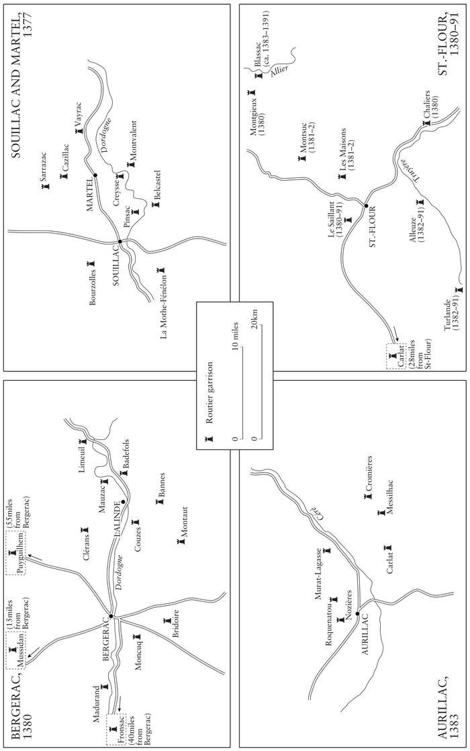
27 Cities under siege, 1379—1389
Saint-Flour paid patis under a succession of agreements with the confederation of Carlat. These deals came at a crushing price and rarely offered much protection. They did not protect outsiders coming to the town, who had to buy safe-conducts. Theroutiercaptains could not always control their men. Treaties would expire or one or other party would be accused of breaking them. Patis would fall into arrears. The captains would then issue letters of marque, a procedure borrowed from international law and gradually sanctioned by practice, which authorised them to enforce the debt against anyone from the same locality. Mounted men would once more descend on the town to carry off animals and people and destroy crops and buildings while desperate attempts were made to patch up a fresh agreement in the face of increasingly exorbitant demands. Captains belonging to different federations declined to honour each others’ agreements and safe-conducts. Mérigot Marchès, for example, established a satellite garrison at Fortuniers within raiding distance of Saint-Flour and insisted that further ransoms would have to be paid to him as well. The tuchins had no regard for anyone’s agreements. Groups of peasant outcasts stiffened by small numbers of hobereaux and impoverished refugees from the towns indiscriminately attacked walled towns and routier castles alike, murdering their victims with a brutality beyond anything for which the free companies were responsible. The meticulous accounts kept by the consuls of Saint-Flour recount day by day the unfolding catastrophe. There were generally between two and five raids a week, most of them coming up the valley from Alleuze. The inhabitants were obliged to keep watch in shifts, each man doing an average of two or three nights a week. Heavy taxes were imposed to pay the patis exacted by the companies and to meet the costs of defence. Materials were requisitioned without warning to repair the walls. The town’s trade dried up. The plat pays was abandoned. Without the crops of the outlying country the inhabitants lived constantly at the edge of starvation. Men left to find a livelihood in other parts of the country. Women and other ‘useless mouths’ were pushed out of the gates to conserve food supplies.26
Saint-Flour was an extreme case but it was not unique. ‘Dear Sirs and good friends,’ wrote the captain of three local garrisons to the consuls of Bergerac, in the imperious style which his clerk had borrowed from the French royal chancery, ‘since you are closer to Bridoire, Issigeac and Bannes, than you are to any other English garrison, I command you to appear forthwith at Bannes to conclude a treaty of patis, failing which you had better watch out or we shall do you all the damage we can.’ In 1382 Bergerac was under attack from at least six garrisons and was paying patis to three of them. The consuls of the town kept a diary of the raids, in which they recorded their losses of cattle, buildings and vines and of men and women mutilated, kidnapped or killed. In the first nine months covered by this document, from February to November 1379, they counted forty attacks by mounted raiding parties, an average of about one a week. Yet life in provincial towns like Bergerac and Saint-Flour would probably have been even worse if they had refused to pay patis. In the double town of Rodez the Bourg paid patis whereas the Cité did not. The evidence suggests that the Bourg survived more or less unscathed. But the Cité listed more than twenty garrisons in 1383 whose continuing depredations were reducing its inhabitants to penury. ‘Make for the forts, take with you your food, drive your cattle out of the region …’ the town crier would proclaim from the cathedral steps on market days when a raid was expected. It was the same in Albi, hemmed in by ten Anglo-Gascon garrisons in the service of the Counts of Armagnac and Foix, where the citizens were forbidden to go out of the gates unarmed. Rather later Saint-Antonin in the Rouergue was said to be under attack by seven Anglo-Gascon garrisons, Figeac by fourteen.27
The kidnapping of townsmen and travellers found outside the walls without safe-conducts was a terrifying experience. Men would find themselves seized by brigands who emerged suddenly from the forest and led them off to some nearby castle with their hands tied behind their backs and their legs fastened together beneath the belly of a horse. Most of them were not worth the cost of their keep. They had to be deliberately ill-treated to make their relatives pay up. Geoffrey Tête-Noir and Perrot de Béarn were notorious for the stinking pits in which they would confine their prisoners. A pastrycook who was tried for brigandage at the Châtelet in 1391 told his judges that his job was to beat them up or starve them until they agreed to pay. He reckoned that some sixty of his victims had died in the process. Yet the great majority of prisoners were peasants and labourers whose ransoms were pitifully small. In 1382 an inquiry into routier operations in the castlery of Casteljaloux in Languedoc found that the average ransom was twenty francs for a live prisoner and twelve for a corpse. Many could not even afford that. They were put to work or murdered.28
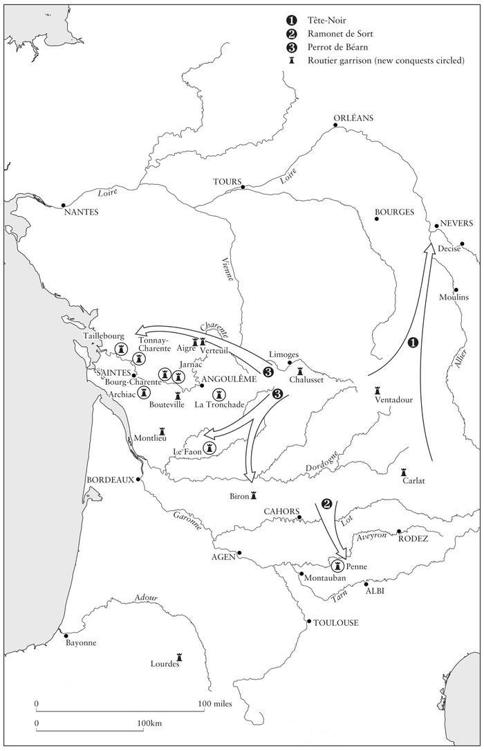
28 Routier operations, autumn 1383
Bertucat d’Albret never completed his grand scheme of conquest. He was taken prisoner in a skirmish in the summer of 1382 and, although he appears to have been ransomed quite quickly, his health was broken. He died in September of the following year. His death deprived the English of an ally of great cunning and organisational skill and brought an end to any prospect of their recovering Bergerac. Bertucat’s successor was a hitherto obscure routier captain from the Landes called Ramonet de Sort. Ramonet called himself Bertucat’s ‘nephew’. He appears in fact to have been the son of one of the old warrior’s companions-in-arms from the early years of his career. Bertucat had appointed him as his lieutenant in Quercy when he departed for England in 1381 and at some stage adopted him as the heir to all his assets outside the Bordelais. It is a tribute to Bertucat’s force of personality and the strength of the leagues which he created that after his death his choice was by and large respected by his companies. Ramonet became the captain-in-chief of sixteen garrisoned castles in Quercy and at least two in Périgord. Ultimately he seems to have stepped into Bertucat’s shoes even in Auvergne, although he personally commanded only one fortress there. What is clear is that Ramonet de Sort, although fighting for profit like all of his kind, saw himself as an English partisan just as Bertucat had. He signed himself ‘Captain for the King of England’. His ransom treaties reserved his obligations to Richard II and declared that he would be at liberty to make war again if the King’s representative ordered him to do so. His men cried ‘St. George!’ as they went into battle.29
Whether or not it was Ramonet’s doing his appearance on the scene coincided with another increase in the range and boldness of the routiers’ operations. In September 1383 the combined companies of Carlat and Ventadour launched a long-distance raid up the valley of the Allier which penetrated as far as the Nivernais, more than 150 miles north of their base. At one point they were reported to be heading across the Morvan hills into Burgundy. The companies’ attempts to extend their reach northward were usually frustrated by the diligence of the Duke of Bourbon’s officers in the Bourbonnais, the strong local cohesion of the nobility of Poitou and the impassable barrier of the Loire. There would be other attempts in the coming years to penetrate north of the river but none of them succeeded. To the south and west, however, the companies fared better. In about October 1383 Ramonet de Sort himself led a large raiding force from Quercy south across the causses and laid siege to Penne d’Albigeois, an important royal castle dominating the gorges of the Aveyron. A formal siege involving forces on this scale was something new in the history of the companies, who had traditionally avoided difficult or time-consuming operations. After several weeks Ramonet captured Penne and made it a base for fresh raids deep into the Toulousain. From the Limousin the Anglo-Gascon companies advanced south into the Bergeracois and west into Saintonge. Perrot de Béarn established himself for a time in the great fortress of the Gontauts at Biron, well south of the Dordogne. In Saintonge his subordinates and allies acquired a string of at least six fortresses along the River Charente, paralysing the main navigable waterway of the region in what was clearly a concerted campaign of expansion.30
*
Because the companies’ activities were confined to the southern and central provinces they had little impact on politicians in Paris where the main strategic decisions on the conduct of the war were made. The only influential figures there with a real interest in the problem were the Duke of Bourbon, whose domains were in the front line of their operations, and Marshal Sancerre, who passed much of his career in the region. South of the Dordogne the control of the Gascon march and the suppression of the companies remained the responsibility of the Duke of Berry as royal Lieutenant in Languedoc. His attention was generally engaged elsewhere and his government was disabled by penury. The aides and the fouage were reimposed in Languedoc in 1383 but anarchy and brigandage continued to depress receipts. The number of taxable households in the three seneschalsies had been 31,000 when the Duke of Anjou departed, a figure which itself represented a reduction of more than 60 per cent since 1370. In 1387 it was only 23,000 and still falling. Much of what was collected was appropriated by the war treasurers in Paris to finance successive attempts to invade England or taken by the household treasurers of the Duke of Berry to fund his opulent style of life. In the 1370s the taxpayers of Languedoc had supported almost all the cost of the campaigns against the English possessions in Gascony. In the 1380s they could not even find the cost of their own defence and internal administration. These problems would have challenged a far abler and more diligent man than John, Duke of Berry. Berry, however, was neither able nor diligent. He was a poor administrator with no grasp of finance and no interest in warfare, who passed just twenty-three months in Languedoc during the nine years when he was Charles VI’s Lieutenant there. He very much preferred Paris.31
The root of the problem was the fragmentation of the defence at a time when the companies had learned to co-ordinate their operations and concentrate their forces. None of the Duke of Berry’s council in Toulouse had the stature to direct the defence of an area extending from the Rhône to the Atlantic and from the Dordogne to the Pyrenees. The job therefore had to be done piecemeal by local officials. They had to find men and money for the task within their own districts from the communities that they were protecting. Since these were the very communities which had suffered most from the operations of the companies they were rarely in a position to pay much. The history of these years is an unending round of arguments with towns and local assemblies, leading to the recruitment of tiny armies for strictly local operations, generally for no more than a few weeks at a time. When the captain of Penne d’Albigeois appealed for help to the Seneschal of Toulouse during the siege of 1383 no one stirred. Even within the same province Clermont would not willingly come to the aid of Saint-Flour or Cahors to that of Figeac or Martel. A number of attempts were made to combine the resources of the provinces of the Massif Central. None of them was successful. In June 1381 the Duke of Berry bullied the provincial Estates of Auvergne into forming a league with four neighbouring provinces to raise a combined army of 500 men for four months. The venture foundered on the particularism of the various provincial assemblies. The Estates of Rouergue, which had been invited to participate, declined to do so. The Estates of Gevaudan, Velay, Vivarais and Valentinois agreed but contributed less than ten per cent of the cost between them. Another attempt was made at the end of 1382. This time Rouergue participated but the enterprise succeeded no better. In October 1384 a fresh league was formed with the same membership but only against the vocal opposition of the Estates of Auvergne, whose representatives regarded it as a device for making them fund the defence of other provinces. They had to be thrown into prison to make them change their minds. There was no suggestion on any of these occasions that contributions should be made by the taxpayers of the three seneschalsies of Languedoc or the King’s treasury in Paris.32
The French King’s ministers in Paris did not wake up to the gravity of the situation until the federated companies of Auvergne and Quercy began to break out into the lowland provinces. The loss of Penne d’Albigeois and the fortresses of the Charente came as a shock in Paris. But there was no change of policy until the mid-1380s. In 1385 the Duke of Bourbon was appointed as royal Lieutenant in the whole march region north of the Dordogne with powers matching those of the Duke of Berry south of the river. Bourbon’s political stature and his reputation as a soldier made possible the first effective collective effort against the companies for many years. About two-thirds of his expenses were met by the King. Further financial contributions were imposed across the territory of his lieutenancy. Much of the baronage of the Bourbonnais, Limousin, Poitou and Saintonge brought their retainers to his army. Including ‘varlets’, a corps of Genoese crossbowmen, and Jack Wyn’s Welsh legion, Bourbon’s strength must have come to more than 3,000 men, the largest force which had fought on the Gascon march since the days of the Duke of Anjou. The Duke passed five months, from June to November 1385, in the valley of the Charente and achieved an almost complete sweep of routiergarrisons in Saintonge. Le Faon, west of Angoulême, was taken by storm. The small forts of Archiac and La Tronchade were demolished and their garrisons put to death. Bourg-Charente surrendered after the besiegers suborned some of the garrison and poisoned the garrison’s water supply. The lower town of Montlieu was battered into submission with stone-throwers and the defenders of the citadel induced to surrender by threats to ‘string them up by their throats’. The great stone bridge over the Charente at Taillebourg was stormed in a combined attack by land and water and every one of its defenders killed. The garrison of the nearby citadel surrendered three days later. Verteuil, one the strongest fortresses of the region, defended by a garrison of nearly a hundred men, was abandoned after Bourbon’s men had bombarded it for more than two months and undermined the walls. At the end of the campaign only one Anglo-Gascon company had successfully resisted the French army and that was the garrison of the immense thirteenth-century fortress of Bouteville. This place, and the small town of Jarnac on the Charente just north of it, were now the only surviving strongholds of the companies north of the Gironde. The Duke of Bourbon left what amounted to a permanent field force of some 600 mounted men to guard the marches of Poitou, Périgord and Limousin under the command of a group of knights of his personal household. The march of Gascony was entrusted after his departure to Marshal Sancerre. He was destined to serve as permanent military governor in Saintonge and Angoumois until 1389, with a standing army which varied from 1,400 men to over 2,000. These steps effectively blocked the northward expansion of the Anglo-Gascon companies.33
The defence of Languedoc proved to be a more difficult problem. In the spring of 1384 the Seneschals of Toulouse and Carcassonne appealed to the King’s Council over the head of the Duke of Berry for help against the companies, which were by now penetrating into the region from the Albigeois in the north and Bigorre in the south. The royal Council appointed Gaucher de Passat, a protégé of the Duke of Bourbon then serving as one of the captains of the King’s bodyguard, as temporary Captain-General of Languedoc. Gaucher de Passat arrived in the south in June 1384 and set up his headquarters at Gaillac in the Albigeois. There he joined forces with the Seneschals of Toulouse, Carcassonne and Rouergue and set about clearing the companies around Albi. His efforts in the Albigeois met with mixed results. Most of the companies of the region had already agreed to evacuate their strongholds for money. The most that can be said is that the presence of his army ensured that the agreements were observed. But Gaucher failed in his main objective, which was to recapture Penne d’Albigeois, the one fortress in the region which had declined to do a deal with the local communities. In the hands of Ramonet de Sort’s lieutenants the place proved to be impregnable and Gaucher was obliged to abandon the siege after a few days. It was ultimately bought back from the garrison of Ramonet de Sort at very great cost in the following year. Gaucher de Passat left for Toulouse towards the end of 1384 and for the next year spread himself thinly across the whole vast area of Jean de Berry’s lieutenancy, firefighting from the Agenais to the Pyrenees. He was a competent soldier but he did not have the stature of a Duke of Bourbon and received little or nothing from the royal treasury. As a result he depended entirely on local contributions and local recruits. None of them would fight outside their home provinces. So Gaucher had to raise and finance a fresh army in each region in which he operated. He never disposed of more than 400 men-at-arms. By the time he was recalled the situation in Languedoc was worse than ever.34
After much pressure from the King’s Council the Duke of Berry was induced to revisit his province in August 1385. Apart from one brief visit he had been absent for three years. Characteristically, his response to the growing crisis that he found in Languedoc was to pass the problem to someone else. In October 1385 the Duke appointed his nephew John III, the new Count of Armagnac, as Captain-General in Languedoc and all the march regions south of the Dordogne. Berry delegated to him his entire civil and military powers and charged him to recruit a permanent force of 700 men-at-arms for the defence of the province, more if the English were to invade from Gascony. For these services Armagnac was promised a large monthly fee together with an even larger life pension than he already enjoyed. Early in 1386 the Duke of Berry withdrew once more to the north leaving John to get on with it. Unfortunately the Count of Armagnac was very close in outlook to the routier captains he was pitted against. He was a natural adventurer: ambitious, aggressive, insubordinate and devious. His appointment was a serious misjudgment. Armagnac appears to have raised most of the 700 men-at-arms and deployed them in garrisons on the northern marches of Languedoc and in the Pyrenean county of Bigorre. But having done this he complained that the treasurers in Paris were not paying his pension and treated this as an excuse to do nothing more. The money raised for the soldiers’ wages was diverted into his own pocket. As a result most of the men deserted. Those in Rouergue and the Velay stayed at their posts but under-strength and without proper equipment. Some of them had to sell or pledge their horses to feed themselves.
The Anglo-Gascon companies seized their chance. There was a dramatic increase in the range and frequency of their raids. The Duke of Berry’s councillors in Toulouse reported that the offensive was being actively pushed by the new Seneschal of Gascony, Sir John Harpeden, and there is some evidence that it was. In the Agenais the Durforts of Duras, who were the main allies of the English, prowled about the country with a company of 500 men-at-arms while Harpeden negotiated with the lords of the plat pays and distributed circulars inviting the whole province to submit. By the autumn of 1386 the Anglo-Gascon companies had established control over most of the Agenais and the neighbouring province of Quercy. The French royal administration virtually ceased to exist in both provinces. Cahors and Montauban were reported to be on the verge of submitting to the English. These conditions quickly spread into the seneschalsies of Toulouse and Carcassonne. One of the captains of the Carlat confederation, the Bourc de Montsac, was active there in the spring of 1386. By September he had established ransom districts right up to the gates of Toulouse. All of this had a catastrophic effect on the receipts of the French provincial treasurers. Tax collectors were unable to venture out on the roads without a large armed escort. Collection entirely ceased in Quercy and almost entirely in Rouergue. The taille imposed to finance the invasion of England was effectively abandoned in Languedoc in April 1386. Over the whole province the yield of theaides fell by a quarter.35
Behind the walls of the towns the familiar structures of authority disintegrated. Families migrated elsewhere. Watches were no longer kept. Garrison commanders were caught trying to sell out to the enemy. Something of the atmosphere of suspicion, fear and insecurity in the small towns of the region emerges from the confession of Jean Fossanas, a Gascon who was captured in a skirmish and accused of treason. Fossanas was probably a peasant by origin. He had found work as a ‘varlet’ at Espiens in the Agenais, one of the castles held by the companies of Nompar de Caumont and the Captal de Buch, who employed him in a variety of low-level missions. His graphic tales of treachery and espionage are in their own way more revealing than the recollections of the more flamboyant figures whose boasts fill the pages of Froissart. A town is identified as a target. A man is sent to explore the walls, looking for dark corners and unblocked openings. A promising site is found beneath the shadow of the church tower and then judged too high. Three men enter the place disguised as casual labourers to see how a gate might be captured. Three more head for another town which may prove easier. Fossanas himself goes to check the gateways of Tournon, a substantial walled town. This is regarded as highly promising. Three inhabitants are found who are prepared to betray the place for 1,500 francs and the right to take the ‘best’ mansions there for themselves. A date is fixed for the assault. A letter is received from a man in Lectoure, who offers to help the company to enter his town when it is his turn on the night watch. He is not even asking for money. He just wants to be allowed to take a fine house of his choice and to ‘have his way’ with two fellow citizens who have crossed him. So the companies of Nompar de Caumont and the lord of Duras turn their attention to Lectoure. Two suitable points of entry are found. Two hundred men from the combined companies are detailed to take part. Help is summoned from other routier federations of the south. Reinforcements are expected from as far away as Lourdes, the principal Anglo-Gascon garrison in the Pyrenees. A specialist in difficult escalades arrives from one of the Count of Foix’s garrisons in the Albigeois. The attempt fails at the last minute because all the dogs of the town start barking as the scaling party approaches. At this point the brief autobiography of Jean Fossanas ends. We know nothing of his fate. He was probably one of the many insignificant figures of the irregular war who were not worth a ransom and were obscurely hanged at midday at the gate of some southern town.36
The situation of Languedoc and the march was conveyed to the Duke of Berry in his Parisian mansion in a succession of panic-stricken reports from his councillors in Toulouse. The Gascon march, they reported, which had been in the western Agenais only months before, was now just five miles from Toulouse. The president of the Duke of Berry’s council travelled to Paris personally to deliver an account of events and to hand in his resignation. The Duke protested that he was too busy to deal with the matter on the spot. He blamed the Count of Armagnac. Armagnac for his part was unrepentant. In September 1386 he too left Languedoc to participate in the invasion force gathering at Sluys, taking much of the chivalry of the south with him. He made no arrangements for the defence of the province in his absence and left no one behind to represent him apart from two members of his own council in Rodez, who closed their ears and declined to answer letters. The Duke of Berry’s councillors could have been forgiven for exaggerating their tale of distress but the sombre picture painted in their reports is borne out by other evidence. Cahors is known to have paid patis to Ramonet de Sort, whose companies were able to dispose of their spoil in the city’s markets and pass freely to and fro across the famous fortified bridge over the Lot. The conditions in the region left them with no alternative, the citizens replied, when the King’s ministers expressed outrage. The citizens of Montauban, surrounded by fourteen routier garrisons, had no more choice than the Cahorsins. They not only paid patis to Ramonet’s garrisons but declared that they would not admit the Duke of Berry or Gaucher de Passat into their citadel.37
*
In 1387 the Count of Armagnac embarked on an attempt to recruit a routier army which was in some ways like his father’s disastrous scheme of 1379. The target this time was not the Count of Foix but the King of Aragon. Some years earlier Armagnac had bought from that impecunious adventurer Isabella of Mallorca the rather tenuous claim of her family to the crown of Aragon. It was a speculation characteristic of both sides. Isabella had no claim to sell, for she had already sold what rights she had to the late Duke of Anjou. And Armagnac for his part had nothing but promises to give her in exchange: a pension, a title, and a share of the spoils, all on condition that the venture succeeded. But the transaction had given the Count what he wanted, a legal and political cover for what was in reality a crude plundering expedition. On 5 January 1387 Peter IV of Aragon died. Armagnac, who had just returned from the mud and frustrations of Sluys, devised a plan to serve his own interests and those of Languedoc at one and the same time. He proposed to rid southern France of the Anglo-Gascon companies by buying them out of their fortresses in the Massif Central at the expense of local taxpayers and leading them into Aragon. Preliminary approaches were made to the captains of the confederation of Carlat in the spring of 1387. Support was obtained from the Avignon Pope, who had his own interest in suppressing the brigandage of the south. Shortly afterwards Armagnac unveiled his plans at a series of provincial assemblies. Characteristically, the whole project was conceived and implemented without disclosing the ultimate object of the venture and without reference to the Duke of Berry, who was in Paris occupied by other affairs. Berry would certainly not have approved if he had known what Armagnac planned to do with his routier army. The new King of Aragon, John I, was a strong francophile married to a French princess. At the very moment that the Count of Armagnac was devising his scheme to unleash an army of bandits over John’s kingdom, the King’s Council was planning to send an embassy to John I in Barcelona with proposals for a closer alliance.38
At the beginning of July 1387 there was a great assembly in the cloister of the Franciscans, beneath the ramparts of the city of Rodez. The Count of Armagnac presided. The papal legates were present. There were delegates from all three seneschalsies of Languedoc and the five outlying provinces of Auvergne, Velay, Gevaudan, Quercy and Rouergue, an unprecedented collaboration covering the whole of Jean de Berry’s lieutenancy. Shortly an agreement was reached. The Count undertook to guarantee the evacuation of thirty major fortresses controlled by sixteen routier captains in Auvergne, Quercy and Bas-Limousin. This represented about three-quarters of the companies operating in central France including almost all of those associated with Carlat. He agreed to obtain the routiers’ undertakings, supported by written oaths if possible, not to make war again in France or in the Dauphiné, Provence or the states of the Avignon papacy. He would then unite them in a great army and lead them out of France by 1 November 1387. In return the communities of the Midi agreed to pay him a lump sum of 250,000 francs, by far the largest single payment ever made for an evacuation. In addition the papal legates offered a clerical subsidy from the dioceses of the south. The conventions agreed at Rodez said nothing about the destination of Armagnac’s army. Even the routiers who were to take part were not told. They had to be content with the information that they would be required to serve on a ‘campaign which His Lordship intends to undertake, which will be worthy and honourable for him and profitable for his companions, but which he cannot disclose yet for fear that the news will undermine the venture.’ In Paris the King’s ministers were already suspicious. The Duke of Berry asked for assurances that theroutiers would be led out of France by the Rhône and not over the Pyrenees. He was presumably put off with lies. The Council sent an emissary to examine the terms of Armagnac’s agreements with the companies. He would have found only circumlocution and silence. The Pope appears to have guessed what was afoot. He withdrew his support and cancelled the clerical subsidy.39
The Count of Armagnac’s evacuation plan was combined with proposals for dealing with the garrisons closer to the Gascon march by force. Either they had refused to participate in the scheme or they were assumed to be hostile to it. Towards the end of the summer, after the delegates at Rodez had dispersed, there was a co-ordinated French offensive against the Gascon march north and south of the Dordogne. In Saintonge Marshal Sancerre siezed Jarnac, then the only remaining English-held town on the Charente, and marched on Blaye and Saint-Emilion, the major English strongholds on the north shore of the Gironde. He failed to take either town. But, while Sir John Harpeden rushed reinforcements to the Gironde, Armagnac invaded the Agenais by the valley of the Lot at the head of a large army of cavalry and mounted crossbowmen. He had overrun most of the garrisoned places in the Lot valley before the English succeeded in organising a coherent defence. He then penetrated down the Dordogne into southern Périgord. A total of twenty-eight castles and walled towns and villages were taken from Anglo-Gascon partisans in the space of a few weeks. It was a substantial achievement but the only one in the four years during which Armagnac was effectively governor of Languedoc.40
There were several difficulties about the agreements which Armagnac had made at Rodez. In the first place they depended entirely on the Count’s diplomatic skills and business acumen. He had to buy out the companies from their fortresses and pay their war wages, all out of his fixed fee. The financial side of the venture was never properly thought through. The three seneschalsies of Languedoc were the richest of the Midi and in spite of the events of the past three years the least war-damaged. However, in order to get their agreement, Armagnac had limited their contribution to the proceeds of a two and a half francs hearth tax. This was later raised to three francs per hearth with a theoretical yield of 69,000 francs, which was about a quarter of Armagnac’s lump sum fee. The main burden fell on the two provinces of Auvergne and the Rouergue, who had to raise 50,000 francs each from a much smaller and poorer population. The Estates of Rouergue refused to contribute more than 9,000 francs. The communities of the Velay had to be forced to grant anything at all. The contribution of Auvergne, which had fewer than 3,000 taxable households, was found to require a hearth tax of twenty-two francs, an unheard-of rate which was received with uproar when it was announced to the provincial Estates at Clermont. The tax ultimately imposed was fifteen francs per hearth and even that proved to be impossible to collect.41
Armagnac’s laborious negotiations with the captains were supposed to be completed by September 1387. In fact they dragged on for more than a year. The captains constantly changed their minds. They quarrelled among themselves. Many of them were subjects or retainers of Gaston Phoebus, Count of Foix, who lobbied actively against the venture and persuaded some significant routier leaders not to participate. In the end Armagnac succeeded in agreeing terms with seven of the principal captains, accounting for twenty-two of the thirty castles named in the conventions of Rodez. They included Ramonet de Sort, Mérigot Marchès and the captains of Carlat and Alleuze. These were admittedly the most important routier leaders in Quercy and Auvergne. But they did not include six important companies which for some reason had been left out of the conventions of Rodez, among them the large garrison of Le Saillant north of Saint-Flour. Nor did they include the important groups of garrisons in Bas-Limousin controlled by Perrot de Béarn and Geoffrey Tête-Noir, both of whom enjoyed close relations with Gaston Phoebus and had declined to take part. As if to demonstrate his independence, in February 1388 Perrot achieved the greatest stroke of his career by capturing Montferrand, one of the three principal towns of Auvergne. According to Froissart, the deed was done by the company of Chalusset, reinforced by detachments from a large number of the other Gascon companies in Auvergne. A handful of men entered the town on market day disguised as merchants and opened the gates for sixty of their companions at dead of night. It was wet, windy and bitterly cold. The captain of the town had sent his son out to do the rounds. But the street patrol bribed him to let them go to bed. When the companies left three days later, 400 horses were needed to carry the plate, carpets, silk and cloth looted from the inhabitants. No town of comparable importance had fallen to the companies for more than twenty years.42
Most of the routier captains had promised the Count of Armagnac to observe a truce while the money was raised to pay them. But the collection of the money took much longer than they had expected. As time went on, the truces expired or were simply abandoned by captains who could no longer restrain their men.43 Shortly the distress in the unwalled villages of the plat pays was as great as anything seen before the Count of Armagnac’s gathering at Rodez. Limoges was the city of St. Martial, the third century apostle of the Limousin, whose relics, preserved in the great Benedictine abbey of the upper town, were exhibited on the high days of the Church. On 30 June 1388, the feast day of the saint, hysterical crowds of pilgrims crammed into the abbey church praying for relief from the physical and mental scars of war in an emotional atmosphere heightened by plague, harvest failure and incoherent reports of distant negotiations for a truce. As the saint’s head encased in enamelled plate was lifted above the heads of the crowd the companies’ victims came forward, some of them completely naked, to proclaim some fresh miracle due to his intercession and to present wax models of themselves as votive offerings at the shrine: prisoners of Perrot de Béarn cast into deep pits at Chalusset; men chained hand and foot by Tête-Noir’s men at Ventadour; travellers carried off by horsemen when they were found on the road without a safe-conduct; a priest kidnapped in the Rhône valley by armed men returning from Castile; countless victims held in dungeons for weeks, months or even years to force their kinsmen to ransom them; all liberated by the power of St. Martial, their leg-irons shattered, their prison doors opened, their guards paralysed. Occasionally there was a victim from the other side of the divide, an Englishman saved from drowning in his heavy armour or a Gascon saved at the last moment from the hangman. The impotence and despair of a whole generation are reflected in these naive tales of miracles commemorated in one place on a single day. They could have been matched over a longer period at many other popular shrines, where a growing proportion of pilgrims and votaries were now victims of the war.44
By the end of 1388 the Count of Armagnac was becoming as frustrated at the slow progress of his plans as everyone else. Unfortunately his receipts from the provincial treasurers were still well short of what he had promised to the companies. In order to get men released for his army of Aragon he had to agree to some untidy compromises. Large payments on account were made to the captains of Carlat and Alleuze in order to persuade them to keep the peace and detach part of their strength for service across the Pyrenees. Mérigot Marchès was paid a lump of 4,000 francs plus 1,000 francs worth of horses and was granted a town in Rouergue. According to his own account he was also given a private assurance that if his garrisons resorted to their old ways in order to keep themselves the matter would be overlooked provided they stayed away from Armagnac’s domains in Rouergue. Ramonet de Sort drove an even harder bargain. In addition to a share of war profits he received a grant in perpetuity (subject to royal confirmation) of all sixteen castles in Quercy which were occupied by his companies plus the town of Gourdon. This meant that only Roquenatou, Ramonet’s one fortress in Auvergne, would be evacuated and then only when he was paid for it. In December 1388 the first contingents of Armagnac’s routier army were ready. Over the following months they were escorted south by Armagnac’s lieutenants in small bands and by different routes towards the marches of Roussillon. The Count sent his brother Bernard, a close collaborator in all his ventures, to take command of the horde of brigands gathering by the Mediterranean.45
*
By this time the political landscape of France had radically altered in ways that boded ill for the Count of Armagnac. When Charles VI shook off the tutelage of his uncles in November 1388 everyone knew that the Duke of Berry’s days as Lieutenant in Languedoc were numbered. The Count of Armagnac, whose fortunes were closely bound up with his uncle’s, was removed as Captain-General within weeks of the coup at Reims and replaced by Marshal Sancerre. For Berry himself the blow fell at a meeting of the royal Council in the Louvre on 18 May 1389. The King declared that he was moved by the ‘clamour’ of complaints reaching him from Languedoc. A commission of senior councillors would leave at once for the south to report on conditions there and take over the civil and military government of the region until more durable arrangements could be made. The Duke of Berry was not formally dismissed. The matter was too delicate for that. But messengers were despatched to proclaim the change in market squares across Languedoc. The Duke took it badly. He blamed Olivier de Clisson and never forgave him for the insult. ‘One day’, he declared, ‘their fortunes will wane.’ Four months later, on 1 September, he formally resigned his lieutenancy into the King’s hands.46
Charles VI left two days later for the Midi. His servants spared no effort to project his image as a just and mighty prince with all the sacerdotal ritual and symbolism at which the Valois monarchy was so skilled. He was carried through city gates beneath a canopy of gold cloth and walked on carpets of flowers. He was welcomed everywhere by kneeling dignitaries, processions, choirs and crowds of curious onlookers who had never previously beheld a king. He was received in state by the Pope in the cavernous gloom of the audience hall of the palace at Avignon. At the end of November 1389 he entered Toulouse. During the six weeks which the King passed in the city the administration left by the Duke was purged of his friends, just as it had been in the north. All three provincial seneschals of Languedoc were replaced and a new government was put over them in which the leading figure was Marshal Sancerre. Two days before Christmas the Duke of Berry’s private secretary and factotum, Jean de Bétizac, whose main crime was that he was a homosexual who had grown rich out of his master’s incompetent and unpopular administration, was burned alive in a public square in Toulouse in spite of the Duke’s frantic efforts to save him.47
The immediate consequence of the change of government in Languedoc was to inject new energy into its dealings with the companies. The Council resolved upon a two-track policy involving negotiation with those companies who were prepared to negotiate and the use of overwhelming force against the rest. In May 1389 Enguerrand de Coucy was sent to the Massif Central with 400 men-at-arms and 200 crossbowmen to serve as the kernel of a permanent army for use against the companies. Their first objective was Geoffrey Tête-Noir’s castle at Ventadour. Tête-Noir’s long history of savage and unpredictable behaviour made him an obvious target. But by the time Coucy reached Ventadour he was dead. He had been caught in a skirmish outside the castle gates and struck by a crossbow bolt which penetrated his helmet and entered his skull. When the French army arrived outside the walls in July the fortress was defended by his two nephews, Alain and Pierre Le Roux. Their only concern was to save their skins. Their uncle had always eschewed any national allegiance but without one they knew that they would be treated as bandits, not as prisoners of war. One of their first acts on taking over was to execute a written declaration that they held Ventadour for Richard II. They had this document carried to England, where it still sits in the Public Record Office, but by the time this disingenuous declaration reached Westminster it was too late. The English had just entered into the truce of Leulinghem and had no further interest in such captious friends. The French for their part were determined to establish the principle that those who fought on after the truce were common criminals who could expect no mercy. The siege of Ventadour lasted nearly nine months. The exact circumstances in which it came to an end are obscure but the evidence suggests that the garrison mutinied and sold their two captains together with the castle and its stores to the government for about 12,500 livres. The garrison received safe-conducts and an armed escort back to Brittany. The Le Roux brothers were taken to Paris and beheaded as traitors at Les Halles. Their fate was intended to impress the other routier captains and no doubt did. Even Perrot de Béarn, who had refused to deal with the Count of Armagnac, thought it wise to observe the truce. Mérigot Marchès actually surrendered his fortresses early.48
Frustrated by the slow progress of the buy-outs the government appointed a commission of three men to take the process out of the hands of the Count of Armagnac. The leading commissioner was one of the King’s chamberlains, Jean de Blaisy. He was a Burgundian knight, ‘famous among soldiers, beloved of princes’ according to Philippe de Mézières. Blaisy set about his task with energy. He travelled south at the beginning of September 1389 and began to look into the Count of Armagnac’s murky dealings with the companies. In November the two men confronted each other at Le Puy. It must have been an uncomfortable occasion. Armagnac had no desire to see his project taken over by the Crown, but he had run out of money and was unable to pay the garrisons their due. He agreed to appoint Jean de Blaisy as his agent to enforce the agreements with the routier captains. He also agreed to add to the list the six major garrisons of Auvergne which had been left out of the conventions at Rodez. In return he received a promise of financial support to make good the deficit. Armagnac had probably received no more than about half of the 250,000 francs promised at Rodez. When his accounts were examined it was found that he was 50,000 francs short of the amount required to buy out the companies with nothing left over for other expenses. The issue was discussed with the King’s advisers. They ordered a further levy on the provinces of the south. The Pope was persuaded to authorise a concurrent tax on the clergy. It was apparently proposed to find the rest of the money from the confiscated assets of Jean de Bétizac. During the winter Jean de Blaisy rode through Auvergne, Rouergue and Quercy with a small cavalry escort, negotiating with one garrison after another. Hostages were taken from those which had received part-payments. Money to pay the balances due to them was collected with painful slowness from the long-suffering taxpayers of the south.49
The most awkward problem was finding alternative employment for the displaced garrisons. Armagnac’s plan to lead them into Aragon was by now public knowledge. In October 1389 Bernard of Armagnac finally gathered the cohorts waiting in Roussillon and set out for the Col du Perthus and the coastal road into Catalonia. Charles VI could not overtly approve of the invasion of Aragon. But neither could he repudiate it without undermining the strategy for disposing of the companies. There was no honourable way out. So the King resorted to a cynical evasion. In February 1390, as the companies of Bernard of Armagnac began to waste northern Catalonia, John of Aragon sent his ambassadors across the Pyrenees to protest. They confronted the French King at Béziers as he was making for the Rhône valley on his way back to Paris. They demanded that he recall his subjects from Aragon and called on him for armed support against the invaders in accordance with their treaties. Charles professed to be ignorant of these treaties. They had, he said, been concluded by the Dukes of Berry and Burgundy during his minority. He would make enquiries of them after his return to the north. In fact he did nothing. In March 1390 4,000 more routiers were reported to be on their way south to join their companions in Catalonia. The Count of Armagnac himself was said to be planning to join them after Easter. In desperation the Aragonese King turned to another ally, Gaston Phoebus, Count of Foix. Gaston Phoebus had plenty of reasons for wanting to see the Count of Armagnac humiliated. He promised to commit 3,000 men from his own companies to the fight. In the event, however, Bernard of Armagnac’s campaign fell apart before either Armagnac or Foix arrived on the scene. In mid-winter, with no standing crops in the fields and the barns and stores emptied out in the invader’s wake, the companies in Aragon soon ran out of food. They began to suffer badly from hunger. In the spring of 1390 the Aragonese gradually drove the main body of the routier army back across the Pyrenean passes. The brothers abandoned the campaign. The whole venture had been a disaster for them both. Bernard of Armagnac was obliged to sell his most valuable asset, the county of Charolais in Burgundy, to defray his losses.50
Armagnac’s deal with the companies in Auvergne was already on the verge of collapse when the Gascon companies began to flow back across the Pyrenees into France. The first serious challenge came from Ramonet de Sort. He had given hostages for the surrender of Roquenatou, but when the time came he declined to deliver the place. In Quercy he refused to surrender any of his castles, on the ground that the Count of Armagnac had granted them to him. Jean de Blaisy for his part declined to recognise the grant, which had in any event been subject to royal confirmation. Ramonet responded by refusing to join Bernard of Armagnac in Aragon and threatening to make war on Jean de Blaisy and his fellow commissioners in France. Some of Ramonet’s companies refused to become involved in this spat. His two principal lieutenants, Noli Barbe and Bernard Douat, both agreed to deliver up their fortresses anyway. But Ramonet himself was intransigent. In December Blaisy challenged him to a trial of the issue by single combat. Both men were in earnest. A place was appointed for them to fight, at Le Puy. A date was fixed, at the end of December 1389. Lists were built. The Duke of Bourbon’s ‘great horse’ was brought to the city for Blaisy to use. The French knight’s jousting armour was repaired and his arms embroidered on his horse’s tunic. At the last moment the rivals were persuaded to settle on the terms that the dispute would be submitted to the arbitration of the Pope. Ramonet can hardly have hoped for much from that quarter but he gained valuable time while Clement VII conducted the formal hearings which his lawyerly instincts demanded. Meanwhile Ramonet resumed his plundering. In March 1390 two castles in Quercy were captured by associates of his: Cazillac, near Martel in the north of the province; and Montbrun, an impressive fortress dominating the valley of the Lot south of Figeac which belonged to the Crown’s principal supporter in the region, the Marquis of Cardaillac. Ramonet de Sort’s example was quickly taken up by others. The captain of Turlande in Auvergne who, like Ramonet, had accepted a part payment and delivered hostages, began to raid the territory of those who had defaulted in paying their patis. The lord of Mussidan resumed his attacks on the city of Périgueux and its dependencies in the valley of the Vézère.51
As for the companies which had followed Bernard of Armagnac to Aragon, once the campaign had failed they were simply abandoned on the march of Roussillon, a defeated rabble, their hopes of booty disappointed and their wages unpaid. Bent on revenge against the house of Armagnac, the men marched north under the leadership of Mérigot Marchès. In about May 1390 Mérigot occupied La Roche-Vendeix, a castle belonging to the Dauphin of Auvergne at one of the highest points of the Monts Dore. Another group sacked the small town of Peyrusse on the marches of Quercy and Rouergue and occupied its castle. Bands of men from both centres spread terror and destruction across much of Rouergue during the summer, doing great damage to the domains of the Count of Armagnac. Froissart imagined Mérigot rejoicing in the rediscovery of his old ways:
What joy it was to ride off across the fields after a rich abbot or prior here or a wealthy merchant there or to come upon a mule train … loaded with silk cloth of Brussels or pelts from the Lendit fairs, spices from Bruges and luxuries from Damascus or Alexandria. The peasants of Auvergne and Limousin would come to our gates laden with wheat, bread, straw for our horses, good wine, beef, mutton and fat lambs, chicken and every kind of poultry. Truly we stuffed ourselves like kings … And when we rode out the whole countryside trembled at the sight of us.
It was a literary conceit but a realistic one. The historian had met plenty of captains who spoke like this.52
*
It did not help that the breakdown of Armagnac’s agreements with the companies coincided with a hiatus in the English administration in Bordeaux, on which the French had been counting for support. The English Seneschal, Sir John Harpeden, died in office in the spring of 1389. John of Gaunt left the duchy for England the following November. This meant that the enforcement of the truce was left to the bipartite commissions of ‘conservators’ established in each region to enforce the truce. As Charles VI’s ministers tartly remarked, Richard’s conservators were the very men who were responsible for much of the violence. Ramonet de Sort, Perrot de Béarn, the lord of Mussidan and the captains of Carlat and Alleuze had all been nominated as conservators for the regions controlled by their fortresses. The principle of turning poachers into gamekeepers could hardly have been carried further. On the rare occasions when they were able to agree with their French colleagues their rulings were ignored by their fellow brigands. Yet at Westminster no one wanted to see the truce fail. In October 1389 two knights of the King’s household, Sir William Elmham and Sir Richard Craddock, were sent out from England to serve as additional conservators. They brought with them instructions to ensure that the truce was observed but, it seems, insufficient powers. They returned to England at about the end of February 1390 to report on the situation, accompanied by one of the principal routier captains in Quercy, Bernard Douat. Parliament was then in session at Westminster. In its closing days Gascony was the main item of business.53
On 2 March 1390 Richard II, with the approval of the Lords and Commons, transferred Aquitaine to his uncle for life, solemnly investing him in full Parliament with the cap and wand of office. John of Gaunt’s investiture as Duke of Aquitaine was intended to give the King’s uncle an independent principality worthy of his status and wealth, and to confer on the duchy itself something of the prestige which it had enjoyed in the time of his brother the Black Prince. But although Gaunt had wanted the title and bore it for the rest of his life his administration in Gascony was a disappointing failure. The grant was resented by the towns, especially Bordeaux, which had privileges uniting them in perpetuity to the English Crown. They claimed that Richard was not entitled to grant the duchy to anyone other than the heir to the throne and sent a delegation to complain to him in England. At the same time deep offence was caused by Richard’s decision to revoke prior grants made by his officers in order to reconstitute the ducal demesne for Gaunt’s benefit. The victims of this measure included some influential Gascon noblemen whom neither Richard nor Gaunt could afford to offend. They refused to recognise the authority of Gaunt or his officers. The dispute was in some ways the mirror image of the quarrel of the cities of Languedoc with the Duke of Berry a decade earlier. It was temporarily resolved by a climb-down at Westminster. Richard issued a declaration undertaking that the duchy would revert to direct rule by the Crown on Gaunt’s death. Gaunt for his part swore to respect the liberties of the duchy. The revoked grants were reinstated. Unfortunately these events left a legacy of mutual suspicion which was aggravated by Gaunt’s inability to visit his duchy in person. Instead he was represented there by a succession of overbearing viceroys. Sir William Scrope, who was sent out as Gaunt’s Seneschal in the summer of 1390, was a capable professional soldier who had already served a term as Seneschal some years earlier. But his abrasive manner quickly reopened old wounds. The city of Bordeaux accused him of trampling on their liberties. In August 1392 they declared that they would no longer obey him. Scrope was eventually recalled but his replacement, Harry Hotspur, was another high-handed soldier whom the Gascons liked no better.54
Far away in England and preoccupied with other affairs, John of Gaunt found it exceptionally difficult to enforce the truce in the south-west. A show of force against the Gascon captains of the march was out of the question. His representatives in the duchy had no force to show. Instead it was necessary to engage in a long and slow process of persuasion. Sir Richard Craddock was sent back to Gascony on the day after John of Gaunt’s investiture, accompanied by the new Mayor of Bordeaux, Sir John Trailly. They were armed with instructions to make the local conservators perform their duties. They brought letters under the King’s privy seal addressed to each of the principal routier captains of the march ordering them to surrender their fortresses or be disowned as traitors and rebels. The language of these documents was deliberately designed to prevent their recipients from claiming to be fighting a lawful war if they ever fell into French hands. In July 1390 the French government sent two ambassadors to Westminster to protest about the activities of the routier captains on the Gascon march. Their arrival provoked an anxious debate at a specially convened meeting of Richard II’s Council at Windsor. In fact, however, the worst was already over. Craddock and Trailly appear to have put an end to the depredations of the lord of Mussidan in Périgord. The dispute with Ramonet de Sort in Quercy was resolved, although at high cost to the French. Montbrun had to be bought out for 12,000 francs. A number of garrisons in Rouergue surrendered in June 1390 and some of the major companies of Quercy followed suit six weeks later. In the autumn of 1390 Sir William Elmham returned to Gascony bearing letters addressed to the Seneschal which conferred draconian powers to punish recalcitrant captains. Craddock and Elmham were destined to spend the next two years serving as the English government’s special envoys to the free companies, travelling continually between England and Gascony, negotiating with the French conservators and plying the captains with threats and promises.55
Mérigot Marchès succumbed to neither one nor the other. At the beginning of August 1390, not long after Craddock had left him, an army of some 600 soldiers and 300 labourers descended on La Roche-Vendeix under the command of Enguerrand de Coucy’s lieutenant, Robert de Béthune, Viscount of Meaux. The siege of the place lasted little more than two months. At the beginning of October 1390 Mérigot surrendered it in return for a promise that the garrison would be allowed to leave with their lives. Then he slipped away, carrying with him some seven or eight thousand francs’ worth of gold, silver plate and jewellery, all that remained of the gains of the past few years. He pawned a valuable jewelled helmet to raise money and hid the rest in various secret places in the Cantal. Then he vanished into the hills, plotting with old friends the capture of one fortress after another. All his plans were abandoned or failed. On New Year’s Day 1391 Mérigot was captured by Jean de Tournemire, a retainer of the Count of Armagnac, while attempting to retake Tête-Noir’s old castle at Ventadour by night. Tournemire lodged him in the keep of the Count’s castle at Rodez and called on the Estates of Auvergne to buy him for the considerable sum of 7,000 francs. Otherwise, he said, Mérigot would be released like a plague bacillus into the hills of Auvergne. Jean de Blaisy eventually succeeded in borrowing the price from moneylenders in Clermont. Mérigot was handed over and taken to the Châtelet prison in Paris.
In spite of the loss of several leaves of the manuscript, the record of his interrogation there is among the most interesting judicial documents of the fourteenth century. Mérigot did not dispute the main facts alleged against him. It was undeniable that he had waged war in France for at least twenty years before his capture. Mérigot’s acts were treason if he was a subject of the King of France. They were treason even for a subject of the King of England if Richard II had disowned him. The legal issue was far from straightforward. Although born in Limousin at a time when it was under French sovereignty Mérigot had entered the service of the English after the province had been passed to Edward III by the treaty of Brétigny. This awkward problem was resolved by declaring that Mérigot had voluntarily chosen the allegiance of the English when the rest of his family had acknowledged the sovereignty of France. He could, and no doubt should, have followed their example even if it meant sharing their exile in neighbouring provinces. But Mérigot was doomed anyway by his activities since the truce, which had on the face of it been disowned by the sovereign whom he claimed to have served. He told his judges that when Richard Craddock had visited him at La Roche-Vendeix he had handed him a letter from John of Gaunt containing secret instructions to hold on to his fortresses until the truce had expired. The court did not believe him. Mérigot was condemned to death as a ‘traitor to King and kingdom, persistent robber and arsonist’. His judges were determined to make a spectacle of his death. On 12 July 1391 he was dragged along the ground on a hurdle to the market of Les Halles and beheaded. His head was displayed at the scene on a pike, his limbs exhibited above the four main gates of Paris and his torso suspended from the public gibbet at Montfaucon.56
The capture of La Roche-Vendeix and the arrival of Sir William Scrope at Bordeaux were the signals for the general dissolution of the major Gascon companies. The castle of Peyrusse surrendered shortly afterwards to the Count of Armagnac. Carlat, Alleuze, Turlande and Le Saillant were all peacefully exchanged for money in the course of January and February 1391. Mérigot Marchès’ family, outraged by his treatment, continued to resist for a time. His wife defended the castle of Saint-Exupéry in Auvergne, which was part of her own inheritance, until late in 1391. His brother Danti reoccupied La Roche Donnezat (the modern La Roche Blanche), a powerful fortress south of Clermont, and withstood a siege of several months before selling out in November 1392. The newly created Marshal Jean de Boucicaut directed mopping-up operations against the remaining garrisons.
Where did the unemployed soldiers go? There is some evidence of a general migration of displaced Gascon routiers back to Gascony. Others moved to Italy, the only place in western Europe which still offered a flourishing market for mercenaries. A few tried to return to their old ways in central France. They were treated without mercy. The fate of the garrison of La Rolphie in Périgord, which fell in November 1391, was probably typical: the lord of Mussidan’s captain was beheaded and the entire garrison hanged. Richard II had disowned them all. John of Gaunt’s representatives in Bordeaux folded their arms and declined to intervene. The last of the great Gascon captains to hold out in the central highlands was Perrot de Béarn. He remained in possession at Chalusset until January 1393, when he finally sold the castle to the Estates of Limousin. He is last heard of some eighteen months later, when he briefly occupied two castles in Saintonge from which he was promptly expelled by the officers of John of Gaunt.57
Low-level brigandage was never entirely brought to an end. Some of the evacuated castles proved impossible to demolish owing to engineering difficulties or the claims of former owners. Some lesser places were later reoccupied, generally it seems by local gangs. A group of Gascon soldiers briefly occupied the cliff-top town of Domme in 1393 but fled when not one but two substantial armies were at once directed against it. With the withdrawal of English support concerted routier operations on the scale seen in the mid-1380s came to an end. In the northern provinces the much resented obligation of countrymen to serve watches on the walls of local towns had been abolished in all inland regions from the Somme to the Loire in April 1390 within a year of the truce of Leulinghem. In about 1396, watch duty was finally suspended in the towns near the Gascon march as well. In Paris Eustache Deschamps celebrated in mediocre verse the end of an age of constant tensions: watches by night, gate duty by day, continual ditch-digging; the perennial presence of armed soldiers and the barked orders of their captains; learning to distinguish the sounds of the night from those of animals and men, and forever listening out for the scrape of ladders against stone walls.58
Notes
1 *Hist. gén. Lang., x, 1770—74.
2 Murder: Froissart, Chron. (SHF), xii, 81—9; Tucoo-Chala (1959), 316—21. Territory: see Tucoo-Chala (1959), 41, maps I, VII (end). Financial dealings: Tucoo-Chala (1959), 88—92, 136—48, 270, 283—300, 306.
3 Bernis, ‘Chron.’, paras. 97—105; Higounet, 548—53, *650—8; Tucoo-Chala (1959), 307—11.
4 *Hist. gén. Lang., x, 1619—24; Tucoo-Chala (1959), 311—15 and map VII (end); Bernis, ‘Chron.’, para. 108; Froissart, Chron. (SHF), xii, 31.
5 Carlat: *Reg. St.-Flour, 71—3; Gr. chron., ii, 183; BN Coll. Doat 194, fols. 167—8; AN X1a 1471, fol. 53. Attempted buy-outs (1377—8): Inv. AC Montferrand, i, 391, 406; Comptes Rodez, ii, 159, 160, 167—8; Doc. Millau, no. 424. Numbers: Mézières, Songe, ii, 407. Damage: Reg. St.-Flour, 65; *Troubat, i, 233.
6 Armagnac’s captains (Bastard of Landorre, Perrot de Béarn): ‘Délibérations Albi’, xlvii, 360, 364—5. Cantal: *Reg. St.-Flour, 71—3; Hist. gén. Lang., ix, 871. Quercy: BN Coll. Doat 200, fols. 253—258vo. Armagnac’s role: Preuves Polignac, ii, 70—4; BN Coll. Doat 87, fols. 239—53; BN Coll. Doat 200, fols. 253—258vo.
7 BN Coll. Doat 87, fols. 239—53; Comptes Rodez, ii, 184—5; ‘Délibérations Albi’, xlvii, 544. Bas-Languedoc: Hist. gén. Lang., ix, 871; Mascaro, ‘Libre’, 73; BN Coll. Languedoc 159, fol. 165; Petit Thalamus, 400; Inv. AC Montferrand, i, 409—10; Reg. St.-Flour, 77, 79, 80, 80—1, 82. The recorded participants in this venture (Bertucat, Benoit Chapparral, the Bastards of Armagnac, Landorre, Savoy and Perulle) had all been party to the agreement for the surrender of Carlat: Doc. Carlat, i, 283—4; Hist. gén. Lang., ix, 871. Perrot de Galard, the principal captain in Quercy, also participated: see Petit Thalamus, 400; Comptes Rodez, ii, 183—4.
8 Perrot: *Froissart, Chron. (KL), xviii, 552; *Flandin-Bléty, 311—13. Date: AN JJ141/28; Ann. Limoges de 1638, 284, 286—7. Strength: Reg. crim. Châtelet, i, 123. On Perrot: ibid., ii, 187; Jurades de Bergerac, i, 76; Foed., vii, 725 (name); Chron. Bourbon, 200. Mérigot: *Thomas, 384—5; Reg. crim. Châtelet, ii, 187, 194; *Troubat, i, 230; Livre de vie, 406, 411; Froissart, Chron. (SHF), ix, 141; Reg. St.-Flour, 261, 271. Mérigot also held Châteuneuf-de-St.-Nectaire: Reg. crim. Châtelet, ii, 177—8; BN Coll. Doat 203, fols. 106—108vo. St.-Exupéry belonged to his wife: Froissart, Chron. (KL), xiv, 175, 181. Mercoeur: AN JJ141/272; *Hist. gén. Lang., x, 1823—5; Reg. crim. Châtelet, ii, 204—5; Froissart, Chron. (KL), xiv, 264.
9 Du Guesclin: Inv. AC Montferrand, i, 408, 411; Reg. St.-Flour, 74*, 82—3, 84, 89, 91—2; Petit Thalamus, 400; Chron. Bourbon, 116—18; Gr. chron., ii, 377—8; Hist. gén. Lang., ix, 882. Carlat: Reg. St.-Flour, 99. For Garcie-Arnaud’s involvement: Reg. St.-Flour, 192, 261, 275; Doc. Carlat, i, 290—5. Le Saillant: Reg. St.-Flour, 78, 99, 104—5, 218; Boudet (1893), 17—18; *Savaron, 466. Mérigot: Reg. St.-Flour, 158, 163, 168, 190—1. St.-Flour: Reg. St.-Flour, 101; Boudet (1893), 17—18. Aurillac: Inv. arch. Aurillac, ii, 8—9, 16. Nîmes: * L. Menard, iii (Preuves), 33—6; Petit Thalamus, 403. Cf. the complaints of the Estates at Mazères (Sept. 1381): Inv. AC Narbonne, 361, 362; and Béziers (Jan. 1382): *Lehoux, ii, 53n3.
10 BN Coll. Doat 199, fols. 92—3; ‘Délibérations Albi’, xlvii, 544.
11 Thuriès: Douze comptes d’Albi, i, 310, 314—15, 337, 343—9; Froissart, Chron. (SHF), xii, 107—8; *Hist. gén. Lang., x, 1676—8; ‘Délibérations Albi’, xlvii, 550. Perrot: ibid., xlvii, 364—5; Douze comptes d’Albi, ii, 26, 28. Bastard of Savoy: ibid., i, 313.
12 Froissart, Chron. (SHF), xii, 66.
13 Dognon, 615; *Hist. gén. Lang., x, 1646; BN Coll. Doat 49, fol. 547vo; Douze comptes d’Albi, i, 313—14; *Baudouin, 374—5; Chron. r. St.-Denis, i, 92—4.
14 Bernis, ‘Chron.’, para. 109; *Baudouin, 375; *Hist. gén. Lang., x, 1644—6, 1724—5, 1817—18; AN JJ 142/84; ‘Délibérations Albi’, xlvii, 550, 551—2, xlviii, 265; Tucoo-Chala (1959), 324; *Compayré, 262—3; Douze comptes d’Albi, i, 317;*L. Menard, iii, 35.
15 *Hist. gén. Lang., x, 1645—8; Lehoux, iii, 461; Chron. r. St.-Denis, i, 94; Gr. chron., iii, 8; Choix de pièces, i, 6—9; Mon. hist., no. 1616.
16 *Hist. gén. Lang., x, 1655—6; *Comptes Rodez, ii, 515; *Cabié (1879), 18; ACA reg. 1746, fol. 140vo; Bernis, ‘Chron.’, para. 110—12; AN J 186A/52; Froissart, Chron. (SHF), xii, 67—8. Cf. *Baudouin, 375—6; *Comptes Rodez, ii, 509; *Hist. gén. Lang., x, 1653—4 (misdated), 1782; *Rouquette, 493—4; Cabié (1901)[1], no. 4 (para. 4), no. 5 (para. 4). Gaston had 2,000 men with him at Limoux on 4 Aug.: Bernis, ‘Chron.’, para. 115.
17 *Hist. gén. Lang., ix, 906—8, x, 1653—4, 1749—50; Froissart, Chron. (SHF), xii, 68; Mascaro, ‘Libre’, 74—6; Petit Thalamus, 403, 403—4; AN JJ 135/91; Bernis, ‘Chron.’, para. 115.
18 Inv. AC Narbonne, 359—62; *Hist. gén. Lang., x, 1655—7, 1663, 1665; Arch. Montpellier, ii, no. 93; Lehoux, ii, 54—6. Census: *Hist. gén. Lang., x, 1442—5.
19 BN Coll. Doat 201, fols. 109—12; *Hist. gén. Lang., x, 1664—8, 1670—1, 1691—2; ‘Délibérations Albi’, xlviii, 267—8; Foed., iv, 167.
20 PRO E364/17, m. 3 (Loryng), E364/21, m.3 (Stratton), E364/27, m. 7d (Gedney). Wine: James, 33, 37. Neville: *Froissart, Chron. (KL), xviii, 550—2 (April 1380). Mérigot: Reg. crim. Châtelet, ii, 196—7.
21 Fronsac: Foed., iv, 42, 152, 153; PRO C61/96, m. 17; C61/99, m. 6; Jurades de Bergerac, i, 48—9; Livre de vie, 405, 409, 414, 417. Green: Jurades de Bergerac, i, 70; Livre de vie, 416. Mussidan: Inv. AC Périgueux, 26, 88; *Dessalles (1847), 2; Titres Périgueux, 441—6; Jurades de Bergerac, i, 56, 57—8, 58—9, 62—3, 69—70, 78—9; Livre de vie,407, 408. St.-Macaire: PRO C61/95, m. 1; C61/96, m. 15. Agenais: BN Coll. Doat 201, fols. 197—203vo; 203, fols. 39—47; PRO E101/184/1, fols. 10, 11vo—12; Foed., vii, 446—7. Tolls: PRO C61/97, m. 11.
22 Perrot: *Froissart, Chron. (KL), xviii, 552. Mérigot: Reg. crim. Châtelet, ii, 186—7. Tête-Noir: *Troubat, 232, 233; Froissart, Chron. (SHF), ix, 140—1, xi, 144—5, xv, 209; ‘Mirac. S. Martialis’, 414; Mézières, Songe, i, 530.
23 Bertucat: PRO E403/487, m. 5 (25 Oct.); John of G. Reg. (1379—83), nos. 522—3, 1095; Jurades de Bergerac, i, 60—1; Trés. Chartes Albret, i, nos. 618, 633—5; Lettres de rois, ii, 221—4; Boutruche, 392. Bérard’s death: Froissart, Chron. (SHF), ix, 120—22. Caumont lands: Gregory XI, Lettres (France), nos. 1036—8, 1066—80. Bergerac: John of G. Reg. (1379—83), nos. 522—3, 1095. La Rochelle: Foed., iv, 133; PRO C61/96, m. 14. Grants: PRO C61/95, mm. 19, 18, C61/96, m.1; E61.96, mm. 13, 12. Finance: the loans were refinanced and secured in 1383: PRO E30/301—6, 1346, 1364; PRO C61/96, m. 2; Cat. Arch. Navarra (Comptos), xv, no. 910.
24 Bordelais: Reg. St.-Flour, 164; PRO C61/96, mm. 3; C61/97, m. 11; BN Coll. Doat 201/167—170vo, 172—176vo. Noli Barbe: AC Martel BB7, fol. 3vo; CC1bis/46; CC5, fols. 2vo, 30vo; EE1/59, 60; Lacoste, iii, 282. Douat: Chron. Bourbon, 153, 156—7; AC Martel BB6, fols. 1, 3vo; CC5, fols. 35vo 37; EE1/48. Numbers: list of 30 castles prepared for the purposes of rachat in 1387 at Preuves Polignac, ii, 131—2. It excludes (i) Le Saillant and five other castles, which were dealt with separately (*Hist. gén. Lang., x, 1811—14); and (ii) Chalusset and Ventadour, and associated castles of Perrot de Béarn and Tête-Noir. Périgord, Agenais: Jurades de Bergerac, i, 55—120; Livre de vie.
25 Reg. St.-Flour, 173—82, 183, 185, 186—7, 190—1, 261, 292—303; *Savaron, 466—71; Inv. AC Montferrand, i, 417—18; Froissart, Chron. (SHF), ix, 141—2 (wrongly attributing the capture to Mérigot Marchès).
26 Reg. St.-Flour, 160—1, 163, 190—1, 276, 282; Boudet (1893), 21—6; ‘Délibérations Albi’, xlviii, 248—50, 252—3, 269, 434—5. Tuchins in Auvergne: Boudet (1895); Chron. r. St.-Denis, i, 306—8; Reg. St.-Flour, 185—6, 187, 190. And in Languedoc: Hist. gén. Lang., ix, 910—13; *L. Menard, iii, 59—77, esp. at 65—8, 72—4, 76; Vitae paparum, i, 487—8.
27 Bergerac: Jurades de Bergerac, i, 42, 43, 44, 47, 48—9, 51—2, 69—70, 72—3, 77—8; Livre de vie, 405—11, 421—4. Rodez: *Rouquette, 498—500; BN Coll. Doat 202, fols. 148—151vo. Albi: ‘Délibérations Albi’, xlviii, 248—79, 420—9. St.-Antonin: BN Coll. Doat 146, fols. 289—294. Figeac: BN Coll. Doat 125, 126vo—129vo.
28 Mirac. S. Martialis, nos. 4, 13, 22, 29, 35—6, 42, 47—8, 54—5, 61—2, 71; Liv. mirac. Ste.-Catherine, nos. 28—9, 32, 57, 71, 78; Reg. crim. Châtelet, ii, 95; AD Pyr.-Atl. E49 (Casteljaloux).
29 Bertucat: PRO E403/490, m. 15; C61/97, m. 4. Ramonet’s father was probably the man of the same name who served as Bertucat’s second in a duel in 1361: see BN Coll. Doat 196, fol. 121—126vo. Ramonet’s origins: Lacoste, iii, 270—2; Cat. Arch. Navarra (Comptos), xv, nos. 905, 907, 910; BN Coll. Doat 198, fols. 331—332; Jurades de Bergerac, i, 85—7, 102—3 (Bannes, Issigeac); Livre de vie, 415. In Oct. 1384, the English chancery treated Ramonet de Sort as captain of the garrisons on the marches of Quercy and Rouergue, but not those of Auvergne: Foed., vii, 447. By 1389, he was recognised as one of the principal captains in Auvergne, together with the captains of Carlat and Alleuze: Foed., vii, 640. He personally commanded at Roquenatou: BN Coll. Doat 203, fols. 281—282vo. English allegiance: Inv. arch. Aurillac, ii, 11; BN Coll. Doat 203, fols. 281—282vo; BN Coll. Doat 194, fols. 54—55; Froissart, Chron. (SHF), xiv, 222.
30 Northward raids: *Flandin-Bléty, 312; Inv. AD Côte d’Or, i, 425; ii, 260; AD Côte d’Or B1461, fols. 134vo, 138, 138vo, B5504; B5505, B5508. Penne: AN JJ141/33; *Hist. gén. Lang., x, 1708—10; Lacoste, iii, 276. Ramonet’s involvement is confirmed by the treaty of surrender in 1385: BN Fr. 7619, fols. 361—366vo. Bergeracois: Inv. AC Périgueux, 88; Jurades de Bergerac, i, 76, 107—8; BN Coll. Doat 201, fols. 212—212vo (Biron). Saintonge (Tonnay-Charente, Taillebourg, Bourg-Charente, Jarnac, Aigre, Verteuil, Montlieu, Archiac, Bouteville, Le Faon, La Tronchade): AN JJ124/111; Liv. mirac. Ste.-Catherine, nos. 57, 71; Foed., vii, 446—7; Reg. St.-Jean d’Angély, i, 308, 316, 319, 322, 324; Froissart, Chron. (SHF), xi, 208—10, 252; Chron. Bourbon, 136. Bouteville had been occupied since 1379 at least: Barbot, i, 223—5. Verteuil was occupied in 1383: AN JJ126/200. Tonnay-Charente in early 1383: ‘Compte Clos des Galées’, 68—9; Doc. Clos des Galées, i, nos. 1195, 1208; Cochon, Chron.
31 *Hist. gén. Lang., x, 1440—3; Preuves Polignac, ii, 133; Arch. Montpellier, ii, no. 242; ‘Délibérations Albi’, xlviii, 453—4. Berry’s itinerary: Lehoux, iii, 460—74.
32 Hist. gén. Lang., x, 1708—10 (Penne); Preuves Polignac, ii, 75—7; *Comptes Rodez, ii, 514—20; Inv. AC Montferrand, i, 426.
33 Titres Bourbon, ii, no. 3602; Froissart, Chron. (SHF), xi, 207—12, 237, 251—3; Livre fais Bouciquaut, 44—5, 47—9; Chron. Bourbon, 136—54; Christine de Pisan, Livre des fais, i, 156—7. Contributions: Inv. AC Montferrand, i, 424, 427 (Auvergne); BN PO Châteaumorand/2. Participants: Troubat, 134—5. Welsh, Bouteville: *Rec. doc. Poitou, v, 254n1. The siege of Verteuil began before 28 Aug. (BN Fr. 20389/52) and ended at the beginning of Nov. (BN Clair. 163/86). Jarnac: AN JJ135/89. Permanent field force: BN Fr. 20389/43, 50. Sancerre: BN Fr. 7858, fols. 297—306vo; Fr. 32510, fols. 288vo—290, 301—303vo.
34 Froissart, Chron. (SHF), xii, 183—203; Gall. Reg., iii, no. 13779; ‘Délibérations Albi’, xlviii, 430—1, 437, 438—9, 441—2; BN Coll. Doat 202, fols. 148—151vo; Mascaro, ‘Libre’, 84. Penne: Hist. gén. Lang., ix, 922—3; Cabié (1901)[2]; BN Fr. 7619, fols. 361—366vo. On Passat: Contamine (1972), 583—4; Troubat, 735.
35 *Hist. gén. Lang., x, 1705—8, 1711—16, 1721—3; Doc. Agenais, no. 24; *Froissart, Chron. (KL), xviii, 551—2; Doc. Durfort, ii, no. 1296. Berry’s movements: Lehoux, ii, 150n2, iii, 463—8. For the Bourc de Monsat: see Preuves Polignac, ii, 131. Escorts: Mon. hist., no. 1661. Taille: *L. Menard, iii, 88—9.
36 *Hist. gén. Lang., x, 1713—14; BN Coll. Doat 201, fols. 197—203vo (Fossanas).
37 *Hist. gén. Lang., x, 1711—16, 1722—3. President: BN Fr. 26021/911. Southern lords in invasion army: BN Coll. Doat 203, fols. 32—36. Cahors: Lacoste, iii, 284—6. Montauban: Hist. gén. Lang., ix, 926, *x, 1740.
38 BN Coll. Doat 202, fols. 292—293; Preuves Polignac, ii, 131—2, 133—4, 140—4; *Hist. gén. Lang., x, 1728—9; Inv. AC Montferrand, i, 431. Papal emissaries: Comptes Rodez, ii, 328. Aragon claim: Durrieu (1885), 31—2; Lecoy, ii, 271—2. Alliance: Le Fèvre, Journal, 332.
39 Preuves Polignac, ii, 130—45; Cal. Pap. R. Letters, iv, 256; BN Coll. Doat 193, fols. 148—150vo, 194, fols. 288—289, 180—180vo.
40 PRO E101/183/13 (3); E101/184/1, fols. 10vo—11, 11vo, 12, 12vo, 23; BN Coll. Doat 201, fols. 212—212vo lists Armagnac’s conquests.
41 Preuves Polignac, ii, 132—3, 145—8; BN Coll. Doat 203, fols. 295—309vo; *Monicat, 229—30; Inv. AC Montferrand, i, 431—2, 432, 433.
42 Froissart, Chron. (SHF), xiv, 138—41, 210, 205—24. Treaties with captains: Mérigot Marchès answered for Charlus-Champagnac and Châteauneuf-de-St.-Nectaire (BN Coll. Doat 203, fols. 106—108vo), but not for St.-Exupéry in Auvergne, which was his wife’s (Froissart, Chron. (KL), xiv, 175); Raymond-Guillaume de Caupenne answered for Carlat, Murat-Lagasse and Valcaylès (Doc. Carlat, i, 290—5); the Bastard of Garlans for Alleuze (ibid., i, 295—8); Chopin de Badefol for Turlande (ibid., i, 298—301); Guillaume de Clarens and Robert de la Lats for Orgueil and Penne (BN Coll. Doat 193, fols. 65—67vo). The castles for which Ramonet answered are not listed in the agreement with him (BN Coll. Doat 193, fols. 148—150vo) but included Roquenatou in Auvergne (BN Coll. Doat 203, fols. 281—282vo); and sixteen castles in Quercy (BN Coll. Doat 198, fols. 331—332). They appear to have included twelve listed in the conventions of Rodez: Le Roc de Verdale, Vayrac, Pinsac, Costeraste, La Garenie, Sabadel, Montvalent, Creysse, Palaret, Loubressac, Gréalou, Frayssinet.
43 See, e.g., BN Coll. Doat 193, fols. 221—3; Coll. Doat 203, fols. 216—233vo.
44 Mirac. S. Martialis, passim; Liv. mirac. Ste.-Catherine, nos. 28—9, 32, 57—8, 71, 73, 78.
45 The shortfall was 50,000 francs in Dec. 1389: *Monicat, 237. Payments on account: Doc. Carlat, i, 342—4; Reg. crim. Châtelet, ii, 199—200, 212. For the purpose of these payments, see the case of Chopin de Badefol, captain of Turlande, who refused a part payment because he did not want to be bound by the truce: BN Coll. Doat 193, fols. 221—223. Ramonet: BN Coll. Doat 198, fols. 331—332; 203, fols. 286—189vo; 204, fols. 1—3, 7—8vo; Inv. AC Rodez (Cité), 40. Armagnac’s army: BN Coll. Doat 193, fols. 209—210; 194, fols. 265—6; Inv. AC Rodez (Cité), 40; ‘Inv. lettres rois d’Aragon’, nos. 39, 41, 53, 62, 65; ‘Ann. arch. Datini’, xii, 117, 118.
46 BN Fr. 32510, fol. 309vo; *Hist. gén. Lang., x, 1770—4; Chron. r. St.-Denis, i, 646—8; AN P2296, fol. 201vo; J188B/14.
47 ‘Séjours’, 445; Mascaro, ‘Libre’, 93—4; Petit Thalamus, 415; Chron. r. St.-Denis, i, 626—30. Purge: Gall. Reg., i, nos. 2965—6, 4877—8; v, 21407—8; Hist. gén. Lang., ix, 951—2, 957—8.
48 BN Fr. 4482, pp. 28—29; BN PO 13, Aggriffin/2, 3; 293, du Berat/2, 3; 384, du Bois/28;477, le Bouteiller/17, 18; 1277, Garait/2; 2953, Viel/2; 3041, Voyer/36; BN Fr. 32510, fol. 314vo. Death of Tête-Noir: Froissart, Chron. (SHF), xv, 208. Le Roux brothers: Ann. Limoges de 1638, 286; PRO E101/41/12; Froissart, Chron. (KL), xiv, 104—5 (execution, but the rest of this account is fictitious). Perrot: ibid., xiv, 168—9. Mérigot: Reg. crim. Châtelet, ii, 178, 198—9; Inv. AC Rodez (Cité), 39.
49 Doc. Carlat, i, 319—22, 334—42, 345—59, 363, 364, 366, 375—6, 377, 379. On Blaisy: Mézières, ‘Épistre lamentable’, 515. Six garrisons: *Hist. gén. Lang., x, 1811—14. Bétizac assets: Mascaro, ‘Libre’, 94—5.
50 ‘Inv. lettres rois d’Aragon’, nos. 41, 44, 62, 65, 67, 70—1, 75; ACA reg. 1957, fols. 143, 148; 1958, fols. 51vo—52vo; 1760, fol. 23; 1970, fol. 67; 2053, fols. 136—7; Zurita, iv, 737—41, 744—6. Gaston Phoebus: *Tucoo-Chala (1959), 367—9. The brothers were both in Paris in mid-June 1390: AN J247/28, 29, 30. Charolais: *Dumay, 200—4;Doc.Carlat, i, 325; BN Coll. Doat 194, fols. 139—139vo.
51 Ramonet: Doc. Carlat, i, 360, 376—7, 381, 385; BN Coll. Doat 198, fols. 331—2. Barbe, Douat (Pinsac, Montvalent, Creysse): Doc. Carlat, i, 348—9. Cazillac, Montbrun: BN Coll. Doat, 194, fols. 313—15vo; AN X1a 44, fol. 110; Doc. Carlat, i, 325—7. Date: Alauzier (1957)[1], 103. Cf. raids from Belcastel: AC Martel CC1, fol. 41. Turlande: BN Coll. Doat 193, fols. 221—3. Mussidan: Inv. AC Périgueux, 185, 247—8.
52 Reg. crim. Châtelet, ii, 199, 200; Zurita, iv, 746; Doc. Millau [2], no. 473; Inv. AC Rodez (Bourg), 3; ibid. (Cité), 40; Rouquette, 371—5, *508—9; Froissart, Chron. (KL), xiv, 164 (quotation).
53 Harpeden, Gaunt: PRO E364/31, m. 5 (Traylly); Westminster Chron., 402, 406. Conservators: *Chavanon, 116—17; Foed., vii, 640. Elmham, Craddock: PRO E101/41/20. Douat: PRO E403/527, mm. 22, 23 (7, 22 Feb.).
54 Foed., vii, 659—63; Parl. Rolls, vii, 143—5 (21, 22). Gaunt and the Gascons: PRO E30/1232, 1234; C61/101, mm. 4, 3; C61/104, mm. 14, 13; Arch. mun. Bordeaux, i, 233—4; Foed., iv, 171, vii, 687—8, 727—8; Anglo-Norman Letters, no. 150.
55 Craddock, Trailly, Elmham: Foed., vii, 656; PRO E101/319/40; E364/24, m. 3d (Craddock, Elmham); E403/532, mm. 21, 26 (23 Feb., 10 Nov.); E403/536, m. 20 (4 Mar.); E403/538, m. 8 (6 July); E403/546, m. 16, 23,24—5 (4 Dec., 2, 11 Mar.); E101/320/4; Reg. crim. Châtelet, ii, 192, 196; Inv. AC Périgeux, 185 (EE11: the date should be June 1390); *Chavanon, 116—17. Surrenders: Doc. Carlat, i. 332, 346—9. French protest: BN PO 2030, Montmaur/40, 41; PO 2431, de Rancé/4, 5; PRO E403/530, mm. 16, 17 (23 Aug., 26 Sept.); PRO E403/530, m. 16 (23 July); CCR 1385—9, 469.
56 La Roche-Vendeix: BN Fr. 4482, pp. 30, 33, 34, 37, 40—2, 43, 44—5, 84, 92—3, 96—7, 98—9, 104—7, 108—12, 115—16, 119—23, 126—8, 270; BN Coll. Doat 204, fol. 77; Inv. AC Riom, 57—8; Doc. Carlat, i, 322—3; Reg. crim. Châtelet, ii, 193. Mérigot’s fate: BN Coll. Doat 194, fols. 248—248vo; Inv. AC Rodez (Bourg), 3; *Moranvillé (1892), 84—7;Inv. AC Montferrand, i, 434, 435, 436, 439; Doc. Carlat, i, 378; Reg. crim. Châtelet, ii, 177—213, esp. 189—90, 193—4, 196, 205—11, 212—13.
57 Surrenders: Rouquette, 374; Doc. Carlat, i, 328—9, 343, 344, 345—6; *Hist. gén. Lang., x, 1820. Mérigot’s family: Inv. AC Montferrand, i, 434, 435—6, 439; Reg. St.-Flour, 228—9; Livre fais Bouciquaut, 84—5; *Savaron, 472. Tax: Inv. AC Rodez (Cité), 40, 41; BN Coll. Doat 87, fols. 292—296; *Rouquette, 510—12. Mopping-up: Rec. Titres Périgeux, 451; Inv. trés. Périgueux, no. 451; Inv. AC Périgueux, 187. Perrot: Ann. Limoges de 1638, 286—7; BN PO 1394, La Grange/20; Livre fais Bouciquaut, 86—7.
58 Domme: Lacoste, iii, 308—9; Livre fais Bouciquaut, 85—6; BN Fr. 32510, fols. 325vo—326vo. Watches: Ord., vii, 334—5, viii, 356; Deschamps, Oeuvres, i, 307—8.