
CHAPTER XIII
On 25 June 1387 Olivier de Clisson was arrested at Vannes on the orders of the Duke of Brittany. He had come to the town to attend an assembly of the baronage of Brittany. The proceedings concluded with a great banquet. At the end of the feast John de Montfort lured Clisson to the Château de l’Hermine, the immense fortress which he was in the process of constructing at the south-eastern entrance to the city, on the pretext of showing off its defences to an acknowledged authority on the art of fortification. There he was seized by armed men, loaded with chains and thrown into prison. The immediate result was the cancellation of the projected invasion of England, in which the Constable was to have taken the leading part. The expedition was almost ready. Some 360 warships and transports had been requisitioned or hired. Most were waiting at Tréguier in Brittany and at Harfleur in the Seine. Others were on their way from La Rochelle. About half the army had already reached their ports of embarkation and more were being mustered across northern and western France. In the course of the following weeks all of them were paid off or transferred to other duties in the confusion which followed the Constable’s arrest. In the longer term the incident was to have yet more profound consequences. Years afterwards it came to be seen as the opening of the long-drawn political crisis which engulfed France in the final years of the fourteenth century and the first two decades of fifteenth.1
Ever since his appointment as Constable of France in 1380 Olivier de Clisson had been at the centre of the tensions and jealousies which divided the court of Charles VI. Apart from the Duke of Anjou, with whom he had enjoyed cordial relations in his time, Clisson had never been close to the royal dukes who dominated the King’s Council. But he was the only major figure at court outside the tight circle of the royal family who had a secure power-base of his own. He was protected by his office, which was conventionally held for life, by his status as the brother-in-arms of the great Du Guesclin and by his reputation, acknowledged even by his enemies, as the most capable French military commander of his generation. He had also achieved a closer personal relationship with the young King than any of his uncles had been able to do. In addition to these solid political advantages Olivier de Clisson possessed one of the greatest fortunes in France. Not only did he own extensive domains in Bas-Poitou and around Josselin in central Brittany but, unusually, he disposed of very large sums in cash. At a time when seigneurial revenues were declining and cash was scarce he had proved to be a capable businessman, making substantial sums from royal grants, spoil and war wages. Clisson shrewdly invested his gains, speculating in land and mortgages and lending out money at interest to the Crown and impecunious noblemen. Few men in France could have advanced 80,000 livres to the Crown to pay war wages, as Clisson did in the summer of 1380, or supplied the mints with 600 marks of gold from his own chests (equivalent to 40,000 livres) to coin money for the soldiers assigned to the invasion of England in 1385. Wealth of this order was a powerful tool of political influence.2Clisson had announced his political ambitions early in the new reign by building the imposing Paris mansion whose gatehouse still towers over the Rue des Archives, following the fashion for grand Parisian residences set by the greatest territorial princes. A man of Clisson’s ambitions made enemies easily.
Of all Olivier de Clisson’s many hatreds the most persistent and corrosive was his hatred for the Duke of Brittany. With the Duke’s submission to Charles VI in 1381 Clisson’s unrelenting hostility became a profoundly destabilising factor in French political life. For although both men were now in the same camp, they remained rivals for land, influence and power in Brittany. Clisson was the leader of those in the duchy whose first loyalty had always been to the house of Blois. John de Montfort responded to the challenge by forging a close political alliance with Philip of Burgundy. Philip had never had much time for the upstart and ambitious Constable, who represented the only credible threat to his own hold on power. The Constable had an even more persistent enemy in the Duke of Berry. They had fallen out over Clisson’s attempt to enlarge his influence in the north-west corner of Poitou, which was part of Berry’s appanage. For all their power and dignities the Dukes of Brittany, Burgundy and Berry felt sufficiently threatened by Clisson to enter into a formal treaty of alliance in 1384 which, without naming the Constable, was plainly directed against him.3
It is unlikely that the parties to this pact thought seriously about its wider implications. But, consciously or not, they stood for a political model in which France operated as a coalition of regional principalities. Clisson stood for a very different principle of government. He gathered around him a miscellaneous band of clients and allies whose belief in the undivided authority of the Crown was their main defining characteristic. Many of them had been officials and courtiers of the last King, men who had been marginalised under the regime of the royal princes since 1380. They were viscerally suspicious of John de Montfort. Several of them had been closely associated with the assault on Breton autonomy which had darkened Charles V’s final years. Bureau de la Rivière, Charles V’s closest friend at the end of his life, owed his survival at court mainly to Clisson’s support. Jean le Mercier, one of the outstanding experts on war finance in the previous reign, was only now recovering some of his old influence. The ambitious and authoritarian First President of the Parlement, Arnaud de Corbie, and the diplomat Nicholas du Bosc, Bishop of Bayeux, were administrators and technocrats who had risen, like them, on the favour of Charles V. Their allies included Jean de Vienne and Enguerrand de Coucy, both prominent opponents of the Duke of Brittany’s interests at court who had risen to fame in the last years of the old King. The nineteenth-century historian Jules Michelet called these men ‘les Marmousets du roi’, borrowing a throw-away phrase of Froissart’s which meant the King’s whisperers, the men who spoke softly in his ear. The name has stuck.
There was, however, more to the Marmousets than nostalgia for a time in which they had whispered in the ear of an all-powerful monarch. For at least half a century there had been a significant constituency in French politics for what can loosely be called administrative reform but was in reality a complex mixture of moral puritanism, financial economy and hostility to the endemic corruption of the public service. It was the programme of the Estates-General of 1347, which had been adopted for largely cynical reasons by the King of Navarre and had resurfaced in more violent form during the civil wars of the 1350s and the urban risings of 1381 and 1382. It had much in common with the programme of the political opposition in England. Within the French political class it drew its support mainly from elements in the civil service, the Parlement and the Church, the background from which most of the Marmousets came. Men of their frame of mind were never likely to approve of the administration of the royal dukes. The Duke of Anjou in his lifetime had pillaged the royal treasury to finance his personal expenditure and his ambitions in Italy. The Duke of Burgundy had conducted French policy largely in his own interest, procuring immense grants in his own favour from the French royal treasury. The Duke of Berry did not have his brothers’ diligence or political ambitions but he had the same persistent appetite for money. The grant of 300,000 francs made to him in 1385 was the largest gift of its kind in the first decade of the reign. The King was now eighteen years old and nominally of full age but convention required him to wait until his twentieth year before he could be left to conduct his affairs in person. Charles found these constraints increasingly irksome as he grew older. His impatience was assiduously nourished by the Constable. Every year, according to his nephew Jean Harpeden, Clisson would would remind the King that he was a year closer to the day when he would be able to shake off the tutelage of his uncles.4
The origin of the crisis of June 1387 lay in some complex and manipulative dealings about the succession to the duchy of Brittany. Charles of Blois’s widow, the old Countess of Penthièvre, had died in September 1384 at her castle overlooking the Loire at Guérande. She was followed to the grave by John de Montfort’s wife, Joan Holand, who had died about a fortnight later after a marriage of eighteen years in which she had borne him no children. These deaths meant that Charles of Blois’s elder son John, a prisoner of the English for more than thirty years, was now not just the heir presumptive of Brittany but as Count of Penthièvre entitled to possession of all his mother’s vast domains including some of the principal fortresses in the north of the peninsula. John de Montfort was determined to prevent the Penthièvre lands falling into the hands of his enemies. So, at the beginning of October 1384, he confiscated the Countess’s domains on the pretext that as a prisoner the heir was not in a position to perform his feudal obligations. He sent his officers to take possession of the fortresses. Shortly after this Montfort attacked Champtoceaux, one of the principal fortresses of the lower Loire guarding the march of Anjou east of Nantes. Champtoceaux was held by Marie, dowager Countess of Anjou, who was John of Blois’s sister. The attack failed but within a few weeks the Duke was reported to be collecting troops and equipment for another attempt.5
Olivier de Clisson’s interests were closely bound up with the fortunes of the house of Blois. He responded to John de Montfort’s move by a series of bold strokes. He sent his agents into England to do a deal with the new Count of Penthièvre. In January 1385 these men met John of Blois behind the walls of his prison at Gloucester castle. John executed a general authority empowering Clisson to act as his lieutenant in France. Armed with this instrument the Constable occupied John of Blois’s lands in Brittany, expelled the officers of the Duke and installed his own garrisons in their place. The wider terms of Clisson’s arrangements with John of Blois are not recorded but the sequel makes it clear what they were. Clisson proposed to raise the money required to pay John’s ransom. Once he was released John would marry Clisson’s daughter and sole heiress, Marguerite. This meant that Clisson’s descendants would in due course inherit Penthièvre and, unless the Duke remarried and fathered an heir, Brittany as well. Shortly after his agents had returned from England Clisson entered into a parallel arrangement with the dowager Countess of Anjou. The Countess, who was in constant financial difficulty, appointed Clisson as her lieutenant in Anjou, probably in return for another large cash advance. The Constable thus acquired practical control of a large block of territory in the lower Loire in addition to his extensive ancestral holdings on the left bank of the river, his domains in central Brittany and the territories of the house of Penthièvre in the north. The effect of these transactions was to present John de Montfort with the most dangerous threat to the security of his duchy since he recovered possession of it in 1379.6
One of the Duke’s first acts after learning of his enemy’s alliance with John of Blois was to make his own approaches to the English. He sent his ambassadors to England in the spring of 1385 to try to negotiate some arrangement which would keep the prisoner of Gloucester incarcerated indefinitely. They received short shrift at the hands of Richard II’s Council. Some of the English King’s councillors had never forgiven John de Montfort for the betrayal of 1381. Some simply saw no advantage to England in keeping him in power. Brest was still valued, arguably beyond its real worth, but the rest of Brittany was of declining strategic importance now that the great continental chevauchées of the past had been abandoned. The King himself looked at the issue in purely financial terms. John of Blois was a valuable asset which he was keen to realise. In March 1386 Richard granted the prisoner to his favourite, Robert de Vere, ostensibly to enable him to defray the costs of his forthcoming expedition to Ireland. De Vere opened negotiations with Clisson. Matters were far enough advanced by August 1386 for Pope Clement VI to issue a dispensation for the prisoner’s marriage to Marguerite. John de Montfort became increasingly desperate. He sent one emissary after another across the Channel to patch up relations with the English and obstruct the progress of his rival’s negotiations, but he had very little to offer the English now that he was reconciled to the French Crown. His agents at Westminster made no progress at all.7
During the winter of 1386—7 Olivier de Clisson’s plans to bring John of Blois back to Brittany suffered some reverses. The parties could not agree upon the ransom. Clisson’s efforts to raise extra money in France were skilfully obstructed by the Duke of Berry. Then the Commission of Government came to power in England and the whole political mood changed. The commissioners, most of whom loathed Robert de Vere, had no interest in helping him to make money out of the Count of Blois. It suited their more aggressive ideas about the conduct of the war to revive the alliance with John de Montfort. In February and March 1387 the Duke of Brittany’s ambassadors were back at Westminster, locked in discussion with English diplomats. The discussions may even have got as far as a draft treaty. As an earnest of future co-operation the Commission promised that John of Blois would not be released without the Duke’s consent. There was a large element of hypocrisy on both sides. The English distrusted the Duke and he for his part had no intention of allying himself with the English if he could attain his objects without such dangerous friends. On 8 May 1387 he entered into a written treaty with the Duke of Berry, the second of its kind within three years. This time there was no doubt about their target. The two men bound themselves to defend each other against their enemies and in John’s case against Olivier de Clisson and John of Blois in particular, together with ‘all other persons who may covet his rights and possessions or challenge or obstruct his enjoyment of them’. The Duke of Burgundy was not party to this instrument but he was in close touch with John de Montfort during this period and there can be little doubt that he approved of it.8
When the news broke that the Constable had been arrested at Vannes it was widely assumed that John de Montfort had been put up to it by the English. In fact the Duke’s desperate stroke had all the marks of an impulsive act with little thought for the consequences and not much in the way of advance planning. Guillaume d’Ancenis, one of the Breton lords who was present at Vannes, told Froissart that the Duke had originally intended to kill Clisson. He was only dissuaded from this course by Clisson’s brother-in-law, the lord of Laval, who spent all night talking the Duke out of it with appeals to both sentiment and political calculation. All that is known for certain is that two days after the event, on 27 June 1387, the Constable put his seal to a document which could only have been extorted from him by the direst threats. It recorded that at the request of his friends and kinsmen the Duke of Brittany had pardoned him all his ‘acts of extortion, rebellion and insubordination’ against his natural lord. The conditions were that Clisson was to renounce his alliance with John of Blois and abandon his plan to marry him to his daughter. He was to order his allies among the Breton nobility to submit to the Duke. All Clisson’s castles in the duchy were to be delivered up to the Duke’s officers. Two of them, including Josselin, would be transferred permanently to the Duke, and a third for his lifetime. All of John of Blois’s castles in the county of Penthièvre were to be garrisoned by the Duke or demolished. On top of all this Clisson was to pay a cash indemnity of 100,000 gold francs. The delivery of the fortresses and the cash were accomplished by the Constable’s agents within four days. At the beginning of July Clisson was released from captivity after sealing a post-dated confirmation purporting to have been made of his own free will. Two castles forming part of his inheritance, including his family seat at Clisson, were then restored to him.9
The news of Clisson’s arrest provoked a grave crisis at the French court. Charles VI left the capital at the end of June for Normandy, where he would be closer to events. The Duke of Burgundy hastened south from Flanders to join him there. Messengers were sent ahead to Vannes to demand the Constable’s immediate release. By the time Charles reached Rouen Clisson had been released and was on his way to meet him, full of bile and thoughts of vengeance. The first thought of the King’s uncles was to exploit the Constable’s humiliation in their own interest. According to Froissart, the Duke of Burgundy smugly informed him that it was his own fault for going to Vannes in the first place when he should have been overseeing the final preparations for the invasion. The story is probably apocryphal but Philip’s attitude was certainly not helpful. As for the Duke of Berry, he took the opportunity, with his brother’s support, to force on the Constable a settlement of their long-standing disputes in Poitou. But the two royal dukes had miscalculated almost as badly as John de Montfort himself. They under-estimated the outrage which John de Montfort’s act would provoke. Older men, who had lived through the civil wars of the 1350s, compared the event to the murder of Charles of Spain by the King of Navarre in 1354. The smell of treason intensified passions, especially among those who had been due to participate in the invasion. The King, now a wilful nineteen-year-old, had always venerated the Constable and regarded his arrest as a personal slight. Over the following months the royal dukes found themselves swept along in the tide of indignation.10
The first sign of the new mood at court was that the obstacles which had hitherto impeded Olivier de Clisson’s attempts to raise the money for John of Blois’s ransom were suddenly lifted. On 1 October 1387 Clisson’s representatives met the agents of Robert de Vere at Calais and sealed an agreement to pay 120,000 gold francs in instalments. Clisson proposed to advance half of this sum from his own chests. The rest was guaranteed by an impressive list of French royal councillors headed by the Dukes of Burgundy and Berry themselves. John was finally released in November and married Marguerite de Clisson two months later. In Brittany Clisson’s partisans, sensing that events were moving their way, had already begun to attack the castles in the north of the peninsula which John de Montfort had seized from the house of Penthièvre. The Constable was at the French fortress of Pontorson on the north-west march of the duchy, gathering his forces and preparing to recover his own property by force. John de Montfort shut himself in the citadel of Nantes and put his castles in a state of defence.11
Faced with the imminent prospect of a civil war in the west, the royal Council met in the King’s presence at the end of November 1387 in the walled city of Noyon, north of Paris. The Duke of Burgundy was present but if he tried to save his protégé he failed. The Council resolved to deliver an ultimatum to the Duke of Brittany. The chosen emissary was no friend of John’s. Bernard de la Tour, Bishop of Langres, was an old councillor of Charles V who had been associated with the late King’s aggressive policies in Brittany. The King, he was to say, intended to take the case against the Duke into his own hands. In the meantime all the property seized from Clisson was to be surrendered to his officers. The Bishop confronted the Duke in the castle of Nantes at the end of December. Bereft of allies and faced with the forfeiture of his duchy, John railed against the Constable. He protested that Clisson had been guilty of many offences against him and that he had imprisoned him as a recalcitrant vassal, not as Constable of France. But the envoy was implacable and with ill grace the Duke submitted. He agreed to appear before the King in April 1388 at Orléans to answer for his conduct. Pending Charles’s judgment he delivered up the disputed castles and pledged his county of Montfort as security for the repayment of the 100,000 francs. Then he turned in desperation to the English.12
*
In England the conduct of foreign policy had been reduced to chaos by the conflict between Richard II and the commissioners who conducted the government in his name. From the outset the King had declined to co-operate with the Commission. In February 1387 he had abandoned Westminster altogether, embarking upon a long progress through the Midlands which lasted with brief intervals until the autumn. Here, in the company of Pole, De Vere and other friends, he plotted to reclaim power. Around them gathered a small group of advisers who began to look increasingly like an alternative government: the quarrelsome and headstrong Alexander Neville, Archbishop of York, scion of one of the leading landed families of the north, who was himself a member of the Commission but had repudiated its authority almost as soon as it had been appointed; Sir Robert Tresilian, the corrupt and authoritarian Chief Justice of the King’s Bench; and the rich wool merchant and ex-mayor of London, Nicholas Brembre, who was probably helping to finance the King’s wanderings. None of them had any following in the country and none were men to look to for balanced advice. Neville and Tresilian, to whom the King listened most, were unbending ultras with little political experience. Pole and De Vere were widely hated and had too much at stake personally. Brembre was an astute city boss with some support among the London guilds but very little in the streets.
The main issues at stake between the King and the Commission were the King’s management of his finances and the control which his friends exercised over royal patronage. But attitudes to the war with France continued to divide the political community and assumed growing significance. The King’s misgivings about the Commission’s foreign policy were well known but his views acquired a new hardness of purpose once Gloucester and Arundel had made the effective prosecution of the war a major element in their pitch for political support. The events of the past year, culminating in the coup of November 1386, had taught Richard that he would never be able to exercise effective control over his realm while the war drained his funds and made him dependent on a fractious Parliament which was periodically dominated by his enemies.
The Commission had found the combination of efficient government and uncompromising hostility to France no easier to manage than Michael Pole had done when he was in power. They had instituted some reforms in the government’s financial administration and made a start on reducing the mountain of accumulated debt. The royal household had been starved of funds in favour of other departments. But it was already apparent that there was no concealed source of money from which the war could be financed without recourse to taxation. The small Parliamentary subsidy voted by the Wonderful Parliament had been exhausted by the cost of continental garrisons and the three-month cruise of the Earl of Arundel. By June 1387 the Commission had run out of money. In spite of the renewed threat of invasion from France no more major operations were planned for the rest of the year apart from another flotilla to resupply Brest under the command of Henry Percy, which was not expected to leave England until September. Even that was clouded by uncertainty. Percy’s indenture contained an unusual provision which envisaged that the Commission might be unable to supply the necessary shipping and permitted the commander in that event to abandon the whole enterprise.13
Meanwhile Richard II was actively dealing with the enemy. He had made contact with the French court through the regent of Hainault at the beginning of the year. By May he was dealing with Charles VI directly through a succession of low-grade members of his household staff, who had been chosen so as not to attract attention. Their object was to set up a summit meeting between the two kings on the march of Calais. This much appears to have been agreed. But what proposals were to be discussed there? The French government was well aware of the weakness of Richard’s personal position. Their terms reflected the fact. They wanted the surrender of all of England’s barbicans on the coast of France: Cherbourg, Brest, Calais and its outlying fortresses. The growing insistence on the problem of Calais bore the mark of Philip of Burgundy, whose possessions in Flanders and Artois were directly threatened by the English enclave. In any case, the French royal dukes observed, the place was worthless given what it cost the English King to maintain. Why should the English want to keep it unless they were contemplating a future cross-Channel invasion? In exchange the French were willing to renew their previous offers to restore most of the territory conquered from the English south of the Charente and the Dordogne, but they maintained their position that the whole duchy would have to be held as a fief of France. What Richard had in mind is much less clear. His domestic enemies accused him of planning to concede all the French demands but his immediate priority appears to have been to obtain a long truce of, say, five years during which concessions of this kind could be more carefully considered. Most of these ideas had featured in past conferences between the two sides. They were of course anathema to the leading members of the Commission. But the indications are that Richard intended the meeting to take place at the end of the year after the Commission’s mandate expired.14
If Richard had been willing to allow the Commission’s authority to lapse without recriminations he could probably have recovered power peacefully and might even have carried through his diplomatic programme. But the King and his advisers were bent on a showdown with the leaders of the aristocratic opposition. In particular Richard was determined to settle scores with Gloucester and Arundel, against whom he had nursed an unrelenting hatred ever since they had lectured him at Eltham the year before. In August 1387 Richard and his Council held two meetings, at Shrewsbury and Nottingham, with the seven judges of the superior courts. Behind closed doors and with the participants sworn to secrecy, ten carefully drafted questions were submitted to them for their opinion. All of them reflected the King’s outrage at the way he had been treated by the Wonderful Parliament. They related to the validity of the Parliament’s acts and to the legal status of the Commission of Government which it had appointed. The judges’ advice, recorded in a document to which each of them put their seals, was one of the most uncompromising statements of the royal prerogative to be uttered before the reign of Charles I. The statute appointing the Commission of Government was declared to have been ‘contrary to the royal dignity and prerogative of our Lord the King’ because his assent to it had been given under duress. Those responsible for forcing the enactment upon him and taking the government out of his hands were declared to be guilty of common law crimes equivalent to treason and punishable by death. The judges went on to declare that Parliament had had no right to propose business of its own and insist on discussing it before addressing the business of the King; that the King was entitled to dissolve Parliament and dismiss its members whenever he pleased; and that the judgment pronounced against Michael Pole was erroneous ‘in its entirety’. Later, when they were taxed with this document by an angry Parliament, the judges claimed to have been coerced. There is some evidence that they were, even if the coercion amounted to no more than angry words and browbeating.15
Armed with the judges’ views the King prepared to confront his enemies. The sheriffs, who were also present at Nottingham, were not optimistic about the chances of raising an army. They reported that the Commission of Government had the support of ‘all the commons’ of the counties. Undeterred, Richard sent his household staff through the Welsh march, the Midlands and East Anglia, regions traditionally close to the Crown, to retain men. He put Robert de Vere in control of the militantly royalist palatinate of Chester, where he prepared to recruit a large company of mounted archers. Rumour had it that by October as many as 20,000 men had bound themselves to come armed for his service when summoned. In London Nicholas Brembre worked covertly on his friends and allies among the guilds and extracted oaths to raise the city against the King’s enemies when the time came.
Unfortunately for Richard, before the time came his plans became public knowledge. The activities of his recruiting agents inevitably created a fair amount of noise. The Commission responded by ordering the arrest of the King’s messengers and the seizure of their letters. In October some of Richard’s own entourage lost their nerves. They became alarmed at the bloody course on which he was set, which they believed could only lead to civil war. One of them was Robert Wickford, Archbishop of Dublin, who had been present at the secret sessions with the judges. In October Wickford went to the Duke of Gloucester and told him everything. Shortly afterwards Richard’s dealings with the French court came to light when a chamber knight, Sir John Golafre, was stopped and searched as he passed through Calais on his way back from France. Golafre himself escaped but his luggage was found to contain copies of Richard’s letters to Charles VI and safe-conducts issued by the French King for the summit meeting. Within days reports were circulating that Richard was preparing to sell out of the English positions in northern France in exchange for armed support against his domestic enemies. It was the second time in a year that rumours of this kind had circulated in England. The allegation was untrue. But it was generally believed.16
Richard had no time to summon the retainers whom he had recruited during the summer. He resolved to strike quickly with the support of the Londoners. A clerk was sent to the capital with a warrant for the arrest of the Duke of Gloucester and his allies and an order addressed to the Mayor to execute it. The Mayor, Nicholas Exton, quailed before such a task. He consulted the aldermen and councillors. They resolved that the city had no business executing a writ of this kind. At Westminster Gloucester must have learned very quickly what was going on. His first instinct was to placate his nephew with protestations of loyalty. His second, when these were brushed aside, was to confer with his fellow commissioners Arundel and Warwick. The judges’ advice left them with no other way of saving their skins than defiance and armed resistance. Towards the end of October Arundel, the most powerful of the three, withdrew to his estates in Surrey and Sussex. He eventually shut himself with a large armed force in the ancient twelfth-century castle of Reigate, twenty miles south of London. Gloucester and Warwick left to recruit troops in Middlesex and Essex. The rest of the Commission of Government remained, frozen, at Westminster.17
Early in November 1387 the King arrived at the royal palace at Sheen by the Thames, west of London. Here he resolved to make for the capital before the situation got out of control. Archbishop Neville and Michael Pole, who had been sent ahead to prepare the ground, reported that in spite of the business of the warrant the King’s support there was solid. On 10 November the King made his formal entry into the city, escorted by the aldermen and councillors and the guildsmen in their colours with all the panoply of deference. Later that day Richard, accompanied by Neville, De Vere and Pole and escorted by his household troops, arrived at Westminster. On the following morning Gloucester and Arundel were summoned to appear before him. At once Richard’s position fell apart. Neville and Pole had badly misjudged the mood of the Londoners. Mayor Exton was an astute trimmer whose main object was to stay out of trouble. Behind the sycophantic facade the aldermen were reported to be ‘as wobbly as reeds’. Support for the opposition was building up in the streets, where Arundel was still the hero of Margate and Cadzand. The freemen of the wards would not stir in Richard’s interest. Richard had no forces of his own with which to confront the rebels apart from his household troops and the retainers of those who were with him at Westminster, a few hundred men at the most. Attempts to recruit more failed miserably. Ralph, Lord Basset, an old retainer of the Black Prince who had fought at Poitiers, spoke for many when he told the King that he was always ready to fight for truth and justice but would ‘not have his head broken for the Duke of Ireland’. On 12 November the Earl of Northumberland was sent with an armed escort to arrest the Earl of Arundel at Reigate. But his heart was not in it. Finding the place bristling with soldiers and the gates shut against him he withdrew without completing his mission. As soon as he had gone Arundel left Reigate and, marching through the night, joined forces with Gloucester and Warwick in the Bishop of London’s park at Haringey, north of London. A large number of armed volunteers from the gentry of the surrounding counties joined them there in the course of the day.18
At Westminster panic set in among the King’s friends. There was a disorderly meeting of the King’s Council on 14 November. It was attended not just by the King’s inner circle but by at least eight members of the Commission of Government who were still at Westminster and some respected outsiders such as the Earl of Northumberland. Pole railed against the Earl of Warwick, whom he blamed for the disaster, and tried to interest the others in a scheme to assassinate him. Neville, supported by Sir Thomas Trivet, was for marching against the rebels with the King’s household troops and the levies of London. The rest knew that the game was up. The great majority of those present advised Richard to capitulate. Their spokesman was the Earl of Northumberland. He believed that it had been a mistake for Richard to treat Gloucester and Arundel as his enemies and said so.19
The King resolved to play for time. The commissioners present were deputed to go before the rebel lords to find out their demands and propose a meeting with the King. Later that day they rode in a body to Waltham Cross in Essex, where Gloucester, Warwick and Arundel had now set up their headquarters. The three lords drove a hard bargain. They declared Neville, Pole, De Vere, Tresilian and Brembre to be the ‘wickedest of traitors’ and presented an ‘appeal of treason’ against all five of them. They demanded that the five should be held in custody and tried before Parliament. Otherwise they were ready to march on Westminster with their army. The meeting with the King took place on 17 November 1387. Gloucester, Arundel and Warwick rode into the palace enclosure at Westminster at the head of 300 mounted men. The King was seated on his throne at the far end of Westminster Hall, surrounded by the officers of state and the other members of the hated Commission of Government. The hall was packed with onlookers. The three lords entered by the east end and advanced towards the throne. The King, always a consummate actor, rose and took each of their hands in turn ‘as is the custom among friends’. Richard accepted their appeal and gave them a date in February when they would be permitted to prove their case before Parliament. Meanwhile he undertook to detain the five accused and to give his protection to both sides. After the public audience was concluded Richard received the three Appellants in his private chamber and drank wine with them.20
When the Appellants had gone the King withdrew to the royal manor of Sheen to organise the raising of an army. Simon Burley proposed to raise 1,000 men in the Cinque Ports, of which he was Warden. There is some, highly circumstantial, evidence that Pole tried to recruit men among the garrison of Calais where his brother commanded the citadel. Robert de Vere left for Chester armed with letters authorising him to raise up to 6,000 men and to pledge the King’s credit for their wages. In the last few days of November 1387 he and his lieutenant, Sir Thomas Molyneux, were busy recruiting troops in Cheshire, Lancashire and north Wales. Within a fortnight of the audience in Westminster Hall the mask was cast aside. Richard wrote to De Vere and Molyneux asking them to come south urgently with as many troops as they had been able to collect. He would meet them with his own forces on the road. It is far from clear where Richard expected his own forces to come from. Nothing had come of the attempt to raise troops in the Cinque Ports and Pole was sent away empty-handed from Calais by the King’s officers in the town. All the indications are that in spite of their fickleness to date Richard was counting on the Londoners. On 1 December the Mayor and aldermen of London appeared before the King at Windsor. Richard asked them directly how many troops they would raise for his cause. Exton, unable to evade the issue any longer, made his excuses. The Londoners, he said, were mere craftsmen and merchants. They would defend their walls. But they could not be expected to supply a field army. Then he asked to be relieved of his office.21
The traditional fiction that the King’s misdeeds were due to his advisers was becoming difficult to maintain. Gloucester and Arundel, if they had had their own way, would have deposed Richard there and then. They were thinking of their own future security and perhaps, in Gloucester’s case, of the succession. In the first few days of December 1387 the three original Appellants marched north from London at the head of their troops. They were joined at Huntingdon by John of Gaunt’s eldest son Henry Bolingbroke, Earl of Derby, and by Thomas Mowbray, Earl of Nottingham. Both men were relatively inexperienced politicians then twenty-one years old. Bolingbroke had the closest possible links with the Crown. He was the King’s first cousin and had been brought up with him. He was in many ways closer to the stereotype of fourteenth-century kingship than Richard was: earnest, flamboyant and generous, a famous knight, enthusiastic jouster and persistent crusader with none of Richard’s disabling nervous introspection. In 1387 he seems to have been moved mainly by resentment of Robert de Vere, whose influence, already very great, would have been overwhelming if he had defeated the Appellants in the field. This was a major issue for Bolingbroke. His father was the dominant landowner in both Lancashire and Cheshire, where De Vere and Molyneux were recruiting their army and threatening to create a rival source of patronage. Mowbray’s motives were probably more straightforward. Like Bolingbroke he had been brought up at court. Unlike him he had been close to Richard and would be again. He had no particular affection for the Appellants personally and no ideological commitment to their cause. But he was ambitious, probably living beyond his means, and no more willing than Bolingbroke to become dependent on De Vere’s favour for his advancement. The support of these two men for the rebellion brought it a great accession of strength but was destined to undermine its cohesion. The fault lines in the alliance became clear at Huntingdon when Gloucester and Arundel put forward their plan to depose the King. For Bolingbroke and Mowbray, De Vere was the enemy, not Richard. The Earl of Warwick agreed and for the moment the idea was put aside.22
De Vere’s army, about 4,000 men from north-western England and the northern march of Wales, mustered at Flint and Pulford in the first week of December 1387. A few days later they began their march south through Shrewsbury, Worcester and Evesham. The Appellants’ army appears to have outnumbered De Vere’s by a considerable margin, particularly in men-at-arms. Its core comprised the military retinues of the five leaders, men united mainly by bonds of personal loyalty to their leaders. But the wide geographical distribution of the men who fought with them suggests a broad-based support for their cause extending well beyond the territorial interests of its leaders, ‘stout hearts from every part of the land’ as a friendly chronicler put it with only slight exaggeration. In the middle of December the Appellants’ host moved west from Huntingdon. Their object was to stop De Vere in the Midlands and prevent a junction with the King. De Vere’s was to avoid battle and conserve his forces for the decisive conflict around London. On 19 December 1387, however, he found his route blocked beyond Evesham. The Appellants had divided their forces and occupied all the main road and river crossings in the western Cotswolds. De Vere decided to turn south and make a dash for the Thames crossings. Under cover of a thick autumnal mist he arrived at the stone bridge over the Thames at Radcot only to find it held against him by Bolingbroke. Trapped between Bolingbroke’s army in front of him and Gloucester and Arundel coming up behind, De Vere tried to fight his way out. His army was routed in the space of a few minutes. Many of his men were drowned in the marshes of the Thames trying to get away. The rest surrendered. They were stripped of their arms and released. De Vere himself swam his horse across the river and disappeared into the night.23
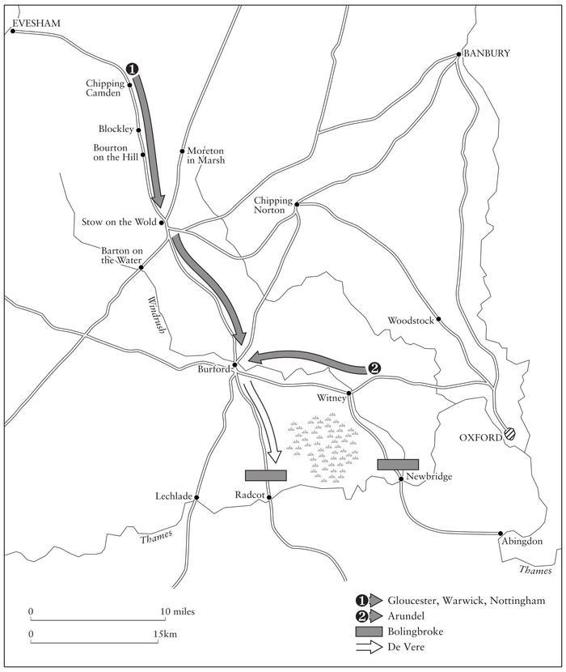
23 The Radcot Bridge campaign, December 1387
Richard had remained at Windsor through the campaign, immobilised for lack of troops. The battle of Radcot Bridge was a disaster for him. His friends, who knew that they could expect no mercy from the Appellants, fled as soon as the news reached them. Neville made off to the north dressed as a simple priest and after many vicissitudes found his way to Brabant. Pole escaped to Hull and thence to France where he took refuge at the court of Charles VI. Robert de Vere, according to one report, succeeded in making his way into Richard’s presence disguised as a groom. He was bundled off to the royal castle at Queensborough on the Isle of Sheppey, where he found a ship for the continent. Tresilian remained in England. He disguised himself as a beggar, put on a false beard and hid in the house of a friend by the walls of Westminster. As for Richard himself, he made for London and took refuge in the Tower. Nicholas Brembre went with him, hoping to rouse the citizens to his cause. But Brembre’s pleas were swept aside by the Mayor and aldermen. They had no confidence in the support of the mob and no desire to see their gates stormed and their homes pillaged by the army of the Appellants. On 27 December 1387 the Appellants arrived with their army in full war array in the open fields by the suburban village of Clerkenwell. The gates of the city were opened before them. On 30 December they took possession of the Tower with a force of 500 heavily armed men and confronted the King.24
Richard received them seated on an improvised throne in an upper room of the White Tower. It was a humiliation which he never forgot. The five rebellious magnates appeared surrounded by armed men and supporters, who made so much noise that the King had to withdraw with his enemies into the nearby Chapel of St. John. There, with the crowd baying outside the door, they confronted him with his correspondence with Robert de Vere, which had been found in De Vere’s baggage at Radcot Bridge, and with intercepted letters from the King of France taken from the satchels of a diplomatic messenger who had recently arrived from France. They accused him of dishonouring his promises of November, plotting their deaths and betraying his kingdom with the support of ‘traitors’. They added, according to a well-informed chronicler, ‘many other things which did not become public knowledge’. The evidence is not consistent but there are good reasons for believing that among the ‘other things’ they told him was that they intended to depose him. For two or three days Richard’s fate hung in the balance. Ultimately the Appellants changed their minds, mainly it seems because they could not agree on his successor. There is reason to believe that Gloucester hoped to take the throne for himself. But that was unacceptable to his colleagues and particularly to Bolingbroke. His own claims were stronger than anyone’s apart from his father who was abroad and possibly the young Roger Mortimer, Earl of March (descended from Edward III’s second son, Lionel Duke of Clarence), who was still a minor. It must also have occurred to them that they were in a position to impose their will without deposing the King. According to the monastic chronicler Henry Knighton, whose house had close links to the house of Lancaster, Bolingbroke took Richard to the walls of the Tower to show him the strength of their army. ‘And this host’, he said, ‘is not even a tenth of the number who wanted to come here to destroy the men who have betrayed you and all your kingdom.’25
On New Year’s Day 1388 Richard II rode to Westminster to preside over a meeting of the Council at which the new regime was inaugurated. Nicholas Brembre, the only one of the five accused ministers who had not fled, was arrested. So were ten knights of the King’s household including Simon Burley, Thomas Trivet, Nicholas Dagworth and William Elmham, along with several of Richard’s chaplains. A month later it was the turn of the judges, who were arrested in their courtrooms, dismissed from their posts and put in the Tower. The whole of the King’s household was dismissed and its more prominent members obliged to swear not to set foot in the court again. A new Council was appointed to conduct the day-to-day business of government, consisting mainly of former members of the Commission of Government. The only notable friend of the King among them was Walter Skirlaw, who was presumably included because of his diplomatic experience.26
On 3 February 1388 Parliament opened in the palace of Westminster. In the opening speech, delivered by Chancellor Arundel, the business of the assembly was declared to be to decide ‘how, by the Grace of God, the great disputes, troubles and dissensions which had divided the realm for want of good government might be peacefully resolved, the King better advised, the country better governed and peace and order restored and maintained.’ The White Chamber was packed as the door opposite the throne was opened and the five Appellants entered arm-in-arm, dressed in uniform golden robes, to present their appeal against the former ministers of the King. The appeal was read out, followed by thirty-nine detailed articles of accusation which took the clerk some two hours to read. These are said to have produced a powerful impression on the assembly. The tenor of the charges was that the five ministers had appropriated the King’s powers into their own hands and excluded from his counsels the great men of the realm who ought by rights to have been his principal advisers.
As the document got down to detail three broad categories of accusation emerged. First there was the familiar, and largely justified accusation that the ministers, especially De Vere and Pole, had used their influence over the King to divert his patronage in their own direction. Secondly they were accused of trying to help the King shake off the power of the Commission of Government. But the most significant group of accusations was the third, which bore the stamp of Gloucester and Arundel and concerned the conduct of war and diplomacy. The ministers were accused of appointing incompetent captains to important fortresses in south-western France, as a result of which many of them had been lost. They were said to have failed to organise any proper defence against the French invasion fleet of 1386. They had allowed John of Blois to be ransomed by the French when the national interest dictated that he should continue to be held as a prisoner in England. Finally they stood accused of trying to reach an accommodation with France. The Appellants alleged, and apparently believed, that Richard’s negotiations with Charles VI had been intended as the prelude to an assault on the King’s domestic enemies with French armed support. These articles suggest a coherent strategy for carrying on the war. The eyes of their authors were fixed on Calais, Brest and Cherbourg, the great English ‘barbicans’ of the Atlantic coast of France. The Appellants regarded these places as gateways for future cross-Channel invasions, the seeds of an eventual English military revival. Richard and his friends, as they saw it, had been preparing to surrender them, thus making recent defeats irreversible. These convictions do much to explain Gloucester’s and Arundel’s behaviour during these months. All the evidence suggests that of the five Appellants it was they and Warwick, the ‘undivided trinity’ as a supportive pamphleteer called them, who dominated the trial of the King’s ministers. And it was they who later pressed for the net to be spread wider to encompass the minnows of the King’s administration, men who had done no more than execute the decisions of others. They knew enough history to appreciate that if the King remained on his throne they might one day be exposed to his vengeance. They were determined to deter his servants with a lesson so terrifying that none would dare to do his bidding in the same way again.27
It was a contemporary, the chronicler Henry Knighton, who first called it the ‘Merciless Parliament’. The trials of the accused opened before the Lords on 5 February 1388. Even the new judges, whom the Appellants had themselves appointed, had misgivings about the procedure employed, for which they could find no authority in either civil or common law. The Lords brushed aside this objection, resolving that so ‘high a crime’ should be tried according to the law of Parliament, which they proceeded to devise for the occasion. On 13 February Neville, Pole, De Vere and Tresilian were all convicted of treason in their absence. Neville, as a cleric, was condemned to lose all his assets. The other three were sentenced to be drawn and hanged. The first to suffer this fate was the unfortunate Tresilian, who was seen watching the comings and goings from the roof of the house in Westminster in which he had taken refuge. The crowd invaded the building, found him hiding under a table and dragged him from his screaming wife and daughter crying ‘We havet hym! We havet hym.’ Tresilian was drawn from the Tower to Tyburn that afternoon. On the scaffold his robes were found to be lined with magic charms to protect his life. They hanged him naked. The trial of Nicholas Brembre, which had been interrupted by Tresilian’s discovery, was a travesty. The accused was not allowed counsel or even a copy of the charges. His attempts to defend himself were shouted down by the Commons and ruled out of order by the Lords. When the King tried to speak up on behalf of his friend members of both houses threw down their gauntlets on the paving to support their allegations. Even so, a commission of twelve peers charged to consider the articles of accusation reported that Brembre had done nothing deserving of death. The Appellants finally got their way by sending for the Mayor of London and selected aldermen, who were asked for their views about the guilt of the accused and rather hesitantly opined that if the treasons charged had occurred, they ‘supposed that he must have been aware of them’. At this, Brembre was condemned unheard and followed Tresilian to the scaffold.28
At the beginning of March 1388 the Lords proceeded to the lesser figures. John Blake, Tresilian’s law clerk, who had drafted the articles sealed by the judges, was drawn and hanged. The under-sheriff of Middlesex was convicted of trying to raise the Londoners in support of the King but his real offence was that he had been designated by the King the previous October to indict Gloucester and Arundel for treason. He was beheaded with thirty strokes of the axe. Next came the judges, who were arraigned on 6 March. They at least were allowed to defend themselves but their protestations that they acted under duress were ignored. They were condemned to death and then reprieved on the petition of the bishops and sentenced instead to exile in Ireland. By the time that the judges were dealt with the momentum of the trials was already failing. Divisions had begun to appear among the Parliamentary peers and even among the Appellants themselves. Richard’s confessor, Thomas Rushook, Bishop of Chichester, was alleged by the Commons to have been one of the men behind the questioning of the judges at Nottingham and had certainly been present when they had given their advice. But the Lords refused to proceed with his trial and finally evaded the issue by adjourning it until after Easter. On 12 March four of Richard’s household knights were brought before the Lords together with his private secretary and three of his chaplains. The proceedings against them aroused so much controversy that the case against the knights was deferred along with Rushook’s. The charges against the chaplains were dropped altogether.29
The final act in the Appellants’ campaign of revenge was played out in April and May 1388, when Burley and the other three chamber knights were brought back to face the charges laid against them by the Commons. The main case against them was that they had helped the King to resist the Commission of Government and the rebellion of the Appellant lords. There was also a charge, which was close to the hearts of Gloucester and Arundel, that they had treasonably caused the King to negotiate with France and arranged safe-conducts to allow his messengers to travel to the French court. Burley, who had been closer to the King than anyone, was attacked with special venom. He was said to have taken advantage of Richard’s youth to usurp the royal power and enrich himself. In the Lords, which had to judge them, these charges aroused intense controversy. Burley had many supporters there. For although he had unquestionably acquired great power and riches through his influence over the King he had had a distinguished career as a soldier in France in the service of the Black Prince and as an administrator in England. The King and Queen and two of the Appellant Lords, Bolingbroke and Mowbray, laboured mightily on his behalf and won over most of the Lords. After a fortnight of fruitless deliberation Edmund Langley, Duke of York, rose to his feet and declared that he would vouch for Burley’s loyalty by fighting a duel with anyone who denied it. Gloucester replied that Burley had been false to his allegiance and offered to prove it with his own sword-arm. York, white with anger, called Gloucester a liar and Gloucester replied in kind. The two brothers would have come to blows if the King had not separated them and adjourned the proceedings for the rest of the week. When they resumed, on 5 May, the Commons were baying for blood while the Lords, weary after the longest Parliamentary session in recent memory, were anxious to get the business done. Gloucester, Arundel and Warwick browbeat them into submission. Burley was convicted and sentenced to death. The King, declaring that Burley was innocent on all charges, thought of refusing to confirm the sentence. But Gloucester told him to his face that if he wanted to keep his crown on his head he had better stop trying to save his old friend. The sentence was carried out on the same day. The three other chamber knights met the same fate a week later. The only concession made to the condemned men was that they were spared being drawn to the place of execution on a hurdle and were beheaded, not hanged. Even that mercy was denied to one of them, John Salisbury. He had been one of the emissaries sent to negotiate with the French court the year before and had earned the special hatred of the Appellants. Rushook was declared guilty of treason but on account of his status as a clerk was spared execution. He was sent to join the judges in Ireland. Six other members of Richard’s household remained to be tried. But neither House had the stomach to prolong the hearing into the summer. So the accused were bailed to appear before the next Parliament.30
*
As soon as they had wrested power from the King the Appellants repudiated his foreign policy and put an end to his attempt to make peace with France. The ports were closed and orders given to stop Richard’s messengers at the Channel. The captain of Calais castle, Pole’s brother Edmund, was replaced along with several other royal captains in the Calais pale who were thought to have connived in the King’s plans. The summit meeting of the two sovereigns was silently abandoned. The men who had helped to set it up were pursued with particular savagery and those who had found safe havens abroad were excluded from the general pardon which closed the proceedings, even down to the minor messengers and clerks who had acted as go-betweens. Philip of Burgundy had written to the Duke of Gloucester from Compiègne three days before the battle of Radcot Bridge to remind him of recent diplomatic proposals and to ask what was going on. His letter was not even answered.31
As the proceedings of the Merciless Parliament ground on, however, it became clear that the Commons were not prepared to pay for the warlike ambitions of Gloucester and Arundel from public taxation. They continued to believe that the war could be financed from the King’s own resources if they were honestly managed, whereas by now Arundel and Gloucester had enough experience of government to realise that it could not. On 21 February 1388 Parliament interrupted their reprisals against the servants of the King to authorise a naval campaign under the command of the Earl of Arundel. But three weeks passed before the Commons could be persuaded to make an interim grant of taxation and then it was small and grudgingly given. They allowed the government just half a standard subsidy. The terms suggest that they had in mind a series of cruises in the Channel against French shipping and coastal settlements with no serious land operations.32
The Appellants may have planned to come back for more later. But any prospect of that vanished in April, when a number of peasant risings broke out in Kent and other parts of southern England. They were provoked by a mixture of local and national grievances, but the burden of war taxation and the government’s inability to defend the coasts were much the most bitterly felt. For a brief moment it seemed possible that there would be another general rising on the model of 1381. The Lords and Commons were alarmed. When they returned to Westminster after the Easter recess one of the few points on which they were agreed was the impossibility of imposing further burdens on taxpayers. They drew up a remarkable joint protest against the continual demands for war taxation:
By the coast in different parts of your kingdom the houses of your poor commons have been burned, people and whole villages ransomed, ships entirely destroyed and the land abandoned and impoverished, so that you no longer have the means to defend your realm or maintain your royal estate to the great grief of all the wiser men about you. The men who have rebelled against you know of no other remedy than to seize the leading men who control your Council and to charge them with treason against you and your realm …
Among the more specific proposals of the petitioners was that a commission of peers should be appointed to ‘strictly examine’ the way the war was being conducted before it brought further ruin on the community. The targets of this petition were plainly Gloucester and Arundel. No one else could have been described as ‘the leading men who control your Council’. When, in the closing days of the session, Parliament turned to the future government of the realm they approved the appointment of a new ‘continual council’ of five on which neither man was included. On 4 June 1388 the most fractious Parliament in recent memory was dissolved.33
In spite of their exclusion from the continual council Arundel and Gloucester remained the dominant figures in the government. They continued to devise grand strategies for prosecuting the war which were far in excess of anything contemplated by the Commons. The catalyst was a fresh crisis in Brittany, which had been developing throughout the sessions of the Merciless Parliament. Faced with a serious threat of invasion from France John de Montfort returned to the double-dealing which he had always used in these straits. He showed just enough interest in the English advances to encourage them and to put pressure on Charles VI to make concessions; but not quite enough to compromise himself irretrievably in French eyes or alienate the Dukes of Burgundy and Berry. In about November 1387 John wrote to Richard II reminding him of the proposals which his agents had discussed with the Commission of Government earlier in the year and declaring his readiness to support an English invasion of France. The Duke of Gloucester knew from experience how difficult it was to trust to John’s good faith but he needed allies too much to question it now. In January 1388 Richard Fotheringhay, the captain of John de Montfort’s castle at Rising in Norfolk, was sent by the Council on a secret mission to Brittany with proposals for a military alliance. Fotheringhay found John at Vannes in March. A draft treaty was drawn up. The document has not survived but its contents can be reconstructed from other sources. The Duke signalled his willingness to receive an English army in Brittany and to deliver up a number of fortresses to its commanders. He agreed to bring his own army to join forces with them. To ease the perennial problems of shipping he promised to provide mounts for the invaders once they had landed. For the moment at least, John behaved as if he meant it. On 11 April 1388 the King of France arrived at Orléans with a large entourage of noblemen, bishops and jurists to hear the Duke of Brittany answer for his imprisonment of the Constable. John failed to appear and sent neither spokesmen nor explanations in his place. Clisson delivered a bitter tirade against his rival before the assembled court, concluding with a challenge to a duel. He threw down his gauntlet on the ground, followed by all the principal members of his household. It was a dramatic gesture but an empty one. A defendant was traditionally entitled to more than one summons before he could be condemned in default. There was nothing to be done. On 27 April the court left for Paris.34
In the hands of Gloucester and Arundel the modest naval operations contemplated by the Commons developed into a major continental campaign, involving co-ordinated attacks on France from Brittany and Gascony. Preparations were already well under way by the time Richard Fotheringhay returned to England in April 1388. The Earl of Arundel was to sail from the Solent in May and land in Brittany with an army of 1,500 men-at-arms and 2,000 archers. In addition he was granted the custody of Brest with its substantial garrison, bringing his total strength to nearly 4,000 men. At the same time plans were in hand to mount a large-scale diversionary campaign in Gascony with the aid of John of Gaunt. This ambitious project seems to have been devised at a very late stage in conjunction with Sir Thomas Percy, who had recently arrived in England as John of Gaunt’s personal representative. Percy undertook that Gaunt would take the field with 1,000 men-at-arms and 1,000 archers. He was expected to find 800 of the men-at-arms among the Gascon nobility. The remaining 200 men-at arms and all the archers were to be recruited in England and sent out by sea. The shipping position, although tight, was healthier than it had been for many years. The requisitioning of ships was completed in six weeks by the end of April 1388, the first time that such a thing had ever been achieved. It produced more than a hundred large ships and barges, half as many again as the Admiral’s original target, in addition to ten war galleys sent by the King of Portugal which joined Arundel’s strength a little later.35
*
At this critical juncture the dominant factor in the strategic plans of the French government was not England or even Brittany but the personal ambitions of the Duke of Burgundy in the Low Countries. These ambitions revolved around the security of the duchy of Brabant, the largest and richest principality of the German Low Countries, which had for many years been a protectorate of Flanders. Its ruler, the Duchess Jeanne, was old and ill, childless and politically incapable. Real power was exercised by the Duke of Burgundy. He and his wife were the designated heirs to the duchy. Their officers dominated the Duchess’s council. Their troops were the backbone of its defence against her enemies.
The chief of these enemies was William, Duke of Guelders and heir to Jülich, the most persistent and aggressive opponent of French influence in the region. William’s territories lay beyond the eastern march of Brabant between the Meuse and the Rhine. There was a history of sporadic border warfare between Guelders and Brabant going back many years but it had recently acquired a fresh intensity. The Duke skilfully exploited the eddies and currents of the Anglo-French war. He timed his main offensives to coincide with the French invasion projects of 1386 and 1387, when he knew that they would be unable to send troops to Jeanne’s aid. He began a noisy exchange of embassies with the English and in June 1387 made a formal military alliance with them, doing homage to Richard II and promising to contribute 500 men-at-arms to his continental ventures. A month after the alliance was made Duke William announced it in letters addressed to Charles VI (‘so-called King of France’) and to Philip of Burgundy and the Duchess Jeanne. He declared war on all three of them.36
This event offered Philip of Burgundy the chance to employ French manpower and French money in a major campaign against his only serious challenger in the Low Countries. In the midst of the crisis provoked by the arrest of Olivier de Clisson, Jeanne’s ambassadors came before the French court and received what amounted to a French guarantee of Brabant’s territory. In the autumn of 1387 the French began to commit troops to Brabant’s north-eastern march. An active war of skirmish and ambush was fought out in the Meuse valley during the winter. But Philip was not content with consolidating the border of Brabant. He wanted a full-scale invasion of Guelders by a French army, which would establish his power as completely in Brabant as the Roosebeke campaign had done in Flanders. His grip on the French government had been much weakened by the events of the past year but he worked assiduously on the young King, remaining almost continually by his side through the winter and spring and staking all his influence at court on the outcome.37
The Duke of Burgundy’s project aroused strong opposition in Paris. An invasion of Guelders responded to no obvious strategic interest of France. It distracted resources and attention from the far more dangerous activities of the Duke of Brittany. And it denuded France of troops at a time when it was facing a serious threat from England in the west. Charles’s ministers had also been concerned for some time about the threat from John of Gaunt in Bayonne. They had no idea of the scale of his losses in Castile. They assumed that he still had at his disposal the substantial army which had landed at Corunna in 1386. Considerable forces had already been deployed along the march of Gascony in order to contain him. The Channel provinces, by comparison, were wide open. There was only a thin curtain of troops defending the march of Brittany. The only warships in commission were the six galleys sent by the King of Castile, which were currently on their way north across the Bay of Biscay with a mixed complement of Portuguese exiles, Castilian seamen and French men-at-arms. A larger fleet of French ships and oared barges was being prepared for service at the Clos des Galées in Rouen but would not be ready until July. The French were well informed about Arundel’s preparations in England and had some knowledge of the English government’s dealings with John de Montfort. They guessed that English operations mounted from Gascony might be co-ordinated with landings in Brittany. The prospect filled them with alarm.38
In the face of these multiple threats the Duke of Burgundy’s sole concern was to save his project for invading Guelders. He bent all his efforts to avoiding a major confrontation with England or Brittany. He opened negotiations with the English government at Calais, initially without the consent of Charles VI, with a view to arranging a separate truce covering his own territories in Flanders. He was probably behind the approaches which the Duke of Berry made at about the same time to John of Gaunt with proposals for another local truce in the south-west. He actively promoted a compromise with John de Montfort in the face of determined opposition from the Constable and other influential men at court. All of these issues came to a head in May 1388. The Earl of Arundel’s preparations at Southampton were approaching completion. On the march of Brabant the current truce with the Duke of Guelders was about to expire and bells were ringing across Jeanne’s principality to summon men to arms. The French royal Council met in Paris in the middle of the month. All three of the King’s uncles were present as well as most of the leading prelates and noblemen of the realm and the more important permanent officials. The Duke of Burgundy pressed for the German campaign to proceed. He was supported by the King, who was excited by the prospect of military glory; and by much of the military nobility, who deplored the dishonour involved in cancelling a widely trumpeted expedition to Guelders and looked forward to the profits that would be had fighting beyond the borders of France. Ranged on the other side were the King’s permanent officials, the risk-averse Duke of Berry and presumably Olivier de Clisson, whose personal interests were as much engaged as Philip’s. The result was a compromise but one which was broadly satisfactory to Philip. The Guelders campaign was deferred until the Breton problem could be resolved. But the Council agreed to offer an olive branch to John de Montfort. Enguerrand de Coucy, who was thought to be the most gracious emissary available, was sent with a small delegation of royal councillors on an urgent mission to Brittany. In the meantime another taille, the second in a year, was imposed on the long-suffering French taxpayers.39
In the few days that remained before the sailing of Arundel’s fleet Philip of Burgundy and his allies travailed mightily to patch up an agreement which might keep John de Montfort loyal, the English out of Brittany and the Duke’s German ambitions alive. Enguerrand de Coucy worked his charm upon the Duke of Brittany. By the end of May he had persuaded him to meet the Dukes of Burgundy and Berry in the Loire town of Blois. At the beginning of June John de Montfort was rowed up the Loire in a fleet of armed barges, accompanied by no fewer than 1,200 barons, prelates, liveried retainers and bodyguards. John was determined not to appear as a petitioner. He was met on the quayside at Blois by the two royal dukes with their own equally magnificent escorts. In the castle, terms were hammered out for John’s submission to the Crown. Their tenor can be inferred from subsequent events. If John would agree to appear before the King and excuse himself for his conduct over the past year Charles would pardon his crimes and convert the current criminal proceedings against him into a civil dispute with the Constable. The King would decide it himself. This would save the King’s dignity while lifting the threat of forfeiture hanging over John’s duchy. John would still be exposed to the risk of having to restore what he had taken from Olivier de Clisson but there is reason to think that the royal dukes dropped a hint that the King might decide in his favour.
John wrote a humble letter to the King apologising for his failure to appear at Orléans, which he claimed was due to illness. He was then conducted in state to Paris. There, on about 8 June, the King received him in the great hall of the Louvre under the resentful eyes of courtiers who had never ceased to regard him as a traitor and a creature of the English. For the Duke of Burgundy it was a moment of extreme satisfaction. Shortly afterwards the French royal Council sent out summonses for the army of Guelders. The muster was fixed for the middle of August at the bridge-town of Montereau, south-east of Paris. The proceeds of the taille were diverted to the new venture. As for John de Montfort, when the King at length issued his award in July it was found to be almost entirely in favour of Olivier de Clisson. The two rivals were publicly reconciled, drinking from a loving cup at a splendid banquet given by the King. John had been duped. But by this time Philip of Burgundy’s object had been achieved. The strategic foundation of the Earl of Arundel’s expedition had crumbled away.40
Arundel knew nothing of these events. His fleet sailed out of the Solent on 10 June 1388, a month late, escorted by the galleys of Portugal. His army consisted of nearly 3,600 men, slightly more than the strength for which he had contracted. About a third of the transports had been designated as victuallers for what was evidently expected to be a long campaign. It was the best-prepared English seaborne expedition for many years. Arundel was accompanied by Sir Thomas Percy with 150 men destined to serve as an advance guard for the army of Gascony and by Richard Fotheringhay, armed with a clutch of powers to conclude the treaty which had been negotiated with the Duke of Brittany in March. The armada made first for the coast of Normandy. From there the ships worked their way south from headland to headland, picking up prizes where they could, but they were unable to land. Everywhere the ports were defended and the coast-guards out. In about the third week of June Arundel finally succeeded in landing on the undefended island of Bréhat, off the north coast of Brittany. There he learned to his dismay about John de Montfort’s meeting with the King in Paris. Since the army had come without mounts, counting on the Duke’s officers to provide them, there was nothing to be done in Brittany. Arundel and his principal officers were forced to remake their plans. After some debate they decided to attempt a landing on the Biscay coast of France. On 23 June the English fleet reached Brest. From there, towards the end of the month, it made a south-easterly course heading for the Bay of Bourgneuf, a traditional hunting ground for English commerce raiders. The spoil here was spectacular. They stormed the castle of Noirmoutier and burned much of the island before accepting patis to withdraw. The islands of Batz and Bouin and four inland towns suffered the same fate. After ten days in the bay they had taken great quantities of gold, wine and cattle and burned no fewer than 140 merchant ships. In the middle of July Arundel’s fleet turned south again. Sir Thomas Percy sailed on to Bayonne to confer with John of Gaunt. The rest of the fleet anchored in the Anse de l’Aiguillon, the vast enclosed bay north of La Rochelle, bounded by the windswept sand and marsh of the Aunis.41
The whole army disembarked, followed by the ships’ crews. Taking some 400 men with him, Arundel penetrated inland in shallow barges through the lacework of creeks and canals and fell upon the town of Marans, some five miles inland on the left bank of the Sèvre Niortaise. The French were taken by surprise. The Seneschal of Saintonge was away at Bayonne trying to negotiate a local truce with the Duke of Lancaster. The local population abandoned the open country and fled to the security of the castles and walled towns. Arundel advanced with his army towards La Rochelle, which lay twelve miles south across the flats. At least part of the fleet followed him off the coast. A few miles from the port the English were repulsed by the garrison, supported by a crowd of armed citizens, and retreated back to Marans. There Arundel waited for about three weeks while his followers burned or looted all that they could find. The English commander’s precise intentions are obscure. The Aunis was a poor and sparsely populated region, a treeless wasteland with no adequate roads and very little food or plunder. Without proper equipment there was no question of trying to besiege La Rochelle. Without horses his men were unable to roam far from their base. The most plausible explanation of his movements was that he hoped to co-ordinate his operations with John of Gaunt and possibly also with the Anglo-Gascon companies of the centre. According to Froissart, he had landed a messenger in Brittany with letters for Perrot de Béarn, the principal routiercaptain of the Limousin.42
*
While Arundel in Saintonge dreamed of these great possibilities, in England the war policy for which he had stood collapsed. In April 1388 the Scots refused to renew the current truce, which was due to expire on 19 June. Unlike previous crises in Anglo-Scottish relations this one was not provoked by the French, who had had very little contact with their Scottish allies since Jean de Vienne’s ill-tempered departure in 1385. With John of Gaunt far away on the marches of Castile, Richard II’s Council concentrating all its resources and energies on Arundel’s expedition and Parliament still unwilling to support the cost of an active war policy, the opportunity was too obvious to need pointing out. England’s weakness was particularly evident in the north, where the Parliamentary assault on Richard II’s friends had left a dangerous vacuum of power at the top. The Nevilles, who had been the dominant figures in the defence of both marches for much of the decade, were tainted by the fall of Archbishop Neville and displaced by their long-standing rivals the Percys. For Scotland the potential gains from reopening the war were considerable: a chance to secure its possession of the lowland enclaves reconquered in the past ten years; a place at the conference table if negotiations between the principal belligerents were resumed; and the prospect of loot and status, which had become the cement of border society. The only brake on the aggressive instincts of the borderers was the King, Robert II, now a sick old man, averse to the risks of war and resentful of the tutelage of his son Carrick, but only fitfully capable of resisting him. In February 1388 Carrick suppressed the last vestiges of his father’s independence by ordering his arrest. From then until his death two years later Robert became a cipher in the hands of successive cliques of noblemen which formed around his sons. The change was marked by an immediate move to the offensive on the border. At the end of April 1388 the puppet-King presided over a council of the leading noblemen of his realm at Edinburgh. Agreement seems to have been reached on a large-scale invasion of northern England in the summer.43
The gravity of England’s situation does not seem to have occurred to the Duke of Gloucester or the Council until early June. On 8 June 1388 commissions of array were issued in every county north of the Trent to meet the threat from Scotland. In the next few days news came in of the build-up of enemy galleys, ships and barges in the Seine. England had been denuded of her biggest ships and most of her seamen to furnish Arundel’s fleet. Heavy calls on the Treasury for funds were answered by the classic devices of every bankrupt government: borrowing, assignments on the customs revenues, a temporary stop on payments to the Calais garrison. There had been a recent reminder of the dangers posed by this kind of financial stringency when one of the outlying forts of Calais had been lost after locally recruited garrison troops deserted to the enemy for want of pay. On 12 June, just two days after Arundel sailed from Southampton, the Council’s courage failed. They could not fight on three fronts at once. Meeting in London, they decided that there was no alternative but to approach the French government and ask for a general truce. The Duke of Gloucester, who was present at the meeting, was required to write an awkward letter to the Duke of Burgundy, reminding him of the unanswered letter which Philip had addressed to him in December and purporting to take up the proposals which had been so abruptly dumped when the Appellants came to power. It must have cost him much pain to write it.44
On 29 June 1388 two Scottish armies simultaneously invaded England. One came through the east march towards Newcastle. The other entered the west march and made for Carlisle. A third, seaborne expedition left the Clyde to plunder Ulster and the Isle of Man. The wardens of the north were unready. There was no serious resistance anywhere. The damage in the east march was the worst for a hundred years according to a sober contemporary reporter. More than 400 men were taken for ransom and carried back to Scotland. Many more were burned in their houses or cut down as they fled. Reports of the scale of the destruction in the north reached Westminster at about the same time as intelligence suggesting that the threatened French descent on the south coast was now imminent. In the middle of July there was another crisis meeting of the Council. They took a number of drastic decisions. The fleet and army of the Earl of Arundel were recalled to England to be deployed against the Scots. The northern magnates were told to wait by the coast for his arrival. A fresh army would be raised in England to reinforce them. As in 1385 the King would take command in person. Meanwhile all the other military enterprises in hand were abandoned. A plan to send 200 archers to reinforce the Duke of Guelders was dropped. Preparations for the army of Gascony ceased. A Great Council was summoned to meet at short notice at Oxford on 27 July to find ways of funding the sudden increase in the burden of war expenditure in the north of England. These hurried and ill-considered decisions proved impossible to carry out. Ships were sent out from Dover and Dartmouth to scour the seas for the Earl of Arundel and inform him of his recall. Either they failed to find him or else he received the message and ignored it. The Great Council duly met but could do nothing. The magnates reminded the King’s ministers of what they already knew, that they had no power to authorise taxation. They suggested that Parliament should be summoned but the earliest that it could meet was September. By then it would be too late.45
At the beginning of August 1388 the French fleet entered the Solent with its Castilian auxiliaries and did considerable damage to Portsmouth and the Isle of Wight.46 At almost the same moment there was another, even more formidable invasion from Scotland. The main thrust of the new Scottish attack was in the west march. The Earl of Fife, Robert II’s second son, accompanied by Sir Archibald Douglas, entered Westmoreland on 3 August with the usual elite corps of knights, followed by an immense horde of lightly armed horsemen, infantry and camp-followers, ‘the whole power of Scotland’ according to a report sent to Richard II. The defence consisted of local levies, greatly outnumbered and poorly led by the warden of the west march, John Lord Beaumont. He was a well-connected nonentity with few local supporters and little military experience, who had only just taken up his appointment. The invaders reached Carlisle within hours. They brushed aside the Cumberland levies who tried to stop them, killing 100 of the defenders and carrying off 300 prisoners including the sheriff. At the opposite end of the border James, Earl of Douglas, entered Northumberland with a much smaller but more select force, probably about 3,000 strong. They were drawn mainly from the retinues of the great Lowland families and the Lothian knights who had followed the banner of Douglas and his father since the 1350s. Douglas was later said by his enemies to have separated himself from the main army and conducted this operation without authority from the King. But it is more likely that he was concerting his movements with those of the Earl of Fife. His object seems to have been to pin down English forces, most of which were concentrated east of the Pennines, and prevent them from going to Beaumont’s aid in Cumberland.
In the event Douglas achieved much more than that. In the first few days of August he marched rapidly south through Northumberland, burning farms and villages as he went and penetrating beyond the Tyne almost as far as Durham. Returning northward he conducted a brief demonstration before the walls of Newcastle. The city was defended by the warden of the east march, Sir Henry Percy. Percy, the eldest son of the Earl of Northumberland, was a famous paladin who had been knighted by Edward III at the age of thirteen and had passed his whole career fighting on the Scottish border, in France and at sea. Still only twenty-four years old, he had already earned the nickname ‘Hotspur’ for his impulsive tactics and speed of movement. In the course of a skirmish outside the gates of Newcastle Douglas captured Percy’s pennon. As the Scots withdrew he sent an abusive message to his adversary, boasting that he would plant it on the walls of Dalkeith castle. Percy replied that it would never leave Northumberland. Behind the walls of Newcastle he had gathered the retainers of his house and the levies of Yorkshire and Northumberland. They must have numbered between 5,000 and 8,000 men. Another host had gathered at Durham under the command of its Bishop, Walter Skirlaw, and was on its way. On 5 August Percy received reports that Douglas’s army was encamped by the River Rede, close to the tower of Otterburn some thirty miles away. In the early afternoon he led his men out of the town and set off in pursuit, leaving behind him orders that the Durham host should follow after him.
Shortly before dusk on 5 August 1388 the English army passed the village of Elsdon, some three miles east of the Scottish encampment. They were hungry and exhausted after the long march. The light was failing. The English archers would be useless in such conditions. But Hotspur was unwilling to allow the Scots to escape under cover of darkness. He believed that the advantage of surprise would carry the day. True to his name he ordered an immediate attack. He split up his men into two divisions. One, under his own command, would deliver a frontal attack on the Scottish positions. The other was placed under the command of Sir Mathew Redmayne. He was ordered to take a circuitous route by the north to attack the Scots in the rear. The Scots were finishing their dinner, their weapons by their sides, and were about to settle down for the night when a mounted scout rode into the camp with the news that the English were almost upon them. ‘Hawys armys spedyly,’ he cried. In the rush the Earl of Moray forgot his helmet. Douglas had no time to put on any armour at all. The Scottish camp stood at the foot of a ridge. The Scots scrambled up the slope and formed themselves up in battle order at the summit. Percy’s division mounted the ridge on foot in no particular order and fell on the Scottish lines shouting ‘Percy!’ and ‘St. George!’ Douglas’s men recoiled before the first impact but held firm and then counter-attacked in the declining light, forcing the English into retreat. Douglas, the ‘true lantern of the Scots’ according to the poet of the battle, was felled in the mêlée with three lances in his body. According to a celebrated but probably apocryphal tale, which was told to Froissart by two knights who had fought in the battle, as Douglas’s companions dragged his naked and half-conscious body from the field he ordered them to pick up his banner from the ground and hold it aloft, crying ‘Douglas!’ above the din so that the Scots should not be demoralised by his death. In savage hand-to-hand fighting, aggravated by the difficulty of distinguishing friend from foe in the dark, the Scots pressed their advantage. At the foot of the hill the English disengaged and tried to reform. But the Earl of Dunbar, who was in command of the Scottish reserve, mounted his horse and led a cavalry charge down the slope, scattering them across the fields.
Most contemporaries blamed Percy for the defeat. Their criticisms had much force. In his haste to engage the enemy he had attacked them before Redmayne’s division had closed in from the north and while the Bishop of Durham and the rest of the English army were still some way off. Redmayne reached the Scottish camp shortly after the fighting had begun. His men wasted time slaughtering the grooms and servants whom the Scots had left to guard their possessions and then lost their way in the darkness. Early next morning they found the corpses of their compatriots scattered across the fields by the Rede while the Scots stood triumphant on the ridge above. Redmayne’s force attacked the exhausted Scots and drove them off, pursuing them north as far as the border. As for Bishop Skirlaw, he was met on the road in the middle of the night by a messenger carrying the news of the rout and turned back at once for Newcastle. Both sides had suffered heavy casualties. The English lost an estimated 550 dead and many captured. Henry Percy and his brother Ralph and twenty-one other knights were among the haul of prisoners. On the Scottish side casualties were almost as high. They lost about 500 men-at-arms. The prisoners included Sir James Lindsay and several other prominent leaders of the border wars.47
In its day Otterburn was a famous battle. Few events so forcibly brought home to English opinion how far things had changed since Edward III’s heyday. It was the first major Scottish victory in the field since Bannockburn. It inspired patriotic epic poems in Scotland from the stilted Latin verses of Thomas Barry, written shortly after it was fought, to the Ballad of the Battle of Otterburn, which was still being sung in various recensions long after the borders wars had finished. ‘I never heard the olde song of Percy and Duglas that I found not my heart moved more than with a trumpet,’ Sir Philip Sidney would write two centuries later in the reign of Elizabeth. Jean Froissart, who had known James Douglas as a young boy when staying as his father’s guest at Dalkeith, went to much trouble to interview those who had fought in the battle and devoted some of his most inventive prose to spreading its fame among a continental audience. Fought hand-to-hand between evenly matched forces of noblemen with famous captains on both sides and no archers to distort the outcome, the battle stood for everything that he most admired in chivalric warfare.
Of all the campaigns, battles and skirmishes, great and small, that I have recounted in this history, this encounter of which I now speak was the most strenuous and best fought for there was not a man there, knight or squire, but did his duty to the uttermost.
Strategically, it is true that there had been little at stake. Douglas had been heading home anyway. The victory was not followed up. The losses of the two sides roughly balanced out both in numbers and importance. Hotspur was eventually released after nearly a year in captivity in exchange for Sir James Lindsay plus 7,000 marks in cash. But politically the battle would have enormous ramifications. The death of the head of the house of Douglas without an heir left a void in the political and military leadership of the Scottish border and a legacy of political instability which persisted for many years. The elaborate network of service and loyalty built up in the Lowlands over four decades by the Knight of Liddesdale and the Earls of Douglas suddenly disintegrated. Vast domains extending along the border from Berwick to Lauderdale and north as far as Aberdeenshire were contested between the different branches of the Douglas family and the leading members of the Scottish nobility. At Carlisle the Earl of Fife abandoned the siege of the city and withdrew to Scotland with his army as soon as the news of Douglas’s death was brought to him.48
Beyond the sea the last continental campaign mounted by England in the fourteenth century ended with a whimper. The Marshal, Louis of Sancerre, who was in command of French forces on the Gascon march, entered La Rochelle towards the end of July, accompanied by some of the leading noblemen of Poitou and a force of about 1,100 mounted men. Arundel challenged him to fight an arranged battle but the experienced Sancerre had no intention of squandering his tactical advantages and returned an evasive reply. There was no sign of help from John of Gaunt. The Duke of Lancaster had no plans to mount major military operations against France and without the promised reinforcements from England he was hardly in a position to do so. In any case Arundel’s aggressive designs conflicted with all of his political instincts and cut across his negotiations with Castile.
The last page of John of Gaunt’s prolonged and complex diplomatic dealings with John of Trastámara was not turned until 8 July 1388, when the final text of the treaty was sealed in the Franciscan convent of Bayonne. The treaty of Bayonne, like all previous versions of Gaunt’s agreement with John of Trastámara, bound them both to work for peace between England and France. There is every reason to believe that Gaunt took this seriously. On 17 July 1388 the Castilian King ratified the instrument in the fortress town of Castrojeriz, west of Burgos. As soon as the instrument of ratification was in his hands Gaunt opened negotiations with the representatives of the Duke of Berry. The two sides met in August near the English-held fortress of Mortagne on the north shore of the Gironde. There, on 18 August 1388, they agreed a truce until March of the following year covering the whole of France south of the Loire. The truce put an end to Arundel’s operations. His army re-embarked on its ships and sailed away. On 3 September 1388 the fleet arrived at Winchelsea. Apart from the plunder of the Bay of Bourgneuf it had achieved nothing.49
When, on 10 September 1388, Parliament met to consider the crisis, it became clear that whatever confidence the political community had once had in the regime of the Appellants had vanished. The assembly was held at Cambridge, in the Augustinian priory of Barnwell, presumably because it was far away from the political tensions of Westminster and the city of London. Comparatively few of those who had been elected in February were re-elected in September. The proceedings are ill-recorded as a result of the loss of the official roll but it is clear that the prosecution of Richard’s chamber knights, which had been adjourned at the conclusion of the Merciless Parliament, was dropped. The decision reflected the widespread disillusionment of the Commons with the conduct of the leading Appellants. They were particularly dissatisfied with the results of Arundel’s expedition. It had cost a great deal of money, about £34,000 or nearly twice the value of the half-subsidy voted by the Merciless Parliament. The Commons blamed Arundel for leaving a month after the appointed date, which had arguably cost him the support of the Duke of Brittany. They demanded to know why he was asking for four months’ pay when he had served only three. The proposed economies and reforms, which had been expected to transform the government’s finances, had not materialised and the government of the Appellants was suspected of hiding or embezzling the resources of the Crown just as earlier governments had been. There was some justice in this view. The Appellants had persuaded the Merciless Parliament to allow them to take £20,000 from the wool duties for their labours ‘in the salvation of the King and all the realm’, a sum which exceeded the entire proceeds of the half-subsidy granted in March. The lion’s share of this probably went to the impecunious Duke of Gloucester but Arundel’s appetite was not much less. He helped himself to a bonus of 1,000 marks and doubled his own fee as captain of Brest. These minor scandals served only to confirm the Commons in the conventional myth that honest government would find a way to finance the war from its own sources.50
As for the Council, their heart had not been in the prosecution of the war since June. But they were obliged to face both ways. They were already in touch with the court of France about the possibility of a long-term truce but needed a credible threat of military action if they were to have any counters to bargain with. They struggled to persuade the assembly to fund another campaign against France. Their pleas fell on deaf ears. A plan to send another war fleet to sea that very month appears to have been announced at the opening of the assembly but almost immediately abandoned. Another, rather vaguer plan took its place, involving an unspecified continental expedition in the spring of 1389. The Commons were only interested in action against the Scots. When eventually they voted a subsidy it was only a single tenth and fifteenth, much less than the Chancellor had demanded, and it was reserved for a campaign of retaliation in the north in the following year. Parliament was dissolved on 17 October 1388. Gloucester, Arundel and Warwick managed to retain control of the government for a few months longer but they had already abandoned most of their original programme. Shortly afterwards the English government agreed to attend a conference with the representatives of Charles VI on the march of Picardy. At about the same time John of Gaunt was empowered to open negotiations for a separate peace between England and Castile.51
*
At the beginning of September 1388 the French army marched on Guelders. The Duke of Burgundy led the advance guard north from Châlons-sur-Marne. The King, accompanied by the Constable, the Dukes of Berry and Bourbon, and most of the leading noblemen of France marched out of Montereau a few days later. With a combined strength of 16,000 men-at-arms, it was the largest cavalry force to be formed in France since the Bourbourg campaign of 1383. The scale of the campaign, which was vastly in excess of what was really required, was due mainly to the participation of the King, who had insisted on taking part against the better judgment of his uncles. They would have preferred a smaller army with a much reduced baggage train which would have been easier to supply. The difficulties were aggravated by the choice of route. The logical course would have been to concentrate the army at Lille and pass through eastern Flanders and Brabant. But the damage and cost of the passage of a great French army through their territory horrified the towns of Brabant, in spite of the fact that its ostensible purpose was to defend them against their enemies to the east. They threatened to empty the country and close the gates of the towns in the face of the French advance. So Philip, whose influence there depended partly on their goodwill, was obliged to reroute the army, entering Germany further east through the Ardennes and passing through the duchy of Luxembourg. This meant marching through steep, heavily wooded valleys with poor roads and very little in the way of supplies to feed such a large host.52
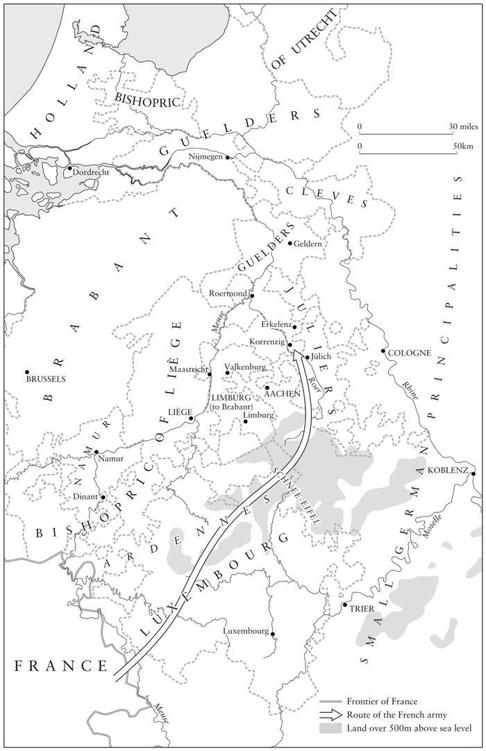
24 The French invasion of Guelders, September—November 1388
The Guelders campaign did nothing to satisfy the King’s thirst for military glory. The army marched through pouring rain for a fortnight before climbing through the arid and unpopulated passes of the Schnee-Eifel, where they found the air bitterly cold and the ground hard and already covered in snow. On 25 September 1388 the French penetrated across the fertile lowlands of Juliers making for the southern march of Guelders. There they encamped along the road south of the town of Erkelenz while their leaders debated what to do and supplies were brought up after them. They remained there for three weeks. The rain fell incessantly, reducing tents to damp rags and turning the ground into a marsh. The horses had to pick their way through the mud. The wagon trains bringing supplies across the hills from the Meuse and the Rhine were immobilised by floods and mudslides. Duke William had hired bands of irregulars, most of them companies of German brigands from beyond the Rhine, to challenge the French advance. They followed the movements of the French from the hilltops, descending without warning on stragglers and foragers and launching murderous night-time attacks on the French encampments. Food ran out. The life of the soldiers, complained Eustache Deschamps, who was one of them, was all ‘rot, cold and bog’. When winter set in conditions could only get worse. Some of the French captains openly spoke of turning back home. Ahead of the army stood the fortress-city of Roermond, blocking their advance at the confluence of the Meuse and the Roer. Olivier de Clisson tried to break the stalemate by provoking a battle outside the walls of this place. He detached some 4,000 men-at-arms from the main force and rode down the valley of the Roer towards the city, accompanied by Jean de Vienne and Enguerrand de Coucy. The French drew themselves up in battle order in the plain but the defenders would not be drawn. They adopted the same tactics as the French had done for thirty years in the face of English armies. They held to their walls and when dusk fell the French were forced to return to their encampments. The Duke of Guelders followed the campaign from Nijmegen on the Rhine. ‘Floods, frost and rain will fight my battles for me,’ he said, according to Froissart, to those who urged him that the French were invincible; ‘by February even the most aggressive of them will want to be back home with his wife and children.’
In fact William did not need to wait that long. On 7 October 1388 he offered the French King a face-saving formula which was promptly accepted: an apology for the insulting language of his letters but not for their substance; some territorial concessions to the Duchess of Brabant, but only on condition that the lordships in question were promptly regranted to one of his allies; and a promise to give a year’s notice before reopening the war. That was all. As for the wider dispute with Brabant, which was ostensibly the occasion for the war, William agreed to submit that to arbitration but on terms which gave him plenty of scope for obstruction. On 12 October the Duke came before the King at the small village of Korrenzig, where Charles had set up his headquarters, to put his seal to the instrument. No trouble was spared to impress the recalcitrant prince. Men-at arms lined both sides of the road leading to a vast pavilion embroidered with golden fleurs de lys. Inside the King sat enthroned in full armour with a squire standing behind him holding his helmet, surrounded by his uncles, the Constable and the principal captains of the army. Charles’s face wore the impassive mask, expressionless and unspeaking, which he had been trained to show to those whom he wished to overawe with the majesty of France, coldly raising his cap and at once replacing it on his head. ‘Et ne jocqua riens’, added the chronicler. Yet, although William of Guelders received his pardon on bended knee, everyone knew that it was a charade designed to mask the failure of the French army.
If anyone doubted it their eyes were opened on the march back to France. The French were prevented from taking the Roman road which followed the west bank of the Meuse because the men of Maastricht and Liège guarded the bridges and refused to let them cross. In Luxembourg they found themselves surrounded by hatred. The countryside had been emptied of all foodstuffs. The towns closed their gates. The Duke of Guelders’s companies, seeing the disorder in the ranks and scenting the chance of ransoms, harassed the retreating troops at every point. Bridges were guarded against the invader by large troops of infantry. The rivers were in full flood after six weeks of continuous rainfall. Fords were impassable. Men and horses lost their footing and drowned as they tried to wade through the torrents. Carts lost their wheels and axles in potholes. Lame horses had to be abandoned. Towards the end of October the bedraggled and starving host reached the French frontier, to all outward appearance a defeated army.53
The immediate consequence of the debacle in Germany was a palace revolution at the French court. The professional administrators had always chafed at the personal power of the Duke of Burgundy. The Guelders campaign brought them new and powerful allies. It had been Philip of Burgundy’s venture, conceived in his personal interest and pressed on the French King’s Council against the judgment of many of its more experienced members. The choice of route had been Philip’s too. So had the decision to negotiate with the Dukes of Juliers and Guelders instead of wasting their dominions with fire and sword, which undoubtedly served the Duke’s political interests in the Low Countries but deprived the captains of the army of the loot on which they had counted. Above all the inglorious outcome of the campaign had proved an intense disappointment to the King, who soon came to resent the pressure that his uncle had brought to bear upon him earlier in the year.
On 3 November 1388, a week after his return from Guelders, Charles VI presided over a Great Council in the hall of the archbishop’s palace at Reims. It was attended by all of the great nobles who had participated in the campaign and by a cohort of permanent officials and lawyers who had been summoned for the occasion from Paris. The moment and the place were symbolic. It was the anniversary of the King’s coronation, which had occurred in the same city eight years before. In a month’s time he would be twenty years old, the age at which he could govern in person. Yet it evidently came as a shock when, at the outset of the proceedings, the aged Cardinal-Bishop of Laon, Pierre Aycelin, rose to propose that the time had come for the King to dispense with his guardians. Aycelin was a widely respected figure who had been close to three successive kings of France. The King’s uncles sat dumbfounded as the murmur of approval spread through the hall. The Archbishop of Reims spoke in support of the Cardinal’s proposal. So did the captains of the army. Charles, who had known what was afoot, was ready with his response. Turning to the Dukes of Berry and Burgundy he thanked them for their diligence and loyalty over the past eight years, declared that he would always welcome their advice and assistance in time of war and then dismissed them. The Duke of Berry rose to his feet. He and his brother were ready to abide by the wishes of the King, he said; but they would like to discuss the matter properly with him after his return to Paris. However, the decision had been made. For the next four years the Dukes of Burgundy and Berry were excluded from the government of the realm. Their advice was sought on major issues and sometimes accepted but they lost the power to initiate policy and became no more than occasional voices in the proposals of other men. They believed that the whole thing had been plotted in advance between the King and Clisson, supported by their enemies at court.54
This was more or less true. A year later, when John of Gaunt’s chamberlain, Sir Richard Abberbury the Younger, was at the French court on his master’s business, he was taken aside by Olivier de Clisson. ‘Do you see the King?’, the Constable asked him; ‘What do you think of him?’ Before the astonished Englishman had a chance to answer, he went on:
I’ll have you know that it was I who made him a real King. It was I who took the government out of the hands of his uncles. Let me tell you that when he took over the conduct of affairs there was no more than two francs in his treasury. And now you see him rich, fortunate and generous. He must have handed out a million francs in gifts since then and all this has been my doing Without me, he would still be in the state he was in before.55
Clisson of course had important personal interests at stake. His own position in Brittany was seriously threatened by the hostility of the Dukes of Berry and Burgundy and by their persistent support for John de Montfort. But the dismissal of the royal dukes was a good deal more than a jealous intrigue. The audible approval which greeted the Cardinal of Laon’s address at Reims suggests that Clisson and his friends had broad-based support in the French political community. In particular there was strong support for a programme of administrative and financial reform, which was unlikely to make progress while the Dukes of Burgundy and Berry were in power. The essential problem was the state of the royal finances. The Constable put his finger on it in his boastful exchange with Richard Abberbury. The current burden of taxation was politically unsustainable. There had been no fewer than six tailles in the past four years in addition to the regular burden of aides and the gabelle du sel. Yet money was short. There would have to be large cuts in government expenditure.
With the departure of the royal dukes and their protégés the personality of the King became a more significant factor in French politics. It was already clear that Charles VI would be a very different kind of ruler than his father. At twenty, he was a broad-shouldered, athletic young man with a patchy beard and a head of blond hair which was already beginning to recede. Charles was a keen soldier with a strong taste for warfare. He was an excellent horseman who could handle a lance or pull a bow as well as any of his companions. He also had a strong awareness of his status. Over the centuries the French monarchy had acquired a crust of religious symbolism and ritual. Like most of his predecessors, Charles VI had to act out in public the part of an icon of state. The cold dignity with which he had received the Duke of Guelders at Korrenzig was no different from the face he showed to his own subjects or to the joyful crowds who would one day press into the streets of Avignon to see him borne like a graven image to the gates. ‘I never saw a prince look so frigid or attended by men whose aspect was so much like his own,’ the Datini factor in the city reported to his master in Prato. Shielded behind the walls of his palaces from the gaze of the crowds, Charles impressed petitioners and ambassadors with his willingness to listen and his memory for names and faces. Yet even that was a mask. For as Charles grew older his private life was increasingly at odds with the carefully cultivated image. He ignored the convention that the King did not fight in tournaments. He threw raucous drunken parties continuing late into the night. He wore fancy dress among friends, to the visible dismay of his more conservative ministers. He rose late. He was recklessly extravagant and a notorious womaniser. The King was never a cipher. But well before his world was clouded by illness and insanity his capacity for public business was limited. He was idle, slow-witted and easily bored. This made him malleable in the hands of those whom he trusted.56
The dominant figures in the King’s counsels were now Olivier de Clisson, who remained the politician closest to the King, the Duke of Bourbon, who was the only one of the King’s uncles to retain his old influence, and Pierre (‘Le Bègue’) de Villaines, the former captain of the French mercenaries in Castile. Day-to-day administration was in the hands of a group of former servants of Charles V who acquired a firm hold on the King’s affections and controlled all access to him. Bureau de la Rivière, who was constantly at the King’s side, became his most influential chamberlain. Jean le Mercier was appointed ‘Grand Master of the Royal Household’ and took over responsibility for the royal finances. Arnaud de Corbie resigned from the presidency of the Parlement to become Chancellor of France. Two rising men became notable figures for the first time. Jean de Montaigu, the scion of a large bureaucratic dynasty, became the King’s private secretary. The title of Provost of the Merchants of Paris was revived after an abeyance of five years for the principal royal officer of the capital and conferred on a young lawyer in the King’s service, Jean Juvénal des Ursins. These men formed a tight corps who acquired a firmer control over the cumbrous machinery of government than any previous ministry. A well-informed if unfriendly observer remarked on their unusual solidarity. They acted collectively, consulting each other in private and supporting each other’s decisions in council. No one was allowed to rise in the King’s government unless he was willing to join them on their own terms.57
‘And then feasts, jousts and dances began to be held in France, more than for many years,’ wrote the contemporary biographer of Jean de Boucicaut; ‘for the young, the vigorous and the noble were all urging the youthful King to enjoy himself, as is natural for a fresh spirit in its prime.’ Charles celebrated his emancipation in a succession of grand festivities in and around Paris over the following year. None of them, however, had the symbolic resonance of the spectacular, week-long celebrations at Saint-Denis by which the regime celebrated its own accession to power and courted popularity among the military nobility, the leading figures in the royal administration and the Parisian elite. The occasion was the knighting at the King’s hands of the sons of the Duke of Anjou, the eleven-year-old Louis, titular King of Naples, and his brother Charles. The celebrations were carefully stage-managed propaganda for the royal house, deliberately contrived to show its fortunes in the hands of a younger generation. The leading place in the public ceremonies was taken by the King himself and by his contemporaries among the royal princes: his younger brother Louis, Duke of Touraine; and his cousins Pierre de Navarre, younger son of Charles the Bad, Henry, son of the Duke of Bar, and John, Count of Nevers, the eighteen-year-old heir of the Duke of Burgundy. The participants jousted for three days in the lists set up in front of the abbey gate and banqueted in a huge timber hall, nearly 600 feet long, which had been specially erected in the great courtyard. All was conducted in accordance with carefully ordained rituals reconstructed from the tales of Lancelot and the legends of the Holy Grail. Invitations had been sent to England, but the only English guests present were exiles: Robert de Vere, Earl of Oxford, who was living in Paris on a pension from Charles VI; and Matilda Holand, Countess of Saint-Pol, Richard II’s half-sister, now naturalised in France, who was given the honour as the most beautiful woman present of leading the King’s horse into the lists. Both of them must have remembered an earlier occasion, on St. George’s Day 1377, when, beneath the eye of the senile Edward III, England had celebrated the coming of a new generation on the eve of one of the most sombre periods of her history. Like the young men of 1377, many of the gilded figures at Saint-Denis were destined to meet untimely deaths during the next three decades at the hands of assassins, executioners or lynch-mobs, or on the battlefields of Nicopolis or Agincourt. The festivities ended on 6 May 1389 with a remarkable ceremony dedicated to the memory of Bertrand du Guesclin, who had died nine years before. The sword and armour of the dead captain were presented to the abbey church in the glow of hundreds of burning torches by the military officers of the Crown, accompanied by a crowd of Bertrand’s kinsmen and retainers. Louis of Touraine and the young princes of the royal house came forward to offer their own swords as if to mark the direct succession from the great days of Charles V to those of his son.58
The new administration immediately set about reforming the machinery of government and hacking away at the luxuriant undergrowth of jobbery which had led to an exponential growth in the royal payroll over the past decade. The Dukes of Berry and Burgundy demanded a formal share of the Crown’s revenues now that they could no longer help themselves. They also wanted an undertaking that the jobs of their protégés would be safe. They were courteously heard out but their wishes were ignored on both points. Over the next four years the flow of new grants to Philip the Bold fell to less than a fifth of its previous level. Grants to Jean de Berry were reduced to a trickle. A large number of superfluous functionaries, perceived opponents of the new regime and advocates of the high-tax policies of the past five years, many of whom had owed their places to Berry and Burgundy, were removed from office. Over the following months a stream of regulations and ordinances issued from the King’s Council. There was a wholesale change in the personnel of the Parlement and a radical reform of its processes. An attempt was made to limit the staff of provincial baillis and seneschals and to abolish the innumerable perquisites by which they supplemented their fees and salaries. The bloated and endemically corrupt financial administration, which was believed to consume up to half of the revenues which it handled, received particular attention. The revenues of the royal demesne were dramatically increased. There was an assault on the endemic corruption and lax accounting of the purchasing offices of the royal household, where so many royal officials had made their fortunes in the past. The Chambre des Comptes recovered the rigorous audit role for which it had once been famous.
It is not easy to change an administrative culture developed over generations but there is a good deal of evidence to support Olivier de Clisson’s claim that the King’s finances were transformed, at least in the short term. For the first time since the death of Charles V it was possible not only to meet the daily expenses of government but to make large, regular payments to the treasurer of the royal household to support the King’s largesse and his increasingly ostentatious court. It was even possible to establish a substantial monthly reserve against unforeseen future expenditure. At the same time the level of taxation was reduced by about a third, a move which contributed largely to the popularity of the new regime. Collection of the latest taille was abandoned in January 1389. No further special taxes of this kind would be imposed for the next seven years. When the Duke of Berry issued an order that the collection of the taille should proceed in any event in his own domains the King’s Council countermanded it.59
One of the first acts of the new government upon assuming power was to take up the English offer of a fresh diplomatic conference.60 The views of the Marmousets on foreign policy were not very different from those of the Duke of Burgundy. But the Marmousets’ need for peace was more urgent than his. The fate of their financial reforms and ultimately their own survival in government depended on bringing an end to the annual armies and fleets of the past two decades and achieving large cuts in the cost of maintaining fixed garrisons on the frontiers. At the same time less tangible factors were altering the climate of opinion. The closing years of the fourteenth century were a time of intense moral pessimism, characterised by a growing preoccupation with sin and personal redemption, the insecurity of life and the ubiquity of death, not only among educated clerics but also in influential sections of the nobility. Their outlook owed much to the pervasive sense of decline which weighed heavily on the French political community. The mood was darkened by other developments in the world beyond France: the papal schism; the advances of the Ottoman Turks in the Balkans; the periodic epidemics of bubonic plague. Corruption, decay, the vanity of political and national ambitions: these are abiding themes of the outpourings of the poet Eustache Deschamps and of the writings of political moralists like the anonymous author of the Songe du Vergier and the prolific Philippe de Mézières. The same themes constantly reappear in the works of the young lyric poet Christine de Pisan, the lawyer Honoré Bonet and the orator and scholar Jean Gerson. These writers were not simply preaching to their own kind. All of them belonged to the political world. They had careers to make and patrons to please, most of whom belonged to the higher reaches of the government and the Church. The Songe was almost certainly the work of one of Charles V’s maîtres des requêtes. Deschamps lived all his life on the margins of the court and in the armies and civil service of the Valois monarchy. Philippe de Mézières had been one of Charles V’s councillors. Bonet was present at diplomatic conferences as a legal adviser. Gerson, a prominent figure in the most intensely political university of Europe, preached regularly before the King.
Hatred of the English was probably as strong as ever in France at the end of the fourteenth century. Yet support for the war declined steeply in these years. It was associated with the wider divisions of Christendom, with a murderous and increasingly pointless military stalemate, an intolerable burden of taxation and the corruption of manners and politics that commonly accompanied high levels of public expenditure. In the last years of his life even Froissart, the authentic voice of aristocratic sentiment and chivalry’s greatest contemporary advocate, turned against what he saw as the mindless greed and indiscriminate violence of the warrior class. In the autumn of 1389 Philippe de Mézières presented Charles VI with his immense allegorical work, the Songe du Vieil Pélerin. Written in the aftermath of the King’s dismissal of his uncles, Philippe’s book was a long plea for peace between England and France, the repair of the papal schism and the promotion of a fresh crusade against the renascent power of Islam. He regarded the youth and inexperience of Charles VI and Richard II as their greatest asset. Let them put aside the hatreds of their forbears and their elders, men stained with blood, nourished and enriched by war, before they grew to share them. Let them meet and settle the issues directly with each other without the intervention of lawyers and diplomats who served only to keep old quarrels evergreen. Philippe de Mézières was now a Celestine lay brother and referred to himself throughout his work as the ‘Ancient Recluse’. Yet his was not a voice in the wilderness. His ceaseless lobbying and his ability to appeal to the most powerful emotions of his contemporaries won him influential converts including the King.61
On 3 May 1389 there was a scene at Westminster reminiscent of the events at Reims in the previous November and quite possibly inspired by them. A Great Council had gathered in the Marcolf Chamber, the small painted hall at the edge of the river in the palace enclosure. Richard II entered the hall to open the proceedings with a prepared statement. He observed that he was now past the age of twenty at which a man was entitled to enter into his inheritance (he was in fact twenty-two) and he called on the magnates present to declare whether he was not entitled to govern in person. They all answered that he was. They could hardly have said anything else. The former Appellants were sitting among the councillors, but without warning and without their allies among the Parliamentary Commons and the city trades there was little that they could do. Richard declared that throughout the twelve years of his reign he had been controlled by others. These years, he said, had been characterised by an unending succession of taxes ‘and I have not noticed that my realm is any stronger for it.’ He therefore proposed to take over the conduct of affairs himself. Turning to Chancellor Arundel he demanded the surrender of his seals. The astonished prelate handed them to the King. The Treasurer and the Keeper of the Privy Seal were summarily dismissed along with the Chancellor. Gloucester, Arundel and Warwick were removed from the Council. Arundel was also deprived of the Admiralty and the captaincy of Brest. The new judges imposed on the King by the Appellants were told that they would be removed as soon as others could be found to take their places. A purge of the civil service was ordered, which resulted in the dismissal of all those whom the Appellant lords had installed in the administration. No fewer than 400 people whom Richard regarded as creatures of his enemies were dismissed from his household.62
Richard played his hand with considerable political skill. Apart from the purges of his opponents in the administration, he did not embark upon a campaign of revenge against the men who had put them there. The accumulated resentments of the past three years were concealed behind a mask of graciousness. The sentences of the Merciless Parliament were allowed to stand. The judges who had advised the King at the notorious Nottingham council of 1387 were allowed to rot away in their Irish exile. Robert de Vere, Michael Pole and Alexander Neville were left to end their days on the continent. In place of these headstrong, opinionated men, Richard appointed an uncontroversial administration headed by William of Wykeham and Bishop Brantingham of Exeter, elderly professional administrators who took up with overt misgivings the offices that they had last held eighteen years before under Edward III. So far as these men stood for anything they stood for honest, economical government and an ideal of public service not unlike that of the Marmousets in France.
Meanwhile the King discreetly built up his own party. John of Gaunt was recalled from Gascony and plied with deference and favours. The Duke of Lancaster’s political skills and his standing among the English nobility would be badly needed in the following years. At the same time Richard made new allies among a younger generation of English noblemen and helped them to build up their power-bases in the country. His raffish and violent half-brother Sir John Holand became Earl of Huntingdon in 1389 and was helped to build up large holdings of land in the west of England. His cousin Edward, the able and ruthless son of Edmund Langley, Duke of York, became Earl of Rutland in the following year and a trusted military and diplomatic adviser. Richard, according to a jaundiced contemporary, ‘loved him better than any man living’. Bolingbroke and Mowbray, the more moderate of the ex-Appellants, were retained on the Council and Mowbray became as close to the King as he had been when they were boys. Even Gloucester and Arundel were readmitted to the Council after a few months, although they never recovered their old influence.63
In another, perhaps conscious echo of events in France Richard announced on 16 May that if a truce with France was agreed he would dispense with the second instalment of the Parliamentary subsidy which was due to be collected in June. It was, he said, ‘his own decision, made without advice from anyone’.64 This was probably true. Richard was well aware of the corrosive political consequences of high taxation and the destabilising effect of a war that made his government dependent on repeated grants in Parliament. As time went on the King’s opposition to the war became not just a political calculation but a matter of conviction with a significant moral dimension. The King threw himself whole-heartedly into the peacemaking process which Gloucester and Arundel had only tolerated for want of any immediate alternative. Richard’s resumption of power at Westminster, following upon the Marmousets’ takeover in Paris, proved to be the decisive moment in the long, frustrating history of Anglo-French diplomatic exchanges.
*
The latest peace conference had opened at Leulinghem on the march of Calais shortly after Christmas 1388. Both delegations were led by diplomatic veterans. Walter Skirlaw, Bishop of Durham, had been involved as a Chancery clerk and then Keeper of the Privy Seal in every Anglo-French negotiation for a decade. He had first met his opposite numbers, Nicholas du Bosc and Arnaud de Corbie, at the final session of the Bruges conference in 1378. These men had been over the ground many times. By now there was very little between the two principal belligerents. The old intractable issues, homage and sovereignty and territorial claims in the south-west, had been put to one side while the parties endeavoured to agree the terms of the long-term truce which they both desperately needed. Calais ceased to be a sticking point once the Duke of Burgundy fell from power. Castile, for years the main obstacle to a long-term truce, faded from view after John of Gaunt’s settlement with the House of Trastámara. The only significant obstacle in the way of the ambassadors at Leulinghem was the renascent power of Scotland. The English had always refused to treat Scotland as an issue to be debated with the French. It was their affair, an internal issue with a subordinate kingdom whose quarrel with England was older than the French war. ‘They are such close neighbours of ours that we can visit them without getting our feet wet, as they can us,’ said the English ambassadors. The problem was that the Scots were not represented at Leulinghem and the French were bound by treaty not to make any long-term arrangements without them. How far the French were prepared to go to protect the interests of these difficult allies remained to be seen. In mid-January 1389 the conference was adjourned while Nicholas du Bosc and his colleagues returned to Paris for consultations.65
In the meantime relations between England and Scotland sharply deteriorated. On 20 January 1389 a Great Council met at Westminster. Plans for the great punitive expedition to the north, which had been in contemplation since the middle of the previous year, were approved and the opening of the campaign fixed for 1 August. Thomas Mowbray, Earl of Nottingham, was nominated as warden of the west march. A commission of four prominent northern lords was charged with the defence of Northumberland. Unfortunately, in order to save money, they were retained from June only. As a result the only organised military forces on the scene were the garrisons of Berwick, Roxburgh and Carlisle. Seizing their opportunity, the Scots resumed their attacks. There was a series of exceptionally destructive raids in the course of March and April. Once again the brunt of these operations was borne by Cumberland and the city of Carlisle. Two hundred people were reported to have been burned alive in their houses on the west march. ‘Everything that the marchers had has been burned and smashed in the continual raids of the Scots,’ they complained; ‘most of them have nothing left to live on and are on the point of abandoning this desolate wasteland.’ Lord Beaumont, who was in command at Carlisle, mounted a brief counter-raid into Teviotdale but otherwise no one stirred in defence of the north. The northern lords, Percy, Neville, Clifford and Roos, had been promised funds to pay their men but received nothing. So far as can be discovered they stayed at home. Too late Mowbray was ordered urgently to the north to take command of the defence of the Scottish border. Scotland was becoming an expensive headache. Operations on the northern marches would soon start to eat up cash at a rate of more than £20,000 a year. The advances of war wages for the King’s great punitive expedition would come to more than double that. This was the situation when Richard II took power into his own hands at the beginning of May 1389.66
At Calais the diplomatic breakthrough came within a few days of Richard’s palace revolution. The English ambassadors reached an informal agreement with their French opposite numbers on the status of Scotland. The French dropped their insistence on Scottish participation in the conference. This cleared the way for the formal sessions to reopen at the beginning of June. The Earl of Salisbury, a vocal advocate of peace with France and at sixty-one the last survivor of the great captains of the reign of Edward III, was added to the strength of the English embassy and sent out to Calais with fresh instructions on the major issues. When the diplomats gathered in the church of Leulinghem on 5 June 1389 they reached agreement almost at once. On 18 June they put their seals to a truce which was to take effect in August and to last for three years, during which a permanent peace would be negotiated. The Scots were left to their fate. The King of Scotland was named as an ally of France. So were the Scottish lords of the border, who were treated as the independent power which they had by now in practice become. But the French government’s agreement was not conditional on their assent. To persuade them to co-operate the English, abetted by the French, hit upon a combination of diplomacy and force. Mowbray, who had by now taken up his command on the Scottish march, was at Roxburgh. He was about to lead a large mounted raid into Scotland with the combined forces of the east and west marches. A French embassy would follow on behind with an ultimatum: unless the Scots agreed to be bound by the truce the King of France would abandon them.67
Events did not work out entirely according to plan. The military side was a fiasco. Mowbray fell out with the northern lords, who regarded him as a brash outsider and resented the fact that he was being paid at rates far higher than their own. Most of them refused to serve under him. As a result, when Mowbray marched north from Roxburgh on 25 June, he was accompanied by only 1,500 mounted men. He found himself heavily outnumbered by the Scots and faced with a determined and effective rearguard action directed by the Earl of Fife. Unable to pursue his advance into Lothian, Mowbray was forced to retreat eastward and shut himself ingloriously behind the walls of Berwick. In the meantime Fife outflanked him and entered Northumberland at the head of a large Scottish army, penetrating south as far as the Tyne. The region had been left almost entirely defenceless and suffered considerable damage. In about the middle of July the Scots withdrew to dump their spoil and prisoners and to regroup for another attack on an even larger scale.68
The French ambassadors reached the Scottish border towards the end of July 1389. They found the Scottish King at Dunfermline. Pierre Fresnel, the young civil lawyer who led the embassy, had a good deal of experience of Scottish affairs and was well aware of the tensions which the French alliance generated. He had been present in 1384 on the last occasion when a French embassy had come to Scotland to force an unwelcome truce on its allies, and again in 1387 when it had suited French interests to push the Scots into reopening the war. Two years later Robert Stewart was a shadow of the man Fresnel had known. The Earl of Carrick, his elder son, who had been the dominant figure at the Scottish court on his last visit, had fallen out with the leading lords of the border over the Douglas inheritance and had then been disabled in a riding accident. As a result he had been replaced by his younger brother the Earl of Fife. Fife, who took the title of ‘Governor’, was an abler politician and a far better soldier than Carrick. He was also the most persistent protagonist in Scotland of the border war. His ally, Sir Archibald Douglas, who had appropriated the earldom of Douglas with most of its lands and followers, was now by far the richest and most powerful of the border lords. Between them these men effectively controlled the Scottish kingdom. They were not easily persuaded to sign up to the truce. They had fought a successful war against the English for more than a year without any significant assistance from France. The raids were profitable and extremely popular among the lowlanders. They had enabled the border lords to invest in fine horses and armour, to maintain their followings in the region and to sustain their dominant position in Scottish politics. While Fresnel was at the Scottish court he was taken with his staff to see the army which was preparing to invade England. The men were drawn up in disciplined units, well mounted and armed. Many of them had pledged their farms and chattels to buy their equipment. Seeing the French party among them the troops jeered and bellowed their anger over the heads of their fellows. It took great patience and an aggressive combination of threats and blandishments to move the Scots from their chosen course. Ultimately, however, the Scottish leaders were not prepared to risk losing the French alliance and facing the undivided strength of the English alone. Douglas himself, newly installed in possession of other men’s lands and sullenly resented by his rivals, had too much to lose if the fortunes of war should turn against him. So the projected invasion force was disbanded. On about 2 August 1389 Robert II put his seal to the truce of Leulinghem.69
*
At the opposite extremity of the vast swathe of Europe which had been drawn into the Anglo-French war, the kings of Castile and Portugal received notice of the truce at the end of July 1389. John of Avis, like Robert II of Scotland, was covered by the terms of the truce provided that he agreed to accede to it. He at least had been consulted in advance, for his agents had been at Westminster in November 1388 when Walter Skirlaw’s instructions were being prepared. The ambiguity of his position probably suited him. Ever since John of Gaunt’s departure for Bayonne nearly two years before, he and his Constable, Nun’ Alvarez Pereira, had conducted an intermittent war against John of Trastámara’s border fortresses and the few surviving Castilian garrisons in Portugal, choosing their moment to attack, profiting from the enemy’s penury and distraction with other affairs. Campo Maior, the last significant Castilian stronghold in the Alemtejo, surrendered in December 1388 during the first session of the Leulinghem conference. On 23 August 1389, about a month after the text of the truce had reached the peninsula, John of Avis crossed the northern frontier and laid siege to the Galician town of Tui, an important bridgehead into a region which was still the most disaffected part of John of Trastámara’s kingdom. In vain the Castilian King sent messengers to invite him to honour the truce. Battered by artillery and repeatedly assaulted, Tui finally surrendered on about 14 November while John of Trastámara was still struggling to collect an army for its relief.70
A fortnight later the ambassadors of the two kingdoms agreed upon a truce of three years on substantially the terms agreed at Leulinghem. The truce marked the final triumph of John of Avis. Its terms provided that in exchange for the surrender of his conquests in Galicia the Castilians were to withdraw all of their remaining garrisons in Portugal. The humiliation of Castile and the exhaustion of the country after forty years of continual war were there for all to see. John of Trastámara felt it personally. Addressing the Cortes at Guadalajara the following February he described the terms which he had agreed with the Portuguese as dishonourable to himself and to his crown. But they had been unavoidable. The country had been drained of treasure to pay the wages of the King’s French mercenaries and the immense indemnities due to the Duke of Lancaster. The experienced captains and cavalrymen required to put another army into the field no longer existed. His conscience, he said, would not allow him to prolong the struggle any longer. In the wider scheme of things the siege of Tui was a minor affair. But it proved to be the last regular campaign of the Hundred Years War in the fourteenth century and the last of all to be fought in the Iberian peninsula.71
Notes
1 Froissart, Chron. (SHF), xiii, 229—32, xiv, 4; ‘Chron. Brioc.’, 59; Chronographia, iii, 86; Morice, Preuves, ii, col. 552; Le Fèvre, Journal, 365, 368; Chron. r. St.-Denis, i, 480—2. Expedition: Chron. Tournai, 317—18; Froissart, Chron. (SHF), xiii, 220—1, 228; Doc. Clos des Galées, i, nos. 1459—60, 1462—4, 1467, 1518; ii, nos. 73, 75; BN PO 789/Clisson 10, 11; 1499/Hazay 6, 17; 2291/Pise 3, 4, 5; BN Fr. 26022/1045, 1047, 1047, 1048; BN Fr. 32510, fols. 299—299vo.
2 Lefranc, 267—8, 270n1, 273—9, *438—9; Ord., vii, 123. For pledges, bonds, cash and plate in his possession at his death in 1407: ‘Inv. meubles Clisson’; Palmer (1968)[3], 422.
3 *Lefranc, 445—50; Choix de pièces, i, 51—2.
4 Grants: Nieuwenhuysen, i, 157—8, 194, ii, 373—4; Vaughan, 34, 57—8, 95, 229—31; Lehoux, ii, 26—7, 162. Harpeden: *Froissart, Chron. (KL), xiii, 352—4.
5 John IV, Actes, no. 521; Le Fèvre, Journal, 56, 58, 72.
6 Foed., vii, 454; Morice, Preuves, ii, 482—3; John IV, Actes, no. 551 (p. 401); Le Fèvre, Journal, 96.
7 Cal. Inq. Misc., iv, no. 296; PRO C76/69, mm. 3, 1; C76/70, mm. 32, 26, 24, 7; C76/71, m. 24; Foed., vii, 503; CPR 1385—9, 132; Le Fèvre, Journal, 312.
8 Le Fèvre, Journal, 331, 332, 333; Foed., vii, 553; PRO C76/71, m. 6; John IV, Actes, no. 613, 620—1; PPC, i, 48; AD Côte d’Or B1467, fol. 30vo; B1469, fol. 33.
9 Froissart, Chron. (SHF), xiii, 228, 233—40, 246, 247—8, 282; Chron. r. St.-Denis, i, 480; Morice, Preuves, ii, 540—2, 552—5; John IV, Actes, no. 646 (p. 439).
10 ‘Séjours’, 436; Itin. Ph. le Hardi, 189; Chron. r. St.-Denis, i, 484; Juvénal des Ursins, Hist., 62; Froissart, Chron., xiii, 250—1, xiv, 1—2; *Lefranc, 445—50; Choix de pièces, i, 80; AD Côte d’Or B1467, fol. 240vo.
11 Jones (1972), 18, 19; Morice, Preuves, ii, 528—9; Chron. r. St.-Denis, i, 498; John IV, Actes, p. 68 and nos. 639—43, 646—51.
12 Itin. Ph. le Hardi, 190; *John IV, Actes, p. 439n1 and nos. 646—7; ‘Chron. Brioc.’, 60—1; Chron. r. St.-Denis, i, 489—91. On Bernard, Gall. Christ., iv, 625.
13 PRO E101/68/11 (253).
14 Dipl. Corr., no. 78 and p. 206; Edinburgh Univ. Lib., Ms. 183, fols. 66vo, 66Avo, 84vo—85 (arrangements for summit); BN Coll. Dupuy 306, fol. 77vo (French memorandum, 1390); Parl. Rolls, vii, 95—6 (Art. XXXI); ‘Inv. lettres rois d’Aragon’, no. 10; CPR 1385—9, 503; Westminster Chron., 204; Walsingham, Chron. Maj., i, 846.
15 Parl. Rolls, vii, 89—90, 91—3 (Arts. XVII, XXV), 105—9. Secrecy: Westminster Chron., 202; Favent, ‘Hist.’, 7.
16 Walsingham, Chron. Maj., i, 826—8; Westminster Chron., 186, 206; Favent, ‘Hist.’, 4—6, 8; Parl. Rolls, vii, 90, 91, 95, 96 (Arts. XIX, XXII, XXIV, XXIX, XXXII, XXXIII), 115, 116 (Arts. XIV, XVI); Cal. Letter Books H, 314—15, 317; Knighton, Chron., 404—6, 426—8.
17 Parl. Rolls, vii, 94 (Art. XXXVI); Favent, ‘Hist.’, 6, 8; Walsingham, Chron. Maj., i, 828—30; Westminster Chron., 210.
18 Westminster Chron., 206—10; Favent, ‘Hist.’, 9; Knighton, Chron., 400—4, 406, 408—12; Walsingham, Chron. Maj., i, 824, 828—30. Array: Cal. Letter Books H, 321.
19 Westminster Chron., 208—10, 212; Walsingham, Chron. Maj., i, 830—2.
20 Westminster Chron., 210—14; Favent, ‘Hist.’, 10; Walsingham, Chron. Maj., i, 832—6; Knighton, Chron., 412—14.
21 Parl. Rolls, vii, 97—8 (Art. XXXVIII), 114 (Art. XI); Westminster Chron., 214—16; Walsingham, Chron. Maj., i, 836, 840—2; Knighton, Chron., 416—18; Favent, ‘Hist.’, 11; Cal. Letter Books H, 321. Richard was at Sheen on 22 Nov.: Saul (1997), 471. On the story put out by the Appellants that Pole was trying to escape via Calais: Palmer (1972), 109—12. Cheshire: Morgan (1987), 188; Walker (1990)[1], 167—71.
22 Westminster Chron., 218—20; Parl. Rolls, vii, 408 (Art. VII). On Bolingbroke: McFarlane (1972), ch. 1—2; Morgan (1987), 191—2; Walker (1990)[1], 167—71. On Mowbray: Goodman (1971), 158—63.
23 Morgan (1987), 188, 190—1; Goodman (1971), 34—41; Cal. Reg. Wakefield, no. 824; Westminster Chron., 220—4; Walsingham, Chron. Maj., i, 838—40, 842; Knighton, Chron., 418—24; Favent, ‘Hist.’, 11.
24 Westminster Chron., 214, 220—6, 320, 342—4, 492; Walsingham, Chron. Maj., i, 842—6; Knighton, Chron., 416, 424—6; Issues Exch., 234; Favent, ‘Hist.’, 12—13, 17.
25 Westminster Chron., 226—8; Walsingham, Chron. Maj., i, 842, 846—8; Knighton, Chron., 426; *Clarke, 157 (Chronicle of Whalley Abbey); Parl. Rolls, vii, 414 (Gloucester’s confession, 1397).
26 Westminster Chron., 228—32, 306—8; Walsingham, Chron. Maj., 848—50; Favent, ‘Hist.’, 13—14; CCR 1385—9, 583, 593—5; Knighton, Chron., 426—8, 430.
27 Parl. Rolls, vii, 63 (1), 84—98 (esp. Arts. VIII, XV, XXIII, XXVIII—XXXII); Favent, ‘Hist.’, 14—15, 21.
28 Knighton, Chron., 414, 432; Parl. Rolls, vii, 99—104; Favent, ‘Hist.’, 17—18; Westminster Chron., 280—4, 308—14.
29 Parl. Rolls, vii, 106—12, 117—18; Favent, ‘Hist.’, 19—20, 23; Westminster Chron., 286—8, 314—18.
30 Parl. Rolls, vii, 112—17, 408 (6), 414, 416 (8); Westminster Chron., 328, 330, 330—32, 338, 340; Favent, ‘Hist.’, 21—2, 23, 24; Walsingham, St. Albans Chron., i, 852.
31 CCR 1385—9, 388; CPR 1385—9, 427, 503, 522; PRO C76/72, m. 5, C76/74, m. 13; Parl. Rolls, vii, 95—6.
32 Parl. Rolls, vii, 66 (11); Westminster Chron., 286, 314, 316—18.
33 Knighton, Chron., 442—50. Date: Palmer (1972), 237—8. Council, dissolution: Parl. Rolls, vii, 68—9 (23), 82 (52); Westminster Chron., 332.
34 John IV, Actes, nos. 613, 673; PRO E101/319/33; E403/518, m. 18 (26 Jan.); Foed., vii, 586—7; ‘Séjours’, 439; Itin. Ph. le Hardi, 192; Chron. r. St.-Denis, i, 507—9. John’s itinerary: Actes, 68. On Fotheringhay: ibid., nos. 277, 279, 727; CPR 1381—5, 402; CPR 1385—9, 259.
35 Brittany: PRO E101/68/11 (257, 258); C76/72, m. 13; E403/518, m. 26 (11 Mar.). Gascony: PRO E159/166 (Trinity, brev. dir. bar.), m. 16; C61/100, m. 5; Westminster Chron., 322 (Holand should read Percy), 345. Shipping: PRO C76/72, m. 13, 3, 2; E403/518, m. 26 (11 Mar.); E403/521, mm. 6—7, 15, 16, 17 (30 Nov., 14 Dec., 30 Jan., 3 Feb.); E101/40/40. Arundel originally planned a fleet of 62 vessels: PRO E101/68/11 (257).
36 Laurent & Quicke, 138—64; Gedenk. Gesch. Gelderland, iii, no. 122; Choix de pièces, i, 78—9; *Cartellieri, 128—9; Laurent & Quicke, 200n2.
37 Froissart, Chron. (SHF), xiv, 180—3, 192—6; Dynter, Chron., iii, 120—3, 126—7; Itin. Ph. le Hardi, 190—3. Troops committed: BN Fr. 32510, fols. 299vo—300; BN PO 2878, La Trémoille/4, 6, 8, 10, 13; Clair. 32/79, 103/120, 112/150; Plancher, iii, 570.
38 Gascony: Choix de pièces, i, 83—6; Mon. hist., no. 1687; Arch. Montpellier, ii, 104—5; BN Fr. 20416/6, 26022/1138, 1140—3, 1152—4; BN Fr. 32510, fols. 303—303vo. Channel: BN Fr. 32510, fol. 305; BN PO 2030 Montmaur/24—26; *Daumet, 176—7; Doc. Clos des Galées, i, no. 1526. Fleet: Doc. Clos des Galées, i, nos. 1491, 1505, 1511—17, 1526; BN Fr. 26023/1224, 1229; BN Fr. 32510, fol. 305vo (musters on 9 July). Intelligence: Ord., vii, 188; BN Fr. 25706/176.
39 Negotiations at Calais: Foed., vii, 581—2; PRO E364/22, m. 2d (Beaupyne), E364/22, m. 8 (Rouhale); Handelingen, no. 56; Rec. Ord. Pays-Bas, i, no. 184. Gascon truce: PRO E101/184/1, fol. 36vo, 37; Foed., vii, 595—6. Brabant: Laurent & Quicke, 211—12. Council: Froissart, Chron. (SHF), xv, 10—16, 28—31; Chron. r. St.-Denis, i, 524—8; ‘Chron. Pays-Bas’, 283; Ord., vii, 186—9. Attendance, date: Le Fèvre, Journal, 523—4; Itin. Ph. le Hardi, 192; Lehoux, iii, 472; Troubat, 800. Taille: Ord., vii, 186—9.
40 Chron. r. St.-Denis, i, 508—12; ‘Chron. Brioc.’, 61; Itin. Ph. le Hardi, 193—4; Froissart, Chron. (SHF), xv, 52—9. Musters (13—20 Aug. 1388): BN PO 1089, Estouteville/12; 1783, Lyons/2; 1814, Malet/28; 1925, Menon/4; Clair. 138/61; etc. Award: Morice, Preuves, ii, 552—5; ‘Chron. Brioc.’, 62.
41 Westminster Chron., 340; Westminster Chron., 350—2; Froissart, Chron. (SHF), xv, 16—18, 20—1, 62—3. Forces: PRO E101/41/5; E403/519, mm. 8, 11 (14 May, 2 June); E403/521, mm. 6—7 (30 Nov.); PRO E101/319/33. Powers: Foed., vii, 586—7. Brest: PRO E101/41/8. Noirmoutier: Rec. doc. Poitou, xxiv, 88—90. The knightings at Batz recorded by the Westminster chronicler occurred on 28 June: PRO E101/40/33, mm. 1d, 3, 4, 10, 11d. The landing in Aunis was probably the occasion for a knighting on 16 July: PRO E101/41/5, m. 14. Bayonne: Frag. chron. norm., 11 (corroborated by Percy’s presence with John of Gaunt in August: PRO E101/184/1, fol. 37). Topography: Tranchant, 17—31.
42 Westminster Chron., 352; Froissart, Chron. (SHF), xv, 63—76.
43 Foed., vii, 572—3, 583; Cal. Doc. Scot., iv, no. 387; PRO E101/319/30, 35. Percies: Cal. Doc. Scot., iv, no. 377; Storey, 596—600, 611—12. Carrick: Boardman (2004), 107—8; Boardman (1996), 142, 157n64; Froissart, Chron. (SHF), xv, 120—1 (wrongly giving the venue as Aberdeen).
44 CPR 1385—9, 456, 475, 502—3. Finance: Steel (1954), 59—60. Calais fort (Poil): Westminster Chron., 320—2; CPR 1385—9, 495, 522.
45 Scotland: Westminster Chron., 344; Bower, Scotichron., vii, 412—14; Wyntoun, Oryg. Cron., iii, 32—4; CCR 1385—9, 603—4. Guelders: PRO E403/519, mm. 19 (17 July). Recall of Arundel: PRO E403/519, mm. 19, 20 (17, 18 July).
46 Westminster Chron., 344; Frag. chron. norm., 11; CPR 1385—9, 547.
47 Edinburgh UL, Ms. 183, fol. 94—94vo; Knighton, Chron., 504, 504—6; Westminster Chron., 346—52; Hist. Vitae, 119; Bower, Scotichron., vii, 414—18 and the confused Latin poem by Thomas Barry, at ibid., 420—62; Wyntoun, Oryg. Cron., iii, 35—9; Froissart, Chron. (SHF), xv, 120—74 (much embroidered); Walsingham, Chron. Maj., i, 854—6. Topography: A.H. Burne, More English Battlefields (1952), ch. 12.
48 Westminster Chron., 400; Bower, Scotichron., vii, 418. Sir Philip Sydney: The Defence of Poesie in Prose Works, ed. A Feuillerat, iii (1912), 24.
49 Westminster Chron., 352; Froissart, Chron. (SHF), xv, 193—6; PRO E101/41/4. The knightings referred to by the Westminster chronicler in connection with this challenge may be those recorded in the muster roll for 27 July: see PRO E101/40/33, mm. 10, 15. Castile: Treaty of Bayonne, 49, 62—4. Truce of Mortagne: Foed., vii, 595—8; PRO E101/184/1, fols. 36vo, 37. Later extended to 31 July: *Chavanon, 109.
50 Westminster Chron., 354; Westminster Chron., 368—70. Arundel: PRO E403/519, mm. 2, 7, 8, 11—12, 23 (13 Apr., 11, 14 May, 2 June, 14 Sept.), E403/521, mm. 6—7, 15, 16, 17 (30 Nov., 14 Dec., 30 Jan., 3 Feb.); E159/167 (Mich., brev. dir. bar.), m. 51. Appellants’ rewards: PRO E403/519, m. 21 (11 Sept.); Parl. Rolls, vii, 67 (16); PRO E364/24, m. 5 (Arundel); E364/27, m. 4d (Arundel). Members: Tuck (1969), 226—7.
51 Plans: Concilia, iii, 205; Rec. Convoc., iv, 125. Subsidy: Knighton, Chron., 508. Conference: Foed., vii, 608. Castile: Ayala, Crón., ii, 286. The power referred to was probably delivered to Sir Richard Abberbury fils, one of Gaunt’s officers, who was in England for consultations in October and returned to Bayonne in November: PRO E101/184/1, fol. 37; E403/521, mm. 1, 6 (19 Oct., 28 Nov.).
52 Chronographia, iii, 94—5; Cron. Tournai, 324—5; Froissart, Chron. (SHF), xv, 99—100, 105—6; Laurent & Quicke, 221—5. Dates: ‘Séjours’, 441; Itin. Ph. le Hardi, 198.
53 Itin. Ph. le Hardi, 198—201; ‘Séjours’, 441; Cron. Tournai, 325—31 (‘ne jocqua pas’ at 329); Hist. Gelriae, 87—99; Froissart, Chron. (SHF), xv, 174—92, 197—8 (quotation at 187); Chron. r. St.-Denis, i, 528—54; Juvénal, Hist., 67; Stavelot, ‘Chron.’, 92—3; Outremeuse, Myreur, vi, 709; Deschamps, Oeuvres, i, 123—4, iii, 25, v, 121. Treaties: Rec. Ord. Pays-Bas, i, nos. 192, 196; Oorkonden, no. 24; Gedenkwaardigheden, iii, no. 132. Supply train: AD Côte d’Or B1469, 1475.
54 Chron. r. St.-Denis, i, 555—62; Juvénal, Hist., 68—9; Froissart, Chron. (SHF), xv, 179; *Moranvillé (1888), 358—9. On Aycelin: Cazelles (1982), 478; Valois (1888), 75, 88.
55 *Froissart, Chron. (KL), xiii, 352—4.
56 Chron. r. St.-Denis, i, 562—6, 568; Mézières, Songe, ii, 212—14, 318—19; ‘Ann. Arch. Datini’, xii, 118.
57 Chron. r. St.-Denis, i, 568, 570, ii, 10; Juvénal, Hist., 69—70; Valois (1888), 94—6. Bourbon’s role: Troubat, ii, 277—92. Montaigu’s early career: Borrelli de Serres, iii, 325—6. On Juvénal: R. Delachenal, Histoire des avocats au Parlement de Paris (1885), 358—9; Favier (1974), 141—2.
58 Livre fais Bouciquaut, 34; Chron. r. St.-Denis, i, 584—604; Deschamps, Oeuvres, iii, 255—6 (quotation); De Vere: *Barroux, 45 (no. 99); BN PO 1633, Lancastre/2.
59 Chron. r. St.-Denis, i, 566—72. Grants: Pocquet (1940—1), 115; Nieuwenhuysen, ii, 374, 378; AN J187B/35 (10,000 gold francs granted to Berry, Sept. 1389). Admin. reform: Ord., vii, 224—5, xii, 162—6; Autrand (1981), 23, 24, 127—8, 279n24. Financial admin.: Rey (1965), ii, 95—104, 175—6, 438—40, 449—54, 472—6, 573—4; Ord., vii, 256—64, 228—30, 236—43, 245—9, 768—70, xii, 167—8, 170—6; Juvénal, Hist., 74—5. Taille: Ord., vii, 284, 768; Rey (1965), ii, 392, 404.
60 Foed., vii, 608.
61 Mézières, Songe, i, 394—403; ii, 373—7. Date: Jorga, 467—8.
62 Westminster Chron., 390—2; Knighton, Chron., 528—30; Walsingham, Chron. Maj., i, 864—6; Foed., vii, 618—19; Tout (1920—37), iii, 454—9.
63 Westminster Chron., 392, 404, 492, 510; Foed., vii, 641. Holand: Saul (1997), 243—4. Rutland: Parl. Rolls, vii, 145—7 (23); Creton, Met. Hist., 309. Council: PPC, i, 11, 12, 17.
64 Foed., vii, 620—1.
65 PRO E364/22, m. 6d (Rouhale), m. 8 (Clanvowe); E364/23, m. 1 (Bp. Durham), m. 8 (Dagworth); Westminster Chron., 374—6; Walsingham, Chron. Maj., i, 862; Foed., vii, 608, 610—12. Bruges: PRO E364/13, m. 4d (Skirlaw); Mandements, nos. 1631, 1633, 1635.
66 Westminster Chron., 376—8, 382—4, 394—6; Knighton, Chron., 526—8; Walsingham, Chron. Maj., i, 862; CPR 1388—92, 60, 203; Northern Petitions, nos. 118—19. Retainers: Rot. Scot., ii, 96. Beaumont was being paid £8,600 a year for the custody of the West March: PRO E403/521, mm. 18, 20, 24 (11, 22 Feb., 31 Mar.). Ralph, Lord Neville, and John, Lord Roos, received £6,000 a year for the same service from July 1389: PRO E403/524, m. 14 (17 July). Mowbray received £12,000 a year in time of war for the custody of the East March: PRO E364/30, m. 4 (Nottingham). PRO E403/524, m. 14 (17 July).
67 PRO C76/73, m. 3; E101/319/39; Dipl. Corr., no. 99; Foed., vii, 622—30. Mowbray: Cal. Doc. Scot., v, no. 4426.
68 Westminster Chron., 396; Walsingham, Chron. Maj., i, 862, 868; Wyntoun, Oryg. Cron., iii, 40—1; Bower, Scotichron., vii, 442—4.
69 Walsingham, Chron. Maj., i, 868—70; Wyntoun, Oryg. Cron., iii, 41—3; Bower, Scotichron., vii, 444; Westminster Chron., 398. Dates: PRO E364/30, m. 4 (Nottingham); E101/319/38. On Fresnel: Chart. Univ. Paris., iii, 264; ‘Voyage de N. de Bosc’, 332—3 (treaty, 1383); BN PO 1246, Fresnel/5, 7, Foed., vii, 423 (embassy, 1384); BN PO 1913, Meilhac/2 (embassy, 1387); Foed., vii, 631 (embassy, 1389).
70 PRO E403/521, m. 11 (8 Dec.) (consultation); Ayala, Crón., ii, 288—9. The truce was published in Castile on 27 July: Suarez Fernandez, i, 306. Campo Maior: Lopes, Crón. D. João, ii, 280—2. Tui: ibid., ii, 287—9; Itin. D. João, 41; Ayala, Crón., ii, 289—90, 303.
71 Ayala, Crón., ii, 290—1, 303—4, 307; PRO E30/1589.