
CHAPTER II
Charles V originally envisaged a short war. When he and his advisers laid their plans they conceived a series of bold strokes involving the deployment of overwhelming force on several fronts at once. The command of the armies was assigned to the King’s three brothers. Louis of Anjou was given sole charge of the war on the south-east march of Aquitaine which bordered on his lieutenancy in Languedoc. The Duke of Berry was appointed lieutenant-general with authority to conduct the war across the whole basin of the Loire from Auvergne to Anjou. Between them Anjou and Berry proposed to mount simultaneous invasions of Aquitaine from all sides. But the main enterprise, which was entrusted to the Duke of Burgundy, was nothing less than a seaborne invasion of England. In March 1369 a Great Council attended by the leading noblemen of the realm met in the King’s presence to approve this venture. At beginning of April orders were given to concentrate all available shipping in the mouth of the Seine. The transports were to be requisitioned in the seaports of France while the escorting warships would be hired from the Castilians and the Genoese. Agents were sent into the Low Countries and Burgundy to buy arms and equipment in bulk. A huge depot for victuals and stores was organised in the Seine port of Harfleur. Philip of Burgundy’s orders were that the armada should be ready to sail by the beginning of September.1
*
By the time that the formal breach with England occurred in May 1369 the Duke of Anjou’s officers had already been waging open war in Quercy and Rouergue for four months. Anjou was not a man to let an opportunity pass him by. He was well aware that these would be the most difficult provinces for the English to defend. In neither of them was there a historic tradition of loyalty for the English to draw on. Quercy was the one province whose cession to the English in 1362 had met with significant local resistance. Rouergue had never previously belonged to the English duchy even in its heyday at the end of the thirteenth century. The lords of Armagnac and Albret, who were the leading figures behind the rebellion, had a large network of kinsmen and clients in both provinces.
So far, the Duke of Anjou’s officers had been able to take over much of the region without invading either province in force. They operated by a combination of blandishments and threats, supported by small packets of men sent from the Toulousain to occupy crucial towns and castles as they submitted. In Rouergue the defence was in the hands of the Prince of Wales’s seneschal, the Cheshire knight Sir Thomas Wettenhall. By March 1369 Wettenhall had lost control of most of his province and was attempting to hold out with a small English garrison in the citadel of Villefranche. The inhabitants of the town below were already in touch with the Duke of Anjou. They had no interest in a government that was incapable of defending them. They told Wettenhall that they would surrender unless help came quickly. The place was in French hands by May. Another Cheshire man, James Mascy, commanded the English garrison at Millau. His relations with the town seem to have been rather better than Wettenhall’s and they remained loyal for longer. But it was a fragile loyalty which owed very little to sentiment. Mascy had a strong garrison and controlled the twin forts of Compeyre and Paulhe which stood on opposite sides of the Tarn four miles upstream. If the townsmen had defected to the French these places would have been a serious threat to their livelihoods. So for the time being Millau fended off the approaches of Anjou’s officers, offering evasive reassurances and sending agents to take legal advice in distant places. There was a handful of other places in Rouergue where the English still clung on: the tower of Sauveterre on the south-east march of the province; the remote castle of Castelmary in the valley of the Viaur; and two small manors belonging to the Anglophile Bishop of Vabres who was now their only significant ally in the province. The situation was almost as bad in Quercy. In the north the English had more or less retained control of the Dordogne valley but had lost most of the rest. The only significant English garrison in the south was the important town of Montauban, where the English Seneschal, Sir Thomas Walkefare, was still holding out surrounded by territory which had submitted to the agents of the Duke of Anjou.2
In the face of the crisis the Prince’s government was paralysed. Its financial position was catastrophic. In round figures, in the financial year ending 29 September 1369 the domestic revenues of the principality stood at 276,000 livres of Bordeaux (about£55,000sterling). This represented a fall of 40 per cent from their highest point three years earlier. Almost three-quarters of these revenues came from just two regions, Poitou and Saintonge, out of the ten into which the principality was divided for accounting purposes. The collapse everywhere else was due to a combination of factors but mainly to the unstable political situation. The five easternmost regions, Limousin, Périgord, Agenais, Rouergue and Quercy, had ceased to account at all owing to administrative chaos and war. Much of the Bazadais, south-east of Bordeaux, was Albret country and had contributed nothing to the Prince’s treasury since the lord of Albret’s appeal. Collection of the notorious fouage, which had provoked the appeals, had ceased almost everywhere. The result, as the Prince told his father, was that his principality was no longer capable of defending itself. Complete collapse was averted only by large subsidies from England. In addition to about £22,500 contributed by the English Exchequer to the cost of sending out troops from England in March 1369, another £20,000 was shipped out in coin in June.3
Two years after the end of his ill-judged Castilian adventure the Prince of Wales was a shadow of his former self. His health had continued to deteriorate. He was now bedridden at Angoulême and only intermittently capable of directing affairs. Day-to-day business was carried on by his principal councillors, who were able men but lacked his presence and his natural authority. The chief figure on his Council was the Seneschal of Aquitaine, Sir Thomas Felton. Felton, who was destined to be the dominant figure in the government of the principality for the next decade, was the kind of man on whom the English war effort in France had always depended. A Norfolk knight of modest fortune, he came from a family with a long tradition of royal service who had made his whole career in the Prince’s following. He was one of the few men in a court of stooges and flatterers to give his master unvarnished advice. Felton was a competent soldier who had fought with distinction at Poitiers and Nájera but he was primarily an administrator rather than a general. The principal military leaders on the English side were Sir Hugh Calveley and Sir John Chandos. Both of them had come relatively late on the scene. Calveley had been in Aragon, where he had been engaged in consolidating a fortune made in the wars of Spain. He had recrossed the Pyrenees and placed himself at the Prince’s disposal at the end of the previous year. Chandos was probably the ablest captain in English service anywhere as well as an astute politician who had warned against the Prince’s insensitive treatment of the Gascon nobility. He was urgently recalled to the Prince’s court from his estates in Normandy in December shortly after Calveley’s arrival.4
When Sir John Chandos arrived at Angoulême he found the government demoralised by the speed of the collapse in Quercy and Rouergue. The administration of the outlying provinces was in disorder. There was no clear plan of campaign and very few troops. Sir Hugh Calveley was engaged in wasting the lands of leading appellants in the Landes and southern Gascony, a useless enterprise which neither won over the rebels nor deterred others. The defection of the lord of Albret with much of his great network of kinsmen and allies had deprived the Prince’s officers of one of their richest sources of military manpower. Except in Poitou and the Bordelais, which remained conspicuously loyal to the Prince’s cause, noblemen across the principality were holding their breath and waiting to see which way events would turn before committing themselves. Reinforcements had been promised from England. But most of them were still waiting for their passage at Southampton.5
The main priority of the Prince’s councillors was to hold the valleys of the Dordogne and Garonne which were the main east–west arteries leading to Bordeaux; and the plains of Saintonge, Angoumois and Poitou in the west of the principality which were its richest and most populous regions and the source of most of its grain. In January 1369, as Anjou’s offensive gathered pace, Chandos resolved on a counter-attack in the south-east. It was a courageous decision. In spite of intensive recruitment no more than about 500 men-at-arms could be found for his army. Chandos was obliged to make good the shortage by forging an alliance with less conventional warriors, the survivors of the routier bands of the Great Company. They had come to life again with the collapse of the Anglo-French treaty and many were returning to their old hunting grounds. Chandos’s chief recruiting agent was Bertucat d’Albret, the illegitimate half-brother of the lord of Albret. One of the most successful professional routiers of the previous generation, Bertucat had recently re-formed his company and begun to infiltrate the mountains of Auvergne, revisiting scenes of his profitable spoliations after the battle of Poitiers. In January 1369 he was persuaded to bring his companies down from the hills to reinforce the English in Quercy and Rouergue. Chandos arrived in Quercy at about the beginning of March 1369 and established his headquarters at Montauban. A few days later Bertucat d’Albret crossed the Dordogne at Bergerac and invaded the province by the north.6
The situation which Chandos found at Montauban was very unsatisfactory. The city was the most important English stronghold in Quercy and the key to their position on the south-east march of the duchy. Yet the walls of the town were weak. The Prince had begun to construct a citadel (now incorporated in the Musée Ingres) at the east end of the bridge over the Tarn but it was probably still incomplete in 1369. Within the town the war was provoking bitter divisions among the citizens as local politicians jockeyed for position with an eye on the next regime. Chandos secured the English hold on the lower valley of the Tarn by occupying the monastic town of Moissac, a walled town dominated by its famous Benedictine abbey which was strategically placed at the confluence of the Tarn and the Garonne. At same time he took possession of the massive fortress of Richard I at Saint-Nicolas-la-Grave, which guarded the confluence from the south side. These moves made Montauban difficult to reach by river from Toulouse and for the time being made its position reasonably secure.7
No French field army had yet set foot in the province, but by April 1369 the French were preparing an invasion in force from two directions. The Duke of Berry and Marshal Sancerre were assembling an army of some 2,000 men-at-arms in Auvergne ready to descend on Rouergue by the valley of the Dordogne. A second army was being organised by Louis of Anjou around the cathedral city of Albi in northern Languedoc. Like Sir John Chandos the Duke of Anjou had to resort to the companies to make up his numbers. The army incorporated several famous brigands from the worst years of the past decade. They were supported by a corps of sappers and a siege train from the Duke’s arsenal at Toulouse. The total strength of this force is uncertain but with the men already in the field it may well have matched the 4,000 or so men whom the English reckoned to be operating under Anjou’s orders.8
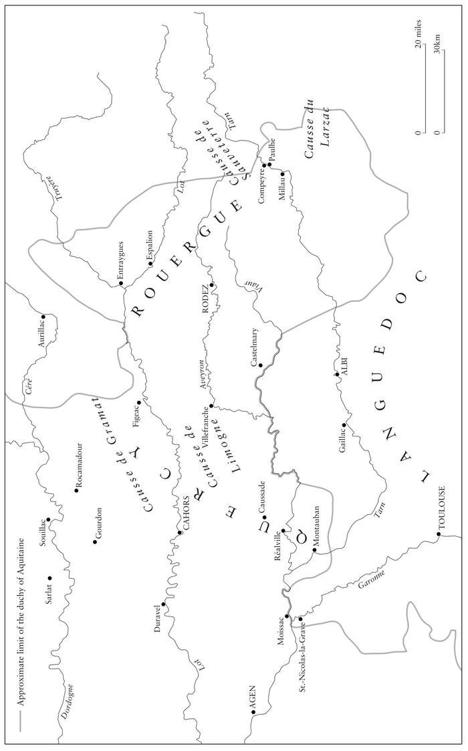
1 Quercy and Rouergue, 1369–1370
Chandos’s first instinct was to avoid challenging Anjou’s army directly but to counter-attack towards the centre of Anjou’s lieutenancy in the Toulousain in the hope of drawing it off. On about 20 March 1369 he marched out of Montauban up the valley of the Tarn towards Toulouse wasting the land as he went. There is no reliable record of this campaign but it undoubtedly caused great destruction in the northern Toulousain and according to Froissart came within a few miles of Toulouse itself. What it completely failed to do was disturb Anjou’s plans. The forces at Albi pressed on with their purpose, marching on Montauban a day or two after Chandos had left it. In Chandos’s absence the defence of Montauban was left to Sir Thomas Walkefare. Walkefare was an experienced soldier who had fought a famous fight at the battle of Poitiers. He put part of his garrison into the bastide of Réalville which was then a river port standing at a sharp bend of the Aveyron, some nine miles from Montauban. The object of this manoeuvre was to stop the French bringing supplies downriver to support a siege. It meant that the French were obliged to take time and effort to capture the place. Réalville resisted with ferocity for more than a fortnight. The walls were battered by stone throwers, undermined by sappers and eventually taken by assault in about the middle of April. In accordance with the pitiless laws of war the defenders were massacred to a man. But they had saved Montauban. By the time that Réalville fell Chandos had returned, placed a garrison of some 200 men in Montauban and then withdrawn into the hills to harass the French siege lines. The French were unwilling to besiege a solidly garrisoned city with Chandos still in the field nearby. For the moment they gave up the idea of attacking Montauban and marched north towards the Lot to deal with the few towns and castles, most of them comparatively minor places, which still flew the Prince’s banner from their walls.9
At Angoulême the Prince’s councillors had managed to scrape together a few hundred more men. They were placed under the command of that old war-horse Sir Robert Knolles who had recently arrived from Brittany to offer his assistance. In April 1369 Knolles made his way up the Lot valley from the Bordelais. About twenty miles west of Cahors he found his path blocked by a detachment of the French army comprising the bands of Petit Meschin, Perrin de Savoie and three other routier captains who had been sent forward to close the River Lot to supplies and reinforcements coming from the west. They had occupied Duravel, a small walled village dominated by a fortified Benedictine priory, which then stood on the right bank of the Lot beneath a steep escarpment. Knolles was forced to lay siege to this place. In about the third week of April 1369, having failed to carry it by assault, he set about starving it out. Chandos came north from Montauban to join him. The siege was a disaster. Within a short time the English had run out of everything except wine. It rained day and night, soaking their clothes beneath their armour. Finally they tried to suborn the defenders. Most of them were old companions in arms of Bertucat d’Albret and some had served with Chandos in Castile. The facts are obscure. It seems that the French captains at Duravel agreed to surrender the place to Chandos and Knolles but were betrayed and arrested before they could carry out their bargain. At about the beginning of May the English abandoned the siege and marched off to the north. As for the routier captains they were sent to Toulouse. There on 11May 1369 Louis of Anjou had Perrin de Savoie and Petit Meschin drowned in the Garonne and three other captains hanged and quartered.10
Lacking a supply train or heavy siege equipment and faced with growing difficulty in foraging for food, Sir John Chandos’s forces were compelled to split up into small groups remaining constantly on the move. Within a few days they were scattered across thecausses from the Dordogne to the Lot. They tried to surprise some of the more substantial places which had surrendered to the French. But they were consistently unsuccessful. The first target was Domme, an important walled town standing on a cliff-top over the Dordogne at the eastern march of Périgord, which had recently accepted a French garrison. Chandos failed to take the place by assault and was obliged to abandon the siege after a few days. Other places were successfully occupied, often without resistance, but proved impossible to hold. The inhabitants simply bent before the wind. Rocamadour was a typical case. The famous pilgrimage town at the northern extremity of the Causse de Gramat was defended by a local garrison which had been retained at the Duke of Anjou’s wages when the place submitted to his officers in March. When Chandos’s men arrived they resisted for long enough to say they had done their duty but no more. Next morning they agreed to admit the English and swear loyalty to the Prince, just as they had two months before to the King of France, and to supply fifty donkey-loads of victuals to Chandos’s army for ready cash. ‘And thus’, says Froissart, ‘Rocamadour remained in peace.’ The pattern was the same everywhere else. Men fled to the village tower on the appearance of men-at-arms shouting ‘Guyenne! Saint-Georges!’ one day and ‘Montjoie! Saint-Denis!’ the next, swearing whatever oaths of loyalty were asked of them.11
On 8May 1369 Chandos briefly reunited his dispersed forces for an attack on the cathedral city of Cahors. A powerful mounted raiding force was created, led by Chandos himself and the Gascon paladin Jean de Grailly, Captal de Buch. They arrived suddenly beneath the walls of the cathedral city a week later, achieving complete surprise, and launched an immediate assault, hoping to carry the walls before the defence was ready. They failed. The attack occasioned a brief panic among the Duke of Anjou’s councillors. He sent all available men to the city and even called on his brother John of Berry to bring reinforcements from Auvergne. Barges were sent urgently up the Aveyron with supplies. He need not have bothered. Chandos lacked the means to undertake a siege. Once the assault had failed he withdrew. Joining forces with Knolles he returned north to the Causse de Gramat. On 19May 1369 there was an attempt on Figeac which also failed. The two commanders are next reported moving east towards the march of Rouergue. Thus did the grand strategic idea conceived in January peter out in June in a series of improvised pinpricks. The campaign established what was to be pattern of the next phase of the war: on the English side the rapid movements of a guerre de course and some brilliant strategic thinking, but without the time or resources to follow anything through; on the French side the slow, overwhelming concentration of forces and progressive rolling back of frontiers. Sir John Chandos had already decided that he was wasting his time on the south-eastern march of the principality. Towards the end of May he sent his herald to Angoulême to ask for instructions.12
*
The long-awaited expeditionary force from England finally sailed from Southampton at the beginning of March 1369. There must have been between 800 and 1,000 men in all, most of them recruited in the English and Welsh lands of the Prince of Wales.13 The commanders were Edmund Langley, Earl of Cambridge, and John Hastings, Earl of Pembroke. Cambridge was the third of the English King’s four surviving sons, then twenty-eight years of age, an easy-going mediocrity with no military experience except for his participation as a teenager in his father’s campaign of 1359–60. Pembroke was an abler man. Intelligent, self-confident and ambitious, he was a great favourite of Edward III and with a longer apprenticeship might have been an effective commander. But, still only twenty-two years old, Pembroke had even less experience than Cambridge. The choice of these two men is eloquent evidence of the lack of experienced talent among the English court aristocracy after the passing of the great generation which had fought in Edward’s wars before 1360.
The army disembarked from its ships in the roads of Saint-Malo on the north coast of Brittany. The Earls’ first task was to make contact with the main English garrisons of the region. Latimer’s garrison at Bécherel appears to have been resupplied and possibly reinforced. Cambridge briefly joined forces with Sir John Cresswell’s company at Château-Gontier to help them consolidate their positions in Anjou and Maine. The army then turned south. John de Montfort later denied that he had connived in these operations and declared that he had had no choice but to let Cambridge cross his territory once he had landed. But no one believed him. The English had discharged their ships under the noses of John’s garrison at Solidor in the bay of Saint-Malo and were allowed to cross the Loire by the great fortified bridge at Nantes.14
The two Earls must have reached the Prince’s court in late April 1369. Their arrival coincided with a series of fresh setbacks for the English cause. The first came in Périgord. So far the Duke of Anjou’s agents had made very few inroads in this province and none at all north of the Dordogne. The English remained securely in possession of the river as far as Domme, with their allies holding all the principal fortresses along its course and a significant garrison guarding the main bridge at Bergerac. Even the Count of Périgord, Archambaud V, a declared enemy of the Prince who had promised the year before to adhere to the appeals against the hearth tax, sat on his hands until it became clearer which side was winning. Towards the end of March 1369 Archambaud made up his mind. He and his brother Talleyrand led their retinues into Quercy to join the Duke of Anjou’s army. On 13 April the Count formally adhered to appeals in the French encampment outside Caussade and appointed his proctors to represent him before the Parlement. Charles V promised him a war subsidy of 40,000 francs and urged him to open hostilities against the Prince in Périgord at once. As a result the first task assigned to the Earls of Cambridge and Pembroke after they reached Angoulême was to mount a punitive raid against the possessions of both brothers, much as Calveley had been doing against Albret and Armagnac in the foothills of the Pyrenees. They brought fire and sword to the family’s properties in the province and passed the best part of May in besieging the impressive thirteenth-century castle of Bourdeilles above the River Dronne west of Brantôme before an incautious sortie by the garrison enabled them to take the place. Pembroke won his spurs in this engagement, receiving his knighthood at the hands of his fellow commander.15
These agreeable acts of war were suddenly interrupted towards the end of May 1369 by a much more serious threat to English interests in Poitou. Poitou was strategically and politically crucial to the English government of Aquitaine. It was a convenient gateway for French armies coming from the north. It was by far the richest province of the Prince’s domains. It was also, of all the provinces ceded by the treaty of Brétigny, the most consistently loyal to the Prince. None of its towns had yet abandoned their allegiance. The nobility had taken to the life of the Prince’s court, receiving grants and offices at his hand. They had rallied round the Prince in his troubles. An important Poitevin contingent was even then serving with Sir John Chandos in Quercy. The only significant noble families of Poitou who supported the cause of Charles V in 1369 were those, generally living on the north and east marches of the province, whose main domains lay outside the principality in areas controlled by the French Crown.16
Early in May 1369 the French embarked on a series of needling raids on English positions on the northern march of the province. Within a few days of the start of this campaign a small force collected by the captain of Tours surprised La Roche-Posay and captured it by escalade in a daring night attack. La Roche-Posay was a powerful fortress sited on a spur of rock above the left bank of the Creuse guarding the Roman road from Tours to Poitiers. Technically just beyond the limit of Aquitaine, its occupation by partisans of the Prince had been a bone of contention between England and France for many years. Its loss seriously seriously weakened the northern defences of the principality. Charles V put a garrison into it and used it as a base from which to mount further incursions towards Poitiers and Châtellerault. The easy terrain, which made the region so prosperous, also made it difficult to defend. There were no mountains or major rivers presenting any serious obstacle to an invader.
Shortly, an even more menacing series of raids was organised from Anjou in the lower Loire by two local captains in French service, Jean de Bueil and Jean de Kerlouet. Jean de Bueil was a nobleman of Touraine serving as captain of Angers. Jean de Kerlouet was a relative unknown. He was a squire from northern Brittany of no great wealth or lineage who had served Charles of Blois for the last eight years of his life and then, after Charles’s death in 1364, had followed Bertrand du Guesclin to Castile. He seems to have based himself at Saumur. Between them De Bueil and Kerlouet built up a raiding force which was estimated by Froissart at 1,000 men-at-arms and may well have been close to that. Many of these men were footloose Bretons who had recently fought with the companies, like Kerlouet himself. They began to penetrate deep into the western march of Poitou. The English were caught off balance. Cambridge and Pembroke were still tied down outside Bourdeilles; Calveley was still in the foothills of the Pyrenees; Chandos was in Quercy with much of the baronage of Poitou. The only significant forces at the Prince’s disposal in the province were the garrisons of the principal towns and a company of some two or three hundred men under command of his friend Sir Simon Burley and his long-standing Welsh retainer Sir Digory Say. Both men were based at Montreuil-Bonnin, a garrisoned fortress ten miles west of Poitiers. Towards the end of May 1369 this force was annihilated by a large raiding party led by Jean de Bueil and Jean de Kerlouet which had managed to penetrate some fifty miles into the principality without being noticed. The English, who were conducting a sweep west of Poitiers, rode into a well-laid ambush. They were heavily outnumbered and swiftly overwhelmed with the loss of 140 men killed or captured. Say escaped with a handful of companions to the nearby fortress of Lusignan. Burley was among the prisoners.17
This event caused panic in Angoulême and an abrupt change of direction as the Prince’s officers stripped resources from every other front to defend the northern march of Poitou. Sir James Audley, another close friend of the Prince, was appointed as his lieutenant in the province. The Poitevin barons were brought back from Quercy and placed under his command. By the beginning of June a second army was being formed from the troops of the Earls of Cambridge and Pembroke with some additional companies raised in Poitou itself. Sir John Chandos was withdrawn from the southern front to join them.18
Audley’s army was the first to see action. He established his headquarters at Poitiers and then struck east in about the middle of June into the valley of the River Creuse, which marked the limit of the province. Audley’s first target was the town of Le Blanc, an enclave of Poitou on the right bank of the Creuse which was under siege by the French. The place was temporarily relieved (it fell a few months later). Then, turning north, Audley attacked Le Soudun, now an insignificant hamlet, which was then the site of an important castle guarding the left bank of the river eight miles upstream of La Roche-Posay. This place appears to have been carried by assault and garrisoned against the French. Turning back on his tracks Audley launched a punitive raid against the territory of Guy de Chauvigny, one of the few prominent noblemen of Poitou to have defected to Charles V. Guy’s castle at La Brosse was taken by storm on the day after Audley’s arrival. Audley hanged sixteen of the Breton company which Guy had left to guard the place and put in a garrison of his own. Many years later the Cheshire knights serving in Audley’s army would recall this incident as one of great feats of arms of their careers.19
The Earl of Cambridge’s army entered the Vendée at about the end of June 1369. The region, lying between the Sèvre Niortaise and the Bay of Bourgneuf, had never been fully absorbed by the Prince’s administration. The French had hung on to some important lordships there which they contended were not included in the territorial settlement at Brétigny. The most significant of these enclaves was the great fortress of La Roche-sur-Yon which was the centre of the road system of the region and the key to the defence of Poitou against any invasion force approaching from Nantes. The place belonged to no less a person than the Duke of Anjou and was defended by one of his retainers, Jean Belon. He commanded the largest French garrison of the region. When, in about the second week of July, Cambridge brought up his siege engines against the walls, Belon faced a dilemma common to many garrison commanders of the late middle ages. Reluctant to face an assault which would put his life at the mercy of the enemy, yet seeing no relief in prospect, he entered into negotiations with the English Earls. In the middle of July he agreed to surrender La Roche-sur-Yon in one month unless he was relieved beforehand. If no relief came he was to be paid 6,000 francs for the stores in the castle and allowed to leave freely with his men. Belon was permitted to send a message to the French King informing him of these terms. Cambridge for his part summoned reinforcements to help him fight off any attempt to relieve the place. Audley brought his own army across from Poitiers to join him. Their combined strength must have amounted to more than 2,000 men.
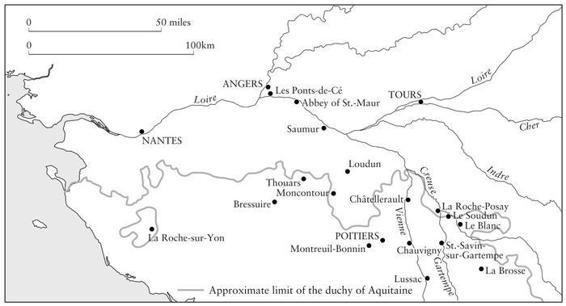
2 Poitou: the northern march, 1369–1371
In spite of the French King’s aversion to pitched battles a serious attempt was made to relieve Belon before the deadline. The task was entrusted to Amaury de Craon, a prominent magnate from Maine who was then serving as the King’s lieutenant in Lower Normandy. Unfortunately the decision was not taken until a very late stage and the force originally assigned to Craon was too small. Precious days were lost while he scrambled about for reinforcements. By the time that he was ready the fortress had surrendered. The whole transaction was strictly in accordance with the laws of war provided that the garrison had put up a reasonable resistance. But the short time during which Belon had resisted and the value of the stores he had left behind proved to be his undoing. When he returned to Angers he was arrested and charged with treason. Early in the following year the Duke of Anjou had him sewn up in a bag and drowned in the Loire.20
The loss of La Roche-sur-Yon was a serious reverse for the French. They made it worse by prematurely withdrawing Amaury de Craon’s force from the Loire valley and redirecting it northward into Maine to deal with the English garrisons of Château-Gontier and Saint-Sauveur. This decision appears to have been made by Charles V himself, almost certainly because of the threat which these places posed to the assembly area of the army of England. However, the operation was badly mishandled. The English companies at Château-Gontier abandoned the place without waiting to be attacked and escaped. Most of them made their way north to reinforce the garrison of Saint-Sauveur. Amaury de Craon was ordered to pursue them and force them to battle but was unable to catch up with them in time. He reached Saint-Sauveur towards the end of August and began to make dispositions for a siege. Shortly, he was joined there by much of the baronage of Lower Normandy as well as by a large contingent from Brittany and both Marshals of France. It was an impressive force. But there had not been time to prepare a proper siege train. The leaders of the besieging army fell out. Then the Bretons withdrew. Without them the Marshals considered that their forces were not strong enough. So in about the middle of September they abandoned the siege. Charles V was furious. He ordered them to return. But they do not seem to have done so.21
The cost of Craon’s unsuccessful attempt on Saint-Sauveur was high, for while the French commanders in the west had their backs turned the Earl of Pembroke followed up the capture of La Roche-sur-Yon with a highly successful campaign along the lower Loire. He first tried to capture the bridge-town of Saumur but was beaten off by its garrison. However, both of the crossings of the river between Saumur and Nantes fell into his hands: the ford by the fortified abbey at Saint-Maur; and the great fortified bridges at Ponts-de-Cé. These places were strengthened and garrisoned. Their capture made it much more difficult for the French to continue their raids into the western march of Poitou and gave the English a clear line of communication to the substantial army which was now crammed into the fortress of Saint-Sauveur.22
With the Loire front secure, companies of English and Gascon troops now began to penetrate east into the neighbouring French provinces of Berry and Bourbonnais. Most of these raids were pinpricks whose impact was small and brief. But one company achieved something more spectacular. The Gascon captain Bernard de la Salle had fought under the Prince in Castile before becoming one of leaders of the Great Company. He joined forces with his brother Hortingo and an adventurer called Bernard deWest, who may have been an Englishman. Together they recruited a company of about 120 men-at-arms and 200 archers out of the large Anglo-Gascon garrison based at Niort and invaded the Bourbonnais. There had been no recent operations in the area, so the custodians of its castles were not on their guard. The principal territorial magnate of the region, the Duke of Bourbon, was away with the King at Rouen accompanied by most of his retainers. They were waiting to embark for England. The raiders arrived outside the Duke’s castle of Belleperche, on the bank of the Allier north of Moulins, in about the middle of August. Dressed as peasants they tricked the gatekeeper into admitting them, swiftly overpowered the small garrison and took over the castle. Inside they found Isabelle de Valois, dowager Duchess of Bourbon, Charles V’s mother-in-law, whom they took prisoner. A large supply of victuals had been laid in for her court, which enabled the invaders to establish a permanent base. From Belleperche they occupied a string of castles regularly spaced across the western Bourbonnais and the neighbouring regions of Berry and the Limousin. At the western extremity of this line of strongholds they joined forces with the Herefordshire knight Sir John Devereux, a colourful protégé of the Prince of Wales, who commanded a large routier company based in the great fortress of La Souterraine on the northern march of the Limousin. For more than a year to come the French were obliged to divert considerable effort and manpower to contain the operations of these captains.23
*
The concentration of virtually all the resources of Aquitaine in its northern march meant that the defence of Quercy and Rouergue was practically abandoned. What little remained of English-held territory in these provinces was swiftly gobbled up by the officers of the Duke of Anjou. The process was highly sensitive to expectations. It was clear that the English were not in a position to defend the more distant outposts of their territory. For small communities concerned above all about their own security and anxious to avoid a return to the catastrophes of the 1350s, this was decisive. Patriotic sentiment rarely entered into it. AtMontauban the townsmen had remained loyal to the Prince while Sir John Chandos was in the province, in spite of being threatened by Anjou’s agents with confiscations and enormous fines. But as soon as Chandos left they opened negotiations and made the best bargain they could. A local nobleman, Ratier de Belfort, who had once served as the lieutenant of the English seneschal of Quercy, was now performing the same office for the French. He distributed money liberally among the townsmen and made lavish promises of privileges and favours. In June 1369, as the French closed in on Montauban, Sir Hugh Calveley arrived in the region from the Landes. He tried to shore up Montauban’s defences by establishing forts on the River Tarn upstream of the town. It appears to have been while he was engaged in these operations that Montauban opened its gates to the French. The place was certainly in their hands by the end of the month. Inside the town the change of allegiance was followed, as it often was in the divided communities of the south-west, by the wholesale replacement of the consuls and an orgy of private vendettas. The only surviving English presence in Quercy was now the garrison ofMoissac, which held out for another year before surrendering in its turn. But the region was given up for lost well before that. Calveley withdrew into the Agenais. Sir Thomas Walkefare, whose office as seneschal of Quercy had by now become an empty symbol, fled to Rouergue to join Sir Thomas Wettenhall, but he was a marked man. The French blamed him (probably wrongly) for the imprisonment and death of the two royal officers who had served the appeal papers on the Prince the year before. When some months later he was captured in a skirmish in Rouergue he was sent to Toulouse, kept in prison for a year and then hanged from a high scaffold specially built for him in a public square.24
The collapse of the English cause in Rouergue followed shortly after their final expulsion from Quercy. The catalyst was a struggle for the possession of Compeyre, a small walled town with a thirteenth-century keep built on steeply rising ground on the right bank of the Tarn, which was the key to the river defences of Millau. The inhabitants of Compeyre had no reason to feel grateful to the Prince’s government. Their town had once been an important place, one of the few possessions of the French Crown in the heart of the Count of Armagnac’s great fief. But, with the arrival of Gascon and English officials after 1362, it had been forced to accept the ‘many insults’ heaped upon it by the larger and richer town of Millau. Its local court was suppressed. It was obliged to accept Millau’s protection, to pay its taxes, to resort to its tribunals and to accept a garrison under the orders of its English captain, James Mascy. On 22 June 1369 a small troop of French soldiers under the command of a local nobleman appeared outside the gates of Compeyre and was promptly admitted by the citizens. The incident was a miniature of the tensions in the region which had undermined the English administration for years. Mascy, who was at Compeyre when the town defected, found himself blockaded in the castle from the streets below. Judging his position untenable he agreed to surrender the place unless he was relieved by 1 July and handed over his son, who was with him in the keep, as a hostage. The deadline was only a week away. There was a desperate scramble among the scattered groups of English soldiers and officials in the province to organise a relief force. Sir Thomas Wettenhall marched as fast as he could to Millau, where he arrived on 26 June. Some small companies of routiers arrived from Auvergne with an English captain, Hugh Russell. The French for their part collected their own reinforcements. In Rodez the Count of Armagnac’s lieutenant raised what local forces he could. The Count himself, who was with the Duke of Anjou at Toulouse, prevailed upon him to send 400 Bretonroutiers. The Count’s son John, who was at Clermont-Ferrand with the Duke of Berry, was urgently recalled. On 16 July 1369 the combined French force arrived without warning at Compeyre. The English were heavily outnumbered and caught between the attacking force and the French troops in the town. There was a bloody battle in which they were badly mauled. As darkness fell they tried to slip away. But they were noticed and pursued. They lost their baggage train and many of their men. Russell escaped with part of his company across the Tarn and took refuge in the castle of Paulhe on the opposite bank. Mascy and Wettenhall found their way by a circuitous route back to Millau where they decided, perhaps unwisely, to struggle on. A few weeks later, as Wettenhall led a raiding party across the causses, he was confronted near Montlaur by a detachment of men under one of Louis of Anjou’s captains and routed. Wettenhall himself was mortally wounded. He was carried to a nearby house where he died. It was some evidence of theregard in which Wettenhall had been held at Millau that they paid for a sung mass in his memory in the town church at which the whole clergy and leading citizens of the town were present.25
*
At Westminster Edward III’s councillors had tried to follow events as reports reached them from France, generally late, inaccurate and confused. They conceived and jettisoned fresh plans with bewildering rapidity in response to each new setback. In March and April 1369 they were still transfixed by the deteriorating situation in Aquitaine. No sooner had the Earls of Cambridge and Pembroke sailed from Southampton but plans were drawn up for another army to leave for Gascony in June under the command of John of Gaunt. These plans were suddenly overtaken by the news of the French occupation of Ponthieu, which occurred at the end of April. This had been planned in Paris for at least two years and anticipated by Edward’s officers in the county for months. But its timing and speed still came as a shock to the English. Hugh de Châtillon, the Master of the Royal Archers, arrived outside Abbeville at dawn on 29 April. The town at once opened its gates. Most of the garrison fled. The governor and his staff were arrested. The first reports of these events reached Westminster at the beginning of May followed swiftly by further tidings of disaster. Le Crotoy was stormed on 5May. The garrison in the castle was the largest in the county and one of the largest in France but they abandoned it within hours of the French occupation of the town and sloped away. Airaines was abandoned on the next day. The remaining garrisons of Ponthieu held out hopelessly for another month. The last English refugees from the county arrived at the gates of Calais on 1 June.26
There was a sudden panic at Westminster. If Ponthieu could fall so easily could Calais be next? There were disturbing reports of French military activity at the edge of the pale. The walled town of Ardres, which marked the south-eastern extremity of the English territory, was attacked over five days in May and remained under a loose siege for several weeks thereafter. The English castle of Audruicq five miles east of it was captured at about this time. Plans to prop up the Prince in Aquitaine were dropped. John of Gaunt’s expedition to Aquitaine was cancelled and the companies originally assigned to it were redirected to Calais. The Earl of Hereford was appointed captain of Calais. On 2 May he was ordered to raise an extra 900 men and to proceed urgently to hold the town against the French. A number of old soldiers were brought out of retirement to man the breaches of the town’s defences, including Sir Frank Hale, one of the great figures in Aquitaine of the 1340s, and the aged paladin Sir Walter Mauny who had begun his military career in Scotland in the 1330s. They were to be followed by a large expeditionary army, at least 6,000 strong, which would cross the Channel later in the summer and invade northern France. The King intended to take command of this force in person. The calculation seems to have been that it would both secure Calais against attack and present a sufficiently serious threat to draw off French attacks on Aquitaine.27
It was in this highly charged atmosphere that Parliament met at Westminster on 3 June 1369. The assembled members received a sombre report from the Chancellor, William of Wykeham, about the breakdown of diplomatic relations with France and recent events in Aquitaine and Ponthieu. The Prince ofWales, said Wykeham, had taken advice from the wisest men about him and concluded that the time had come for Edward III to resume the title of King of France. The Chancellor did not spell it out but everyone must have realised that this formal step would mark the final repudiation of the treaties of Brétigny and Calais and a return to the old war aims of the 1350s. It was probably the only realistic response to events on the ground in France. Three days later, on 6 June 1369, the King was advised to take this momentous step by both Houses.28
It is obvious from the terms in which Wykeham addressed his audience that the English government was still unaware of the French King’s invasion plans. Their eyes were shortly opened. The French invasion fleet began to assemble in the Seine in June. Within a few days the English government was informed that a ‘large fleet of sailing ships and galleys’ was being created to invade their island. Whether the news would have altered their plans if it had come earlier is an interesting question, but coming at this late stage it was received with surprising equanimity. Attack was thought, rightly as it turned out, to be the best form of defence. So John of Gaunt continued with his plans, crossing discreetly to Calais with a small entourage at the beginning of July. The Earl of Hereford left at about same time to take up his command in the town. A fleet of nearly 300 ships, ranging from small crayers to monsters of 300 tons, gathered in the Bay of Sandwich to carry their men in relays across the Channel. A raiding squadron was detached from the fleet at Sandwich and sent to reconnoitre the French coast. They succeeded in causing a fair amount of disruption to the French King’s invasion plans. About a dozen French ships were caught in the mouth of the Somme. A landing was briefly effected at Saint-Denis in the Chef de Caux (modern Sainte-Adresse) within sight of the French fleet’s anchorage.29
*
There was something curiously unreal about the French invasion plan of 1369. It must have engrossed the efforts of many officials and soldiers during the summer, but has left little trace in the surviving records. The enterprise had been controversial from the outset. As the Breton magnate Olivier de Clisson had pointed out in the Great Council which approved the project in March, the French had limited experience of major seaborne expeditions. It is clear that they greatly under-estimated the scale of the undertaking. At an early stage things began to go wrong, mainly on the maritime side. Like their English rivals, the French had traditionally relied on requisitioned merchantmen to supply both transports and warships for their fleets. However, no great naval campaign had been attempted since the 1340s and since then the maritime geography of France had changed beyond recognition. Calais had been an English port since 1347 and La Rochelle since 1362. These had previously been the leading mercantile ports of the French Atlantic coast. Brittany and Flanders were neutral. That left the French government with only the ports of Normandy and Picardy, principally Boulogne, Saint-Valéry and Dieppe. Even in these places the abrupt ending of trade with England in 1369 and the dangers of running the gauntlet between Calais and the Kent ports had dealt a severe blow to France’s merchant marine. French naval resources in 1369 consisted of a modest fleet of requisitioned ships most of which were too small for efficient war service. Of those whose size is recorded, none exceeded fifty tons burden and most carried less than half of that. The famous royal arsenal at Rouen had not been used for construction or repair work for a decade. The royal galley fleet comprised just ten vessels, half of them based in the Mediterranean and the rest in a poor state of repair. None of these problems appear to have been considered when Charles V formulated his invasion plans.30
The King was counting on his allies to make good the deficiencies in France’s indigenous naval resources. In this he was sorely disappointed. Flanders, which had been expected to provide much of the transport fleet, appears to have contributed little or nothing. The Grimaldi of Monaco and Menton had furnished war fleets of up to thirty-two galleys to Philip VI, but their maritime strength was only a shadow of what it had been. They controlled just ten galleys in 1369 and were unable to commit more than half of them to the invasion fleet. In the event they supplied none at all. Castile, the other traditional source of war galleys, did no better. Henry of Trastámara, the French-backed pretender to the Castilian throne, had undertaken the previous autumn to provide at his own expense two galleys for every one that Charles V could find from other sources. He was unable to live up to his promises. Seville, the largest city of Castile and the site of its principal naval arsenal, was securely held by his partisans and about twenty galleys were still there more or less intact. But the supporters of the murdered Don Pedro had disabled most of them by removing their oars and their Portuguese allies were blockading the mouth of the River Guadalquivir. The invasion fleet waiting in the Seine was apparently an impressive sight. The French King took parties of distinguished visitors out to watch the spectacle from the shore. Not many of them can have realised how many ships were required to carry even a modest army encumbered with its stores, horses and equipment.31
On 16 July 1369 the leaders of the French army of invasion received the Oriflamme at the abbey of Saint-Denis and prepared to set out for Harfleur. The King and the Duke of Burgundy established their headquarters in the citadel of Rouen at the end of July. The army was already encamped in the meadows of the Seine. Its final strength was the result of decisions made in Paris a month before, when it was known how much shipping was available. It must have fallen well short of the numbers originally envisaged in March. There were about 2,000 men-at-arms, most of them retainers of the Dukes of Burgundy and Bourbon. They were supported by several hundred crossbowmen, including some Genoese companies recruited by Rainier Grimaldi, and by the crews of the ships, who would be expected to fight with the army once it had landed. The whole force, including seamen, probably numbered between 4,000 and 5,000 men.
At Calais the English army had crossed the Channel by the end of the month. Its total strength according to French estimates was about 4,000, which is consistent with the English records. Their first task was to consolidate the English hold on the territory around Calais before Edward III arrived to take command. He was expected to follow in the autumn with fresh contingents which could be expected to bring the army’s payroll strength to between 8,000 and 10,000 men, plus between 4,000 and 5,000 servants (‘varlets’) who were not counted on the paid strength but were in fact combatants. On about 1 August 1369 John of Gaunt rode out of Calais with the Earl of Hereford on the road to Ardres. The French commanders on this front were Gui de Luxembourg, Count of Saint-Pol, and John, lord of Sempy, captain of Boulogne, both of them prominent magnates of the region who were destined to spend much of their lives guarding the barren marshes of the Pas-de-Calais. They were supported by Moreau de Fiennes, the rather ineffectual Constable of France. Froissart’s estimate of the troops at their disposal was about 1,000 men, thinly spread in a great arc between Boulogne and Saint-Omer. As the chronicler pointed out, it was enough to contain raiding parties but not to confront a major field army. Gaunt’s forces swept aside the French troops besieging Ardres. They retook the keep of Audruicq. About ninety smaller fortified places were captured and either manned or destroyed. Then the army burned a path eastward towards the ancient and dilapidated episcopal city of Thérouanne and the walled town of Aire, and south into the county of Saint-Pol.32
The French government’s intelligence had proved to be even worse than that of the English. They had known nothing of the arrival of an English army at Calais until John of Gaunt rode out of the gates of the town. The news was brought to the King at Rouen. At the time Charles was presiding over a great assembly of notables in the Norman capital and was in the midst of some delicate negotiations about the financing of the invasion force. The timing could not have been worse. Most of the King’s Council was for postponing the expedition to England at once and sending the Duke of Burgundy north to confront John of Gaunt instead. A commission was appointed from the ranks of the assembly to deliberate on the matter. After a certain amount of hesitation they agreed with the advice tendered by the Council. Charles reluctantly put off the invasion until the autumn. The army was ordered north to the Somme. Philip of Burgundy left Rouen on 7 August and reached Abbeville two days later. The French garrisons of the Calais march were ordered to withdraw south to meet him at Hesdin. A general summons was issued to the nobility of northern France and the inhabitants of the major cities. With these additions to his strength the best estimate that can be made is that the Duke of Burgundy had between 8,000 and 10,000 men under his command. On 19 August 1369 Philip marched north out of Hesdin.33
Four days later, on 23 August 1369, the English army was resting from its labours in the fields between Ardres and Guines when the French army was reported a short distance away. John of Gaunt and his captains were at dinner. They rushed to grab their arms and their horses. Within a few hours each army had fortified itself against the other. The English concentrated their strength around the hamlet of Balinghem. They drew themselves up in battle formation on flat ground protected by an impassable marsh. The French took up position on a steep hillside above a stream behind the village of Tournehem, where they dug deep ditches around their positions. About six miles of gently undulating ground lay between them. Neither side moved, except for skirmishes between scouting parties and exhibitionists and the occasional mounted raid. Philip of Burgundy sent his interpreter, an English squire, to mingle among his countrymen and report back. There were desultory negotiations for an arranged battle which came to nothing as such exchanges almost always did. Both commanders were later criticised for their immobility. Part of the problem was the inexperience of the English commanders. John of Gaunt had fought in several campaigns but was exercising his first command. The Earl of Hereford was Constable of England but had inherited his office and at twenty-seven had never been to war. But there was not much that even a more enterprising general could have done. The English were outnumbered. Their men were experiencing difficulty in getting supplies through the waterways from Calais. Many of them had fallen ill in the still, stinking swamp. As for the French, Philip of Burgundy, although a good deal more experienced than the opposing commanders, was never an inspired general. According to Froissart he had been ordered by his brother not to start a pitched battle without his express permission. His father-in-law, Louis de Mâle, plied him with advice to the same effect. The advice, if it was given, was sound. Philip’s advantage of numbers was not enough to force the narrow passages through the marsh. But the absence of movement quickly undermined the morale of his men. Discipline began to break down. There was much murmuring in the ranks about the delay in paying their wages. Quarrels broke out within the French army.34
In England chaotic attempts were being made to accelerate the assembly of the second army which would give them the decisive advantage of numbers. They were hindered by the usual logistical difficulties. A renewed epidemic of bubonic plague began without warning and infected a number of people close to the court including the Queen. Meanwhile, a steady stream of intelligence was coming in from spies planted in the entourage of Charles V and his captains. By 7 August 1369, the day that the Duke of Burgundy left Rouen, it was already known at Westminster that the French army of invasion was being diverted to the march of Calais. Across the English counties men-at-arms who had been holding themselves ready for orders were directed urgently to join the King at Sandwich. A week later on 14 August these orders were countermanded and embarkation delayed. Then, later on the same day, the timetable was accelerated once more. The King had received a report, which was probably false, that the French fleet had sailed from Harfleur and was about to attack the Solent ports or, worse, the crowded mass of transports gathered in the Downs off Sandwich. Men-at-arms were ordered to the coast as soon as possible. On 18 August Edward’s ministers learned that the Duke of Burgundy had left Abbeville and was expected to reach John of Gaunt’s army within three or four days. Edward was by now at Eltham. From here he issued a fresh round of commands, telling his commanders that they must be at sea by the 20th in order to reach Gaunt in time. In the event the second army was still not ready by the second week of September when it was decided to send those who had mustered across the Channel straight away without waiting for the rest.35
Edward had by now abandoned his plans to command them in person and resolved to stay in England. So the second wave of English troops to reach Calais was commanded by the Earl of Warwick. Warwick was very different from the two youngingénuescurrently commanding in France. He was a popular and flamboyant figure, an experienced soldier and an aggressive commander, who had fought at Crécy and Poitiers. He was accompanied across the Channel by the Earls of Salisbury, March and Oxford and by a large number of household troops and experienced veterans, about 2,000 men in all. They reached Calais on about 12 September 1369. While the army was laboriously disembarked from the ships Warwick rode out of the town with a small escort to confer with John of Gaunt at Balinghem. He was not impressed by what he saw. He enquired sarcastically of Gaunt and Hereford how long they planned to stay put in their tents. He swore a ‘great oath’ to have the enemy dead or alive if they remained where they were for another two days. This was bravado. But it was never tested, for the enemy did not remain where they were for two days. Reports of the scale of the reinforcements, which may have been exaggerated, persuaded the Duke of Burgundy that his situation had become untenable. On the following day before dawn the French army set fire to their stores, abandoned their positions and marched south to Hesdin. They left in such haste that the English were able to salve sixty barrels of wine, another sixty of beer and huge supplies of bread, meat and fish, on which they gorged themselves till nightfall.36
When the French army reached Hesdin most of it was disbanded, leaving the whole of northern France at the mercy of the large English army standing on the march of Calais. The Duke of Burgundy returned to Paris. Charles V, who had been waiting upon events at Rouen, cancelled the invasion of England and began to devise other plans for the fleet that was still lying at anchor in the Seine. Then, on about 18 September 1369, he too left for Paris.37 On the face of it, these were extraordinary decisions. The most plausible explanation is a sudden cash-flow crisis which prevented the Duke of Burgundy from paying his men. But if the French King and his brother thought that John of Gaunt was about to return to England they were gravely mistaken. Some English companies did return home. But the Earl of Warwick had landed all his men by 15 September and fresh contingents were now reaching Calais every day. They were joined in the town by a large body of German troops, the results of an energetic campaign of propaganda and recruitment in the Low Countries during the summer. The leaders of the English army resolved to strike against the Seine base of the French fleet. The whole army must by now have had a payroll strength of about 6,000 strong or about 8,000 with additional combatants. On about 15 September they formed themselves into three divisions and advanced south on a broad front more than twenty miles wide, burning everything before them. Towards the end of September Edward III’s Council decided to support their operations with a fleet. Forty-three ships were selected from the transports recently returned from Calais and placed under the command of the two admirals. They sailed from Rye on 1 October and began to loot their way down the coast of Picardy and Normandy towards the mouth of the Seine.38
The French defence in the Pays de Caux was in the hands of the Count of Saint-Pol, the commander on the march of Calais. Although largely deprived of men by the dispersal of the army, Saint-Pol performed his task with great skill. He was forbidden, just as Philip of Burgundy had been, to engage the English in battle. But he retreated before John of Gaunt’s army, keeping a few hours’ march ahead of them, slowing up their advance, making long-distance foraging impossible by picking off isolated groups. The French either knew or guessed that Harfleur was Gaunt’s destination. The delay which Saint-Pol inflicted on the invader won them precious time in which to strengthen its defences. The King sent Pierre de Villiers, master of his household and a close confidant in the crises of the late 1350s, to prepare the place for a siege. He built a flour mill and temporary defences around the gates and brought in vast quantities of artillery and ammunition from the arsenal at Rouen. The French fleet, which was still anchored in the estuary, was sent out to sea for safety.39
At about the beginning of October 1369 the English army arrived outside the walls of Harfleur. The English fleet must have arrived off the harbour at almost the same moment. The Count of Saint-Pol had by now shut himself in the town with 200 men-at-arms. He left another 100 men under the command of Baudrain de la Heuse in a fortified village north of the town to harass the English lines from the rear. The English commanders ordered an immediate assault on the walls. When this failed several more were attempted, equally unsuccessfully. The ferocity of these attacks can be judged by fact that the defenders expended 12,000 crossbow bolts in repelling the first one alone and 44,000 more in the later ones. John of Gaunt could have undertaken the siege of Harfleur, as the French plainly assumed that he would. He had carpenters and sappers with him. He had plenty of time. But his men were suffering from disease, not only the dysentery which was endemic among armies on campaign, but in some cases bubonic plague which was active in London and Calais. With the French fleet dispersed and the army of invasion disbanded, the strategic objective of his campaign had largely disappeared. So, in the third week of October, after just four days outside the town, John of Gaunt turned back towards Calais.40
The retreat proved to be more difficult than the advance. It involved marching back across land which had been devastated by both armies. The French made a serious attempt to block Gaunt’s path and break up his army. Hugh de Châtillon, the Master of the Royal Archers, who was still holding Ponthieu, barred the western crossings of the Somme. All the bridges of the Oise were blocked in order to stop the invaders moving east. Gaunt’s men were ambushed by the garrison of Abbeville a few miles east of the town as they headed for the ford of Blanchetaque. There was a bloody battle in which the English eventually beat off their assailants and captured a number of prisoners, including Hugh himself. By an irony which was no doubt delicious to him, Hugh’s captor was none other than Nicholas of Louvain, the former governor of Ponthieu whom Hugh had surprised and captured at Abbeville in April. Hugh was taken back to Calais and sold to Edward III, who ordered him to be locked up in Nottingham castle. By the middle of November Gaunt and his sickly army had returned to Calais. Warwick died there of plague before he could get back to England. By the end of the month most of the survivors had returned to their homes.
It may be wondered what John of Gaunt had achieved for his pains. He had demonstrated his father’s military power. He had forced the abandonment of Charles V’s invasion plans. In a pungent return to the strategy of the 1350s he had dented the prestige of the French monarchy, which had stood by and allowed northern France to be burned and pillaged under the noses of its commanders. But Charles V was strong enough to live with that. It was the English who needed to force a decision. In this sense they had failed. The decisive battle had eluded them.41
*
Charles V felt keenly the loss of face involved in the cancellation of the invasion. But his alternative plan for the fleet proved to be an even more humiliating failure. It was devised during the autumn of 1369 in conjunction with two Welsh adventurers called Owen Lawgoch (or Owen ofWales) and Jack Wyn. Owen was the great-nephew of the last native prince of Wales, who had been killed in 1282 in the final stages of Edward I’s conquest of the country. Since then his family had lived in impoverished obscurity, owning small parcels of land in Wales and the marches and in Surrey. According to Froissart, Owen himself had been brought up at the French court and as a young man had fought at the battle of Poitiers on the French side before following the Anglo-Gascon companies into Italy in the early 1360s. At some stage he fell in with Jack Wyn, a colourful professional mercenary calling himself ‘Le Poursuivant d’Amours’ who was probably the best-known Welsh captain in France. Wyn had served with the English companies in eastern France in 1359 and 1360 and had settled permanently in Burgundy after the peace. There he served as the custodian of John of Gaunt’s possessions in Champagne, including the important castle of Beaufort east of Troyes. When the war resumed in 1369 Wyn declared for the King of France. Together with Owen of Wales he began to recruit a following among Welshmen in France, including a number of prisoners of war in French hands and others who had deserted from the Prince’s companies in Aquitaine. They persuaded Charles V that Wales was ready to rise against the English if only help could be brought to them from outside.
Their pretensions were much exaggerated but they were not complete bluff. There were in fact prominent men in north Wales who were ready to rise against the English. And, although Owen had not been in Wales for many years, except perhaps briefly in 1365–6, his name still counted for something there. Without knowing or understanding more than a smattering of this, Charles V was persuaded in the autumn of 1369 to use the fleet which he had assembled for the invasion of England to carry Owen and Jack Wyn to Wales. They were to embark at Harfleur on 6 December 1369. The preparations were even more hurried and unsatisfactory than those which had preceded the attempt to invade England in the summer. It would be interesting to know if anyone other than the silver-tongued Owen counselled the cautious King to finance an expedition across more than 500 miles of sea in the middle of winter in order to land a tiny army in one of the remotest parts of Britain.42
The whole venture was a disaster. Owen’s Welsh companies began to arrive at the port in the second half of November 1369. They were reinforced over the following fortnight by some companies of Genoese crossbowmen and French men-at-arms as well as infantry contingents recruited in the towns of northern France. Victuals and equipment were procured and loaded. More than 100,000 francs was said to have been disbursed. December is squally on the Atlantic coast. Some of the urban contingents, appalled by the weather conditions in which were expected to sail, deserted. But Owen of Wales and Jack Wyn pressed on. They put to sea with a somewhat reduced army more or less on time on about 7 December 1369. But they were driven back by difficult weather conditions after about twelve days at sea during which they failed to make a landfall. In England the government learned about Owen’s treason by the beginning of November 1369 and of his planned invasion of Wales about six weeks after that. They confiscated his meagre lands. They reinforced the coastal garrisons of Wales and arrested the Anglesey man who was supposed to organise the rising in the west. It was not until much later that they learned to take Owen of Wales seriously. It says something for his persuasiveness that the fiasco did nothing to dent his reputation with the King of France. But Charles V never embarked on such a reckless operation of war again.43
*
The travails of the English King and his captains in the north were not enough to halt the progressive collapse of the English position on the south-east march of Aquitaine. Quercy was already lost and the only significant town which remained to them in Rouergue was Millau. The opinions of the doctors of law at Bologna, which the consuls of Millau had commissioned in the spring, had now been received. They were found to be unconditionally favourable to Charles V. The opinions, which had been commissioned mainly in order to put off importunate representatives of the Duke of Anjou, now eased the path of surrender. The consuls negotiated a short truce with Anjou’s officers at the end of September 1369. The captain of the town, James Mascy, left for Angoulême to impress upon the Prince the seriousness of his situation. When the truce expired no answer had come from Angoulême. So the consuls resolved to surrender the town. The opinions of the doctors of Bologna were read out at a general assembly of the citizens and the populace with one voice ratified the decision. The small English garrison in the citadel continued to hold out, but the end when it came was surprisingly amicable.
Mascy returned to Millau from Angoulême at the end of December to find that the townsmen had manned the walls and gates against him. As he stood outside the consuls invaded the citadel. In a tense exchange in the hall of the castle Mascy’s wife, who had been left in command during his absence, refused to hand over the keys. But she ostentatiously left them on the table to be taken. Mascy had a substantial company of men-at-arms with him but he made no attempt to force the issue. The townsmen allowed him to enter the town with his son and a page and they agreed over a meal that the best thing would be for him to negotiate the peaceful departure of all the remaining English troops in the province. The garrisons in Castelmary and Sauveterre had already agreed to sell out. The two garrisons maintained in the English interest by the Bishop of Vabres were disbanded. Over the next few days Mascy negotiated the surrender of Paulhe. He was eventually escorted under safe-conduct from Millau to Castelmary where the remaining English troops in the province had assembled for their final departure. After they had gone the arms of Edward III and the Prince were ceremonially taken down from the gates of Millau and smashed. It was almost exactly eight years since Sir John Chandos had put them there.44
In Poitou the glow of success left by the English operations of the summer had already faded. The French troops of the march did not disband at the onset of winter. They concentrated on long-distance raiding from Touraine and Berry, the only regions where the march remained easily penetrable after Pembroke’s campaigns along the Loire. The main centres of operation were Saumur, the westernmost bridge over the Loire still in French hands, which was the base of Jean de Bueil and the Marshal, Louis de Sancerre; and La Roche-Posay on the Creuse, where Jean de Kerlouet and his troops established themselves in September. Shortly afterwards Kerlouet created an important subsidiary base at Saint-Savin-sur-Gartempe, a walled town on the west bank of the Gartempe about fifteen miles south of La Roche-Posay.45
On the English side the defence of the whole march was nominally the responsibility of the Prince’s lieutenant, Sir John Chandos. In reality Chandos commanded only his own retainers and garrisons and, when they were summoned, the Poitevin retainers of the Prince. The Earl of Pembroke, who commanded the English expeditionary force, took the view that it was beneath him to serve under a mere banneret, however famous. In practice the task was informally divided between them, Pembroke maintaining a screen against Jean de Bueil and the garrisons of the Loire valley while Chandos defended the eastern march against Kerlouet’s garrisons on the Creuse and the Gartempe.
Pembroke may have had the grander name but his inexperience showed. In December 1369, shortly before Christmas, he conducted a fire-raising raid across the Loudunois and encamped with a force of about 500 men around the village of Purnon. He stayed there for long enough to enable Jean de Bueil to gather 600 men-at-arms from the garrisons of the Loire to surprise him. Pembroke’s men were still struggling to form lines across the village street when the French horsemen charged into them, killing or capturing about a hundred. Pembroke abandoned his supplies and several hundred war-horses to the enemy and fled to a fortified house at the edge of the village where he had to be rescued by Chandos and the garrison of Poitiers. The French withdrew to their bases. ‘We have acquitted ourselves honourably,’ they told each other; ‘now let us make off with our loot and prisoners while we still have them.’ Pembroke’s enemies, a growing band by now, could scarcely conceal their satisfaction.46
Chandos’s own days, however, were numbered. On the last day of December 1369 he tried to trap the company of Jean de Kerlouet as it entered Poitou by the bridge over the River Vienne at Lussac. The bridge, which carried the old Roman road from Limoges to Poitiers, consisted of a timber carriageway supported on four great stone piles rising out of the water. As the French captain approached with his men he found the carriageway blocked at the western end by about 140 men commanded by Sir Hugh Stafford and Sir Digory Say. There was a fierce fight for possession, but before the French could break out they were attacked from behind by Chandos, who had brought the rest of his troops round by the other bank of the river. The French were crushed between the two English forces. Casualties were exceptionally heavy on both sides. They included both of the principal commanders. Jean de Kerlouet was one of the large number of prominent French prisoners. Chandos, who like many professional soldiers never wore a vizor, was run through the head with a sword. He died a few hours later without recovering consciousness. In English eyes his loss far outweighed any gain made in the fight. They would later say that had he lived he would have turned the tide and saved Aquitaine. That perhaps was self-deception. But Chandos’s death, following upon that of Audley five months earlier, deprived the Prince of his wisest political counsellors and his only outstanding generals.47
*
The English probably had the better of the war of raid and counterraid in Poitou. But whatever advantages they derived from it were dissipated in the first three months of 1370 by a disastrous adventure of the Earl of Cambridge in the Bourbonnais. The capture of Belleperche in the previous summer had been a humiliation keenly felt by Louis, Duke of Bourbon. As soon as the army of the north was disbanded in September Louis set about recovering the place. At the end of December 1369, after long preparations, he and Marshal Sancerre laid siege to Belleperche with an army of about 1,000 men. The siege was methodically pursued. Bourbon had trenches dug around the castle. He built elaborate field fortifications (‘bastides’) opposite the gates. He brought in siege engines to batter the walls day and night until the captive Duchess, terrified by the constant crashing of masonry about her, sent a message begging her son to stop. The Duke, who had committed his reputation to the recapture of the place, ignored her.48
The Earl of Cambridge was with the Prince at Angoulême when the news of Bourbon’s operations reached them. A better strategist might have been satisfied that a substantial French force was being tied down by a garrison of just 120 routiers in a place which was marginal to the wider course of the war. But it was decided that it should be relieved. Froissart, who was well informed about this campaign, says that it was the Prince who made the decision, it is not clear on whose advice. The main reason was probably a desire to force a pitched battle, a form of warfare in which the English had excelled for two generations and in which victory would count for a great deal in the contest for local loyalties. It was a bold strategy. It involved redeploying most of the English expeditionary force and raising the largest locally recruited army that the Prince’s states had produced since the ill-fated invasion of Castile. They would have to march 200 miles through inhospitable territory in mid-winter in order to reach Belleperche. Unfortunately the Prince was in no state to execute the plan himself. He depended on the generalship of his brother, who had neither the experience nor the skill for the task and was poorly served by his advisers.49
At the beginning of February 1370 the Earl of Cambridge, accompanied by most of the English expeditionary force, the Prince’s household troops and the baronage of Poitou, arrived at Limoges. The rest of the nobility of Aquitaine had been ordered to join him there. Reports reaching the French commanders put his strength at about 4,000 men, which accords broadly with Froissart’s information but may have been rather more than the true figure. In the course of February and early March the Duke of Bourbon’s army was heavily reinforced from Burgundy and the northern provinces in order to meet the new threat. As a result, when Cambridge reached Belleperche, probably towards the end of February 1370, he found himself facing a French army of about 1,500 men-at-arms and 300 archers, well dugin on one side of the castle and defended at the front and rear by rings of trenches and field-works. The French artillery train included a huge fixed arbalest made in Genoa which had been brought from the Duke’s castle of Chantelle and was still talked of two centuries later in the time of Rabelais.
The English had expected to be able to bring the besieging army to battle or force them to withdraw. However, to the surprise of his troops and the indignation of some of them, the Earl of Cambridge declined to order a full-scale assault on Bourbon’s positions. Instead he began a laborious counter-siege, punctuated by sharp skirmishes and exchanges of artillery fire. After two weeks of this Cambridge finally changed his tactics and tried to provoke a battle on open ground. He sent Sir John Chandos’s herald into the French lines to challenge them to come out. The Duke of Bourbon was having none of that. ‘Chandos,’ he replied, as the herald later told Froissart, ‘you may tell your masters that I shall not fight to suit them.’ After digesting this answer Cambridge tried to provoke the French to break cover by using Bourbon’s mother as a bait. He drew up his men in battle order in front of the French positions. On the other side of the castle, which the French army had been forced to leave uncovered in order to face the English, the garrison brought the Duchess of Bourbon out of a postern gate and led her under heavy escort through the deserted French siege lines. The French told the Chandos herald that they thought this a discreditable trick ‘unheard of in a war of gentlemen’. The Prince of Wales agreed with them when he was told about it later. At any rate it did not work. The Duke of Bourbon’s men held their ranks and the Duchess was carried off into the Limousin. Shortly afterwards, in about the middle of March 1370, the English companies at Belleperche set fire to the castle and escaped. As they left the French stormed the walls under the noses of the Earl of Cambridge’s army and planted Bourbon’s standards on top of the towers.
After a few days of confused counsels and bitter internal wrangling among the English leaders Cambridge’s army abandoned the campaign. The retreat was very difficult. The English withdrew under cover of a heavy snowstorm. Entering the Limousin they were forced by appalling weather and shortage of victuals to divide their army into small groups which were harassed by a skilful French pursuit directed by Marshal Sancerre. Deserters told the French that Cambridge was suffering heavy casualties and had lost a great number of horses. As for the men who had occupied Belleperche, they were cornered in the small town of Lesterps in the county of La Marche and all but annihilated. Their leaders were taken to Paris to be beheaded for treason. Only Bernard de la Salle escaped. All that the English gained from the Belleperche campaign was the Duchess of Bourbon. She was placed at the disposal of the Prince, who gave her to his friend Simon Burley to enable him to pay his own ransom. The Duchess was eventually released in 1372 after three years in captivity in exchange for Burley plus a large sum in cash. Militarily the campaign had been a disaster. It had cost the Prince many men and emptied what remained of his treasury as well as inflicting a public humiliation on a son of the King of England.50
*
While the Earl of Cambridge was marching across the Limousin plateau to Belleperche the French extended their power into the Agenais. This region, which bordered on Quercy to the west, stood across the routes to Bordeaux by the valleys of the Lot and the Garonne. It was a region of countless small, subdivided lordships many of whose possessors were old allies of the Albret or Armagnac families and had adhered to the appeals from the outset. The leaders of the towns had waited upon events like so many others. Anjou’s agents had been pressing for their submission for some months. In February 1370 the pace of events sharply accelerated. Anjou bought the submission of the provincial capital at Agen by lavish gifts to influential figures in the town and extraordinarily generous grants to the inhabitants, including a perpetual exemption from all royal taxation. He thought well enough of his prize to come to the town to receive its submission personally in the middle of February. The Prince’s officers appear to have made a deliberatedecision to concentrate their whole remaining strength in the region in the walled towns of Aiguillon and Port-Sainte-Marie by the confluence of the two rivers. This was no doubt realistic. But it involved allowing the French to walk in to the rest of the province. The Count of Armagnac took charge of this process. Once the men of Agen had submitted he found that other places were very ready to follow their example. All the significant towns of the region submitted in the course of the month.51
In Périgord a similar story was unfolding. Arnaud d’Espagne, Seneschal of Carcassonne and marshal of Anjou’s army, was the Duke’s captain-general in the province. A number of castles were occupied and garrisoned by his officers. In the uplands north of the Dordogne the Prince’s subjects and allies now deserted him in droves. Périgueux, the provincial capital, had already decided that the safest course was to submit. The consuls were only holding out for suitable terms. Like everyone else their main concern was to ensure that they received proper military support to secure them against the Prince’s revenge. On 28 February 1370, the place formally submitted. The citizens were summoned by trumpets to the cloister of the monastery of Saint-Front to hear the summons of the King and the Duke of Anjou read out and to ratify the consuls’ decision. The bishop’s palace in the Cité, which the English had used as a fortress and an occasional residence for the Prince and the Earl of Cambridge, was demolished and its materials carried away lest either side should use it again to overawe the citizens.52
The English had now lost control of most of the hill country of Périgord and the whole of the valleys of the Lot and the Garonne east of the confluence, with the isolated exception of Moissac where the garrison left by Chandos was still courageously but pointlessly holding out. The process accelerated as each submission brought more in its wake and the inhabitants of the English principality lost whatever confidence they had ever had in the Prince’s ability to defend them. It was not at all clear that the French advance could be stopped even at Aiguillon or Bergerac which were now the outer barbicans of the Prince’s domains. The lord of Albret had returned to Gascony after his long and highly profitable stay at the court of Charles V with a promise of 60,000 francs a year towards the cost of making war on the Prince in the Landes and the Bazadais where his family’s lands were concentrated. But in the event no war was required. In about February 1370 Albret occupied the important walled city of Bazas. The language of the records suggests that some force was necessary but not much. Albret had already distributed 2,000 francs among the leading citizens for their co-operation and it is likely that the only resistance came from the garrison in the citadel. By the beginning of March he had his own garrison of 100 men there. Bazas was just forty miles from Bordeaux.53
The lack of any serious resistance from the Prince’s officers in these places is remarkable. There is no trace of any fighting, even on the modest scale which Wettenhall and Mascy had managed in Rouergue. Shortage of money and manpower is the most likely explanation. The domestic revenues of Aquitaine, which had fallen to a historic low in the year ending 29 September 1369, fell by another third in the following year. The main reasons were the progressive disintegration of the Prince’s administration and the collapse of the wine trade as a result of the war. The tonnage of wine passing through Bordeaux fell by 70 per cent by comparison with the year before and the proceeds of the wine customs by four-fifths. Unpaid men might still serve out of loyalty but there was little enough of that. None of the cities occupied by the French in February and March 1370 had had garrisons to defend them, with the possible exception of Bazas, and no field army was within reach. Major towns, long-standing allies, powerful castles, were simply abandoned to the Duke of Anjou.54
As the formal structure of the Prince’s government collapsed in the outlying regions of Aquitaine his officers were gradually replaced by irregulars: self-employed captains of free companies operating in a loose alliance with the English, and local lords pursuing their own interests under English colours. In Quercy Bertucat d’Albret joined forces with Bernard de la Salle after the latter’s escape from Belleperche. The two of them commanded a combined company of 200 men-at-arms with perhaps 500 hangers-on which established itself in the Figeac area. From here they raided over the whole region. In Périgord the towns which submitted to the French in the Vézère valley were mercilessly harried by the Montaut lords of Mussidan, who remained the standard-bearers for the Prince in the valleys of western Périgord. The royal garrison in Périgueux kept the raiders away from the immediate vicinity of the city, but within three months of its submission the citizens were complaining that raiding parties were penetrating to within ten miles of its walls. The Prince’s dependence on men like Bertucat and the Montauts was the only alternative to deploying proper garrisons and field armies, but their use inevitably meant treating the populations of these provinces as enemies.55
*
In both England and France the campaigns of 1369 were followed by a period of reflection and reassessment. Both governments had entertained hopes of a swift knock-out blow. Both had been disappointed. In France, which had spent more and run out of money first, serious thought was already being given to the implications of a political stalemate and a long war of attrition. The lack of an effective system for imposing and collecting taxes had been the single most important factor in the military failure of France in the 1340s and 1350s. In just the same way the development of an efficient tax system in France in the next two decades, coinciding with systemic failures of the English system, is central to an understanding of the French military revival.
The financial demands of the war were conditioned by significant changes in the way it was fought. In the 1340s and 1350s the main military operations had been conducted by very large armies operating for short periods, generally in summer. The French army at Crécy had been at least 20,000 strong and was in being for just one month. But the great battles fought by these slow-moving hordes were a thing of the past by 1369. The French, having rejected the pitched battle as the main end of warfare, concentrated instead on the effective control of territory. The army commanded by the Duke of Burgundy in September 1369 was the largest that Charles V deployed in the whole of his reign. After that he never deployed more than about 4,000 men-at-arms in a single army and rarely had more than 6,000 on his payroll at any one time, divided between all theatres. On the other hand these armies remained in the field for much longer periods. Although the rhythm of expansion in spring and contraction in the autumn continued, there were always substantial forces serving at the French King’s wages even in winter. The consequence of these developments was that the trend towards the professionalisation of war, which had been evident in most European countries for many years, was sharply accelerated in the last three decades of the fourteenth century. The maintenance of standing forces of professional fighters called for a steady, predictable stream of funds, month in, month out, every year. The laconic Bertrand du Guesclin is said to have reminded Charles V of this at the time of his appointment as Constable. ‘Qui bien ne les paie, ils ne veulent servir,’ he said.56
Before 1360 the French tax system had consisted of a bewildering variety of taxes granted either by the Estates-General of one or other of the two great administrative divisions of France, Languedoc and Languedoil, or more commonly by smaller assemblies representing a single province or region. The great majority of these taxes were local, temporary, and hedged about with conditions which took a long time to negotiate and greatly reduced their value. The inadequacy and unpredictability of these sources of revenue had been an abiding problem for French governments, which had been unable to engage in the most basic financial planning and had been forced to resort to coinage manipulation to fill the funding gap in times of crisis. By 1369, however, the French state was collecting three permanent taxes, all of which had come into existence during the past nine years. The main decisions were due to the much-maligned John II, or perhaps to his more far-seeing advisers. In December 1360, immediately after his release from captivity in England, John issued the ordinance of Compiègne which introduced special taxes in order to raise the money owed to Edward III for his ransom. These took the form of indirect taxes on goods exposed for sale (known as ‘aides’) and a surcharge on the salt tax (orgabelle). The aides were levied at the standard rate of 12d in the pound (5 per cent) on all commodities except wine which paid one penny in the shilling (8.3 per cent). After a number of experiments with higher rates the gabelle had been fixed by 1369 at 10 per cent.57
The payment of a king’s ransom was one of the few unconditional financial obligations of a subject to his lord. The aides and the gabelle had therefore simply been imposed by royal decree without the consent of any representative assembly and without the prolonged and expensive negotiations which had preceded the collection of earlier taxes. In theory this was an extraordinary and strictly temporary state of affairs. The ransom was supposed to be paid by 1366 and payments in fact ceased early in 1368. By this time, however, the ransom aides had been tacitly recognised as an additional war tax of indefinite duration. Money raised from the ransom taxes was repeatedly diverted by the King or his lieutenants to military expenditure during the successive crises of the 1360s. Latterly, a significant proportion (generally a sixth) of the revenues raised from aides had been spent with the government’s permission on the defences of the towns where they were collected. Other grants were being made from the receipts of the aidesfor war damage repairs and the military expenses of favoured noblemen and princes of the blood. This state of affairs appears to have been more or less accepted by the regional assemblies which had met at Compiègne, Chartres and Sens in 1367. They complained about several aspects of the new tax regime. But they did not complain about the continued collection of the aides nor about its diversion to war expenditure.58
From the beginning of 1364 the ransom taxes were supplemented by an even more important source of revenue, the fouage or hearth tax. The fouage was a traditional form of taxation in Languedoc which had been accustomed for many years to frequent, heavy war taxes. Hearth taxes had considerable advantages. They broadened the tax base, enabling the burden to be spread on a more or less uniform basis across a whole region. The lion’s share of every hearth tax came from taxpayers in the plat pays where most people lived. For these reasons they were complementary to the aides which were collected mainly in market towns. In November 1363 the Estates-General of Languedoil meeting at Amiens ordained a hearth tax to be levied on each household at a graduated rate more or less related to ability to pay, which was designed to yield an average of three francs per hearth across the whole of Languedoil. It was explicitly a war tax, intended to finance a standing army of 6,000 men to deal with the free companies then at the height of their power. The introduction of the fouage depended on consent at the outset, but no term was set on it. It was an indefinite tax and shortly became a permanent one, unlike previous grants of taxation by the Estates-General of Languedoil which had always been made for a limited period, and unlike those of Languedoc which still were.
All three of the new taxes of the 1360s were designed for particular purposes. But their collection was under the control of the Crown which in practice applied them as it saw fit. Salaried royal commissioners (élus) in each diocese let the taxes in their districts to tax farmers, financiers who promised to pay fixed sums at fixed times to the district receiver, taking their profit or loss from any difference. The élus and the treasurers-general in Paris supervised the process of assessment, enforced the obligations of the farmers and resolved the innumerable disputes which arose in the course of collection. It is clear that in the first few years these functionaries encountered serious problems which were only gradually surmounted. But they were not responsible for the main weakness of the system, which was the large number of exemptions. The clergy were exempt from hearth taxes on the footing that they paid clerical tenths. Noblemen were also exempt both from direct taxation and from sales taxes on the produce of their domains. However, the most significant exclusions were geographical. The counties of Artois, Boulonnais and Saint-Pol, which bordered on the English pale of Calais and were constantly fought over, had to be allowed to commute their liability for comparatively modest sums. The newly conquered regions of the south-west were generally given extensive tax exemptions for an initial period in order to induce them to support the new order. Flanders and Brittany were practically independent states contributing neither service nor revenue. The Dauphiné and Burgundy east of the Saône were technically beyond the frontiers of France. More significantly the administrative service which collected the taxes in Languedoil did not extend to the appanages of the royal princes, the duchies of Burgundy and Anjou, the county of Blois and the extensive territories in central and western France belonging to the Duke of Berry. The aides were collected in the appanages. But they were collected by the officers of the princes who ruled them. They were generally entitled to take all or a large part of the proceeds as the price of their acquiescence. As for the fouage, that did not extend to the appanages at all. However, for all their drawbacks these were highly productive taxes and the administrative apparatus which was devised to enforce them was an immeasurable improvement on anything that had existed before. By 1369 they had already enabled Charles V not just to finance the elaborate bureaucratic structure of his government and to spend large sums on war and building, but to accumulate a reserve of about 400,000 francs in cash stored in sacks in the castle of Melun and in the towers of the Hôtel Saint-Pol and the Louvre in Paris.59
The breakdown of relations with England in 1368 and the reopening of the war in the following year were inevitably accompanied by a rapid acceleration in the rate of government expenditure, which quickly outstripped current receipts from the collectors. Without a major campaign of borrowing or an increase in tax rates this state of affairs could only last as long as the reserve. In round figures, out of the reserve of some 400,000 francs accumulated by 1368, 249,000 francs had been spent on military operations by July 1369 and 121,000 francs on diplomacy, in addition to small sums on building and personal expenditure of the King. The reserve was exhausted at the precise moment when Charles V’s army of invasion was mustering by the Seine and John of Gaunt was marching out of Calais at the head of his army.60
It was against this background that the King’s great assembly of notables met in the hall of Rouen castle at the beginning of August 1369. The precise status and powers of this assembly are uncertain because the summonses which called it into being have not survived. It was probably not technically a meeting of the Estates-General but a more limited gathering of selected interests, the sort of gathering which Charles V, with his acid experience of the representative assemblies of the 1350s, found it easier to manipulate. The King’s spokesman was Jean de la Grange, the Benedictine Abbot of Fécamp, who had emerged as one of the King’s most astute financial advisers. He told the assembly that the fouage of 1363, although intended to finance an army of 6,000 men, had in fact yielded barely enough to pay a quarter of that number. This may have been an exaggeration. But there is little doubt that the yield of the fouage had been disappointing and it had certainly not been designed to sustain a war against England. So the Abbot proposed that the fouage and the gabelle should continue to be collected but that they should be supplemented by fresh indirect taxes at much increased rates. This proposal caused great ill-feeling in the assembly and all three Estates objected to it. As ever, a large part of the problem was the difficult balance between urban and rural taxpayers. In the event the representatives were prepared to agree to an increase in the aides, including the doubling of the rate on wine sold wholesale, but only on the basis that these impositions were levied in place of the fouage, not in addition to it. To make the plat pays bear its share of the burden once the fouage had gone a new tax (the molage) was introduced on grain brought to the mills, which bore mainly on grain-growers and rural consumers for whom bread formed a larger part of the diet.61
This compromise proved to be highly unsatisfactory for taxpayers and ministers alike. It may even have diminished the government’s net tax revenues. The truth was that the war could not be financed without imposing direct taxes on the great majority of French households located outside the towns and their immediate suburbs. The molage, which was designed to be the main tax imposed on the plat pays, was a disaster. It was so unpopular that in at least one diocese of northern France (Noyon) the élus could find no one willing to farm it. In November 1369 the government was forced to abandon the molage after only three months and to reinstate the fouage.
The whole question was revisited at a meeting of the Estates-General of Languedoil in Paris early in December 1369. The Chancellor of France opened the proceedings on 10 December in the palace on the Île de la Cité with an explanation of the government’s predicament. The object was still the maintenance of a standing army of 6,000 men, but this time the King’s ministers made it quite clear that a mere return to the pre-August situation would not do. There would have to be a large overall increase in the tax burden. The Estates deliberated for more than a week before agreeing on 19 December to a new package of fiscal measures. The molage was abolished. The aides were reinstated at the rates in force before August. And the fouage was reimposed at rates which reflected the contrasting fortunes of urban and rural households but were very high in both cases. The towns were to pay an average of six francs per hearth and the plat pays an average of two. Individual assessments were, as always, dependent on the taxpayer’s resources, ‘le fort portant le faible’. Even so the new scheme almost immediately ran into stiff resistance from taxpayers, so much so that for the first few months it was necessary to order a large abatement in the rates. But they remained in force without any further authority from the Estates-General, which never met again in Languedoil until after the King’s death.62
The Duke of Anjou never freed himself from the need to engage in regular bargaining with representative assemblies as his brother had done in the north, but he proved adept at manipulating and bullying them when he needed to. Languedoc paid the aides like the rest of France and, like the rest of France, tacitly accepted their transformation into a permanent war tax. Their yield in the region was estimated at about 200,000 francs a year, most of which was reserved for paying the great pensions and subsidies promised to the counts of Armagnac and Périgord and the lord of Albret for bringing their appeals against the Prince of Wales. Languedoc also paid the gabelle, which needed to be regranted from time to time but invariably was. The fouage had a more chequered history. Collection was for some time held up by the lack of any up-to-date census of taxable households. Migration, plague and financial misfortune had made the existing assessments unusable. The practice had therefore been for the Estates of Languedoc to grant fixed sums which most communities then collected internally by imposing a hearth tax at whatever rate was required to satisfy their share. Between 1364 and 1374, however, a new census was carried out and thereafter periodically updated. It embraced all households with at least 10 livres worth of moveable property. This established a somewhat arbitrary but serviceable basis for collecting hearth taxes and enabled the Estates of Languedoc to start granting them again. The Duke of Anjou obtained a fouage of one franc per hearth in March 1368, the equivalent of another of two francs in October, and an extra half franc in January 1369, two francs and one gros more in May, making a total of just over five and a half francs per hearth payable over a period of eighteen months.63
The real turn of the fiscal screw, however, in Languedoc as in the north, came in the autumn of 1369 after the early campaigns. The Estates of Languedoc sat in successive sessions over a period of six weeks between September and November, first at Carcassonne, then at Toulouse. The outcome was a grant of 430,000 francs payable over one year, the largest grant ever made by the Estates of Languedoc, which was to be raised by indirect taxes on wine and a molage on grain. This grant was originally intended to replace the aides (worth about 200,000 francs in Languedoc) and to make about 230,000 francs of new money available for war purposes. The scheme was somewhat similar to the one ordained for Languedoil at the assembly at Rouen in August and it ran into much the same difficulties when they tried to enforce it. The collectors advised that the new taxes would not even raise half the amount promised. The Estates had to be recalled to Toulouse in February 1370 to revise the terms of the grant. They suppressed the molage, increased the rate on wine, and authorised a fresh hearth tax at the high rate of three francs per hearth. For one major city, Montpellier, these taxes represented a liability six times what the city had paid from a much larger population in 1328 before the war began, and three times what it had paid in 1348 when the war was still in its early stages. Yet Montpellier is exceptional only in the wealth of its surviving records.64
For their scale and persistence these changes represented a historically unprecedented burden of taxation in north and south alike. Moreover, it proved to be no more than a minimum in many parts of France, for the practice grew up of imposing local and temporary additional taxes, usually with the sanction of local assemblies, in order to fund particular operations of war which were important to the region, such as the siege of a nearby fortress or the pursuit of a local company of routiers. The major theatres of the war, in particular Lower Normandy and, later, Auvergne, therefore paid much higher taxes overall than others, in addition to bearing the brunt of war damage. The disappearance of most of the financial records of the time means that the yield of war taxes can be only very roughly estimated. In 1372 the combined receipts of the aides, gabelle and fouage in Languedoil were estimated by the King’s Council at about 1,640,000 livres. In Languedoc, where the rates varied from year to year, the yield of all direct and indirect taxes other than the gabelle was estimated at 430,000 francs in 1370. This assumed a hearth tax of three francs over a year which was less than the Duke of Anjou was usually able to extract. Even allowing for the perennial optimism of such estimates these figures suggest total revenues from general taxation of at least 2,000,000 livres, or £400,000 sterling. This takes no account of taxes on the clergy, which were negotiated with the Pope and separately administered, nor of extraordinary taxes voted by local assemblies for special purposes.65
Of course not all of these large sums were available for war expenditure. The Estates-General of Languedoil in December 1369 had expressly authorised the use of at least part of the yield of the gabelle and of the tax on wine sales to support the cost of the royal household. In practice tax revenues were also spent on the salaries and expenses of the civil service, on pensions and gratifications for the princes of the blood and on satisfying the King’s taste for jewellery, books and palaces. It is a striking fact, and some evidence of the natural buoyancy of French tax revenues, that the most intensive and continuous period of military activity in French history coincided with the construction of the King’s great Parisian palaces and fortresses at Saint-Pol, the Louvre, the Bastille Saint-Antoine and Vincennes, as well as the creation of a new wall around the right-bank quarters of Paris; not to speak of the fine royal residences at Saint-Germain-en-Laye, Creil, Montargis and Melun and the princely constructions of the Duke of Berry at Mehun and Bourges. Louis of Anjou was less interested in building than his brothers but he appropriated a substantial part of the aides and the gabelle of Languedoc to the cost of his magnificent personal household. For all this, however, the evidence indicates that a high proportion, about two-thirds, of the tax revenues of the French state was in fact devoted to the prosecution of the war. This would in most years have amounted to somewhere between 1,200,000 and 1,500,000 livres, say £240,000 to £300,000 sterling. There was no prospect of Edward III matching war expenditure on this scale. England had only ever held its own against the superior economic resources of France in the late 1350s when France was divided by civil war and wrecked by brigandage. Excluding the cost of guarding the coasts and defending the Scottish march, the English government spent an average of about £90,000 a year on the prosecution of the war on land and sea between 1369 and 1375, which was about a third of the amounts available for war purposes to Charles V. The whole history of these years is written in these figures.66
Notes
1 Mandements, nos. 495, 507; Anselme, vi, 205; Chron. premiers Valois, 201; Arch. St.-Quentin, ii, no. 713; Froissart, Chron. (SHF), vii, 157–8; Chron. Bourbon, 72–3; AN JJ102/240.
2 Anglo-Norman Letters, 198–9; Ord., v, 699–702; *Hist. gen. Lang., x, 1453–4; Doc. Millau [2], nos. 318, 325–6, 328–9 332, 336, 359–60.
3 PRO E403/436, mm. 24, 25, 26 (26, 31 Jan., 3 Feb.); E403/438, m. 25 (14 June); Delpit, Coll. doc., 132–68, 175 (no. 28); Parl. Rolls, v, 258 (7, 8).
4 Anglo-Norman Letters, 200. Felton: Reg. Black Prince, iv, 99, 161, 207, 246; Cal. Pap. R. Petitions, i, 452; Chandos Herald, Prince Noir, ll. 1910–14, 1936–8, 4201–2. Calveley: ACA reg. 916, fol. 36. Chandos: Sumption, ii, 569, 571; Compte r. Navarre, 219; Froissart, Chron. (SHF), vii, 104.
5 Calveley: Froissart, Chron. (SHF), vii, 117–18; *Gr. Chron., iii, 146. Reinforcements: Foed., iii, 861–2.
6 Froissart, Chron. (SHF), vii, 120, 122, 339; Anglo-Norman Letters, 198; Chandos Herald, Prince Noir, ll. 3933–4; Douze comptes d’Albi, i, 94 (no. 1666); cf. BN Doat 131, fols. 21–22. Bertucat: Rouquette, 178; Comptes Rodez, ii, 69, 70; AC Martel EE1/23; Lacoste, iii, 206n1; *Boudet (1893), 345 (Auvergne).
7 Froissart, Chron. (SHF), vii, 143–5; BN Doat 131, fols. 21–22 (St.-Nicolas). Citadel: J.-U. Devals, Monuments historiques de Montauban (1841), 49–50.
8 AN JJ 102/91; Anglo-Norman Letters, 199–200. For French garrisons see, e.g., Cahors (BEC, xv, 199) and Figeac (BN Fr. 20586/32). Armies: Anglo-Norman Letters. 201; Froissart, Chron. (SHF), vii, 114, 123–4, 335, 341; *Moranvillé (1888), 221–4. Cf. Mandements, nos. 510, 525; Douze comptes d’Albi, i, 94 (nos. 1657, 1662, 1664); copy musters and receipts at AD Lot F45–8.
9 Chandos: Douze comptes d’Albi, i, 96 (no. 1688); Froissart, Chron. (SHF), vii, 143, 339–40; Hist. gén. Lang., ix, 808. Réalville: AN JJ 100/242–3, 102/305; Froissart, Chron. (SHF), vii, 123–4, 135, 341. Walkefare: Reg. Black Prince, iv, 308, 334, 388; Froissart, Chron. (SHF), vii, 123, 340–1; AN JJ 108/183, J642/2 (his name). The French were besieging Réalville and Caussade on 13 April: BN Doat 241, fol. 661.
10 Froissart, Chron. (SHF), vii, 139–46, 356–7; Artières, ‘Nouveaux docs’, 280–1; Chron. Bourbon, 74. Cf. Doc. Millau [2], no. 313; Petit Thalamus, 383–4; BN Coll. Languedoc 159, fol. 127vo. Date: Comptes Rodez, ii, 70. Topography: Lartigaut, 176.
11 Froissart, Chron. (SHF), vii, 142–9, 357–61; Lacoste, iii, 208–9; AC Cajarc CC6, fol. 147; Anglo-Norman Letters, 200 (Domme is ‘H’); Ord., xv, 443; BN PO 1009 De Dome/8; *Rupin, 368–9; *Hist. gén. Lang., x, 1489–90.
12 ‘Inv. Arch. Cahors’, nos. 507–9; AC Cajarc CC6, fols. 147vo, 148, 148vo; Froissart, Chron. (SHF), vii, 146–7, 358–9.
13 PRO E101/29/24, E101/315/35; Froissart, Chron. (SHF), vii, 116; Knighton, Chron. 196. Last protections issued 28 Feb.: Foed., iii, 857, 859, 862.
14 Froissart, Chron. (SHF), vii, 116–17, 118, confirmed by acct. of Robert Beverley (PRO E101/315/35) and John’s excuses in Jan. 1372 (Morice, Preuves, ii, 34). Solidor: Gregory XI, Lettres (France), no. 775.
15 The defectors before April 1369 were the lords of Castelnaud, Biron, Badefols and Montferrand: AN J655/18 (lost: see summary in the 17th cent. MS inventory of Dupuy and Godefroy). On these families: Maubourguet, 310–11, 324–6. Count: AN JJ 100/778, 102/305; BN Doat 241, fol. 661; BN Doat 244, fols. 29–38; BN Fr. 22382, fol. 5;Mandements, no. 686; Rec. titres Périgueux, 374–8. Raid, Brantôme: AC Périgueux BB13, fol. 47; Chandos Herald, Prince Noir, ll. 3927–30; Froissart, Chron. (SHF), vii, 118–19, 150–3, 362–4.
16 Rec. doc. Poitou, iv, pp. x–xii. Service with Chandos: Froissart, Chron. (SHF), vii, 122, 137 (lords of Châtellerault, Angle, Parthenay).
17 Mandements, no. 535; Rec. doc. Poitou, iii, 389–91; Froissart, Chron. (SHF), vii, 114, 120, 136. On De Bueil: Mandements, no. 510; *Moranvillé (1888), 219; Froissart, Chron. (SHF), vii, 120. On Kerlouet: Mon. proc. canonisation Ch. de Blois, 108, 109. Ambush: Chron. norm., 192; Froissart, Chron. (SHF), vii, 120–2; Rec. doc. Poitou, iv, 406.
18 Froissart, Chron. (SHF), vii, 137–8, 160; *Delisle, ii, 169. Audley: BN Doat 197, fol. 51.
19 Controversy Scrope Grosvenor, i, 261, 262, 271, 275, 286, 286–7, 319, 322; AN JJ100/292, JJ105/374; Rec. doc. Poitou, iii, 376–7, 413–14, iv, 113; Froissart, Chron. (SHF), vii, 137, 138–9, 349–51.
20 Froissart, Chron. (SHF), vii, 160–2; Controversy Scrope Grosvenor, i, 261, 262, 269, 271, 275, 286, 299, 302, 316, 319, 322; Mandements, no. 544, 559, 568–70, 661; *Moranvillé (1888), 215, 232–3, 242n; BN Clair. 73, p. 5735; Froissart, Chron. (SHF), vii, 162; Rec. doc. Poitou, iii, 387–8, iv, 53–4; AN KK242, fols. 4vo, 19. On legal status of La Roche-sur-Yon: AN JJ102/4.
21 Ch.-Gontier garrison: Mandements, no. 570; Frag. chron. norm., 9; Morice, Preuves, i, 1632–3. Attack on St.-Sauveur: Mandements, no. 661; Morice, Preuves, i, 1633–4; Frag. chron. norm., 9; Gr. chron., ii, 134; Chron. premiers Valois, 203–4.
22 Froissart, Chron. (SHF), vii, 190, 386–7.
23 Froissart, Chron. (SHF), vii, 155–6, 366–8; Froissart, Chron. (KL), xvii, 480; Chron. Bourbon, 23, 74–5. Date: Titres Bourbon, i, nos. 3120, 3123; *Petit, 263n1. On B. de La Salle: Sumption, ii, 563; ‘Ciquot de la Saigue’ is another name for him, see Froissart, Chron. (SHF), vii, 398. On his companions: Durrieu (1885), 110–11. On Devereux: Chandos Herald, Prince Noir, ll. 1983–93; AN JJ112/345, 11/177; Rec. doc. Poitou, iv, 113–14; Chron. Bourbon, 23, 26. La Souterraine had been occupied since at least 1361: AN JJ112/345.
24 Devals, 28–30, *70; *Hist. gén. Lang., x, 1411–12, 1427; BN PO 268 Belfort/12; BN Doat 87, fols. 239–253; Ord., xii, 113–15; PRO C47/25/5 (16), C61/91, m. 1 (pensions to exiles). Ratier’s past: Livre Tannée fol. 92 in AC Cahors (I owe this information to Mr Guilhem Pépin). Moissac: BN PO 2615 de la Salle à Toulouse/3. Walkefare: Froissart, Chron. (SHF), vii, 104; BN Clair. 137/40; BN Coll. Languedoc 159, fol. 137vo.
25 Rouquette, 198; BN Doat 197, fols. 42–44; Doc. Millau [2], no. 332–4, 339, 359; *Hist. gén. Lang., x, 1426–7; Douze comptes d’Albi, i, 121, 136, 140, 143–4 (nos. 259, 276, 572, 728, 813); *Moranvillé (1888), 223. On Compeyre: Ord., v, 236–7; Doc. Millau (2), no. 240; Miquel, i, 149, ii, 169.
26 AN JJ100/460; *Storey-Challenger, 195–9, 310–12; PRO E36/79, pp. 485, 543, 547–51, 552, 563; E403/438, m. 14 (2 May). Chronographia, ii, 337–9; Froissart, Chron. (SHF), vii, 111–12. Gascony: Foed., iii, 864–5.
27 Calais: Anonimalle, 59, 60; Froissart, Chron. (SHF), vii, 133–4, 347–8; Foed., iii, 866; PRO C61/82, m. 12; E403/438, mm. 14, 17–18, 21 (2, 5, 7, 8, 18 May); E101/396/13; E101/396/13 (71); Cal. Letter Books G, 242–3. Gascony: PRO E403/438, m. 19 (16 May). Expeditionary force: PRO E403/438, mm. 21, 25 (18 May, 16 June); E101/68/4 (87); Foed., iii, 871 (first orders issued on 5 May: PRO E101/29/35, 36). King’s role: Cambridge, UL Ms. Dd. III.53, fols. 76vo–77; Reg. Appleby, no. 179.
28 Parl. Rolls, v, 221 (2), 223 (8).
29 Doc. Clos des Galées, i, 662–6, 668–72; PRO E403/438, mm. 24, 29 (13 June, 7 July); E364/3, m. 4d (atte Wood); E101/29/36; E101/36/14; E101/396/13; Foed., iii, 874–5, 876; Chron. premiers Valois, 202; AN JJ100/240; Doc. Clos des Galées, i, no. 685.
30 Doc. Clos des Galées, i, nos. 659–70, 673–4, 677, 683–4, 687, 690–1, 697–8, 708, 710–12, 865; Mandements, no. 507; Anselme, vii, 758. Clisson: Froissart, Chron. (SHF), vii, 158
31 Monaco: Anselme, iv, 490; compare Doc. Clos des Galées, ii, no XXXII (84). Grimaldi galleys served from 1370: ibid., i, nos. 780, 791, 810, 816, 819. Castile: Foed., iii, 850–2, 869–70; Ayala, Crón., ii, 14–17; Lopes, Crón. D. Fernando, 137–9, 143. Visits: Mandements, nos. 562 (p. 278).
32 Mandements, no. 549–50, 553–4, 557–8; Itin. Ph. le Hardi, 57; ‘Séjours’, 222; Gr. Chron., ii, 132–3; Itin. Ph. le Hardi, 57; *Moranvillé (1888), 224–32; Chron. premiers Valois, 202; Chron. Bourbon, 72–3; Anonimalle, 59–60; Froissart, Chron. (SHF), vii, 348.
33 Chron. premiers Valois, 202–3; BN Clair. 12, p. 747, 56, p. 4303, 74, p. 5819, 100, p. 7757, 109, p. 8521, etc.; Mandements, nos. 566–7; Chron. Bourbon, 73; Froissart, Chron. (SHF), vii, 164–5; ‘Chron. Pays-Bas’, 247–8; Itin. Ph. le Hardi, 58.
34 Anonimalle, 60–1; Itin. Ph. le Hardi, 58; Gr. Chron., ii, 133; Chron. Bourbon, 73; Froissart, Chron. (SHF), vii, 166–7, 183–5, 374–5, 385–6; Chron. norm., 190; Chron. premiers Valois, 205; Walsingham, Hist. Angl., i, 308. Philip’s squire: AD Côted’Or B1430, fol. 168.
35 PRO E101/29/40; E403/438, mm. 35, 36 (14 Aug., 1 Sept.); Foed., iii, 878. Spies: Issue R. Brantingham, 493.
36 PRO E403/438, mm. 37–8 (12, 15 Sept.), and cf. Sherborne (1964), 720–3; Anonimalle, 61; Eulogium, iii, 336; Walsingham, Hist. Angl., i, 308; Gr. Chron., ii, 135; Itin. Ph. le Hardi, 59.
37 The principal captains were employed elsewhere after about 12 Sept.: *Moranvillé (1888), 234, 235. The Duke of Burgundy left Hesdin for Paris on the 13th: Itin. Ph. le Hardi, 59. Fleet: Chron. Bourbon, 73; ‘Séjours’, 222.
38 PRO E403/438, mm. 37–8 (15 Sept.); E403/460, m. 26 (23 Sept.); E101/36/14; Cochon, Chron., 123. Germans: Froissart, Chron. (SHF), vii, 126–9.
39 Froissart, Chron. (SHF), vii, 192–3, 388; Chron. premiers Valois, 205–6; Gr. Chron., ii, 136; Cochon, Chron., 123; Mandements, no. 642 (note), 747.
40 Froissart, Chron. (SHF), vii, 192–3; Chron. premiers Valois, 205–6; Gr. Chron., ii, 136; Mandements, nos. 598, 642 (note); Doc. Clos des Galées, i, nos. 715; Walsingham, Hist. Angl., i, 308.
41 Anonimalle, 62; Froissart, Chron. (SHF), vii, 193–5, viii, 182; Issue R. Brantingham, 5, 368, 376, 445, 450, 466. Cf. Gr. Chron., ii, 136; Chron. norm., 191; Cal. Inq. P.M., xii, 307.
42 Christine de Pisan, Livre des fais, i, 204; Gr. chron., ii, 137. Prisoners of war: see, e.g., CPR 1381–5, 381. On Owen: Froissart, Chron. (SHF), ix, 76–7; Record of Caernarvon, ed. H. Ellis (1838), 133; CFR, vii, 319; Cal. Inq. Misc., iii, no. 712. On Wyn: Oxford, Corpus Christi Coll., Ms 495, fol. 16 (in Gaunt’s service); Froissart, Chron. (SHF), vii, 115; Gr. chron., ii, 137.
43 BN Fr. 26008/793; PO 1186 (de Fontaines en Normandie, 18, 19); 656 de Chambly/3; BN Clair. 13, p. 819, 17/6879; BN Clair. 13, p. 819; 17, p. 6879; Cron. Tournay, 166–7; ‘Chron. Pays-Bas’, 249–50; Doc. Clos des Galées, i, nos. 721–2, 727–30; Gr. chron., ii, 139–40; Foed., iii, 883.
44 Doc. Millau [2], nos. 336–7, 341, 343–4, 346, 348, 351–6, 361; Rouquette, 223, 230, *467–9, *477–9; Chaplais, ‘Some documents’, 58–78; Comptes Rodez, ii, 115–17.
45 Chron. norm., 191; *Hay du Chastelet, 434–6; Rec. doc. Poitou, v, 113; Froissart, Chron., vii, 136, 181, 190–1.
46 Froissart, Chron. (SHF), vii, 167–8, 170–81; Chron. norm., 191–2.
47 Chron. norm., 194–5; Froissart, Chron. (SHF), vii, 196–207, 389–95; Walsingham, Hist. Angl., i, 312.
48 Froissart, Chron. (SHF), vii, 213–14; Chron. Bourbon, 75–8. Cf. Moranvillé (1888), 235–7; BN Clair. 7, p. 335; 13, p. 873; 16, p. 1087; 45, p. 3375; 71, p. 5525; 99/15, 100/9, 102/121, 103/164, 115/33, etc.
49 Froissart, Chron. (SHF), 372; Chron. Bourbon, 77–8.
50 Froissart, Chron. (SHF), vii, 215–20, 401–3; Chron. Bourbon, 78–86 (confuses Cambridge with Thomas of Woodstock, later Earl of Buckingham); *Petit, 262; Chron. norm., 192–3; AC Martel EE1/23. Cambridge was at Limoges on 2 Feb.: PRO C61/84, m. 3. For arbalest of Chantelle, see Rabelais’s Pantagruel, Lib. II, cap. 5. Release of duchess:Titres Bourbon, nos. 3222, 3227, 4780.
51 BN PO 1258 Fumel/19, 21, 22, 23; 1050 Emerat/2; 1936 du Merle/34; BN Doat 197, fols. 78–79vo; Ord., v, 310–14, xv, 637–8; AHG, xxxiv, 197–207; AN JJ102/104; Petit Thalamus, 388. Aiguillon had an English garrison by spring 1370: *Hist. gén. Lang., x, 1431–3. Port Ste-Marie held out until 1372: Petit Thalamus, 388.
52 BN PO 1065 Espagne/33, 35; 2507 de la Roche/24, 25; Rec. titres Périgueux, 369–71, 379–84; Inv. AC Périgueux, 231–2; Inv. Trés. Périgueux, nos. 34–5; *Denifle, 545n6.
53 AHG, i, 158–9; Petite chron. Guyenne, para. 61; BN PO 24 Albret (doss. 603)/18, 23; 3057 Ysalguier/15; AN JJ100/889.
54 Delpit, Coll. doc., 136 (nos. 49–57), 148–9 (no. 355), 164–8; James, 33 (App. I).
55 BN Doat 125, fols. 97–99vo; Comptes Rodez, ii, 99–100, 101–2; Lacoste, iii, 214–16; *Denifle, 545n6.
56 Contamine (1972), 138; Cuvelier, Chanson, i, 360 (l. 18296).
57 Ord., iii, 433–9, v, 17 (Art. 9); Rey (1973), 502–3.
58 Broome, ‘Ransom’, 37; Henneman (1976), 180, 188, 209–10, 216, 239–40. Towns’ sixth: e.g. Mandements, nos. 181, 183, 196, 208, 222, 223, 225, 234, 243, 258, 271, 370, 388, 415, 417, 424, 437, 459, 482, 487, 492, 543, 548, etc.; Inv. AC Montferrand, i, 395; Arch. St.-Quentin, ii, 695; Arch. admin. Reims, iii, 317. Other grants: ibid., nos. 163, 166, 169, 173, 174, 192, 212.
59 Mandements, no. 562 (p. 277); Arch. admin. Reims, iii, 273–6; Ord., iii, 436–7. Henneman (1976), 119–20, 209, 228–9, 236, 278–80, 291–2; Rey (1965), i, 70–3, 178–80; Rey (1973); Autrand (1981), 213–14, 220–1; C. Hirschauer, Les états d’Artois (1923), i, 16–23. Appanages: Mandements, no. 537, *Rey (1965), i, 371–2; for Burgundy, see *Plancher, iii, PJ nos. 14, 16; for Berry, Mandements, no. 376, 486. Reserve: Rey (1965), ii, 446–7; Cazelles (1882), 531–4.
60 Rey (1965), ii, 447–8. Sources of war treasurers’ receipts: *Moranvillé (1888), 211–13.
61 Mandements, nos. 562–3, 609 (p. 312); Chron. premiers Valois, 202; ‘Chron. Pays-Bas’, 248.
62 AN X1a 1469, fol. 388; Gr. Chron., ii, 138–9; Mandements, nos. 609, 625, 637, 679 (p. 342); BN PO 674 de la Chapelle/19.
63 Aides: AN J655/40; AHG, i, 159. Gabelle: Dognon, 606–14. Fouage: ibid., 621, 624–9. Grants: *Hist. gén. Lang., x, 1380–2, 1396–7, 1403–4, 1408, 1413; Douze comptes d’Albi, i, 67, 69–70 (nos. 917, 938–9, 944, 950) (the reference to 2½ francs is to the forced loan granted against the subsidy at the same time); *E. Molinier, 328–9.
64 Douze comptes d’Albi, i, 132, 133, 139 (nos. 494, 518, 702, 704); BN Lat. 9175, fols. 130–149, esp. fols. 135vo–136; Arch. Montpellier, ii, no. 923; *Hist. gén. Lang., x, 1415–17; Arch. Montpellier, i, no. 3920; Henneman (1976), 261–4.
65 *Rey (1965), i, 371–7 and Ord., v, 541 (Arts. 18–22), analysed in Rey, op. cit., i, 36–9.
66 Of estimated tax revenues of Languedoil in 1372, in round figures 631,000 l.t. (38%) was earmarked for garrisons, military officers, and operations, 83,000 l.t. (5%) was granted to walled towns, generally for defence, and 350,000 (21%) for the repayment of debt most of which must have represented past war expenditure: Rey (1965), i, 37–7, *370–7. Household: Gr. chron., ii, 138; cf. Mandements, no. 669. English expenditure: Sherborne (1977)[1], 140.