
CHAPTER III
According to Froissart, when the French King had been considering whether to receive the appeals of the Gascon lords one of the people whom he consulted was the Count of Saint-Pol, who had been a hostage in England for several years and was then in Paris on parole.
He said that England was only a little country by comparison with France, for he had ridden the length and breadth of it several times and had given much thought to its resources. Of the four or five regions into which one could divide the kingdom of France the poorest would offer more revenue, more towns and cities, more knights and squires than the whole of England. He was amazed at how they had ever mustered the strength to achieve the conquests that they had.1
It was an exaggerated picture but recognisable. England did not have anything like the wealth or taxable capacity of France.
In an age of limited credit, when governments lived like most of their subjects from hand to mouth, the conduct of England’s long war with France was always dependent on the state of its public finances. In England as in France the costs of the king’s household and the administration consumed far more than the ‘ordinary’ revenues of the crown, essentially the income generated by the royal demesne and the king’s prerogative rights. For nearly a century these revenues had had to be supplemented by a number of permanent taxes. Unusually among European states these included duties levied on the country’s export trade. The so-called ‘great and ancient custom’ had been levied on the export of wool, pelts and hides since the reign of Edward I. Miscellaneous duties on wine, cloth and other goods had been added over the years. The most recent of these was the wool tax, in effect a supplementary customs duty on wool exports. Initially granted as an extraordinary measure to fund war expenditure, the wool tax had in effect become part of the Crown’s permanent revenues since 1362, when Parliament recognised that the King could not do without it even in peacetime. The war Parliament of June 1369 regranted it at increased rates.2
The customs revenues were always the largest single source of revenue available to the English kings. But they were sensitive to economic conditions and the yield was correspondingly variable. Between 1353 and 1362, in retrospect the golden age of English public revenues, they had yielded an average of about £88,000 a year, an unprecedented figure which was never attained again. The 1360s and 1370s were more difficult times for English trade. The average annual yield of the customs between 1368 and 1375 was about £67,000 and the tendency was downward. When the revenues of his demesne and prerogative rights and exactions are added, the total revenues on which the King could count came to between £80,000 and £100,000 a year. Of this sum the ordinary overheads of the King’s household and government consumed at least £55,000 a year, sometimes more.3
This meant that the English King was wholly dependent in the long run on Parliamentary taxes to finance the conduct of the war. Parliamentary taxes were traditionally levied as a proportion of the value of moveable property. They were collected at standard rates, a tenth in the towns and a fifteenth in the country, according to an assessment originally made in 1334 which was now becoming out of date. They were granted for short periods, usually a year, occasionally two or even three years. A single tenth and fifteenth (which was as much as Parliament had ever granted for a year) had a nominal value of about £38,000 and in practice brought in almost that much. In addition the Church granted clerical tenths which were voted by the convocations of the ecclesiastical provinces of Canterbury and York, generally in conjunction with Parliamentary subsidies. The clerical tenth had a nominal yield of £18,000. But it was collected by the Church itself, not very efficiently, according to an even more antique assessment dating from 1291. In practice it brought in rather less than the nominal yield.4
In the aftermath of the break with France Edward was unwilling to ask his subjects for war taxes. Like his adversary he expected the war to be short and decisive. He probably believed that a demand for a lay subsidy would be resisted. If so he was almost certainly right. The outbreak of the war coincided in England with a series of natural misfortunes. A fresh epidemic of bubonic plague, the third to hit England in a generation, had begun early in 1369. Torrential summer rains had broken the grain crop and food prices were rising to levels not seen for half a century. Cattle disease and stagnating wool prices added to the woes of English producers.5 Edward III’s war propaganda seems to have had little impact on public opinion. There had been very little war damage in England. The Scots were quiescent. The mass of the population appear to have been no more impressed by the threat of invasion from France than Edward III himself was. There was nothing to bring home to them the menace of war. Unlike Charles V’s subjects Englishmen had become unused to heavy taxation. In the 1350s the war had been financed mainly from customs revenues, the pain of which was too indirect to be noticed by the population at large. Apart from a conspicuously unsuccessful emergency levy in 1360 there had been no Parliamentary subsidy since 1357 and there would not be another until 1371. For the time being the English were content to watch with anxiety the progress of a war that they could still regard as the King’s personal affair.
At this stage of his long reign Edward III was extremely cautious with his finances. He made no attempt to repeat the rash financial experiments by which he had funded his early campaigns in France. Like his adversary, Edward paid for the opening campaigns of the war at a rate greatly in excess of his revenues by drawing on a reserve accumulated in the 1360s. Edward’s reserve had been funded not from a surplus of tax revenues, as Charles V’s had, but from the windfall receipts such as ransoms and dowries which could be regarded as belonging to the King personally. In the year 1369 Edward III’s war expenditure was financed almost entirely from this accumulated hoard and from other one-off gains of the same kind which were continuing to come in. He spent £42,000 on supporting the defence of Aquitaine, at least £75,000 on John of Gaunt’s campaign in Picardy and Normandy, about £20,000 on the garrison of Calais and £10,000 on Ireland. Including money spent on coastal defence, for which no adequate record survives, the King’s total war expenditure for the year must have been in the region of £160,000. Of this, nearly nine-tenths (£135,650) was covered by payments made between November 1368 and August 1369 from the King’s personal resources. Although Edward continued to make modest personal contributions to the cost of the war during the following years he exhausted most of his personal liquid assets in the first year. He had nothing like the regular inflow of funds to fall back on that his rival could command. This inevitably operated as a powerful constraint on his conduct of the war. ‘I counsel that ye begin no war in trust of your riches,’ said Dame Prudence in Chaucer’s Melibee; ‘for they … suffice not wars to maintain.’6
*
Edward III faced the same strategic dilemma after 1369 as he always had done. His main object was to defend the possessions of his house in south-western France. This was exceptionally difficult and expensive to do directly. Defensive warfare required a large number of permanent garrisons and an army ready to appear at short notice to meet threats which would materialise at a time and place of the enemy’s choosing. A generation of English and Gascon soldiers had grown used to wars of rapid movement by heavily armed cavalrymen supported by mounted archers, the traditional techniques of aggressive warfare. Defensive warfare, with its static forces and its scraps and sieges, was not the kind of fighting at which they excelled. Moreover it could never be decisive. The war would be won, if at all, by bringing political pressure to bear on the French King, which necessarily involved invading France by the north. The northern provinces were the richest parts of France and politically the most sensitive. The march of Aquitaine by comparison was politically marginal and difficult to reach from England. The sea route was long and hazardous. The passage of an army of any size required great numbers of the largest kind of ships, of which England never had enough. The overland route was blocked by the Loire, rising in the hills of Auvergne and descending in a great arc north then west to the Atlantic. The river was a formidable barrier: broad, fast-flowing and treacherous, exceptionally difficult to ford and guarded at every crossing by fortified bridges and walled towns. Invading northern France by Calais or with local support through Brittany or Normandy was a more inviting strategy.
The English King was well aware that internal divisions within France had in large measure accounted for his successes in the 1350s and sought out the fault lines which might enable him to repeat them. His plans for 1370 revolved around that French Alcibiades, Charles of Evreux, King of Navarre. Charles had been living in his Spanish kingdom for the past eight years nursing his grievances against the Valois kings of France. The loss of his valuable domains in the Seine valley in 1364 had left him with nothing more in France than the Cotentin peninsula, the city of Evreux and a claim to the lordship of Montpellier in Languedoc, which Charles V had promised him in 1365 but never delivered. Charles of Navarre was another man who looked back nostalgically to the 1350s, when, by playing off England and France against each other and recruiting supporters among the natural enemies of the Crown, he had briefly been the arbiter of France’s destinies. In mid-June 1369, five weeks after Charles V had declared war on England, the King of Navarre crossed the Pyrenees with his ministers and counsellors and returned to France. There is some evidence that his return was suggested or at least encouraged by the Prince of Wales. In July 1369 he arrived in Brittany and at once made contact with potential allies.7
Charles of Navarre’s first stop was the castle of Clisson in Bas-Poitou. Its owner, Olivier de Clisson, offered to serve as a go-between with the Duke of Brittany. The two men travelled together to Nantes, where the Duke was staying, and finalised their negotiations in great secrecy in the citadel. The outcome was an agreement, supported by the oaths of both parties, that each would come to the aid of the other. The detailed terms have not survived and Charles’s chancellor never dared to reduce them to writing. Charles then went to Cherbourg, which was the principal fortified town of his shrunken domain. From there he sent his ambassadors to Edward III and Charles V in order to lay out his stall.8
In the last week of August 1369 two of Charles of Navarre’s councillors appeared before the French King at Jumièges, the beautiful Benedictine abbey on the banks of the Seine to which the King had retreated after the sessions of the assembly at Rouen. Their demands when they came were predictable: the restoration of all Charles’s lost possessions in Normandy, the recognition of his rather remote claim to the duchy of Burgundy, and the delivering up of the promised lordship of Montpellier. Charles V did not overreact as his father would have done. He was a cleverer diplomat and quickly took the measure of the King of Navarre. His representatives rejected outright Charles’s demands for the recovery of his lands in Normandy, pointing to the treaty by which Charles of Navarre had ceded them in 1365. As for his other claims, the French King played for time while he set about outmanoeuvring the ambitious prince. He suborned the King of Navarre’s principal negotiator. And he quickly squashed Charles’s alliance with John de Montfort and Olivier de Clisson. The agreement had come to the ears of the Marshals during the siege of Saint-Sauveur in September 1369. They reported it to Charles V. John de Montfort took fright and was forced into a public declaration of loyalty to the Crown. He sent Olivier de Clisson, that practised trimmer, to deliver a complaisant message to the King in Paris.9
Charles of Navarre’s emissaries to Edward III arrived in England towards the end of August 1369 in the midst of the clang of arms surrounding the final preparations for the despatch of the army to Calais. They were accompanied by a Gascon knight in the service of the Prince of Wales. Their instructions were to pave the way for a grander Navarrese embassy which arrived in the autumn, in which the leading light was Charles’s subtle confidential secretary Pierre du Tertre.
The King of Navarre’s dealings with the English court were devious even by his standards. In the first place, although his emissaries were there to interest the English King in a military and political alliance, he did not really want one. His real object was to strengthen his bargaining position with the King of France in order to obtain a better settlement of his claims. Edward, who had been double-crossed more than once by Charles in the 1350s, can hardly have been unaware of this. He simply had to hope that intransigence on one side or the other would bring about a breakdown of relations between the King of Navarre and his cousin of France and open an opportunity for him. Secondly there was a major bone of contention between Charles and Edward in the shape of the garrison of Saint-Sauveur-le-Vicomte, which was situated in the heart of the Navarrese domains in Normandy. Since the departure of Sir John Chandos for Aquitaine the fortress had been governed in their own interest by the two principal captains in command there, Chandos’s sometime lieutenant John Cocking and a man called Roger Hilton, who had emerged as the leader of the free companies from Château-Gontier. They were a law unto themselves. Their men ranged over the whole of the Cotentin, raiding up to the walls of Cherbourg. Charles’s officers could not move about his domains without a safe-conduct from Cocking and Hilton. There was ‘not a foot of land belonging to him which was not subject to ransom’, his ambassadors complained. During the winter the garrison of Saint-Sauveur had carried out extensive works around the fortress to improve its defences and accommodate the enlarged garrison. The monks of the abbey outside the gates had been expelled and their buildings fortified. A subsidiary fort had been constructed at the manor of Garnetot on the opposite bank of the River Douve. To prevent further destruction of his territory Charles of Navarre was obliged to pay protection money, levying the cost in taxes from the inhabitants. Between December 1369 and September 1370 the captains of Saint-Sauveur were able to extract promises of 17,000 francs (about £2,800) in this way, of which more than ninety per cent was actually paid. The effect was to divert substantially the whole taxable capacity of Charles of Navarre’s domains into the pockets of the English.
There is no record of the work of Pierre du Tertre’s embassy of September 1369. However, it is clear from the sequel that Charles’s agents offered his domains in Normandy as a base for English operations against the King of France, provided that suitable terms could be agreed. They also made it clear that an end to the depredations of the garrison of Saint-Sauveur would be one of those terms. During the winter English emissaries continually passed between Southampton and Cherbourg with plans for military action. They received discreet encouragement from the sinuous King of Navarre but they got no further towards a firm agreement than Edward had.10
The English government’s military plans for 1370 were put before the assembled baronage at a Great Council held in London at the beginning of February. An English agent by the name of John Paulesholt had recently returned from Cherbourg, where he had passed several weeks in discussion with Charles’s councillors and the captains of Saint-Sauveur. He reported on the situation in Normandy for the benefit of the assembled magnates. Provided that suitable terms could be worked out with the King of Navarre it was agreed that the main enterprise of the summer should be the landing of an army of 2,000 men-at-arms and 2,000 archers in the Cotentin. The plan was to disembark the army in the great open bay of La Hogue on the east side of the Cotentin peninsula, where Edward III himself had landed in 1346. They would then join forces with the King of Navarre and the garrison of Saint-Sauveur and invade France through the Seine valley. Arrangements were immediately made to requisition the necessary shipping and to send out weapons and other equipment to fill the stores of Saint-Sauveur. Sir Robert Knolles, who had left Aquitaine in the previous autumn to return to Brittany, was now recalled to England. With the approval of the Great Council he was offered the command of the proposed army of invasion. The details were not worked out until later, but in their final form what was proposed was that Knolles should serve as the King’s lieutenant in France with a general commission to carry on the war in Edward’s name for a period of two years. Knolles’s commission did not extend to Aquitaine. But everywhere else he was to have authority over all other English captains fighting in France.11
Sir Robert Knolles was a skilful and experienced professional soldier, but in an age when great commands went with social rank he was a surprising choice for a commission like this. He was a man of modest origins, now about fifty years old, who had made a fortune as an independent captain in the Breton civil wars. He was best known for his capture and sack of Auxerre in January 1359 and for his audacious chevauchée in Auvergne and Velay at the head of a great coalition of freebooters later in the same year. His selection as commander of the army severely limited the range of potential recruits, since none of the great magnates whose retinues traditionally supplied the backbone of the King’s armies could be expected to serve under a man of his rank. The reason for the choice was the penury of the King and the remarkable way in which it was proposed to finance the campaign. It was conceived as a business venture. Knolles was to be paid a fee of £1,000 a year. He was authorised to recruit his own army in any part of England except for Northumberland, Westmoreland and Durham, whose manpower was reserved for the defence of the Scottish march. The King agreed to supply shipping to carry his army to the continent and to pay wages and recruitment bonuses (‘regards’) at double the traditional rates but only for the first three months. Thereafter the army would have to pay its own way from plunder and other profits of war.
Knolles’s particular military experience made him the obvious choice for a long plundering campaign of this sort and his wealth enabled him to bear the financial risk of a project representing a total financial commitment of at least £10,000 a month. His personal contingent was 600 strong. He spread the risk by entering into subcontracts with three prominent knights, Sir Alan Buxhill, Sir Thomas Grandison and Sir John Bourchier. Buxhill was an influential courtier who had been Constable of the Tower since 1366 and was currently serving as under-chamberlain of the royal household. Bourchier had served for many years with the Prince of Wales in Gascony and fought at Nájera. Grandison was a nephew of the aristocratic Bishop of Exeter. He had fought at Poitiers, Reims and Nájera and had recently been admitted to the Order of the Garter. Knolles’s agreements with these men provided for the four of them to share the profits of the venture in proportion to the size of their retinues. They were appointed deputy royal lieutenants by the King and made to swear oaths that in spite of the division of authority they would make their decisions collectively and keep the army together throughout the campaign. This was a prescient precaution as it turned out, but useless. The four commanders in turn entered into agreements with a number of other captains. The full agreements have not survived but the likelihood is that all of those involved were providing their companies at their own cost and risk after the first three months just as Knolles was.
The captains were an interesting group. Some, like the two bannerets Walter Lord Fitzwalter and William Zouche of Harringworth, were noblemen of the sort who would have accompanied an expedition of the more traditional kind. Some were professional freebooters after the model of Knolles himself, like Thomas Caun, one of the more notorious captains who had terrorised the Île de France and Normandy in the 1350s. Most were ambitious young men for whom the campaign was a speculative venture offering fame and fortune far ahead of their rank and experience. Sir John Clanvowe was nineteen years old. Sir Walter atte Lee was just seventeen. His participation in John of Gaunt’s campaign of the previous year must have been his first experience of war. Mathew Redmayne, who agreed to answer for 150 men-at-arms and 150 archers, belonged to a prominent military family in the north-west but he was still only a squire and cannot have been any older than Clanvowe. Some of these men must have staked a large part of their wealth on the enterprise. Sir John Minsterworth, an ambitious hothead from the Welsh march, was a man of very modest means but contracted for 200 men-at-arms and 300 archers, the largest company in the army after Knolles’s own. His subsequent career suggests that he may have been unbalanced. How these men recruited their companies is unclear. Most were probably recruited in the ordinary way by contracts of indenture. But it is clear that a fair number were outcasts, apostate clergymen and criminals on the run or emptied out of the jails, who served for loot and pardons.12
Aquitaine was a distraction in this scheme, but as spring approached it became a more significant distraction. At the time when the Great Council was considering the plans for the coming year, the defence of Aquitaine was believed to be in a reasonably satisfactory state. The news of Chandos’s death had not yet reached England and the disasters of February and March had not yet occurred. It was therefore decided to send only modest assistance to the principality. About 300 men recruited in England by the agents of the Prince and the Earl of Pembroke were due to sail in the next few weeks. Another 500 were due to follow in the spring under the command of Sir Walter Hewitt. The choice of Hewitt was probably influenced by much the same sort of considerations which had pointed to Knolles as the captain of the larger expedition. He was another successful professional who had made a fortune in Brittany in the 1360s. He was in a position to lend the government almost half the cost of taking his company to Gascony. These plans had to be radically revised in April 1370 when the collapse of the Prince’s position in the Garonne valley became known in England. It was now obvious that neither the Prince nor the Earl of Cambridge was capable of controlling the situation there. So it was resolved in about the middle of April to send John of Gaunt to Aquitaine with a further 800 men in addition to the 800 or so already planned. Gaunt was chosen at least in part because he was thought to be a better diplomat than either of his brothers. He was armed with extensive powers to grant pardons and concessions to those whom the Prince of Wales had offended and driven into the arms of the French.13
By the standards of the past three decades these were not particularly ambitious operations. Even so, financing them was never going to be easy in the conditions of 1370. The initial funding of Knolles’s army cost about £35,000 plus associated shipping expenses of about £3,500. Reinforcing Gascony on the scale originally envisaged represented a commitment of about £10,000. But John of Gaunt’s expedition, given the exalted status of its commander, would have to be funded on a grander scale. The immediate cash cost in advances of wages and shipping expenses amounted to nearly £17,000 and the ultimate cost was nearly twice that figure. In addition there were other expensive distractions. From February 1370 onwards Edward III’s government was spending large sums in keeping two fleets amounting to more than thirty vessels at sea with full complements of soldiers and seamen in order to defend the coasts against French seaborne raids. Unfortunately Edward’s resources were at a low ebb. He had spent his reserves. It was a poor year for customs revenues. The only taxes being collected were a clerical tenth granted by the Convocation of Canterbury with exceedingly bad grace and after more than a week of argument in St. Paul’s cathedral in London. The province of York followed suit. The figures suggest, when account is taken of the ordinary overheads of government, not just a cash-flow problem but a revenue deficiency of at least £50,000.14
It was made good by a systematic campaign of borrowing from Edward’s subjects. This began in a small way in the new year. By March 1370 Exchequer officials were touring the country with demands for loans against the future receipts of the clerical tenth and the customs in order to finance the down-payments on Sir Robert Knolles’s contract. The receipts proved quite inadequate. In June the Exchequer reported a ‘tresgrande et hastife effusion de despenses’ and began to panic. The King declared that he had to have the enormous figure of 100,000 marks (£66,666) by 5 July or be forever dishonoured. The response was impressive. The largest contribution came from a single individual, the famously rich Richard Fitzalan, Earl of Arundel, known as ‘Copped Hat’. Arundel, who had inherited the vast estates of the Mortimers of Chirk and the Warenne Earls of Surrey and made a profitable career as a soldier in his younger years, was an astute financier who stored up cash in chests and sacks in the high tower of Arundel castle, in his castles on the Welsh march and with churches and merchants in London. He had already lent the government 10,000 marks (£6,666) in September 1369. Between May and September 1370 he lent another 30,000 marks (£20,000), all secured on the London customs. Even on this munificent scale the King’s borrowings were very much a hand-to-mouth affair. Much of Arundel’s money had to be laboriously carried to Westminster in wagons from the Earl’s stores at Shrewsbury, escorted by an Exchequer clerk and a company of archers, before being distributed to soldiers and seamen at the ports.
The rest of Edward’s requirements were supplied by another, more insistent round of borrowing. The King’s ministers opened up their own chests. The city of London organised syndicated loans. Collectors of the customs and the clerical tenth were pressed for advances on their receipts. But the most productive form of pressure and the most widely resented was the appointment of commissioners for each county to assess the richest men of the community according to their reputed wealth. Refusals were not to be tolerated. The target of 100,000 marks may have represented an opening bid, but in fact Edward III raised about two-thirds of that amount by the end of September from more than 200 bishops, abbots, landowners, urban corporations and merchants. This was more than the value of a Parliamentary subsidy. Indeed part of it might as well have been a subsidy. For, although favoured or secured lenders received repayment of their loans quite quickly, many of the smaller lenders were still unpaid a decade later. Most of them never saw their money again.15
*
Charles of Navarre was told about the English King’s military plans in February 1370, shortly after the Great Council had approved them. About a month after this he received what amounted to Charles V’s final offer. It was not generous. After a long-drawn mediation in Paris the French King’s councillors promised no more than that the King would observe his existing obligations under the treaty of 1365. What he would not do was restore the valuable domains which Charles of Navarre had possessed in Normandy before the civil war of 1364—5. A delegation of Charles V’s Council was sent from Paris to Cherbourg to discover Charles’s reaction and make arrangements for him to do homage. They found him, as always, dissatisfied, inscrutable and devious. He put off doing homage on various pretexts, dragging out the preliminaries while he set about making himself a bigger threat to Charles’s security, in the hope of provoking a better offer.16
In England the first companies of Knolles’s army began to muster in the course of May 1370. The Admirals’ officers were working to assemble the large fleet of ships required to carry it to La Hogue but there was still no agreement with the King of Navarre. After a series of inconclusive messages had passed back and forth across the Channel it was decided to invite Charles of Navarre to come to England in person, since ‘they would seal their alliance more quickly and with less contention in person than by intermediaries.’ On the assumption that something would come of this the Council announced that Southampton would be the army’s port of embarkation and ordered the transports to proceed there by 1 July. The delay was only partly due to the gyrations of the King of Navarre. There had also been serious problems in the requisitioning process. It had been assumed in February that a fleet large enough for an army of 4,000 men with horses and equipment could be assembled just from the larger ships of the ports of East Anglia. This proved to be a serious mistake, and the Admirals’ officers were to spend most of the next three months turning merchant ships out of ports in the west country and up the east coast as far north as Berwick, some of them as small as twelve tons. In the end it was necessary to make up the strength of the transport fleet by chartering ships in Holland and Zeeland.17
As time went on it became increasingly doubtful whether the King of Navarre would commit himself even by July. When Edward’s messengers arrived at Cherbourg they found him preoccupied with the problem of Saint-Sauveur. His officers had recently spent two weeks in the company of the French Marshal Moutier de Blainville, recapturing the castle of Eroudeville outside Montebourg, where the captains of Saint-Sauveur had tried to set up a satellite garrison. Charles was also facing demands from Cocking and Hilton for a large increase in the patis payable to them once the existing ransom treaty expired in late May. His response to Edward III’s invitation was to send his private secretary, Pierre du Tertre, back to England, accompanied by his equally conspiratorial chamberlain, Jacques de Rue, and a number of other councillors. Their instructions were to arrange a personal meeting with Edward III. First, however, they were to impress on the English King the importance of doing something about Saint-Sauveur. Otherwise there would be no point in going on. ‘You would not believe the damage and dishonour that they are inflicting on us and plan to inflict in future,’ they were to say, ‘… it is martyrdom to have to endure such shame. No man could be expected to put up with it.’18
Charles’s ambassadors landed at Newport, Isle of Wight, early in June 1370. Passing through Southampton they were able to see for themselves the gathering of Knolles’s army and the assembly of the fleet. Edward III received them at Westminster. The first and most urgent item of business as far as the English were concerned was to make the arrangements for the King of Navarre’s visit to England. These were extremely elaborate. Charles never put himself in anyone’s power without taking hostages for his safety and Edward III had to agree that a large number of imposing personages, including the Earls of Warwick and Suffolk and the Bishop of Durham, would be held in Cherbourg castle until his return. To serve Charles’s dignity and protect him from French naval operations in the Channel, a fleet of eighteen of the King’s own ships, streaming with coloured pennons and stuffed with armed men and artillery, was made ready at Southampton to bring him to England. The projected cost of this state visit was so great that the King was obliged to call for an extra 25,000 marks (£16,666) of loans to cover it. Once all this had been agreed the ambassadors turned to the question of Knolles’s expedition to France. This was a delicate matter. Charles of Navarre was anxious that Knolles should enter the field as soon as possible, but he did not want him in the Cotentin. He was afraid to burn his boats with the King of France by publicly receiving an English army in his territory. Edward III reluctantly accepted reality. Knolles’s destination was changed to the Pays de Caux, north of the Seine estuary. This was very much second best. It would be practically impossible for the army to reach southern Normandy as long as the French held the bridge-towns of the Seine. It also necessitated a change of embarkation point. On 26 June 1370 the revised orders reached the fleet and the ships began to head east out of the Solent ports towards Winchelsea and Rye, which the Council had appointed for the purpose. The army followed along the shore. A whole month was lost.19
By the time that Charles of Navarre arrived in England the original point of his meeting with Edward III had disappeared. Knolles’s army sailed from Winchelsea and Rye in stages between mid-July and 2 August 1370. There were about 2,000 men-at-arms and 2,000 archers on the payroll, making a total of about 6,000 mounted men with pages and varlets. The weather was atrocious. At least one ship laden with horses foundered in high winds off Rye. In the end it became necessary to abandon the plan to land in Normandy and to ship the army to Calais instead. Walter Hewitt’s companies had already sailed for Gascony from Dartmouth at the end of June and Gaunt’s larger force followed him about a month later. The course of events for the next year was fixed as far as it could be. Charles of Navarre arrived in England on 21 July 1370 while the embarkation of Knolles’s army was in progress. On 1 August he came before Edward III with a crowd of gentlemen, servants and minstrels at the royal manor of Clarendon, the famous hunting lodge of Henry II and Henry III in Wiltshire, where they could be assured of some privacy. But the outcome hardly warranted the secrecy. The two men agreed on a truce in the Cotentin for a limited period, which was roughly drafted out by them and handed to Latimer to be formalised. They spoke vaguely of ‘alliance and friendship’ but Edward III found it impossible to pin Charles down on any point of real importance. Everything was to be settled between the councillors of the two kings in due course. It was, as Edward euphemistically observed, ‘a start’. Nothing was recorded in writing. No witnesses were present except, apparently, Latimer. On about 12 August Charles of Navarre left Clarendon for the ships.20
*
In the middle of April 1370 Charles V, his three brothers, the Dukes of Anjou, Burgundy and Berry, and his brother-in-law, the Duke of Bourbon, gathered in Paris to celebrate Easter and to take stock of the strategic situation. The main lines of the French government’s strategy in the coming six months were laid down at a series of meetings after Easter, attended by most of the leaders of the military aristocracy. They resolved to concentrate their efforts on completing the conquest of Aquitaine. Two armies were to be formed. The Duke of Anjou would invade the principality from the south-east by the Garonne and make for La Réole and Bergerac, while the Duke of Berry entered the Limousin to penetrate into the heart of the principality from the east. The two wings were to meet at Angoulême where it was hoped to lay siege to the Prince in his capital. At some stage the plan was expanded to embrace21 a third attack on the principality by the north from the fortresses of the Loire and the Creuse under direction of the Marshal Mouton de Blainville. The Duke of Anjou, who was the hero of the hour after his bloodless conquests of the past three months, ventured to predict that the English would be driven out of Aquitaine within two years.21
Another momentous decision was made at the same time. It was resolved to dismiss the Constable, Moreau de Fiennes. The Constable’s office was traditionally held for life but Moreau was not thought to have distinguished himself on the march of Calais over the past year. He was ‘half-asleep’, they said. Instead it was proposed to recall Bertrand du Guesclin from Castile and to appoint him in Fiennes’s place. It was an unconventional choice. By tradition the Constable was a great noblemen, not a man like Du Guesclin whose only claim was that he was an outstanding professional soldier. But there was serious concern in Paris about the plans of Knolles, whose very name had sown terror in France since 1359. No obvious alternative candidate existed among the higher nobility. According to Froissart, Du Guesclin’s promotion was the work of Louis of Anjou. There is some support for this from Du Guesclin himself, who would always look on Anjou as his patron and protector at court.
Now in his mid-forties, Bertrand du Guesclin was already a famous figure. He had been largely responsible for placing Henry of Trastámara on the throne of Castile, overthrowing the English-sponsored candidate in a campaign which, although supported and subsidised by the French government, was very much a personal venture. He had made himself in the process the richest of all the soldiers of fortune who had flourished on the margins of the Anglo-French war in the 1350s and 1360s. In one sense he was the French counterpart of Robert Knolles, a man of humble origins (though not as humble as Knolles’s) who had made his reputation and his fortune as an independent captain. The line between public war and brigandage had been extremely uncertain in the careers of both men. And they had traits of personality in common. Both were grasping, self-reliant men whose taciturn manner probably reflected their discomfort in the presence of the great magnates who traditionally dominated the counsels of kings. Bertrand, as Christine de Pisan described him in her portrait of the ideal constable, was ‘dignified and spare with words, never talking of trifles’. But if Du Guesclin had these things in common with Knolles he was a much greater soldier. He was not, it is true, a good battlefield tactician like Chandos or the Prince of Wales, both of whom had had the better of him in the field. But these experiences had led him to share the misgivings of Charles V about the risk of fighting battles against the English. His war was not to be a war of battles. He understood the value of a war of attrition which in the long term the English could not win. His strengths were his tight control over the forces under his command, his meticulous planning of his campaigns, his mastery of a war of rapid movement and a grasp of the wider strategic object which was equalled only by the late Henry of Lancaster or by Edward III in his prime.22
The first of the three attacks on Aquitaine to materialise was the attack on Poitou from the north. Jean de Kerlouet, who had been ransomed almost immediately after being captured at the bridge of Lussac, was the prime mover. With the advantage of speed and surprise he achieved a notable victory at the outset of the campaign. In the first week of July a raiding force drawn from his garrisons at La Roche-Posay and Saint-Savin appeared without warning outside Châtellerault at dawn. They seized the walls with ladder parties and quickly took possession of the town. Châtellerault was an important walled town at the confluence of the Vienne and Clain in north-eastern Poitou, which commanded the main road from Tours to Poitiers and a fortified bridge over the Vienne. It belonged to Louis of Harcourt, one of closest of the Prince’s Poitevin councillors, who was in the town at the time. He had to flee in his nightshirt through the gardens of his neighbours’ houses. Harcourt’s garrison held out for some weeks in the towers of the bridge until they too were obliged to abandon the place and flee. The French strengthened the fortifications of Châtellerault and put in a large garrison. It became the base of Marshal Sancerre. These events made a serious dent in the defences of Poitou and caused much concern for the security of Poitiers, which was only fifteen miles away. Shortly afterwards the Prince’s officers in Poitiers unearthed a plot to surrender the city, organised by three senior clerics. For the time being the establishment of the town remained loyal to the Prince. But it was a fragile loyalty. ‘A fine outline of a bishop’ was what one of the plotters called the Bishop of Poitiers.23
In spite of the ambitious target announced by Louis of Anjou at the Paris assembly, his own campaign in the Garonne valley achieved little more than the consolidation of previous gains. It was mainly important as a spectacular demonstration of Du Guesclin’s capacity to be everywhere at once. The Breton captain came over the Pyrenees from Castile in June 1370. He brought with him his entire company of about 1,000 French and Breton retainers, a sprinkling of Castilian fortune-hunters and the huge sum of 120,000doblas (just under £30,000) in cash paid to him by the grateful King of Castile. He arrived at Toulouse in about the middle of July. On about 15 July Anjou and Du Guesclin moved north from Toulouse down the valley of the Garonne. Their total strength must have about the same as the 4,000 or so men who had been deployed in 1369. On the 23rd they captured Moissac at the confluence of the Garonne and the Tarn. The garrison, the only one still holding for the Prince of Wales in Quercy, surrendered without a blow when it became clear that the townsmen would not support them. The capture of this place enabled supplies to be carried downriver after the army. At the beginning of August Anjou’s army moved into the Agenais and then thrust north into the valley of the Dordogne. Anjou’s council had already agreed deals with some major defectors from the English cause, which were dependent on his showing his face there. The lord of Beynac had recognised Charles V since the previous autumn. Sarlat had declared for the King of France by July. Nicholas de Beaufort, who was probably serving in the French army, brought into the French allegiance the huge inheritance of his wife, Marguerite de Galard, dame de Limeuil, in return for a lump sum, a handsome pension and a contribution to the cost of defending his lands. This great lordship comprised more than thirteen castles on the north side of the Dordogne valley in addition to the town and castle of Limeuil guarding the confluence of the Dordogne and the Vézère. The French were now in control of the whole course of the Dordogne upstream of Lalinde.24
Louis of Anjou and Bertrand du Guesclin entered Sarlat in the second week of August 1370. From here they penetrated rapidly west into the heart of Périgord. At Périgueux Du Guesclin separated himself from Anjou. Using the city as his base he divided his troops into a number of separate raiding forces and launched rapid attacks on English-held towns in the lowlands to the west. Brantôme on the Dronne and Montpon on the Isle were both occupied in the space of a few days, together with a large number of smaller places around them. According to the versifier who wrote Bertrand’s life he ‘seemed to multiply himself everywhere and from all directions men came out to offer him the keys of their towns’. The main object of these moves seems to have been to obstruct the routes from Bordeaux towards Angoulême and Limoges in order to hamper the communications of the Prince’s armies on the eve of the Duke of Berry’s operations in the Limousin. A brief and unsuccessful attempt was even made to take Bergerac, the principal English garrison town on the Dordogne. This was beaten off by the Seneschal of Aquitaine, Sir Thomas Felton, without much difficulty. But the English very nearly lost the nearby town of Lalinde, an important bastide town on the north bank of the Dordogne, whose inhabitants resolved to admit the French. Felton arrived in the place only just in time to avert this disaster.25
The Limousin was the province which the English had taken over last and absorbed least. It was high, infertile and heavily wooded. It generated very little revenue for the Prince’s coffers. The surviving accounts of the principality suggest that it had been virtually ungarrisoned before the outbreak of the war. Given the financial state of the principality things were probably no better afterwards. At an early stage Charles V had begun to prepare the ground for its reconquest. As in Poitou, the first wave of defections consisted for the most part of men whose main landed interests lay elsewhere, in territory controlled by the King of France. They began to adhere to the appeals against the Prince’s fouage in large numbers from May 1369, encouraged by generous promises of pensions and grants. Some did much more than just adhere to the appeals. Louis, Viscount of Rochechouart, whose most valuable domains lay in Berry and southern Touraine, had fled to Paris and taken service with the King of France. He returned with 120 French troops to occupy his great thirteenth-century castle at Rochechouart which guarded the western approach to Limoges by the valley of the Vienne. The fortress of Chalusset, eight miles south of Limoges, with its vast thirteenth-century curtain walls, is still one of the most impressive military ruins in France. Charles V acquired possession of this place in October 1369 from Rochechouart’s cousin, Louis de Sully, together with the important castle of Châlus, standing over the road from Limoges to Périgueux.26
When it became known in the spring of 1370 that the Duke of Berry was to invade the Limousin and no steps appeared to be planned by the Prince of Wales to defend it, the trickle of deserters became a flood, even among those who had no significant interests outside the province. Most of these men were moved by the conviction that the Prince’s rule was doomed. This applied particularly to those whose domains lay in the east and south of the province, regions whose natural lines of communication with the rest of Aquitaine lay through the valleys of Périgord and Quercy, now for the most part occupied by the French. Raymond de Mareuil, whose family originated in the Angoumois but had large possessions in the Limousin, had begun the war as a stout adherent of the Prince of Wales. He had served with Chandos in Quercy, participating in the defence of Montauban and the siege of Domme. He submitted to the King of France in June 1369 as soon as Chandos abandoned Quercy. In July 1370 he brought his retinue to Auvergne to join the army of the Duke of Berry. He was typical of his kinsmen and neighbours. When the Duke of Berry marched south out of Bourges at about the end of the first week of August his army included a large number of barons of the Limousin, several of whom had been with Chandos the year before. They were determined to be on the winning side. The English had ‘lost too much to recover now’, they reasoned, according to Froissart. Berry’s agents toured round the towns and leading magnates of the Limousin encouraging others to follow suit. By the time the Duke himself arrived in the province most of it was ready to drop like ripe fruit into his lap.27
The Duke of Berry was joined on his march by the Duke of Bourbon, who brought more men from Bourbonnais, and by the Count of La Marche with the men of his county. At same time the Marshal Sancerre entered the Limousin from the north-west with troops drawn from French garrisons in northern Poitou. The total strength of the forces converging on the Limousin was probably about 2,000 men-at-arms. Their objective was Limoges, the provincial capital. Like many cities of southern France, Limoges was a double town comprising two distinct built-up areas, each with its own circuit of walls. The larger and more ancient of the two, which was known as the Château, had grown up around the old Roman city and the Benedictine abbey of St. Martial on high ground about half a mile from the River Vienne. Below the Château, on the right bank of the river, the smaller Cité had grown up rather later around the cathedral of St. Etienne and the bridgehead. Between the two enclosures lay a dense undefended suburb where the butchers and tanners carried on their noxious trades. The Château was a commune governed by its consuls, where most of the population and the commercial wealth of Limoges was concentrated. It was defended by a powerful circuit of walls built in the thirteenth century, about a mile and a half long and forty feet high, with more than two dozen towers and eight fortified gateways. The Cité by comparison was essentially an ecclesiastical enclave, overshadowed by the unfinished bulk of the cathedral and a cluster of urban monasteries, and dominated politically by its bishop. It was weaker. It stood on lower ground. Its walls, although more recent than those of the Château, had not been maintained and were ‘notoriously insufficient’ according to its inhabitants. Neither the Château nor the Cité appears to have had any significant garrison.28
On the evening of 21 August 1370 the Duke of Berry arrived at the head of his army after a march of two weeks in which he had encountered no serious opposition. He set up his headquarters in the Dominican convent, among the vineyards and suburban gardens, and opened negotiations with the defenders. The Bishop, Jean de Cros, had traditionally enjoyed cordial relations with the Prince of Wales and had recently stood godfather to his youngest child. Nevertheless he agreed to surrender the Cité to the French. His motives were never clearly established. There is some evidence that he was won over by his kinsman Roger de Beaufort, a member of the powerful family of the lords of Turenne, who was with the Duke of Berry’s army. He probably decided, like so many other territorial magnates in south-western France, that English rule in the Limousin was doomed. On the morning of 24 August 1370 the population of the Cité gathered in the square in front of the Porte de l’Escudière on the west side of the Cité to formalise their submission in the presence of the Duke of Berry and the leaders of the French army and to receive them into the streets to cries of ‘Montjoie!’ and ‘Saint-Denis!’ The ceremony must have been visible and audible from the towers of the Château, just 200 yards away. But the Château did not follow Jean de Cros into the French King’s allegiance. Its inhabitants defied the Duke of Berry and held out for the Prince.29
At the end of August 1370 the great French campaign devised in Paris in April came to a sudden end. The plan for the forces of Berry and Anjou to join up in Périgord was abandoned along with the idea of confronting the Prince of Wales at Angoulême. Precisely how and when this change of plan was decided is difficult to say. The reasons were almost certainly financial. The Duke of Berry depended for the financing of his campaign on grants from Charles V’s treasury in Paris. Charles V had paid the advances of part of his army and contributed 2,000 francs per month to the cost of paying his personal retinue up to the end of November. But Berry had great difficulty in paying the balance and was short of cash throughout the campaign. The Duke of Anjou’s financial position was even worse, for although his resources were greater he had seriously overstretched them. The nobility of Languedoc had been paid their advances on mustering in July but many of them were still waiting for the rest. This was a serious embarrassment since some of their captains were great figures among the nobility of Languedoil. The Duke extracted himself from it only by heavy borrowing. A loan was raised from a syndicate of Florentine bankers organised by the Pazzi agent at Avignon. Bertrand du Guesclin made another substantial loan from the hoard which he had accumulated in Castile, rather as English captains like Hewitt and Knolles lent their war profits to Edward III. Even so the French campaigns in the Midi could not continue without large subsidies from the Treasury in Paris, which Charles V was unwilling to provide with Knolles’s army in his front garden. In that sense Knolles may have achieved more for his master than he realised. Louis of Anjou withdrew from Périgord at the end of August 1370 and returned to Toulouse. Du Guesclin marched at high speed up the valley of the Isle towards the march of the Limousin and briefly joined the Duke of Berry at about the time that the Cité of Limoges surrendered. But the two of them then went their separate ways. Berry turned north on the day he received the surrender, without making any attempt on the Château of Limoges and leaving only a modest garrison in the Cité. He paid off his army at Bourges at the beginning of September. Du Guesclin turned south and was back in Toulouse by the end of the month to collect his pay. His company received their wages from the Duke of Anjou’s treasurers on 14 September and then left for the north.30
The first ships of John of Gaunt’s fleet must have reached Bordeaux in mid-August 1370 just as the French campaign was beginning to wind down. Early in September he appeared with his army at Cognac, where the Prince of Wales was waiting with the Earls of Pembroke and Cambridge. Gaunt must have been shocked by the sight of his elder brother, whom he had last seen in England at the height of his powers seven years before. Reduced to being carried in a litter, the Prince lay surrounded by attendants and councillors who were obliged to take most of his decisions for him. They had mustered as large an army as would serve, given the rather distant prospect of payment. Its strength is a matter of conjecture but, allowing for the troops serving in garrisons and on the northern march of Poitou, there must have been about 3,000 men, including those who had recently arrived from England. The original objective had been to confront the troops of the Duke of Anjou in the valleys of the Dordogne and the Garonne before they could join up with those of the Duke of Berry. But it was too late for that now that both enemies had melted away. So the decision was taken to mount a powerful punitive raid into the Limousin. The intention was to make an example of the Cité of Limoges which would echo through every other town in the south-west that contemplated joining the steady tide of defections to Charles V. The leaders of the army of retribution included some of greatest names of European chivalry: three sons of Edward III, Walter Hewitt, the Captal de Buch, Guichard d’Angle and most of leading barons of Poitou. At some time in the second week of September 1370 the Anglo-Gascon army arrived outside Limoges. It was less than three weeks since the Duke of Berry had left. The Prince sent his messengers into the Cité to summon the townsmen to surrender. He told them that otherwise he would destroy their homes with fire and sword.31
The Duke of Berry had left the Cité in the hands of three captains, Roger de Beaufort, his brother-in-law Hugh de la Roche, and Jean de Villemur, a confidant of his from Berry. They commanded a garrison of just 140 men. It was enough to overawe the citizens, who were beginning to regret their support for the surrender of August, but it was not enough to hold out against a determined assault by the Prince’s army. The siege lasted just five days. John of Gaunt directed operations. A careful survey of the defences was carried out, which revealed that one section of the high city wall was built on foundations of soft tufa, not rock. Gaunt sent in miners to tunnel underneath it. The defenders detected the mine and tried to countermine, digging tunnels beneath those of the besiegers. According to one report Gaunt himself was in the tunnel when the counterminers succeeded in breaking through the gallery walls. They had to be beaten off in hand-to-hand fighting in the cramped underground space. On 19 September 1370 the besiegers fired the timber supports holding up the mine and brought down about a hundred feet of wall. The English and Gascons, who were gathered in battle order outside, launched an immediate assault which was repulsed. But a second assault overwhelmed the defenders and brought the attackers into the streets of the city. It happened so quickly that the defenders did not have time to set up an inner line of defence. The soldiers poured into the conquered place, killing and looting wherever they went. The population, swollen by the influx of refugees from the surrounding plat pays, was defenceless.32
The capture of cities by assault was routinely followed by appalling scenes of looting, rapine and murder. Contemporaries shrugged their shoulders. By the laws of war it was the proper fate of a city which had been summoned to surrender and then been taken by assault. The inhabitants had defied the Prince’s justice and could hope for nothing. Froissart was a historian all of whose instincts lay with the men-at-arms of the besieging army. Yet he was one of the few to spend tears on the fate of these nameless victims of the customs of medieval warfare. His account, although exaggerated and embroidered with much imaginary detail, is one of the most famous pages of his chronicle:
The Prince, the Duke of Lancaster, the Earl of Cambridge, the Earl of Pembroke, Sir Guichard d’Angle and the rest entered the city on foot with their companies and their hordes of hangers-on. All of them were equipped for evil and ready to spread out across the city, killing men, women and children as they had been ordered to do. It was heart-rending to see the inhabitants throwing themselves on the ground before the Prince as he passed, crying out ‘Mercy, noble lord, Mercy’. He was so enraged that he heard them not. No one listened to their appeals as the invaders ran through with their swords everyone they found in their way. These people had had nothing to do with the city’s treason but paid a dearer price than the great figures who had really been responsible. There is no man who, if he had been at Limoges and remembered the name of God, would not have wept over the tragedy that happened there, for more than three thousand people, men, women and children, died on that day. Let the Lord receive their souls for they were all martyrs … And the looting did not stop until the whole city was stripped and left in flames.
In fact the most reliable figure for casualties, which is given by a monk of St. Martial’s abbey writing shortly after the event, suggests that some 300 people, perhaps a sixth of the normal population, lost their lives. About sixty members of the garrison, almost half its strength, also perished in the assault.33
Most of the leading figures in the city were taken prisoner. The Bishop was found in his palace by a company of soldiers who grabbed him and brought him before the Prince of Wales. The Prince abused him to his face and swore by God and St. George that he would have him beheaded. But he too was to be spared, saved by the intervention of John of Gaunt who claimed him as his prisoner. Roger de Beaufort, Hugh de la Roche and Jean de Villemur had had their headquarters in one of the monasteries of the city. They emerged from the building, unfurled their banners and drew up the eighty or so surviving members of the garrison in formation in an open square, where they fought off the English and Gascons until they could carry on no longer. Then they appealed to be received as prisoners. ‘My Lord,’ they said to the Duke of Lancaster according to Froissart, ‘you have defeated us and we are at your mercy. Deal with us now according to the laws of arms.’ The Prince, who had watched the fight from his litter, felt his anger sated and allowed them to be spared and taken. Jean de Cros bought his release early in the following year. Hugh de la Roche was put to a ‘great and excessive’ ransom but was free by 1372. The other captains of the garrison were taken to England where they were held while interminable negotiations continued about their ransoms. Jean de Villemur appears to have died in captivity. Roger de Beaufort and the son of Hugh de la Roche had still not succeeded in agreeing a ransom in 1375, when they were finally released on parole. The damage to the city, although probably exaggerated by first reports, was certainly very severe. The timber houses of the inhabitants were burned out. All the churches except for the cathedral were sacked. Many of them were left burned out and derelict. Parts of the city still bore the marks of the sack seventy-five years later. The bishop’s palace remained uninhabitable until the sixteenth century. From what was left to them inhabitants were required to pay an indemnity of 40,000 écus to the Prince’s treasury.34
*
Sir Robert Knolles landed at Calais during the first week of August 1370. After resting his men for five days he marched out of the gates on about the 9th. The campaign was conducted as it had been conceived, as a large-scale plundering raid. The route taken almost exactly followed that of Edward III’s great raid of 1359. The army, all mounted, struck out east across Picardy past Saint-Omer, Arras and Noyon. They passed north of Paris making for Reims, describing the same great arc around the capital. Knolles’s methods were those of the free companies of the 1350s. It was just before the harvest and the ripe grain was standing in the fields. The army demanded protection money wherever it went. Major garrisoned places, towns, castles and fortified abbeys, which rarely paid ransom money, saw their suburbs and outbuildings attacked and burned. Weaker places generally paid if they could. ‘How much will you pay us to leave you alone?’ was the question which Knolles’s harbingers put to successive village communities. He was reported to have taken 100,000 francs personally. The French adopted what had now become their traditional strategy. They brought the population of the plat pays into the walled towns and castles. They used sortie parties and small mounted forces to harass stragglers and foragers. But they made no attempt to put an army into the field to challenge the advance of the invaders. On 22 September, after six weeks on the march, the English army arrived on the left bank of the Seine close to Corbeil, south-east of Paris, where Edward III’s army had encamped almost exactly eleven years before.35
Much had changed in the silhouette of the capital since the last occasion when an English army had stood before it. The walls and towers showed off the recovery of the Crown, the fruit of Charles V’s obsession with building and his concern for the security of his capital. On the north side a new circuit of walls, hardly begun in 1360, was now approaching completion. The left-bank quarters were still defended by the thirteenth-century walls of Philip Augustus but they had been improved and strengthened and a substantialbastide built at the Porte de la Bordelle, opposite where the English army now stood. The great circular keep of Philip Augustus’s Louvre, which had once dominated the skyline at the western extremity of the city, was now almost hidden by Charles V’s high curtain wall, the ‘beaulx murs et maçonnages’ which Charles V would proudly display to the Holy Roman Emperor in 1378 and which the Limbourg brothers would illustrate in Jean de Berry’s Très Riches Heures. At the opposite end of the city the sky was marked by the towers of Charles V’s new buildings at Saint-Pol, extending down to the waterfront and dominated by its great square bell-tower. The slate roof of the new Celestine church just east of them had been built under the King’s patronage and dedicated by the Archbishop of Sens only the week before Knolles’s arrival. Close to the Porte Saint-Antoine, marking the eastern limit of the city and the scene of the disorderly events of 1358, it was possible to see the footings of the new Bastide Saint-Antoine (the Bastille of later notoriety) whose foundation stone had been laid just six months earlier. Beyond, rising above the forest east of the new walls, was the great keep of Vincennes, just completed at prodigious cost to serve as the core of a new official city and a refuge for the revived monarchy in time of disorder, one of many symptoms in dressed stone of the historic distrust between the King and the citizens of his capital.36
Paris was defended by its citizens, supported by about 1,200 professional men-at-arms. Most of them had been withdrawn from the army of the Count of Saint-Pol on the march of Calais. In fact Knolles had no thought of besieging the city. He did not have the equipment, the manpower or the time. His object was to provoke an engagement. On 24 September he drew up his army on the south-east side of the city between the Seine and the Orléans road. But the French King ordered his men to remain within the walls. ‘Let them go,’ Olivier de Clisson is reported to have said, ‘they cannot take the land away with them.’ At the gates there was much discontent among the men-at-arms and some overt disobedience. A few men came out of the Porte de la Bordelle and engaged in bloody skirmishes with detachments of the English force outside, but in general the King’s order was obeyed. When it became clear that French were not willing to fight on Knolles’s terms, the English began to destroy suburban villages and houses under the noses of the defenders in hope of forcing them out. Villejuif, Gentilly, Arcueil, Bicêtre and other places that had survived the debacle of the 1350s went up in flames. The King watched the ring of fire from the upper windows of the Hôtel Saint-Pol. In the evening Knolles’s army withdrew to the heights of Anthony overlooking the city from the south-west. Early on the following day, 25 September, they had gone. They split up into at least two columns. One of them marched rapidly west into lower Normandy and began to plunder around the cathedral city of Sées. The rest hung around the Beauce and the southern Île de France, returning briefly to try the defences of Paris again at the end of the month. By the middle of October 1370 the English had regrouped and were heading south towards Vendôme.37
Bertrand du Guesclin arrived in the capital from Languedoc just as Knolles was retreating. In the Hôtel Saint-Pol, on 2 October 1370, the King formally invested him with the sword of office of the Constable. The great captain’s arrival had an immediate impact on the conduct of the war. His first task was to deal with the English army before it did irreparable damage to the King’s authority in the northern provinces or linked up with his internal enemies. This meant raising substantial fresh forces and paying them at least their advances. The decisions were made in the first few days of October and approved by another of the carefully stage-managed assemblies in which Charles V specialised: a session of the royal Council, swelled out with noblemen at court and leading citizens of the capital. The King’s treasury was exhausted. He needed to associate his subjects with the conduct of the war as the prelude for the renewed financial exertions which would be required to finance it. The method chosen was the same as the one to which Edward III had resorted in England: a forced loan from his subjects. Commissioners were sent into each diocese of Languedoil to raise cash loans from rich townsmen, ecclesiastics and functionaries. They were assessed according to their wealth and required to advance a sum equal to the wages of a certain number of men-at-arms for a standard period of six weeks. The French commissioners, like their English counterparts, were told not to take No for an answer. They were especially tough on those perennial butts of popular ire, lawyers and bureaucrats, ‘fur hats’ as Du Guesclin contemptuously called them.38
The main concern of the French ministers was that Knolles might join forces with Charles of Navarre and re-establish the grip which the English had held on Lower Normandy at the end of the 1350s. The King of Navarre had so far declined to declare himself for either side, while holding out prospects to both. He had promised many months ago to come before the French King to resolve their differences personally if satisfactory arrangements for his safety could be worked out, but discussion of the arrangements had been deliberately drawn out. Jean du Tertre and two other confidential advisers were closeted with Edward III’s councillors, while in France other councillors of the King of Navarre haggled with Charles V’s ministers over the terms of a safe-conduct that would enable him to come to court. A safe-conduct was eventually issued by the King at the end of October and oaths exacted from prominent French commanders that it would be honoured. But Charles of Navarre showed no signs of acting on it.39
In the meantime Knolles’s army marked time. They passed the whole of October in the Vendômois and Touraine, where they would be well-placed to co-ordinate operations with the English forces in Poitou and Saint-Sauveur or to march into lower Normandy once a deal was done with Charles of Navarre. Knolles tried to established a secure base between the Loir and the Loire. He captured and garrisoned a number of castles and monasteries there in the course of October and divided the territory up into ransom districts. But his long-term intentions were entirely unclear even to those around him. There were tensions between the English commander and his subordinate captains, which came to the surface as the autumn wore on. Most of the captains were much younger men than Knolles and some, at least in their own estimation, were better-born and better formed in chivalry. They were dissatisfied by the results to date, which they attributed to Knolles’s misjudgments and his lack of experience of commanding properly constituted armies. Sir John Minsterworth had conceived a virulent hatred of his commander, constantly criticising his generalship and referring to him as the ‘Old Freebooter’. He made himself the leader of the malcontents.40
The French did not stand still while the English commanders exposed their differences. Their main force in the field was the army of the Count of Alençon, the King’s lieutenant in Lower Normandy, who was based at Caen. Alençon was actively recruiting troops in Lower Normandy from late September. As autumn turned to winter substantial reinforcements were brought in from elsewhere. Bertrand du Guesclin and the Marshal Mouton de Blainville arrived at Caen with their retinues in early November. The aged Marshal Arnoul d’Audrehem came out of retirement to join them. Olivier de Clisson brought his men from Brittany. Troops were stripped from the French garrisons of the Breton march. The King had authorised Bertrand du Guesclin to raise 2,000 men, but his total strength by the end of November was probably about twice that number. While this force gathered at Caen a second army was formed at Châtellerault in Knolles’s rear under the command of Marshal Sancerre. Sancerre stripped every available man from the garrisons in the marches of Berry and Poitou to increase his numbers. With these men at his back he moved down the Loire valley and established his headquarters at Vendôme. With fresh troops arriving daily from Paris his total strength rose to nearly 1,200 men.41
These troop movements began to cause serious concern to the English commanders, who were in danger of being caught between the Marshal’s forces at Vendôme and the Constable’s at Caen. Knolles called for help from other English forces in western France. The main English force within reach was the garrison of the fortified abbey of Saint-Maur, west of Saumur, one of the northern barbicans of Poitou which guarded the only usable ford over the lower Loire. Sir Hugh Calveley, who was in command at Saint-Maur, joined Knolles with some of his men in November. Co-ordinating operations with the companies at Saint-Sauveur proved to be more difficult. They were further away and most of them were not in the King’s pay. So, using his powers as royal lieutenant, Knolles sent one of his deputies, Sir Alan Buxhill, with a troop of 100 men to take command of the fortress. Buxhill left Knolles at the end of November and reached Saint-Sauveur on 1 December 1370.42
Sir Alan Buxhill was a considerable figure among the petty captains around Knolles, and it may well have been his departure which precipitated the break-up of the army. The occasion was a violent dispute between Knolles and his colleagues about where the army was to winter. Knolles belonged to a tradition of guerilla warfare whose tools were surprise and concealment. He was as suspicious of pitched battles as the French commanders were for their own, very different reasons. He was unwilling to hang around while the French concentrated their forces around him. He proposed to withdraw into Brittany where he could lodge his profits in safety. The army could then re-form to resume the campaign in the following spring. His officers took a different view. They were in a rich, strategically central region close to the northern march of Aquitaine. They preferred to find themselves defensible winter quarters from which they could continue to ransom the country. They were willing to accept the challenge of a pitched battle. There was something to be said for both views. Knolles persisted in his own and when his colleagues refused to accept it he told them that he would go to Brittany without them. Knolles left four garrisons to hold his conquests on the march of Anjou, in the abbey at Vaas on the Loir, at Louroux (north of La Chartre-sur-le-Loir) and at the castles of Rillé and Beaufort-la-Vallée further south. He then marched off to the west at the beginning of December, taking with him his own retinue, the largest in the army, and several other companies.43
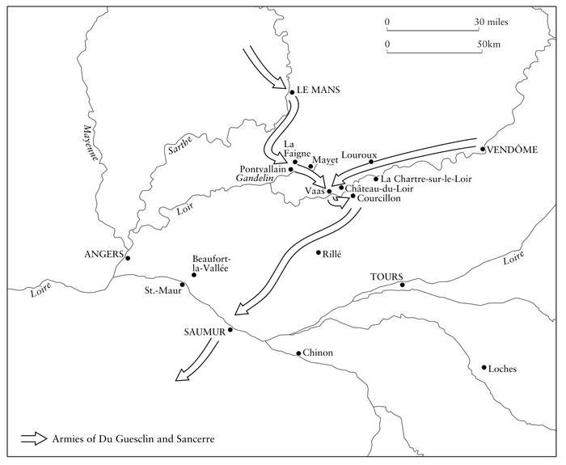
3 The Pontvallain campaign, December 1370
The rest of the English army divided itself into three independent corps. One was jointly commanded by Grandison and Calveley and the other two by Fitzwalter and Minsterworth. They resolved to separate in order to make their own wintering and foraging arrangements, but before they could act on this plan Bertrand du Guesclin was upon them. On 1 December 1370 he left Caen with his army and marched south at great speed night and day. On the evening of 3 December, after covering more than thirty miles a day, he arrived in the area of Le Mans. On the 2nd or early on the 3rd Sancerre left Vendôme with his own smaller army and approached the English positions from the other side. The English captains had no warning of the threat from either direction. Knolles was by now well west of Le Mans. Grandison’s corps, variously estimated at 600 or 1,200 men, was spread out in disorderly encampments along the banks of the River Gandelin between the villages of Pontvallain and Mayet, flat featureless land now densely planted with pine forests but which in the fourteenth century was largely given over to marsh and scrub. Fitzwalter’s corps was encamped a few miles further south. The exact whereabouts of Minsterworth’s corps is not clear. Du Guesclin received reports of the English positionsfrom his scouts on the night of 3 December. He determined to attack before they could concentrate. So, in spite of the exhaustion of men and horses, Du Guesclin ordered another night march and reached Pontvallain at dawn. His sudden appearance was a terrible shock to the English. Grandison had just enough time to form up some sort of line with his own men. They tried to retreat northward to find higher ground on which to make a stand. Some 300 men-at-arms of the French vanguard caught up with them beneath the walls of the Château de la Faigne. The Frenchmen dismounted and rushed the confused English lines. There was a bitter hand-to-hand battle in which heavy casualties were suffered by both sides before the English were overwhelmed. On the French side the chief casualty was the valiant old Arnoul d’Audrehem, who died of his wounds shortly after the battle, the end of a distinguished military career extending back to the outset of the war. English casualties were far heavier. Most of Grandison’s corps perished. Grandison himself was captured along with several of his principal lieutenants.44
Sancerre was at this point a few hours’ march away to the east. When he heard the outcome of the battle he turned south to deal with Fitzwalter, whose corps was now the largest concentration of English troops in the region. Bertrand du Guesclin paused briefly to sort out the prisoners and regroup his men. He detached part of his army under Olivier de Clisson and sent them off to the west after Knolles. Then he took the rest of his exhausted troops to join in the pursuit of Fitzwalter. Fitzwalter had no intention of being caught on open ground like Grandison. He fled south with his men towards the abbey of Vaas on the Loir, a large, partly fortified abbey which was held by one of Knolles’s garrisons. He just had time to get within the abbey walls before Sancerre’s men caught up with him. But he did not have time to organise its defence. Sancerre ordered an immediate assault. There was fierce fighting on the walls before the French finally forced their way into the enclosure as darkness fell and began to massacre the defenders. Du Guesclin arrived on the scene with his men at the end of the fighting to complete the rout. Reliable estimates put Fitzwalter’s casualties at over 300 men killed and an unknown number of prisoners, including the commander. Du Guesclin claimed Fitzwalter for himself, a privilege of his office which led to some ill-feeling among the men who had borne the brunt of the fighting. Perhaps he thought, like the old soldier who tells us this, that Fitzwalter was the Marshal of England.45
The survivors of the English army scattered in confusion after the battles of Pontvallain and Vaas. Sir John Minsterworth’s corps, which had not fought in either battle, fled into Brittany as soon as the issue was known. The rest spread across the country in all directions. A few made their way to Saint-Sauveur. Hugh Calveley found his way back to Poitou. About 300 men managed to form themselves into a company and occupied the castle of Courcillon, just south of Château-du-Loir. Here they rested briefly before making their way towards the Loire with Sancerre’s cavalry snapping at their heels. Knolles’s garrisons at Rillé and Beaufort-la-Vallée abandoned their walls and joined them. The combined group, several hundred strong, headed south pursued by Du Guesclin. They lost much of their strength in ambushes and cavalry attacks as they fled. In the end about 400 men succeeded in reaching the ford of Saint-Maur, where they were able to cross the Loire under the protection of the English garrison in the abbey. From here some of the survivors made their way east towards Auvergne. The rest headed for Bordeaux. But they were not safe even now. Du Guesclin and Sancerre had reached the bridge-town of Saumur, where they rested their men for a couple of days while scouts collected intelligence about the fugitives’ movements. Then, on about 8 December, they crossed the Loire at midnight to continue the pursuit. They caught up with the largest group of English refugees deep inside Poitou by the fortress of Bressuire. The castle was garrisoned for the Prince of Wales but its defenders would not open the gates to admit the fugitives for fear of letting in the French as well. As a result the English were caught beneath the walls and wiped out almost to a man.46
As for Knolles he safely reached his castle at Derval on the Breton march, where he passed the winter in comfort. Most of his troops, together with those of Sir John Minsterworth, resolved to return to England. Several hundred formed themselves into companies and marched across Brittany making for Saint-Mathieu, the harbour at the tip of Finistère which was the traditional stopping place for ships passing between England and the Biscay ports. They were continually harassed on their way by the cavalry squadrons of Olivier de Clisson. Many were killed before reaching their destination. At Saint-Mathieu they found just two ships in the harbour on which some of them, including Minsterworth, were able to buy a passage to England. The rest were left behind on the beaches where they were shortly afterwards cornered by Clisson and massacred. For the dead there was nothing to be done. The prisoners were taken to Paris in carts and thrown in prison where most of them remained for several years. Grandison’s health was destroyed by prison conditions. He died shortly after his release, not yet forty years old. Fitzwalter had to mortgage most of his land to moneylenders to pay the crippling ransom demanded of him. Sir Geoffrey Workesley may have been one of the lesser captains of Knolles’s army but he had to encumber his estates to buy his liberty and in the end lost almost everything to his creditors. Years after the disaster several of their companions were said in Parliament to have returned to England ruined men.47
The French withdrew from Bressuire in about the middle of December 1370. Du Guesclin then turned north to deal with the garrison of Saint-Maur, a major source of instability in western Touraine and a valuable strategic asset to the English who could use the ford to co-ordinate their operations north and south of the Loire. In the event Saint-Maur hardly resisted. The garrison had been weakened by Calveley’s departure in November and demoralised by the defeat of their companions. Sir John Cresswell, who took command in Calveley’s absence, fought off one assault and then sold the place to the Constable. The whole campaign from beginning to end had been an extraordinary demonstration of Du Guesclin’s unconventional skills as a commander. He had covered several hundred miles of ground in about two weeks, marching at night in driving rain in the middle of winter. By sheer force of personality he had driven his men to do the same. By the speed of his movements, the quality of his reconnaissance, the boldness of his decisions and his ruthless persistence in carrying them out, he had frustrated the main English military enterprise of 1370 and had not just defeated but destroyed an army of 4,000 men. ‘I tell you,’ said the Breton knight who showed Froissart the scene of these events many years later, ‘this Constable Bertrand was a gallant man who did great things in his time for the honour of France.’48
The return of the remnants of the army with their conflicting tales of discord, incompetence and betrayal began a long period of recrimination in England. The King’s Council ordered an inquiry. In the absence of the principal actors, who were either serving in France or languishing in French prisons, their main source of information was Sir John Minsterworth who was as much responsible for the disaster as any man. His main object was to exculpate himself. In July 1372, more than eighteen months after the disaster, the Council concluded that the fault lay with Knolles and to some extent with Buxhill, who had failed to maintain discipline in the army and abandoned the enterprise without the King’s leave. Edward censured both men. He also confiscated the land which Knolles had been granted as his fee for organising the campaign. This act aroused much indignation among Knolles’s many friends in England. The Prince of Wales and John of Gaunt protested. Knolles and Buxhill sent men from France to plead their cause. Edward III eventually relented, although Knolles never recovered his fee and had to disgorge the 10,000 marks in profit which he was thought to have made out of the campaign. As for Minsterworth, he was arrested and charged before the Council with traducing Knolles. His ultimate fate is perhaps the oddest postscript to the campaign of 1370. Humiliated by the King and frustrated in his ambitions, Minsterworth fled to France and began a new career in the service of Charles V.49
The immediate consequences of the destruction of Knolles’s army were more serious than the saving of reputations at Westminster. It ended the myth of English invincibility on the battlefield, which had for years been among their most valuable military and diplomatic assets. Particularly striking was the ineffectiveness of the English archers, who had constituted about half the army. They had admittedly been badly positioned, but what struck at least one contemporary was that their arrows failed to penetrate the armour of Du Guesclin’s troops or to break up their lines. The disaster brought an end to Edward III’s hopes of an alliance with Charles of Navarre. On 2 December 1370 Edward III’s councillors had put their seals to a draft treaty. Under its terms Charles of Navarre undertook to do homage to the English King as King of France and to support him against Charles V in ways that his wily ambassadors had contrived to leave largely undefined. In return Edward III offered a cash subsidy, possession of Saint-Sauveur, large territorial concessions in the principality of Aquitaine subject to the consent of the Prince of Wales, and more in northern France should Edward III ever conquer it. In the meantime Edward promised to take firm measures against the garrison of Saint-Sauveur. The King sent abrasive instructions to Sir Alan Buxhill requiring him to reduce the garrison to the minimum required for its defence and to withdraw the satellite garrisons from the abbey buildings outside the walls and the manor of Garnetot across the river. The battles of Pontvallain and Vaas were fought just two days later while Charles’s ambassadors were waiting at Southampton for a fair wind to take them back to Normandy. The whole transaction was ultimately vetoed by the Prince of Wales, who objected to the territorial concessions which had been made at his expense. But the alliance was already dead by then. With the destruction of Knolles’s army there was no point in it for either side.50
Charles of Navarre lost no time in responding to the new strategic reality. He dismissed the many English mercenaries serving in his garrisons in the Cotentin. They left to swell the garrison of Saint-Sauveur. For his part Edward III made no further attempts to restrain the operations of the garrison of Saint-Sauveur, which became more aggressive than ever. In the spring of 1371, the only period for which accounts survive, the garrison was exacting ransoms of more than 6,000 francs in cash and kind from a total of 273 villages of the Cotentin. A few months later the King of France was obliged to remit most of the tax liabilities of the inhabitants of the region on account of the ‘misery and poverty of men pillaged and ransomed day and night and living continually under the threat of violent death’. On 25 March 1371 the long deferred meeting of Charles V and Charles of Navarre took place in the castle of Vernon, overlooking the Seine west of Paris. It was a frigid occasion. The two men did not even exchange the kiss of peace and Charles of Navarre declined to take supper with his host. They had a series of private meetings over the following days. Charles V conceded virtually nothing to his cousin apart from a promise to put him in possession of Montpellier, to which he was already entitled under earlier agreements. On 29 March Charles of Navarre did homage to the King and left.51
*
The Prince of Wales was carried back from Limoges in his litter followed by his entire army. In the first week of October 1370 he arrived at the small town of Cognac where he disbanded his Gascon troops. The campaign had sapped what remained of his physical strength. It was apparent that he was no longer capable of performing even the outward gestures of government. His doctors advised him that he must return to England, and after the ordeal of Limoges he was disposed to agree with them. The Prince’s inclination to give up the government of his principality may well have been reinforced by pressure from his father and his father’s ministers in England. They were beginning to understand something of the political misjudgments which had brought the affairs of Aquitaine to their present pass. At about this time the notorious fouage, which was hardly being collected any more, was formally annulled, apparently at Edward III’s insistence, and an amnesty declared for the many people in Aquitaine whom the Prince had alienated since his return from Castile. Without further warning or discussion with his courtiers and captains the Prince announced at Cognac that John of Gaunt would take over the government of the principality as his lieutenant. Gaunt was reluctant to accept the appointment for more than an interim period. It would call for heavy expenditure and keep him away from England. So he insisted on a document which would entitle him to be released from his responsibilities and to leave if the wages of his retinue fell more than a month in arrears and in any event by 24 June 1371. These decisions were formally ratified at about the end of November 1370 at an assembly in Bordeaux attended by the baronage of the surviving provinces of Aquitaine. The Prince embarked in the Gironde at about Christmas-time, accompanied by his wife and by the Earl of Pembroke, who had resolved to return to England with him. They arrived at Plymouth soon after the new year. The long sea journey was a fresh blow to the Prince’s weakened frame. It was some three months before he could be moved from his bed in the priory of Plympton overlooking the sound. On 19 April 1371 he entered London in obvious discomfort, to be met at Southwark bridge by the Mayor and a crowd of citizens and dignitaries and escorted to the Savoy Palace. It was a stark contrast to the last occasion when the Prince of Wales had entered the city in state, in 1357 after the battle of Poitiers. After the ceremonies the Prince retired to his manor at Berkhamsted. He remained nominally Prince of Aquitaine for the next eighteen months. Even after that he presided occasionally at meetings of the Council and made rare appearances on state occasions, but it was for practical purposes the end of his public career. He was forty-two years old.52
John of Gaunt’s immediate priority when he took over the government of the Prince’s domains was to recover some of the ground lost to the French in the eastern highlands of the principality. The recapture of Limoges, followed by the abrupt withdrawal of the Prince and his army, had left the English in possession of the provincial capital while most of the rest of the province was controlled by local noblemen committed to the King of France. Sir Richard Abberbury, a retainer of the Prince who had come out to Aquitaine with the Earl of Cambridge, was appointed Seneschal of Limousin and put in charge of a rudimentary administration. He was probably based at Limoges. The reconquest of the rest of the province was left to Eustache d’Aubricourt. He was appointed as lieutenant in Limousin and in the adjacent parts of Périgord, with Walter Hewitt as his assistant and several hundred English men-at-arms under his command. Unfortunately it was not enough to persuade the inhabitants of the Limousin that the English government was serious about defending the province, and without that their task proved hopeless.
Shortly after the departure of the Prince, Aubricourt and Hewitt laid siege to the castle of Rochechouart, which was the seat of the largest French garrison in the province. The captain of Rochechouart was a Breton companion of Bertrand du Guesclin called Thibault du Pont, who was away in the north with the Constable. His deputy, an illegitimate half-brother of the Viscount of Rochechouart, agreed to surrender the place if it was not relieved within a limited period. Charles V sent Thibault urgently back to the Limousin with a relief force, which succeeded in entering the castle and raising the siege. The bastard of Rochechouart, who was thought to have made terms a bit too readily with the besiegers, was charged with treason.
Not long after this reverse Aubricourt’s career in the Limousin came to an abrupt close. He was tricked into entering the French castle of Pierre-Buffière, south of Limoges, and ambushed by its garrison. He was ransomed for an enormous sum and made to withdraw from Aquitaine. Hewitt left the Limousin soon after this. By the spring of 1371 the formal structure of English government in the Limousin had collapsed. The citizens of Limoges sent one of their number to England to protest to Edward III about the way his representatives had abandoned them. They could not be expected to remain in his obedience, they said, unless they received some protection. Edward wrote to Abberbury about it but very shortly Abberbury himself left.53
As in Quercy and Rouergue, once it became clear that the Limousin could not be held, the English abandoned it to guerillas. Aubricourt was replaced as lieutenant by Sir John Devereux, the English captain of the routier garrisons at La Souterraine and Sainte-Sévère on the northern march of the province. Devereux terrorised the northern parts of the Limousin. He forged alliances with the Gascon companies, who did the same in the south. Early in 1371, Bertucat d’Albret and Bernard de la Salle began to penetrate into the Limousin from Quercy and the Cantal. Ussel, a small walled town on the old Roman road from Clermont to Bordeaux, was seized and garrisoned at the beginning of the year by Perrot de Galard, a Gascon confederate of Bertucat’s. Many of the small towns of the southern march which had submitted to Charles V’s officers were occupied and garrisoned by small groups of soldiers drawn from the military underworld of displaced Gascon and French ruffians that men must have remembered from a decade before. By the summer of 1371 the Anglo-Gascon companies were holding a ring of forts around Limoges itself even though the place was still nominally a possession of the Prince of Wales.54
Périgord was an easier province than the Limousin for the English to operate in. It was more accessible from the Atlantic regions where their strength was concentrated. They also had more significant alliances there. At beginning of December 1370 John of Gaunt and the Earl of Cambridge laid siege to the town of Montpon with a large army of Englishmen, supported by many of the principal lords of Aquitaine. Montpon was a small walled town dominated by a strong castle, guarding the bridge over the River Isle only twenty miles from Libourne. It had been captured by Bertrand du Guesclin earlier in the year. He had left it to be defended by Sylvester Budes, a cousin of his who commanded one of the Breton companies in the service of the Duke of Anjou. Budes’s relatively small garrison tied down Gaunt’s forces for more than two months. Gaunt, intensely irritated, methodically filled in the ditches of the castle with tree trunks covered with earth. There followed a series of assaults launched from specially constructed mobile shelters and ramps while the English archers tried to force the defenders away from the battlements with showers of arrows. The assailants came up over the walls. They broke their way through at ground level with pickaxes. The defenders fought them all off.55
In January 1371 the siege of Montpon seemed likely to turn into a major operation. Bertrand du Guesclin regarded its relief as a debt of honour. He began to raise troops in December. In about the middle of December Anjou decided to raise the stakes. He not only resolved to direct the relief of the town in person but persuaded his brothers the Dukes of Berry and Burgundy to join him with their own troops. The raising at short notice of a large army in several parts of France to fight a winter campaign in the south-west put a great strain on Anjou’s finances, for he had to undertake to pay not only his own contingents but those of his brothers. The enormous hearth tax voted by the Estates of Languedoc in 1370 had already been committed to the repayment of loans and arrears of wages outstanding from Anjou’s campaign in the summer. Armed with the news that three royal princes and the Constable of France were to descend on Montpon, Anjou’s councillors were able to extract an extra two francs per hearth from the representatives of Languedoc, bringing to more than five francs the total of hearth taxes imposed over the past year.56
Considering the scale of the operation, the distances involved and the financial embarrassment of the Duke of Anjou, the relief army was collected with impressive speed. But it proved not to be fast enough. The Constable marched south from Paris, joining forces with the Duke of Berry at Bourges and with Philip of Burgundy at Clermont in Auvergne. The whole army gathered on open ground outside the city gates on 17 February 1371. The Duke of Anjou’s army began to muster at Montauban on 19 February. The French garrison of Montpon knew that relief was on the way but after eleven weeks of siege they could hold out no longer. On about 19 or 20 February 1371 John of Gaunt launched the fiercest assault on the walls so far. Seeing that they were in no position to resist, the defenders sent a herald to parley with the besiegers. The attack was briefly called off while the captains of the garrison bargained for their lives. Froissart gives a detailed account of the negotiations which is probably fanciful but reveals much about the growing formality which governed the conduct of war, at least among those who fought for princes rather than for themselves. The defenders were initially told by Gaunt’s marshal, Guichard d’Angle, that the Duke would not even concede their lives after all the trouble that they had caused him. One of the Breton captains, who was acting as spokesman, replied:
Sir Guichard, we are soldiers in the pay of the King of France and we have sought to do our duty to our lord as you would do for yours. We call on you to deal with us justly according to the law of arms, as knights and squires ought to deal with each other and as you would expect us to deal with you if you were in the pass to which we have come.
It was eventually agreed that the town and castle would be surrendered at once and the garrison taken as prisoners of war. They were promised their lives, with the exception of the lord of the place who had originally opened the gates to Du Guesclin’s troops the year before. He, however, had already escaped by a postern gate during the final assault and was nowhere to be found.57
The Duke of Anjou abandoned the campaign as soon as the news reached him. This left his brothers in the lurch. They were approaching from Auvergne by two separate routes. The Duke of Berry and the Constable had taken the northerly route by the Roman road to Bordeaux while Philip of Burgundy passed further south through the valley of the Lot. Rather than turn back with nothing to show for their pains Berry and Du Guesclin resolved to continue their advance and attack the town of Ussel, the mainroutiergarrison in southern Limousin, which lay a few miles ahead of them. Ussel was vigorously defended. The French launched an assault against the walls as soon as they arrived but when it failed they had to sit down for a siege for which they were ill-prepared. They had no heavy siege equipment and very limited supplies of food. It was bitterly cold. During the first night a blizzard began to blow. ‘God the Father, King of the firmament, was an Englishman that night,’ the French said, according to Du Guesclin’s biographer. A few days later Philip of Burgundy came up to join them. His appearance on the scene may have saved the face of the French. The garrison were there for money not honour. They agreed to sell the place while they could still expect reasonable terms. They exacted a high price and a safe-conduct through the length of the Limousin to join Sir John Devereux at Sainte-Sévère. On 4 March the French army departed. Within a few months, Ussel had been reoccupied by another Gascon company.58
*
On 24 February 1371 the English Parliament met in the Painted Chamber at Westminster beneath the famous paintings of battle scenes from the wars of Ptolemy and Judas Maccabaeus. William of Wykeham gave the opening address as he had done in 1369. He had a sombre message to deliver. Since their last meeting, he said, when they had approved the King’s resumption of the arms and title of France, Edward had sent his captains overseas to recover his rights at enormous cost. But the King of France had become so strong that he was now in a position to reconquer the entirety of Edward’s continental dominions and to gather a fleet large enough to destroy the whole navy of England and carry an invading army over the Channel to pillage and conquer the realm. This was a gross exaggeration, as Edward III’s ministers must have known, but the true situation was serious enough. For two years Edward III had been trying to fight a war on several fronts, financed mainly by savings and borrowing. By now it was clear he was dealing with a far more formidable and powerful enemy than John II. The war was going badly and a substantial increase in taxation was unavoidable. The King’s Council told the Commons that the government urgently required a subsidy of £100,000, half of which was expected to come from the laity and half from the clergy, who were due to meet after Parliament had been dissolved. This was an exceptionally steep demand. It represented nearly twice the conventional value of a Parliamentary subsidy.
Nothing is known about the deliberations which followed except that they were acrimonious and lasted more than a month. It was not that there was any serious opposition to the war itself, which had so far been fought with only limited demands on the purses of the King’s subjects. If the chroniclers are any guide there was widespread resentment of the way that the French had undone the settlement of 1360. Ill-feeling against France was aggravated by the disruption of the wool trade with Flanders and the threat and occasional reality of naval raids on the coast of England. This was reflected in fierce hostility to French nationals in England, whose presence as businessmen, monks, spouses, domestic servants or prisoners of war had been an ordinary feature of life for many years. If the Commons had had their way they would all have been interned or expelled in 1371. Edward III’s remarkable record as a war leader was still remembered and still inspired confidence. But it also meant that the run of minor defeats and the progressive loss of territory was received with widespread incomprehension and far too readily attributed to corruption or incompetence. This was one reason why there was so much resistance to the proposed tax. The Commons called it an ‘oppressive ransom’. The Council responded with menaces. The Commons assumed that the King’s revenues must have been diverted to improper purposes. They prepared a petition, which they were not allowed to present, demanding that the proceeds of all future taxes should be paid over to commissioners to be disbursed only for war expenditure.
When it became clear that the government would brook no refusal of its demands, the ecclesiastical peers fell to quarrelling with the Commons about the increased share which the clergy were being asked to bear, half instead of a third. They declined to commit the clergy in advance of the meeting of Convocation. This in turn provoked ugly outbursts of anti-clerical feeling, and calls from some quarters for the dispossession of the Church. To the general feeling that the clergy were not bearing a fair share of the national burden was added an unreasoned instinct that the fighting men had been let down by greedy churchmen and incompetent clerical administrators. This view was common enough in wartime in both England and France, and would become more so. Du Guesclin’s views about ‘fur hats’ were widely shared on both sides of the Channel. The knight in the famous French allegorical tract Le songe du vergier spoke for many when he said that the clergy ‘reposed peacefully beneath shady canopies elegantly scoffing fat delicacies’ while he and his kind spilled their blood and fortunes in their defence. At Westminster in 1371 it was characteristically the young, hot-headed Earl of Pembroke, just returned from the frustrating and underfunded campaigns in south-western France, who apparently suggested the scheme to increase the clergy’s share. The King’s ministers, who included prominent clergymen, found themselves attacked from all sides. It is reasonably clear that the Commons refused to grant a subsidy until they were removed. The ministers preferred not to provoke a crisis on an issue which was known to be extremely sensitive with the King. So, on 24 March 1371, William of Wykeham resigned as Chancellor. He was followed three days later by the Treasurer, the competent and honest Bishop Brantingham of Exeter. Both men were replaced by laymen.
On 28 March, the day after Brantingham’s resignation, the Commons agreed to grant its half of the subsidy. The two convocations followed suit but with extreme reluctance. The southern convocation listened stony-faced in St. Paul’s cathedral to the appeals of the King’s councillors. They had to be adjourned to the Savoy Palace where the sick Prince of Wales, surrounded by ministers and noblemen, browbeat them in person, ‘first earnestly requesting then demanding’ a subsidy, before they would consent. In the northern province it took two assemblies and two months to persuade the clergy to comply. The Parliament and convocations of 1371 proved to be the first of a succession of assemblies in which defeat and insecurity provoked discord and mutual recrimination among the English.59
The government had hoped to get the first instalment of the new taxes into its coffers by Whitsun and the rest by midsummer. It quickly became apparent that this would not be achieved. The first problem was that both the lay and clerical subsidies were being levied on a different basis to their predecessors which required fresh assessments. The clerical subsidy extended to unbeneficed clergy and clergy who had previously been exempt. The lay subsidy was granted as a lump sum of £50,000 to be raised by a levy on parishes at an average rate of 22s 3d per parish. This scheme was designed to deal with the effect which plague, migration and exemptions had had on the traditional tax assessments, now nearly forty years old. But it assumed that there were 45,000 parishes in England, a figure which the Commons appear to have got from the widely read chronicle of Ranulph Higden of Chester. Unfortunately it had no empirical basis at all. Within a month of the grant the government realised that it was uncollectable. They ordered an urgent survey of parishes and summoned the sheriffs to send one of the two burgesses from each town and one of the two county representatives who had made the original grant to attend a new assembly. On 8 June this semi-Parliament met at Winchester. They were presented with evidence that the true number of parishes in England was about 8,600, less than a fifth of the number previously assumed. The assessment was therefore increased from 22s 3d to 116s, which was probably more than the Commons would have granted on the first occasion if they had known what they were doing. New assessments were then commissioned to enable it to be properly distributed. Ultimately, in spite of the resistance of taxpayers, nearly £92,000 of the £100,000 was actually collected. But it took a long time. The bulk of the proceeds did not become available until the summer of 1372 and collection was not completed until 1374. This ruled out any ambitious military ventures in 1371.60
Fortunately for the English the French government was also in financial difficulty in 1371. The effort involved in mounting two major campaigns in mid-winter had drained the French treasury. In February 1371 Charles V’s Council suspended payment of civil service salaries. During the summer unexpected difficulties were encountered in collecting the aides. The nature of these difficulties is not disclosed by the rather fragmentary sources, but what is clear is that a major enquiry into the falling off of yields was under way in most of the provinces of Languedoil. Charles V was obliged to anticipate the flow of tax revenue by borrowing 100,000 francs from a syndicate of Italian bankers at Avignon. Even this did not enable him to pay the wages of his troops regularly. The wages of the army on the march of Calais were in arrears. Some of his captains were still waiting to be paid for their service in the campaigns of 1369. As a result the French King was not in a position to carry out any of the menacing operations with which William of Wykeham had tried to frighten his audience in the Painted Chamber in February. After the rapid movements of the past two years a stagnant calm, born of exhaustion and financial paralysis, fell on all the main theatres of war.61
The summer campaigning season was largely taken up with the painstaking and unproductive sieges of the handful of fortresses in western France, where English garrisons and the remnants of the Great Company of 1367—8 had continued to hold out in the midst of French territory. The castle of Thury-Harcourt on the River Orne south-west of Caen had been occupied since the summer of 1370 by two retainers of Charles of Navarre, the cousins Jean (‘Le Moine’) and Eustache (‘Rifflart’) de Pollehay. Jean de Pollehay called himself an officer of the King of England, which he was certainly not, at least in any formal sense. The garrison, which was probably an offshoot of the garrison of Saint-Sauveur, was a mixed rabble of Englishmen, Normans and Navarrese routiers and, although not large, it had devastated much of Lower Normandy since the summer of the previous year. One of Charles of Navarre’s first public acts as a vassal of the King of France was to negotiate its surrender on 12 April 1371. The terms made it clear that although the place had been under loose siege for several months it was by no means at the end of its resistance. The English in the garrison would not contemplate surrender without a safe-conduct to Saint-Sauveur or Bécherel and payment of the arrears of theirpatis and ransoms. This liability, amounting to 14,000 francs, ultimately had to be met by the long-suffering taxpayers of the five dioceses of Lower Normandy.62
In about April 1371 Du Guesclin turned his attention to the twin castles of Conches and Breteuil on the edge of the Pays d’Ouche. These places nominally belonged to Charles of Navarre, but had been granted by him to Edward III’s famous Gascon captain Jean de Grailly, Captal de Buch, during the civil wars of the 1360s. They were still commanded by his captains. When summoned to surrender at the beginning of April 1371 they replied that they would take no orders but his. They were allowed a six-week truce in which to obtain the Captal’s instructions. The French entertained some hopes that the Captal would surrender the castles. He had been captured commanding Charles of Navarre’s army at the battle of Cocherel in 1364 and released without ransom by Charles V. There was a school of thought at the French court which considered that this prevented him fighting directly against the King. The Captal did not agree. He declined to surrender either fortress. There was some inconclusive skirmishing around the walls of both places in the second half of May. At the beginning of June the Constable set about organising a formal siege of Conches, digging trenches around its walls, strengthened at critical points by stone bastides, and fortifying churches and other buildings around the perimeter. A looser siege was maintained around the castle of Breteuil. The sieges were interrupted by frequent diversions on other fronts and the two fortresses held out until early in the following year. The garrison of Conches eventually surrendered at the beginning of February 1372 after the French had brought up heavy reinforcements and gunpowder artillery. They were granted honourable terms and were allowed to leave in peace. The garrison of Breteuil made an even better deal. They were allowed to remain in occupation on behalf of the Captal de Buch provided that they undertook not to make war on the King of France and his subjects. It was a small reward for nearly a year of effort.63
*
Charles V had adroitly countered the schemes of the King of Navarre. The tragedy of his reign was that he was never able to do the same with John de Montfort. The French King lived in perennial fear that John would align himself with his old champions and let English armies into France across the open march of the duchy. The King’s fears were very wide of the mark. In fact the Duke’s great object was to keep out of the war and avoid antagonising either side. He had no desire to become an English client again unless he had to. Charles V never really understood this or realised how difficult John’s position was. He was shocked by the Duke’s decision to allow the army of the Earls of Cambridge and Pembroke to land at Saint-Malo and cross Brittany on their way to Aquitaine in the spring of 1369.64 He was infuriated by John’s brief dalliance with the King of Navarre. These were acts which branded John de Montfort at the court of France as an enemy for the rest of Charles’s reign. The result was to bring about the very thing that Charles most feared. It was a serious misjudgment.
A large part of the explanation for it lay in the presence of influential Bretons at Charles V’s court and in his army, men who had never really accepted John de Montfort’s legitimacy as Duke. The cause of Blois was dead, but it would be many years more before its partisans were ready to forget. Jeanne de Penthièvre lived in Paris but retained the enormous possessions of her family in northern Brittany. She was still a power in the duchy and a focus of loyalty among the former supporters of her husband. Her daughter was married to Louis of Anjou, whose appanage bordered on Brittany to the south-east and who stirred up difficulties for John de Montfort whenever he could. It was Louis and his mother-in-law, and the Franciscans of Guingamp in whose church the dead hero was buried, who were the main drivers behind the attempt to promote the canonisation of Charles of Blois in the decade after his death. The sanctity of politicians and war leaders was a delicate matter in an age which believed that God was the arbiter of men’s political fortunes, as the myths surrounding Joan of Arc were to demonstrate in the following century. John de Montfort regarded the cult of his old enemy, with its attendant eulogies and miracle stories, as a direct challenge to his authority.
Others were willing to challenge it more directly. Bertrand du Guesclin had been a supporter of Charles of Blois. He always refused to do homage to John de Montfort for his lands in Brittany. His retinue and the many Breton companies who fought for Charles V on the marches of Aquitaine were full of men who had fought for the House of Blois and had chosen to make a career outside Brittany since Charles’s death. John de Montfort might try to steer a difficult path between England and France but the leading noble houses of Brittany, Laval, Beaumanoir, Rohan and Retz, who had recognised Charles of Blois in his lifetime, were never favoured by John de Montfort as his own supporters were. They all rejected neutrality for themselves and fought in the armies of the King. Charles V exploited these natural tensions within the Breton aristocracy. He plied Montfort’s enemies with favours. He flattered the oligarchies of the towns. He played on the traditionally royalist sentiments of the bishops. Many of them became the King’s familiars and friends. They were probably the real authors of his Breton policy.65 John de Montort for his part reacted very defensively. He could not afford to abandon his residual links with the English while his enemies were so powerful at the court of France.
Ironically by far the most persistent and dangerous of the Duke’s Breton enemies was a man whose father had been executed for treason by Philip VI and whose family had been as closely associated with the English as John de Montfort himself. Olivier de Clisson, then thirty-five years old, was a tempestuous spirit who was destined to become one of the pivotal figures in French politics of the late fourteenth century. He was the leading territorial magnate of Bas-Poitou, an appendage of the duchy of Brittany extending south from the estuary of the Loire to the Bay of Bourgneuf. His hereditary domains included the great castle of Clisson, which still stands above the road from Nantes to Poitiers, and the fortress of Champtoceaux, guarding the eastern frontier of the duchy on the Loire. He had been brought up in England after his father’s execution and had gained his first experience of war in English armies. He had lost an eye while fighting with Sir John Chandos at Auray, and served under the Prince of Wales at Nájera. For the first year of the war Clisson had tried to stay in with both sides, a prudent course perhaps for a man whose territory lay on the marches of the enlarged duchy of Aquitaine. All this ambiguity stopped around the end of 1369 when it became clear that the English were in difficulty. Olivier de Clisson decided that his ambitions would be better served by allying himself with the French royal house. Charles V drew him to his service by well-judged grants and favours and flattered his vanity with a series of important commands and diplomatic missions. As Clisson became more closely identified with the King’s cause his relations with John de Montfort deteriorated. It is hard to say which was the cause and which the effect. There may also have been other, more personal factors at work: obscure jealousies at the Breton court, aggravated by Clisson’s short temper and notoriously prickly personality. There was persistent gossip that Clisson had made advances to John’s wife. What is clear is that the two men became not just political adversaries but bitter personal enemies. Their prolonged vendetta, which lasted in one form or another for three decades, would be a source of serious instability in the politics of Brittany and later in those of France.66
In 1370 Clisson set about creating a coalition against John de Montfort among his enemies within the duchy. His first step was to procure his own appointment as the lieutenant of Jeanne de Penthièvre in Brittany. Shortly after this he became Charles V’s lieutenant in Bas-Poitou. In the summer of 1370, he acquired control of the great fortress of Josselin in the central highlands of the Breton peninsula. Josselin had recently passed by marriage to the Count of Alençon. Charles V, observing that it was ‘essential’ to have control over the place, pressed Alençon to exchange it for two royal castellanies in Normandy and a cash income, and then granted the place to Olivier de Clisson. Then in October 1370 Clisson went further by concluding a remarkable personal alliance with Bertrand du Guesclin. The two men agreed to defend each other’s interests against all others except for the King of France, to come to each other’s assistance whenever they were in danger, and to share equally all their profits of war. The agreement did not name John de Montfort but it was clearly directed against him and appears to have provoked the final breakdown between the two men. John summoned Clisson before his court to answer for his ‘gross disloyalty’, and when he failed to appear decreed the confiscation of all his possessions in the duchy. The Duke’s officers were never able to take control of Clisson itself but they occupied Champtoceaux and put a garrison into it. Clisson appealed to the Parlement of Paris, thus challenging the tacitly accepted immunity which Brittany had long enjoyed from the jurisdiction of the courts of the King of France. When his lawyer tried to serve John de Montfort with the papers, the Duke had him drowned in the Loire with the documents around his neck. The breach was complete.67
The presence of English-controlled garrisons in Brittany gave Du Guesclin and Clisson plenty of occasions for making war in John de Montfort’s duchy. This process ultimately destroyed the delicate balance by which John de Montfort had sought to distance himself from both sides in the wider war. In December 1370 Clisson led a French army across the whole length of the Breton peninsula in pursuit of the fleeing remnants of Robert Knolles’s army. The garrison of Pontorson, which was directly controlled by Bertrand du Guesclin, nibbled away at the marches of the duchy. John de Montfort completely lost control of Bas-Poitou, which became for practical purposes part of the French march opposite Aquitaine. The coastal fortress of Collet in the Bay of Bourgneuf, the only important place in the region not already in the hands of Charles V’s allies, was taken from its English garrison by French troops and held in the King’s name in spite of Montfort’s protests. The retreat of English arms encouraged many Bretons hitherto loyal to Montfort to identify themselves with the renascent power of the French Crown and to join in the attack on English interests in Brittany.68
Early in 1371 Olivier de Clisson decided to lay siege to the English fortress at Bécherel. It was an astute move. The garrison of Bécherel was deeply unpopular in Brittany. Clisson’s venture not only had the support of the traditional allies of the King of France in the duchy but of many who had been firm partisans of John de Montfort. But Montfort, although he resented the ransoming of the land by Latimer’s garrison as much as any man, could see that he himself was Clisson’s real target. He had spent three years avoiding a choice but, when forced to choose between the occupation of Bécherel by a French garrison controlled by Olivier de Clisson and its possession by an English minister, he decided that the second was the lesser evil. He forbade the operation. His objections were brushed aside. The siege of Bécherel was a running sore between John de Montfort and Charles V for more than a year. Olivier de Clisson’s army arrived outside the fortress in about April 1371. The place was defended by a garrison of some 300 freebooters under the command of Latimer’s deputy, Sir John Pert. He was later to be accused of greed and corruption in the House of Commons and it may well have been his fault that the castle’s stores were low when Clisson’s siege began. But whatever his faults he redeemed them by the skill of his defence. Pert led repeated sorties into the siege lines and generally had the better of the fighting. He certainly received no help from Latimer or anyone else in England. In late July 1371 an attempt was made to create an army of relief out of other English garrisons in western France. About 700 men are said to have been found for this venture. The relief plan was thwarted by Du Guesclin, who drew off large numbers of troops from the sieges of Conches and Breteuil, recruited more in Lower Normandy, and then invaded the duchy. For a short time in the first half of August 1371 the Constable took command of the siege of Bécherel in person. For want of money to intervene, the English were impotent spectators of these events. An emissary from the beleaguered garrison penetrated through Clisson’s lines and reached England in June 1371 during the sessions of the Winchester Parliament. He brought personal letters addressed to the King and every one of his councillors pleading for help. But the Treasury was empty. They refused ‘utterly’ and sent him away.69
*
John of Gaunt passed most of the year 1371 in the Atlantic provinces of his brother’s principality, endeavouring to put some sort of order into its government, but he undertook no major military operations. His relative immobility was due to the dire financial problems of the principality, the full measure of which was still not appreciated by his father’s ministers at Westminster. The English expeditionary force which had come to Aquitaine with Gaunt and Hewitt in 1370 had been paid for the first six months of its service from June 1370. It had received nothing since. John of Gaunt’s appeals presumably had a more courteous hearing in England than those of the captain of Bécherel, but he got the same answer. By the spring of 1371 he was becoming concerned that the men would start to support themselves by pillaging the Prince’s domains, thereby accelerating the rate of defections among the local nobility. He borrowed heavily on his own account in order to pay them at least part of their due. He had cash shipped out by his treasurer in England. He raised what revenues he could in the duchy. An assembly of the Estates of Poitou voted him a sales tax of five per cent for a year but not much of it appears to have been collected and there is no evidence of any similar grants in other parts of the principality. Under the terms of his appointment by the Prince of Wales, John of Gaunt had agreed to serve as his brother’s lieutenant for a limited period and then only if his wages and those of his men were paid. So, on 21 July 1371, he called the Prince’s councillors before him in Bordeaux and announced his resignation. He then formally surrendered his powers into the hands of the Prince’s officers. The melodrama at Bordeaux was designed mainly to make an impression in England. John of Gaunt made it clear that he would continue to do what he could to defend the principality while he remained there. But his main preoccupations as the summer wore on were his designs on the Crown of Castile, of which more will be said in the following chapter, and his preparations to return to England.70
The only notable military operation conducted by the English in Aquitaine in 1371 was due to the Seneschal of Poitou, Sir Thomas Percy. He was probably the nearest that England came to finding a successor to the military tradition of Audley and Chandos. A cadet of the famous Northumberland clan, he was the only member of his family to make a career fighting in France. In August 1371 Percy laid siege to Moncontour, one of a number of places on the northern march of Poitou which the French captains of the march had strengthened and garrisoned to serve as forward bases for penetration into Poitou. Moncontour was a small town dominated by the massive fortress built by that great castle-builder Fulk Nerra, Count of Anjou, in the eleventh century. Percy arrived there in early August with a scratch army drawn from nearby garrisons and from the retinues of the leading Poitevin barons, together with a battery of stone-throwing artillery. Charles V and his commanders made a serious effort to relieve the place. Their problem, like Gaunt’s, was a severe shortage of cash. It was estimated that 2,000 men would be required for the operation. There was no money to pay them. The Constable, who was then at Bécherel, left a screen of troops around the castle and marched south with Olivier de Clisson and the rest of the army. The Marshals stripped men from the garrisons of the Loire and northern Poitou to reinforce him. But they were too late. In about the middle of September 1371 Moncontour was stormed by Percy’s troops. The entire French garrison was killed apart from the captain and five or six of his companions. When the Constable reached the town, four days after it had fallen, he found it defended by a large English garrison. He ordered an assault, but his officers thought better of this idea. They had no crossbowmen with them. The task was hopeless. So the French turned round and marched away.71
On 23 September 1371 John of Gaunt entered La Rochelle to embark for home, accompanied by most of the army that he had brought with him from England. His departure must have resulted in the withdrawal of at least a third of the English troops then serving in southern France. Gaunt made what arrangements he could for the defence of Aquitaine in his absence. Lieutenants were appointed for each province of the principality, all of them prominent local noblemen, a notable break with the Prince’s practice of appointing Englishmen to such posts. Most of the available resources were concentrated on the defence of Poitou. On the northern march a number of semi-autonomous captaincies were created under the command of contractors who agreed to guard the march in return for what profits they could make from the land around them. A partnership of military contractors comprising Thomas Percy, the Seneschal of Saintonge John Harpeden, and the Poitevin nobleman Renaud de Vivonne took over responsibility for the fortress of La Roche-sur-Yon together with much of the north-western march. They were to meet all their own costs and pay a rent of 500 marks a year from the forfeitures of traitors in their area and the profits of raiding into Anjou and Bas-Poitou. Moncontour was exploited for their own account by another syndicate organised by Walter Hewitt. Other castles of the march were assigned to other captains on much the same basis. Garrisons were left in the main surviving fortresses of the Garonne and the Dordogne. The rest of the principality was left to fend for itself.72
The citizens of Limoges had had enough. While John of Gaunt waited at La Rochelle for shipping and a fair wind, a delegation came before Charles V in Paris to press him to take possession of their city and restore order in the region. Marshal Sancerre gathered 200 men-at-arms and left for Limoges so quickly that there was not even time to take the muster of his company. On 14 November 1371 Limoges formally submitted to the King of France. Experience had made the citizens wary of submitting too completely. They would not let Sancerre and his men within their gates at once. He had first to procure the confirmation of their ancient privileges and the grant of new ones, then to pass the winter months removing the Anglo-Gascon routiers from the castles which blockaded the road and river routes around the city. As a result the Marshal did not formally take possession until 26 April 1372. Even then the citizens of Limoges would not remove the arms of the Prince of Wales from their gates. They simply placed those of the King of France above them. For many years this symbol remained the last vestige of an official English presence in the Limousin.73
*
Three decades earlier, when Edward III had only just embarked on his great adventure in France, Benedict XII, the shrewdest of the Avignon Popes, had warned him in prophetic tones of its ultimate outcome. The King of France, he said, was fighting in his own country surrounded by his own people. He could lose many battles without losing the war, suffer huge casualties and yet recover. But Edward, fighting with expeditionary armies in a foreign land, could win fight after fight and yet ultimately lose everything he had in France.74 Like all the Avignon Popes Benedict had been bound to France by strong ties of sentiment, political calculation and financial interest. But there was also a more disinterested reason for the attention which they paid to the Anglo-French war. In spite of the manifest sympathy of the Avignon Popes for France the papacy remained the only organisation with the international prestige to organise a major peace initiative. The 1370s was the last period of European history in which it was to play this role.
When the war reopened in 1369 the reigning Pope was Urban V. Urban had been elected in Avignon but he had returned to Italy in June 1367, accompanied by some of the cardinals and a skeleton administration. The experiment had failed for a number of reasons: persistent war between the major cities of the papal state, the growing threat from Bernabò Visconti, the ambitious despot of Milan, and the poverty and anarchy of Rome and Viterbo where Urban resided. These factors might have driven him from Italy even if the Anglo-French war had not suddenly reignited in his absence. But when he did finally announce his intention of returning to France, well-informed contemporaries believed that the main reason for his decision was a genuine desire to reconcile Edward III and Charles V and a naive belief that he could do it. The French government, which had been unspeakably dismayed by Urban’s departure and had done its best to dissuade him, was overjoyed. They sent a fleet of galleys to escort him back across the Mediterranean to Marseille. At the end of September 1370, while Robert Knolles was burning villages along the roads south of Paris and the Prince of Wales was returning from the destruction of Limoges, Urban V entered Avignon.75 As soon as he had arrived he began to plan a fresh round of peacemaking. He wrote to the two kings. He selected his mediators. But he got no further with his task. The voyage had broken his already delicate health. He fell ill in November and died on 19 December 1370.
Urban’s successor, elected on 30 December 1370, was Pierre Roger II de Beaufort who took the name Gregory XI. Gregory was the nephew of an earlier Pierre Roger who had been Chancellor of France before reigning for ten years as Pope Clement VI (1342—52). The new Pope had much in common with Clement: intelligent, cultivated, charming, he impressed even his enemies by his princely manner. The Chancellor of Florence, Salutati, no friend of the papacy, called him ‘cautious and wise, modest, devout, charitable, charming and, which is fitting in such a magnificent ruler, completely trustworthy and reliable’. These genial qualities were attested by others and Gregory undoubtedly possessed them. But they did not prevent him from being a determined politician and a shrewd diplomat. Gregory’s political life was dominated by two great obsessions. The first was an unwavering ambition to take the papacy back to Rome, as his predecessor had tried and failed to do. To this end he needed to consolidate the papal state in central Italy and todefend it against the expansive dictatorship of the Visconti lords of Milan and, later, against the self-governing cities of his own dominions. This meant that in his time the budget of the papacy was largely committed to the prosecution of a succession of expensive wars in Italy.
Gregory’s second obsession was his family. The Rogers had once been a minor noble family from the region of Bas-Limousin, more or less corresponding to the modern département of the Corrèze. Their rapid ascent in the middle years of the fourteenth century was entirely due to the patronage of Pierre Roger I when he was Chancellor of France and at Avignon once he became Pope. In 1350, in one of the more spectacular property transactions of the period, Clement arranged for his nephew (Gregory XI’s older brother) to purchase the viscounty of Turenne from the bankrupt house of Comminges. Turenne was the richest and most powerful lordship of Bas-Limousin. It included the great fortress of Turenne itself, numerous subsidiary forts, castles and manors, and vast domains extending from Brive on the River Corrèze to Beaulieu on the Dordogne. At the time of Gregory’s election Guillaume Roger, Viscount of Turenne, was a loyal but inactive vassal of the Prince of Wales. He eventually made his submission to the French crown in January 1373. Two of the Pope’s younger brothers were determined partisans of the Duke of Anjou. Nicholas de Beaufort, who had been married to the heiress of the great lordship of Limeuil on the Dordogne, had recently put French garrisons into all his castles. Roger de Beaufort was one of the captains of the Cité of Limoges who was captured fighting against the Prince of Wales in September 1370.
These events gave Gregory a more direct emotional interest in the course of the war than any of his predecessors. Partly because it suited his political ambitions, partly from personal sentiment and family interest, partly also because of the francophile mood of the papal court where he had passed his adult life, Gregory was wedded to the interests of France. At his coronation procession in January 1371 the Pope gave the place of honour to the Duke of Anjou, who held the bridle of his horse. He passed part of the hot Rhône summers in the Duke’s mansion at Villeneuve-lès-Avignon. He addressed unsolicited advice to Charles V about the importance of watch duty at his castles. He wrote fulsome letters of congratulation to French commanders on their victories and tipped 200 florins to the messenger who brought him news of an English defeat.76
Gregory believed, as Urban had done, that he could not leave Avignon while the Anglo-French war continued. He also needed the political support of France and the financial resources of the French Church in order to restore his authority in Italy, both of which were bound to be limited while France was torn apart by war. One of the first steps which Gregory took after his coronation was to write to both kings to inform them of Urban V’s plans for a peace conference and to tell them that he had appointed the mediators whom his predecessor had selected before falling ill. He also sent an emissary to sound out Louis of Anjou and John of Gaunt in Gascony. The selection of suitable mediators had always proved difficult. But the choice made by Urban and confirmed by Gregory was remarkable. Simon Langham, the only English member of the college of cardinals, was an austere and independent-minded Benedictine who had formerly been Archbishop of Canterbury and Chancellor of England. Langham’s relations with Edward III were poor. He seems to have had reservations about Edward’s foreign policy. Edward for his part distrusted the papacy and had disapproved of Langham’s promotion to the cardinalate. In spite of his English nationality and official background Langham’s appointment is unlikely to have been welcomed at Westminster. By comparison the other mediator, Jean de Dormans, ‘Cardinal of Beauvais’, was extremely close to Charles V. He had been one of his most intimate counsellors when he was Dauphin. He had been present at the negotiation of the treaty of Brétigny. He had been Chancellor of France since 1361. He had been involved in all Charles V’s dealings with England and had delivered the opening address at the assembly of May 1369 in Paris at which war had been declared. Dormans had been promoted cardinal in the same year as Langham but, unlike Langham, he retained his position within Charles V’s government after his appointment and stayed in France instead of moving to the papal court. These appointments can only be explained on the footing that the Pope’s advisers thought that Edward III was shaken by the experience of the last two years of war and was ready to compromise on something like Charles V’s terms.77
If so it was a serious mistake. Among the English King’s ministers there were undoubtedly some who thought that England would have to surrender some of the gains made at Brétigny for a durable peace. There is some evidence that they included the leading figures in the government of Gascony, John of Gaunt and the Seneschal, Sir Thomas Felton, both of whom had struggled to defend Aquitaine without money and welcomed the appointment of mediators.78 They could see, as the King himself could not, that there was only one direction in which events in the south-west could move. In England, however, the political community was still transfixed by the victories of 1346 and 1356. The reality of Edward III’s position in France was little understood. The subsequent course of events suggests that at this stage Charles V was no more willing to compromise than his opponent. Gregory XI’s first attempt at peacemaking was doomed to failure before it began.
The ‘Cardinal of Canterbury’ left Avignon on his mission of peace at the end of March 1371, accompanied by his learned secretary Adam Easton. They met Jean de Dormans at Melun about a month later. Charles V received them graciously in Paris. He assured them that his Council was in principle content to negotiate with his adversary. But he made no other commitments. The English government would not at first go even this far. Leaving his colleague in Paris, Langham travelled to Calais where he passed several months trying in vain to obtain a safe-conduct to visit the English court. It was not until October that he was allowed to cross the Channel, and when he arrived it was to receive a humiliating rebuff. The cardinal made a series of proposals for submitting the dispute with France to arbitration. According to a French chronicler the Pope himself was suggested as arbitrator, or a tribunal of Christian monarchs or perhaps a commission of dignitaries recruited equally in both countries. All of this was entirely unrealistic. Edward III would never have put his fortunes in the hands of Gregory XI, whose French sympathies were well known. The idea of arbitration by the Pope was not even acceptable to Charles V. The Pope responded by suggesting another approach, a diplomatic conference, the first of many that was to grapple with the problems of sovereignty and territory during the 1370s and 1380s. This was eventually and rather grudgingly agreed. But the prospects were poor. Langham’s problem was that at the time he was in England the strategic situation was particularly fluid. Both governments were planning major campaigns for the year 1372. At the same time the geographical range of the fighting seemed likely to expand with both Brittany and Castile being drawn into the war as active belligerents for the first time since 1369. Both sides had strong hopes that the coming year would see dramatic changes in their fortunes and were inclined to defer serious negotiation until events had improved their bargaining position.79
Notes
1 Froissart, Chron. (SHF), vii, 320—1.
2 Parl. Rolls, v, 151—2 (35), 181 (9), 209 (9), 223 (10).
3 Customs: Ormrod (1990), 207 (Table 4). Staple fees: Parl. Rolls, v, 300—2, 304—5 (17—18, 27); Holmes (1975), 79—81, 83, 110—11. Demesne and prerogative: Ormrod (1995), 147 (fig. 23) (full figures at ESFDB/orm/engd030); Harriss (1975), 489. In the Exchequer year 1371—2 (when figures are undistorted by advances) alien priories yielded£3,061/13/8d: PRO E401/506, 508. Overheads: Harriss (1975), 487.
4 Ormrod (1990), 204 (Table 1), 205 (Table 2); Ramsay, ii, 294 (Table V).
5 Wykeham, Register, ii, 82—8; Walsingham, Hist. Angl., i, 309.
6 PRO E401/495 (14 Nov., 16 Dec., 31 Jan., 3, 24 Feb., 5, 6 Mar.); E401/499 (5, 7, 12, 17, 29 May; 14 June, 4 Aug.). Windfalls: Harriss (1975), 489—94, 499; for Violante Visconti’s portion, see PRO E401/495 (24 Feb., 5, 6 Mar.). Expenditure from reserve: PRO E403/436, mm. 24, 25, 26 (26, 31 Jan., 3 Feb.); E403/438, m. 25 (14 June); E361/4, mm. 21—22 (Wakefield) (not including advances to troops who had not yet accounted for them); E364/5, m. 6d. (Calais, payments for 22 months, 1369—71, annualised); PRO E101/30/1 (Ireland). Chaucer, Works, iv, 231.
7 Cat. Arch. Navarra (Comptos), vii, nos. 744—56; Compte r. Navarre, 63, 136, 361.
8 Secousse, Preuves, 380—1 (confession of Jacques de Rue), 412, 428—9 (confession of Pierre du Tertre); Compte r. Navarre, 374.
9 Secousse, Preuves, 301—4; Gr. chron., ii, 133—4, 140—1, 379, 433—4 (confession of Pierre du Tertre); Chron. premiers Valois, 204; John IV, Actes, no. 145; Morice, Preuves, i, 1637—8. Charles V was at Jumièges on 16 and 24 Aug.: ‘Séjours’, 222.
10 Compte r. Navarre, 39—40, 302—3, 361; PRO E101/29/28; E101/315/34; E403/438, m. 35 (28 Aug.); Foed., iii, 879. St.-Sauveur: Cal. Inq. P.M., xiv, no. 116; Foed., iii, 993; Compte r. Navarre, 39; Secousse, Preuves, 428 (confession of Pierre du Tertre); BN Fr. 26008/771; *Delisle, ii, 200—1. Works: Frag. chron. norm., 9; Compte r. Navarre,224;Foed., iii, 903; Mandements, no. 699. Hilton’s presence at Château-Gontier: *Borderie, iv, 113. Emissaries: Issue R. Brantingham, 371, 374, 382, 406, 421, 422.
11 Anonimalle, 62 (the text says 6,000 archers, but this must be a copyist’s error for 2,000; see proportion of men-at-arms to archers in Knolles’s indenture: PRO E101/68/4 (90)); Issue R. Brantingham, 382, 406, 421, 430; Secousse, Preuves, 427 (confession of Pierre du Tertre). English preparations: PRO C76/53, m. 28; E101/30/6; E101/31/6. Knolles: Froissart, Chron. (SHF), vii, 220; E101/68/4 (90); Foed., iii, 894—5.
12 PRO E101/68/4 (90); E101/30/25; Foed., iii, 894—5, 896, 897—8; CPR 1367—70, 397—8, 411—17, 430—55 passim; CFR 1369—77, 167; Anonimalle, 63; PRO E101/30/25; cf. Knolles’s ordinances for the campaign, BL Cotton Caligula D.III, fols. 115—115vo. Buxhill: CFR 1369—77, 321; Foed., iii, 963. Bourchier: PRO C61/67, m. 2; C61/77, m.4; Chandos Herald, Prince Noir, l. 2335. Grandison: Froissart, Chron. (SHF), v, 261, 401, vii, 40; Beltz, 177. Minsterworth: Cal. Inq. Misc., iii, no. 885. Caun: Chron. norm., 121—2; Chron. premiers Valois, 81, 107. Redmayne: Hist. Parl., iv, 183—4. Clanvowe, Atte Lee: Controversy Scrope Grosvenor, i, 172, 184—5.
13 Foed., iii, 886, 888, 894; Issue R. Brantingham, 99, 445, 446; 452, 459, 482, 119—20, 130, 141, 142. Hewitt’s force cost £5,856, ibid., 452, 459, 482, 119—20, 130, 141, 142; for his loans (£2,680): PRO E401/500 (18, 20 Feb.), E401/501 (21 May); £1,000 was repaid before his departure, Issue R. Brantingham, 139; Date of decision: Oxford, Corpus Christi Coll., Ms. 495, fol. 15 (warrants for expedition from 18 April 1370).
14 Knolles: PRO E403/441, m. 5 (4 Nov.); Issue R. Brantingham, 267—8. Gascony: ibid., 212, 231, 271, 445, 446, 452, 459, 482, 119—20, 130, 141, 142; PRO E364/5, m. 5d (Lancaster). Naval patrols: PRO E101/30/13, m. 2; E101/396/13 (6); E364/4, m. 4d (Wodeburgh); E364/3, m. 6d (Brian); E101/30/21, 29, 36. Customs: Ormrod (1990), 207 (Table 4). Clerical subsidies: Rec. Convoc., iii, 300—3; Concilia, iii, 85.
15 PRO E401/500 (22 Jan. et seq.); E401/501, passim; Issue R. Brantingham, 146, 169—70, 173—9, 184—91, 194, 214, 216, 221, 228, 251; Cal. Letter Books G, 263; Antient Kalendars, i, 221 (no. 11), 226—7 (no. 16); CPR 1367—70, 451; CCR 1369—74, 149—50; E403/444, m. 9 (14 Nov.); Concilia, iii, 87—8; Reg. Appleby, nos. 249, 251—3;Anonimalle, 63; Walsingham, Hist. Angl., i, 309; Parl. Rolls, vi, 129 (42). Arundel loans: McFarlane (1973), 88—91; Given-Wilson (1991), 1—2, 5—17, 18—22.
16 Gr. chron., ii, 140—2; Issue R. Brantingham, 442; Secousse, 307—11.
17 PRO E101/29/36; E101/30/6, 20, 25; E101/30/34; C76/53, m. 28; E364/3, m. 6 (Châteauneuf); E364/4, m. 2 (Stokes); Issue R. Brantingham, 115—16, 151—6; 149, 154, 183, 267—8; Secousse, Preuves, 427 (confession of Pierre du Tertre). Transports: Foed., iii, 890; PRO E101/30/6.
18 Compte r. Navarre, 39, 152, 281—3, 299, 302—3; Frag. chron. norm., 9; Secousse, Preuves, 427 (confession of Pierre du Tertre); Issue R. Brantingham, 166—7, 167.
19 Secousse, Preuves, 427—8 (confession of Pierre du Tertre); Issue R. Brantingham, 167, 186, 191—2, 202—3, 225, 263; Anonimalle, 66; Walsingham, Hist. Angl., i, 309; PRO E101/29/36, 39; E101/30/13, m. 4.
20 PRO E101/29/39; E101/30/22; E101/30/29, mm. 3—6; E364/3, m. 6 (Châteauneuf); E403/441, m. 4 (26 Oct.); Higden, Polychron., viii, 375; Foed., iii, 899—900; Anonimalle, 66; Walsingham, Hist. Angl., i, 312; Walsingham, Chron. Maj., i, 22—4; Anglo-Norman Letters, 267; Issue R. Brantingham, 244, 248, 268—70, 273—4, 275—6, 277; Secousse, Preuves, 428 (confession of Pierre du Tertre). Charles had returned to Cherbourg by 24 Aug., when the Earl of Suffolk, one of the hostages, left: E101/315/39.
21 Froissart, Chron. (SHF), vii, 220—1, 403—4; Chandos Herald, Prince Noir, ll. 4001—18; Chron. premiers Valois, 206; Anselme, vi, 757. Cf. Delachenal, iv, 254; Lehoux, i, 226—7.
22 Christine de Pisan, Livre des fais, i, 185, ii, 208—9 (App. 17); Froissart, Chron. (SHF), vii, 221, 255; Chronographia, ii, 390.
23 AN KK251, fols. 26, 28, 38vo; Froissart, Chron., vii, 212; Cuvelier, Chanson, i, 412—14; *Hay du Chastelet, 330—1;*Moranvillé (1888), 247; Rec. doc. Poitou, iv, 121—3; Gregory XI, Lettres (France), no. 277.
24 Col. doc. Murcia, viii, no. 55; Ayala, Chron., ii, 12—13; Letters B. du Guesclin, nos. 335—6, 344; Petit Thalamus, 384; Froissart, Chron. (SHF), vii, 227; BN Coll. Languedoc 86, fol. 131; BN PO 2615, de la Salle à Toulouse/3. Anjou’s movements: AD Hérault A5/64; AN JJ102/243, 156/260. Bertrand was at Moissac on 26 July and Toulouse on the 27th: Letters B. du Guesclin, nos. 346—7. On 8 Aug. both were at Agen: BN PO 1015, Doria/6; AN JJ102/116. Strength: Hist. gén. Lang., ix, 818; *L. Menard, iii, 3; *Delachenal, iv, 264n2,3, 265n1,2; BN PO 1015, Doria/5, 6, 7. Castilian retainers: Morice, Preuves, i, 1650—1, 1654—5. Beynac: BN Doat 197, fols. 55—58vo. Sarlat:Ord., v, 339—42; J.-J. Escande, Histoire de Sarlat (1912), 73—4. Limeuil: AN JJ102/319.
25 AN JJ101/139 (Sarlat); AC Périgueux CC13/1; BN Doat 241, fol. 488vo; BN PO 1407, Gresignac/4; Chronographia, ii, 390; Cuvelier, Chanson, ii, 361; Froissart, Chron. (SHF), vii, 227—8, 230—1.
26 Delpit, Coll. doc., 152—3 (nos. 402—6); Jeanne de Penthièvre, Actes, no. 308—9, 320; *Plaine, 44—6; Clément-Simon, 18—21. Rochechouart: Froissart, Chron. (SHF), vii, 164; *Moranvillé (1888), 219; Mandements, nos. 613, 615, 659. Distribution of Viscount’s lands: AN JJ81/773; Anselme, ii, 858E; Froissart, Chron. (SHF), vii, 169, 170—1. Chalusset: AN J400/63; Mandements, nos. 619, 692; *Moranvillé (1888), 239.
27 Froissart, Chron. (SHF), vii, 228, 339, 358, 397, 411; AN J242/16 (8); AN KK251, fols. 5vo, 26vo, 39, 45vo. Nobles in army: e.g. lord of Pierre-Buffière and Raymond de Mareuil’s uncle the lord of Malval: Froissart, Chron. (SHF), vii, 209, 228, 339, 358, 397, 411; AN J242/16 (13). Berry’s agents: AN KK251, fol. 26vo, 27.
28 AN KK251, fols. 23vo, 24, 39vo; *Moranvillé (1888), 246, 247; *La Roque, iv, 1568; Doc. Limoges, i, 68.
29 AN KK251, fol. 27; Froissart, Chron. (SHF), vii, 228—9, 241—2; Higden, Polychron, Cont. (iv), 374; ‘Privilèges de Limoges’, 116—22.
30 Froissart, Chron. (SHF), vii, 241. Anjou’s movements: BN PO 1407, Gresignac/4; *L. Menard, iii, 3. Berry’s finances: *Moranvillé (1888), 245—7; AN KK251, fols. 3vo; Lehoux, i, 248—50. Anjou’s finances: AHG, i, 157—9; BN PO 2130, Noyers/16; *E. Molinier, 339—42. Du Guesclin’s movements: Letters B. du Guesclin, no. 351—2; BN PO 2202, Partenay/5; AN KK251, fols. 31vo. Berry’s movements: AN KK251, fol. 24, 27, 40—40vo; BN Clair. 85/89.
31 Chron. premiers Valois, 208; Froissart, Chron. (SHF), vii, 239—40, 243—4; Walsingham, Hist. Angl., i, 311.
32 Petit Thalamus, 385; Chron. norm., 195; Cron. Tournay, 173; Chron. premiers Valois, 209—10; Ann. Limoges de 1638, 271—2; Froissart, Chron. (SHF), vii, 244—5, 249—50; Walsingham, Hist. Angl., i, 311—12; Vitae paparum, i, 376. Garrison: Chron. norm., 195; *Moranvillé (1888), 245; * Hay du Chastelet, 330—1.
33 Froissart, Chron. (SHF), vii, 250, 252; Chroniques de Saint-Martial de Limoges, ed. H. Duplès-Agier (1874), 154. Laws of war: Keen (1965), 120—4.
34 Froissart, Chron. (SHF), vii, 250—1, 251—2; Chron. premiers Valois, 210; Chandos Herald, Prince Noir, ll. 4043—52; Ann. Limoges de 1638, 273—4; Vitae paparum, i, 376; Doc. Limoges, i, 71—4. Fate of prisoners: Gall. Christ., ii, 534; BN Coll. Languedoc 159, fol. 138; Ausgaben apost. Kammer, 381; Rec. doc. Poitou, iv, 41n; Foed.., iii, 923, 1034.
35 Gr. chron., ii, 144—5; Chron. norm., 195; Anonimalle, 63—4; Chron. premiers Valois, 207; Froissart, Chron. (SHF), vii, 232—9, 245.
36 Cazelles (1972), 346—7; Berty, 124—5; Christine de Pisan, Livre des fais, ii, 37, 40, 114; Bournon (1880), 93—4; Sauval, i, 448; Gr. chron., ii, 143; F. de Fossa, Le Château Historique de Vincennes, ii (1908), 5—17.
37 Gr. chron., ii, 145—6; Chronographia, ii, 342; Froissart, Chron. (SHF), vii, 245—8; BN Fr. 26009/1054 (Sées); Comptes Tours, ii, no. 332—3.
38 Gr. chron., ii, 147—8; Mandements, nos. 1967; cf. nos. 728—34, 737, 1968; AN X1a 1469, fol. 445vo.
39 Gr. chron., ii, 141—2; PRO E30/260; Anglo-Norman Letters, 266—7. French safe-conduct: Cat. Arch. Navarra (Comptos), viii, nos. 297; Letters B. du Guesclin, no. 359.
40 Comptes Tours, ii, nos. 332—5, 348, 514; AN JJ109/15; *Moranvillé (1888), 249; Gr. chron., ii, 147—8; Froissart, Chron. (SHF), viii, 1—2; Gr. chron., ii, 147—8; AN 103/214 (Vaas, Rillé); Chron. norm., 196—7 (Vaas, Rillé, Louroux); Walsingham, Hist. Angl., i, 310.
41 Mandements, nos. 704, 714, 743; *Coville (1894), 387—8; Letters B. du Guesclin, no. 393; Morice, Preuves, i, 1643—5; Chronographia, ii, 343, 390. Sancerre’s army: AN JJ109/15; Comptes Tours, ii, no. 514; Chron. Bourbon, 25. His strength: Mandements, no. 718; *Moranvillé (1888), 247—9. Musters from 21 Sept. to 2 Oct. in BN PO and BN Clair.: BN PO 1936, du Merle/36; 1947, Mesnil-en-Normandie/44; 2014, Montenay/9; 2182, Painel/32; 2272, La Pierre/2; 2339, de Porcon/15; 2753, St.-Germain/75; 1004, Dinan-en-Bretagne/3, 4; BN Clair. 176, p. 6027; etc.
42 Froissart, Chron. (SHF), viii, 2—3; PRO E101/30/38, 39; Doc. hist. Maine, no. 238; Foed., iii, 903.
43 Walsingham, Hist. Angl., i, 310; ‘Trésor des Chartes, Anjou et Craon’, 224—5 and Chron. norm., 196—7 (Vaas, Rillé, Louroux); Froissart, Chron. (SHF), xiv, 5 (Beaufort).
44 Walsingham, Hist. Angl., i, 310; Anonimalle, 64; Cuvelier, Chanson, i, 377 (ll. 19193—19207); Chron. norm., 196—7; Chron. premiers Valois, 208; Chronographia, ii, 343, 390. Dates: Morice, Preuves, i, 1644—5; Letters B. du Guesclin, no. 364. Fitzwalter’s position: Chron. norm., 198; Chron. Bourbon, 25.
45 Letters B. du Guesclin, no. 370; Chron. Bourbon, 25—6; Chron. norm., 198—9; Gr. chron., ii, 148.
46 Anonimalle, 64—5; Walsingham, Chron. Maj., i, 106; PRO E101/30/38, 39 (St.-Sauveur); Froissart, Chron. (SHF), viii, 7—8, xiv, 5—7; John of G. Reg. (1372—6), no. 981; Chron. Bourbon, 26—7; Gr. chron., ii, 148—9; Chron. norm., 198—9, 199n1; Letters B. du Guesclin, no. 364; *Hay du Chastelet, 336; *Moranvillé (1888), 247.
47 Walsingham, Hist. Angl., i, 310; Chron. norm., 198; Gr. chron., ii, 150; Anonimalle, 64—5 (confused); Chron. premiers Valois, 208; Chronographia, ii, 344; Parl. Rolls, v, 344 (129). Grandison: GEC, vi, 66—7. Fitzwalter: PRO C76/54, m. 10, C76/56, m. 13. Debts: CPR 1374—7, 191; CCR 1374—77, 71, 267, 274—6, 276—7, 457. Workesley: Walker (1990)[1], 75.
48 Chron. Bourbon, 28—9; Comptes Tours, ii, no. 498; Chron. norm., 199, 199n1; Letters B. du Guesclin, no. 371; Froissart, Chron. (SHF), xiv, 8.
49 Walsingham, Hist. Angl., i, 310—11; Walsingham, Chron. Maj., i, 16, 106—8, 984—6; Froissart, Chron. (SHF), viii, 24; CCR 1369—74, 394; CPR 1370—74, 394, 420—1; CPR 1374—77, 20—1; Foed., iii, 963—4; Cal. Inq. Misc., iii, no. 885; CFR 1369—77, 232.
50 Secousse, Preuves, 375 (confession of Jacques de Rue), 390—400, 428; Anglo-Norman Letters, 266—7; PRO C76/53, m. 9; Foed., iii, 903, 907—8, 993. Archers: Froissart, Chron. (SHF), viii, 256.
51 PRO E101/30/38; PRO E101/31/19 (15 Feb.—3 June 1371); Mandements, no. 860. Meeting at Vernon: Gr. chron., ii, 153—5; Secousse, Preuves, 316, 324—5.
52 Froissart, Chron. (SHF), vii, 252, viii, 9—10, 260—3; John of G. Reg. (1372—6), no. 9 (pp. 6—7); Anonimalle, 67; Walsingham, Hist. Angl., i, 312; Mems. London, 352. The Prince was at Cognac on 8 Oct.: John of G. Reg. (1372—6), nos. 773—4. Pembroke was in England in Feb.: Parl. Rolls, v, 236 (4).
53 Appointments: Chandos Herald, Prince Noir, ll. 4216—18; Gregory XI, Lettres (France), no. 146; L.-V.-L. de Rochechouart, Histoire de la maison de Rochechouart (1859), i, 143. On Abberbury: PRO E101/29/24; C61/81, m. 3. Rochechouart: BN Fr. 8604/1; BN Fr. 31928, fol. 121. Pierre-Buffière: Froissart, Chron. (SHF), viii, 6. Hewitt was at the siege of Moncontour in ca. July 1371: Froissart, Chron. (SHF), viii, 21. Limoges: Ann. Limoges de 1638, 276—7.
54 Gregory XI, Lettres (France), nos. 229, 550—2; Ann. Limoges de 1638, 276—7; *Troubat, i, 231; Froissart, Chron. (SHF), viii, 22; Inv. arch. Aurillac, ii, 12—15; Mandements, no. 844. On Perrot: Gregory XI, Lettres (France), nos. 687, 689.
55 Chron. norm., 200; Chron. premiers Valois, 208—9; Petit Thalamus, 385; Froissart, Chron. (SHF), viii, 12—15, 263—6. On Budes: Inv. AC Périgueux, 84, 85; BN PO 548, Budes/2, 3.
56 Chron. norm., 200; Chron. premiers Valois, 209; Morice, Preuves, i, 1647; *Hay du Chastelet, 337—9; Arch. Montpellier, i, nos. 3924—5; Gregory XI, Lettres (France), no. 17; *Itin. Ph. le Hardi, 484. Finance: *L. Menard, iii, 3; BN Fr. 26010/1131; Douze comptes d’Albi, i, 182 (1297), cf. 184 (1340, 1361), 185 (1386), 188 (1453), 193 (1549);Arch. Montpellier, i, nos. 683—4, 3924—5.
57 Chron. premiers Valois, 210; Chron. norm., 200; Petit Thalamus, 385; Froissart, Chron. (SHF), viii, 15—17, 267—8, 270—1. Movements: Morice, Preuves, i, 1645—7; *Hay du Chastelet, 337—41, 343—6; AN KK251, fols. 31, 43; Itin. Ph. le Hardi, 65; Inv. AC Montferrand, i, 384—5; BN Fr. 26010/1136; N.a fr. 8604/15—16.
58 Itin. Ph. le Hardi, 65; Petit, 274—5; Mon. proc. canonisation Ch. de Blois, 281—2; Chron. norm., 201; Chron. premiers Valois, 210; Cuvelier, Chanson, i, 415 (ll. 21155—7); Inv. AC Montferrand, i, 385, 386; *Troubat, i, 231; Froissart, Chron. (SHF), viii, 23—4. Reoccupation: Reg. St.-Flour, 113. Anjou left for Lavaur ca. 22 or 23 Feb.: *L. Menard, iii, 4.
59 Parl. Rolls, v, 235 (1), 237 (6), 247 (40), 240—1; Anonimalle, 67; *Galbraith, 580; Higden, Polychronicon, Cont. (iv), viii, 378; Walsingham, Hist. Angl., i, 312—15; CCR 1369—74, 287; CPR 1370—74, 61; Rec. Convoc., iii, 309—12, xiii, 167—70; Songe du vergier, i, 39—40.
60 Parl. Rolls, v, 237—8 (6, 10—11); CFR, viii, 110—12, 124—5; Higden, Polychronicon, ii, 90; Ormrod (1988), 67, 80.
61 AN X1a 1469, fol. 448vo (salaries); Mandements, nos. 806, 861, 809; BN Clair. 94, p. 7321; Chron. Bourbon, 87.
62 Doc. norm., no. 467, 597, 667; BN PO 2320, Pollehay/3. On the Pollehays: Compte r. Navarre, 170—1; BN PO 245, Beaumanoir/3; Mon. hist., no. 1493; BN Fr. 26011/1282; Chron. premiers Valois, 212—13.
63 Chron. premiers Valois, 212—13; Chron. norm., 201, 203; Christine de Pisan, Livre des fais, i, 87—8. Conches: BN PO 526, Brun/4; PO 1646, de Lannoy/15; 1699, de Lestandard/11, etc.; BN Clair. 32, p. 2416; 36, p. 2725; 45, p. 3337; 46, p. 3413; 47, p. 3491; 55, p. 4197; 63, p. 4899; 69, pp. 4537, 5359, etc.; *Hay du Chastelet, 359—61;Letters B. du Guesclin, no. 441—2. Breteuil: BN Fr. 26010/1240, 1275; 2342, du Port/3, 4, 5. Artillery: Mandements, no. 797; BN PO 1726, de Lions/11, 13, 14, 15.
64 Morice, Preuves, ii, 36—7.
65 Urban V, Lettres (France), nos. 2843; Mon. proc. canonisation, 2—4; Morice, Preuves, i, 1667—8, 1676—8; *Hay du Chastelet, 304; Jean IV, Actes, nos. 196, 211 (pp. 221—3); Jones (1970), 53—4; Froissart, Chron. (SHF), viii, 289.
66 Foed., iii, 431, 465—6; CCR 1354—60, 481; Froissart, Chron. (SHF), vi, 165; Chandos Herald, Prince Noir, ll. 2124—30, 2327; Secousse, Preuves, 380—1 (confession of Jacques de Rue).
67 Jeanne de Penthièvre, Actes, no. 322; Mandements, no. 702, 712, 814; Morice, Preuves, i, 1640, ii, 70—3; Letters B. du Guesclin, no. 357; Jean IV, Actes, no. 170—3; *Gr. chron., iii, 216—17; Songe du vergier, i, 266.
68 Jean IV, Actes, nos. 195 (p. 210), 196 (p. 211), 211 (p. 222—4); Jones (1970), 54n1.
69 Morice, Preuves, i, 1356—7, 1654—7, 1662—3; Istore, ii, 116; Anonimalle, 68; Chron. premiers Valois, 214—15; Istore, ii, 116; Rot. Parl., ii, 324—5 (22, 23); Letters B. du Guesclin, nos. 421; 425; *Hay du Chastelet, 362—7.
70 PRO E364/5, m. 5d (Lancaster); John of G. Reg. (1372—6), nos. 9, 1038; *Lacour, 60—1.
71 Froissart, Chron. (SHF), viii, 17—18, 20—1; Chron. premiers Valois, 220—1; Chron. norm., 202; Mandements, nos. 813—15; *Moranvillé (1888), 255—6; Morice, Preuves, i, 1666—7; BN PO 789, Clisson/7, 40. Musters before Marshals at Tours, 5—7 Sept.: BN Clair. 167/155, 156, 177/94, etc.; BN PO 47, Amboise/18; 398, de Blainville/31; 423, du Boschet/6; 1522, Heuse/29; 1699, de Lestandart/6; 1831, Macquerel/8, 10; 1917, Melun/247; etc. Cresswell: BN PO 2881, Cressovalle/2.
72 PRO E364/5, m. 5d (Lancaster); Froissart, Chron. (SHF), viii, 21, 32; John of G. Reg. (1372—6), no. 5; BN PO 2881, Cressovalle/2 (Cresswell at Moncontour).
73 Ann. Limoges de 1638, 277; Arch. hist. Limousin, xii, 23—4; *Moranvillé (1888), 256—7; Doc. Limoges, i, 338—45; Arch. hist. Limousin, iii, 313—15. Castles round Limoges: Mandements, no. 844, 846; BN Fr. n.a. 8604/32; BN PO 2209, Passac/3, 4; BN Fr. n.a. 8604/32; Gregory XI, Lettres (France), nos. 550—2, 602; Arch. hist. Limousin, iii, 314.
74 Benoit XII (Benedict XII), Lettres closes et patentes intéressant les pays autres que la France, ed. J.-M. Vidal and G. Mollat (1950), no. 2871.
75 Vitae paparum, i, 375—6, 413; Salutati, Ep., i (1891), 141—2; Walsingham, Hist. Angl., i, 313; Mandements, nos. 741, 763, 935; *Prou (1887), 170—1.
76 Salutati, Ep., i, 143. Turenne: Higounet, 523—6; Gregory XI, Lettres (France), no. 338; PRO C61/84, m. 4; *Justel, 111—12. Limeuil: AN JJ102/319. Relations with France: Gregory XI, Lettres (France), nos. 1, 23, 183; Gr. Chron., ii. 149—50; BN PO 1689, Lesant/3; 1774, Luisant/2; Hist. gén. Lang., ix, 862; Ausgaben apost. Kammer, 385
77 CPR Letters, iv, 93; Gregory XI, Lettres (France), no. 8. On Langham: Eulogium, iii, 334; Birchington, ‘Vitae Archiep. Cant.’, i, 47—8. On Dormans: Gr. chron., ii, 74.
78 CPR Letters, iv, 93—4; Gregory XI, Lettres (France), no. 152.
79 Ausgaben apost. Kammer, 363; Reg. Appleby, no. 265; Gr. chron., ii, 156—7; ‘Dispacci di C. da Piacenza’, 37; Anonimalle, 69—70; Foed., iii, 929; Reg. (France), no. 454—5; Chron. premiers Valois, 214; ‘Anglo-French negotiations’, 70—1 (7); Gregory XI, Lettres (France), nos. 454—61, 604—5.