
CHAPTER IV
When John of Gaunt took over the government of the principality of Aquitaine at the end of 1370, he took over with it the traditional responsibility of the officers of the principality for the conduct of England’s relations with the kingdoms of the Spanish peninsula. From England’s point of view the situation which he found could hardly have been worse. Edward III and the Prince had backed the losing side in the Castilian civil war, as a result of which the richest and most powerful of the Iberian kingdoms had become a French protectorate. The Prince had continued to foment domestic opposition to Henry of Trastámara’s rule in the hope of recovering some of his financial losses but that policy simply made the position worse. Two years after murdering his rival Pedro I at Montiel in 1369, Henry of Trastámara had established a large measure of control over his kingdom. His many enemies, within and beyond its borders, had proved unable to act together and he had prevailed over all of them separately. The King of Portugal had suffered a series of humiliating defeats on land and sea before finally making peace in March 1371. The King of Aragon had withdrawn from the fray. Within Castile Henry’s enemies had hung on to a number of fortresses from which they were gradually extruded in the course of the year 1371. Zamora fell in February. Carmona fell in May and with it most of the surviving leaders of the resistance.
The English had only one bargaining counter in the affairs of Castile. They were in possession of King Pedro’s two surviving daughters, Constanza and Isabel, who had been delivered up to the Prince five years before as security for their father’s debts and were currently living at Bayonne. The two girls were the children of Pedro’s mistress Maria de Padilla, and their legitimacy had once been a debatable issue. But in 1362 the Cortes of Castile had formally accepted Pedro’s statement that he had been through a ceremony of marriage with their mother and had accepted her children as his legal heirs. In his will Pedro had declared that the eldest surviving daughter and her husband should she have one were to inherit his kingdom. There could be little doubt, so far as the law mattered, that if Pedro had been rightful King of Castile then the elder of the two girls, Constanza, was entitled to be Queen. She was then seventeen years old and wholly without political experience. But her birth alone ensured that she would become the standard-bearer of the emperogilados, as the supporters of the dead King Pedro were called. At some time in 1371 John of Gaunt decided to marry her.1
When and how this plan took shape in his mind is impossible to say. The Duke of Lancaster had been a widower since 1368, when his first wife Blanche had died at the age of twenty-two. Gaunt was an ambitious, flamboyant man who was never likely to be satisfied by the secondary role reserved for the younger sons of kings. Like Louis of Anjou, that other ambitious dreamer whom he in many ways resembled, he wanted to carve out a principality for himself and to play a great part in the politics of Europe. He might have become King of Scotland if the idea had not been rejected by the Scottish Parliament in 1364. He had already toyed (like Anjou) with the idea of asserting an ancient and rather technical claim to the county of Provence. To such a man the prospect of becoming King of Castile in his wife’s right was infinitely enticing. Gaunt must have consulted his father about it, but it is not at all clear that England’s strategic interests were uppermost in the mind of either of them.
As for Constanza, her marriage can never have been a source of much personal happiness. It was a union of political convenience. Her relations with her new husband would always be distant and formal. But the marriage would give her what she wanted most, a champion who would avenge her father’s death. Constanza was intensely loyal to his memory and surrounded by dispossessed Castilian noblemen and clerics who encouraged her resentments. Her marriage may well have been suggested by one of them, Juan Gutiérrez, Dean of Segovia, the conspiratorial Castilian cleric who had been a confidant of King Pedro’s and briefly his ambassador to the English court in 1369. He was almost certainly a member of Constanza’s tiny court at Bayonne in 1371. Gutiérrez would in due course emerge as John of Gaunt’s Castilian secretary and chief adviser on the affairs of the peninsula. Doña Constanza and John of Gaunt were married, probably at Roquefort in the southern Landes, on about 8 September 1371.2
John of Gaunt’s ambition to make himself King of Castile was to absorb most of his energies for the next eighteen years. It was not as unrealistic a project as it now seems. Henry of Trastámara had imposed his will on almost all of Castile, but he was by no means secure on his throne. He had usurped it without the shadow of a claim with the aid of an army composed mainly of French routiers. Doubtless long tenure would in due course bring the house of Trastámara legitimacy and security, but for the time being Henry’s hold on the Castilian throne depended on the continuing presence of French captains in his service. Even after Bertrand du Guesclin’s departure with his retinue in June 1370 there were believed to be at least 1,000 French men-at-arms serving in Castile. The true number may have been larger. Yet Henry’s dependence on them was a source of weakness as well as strength. Most of them were independent captains with few natural loyalties who had been recruited by Du Guesclin from the ranks of the Great Companies. Henry did his best to bind their interests to his cause. He poured wealth and titles over them. Pierre de Villaines was now a rich man and Count of Ribadeo. Bernard of Béarn, a professional brigand and an illegitimate son of the Count of Foix, was Count of Medinaceli. Arnaud du Solier, who had once led a notorious band of routiers in Languedoc under the nickname ‘Le Limousin’, was lord of Villalpando. These men were unlikely to stay if ever the flow of largesse dried up. Constanza no doubt lacked allies in Castile capable of fighting the French on equal terms but she was a potent symbol. Her claims enjoyed a good deal of latent support among Henry’s subjects which a change in his fortunes or the departure of his French protectors could be expected to bring to the surface. The Cortes of Toro claimed in 1371 that there were still many towns of the kingdom where venomous disputes were provoked by friends of the ‘tyrant who called himself King’. There were disturbances in Murcia and probably in other towns, whose authors were found with letters from John of Gaunt in their possession. The province of Galicia in the north-west had supported King Pedro at the lowest periods in his fortunes and had never learned to accept his successor. At the end of the year 1371 a fresh rebellion, fomented by emperogiladosbased in Portugal, was to throw over the authority of Henry’s officers and put the province once again in the hands of the late King Pedro’s partisans.3
Henry of Trastámara was surrounded by external enemies whose hostility was constrained only by fear and by treaties of convenience. The kingdom of Aragon-Catalonia, with its great maritime wealth and powerful navy, had been the leading light in most of the anti-Castilian coalitions of the 1350s and 1360s. Her cautious ruler had privately concluded by 1371 that Henry of Trastámara was there to stay. But he was too canny to admit the change of policy to the outside world and no one doubted that he would be there for the pickings if Henry’s government collapsed. Navarre remained a critical piece in the Spanish chequerboard, for it controlled all the passes of the western Pyrenees and was still occupying a substantial slice of Castilian territory which it had seized during the blackest period of the civil war. However, the most dangerous enemy of Trastámaran Castile was Portugal, which was gradually emerging as a force in the affairs of the peninsula.
Since the opening up of the straits of Gibraltar in the middle of the thirteenth century Portugal had become a significant staging post for trade between the Mediterranean and the Atlantic and a base for the first European explorations of the Atlantic coast of Africa, developments which would briefly make Portugal a world power in the fifteenth and sixteenth centuries. The maritime communities of the Portuguese coastal strip, where most of population was concentrated, were already waxing rich. In the 1360s up to 450 merchant ships at a time could be seen lying off Lisbon and significant communities of Italian, Catalan and southern French merchants resided there. Lisbon and Oporto were both important shipbuilding centres. As a naval power Portugal was second only to Castile, with a fleet of about twelve fighting galleys, commanded and probably built by Genoese specialists. King Pedro of Portugal, who died in 1367, was said to have enjoyed an annual income of about 240,000 dobras (about £45,000) at the time of his death and to have left a hoard of 800,000 pieces of gold and 400,000 marks of silver in the keep at Lisbon.4
The fifteenth-century chronicler Fernão Lopes, who tells us all this, was making a point. Portugal had traditionally avoided the international entanglements of the other Iberian kingdoms and Pedro had grown rich mainly by keeping his country out of the Castilian civil wars. His son Fernando, who succeeded him at the age of twenty-two, reversed his father’s policy and dissipated his fortune in the process. Handsome, self-confident and ambitious, Don Fernando was also impetuous, easily led and wholly lacking in judgment. His sixteen-year reign was a catastrophe for Portugal and an opportunity for the English which they would grasp with both hands. As the nearest surviving male relative of Pedro of Castile, Fernando had a colourable claim of his own to the Castilian succession. His first intervention in Castile in 1369 was a disaster. To begin with there had been some easy successes on land. But within a short time the tables were turned. In the autumn of 1370 the Castilians scattered the Portuguese fleet at Sanlucar de Barrameda at the mouth of the River Guadalquivir. Fernando’s country was invaded and partly occupied by Henry and his French auxiliaries. At the treaty of Alcoutim in March 1371 he publicly renounced his claims to Castile, abandoned his Aragonese allies and made peace with Henry of Trastámara, promising to marry the Castilian pretender’s daughter. For the moment peace reigned between Castile and its chief Iberian rival. But Fernando had not reconciled himself to defeat or abandoned his hopes of glory. There was plenty of scope for Henry’s enemies to make trouble for him at the court of the impulsive and ill-advised young King of Portugal.
*
When John of Gaunt left La Rochelle for England in October 1371, his first objective was to persuade his father’s government to give a higher priority to the defence of Aquitaine. Gaunt no doubt genuinely believed in this, but he was also well aware of the value of Aquitaine as a base from which to invade Castile. He was dismayed to discover when he reached England that the main preoccupation of Edward III and his ministers was not Aquitaine, still less Castile, but Brittany. Forced by the operations of Clisson and Du Guesclin to make the choice which he had been avoiding since 1369, John de Montfort had finally resolved to appeal to the English. During the autumn of 1371 he retreated to the security of the great castle overlooking the harbour of Vannes, the old headquarters of the English lieutenants of the civil war period. From there he sent two emissaries to England to plead his cause with Edward III: his treasurer, Thomas Melbourne, and the Admiral of Brittany, John FitzNicol. His selection of two members of the small surviving caucus of Englishmen on his council speaks volumes about his plight. They arrived in England in October 1371, about a month before John of Gaunt.5
The English King’s councillors were keen to intervene in Brittany. But they were also determined to exploit John de Montfort’s political weakness. Edward III’s terms were put to Melbourne and FitzNicol by his Council at the beginning of November 1371. The English King was willing, they said, to send English troops to the Duke’s assistance in the following year. When the garrison of Bécherel had been rescued from Olivier de Clisson the place would be delivered up to John de Montfort, thus removing a major bone of contention between the Duke and his subjects. But in return he would be required to do liege homage for his duchy to Edward III as King of France and to support his war with Charles V. In addition he was to surrender twelve major fortresses in the duchy to Edward III’s officers for the duration of the war, including the three main harbours of western Brittany at Brest, Morlaix and Hennebont. They were to be occupied immediately by the garrison evacuated from Bécherel. Edward appointed two ambassadors to carry these terms to Brittany and obtain the Duke’s agreement. One of them, Robert Neville, was the younger brother of the prominent northern baron John Neville, lord of Raby, a close friend of Latimer’s and a rising figure at court. He knew the Duke well, having briefly served as Marshal of Brittany some years before. His colleague, Ralph Barry, was a chamber squire and veteran of many clandestine missions to Charles of Navarre, one of those reliable servants of the King who so often acted as the executants of his secret diplomacy.6
On 6 November 1371 John of Gaunt disembarked at the Cornish harbour of Fowey. With him came the two princesses of Castile; some prominent Gascon and Poitevin noblemen; and several of the leading English captains who had served with him in Gascony, including Sir Hugh Calveley and the English Lieutenant in the Limousin, Sir John Devereux. Gaunt was also accompanied by a small group of Castilian exiles. They included two men who were to be prominent among the makers and executants of Gaunt’s great project: the indispensable Dean of Segovia, Juan Gutiérrez, and a charming and colourful adventurer from Galicia called Juan Fernández Andeiro. Andeiro was exceptionally good at ingratiating himself with men of power in every country where he lived. He had served King Pedro until his death and then fled to Portugal, where he had rapidly become a personage of some influence. He soon became equally intimate with John of Gaunt. His presence in the Duke’s inner circle signalled a new interest in what Portugal could contribute to the Duke’s ambitions.7
The Duke of Lancaster reached London about a week after Neville and Barry had left for Brittany. He had a difficult meeting with the King on 25 November 1371. The Marshal of Aquitaine, Guichard d’Angle, and Guiraud of Tartas, lord of Poyanne, one of the few significant lords of the Landes still loyal to the Prince, were also present. The main purpose of this meeting was to impress upon Edward the urgent need to fund the defence of Aquitaine before it was lost. There was no possibility of the necessary funds being found in the principality. They would have to come from England. The Gascons present also wanted a prominent leader in the King’s confidence to be charged with their defence, if not one of his sons then the Earl of Pembroke who was known to be close to Edward III and had made a favourable impression during the two years which he had passed in the principality. Gaunt believed that if the duchy was properly defended in the coming year there was a chance of bringing back into the English allegiance some of those who had deserted it since 1368. Even the lord of Albret, who had recently become discontented by the Duke of Anjou’s growing rapprochement with his ancient enemy the Count of Foix, might be drawn back to the fold. There is a rather cryptic report of the discussion in a letter which Edward III wrote to Albret a few days later which suggests that Gaunt had already made overtures to him. But it was obvious that everything depended on a dramatic improvement in England’s military fortunes. It is probable that Gaunt raised with his father on the same occasion his other great project of invading Castile and deposing Henry of Trastámara. All that is known is that Edward III would not be rushed into a decision. These were, he said, ‘difficult matters’. An enlarged meeting of the Council, attended by the leading bishops and nobles, would be summoned to Westminster to consider them.8
The Great Council was the traditional forum in which the major decisions on the conduct of the war were made. It met at Westminster on 13 January 1372 and remained in session for about two weeks, one of the longest meetings of its kind that had ever been held. The proceedings are not recorded. The main outlines have to be inferred from the orders which were issued after it closed. The main military operations of the coming year were to be in Brittany. A great fleet was to be requisitioned in every port of England and directed to four assembly points in the Solent to embark troops at the beginning of May. An army of about 6,000 men was planned, which the King intended to command in person. Initially two of his sons, the Prince of Wales and the Earl of Cambridge, were expected to accompany him. The Earl of Pembroke was appointed as the Lieutenant of the King and the Prince and ordered to return to Aquitaine as soon as possible. Pembroke proposed to sail to La Rochelle with no more than a small personal retinue but with enough coin and bullion to recruit an army of 3,000 men locally. Once he had secured the defence of Aquitaine he was to head north and cross the Loire to join forces with the King. The strategy was very similar to that of 1356, in which the Prince and Henry of Lancaster had tried to mount simultaneous campaigns in Brittany and Gascony and to join their armies near the Loire. The King went to great lengths to keep these decisions secret. Guichard d’Angle and Giraud de Tartas, who had been present at the Council, were sworn to secrecy and authorised to disclose the King’s plans to no one but the Prince’s principal officers in the duchy.9
*
The Great Council made one other decision of great moment. It was by the ‘common counsel of England’ that on 29 January 1372 John of Gaunt publicly declared himself to be King of Castile and León in right of his wife and quartered his arms with those of the Spanish kingdom. It is not clear what if any decisions were made about how that claim was to be made good, but it was widely believed, both in France and in Spain, that Gaunt intended to invade Castile later in the year. There is a good deal of evidence that he did. His plan seems to have been to recruit his own army of about 1,200 men to embark at Plymouth in the summer and land in Gascony. He proposed to take with him that experienced warrior William Montague, Earl of Salisbury, and Sir Hugh Calveley, a veteran of Hispanic affairs who had fought on both sides of the Castilian civil wars of the 1360s. They expected to be able to recruit additional forces in Gascony and to invade Castile across the Navarrese passes. The King of Navarre, whose co-operation in the scheme was essential, was then on his way back to his kingdom from Normandy and was expected to pass through Barcelona. Agents were despatched to Catalonia to meet him there. John of Gaunt had ambitious plans for fomenting simultaneous invasions of Castile from east and west as he entered the kingdom from the north. His representatives in Aragon were instructed to try to interest the Aragonese King, Peter IV, in this scheme. But the western wing of this strategy, which depended on the goodwill of Portugal, had much more promise. Portugal, unlike Aragon, was accessible by sea from England or Gascony. John of Gaunt had already received an indirect indication of support from Don Fernando, who had secretly written to his old friend Juan Fernández Andeiro in England suggesting some form of joint military action against Castile. The Great Council was persuaded to approve the despatch of a small force of men-at-arms to Portugal to encourage Don Fernando’s aggressive instincts. Gaunt appointed ambassadors to leave for Portugal as soon as possible. The leader of the embassy was none other than Andeiro himself.10
On 9 February 1372, a few days after the Great Council closed, Constanza made her ceremonial entry into London as Queen of Castile, accompanied by the Prince of Wales, an exotic mixture of English and Castilian retainers and a great escort of city dignitaries. Crowds lined the streets to see her as she processed along Cheapside and the Strand to be received by her husband at the Savoy Palace. In the next few weeks John of Gaunt set about giving himself the ways of a king. He was henceforth referred to in English official documents as ‘King of Castile and León’ and was orally addressed as ‘Monseigneur d’Espagne’. He gathered around himself a small court of Castilian knights and ladies, some of whom had accompanied him from Gascony. Others joined him over the following years as successive disasters forced them to flee from Castile and from neighbouring kingdoms where they had taken refuge. Within Gaunt’s household a small Castilian chancery was set up under the supervision of Juan Gutiérrez, which prepared documents in his name according to the traditional style of King Pedro’s chancery, dated after the Castilian era, sealed with a silver seal of the royal arms of Castile and England and signed in John’s hand with the traditional formula ‘Yo El Rey’, possibly the only words of Spanish that he ever knew.11
John of Gaunt’s marriage and his designs on the throne of Castile proved to be a serious political mistake from every point of view but his own. It cemented the alliance of the Trastámaran dynasty with its French protectors and made Castile an enemy of England for a generation. Castile was a formidable adversary. The country was relatively infertile and it had suffered as much as anywhere in western Europe from the economic misfortunes of the fourteenth century: plague and depopulation, declining production, persistent inflation, all of them accompanied by severe social tensions. But its population was about twice that of England and its resources, although laid waste in the civil wars, were potentially very large. Henry of Trastámara had begun his reign with a heavy burden of debt which he had funded, as weak rulers tended to do, by lavish disposals of assets and devaluing the coinage. But by the time that John of Gaunt chose to pick his quarrel with the new dynasty the Castilian crown was already well on the way to recovery and disposed of revenues substantially exceeding those of England. The Cortes which met in the northern town of Toro in September 1371 resumed the periodic grants of direct taxes on non-nobles (servicios) and reintroduced a permanent sales tax (thealcabala) at the historically high rate of ten per cent. Over the following years Castile, although lacking the pervasive bureaucracy of England and France, would gradually join the ranks of the western European countries to whom war brought intensive government and crushing levels of taxation. The tax revenues of the Castilian Crown had stood at 500,000–600,000 doblas (about £100,000–£120,000) before the civil war, which was roughly comparable to the annual revenues of the kings of England in wartime. They rose to well over twice that level at their peak in the 1380s.12
Castile was the principal naval power of the Atlantic seaboard. She was a major exporter of primary commodities, particularly wool and iron, with a large and growing merchant fleet. The Biscay ports of Santander, Bermeo, Bilbao and Castro Urdiales were a significant force on the Atlantic trade routes. Their ships, built for carrying bulk cargoes, were among the largest vessels afloat, immense sailing vessels carrying 200 tons and upwards which were much prized as fighting vessels. In addition Castile maintained the largest permanent war fleet of any Atlantic power. At its peak, before the civil wars of the 1360s, it had comprised at least thirty fighting galleys based at Seville, where a large naval arsenal existed to service them. They were designed, managed and commanded by Genoese experts, the acknowledged masters of galley fighting in the late middle ages. Gil Boccanegra, Admiral of Castile and younger brother of the Doge of Genoa, who died in 1367 after a quarter of a century of service to the kings of Castile, had been among the most famous galley commanders of his day. His son and successor Ambrogio was an enterprising and ingenious naval commander in the same tradition.13
Henry of Trastámara had been under contract to supply his galley fleet to the King of France since the naval treaty of 1368. It is possible that he would have done so even if John of Gaunt had not publicly claimed his throne but it is by no means certain. Henry had been in a position to send naval assistance to France ever since the conclusion of the treaty of Alcoutim with Portugal in March 1371 but had done very little about it. During the summer of that year there was a good deal of diplomatic traffic between Paris and the Castilian court. The instructions of these emissaries have not survived but the naval question was certainly part of them. Yet Charles V was so uncertain of Castilian support that he applied to the Republic of Genoa to furnish the required twenty galleys instead. There is every reason to believe that Henry of Trastámara’s rather cool attitude to his obligations was transformed, late in the day, by the news of John of Gaunt’s marriage to his niece. The event evidently caused real consternation among his councillors. They had not forgotten the Prince of Wales’s devastating invasion of 1367 and, like much of Europe, they entertained exaggerated notions of England’s military capacity. In September 1371, Henry told the Cortes at Toro that he had resolved to send a fleet to support the King of France in the following year. Part of the exceptionally heavy taxation authorised by the Cortes was required in order to equip and man it. Towards the end of the year a ‘solemn’ embassy arrived at the French court from Castile to confirm the naval treaty and enlist the support of France against what was obviously thought to be a grave and imminent peril.14
This happened at a critical moment for France, whose maritime fortunes were then at a low ebb. After the humiliating abandonment of the King’s project for invading England in 1369, an attempt had been made to address the problem by a programme of new construction at the royal arsenal at Rouen. Initially the workforce concentrated on making Norman barges, long clinker-built ships somewhat like Scandinavian longships, with raised stern and forecastle, powered by up to 200 oarsmen and an auxiliary sailing rig. Three of them were built during the winter of 1369–70 and two more in the following winter. These were the traditional workhorses of French royal fleets but they were slow and notoriously short-lived. At the beginning of 1370 a Genoese shipwright was hired to supervise the construction of proper Mediterranean galleys, smooth-sided, faster and more robust. Six of these vessels were built in 1370 and three more in 1371. In addition there were five Mediterranean galleys hired from the Grimaldi of Monaco and about five older Rouen galleys, probably dating from the 1340s and 1350s, of the type knows as galées huissières with broader hulls and stern gates for loading horses.15
This was a significant force but it had not been well used. The first two years of the war was an undistinguished period for French naval operations. The only notable feat of arms was the destruction of part of Portsmouth by a cruising squadron detached from the invasion fleet of 1369. This had done nothing to divert the English from their purpose and subsequent events showed it to be a flash in the pan. The reasons for this are unclear. The lack of experienced galley captains and crews was certainly part of the problem. Aimery of Narbonne, who was appointed Admiral of France at the end of 1369, was a valiant knight but completely without specialised skills. Although he went to sea with his fleet his functions as a commander in practice appear to have been exercised by his deputy, Jean de Coulombier, a shipmaster from Montpellier, who was relieved of his duties after a year.
There were many problems, which the French government had never really mastered, associated with the deployment of galleys and other oared ships. They were ideal for coastal raiding because of their shallow draft, manoeuvrability and large armed crews. However, they required regular maintenance and frequent refits. They had limited storage space, which meant that they could not remain at sea for very long without returning to port to take on victuals and drinking water. They were vulnerable to attack by sailing ships which, although less manoeuvrable, had the advantage of height and could be built up with raised timber superstructures fore and aft. This was an important consideration at a time when bows and arrows were still the main weapons of naval warfare. The greatest medieval sea captains fought with oared vessels and sailing ships in combined fleets. But French efforts in this direction continued to be addled by the shortage of large French sailing vessels.
In 1370 the French did nothing with their fleet until mid-July when a squadron of twenty-four ships eventually sailed from the Seine. The squadron comprised ten of the sixteen galleys in French service, together with thirteen large sailing ships and a seagoing barge chartered in Castile. The returns from all this effort were meagre. In the first few days of their cruise the fleet burned the village of Gosport outside Portsmouth and captured a large merchantman of Bayonne. But although they were at sea on and off until early November the rest of their cruise was uneventful apart from pinprick raids on undefended settlements. They failed to intercept the King of Navarre on his return from Southampton to Cherbourg. The record was worse in 1371. French strength in galleys and oared barges now stood at between twenty and twenty-five vessels, and along the south and west coasts the English were bracing themselves for a savage campaign of coastal raids. In fact the French ships passed the whole year in lay-up, probably because they had not been properly maintained.16
The Castilian naval alliance, coupled with the gradual revival of France’s indigenous maritime strength over the next decade, shifted the strategic balance in France’s favour. The Castilians not only threatened England’s ability to move armies more or less freely to any point on Europe’s long Atlantic coast-line as she had done since the battle of Sluys in 1340. The constant threat to England’s maritime counties profoundly altered English attitudes to the war, forcing English governments to concentrate more of their financial and military resources on home defence and severely limiting their capacity to defend Aquitaine or send great expeditionary armies to France.
*
The Christmas festivities at the French court in 1371 were especially splendid and more than usually significant politically. They were attended by all of the King’s closest advisers, his brother the Duke of Berry, the Duke of Bourbon, the Constable Bertrand du Guesclin, and most of the captains who had borne the burden of the war. The plans formulated among small groups of councillors over the past month were now submitted to those who were to carry them out, part of the formalities of consultation on which medieval government depended even in an age of autocracy. The main military operation proposed for 1372 was to be the reconquest of Poitou, a project which had been close to the King’s heart since the early months of the war. Poitou had ancient connections with the royal house. It had been formally added to the appanage of the Duke of Berry as early as November 1369, together with the neighbouring provinces of Angoumois and Saintonge, in expectation of their swift recovery from the English. These regions constituted the heart of English Aquitaine, where the Prince’s government maintained significant garrisons and had the support of almost all the nobility. It was not going to be possible to detach them by covert negotiations with local potentates followed by limited military operations, in the way that had proved so effective in Quercy, Rouergue or the Limousin. After the halting start of the past three years tax revenues were now flowing strongly into the King’s coffers. It was intended to invade Poitou with a field army of some 4,000 men. The command would be given to the Duke of Berry in deference to his rank and his position as nominal overlord of the region to be conquered. But its real leaders would be the Constable, the Duke of Bourbon and Marshal Sancerre.17
The Duke of Anjou was not present at the festivities and was not party to these decisions. But Charles V intended to maximise the pressure on the English administration by getting Anjou to mount a simultaneous invasion of Aquitaine from Languedoc, the first significant operation there since 1370. The King had been negotiating directly with a delegation of the towns of the seneschalsy of Toulouse in Paris over his brother’s head and had persuaded them to grant a special war tax of 350,000 livres of Tours. In January 1372 this arrangement was ratified in Anjou’s presence by the Estates of Languedoc. They granted the Duke a hearth tax of three francs per hearth (later increased to four) for a period of a year and the gabelle du sel for the same period on the strict condition that the proceeds were to be spent exclusively on the prosecution of the war. This represented almost as heavy a burden of taxation as they had experienced in the first two years of the war.18
Four thousand men was not a large force for the reconquest of Poitou even with a major diversionary campaign in the Garonne valley. Success depended on preventing the English from sending large-scale reinforcements to Aquitaine or mounting a major invasion of France by the north. Over the past few months Charles V had returned to the project for invading England. He no longer imagined, if he ever had, that the country could be conquered, but he believed that a landing in force on the English coast would tie down English forces in the defence of their homeland and prevent his adversary from sending expeditionary armies to the continent.
Initially the French King had pinned his hopes on the Scots. David II had unexpectedly died at the age of forty-seven in February 1371 and had been succeeded by his amiable but unwarlike nephew, Robert Stewart. The French King had made a serious bid for Scottish support in the first few months of the new reign. In June 1371 he had received a Scottish embassy at Vincennes which had come to notify him of Robert’s accession and to renew the long-standing treaty of friendship between the two countries. The embassy was led by the experienced and loyal Bishop Wardlaw of Glasgow. Its members included Archibald Douglas, a good friend of France who had fought in the French army at the battle of Poitiers. It was probably Douglas who was responsible for the secret agreement made with Charles V’s councillors at Vincennes on 30 June 1371. By this document Charles V agreed to arrange for the Anglo-Scottish truce to be annulled by the Pope. As soon as this had been achieved the French King would pay 100,000 nobles (£33,000) to enable Robert to salve his honour by paying off his predecessor’s ransom before making war on England. Charles was prepared to send 1,000 French men-at-arms to Scotland for two years and to pay the wages of 1,000 Scots to support them. Whether Robert authorised Douglas to make any such agreement is not at all clear, but he certainly did not ratify it when the ambassadors returned to Scotland in the autumn. In the event the project came to nothing. The Scottish King was content to confirm the French alliance but only in the most anodyne terms. He would not promise to fight the English unless they were foolish enough to repudiate the truce.19
Spurned by the Scots, Charles V turned to the possibility of fomenting a rebellion in Wales, a plan which had already failed in 1369. Once more the instruments of Charles’s plans would be the persuasive Owen of Wales and his companion in arms, Jack Wyn. Since the fiasco of 1369 Owen had succeeded in expanding his influence in Wales. Periodic indictments disclose the existence of small cells of Owen’s supporters in north Wales, some of whom sent him money and recruits. Many more must have escaped the attention of the Prince’s officers. Owen had kept his largely Welsh company of some 200 men in being by taking employment as a jobbing mercenary wherever he could find it. In the autumn of 1371 he was one of a number of mercenary captains of diverse nationalities in the service of the German city of Metz. Towards the end of 1371, however, he was recalled to France. He was probably among the councillors with the King at Christmas. His role in the coming campaign would be to take command of a small army which was to sail for Wales as soon as shipping could be found for it. When the Castilian ambassadors arrived in Paris, probably during December, with their fears of invasion and their offers of naval assistance, Charles seized the opportunity. Henry of Trastámara’s emissaries received prompt and generous assurances that Charles would if necessary send a French army to Castile to frustrate any Lancastrian invasion. In return he exacted a promise that twelve Castilian galleys and eight sailing carracks would be sent urgently to join the French fleet at Harfleur. Their first task would be to escort Owen’s army to Wales, perhaps as early as February or March 1372.20
Charles V was well informed about what was happening in England. The ‘notable persons well disposed to us in whom we have every confidence’, whom the King identified as the source of his intelligence, may have included people close to the English court or they may simply have been Anglophone spies sent to pick up the gossip of Westminster. Whatever the source, within days of the dispersal of Edward III’s Great Council the French King had received more or less accurate reports of its proceedings in spite of all the English King’s precautions. By the end of January 1372 he knew about his enemy’s plans for landing an army in Brittany. Either then or soon afterwards he learned about the mission of the Earl of Pembroke to Aquitaine.21 As a result his scheme for a diversionary landing in Wales became more ambitious. In about March 1372 the size of the landing force was trebled and the scheme radically altered. The new plan was that Owen should sail first with his company to northern Castile, where he would be joined by the promised Castilian ships and by 1,000 men-at-arms recruited from among the French mercenaries in the service of Henry of Trastámara. The diversion would also have the advantage of enabling the fleet to approach the Scillies on its way to Wales from the south with the aid of the prevailing westerly winds instead of laboriously tacking into them from the east and running the gauntlet of England’s western fleet.
The task of persuading Henry of Trastámara to co-operate in these plans was confided to an emissary sent from Paris, the Burgundian knight Jean de Rye. He was a veteran of Castilian affairs whose knowledge of the country went back to the siege of Algeciras in 1344. He knew Henry of Trastámara well, having been present at the negotiation of the naval treaty of 1368. This was just as well for he had an exceptionally difficult mission to perform. Henry had to be persuaded to part with most of the foreign mercenaries who were keeping him on his throne. The mercenaries themselves had to be induced to leave a country where they were living off the fat of the land in order to embark on a perilous voyage to one of the poorest regions of Europe. If this proved too much to ask, Jean de Rye was instructed to press for Owen to be reinforced with Castilian troops instead. In either case it would be necessary to spend large sums of money in Castile on shipping, crews and soldiers. Charles hoped that Henry of Trastámara might meet the cost himself, if necessary by setting it off against the debts which he owed to Charles V and Louis of Anjou for their past support. But if Henry would not pay, Jean was empowered to raise the money from moneylenders on the French King’s credit or in the last resort by taking up to 60,000 francs from the proceeds of Bertrand du Guesclin’s Castilian estates, which the Constable was in the process of selling. In about March 1372 Jean de Rye left Paris for Castile.22
*
Against this unpromising background, the cardinals of Canterbury and Beauvais opened the long-planned diplomatic conference beneath the walls of Guines on 1March 1372. Neither side was represented by men who were particularly close to the counsels of the kings. Charles V’s instructions to his own representatives were calculated to ensure that nothing of much importance would occur. They were told to manoeuvre the English into making the running and to confine themselves to bland professions of goodwill without making any proposals of their own. Any suggestion of arbitration was to be resisted. If the English complained about the repudiation of the treaty of Brétigny the French were to respond with the same legal arguments and counter-accusations as Charles V had deployed during the acrimonious diplomatic exchanges which had preceded the outbreak of war in 1369. As for the English ambassadors, they are said by a French source to have spoken ‘more graciously than usual’, but it is unlikely that their instructions were any more accommodating. The two sides exchanged their incompatible views about the legal basis of Edward III’s claim to the French Crown. There is some evidence that they agreed on a proposal to be presented to the kings for suspending the war for the lifetime of Edward III, an interesting idea which at least one and probably both kings rejected. The conference broke up after five weeks at the beginning of April.23
*
John de Montfort’s position in Brittany deteriorated rapidly during the winter of 1371–2. The siege of Bécherel was still continuing. A succession of inconclusive embassies passed between Paris and Vannes, in which each side aired the grievances built up over the past three years and John sought to fend off French intervention in his duchy. But, however desperate he was for military assistance, John de Montfort was not prepared to accept it on the demeaning terms offered by Edward III’s ministers. The surrender of twelve fortresses to the English would have discredited him in the eyes of his subjects. John also thought, rightly as it turned out, that the English were at least as keen to get a foothold in Brittany as he was to have their support, and that better inducements would be offered if he held out for them. Neville and Barry, who must have reached Vannes at about the beginning of December 1371 with the Council’s proposals, were obliged to call for more convenient instructions. The broad lines of an agreement only emerged in the course of February 1372, after the Great Council had resolved upon an invasion of Brittany and Edward’s ministers had become anxious about the timetable. Edward’s ambassadors were authorised to drop all of their more objectionable demands. The Duke was promised an advance guard of 600 men to defend the duchy against the French. He was given the ultimate control over their operations. The demand for the surrender of ports and castles was abandoned. Instead the English agreed to surrender on demand any places which they occupied in the course of the campaign. The price paid for John’s alliance was increased. He was now to have the honour of Richmond restored to him and a complete release of his debts to Edward III. In return for all this the Duke would be expected to allow the English King’s host to land in the duchy and use it as a base from which to invade France. John himself was expected to contribute 1,000 men-at-arms of his own to the venture. After four months in Brittany Neville and Barry returned to England. They reported to the Council on about 28 March.24
They found Edward III’s ministers preoccupied with the problems of shipping and coastal defence. England’s island position made her uniquely dependent on being able to deploy very large fleets of transports and escort ships, which had to be requisitioned from commercial shipowners. The limiting factors in the planning of any overseas expedition were the availability of ships and seamen and the length of the sea passage. Shipping an army to Brittany across more than 200 miles of sea was a much more difficult undertaking than crossing the Channel to Calais, as Edward III might have recalled from his first campaign there, thirty years before. In 1342 at least 440 ships had been requisitioned to carry an army of about 7,000 men to the peninsula. Most of the ships had had to perform the passage twice and even so about 1,400 men had been left behind. The whole process had taken three months from the time the ships were assembled. The army of 1346, which was probably about 14,000 strong, had crossed to the Cotentin in one passage but had needed about 750 ships to do it. The transport of armies to Gascony was even more difficult. The English had never succeeded in shipping much more than 3,000 mounted men across the Bay of Biscay in one go even when they controlled its entire coast-line.25
According to the complaints of the Commons at the end of 1372, the growing difficulty which the English encountered in transporting their armies to the continent was due to a serious decline of their merchant marine. The evidence, although incomplete, bears this out. In 1347 Edward III had deployed 737 ships for the epic siege of Calais, the largest English fleet for which there is reliable evidence in the whole medieval period. Of these ships 682 were requisitioned merchantmen and the rest were either the King’s or chartered in from abroad. By comparison in the early 1370s the Admirals, with much effort and barrel-scraping, were able to requisition about a third of this number, between 200 and 250 ocean-going hulls. Moreover their average carrying capacity, although larger than it had been in the early years of Edward III, was still too small for effective use as transports. The shipowners of Venice, Genoa and the Biscay ports of Castile routinely traded vessels of 300 tons burden and upwards. But the merchant fleet which carried John of Gaunt to Calais in 1369, at 255 hulls the largest that the English assembled in this period, included only eight vessels of more than 200 tons burden. Seventy per cent of the requisitioned merchantmen were under 100 tons.26 The comparatively small size of English ships posed special problems in an age of all-mounted armies. Large numbers of horses had to be shipped: generally one for an archer and three for each man-at-arms.27 They had to be stowed below deck in dismantlable wooden pens. English ships were designed for carrying bulk cargoes in deep holds and had only very limited deck space, which made them particularly unsuitable for carrying passengers with animals. In the early years of Edward’s reign the average carrying capacity of English ships had been no more than about eighteen to twenty men with their horses per hull. In the later years of the century it was between twenty and thirty men with horses, depending on the length of the sea passage. This meant that it took between four and six tons of cargo capacity to carry one man and his horses.28 Most of this was for the horses. Up to six times as many men could be carried if horses were not required or were to be found at the destination.29
The supply of seamen proved to be as critical as the supply of ships. Medieval merchant ships were labour-intensive. The English had been forced by shortage of manpower to abandon the earlier practice of sending ships to sea with double crews working in shifts. But, as a broad generalisation, even with single crews they needed at least one crewman for every four tons of carrying capacity. Crewing ratios were higher on the smaller vessels. Unlike soldiers, who were recruited almost entirely from volunteers, the seamen serving on requisitioned ships were conscripted men. They were obtained by press gangs working their way along the coast from port to port clearing the menfolk from coastal villages and towns. The administrative records of the 1370s are full of imprecations hurled at harassed officials, complaining about the slow and inadequate results produced by the press gangs. For all their efforts, the returns diminished with the fortunes of English merchant shipping generally. More than 13,300 English seamen had manned the fleet of 1347. Yet the largest number of seamen raised at one time in this period was just over 5,000 men in 1369.30
The shipowners of England repeatedly petitioned Parliament for a solution to their woes and the Commons took up their cause at almost every session. They pointed to requisitioning and impressment as the main cause of the destruction of their fortunes. It had led, they said, to the decline of the English merchant marine and the abandonment of the seafaring life by growing numbers of young men. These claims oversimplified a complex problem, for other factors were also at work including the general contraction of England’s foreign trade and the devastating impact of the Black Death on English coastal communities. But the Commons’ diagnosis is plausible. On average a large oceangoing merchant ship represented an investment of about £500, which had to be recovered over the relatively short life of a wooden, clinker-built ship. Requisitioned ships were taken without hire or any other form of compensation, often for long periods. They served for at least four months in 1369 and 1370 and would serve for six in 1372. This represented a heavy annual tax on England’s shipowners which in the longer term reduced their profits and inhibited investment in new hulls. Seamen, unlike shipowners, were paid but the rate was low. Moreover, until the system was changed in 1373, paid time ran only from the date when operations began. Weeks and sometimes months which seamen passed in port waiting for orders were in principle entirely unpaid. In 1372 one group of 620 west country seamen complained that they had been kept idle without pay from April to July awaiting orders. We know this because the King made them an ex gratia payment which is recorded in the accounts. But their experience was fairly common and others in their position did not even get a tip. There is a good deal of anecdotal evidence of resistance to war service among seamen, who escaped from the ports in growing numbers as the King’s sergeants approached and occasionally tried to fight them off by main force. In 1372 the Admirals’ officers encountered serious resistance in the ports. Although the evidence is sparse there seems to have been something approaching a strike in the west of England. By the end of March, after two months of effort, the ports from the Thames to Bristol appear to have produced fewer than fifty ships between them. The masters and crews were reported to be breaking their bonds and escaping to sea to fish or trade.31
Determined efforts had been made since the previous year to obtain fully manned galleys from the republic of Genoa, the only source of such ships which was not already beholden to France. Early in 1371 Edward III had taken into his service an Italian by the name of Jacopo Provana who offered to negotiate an arrangement with the Genoese. He left England in the spring carrying the enormous sum of £9,500 to cover advances to the shipmasters. Provana was the kind of shadowy adventurer to whom the English government often turned in order to make up for its ignorance of Italian affairs but he was not an ideal choice. He was a Piedmontese nobleman and a stranger to the turbulent and clannish politics of Genoa. He also had the misfortune to begin his task just after a revolution had brought a new plebeian government to power in the city. Provana’s contacts were with the ousted patrician opposition. In December 1371 he concluded a treaty in Florence with two prominent patrician politicians from Genoa, Antonio Fieschi and Marco Grimaldi, both of whom were at war with the current government of the republic. They promised to furnish eight to ten war galleys for four months in the summer of 1372. Provana promised them generous advances and mobilisation fees in addition to a substantial monthly hire once they reached England. Some of this may even have been paid. But the agreement was never implemented, probably because of the failure of the Fieschis’ plans to seize power in Genoa. It must have been clear by March 1372 that the Genoese would not be coming. The English turned for help to Bayonne. At the end of the month an agent was sent there to hire carracks and ocean-going barges urgently for the King’s service.32
At about the end of April 1372 the English government became aware that the French and their Castilian allies were preparing a major naval campaign. The precise nature of their plans was still unclear but it was assumed that there would be large-scale coastal raids against southern England. On 26 April orders went out to array men for coastguard duty and to make beacons on hilltops along the Kent coast. The ships of the Cinque Ports were sent out to patrol off the Kent coast. All of this seriously aggravated the Admirals’ difficulties in finding shipping for three continental campaigns. On 10 and 11 May the current demands on available shipping were reviewed at a two-day session of the Council at Westminster attended by all the King’s principal advisers. The special arrangements for the defence of the coasts, hitherto limited to Kent, were extended to Surrey and Sussex. It was decided to try to concentrate on despatching the smaller forces planned for the continent. The Earl of Pembroke left at once for Plymouth. His shipping needs were very modest, about fifteen vessels, but they would not be met until well into June. Another eight or ten ships would be needed to carry the small corps destined for Portugal. The advance guard of 600 men-at-arms which had been promised to John de Montfort was being put together under the command of the Steward of Edward III’s household, Sir John Neville, the ambassador’s elder brother. Thirty to forty ships would be needed to carry them. Unfortunately there were not enough ships even for these modest task forces, let alone the 6,000 men whom the King proposed to lead into Brittany. A fresh round of requisitioning was ordered. Agents were sent to hire ships on the continent in Holland and Zeeland. The King still clung to the hope that the main expedition might embark in mid-June.33
*
On 10 May 1372 Owen of Wales issued his manifesto in Paris announcing his ambitions to his own people and incidentally to his English enemies:
Whereas the Kings of England have in the past, moved by intemperance and greed, wrongly and without cause treacherously killed or put to death my forbears the Kings of Wales and expelled them by force from their kingdom and subjected a kingdom that is rightly mine as their lineal descendant and closest blood relation, I have petitioned various Christian princes, declaring my right and humbly beseeching their help. Lately I came before my most powerful and well-regarded lord Charles by the grace of God King of France and Dauphin of Vienne and showed him my right, and he taking pity on my estate and considering the great wrong that the kings of England have done to my forbears and that the present king still does to me … has supported me with his men-at-arms and ships to recover my kingdom.
The French King, according to Owen, had already committed himself to expenditure of 300,000 francs on men-at-arms, archers, shipping and equipment to support his venture, which was to be repaid from the revenues of Wales after the conquest. But the contrast between this grandiose declaration and the meagre forces at Owen’s disposal was striking. In addition to his own company, now 200 strong, Owen had been given a French company of 165 men under one of Charles V’s chamberlains, Morelet de Montmor, and a fleet of eight galleys and four barges under the command of the Monegasque admiral, Rainier Grimaldi.34
In the last week of May 1372 Owen of Wales’s tiny force sailed for Castile from Harfleur. They rounded the Cotentin peninsula, turned south and fell on Guernsey at the end of the month, landing their whole force near St. Peter Port. Guernsey was ill-prepared for an invasion. Castle Cornet, the most substantial place on the island, was in an appalling state of disrepair, its towers falling in and the gates, portcullises and drawbridge broken. Beauregard was a modern keep at the south-east end of the town which had recently been constructed as a refuge. Both had nominal garrisons in 1372. It was necessary to get help from Jersey. Sir Edmund Rose had just taken over as captain of Gorey castle on Jersey, the strongest fortification in the Channel Islands. He crossed urgently to Guernsey with his garrison. He also brought eighty men borrowed from the companies at Saint-Sauveur, who were increasingly used as a reserve of manpower to support England’s military ventures in western France. Rose led his troops against the invaders, supported by about 800 islanders. About five miles from St. Peter Port they suffered a bloody defeat. Much of the island army was killed. Rose fled from the field with the survivors and took refuge in the ruins of Castle Cornet. Here he defied Owen’s army, in spite of the dilapidated state of the defences, until they withdrew to their ships to continue on their voyage.35
In the meantime a highly effective softening-up operation was in progress on the march of Poitou. Bertrand du Guesclin and the Duke of Bourbon had established their headquarters since the end of March in the fortress of Chinon on the northern march of Poitou. They commanded a raiding force of about 1,000 men-at-arms and a company of Genoese crossbowmen. They also had the large French garrisons on the northern march at Châtellerault and La Roche-Posay to draw on. Du Guesclin launched the rapid raids over great distances which had become characteristic of his military method. The first of them, up the river valleys of the east march of Poitou, was conducted at such speed that the troops were unable either to forage or feed themselves properly and lost many of their horses. This campaign left the French in control of all the major river crossings into Poitou from the east except for Chauvigny. Bertrand du Guesclin’s purpose was as much diplomatic as military. His agents and those of the Duke of Berry had been active in Poitou for several months, making emollient offers in return for promises of submission. The Poitevin nobility rejected his approaches to a man. But the towns, which had never been as committed to the Prince, were not so sure. Poitiers was left increasingly exposed by the French conquests on the eastern march. The city was divided between two parties whose relative strength fluctuated with the military situation. The Mayor, Jean Renaud, the officers of the city and the richest citizens were loyal to the Prince. But most churchmen and some leading merchants openly declared their preference for the King of France. By now they were probably supported by most of the population.36
Pending the arrival of the Earl of Pembroke from England the defence of Aquitaine was in the hands of Jean de Grailly, Captal de Buch, and the Seneschal of Bordeaux, Sir Thomas Felton. The Captal, who took command of the military operation, had many advantages for the task. His family had never wavered in its support of the English dynasty even in the darkest days of the 1330s. He was a soldier of courage and experience with a European reputation. But he had been formed in the school of the Gascon companies of the 1350s, like many of his contemporaries, and he was not a particularly skilful strategist or field commander. He also had very few troops at his disposal, a few hundred at the most, and those probably unpaid. His main problem was the uncertain loyalty of the towns, which made it necessary to detach large numbers of men to serve in the four main garrisons at Poitiers, Thouars, Niort and La Rochelle. The Captal’s response to the French raids of the spring was, perhaps understandably, to sit tight in the walled towns and castles until the promised subsidies arrived from England and to conserve his strength for the main French assault which was known to be in preparation.
In June 1372 the Constable sent Olivier de Clisson to lay siege to Moncontour, now the only significant English garrison north of Poitiers, while he and the Duke of Berry conducted a powerful military demonstration beneath the city walls. Moncontour was held by Sir John Cresswell with a garrison of sixty mainly English troops. The prospect of losing it was sufficiently serious to provoke the English into attempting its relief. With Bertrand du Guesclin and Louis of Bourbon prowling outside Poitiers, the relief had to be attempted from Niort, the only other large garrison which was close enough. Walter Spridlington, the captain of Niort, managed to collect a field force of several hundred men and briefly established a counter-siege at Moncontour. Shortly after this the French launched a ferocious assault on the castle. Once they had carried the outer bailey Cresswell sued for terms. His men were allowed to withdraw with their arms (but not their booty) to Poitiers. The capture became known for a famous incident which illustrated the notorious prickliness of the low-born Constable about his chivalric reputation. One of the garrison had taunted him during the siege for fighting against the Prince when (it was wrongly alleged) his ransom from the battle of Nájera remained unpaid. This man disgraced Bertrand’s arms by hanging them upside down from the battlements. When he fell into the Constable’s hands after the fall of the outer bailey he was hanged from the walls with his helmet around his neck.37
In about the second week of June 1372 the Earl of Pembroke sailed out of Plymouth for La Rochelle. He was accompanied by Sir John Devereux and a number of Gascon notables. They brought with them a treasury of £12,000 in cash, enough to pay the projected army of 3,000 men for more than four months. Considering the importance of Pembroke’s mission and the information that the English government now had about the strength of enemy forces at sea, Pembroke’s forces were extraordinarily vulnerable. Froissart says that there were about fourteen ships, which is consistent with other evidence. Most of them were quite small. The requisitioning orders had insisted that the vessels assigned to Pembroke should not exceed fifty tons burden. An escort was provided of just three large fighting ships with built-up towers. To defend these vessels Pembroke had eighty English men-at-arms and eighty archers, plus the Gascon notables and their companions and a small company charged with guarding the cash, fewer than 200 men in all. He plainly did not expect to encounter more than pirates on his route.38
The harbour of La Rochelle is sited at the head of a deep inlet giving onto the great open bay between the islands of Ré and Oléron. The approaches to the port were narrowed by sandbanks close to the shore which became treacherous at low tide, creating difficulties for the heavily laden English cogs with their deep draft and inability to sail close to the wind. Pembroke’s squadron entered the bay on the afternoon of 22 June 1372. As the ships passed south of the Île de Ré they saw the whole Castilian fleet lying at anchor off the mouth of the harbour, twelve galleys and at least eight carracks. Ambrogio Boccanegra had brought them across the Bay of Biscay to blockade the Gascon ports against Pembroke’s fleet as soon as his plans became known. They had been lying in wait for him for several weeks. When Pembroke arrived the tide was high but ebbing and the Castilian ships lay across the channel.
In spite of the inferiority of his forces Pembroke seems to have decided to try to force his way past the Castilian squadron into the safety of the harbour. The soldiers armed themselves. Several squires of Pembroke’s retinue were knighted on the deck of his flagship. The men-at-arms were concentrated on the larger ships, the archers positioned in the forecastles. As they sailed towards the entrance the Castilians moved into formation, hoisted their banners, pennons and streamers from their masts and came forward to meet them. The probable site of the battle lies about two miles west of the harbour, off the promontory on which the modern port of La Pallice now stands. The English were caught between the enemy and the sandbanks and found themselves attacked at close quarters by the Castilian carracks. These towered over the much smaller English vessels. Their upper decks were filled with crossbowmen and a rain of arrows came down on the exposed English soldiers and seamen. The Castilian galleys were equipped with heavy mounted arbalests and stone-throwers which cast huge stones and lead projectiles to crush the timbers of the English decks. For their part the English archers made little impression on the Castilian archers and crews, who were high up and well protected by timber breastworks and large ‘pavois’ or shields. After several hours of fierce fighting the English had lost two of their ships. Night fell and the Castilians withdrew. The English squadron anchored in its awkward position for the night, cut off from the open sea by the Castilian fleet around them. In La Rochelle the senior English officer was the English Seneschal of Saintonge, Sir John Harpeden. He was making desperate efforts to find reinforcements for Pembroke’s tiny army before the fight resumed in the morning. He pleaded with the townsmen to supply him with men and ships. But the English government had few friends in La Rochelle. Its shipmasters had no desire to risk their ships and their lives against an experienced Castilian war fleet. Harpeden eventually managed to collect together a force of Gascon men-at-arms from nearby garrisons. They commandeered four barges and succeeded in reaching Pembroke’s ships shortly after dawn. Meanwhile messengers were sent urgently to the Captal de Buch and to Sir Thomas Felton to bring in reinforcements from further afield.
As the sun rose on 23 June the English found themselves held against the sandbanks by the wind and the incoming tide, unable to move. The Castilians were lying upwind of them. During the morning the Castilians closed again. Once more it seems to have been the carracks, not the galleys, which took the lead. Pembroke put his largest ships and the barges newly arrived from the town in front of his line and posted all his archers in them. The Castilians concentrated the entire force of their attack on these vessels. At least four Castilian vessels attached themselves to Pembroke’s flagship with grappling irons and poured arrows into the ranks of the defenders. Eventually they succeeded in casting oil over the decks of the leading English ships and setting fire to it with burning arrow-heads. Pembroke fought them off for several hours with a handful of men-at-arms and some archers but, as the flames spread, their resistance began to fail. The horses in the holds began to shriek in agony, forcing their way out of the pens in which they were confined and breaking the timbers at the side of the holds. Men threw themselves into the sea to escape the heat. Pembroke surrendered and was taken onto a Castilian vessel. All the Gascon notables were captured. The other large ships suffered the same fate. Sir John Harpeden, who was in one of the barges of La Rochelle, was captured along with several of the knights who had come out with him from the town. Once the larger and better-manned English ships had been overcome the Castilians made short work of the smaller ones behind. By mid-afternoon it was all over. The Castilians took possession of the surviving English ships, crewed the ones that they could use and burned the rest. Pembroke’s treasury was captured intact. About 160 prisoners were taken, including seventy knights. A handful of men escaped after the battle, among them the resourceful John Devereux. But apart from these there were hardly any survivors. Boccanegra’s ships remained at anchor for the following night, the sounds of revelry floating across the bay. Then on the following day they left with the tide and sailed for Castile to join forces with Owen of Wales.39
The sea battle off La Rochelle is sometimes regarded as a vindication of the fighting galley against the sailing ship as an instrument of war. There is some evidence that the English themselves took this view. But it is hard to justify. The leading role in the battle on both sides was taken by sailing ships and it was their height and manpower which won the day. The English were defeated mainly because they had chosen to send a small, lightly protected squadron to Gascony, counting on the good fortune which had enabled their ships to cross the Bay of Biscay without mishap so many times before. The folly of this decision should have been obvious. The real lessons of the battle were the importance of good intelligence and the superiority of experienced professional admirals. Boccanegra’s strategic judgment had been faultless. His ships were in the right place at the right time as those of the French and English admirals hardly ever were.
On the evening of 24 June 1372, midsummer night, Sir Thomas Felton and the Captal de Buch arrived in La Rochelle with a large body of troops which they had recruited with admirable speed in Saintonge and the Bordelais. They found the town a scene of confusion. The Castilian fleet had vanished. No one seemed to know what had happened. Eventually one of John Harpeden’s Gascon companions appeared. He had managed to persuade his captor to accept his parole and had found his way back to the town. From him they heard the story of the gravest strategic set-back that the English had yet suffered in the war.40
The French fleet of Owen of Wales and Rainier Grimaldi arrived in the Basque port of Santander at the end of June 1372, shortly before Ambrogio Boccanegra’s triumphant return from La Rochelle. The courteous conventions which usually prevailed between English and French gentlemen had no appeal for the Castilians. The visitors were appalled to see famous knights such as the Earl of Pembroke and his companions bound together by chains round their necks ‘like dogs on their leads’. ‘They know no finer courtesy,’ Froissart remarked, ‘just like the Germans.’ The prisoners were taken to Burgos to be exhibited to Henry of Trastámara. He was quite as rough a man as his admiral and had no intention of releasing them even for ransom while there was political advantage to be gained from holding them. The Gascon knight Florimond de Lesparre was released fairly quickly by the good offices of Matthew Gournay, one of the English knights who had fought for Henry in the 1360s. Most of the others had to wait many years.
The Earl of Pembroke’s fate was particularly wretched. He was sent to the grim fortress of Curiel above the River Duero, east of Valladolid. There he was kept in appalling conditions which broke his health within six months. He was ultimately given to Bertrand du Guesclin in 1374, together with twenty-six other prisoners, in partial discharge of the debt owed to him by the Castilian King. Pembroke agreed to pay the Constable a ransom of 130,000 francs (about £22,000). His English friends arranged for a large sum in cash and promissory notes to be deposited with an Italian banker at Bruges and released to the Constable’s agents provided that the Earl was delivered into English custody at Calais by Easter 1375. But the Earl was obviously dying. He was carried north in a litter ‘in short stages as kindly and gently as could be’, but died six days before Easter as the cortege reached Amiens. Du Guesclin never got his money.
The Poitevin nobleman Guichard d’Angle got out of Castile under another complicated commercial deal in return for the surrender to Henry of Trastámara of the Castilian estates of the French condottiere, Olivier de Mauny, notorious as the ‘evil nest’ (Mau Nid) whom Chaucer accused of having lured King Pedro to his death. Olivier exchanged the prisoner for Mathieu, lord of Roye, one of the surviving hostages for the treaty of Brétigny, who was still in captivity in England. Mathieu in turn paid for his release by marrying his daughter with a large endowment to Olivier’s brother. As for Sir John Harpeden he remained in captivity until 1378. According to a story circulating in England, which must have been apocryphal, he earned his freedom by volunteering to champion the divinity of Christ in single combat against two ‘Ethiopian’ heathens. Humbler men died in captivity or were released many years later when it became obvious that they were no longer worth their keep. Eight years after the battle there were still west country seamen captured at La Rochelle who were believed by their friends and families to be rotting in Castilian jails.41
In Aquitaine the battle of La Rochelle had a shattering effect on the Prince’s officers and their allies. Without Pembroke’s treasury or a commander of his political stature it was far from clear that an army could be found to resist the coming invasion. Sir John Devereux, the only notable survivor of the battle, was appointed as captain of La Rochelle with as large a garrison as could be spared. Sir John Cresswell and Sir Thomas Percy took command in Poitiers. The Captal de Buch remained in the field, keeping the advantages of mobility. It is not clear what kind of force he had under his command. But the signs of desertion among hitherto loyal subjects of the Prince were now multiplying ominously. On 9 July 1372 Bertrand du Guesclin and Olivier de Clisson met prominent churchmen and noblemen of the province at Loudun to discuss what terms would be available to them if they defected. The two French commanders saw the prospect of a bloodless conquest of the province if they stayed their hand. They granted a truce to all Poitevins. The terms have not survived but the sequel suggests that they were granted protection from forfeiture if they promised not to take up arms in the Prince’s interest. On the south-eastern march of Aquitaine the impact of the destruction of Pembroke’s fleet was just as dramatic. Louis of Anjou brought forward his preparations in order to take advantage of the disarray of the defenders. Mustering relatively modest forces at Moissac and Agen he entered the valley of the Garonne at the beginning of July encountering no resistance at all. Aiguillon, at the confluence of the Garonne and the Lot, and Port-Sainte-Marie, the river port on the Garonne downstream of Agen, had resisted him in 1369 and 1370 but surrendered in 1372, apparently without a blow. At least six other places followed their example.42
*
At Westminster English policy underwent a bewildering series of changes as Edward III and his ministers, without accurate or up-to-date information about their enemies’ plans, groped about for a response to these events. They learned very quickly that the French fleet had sailed from the Seine. But they do not seem to have realised how small it was nor that it was bound for Castile rather than England. Until the first reports arrived of the invasion of Guernsey they do not even seem to have known of Owen’s involvement. The scraps of information that they had, more menacing for being incomplete, provoked a panic in England out of all proportion to the immediate threat. From 9 June onwards a stream of commands issued to royal officials in Hampshire, the Isle of Wight and the west country. They were warned that the French and their allies would shortly descend on them in a ‘great fleet of ships and galleys packed with fighting men’ to invade the realm and eradicate the English tongue. Coast-guard levies were called out in all the maritime counties of southern England. The order to array men for coast-guard service and prepare beacons on hilltops, hitherto limited to the south-east of England, was extended to the whole of the south and west coast as far as the Bristol Channel. Wales was recognised as a target as soon as Owen’s participation was known and all fortified places there were ordered to be manned and equipped against a landing.43
On 22 June, as Owen of Wales sailed south across the Bay of Biscay and the Castilian fleet opened its two-day engagement against the Earl of Pembroke, Edward III decided to assemble all the shipping which was being made ready for his passage to Brittany in the Downs off Sandwich. He resolved to postpone his continental campaign and instead use the ships to carry out a sweep of the Channel with a view to finding out and destroying the enemy’s fleet. The main companies who were holding themselves ready to invade France, including those of the Prince and the Earl of Cambridge, were summoned to Sandwich bringing four months’ provisions but leaving their horses behind. Many others, who were preparing to embark at Southampton with the advance guard destined for Brittany, were diverted to join the King. John of Gaunt, the Earl of Salisbury and Sir Hugh Calveley were recalled from their Iberian fantasies and given the same instructions. No less than twenty-nine iron ‘gonnes’ firing lead shot were brought out of the arsenal at the Tower to be mounted on the decks of the ships. The increased scale of the operation, the need to reposition ships and the grinding deliberation of the English administrative machine forced on Edward the usual frustrating delays. The best that could be done was to have the men ready at Sandwich for the new enterprise in the second week of August.44
Juan Fernández Andeiro, oblivious of the disaster at La Rochelle and the mounting hysteria at Westminster, arrived at the Portuguese court in the cathedral city of Braga at the beginning of July 1372, accompanied by one of John of Gaunt’s squires. The situation which they found would have been extremely promising if England’s military fortunes had been better. The Portuguese treaty of peace with Castile, although barely a year old, was already looking threadbare. Within six months of sealing it Don Fernando had repudiated his promise to marry Henry of Trastámara’s daughter in favour of his mistress, Leonora Teles de Meneses, a promiscuous and dominating married woman whose uncle was the King’s principal councillor. This misalliance was not well received in Portugal. It provoked sullen hostility among the nobility and riots in the streets of Lisbon. But Leonora’s marriage to her previous husband was duly annulled by royal order towards the end of 1371 and shortly afterwards Don Fernando married her. The new Queen of Portugal and her aged and inept uncle now became the most powerful figures in Portuguese politics. They filled the court and council and the major castles of the Crown with her relations and friends. They pursued an actively anti-Castilian policy. They showed special favour to the exiled partisans of King Pedro of Castile, who now gathered in growing numbers at the fringes of the Portuguese court. On 10 July 1372 the two envoys from England entered into a formal military alliance with Portugal which envisaged a joint invasion of Castile.45
In about the middle of July reports reached Westminster that the garrison of Bécherel had entered into a conditional surrender agreement. Sir John Pert had done more than his duty. His men had been reduced to eating their horses and hunting for rodents in the cellars of the castle. They finally agreed to surrender the place unless the King or one of his sons appeared with a relief force by an agreed date. The news provoked yet another panic at Westminster and a reversion to the plans which had been jettisoned in the last panic only three weeks before. The army would land in Brittany after all. The King urged his ministers on to fresh efforts in the hope of getting there in time to relieve the beleaguered garrison. The treaty between Edward III and the Duke of Brittany, which had been so long in the making, was sealed in St. Stephen’s chapel at Westminster on 19 July. On 25 July there was a hastily convened meeting of the Council at Westminster at which the latest plans were approved. Sir John Neville, who was to command the advance guard, was dispatched at once to Southampton. There a desperate scramble was in progress to find ships for him. A fleet of barges, which was being made ready in Plymouth and Dartmouth, was directed to the Solent. A squadron of chartered merchantmen which had recently reached Sandwich from Holland and Zeeland was sent to join them. When these proved to be insufficient the Admirals’ clerks were sent round the west country ports yet again to search for ships which had evaded previous sweeps. The King himself proposed to follow as soon as the fleet and army gathering at Sandwich were ready.46
*
The Duke of Bourbon took the field with Bertrand du Guesclin and Marshal Sancerre in the first half of July 1372, probably at Bourges. They were joined towards the end of the month by the Duke of Berry. Their combined force was estimated at about 3,000 men-at-arms and 800 crossbowmen. The army’s first task before invading Poitou was to deal with the fortress town of Sainte-Sévère on the River Indre in southern Berry, a thorn in the flesh of the Dukes of Berry and Bourbon and their subjects for several years and a serious threat in the army’s rear. They arrived there in about the middle of July. A subsidiary force was sent to invest La Souterraine, thirty-five miles away across the plateau of Bas-Berry. The captain of both fortresses, Sir John Devereux, was at La Rochelle. In his absence the command of Saint-Sévère was assumed by John Fotheringhay, a notorious figure from the past who had achieved brief fame and a considerable fortune as the captain of the routier garrison of Creil at the end of the 1350s. He commanded a garrison of 140 routiers of diverse nationalities including many local men. On about 30 July 1372, after the siege had been in progress for about two weeks, Sainte-Sévère was taken by storm in an operation which was long remembered as a model of its kind. The French undermined the outer curtain wall at several points. They then divided the circuit into three sectors and, as the mines were fired, launched simultaneous assaults with scaling ladders on all three. The defenders of the curtain wall were overwhelmed too quickly to be able to withdraw to the citadel. Nearly half of them were killed in the fighting and many more were cut down as they tried to escape into the fields. The rest were left to the mercy of the conquerors in accordance with the pitiless laws of war. The French attitude toroutiers had hardened since the 1350s. They hanged every one of them, apart from those who were judged to be soldiers in the service of Edward III rather than brigands fighting for themselves. Fotheringhay’s position was perhaps ambiguous. But he had crossed Marshal Sancerre at an earlier encounter and was put to death with the rest. Another English brigand was only spared by order of the Duke of Bourbon, who recognised him as a man who had served him in England during his years as a hostage in the 1360s. Recalling these events many years later as an old man, Bourbon’s standard-bearer thought that only four of the defenders had left the place alive.47
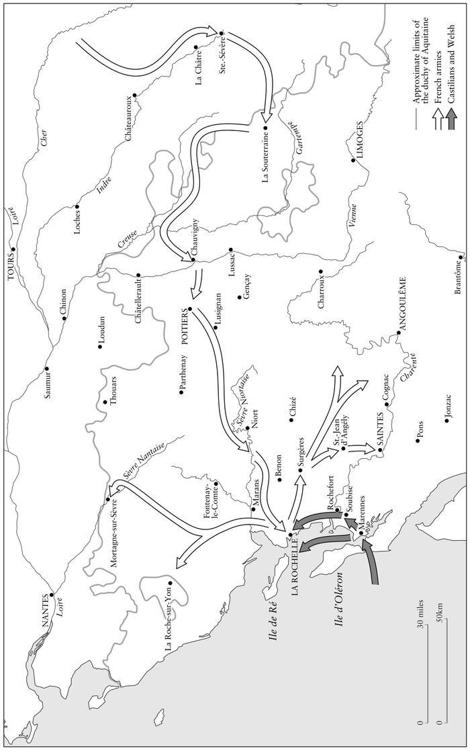
4 The reconquest of Poitou, April–September 1372
The Captal de Buch was at Saint-Jean d’Angély in northern Saintonge. As soon as he knew that the French army had left Bourges he called a council of war. The moment of crisis had clearly arrived. The assembled captains resolved to summon every available man-at-arms from Poitou and Saintonge to confront the invaders. It is impressive that even at this stage and against such long odds the Captal was able to gather most of the more famous names of the Poitevin nobility under his banner. But many of their followers stayed away. By the end of July the Captal is reported to have had about 900 men-atarms and 500 archers under his command and many of those had been taken from garrisons. Froissart says that the Captal’s army had planned to attack the French siege lines at Sainte-Sévère. Sir John Devereux, whose garrison had been holding the place, and Sir Thomas Percy, one of whose cousins was there, were the main supporters of this plan. It suited the Captal’s aggressive instincts and he went along with it. But the attempt cost him the campaign. The Captal’s army was assembled at the Benedictine abbey of Charroux in southern Poitou. While they were there the French commanders abandoned the siege of La Souterraine and marched directly into Poitou. The Constable and the Duke of Bourbon led the way. On about 1 August 1372 they arrived before Chauvigny, the fortress-town which guarded the bridge over the River Vienne. Situated on a spur of high ground over the bridge and defended by a circuit of walls and no fewer than five castles, Chauvigny was one of the strongest places on the eastern march of Poitou. But its garrison, after an initial show of defiance, surrendered on about 5 August as the French were preparing to launch their assault. Once the French had siezed the bridge at Chauvigny they were able to put the bulk of their forces between the Captal’s army at Charroux and the provincial capital at Poitiers.48
Poitiers was in a state of ferment. Its garrison was too small to defend the place. The last vestiges of the Prince’s administration collapsed. The Prince’s receiver packed up the contents of the provincial treasury, 30,000 florins in gold, jewels and cash, into a chest and stole away. The pro-French element among the citizens, who must now have been a considerable majority, sent word to Bertrand du Guesclin that they were ready to open the gates to him if he came quickly. Du Guesclin collected a cavalry force of some 300 men-at-arms and made for Poitiers as fast as possible, riding through the night. The Mayor, Jean Renaud, and leaders of the city did their best to stem the tide of defections. They sent urgently for help to the Captal. But he was unwilling to emasculate his small field army and could spare no more than about a hundred men-at-arms. They rode north under the command of Guichard d’Angle’s bastard son Jean. It was an unequal race. Du Guesclin arrived outside the gates of Poitiers while they were still some miles off, probably on the morning of 6 August. Du Guesclin began to parley with the representatives of the citizens on the walls. The epic poem of Bertrand du Guesclin’s life, that curious mixture of fact and fiction and arresting images, describes the Constable standing beneath the walls with a handful of attendants, a page holding his helmet as if in readiness for an assault, and offering the city a choice between surrender or the horrors of a sack. They asked for time to deliberate. By now even Renaud and his colleagues recognised defeat. Cautious to the end, they resolved not to surrender to such a small force for fear that the city would be retaken by the Captal before the main French army could arrive. They told the Constable that they would open their gates when they saw the banners of the Duke of Berry on the horizon. They also made it a condition that the French were not to depart without dealing with the English garrison. As soon as this decision had been made the handful of English soldiers in the city fled for the citadel. Those who failed to make it were seized and bundled out of the gates. On 7 August 1372 the Duke of Berry, having ridden at more than his usual dignified speed from Chauvigny, arrived outside the city. He solemnly received the keys from the Mayor before riding through the streets to cries of ‘Montjoie!’ from the assembled crowds. The citadel was assaulted from the streets shortly afterwards and after resisting for a day and a half surrendered on terms. Inside the French found just eighteen men, a magnificent ceremonial sword, and the seals of the principality of Aquitaine. In Paris Charles V ordered masses to be celebrated at Notre-Dame.49
The news of the fall of Poitiers caused consternation among the Captal’s army. The leaders held another council of war. They decided to split the army into two groups, small as it was, and to cling on to a small number of fortified places until help could reach them from England. The Poitevin companies withdrew to the northern march to shut themselves in the fortress-town of Thouars. The rest of the Captal’s army, comprising the English and Gascons, withdrew west towards Saintonge and the coast. These dispositions seem to have been made with a view to holding territory through which a relief force might reach Poitou overland from Brittany or by sea from England. But the English encountered considerable resistance in the west. The inhabitants of the walled towns had no desire to see their homes turned into a battlefield. They wanted to surrender to the dominant army, which was manifestly Du Guesclin’s. The men of La Rochelle would have declared for Charles V at once if they had not been overawed by the Anglo-Gascon garrison in the citadel. Walter Hewitt, who arrived at Niort with an advance guard of 200 men, found the great citadel on the bank of the Sèvre held by Walter Spridlington’s garrison. But the gates of the town were closed in his face. The citizens intended, they said, to receive the French as Poitiers had done. The Captal, who arrived at Niort shortly after Hewitt, was in no mood for this. He was able to enter the citadel from outside the town through a wicket gate and invaded the town from the other side, killing large numbers of the inhabitants in the streets and ordering the summary execution of the ringleaders. A large garrison was left to hold Niort and the road from Poitiers while the rest of the army occupied the surrounding strongholds. Sir Thomas Percy made for La Rochelle. The Captal occupied Saint-Jean d’Angély. Hewitt took a company of men to the south end of the bay of La Rochelle and occupied the fortress of Soubise at the mouth of the Charente.50
*
Owen of Wales and the Welsh and French troops who had sailed with him from Harfleur were still kicking their heels in Santander, while attempts were made to find money to pay them and reinforcements for the invasion of Wales. The French government’s commissioner, Jean de Rye, had raised substantial sums by collecting various debts owed to Louis of Anjou by the King of Castile and by realising the remaining value of Bertrand du Guesclin’s Castilian estates. But the main obstacle to the enterprise proved to be Henry of Trastámara. He was alarmed by Andeiro’s noisy intrigues in Portugal. He had sent an ambassador of his own to Portugal, ostensibly to reconfirm the peace treaty, but in fact to find out what was going on. The ambassador, Diego Lopez de Pacheco, was a venerable figure, by birth Portuguese, who had served as a minister of Don Fernando’s grandfather before making his career in Castile. He must have been there while Andeiro and Hore were concluding their business at Braga. On top of the rumours from Portugal came the first reports of Edward III’s naval build-up in southern England, which had reached Paris by the last week of July and Burgos by early August. In both places it was believed that Edward III’s objective was La Rochelle. With all these pressures crowding in on him Henry was unwilling to allow his galley fleet and his French auxiliaries to leave for Wales on an expedition of doubtful strategic value. As for his subjects, none of them was willing to go. They would rather fight in Granada ‘or Persia’, they said, than in Wales. Early in August 1372 Henry of Trastámara went in person to Santander to confer with Owen of Wales and the French naval commander Morelet de Montmor. He told them that he would honour his obligations to Charles V and put a fleet of forty Castilian sailing vessels at their disposal. But their destination would be La Rochelle, not Wales. Shortly after this Henry moved his headquarters close to the Portuguese border at Zamora to wait upon events.51
Forced to abandon their Welsh project, Morelet de Montmor and Owen of Wales sailed from Santander for La Rochelle in about the middle of August 1372. Their original fleet was reinforced with Castilian merchant ships stuffed with soldiers. Shortly, the ships anchored in the sheltered waters between the Île d’Oléron and the mainland. They landed their men near the small harbour of Marennes. The Constable and the Duke of Bourbon were still nearly a hundred miles away around Poitiers, suppressing pockets of resistance which might threaten the newly won capital. Learning of Owen’s landing on the coast of Saintonge, Du Guesclin detached about 300 men. He put them under the command of the Breton captain Thibault du Pont and Renaud, lord of Pons, and sent them to the coast to support Owen’s operations there. In the third week of August the combined French, Welsh and Castilian force laid siege to Hewitt’s garrison in the castle of Soubise.52
The Captal de Buch was anxious not to find his small army caught between two French ones. He determined to snuff out this second front before it could be built up any further. So he collected as many troops as could be spared from the garrisons of Saintonge and western Poitou. With these men at his back the Captal set off on the evening of 22 August on a bold night-time attack on the French lines around Soubise. It was a dark night in the waning phase of the moon. As they approached the enemy siege lines they tightened the straps of their armour to stop them clinking in the silence. They achieved complete surprise. Shortly after midnight the Anglo-Gascon force, commanded by the Captal in person, fell without warning on the French encampments while Hewitt led a sortie out of the castle with about thirty men-at-arms. The first encampment which the English and Gascons came upon was that of Thibault du Pont and the lord of Pons, who were lodged in the buildings of a monastery church just outside the town. The Captal assaulted the building, scattered the French troops sleeping in the courtyard and captured both commanders. The survivors fled to the encampment of Morelet de Montmor and Owen of Wales, which was a short distance away in a group of suburban buildings.
Owen and Morelet had been warned by the noise and had had time to organise their men. When the Anglo-Gascon attack came it was met with volleys of crossbow fire in front while Owen and Morelet took their men-at-arms around the rear of the attackers andcounterattacked. They fought the assailants hand-to-hand in the dark. The cries of ‘Notre-Dame’ and ‘St. George’ were the only means of identification. The Anglo-Gascons were driven back, lost their way, and then found themselves trapped in a dead end in the village of Soubise. Sir Thomas Percy was captured by a Welshman. The Gascon lord of Mareuil surrendered with him. The English Seneschals of Saintonge and Angoumois were both taken. The Captal sold himself dearly. He laid about the French to right and left with his axe, felling any who approached him until he too was overpowered. Like King John at the battle of Poitiers, the Captal is said to have demanded to know whether his captor was a gentleman, ‘for I refuse to surrender save to a gentleman though I die by it.’ His captor was in fact an extremely impoverished man-at-arms but he could truthfully say that he was ‘nobly born, of a knight and a lady’. Once the Captal had been taken the rest of his army disintegrated. The men submitted or fled. Hewitt, who knew the ground better, found his way back across the ditch into the castle. Sir John Cresswell, Sir John Devereux and a few others managed to follow him. As the French prepared to assault the walls of the castle Hewitt and his companions bargained with the enemy for a safe-conduct out. They were the only captains of the Anglo-Gascon army to escape. As day broke the gates of the castle were opened and the French took possession.53
Although the battle of Soubise involved very few men, perhaps 600 or 800 on each side, it marked the end of the last hope that the English might have entertained of saving Poitou and Saintonge. With the towns in no position to resist a siege, the Captal had had no realistic alternative but to stake everything on a surprise attack on the enemy in the field. The gamble had almost succeeded. But in the event defeat deprived the English at a stroke of almost all their leaders and probably about half of their reliable troops in the south-west. In Bordeaux the government was in the hands of the Seneschal, Sir Thomas Felton. He was now little more than a caretaker. There was a handful of garrisons left north of the Gironde but they had been stripped to skeleton strength to reinforce the Captal’s army. Loyalty was the only currency left to pay them with. The money salvaged from the treasury at Poitiers, which would have paid a thousand men for a quarter, was lost when the receiver of Poitou was murdered by robbers as he tried to reach La Rochelle. In the west the islands and coastal areas of Saintonge surrendered to Morelet de Montmor and Jean de Rye immediately after the battle. The combined French and Castilian fleet then sailed north to blockade La Rochelle. On 30 August 1372 the main body of the French army, with the Dukes of Berry, Burgundy and Bourbon and the Constable at its head, marched west from Poitiers to confront the surviving pockets of English and Gascon troops. On the same day the Duke of Anjou mustered the army of Languedoc at Agen and prepared to march down the Garonne valley. ‘Alas, Guienne, now you are truly lost’, the Captal is said to have exclaimed to Morelet de Montmor after his capture. ‘What are you saying?’ replied Morelet, ‘Guienne is won.’54
In England Edward III’s efforts were lost in a chaos of conflicting objectives and administrative disorder. The stream of terrible news from Aquitaine reached Westminster always at least two weeks out of date and often inaccurate. The King’s ministers realised by now that the invasion scare of June and July had been a delusion and that the whole of Aquitaine might be lost unless drastic measures were taken to reinforce it. It was probably in the second week of August that they devised yet another strategic plan, the fourth since the beginning of the year. A very large army, about 6,000 men-at-arms and archers, perhaps 8,000 combatants altogether, was waiting on the coast of Kent by the Downs. The new plan appears to have been to land them on the north coast of Brittany and, after relieving Bécherel, to march overland into Poitou, presumably crossing the Loire by the bridge of Nantes. On 11 August 1372 the King left Windsor for the coast. He informed the two archbishops that he had resolved to take the war to the enemy ‘manu forti’. Unfortunately Edward’s frequent changes of plan had left him badly placed to do this. Many of the men waiting by the Downs had no horses because they had expected to be fighting at sea. There was a large fleet waiting to embark them, 376 ships according to reports reaching the generally well-informed Italian community at Avignon. But they were in the wrong place for a descent on Brittany. Edward arrived at Sandwich on 27 August and boarded his flagship, the Grace Dieu. But his ships were pinned to their anchorage in the Downs by stiff contrary winds which continued to blow for a month. John Neville on the other hand, who was waiting at Southampton with his men, was in the right place to reach Brittany but had no ships. None of the west country barges assigned to him had arrived. Some of them had absconded. The chartered ships of Holland and Zeeland were just enough to carry Neville’s horses. They were sent ahead. Neville and his companions were compelled to kick their heels in the fields about Southampton ‘pur defaute de navye’, as he explained when years later he was charged with misconduct by a vengeful Parliament.55
*
On 5 September 1372 the French army arrived before La Rochelle. The citizens had already made up their mind to surrender. They had taken over the town and overpowered its English garrison, who were being held in the cells of the town jail. Froissart tells a pretty story that the captain of La Rochelle, the Englishman Philip Mansel (‘not a very intelligent man’), was invited to dinner by the Mayor and tricked into organising a review of the garrison. The review occurred in the plain outside the castle gates on the following morning while the townsmen broke into the castle behind his back. The truth was probably more prosaic, a matter of sleepy sentries and scuffles at night. What is certain is that when the French arrived the citizens were furiously engaged in demolishing the citadel so that they would never again be overawed by the garrison troops of either side. Only on 8 September, when they had completed this task, did they open their gates to admit the French army. The English captain was delivered up to the Duke of Berry and the Duke’s troops processed in triumph through the town.
In the rest of Poitou resistance swiftly collapsed. As at Poitiers, the French set about capturing all the small satellite garrisons around La Rochelle which might otherwise have made life intolerable for the newly surrendered town. The isolated castle of Benon, east of La Rochelle, was taken by storm and the entire garrison put to the sword. Marans, north of the town, was held by a garrison of Brabant mercenaries who surrendered it and threw in their lot with the French rather than suffer the same fate. The lesson was not lost on the nobility of Poitou who were still holding out in Thouars. The Duke of Berry had written to their leaders suggesting that they should come to an accommodation. The Poitevins kept their distance but were careful not to lose contact. In the middle of September the majority of them decided to sue for terms. A few dissentients withdrew from the fortress and joined the English garrison at Niort. The rest, the Bishops of Luçon and Maillezais and twenty-three of the leading lay barons of Poitou, appointed plenipotentiaries to negotiate for them. They came before the Dukes of Berry and Burgundy in their camp outside Surgères, a small walled town east of La Rochelle, where the French army was engaged in the siege of the Anglo-Gascon garrison. On 18 September 1372 a truce was agreed for the whole province of Poitou until 30 November. Unless Edward III or the Prince in person relieved Thouars by that date the signatories agreed to submit to Charles V. Charles’s lieutenants undertook that they would all recover their possessions and hold them in peace as vassals of the King. At the same time their leader Louis d’Harcourt, having secured his right to be restored to his domains in Poitou, entered into a private convention of his own by which the French King’s lieutenants promised him the return of all his confiscated domains in Touraine and the revenues of his family’s barony of Saint-Sauveur in the Cotentin as soon as it should be recaptured from the English.56
On the following day, 19 September 1372, Surgères surrendered and the French invaded Saintonge and Angoumois. The conquest of these provinces was even swifter than that of Poitou. Saint-Jean d’Angély, which was defended by the remnants of the Captal’s garrison, surrendered as soon as the French army came before the walls. At Saintes the acting seneschal, William Farringdon, determined to resist. His men put up a fierce fight from the fortified bridge over the Charente. But the citizens seized the captain at night and forced him to surrender. The conquest of Angoumois was left to subordinate commanders with quite small companies of men but this was enough. Angoulême, the Prince’s old capital, which more than any southern town had witnessed the magnificence of the Prince’s court in his prime, surrendered at about the same time as La Rochelle. Pons was reoccupied by its lord, Renaud de Pons, after more than a year in which it had been held against him by his estranged wife. The only notable town which still held out for the Prince was Cognac. Its citizens would gladly have surrendered like those of so many other southern towns, and at one point agreed to do so. But the English recovered control in time to stop them and the garrison maintained an isolated defiance there until 1375. Further south, in the valley of the Garonne, another body of French troops under the Duke of Anjou edged closer to Bordeaux, capturing the great border fortress of Le Mas d’Agenais on the western edge of the Agenais. The whole of the remaining holdings of the English in the Agenais had been overrun by the end of September 1372 with the solitary exception of the fortress of Penne on the left bank of the Lot, where an isolated Anglo-Gascon garrison continued to hold out. Penne ultimately surrendered by agreement on New Year’s Day.57
By this time any prospect of help from England had disappeared. On the day that the magnates of Poitou made their conditional surrender to the Duke of Berry, Edward III’s flagship the Grace Dieu reached Winchelsea, a progress of barely fifty miles after two weeks of beating into the wind. Nine months after they had been presented to the Great Council atWestminster, the King’s ambitious plans for the year had come to nothing. More than £60,000 had been spent on the fleet and the armies of invasion but not a single company of men had left England apart from the companions of the Earl of Pembroke and some minor reinforcements for the garrison of Calais. It was getting late in the season. The requisitioned merchantmen which provided the bulk of Edward III’s transports were urgently required for the annual wine fleet to Bordeaux. The King would probably have had a mutiny on his hands if he had not released them. Most of the ships and the men serving in them were paid off on 6 October. Edward himself refused to give up. He insisted that the campaign was not over and declared that he expected to be at sea for another three weeks. It was not until 14 October that he agreed to disembark from the Grace Dieu after seven weeks on board.
The Prince recognised defeat earlier than his father. On 5 October he came before a packed meeting of the Council at Westminster bearing the charters investing him with the principality of Aquitaine. He declared to the assembled prelates, peers and royal officials that he was resigning all of his continental titles and possessions into Edward’s hands. One of the Council, Guy Brian, a respected veteran of Edward’s wars whose service dated back to the Scottish campaigns of the 1330s, asked the Prince whether that was really his wish. The Prince replied that it was. Less than a fifth of the great territory which he had ruled in 1364 now remained under English control.58
England’s only continental allies, Brittany and Portugal, were swiftly engulfed in the disaster. On 16 October 1372, six months late, Neville finally sailed from Southampton with the wine fleet, escorted by ships of war of England and Bayonne. He landed at Saint-Mathieu at the western tip of Finistère with just under 1,000 men. From here he swiftly took possession of Brest and a number of other walled places of the far west. A well-trained force even of this modest size might have made a great difference to John de Montfort’s fortunes in the summer, but in October it was too late. Bécherel had surrendered. In vain John de Montfort pleaded with the besiegers to take possession of it in his name. They claimed it for the King of France. The news of Neville’s arrival completed the destruction of the Duke’s cause. There was uproar among the prelates and leading noblemen of Brittany when they heard about it. The French King moved swiftly to exploit their anger. He had a large army at his disposal in north-western Poitou which was waiting for 1 December, the date appointed for the surrender of Thouars. On 22 October 1372 these forces were diverted north. On the 28th the Constable, the Dukes of Berry, Burgundy and Bourbon, and the Marshal Louis de Sancerre invaded Brittany. On the 30th they were before Rennes. Their suspicions about John de Montfort were soon confirmed. The march had been so swift that John’s English Duchess, who was in Rennes when their approach was reported, only just had time to flee. She was caught a few miles south of the city on the road to Vannes by soldiers of the Duke of Bourbon. Many years later, when he was an old man, the Duke of Bourbon’s standard-bearer recalled that when her baggage was searched they found a copy of her husband’s treaty with Edward III which Neville had brought with him from England. ‘Am I a prisoner?’ the Duchess asked the Duke of Bourbon when she was brought before him. ‘No, Madam,’ he replied. ‘We do not make war against women.’ But her husband, he added before releasing her, was ‘playing a foolish game from which he will not easily extricate himself’.59
John de Montfort tried to extricate himself, but as the Duke of Bourbon had foreseen it was not easy. He wrote to the King of France admitting that he had invited the English in, but saying that he had done it only in order to maintain his authority against Olivier de Clisson and other rebellious barons. He entered into direct negotiations with the leaders of the French army outside Rennes, protesting his good faith. A compromise was eventually patched up under which John agreed that he would expel the foreigners from his duchy and the French agreed to withdraw their army from Rennes. But he never intended to honour it. Instead he made his way to the fortress of Brest, where he met Neville and his officers and secretly ratified the treaty with Edward III. Charles V’s emissary, Guillaume Mauvinet, who came before the Duke to deliver the King’s protest against this treachery, was treated to a charade in which John called the English captains before him and ordered them to depart. The only reason, he explained, why they were slow in complying was that ships could not be found to carry them back to England. In fact John did nothing to expel Neville’s men and according to reports reaching Paris had even appealed to Edward III to send more.
The French made the most of their discovery of John’s secret diplomacy. The text of the Anglo-Breton treaty was widely distributed in Brittany and provoked mass desertions among the Breton nobility. Several of them swore never to serve him again. By the end of the year John deMontfort’s administration was still effective in Finistère, around Vannes and in the Guérande peninsula west of Nantes, but almost nowhere else. Neville succeeded in occupying a handful of ducal castles in the extreme west but his garrisons were confined there by a wall of local hostility.60
Fernando of Portugal suffered his own nemesis shortly afterwards. He may not have known about the battle of La Rochelle when he sealed the treaty of Braga with John of Gaunt’s emissaries in July. But he does not seem to have been shaken by the news of the battle, which must have reached him shortly afterwards, nor by the succession of reverses which the English suffered in south-western France in August and September, nor even by the growing signs of unrest in his own kingdom. His marriage and the large-scale changes of personnel at court which had followed it remained profoundly unpopular with the Portuguese nobility. His aggressive foreign policy was equally unwelcome to the mercantile oligarchies of the towns. Diego Pacheco reported to Henry of Trastámara on his mission to Portugal at Zamora at about the end of August 1372. He advised an immediate invasion of Portugal. Don Fernando was too weak at home to put up any serious resistance. He thought that disaffection was so strong in Lisbon that a fifth column in the Portuguese capital might rise up on Henry’s approach and deliver it to him. Pacheco’s advice provoked vigorous debate in the Castilian King’s council. Ultimately Henry resolved to advance into Portugal. He had the same exaggerated view of England’s capacity to launch an army across a thousand miles of ocean as Fernando did and was determined to snuff out the Anglo-Portuguese alliance before the English arrived. At the end of November 1372 Fernando began to realise the seriousness of his position. Juan Fernández Andeiro, who was still at the Portuguese court, was sent back urgently to England to get help.
In about the middle of December 1372 Henry of Trastámara crossed the frontier west of Ciudad Rodrigo with a mixed army of his Castilian vassals and French mercenaries. Pacheco’s assessment of the country’s defences proved to be correct. The French and Castilians swept aside resistance around the frontier fortress of Almeida, captured the city of Viseu and then turned south. A second Castilian army, largely recruited in Andalusia and commanded by the masters of the military orders of Santiago and Calatrava, entered Portugal at the same time by the Tagus valley at Alcántara. The two wings joined forces at Coimbra at the end of the year and prepared to advance on Lisbon. In Seville, where the Castilian fleet was being refitted and resupplied after the exertions of the summer, twelve galleys were being made ready to attack the Portuguese capital from the sea. Fernando stood by helplessly.61
In Poitou the end had come. In the last days of November 1372 the French army began to gather outside the walls of Thouars. Inside the fortress the leaders of the local nobility were waiting for 1 December, the day appointed for them to submit to the Crown of France unless Edward III or the Prince got through to them with a relief force. The abandonment of Edward III’s seaborne expedition was known in the principality by now. In Bordeaux Sir Thomas Felton was desperately trying to assemble a relief force from the shrunken remnant of the principality still under his control. He succeeded in raising a small scratch army from the loyal nobility of the Bordelais and southern Périgord. With only a short time to go before the deadline Felton marched north to Niort. There he found the remaining English captains waiting for him: Sir Digory Say, Sir John Devereux and Sir John Cresswell. They had a handful of Poitevin loyalists with them. The total strength of the English and their allies was about 1,200 men-at-arms. Felton and his colleagues sent a herald forward to the Poitevins in Thouars. He knew, he said, that they had bound themselves to surrender the town if they were not relieved by the King or the Prince in person. But only the ‘fortunes of the sea’ had stopped them from coming to the Poitevins’ aid. He urged them to make a sortie from the walls and join forces with him to confront the French in battle. These proposals provoked agonised debate inside the citadel of Thouars where the sentiments of the Poitevins were still very much with Edward III. The lord of Parthenay spoke strongly for accepting Felton’s proposal and offered various reasons why it was consistent with the oaths that they had sworn to the French. But no one else took this view. The herald returned to Niort bearing their excuses and a copy of their treaty with the French leaders. Felton contemplated challenging the French army. But his scouts reported that there were more than 3,000 French troops drawn up in battle order in the plain south of Thouars with their banners unfurled. His men refused to continue against such odds and he was forced to withdraw. On 1 December 1372 the Poitevins came out of the gates of Thouars unarmed and rode into the French camp. Later that day, in the Franciscan church at Loudun, they did homage to the Duke of Berry as Count of Poitiers. On 11 December the three royal dukes and the Constable entered Paris, accompanied by the leading barons of Poitou and bringing the prisoners of Soubise in their train. On the following day there was a magnificent ceremony in the great hall of the Louvre. The Duke of Berry did homage for Poitou to his brother the King. The Poitevins for their part swore oaths of loyalty to the Crown, promising to uphold its rights against all persons, ‘especially the King of England and his children’.62
The surrender of Thouars left the English with just five places of any military value in Poitou: La Roche-sur-Yon and Mortagne-sur-Sèvre in the Vendée; Lusignan and Gençay, south of Poitiers; and the walled town of Niort in the west. Felton left Sir John Devereux in command of these places when he returned to Bordeaux in December. The combined strength of their garrisons seems to have been between 1,000 and 1,200 men. Devereux did what he could to hang on to these enclaves. He established his headquarters at Niort and maintained a spirited guerilla war for another four months, but he was in an impossible position. The hostility of the inhabitants of Niort made the place difficult to defend. The scattered distribution of his forces made it equally difficult to fight in the field. In February 1373 Bertrand du Guesclin returned to the province with an army largely composed of Breton companies and converts among the local nobility to mop up Devereux’s garrisons. Olivier de Clisson laid siege to Mortagne-sur-Sèvre and La Roche-sur-Yon. The French Seneschal of Poitou laid siege to Lusignan. The Constable himself prowled about Niort with a field force of some 500 men.63
By denuding his garrisons Devereux succeeded in collecting together a field force of about 800, just enough to achieve local superiority against the dispersed French forces. With these he embarked on a campaign of rapid spoiling raids against the French siege operations in a style reminiscent of Du Guesclin’s own. He attacked Clisson’s detachment in early March and forced him to abandon the siege of Mortagne. Clisson had to flee in the middle of his dinner. At about the end of the month Devereux almost achieved the same thing against the Constable, but this time the outcome was disaster. It happened at Chizé, a small walled town about fifteen miles south of Niort on the banks of the River Boutonne, where an isolated company of English troops was defying the much larger forces of the Constable from the walls. Devereux’s army outnumbered the Constable’s and initially had the better of the encounter but the French rallied and drove them back, eventually putting them to flight. Devereux lost almost all of his men in this battle and he himself was taken prisoner along with most of his captains. The men of Niort opened their gates as soon as the news of Devereux’s fate reached them. La Roche-sur-Yon surrendered to Olivier de Clisson in the summer after a siege of some five months. Mortagne was recovered by the French at about the same time, after Devereux had accepted a 10,000 gold francs reduction of his ransom in return for ordering the garrison to surrender.
Lusignan held out for longer by dint of its powerful situation, but the garrison had suffered grievous losses at Chizé and was confined to the walls by the bastides which the French constructed across the approaches. Lusignan had once been among the most profitable centres of brigandage in southern France. Its powerful position and prodigious walls and ditches became the stuff of legend within a generation of these events. But, by the spring of 1374, the garrison was unable to raid or forage and the place remained in English hands after 1372 only by virtue of a subsidy from Bordeaux. Even that was not enough. The fortress opened its gates to the Duke of Berry in September 1374. In his later years the Duke encouraged the story that that tough old freebooter, Sir John Cresswell, had decided to surrender it when, lying in bed with his mistress, he saw a vision of its mythical creator the enchantress Mélusine. The truth is more prosaic. Cresswell had been captured by Marshal Sancerre while trying to ambush the cortege of the Duchess of Berry. He was persuaded to surrender Lusignan in lieu of his own ransom and that of Sir Thomas Percy, one of the leading prisoners of Soubise.
Only one notable Anglo-Gascon garrison now survived in Poitou, at Gençay, the great triangular fortress whose ruins still stand on a rocky outcrop above the River Cloyère south of Poitiers. Gençay belonged to theWelsh knight Sir Digory Say and his Poitevin wife and step-daughter. The three of them defended it for nearly two years after the battle of Chizé with the aid of a garrison of Englishmen and Gascons. It finally surrendered in February 1375.64
The English had put down deeper roots in Poitou than in any other part of France and for them the loss of the province was unexpectedly painful. Prominent Englishmen had acquired land in Poitou. They had become closely integrated with the indigenous nobility in a way that they had never done even after two centuries of possession in the Gascon heartland of the principality, with its pride of place, self-contained clans, awkward dialect and reputation for difficult friendships. Sir Digory Say had held three substantial lordships in Poitou either through his wife or by grant of the Prince. Sir Simon Burley, the future tutor of Richard II, was another Englishman who had married a rich Poitevin widow and settled agreeably in the province. Walter Spridlington, who had been captain of Poitiers since 1361, was a modest squire but he married a local widow of fortune and became in a decade one of the richer English settlers, with lands scattered across the province. Robert Granton, one of the Prince’s clerks who served as his receiver for Poitou, had grown fat on grants made by the Prince from the confiscated lands of those who had gone over to the French. These men lost everything in 1372.65
Their losses were perhaps the ordinary fortunes of war, which such men had to accept as risks of their profession. The position of the indigenous nobility of Poitou was more complicated. After the surrender of Thouars they kept their lands and almost all of them served Charles V and the Duke of Berry as loyally as they had previously served the Prince. Louis d’Harcourt and the lord of Parthenay were prominent among the Poitevin contingents fighting with Bertrand du Guesclin at Chizé. One Poitevin member of John of Gaunt’s household in England, hearing of the fall of Poitiers, resolved to join his next campaign in France with the express purpose of deserting as soon as he could. Only a handful of men followed the English into exile and most of these were humble men with little to lose and strong attachments to English patrons. But a few were considerable figures who might have made a different choice. Guichard d’Angle, perhaps the closest of the Prince’s Poitevin confidants, never returned to Poitou after his release from captivity in Castile. He ended his days in England as Earl of Huntingdon, a curious evolution for a man who had spent his whole adult life before 1360 fighting against the English. Even that great Anglophobe, the poet Eustache Deschamps, found time to write a lament for him after his death in 1380, calling him Poitou’s finest soldier for whom there was nothing to reproach. Guichard’s bastard son Jean remained, like his father, loyal to the English for the rest of his days and his nephew William probably also accompanied him to England. But his legitimate daughters and their husbands promptly switched their allegiance to Charles V and received a grant of his confiscated lands.
Even more difficult were the dilemmas of the families of English settlers, who found themselves inhabiting an unfamiliar twilight world, neither English nor wholly French. Sir John Harpeden, the Prince’s Seneschal of Saintonge in 1372, had married a sister of Olivier de Clisson in the 1360s at a time when Clisson was an intimate of the Prince of Wales. His son was brought up in Clisson’s household, became a Frenchman and founded a distinguished Poitevin dynasty. When John the elder returned to Aquitaine as Richard II’s Seneschal in 1385 John the younger was a prominent figure at the court of Charles VI, enjoying his father’s forfeited estates in Poitou, serving as French seneschal in the march province of Périgord and fighting in French armies, as his descendants continued to do until the twentieth century. So far as we know father and son never met again after 1372.
Poitevin women who married English soldiers and administrators felt these dilemmas acutely, especially when they had property and kin in the province. Guichard d’Angle’s wife hung on to her husband’s castle at Château-Larcher during his captivity in Castile and was able to negotiate a personal truce with the Duke of Berry, for Guichard, says Froissart, ‘although a loyal English partisan was not excessively hateful in French eyes’. She seems to have stayed in France once her husband was released from captivity. Simon Burley’s wife also seems to have stayed behind when he returned to England. The elder Harpeden’s second wife, Catherine Senechal, was still in her early twenties when her husband was captured at the sea battle of La Rochelle. She commanded the brief defence of the citadel of Fontenay-le-Comte against the Duke of Burgundy in October 1372 after the town below had been surrendered by its citizens. Her mother married Sir Digory Say. Mother and daughter played a prominent part in the defence of Gençay against the French. And when the end came both of them followed their husbands to England. Catherine later claimed always to have been a Frenchwoman at heart, which may well have been true, for she returned to France as soon as her husband died and married a retainer of the Duke of Berry. But her mother stayed on in England after the death of Sir Digory, where she kept a comfortable household and survived into the following century. Humbler women fared less well. Agnes Forget, a widow of Fontenay-le-Comte, had married an English soldier of the garrison and had a son by him. When the place fell her husband vanished. Her fellow citizens gleefully seized her property and drove her out of the town to beg for alms in the streets of Paris. We cannot know what hidden rancours had built up over the decade in which the English had occupied Fontenay-le-Comte and similar places, but Agnes’s story was probably not unusual.66
*
With the reconquest of Poitou and Saintonge Charles V and his captains had succeeded in recovering substantially all of the territory ceded to England at the treaties of Brétigny and Calais. Unable for logistical and financial reasons to counter-attack in force, the English resorted increasingly to irregular warfare fought in their name by free companies of Gascons. Their operations followed a consistent geographical pattern which reflected the declining fortunes of the English principality. They were concentrated in themassifof Auvergne, which had never been ruled by the English, and in the provinces of Aquitaine from which the English King’s officers had been progressively expelled since 1369. Auvergne was still the natural fortress that it had been when the Arverni tribes had held out against the Romans. Although relatively poor, its remote valleys and difficult terrain made it an ideal defensive redoubt. Its position at the head of all the great river valleys of western France enabled the companies to launch raids into the surrounding lowlands over considerable distances from their bases.
In the reconquered provinces the main factors were political. The French reoccupation of Quercy, Rouergue, Limousin and Périgord had been achieved mainly by forging alliances with prominent local noblemen and leading figures in the towns. These men expected to emerge as dominant figures in the politics of their regions, which by and large they did. But what they gained in the process their local enemies and rivals lost. The massive disturbance of local patterns of power which usually followed the restoration of French administration tended to create a class of losers who provided the essential support for the local operations of the Gascon companies. Only in Poitou did a different pattern emerge, and that was because it was the only province of Aquitaine which the French recovered by force of arms alone. Its nobility and its towns remained completely loyal to the Prince until the end; and when the end came the whole political community accepted the incoming regime. The old solidarities survived. The impact of the change was therefore smaller in Poitou than it was anywhere else and the companies never made any significant inroads there.
In the early 1370s the major figure among the captains operating in south-western France was Bertucat d’Albret. He was one of the few independent captains with a clear strategic vision. His force of personality enabled him to impose it on other captains in a way that no one else had done since the days of Arnaud de Cervole and Séguin de Badefol. Like many of the leading Gascon routiers Bertucat was the acknowledged bastard of a noble father. But although nobly born and brought up in the profession of arms, he was excluded by convention from a share of the landed wealth of his family. Bertucat was truly rootless, a professional captain living on the spoils of his company. His position was very similar to that of the many other captains in the irregular war who were either illegitimate or else younger sons in regions where primogeniture was the rule of succession. Philippe de Mézières, an astute observer of the habits of his class, put his finger on their dilemma. They were men who
by the custom of the land have little or no portion of the inheritance of their fathers and who are often forced by poverty to follow unjust and tyrannical wars in order to sustain their nobility, for they know no other trade than the profession of arms. In this way they do so much harm that I dare not relate all the looting and violence by which they oppress the poor.67
After the collapse of English rule in Quercy the province remained the main centre of Bertucat’s operations for the next four years. The combined strength of his company and Bernard de la Salle’s was reported in 1371 to be about 160 men-at-arms and about 500 mounted infantry, a very substantial force by the standard of fourteenth-century companies. At least eleven garrisons in Quercy are known to have operated under their control in this period, in addition to the important bridge town of Espalion on the Lot in western Rouergue. The list is certainly incomplete. As the English progressively retreated from the eastern provinces of Aquitaine the routiers expanded the range and scale of their operations to fill the void. A loose federation of Gascon companies occupied fortresses distributed in a broad arc extending from the Tarn in the south to the Vienne in the north. Their methods were the classic methods of irregular soldiers throughout the Hundred Years War. They spied out the defences of castles and small towns, suborned the defenders or introduced their companions on market days disguised as merchants or peasants. They clambered over dark sections of the walls from ladders at dead of night or forced their way through gateways opened for them from within. They put small groups of men into well-sited castles within easy marching distance of each other. Their garrisons had their own captains and operated more or less autonomously. But they worked together, dividing the region into ransom districts which they shared out among themselves and joining forces to mount long-distance raids or to fight off attacks from the armies of the King’s lieutenants. They strangled the commerce of the greater commercial towns, preying on merchants, ransoming travellers and carrying off townsmen working in the vineyards and vegetable plots by the walls. Then, when conditions became difficult, they sold out, took their profit, and re-established themselves elsewhere.68
On 14 October 1371, shortly before dawn, Bertucat d’Albret and Bernard de la Salle captured Figeac. Figeac was an important market town on the western march of Quercy with substantial walls, a rich Benedictine abbey and a fortified bridge over the River Célé. Its prosperity was measured by the loot. The immediate haul of jewellery, plate and other valuables was reckoned at 50,000 francs plus 4,000 florins worth of foodstuffs. Bernard de la Salle commemorated the event by receiving his knighthood from his companion in arms in the public square of the town (the modern Place Carnot). They had good reason to be satisfied with their work. They moved their headquarters into the town, recruited fresh gangs of adventurers across Gascony and used the place as a base for long-range raiding. For the inhabitants of the surrounding region it was a disaster. Most of the population of the town abandoned it to the conquerors and settled temporarily in a hill-town five miles away. The rest of northern Quercy was parcelled out into ransom districts and shared among Bertucat’s captains. The records of the small town of Martel in northern Quercy tell us something of what it meant to live in the region during the occupation: sentries standing guard day and night on the walls and towers; continual reports of cavalcades leaving Figeac two, three or five hundred strong; speculation about the direction in which they were going; frightened letters between the towns of the region asking for news; delegations sent with bags of cash to redeem their friends from the cells of Bertucat’s castles; and the perennial fear of spies and traitors within their own walls ready to let in Bertucat’s bands in return for a share of the spoil. Further afield the threat was more sporadic. But over the following months mounted raiding forces from Figeac penetrated deep into southern Quercy. The revenues of the cathedral chapter of Cahors fell to less than a sixth of their pre-war levels.
The French response perfectly illustrated the impotence of the King’s officers in the face of well-organised guerilla operations away from the main theatres of the war. The fall of Figeac had not come as a bolt from the blue. The place was known to be vulnerable, a low-lying valley town with no professional garrison whose population had been much reduced by plague and war losses. Bertucat d’Albret and Bernard de la Salle had prowled around the walls for more than a year before they finally took it. Yet the French King’s officers in the region did nothing to save it or to recover the place after it was taken. This was probably a rational decision. It would have required a large army to lay siege to a town the size of Figeac. Neither the King nor his Lieutenant in Languedoc was willing to divert resources from other tasks of greater strategic value. They treated the elimination of routier garrisons in the former English provinces as a problem for the local communities, to be financed out of local revenues on top of the ordinary burdens of war taxation. For their part the local communities usually preferred to buy the routiers out, which was cheaper and surer than a major siege even if the result was to swell the raiders’ profits and encourage them to resettle elsewhere.69
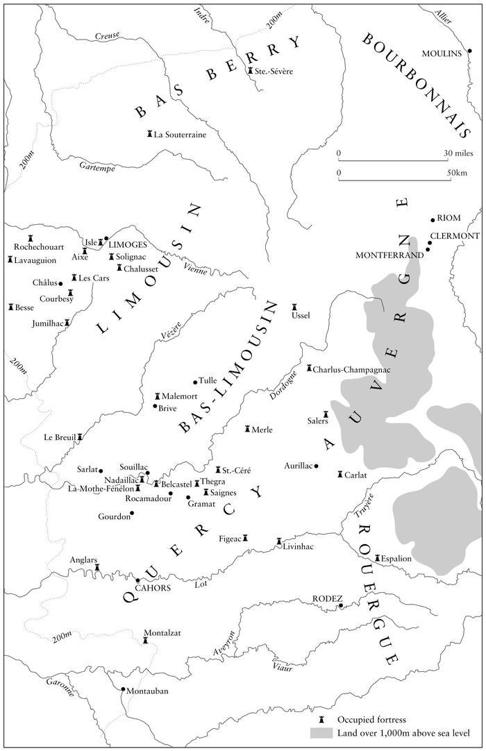
5 Principal routier garrisons of the Gascon march, 1370–1373
In the case of Figeac even a buy-out took more than eighteen months to organise. It involved the representatives of at least five provinces within riding range of Figeac: Quercy, Rouergue, Auvergne, Limousin and Gevaudan, none of whom could agree about the amount to be paid or its distribution among the various contributors. They appealed for help to the King, who referred them to the Duke of Anjou, who referred them on to the Count of Armagnac and his son. There was a succession of ill-tempered meetings and at least two abortive treaties with the companies of Figeac before the Count of Armagnac finally reached a workable deal with them in May 1373. The terms provided for Bertucat d’Albret and Bernard de la Salle to withdraw from Figeac and all their other garrisons between the Lot and the Dordogne. They agreed not to make war in the region again except as part of an army led by a son or lieutenant of Edward III. For this they were to be paid 120,000 francs (about £20,000). It was the largest amount ever paid for the evacuation of a fortress, more than three times the amount paid for the videment of Brioude or Anse in the 1360s, which had themselves set records in their day. Further payments must have been exacted for the evacuation of Bernard de la Salle’s companies from the Limousin, which was agreed between him and the agents of the Pope at about the same time. It took another three months to raise the money from the taxpayers and moneylenders of the region and to sort out the contributions of different participants. In the event half of the immense burden fell on the single province of Rouergue and most of the rest on the neighbouring province of Quercy. In both regions it was the towns who paid the lion’s share, the Church insisting on its status and the military nobility on its services in kind. The contribution of the rest of southern France was limited to a gracious aid of 4,000 francs from the Duke of Anjou. Even that was reduced by the fee paid to the intermediary who negotiated it. On 3 August 1373 the Gascons finally marched out of the gates of Figeac, leaving the inhabitants to survey the wreckage of their town: 500 houses burned out or trashed beyond repair, both parish churches in ruins and the trade of the citizens destroyed for a generation.70
Like most videments this one simply shifted the problem elsewhere. Bernard de la Salle took his companies south into Languedoc as soon as the treaty with Armagnac had been sealed. In July and August he was operating around Béziers and Montpellier and along the trade routes of the Mediterranean coast, the traditional hunting grounds of the companies of the 1360s with whom Bernard had learned his trade. As for Bertucat, he hired himself out to the city of Cahors for service in a vicious private war against an unruly French nobleman, Philippe de Jean. At some time in the autumn of 1373 he fell into the hands of Philippe who sold him to the Duke of Anjou. Anjou demanded an enormous ransom and had him held in chains in the fortress of Roquemaure on the Rhône until he paid it. He was not seen again until the beginning of 1377.71
The Provençal lawyer Honoré Bonet was not the only contemporary to ask himself why lowly peasants and townsmen should have to suffer for the quarrels of their sovereigns. Nor was he the only one to answer that by the fruits of their labour they gave their rulers the means to fight their wars. It followed that ‘if on both sides war is decided upon and begun by the councils of the two kings the soldiery may take spoil from the kingdom at will and make war freely.’ In contemporary eyes the men responsible for these acts were ‘English’ although, as Froissart’s good knight Bonne-Lance observed, they were ‘not English by nationality, but Gascons fighting the Englishman’s wars’. In fact many of them were not even Gascons but Béarnais or even Bretons. Yet the label was in a larger sense justified. Bertucat d’Albret and Bernard de la Salle, like almost all the routier captains operating in the south-west, declared themselves to be Edward III’s captains, proclaiming their allegiance on their banners and in their treaties and safe-conducts. They needed the legitimacy which these symbols conferred on their violence. A lawful war in the eyes of medieval men meant a war, however indiscriminate its violence or innocent its victims, which was fought by the authority of a sovereign prince. If a routiercaptain was ever captured his allegiance might make the difference between being ransomed as a prisoner of war or being hanged or drowned as a bandit. Not for nothing did Charles of Artois, a French nobleman who fought a long guerilla war against the Valois monarchy in the lower Loire with a mixed band of English and French soldiers, come before Robert Knolles during the campaign of 1370 to ask for a banner and a tunic with the King of England’s arms. Many years later when the Limousin routier Mérigot Marchès was on trial for his life in Paris, his defence consisted of a string of incidents designed to demonstrate that his wars were authorised by John of Gaunt and Richard II of England.72
Such claims were often justified, as indeed they had sometimes been in Mérigot’s case. The belligerent status of the leading Gascon routiers was tacitly and sometimes overtly recognised at Westminster and Bordeaux, a symptom of the increasingly close relations between the English government and the companies. A small number of routier garrisons which were conceived to be important to the defence of the Bordelais were subsidised from the revenues of the duchy. Well-known routiers were appointed as royal captains in distant provinces, as Sir John Devereux had been in the Limousin and Bernard de la Salle would be after him. They appeared as the English King’s representatives on the joint commissions which enforced truces. They dealt regularly with the English King’s Council in Bordeaux. Indeed Bertucat ended his career in the 1380s as one of them. Some even visited England and maintained direct relations with the court at Westminster. In return the English King’s ministers, although they could never control the operations of the companies, enjoyed a degree of influence over many of them. Active co-operation between the English King’s officers and the free companies, which had once been rare, became normal and even indispensable in the 1370s and 1380s. English and Gascon captainsco-ordinated their military enterprises with those of English armies in the field. Bertucat d’Albret had fought with Sir John Chandos in Quercy. Bernard de la Salle supported John of Gaunt’s operations in the Massif Central at the end of 1373. The companies at Saint-Sauveur received nothing from the English Exchequer and not all of them were English. But they accepted captains appointed by Edward III and in 1370 they even complied with instructions to moderate their looting when it briefly became a diplomatic embarrassment. This was perhaps the ultimate test for garrisons whose main purpose was looting. Yet it was by no means uncommon. In 1372 Bernard de la Salle was ordered by the Prince’s representatives in Gascony to withdraw from one of the towers of Merle in Bas-Limousin, which he had taken from a kinsman of the Pope. Eventually and with ill grace, he did so.73
Notes
1 Russell, 68, 173–4.
2 Provence: Foed., iii, 830; Gregory XI, Lettres (Autres Pays), no. 91. Gutiérrez: Russell, 167–8, 183–4. Marriage: Anonimalle, 69; Froissart, Chron. (SHF), viii, 30.
3 French in Castile: *Hay du Chastelet, 316–17; Valdeon Baruque, 280–1. Emperogilados: Cortes Castilla, ii, 213–14 (28); Col. doc. Murcia, viii, nos. 97–8; Ayala, Crón., ii, 36; Col. doc. Murcia, viii, no. 103; Lopes, Crón. D. Fernando, 242.
4 Lopes, Crón. D. Fernando, 5, 6; Lopes, Crón. D. Pedro, 150, 195; Ayala, Crón., i, 275.
5 Jean IV, Actes, 57; PRO E403/444, m. 10 (22 Nov.). Their offices: Cal. Plea & Mem. R. 1364–81, 123.
6 Foed., iii, 926, 927–8; PRO E364/5, m. 3d (Neville); E403/441, m. 9 (17 Nov.); E403/446, m. 3 (23 Apr.). On Neville: Given-Wilson (1986), 148; Tout (1920–37), iii, 379, 386n4; Morice, Preuves, i, 1603, 1606. On Barry: Issue R. Brantingham, 154, 182–3, 196, 371, 374, 406, 421; Secousse, Preuves, 428; Compte r. Navarre, 150, 224, 225; PRO E403/441, m. 11 (28 Nov.).
7 PRO E364/5, m. 5d (Lancaster); Froissart, Chron. (SHF), viii, 32: AHG, iii, 275–6. On Andeiro, Lopes, Crón. D. Fernando, 417–18.
8 AHG, iii, 275–6; Froissart, Chron. (SHF), viii, 34–5, 288–9. For Anjou’s relations with Albret, and his ally Armagnac in this period: *Hist. gén. Lang., x, 1476–82; BN Doat 197, fols. 201–2, 266–171.
9 AHG, iii, 275–6; PRO E403/444, mm. 17, 21 (12 Dec., 20 Jan.). Army of Brittany: PRO E403/444, mm. 23, 28 (31 Jan., 4 Feb., 6 Mar.); Foed., iii, 933; Reg. Appleby, no. 301. Army of Gascony: PRO E101/68/5 (103, 109); C61/85, m. 8; E403/446, mm. 3 (20, 29 Apr.); Cambridge, UL Ms. Dd. III.53, fols. 90, 90–90vo (oath of secrecy). Advances were paid in March and April for 2,355 men-at-arms: PRO E403/444, mm. 28, 29 (6, 8, 13, 17, 23, 30 Mar.), E403/446, m. 3 (22, 24 Apr.). Comparison with surviving indentures suggests that advances were initially paid for two-thirds of the contracted men-at-arms of most retinues: PRO E101/68/4 (92–4), 101/68/5 (95–102). This suggests a total of about 7,000 men, of whom 1,000 were to form part of the separate force (see below) commanded by John of Gaunt: John of G. Reg. (1372–6), no. 51.
10 Anonimalle, 69. Army of Castile: John of G. Reg. (1372–6), no. 51, 1000; PRO E159/153 (brevia directa baronibus), Mich., m. 5; Easter, m. 13d; E403/446, m. 25 (14 July). Negotiations with Aragon and Navarre: Russell, 190, *557–61 (Gaunt’s treaty with Portugal, 10 July 1373, which presumably reflected the instructions of his ambassadors, appointed on 1 March); Foed., iii, 939–40. Portugal: Lopes, Crón. D. Fernando, 417–18; PRO E159/154 (brevia directa baronibus), Hilary, m. 9; *Russell, 560–1.
11 Russell, 176–85. Procession: Anonimalle, 69.
12 Cortes Castilla, ii, 202–43; Col. doc. Murcia, viii, nos. 84–9; Ladero Quesada, 182; Ormrod (1995), 144–5 and fig. 21 (compare fig. 23).
13 Ayala, Crón., i, 275, ii, 17.
14 Gregory XI, Lettres (France), nos. 260, 383; Mandements, no. 791, 803; AN J497/14; Col. doc. Murcia, viii, nos. 84 (p. 117), 86 (p. 124); Froissart, Chron. (SHF), viii, 30–1.
15 Doc. Clos des Galées, i, nos. 716, 723–4, 749, 753, 756, 760, 770, 772, 780, 782, 791, 810, 816, 819, 834–5, 847–8, 854, 881. Galées huissières: Anselme, vii, 758; they are probably the ones for which repair bills survive from 1370 and 1371: Doc. Clos des Galées, i, nos. 847–8, 881.
16 1369: Foed., iii, 880; Hist. gén. Lang., ix, 813–14; Doc. Clos des Galées, i, nos. 765, 767, 868. 1370: ibid., i, nos. 778–80, 783–4, 786–94, 804, 828, 832, 863; PRO E101/29/40 (Gosport); Foed., iii, 909. 1371: CCR 1369–74, 220–1; CPR 1370–74, 107–8.
17 Chron. Bourbon, 29–32, 86–7; AN 185A/22, 185B/50.
18 Inv. AC Toulouse, 470; *Hist. gén. Lang., x, 1462–4 (Art. I). Increase (June 1372): *L. Menard, iii, 4, 5; Dognon, 612.
19 Acts. Parl. Scot., i, 559–60; Parl. Recs. Scot., 122–3; Foed., iii, 925–6.
20 Russell, 186; *Hay du Chastelet, 316–17. Owen was mustering his company in Paris at the end of Jan. 1372: BN Clair. 114/69. On his activities since 1369: Carr (1975), 163–5; Carr (1991), 60, 61–2; *J. François and N. Tabouillot, Histoire de Metz, iv (1775), 270–5; *Calmet, iii, 391; Chron. premiers Valois, 230.
21 Mandements, nos. 854–8, 905; Froissart, Chron. (SHF), viii, 36.
22 *Hay du Chastelet, 316–17. On J. de Rye: H.-P.-A. Terrier de Loray, ‘Jean de Rye’, Méms. Acad. Sci. de Besançon, cxxxvii (1889–90), 150–69; G. Daumet, ‘Jean de Rye au siège d’Algesiras’, Bull. Hispan. Fac. Lettres Bordeaux, xii (1910), 265–74; Foed., iii, 851.
23 ‘Anglo-French negotiations’, 69–74; PRO E364/5, mm. 3 (Scrope), 3d (Brian), 5–5d (Savage); Chron. premiers Valois, 224–6; Anonimalle, 70.
24 Jean IV, Actes, nos. 195, 196, 211; Morice, Preuves, ii, 34–7; BL Cotton Julius B.VI, fols. 10vo–13vo (probably the draft articles of agreement referred to in John de Montfort’s instructions of 25 Feb. to Thomas Melbourne: Foed., iii, 936); PRO E364/5, m. 3d (Neville); E403/446, m. 3 (23 Apr.).
25 Sumption, i, 398–9, 403, 455, ii, 154. Army of 1346: A. Ayton and P. Preston, The Battle of Crécy, 1346 (2005), 167–8, 181–6, 189, 242–51.
26 Parl. Rolls, v, 261 (20). Fleet of 1347: Lettres de rois, ii, 86–92. 255 English merchantmen were requisitioned in 1369 (PRO E101/36/14); 218 in 1373 (BL Add. Mss. 37494, fols. 17–20vo, 35vo–37vo); and 194 in the winter of 1374–5 (PRO E101/33/27, 31). These figures do not include royal ships or foreign ships. Tonnage (1369): PRO 101/36/14.
27 Wardrobe Book of William de Norwell, ed. M. Lyon et al. (1983), 386–92 for 1338–40; PRO E101/393/11, fols. 79–116vo for 1359–60. The more generous allowances for knights, bannerets and earls were dropped after 1369, see, e.g., Knolles’s army of 2,000 archers and 2,000 men-at-arms in 1370, which had shipping space for 8,000 horses: PRO E101/30/22; Issue R. Brantingham, 244, 248, 268–70. In 1378 John Neville of Raby led 280 men-at-arms and 280 archers to Gascony, for whom he was assigned shipping space for 1,114 horses: PRO E403/468, m. 15 (28 May); E364/23, m. 3d (Trivet); E101/38/19.
28 Before 1360: Sumption, i, 178 (twelve men per hull, not including pages and varlets). In April 1375, 194 vessels carried about 2,000 men-at-arms and 2,000 archers with horses to Brittany: see PRO E101/33/27, 31; E403/454, m. 23 (20 Sept.). Assuming that each man-at-arms had one page or varlet, this suggests an average carrying capacity of 30.9 mounted men per hull. Tonnage figures are not recorded for this expedition. Capacity was lower on the longer passage to Gascony. In 1370, 80 ships with a capacity of 6,344 tons carried John of Gaunt to Gascony with 300 men-at-arms and 500 archers, all with horses, i.e. 10 paid troops with their horses and attendants (say 13.75 mounted men altogether) per hull: PRO E364/5, m. 5d (Lancaster) and PRO E101/30/29, mm. 4–6. This equates to 0.17 mounted men per ton of carrying capacity. The corresponding figures for the force led by Walter Hewitt to Gascony in the same year are: 14.3 paid troops (say 20 mounted men) per hull, or 0.25 mounted men per ton: Issue R.Brantingham, 119–20, 482, PRO E101/30/29, mm. 3–4. Gaunt’s force, being drawn from men of higher rank, travelled in greater comfort and may have had more non-combatant attendants and clerks. In August 1378, 34 ships, including 12 large Dutch barges, carried 280 men-at-arms and 280 archers to Gascony, an average of 16.5 paid troops per hull, say 24.7 mounted men including pages and varlets: see PRO E101/38/19 (ships) and E364/15, m. 4d (J. Neville), E364/23, m. 3d (Trivet) (troops). All of these calculations are complicated by uncertainty about the number of pages and varlets (who do not appear on pay records), the questionable accuracy of medieval tonnage figures, the omission of tonnage figures for barges and the use of some ships as escorts rather than transports. Ships with unrecorded or illegible tonnage have been assumed to correspond to the average. It is impossible to calculate capacities on the short passage to Calais, because of uncertainty about the number of passages performed by each vessel.
29 On John of Gaunt’s expedition to St.-Malo (1378), 102 ships and barges carried 4,980 paid troops (say 7,500 men altogether) with few if any horses, an average of 48.8 paid troops (say 73.2 mounted men altogether) per hull: PRO E403/465, m. 20 (5 Apr.), E403/468, m. 15 (28 May); E101/37/25. Tonnage figures cannot be calculated because of the large number of barges employed whose tonnage is not recorded. In July 1381, 41 large vessels of a total of 4,800 tons burden (reckoning the capacity of the two barges at 100 tons each) carried 2,997 paid troops without horses (about 4,500 men altogether) to Portugal, an average of 73.1 paid troops (say 110 men altogether) per hull or 0.94 men per ton including pages and varlets: PRO E101/39/17.
30 Crewing ratios: PRO E101/36/14 (1369); E101/30/29 (1370); E101/32/22 (1372); BL Add. Mss. 37494, fols. 17–20vo (1373); PRO E101/37/25 (1378); E101/38/19 (1378–9); E101/39/2, mm. 1–2 (1380); E101/39/17, m. 2 (1381); E101/40/19 (Portugal, 1386); E101/40/21 (Thames, Oct., Nov. 1386); E101/40/40 (1388). Crew numbers in 1347: Lettres de rois, ii, 86–92.
31 Parl. Rolls, v, 245 (32), 261 (20), 284–5 (28–9); vi, 133 (50), 179 (47), 200 (33). Pay: PRO E403/444, mm. 23, 24 (31 Jan., 10 Feb.); E403/446, m. 38 (29 Sept.). Requisitions of 1372: PRO E101/32/22; PRO E403/444, m. 24 (10 Feb.); E403/446, m. 38 (30 Sept.); Foed., iii, 938. Requisitioning officers had also been sent to Wales and the north-west: see PRO E403/444, m. 23 (4 Feb.); but no record of their work survives.
32 CPR 1370–74, 68; PRO E403/441, m. 22 (5 Feb.); E30/264; E364/19, m. 4 (Eyrmin). Revolution: Stella, Ann. Gen., 164, 165–6.
33 Coastal defence: PRO C76/55, m. 40; Foed., iii, 940; PRO D364/6, m. 3 (Tiddescombe); E403/446, mm. 9, 11 (15, 29 May); CCR 1369–74, 436. Council: PRO E403/446, m. 10 (15 May). Pembroke: PRO E403/446, mm. 4, 12 (29 Apr., 29 May). Portugal: PRO E403/446, m. 20 (18 June); E364/11, m. 5 (Green). Neville: PRO E101/68/5 (111); cf. E403/446, m. 9 (15 May); PRO E101/32/22. Further ships: PRO C76/55, m. 41; E403/446, mm. 9, 25 (14, 15 May, 15 July). June embarkation: PRO E403/446, mm. 9, 10 (15 May).
34 Froissart, Chron. (KL), viii, 435–6; *Moranvillé (1888), 264; Gr. chron., iii, 165; BN Clair. 9, p. 84; 95, p. 7379; Doc. Clos des Galées, i, no. 907.
35 Chron. premiers Valois, 230–1; ‘Chron. Pays-Bas’, 259; Froissart, Chron. (SHF), viii, 45–6. Date: Doc. Clos des Galées, i, 916. Defences of Ch. Islands: PRO E364/14, m. 6 (Appelby); C47/10/9 (20); E364/17, m. 1 (Rose); Issue R. Brantingham, 138.
36 Mandements, nos. 819, 872, 878, 880; ‘Compte inédit de B. du Guesclin’, 263; AD Côte d’Or B11749; Letters B. du Guesclin, no. 456, 467; Chron. Bourbon, 87–8; Chron. premiers Valois, 229–30; Froissart, Chron. (SHF), viii, 51, 60–1; AN KK 251, fols. 75, 96vo; BN Fr. 7615, fols. 449–451 (Sept. 1371).
37 Chron. Bourbon, 87–9; Froissart, Chron. (SHF), viii, 51–3; ‘Chron. Pays-Bas’, 261.
38 PRO E403/446, mm. 3, 4, 12 (20, 29 Apr., 29 May); PRO C61/85, m. 8; Froissart, Chron. (SHF), viii, 294.
39 Chron. premiers Valois, 232–4; Froissart, Chron. (SHF), viii, 37–43, 293–300, 303; ‘Chron. Pays-Bas’, 259; Ayala, Crón., ii, 31–2; Gr. chron., ii, 164–5; Walsingham, Hist. Angl., i, 314.
40 Froissart, Chron. (SHF), viii, 43–4, 300.
41 Chron. premiers Valois, 235; Froissart, Chron. (SHF), viii, 47–9; Ayala, Crón., ii, 32; Anonimalle, 71. Date: BN Clair. 9, p. 511; 95, p. 7379. Florimond: PRO C61/100, m. 6; E101/179/14, m. 13. Pembroke: Ayala, Crón., ii, 32, 66; Inv. Arch. Bruges, ii, 240–7; Letters B. du Guesclin, nos. 633, 635, 660, 725, 921; Col. doc. Murcia, viii, no. 117; *Hay du Chastelet, 454, 456–7; Walsingham, Hist. Angl., i, 319–20; Higden, Polychron., viii, 383; Royal Wills, 95. Guichard: Froissart, Chron. (SHF), viii, 165–6; Anselme, viii, 9–10. Harpeden: Anonimalle, 115–16. Seamen: Cal. Inq. Misc., iv, no. 126.
42 Froissart, Chron. (SHF), viii, 50, 53, 54, 56; Rec. doc. Poitou, iv, 185–6, 185n1; Letters B. du Guesclin, no. 474. Anjou: *L. Menard, iii, 4; Petit Thalamus, 388.
43 Foed., iii, 942, 944, 947, 947–8, 953; PRO E403/446, m. 20 (17 June), m. 21 (22 June); John of G. Reg. (1372–6), no. 253; CPR 1370–4, 238.
44 PRO E101/31/33 (p.s. letter of 22 June); John of G. Reg. (1372–6), no. 63; Reg. Appleby, no. 301; Cambridge, UL Ms. Dd. III.53, fols. 47, 54vo; PRO E101/31/33; E101/32/21; E159/153 (brevia directa baronibus), Mich., mm. 2, 5, 15d, Easter, m. 13d; E403/446, m. 25 (14 July); C76/55, m. 28; Tout (1934)[2], ii, 265. Cf. advances paid for service at sea to companies previously destined for France: PRO E403/446, mm. 22, 23, 25, 28, 29 (29 June, 3, 14, 15 July, 2, 5 Aug.). The small force waiting at Plymouth for Green’s passage to Portugal joined the royal fleet instead: PRO E364/11, m. 5 (Green).
45 John of G. Reg. (1372–6), no. 955; Lopes, Crón. D. Fernando, 197–204, 209–21, 227–30, 235. Alliance: *Russell, 557–61.
46 Bécherel: Anonimalle Chron., 68, 70; Froissart, Chron. (SHF), viii, 177–8 (wrongly dating the event to 1374). King’s army: PRO E101/30/13, m. 7 (issue of equipment to ships for King’s expedition to Bécherel); C76/55, m. 27 (recruitment of stone-masons); E403/446, m. 27 (24 July) (recruitment of miners); E403/446, mm. 27,33 (24 July, 16 Aug.); E364/19, m. 4 (Eyrmin, 2nd account); Lettres de rois, ii, 180. Treaty: Foed., iii, 9 53–6. Neville’s army: Cambridge, UL Ms. Dd. III.53, fol. 47, 47–47vo; PRO E403/446, m. 27 (24 July); C76/55, mm. 30, 24; E403/446, m. 21, 25, 33, 34, 38 (21 June, 15 July, 16, 29 Aug.).
47 Chron. Bourbon, 32–5, 87–8; Istore, ii, 119; ‘Chron. Pays-Bas’, 261; Cuvelier, Chanson, i, 419–31; Froissart, Chron. (SHF), xii, 106 (recollections of the Bascot de Mauléon). Froissart’s own account, ibid., viii, 54–60, is unreliable. Date: AN KK 251, fol. 89vo. Verse: Cuvelier, Chanson, i, 416 (ll. 21193–5). La Souterraine: Istore, ii, 120.
48 Froissart, Chron., (SHF), viii, 56–7; Chron. Bourbon, 35–6; AN KK 251, fols. 97, fol. 97vo; Chronographia, ii, 391; Chron. premiers Valois, 237; Istore, ii, 120.
49 Rec. doc. Poitou, v, 416–17; Froissart, Chron. (SHF), viii, 60–2; Istore, ii, 119–20; Chron. premiers Valois, 237–8; Gr. Chron., i, 166; Chron. Bourbon, 36, 89–90; Cuvelier, Chanson, i, 443–7. Regnault: Rec. doc. Poitiers, iv, 233–4, 237–8. Date: Cuvelier, Chanson, i, 446 (l. 22765); AN KK251, fol. 89vo.
50 Froissart, Chron. (SHF), viii, 62–5; Istore, ii, 121; Chron. premiers Valois, 241.
51 BN Clair. 9, p. 511; 95, p. 7379; Ayala, Crón., ii, 34, 36–8; Lopes, Crón. D. Fernando, 231–3; Mandements, no. 905; Chron. premiers Valois, 235.
52 *Gr. chron., iii, 165; Istore, ii, 122–3; Froissart, Chron. (SHF), viii, 65; Chron. premiers Valois, 238–9; Chron. Bourbon, 36, 90.
53 Chron. premiers Valois, 238–41; Istore, ii, 123–5; Froissart, Chron. (SHF), viii, 66–71; *Froissart, Chron. (KL), xviii, 506; Col. doc. Murcia., viii, no. 103.
54 Rec. doc. Poitou, v, 416–17; Ord., v, 565–7; Chron. premiers Valois, 241–2; Itin. Ph. le Hardi, 85; AD Côte d’Or B11749. Anjou: BN PO 2556, Roucy/7; 2776, de St.-Rion/4; 1910, Geneve/1; 1836, Marcenac/5, 6; 1896, Mauny/8; PO 548, Budes/4; etc.; *Hay du Chastelet, 378; Morice, Preuves, ii, 49–50. Anjou was at Le Mas d’Agenais on 7 Sept.: BN PO 2037, Montpezat/11.
55 King’s army: PRO E403/446, mm. 28 (2 Aug.), 29 (5, 11 Aug.), 31–3 (16 Aug.); E101/30/13, m. 7; E101/31/33–5, 37, 39–40, 32/12–21, 26, 30 (mm. 2, 6); E364/9, mm. 13 (Warwick), 14 (Hereford); E364/12, m. 9 (Zouche); E101/397/5, fols. 52vo–54; ‘Dispacci di C. da Piacenza’, 42; Walsingham, Hist. Angl., i, 315; Eulogium, iii, 339;Foed., iii, 960, 962; Parl. Rolls, v, 258 (9). Neville’s army: Parl. Rolls, v, 312 (34); PRO C76/55, m. 16; E403/446, m. 38 (29 Sept.).
56 Itin. Ph. le Hardi, 86; AN KK 251, fols. 90, 98; Froissart, Chron., viii, *pp. clv–clix, 75–80, 86–8, 97; Istore, ii, 126–7; Chron. Bourbon, 91–2; Gr. Chron., ii, 166; Mandements, no. 918; AN JJ 104/156; Letters B. du Guesclin, no. 520.
57 Saintonge: Itin. Ph. le Hardi, 86; Froissart, Chron. (SHF), viii, 72–5; Istore, ii, 125. Angoumois: AN JJ104/2; Gr. chron., ii, 167, 178; Froissart, Chron. (SHF), viii, 7, 75; ‘Reg. B. de Noces’, 543–4. Agenais: BN PO 2037, Montpezat/10–12; BN Fr. 26011/1333; BN Coll. Languedoc 159, fol. 142; Petit Thalamus, 388; *L. Menard, iii, 5.
58 Cal. Letter Books G, 297; PRO E101/31/35–9, 32/12–19, 21; PRO E101/397/5, fol. 57vo; PRO E403/447 (6 Oct.); CCR 1369–74, 463–5. Cost: PRO E403/444, 446 and captains’ accounts at E101/31/33–5, 37, 39–40, 32/12–21, 26, 30 (mm. 2, 6) and E364/9, mm. 13 (Warwick), 14 (Hereford); E364/12, m. 9 (Zouche). Prince: Parl. Rolls, v, 258 (8). Date: PRO E101/179/7. On Brian: Given-Wilson (1986), 156–7.
59 Neville: PRO E403/446, m. 36 (28 Sept.); E364/19, m. 4 (Eyrmin). Date: PRO E101/179/13; E403/446, m. 38. (29 Sept.); Froissart, Chron. (SHF), viii, 106; *Gr. chron., iii, 179. Bécherel: Istore, ii, 116; Chron. premiers Valois, 215. French invasion: Froissart, Chron. (SHF), viii, 106–7; Itin. Ph. le Hardi, 87; Chron. Bourbon, 37–9.
60 *Gr. chron., iii, 179–80; Jean IV, Actes, no. 208; Foed., iii, 964; Chron. Bourbon, 39–40; Anonimalle, 71.
61 Ayala, Crón., ii, 37–9, 40–1; Lopes, Crón. D. Fernando, 231–3, 243, 245–7, 249, 251–2, 265–6; Foed., iii, 966.
62 Gr. chron., ii, 167–8; Froissart, Chron. (SHF), viii, 96–101; Istore, ii, 128; Itin. Ph. le Hardi, 89; ‘Chron. française’, 651; AN X1a, fol. 6.
63 ‘Compte inédit’, 264–5; Froissart, Chron. (SHF), viii, 101–3, 107–8; Chronographia, ii, 391; John of G. Reg. (1372–6), no. 42. Du Guesclin was at Poitiers on 17 Feb. 1373: AN JJ104/87.
64 Mortagne: Froissart, Chron. (SHF), viii, 101–3; AHP, viii, 417–18, 424–6. Chizé: Chronographia, ii, 391–2; Chron. Bourbon, 40–1; Froissart, Chron. (SHF), viii, 107–15; Istore, ii, 133–4; *Itin. Ph. le Hardi, 497; AN KK251, fol. 93vo. La Roche-sur-Yon: AN KK251, fol. 94vo, 127; Froissart, Chron. (SHF), viii, 131, 139 (wrongly attributing the siege to the Duke of Anjou). Lusignan: Jean d’Arras, Mélusine, 215, 263–5, 813–15; John of G. Reg. (1372–6), no. 42; Rec. doc. Poitiers, ii, 256–7; AN KK251, fols. 127–9; AN KK252, fol. 21, 31; ‘Reg. B. de Noces’, 220, 246–8; Istore, ii, 130–1; Walsingham, Hist. Angl., i, 317; *Rec. doc. Poitou, iv, pp. lxvii–lxviii. Gençay:Rec. doc. Poitiers, ii, 256, 259; Rec. doc. Poitou, iv, 364–7, 402–4.
65 Rec. doc. Poitou, iii, 380–4, iv, 67–71, 129–32, iv, 4–7, 41–8, 57–60, 63–5, 77–80, 117–20, 134–43, 157–9, 163–5, 354–8, 364–7, 402–5. On Spridlington: ‘Procès-verbal Chandos’, 250; he is called a squire in his letters of protection of 1371 (PRO C61/84, m. 2).
66 Istore, ii, 133 (Poitevins at Chizé); Rec. doc. Poitou, iv, 217–21, 319, 388–90, v, 181–5. Guichard and his family: Deschamps, Oeuvres, iii, 320–1, iv, 120; Froissart, Chron. (SHF), viii, 115–17; Rec. doc. Poitou, iv, 312–16, v, 342; CCR 1377–81, 395; Testamenta Vetusta, ed. N.H. Nicolas, i (1826), 109. Harpeden and his family: Anselme, vi, 203; PRO C61/98, m. 3; Rec. doc. Poitou, v, 203–7; Inv. AC Périgueux, 27. John the Younger at French court: Chron. r. St.-Denis, i, 646–8; *Froissart, Chron. (KL), xiii, 352–4; Cal. Inq. P.M., xvii, no. 289; CFR, xi, 240, 241. Burley: Rec. doc. Poitou, iii, 381n1. Radegonde Béchet and Catherine Senechal: Froissart, Chron. (SHF), viii, 88; Itin. Ph. leHardi, 87; Rec. doc. Poitou, iv, 366, 402–5, vi, 17–21, 291–2; PRO C61/96, m. 2; C61/97, m. 1; C76/89, m. 12; *Pépin, 114; cf. CPR 1399–1401, 22; CCR 1405–9, 307. Forget: Rec. doc. Poitou, iv, 159–62, 282–6.
67 Oxford, Bodley MS Ashmole 865, fol. 423 (statutes of the Order of the Passion), cited by Keen (1976), 43.
68 Bertucat: BN Doat 125, fol. 97–97vo; cf. his own estimate, in 1375, that his company had been 500 strong in 1368, BN Fr. 15515, fol. 294. His garrisons in Quercy and Rouergue: BN Doat 125/97–99vo (Figeac, Cayssor, St.-Espene, St.-Céré-de-Lagarde, Malemort); Inv. arch. Aurillac, ii, 13 (Saignes, Anglars); AC Martel CC1bis/3 (Montalzat); AC Martel CC5, fol. 40vo, 6, 11, 11vo, 15vo (Belcastel, Nadaillac, Lamothe-Fénélon); Rouquette, 265 (Espalion). Others: Inv. arch. Aurillac, ii, 12–15.
69 BN Doat 125, fols. 42–45vo, 97–101; *Denifle, 839; Petit Thalamus, 386; Lacoste, iii, 223–4, 227, 229–33; AC Martel CC1bis; CC5, fols. 1–30 passim, esp. fols. 1, 1vo, 2vo, 15vo, 16; *Denifle, 839.
70 AD Aveyron C1886, fols. 3, 26, 30–30vo, 31, 34vo, 35vo, 36, 39, 39vo, 40, 40vo, 41; AC Martel CC1bis/3; CC5, fols. 3vo, 10, 12, 12vo; EE1/40; Rouquette, 266–9; Lacoste, iii, 235; BN Doat 125, fols. 46vo–54, 61–71vo, 101, 113–17; Petit Thalamus, 386; *Denifle, 826; Gregory XI, Lettres (France), no. 1294.
71 La Salle: *L. Menard, iii, 317, 318. Bertucat: BN Doat 87, fols. 239–253; BN PO 1577, Jean/12; Rouquette, 270; BN Fr. 15515, fol. 293vo. On Philippe de Jean’s wars, see Lacoste, iii, 229, 233, 236–7. He is reported at Comiac (Quercy) in January 1377: Reg. St.-Flour, 35–6.
72 Bonet, Tree, 153–4 (cf. Keen (1965), Ch. 5); Froissart, Chron. (SHF), xiv, 200 (Bonne-Lance); BN Fr. 15515, fol. 291, AN JJ108/104 (Charles of Artois); Reg. crim. Châtelet, ii, 177–213 (Mérigot).
73 Subsidies: PRO E101/179/7, fol. 13vo (payments to Bertucat, 1372–3); John of G. Reg. (1372–6), no. 42 and Antient Kalendars, i, 243 (payments for Lusignan, 1374). Appointments: ‘Anglo-French negotiations’, 24; Foed., iv, 153. Instructions: Anglo-Norman Letters, 266–7; Foed., iii, 903; Secousse, Preuves, 428 (confession of Pierre du Tertre); Gregory XI, Lettres (France), nos. 898, 1243.