
CHAPTER VI
‘War at his beginning hath so great an entry and so large that every wight may enter when him liketh and lightly find war,’ wrote Chaucer, ‘but certes what end shall thereof befall it is not light to know.’ Since 1369 there had been few attempts to find a negotiated end to the war and none that had proved productive. Two short conferences, at Guines in March 1372 and Bruges in January 1373, were all that diplomacy had achieved, and these had consisted largely of reiterated exchanges of the two governments’ public positions. A year later growing pessimism about England’s ability to defend its possessions in Aquitaine naturally encouraged thoughts of a negotiated settlement.
John of Gaunt had his own interest in promoting peace with France. It was becoming increasingly clear that while the war continued the French government would have the strongest reasons for supporting Henry of Trastámara with money and manpower. Over the following years the Duke of Lancaster became the foremost English advocate of peace with France, to the irritation of many of his more bellicose compatriots. At about the beginning of December 1373, when he was at Brive on his march through France, he made contact with the local representatives of Guillaume Roger, Viscount of Turenne, the Pope’s brother and principal political adviser. Gaunt wanted it to be known in Avignon that he was interested in the idea of a fresh diplomatic conference under papal auspices. This roundabout method of dealing with the papal court was probably dictated by the limitations of the Duke’s authority, but it was good enough for the purpose. The message reached Gregory at about Christmas-time. His reaction was extremely guarded. He discussed it with the Duke of Anjou and eventually sent an agent to Bordeaux with a cautious response. There was not the slightest prospect, he said, of the French King compromising on his claim to ultimate sovereignty over Aquitaine, which was the point on which previous Anglo-French conferences had foundered. Louis of Anjou had made this perfectly clear. So if another attempt was to be made with any chance of success John of Gaunt would have to press Edward III and his ministers to make concessions. Was the Duke prepared to do that, the Pope wondered?1
After his return to England in April 1374 John of Gaunt took a more decisive and persistent role in the direction of English foreign policy than he had ever done before. After resting in the west country he went straight to London at the beginning of May and passed most of the next three months there. Although there is no direct record of his role in Edward’s counsels events to some extent speak for themselves. The Archbishop of Ravenna, Pileo de Prata, a shrewd Italian prelate from the Veneto who was serving as one of the Pope’s legates in France, arrived in London in May. He brought with him proposals for a long truce and a diplomatic conference at which Edward III and Charles V would each be represented by one of his sons. The plan probably reflected Gaunt’s discussions with the Pope’s representatives in Bordeaux earlier in the year and it was presumably Gaunt whom the Pope had in mind as the royal prince who would lead the English delegation. Pileo proved to be a skilful diplomat. At the conclusion of his visit Edward told him that he was prepared to agree to a general truce until Easter 1375 in order to enable a diplomatic conference to be convened at Bruges in Flanders. He proposed to nominate a distinguished embassy with full powers to commit him. He promised to nominate the Duke of Lancaster as its leader. His only condition was that the King of France would give a similar commitment.2
The immediate obstacle to a diplomatic solution was Brittany. John de Montfort had arrived in Brittany by sea from Bordeaux in about mid-February 1374 to try to revive his friendships in the duchy from which he had fled nearly a year before. The visit served only to confirm the destruction of his authority. He landed at Auray, the fortress town in the Gulf of Morbihan which his wife was defending with the aid of an English garrison. There he summoned the Estates of Brittany. However, none of them would come without the leave of the King of France. Charles had no interest in giving it. The Breton duchy had not formally been confiscated but the King had refused to recognise John de Montfort as Duke since his letter of defiance of the previous year and was in practice treating the duchy as vacant. Far from permitting the Bretons to go before John at Auray he sent Bertrand du Guesclin and Olivier de Clisson into Brittany in April with heavy French reinforcements to remind them of their duty. At about the same time John withdrew to England, determined to return at the head of an English army. In May, while Pileo de Prata was working on the English King’s ministers, John was bargaining for the support of Edward’s Council. John of Gaunt is unlikely to have favoured this project, which cut across all his plans for a diplomatic conference. But the English government seems to have been divided on the issue. John de Montfort was a great favourite of the King’s. He also had allies on the Council including its two most assiduous members, Neville and Latimer, both of whom were steeped in the affairs of Brittany and reluctant to abandon the Duke to his fate.3
The inner history of policy-making in this period is even more obscure in France than it is in England. The papal legates had consulted Charles V in advance about their proposed conference and he had given it his blessing, at least outwardly. Charles V was reappraising his war aims. Having recovered almost all the territory ceded by the treaty of Brétigny he was willing in principle to compromise with the English for the sake of peace. France had lived through five years of almost continuous fighting. The war was expensive and locally destructive. The taxes which supported it were unpopular. Renewed bouts of bubonic plague depopulated villages and towns and made hearth taxes harder to collect. The aides, which were levied on transactions and tended to fall in times of depression, experienced a sharp reduction in 1373 and 1374 from which they would not recover for some years. In spite of the failure of English arms since 1369 the English were still feared for the damage that they could do to the land of France and to the delicate balance of its internal politics. Charles V, although only thirty-six years old, was a sick man. Gouty and unhealthy for many years, he was afflicted in the summer of 1374 by an obscure but apparently serious malady. He was thinking about the political situation which he would bequeath to his six-year-old son if he died prematurely, and was already preparing the great series of ordinances which would attempt to control the rivalries of his three brothers during what might be a long regency.4
These changes of mood at the Hôtel Saint-Pol coincided with the emergence of tensions within the French royal family. Louis of Anjou remained as uncompromising as ever in his hostility to England but he was marginalised by his distance from Paris, by doubts among Charles’s councillors about his political judgment and by his facility for making influential enemies. More significant as a factor in French thinking about war and peace was the personality and ambition of his youngest brother, Philip, Duke of Burgundy. Philip was emerging as the most influential of the royal princes. He was with the King for much of June and July 1374, when the French response to the papal legates’ plans was being considered. His main interest in the peace process arose out of his marriage to Margaret of Flanders, daughter and sole heiress of Louis de Mâle. He was on good terms with his father-in-law and listened to him. As the heir to Louis’s territories he was the heir to many of Louis’s political preoccupations. He was also a subtle diplomat with an instinct for compromise and an intelligent grasp of the political dilemmas of the English. He had known most of the leading figures at Edward III’s court during his long captivity in England after the battle of Poitiers. Alone among Charles V’s councillors he retained the forgotten commonplace of an earlier age that the royal princes of England and France belonged to one cousinhood. Philip of Burgundy became the most persistent advocate at the French court of a negotiated settlement with England, very much as John of Gaunt did for quite different reasons on the other side of the Channel.5
For the French King the main problem about the conference lay in its timing and in the English demand for a general truce while it was being organised. The French government wanted to negotiate from a position of strength. In particular, if there were to be negotiations for a permanent peace, it was important to eliminate the surviving English positions outside the heartlands of the Gascon duchy and the pale of Calais. In the north this meant the fortress of Saint-Sauveur-le-Vicomte in the Cotentin and the surviving English garrisons at Brest and Auray in Brittany. In the south-west the military situation was even more delicately balanced. The Duke of Anjou was on the point of invading the Garonne valley. The garrison of Lusignan, the most dangerous of the surviving English enclaves north of the Gascon march, was negotiating for its surrender. Sir Digory Say was still holding out in the castle of Gençay in the heart of Poitou. So was the important walled town of Cognac on the Charente east of Saintes. All of this unfinished business made the timing of any truce a critical issue. When the King received the legates again at about the end of June 1374, he played for time. He told them that he needed to reflect. In the meantime he began to make preparation for a fresh military campaign.6
On about 12 July 1374 Pileo de Prata’s letters arrived at Westminster, reporting that there would be a delay while the French King made up his mind. The English King’s Council knew nothing about the French government’s plans but they assumed, quite correctly, that Charles V was not interested in freezing the current military balance and naturally turned to their own projects. The tepid French response tipped the balance on the King’s Council in favour of John de Montfort’s project. John received the go-ahead for his invasion of Brittany less than a week after Pileo’s messenger had left England. On 17 July the first orders were given to requisition shipping for his men. The expedition was conceived on an ambitious scale. The army was to comprise 4,000 men under the joint command of John de Montfort himself and the King’s son Edmund Langley, Earl of Cambridge. Their personal retinues accounted for about two-thirds of its strength. The rest was provided by the 22-year-old Edmund Mortimer, Earl of March, and by Edward, Lord Despenser, an accomplished courtier and patron of Froissart, who called him ‘the finest knight and the most gallant and courteous man in England’. This was gross flattery, but Despenser was certainly an experienced captain, having fought in all the major English campaigns on the continent since 1356. The four captains contracted to serve for a full year, the first six months at the King’s expense. After that they would be expected to maintain themselves from the plunder and ransoms of Brittany and France, an echo of Knolles’s disastrous campaign of 1370 which was likely to destroy whatever goodwill John de Montfort still had among his subjects. But the English government was less interested in re-establishing Montfort’s authority in his duchy than in improving their bargaining power at Bruges by a decisive stroke against France. The campaign was always seen as the complement to a long diplomatic game. The captains’ indentures made express provision for the recall of the army if a truce or peace was made. So when, in the middle of August 1374, the legates finally reported to the English Council that Charles V was ready to discuss the general truce and the conference it was Edward’s turn to temporise. The legates were told that the King would need the advice of the leading men of the realm. They had unfortunately dispersed to the country for their holidays. There would be no response until early October. With the optimism that had become habitual among English military planners, it was hoped that by early October John de Montfort’s expedition would already have sailed.7
These decisions came at an exceptionally difficult time for the English government, which was experiencing a cash-flow crisis of a kind which was becoming familiar to the harassed officials of the Exchequer. Naval operations in the Channel had been wound down three months early in July 1374 and the fleets of both admiralties paid off, leaving only the King’s ships and barges and the service of the Cinque Ports to defend the coasts. Since the threat from the French and Castilian fleets was then at its height, financial stringency is likely to have dictated this decision. The Breton campaign presented the Exchequer with a serious financial headache. Most of the cost had to be paid in advance. Up-front payments of more than £32,000 to the troops would be required in the next few weeks in addition to the wages of the crews of the 200 or so ships which would be needed to carry them across the Channel. In August, as the captains were recruiting their retinues in the shires, there was a scramble for ready money at Westminster. A syndicate of London merchants with interests in the Calais staple offered to come to the King’s aid with an interest-free loan of £10,000 if the government would agree to enforce Calais’ theoretical monopoly of the English export trade. This was thought to be too expensive a concession, and in the event an even larger loan was made, ostensibly by another London merchant, John Pyel, in partnership with the financier Richard Lyons. They combined to lend the government £20,000 to pay the advance due to John de Montfort. It was a characteristically murky transaction. Lyons’s participation was real enough but Pyel was simply a front for Latimer. Moreover only two-thirds of the loan was actually received in cash from the two lenders. The rest was set off against the face value of some ancient royal debt which the lenders had bought up, presumably at a heavy discount, from the Bardi bank and other creditors of the Crown. This represented an implicit rate of interest of something like 50 per cent per annum. Although extortionate on the face of it this probably represented the going rate for a government whose credit was weak and whose military fortunes were low. More controversial was the source of the money. Some of it certainly came from the private fortunes of Latimer and Lyons, both of whom were rich men. But much of it appears to have been taken by Latimer from cash balances of the King’s Chamber so that the King was effectively lending money to himself for the profit of his ministers. In round figures a total of about £46,500 inclusive of interest was borrowed for the Breton campaign from various ministers, courtiers and professional financiers between August and December 1374, of which about £8,800 represented very short-term finance (a matter of days) and about £9,300 was never actually received but settled on account in discharge of ancient debt. The balance, about £28,400, was new money which was effectively being advanced against the receipts of the following year.8
*
The first military objective of the French government was Saint-Sauveur, a running sore in the French flank for many years. There had been three previous attempts to capture the fortress: one in August 1369, which had dissolved in disputatious chaos after less than a month; another in 1372 when a much smaller French force tried to surprise the place but was detected as it approached and wiped out; and a third early in 1373 when elaborate preparations were made for a siege, only to be abandoned as a result of the political crisis in Brittany. These failures at least made it clear what scale of operations would be required. Saint-Sauveur occupied a strong position. It had vast store-rooms, plentiful supplies of water and a garrison large enough to mount formidable sorties against a besieging army. At the end of 1372, Charles V had been advised that its reduction would require a force of 3,000 men-at-arms and 600 crossbowmen in addition to the horde of labourers and artificers required to build field-works and artillery. The cost was estimated at 40,000 francs (about £6,700) and even that was a serious under-estimate. This advice probably explains why for a long time afterwards the French government balked at the idea of a siege in spite of the loud and persistent complaints of the Normans.9
In July 1374 Charles V ordered his officers to undertake the siege of Saint-Sauveur. They were to invest it as soon as possible and to keep to the task ‘day by day’ until it was captured. The man put in charge of this operation was Jean de Vienne, a Burgundian knight who had made his military reputation as a young man in the civil wars of the 1360s and had been employed virtually full-time since 1369 as a professional captain in French armies. In about December 1373 he had been appointed Admiral of France. Jean de Vienne was given as his lieutenants a number of prominent Norman magnates and a rising figure in the royal bureaucracy, Jean le Mercier, who was coming to be regarded as the King’s chief financial technician. Charles V had no intention of paying for the operation from his own resources if he could avoid it. He proposed to lay the whole burden of the siege on the corner of western France which had suffered most from the depredations of the English garrison, as if its capture would benefit no one else. The siege operations were expected to cost about 15,000 francs (about £2,500) a month. On 24 August the representatives of the six dioceses of Lower Normandy gathered before the King’s commissioners in the royal castle at Caen and after a week of deliberation agreed to authorise the collection of this sum in September and October on top of the usual taxes. They cannot have imagined that the operation would last almost a year.10
The main reason why it took so long was that Charles V ignored the advice which he had received and tried to retake the fortress with insufficient resources. Jean de Vienne arrived in the Cotentin in about the middle of August 1374 with no more than a few hundred men. He set up his headquarters in the village of Pont-l’Abbé by the River Douve, about five miles east of Saint-Sauveur. Workmen began to construct a large bastide there under the protection of his troops. Another was built at Beuzeville a little further east, whose ruins can still be seen in the fields; and a third at Saint-Sauveur-de-Pierrepont, some five miles south of the fortress. Garrisons were put into the principal seigneurial castles of the region. The Castilian galleys, which arrived in the Channel in July, were detailed to lie off the Cotentin to intercept any attempt by the English to reinforce Saint-Sauveur by sea. This kind of loose siege was a technique often employed to limit the depredations of an enemy garrison and obstruct their foraging and pillaging expeditions. But it was not likely to recover the fortress in the face of determined opposition from its garrison. In the event it did not even significantly restrict their operations.11
The defence of Saint-Sauveur in 1374 was nominally the responsibility of its captain, Sir Alan Buxhill, a courtier who had taken a lease of it from Edward III at a rent of 1,000 marks a year in return for the profits of war. But Buxhill had returned to England some years before, leaving the defence of the place to be directed by his deputy, Thomas Catterton. Catterton was an obscure English squire who had originally been sent to Saint-Sauveur by Latimer in 1370 to take control of the garrison’s lucrative revenues and had stayed there ever since. According to a jaundiced English chronicler his job was to do the minister’s bidding ‘in peace and war, in justice and injustice, in true and false alike’. He was assisted by a Somerset knight, Sir Thomas Trivet, and by a Breton called Hennequin Vallebreton. Nothing is known of Vallebreton, but Trivet was a considerable figure. He had been a professional soldier since he was about sixteen. He had fought with the Prince at Nájera and with Knolles at Pontvallain. He also had some experience of siege warfare, having taken part in the long defence of Bécherel and received his knighthood there. These three men commanded an ill-assorted group of adventurers: well-born fortune-hunters from the margins of Edward III’s court, refugees from the former garrison of Bécherel and survivors from the military underworld of the Great Companies of the 1360s. The total strength of the garrison was about 300 men. They were to be much reviled for their role in the events of the next few months, but the truth is that they conducted the defence of the Saint-Sauveur with remarkable courage and endurance.
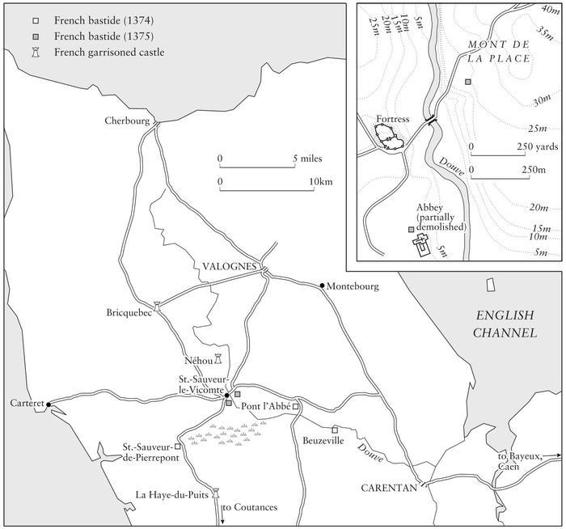
9 The siege of Saint-Sauveur-le-Vicomte, August 1374—July 1375
In any medieval siege the strongest weapons of the besiegers were psychological: the constant threat of an assault, which spelled capture, ruin or death to the defenders if it succeeded. Most garrisons in this period surrendered after a largely symbolic resistance when confronted by overwhelming force, bargaining for their lives before opening their gates. But by the time that the defenders of Saint-Sauveur were summoned to surrender by Jean de Vienne they were prepared for a long fight. They had already demolished the buildings within bowshot of the walls. They had dismantled the nearby Benedictine abbey to prevent the French from occupying it, taking the dressed stones into the castle to serve as projectiles for their mangonels. They launched powerful raids against French positions and supply lines and took a number of important prisoners from under Jean de Vienne’s nose. They even continued their booty runs, taking cattle from the surrounding countryside for their stores and burning the suburbs of Saint-Lô and Bayeux during the siege. There were ‘many fine feats of war and chivalry’ around the beleaguered town, according to reports reaching England.12
Edward III’s ministers were counting on the expedition of John de Montfort and Edmund of Cambridge to draw off most of the French forces around the fortress. But the English had, as usual, under-estimated the logistical difficulties. The Admirals seem to have been intending to commandeer the annual wine convoy to Gascony, which normally left England with empty holds in early October and called at Saint-Mathieu in Finistère on the way. But the requisitioning officers appear to have encountered unexpected resistance from the shipmasters. Many of them had already had their ships requisitioned once that year for coastal defence. Many seem to have sailed away while they could. Others accepted their advances and absconded. About 200 large ships were needed, but by the end of September, after two months of intensive requisitioning in every maritime county, the Admirals’ officers had managed to find just sixty.13
The long-awaited Great Council met at Westminster on 6 October 1374 to consider the papal legates’ proposals for a peace conference. Pileo de Prata was present in the English capital in October and probably attended it. Its decisions were no doubt carefully prepared by the King’s ministers. The upshot was that the English magnates agreed to negotiate with France at Bruges. They also agreed to the reappointment of John of Gaunt as Edward’s chief negotiator. However, they were not now willing to agree to a general truce. Instead there would be only a local one on the march of Picardy to enable the representatives of both sides to reach Bruges without interference. The reservation must have dismayed the legates. It meant that the conference would take place against the background of a fluctuating strategic situation. But both sides now had large-scale military enterprises on foot which they were unwilling to abandon. At the end of November 1374 the French King gave his formal consent to proceed with the conference on these terms. Both sides were playing for time. The dense preliminaries, the negotiation of the truce and the issue of safe-conducts and procurations were not completed until well into the new year. Right up to the last moment the French had doubts about how serious the English really were. The opening of the conference was eventually fixed for 11 March 1375.14
As autumn turned to winter and the date of the conference approached there was a palpable sense of frustration in both capitals. At Saint-Sauveur the French commanders were making no progress. By October Jean de Vienne had succeeded in persuading the King that he did not have enough troops for the job and that the bastides around the fortress were too small and perhaps too far away to contain the English garrison. Fresh troops began to arrive during the second half of October but the numbers still fell far short of what was required. The representatives of Lower Normandy had appeared before Jean de Vienne at Saint-Lô, the principal town of the Cotentin, on 16 October in order to be bullied into authorising the continued collection of 15,000 francs a month from their province until the end of December. Yet the end of December came and the garrison of Saint-Sauveur, now in the fifth month of the siege, showed no signs of exhaustion. In January 1375 the French King sent a testy message to Jean de Vienne ordering him to increase the pressure on the fortress and speed up the campaign. The King’s Council decided to increase the size of the army to 2,000 men in addition to the crowd of workmen employed on the siege works. A close siege (siège fermée) was to be undertaken instead of the strategy of loose encirclement followed since the previous summer. A major deployment of gunpowder cannon was planned, in addition to the more familiar mechanical stone-throwers which were already in use. The King’s ‘great cannons’, which were stored in the Louvre, were loaded onto barges, carried down the Seine and dragged across the rough roads of southern Normandy. An expert from Languedoc was hired to set up an iron foundry at Saint-Lô to build more of these crude ancestors of modern field artillery. One of them was designed to fire balls weighing a hundred pounds (45 kg). Two more foundries, one for iron and one for brass, were created at Caen to cast artillery pieces under the supervision of another specialised ‘cannon-master’, who appears to have been an Italian. All of this cost the equivalent of a major campaign. The long-suffering Estates of Lower Normandy met for a third time at Bayeux at the end of January 1375 to authorise another two months’ worth of emergency fouages. Similar taxes were now exacted for the first time from the rest of Normandy north of the Seine. The King even loosened his own purse-strings and allowed contributions to be made from central funds.15
In England John de Montfort and his companions had still not embarked for Brittany. The winter weather may have contributed to the delay but shortage of shipping was the main reason. By the end of the year there were 115 ships in the harbour, barely half of what was required, and many of these had only skeleton crews on board. John de Montfort and the Earl of Cambridge, who had hung about London with their retinues while their transports were being found, finally left for Plymouth after Christmas with orders to embark as many men as they could in whatever ships were available. Two senior knights, Guy Brian and Ralph Ferrers, were instructed to hurry them on and take their musters as they embarked. The shipping situation improved in January with the return of the wine fleet from the Gironde and muscular recruitment by the press gangs in ports across southern England. There were nearly 170 ships at Plymouth by the end of January, most of which now had full crews. But now it was the turn of the troops to cause delay. A month after the arrival of the leaders at Plymouth stragglers from their retinues were still being turned out of London hostelries and packed off to join their companions. Despenser’s company did not start arriving until several weeks later. Bored and idle men waiting by the coast took readily to cattle-rustling and house-breaking. The delays greatly aggravated the government’s already serious financial problems because the men had to be paid for sitting around uselessly in London and the west country. Some of the loans which the King’s ministers had arranged in the autumn were already falling due. The government had no choice but to pay those who were secured and leave the rest of their creditors to go without. The garrison of Ireland was peremptorily informed that because of the ‘great outpouring’ of money occasioned by the Breton campaign their pay-bills could not be met. At the beginning of March there was an explosion of anger at Westminster. In a letter addressed to Guy Brian and Ralph Ferrers, which has the authentic ring of Edward’s drafting, the King expressed his astonishment at their ‘slackness’ and threatened retribution if things did not improve. Similar letters went to the commanders themselves.16
Outside Saint-Sauveur the measures taken by the French royal Council in January were beginning to bite. By the end of February the besieging army had reached its full strength and had moved into positions close to the walls of the fortress, among the ruins of the town. A mass of workmen recruited in the towns of Normandy were digging trenches and building shelters. A new bastide was built in the ruins of the abbey, some 500 yards from the walls on the south side. Several of the ‘great cannons’ brought from Paris were in place. They shortly began to do serious damage to the roofs of the fortress and the topworks of its walls. The main keep had to be abandoned owing to its vulnerability to artillery fire. Most of the garrison was sheltering in the wall-turrets which were thought to be stronger.17
We cannot know whether the men who witnessed these engines in action understood the significance of what they were seeing. Ever since its first significant appearance on a European battlefield, at Crécy in 1346, gunpowder artillery had been used mainly as infantry weapons, against men rather than masonry. In sieges they were weapons of defence, used to fire iron quarrels from the walls into the ranks of the besieging army and, slightly later, round cannonballs into its flimsy timber field-works. The single artillery piece which the French deployed in front of the southern castle of Puyguilhem in 1338, a precocious case, and the two pieces used against Melun in 1359 were designed for firing metal shot at wooden doors and sortie parties, not for battering stone walls. Gunpowder artillery had a dark reputation. An English writer of the time referred to it as ‘that devilish instrument of war’. Yet the recorded instances of its use are more interesting for the later developments that they foreshadow than for any effect that they had at the time. The use of cannon against masonry was a more recent and potentially more fertile development, requiring much larger and more powerful machines made of iron rather than brass. They called for foundry skills of a high order as well as prodigious expenditure on saltpetre, a rare and costly commodity. Their deployment presented many difficulties. Siege cannon were heavy machines, difficult to transport, relatively inaccurate, with a slow rate of fire and a horizontal trajectory which tended to reduce the range. Their barrels were rarely completely regular and projectiles, generally cut stone balls, were a poor fit. Powder and ball had to be muzzle-loaded with gas-tight tampons of earth rammed into place between them. But it was at Saint-Sauveur that the new weapon first played a decisive role in siege operations. The transformation of siege tactics and fortress design, which was to be the main contribution of the next century to the technology of warfare, had begun.18
*
The great Carolingian church of St. Donatien in Bruges has long since been demolished. The largest and grandest of the city’s sixty churches, it stood close to the town hall on the site of the open square known as the Burg. The diplomatic conference which had been in the making for the past year opened in its cavernous interior some two weeks late on 27 March 1375. Both governments had sent impressive embassies. The French delegation was led by the Duke of Burgundy and Jean de la Grange, a highly political Benedictine, now Bishop of Amiens. The English were represented by the Duke of Lancaster and the Bishop of London, Simon Sudbury. Sudbury was an able lawyer with a broader outlook on the European scene than most of his colleagues. He was one of the last English bishops of the middle ages to take his degree at the University of Paris and one of the few Englishmen to have made a career in the largely French bureaucracy of the Avignon papacy. The third important member of the English team was Latimer who, although not formally named as an ambassador, was present among the English representatives and served as the main link between the negotiators and the Council at home. Both embassies were supported by a small army of councillors, military commanders, lawyers, clerks and attendants, swelling the numbers in the church and filling the lodging houses of Bruges. The French ambassadors, whose safe-conduct allowed for up to 500 followers, appeared in magnificent style. The Duke of Burgundy received an allowance of 5,000 francs a month for his expenses. A special livery was designed for his retainers, who included his entire administrative household, complete with heralds, trumpeters, minstrels and harpists. Three carts drawn by fifteen horses were required for his robes and tapestries. John of Gaunt’s allowance was less than half his opposite number’s; but even in his case there were mutterings in England about his ‘vast’ retinue and its ‘horrible, incredible cost’. The papal legates went to some lengths to stage-manage the proceedings so as to accommodate the pride of these magnificent personages. They met the rival delegations on successive days at precisely the same distance from the gates of Bruges and arranged for them to enter the church at precisely the same moment from different sides. They refused to adjudicate on the question which team should sit on the right-hand side of the church at the plenary sessions, ordering both teams to stand, alternately on the right and the left, until they had sorted this out for themselves. The Archbishop of Ravenna delivered the opening sermon. The Bishops of Amiens and London followed with stately homilies. The two royal dukes delivered ‘most eloquent’ speeches declaring their devotion to the cause of peace.19
There was an established procedure at such conferences which was modelled mainly on the methods of courts of law. That was the problem. Both sides conceived the process as a sustained appeal for justice rather than a search for the fertile compromise which might fall short of both sides’ expectations. Much energy was applied to nice questions of precedence and procedure. This considerably lengthened the formal sessions while ensuring that the more productive exchanges occurred elsewhere. The real business began on the second day, 29 March, when the spokesmen of the two embassies stated their opening positions before the whole assembly. The English demanded that either Edward III should be recognised as King of France or else the treaty of Brétigny should be observed and all their territorial losses since 1369 restored to them. The Bishop of Amiens responded that Charles V was the sole lawful King of France and that there could be no question of returning to the treaty of Brétigny, which the English had repudiated by their continued fighting in France during the 1360s. Everyone knew that these declarations were being made for form. Simon Sudbury’s reply ‘passed lightly over’ the claim to the Crown of France before broaching other, more tractable issues. The legates proposed that the broad lines of a peace should be discussed before the embassies got down to detail and on the following day they put the outlines of two proposals before the assembly. The first was that the English should simply sell their remaining territories in south-western France to Charles V for cash. The second was that the provinces which had been ceded to Edward III in 1361 should be partitioned between England and France. The latter option, which was the only one likely to interest the English, left open the critical question whether those parts of Aquitaine which the English retained should be held as fiefs of the French Crown in return for homage and service, or in full sovereignty. The legates addressed this problem two days later at the next plenary session. They were well aware that the dual status of the English dynasty as kings in England and vassals in France had been the origin of the war. A clean juridical separation between the crowns was plainly required. There were two possibilities, they suggested. One was that the English should have only the reduced territories in the south-west which they still occupied, essentially the coastal strip from Bordeaux to Bayonne and the lower reaches of the Dordogne valley, but in full sovereignty. The alternative was a more controversial proposal, now suggested for the first time, that the duchy of Aquitaine should be enlarged by the restoration of some at least of the territories lost to the French but that it should be settled on the Duke of Lancaster. He would then do homage for it to the King of France and would renounce all his domains in England, a solution which could be expected over the generations to transform the house of Lancaster into truly French princes.
The legates held a series of sessions with each side separately to receive the ambassadors’ initial reactions. These proved to be entirely incompatible. The Duke of Burgundy insisted that all territory within the traditional borders of France had to be held as a fief of the French King. For their part, the English refused to contemplate any kind of dependent status for the duchy of Aquitaine. As far as they were concerned the real issue was what should be the territorial limits of an English sovereign state in south-western France. Over the following days both sides moderated their positions. The French declared that they would consider dividing the enlarged duchy of Aquitaine created by the treaty of Brétigny into three parts, one to be ceded to the French Crown, one to be held by the English in full sovereignty, and a third to be settled on an English prince (a son or nephew of Edward III) as a fief of France. The English countered with a proposal to divide it into two parts: the territory which they still held would be retained in full sovereignty, while the rest of the vast domains once ruled by the Prince of Wales would be held by an English prince as a fief of France. The legates proposed a number of variants for consideration. Alternatively, if the issue of sovereignty could not be resolved, the parties might consider a forty-year truce during which each side would hold the territory presently under its control and the French would make an annual payment to the English King in compensation for his territorial losses.
It is worth dwelling on these exchanges since they encapsulated the war aims of both sides as well as the difficulty of finding a solution short of total victory for one of them. The proposals put forward by the papal legates at Bruges may not have found favour at once but they supplied the themes for every Anglo-French negotiation until the end of the fourteenth century. The immediate problem, however, was that all of them went beyond the current instructions of the ambassadors. The conference therefore adjourned on 8 April 1375 to enable them to consult their governments. The principals were to remain at Bruges while their subordinates returned to Paris and Westminster. The men who left swore mighty oaths to put the proposals fairly to their masters and the principals to consider them with open minds at the next session. At Avignon rumours that peace was imminent began to circulate among the mercantile and diplomatic communities. The date fixed for the next session of the conference was 6 May 1375.20
By the time that the delegations reassembled, however, the political situation had changed and the auguries were much less favourable. Latimer returned to Westminster from Bruges as soon as the conference had adjourned, accompanied by one of lawyers of the English delegation. They reported to Edward III and his Council in the middle of April. The Council’s response was consistent with the line which the English had taken for many years. They were not prepared to separate the duchy of Aquitaine from the English Crown. Nor would they agree that the English King should hold it as a vassal of France. But they were prepared to accept a substantial reduction in its geographical extent by comparison with the vast territories held by the Prince of Wales in his heyday. They were interested in the three-part division of the duchy suggested by the French delegation, under which the part held in full sovereignty by the King of England would have been limited to the area of the south-west which the English currently controlled.
Unfortunately a more absolute line was taken in Paris. The French King’s Council, its numbers swollen by prominent figures from beyond the royal court, received a report of the conference from the Bishop of Amiens. Philip’s tentative compromises received a sour reception, which probably owed something to the presence of his brother, Louis of Anjou. But whatever the dynamics of the assembly there could be no doubt about the outcome. ‘With one accord’ they rejected any solution which left part of French territory in the hands of the English Crown free of homage to the King of France. This effectively marked the repudiation of the three-part division which the French delegation had itself put forward. It was not the first time that Philip of Burgundy’s desire to bring an end to the war had put him ahead of sentiment in Paris and it would not be the last. Perhaps the English would have given more serious consideration to the idea of settling Aquitaine on a son or nephew of Edward III if they had not been encouraged to hope for better. As it was the conference was doomed to failure when it reconvened in May. By then, however, events on the ground had added fresh bones of contention.21
*
The army of Brittany finally embarked at Plymouth at the beginning of April 1375. They landed a few days later at Saint-Mathieu at the tip of Finistère. If John de Montfort expected to find loyalists waiting to rally to his flag he was quickly disabused. His arrival in his duchy with a foreign army was sullenly received even among his natural supporters. But there was no organised opposition. The defence of Brittany had been left to Olivier de Clisson with a scratch army of about three or four hundred men-at-arms formed from the retinues of the leading royalist houses of Brittany: Rohan, Beaumanoir, Rochefort and Laval. The only the major concentrations of French royal troops in the field were around Saint-Sauveur, where Jean de Vienne had about 2,000 men under his command, and on the march of Gascony, where another army, probably rather smaller, was operating under Bertrand du Guesclin. At the time of the English landings Du Guesclin had his hands full. He had just taken the surrender of Sir Digory Say’s castle at Gençay, the last surviving English enclave in Poitou, and stormed Montreuil-Bonnin, a walled town west of Poitiers which an English company had surprised a few weeks earlier. In the middle of March Bertrand du Guesclin had arrived before Cognac, by then the only remaining English stronghold north of the Gironde.22
John de Montfort’s invasion had come some six months later than planned. But with 4,000 men at his back and several hundred English garrison troops in Brest and Auray he might have achieved great things even now. The problem was that he had a more limited strategic view than the English government. His object was to reassert his authority within his duchy. He had no conception of using the largest army currently operating in France for any wider ends. More might perhaps have been expected of his fellow commanders. But the Earl of Cambridge was not a man to press his own view even if he had one. The army began by invading the northern part of the peninsula where opposition to John’s rule had traditionally been concentrated. The Earl took the small harbour town of Saint-Pol de Léon by assault, massacring much of the population. He then marched along the rocky north coast, wasting the land as he went. In about the second week of May, after six weeks in his duchy, John de Montfort arrived outside Saint-Brieuc, a small episcopal town on the north coast whose inhabitants closed their gates against him. Saint-Brieuc was a place of no importance. But the Duke could not lose face by letting the challenge pass. So he laid siege to it. In spite of the enormous size of his army he failed to make any impression on the place. Two weeks after the beginning of the siege John de Montfort was still patiently pushing mines through difficult terrain towards the walls while his army sat idle around him. 23
In the church of St. Donatien at Bruges the papal legates sensed the change of mood as soon as the diplomatic conference reopened in the second week of May. The delegations seemed ‘much harsher and more obdurate than before’, they wrote in their report to Gregory XI. They rapidly reached an impasse on the question of sovereignty. All the compromises considered before the adjournment were rejected by one side or the other and neither had any fresh proposals to offer. The only course which remained open was a long truce of at least forty years, in effect a provisional peace treaty with the French government paying an annual quit-rent for the parts of the duchy of Aquitaine that they had reconquered. This was really a device for bringing peace while leaving the insoluble issues unsolved. The English response was not encouraging. They had come to discuss a peace treaty, they said. They were fed up with the turn the proceedings were taking and were thinking of going home. On 15 May 1375 the conference was suspended for three days of festivities and jousting in the market of Bruges organised by Philip of Burgundy, an occasion for the champions to show off their skills and for the Duke to impress onlookers and enemies with the splendour of a prince of the fleur de lys. On the 16th, while these celebrations were in progress, a Great Council met in England to receive what must have been a rather gloomy report on what was happening in the Flemish city. Its proceedings are not recorded but the outcome is likely to have reflected the government’s instincts, fortified by John of Gaunt’s reports from Bruges. No one seems to have thought that the time had come to buy peace at the price that the French were now demanding, but neither did they want to see the conference collapse in disarray after its promising opening. It was decided to authorise John of Gaunt to negotiate a truce for one year, which would at least enable the conference to limp on into another session at which the French government might prove more accommodating. This could also be expected to save Saint-Sauveur and possibly Cognac as well.24
Even this modest proposal generated fresh contention when it was discussed at Bruges a few days later. The problem was that the negotiations were being conducted against an unstable military background, with each courier from Paris, Westminster or Brittany changing the bargaining position of the parties. The siege of Saint-Sauveur was approaching its critical moment. A large English army was operating in Brittany under the command of a man driven by his own political objectives who was not represented at Bruges. In the south-west the courage of the garrison of Cognac had lasted just two months. After fighting off a number of assaults and watching the Constable’s engineers assembling the stone-throwers on the plain beneath their walls they agreed in about the middle of May to surrender the place to Bertrand du Guesclin on 1 June if it was not relieved by then. This passed responsibility for its fate to the English government in Bordeaux. In the second half of May, as discussions resumed at Bruges, the Constable and Marshal Sancerre were recruiting substantial forces in the Loire valley and across central France in order to head off any attempt at relief.25
A week of acrimonious argument at Bruges finally concluded with an exceptionally obscure document. What appears to have happened is that the two national delegations, unable to settle the terms of the truce among themselves, agreed to leave them to be determined provisionally by the legates themselves. The legates published their decision on 26 May 1375 in the form of an arbitrators’ award. This document was a brave but hopeless attempt to freeze the military situation as it was, before fresh developments once more undermined their efforts. The legates declared a truce of one year to take effect immediately. But it would be subject to confirmation by the two kings when they had had a chance to consider it. The ambassadors on each side promised to send some of their number home to deal with this. They were to return with their governments’ instructions by 17 June. In the meantime the document made elaborate provision for the sieges of Cognac and Saint-Sauveur. Cognac was to be surrendered into the hands of the Pope and his legates for the duration of the truce. At Saint-Sauveur the French siege was to be lifted. The siege works around the walls of the fortress would be abandoned but left intact and the French allowed to reoccupy them when the truce expired. Thebastides east and south of the town would remain in the hands of their French garrisons but they would be forbidden to engage in any acts of war.26
Unknown to the negotiators at Bruges these provisions were already redundant. It was too late to stop the surrender of Cognac and there is no evidence that the French government even tried. The Duke of Berry, to whose appanage the town belonged, was already on his way there. The citadel was given up by its garrison on the appointed day, 1 June, in accordance with their agreement. As for Saint-Sauveur, Catterton and his companions had entered into a conditional surrender agreement five days before the legates’ award. After nine months of siege operations they had reached the limits of their endurance. Physical exhaustion, empty store-rooms and relentless bombardment had all taken their toll. The first of the great iron cannon ordered earlier in the year had been dragged into position in the ruins of the abbey buildings on 4 May and embedded in its prepared timber and earth position. It began firing immediately. Another of these monsters was sited on the Mont de la Place, east of the fortress, a few days later. They brought to about eight the number of large artillery pieces and mechanical stone-throwers around the fortress. The high walls of Saint-Sauveur had not been designed to withstand this battering. They began to suffer serious damage. According to reports subsequently made to the King of France the walls, roofs, bridges and gatehouses were all ‘grandement demolie’ by artillery. Thomas Catterton was nearly killed when a large cannonball came in through the window of the tower in which he was sleeping.
Almost as serious as the artillery damage was the progress being made by French sappers now that they could start their mines just an arrow’s shot from the walls. At about this time they succeeded in undermining part of the curtain wall, bringing one of the towers crashing over and opening a breach. Shortly after this incident the garrison sent a herald into the French camp to tell the French King’s officers that they wanted to treat. Terms were finally agreed on 21 May 1375. Unless the fortress had been relieved by an English army by 2 July the fortress would be surrendered on the following morning, 3 July. Eight prominent members of the garrison, including Sir Thomas Trivet, were to be delivered up as hostages to secure the punctual performance of this engagement. In the meantime there was to be a cease-fire around the fortress.
More controversially, the agreement provided for large payments to be made to the defenders once they had surrendered. The garrison was to receive 40,000 francs (about £6,700), which Jean de Vienne and the leading men of Normandy swore to pay them ‘by the faith we owe to God, to Our Lady, to the profession of arms and to the bonds of honour and chivalry’. In addition, 12,000 francs (about £2,000) was to be paid to Catterton personally, 2,000 francs (about £330) to Trivet, and 1,000 francs (about £170) to Vallebreton. The garrison was also to be paid the ransoms of some its more prominent prisoners, which were said to be worth another 4,500 francs. Finally, they were to have a safe-conduct home with transport laid on.
Payments to garrisons for surrendering their fortresses were not uncommon in the late middle ages. The payments to Catterton and his colleagues, however, were unusually large and naturally provoked accusations of collusion when they became known. Yet Catterton’s accusers ignored the circumstances in which the agreement was made. The garrison knew nothing of the negotiations at Bruges. For them what mattered was that they had obtained a six-week respite from the pressure of artillery bombardment and mining and from the constant threat of assault. They knew that John de Montfort and the Earl of Cambridge were in Brittany with an army twice the strength of Jean de Vienne’s; and they fully expected to be relieved before the date fixed for the surrender. One of Catterton’s first acts after the agreement was made was to send a messenger to the two commanders informing them of the terms and calling on them to come to his aid. Of course John de Montfort might ignore their appeal or march on Saint-Sauveur and fail beneath the walls. But in that case the fortress was doomed anyway.27
As for the French, the agreement had obvious advantages in spite of its high cost and the progress that they had made on the ground. ‘That which may be bought ought not to be bought with men’s blood,’ Charles V used to say to those who thought it shameful to trade places with the enemy. The composition with Catterton and his men pre-empted the negotiations at Bruges. And it could be expected to draw the English out of Brittany and force them to confront a French army on ground of its own choosing. Charles V’s commanders were just as convinced as Catterton was that John de Montfort and the Earl of Cambridge would attack their siege lines at Saint-Sauveur. They were preparing for the fight. The first step was to bring the Constable’s army north from the march of Gascony. The King ordered him to join Jean de Vienne in Normandy as soon as Cognac was in his hands. This would bring the strength of the French army at Saint-Sauveur to at least 4,000 men-at-arms. Three more large artillery pieces were ordered from the foundries of Caen and no fewer than twenty-nine smaller artillery pieces armed with lead shot. These last were infantry weapons, destined to reinforce the fixed positions of the army against a relief force. What was probably envisaged was a double line of defences around the fortress: one facing inwards to contain a sortie by the garrison, the other facing outward towards the troops of the relieving army.28
The news of Catterton’s agreement with Jean de Vienne reached Westminster and Bruges at about the same time in the last few days of May. It caused consternation in both cities. The great question for the French government was whether to ratify the deal set out in the legates’ award. If they did they would lose the fruits of nine months of expensive effort at the moment when Saint-Sauveur was about to fall into their hands. If not, then there would probably be an attempt to relieve the place, which could only lead to a large-scale pitched battle between the English and French armies in Normandy and the end of any prospect of peace. But if the French had a dilemma the English had a worse one. At Westminster the Council’s immediate reaction was to organise a relief force. The exact plans are not known, but they must have involved the use of the English army in Brittany. There was no other way in which a large enough force could be got to Saint-Sauveur in time. The Council also proposed to send additional troops from England. On 31 May orders were given to organise a small expeditionary force to sail from Southampton by the middle of June. The requisitioning officers moved fast. At least fifteen ships were requisitioned within a week and more were being found.29 It was the best opportunity that the English had had since 1369 to force a decisive battle on their enemies. Unfortunately for them, however, their leaders failed to rise to the opportunity. And as they hesitated, the French were able to outmanoeuvre them.
John of Gaunt’s messengers appear to have arrived in England in the first days of June bearing the text of the legates’ truce. It was apparent that to continue with the relief operation now would be tantamount to repudiating it. It would also be quite unnecessary if the truce was respected by the French, as John of Gaunt plainly assumed it would be. So the Council reconsidered its decision. On 5 June 1375 its orders were revoked. The officers charged with finding men and ships were ordered to return immediately to Westminster ‘because of the truce with France’. But what if the French repudiated it? That question had already occurred to the papal legates. They left Bruges at the beginning of June and made for Paris, where they arrived unannounced on 6 June and sought an immediate audience with the King. There they learned that their worst fears were about to be realised. Charles had no intention of ratifying the legates’ terms. The siege of Saint-Sauveur would not be lifted. The bastides would not be evacuated. The iron founders of Caen and Saint-Lô continued to work shifts day and night. On about 15 June 1375 the French King issued a general summons to all men-at-arms in the provinces of Languedoil to muster beneath the walls of Saint-Sauveur by 2 July.30
News of the legates’ truce was brought to John de Montfort and his companions in Brittany in the first few days of June by a herald sent by John of Gaunt from Bruges. He found them still engaged in the siege of Saint-Brieuc. John de Montfort had no interest in relieving Saint-Sauveur. The Earl of Cambridge lacked the will or force of personality to insist. After a certain amount of debate the leaders of the army decided to put off a decision until they had completed the siege of Saint-Brieuc, which they believed (wrongly as it turned out) to be on the point of falling. In the event they did not even do that.
Early in June Olivier de Clisson decided to attempt a spectacular diversion. At this stage the captain of the English garrison of Brest was that resourceful survivor, Sir John Devereux. He had built a bastide known as the ‘New Fort’ about five miles north of the town of Quimperlé by the south coast. Here he had installed a subsidiary garrison to prey on the citizens of the town and to maintain communications between Brest and the other major English garrison in Brittany at Auray. Clisson detached about 200 men-at-arms from the tiny French army in Brittany. It included the leading Breton lords who were with him. They marched some seventy miles to the south coast to surprise and capture Devereux in his lair. John de Montfort saw a chance to capture all of his principal aristocratic opponents at a stroke. So, leaving a detachment of troops to carry on the siege of Saint-Brieuc, he abruptly left with the main body of his army and pursued Clisson south. As the Duke approached the New Fort, Clisson and his companions fled and took refuge behind the walls of Quimperlé. They only just had time to close the gates and draw up the bridges before the English rushed the walls. John de Montfort methodically surrounded the town, which was not much more important than Saint-Brieuc, and set about starving his enemies out. The Breton barons inside did not give much for their chances of defending it with their small troop of men-at-arms and the uncertain aid of the inhabitants. But John de Montfort left them no alternative. When they sent a herald into his camp to ask for ransom terms the Duke sent him away with the response that he would take no prisoners unless they submitted unconditionally to his mercy. It seemed cruel, the herald is said to have answered, to deal thus with men who had only been loyally serving their lord. ‘Their lord?’ said John. ‘They have no lord but me and when I lay hands on them they will know it.’31
Shortly after 17 June 1375 the messengers from Westminster and Paris returned to Bruges with the instructions of the governments. The delegations at once fell to bitter argument, barely concealed by the cryptic documentation which records the ultimate outcome. On 27 June 1375 a truce of a year was sealed by John of Gaunt and Philip of Burgundy. A separate document contained the terms relating to current operations in Normandy and Brittany. These terms represented a complete defeat for the English. Edward III was required to recall his army to England immediately, thus sealing the fate of Saint-Sauveur and depriving John de Montfort at a stroke of all his strength. John was to be allowed to keep just 200 men-at-arms, Breton or English, to garrison the handful of places under his control, and a small personal retinue to support his dignity, but that was all. The diplomats devised a face-saving charade for Saint-Sauveur. It was agreed that the gathering of the French army at Saint-Sauveur on 2 July would be cancelled. The payments due to the garrison and its commanders were to be made on the appointed day in accordance with the agreement made with Catterton in May. But the fortress was to be delivered up to the two papal legates to be held temporarily in the name of the Pope. He was to hold the place as stakeholder. If there was a permanent peace its terms would ordain the fate of Saint-Sauveur. But if no peace had been made by 1 June 1376 the place would be delivered by the Pope’s custodian to the King of France on payment of a further 40,000 francs to Edward III. The real effect of this agreement was that the English sold Saint-Sauveur to Charles V for 40,000 francs with a year to pay. To underline the point it was agreed that the Pope’s custodian would be none other than Bureau de La Rivière, the French King’s principal chamberlain.32
The painful process of extracting from taxpayers the funds to pay the garrison of Saint-Sauveur was already almost complete. On 4 June 1375 the Estates of Lower Normandy gathered before the King’s commissioners in the cathedral city of Bayeux, their fifth meeting since the start of the siege. They confessed themselves incapable of raising the 60,000 francs required. Instead they offered a third of it, which they proposed to borrow from the royal treasury and repay over a period of time by raising a forced loan from the richer inhabitants. The rest of the sum due to Catterton and his men, together with the enormous cost of recruiting troops for the journée de Saint-Sauveur, was contributed by the King. The total cost of the siege operation, the surrender payments and thejournée can only be guessed. But the amount which fell upon the six dioceses of Lower Normandy alone amounted to 150,000 francs (about £25,000) in supplementary taxes and forced loans, in addition to the ordinary burden of war taxation. This represented about four times the normal burden of the province’s hearth taxes on top of the aides levied on sales.33
The truce came into force in Normandy on 2 July 1375, the day by which Saint-Sauveur had to be relieved if it was not to be surrendered. Ignoring its terms, the French had assembled a huge army, between 6,000 and 10,000 strong in the fields about the fortress. The garrison were confused. The messenger sent from England with the King’s instructions had not arrived. The men inside the fortress appear to have had little information about the truce and none about the supplementary declarations which regulated the fate of the fortress. According to Froissart they fell to arguing about whether the truce had superseded the surrender agreement or whether the earlier agreement prevailed over the later. But Bertrand du Guesclin cut short the argument, telling the garrison that unless they surrendered he would kill all their hostages and launch an immediate assault on the walls in which no quarter would be given. On the following morning Saint-Sauveur was surrendered at the appointed time. The cash was counted out in coin and paid to the garrison. In a curious gesture of complicity, Thomas Catterton presented a tip of 2,000 francs to Jean le Mercier, one of the French commissioners who had negotiated the surrender agreement in May, as if to show what a good bargain Le Mercier had made for the defenders. He received it with condign embarrassment and paid it into the funds of the province of Lower Normandy. The baggage and spoil accumulated in years of successful plundering operations was loaded onto several dozen open carts flying pennons painted with the arms of France and escorted to the nearby harbour of Carteret to be loaded into ships for England.34
In Brittany a similar scene was played out a few days later before the gates of Quimperlé but with a very different outcome. On about 30 June Olivier de Clisson and his companions had made their own conditional surrender agreement with the Duke of Brittany. They accepted the bleak terms which he had offered at the outset of the siege and agreed to surrender to his mercy. But they asked for a delay of two weeks to uphold their honour and allow the King of France to send a relief force. John de Montfort offered them eight days and so it was agreed. Neither side knew anything yet about the truce, which was due to come into force in Brittany on 7 July. Unfortunately for John de Montfort this was just before the agreed date for the surrender of Quimperlé. Shortly after the agreement with Olivier de Clisson had been made, two English knights arrived exhausted from Bruges with an escort of French sergeants. They had covered some 450 miles in five days to bring a copy of the truce. They also brought the Duke of Lancaster’s orders that the army should leave immediately for England. They were followed soon afterwards by Sir Mathew Redmayne, who arrived from England with a similar message from Edward III.
John de Montfort was speechless with frustration and rage. If he had not made a composition with the defenders of Quimperlé the town and his leading enemies in the duchy would have been in his hands. After a long silence he said to Gaunt’s emissaries: ‘Cursed be the hour when I granted this respite to my enemies.’ The thought may have occurred to him to ignore the truce, which was not directly binding on him, and carry on the fight with the aid of those of his men who were willing to join him in his defiance. Edward III had to send direct orders under his privy seal on 20 July commanding the English captains in peremptory terms to cease fighting. In about the middle of August Sir Philip Courtenay arrived off Brittany with the ships of the western admiralty to bring the army back home. Deprived of his army, John de Montfort acceded to the truce with ill grace. But he would not back it with a public oath and he kept with him rather more than the 200 garrison troops allowed by the terms. He even tried to form a fresh army in conjunction with the former English captain of Lusignan, Sir John Cresswell.
These attempts at continued resistance were snuffed out by Bertrand du Guesclin and Olivier de Clisson, who arrived in the duchy with a substantial force at the end of August 1375. John de Montfort’s duchy was now for all practical purposes bounded by the walls of Auray and Brest. Knolles’s castle at Derval is no longer heard of and had probably been abandoned. The only conquest which John de Montfort had to show for three months in the field was the small coastal fort at Saint-Mathieu. Early in the following year the Duke left Brittany and withdrew to the court of Flanders. It was to be two years before he returned to his duchy.35
The truce was received in England with intense dissatisfaction. The general opinion was that the conference had been a collusive sham in which the English ambassadors had got too close to their French counterparts. Their days were reported to have been filled with ‘japes and jollities’ and their nights with ‘revelry and dancing’. The elaborate formulae obscuring the surrender of Saint-Sauveur deceived no one, and the abandonment of John de Montfort was seen as a shameful waste of a golden opportunity. Some said that the Duke of Lancaster had been duped, others that Latimer had been bribed. No one had a word to say for the garrison of Saint-Sauveur, whose courageous defence of the fortress over ten months was forgotten. Catterton himself suffered particular abuse because he was a protégé of Latimer’s and had made more money than anyone else from the surrender. He was destined to pass the rest of his life in and out of prison before being killed in a duel by one of his traducers.36
*
During July and August 1375 the heralds passed through the war zones of western France proclaiming the truce of Bruges to the sound of trumpets in the market squares of provincial towns and before the closed gates of countless garrisoned fortresses. As a result of successive extensions formal hostilities between England and France were to be suspended for a period of almost exactly two years. Conceived in an untidy compromise, the truce of Bruges was seen in England as a triumph of French diplomatic guile. Yet it ended by disappointing even French expectations.
The first problem about it became apparent almost immediately. Although the truce extended in theory to Castile, Henry of Trastámara had not been represented at Bruges and never regarded it as binding upon him. The ink was scarcely dry on the document before a fleet of some eighty galleys and carracks sailed from the Biscay ports of Castile under the command of the Admiral of Castile to prey on English shipping. On 10 August 1375 they sighted a large English convoy which had put into the Bay of Bourgneuf to take on cargoes of salt on its way back from Gascony. The heavily laden English ships, cornered in the confined space of the bay, were sitting targets for the galleys. Thirty-nine of them were captured, including twenty-two of more than 100 tons burden whose loss would be felt by requisitioning officers for years to come. In another incident, a few weeks later, two ships bound for England were captured in the Bay of Biscay by armed Castilian merchantmen. On board one of them was Florimond de Lesparre, Edward III’s former acting seneschal in Bordeaux, who was on his way to England for discussions with the Council. He appealed in vain to the truce. They took him back to Castile as a prisoner. The King of Castile was unrepentant. As long as John of Gaunt continued to claim his crown he would have his own quarrel with England whatever Charles V chose to do. At the end of the year he informed the ambassadors of the King of France and the Duke of Anjou that he regarded himself as still being at war with the English.37
A more persistent threat to the truce came from the continuing operations of the Gascon companies in central and southern France. The terms did not require them to surrender their captured fortresses in French territory but they did restrict their operations. Apart from enforcing arrears of patis under existing agreements the companies were forbidden to ransom the country around them or to engage in acts of violence against the French King’s subjects. This was a severe test of their rather ambiguous relationship with the King’s councillors at Westminster and Bordeaux. The trouble, as Froissart judiciously observed, was that these professional brigands ‘did not know how to stop fighting’. At the beginning of 1376, when the truce had been in force for six months, the French complained that the war was still being fought across the provinces of the south-west in Saintonge, Périgord, Quercy, Limousin and Auvergne.38
Politically the most sensitive of these regions was Périgord, which was close to Bordeaux and to the main road and river routes between Gascony and the central highlands. The truce was hardly noticed there. The English still securely held the Dordogne valley below Lalinde. Further north their cause was sustained by a large Anglo-Gascon garrison at Brantôme on the River Dronne and by Raymond de Montaut, lord of Mussidan. Raymond was a formidable guerilla leader who had been one of the Prince of Wales’s closest companions and remained loyal to his successors long after most men in his position had recalculated their advantages. His partisans were active in the valleys of the Isle and the Vézère throughout the truce. Their main target was the provincial capital, Périgueux, rich by the standards of a poor province, insecure behind its dilapidated walls and reduced by the misfortunes of past wars to little more than 500 households. As the autumn evenings drew in the citizens were obliged to mount watches as if in time of war and make bonfires in the ditches beyond the walls to light up the approach of ladder parties on moonless nights. Within a few weeks of the proclamation of the truce in Périgord Marshal Sancerre had to be sent into the region to enforce it. Unfortunately the forces at his disposal were not nearly adequate to the task and he was never able to make much impression, except in the immediate vicinity in which he was operating. The French protested bitterly to Sir Thomas Felton in Bordeaux and endeavoured to put into service the creaking machinery for enforcing the truce. The joint commission of conservators of the truce met in late November 1375 in the small village of Caudrot, half-way between La Réole and Langon, which marked the boundary between English and French territory so far as it was possible to speak of one. The lawyers made promises of amendment and damages. The raids continued. Fresh complaints followed within three weeks.39
The French government was unbending in its insistence that the cost of defence against the companies would have to be met on top of the aides and fouages by special contributions from the regions directly affected. The policy applied as much in Périgord as anywhere else. In December 1375 Charles V recalled Sancerre and announced that the Constable would be sent to the south-west with a much larger army in the new year. But when Du Guesclin arrived in February 1376 his first act was to haggle about money. He told the consuls of Périgueux that he was in principle willing to concentrate his efforts in their area but it would depend on what they could offer him. The neighbouring province of Saintonge had also asked him to intervene and had offered him attractive grants. What was it worth? In the event it took a promise of free supplies for his army and the yield of a one-franc hearth tax for their wages.
Whether the taxpayers of Périgueux got value for money is a difficult question. The Constable laid siege to Brantôme at the beginning of March 1376 and the Anglo-Gascon garrison was eventually bought out six weeks later. But the long-suffering inhabitants of the region had to pay the cost of this composition on top of the expenses of his army. Moreover the Constable’s operations lit as many new fires as it extinguished old ones. While his men were encamped around Brantôme he formed raiding parties to descend on the valley of the Dordogne, in much the same way as Raymond de Montaut had done in the valley of the Isle. Du Guesclin denied that he was breaking the truce and he may well have been right. The distinction between offence and reprisal was almost impossible to draw. The result, however, was to spread the fighting into the Bergeracois and southern Périgord, where persistent dogfights would break out between English and French for several months to come. Without troops or money Edward III’s representatives in Bordeaux were powerless to intervene. ‘I think that the Constable will do much evil before he withdraws,’ the Mayor of Bordeaux resignedly wrote to Archbishop Sudbury, as if he was speaking of another country.40
Périgord got off lightly by comparison with the provinces of the central highlands, where the truce was broken with a savagery and persistence that matched the worst years of King John II. The valleys of the upper Dordogne and the Céré and their tributaries were dominated by the enormous presence of Garcie-Arnaud de Caupenne’s garrisons at Carlat and its satellites. The truce had been publicly proclaimed throughout this region on 6 July 1375. But an inquiry commissioned by the French seneschal of Rouergue reported that over the next three months eight major raids had been carried out against targets in his province alone. Behind this dry document, full of wordy legal formulae and arid calculations, lay thousands of ruined lives. Mounted men would appear in small villages with little or no warning in formations up to 500 strong to round up the horses and cattle, breaking into the larger houses to find money or jewellery, commandeering carts and dragging them away filled with all the stores they could lay hands on. Straw, grain, loaves, cheeses, barrels of vinegar, logs, boots, blankets and tablecloths, candlesticks, swords, clothing are all mentioned in the catalogues of lost possessions. A few miles away the raiders would pause to make their camp, sort out the spoil and decide how much of it they wanted for themselves. Then, from all around, the villagers would come to claim the rest, paying ransoms for their goods according to a rough appraisal of their value. The hidden savings of the richer peasants and village squires were dug out by their owners to redeem farm animals: forty gold florins in one case to recover eleven cattle and six horses, five florins in another for a prized plough ox. Two neighbouring hamlets which had fallen behind in their payment of patis lost more than a hundred stolen cattle, five burned-out houses and most of their stores of rye and straw in a single raid. They had their losses assessed at 1,193 gold florins, a considerable fortune. One broken farmer told the investigators that, although the eight cows and two plough oxen which he had lost were worth fifty florins, he could not begin to estimate his real loss. Without a full plough team he could not till his land and so lost his crop as well. Yet he was by no means the worst off. Some men who tried to resist the raiders were hacked to death. Any who looked prosperous enough were seized and taken away with their legs tied together under the belly of a horse and then left in leg-irons in a cellar until their ransoms were found. Some of these men were worth no more than twenty-five francs, scarcely more than the cost of feeding them. But even in small farming villages there were rich peasants who could be sold back to their families for as much as 1,000 francs.
The same scenes must have been repeated across most of Gevaudan and Auvergne. In about August or September 1375 the bastard of Caupenne fought a pitched battle near Saint-Flour against an army raised by the Estates of Auvergne. In the course of this engagement he captured the commander of the Auvergnats and several prominent local noblemen. Some of these men remained in captivity for eighteen months while the garrison raided their lands to force them to ransom themselves on the ruinous terms demanded. Others were put to work to procure supplies, mounts and medical services for the garrison’s needs. It is some indication of the prosperity of the garrison of Carlat and its satellites in this period that part of the patis exacted from the town of Saint-Flour was demanded in bales of silk which had to be bought from a wholesaler near Montpellier and in decorative silver objects specially commissioned from jewellers at Le Puy.41
In the spring of 1376 raiding parties from Carlat began to penetrate into Quercy, a province which had been more or less left alone by the Gascon companies since Bertucat d’Albret’s treaty of 1373. Bernard Douat, a young protégé of Bertucat’s then at the outset of his career as a professional routier, captured the castle of the Marquis of Cardaillac at Balaguier on the left bank of the Lot near Figeac. Douat is known to have been operating in Auvergne and there is some evidence that his men came from Carlat. Within three months there were reported to be more than 500 men at Balaguier and the place had become a base for fresh conquests. Belcastel, an austere thirteenth-century castle whose ruins still stand above the Aveyron between Rodez and Villefranche, was captured during the summer, thus bringing all of Rouergue within riding range of Carlat’s satellites. Over the following weeks Bernard Douat’s men established at least six satellite garrisons in Rouergue.
The provincial Estates strained every muscle to raise a permanent force of just 100 men-at-arms to patrol the province. A tentative project for laying siege to Belcastel was abandoned, apparently for want of money. The royal authorities in the region did almost nothing. In November 1376 the Duke of Anjou assured the Estates of Quercy, who had come before him at Toulouse, that he was ready to chastise the truce-breakers ‘so that they would never have seen the like’. But, like Du Guesclin’s clients in Périgord, they would have to pay for it. He was not willing, he said, to subsidise the defence of Quercy from the tax revenues of the rest of Languedoc. His officials added that they would need to raise the equivalent of a two-franc hearth tax and a five per cent sales tax on commodities from the population of the province. It would be cheaper, they observed, than paying patis to the enemy. But when the delegates withdrew to the Carmelite convent nearby to discuss the idea they at once fell to violent quarrels about the distribution of the burden. Cahors, the richest community in Quercy but far away from the raiders and well protected by its walls, refused to make more than a modest financial gesture. Although abused on all sides as ‘fous et buzes’, they stuck to their position. In the end Louis of Anjou got no more than the sales tax. The promised campaign against the companies of Quercy never happened. Most of the places in Quercy occupied by the Gascons in 1376 and 1377 were still in their hands a decade later.42
*
For the French King’s ministers the Gascon companies were just part of a broader problem to which their own troops contributed as much as anyone. The growing dependence of both governments on full-time professionals to fight their wars meant that any prolonged period of truce was bound to release large numbers of armed men into idleness and crime. On the French side the most problematic group were the Bretons. Brittany was a poor and densely populated region with a large nobility, serious war damage and deep political divisions. These conditions had created a great military diaspora as Breton soldiers formed themselves into self-governing companies to job for work in the service of the King of France. They were employed on all fronts: on the march of Brittany itself, in garrison duties in the Loire provinces, in the personal retinues of Du Guesclin and Clisson. After the reconquest of Poitou most of them found employment in the armies of Louis of Anjou in Languedoc. The ravages of the Breton companies had fewer diplomatic ramifications than those of the English and Gascons because their victims were usually other subjects of the King of France. But sound judges, such as the poet Eustache Deschamps, thought that they were the worst of all.43
Louis of Anjou had released almost all the professional companies in his service in the course of 1374. Most of them were Bretons. Some of them crossed the Pyrenees to support a hopeless rebellion against Peter IV in Aragon and then drifted back to Languedoc in the following spring. Some made their way into Berry, Limousin and Auvergne, the traditional hunting grounds of the Gascon companies. Most eventually found their way across the Rhône to loot the papal state under the leadership of Olivier du Guesclin and Sylvester Budes, the Constable’s brother and cousin. By the time of the truce of Bruges the Breton bands in the south had already been unemployed for several months and were becoming a serious problem. They went, says Froissart, ‘to serve the lords from whom they expected the biggest profits’. But the truth was that there were no lords in France with work to give to them or indeed to the hundreds of others who were paid off after the truce of Bruges was proclaimed.44
The French government responded as it had done in the 1350s and 1360s. It tried to push the companies out of France to do their worst elsewhere. Louis of Anjou paid the leading Breton companies operating beyond the Rhône not to come back into France and took steps to obstruct the crossings of the river if they should try. The Queen of Sicily’s seneschal in Provence successfully blocked the crossings of the Durance to prevent them from moving south. The Pope paid them ransom money to go away but then found that it was impossible for them to leave. In the following spring most of them were cantoned in the papal state around Carpentras and on the east bank of the Rhône at Pont-Saint-Esprit. Meanwhile news arrived of fresh bands of soldiers making their way down the Rhône towards Avignon apparently in the hope of finding work in Spain. Most of these men had probably been laid off from garrisons in northern France.45
In about May 1375 Charles V promoted a scheme to enrol several thousand unemployed soldiers into a private army and send them into Germany under the command of Enguerrand de Coucy. Enguerrand was one of the more remarkable of the rootless adventurers of the period. By birth one of the leading barons of Champagne, he owed his fame and fortune to the favour of Edward III. He had arrived in England at the age of twenty-one in 1360 as one of the hostages for the performance of the treaty of Brétigny and had made a great impression at Edward’s court, then at its most glamourous. Froissart, who met him there, described him as a graceful courtier who sang and danced beautifully and filled the needy historian’s hand with silver. In 1365, still ostensibly a prisoner, he married Edward III’s eldest daughter Isabel. He was admitted to the Order of the Garter and in the following year became Earl of Bedford. Not content with making Enguerrand by rank one of the leading barons of England, Edward III bought his son-in-law the rich county of Soissons in northern France. The outbreak of war between the country of his birth and that of his adoption was a cruel blow for Enguerrand de Coucy. He responded to it by declaring that he would fight for neither King. Instead he led an errant life in Bohemia and Italy before returning to France in about the middle of 1374.
Coucy had inherited from his mother a rather tenuous claim to a group of territories beyond the eastern march of France, in the Breisgau, Alsace and the German-speaking regions of Switzerland, which were currently occupied by the Habsburg dukes of Austria. It was two of Charles V’s councillors, Bureau de la Rivière and Jean le Mercier, who apparently suggested that the King might be prepared to contribute to the cost of employing the Breton and Gascon companies in a campaign to recover these places by force. The plan was for Coucy to take into his service as many as possible of the companies operating in central France and the Rhône valley. To these would be added a second army of about 1,500 men-at-arms, most of whom were drawn from the troops concentrated in Normandy for the surrender of Saint-Sauveur. They included about 500 Burgundian men-at-arms led by Charles V’s lieutenant in Normandy, Jean de Vienne, and the 400-strong Welsh companies of Owen of Wales. The French King, we are told, ‘did not care what the terms were provided that his kingdom was rid of them’.46
Early in June 1375 the Breton companies cantoned by the Rhône began to move north. The Pope paid them 5,000 francs to speed them on their way and then hired the Gascon companies of Bernard de la Salle to guard the northern limits of his dominions and prevent them coming back. Originally about 2,000 strong, as they advanced the Breton companies were joined by other bands of unemployed soldiery. By the time they passed Lyon, at the beginning of July, their estimated strength was about 4,000 men-at-arms in addition to 800 Genoese and the huge mob of pages, ‘pillagers’ and hangers-on who always followed in the wake of routier armies. They swarmed across the Dombes and the county of Burgundy during July and August. The grapes were ripening on their stalks and the harvest was about to begin as the Bretons burst into the Barrois at the beginning of September. Everywhere they passed they left a trail of burning buildings and uprooted vines. On 31 August 1375 Coucy issued a wordy manifesto from Paris proclaiming his grievances against the dukes of Austria and declaring his intention with God’s help of recovering his own. Then, in the first few days of September, he marched through Champagne into the great plain of the Sundgau west of Basel and waited for the companies to join him.47
The outcome was an almost exact repetition of the disasters which overcame Arnaud de Cervole’s attempt to lead the French companies into Germany in 1365. Instead of joining Enguerrand de Coucy in the Sundgau, the companies split up into some twenty-five separate groups and rampaged over Alsace and Lorraine, burning and looting the open country, blackmailing the cities and extracting patis from those they left alone. The population fled to the walled towns and castles with all that they could carry. They referred to their tormentors as ‘English’. The very word had become synonymous with violence and looting, although few of the attackers had ever been in English service and most were known to be ‘Bretons from Brittany’.
It took nearly two months to gather these unruly tribes together under Coucy’s banner. By then Duke Leopold of Austria had arrived to direct the defence of his domains. Large garrisons had been raised by all the major cities of the Rhine. Every crossing of the river had been blocked. Balked in his original plans, Coucy was compelled to take his ramshackle army further south through the passes of the Jura mountains and across the valley of the Aare into the Swiss canton of Berne. The defenders cleared the countryside of men and supplies and destroyed what they could not take, as men had learned to do in France. As a result the army was left to wander about the region without an enemy to confront, spoil to take, or food to eat. They broke up into small groups, forcing the defences of the smaller towns, burning villages, breaking into abandoned houses and monasteries, and making empty demonstrations of force outside the closed gates of walled towns. At the end of December 1375 the men of Berne launched a series of ferocious surprise attacks against detachments of Coucy’s army and slaughtered a large number of them. Owen of Wales was caught with his own company and a large part of the Breton contingent encamped around the Cistercian convent of Fraubrunnen north of Berne. Several hundred of them died in the burning wreckage of the convent or were hacked to death by the furious Swiss as they tried to escape. On 13 January 1376 Coucy made his peace with Leopold in the small town of Wattwiller and turned back, empty-handed, for home.48
His army, some 4,000 men-at-arms with great mobs of angry, leaderless and hungry followers, were left to fend for themselves. They flowed back westward into Alsace inflicting appalling destruction on the region as they passed. Charles V was forced to raise another army under Marshal Sancerre to head off those who seemed intent on re-entering France and keep them beyond its frontiers. Sancerre raised his banner at Reims on 1 March 1376. The Breton companies turned away, heading south. For two months Sancerre kept them on the Empire side of the Saône and the Rhône, shadowing them from the west bank as far as Vienne. Part of his force continued the pursuit to Pont-Saint-Esprit. In the course of March and April 1376 most of the Breton companies arrived back where they had started on the northern march of the papal state. There they were joined by fresh routier bands from Languedoc, mostly Bretons like themselves. These men had been paid the equivalent of a quarter-franc hearth tax by the Estates of Languedoc to leave France. In April they marched across the bridge over the Rhône at Pont-Saint-Esprit. At the end of the month there were some 5,000 mounted routiers and perhaps the same number of hangers-on crammed into the Comtat Venaissin north of the papal city of Avignon.49
*
Some of these exiled veterans of the wars of France melted into the countryside, making new lives in the Imperial territories beyond the Rhône. Many more must have slipped away and found their way back to their homes in Brittany and other parts of France. But, as in the 1360s, the ultimate destination of most of them was Italy, where the endemic wars of the papacy against the cities and despots of the north offered evergreen opportunities for professional warriors in one of the richest parts of Europe. Sir John Hawkwood’s ‘Company of the English Men-at-Arms in Italy’, which had come to Italy with the first wave of English and Gascon mercenaries in 1362, was by now indisputably the largest and most effective mercenary company in the peninsula with some 2,500 men-at-arms and 500 archers. Injury and disease had taken its toll of Hawkwood’s men and many of them must by now have been Italian, French or German. But the officers and council of the Company were certainly Englishmen and it is clear that a steady trickle of English recruits must have been reaching them from England and Gascony. The famous English condottiere was well informed about the progress of negotiations at Bruges and understood perfectly the implications for Italy. ‘You will have plenty of trouble on your hands if peace is made between England and France,’ one of his lieutenants told the ambassadors of Florence.50
In the winter of 1375—6 the fortunes of the papacy in Italy were at their lowest point for many years. Gregory XI’s representatives in the peninsula were locked into a fresh war, this time with the Florentine republic. Most of the principal cities of the papal state had rebelled and joined forces with Florence. Urbino rose in November, Perugia, the seat of the papal vicar, in December. Viterbo and Orvieto followed. In March 1376 the papal vicar lost control of Bologna, the principal papal city of the Romagna and the northern barbican of the Pope’s dominions. In desperation, the Pope turned to the free companies. Sir John Hawkwood, the principal condottiere in Gregory’s service, was pressed into service against the recalcitrant cities of the papal state. Bernard de la Salle, still the leading light among the Gascon companies operating in southern France, was called into the Pope’s presence at his summer residence at Pont-de-Sorgues, north of Avignon, and persuaded to undertake the task of taming the Florentines. He crossed the Alps with a company of about 1,000 Gascons in about November 1375. In the spring of 1376, with most of Coucy’s companies from Switzerland encamped in the Rhône valley at Gregory’s back door, the Pope resolved to add their numbers to the horde of brigands operating in his name in Italy. Gregory appointed a new legate to represent his interests in the peninsula, Robert, Cardinal of Geneva. The son of the Count of Geneva, Robert was a ruthless and worldly ecclesiastical politician then aged thirty-four. He struck a deal with the two leading Breton captains in the Rhône valley, Jean de Malestroit and Sylvester Budes. They agreed to take command of all the routier companies then occupying the Pope’s dominions in France and lead them across the Alps. The total strength of their force, according to Italian estimates, was between 10,000 and 12,000 men, which was comparable to the largest armies that the English and French kings had deployed in France since 1369. Somehow money was found to pay their advances. At the end of May 1376 Malestroit and Budes made their way out of the Comtat and through the Susa pass into the great plain of Lombardy.51
These events rid France and the French-speaking regions to the east of most of the free companies who were not established in garrisons. But they achieved very little for Gregory XI. The cities of Italy had learned much since the first great military migration from France in 1362. Native Italian companies were better armed and organised than their predecessors and the inhabitants of the cities were better at defending their walls. In principle the Cardinal of Geneva had between 15,000 and 20,000 mercenaries at his disposal but ambition and jealousy got in the way of his attempts to co-ordinate their movements and none of them would undertake any major operation while their pay was in arrears, as it generally was. Hawkwood made a private truce with the Bolognese and withdrew. The Bretons and Gascons prowled about the walls of Bologna, destroying farms and vineyards, until the beginning of 1377 when lack of pay and supplies forced them to withdraw eastward towards the Adriatic coast. There they joined forces with some of Hawkwood’s followers and supported themselves by looting. The result was to provoke fresh rebellions against the Pope’s authority in one of the few regions which had remained loyal. The sack of Cesena in February 1377, in which a combined force of English and Breton mercenaries massacred an estimated 4,000 citizens as the Cardinal of Geneva urged them on from the citadel, was shocking even by the standards of a region hardened to the atrocities of professional soldiers. The rhyming verses in which a French poet celebrated the deed reveal all the contempt of an aristocratic cardinal and a band of professional men-at-arms for the menial townsmen who refused to feed and pay them for their pains. ‘Strike and kill, strike and kill,’ Sylvester Budes is said to have shouted at his men at Cesena as they passed through ‘streets paved underfoot with the dead and mutilated of the town’.52
*
At Christmas 1375 the English ambassadors returned to Bruges for the next session of the peace conference. John of Gaunt was once again the leading member of the delegation, accompanied this time by his brother Edmund, Earl of Cambridge. They were supported by Simon Sudbury, the ubiquitous Latimer and other prominent councillors of Edward III. A Florentine merchant who witnessed their entry into the city was not impressed. They arrived from Calais with a suite of 300 horsemen looking like a company of soldiers, armed and dressed in campaign leathers, the Duke of Lancaster carrying a hawk on his arm.
By comparison Charles V’s representatives, who arrived a few days later on 29 December, lost no opportunity to exhibit the revived wealth and power of France. Two hundred horsemen in the Duke of Anjou’s livery rode through the city gates on chargers with surcoats embroidered with the arms of France, followed by 250 liveried pages riding four or six abreast. Then came 30 carriages of luggage, drawn by teams of four; 40 liveried falconers, each carrying two large birds on his arm, one with a leopard draped over the cropper of his horse, all surrounded by packs of greyhounds and hunting dogs; 150 squires dressed in black and blue coats of silk and satin and 80 knights in scarlet and black, riding four abreast; 8 mace-bearers in the livery of the King of France; 30 bandsmen in gold robes and jewelled collars; 6 noblemen on great war-horses, some in robes trimmed with fur, others with jewelled collars and headbands; and 2 men holding drawn swords upright before them. Behind this great cavalcade rode the Dukes of Anjou and Burgundy and the cardinal Bishop of Amiens, Chancellor of France, all three of them dressed in cloth of gold and blue damask, and wearing hoods studded with precious stones. The French ambassadors’ cavalcade was immediately followed by the two papal legates with their own great suite of bishops and clerks and an escort of 1,600 horsemen. The English delegation had hired a house on the route to watch the spectacle discreetly from behind the curtains of an upper room. But their hiding place was pointed out to the French royal dukes as they passed. The watchers had to save their dignity by pulling the curtains aside, bowing deeply and engaging in unrehearsed banter through the window.53
The conference reopened against an unpromising political background in both countries. Originally fixed for 15 September, the opening had been repeatedly adjourned, generally at the insistence of the French. They had refused to agree to reconvene at Bruges on the ground that they felt unsafe there, whereas the English refused to meet them anywhere else. For some two months Anjou had kicked his heels in Saint-Omer and John of Gaunt in Calais while this dispute was resolved. The row had all the hallmarks of Anjou’s negotiating style, as the Duke of Lancaster recognised when he was told about it. Anjou had recently been cultivating his influence in Paris after years of relative neglect. His emergence as the ‘chef et principal’ of the French delegation was a bad omen. ‘Let us at least have goodwill in time of peace and fighting in time of war,’ the Duke of Lancaster is reported to have said, his head sunk in his hands.54
On 30 December 1375 the two embassies entered the church of St. Donatien simultaneously by separate staircases. The ambassadors of each side raised their hats, bowed low and kissed each other on the lips. But their negotiations made no progress at all. The legates made no attempt to resolve the issue of sovereignty. They moved straight to the proposal which they had floated back in March for avoiding the issue. This envisaged a forty-year truce, in effect a peace, but one which preserved the territorial status quo, broadly favourable to the French. Discussion, however, was overshadowed by venomous disputes about the failures of the current, temporary truce. The English delegation produced two rolls of complaints about French breaches of the truce in the south-west, to which the French responded with their own roll of counterclaims about the operations of the Gascon companies. After what the legates delicately called ‘many disputes and debates’ they finally produced a wordy draft of the proposed truce. The practical effect of this document was to confirm the French in their occupation of all the reconquered provinces and to remove the Anglo-Gascon garrisons from the reconquered territories. In return the legates proposed that the French should pay the English King a lump-sum ‘rent’, spread over the forty years of the truce. All patis and personal ransoms already due at the date of the truce would remain due but new exactions would cease. Broadly similar arrangements were proposed for Brittany. John de Montfort was to be allowed to retain the three places of Auray, Brest and Saint-Mathieu which were occupied by English garrisons on his behalf, and to receive a pension from the revenues of the duchy. Otherwise he was expected to leave the province and reconcile himself to the loss of his lands, in theory for the duration of the truce, in effect for ever. In about the middle of February the two delegations were charged to send some of their number home for instructions on these proposals.55
The English King and his advisers studied the legates’ proposals during the last week of February 1376. They were realistic about them. An air of weariness can be detected in their answers, which quibbled on detail but accepted the main principles. They were not, after all, being required to concede anything that they had not lost already. They had given up what hope that they had once entertained of reversing their fortunes in the field. They were even willing to abandon John de Montfort if they could hold on to Brest for themselves. Their main interest was to secure the largest possible ‘rent’ for their lost provinces. However, when the sessions resumed, on 4 March 1376, it became apparent that the misgivings of the French were more fundamental. They were concerned about the English King’s status in the provinces which he would continue to occupy for the next forty years. They were not prepared to agree to his calling himself King of France there. They would make no promises about whether appeals would be received from the English duchy during the truce. So the problem of sovereignty had not, after all, been avoided. The second session of the conference ended as the first had done with a stalemate and a temporary truce. On 12 March 1376 it was agreed to extend the existing truce by nine months to 1 April 1377. The ambassadors were to meet again on 1 July to give their governments’ final answers to the legates’ proposals. In the meantime the French royal dukes promised to do their best to restrain Bertrand du Guesclin, news of whose operations in Périgord was beginning to reach the delegations at Bruges; and to prevail on Henry of Trastámara to cancel the naval campaign that he was planning for the summer. But they gave no guarantees on either count. When the English delegation returned to Westminster in early April 1376 they must have felt that they had achieved very little for their pains.56
*
Three weeks after the return of the English delegation the storm of frustration and anger provoked by seven years of ineffective government and military defeat broke over the heads of Edward III’s ministers. On 28 April 1376 Parliament opened at Westminster. On the next day, the first day of business, the Chancellor, Sir John Knyvet, made the traditional speech explaining the reasons for the summons. The King’s main concerns, he declared, were the defence of England and the prosecution of the war on the continent. The government, as always, needed fresh grants of war taxation to meet these burdens. Knyvet asked for a tenth from the clergy, a tenth and fifteenth from the laity and an extension of the customs for at least a year. These demands were comparatively modest. But they were the prelude to a major political crisis, the first of a succession of internal tumults which was destined to cripple the English war effort over the next two decades and to transform the English government’s attitude to the peacemaking process.
After the Chancellor’s speech the Commons withdrew to their habitual meeting place in the great polygonal chapter house of Westminster Abbey. There the government’s demands immediately encountered an avalanche of objections. The first break with tradition came almost immediately when someone proposed that the Commons should all swear an oath to speak their minds candidly and to give each other mutual support against the King’s anger. Members delivered their speeches behind closed doors, addressing the crowded chamber from the large carved lectern by the central pillar. The first to speak, an unnamed knight, opened by declaring that the people were so enfeebled and impoverished by past grants of taxation that they could no longer pay. ‘What is more,’ said this man, ‘for many years all that we have paid for the prosecution of the war has been squandered by incompetence and treachery.’ The King should be able to live from the revenues of the royal demesne without ‘ransoming’ his subjects. There was plenty of gold and silver belonging to him which he had only to retrieve from the secret hoards of the ministers who had embezzled it. Another knight came to the lectern after him to take up the theme. £8,000 a year, he alleged, was being spent by the King on the defence of Calais when the whole cost could be borne by the merchants of the town if only the government would enforce the staple ordinances which were designed to give them a monopoly of England’s foreign trade. He was followed by a succession of speakers making the same points in increasingly accusatorial tones. It was eventually agreed that these were difficult matters on which it would be necessary to canvass support among the Lords. On 3 May 1376, after three days of discussion among themselves, the Commons began to draw up a list of the frauds and other misdeeds which they would lay at the charge of the King’s ministers and officers. This exercise was still in progress on 9 May when one of the King’s household knights, Sir Alan Buxhill, arrived at the doors of the chapter house with a testy message from the King. He wanted to know why they were taking so long to agree to his demands and summoned them to appear before the King and the peers. The Commons elected the first known Speaker of the House to act as their spokesman. He was Sir Peter de la Mare, the steward and friend of the Earl of March.57
The ‘Good Parliament’, as it came to be known, met at a time of widespread discontent in England, the consequence of a long agricultural depression, aggravated by plague, cattle disease and harvest failures. But the anger of the Commons was due to grievances most of which were directly related to the war. They included weariness at the high level of taxation since 1371, disgust at the small military return for so much effort and resentment against ministers who had presided over the succession of expensive defeats. There was as yet no inclination to question the wisdom of the war itself. The complaints were about means not ends. The disappointing outcome of the peace conference at Bruges added force to their anger and discredited its leading architect, the King’s son John of Gaunt. The English seemed to have cravenly given up a promising military position for nothing. The French had outmanoeuvred them completely. Much of this was misconceived. The Commons did not know about the diplomatic revolution in Paris which had replaced the Duke of Burgundy by Louis of Anjou as the main architect of French diplomacy just as John of Gaunt’s peace policy seemed to be on the point of success. They knew even less about the government’s financial difficulties. Edward III’s annual expenditure on Calais was not £8,000 as the Commons believed but nearly three times that amount, and the cost had always fallen on the King’s Treasury and not on the merchants of the Calais staple. The King’s government had never been able to pay for the war without Parliamentary subsidies, except briefly in the 1350s during a period of exceptionally buoyant customs revenues. There was not the slightest prospect of its being financed now from the modest revenues of the royal demesne, however carefully husbanded. The King’s ministers had indeed lined their own pockets, as ministers had often done in the past, but not on anything like the scale imagined by the Commons and certainly not on a scale which could explain the King’s current penury. Nor was there any great store of gold and silver to be found in their chests if they were to fall. The real problem, as the chronicler Froissart perceived, was that the victories of Edward III’s prime had come back to haunt him. They had set a standard of achievement which was hard to meet but equally hard to abandon.
In the time of good King Edward III and of his son the Prince of Wales the English had so many fine victories over the French and made so many great conquests, taking so much money from ransoms and patis that they became marvellous rich. Many who were no gentlemen by birth had won so much gold and silver by their boldness and courage that they became noble and rose to great honour. And so those who came after them naturally wanted to do the same, howbeit that … by the wisdom and cunning of Sir Bertrand du Guesclin and by the aid of other good knights of France the English were sorely worsted.58
To the Commons, who did not understand the exceptional conditions in which England had triumphed in the 1350s, there seemed to be no explanation short of treachery and folly for the turn which the war had taken two decades later.
These prejudices were not new. If they proved more dangerous in 1376 than before it was because they were skilfully exploited by men with strong vested interests and more focussed complaints about the policies of the King’s government. There were three main groups at work. The first and most active were the merchants of the Calais staple, who were closely connected with the mercantile community of the city of London. By 1375 the staple merchants were disappointed and resentful men. They believed that their business had been ruined by the government’s sale of licences to export English goods to other ports. One side-effect of these licences had been to bypass the indigenous English wool wholesalers, since most of the licences were bought by foreign merchants, generally representatives of the great Italian trading houses. This aggravated the discontent and spread it beyond the tight circle of staple merchants to the wholesalers of the provincial market towns. In Parliament Latimer and Lyons, who had been closely associated with the sale of licences, found themselves the main targets of the staplers’ anger. It is tolerably clear that the staplers were behind most of the allegations of financial peculation levelled at both men.59
The second notable group of opponents was the clergy, who had their own reasons to be suspicious of the diplomatic manoeuvrings at Bruges. They associated them with an obscure deal which Edward III had negotiated with the papal legates in parallel with the better known dealings with the French. For more than a century successive English kings had sought to conserve the taxable resources of the Church for themselves by limiting the power of the Popes to levy their own taxes on the clergy. These arrangements had come under pressure with the Pope’s growing need of money to fight his wars in Italy during the 1370s. As a result relations between England and the papacy had become increasingly strained at a time when Edward III’s ministers were trying to negotiate a peace with France under papal auspices. In June 1375, at about the same time as the conclusion of the truce at Bruges, Edward III’s representatives had executed an unexpected volte-face. They reached a deal with the legates by which the Pope would be allowed to collect a subsidy of 60,000 florins (about £8,500), in return agreeing to a series of promotions of royal servants to English bishoprics, including the pliable Simon Sudbury, who had been prominent among the English negotiators at Bruges and now became Archbishop of Canterbury. The result was to expose the Church to simultaneous demands from both Pope and King after five years in which the Church had been heavily taxed to pay for the war with France. Many of the clergy were thrown into alliance with other opponents of royal taxation. The clergy were not of course represented in the Commons. Their own assemblies were being held at St. Paul’s cathedral and in York Minster. But many of the prelates sitting in the Lords overtly sympathised with the government’s critics and others were active in influencing opinion at Westminster. On 18 May 1376 the learned Benedictine Thomas Brinton, Bishop of Rochester, delivered a sermon in London which, although wrapped in the allusive conventions of formal preaching, offered an unmistakably hostile message. Brinton lambasted the King for allowing the spoliation of the Church for the benefit of a few ambitious officials in search of bishoprics. He took up many of the Commons’ grievances against corrupt and self-serving ministers. It was the duty of Parliament, he said, to remedy these scandals.60
The third and perhaps the most formidable group to join this miscellaneous coalition of the government’s enemies comprised a large section of the English military nobility. They were well represented not only in the Lords but among the knights of the shires sitting in the Commons. Of the seventy-two representatives of the shires who sat in the Good Parliament at least forty-four were real knights. Their collective experience embraced the whole course of England’s war over the past forty years from the highest points to the lowest. Some of them looked back on military careers extending back to the beginning of the King’s reign. William Haselrigg, a squire who sat for Northumberland, had fought at Halidon Hill in 1333 when he was seventeen years old. Sir John Eynesford, one of the members for Herefordshire, had begun his career at the age of thirteen at the siege of Perth (1335) and had been with the King in Flanders in 1339. Four members of the Commons had fought at Crécy, seven at Poitiers and five at Nájera. Sir Richard Waldegrave, one of the members for Suffolk, was one of several possible originals for Chaucer’s ‘veray parfit gentil knight’, for after serving in the English army which attacked Paris in 1359, he had fought under the Earl of Hereford with the Teutonic Order in Lithuania and been present at the storming and sack of Alexandria in 1365. But some of these men, including Sir Richard, had also stood with younger men in the bleak marshes of the pale of Calais in 1369 waiting for the decisive engagement which never came. Others had fought in the army which Du Guesclin had defeated at Pontvallain in 1370; embarked on ships in 1372 which never left the English coast; joined the fruitless march of John of Gaunt across France in 1373—4 or the abortive expedition of John de Montfort to Brittany in 1375. The knights were not a monolithic political block. Many were retainers of the King or the Duke of Lancaster, who are likely to have supported the court. But all of them belonged to a demoralised and disappointed caste. As the Commons would put it early in the following reign, they ‘longed to participate in great adventures and achieve famous feats of arms each in the sight of the others.’61
John of Gaunt was initially inclined to dismiss these men as country bumpkins (‘knights of the hedgerows’). This was a mistake, as one of his squires told him to his face. They were ‘no common men but experienced and powerful men of war’ with friends and kinsmen among the most powerful men in the land. It soon became clear that these friends and kinsmen included much of the lay peerage and all the King’s sons other than Gaunt himself. The Prince of Wales, a dying man but a powerful symbol, ostentatiously refused to support the King’s ministers in their troubles. The Earl of March would not have allowed his steward to serve as the Commons’ spokesman unless he was of the same mind. Indeed in some ways his career exemplified the disappointments which the lay peerage shared with the knights. A man of large ambitions, he had a name to live up to. He was too young to have shared in the achievements of Edward III’s prime, yet his military achievements at the age of twenty-three consisted of his participation in the abortive naval expedition of 1372 and the unsuccessful campaign in Brittany in 1375. He had raised his own company of 800 men to fight in Brittany and would have fought on in the service of John de Montfort if he had not been peremptorily recalled to England. It was a loss of face which he obviously felt personally.62
On 9 May 1376 Sir Peter de la Mare came before the Lords in answer to the King’s summons. The Lords sat in the White Hall, a bare stone hall next to the Painted Chamber in the heart of the palace. When he entered the intimidating surroundings of the chamber, the doors were closed after him and most of his colleagues shut out. John of Gaunt, presiding, commanded him to state his business. De la Mare refused to be browbeaten. He would not speak until the whole Commons was present ‘for what one of us says we all say’. When the rest of the Commons were eventually brought into the hall the Speaker presented the Commons’ request for the appointment of a committee of peers to deliberate with them. The Commons, he said, wished to discuss with them ‘many faults and grave problems’ which they had identified in the King’s administration and which would have to be remedied before they could deal with the King’s demands for a subsidy. The Lords, after discussing this briefly among themselves, agreed; and after obtaining the King’s consent the Commons nominated four bishops, four earls and four barons whom they wished to see on the ‘intercommuning committee’. The bishops selected included none of the men most closely connected with the royal administration and one (Courtenay of London) who had already shown himself to be one of its most articulate opponents. The earls and barons were all men who had made a name for themselves as soldiers in past campaigns.63
The King and the Prince had both been present for the opening sessions of Parliament. But they were sick men who could no longer attend to business for more than short periods. Edward withdrew shortly afterwards to his private apartments in the palace of Westminster and the Prince to the manor of Kennington. They featured in the unfolding crisis as distant figures, informed and consulted at critical moments, but for ever off-stage. In their absence the defence of the government’s interests fell to John of Gaunt. He played a weak hand badly. Gaunt did not have the same status and authority as his father and elder brother and his dominant role at the peace conference had identified him too closely with the perceived limpness of English policy towards France. Moreover he was not by nature a conciliator. His exalted conception of royal authority was outraged by the presumption of the knights and his first instinct was to try to overawe the Commons by a show of force. ‘I do not think they realise how powerful I am,’ a hostile source records him as saying. He was dissuaded from this course by the advice of his own men. They pointed out to him that the Parliamentary knights had too much support to be intimidated in this way. Apart from the Prince and much of the nobility they had important allies in the city of London. If they were threatened the Londoners would be likely to come to their defence. Gaunt himself and his friends and allies would be in serious danger.
The twelve members of the Lords’ committee conferred with the Commons on the morning of 12 May. They fell in with the proposals of the knights after what appears to have been a very perfunctory discussion. Later that day the Commons, accompanied by the twelve, appeared before John of Gaunt and the peers to present the Commons’ response to the government’s opening statement. Sir Peter de la Mare spoke for them. The Lords, he said, could have no idea how heavily the burden of past war taxation year upon year had weighed on the Commons. Even this they would have borne with patience if the war had gone well. Indeed they could have borne defeat as well if their money had been well spent. But they wanted a full account of where the money had gone. With the great sums which had been received from the ransoms of the kings of France and Scotland and from past grants of taxation there ought to be immense sums still unspent in the Treasury without any need for further taxation. If there were not, then the King was being defrauded by his servants. The Duke of Lancaster asked for names. Sir Peter named Latimer, Lyons and Alice Perrers. Then he expanded on the charges against them, persisting in the face of constant heckling by John of Gaunt, Latimer and other peers who claimed to know the facts. Latimer and Lyons, Sir Peter alleged, had undermined the Calais staple, thereby impoverishing the merchants of the kingdom and increasing the burden of defending the town on the royal Treasury. They had rejected an offer of an interest-free loan which the staple merchants of Calais had offered on condition that the government abandoned the sale of licences to avoid the staple ordinances. Instead they lent the money themselves at an extortionate rate of interest. The Commons wanted to conduct a full investigation of this transaction and called for the last two Treasurers, both of whom were sitting among the Lords, to give evidence about it. Next Sir Peter turned to the systematic buying up of dishonoured royal debts at a discount which Latimer and Lyons had procured to be paid by the Treasury at par for the benefit of themselves and their friends. This was likely to be a popular theme, for many of those present had lost money by the King’s repudiation of his debts. Sir Peter’s final charge was levelled against an equally unpopular target, the King’s mistress Alice Perrers. Sir Peter demanded an end to the flow of gifts to Alice and declared that it would be ‘a great advantage to the realm if she were removed from the King’s company’.64
For most of the next two weeks the Commons worked with the designated committee of the Lords on the preparation of their case against the King’s ministers. They looked for material to discredit them wherever they could find it, without much care for accuracy or objectivity. The Commons already knew a fair amount about the loan of August 1374 because both aldermen who sat for the city of London had been involved. Some further information came to light on 19 May when they took evidence in the White Hall from both men and from Richard Scrope, who had been Treasurer at the time. The Commons ‘cried out with one voice’ when this evidence established that Latimer and Lyons had been behind the loan and that the money might have come from the King’s Chamber. Fresh material came into their hands when Sir John Annesley, a Nottinghamshire knight whose wife had inherited a share of the barony of Saint-Sauveur, publicly accused its captain, Thomas Catterton, of having treasonably sold the place to the French. Catterton had been and possibly still was a retainer of Latimer. The Commons saw the chance to broaden the inquiry to cover Latimer’s responsibility for the collapse of English positions in France. They resolved to accuse him of being privy to the sale of Saint-Sauveur. At the same time they began to look into the custody of Bécherel, which had been lost three years earlier at a time when Latimer was nominally its captain. A roll was obtained, apparently from the records of the Exchequer, recording ransoms collected at Bécherel in Latimer’s time, which provided the basis for charges of extortion and embezzlement going back to the early 1360s. To this was added accusations that he had procured the release of French spies caught in England, that he had failed to supply the fortress properly or to pay its garrison and even that he had deliberately frustrated the naval expedition of 1372, which had been intended to relieve the place. These weighty, though unsubstantiated, allegations were filled out with a variety of petty charges of embezzlement or misuse of office against Latimer and Lyons themselves and various minor officials who could be shown to have some connection with them. By comparison the most that they could find to throw at John Neville, the other man associated with the direction of the war on the King’s Council, was that his retinue had pillaged the villages of Hampshire while waiting to embark for Brittany in 1372 and that he had obtained repayment in full of two ancient royal debts which he had bought at a discount.65
On 24 May 1376, at a joint session of both houses of Parliament, Sir Peter de la Mare formally presented the Commons’ charges before the Lords. He called for the impeachment of Latimer, Lyons, Neville, Catterton and Alice Perrers. To these were added a number of lesser victims of the in-fighting in the city of London: the skinner Adam Bury, who held the office of King’s mayor at Calais and like Lyons had fallen foul of the staple merchants; a wealthy London fishmonger, a crony of Lyons who had offended some of the staplers’ allies on the court of aldermen; and several petty officials who had suddenly found their minor peculations caught up in larger events. Sir Peter called for the dismissal all the King’s principal councillors on the grounds of venality or incompetence and the removal of Alice Perrers from court. In their place the King was invited to appoint a permanent council of three bishops, three earls and three barons who would reform the royal administration, stop improvident grants to favourites and ‘not fear to tell the King the truth’. Until this was done they would not consider any further grant of tax revenues. The Lords approved both courses.
Over the following days Edward III’s government capitulated. Steps were taken to secure the accused and their property. Latimer was placed in the charge of the Earl of March as Marshal of England until the conclusion of the proceedings and released on bail. Lyons was arrested and held in honourable custody in the Tower, to the disgust of the Commons who wanted him closely confined. Catterton was found in the city and taken by boat to the King’s great fortress of Queensborough on the Isle of Sheppey. Adam Bury fled to Flanders. On 26 May the King agreed to dismiss Latimer and Neville. He also swore to remove Alice Perrers from his household and never to allow her in his company again. The new permanent council demanded by the Commons was appointed at once. John of Gaunt, too angry to accept any part in this revolution, refused to be appointed. The new council was therefore largely filled with the government’s critics. Most of them were members of the Lords’ committee which had worked with the Commons on their charges.66
The trial of the disgraced ministers and officials occupied substantially the whole of the month of June and the first few days of July. It occurred in an atmosphere of intense hostility to the accused. William of Wykeham, who had never forgiven his own dismissal from office five years before, hectored Latimer when he was called on to answer Sir Peter’s charges. If he had had his way the charges would have been determined summarily without allowing Latimer either counsel or time for preparation. The accused were interrupted as they presented their case. From time to time the Lords broke off to investigate absurd rumours discreditable to one or other of the accused: that Latimer had imprisoned a messenger coming from La Rochelle with unspecified tidings from the King; that he had betrayed the King’s secret dealings with Charles of Navarre to the King of France and made away with a witness who could have proved it; or that Alice Perrers employed a Dominican friar to cast spells on the King to entice him into her arms. Many of these reports seem to have originated in London, where lampoons and jingles against the court were everywhere and ugly mobs gathered in the streets. In the event something approaching justice seems to have been done. Catterton came before the Lords in the middle of June but refused to give any account of his conduct at Saint-Sauveur. Since there was no evidence against him, no verdict on him was ever reached. He was returned to his prison cell and released shortly afterwards. Latimer stoutly defended himself before the Lords and was acquitted of the charges of betraying Saint-Sauveur and Bécherel, which would have carried the penalties of treason. He was convicted on only two charges, one relating to the sale of licences to avoid the Calais staple, the other to the loan of August 1374. For these he was fined a sum to be determined by the King and declared ineligible to hold public office again. Lyons admitted most of the acts charged against him but claimed the King’s authority to do them. Since he had no official position and could produce no warrant this was difficult to sustain. He was found guilty on all the charges against him and sentenced to be imprisoned at the King’s pleasure and to lose all his property. Several of his associates suffered imprisonment and fines. Neville was ordered to make restitution of his gains on one of the debt discounting transactions but otherwise seems to have got away scot-free. Alice Perrers never appeared before her judges, perhaps because of the embarrassment which the proceedings would have caused to the King, but a statute was passed excluding her by name from the confines of the court.67
The last weeks of the Good Parliament were overshadowed by the slow decline of heroes. At the end of May 1376 the Prince of Wales’s health suddenly deteriorated. It became clear that he was dying. There was a pathetic scene as the King, himself increasingly infirm, came to Kennington to take leave of his favourite son, surrounded by weeping attendants. On 8 June 1376, Trinity Sunday, he died. ‘On his death,’ wrote the chronicler Thomas Walsingham, ‘the hopes of England utterly perished.’ Contemporaries vied with each other to heap conventional praise on a man who ‘never attacked a nation which he did not defeat nor besieged a city which he did not take’, knowing that their words would be heard as an oblique commentary on modern times. Bishop Brinton, who had preached against the court during the early sessions of the Good Parliament, composed a eulogy of the dead man with an overtly political message addressed to his successors. Brinton drew on a timeless theme which had been used to explain military decline ever since the age of Tacitus. There had been a time, not so long ago, he told his hearers, when God had favoured the just cause and French armies had been ‘wonderfully scattered’ by English arms. Was it surprising that noblemen and knights of a later generation had failed in war when they had become soft, abandoning the hardy ways of their forbears in favour of luxury and vice, or when the bishops themselves no longer dared to rebuke the powerful for their misdeeds? ‘Power without wisdom’, said Brinton, ‘was a like a sword in the hands of a madman.’ Like others who wrote obituaries of the Prince, Brinton drew a veil over the political follies and misgovernment which had cost him most of Aquitaine and the enduring hostility of Castile. In Paris, which the Prince had once threatened to take with his helmet on his head and an army at his back, a magnificent requiem mass was said in the Sainte Chapelle in the presence of the King of France and his court.68
Edward III was not strong enough to attend the final session of the Good Parliament at Westminster. He withdrew to the palace of Eltham where, in obvious discomfort, he received the Lords and Commons in the great hall to respond to their petitions. The Parliament had been a disaster for Edward’s government; and in its final days it completed the rout of the ministry by refusing to grant taxation. Although the King had yielded before the storm at every point the Commons would agree only to extend the collection of the customs for a further three years, which was no more than tradition entitled the King to have in any event. They refused to grant a lay subsidy, pleading plague, poverty, cattle disease and harvest failure. Then they withdrew. This was a serious break with constitutional tradition, the only occasion in the past generation when the Commons had failed in its duty to aid the King in his necessity. It was also a grave political misjudgment. If the Good Parliament had ended with the grant of a subsidy the government might have felt bound to leave the rest of its work intact. As it was, the withholding of taxation alienated the lay peerage, who had been broadly supportive of the Commons’ position. Those close to the King came to the same view as John of Gaunt, that the whole episode was an act of insubordinate and unconstitutional meddling. Parliament closed on 10 July 1376. It was the last episode of Edward’s public life. Some time after this the King moved to his favourite residence at Havering where, at the end of September, his health suddenly deteriorated. For some months he lay, apparently on the verge of death and barely able to exercise even the desultory and intermittent influence over affairs which had been characteristic of the past few years. His physicians melted away for fear of being blamed for his death. Effective power passed to John of Gaunt.69
On 5 October 1376 the Prince of Wales was splendidly interred at Canterbury in the presence of the great men of the land and a dense crowd of onlookers. His body was carried through the city on a hearse, preceded by two great war-horses dressed in his arms and two men in armour and helmets, one bearing the Prince’s heraldic arms of war with all its quarterings, the other with the arms of peace with ostrich plumes. It was laid to rest between the high altar and the choir of the cathedral, surmounted by the armour which he had worn in life, while his tomb was prepared in the Trinity Chapel beside the shrine of Thomas Becket.
John of Gaunt launched his counter-revolution as soon as the obsequies were over. The members of the permanent council were curtly notified that the King had no further need of their advice and steps were taken to refuse them access to him at Havering. Gaunt himself came to Havering on about 7 October and appeared before the King, accompanied by the Chancellor and the principal officers of the royal household, proffering a petition that Latimer should be pardoned for all the offences that the Good Parliament had found proved against him. The King gave a sign that he granted it. Latimer formally submitted to a fine of 20,000 marks which Edward at once graciously remitted. The royal Council was then reconstituted and the disgraced minister restored to his old place on it. A few days later Alice Perrers was restored to favour. She received a pardon for all the money, gold, silver, cloth and jewellery that she had taken over the years from the Chamber or the Exchequer and an ample grant towards a new wardrobe.70
Shortly, John of Gaunt turned his attention to the men whom he regarded as the chief authors of the parliamentary revolution. His first target was William of Wykeham, Bishop of Winchester. Wykeham had been the most overtly hostile of Latimer’s opponents in the Lords and had emerged as the senior member of the permanent council which the Commons had foisted on the King. There is some evidence that he had also been spreading gossip casting doubt on the legitimacy of John of Gaunt’s birth, a perennial rumour which regularly reappeared among the Duke’s enemies and always provoked him to paroxysms of anger.
On 13 October 1376 a Great Council met in the White Hall at Westminster. It had been summoned in order to take stock of the peace negotiations with France and to make plans for the resumption of the war if it should come to that. In fact its first business was to be Wykeham’s impeachment. The charges, which were promoted by John of Gaunt and Latimer, all related to Wykeham’s misconduct of the King’s business during the period when he had been a minister between 1361 and 1371. The staleness of these charges and the fact that they were the mirror image of those advanced against Latimer in the Good Parliament made it perfectly clear that revenge was the main motive of the prosecutors. When Wykeham asked for time to prepare his defence William Skipwith, a compliant lawyer recently appointed to the bench who was present to advise the magnates on the law, reminded him that he had spoken against a similar application by Latimer in May and declared that the Bishop was no more entitled to the indulgence than Latimer had been. In fact Wykeham got a brief adjournment at the insistence of John of Gaunt and was defended by six sergeants-at-law when the council resumed. It did him no good. On 23 October he was sentenced to be deprived of the temporal possessions of his see. Wykeham was obliged to dismiss his personal household, to disperse the scholars of New College, his foundation at Oxford, and to wander for several months from house to house in search of a roof over his head. Peter de la Mare, whose forthrightness had so outraged Gaunt, did not even receive the favour of a trial. He was arrested by royal warrant at the end of November 1376 and sent to the grim castle of Nottingham. His patron, the Earl of March, was deprived of the office of Marshal of England.71
William of Wykeham had never been a popular figure and his own reputation for honest administration was no better than Latimer’s. But it is clear that the main reason for his fall was a change of political sentiment in the short period since the dissolution of the Good Parliament. The only contemporary chronicler who ventured to comment suggested that opinion had been turned by an outbreak of violent disorder in the west country instigated by tenants of the Earl of Warwick, one of the permanent councillors appointed in the Parliament.72 This incident may well have seemed symptomatic of a wider breakdown of law and order in the provinces, of which there is some evidence. But a more significant factor in the change of mood was the deterioration of the international situation. The truce was breaking down across south-western France and hopes of a compromise on sovereignty at Bruges were receding. The grievances of those who had objected to the mishandling of the war and the terms of the truce faded away with the prospect of renewed fighting.
The reversal of the Good Parliament’s work was not accepted by everyone. Resentment of John of Gaunt’s ruthless exercise of power earned him the life-long distrust of many of his contemporaries. Among Gaunt’s increasingly vocal enemies it was widely believed that he was making a bid to succeed his father as King. The St. Albans chronicler Thomas Walsingham believed that John of Gaunt planned to elbow his young nephew Richard of Bordeaux aside and perhaps even to poison him. The Commons’ concern about this was probably what lay behind their request, which was duly granted, that Richard should be brought before them in the last days of the Good Parliament to be honoured as the King’s heir. The Duke of Lancaster understood the point that they were making and deeply resented it. As he would later say in Parliament after Edward’s death, he was the son of a King and one of the greatest men of the realm after the King. He had more to lose by an act of treason than any man living. Yet the gossip of Westminster and the London streets quickly became the orthodoxy of European courts.73
*
By the autumn of 1376 Gregory XI had lost whatever hope he had ever entertained of brokering a permanent peace. Having more than once postponed his return to Italy to follow the tortuous course of the Bruges conference, the Pope left Avignon for the last time on 13 September 1376, brushing aside the lamentations of the cardinals, the court of France and the tradesmen of the city. A few days later he embarked with his court at Marseille. The facts fully justified his pessimism. There had been some brief and unsatisfactory negotiations at Bruges in August. Since neither side brought any fresh proposals and none of the royal princes on either side attended, these discussions were never likely to be fruitful. Most of the time was taken up with mutual recriminations about breaches of the truce. ‘I really do not know what news to give you,’ one of the French ambassadors wrote to a friend; ‘our days are filled with speeches but none that offers any prospect of peace.’ The conference adjourned at the beginning of September 1376 for the two governments to consider another ingenious proposal of the legates. The idea was that the territory currently occupied by Edward III should continue to be held in full sovereignty but only for the lifetime of Edward himself. After that sovereignty would either vest in the King of France or be awarded to one or other King by arbitrators or possibly by the Pope. The English ambassadors laid this scheme before the Great Council in October after the trial of William of Wykeham. It was completely rejected. The reaction of the King of France was equally uncompromising.74
In the middle of November 1376 the delegations made their way back to Bruges. Once again the princes on either side stayed away. The business was handled by royal councillors with strictly limited instructions. As soon as the question of sovereignty arose it became obvious that the gap between them was unbridgeable. If they compromised on this, the English said, they would be lynched on their return to England. The legates proposed to write to both kings asking for the appointment of new and grander emissaries with wider discretion. The English replied that no one else was likely to be given wider discretion. They added that since they were obviously wasting their time they would prefer to go home. The French ambassadors were more tactful but no more pliable.
Recounting all this in a private letter to the King of France, the legates pressed him to make concessions. ‘Think’, they wrote, ‘of the supreme blessings of peace and tranquillity for a Christian people who have suffered so much by this war.’ Charles V laid the letter before his Council. His answer was brought to Bruges on 7 December 1376 by Jean le Fèvre, Abbot of Saint-Vaast, a civil lawyer recently admitted to the French King’s Council. Le Fèvre delivered the King’s message to the legates and the French ambassadors in a private session on the following day. It was a remarkable statement. Charles V set out his views with brutal candour and without any of the crafted legal arguments and diplomatic obfuscation which had characterised his earlier pronouncements. There were no circumstances, he said, in which he would concede sovereignty over any part of France. The chronicles of France showed that even the Viking invaders who settled in Normandy in the ninth and tenth centuries had acknowledged the ultimate sovereignty of the kings. None of his predecessors had ever been willing to deal with the holders of the great fiefs on any other basis and he himself had sworn at his coronation that he would never alienate the rights of his crown. If he were to refrain from exercising his sovereignty in Aquitaine he would dishonour himself, encourage other rebellious princes in France and prejudice the rights of third parties, namely the inhabitants of Aquitaine to whom he owed justice. What was more, there was no obvious advantage in compromise, for if the English were allowed unfettered dominion of any of the French provinces they would sooner or later use them as a base from which to make war on him or his successors. As for the terms agreed at Brétigny and Calais they were past history now. If Charles himself had sworn to honour them that was only in order to get his father out of captivity in England. Fortunately the English had spared him the moral dilemma by delaying John II’s renunciations of sovereignty over the provinces ceded to England. They had never been made. There was once a Roman emperor, the Abbot said, who asked a captured prince how long, if he made peace with his people, he could expect it to last. The prisoner answered: ‘for as long as it remains founded in reason and justice and no longer’. The same would be true, he said, of any treaty made with the English.
The French King knew the strength of his own position. His understanding of his adversaries was less impressive. He seemed oblivious to the real difficulties which the feudal relationship between France and Aquitaine had caused in the half-century before 1337 or of the importance which the English had always attached to the question of sovereignty. His ministers made no attempt to follow the complex internal politics of England and had no idea of the extent to which John of Gaunt had gone out on a limb to support a compromise peace at the English court. Charles V’s view about the cause of the present impasse was simple and wrong. He held the Duke of Lancaster personally responsible for it. His view was that Gaunt was a great captain whose influence in England depended on being able to find employment for his vast military retinue. He therefore had a vested interest in the continuance of the war. Charles had heard the reports of the Duke’s ambition to succeed his father and believed them. Comparing the Duke to Julius Caesar, returning from Gaul to suppress the Roman Republic, Charles told the papal legates that Gaunt’s ultimate object was to keep an army in being with which he could seize the throne when the moment came. The peace conference might as well have closed at this point. In fact it limped on at Bruges until the new year, mainly because neither government was willing to incur the odium of publicly breaking off negotiations. It was then adjourned until 1 March 1377. This was just one month before the expiry of the truce.75
*
Charles V’s intransigent line was explained by his strong strategic position and his well-filled war chest. While the English House of Commons had maintained its traditional hostility to the collection of subsidies in time of truce, the system of permanent taxation which now operated in France was not dependent, at least in the north, on regular consent from representative assemblies. This meant that between 1375 and 1377, when war expenditure had been running at a comparatively low level, French tax revenues had continued to flow in at wartime rates. There is much evidence that, even after meeting his swelling personal commitments, Charles V had accumulated a large surplus since the proclamation of the truce. In Languedoc and in the Duke of Berry’s appanage in central France consent to taxation continued to be required, but even in these regions the persistence of routier operations had made it possible to go on obtaining grants at the high levels which had been traditional before the truce. The Duke of Berry received larger and more frequent grants of taxation during the truce than ever before. Much of it was earmarked for financing videments which never actually occurred. Louis of Anjou secured four grants from the Estates of Languedoc during the truce, amounting to eight and a half francs per hearth altogether, at a time when his only significant war expenditure was the financing of small-scale cat-fights in Périgord and the bribing of the companies in the Rhône valley. There were plausible reports of a great hoard of cash accumulated in his castle at Roquemaure on the Rhône.76
When the French King’s ministers began to prepare for the resumption of the war after the Christmas festivities of 1376, the main focus of their plans was the preparation of a large fleet and an ‘army of the sea’. For the past three years Charles V had been making strenuous attempts to reform the French war fleet. Jean de Vienne, who had been Admiral of France since 1373, was no seaman. But he was a bold military commander and a competent administrator. He had addressed the endemic corruption of the arsenal at Rouen. He had put in hand a proper programme of maintenance to keep the King’s galleys and barges seaworthy. In about February 1376 the arsenal had begun an important campaign of new building. Great quantities of timber had been cut down in the forests of the Seine valley and floated down the river to be seasoned for new hulls. The skilled workforce had been increased to about 160 men. Ten new clinker-built oared barges had been laid down. More had been ordered in 1376 and yet more in 1377. Plans were being made with the Castilians for a large reinforcement of Mediterranean galleys from Seville. The Castilians were in turn applying pressure to the Portuguese to contribute their own contingent.77
The exact nature of their plans for using this formidable navy is as uncertain as anything else which has to be deduced from the evidence of intercepted correspondence and interrogated agents. The south coast of England was an open, accessible and inviting target. The evidence is that Charles V initially proposed that the ships should burn their way west along the south coast and then land an army at Milford Haven in Pembrokeshire under the joint command of Owen of Wales and the renegade English knight Sir John Minsterworth. For Owen this marked a return to the abortive plans of 1369 and 1372 and to the dream of restoring an indigenous principality of Wales. What Minsterworth could contribute, or indeed expected to get out of this adventure, is more difficult to say. He must have been a plausible talker in spite of his shady past. Early in 1377 Minsterworth was sent by Charles V to Castile with instructions to organise the hire of transports and troops and the purchase of arms and equipment to be distributed among the Welsh after they had landed.78
At the same time the French were hoping, not for the first time, to reawaken the Scottish lion, which had been such a valuable ally before 1357. The Scots had a far greater potential than the Welsh for drawing English efforts away from France, as even Owen admitted. The main obstacle to France’s ambitions in this direction was the unwarlike King, Robert Stewart. Robert’s family interests lay north of the Forth. He had never had much time for the complex politics of the border or been willing to risk his security by repudiating the truce with England. When the Scottish borderers launched occasional forays into the north of England, his reaction was to abuse them as ‘wicked drunkards’ and disavow them. Yet there were signs, to which Charles V’s advisers may have been more sensitive than Edward’s, that the mood in Scotland was changing. Edward III in his dotage was not the terrible figure that he had been in his prime. The Scots had noticed the divisions of the English political community once his firm hand was removed. The lords of the Scottish border were impatient with the stalemate and less amenable than they had been to control by the King. These men relied for their power on extensive networks of dependants: kinsmen, tenants, friends and followers who looked to them for leadership and patronage and for opportunities which in a poor country only war could provide. Yet they were more than gang leaders and freebooters. Sir Archibald and his cousin William, Earl of Douglas, had both been brought up in France and fought with John II at Poitiers. They and their kind lived in the harsh world of the border. But they shared a European outlook and were treated by Froissart with the respect due to those who belonged to the world of European chivalry. At some time early in 1377 Charles V sent an agent to Edinburgh to persuade Robert II to repudiate the truce. He promised to send another embassy with more detailed proposals. According to Froissart, Robert summoned a council of the Scottish baronage and agreed, on their advice, to reopen the war. If this is true then he shortly thought better of it. But his subjects were increasingly inclined to take matters into their own hands irrespective of his views. They had the support of prominent officers of his court. John Mercer, the richest merchant in Scotland and a long-standing friend of France, travelled to France in the spring, visited the French court and personally inspected the preparations of the French ‘army of the sea’.79
With high hopes that the English would have their hands full with major raids on southern England, a rebellion in Wales and possibly a Scottish invasion in the north, the French ministers set about planning their own operations for the summer of 1377. The main lines of their strategy seem to have been laid down at the beginning of February, when the Dukes of Burgundy, Berry and Bourbon and the Constable Du Guesclin were all with the King in Paris. What was envisaged was no fewer than four royal armies, in addition to Jean de Vienne’s ‘army of the sea’. Two major offensives were planned, one under Louis of Anjou against the remaining English strongholds of the south-west, the other under the Duke of Burgundy against Calais. At the same time it was intended that Olivier de Clisson would attack the two surviving fortresses held for John de Montfort in Brittany, at Brest and Auray; and that the Dukes of Berry and Bourbon would march on Carlat and its satellite fortresses in the foothills of Auvergne. ‘Never in the memory of man had such a great enterprise been undertaken,’ declared the official chronicler of the reign.80
*
1377 was the year of the English King’s jubilee. By now Edward had become a remote figure in his own kingdom, moving at irregular intervals between the royal manors around London and keeping to the shadows, out of sight of his subjects. There is some evidence of an improvement of his health early in 1377 but he seems to have remained incapable of giving more than passing attention to public affairs and access to him was strictly controlled by his household. There are vivid but pathetic glimpses of his life: Alice Perrers, a manipulative presence standing at the head of the King’s bed as officials came before him; the Chamberlain quarrelling with petitioners outside his room until the King came to the door to find out what was going on and silenced them by taking the petition out of their hands; the old man propped upright on his chair at formal audiences, looking ‘like a statue’ and unable to speak, as his sons and selected bishops, officials and courtiers stood around him; a hooded barge bearing the prostrate King up the Thames from Havering to Sheen during the sittings of Parliament, making its way through the mass of boats lying off the palace of Westminster, all filled with people trying to catch a last glimpse of him.81
Parliament opened at Westminster in the absence of the King on 27 January 1377. The Council had been forced to summon it by shortage of funds to fight a war that now seemed inevitable. According to Thomas Walsingham, John of Gaunt brought pressure to bear on the electors of the shires to return more amenable knights than those of 1376. But even without interference the imminence of the threat from France would probably have been enough to produce a more compliant mood. The opening address was delivered by the newly appointed Chancellor, Adam Houghton, Bishop of Saint David’s. His words were calculated to darken the menace and loosen men’s purses. He dwelt on the enemies that now encircled England: France, Scotland, Castile. The Council, he said, had received ‘several letters and private reports’ about the progress of French and Castilian naval preparations. The English King’s barges were already being mobilised. A comprehensive programme of requisitions began in early February while Parliament was sitting. Yet the main difference between the new Parliament and its predecessor lay not in the personnel or attitudes of the Commons but in the position of the Lords. Their support for the Parliamentary revolution of 1376 had been indispensable but they were no longer inclined to favour a radical programme of reform in the face of the government’s obvious financial need. This time the ‘intercommuning committee’ which the Lords appointed to assist the Commons in their deliberations was stuffed with government supporters. Even the Earl of March seems to have rallied to the government’s cause. In most respects both houses showed themselves willing enough to do the government’s bidding. Gaunt’s counter-revolution was completed with the reversal of all proceedings in the last Parliament against Alice Perrers and Richard Lyons and his associates and the restoration of most of their sequestered assets. A few members of the Commons, including some veterans of the previous Parliament, raised their voices to protest about the treatment of Peter de la Mare, but they were cowed into silence. The leadership of the opposition passed from the Commons to an unlikely coalition of the Church and the citizens of London.82
The leading figure among the government’s clerical opponents was William Courtenay, the impulsive and ambitious but extremely able younger son of the Earl of Devon. Courtenay had recently been appointed at the age of thirty-four to the bishopric of London, a promotion which he probably owed to the patronage of the Black Prince. He was already known as an outspoken opponent of royal taxation and a vocal enemy of John of Gaunt. He had sat on the intercommuning committee of the Good Parliament and on theshort-lived permanent council which emerged from it. He had also acted as William of Wykeham’s counsel at his trial. None of these things can have endeared him to the ministry. Courtenay’s continued acceptance of the programme of the Good Parliament became apparent quite early in the Parliament of 1377, when he raised objections to the grant of any subsidy at all even with the war about to restart. At least three bishops supported him. Their opposition intensified when the southern convocation assembled in its traditional meeting place at St. Paul’s in London on 3 February, a week after the opening of Parliament at Westminster. The presiding bishop, Archbishop Sudbury, was a dependable supporter of the government and made no secret of the fact. Walsingham calls him a ‘hireling drunk with the poison of greed’. But Sudbury proved quite unable to manage one of the most unruly clerical assemblies for many years. The first bone of contention was the position of William of Wykeham, whom the government had refused to allow to come within twenty miles of Westminster. At Courtenay’s urging convocation refused to transact any business until the government relented and allowed him to join their deliberations. At Courtenay’s urging again they opened proceedings for heresy against a royal clerk and protégé of John of Gaunt’s, John Wycliffe. Wycliffe would later become a much more celebrated figure than he was in January 1377, but he was already the author of some government-inspired tracts and a remarkable academic treatise, De Civili Dominio(‘Of Temporal Power’), which advocated the political subordination of the Church to the civil power and the use of its property for public purposes. For a few days Wycliffe’s prosecution, like Wykeham’s, acquired a symbolic importance in the eyes of all the main protagonists, for reasons which had little connection with either the man or his views. Courtenay and his supporters saw in Wycliffe’s writings signs of what they perceived to be the wider political threat to the autonomy of the Church. For his part Gaunt saw the heresy charge as an indirect attack on himself.83
The other force involved in the confrontation was the London mob. London had been a significant factor in the revolutions of the thirteenth century and in the deposition of Edward II. Yet its re-emergence as a force in English politics during the last three decades of the fourteenth century took John of Gaunt’s generation by surprise. Perhaps it should not have done. With an estimated population of about 45,000 souls, London was only about a quarter of the size of Paris but it was still among the largest European cities at a time when urban unrest was becoming an endemic problem for most western monarchies. The city’s oligarchic organisation and social divisions made it as vulnerable as any of them to crime and disorder. Political power was concentrated in the hands of the mayor and aldermen, themselves drawn from a small group of rich merchants belonging to the major guilds. The mass of the population consisted of unenfranchised apprentices, journeymen, labourers, servants and beggars, most of whom lived close to subsistence levels at the best of times. The physical fabric of the city aggravated the natural tensions of this world. People lived packed together in a dense network of narrow lanes and alleys interrupted by the gardens of monasteries, churchyards and aristocratic mansions. The city’s ancient and extensive liberties deprived the King’s ministers of any real measure of control over this crowded and intensely political place. There was no equivalent in London of the Paris Châtelet, installed in the heart of the city, with its royal judges, jailers and sergeants. The only visible signs of royal power were at the edges of the city: the Tower of London on the east, a royal fortress, arsenal and zoo; and the Marshalsea and King’s Bench prisons south of London Bridge in Southwark.
London had done well by the war. It was an important entrepôt for the sale of armour, equipment and looted objects. The building trade had prospered by the magnificent spending of successful captains returning from France and merchant capitalists grown fat on the profits of the government’s financial operations. Calais was virtually a London colony. Yet Londoners had felt the decline of English arms since 1369 as much as any group of Englishmen. The disruption of English trade and shipping had badly affected the city’s interests. The return of heavy annual taxes bore hard on mercantile cities which paid both Parliamentary tenths and customs duties. The city government had promoted most of the charges against Lyons and his associates in the Good Parliament and when they were convicted it had gleefully degraded them from their offices in the city. The Duke of Lancaster was not popular in London. He suffered the obloquy reserved for all politicians with high pretensions and more power than status. As the effective ruler of England, the principal commander of its armies and the author of its recent policies towards France, it was perhaps inevitable that he should become the focus of popular resentment. Bishop Courtenay’s challenge to the government in convocation provided an unexpected catalyst for these emotions. Lampoons against the Duke appeared in public places. Banners were carried about insulting his name. Posters repeating the old fable that he was the son of a Ghent butcher were nailed to the doors of St. Paul’s and Westminster Abbey.
John of Gaunt responded to the challenge with all the injured majesty and impulsive anger which his staff had managed to restrain during the sessions of the Good Parliament. On 19 February 1376 he proposed a bill in Parliament which would have effected a revolution in the city’s relations with the Crown, transferring the powers of the mayor and aldermen in matters of public order to a royal captain and conferring on the Marshal of England the same power to make arrests within their jurisdiction as he already enjoyed in most of the realm. On the same day Gaunt personally escorted Wycliffe to St. Paul’s cathedral to meet his judges. He came mob-handed with the Marshal, Henry Lord Percy, his baton held before him, four doctors hired for Wycliffe’s defence, and a mass of noblemen and liveried retainers. Inside the cathedral he and Percy heckled the proceedings and exchanged undignified abuse with the Bishop.
On the following day London erupted into violence. A meeting of prominent citizens was called to organise the city’s defence against what appeared to be a systematic assault on its privileges. They were addressed by two disaffected lay peers, Guy Brian and Walter Fitzwalter. Both were experienced military men who had been prominent supporters of the Parliamentary attack on the court in the previous year. Brian was a well regarded veteran of Edward III’s early campaigns and a former knight of the royal household. Fitzwalter was an ambitious and disappointed cavalier who had been captured in the battle at Vaas in 1370 and had had to mortgage his Cumberland estates on ruinous terms to Alice Perrers to raise money for his ransom. He took the lead with an inflammatory speech against John of Gaunt. At the end of the meeting the Londoners present grabbed what weapons lay to hand and went in search of their enemies. They broke down the doors of Henry Percy’s house in Aldersgate and forcibly released a prisoner whom he was detaining there. Then they went in search of Percy himself, rampaging through the bedrooms and piercing the beds with their lances. Thwarted of their prey, they made their way through Cheapside towards John of Gaunt’s palace of Savoy, gathering the crowds about them as they went. They swarmed down Ludgate Hill, declaring their intention to seize the Duke. They reversed Gaunt’s arms whenever they found them. They beat up anyone seen wearing his badge. They battered to death a clerk who gave it as his opinion that De la Mare was a traitor who deserved all that he had got. The Duke was dining with Henry Percy at the house of a friend. They had not yet finished their oysters when the mob was heard approaching. The two men got up so fast that the Duke cracked his shins against the table. Running to the nearby quays of the Thames, they commandeered a boat and rowed themselves across the river to Kennington where the dowager Princess of Wales gave them sanctuary in the Prince’s manor. Only the personal intervention of Bishop Courtenay saved the Savoy from being torched.
How far the city government was behind these events is hard to judge. ‘So large a crowd cannot be calmed even by the pleas of the mayor,’ the aldermen protested after the event; ‘a riot, once it has begun, rages like a whirlwind to one side then the other, provoked by mindless cries of different ringleaders, until eventually they inflict some terrible injury.’ Edward’s ministers did not proceed with the plan to appoint a royal captain, perhaps because they were chastened by the rioters or perhaps, as Thomas Walsingham says, because the King in an interval of lucidity forbade it. But the city government was forced to dismiss the Mayor and to earn the Duke’s pardon by carrying a large wax candle impressed with his arms through the streets to St. Paul’s, where it was to be kept ever lit. The common people of the city never accepted the submission of their leaders. Although summoned by the town crier to join the procession behind Gaunt’s armorial candle, all but the city’s office-holders stayed away. The mob remained as dangerous a threat as it ever had been. For some time Gaunt and Percy were obliged to pass between their mansions and the palace of Westminster through the back streets, accompanied by an escort carrying shields and drawn swords.84
Ultimately the success of the Duke’s policy of repressing dissent was measured by his ability to obtain grants of taxation. By that test the results were very mixed. Speaking in Prince Richard’s name Gaunt had called at the outset of the Parliament for larger subsidies than the Commons had ever voted in a single session. The government, he said, needed to raise two tenths and fifteenths in a single year. But if the Commons were reluctant to grant a subsidy in the traditional form he invited them to consider alternative ways of raising the same money: a general purchase tax of 5 per cent, a hearth tax of one groat (four pence) per household or a tax of one pound per knight’s fee on holdings of land. It would be better, he said, ‘to give voluntarily than to lose everything to the enemy’. The Commons declined to grant a double subsidy. They had endured some ‘difficult years’, they said. They singled out in particular the heavy loss of ships to the enemy, almost certainly a reference to the fleet lost in the Bay of Bourgneuf. In the event, after discussing the possibilities for a long time, the Commons chose a form of taxation which the government had not suggested. On about 22 February they granted a poll tax of four pence per head on every man and woman in the country, which they appear to have believed was the equivalent of one tenth and fifteenth. There were to be no exemptions apart from children under fourteen years old and honest beggars. Convocation, in spite of the ill-feeling generated by recent events, or perhaps because of it, made its own grant four days later: a poll tax of twelve pence from each beneficed clergyman, inclusive of the four pence granted by the Commons.85
The poll tax was condemned by the chronicler Thomas Walsingham, that arch-conservative and acerbic anti-government man, as ‘an unheard-of tax’, which it was. Nevertheless it had a number of attractions for those who devised it. It offered, like the parish tax of 1371, an escape from the outdated standard assessments of 1334 on which the tenths and fifteenths had been based for the last forty years. It substituted a broader tax base defined on the simplest possible principle. It had the advantage of being a regressive tax, unrelated to income or assets, which bore lightly on the landowners and substantial townsmen represented in the Commons. It also bore very lightly on the Church, even at three times the rate payable by laymen. No doubt many men agreed with John Robynet, a young domestic servant in Nottingham, who protested, as he was arrested for non-payment, that it was ‘unjust and irrational for him to have to pay as much as a richer citizen ought to pay’. Yet four pence was not an enormous sum, about a day’s wages for a carpenter or two-thirds of a day’s wages for an archer. The Commons was well aware of the upward pressure on wages since the great epidemics, which had contributed to the declining profitability of land since the middle years of the century. They must have believed, like their predecessors in 1371, that there was a large number of people who had fallen outside the tax net under the old system but who could afford to pay. In prosperous years this calculation would probably have been justified. But it proved to be a serious misjudgment in 1377. There would have had to be about 2,300,000 adult lay taxpayers to justify the Commons’ expectations. In fact some 1,355,000 laymen were assessed for a total of £22,586 which was less than two-thirds of the value of a traditional subsidy. The discrepancy was due partly to the fact that the Commons had over-estimated the adult population of England and partly no doubt to indulgent local assessors and a measure of evasion and fraud. The clerical poll tax brought in just£800 as compared with the £15,000 which a clerical tenth traditionally yielded. These exceptionally poor receipts coincided with one of the worst periods for the customs receipts in recent memory. As a result the English government faced a reopening of the war in 1377 with total revenues from taxation of less than £60,000, about half the average level for the period.86
*
Early in March 1377, a few days after the dissolution of Parliament, the Council received its first inkling of the scale of French military plans for the summer when it discovered about the projected invasion of Wales. A report was received from Sir Thomas Felton, the Seneschal of Gascony, that Sir John Minsterworth had been captured by a Gascon squire in Navarre on his way to the Castilian court. He was brought back to Bordeaux and put on a ship bound for England. Minsterworth’s papers told most of the story and the rest was extracted from him under torture in the Tower of London. He was drawn and hanged and his quarters distributed to the four corners of the realm to warn others of the perils of treason. Shortly after this the French government’s negotiations with the Scots became known when Charles V decided to send one of his private secretaries, Pierre Bournaseau, on a secret mission to concert plans with the Scots. Unfortunately for Bournaseau his flamboyant manner and princely dinner plate betrayed him. He was stopped at the port of Damme by the officers of the Count of Flanders as he was about to board a ship for Edinburgh and accused of conducting the French King’s business in Flanders without its ruler’s consent.87
These reports intensified the English sense of vulnerability. The King’s Council was in almost continual session during the spring. The great men of the realm assembled roughly once a month to consider the state of negotiations with France and the conduct of the war which would follow their collapse. The garrisons of Berwick and Lochmaben on the Scottish march were reinforced. Although the French ministers abandoned their designs on Wales once the secret was out, the Welsh paladin Sir Digory Say was sent to take charge of its defence. Three hundred English troops were sent to the principality. All the major Welsh castles were repaired and revictualled, their garrisons brought up to strength and equipped with artillery. At least in Wales the English had the advantage of intelligence telling them where to expect an attack. The problem everywhere else was the immense length of coast to be defended against an attack whose exact direction was impossible to predict. Coast-guards were arrayed along the south and east coasts. Garrisons were put into the Isle of Wight and the ports of Devon and Cornwall, all of which had been the targets of earlier French raiding campaigns. London, which had not been a target for thirty years, was put in a state of defence with watches kept on the walls and the citizens formed into units to resist an attack. The whole fleet of the northern admiralty and most of the ships of the western one were concentrated in the Thames.88
What the Duke of Lancaster needed above all was more time. For five months, from February to June 1377, the English tried to put off the coming conflict by breathing life into the moribund negotiations with France. The papal legates had passed much of January and February in Paris trying to persuade Charles V to extend the truce. The difficulty, as they discovered, was the long lead time required for any major naval campaign, which meant that Charles V was for practical purposes committed already. The Castilians were in the same position. Henry of Trastámara’s fleet was being made ready for action at Seville. His ambassadors in Paris objected to any discussion with the English at all. From Westminster the Council sent a herald to Paris to listen out for news. They authorised the Earl of Salisbury, who had been permanently residing at Bruges since the previous autumn, to agree a truce of two years. But when the conference at Bruges reopened in early March the French ambassadors had nothing to offer except for an invitation to meet again on the march of Calais and an extension of the truce for just one month until 1 May. This was shortly afterwards extended to midsummer, 24 June. Early in April the ambassadors of both nations left Bruges for the last time.
There was a brief epilogue in Picardy. The papal legates installed themselves in May in the town of Montreuil in Ponthieu and tried to reopen the conference there. Both governments sent ‘solemn’ embassies to signify the importance that they attached to the occasion. The English sent the Chancellor and the Chamberlain as well as the Earl of Salisbury, the Poitevin nobleman Guichard d’Angle and a host of clerks and officials including the poet Chaucer. Charles V was represented by his own Chancellor, Pierre d’Orgemont, his principal Chamberlain, Bureau de la Rivière, together with two bishops and two counts. Edward III’s son-in-law Enguerrand de Coucy, although formally part of the French delegation, acted as a neutral intermediary as far as he could. The French Chancellor’s account of the proceedings more or less admits that the whole thing was a grandiose charade.89
As Orgemont wrote, and probably said, there was no reason for the French King to be particularly accommodating. In mid-May, while the diplomats were arguing at Montreuil, Charles V travelled to Normandy to review the royal fleet of galleys and barges in the arsenal at Rouen. They moved downstream to their sea base at Harfleur at the beginning of June. They were joined there in the next few days by the combined galley fleets of Castile and Portugal. The whole international force comprised between fifty and sixty ships, including thirty-six galleys. Six of the cannon made for the siege of Saint-Sauveur, two armed with stones and four with lead shot, were hauled over from the Cotentin to be mounted in the bows of the leading French vessels. A huge ‘army of the sea’ was mustered at the beginning of June to fight from these ships: no fewer than 3,500 crossbowmen, the largest concentration of bowmen which the French had ever assembled; several hundred men-at-arms; and at least 3,000 armed seamen.90 On the other side of the Channel more than 150 requisitioned merchant ships had been collected in the Thames off the Tower and at Rotherhithe. Nearly 4,000 men-at-arms and archers had been retained to fight on board these ships. The Admirals were working towards an embarkation date in the middle of July.91
Whether by accident or design Charles V’s ministers timed their diplomatic manoeuvres perfectly. On 21 June 1377, just three days before the expiry of the truce, the papal legates at Montreuil communicated Charles V’s final offer to the English ambassadors. The King of France, they said, would not restore any of the conquered provinces north of the Dordogne apart from the strip of southern Saintonge along the right bank of the Gironde. The most that he would do was buy out the English claims for 1,200,000 francs (£200,000) in cash. He was also willing to consider a marriage between the young Prince Richard and his daughter Catherine, with the Angoumois as the bride’s dowry. South of the Dordogne he was prepared to cede all the provinces which had been held by the Black Prince before 1369 provided that the English abandoned Calais. According to the French ambassadors’ evaluation the territories which they were offering comprised sixteen or seventeen walled cities and at least 4,000 fortresses. The proposal fell well short of the Englishmen’s minimum demands. Edward’s representatives had been instructed to draw out the negotiations for as long as possible and they were careful not to reject it whatever their private thoughts. They said that they would give their answer by 15 August at Bruges. They presumably asked for an extension of the truce at least until then. But if so it was refused.92
In the event the slow progress of England’s naval preparations made no difference to the outcome because the whole English plan of campaign was thrown into disarray by the death of Edward III. The King’s health had appeared to be mending recently. He had been rowed upriver for the annual festivities of the Order of the Garter at Windsor on St. George’s Day. In what proved to be the last great pageant of his reign Edward knighted his grandson Richard of Bordeaux, together with his youngest son, Thomas of Woodstock, John Sotherey his bastard by Alice Perrers, and the heirs of the houses of Lancaster, Oxford, Stafford, Salisbury, Percy, Mowbray and Beaumont: a whole generation of young men destined to participate in the defeats and divisions of the next two reigns. Two months later, on 21 June 1377, the day that the last French offer was put forward, Edward III suffered a stroke at the royal manor of Sheen near Richmond. Paralysed and speechless, he declined rapidly and died before the night was out. His death was as pathetic as the final years of his life. The malicious Thomas Walsingham reported that the knights and squires of his household slipped away to safeguard their fortunes in the new reign. Alice Perrers was said to have fled from the house, taking the rings from his fingers as she went. The King died attended by a single priest. His death could not have come at a worse moment. It was out of the question for the leading members of the English political community to be away from the seat of government at such a time. The English naval expedition therefore had to be cancelled. The troops mustered for it were stood down before they reached the port. Most of the ships were held in the Thames to await further orders. The powers of the English ambassadors at Calais automatically lapsed on the death of the king who had appointed them. The Earl of Salisbury and his colleagues, unable even to procrastinate, crossed the Channel to England on 23 June to find the country filled with lamentation and foreboding. The truce expired at dawn on the following day.93
Notes
1 Chaucer, The Tale of Melibeus (Works, iv, 203). Preliminaries: *Clément-Simon, 102; Gregory XI, Lettres (France), no. 1486. Turenne at Avignon: Ausgaben apost. Kammer, 450, 452, 548. His local representatives: ibid., 381, 445; Reg. (France), no. 1294; ‘Dispacci di C. da Piacenza’, 54.
2 Foed., iii, 1004; Chaplais, English Med. Dipl. Practice, 787; Gregory XI, Lettres (France), nos. 1613, 1662; ‘Anglo-French negotiations’, 1—2, 4, 75—6. Gaunt’s movements: John of G. Reg. (1372—6), nos. 196—7, 607—8, 611—12, 682—3, 865, 869—70, 1403—4.
3 Pocquet (1967), 152—4; Gr. chron., ii, 173; ‘Chron. Brioc.’, 48.
4 Rey (1965), i, 233—6; Chron. r. St.-Denis, i, 12. Succession: Ord., vi, 26—32, 45—54.
5 Hist. gén. Lang., x, 1509—12; Songe du vergier, i, 266; Itin. Ph. le Hardi, 106—7.
6 ‘Anglo-French negotiations’, 75—6. Pileo left England ca. 10 June: Chaplais, English Med. Dipl. Practice, 787.
7 Diplomatic exchanges: ‘Anglo-French negotiations’, 75—6; PRO E403/454, m. 14 (12 July); Cambridge, UL Ms. Dd. III.53, fols. 43—43vo. Expedition: Foed., iii, 1006; PRO E403/454, m. 20 (23 Sept.); E364/10, mm. 4 (March), 4d (Despenser), 7d (Cambridge). On Despenser: GEC, iv, 274—5; Froissart, Chron. (SHF), i, 257.
8 Fleets: PRO E101/33/9—11, 13—15, 25; E403/454, m. 19 (4 Aug.). Brittany: PRO E403/454, m. 23 (20 Sept.). Borrowing: CPR 1374—7, 5—6; E401/515 (3, 23 Aug., 18, 20 Sept.); E401/518 (23 Dec.); E403/454, mm. 22 (23 Aug.), 23 (20 Sept.); Holmes (1975), 77—8; Parl. Rolls, v, 300—2, 304, 304—6 (17—18, 24, 27); Anonimalle, 86—7, 88—90; Walsingham, Chron. Maj., i, 18.
9 Chron. premiers Valois, 226, 229, 236; *Delisle, i, 181, ii, 208—12; AN KK350, fols. 336vo—338; *Terrier de Loray, PJ no. 22; *Coville (1894), 388—9; AN KK350, fols. 326—55.
10 Mandements, nos. 1009, 1057, 1064; Terrier de Loray, 65; *Delisle, ii, 183, 216—17 (one third of a year’s fouage was worth about Frs. 15,000: ibid., ii, 227). On J. de Vienne: Contamine (1972), 591—2. On Mercier: Chron. premiers Valois, 263.
11 Anonimalle, 77; BN Clair. 44/3253, 56/4295, 4297, 83/6509; *Delisle, ii, 183, 217, 218—19, 222, 234—5; Mandements, no. 1227; Froissart, Chron. (SHF), viii, 190. Seigneurial castles: *Delisle, ii, 288—9; Doc. norm., nos. 789, 1006; *Delisle, ii, 219; cf. Gall. Reg., ii, nos. 7593—4 and Rey (1965), i, 372.
12 Buxhill: Foed., iii, 917. Catterton: PRO C76/53, m. 9; *Delisle, ii, 178—80; Compte r. Navarre, 302—3; Walsingham, St. Alban’s Chron., i, 356. Trivet: Froissart, Chron. (SHF), vii, 42; PRO E101/30/25; Controversy Scrope Grosvenor, 179. Garrison: see Anonimalle, 77; Froissart, Chron. (SHF), viii, 193, and names cited in the agreements of May 1375 (*Delisle, ii, 242—8). Operations: *Delisle, ii, 219, 232, 340, 341; Chron. premiers Valois, 250; AD Côte d’Or B1444, fol. 74; Anonimalle, 77—8.
13 PRO E403/454, m. 18 (2 Aug.); E403/456, m. 23 (19 Apr.); E101/33/31, mm. 2—7.
14 ‘Anglo-French negotiations’, 1—2, 6, 7, 76; PRO E403/454, m. 24 (22 Sept.); Foed., iii, 1015.
15 *Delisle, ii, 185—6, 189, 190, 220—1, 223—31, 227, 237—8, 241; BN Clair. 10/575, 33/2490, 44/3253, 58/4413, 83/6511, etc.; *Terrier de Loray, PJ nos. 24, 25.
16 PRO E101/33/27; E101/33/31, mm. 2—7; E101/33/33; E101/34/3, 5; E403/456, mm. 10 (23 Dec.); Foed., iii, 1021; Cambridge, UL Ms Dd. III.53, fols. 42—42vo (for date of this letter, PRO E403/456, m. 16 [2 Mar.]); Cal. Letter Books H, 4; PRO E101/34/3, 5; Parl. Rolls, v, 370—1 (180). Ireland: Parls. & Councils, i, 82—3.
17 *Delisle, ii, 192, 235—7, 292, 301—2; Froissart, Chron. (SHF), viii, 194, 197.
18 Lacabane (1844), 45—6, 49, 52; Tout (1934)[2], ii, 241—4; BN Fr. 9237, p. 781; *P. Horton-Smith Hartley and H.R. Aldridge, Johannes de Mirfield (1936), 90.
19 ‘Anglo-French negotiations’, 9—10, 12, 18; Foed., iii, 1024—5, 1027; PRO E403/456, mm. 15, 20 (24 Feb., 9, 18 Apr.); Petit, 301; Inv. mobiliers Bourgogne, i, nos. 2286, 2304; Walsingham, Hist. Angl., i, 317—18; Anonimalle, 79. Latimer: PRO E101/316/38.
20 ‘Anglo-French negotiations’, 10—13, 14, 17—18; ‘Dispacci di C. da Piacenza’, 73, 75.
21 ‘Anglo-French negotiations’, 15, 18—19; Gr. chron., ii, 176—7. Louis was in Paris throughout March and April 1375: Hist. gén. Lang., ix, 846n5, *x, 1524.
22 PRO E101/33/27, 31, 33; Chron. premiers Valois, 252, 254; Froissart, Chron. (SHF), viii, 196; Rec. doc. Poitou, iv, 365—7, xxiv, 291—2; AN KK252, fols. 69, 79, 82vo. Cognac: Gr. Chron., ii, 178; BN PO 147, Auterives/3; 975, le Dard/2, 1561, d’Isy/3; 1133, Terron en Bretagne/3.
23 Foed., iii, 1018—19; Chron. premiers Valois, 254; Froissart, Chron. (SHF), viii, 195, 196, 200, 204.
24 ‘Anglo-French negotiations’, 14—20; PRO E403/457, m. 2 (7 May); Foed., iii, 1029. Jousting: AD Côte d’Or B1444, fols. 79—79vo, 96vo.
25 Chron. premiers Valois, 252; Gr. chron., ii, 178. The agreement was made before 17 May: AN KK252, fol. 71vo. Sancerre: BN PO 2527, Rogerville/3—4; 2063, de la Mote/38; 2919, de la Vallée/2; Hist. généal. Harcourt, iv, 1585—6.
26 The text of the legates’ truce does not survive but an amended version of it, with changes made shortly after 17 June, was included in a declaration made by John of Gaunt and Philip of Burgundy on 27 June: Foed., iii, 1033. Subsequent events suggest that the original instrument did not include the provision relating to Montfort’s forces in Brittany, but that it did include the provision relating to Saint-Sauveur, which appears to be referred to in a later declaration of the legates: Foed., iii, 1034. The terms are said to have been ‘notified and awarded’ (‘avisé et regardé’) by the legates. The relevant meaning of ‘regarder’ in 14th-century French was to make an adjudication: F. Godefroy,Dictionnaire de la langue française… du ixe au xve siècle, vi (1889), 734—5.
27 Cognac: ‘Reg. B. de Noces’, 557; AN KK252, fols. 72, 83vo; Gr. chron., ii, 178. St.-Sauveur: *Delisle, ii, 191—3, 195—6, 284, 341; terms recited at ibid., ii, 242—5, 250, 261—2, 263—4, 272—3; Chron. premiers Valois, 253; Froissart, Chron. (SHF), viii, 197, 200.
28 Chron. premiers Valois, 252—4; Gr. chron., ii, 178; *Delisle, ii, 194, 195—6. Quotation: Christine de Pisan, Book of Fayttes of Armes, 128—9.
29 PRO C76/58, m. 18; E403/457, m. 10 (8 June); E101/34/10; Foed., iii, 1029. Gaunt: E101/316/38. Philip: Itin. Ph. le Hardi, 117.
30 PRO E403/457, m. 8 (5 June); C76/58, m. 14; ‘Reg. B. de Noces, 549—50; Hist. généal. Harcourt, iv, 1597.
31 Froissart, Chron. (SHF), viii, 200—9; Walsingham, Hist. Angl., i, 318—19. Part of the army was still at St.-Brieuc on 10 June: Jean IV, Actes, i, 58n1.
32 Foed., iii, 1033—4; ‘Anglo-French negotiations’, 21—2.
33 *Delisle, ii, 216—17, 220—4, 226—9, 239—40, 250—7, 281—2, 285—6, 306—8, 319—20; AN KK350, fols. 228vo—232.
34 *Delisle, ii, 185, 263—6, 272—3, 278; Foed., iii, 1034—5; PRO C76/58, m. 15; Froissart, Chron. (SHF), viii, 213—14.
35 Froissart, Chron. (SHF), viii, 209—12; Walsingham, Hist. Angl., i, 319; PRO E101/34/6 (text in Holmes (1975), 45n2); E403/457, mm. 15, 22 (4, 30 Sept.); E403/461, m. 34 (23 Mar.); C76/58, m. 14; Foed., iii, 1034—5. After English withdrawal: Morice, Preuves, ii, 99; Chron. premiers Valois, 255, 256; ‘Anglo-French negotiations’, 34. Montfort in Flanders: Rek. Gent, 43; Froissart, Chron. (SHF), viii, 217—18.
36 Walsingham, Hist. Angl., i, 317—18; Walsingham, Chron. Maj., i, 356—64; Anonimalle, 78—9, 93; Foed., iv, 80—1.
37 Parl. Rolls, v, 351—2 (136); *Nicolas, ii, 510—13; Anonimalle, 77, 79; Chron. premiers Valois, 255; Ayala, Crón., ii, 78; ‘Anglo-French negotiations’, 36, 79; Cambridge, UL Ms. Dd. III.53, fol. 90vo; *Lecoy, ii, 398—9.
38 Froissart, Chron. (SHF), viii, 214—15; ‘Anglo-French negotiations’, 35—6.
39 Inv. AC Périgueux, 58, 85, 86; BN Clair. 3/39, 64/4949, 75/5837, 88/6595 BN PO 323, Beslon/4; 384, du Bois 15; 976, le Dard/2; 1906, Gimuchat/4; 2787, de Talaye/5, 8—10; BN Coll. Languedoc 159, fols. 151, 170.
40 ‘Anglo-French negotiations’, 35—6, 46; Inv. AC Périgueux, 57—8, 85—7; Jurades de Bergerac, i, 34—7; PRO SC1/56/47.
41 BN Doat 199, fols. 109—176; *Hist. gén. Lang., x, 1594—6; Gregory XI, Lettres (France), no. 1981—2, 1985; Reg. St.-Flour, 40—1, 44—5.
42 Alauzier (1957)[2], 98—9, 99, 99—100, 100—1; AN KK 252, fol. 28; ‘Doc. St.-Antonin’, 290; Inv. AC Rodez (Bourg), 2; AD Aveyron, 2E 178 (8), fol. 4—4vo; BN Doat 87, fols. 199, fols. 257—261vo, 263—267vo; Inv. AC Rodez (Bourg), 2. Douat negotiated jointly with Carlat later in the year for the videment of Carlat, Castel d’Ozon and Balaguier: Inv. AC Rodez (Bourg), 2; Doc. Millau [2], no. 424. Finance: ‘Inv. Arch. Cahors’, 83n3; BN Doat 199, 218—219vo.
43 Deschamps, Oeuvres, i, 217—18.
44 Dismissal of Bretons: BN PO 548, Budes/10; 798, Coetlogon/2; 1495, de la Haye/3; 1813, Malestroit/3; 2917, Guesclin, 38. Others: see BN PO 174, de Balastre/2; 573, de Callar/2; 1346, Godelin/2; 1495, de la Haye/3, 4; etc. Aragon: Froissart, Chron. (SHF), viii, 28, 276; Zurita, iv, 633—4, 637—8; Lecoy, ii, 196—200; Cat. Arch. Navarra (Comptos), ix, no. 859, and l, no. 754; *Tucoo-Chala (1959), 355. Berry, etc.: Gregory XI, Lettres (France), no. 1923. Papal state: ‘Dispacci di C. da Piacenza’, 61, 66; Ausgaben apost. Kammer, 518, 568, 570, 571, 572.
45 *Hay du Chastelet, 386; ‘Dispacci di C. da Piacenza’, 61, 66; Ausgaben apost. Kammer, 571; Gregory XI, Lettres (France), no. 1815.
46 *Dumay, 146—7; Königshofen, Chron., 818; Urkundenbuch Strassburg, v, no. 1225, 1229, 1234; Fontes Rerum Bernensium, ix, no. 972; Froissart, Chron. (SHF), viii, 214—16. Coucy’s career: Froissart, Chron. (SHF), vi, 96, vii, 100, 208—9; Le joli buisson de jonece, ed. A. Fourrier (1975), 56; ‘Anglo-French negotiations’, 83—4 (25); *Duchesne, ii, 415; CPR 1367—70, 271; CPR 1370—4, 17; CCR 1369—74, 87; Gregory XI, Lettres (France), nos. 911, 2750—2.
47 Ausgaben apost. Kammer, 572, 576, 606; Inv. AD Côte-d’Or B, ii, no. 4421; *Dumay, 146—7; Servais, i, 302—5; Urkundenbuch Strassburg, v, no. 1213, 1218.
48 Urkundenbuch Strassburg, v, no. 1221—3, 1225—7, 1231—4, 1414; Königshofen, Chron., 815—16, 817—19; ‘Chron. S. Thiébaut’, p. xxvi; *Calmet, iii, col. ccxcv; Limburger Chron., 71; Justinger, Berner-Chron., 142—5; ‘Kleine Basler Annalen’, 62; Chron. Zurich, 85. Peace of Wattwiller: Froissart, Chron. (SHF), viii, p. cxxxvii n2.
49 BN Fr. n.a. 7414, fols. 241vo—245; BN Clair. 18/1, 36/2733, 46/3419, 55/4165, 101/18, etc.; receipts for war wages at Autun, 14—16 March (BN Clair. 12/739, 17/1181, 92/7145, etc.); Lyon, 2 April (BN Clair. 55/4195, 57/4317, etc.); Vienne, 2 May (BN Clair. 12/757, 106/88, etc.); Pont-St.-Esprit (BN Clair. 17/1181, etc.); Ausgaben apost. Kammer, 631; *Hist. gén. Lang., x, 1535; Durrieu (1835), 126n2; Mirot (1897), 599n1.
50 Caferro, 145—6, 162—3, 192, 272, 281; Temple-Leader & Marcotti, 84, 87—95, *331—2, *334; Miscellanea fiorentina di stori e erudizione, ed. I. del Badia (1902), ii, 172—3.
51 Ausgaben apost. Kammer, 579, 596, 641, 645—6; Gregory XI, Lettres (France), no. 3759, 3785—9, 3762—3; Corpus chron. Bonon., iv, 300, 301; ‘La guerra dei fiorentini con papa Gregorio XI detta la guerra degli otto santi’, ed. A. Gherardi, Archivio Storico Italiano, Series III, vii (1), 217—18; ‘Dispacci di C. da Piacenza’, 86.
52 Mirot (1897), 604—14; (1898), 262—9; Caferro, 189—90; Temple-Leader & Marcotti, 106—8, 118—23; ‘Gesta Britonum in Italia’, cols. 1468—9.
53 Foed., iii, 1039—40; Lettere di mercatanti, 28—33.
54 Foed., iii, 1034, 1040; Mandements, no. 1174A; ‘Anglo-French negotiations’, 24—6; Gregory XI, Lettres (France), no. 2005; Cotton Manuscrit Galba B.1, 31—3; Gr. chron., ii, 179; Froissart, Chron. (SHF), viii, 191; *Lecoy, ii, 392 (quotation).
55 Lettere di mercatanti, 34—5; Cotton Manuscrit Galba B.1, 31—2; ‘Anglo-French negotiations’, 26—37. Date: PRO E364/8, m. 4 (Sheppey).
56 PRO E364/8, m. 4 (Sheppey); ‘Anglo-French negotiations’, 37—43; Foed., iii, 1048; PRO E101/317/10, 11, 19.
57 Parl. Rolls, v, 295 (1, 2); Anonimalle, 80—3.
58 Froissart, Chron. (KL), xiv, 384.
59 Anonimalle, 81—2. On London and the Good Parliament: Nightingale, 243—7; Bird, 17—24; Holmes (1975), 80—4; Lloyd (1977), 218—19, 220, 222—3.
60 Perroy (1933), 28—40; Lunt, ii, 103—7, 351—3, 377—8; Holmes (1975), 11—20, 46—8; Foed., iii, 1049; Brinton, Sermons, ii, 315—21.
61 The writs de expensis list 39 as knights: CCR 1374—7, 428—9. Add: Sir Thomas Hoo (Wrottesley, 171); Sir Thomas Blount (Foed., iii, 857, 888); Sir Thomas Cobham (Foed., iii, 958); Sir John Avenel (Foed., iii, 897); and Sir John Kentwood (CCR 1374—7, 471). Individuals: Controversy Scrope Grosvenor, i, 112, 126—7, 162 (Saville, Haselrigg, Eynsford); Wrottesley, 133, 165, 171 (Marney, Boteller, Hoo); Foed., Supp., i, 2, 16, 17 (FitzWalter, Wingfield, Blount); Reg. Black Prince, iv, 285 (Kentwood); Foed., iii, 323, 326, 731, 765, 812 (Appleby, Fyton, Preston, Gissing); CPR 1354—8, 559, 560 (Ludlow, Wood); Hist. Parl., iii, 517 (Kentwood). Waldegrave: Controversy Scrope Grosvenor, i, 166; Anonimalle, 51—2, 170 (note). Calais, 1369: PRO C76/52, m. 15 (Appleby); Controversy Scrope Grosvenor, i, 77, 117 (Bonville, Boynton); ibid., i, 166 and Foed., iii, 866 (Ludlow, Waldegrave); Foed., iii, 870 (Burton); Foed., iii, 871 (Hamely); Foed., iii, 873 (Teye, Thorp, Bussy). Pontvallain: Foed., iii, 897. Fleet of 1372: Foed., iii, 958 (Cobham). Gaunt, 1373: PRO C76/56, mm. 20, 27 (Boteller, Saville, Fogg). Brittany, 1375: Foed., iii, 1010 (Giffard); Foed., iii, 1014, 1018 (Aylesbury, Boteller). Parl. Rolls, vi, 11 (16) (‘longed to participate’).
62 Walsingham, Chron. Maj., i, 10—12, 34; Higden, Polychronicon, Cont. (iv), 386; Anonimalle, 92, 94. March: PRO E403/446, m. 25 (14 July); E403/454, m. 23 (19 Sept.).
63 Anonimalle, 83—5. On the members of the Lords’ commission: Holmes (1975), 139—55.
64 Walsingham, Chron. Maj., i, 8—12; Anonimalle, 79, 85—8, 92, 94—5.
65 Anonimalle, 88—90, 93; Walsingham, Chron. Maj., i, 14—18, 356; Parl. Rolls, v, 302, 304, 307—11, 313—14, 324, 424, 426 (21—3, 25, 31—4, 46, 90, 92, 96).
66 Anonimalle, 90—2, 94; Walsingham, Chron. Maj., i, 14, 40—2; Parl. Rolls, v, 298, 307, 314, 326—7 (10, 30, 47); PRO E101/531/28.
67 Anonimalle, 93—4; Walsingham, Chron. Maj., i, 22—8, 28, 46—50; Higden, Polychronicon, Cont. (iv), 385; Cal. Letter Books H, 25, 30; CCR 1374—7, 318, 439—40; Parl. Rolls, v, 300—6, 307—12, 313, 424 (17—28, 31—4, esp. 28, 45, 89).
68 Anonimalle, 94—5; Walsingham, Chron. Maj., i, 32—6; Brinton, Sermons, 354—7; Froissart, Chron. (SHF), viii, 225; Chron. premiers Valois, 257.
69 Parl. Rolls, v, 297—8, 315 (9, 51); CCR 1374—7, 428—9; Anonimalle, 94—5; Walsingham, Chron. Maj., i, 56.
70 Prince: Anonimalle, 95; Royal Wills, 66—9. Attendance: PRO E403/460, mm. 23, 25, 26 (31 July, 22, 23 Sept.). Counter-revolution: Walsingham, Chron. Maj., i, 54; Higden, Polychronicon, Cont. (iv), 387; CPR 1374—7, 353—4, 361, 364—5; Holmes (1975), 160n3; PRO E101/397/20.
71 Holmes (1975), 160n1; Walsingham, Chron. Maj., i, 58—62; Anonimalle, 95—100; Foed., iii, 1069; CCR 1374—7, 397.
72 Higden, Polychronicon, Cont. (iv), 386—7.
73 Walsingham, Chron. Maj., i, 38; Parl. Rolls, v, 315 (50), vi 10 (13); Chron. premiers Valois, 259; *Froissart, Chron. (KL), viii, 461.
74 *J. Finot, ‘Le train de maison d’une grande dame au xive siècle’, Bull. Philol. et Hist. du Com. des Travaux Hist. et Sci. (1888), at 199—200; ‘Anglo-French negotiations’, 48—9, 53—4.
75 ‘Anglo-French negotiations’, 53—60, 63—6.
76 Cazelles (1982), 537—41; *Troubat, i, 230—1; *Hist. gén. Lang., ix, 855, x, 1512—22, 1534—42; Dognon, 613; Froissart, Chron. (SHF), x, 170—1.
77 Ordonnances, vi, 219—22; Doc. Clos des Galées, i, nos. 1002, 1008, 1013, 1042; *Terrier de Loray, PJ no. 30; Lopes, Crón. D. Fernando, 330.
78 Walsingham, Chron. Maj., i, 106—8; Anglo-Norman Letters, 164.
79 Froissart, Chron. (SHF), viii, 121, ix, 27—8, 127—8; Mandements, no. 1414; Facs. Nat. MSS. Scot., ii, no. 46.
80 Gr. chron., ii, 183—4. Attendance: Itin. Ph. le Hardi, 135; AD Côte d’Or B1451, fol. 18; Lehoux, iii, 454.
81 Anonimalle, 95, 103; ‘Anglo-French negotiations’, 78; Parl. Rolls, vi, 27—30 (42); Walsingham, Chron. Maj., i, 102.
82 Walsingham, Chron. Maj., i, 68—70; Parl. Rolls, v, 397 (12), 399—400 (18), 424—6 (89—96); Rec. Convoc., iii, 340 (March); CPR 1374—7, 439—40, 444, 448—9, 453, 455. Mobilisation: PRO C76/59, m. 4; C76/60, m. 7; E403/461, m. 30, 34 (19, 20, 23 Feb.); Foed., iii, 1066, 1071.
83 Anonimalle, 100—1; Weske, 259; Walsingham, Chron. Maj., i, 72—4; Rec. Convoc., iii, 342, 343, 344, 345.
84 Walsingham, Chron. Maj., i, 80—98, 104; Anonimalle, 103—5, 105—6; Cal. Letter Books H, 59—61. Fitzwalter’s debts: CPR 1374—7, 191; CPR 1385—9, 204; CCR 1374—7, 71, 267, 274—6, 276—7, 457.
85 Walsingham, Chron. Maj., i, 68, 980; Parl. Rolls, v, 400 (19); Anonimalle, 101; CFR, viii, 391—2. The northern province resisted until June: Concilia, iii, 114, 125; CFR, ix, 38.
86 Walsingham, Chron. Maj., i, 100; Select Cas. K.B., vi, 178; Oman, xii n6, xvi—xvii, 164—6; Ormrod (1990), 205 (Table 4); Ormrod (1999), 177 (Fig. 8.7).
87 Minsterworth: Issues Exch., 202, 203; CPR 1374—7, 488—9, 491; Anglo-Norman Letters, 164—5; Walsingham, Chron. Maj., i, 106—8. Bournaseau: *Froissart, Chron. (KL), ix, 511—16; Froissart, Chron. (SHF), ix, 127—30.
88 Cal. Doc. Scot., v, nos. 4029—39; CPR 1374—7, 495; PRO E101/34/29; E403/461, m. 34 (21 Mar.); E403/462, mm. 3—4 (22 Apr.); Foed., iii, 1071, 1075, 1076, 1078, 1078—9; Cal. Letter Books H, 64—6. Councils: PRO E403/461, m. 34 (21 Mar.); E403/462, mm. 1—2, 11 (9 Apr., 16 May).
89 ‘Anglo-French negotiations’, 66—8; PRO E101/317/12, 23; Walsingham, Chron. Maj., i, 114; Froissart, Chron. (SHF), viii, 225—6; Gr. chron., ii, 180. Montreuil: Foed., iii, 1076; Mandements, no. 1425; Froissart, Chron. (SHF), viii, 223—4, 226, 227; Chaucer Life-Records, 45—9; Gr. chron., ii, 180; ‘Anglo-French negotiations’, 80—5; PRO 101/317/30—32, E101/318/1—2. The English delegation maintained direct contact with Coucy during the conference: PRO E403/462, m. 1 (7 Apr.).
90 *Moranvillé (1888), 309—10; Mandements, no. 1392; *Delisle, ii, 312. Ship strength: Walsingham, Chron. Maj., i, 132; Walsingham, Hist. Angl., i, 142; Thorne, Gesta Abbatum S. Augustini, cols. 2152—3; Gr. chron., ii, 180; Cochon, Chron., 129. Manning: Mandements, p. ix; Chron. premiers Valois, 262; Froissart, Chron. (SHF), viii, 229.
91 PRO E101/34/25; E101/37/15; E403/462, mm. 12, 16—18 (26 May, 20 June); E403/463, m. 1 (2 July). Manning: PRO E403/462, mm. 14, 15, 16, 19 (12, 17, 19, 20 June). Embarkation: PRO DL28/3/1, m. 7.
92 ‘Voyage de N. de Bosc’, 327; BN Coll. Dupuy 306, fol. 77 (recitation of the offer in 1390); ‘Anglo-French negotiations’, 80—5; Gr. chron., ii, 181.
93 Pageant: Beltz, 11; Anonimalle, 106. Death: Walsingham, Chron. Maj., i, 116—22. Cancellation: PRO E101/34/23; E101/37/8, 13, 19, 20. Ambassadors: Gr. chron., ii, 181.