
CHAPTER VII.
Somewhere about the year 785 (1383), when the Ottoman throne was occupied by Sultan Murád I and when Ahmedí was writing his Iskender-Náme, there arose a new Prophet in the Eastern lands. This was Fazl-ulláh the son of AbuMuhammed of Tebríz, surnamed el-Hurúfí or ‘the Literalist.’ Almost all we know concerning the life of this teacher is contained in the following brief passage from the Arab historian Ibn-Hajar whose work we have already referred to when speaking of Cadi Burhán-ud-Dín.1 ‘Fazl-ulláh,’ says this biographer, ‘was one of the ascetics among the innovators. He was of the heretics, and finally he originated the sect which is known as the Hurúfís e. Literalists); and he gave out that the letters were metamorphoses of men, together with many other groundless fictions. And he called the Emír Timur the Lame to his heresy. And he (Timur) sought to slay him (Fazl-ulláh). And this came to the knowledge of his (Timur’s) son — for he (Fazl-ulláh) had taken refuge with him (Timur’s son) — and so he (Timur’s son) smote off his (Fazl-ulláh’s) head with his own hand. And this came to the knowledge of Timur, whereupon he demanded his head and his body, and he burned them both in this year, to wit, the year 804 (1401-2).’
Our knowledge regarding the doctrines taught by Fazlulláh is not very much greater than our information as to his life; for although several manuscripts of his own and his disciples' works have been for long preserved in some of the great public libraries of Europe, these works remained quite unnoticed till the year 1898, when Mr. G. Browne published an article on the Hurúfí Sect in the Journal of the Royal Asiatic Society.1 Fazl-ulláh himself was, so far as is known, the author of three works, namely, the Jávidán-Náme2 or ‘Eternal-Book,’ the Mahabbet-Náme or ‘Book of Love,’ and a poem called ῾Arsh-Name or ‘The Book of the Throne.’3 The most important known Hurúfí work — other than those due to Fazl-ulláh — is the Istiwá-Náme or ‘Book of the Ascent,’ which was composed subsequent to 828 (1424-5) by Emír Ghiyás-ud-Dín Muhammed.4 All these books are in the Persian language, and all, except the ῾Arsh-Náme, are in prose. They are, however, very hard to understand, as they are full of contractions and enigmatic symbols, the precise meaning of which it is not always possible to determine, which indeed were made use of in order to conceal the conceptions they indicate from the eyes of the heretic-hunting orthodox. The task of discovering what were the special features of Fazl-ulláh’s teaching is rendered yet more difficult by the fact that the Hurúfí books, like most of their class, are utterly unsystematic in their arrangement. Mr. Browne has, however, been able to extricate from this seemingly hopeless tangle the following four points which appear to be the most prominent of the peculiar doctrines of the Hurúfí sect: —1
1. There exists a hidden science, to acquire which is at once the supreme duty and the supreme happiness of man, indicating and explaining the meaning and significance of all things in Heaven above and in earth beneath, and the mystical correspondences which unite them.
2. This hidden science is contained in the Koran; but the key which unlocks it was in the hands of Fazl-uláh, and, after him, passed to his Successor. By them it was disclosed to the believers.
3. Man, created in the Image of God, ‘in the Best of Forms,’2 is the Microcosm, the Book of God, the Throne on which God ascended when He had finished the creation of all intenor and subordinate creatures,3 an Object of Worship to the Angels, save Iblís (Satan) who waxed proud and refused.1
4. While there is a deep meaning of infinite significance both in the Koran and in the religious observances (prayer, fasting, pilgrimage, etc.) which it ordains, the merely literal meaning of the former and the merely formal fulfilment of the latter are entirely devoid of importance.
Among the most striking of the peculiarities special to Hurúfí writings are the fanciful analogies referred to as ‘mystical correspondences’ in the first of the foregoing articles of belief. Perhaps the most favourite of these is the parallel set up between Man ‘the Book of God’ and the Koran, which is also the Book of God. This is worked out in detail; thus the Head or Face of Man corresponds to the Fátiha or Opening Chapter of the Koran; and as the latter comprises Seven Signs or Verses,2 so in the Face of Man are there Seven Signs or Lines, namely, the hair, two eyebrows, and four rows of eyelashes, — which Seven Signs or Lines he brings with him when he issues from the womb of Eve, who is therefore styled the ‘Mother of the Book,’3 a title which she shares along with the Fátiha and with the Face of Man as corresponding the Fátiha.
It is, however, to the mystic significations which he attributed to the letters of the alphabet and to combinations of these that Fazl-ulláh owes his distinctive title of Hurúfí, that is, ‘He of the Letters,’ ‘the Literalist,’ a title which was straightway adopted by or given to the sect he founded. As an example of the fantastic way in which the letters were dealt with, Mr. Browne cites the treatment of the first verse of the much-suffering Fátiha. The 18 letters contained in this verse are taken to represent the 18,000 worlds, of which, according to an ancient Eastern tradition already mentioned, the universe consists.1 Now the Sum of the Universe, as we have seen before,2 is sometimes expressed by ‘God plus What is beside God.’ If we take away the 4 letters which in Arabic form Alláh or ‘God’ from 18, we have 14, which number therefore represents the ‘What is beside God,’ i. e. the phenomenal or material universe, all contingent existence. This same number to which the Hurúfís seem to have attached great importance, they get at in another way. The Arabic alphabet which, according to them, represents the Sum of the Universe, i. e. ‘God plus What is beside God,’ consists of 28 letters; if we deduct what they call the ‘fourteen letters of God,’3 we have again 14 letters left to represent the ‘What is beside.’ Scarcely less importance was attached to the number 32, which represents the letters of the Arabic alphabet plus the 4 letters added thereto by the Persians.
Mr. Browne, in the interesting and valuable paper of which I have made so free a use, gives many more particulars concerning this strange and little-known sect in which he traces a resemblance to the old Isma῾ílís on the one hand and to the modern Bábís on the other. Enough, however, has been said for our purpose here. We need only add that Hurúfíism was in no sense a new religion, it was merely a Muhammedan, or more strictly, a Súfí sect; the Jävidän-Näme and other books of Fazl-ulläh make no pretension to abrogate or even to supersede the Koran, they simply expound it in a peculiar fashion of their own. Again the cabalistic science known as ῾Ilm-i Hurúf or the ‘Science of the Letters’ (i. e. Onomancy), whence the sect gets its name, is among the oldest branches of occult lore, while we have come across more than one reference to the virtues of the Letters conceived as elements of Words, themselves the expression of Thought. Here Fazl-ulláh did but work up afresh ancient materials which he found ready to his hand, and adapt them to the requirements of his special theories. Thus again is exemplified what we learned in the First Chapter to look upon as one of the most striking characteristics of Eastern thought, namely, the persistence of ideas once accepted, and the recurrent appearance of these, more or less modified or disguised to meet the exigencies of altered conditions.
The distinctive feature of Hurúfíism as presented by the Turkish poets is, however, neither the cabalistic notion of an occult virtue attaching to the letters, nor the fantastic analogies imagined between sacred texts and members of the human frame; it is the deification of man conceived as the Divine theophany. The roots of this conception, which underlies all the writings of Nesímí and Refí῾í may be discovered in the mystic’s watch-word, ‘Whoso knoweth himself knoweth his Lord,’ in the philosopher’s presentment of man as the microcosm containing in miniature within himself all that exists in the great cosmos without, and in that ideal, common to thinkers of both schools, of the Perfect Man. But the Hurúfís pushed these ideas farther and in a direction other than originally intended, for they extended to the body what was meant to apply only to the Soul. The apotheosis of the merely material part of man was perhaps a not unnatural outcome of the pantheism which had prevailed for ages upon every hand; and it may be that a consciousness on the part of the ῾ulemá of the imminence of such danger contributed in some measure to the ruthlessness wherewith the sect was hunted down. In any case, it is this presentation of humanity, or at least of the beautiful members of humanity, as the proper objects of worship and adoration, that distinguishes the Hurúfí poets from all other Turkish writers, and that caused the adherents of this sect to be regarded by the orthodox as the most impious of blasphemers.
The best-known of the Turkish Hurúfí poets is the gifted and devoted Seyyid ῾Imád-ud-Dín, famous in the national literature under his makhlas of Nesímí. With the exception of ῾Ashiq, who connects him with Amed or Diyár-bekr, the biographers are agreed that he was a native of a place called Nesím in the district of Baghdad, whence, they say, his pen-name of Nesímí. ῾Ashiq and ῾Ἅlí are probably correct in making him of Turkman extraction, as the regions of ῾Iráq are largely peopled by clans and families of that race. That there was an Arab somewhere, however, in his genealogical tree is indicated by his title of Seyyid, a title given to those alone who can trace descent from the Prophet.
Latífí, the biographer who is responsible for the statement that Nesímí and Sheykhí met one another at Brusa, says that the former poet came to Rúm in the time of Murád Khan Ghází. The Sultan here meant must be Murád I who reigned from 761 (1359) to 792 (1390), and not Murád II, as ῾Ἅlí imagines, seeing that the latter monarch did not succeed till 824 (1421), four years after the execution of the poet.
The details of Nesímí’s life are unrecorded; but it is clear, alike from his own poems and from the meagre scraps of information to be gleaned from biographers and historians, that his was one of those eager, subtle, enthusiastic natures that have at no time been uncommon among Eastern peoples, natures to which the quest of Truth is the one thing needful, which pursue the same with intensest fervour and most single-minded devotion, and which, when they have found what they believe to be the sought-for Light, welcome it with a passionate love which in the delirium of its exaltation sets them beside themselves, frenzied, and reckless of all else in existence.
Before he fell in with Fazl-ulláh the Hurúfí, Nesímí had, in pursuit of this need of his soul, frequented other mystic teachers of the day, and, if we may believe Latífí, had formed some connection with the sect or school founded by Sheykh Shiblí, a famous Súfí saint of early times.1 It was in all probability from Fazl-ulláh’s own lips that Nesímí learned the Hurúfí doctrines. That the two men were personally acquainted seems almost certain; the language of the Ottoman biographers points to this, as also do the allusions and anecdotes in the Hurúfí books. There can at any rate be no doubt that the Turkish poet had accepted the doctrines of the Persian teacher some time before the latter perished at the hands of Timur’s son. This is shown by an anecdote in the Istiwá-Nárne, in which the author Ghiyásud- Dín tells of a discussion between himself and Fazl-ulláh on certain technical points in Nesímí’s poems which took place at a conference where these poems were being read. The poet must therefore have embraced the Hurúfí doctrines some time before the year 804 (1401-2).
Not content with being a disciple, Nesímí became a missionary, and made at least one convert whose name is remembered to the present day. This is the poet Refí῾í, a manuscript of whose Besháret-Náme or ‘Book of Glad Tidings’ is preserved in the British Museum.2 In this book, which was written in 811 (1409), the author speaks of Nesímí, his spiritual guide, with the greatest reverence and affection; and as he alludes to the bonds and imprisonments uncomplainingly endured by his dear master, it is probable that even by this time the indiscreet zeal of Nesímí had aroused the hostility of the ῾ulemá.
Towards the end of his career Nesímí seems to have cast aside every shred of self-control. His Hurúfíism would appear to have fallen into the background, and Mansár-i Halláj,1 the martyr-ecstatic, to have become his paragon. It was not enough for him to extol this beloved exemplar, to flout and revile his blinded executioners, and to declare that a death such as his was the highest bliss the Lover could attain. Such conduct, though naturally reprehensible in the eyes of the orthodox, might have been overlooked; but Nesímí, possessed by a conviction that the Day of Grace was come, and that they to whom God had revealed the truth must no more keep silence, roamed the country crying aloud the very words for uttering which Mansur had perished, — those mysterious and awful words, I am The Truth! I am God! which, whatever their import on the lips of the mystic devotee, are rank blasphemy in the eye of the Canon Law of Islam.
In vain did Sháh Khandan, Nesímí’s own brother and, like himself, a dervish mystic, seek to restrain this all too fervid ardour; in vain did he appeal to the poet to respect the sacred mysteries of their faith and cease proclaiming them in the face of the unworthy multitude.
‘Look ye, unto none disclose that Secret Word;
‘Feed not from the Chosen’s board the common herd,’2
he wrote; but Nesímí vouchsafed no reply save these verses from one of his poems: —
‘Stirred to its depths is the Circling Ocean,1
‘Being and Space are in wild commotion!
‘’Tis the Secret Eternal’s revelation;
‘Shall the Lover practise dissimulation!’2
Nesímí courted his doom. Never was saint or confessor of the early Church more eager to win the martyr’s crown than this dervish poet. It was in the city of Aleppo that his heart’s desire came to him. There, by the Arab ῾ulemá. — the city was then in the hands of the Egyptian Memluks — was Nesímí found guilty of blasphemy on the evidence of his own poems, and condemned to be flayed alive.
Concerning his death ῾Ἅlí tells the following story. Among those present to witness the execution was the Muftá of Aleppo by whose fetwa the poet was condemned. This legist waxed vehement in denunciation of his victim, and pointing towards him, cried, ‘Unclean is he! unclean is his death! did but one drop of his blood touch any limb, that limb must needs be cut off!’ Just then a drop of Nesímí’s blood, spirting forward, fell upon the Muftá’s finger and stained it red. An ancient Súfá, who was standing near, observed this and said, ‘In accordance with your own fetwa, Muftí, it is now become needful that your finger be cut off.’ ‘Ah,’ replied the legist, ‘it fell on me while I was exemplifying; so legally naught is needful.’3 Nesímí saw what had passed, and from the hands of the tormentors rebuked the cowardly evasion by this extemporized couplet: —
’So thou’d cut the zealot’s finger, from the truth he turns and flees!
‘La, this hapless Lover weeps not though they flay him head to foot!’1
According to Kátib Chelebi this tragedy took ‘place in the year 820 (1417-8).
So perished he whom the Hurúfí books entitle the Beatified MartyF; but it is very doubtful whether it really was for Hurúfíism that Nesímí laid down his life. Latífá distinctly says that what led to his condemnation was the following verse: —
Mansúr declared ‘I am The Truth!’ His words were truth, ‘twas truth he spake;
Nor aught of dole was in his doom, by aliens on the gibbet hanged.2
If this is so, it is clear that at any rate the avowed reason of the poet’s execution was not his connection with the Hurúfí heretics, but his unlawful proclamation of a well-known and widely spread Súfá tenet.
It is evident from the sympathetic tone which they adopt towards Nesímí that this was the opinion of the old biographers. Those writers were all professedly orthodox Muslims and would not have dared — even had they so desired — to express their admiration of the obstinate adherent of a notorious heresiarch; but on the other hand they, or at least most of them, and of their readers also, were more or less imbued with Súffistic ideas, and in their hearts felt and believed far more truly after the fashion of Nesímí the Mansurian than after that of his orthodox executioners. The only notable exception is Ἅshiq Chelebi who dismisses Nesímí in a few somewhat contemptuous lines which show sufficiently that his sympathies were with the ῾ulemá. But this writer appears to have had an unusual aversion to mystics of every class, an aversion which he is at little pains to conceal, and for which he is repeatedly and severely castigated by Esrár Dede the special biographer of the Mevleví poets.
As they give some idea of how far men ostensibly orthodox could forget their orthodoxy in the presence of Súfá enthusiasm, it will be interesting and instructive to reproduce the remarks made by those biographers who are apologists for Nesímí when dealing with the crucial subjects of his alleged crime and his execution.
Latífí,1 who describes Nesímí as ‘the Dauntless Champion of the Field of Love, the Glorious Sacrifice of the Kacba of Affection,’ says, 'Whoso knoweth not from what Station he (Nesímí) uttered that Word (I am The Truth!) and hath not found annihilation in the Essential Unity, can have no understanding of his case. Towards the close of his life, attraction from the World Unseen laid hold on him, and many a time was he beside himself, when, powerless of self-restraint and self-control, he would publish and proclaim Mysteries which it is needful to conceal.’ ‘In the terminology of the Sheykhs (i. e. Mystics) they call this Station Qurb-i Ferá᾽iz.2 It is the Station wherein the Lover passeth from himself and becometh one with the Beloved. Its similitude in external things is the annihilation of individuality in the rain-drop that falleth into the sea. Whoso looketh merely at the outside thereof seeth blasphemy; but in the eyes of the initiate it is the Perfect Faith. And it is blasphemy in the eyes of them who see but the outside, for this that it is a strange whirlpool hard by the stead of blasphemy. And should anyone (which God forbid), ere he hath reached that Station and become united with The Truth, speak such words through blind imitation, that indeed were blasphemy.’ ‘At length the Arab Imáms in the city of Aleppo, saying, “Outwardly this word is contrary to the Sacred Law,” gave judgment that he be put to death; and hearkening not, neither listening to the interpretation of his saying, did they flay him. They looked but to the outside of the word, and went the way of the Law; for the point at which look the executors of the Law is the outside, and not what is hidden and what is meant.’
Hasan Chelebi writes, in the grandiloquent and ultra-Persian style that he affects: ‘The reins of self-restraint and freewill passed from the hand of his control, and as the delirium of Love overmastered the Sultan Reason, involuntarily was he instant in the divulgement of the Mysteries and in the discovery of the Secrets; and he proclaimed in every marketplace things which alike by reason and by the Law it is needful to conceal. Therefore in the city of Aleppo, by judgment of the Imáms of the Law, was he slain on the field of Love and Passion, and laved in the cleansing water of Martyrdom. In very truth, when the Sultan of the throne of Love and Ardour, upraising the ensigns of victory and mastery complete, would hurl the vanquished of the field of amaze into the abyss of disaster and calamity, and would part the bewildered reelers in the waste of terror and amaze from the companion Reason and the guide Understanding, their feeble hearts (which are the treasuries of the mysteries of truth) become powerless to conceal the secrets of the Godhead, and their frail bodies (which are the bearers of the burden of the Trust 1) chafe against carrying the load of the Law; so perforce do sighs and groans issue from their woeful souls, and that veiled converse is made public as the day, and the hidden secret becometh manifest to the world. It is even as saith that Pilgrim of the Typal and the Real, that Leader of the Field of Love, that Knower of the Secret, Khoja Háfız of Shánáz: —
‘My heart from hand escapeth! O men of heart! By Heaven!
‘Woe ’s me! My Secret Hidden will now to all be given!’ ’2
Those extracts throw a flood of light on the real attitude towards religious subjects of the vast majority of cultured Turks before the days of the Western learning.
Latífá, perhaps anxious to screen the ‘Dauntless Champion of the Field of Love’ from the opprobrium of connection with an heretical sect of ill repute, mentions a report that Nesímí was not actually a Hurúfí of the sect of Fazl-ulláh, but was merely a proficient in the cabalistic science dealing with the virtues and properties of the letters of the alphabet; and he adds that it is so written in the book called Menáqibul- Wásilán or ‘The Acts of the Attainers.’1 There can, however, be no manner of doubt that Nesímí was really a Hurúfí and a disciple of Fazl-ulláh. Even if his own poems, which abound in Hurúfí catch-words, were insufficient evidence, we have the statement of his pupil Refí῾í who tells us that it was by Nesímí that he was initiated into the doctrines of Fazl-ulláh. The Hurúfí books again frequently mention him either as Nesímí or as Seyyid ῾Imád, and speak of him as being one of the most brilliant lights of their school; Ghiyás-ud-Dán indeed in the Istiwá-Name places him among the seven ‘most learned, most perfect, most excellent, most eminent dervishes of the age.’ The utmost that can be allowed is that Nesímí’s enthusiasm for Hurúfíism may possibly have somewhat waned towards the close of his life under the stress of his fervour for the ways of Mansúr.
Nesímí’s literary work consists of two Díwáns, one Turkish, the other Persian, besides a number of poems in Arabic. The Turkish Dáwán, with which alone we are concerned, is much the larger and more important. It contains one piece of about fifty lines in mesnevá form, the same from which the author sent a verse or two in answer to his brother’s appeal, somewhere between 250 and 300 ghazels — several of which are of inordinate length, — and over 150 rubá῾ás or quatrains.
Two elements, the Súfá and the Hurúfí, meet and blend in Nesímí’s poetry, with the result that his Dáwán stands by itself in Turkish literature. The Súfá element he shares in common with hundreds of his fellow-poets; all that differentiates him here is the quite unusual frequency of his references to Mansúr, and the persistence with which he asserts his own pretension to the Divine Ipseity. This last point no doubt underlies almost all Súfá poetry, but it is rarely proclaimed so audaciously and undisguisedly.
It is therefore the Hurúfí element in his work that really gives Nesímí his unique position. Being a true poet, he selected and presents almost exclusively that aspect of Hurúfíism which alone is capable of poetic treatment. Except for a stray line or two, chiefly in the quatrains, where the mystic import of the numbers 28 and 32 is suggested, the cabalistic side of the doctrine is completely ignored. What took captive Nesímí’s imagination, and what he lovingly dwells on in every poem in his book, is the conception embodied in the third of the four articles of Hurúfí faith mentioned a little while ago. The root of this conception, the self-revelation of God in humanity, is a perfectly familiar Súfíistic idea; but to the Súfí the fair human form is only a mirror in which is reflected the Divine Beauty, and so the love which such mirror inspires is merely the ‘Typal Love’ which is but the ‘Bridge’ to the ‘Real Love,’ that is, to the love of the Reality shadowed therein.1 To the Hurúfí, on the other hand, the fair human form is not simply a reflection, it is an incarnation of the Deity; and the love which it inspires is not a mere ‘Bridge’ to something else, but is itself the goal.
Here we have the key-note of Nesímí’s poetry. He sees the Revealer present indwelling in the Revelation; and so in his eyes the fair object of his love is not merely the mirror of God, but is God.
‘Who saith then unto thee, “Nay, thou art not God.”?
‘Who knows thee not for God, from God is sundered!’2
he cries; and the cry rings from end to end through his Díwán.
It follows that the love inspired by the beloved thus conceived must be itself the end and goal, as there is nothing higher to which it can lead. Moreover, the Beloved, being God, is properly the object not only of the poet’s love, but of his adoration. And not of his adoration alone, but of that of all men; and he who refuses to bow down and worship the Beloved is a devil; for was it not the Devil, and the Devil only, who refused to obey the command of God and fall down in adoration before the man Adam?
This brings us to another peculiarity of Nesímís poetry; that is the extreme frequency with which he quotes passages, sometimes mere expressions, from the Koran and Traditions, and the ingenious subtlety with which he contrives to make these appear to confirm and bear out his own conclusions. Thus the incident just referred to, the refusal of Iblís to worship Adam at God’s bidding, which occurs in the Koranic story of the creation,1 is continually presented as a Divine confirmation of the Hurúfí doctrine that the human form is a fitting object of adoration and that whoso refuses to acknowledge this is a rebel even as Satan himself. Again, there is a Koranic text which runs, ‘Everything doth perish except His face,’2 referring of course to the face of God; this Nesímí and the other Hurúfís represent as referring to the human face (to which, as we have seen, they attribute extraordinary significance) and then deduce therefrom the eternity, and consequently, the divinity of humanity.
That arguments such as these, which to us seem so puerile and so little convincing, should have been seriously set forth and fervently believed by men of more than average intelligence may appear scarcely credible. But the East is not as the West; and, as the scholar whom I have so often quoted in this chapter.1 most truly says, while for the Western the essentials of religion are Faith and Righteousness, for the Eastern they are Knowledge and Mystery. The more subtle therefore and intricate a religious system is, and the more it professes to explain, the stronger is its appeal to the more highly strung type of Eastern mind. Of the sincerity of Nesímí’s belief in the ideas he took up there can be no question. The story of his life and death is warrant enough for that. But even if we knew nothing of this story, and had only his Díwán in our hands, we could no more doubt the absolute sincerity than we could the passionate ardour of the man who wrote those pages.
It is this utter single-mindedness combined with this white-heat of passion that has made Nesímí the first true poet of the Western Turks, the only true poet of this far-off Period. They are no vain words in which Ἅlí says that it is Nesímí who first gave lustre to Turkish poetry. In his verse, more than in that of any of the poets we have yet considered, we can hear the note of inspiration. Those have striven with varying success to reproduce in their own language something they have studied in another; Nesímí sings because he must, because he himself has a message that demands deliverance. And Love lends eloquence to his tongue; his expression is more graceful, his language more perfect, than that of any predecessor or contemporary. And so when we read his impassioned lyrics, a-thrill with ecstasy and rapture and clothed in gracious melody, we almost forget the fantastic features of Hurúfí doctrine, and feel that this old poet too has indeed, after his own fashion, looked upon the Face of God.
In Nesímí’s poems there is of course no formal exposition of any Hurúfí doctrine; these are taken as established, and a knowledge of them on the part of the reader is presupposed. Without such knowledge the poems are in great part unintelligible, and this is my excuse for having dwelt upon these doctrines at so milch greater length than their importance may appear to warrant. Nesímí nowhere applies the term Hurúfí either to himself or to his fellow-sectaries; they are simply Lovers, like any other mystics. He frequently refers, however, to the founder of his sect; but he generally translates the name Fazl-ulláh, which in Arabic means ‘Grace of God,’ into some such Persian equivalent as Fazl-i Yezdán or Fazl-i Khudá. His object in doing so was probably twofold; in the first place, as these Persian terms are less proper names than phrases signifying ‘the grace of God,’ the poet, by using them in lieu of his teacher’s name, is able to produce a series of equivoques such as the Eastern loves; and in the second place, they would provide him with a ready retort should any orthodox critic object to the laudation of Fazl-ulláh the teacher, by enabling him to ask whether the objector disapproved of the celebration of the grace of God. If this last proceeding should appear to the reader to partake of the nature of an evasion, it must be borne in mind that to the medieval Oriental, and above all to the Hurúfí, there was in words a vast deal more than the mere superficial signification; and so it might quite honestly be averred that when speaking of the grace of God, the conception of the individual so named and through whom this was revealed, was swallowed up and lost sight of in the far greater conception of the revelation itself.
In point of literary execution Nesímí’s lyrics are ahead of all other poems of the same class that have hitherto been produced. His prosody is Persian throughout; and if at times he departs from the Persian usage, he is at least consistent in his departures. Some of his work must have been written prior to the Tartar invasion, as we have seen that Fazl-ulláh, who was one of Timur’s innumerable victims, discussed verses by him with Ghiyás-ud-Dán; but no doubt much also was composed during the score or so of years that elapsed between his master’s execution and his own. There is, however, no visible inequality in the workmanship of his ghazels; and it would be quite impossible to throw these into any kind of chronological order. The equal excellence of his earlier with his later work may perhaps be due to the circumstance that Nesímí was a great traveller and frequented the society of the saintly, who in those days were also the learned. In this way he would acquire, it may be almost unconsciously, a knowledge of form in poetry before such became general among the Turkish peoples.
The fame of Nesímí has long outlived that of the sect whose brightest ornament he was. For many a year, even to the present day, the poet has been looked upon as a saint and a martyr by thousands of his countrymen who have never so much as heard the name Hurúfí. Testimony to his reputation during the intervening centuries comes from an unexpected quarter. The old European travellers, Nicholay and Rycaut, in the curious and interesting, though naturally confused and inaccurate, accounts which they give of the religious sects in Turkey, both speak of the esteem in which the dervishes of their time held Nesímí. Nicholay, who visited Constantinople in ISS I in the suite of the French ambassador, tells us that there are among the Turks four religious sects. It is with the second of these, which he calls the Qalenders,1 and the members of which he describes as glorying in chastity and abstinence and as living in little ‘churches’ called Tekyes, that he associates Nesímí. Of those sectaries he says, speaking through his contemporary English translator:2 ‘These also goe reading of certain songs and common rymes compounded by one of their order called Nerzimi (Nesímí), whom they repute and take amongst them to have bin the first saint of their Religion, who for having spoken certaine words against the law of Mahomet, was in Azamia, which is Assyria,3 flaide quicke, and by these means the first martyr of their Religion.’
In the entertaining volume entitled ‘The History of the Present State of the Ottoman Empire,’ which was written by Sir Paul Rycaut on his return to England after a five years’ residence in Turkey, whither he had accompanied the mission sent by Charles II to Mehemmed IV in 1661, we get a long description of ‘the Sects and Heresies in the Turkish Religion.’ In the course of this the author speaks about the Bektashá dervish-order, of which he gives a very unfavourable account.1 According to his information, this order was instituted in the time of ‘soleyman the Magnificent’ (Suleymán I);2 and he informs us that its members, besides being the most strict and superstitious of Muhammedans, ‘hold it unlawful to adjoyn any Attributes to God, by saying that God is great, or God is merciful, by reason that the nature of God being infinite and incomprehensible, cannot fall under the weak and imperfect conceptions of mans understanding, which can imagine nothing applicable to his nature.’ ‘Of this sect was a famous Poet amongst the Turks called Nemisi (Nesímí), that was Head alive, for saying, when the Emaum (Imám) called the people to Prayers at the ordinary hours from the Steeple with the usual word Allah Ekber (Alláhu Ekber), God is one (really, ‘God is Most Great’), that he lied, upon the supposition that no Epithete can be predicated of the Divine Essence.’
These statements are of course incorrect in detail, the old traveller was doubtless misinformed by the ‘Polonian’ convert to Islam to whom he was indebted for most of his particulars concerning religious matters. Disinclination to predicate anything of the Divine Essence was not a peculiarly Bektashá characteristic; it was, as we have learned, the usual attitude of the philosophers and higher mystics in presence of the One, an attitude learned from the Neo-Platonists. We know, moreover, that the offence for which Nesímí suffered was quite other than that reported by Rycaut.
Setting aside whatever might be inferred as to the widespread reputation of Nesímí from the circumstance that he alone of the Turkish poets is mentioned by both these foreign writers, it is notable that neither of them seems ever to have heard of the Hurúfí sect, while each represents Nesímí as being claimed by a different dervish-order. From this we may gather, firstly, that the Hurúfís had ceased to be of importance by the middle of the sixteenth century, and secondly, that the fact of Nesímí’s connection with that school had by then faded from the popular memory. This last point may perhaps tend to strengthen the conjecture already made that towards the close of his life Nesímí’s zeal for Hurúfíism was swallowed up in his enthusiasm for that advanced form of Súfáism which is associated with the name of Mansúr the Wool-carder.
We shall now let Nesímí speak for himself, so far as this IS possible through the medium of translation.1
Ghazel. [53]
Yea, every dulcet speech o’ thine is e’en a pearl of lustrous ray;2
Both sun and moon are moths that round thy Face’s taper flit and play.
Thy Face is yonder shining orb from whose effulgent radiance ’tis
The flambeaux of the sun and moon do flare with blazing light alway.
O censor,1 cast thy rosary and prayer-rug afar from thee,
And gaze on yonder curl and mole, and see what snare and grain are they.2
The Lovers’ Loved One is The Truth, so to The Truth give thou thy life;
For why? — That frame which loveless is shall likewise ever lifeless stay.
Come, hearken to the tale of Love, nor cheated be by fables still;
For every preacher’s words who sells the Koran are but fables aye.
Through all eternity no ache or ill from wine of Unity ,
Will reach that toper of The Truth whose skinker is yon narcisse gay.3
The measure4 of the Wine of Unity is e’en the dearling’s lip;
O zealot, make thee drunk from yonder measure, sweet the measure, yea!
Bow down before yon Image of the Merciful, for ne’er repelled
Is man of God who doth yon Image of the Lord adore in fay.5
The sage is he who sees his Lord; come, see thy Lord, and sage become;6
The alien7 ’tis, who ’fore The Truth is shamed, that ’s Satan-like to-day.
Nesímí in thy musky tresses’ chain is bound, O Idol fair;
The madman he who all unfettered by those chains pursues his way.8
Ghazel. [54]
Lo, thy beauty is the feast-tide, yea, the soul is victim there,1
Lo, thy liplet is Life’s Fountain, whoso drinks it lives for e’er.
Yea, my heart laid low in ruins is the home of love for thee:
Whence is this that every ruin should a boundless treasure bear?2
Thou whose Eyebrow is the faithful’s prayer-niche,3 and whose Face their shrine!
Lo, the Lovers’ holy temple is the Lord God’s Image fair.4
How should zealot or should legist know the mysteries of thy Form? —
‘Say thou, God sufficeth!’5 Whence should every brute the secret share?
Thou whose Eyebrows, Hair and Lashes make the Mother of the Book,6
Guide and imám of the faithful is the Koran everywhere.7
Art thou spirit, art thou child of Adam, O thou Fairy-Face? —-
For that all who view the fashion of thy Form distracted stare.
Yea, thy beauty is the Maker’s grace (exalted be His glore!): — Grace is aye his wonted custom who hath might and power plenare.
O my Lord! yon Gem of purest ray in human Form y-clad;
What the world from whence it cometh? why our mortal shape doth wear?
Though my heart should home midmost thy tangled tresses, — where amiss?
Rizwán’s Garth is aye the dwelling whereunto the just repair.1
Since in all things manifested shines thy Form, O radiant Sun,2
Who hath said, ‘The fays are hidden and the houris seen no where.’?
Thou who say’st, ‘Uneath ’tis union with the Well-Beloved to win,’
Quit thy ‘thou-ness,’ cast it from thee;‘eath thine uneath then and there!
Say what manner flower the rose that I should name it with thy cheek?
Where the garden boasts a smiling rose may with thy Face compare?
Every wight who knows himself and who hath found The Truth is grown
Knower of the Lord, a Sultan he though name of slave he bear.3
‘Every thing doth perish’ save thy Face;4 there is no doubt thereof;
See this Face, and how it pointeth to that Face’s face be ware.5
Passion-smit, the heart is fallen dazed within thy tresses’ springe;
Wildered and head-giddy reels who falls not in that ambered snare.
’Twas the cursed fiend denied the Image of the Merciful;6
Satan he who doth not bow him ’fore ‘the Best of Forms’7 most fair.
O Nesímí, Kevser’s water floweth in thy speech belike,
For that all who drink that vintage drunken bide thenceforth for e’er.
Ghazel. [55]
Thou whose Face is ‘Aid from God!’ O thou whose Hair is ‘Victory near!’1
Thou the Merciful in human Form!2 thou angel-visage dear!
Wildered I before thy beauty, thou whose locks the basil rile;
Yea, the Paradisal basil is thy jacinth’s perfume sheer.
Curl and cheek o' thine stand there, the Lord ‘ascended on the Throne;’3
Thou whose eyebrow is the Kacba-niche, whose eye the preacher here.
Bare the Secret of thine ambergris-diffusing locks is laid;
Come is God’s own Spirit, abrogate are cross and monkish gear.4
Gabriel5 hath revealed the Scripture on the tablet of thy Form,
Thou whose beauty is the Word of God; ‘a wondrous thing is here!’6
’Tis the sage who knows The Truth who doth the Lover’s Secrets know;
How should he who ne’er hath known himself know aught anent his fere?7
Whosoe’er is sick a-yearning for those azure eyes of thine, —
La, his leech thy Jesus-speech,8 his draught thy dulcet liplet dear.
Zealot, seek not thou to stay me from the love of beauties bright;
For The Truth made Love my portion in the Fore-eternal Year.9
Prate not, schoolman,1 of thy schoolmanship to them of Unity;
Hold thy peace! for why? — the schoolman weets not of Love’s lore or cheer.
Yea, thy Face is Eden’s flowery garden, doubt thereof is none,
Thou within whose garth are Rizwán and God’s Spirit bulbuls clear.2
O Nesímí, since thy rival is thy love, to wit is God,
One are wrath and grace, and one likewise thy rival and thy dear.3
Ghazel. [56]
Since from yonder lunar Visage now the veil is cast aside,
Lo! the glorious sun is risen and of gloom is past the tide.
Yea, inebriate4 are all things from the wine-cup of thy lip;
Bravo r O pure-hearted skinker, be thy potion sanctified!
Thou for longing for whose cheek in Heaven’s heart there burns a flame!
Thou for sherbet of whose lip in Kevser’s eye5 doth water bide!
Thou for whose bright cheek’s red rose the tulip’s cup with wine is filled!
Thou the wine of yearning for whose eye with sleep the narcisse plied!6
That thy Form, — it is the comment on the Word of God Most High;
Thou whose Face is ‘We have opened,’ yea, a door by God oped wide.1
True, thine Eyebrows, Hair and Lashes are the Book of God;2 to him
Who doth know that Book ‘with him is knowledge of the Book’3 ’s applied.
Whoso knoweth not the characts writ upon that Form o' thine,
Knoweth not the tale of prayer or fast or of the Reckoning.tide.4
That thy lip is e’en Life’s Fountain, that thy breath the Holy Spright,
That thy Visage is God’s Image; ‘and God knoweth best’5 beside.
Sure, thy lip unto the Lover Granter of all Needs6 must be,
Seeing to whate’er he prayeth, ‘I will answer,’7 is replied.
On the road to reach the Loved One is duality the veil;
Ne’er till ‘I-ness’ is uprooted is the curtain drawn aside.
O Nesímí, bow thee down before yon Moon; for God to thee
‘Worship those my signs, adore, and draw thee nigh!’8 aloud hath cried.
Ghazel. [57]
‘I am The Truth!’ I ceaseless cry, for Mansúr-like Truth-helped I be!
A bulwark to this city I, who then were fain to gibbet me!
I am the Shrine of all the True, the Loved One of the Lover-crew,
The Mansúr of the worthy few, the Heavenly Kacba,9 verily!
I’m Moses, for with God alway I parley and hold converse sweet;
My heart ’s Epiphany’s Sinai, so I’m Sinai in verity.1
I’ve won th’ Ascension2 of yon Eyebrows twain the which ‘two bowlengths’ tells;3
Behold me upon Union’s, night, from head to foot a radiancy.4
I quaffed the Wine of Unity long since at the Primeval Feast,5
And drunken with that draught grew I thenceforth to all eternity.
O Sun, thy Face is ‘By the light!’ and thy black Hair is ‘By the night!’6
Thy lip hath healed my sickened spright, — and that the dolour that I dree!
What way soe’er I turn my face, I see the Loved One in that place;
That I have grieved of grief for thee is all of my felicity.
That Beauty Unbeheld am I, for I am One with all that is;
That Word of the Divine am I, for in the heart they hymn to me.
In that my being is the glass where show the eighteen thousand worlds,7
I am the Image of the Lord, veiled ’fore the base plebeity.8
I am that Hidden Treasure’s1 mystery made manifest to all;
I am that Essence now revealed like to the sun for all to see.
As I Nesímí am the Essence, I to you my hoards disclose;
A ruin treasure-fraught am I,2 behold my fair prosperity!
Almost all Nesímí’s quatrains are rhymed in what is called the musarra῾ manner, that is, the third line rhymes with the others.3
Rubá῾í. [58]
Thou for love of whose fair Face doth reel the Sphere,
Yonder Face o’ thine the angel-hosts revere.
Doubtless this, thou hast in beauty ne’er a peer;
’Tis the touchstone proves the coin of every fere.
Rubá῾í. [59]
Thou who lookest everywhere The Truth to see,
In thyself abides The Truth, yea, e’en in thee.
Ne’er the faithless shall the Prophets’ Secret see;
Such sweet-savoured wine is not the demon’s fee.
Rubá῾í. [60]
From The Truth I’m come; ‘I am The Truth!’ I cry.
Truth am I, The Truth is in me, Truth I cry.
Look ye how these mysteries uncouth I cry.
Sooth am I, and all the words are sooth I cry.
Rubá῾í. [61]
Plunged have I amid the Sea that shore hath none;
Fall’n am I upon the Pain that cure hath none;
Seen have I die Moon which hath nor fleck nor flaw;
Found have I the Treasure-hoard that store hath none.
Rubá῾í. [62]
Tired and weary of the wordly folk my heart;
Up from sleep of heedlessness awoke my heart;
Shamed of having hurt The Truth, is broke my heart;
Now unto The Truth alone doth look my heart.
Rubá῾í. [63]
Come and plunge thee deep beneath Love’s ocean-tide,
Mid the Secret of the Unity abide.
Be not Satan, fall not into guile and pride;
Bow to Adam, cast thy haughty thoughts aside.
Rubá῾í. [64]
Verily, The Truth in every thing I see;
Lose not thou The Truth unless no thing thou be.
Whoso knoweth not The Truth, a rebel he.
Come, for lo, the flood hath swept thy barque from thee.
Rubá῾í. [65]
God Most High as very son of man is seen.
Thirty-two the Words are of God’s Speech, I ween.1
Know that all the universe is God’s own Self.
Man is yonder Soul whose Face the sun is e’en.
Of Refí῾í, the disciple of Nesímí, absolutely nothing is known beyond what may be gathered from his own poem. The Ottoman biographers and historians, so far as I have been able to see, ignore him completely. It may be that when the later Hurúfí writings, such as the Istiwá-Náme, come to be examined in detail, some allusion to him may be found, though up till now these have contributed nothing to the very little we know concerning him. Weare therefore compelled, for the present at any rate, to fall back on Refí῾í’s own work, though little indeed regarding the author is to be learned there.
Towards the end of his poem, which, as we have already seen, is entitled Besháret-Náme or ‘The Book of Glad Tidings,’ Refí῾í tells us that before Nesímí became his guide and director,1 he had been wandering as one whose head reels, unable to determine what to believe or what to think, and every day taking up with some new doctrine. His ‘I-ness’ had been a veil before him; and although he was versed in various sciences, these had not enabled him to judge between false and true.1 Now he would be a Sunní (orthodox Muslim), now a philosopher; sometimes it was metempschycosis, sometimes materialism, that won his favour; then again he would speak as the Súfí sheykhs and treat with contempt all mundane things. Thus unable to find satisfaction in any system, he travelled along every road; and whenever he heard of a learned man, lie knew no rest until he had sought him out and ’searched his soul from end to end;’ but for all that he could do, he still remained unsatisfied.2 At length, he was taught what means the ‘grace of God,’ and taught by that Zephyr3 of mercy from the ‘Grace of God,’ by him who seeth man alike with the bodily and the spiritual eye, by that Martyr of the love of the ‘Grace’ of the All-Glorious, who, though he hath lain for months and years in bonds, hath never complained of his sufferings or concealed the Mysteries that ought to be declared.4 When this Nesímí declared unto him the meaning of the Grace of God, the veil was rent, and his darkness was turned into light; for this teacher was to him as Khizr proffering the Water of Life, which he took and drank, and lo, all his difficulties passed away and the enigmas of the Koran became clear. Then Nesímí bade him go and teach the truth to the people of Rúm, expounding unto them those Mysteries. It was thus needful for him to speak in Turkish; so he laboured for some days and produced this Besháret-Náme, which was finished on the first Friday of the Fast (i. e. of Ramazán) of the year 811 (18th. Jany. 1409).
Thus all we know of Refí῾í is that he was an earnest seeker after God, that he was persuaded of the truth of the doctrines of the ‘Grace of God’ (i. e. Fazl-ulláh) by Nesímí, and that at the bidding of that teacher he wrote on these same doctrines a Turkish poem, entitled Besháret-Náme which was finished early in 811 (1409).
The Besháret-Náme is a comparatively short work,1 and is in mesneví verse. The metre is that of Ἅshiq’s Gharíb-Name and other old mesnevís, and the prosody is by no means always accurate. The style is prosaic in the extreme, and it is rare indeed that any flash of poetry lights up the dull and obscure pages. The work is merely a versified treatise on the Hurúfí doctrines; and most probably was written in verse simply for the reasons mentioned in an earlier chapter, namely, that it was then the custom to clothe religious and philosophic thought in verse, and that in Turkish it was easier to write in verse than in prose, which as yet was hardly formed.
The Besháret-Náme is marked by the same complete absence of method or system of arrangement which characterises almost all the writings of those Eastern transcendentalists. The author begins by discoursing on the virtues of the ‘Names,’ which, however, are themselves composed of the Letters; so the ‘Thirty-Two1 Letters’ are the elements of all the Names, and consequently of all existent things; a saying which, he adds, comes from the Prophets, so there can be no mistake about it. The Letters then are the roots of Speech, which is really uttered Thought, and therefore eternal and undying as God Himself. The Word (i. e. Thought) of God is not distinct from God Himself, as speech is not other than the speaker. The Word of God is the source of all things, uncreated and eternal, first and last, hidden and manifest. So if we take this Word away from things, there remains no trace of any thing. This Word is then the essence of being, therefore we must try to understand it.
Now in Man are made manifest all the Names,2 so in Man we shall find the Prophets and the Truth, for in him are all things hidden and manifest. He is at once the centre of the universe and the builder thereof, its cynosure and its monarch. All things in existence are his, as is the kingdom alike of the highest and the lowest. Whoever then can find the Way to that Word which is made manifest in Man shall be delivered from the anguish of ‘Thou shalt not see Me;’3 and whoso knoweth the truth concerning Man can like Jesus raise the dead to life. The greatest of all things is the Throne (῾Arsh) of God, that Throne whereupon He ascended when He had finished the work of creation, and the Prophet hath said that the Heart of the Believer is the Throne of God, and again that the Heart of the Believer is the House of God;1 but there is naught in the Heart except the Word. So Man is the Throne and God is the Word; this is the creed of all the Prophets. The wise and holy have said that the Heart is the place whereinto descend the Mysteries of God; so if thou would seek God, O beloved, seek Him in the crumbling tomb of the broken Heart.2
All the saints yearn for the sight of God; Refí῾í would say that His Word, i. e. Thought, i. e. Essence, is made manifest in Man, and that therefore whoso has eyes to see Man as he really is, has attained to the bliss of beholding God.
A little farther on Refí῾í dilates on the virtues and mysteries of the human Face. In the Face of Man, he says; are made clear the meaning of the pilgrimage and of prayer; whoever hath seen and understood that Face hath looked upon and read the Being of God. ‘Ope thine eye,’ he cries, ‘look into the Face of Man, that thou be not far from the Glorious Truth.’ Man, formed of dust, is the life of the world, and the knowledge of him the medicine for heart’s ills. Whoso looketh on the Visage of Man perceiveth the secrets of the Eighteen Thousand Worlds.3 He hath four rows of eye- lashes, two eyebrows, and one mass of hair, seven in all, and these are called the Mother of the Book. The cheeks and the nose (i. e. each nostril, or each side of the nose) yield four lines, which, with three more for the lips (perhaps the two lips and the line between them) give other seven; that is fourteen lines altogether in the human Face. Double this, and there is twenty-eight (the number of the letters in the Arabic alphabet); but know that no demon can understand these mysteries! To these fourteen lines answer another fourteen, namely the Fourteen Letters of the Koran,1 which Letters are the Attributes of God, and are undying like His Essence. Like Him, they are immanent in all things; for His uncreated Word holds the Kingdom of things.2
Refí῾í next proceeds to interpret in Hurúfí fashion the Koranic text, ‘And the moon is split asunder.’3 The hair, he says, is not to be reckoned (in this case) as one, but as two, for Abraham parted it, and Muhammed’s own tresses bear witness to this.4 Now if the hair be parted, a straight line is seen, this is the Way of God, what is called ‘the Right Way,’1 the which unless one travel, he shall never behold the vision of delight. Again, there is a line between the lips, part these like the hair; thus (in two ways) the meaning of the ’splitting of the moon’ becometh clear.
Farther on in his work, Refí῾í has a panegyric on Fazl-ulláh the founder of his sect. Whatsoever existeth, he says, is but the Divine Names; but the Most Great Name is he, he who showed to us the true path. All that existeth is the Word, but the Sultan of the Word is he, to wit, Fazl-ulláh, the Grace of God, the Lord of the Worlds, he to whose Jávidán-Náme the poet refers the reader for proofs of what he has just advanced.
Farther on still, and near the end of the book, occurs the passage in which Refí῾í speaks of himself and tells how he had gone on seeking for truth now in one belief, now in another, till he met Nesímí who by expounding to him the Hurúfí mysteries had set his doubts at rest, and then bidden him place the truth within the reach of the people of Rúm by writing in the Turkish language a book explaining the tenets of their sect. The result of this injunction is the Besháret-Náme, concerning which its author says that though in outward appearance but a small compendium, in reality it is worthy of the highest esteem; for ‘hast thou, O beloved, understood what glad news (besháret) it giveth? In it the Essence of the Creator is become known, the promise of the Prophets is fulfilled, the ‘Grace’ of the Unsleeping One is made manifest, the Hidden Secret is spoken openly, the riddle of the Four Books2 is solved.’ A few lines farther on Refí῾í mentions his sources; he says, ‘There are here from the words of the ῾Arsh-Náme; I have translated these that they may remain a souvenir, I have written in Turkish many couplets therefrom; think not I have strayed from the path *** Most of it (the Besháret-Náme) is the word of the Jávidán-Náme; whoso understandeth it will become the greatest of the world. I have also taken sayings from the Mahabbet-Náme. It hath been accomplished from the Three Books of The Truth.’
The work closes with a supplication to God whom Refí῾í prays for the sake of Muhammed ana Jesus and Noah and Abraham and Moses, and for that of the Koran, the Gospel, the Pentateuch, the Psalms and the Jávidán-Náme to make him of His true lovers and faithful servants, to admit him to all the mysteries, and if there be any errors in his book, to pardon them of His mercy; and further, for the sake of the Prophets, to forgive his sins and shortcomings, seeing how he seeketh neither wealth nor power nor any earthly good, but only to be reckoned among His servants. And last of all he prays God to manifest His Grace (Fazl).
In the printed edition of Nesímí’s Diwan1 is inserted a Turkish mesneví poem of 144 couplets over which is the title: Genj-Náme li-Mevláná Refí῾í, or ‘The Book of the Treasure by Our Lord Refí῾í.’ The metre of this poem is a graceful variety of the hezej;2 which, though destined to brilliant service in the future, had not up till this time been used in Western Turkish. From a literary point of view the Genj-Náme is much superior to the Besháret-Náme, the versification is smoother, the phraseology more polished. The poem is less of a Hurúfí text-book; in many places it reads like an ordinary Súfí effusion, though the author’s peculiar tenets, which underlie the whole, often crop up through the surface.
The poem opens with a glowing apostrophe to Man conceived under a double aspect, namely, in Hurúfí fashion as incarnate Divinity, and in the manner of the philosophers as the goal to which all nature tends. The reader is then called on to learn of Fazl (-ulláh) and Ahmed (the Prophet Muhammed); for whoever taketh these two as guides, unto him will the mysteries of the Four Books be revealed, He who knoweth himself knoweth God; he entereth into Paradise, and wherever he turn his eyes, he seeth the Beloved; he fındeth the totality of things in himself, and he is Sultan in this world and that. Such an one is a ‘living Khizr;’ for he hath penetrated to the Most Great Blackness,1 and there hath drunk of the Water of Life. He can therefore walk the waters and fly through the air, and can traverse all time and space in the twinkling of an eye; he holdeth converse with all things, and by his breath can wake the dead to life. Whomsoever such a ‘living Khizr’ toucheth he maketh like unto himself, unfolding to him all mysteries and laying bare the meanings of rites and ceremonies. The reader is bidden seek out such a Khizr that his eyes be opened and he see the Beatific Vision. Thanks to the aid of Fazl (-ulláh), those Khizrs are now to be found in every corner; but it is only the noble and the free who will seek them, the base-souled desire not such things.
If the Lover be not of ill-repute among men, he is held by the initiates to be but immature.2 He must turn his back upon the world; if he seek the Paradise of Light, he must pass from this dark earth and spread his pinions for Heavenward flight, he must wing his way to the Spirit World, leaving all mean desire behind him here.
None the less (and here the Hurúfí speaks) he who is blind in this world will be unable to see in the Other; if one cannot perceive the Beloved here, he will not behold Him in the Hereafter. What appeareth manifest There is to be seen by glimpses here. Paradise, the houris, the angels, the Bridge, the Balance, all are here; so one must enter into Paradise here that he may fınd his way to it There. If one hath not been distraught by the beloved here, how shall he be comforted by the Beloved There? This is the field, and what one soweth now he shall reap hereafter.
The reader is then called on to study the pictures presented by the phenomenal world and learn how the Painter and His pictures are both eternal. Then he may plant his banner above the heavens; for in that realm first and last, hidden and manifest, all are one. There in that Spirit World he may drink with Rizwán from the Paradisal fountains and walk with houris hand in hand. There is the palace of all delight, and there are myriad gardens glorious with every loveliest flower and vocal with the sweetest notes of nightingale and dove. And whoso would attain to this felicity, let him cast aside all pride, bow down to Man, and so be merged and whelmed in God.
All the Prophets tell us that every perfection is (latent) within the soul, so we must be heedful that we be not slaves of the flesh. If we have knowledge of the things of this world, these will tell us of the Unseen World. Now Man is Sultan in Either World, and the cure of the soul’s ill; we are bidden look in his face and see the Image of God; and whosoever knoweth this knoweth everything that is; so whoso boweth not down before Man is rejected, while the angels and the spheres are the slaves of him who doth.
Whatever is within the veil of Thought is circumscribed within the Letters. The Two-and-Seventy Sects1 are whelmed within the ocean of the Letters; but not one of them all understandeth, not one hath found the road to this city. If the gnostic find the way to those Letters, he will comprehend himself and God. It is they who are become the familiars of this Mystery who have learned the Most Great Name,2 and through that Name they know all Names, and win to the heart’s desire; and to everyone to whom they give to drink, they proffer the Water of Life.
Then Refí῾í, repeating what he says in the Besháret-Náme, declares that when those enlightened ones cured his ill the hidden secrets were unveiled before him. We had been, he says, as it were, dead, and we found life; we had been in prison and we found deliverance. When we found that Zephyr (Nesímí) of the Bounteous One, that was the mercy of the Merciful to us; we drained one draught of his wine, and we forgot what sorrow was; we learned what are the secrets of this City, we understood what are the mysteries of the universe. The poet finally bids the reader come and learn of him, for he is now the pearl in the ocean of existent things, the centre of the universe of the Divine Attributes. The advantages of following this course are set forth, but the would-be pilgrim is warned against setting out on the endless road without a trusty guide. ‘If, however,’ adds the poet, ‘Refí῾í be thy guide, thou shall attain thy heart’s desire.’
Hurúfíism produced no other poets of any note; but the sect lived on till at least the middle of the seventeenth century. I have found only two notices concerning it in the Turkish chronicles, and both of these point to the hatred and persecution which was apparently the usual lot of its adherents.
The first of these notices is in the Crimson Peony where Tash-köpri-záde in his account of Mevláná Fakhr-ud-Dín-i ῾Ajemí, the Persian doctor who in 834 (1430-1) succeeded Mevláná Fenárí1 as Muftí of the capital, relates as creditable to the pious zeal of that legal guardian of orthodoxy the following instance of ferocious fanaticism.2 There were at the court of Sultan Mehemmed II at Adrianople certain Hurúfís who had contrived to ingratiate themselves with the monarch and to induce him to listen attentively to their expositions of their doctrine. Mehemmed, who was interested in philosophical and literary matters, treated these sectaries with great courtesy and consideration, even going so far as to appoint special apartments in his palace for their use. Such marks of the imperial favour roused the suspicions, if not the jealousy of the Grand Vezir Mahmúd Pasha, who cast about for some means whereby he might remove the obnoxious favourites. He bethought him to call in the aid of Fakhr-ud-Dín, the official head of the Law, to whom he represented the danger of allowing the Sultan’s mind to be poisoned by the pernicious notions of such pestilent heretics. But before deciding, the Muftí wished to hear for himself what the Hurúfís had to say; so it was arranged that the Vezir should invite the sectaries to a banquet and inquire of them concerning their doctrine, while the Muftí, hidden behind a curtain, would be able to hear all, without the heretics guessing his presence. This plan was carried out; and the Hurúfís, being led to imagine that Mahmúd was favourably inclined towards them, spoke freely, one point leading on to another, till the subject of the Theophany in man1 was reached. This was too much for the Muftí; as Tash-köpri-záde says, ‘the pot of his wrath boiled over with the fire of zeal,’ he dashed from his hiding-place and began to curse and revile the astonished speaker. The latter, terrified at the furious apparition, fled from the Vezir’s house and made for the palace. Thither the Muftí followed him, seizing him in the very presence of the Sultan, (who apparently had not the courage to protect his client), whence he dragged him to the Mosque of the Three Galleries.2 He thereupon bade the mu᾽ezzins summon the people to the mosque, and on their assembling, he mounted the pulpit and denounced the Hurúfís and their blasphemies, declaring that it was needful they should die, and that whoever lent his aid in accomplishing their death would in Heaven be rewarded with a great reward. So the luckless Hurúfís were taken from the mosque to the Oratory1 and there burned. It is related that the Muftí, who in his frantic zeal was blowing the fatal fire, approached so close to this that the flames caught the long beard for which he was famous.
The second glimpse that we get of the Hurúfís is in the pages of Latífí. Among the poets whom this writer has entered in his Tezkire is an obscure versifier called Temennáyí; and it is noteworthy how the biographer who is so courteous to Nesímí has none but hard words for this accursed heretic, — a fact which may perhaps strengthen the idea that Latífí and the other writers who speak so fondly of that poet did not regard him as at heart a follower of Fazl-ulláh. Concerning this Temennáyí, Latífí says but little; we are told that he came from the neighbourhood of Qaysariya, that he was a qalender or wandering mendicant dervish,2 and that he was one of those blasphemers who say that man groweth as the grass and dieth as the grass. He made a collection of books about the Hurúfí doctrine and about metempsychosis, and gathered around him a band of materialists and heretics ‘upon each and all of whom be the curse of God!’ These reprobates used to declare that man is the Macrocosm and the theatre wherein God displayeth Himself, and so whenever they saw a beauty they used to bow down in adoration, saying: —
‘O thou Idol, theatre of God art thou!
‘Perfect com pend of the Word of God art thou!’1
And so they walked in the ways of Satan, and held all forbidden and questionable things for lawful. And by an unreasonable interpretation of their own they found everything that is in the scriptures in the human form; moreover, they reckoned it martyrdom to die for their blasphemies, and took as their watchword this quatrain of their master Fazl-ulláh: —
‘In the kitchen of Love except the fair they slay not.
‘Those lean-souls,2 — the loathly spirits there they slay not.
‘So thou be Lover true, from slaughter fly not.
‘Unclean in sooth is whosoe’er they slay not.’3
In the time of Sultan Báyezíd, adds Latífí, some of those schismatics were destroyed by the sword and some were burned.4 The biographer gives the three following couplets (the first and second of which are Turkish, the third Persian) as examples of Temennáyi’s ‘blasphemous nonsense: —’5
‘Súfí, become a qalender, pluck out that beard and hair;
‘This tittle-tattle passeth, and those are to thee a snare.’1
‘Be no fool, nor give for something ta’en on trust the cash of life!
‘Súfí, ope thine eyes, the Houris, Heaven, and Face of God are Here!’2
‘Yonder grain of green3 the which within his hand the gnostic holds,’
‘Thousand mysteries he seeth through the vision it unfolds.’4
As I have failed to discover any record of later movements on the part of the Hurúfís, I am inclined to think that the activity of the sect did not extend much beyond the close of the fifteenth century. Such organisation as the body may have possessed was probably destroyed in the persecutions to which, according to Latífí, it was subjected in the reign of Báyezíd II. But that it still dragged on for quite a century and a half a more or less precarious existence is evidenced by the facts that one of the Hurúfí MSS. in Paris was transcribed in 970 (1562-3)5 — for none save a believer would endanger his life by transcribing or possessing a textbook of a proscribed sect — and that Kátib Chelebi, writing about a century later, says of the Jávidán-Náme, which he correctly calls Jávidán-i Kebír, ‘this is a book in Persian prose by Fazl-ulláh the Hurúfí who wrote it concerning his doctrine; and it is well-known and circulates among the Hurúfí sect,’ — from which words it is quite clear that Hurúfíism existed as a distinct form of belief in the middle of the seventeenth century. When it passed away is unrecorded; but all recollection of it seems to have disappeared from modern Turkey.
The Turks are not a fanatical people; they have never persecuted any sect merely on account of its religious opinions. The massacres that have from time to time desolated different parts of their dominions have in reality been provoked by political or social causes, not by religious animosity. If the victims have generally been members of a particular sect or community, this arises from the facts that religion. and race are in the East almost convertible terms, and that the former is turned into a political tool, and used as a potent lever by the incendiary and revolutionist. Men of this class invariably play upon the religious feelings alike of the people whom they wish to incite and of those whom they seek to exasperate, — a course which in modern times has the additional advantage of enabling them to misrepresent the result of their machinations as an outburst of barbarous fanaticism. So long as a community is content to live quietly and obey the law, it may hold whatever religion it likes without molestation from the authorities. This has been the rule from the very foundation of the Ottoman Empire. If the fate of Nesímí seem to contradict this statement, it will be enough to recall the fact that the poet was put to death in a city then outside the limits of the Turkish state, and by men not of Turkish but of Arab race. It may also have been observed that the Mufti who brought about the murder of the Hurúfís at Adrianople was a Persian, not a Turk.
It is then fair to assume that there must have been something over and above their religious tenets which led to the persecutions to which the Hurúfís were undoubtedly subjected. It is not very hard to surmise what this something was; indeed it is pretty clearly suggested in some of the verses of Refí῾í and Temennáyí. The leaders of the Hurúfís, like many advanced Súfís, were antinomians. When a man believes himself to be identical with God, he is hardly likely to consider himself bound by the conventional moral law; so far as concerns him, there is no difference between good and evil, all things are merged in the one fact of his own existence. Such beliefs may lead to no practical evils so long as they are confined to saints and sages; but when they are proclaimed openly to all classes of society, and when in addition the promised Paradise is declared to be here in this present world, and the houri-brides to be none other than the beauties of earth, the flood-gates of moral and social anarchy have been flung open. Here we have the real explanation of the relentless hostility shown towards the Hurúfís. Of the single-mindedness of such men as Nesímí there can be no question, but no more can there be of their utter heedlessness as to the inevitable outcome of their teaching. Dazzled, intoxicated, by what they held to be the vision of the Truth, they proclaimed from every house-top the mysteries revealed to them, neither thinking nor caring what such conduct must lead to. A creed so easy and so accomodating would at once be seized upon by the self indulgent and the dissolute; and we shall in all probability be guilty of little injustice if we take it that the band of sectaries who gathered round Temennáyí consisted for the most part of desperate and lawless fanatics who made religion the cloak under which to perpetrate every species of abominable outrage. Between such and the guardians of the law there could be no peace.
1 See p. 205.
1 To this article, which, apart from one or two Turkish poems, forms the only source of information concerning the Hurúfí doctrines accessible to me, I am indebted for most of what is said in the present chapter regarding the tenets of the sect.
2 As Mr. Browne points out in an interesting account of this work in his Catalogue of the Persian MSS. belonging to the University of Cambridge, its correct title is Jávidán(-Náme)-i Kebír or ‘The Great Eternal (Book);’ but the Turkish Hurúfí poets always refer to it simply as the Jávidán-Náme.
3 The title ‘Arsh-Náme or ‘Book of the Throne’ has reference to the last word of the Koranic text  Thumme ’stewa ῾ale-’l- ῾arsh, ‘Then He (God) ascended upon the Throne,’ a text which is constantly quoted or alluded to by the Hurúfís with whom the ‘Throne’ represents Man. It was, according to Kátib Chelebi, on account of this book that Fazl-ulláh was put to death by ‘the Sword of the Law.’ It is not quite certain whether there is a copy of the ῾Arsh-Náme in Europe; Mr. Browne found a poem in the metre in which the ῾Arsh-Náme is known to be written, bound up with a copy of the Istiwá-Náme in a MS. belonging to the Bibliothèque Nationale at Paris. He conceives this may be Fazl-ulláh’s poem; but is not yet fully satisfied as to the identity.
4 This book has been described by Mr. Browne in his article in the J. R. A. S.
The title is taken from the second word in the Koranic text quoted in the preceding note. For the usual acceptation of the term ῾Arsh, see p. 35.
1 These are transferred (slightly condensed) from Mr. Browne’s article.
2 This expression is Koranic: in ch. xcv, v. 4, we read: ‘We have indeed created man in the best of forms.’
3 Referring to the Koranic text quoted in n. 3, on the preceding page.
1 This refers to the Koranic story mentioned in n. 5, p. 119.
2 Whence the Fátiha is sometimes called Seb῾-ul-Mesáná or ‘The Seven of the Repetition.’ This term, which is frequently used by Hurúfí writers, is borrowed from the Koran itself, where in ch. xv, v. 87, we read ‘And we have already brought thee the Seven of the Repetition,’ — the reference being to the Fátiha.
3 Of this term, Umm-ul-Kitáb, which also is Koranic, occurring in iii, 5, and elsewhere, various interpretations are given; some say it refers to the Fátiha (this is the usual opinion); some, to the fundamental parts of the Koran; others, to the Preserved Tablet on which is inscribed the original of the Koran (see p. 35); and so on.
1 See 54.
2 See 181, n. 1.
3 Perhaps, the 14 letters contained in the formula  ‘God, there is no god but He;’ or perhaps, the ‘Fourteen Letters of the Koran,’ i. e. the 14 different detached letters which stand at the beginning of certain chapters of the Koran.
1 Sheykh Shiblí was born at Sámará in ῾Iráq in 247 (861-2), and died in Baghdad in 334 (945-6).
Latífí’s statement derives some colour from the fact that Nesímí mentions Shiblí from time to time in his Díwán.
2 Add. 5,986.
1 See p. 21, II 2.
2 
1 The great ocean which according to the ancient tradition surrounds the earth. See p. 38.
2 
3 This refers to a well-known phrase  ‘in exemplifying is no evil,’ which is used by teaching members of the ῾ulemá when they show or explain to their pupils how canonically to perform certain actions. The Muftá here of course perverts the meaning of the phrase to make it suit his own purpose.
1 
2 
1 I translate from a MS. of Latífá’s Tezkire in my collection, which is here and in many other places fuller than the printed edition.
2 The term Qurb-i Ferá᾽iz which means ‘The Proximity (to God) resulting from (the Observance of) the Things Commanded,’ is thus explained in the ‘Dictionary of the Technical Terms used in the Sciences of the Musulmans, edited by Sprenger and Lees, 1862: ‘This is the entire annihilation of the worshipper from consciousness of all created existences, including even his own, in such a way that naught remaineth in his view save the existence of The Truth. And this is the meaning of ‘the annihilation of the worshipper in God.’ And it is the fruit of the (observance of the) things commanded.’
1 ‘The Trust,’ this is a reference to the Koranic text, xxxiii; 72: ‘Verily, We offered the trust to the heavens and the earth and the mountains, but they refused to bear it, and shrank from it; but man bore it.’ The orthodox commentators generally explain this ‘trust’ from which the mightiest objects in nature shrank, but which man accepted, to be the Faith with the tremendous responsibilities this involves. The mystics however interpret it to be the esoteric doctrine, and say that in the ‘man’ who bears it we are to see the Lover, he who alone is ‘Man’ in the highest sense.
So in this passage Hasan means that they who bear this tremendous burden of awful knowledge, from which the very heavens and earth recoiled, have no strength left to patiently support the yet further load of the external and ceremonial Law.
2 
1 I have been unable to find any trace of a book so named. The ‘Attainers’ of the title are doubtless the saints who have attained to mystic union with God
1 See pp. 20-1.
2 
1 See p. 119, n. 5.
2 Koran, xxviii, 88.
1 Mr. Browne.
1 The order of the Qalenderis was founded by Qalender Yúsuf-i Endelusá, a Spanish Muslim who was contemporary with Hajji Bektash. In addition to purity of heart, spirituality of soul and exemption from all worldly defilement, he required of his proselytes that they should perpetually travel through the Muslim world and live wholly upon alms. They were further required to practise the severest acts of austerity in order to attain to the Heavenly favour, more especially the state of ecstasy and illumination. Hence the name Qalender came later to be applied' to any dervish of any order who was distinguished above his fellows for works of supererogation, for Divine revelations, or for any special favour of Heaven. Later still the name fell into ill repute, and the Qalender was regarded as a dissolute antinomian who roamed the world doing whatsoever seemed good to him under the mask of a superior sanctity.
2 ‘The Navigations, Peregrinations and Voyages, made into Turkie,’ by Nicholas Nicholay, Translated out of the French by T. Washington the Younger. London, 1585.
3 In the Italian version of Nicholay’s Travels, Azamia becomes Amazia (for Amasiya?), and the words ‘which is Assyria’ are omitted.
1 Rycaut says the Bektashás were reputed to practise incest, whence they were called by some ‘zerati’ (perhaps for zirá῾atá ‘husbandman’ in allusion to the metaphor wherewith, according to the information of the English writer, they were wont to defend their use), and by the vulgar ‘mumsconduren’ (for mum sugundiren, ‘putters out of the candle’). The reason of this last by-name may be understood from the proverb 
 ‘when the candle goes out
  cannot be distinguished from
  a saying which, in its ordinary application, is equivalent to our proverb ‘all cats are grey in the dark.’
2 Suleymán I reigned from 926 (1520) to 974 (1566). Hajji Bektash, the patron of the Bektashá order, died not later than 792 (1390); see p. 179, n. I. It is true, however, that during the reign of Suleymán many abuses crept into the order; as Tash-köpri-zade, who was a contemporary, says, ‘in our time an unshorn crew of innovators, the roar of the drum of whose errors and the clangour of the naker of whose effrontery hath ascended to the apogee of the sphere, giving themselves out to be disciples of that Elder of the Path (Hajji Bektash), have made show of discipleship at the shrine of Love (the saint’s tomb), and have laid claim to connection with that threshold of miracles,’ a claim which the writer vigoronsly controverts.
1 The Dáwán of Nesímí was printed in Constantinople, in 1298 (1881), at the printing-office of the newspaper Akhter. There is in my collection a MS. of the Dáwán which differs in many places from the printed edition.
2 Beautiful and wise words are often compared to pearls.
1 The ‘censor,’ like the ‘zealot’ and the ‘legist,’ is a type of aggressive conventionality.
2 The comparison of a beauty’s locks to a snare and of her mole to the grain set as bait therein, is common.
3 The ‘narcisse’ is of course the beloved’s eye; the idea here is that the beauty of the loved one’s eye intoxicates the lover, but with a spiritual intoxication that brings no ill.
4 The measure, i. e. the cup or beaker.
5 This couplet, in which Nesímí calls upon the reader to adore the Form of his beloved, made in the image of God, is pure Hurúfíism.
6 Referring to the oft-quoted aphorism: ‘Whoso knoweth himself knoweth his Lord.’ Nesímí here perverts the true meaning, he bids the reader look on his beloved, there recognise his Lord, and so become a sage.
7 The ‘alien’ (to The Truth) is as the ‘censor,’ the ‘zealot’ and so on.
8 In the East, madmen are often chained.
1 Referring to the animals sacrificed at the Qurban Bayrami or ‘Festival of the Sacrifices,’ which begins on the 10th. of Zá-l-Hijje.
2 Buried or hidden treasures are generally spoken of as being concealed amid ancient ruins; because such treasures were frequently found among the ruins of old cities. Here Nesímí pictures his heart as a city laid waste by Love; yet hiding beneath its ruins Love’s boundless treasure.
3 The comparison of the e’yebrow, because of its curved shape, to the arched mihráb or prayer-niche in a mosque (see p. 224, n. I.) is a favourite conceit.
4 Here the form of the beloved is conceived as the temple of the lover, her face representing the shrine (qibla) and her eyebrow the mihráb.
5 In the Koran, xiii, 43, and elsewhere, it is written: ’say, God sufficeth (as witness between me and you).’ In the present verse this is thrown in parenthetically.
6 See p. 339.
7 As thy eyebrows etc. are the Fátiha, thy person is the Koran, and therefore the guide of the faithful.
1 The beloved’s rosy face encircled by her tangled tresses is Rizwan’s Garth, i. e. Paradise.
2 It is the beloved who is thus addressed.
3 Another allusion to the aphorism mentioned p. 360, n. 6.
4 This is the Koranic text quoted on page 353.
5 i. e. look on the beloved’s Face and see how this points to (reveals) the face (aspect) of the Face (Essence) of God.
6 This couplet refers of course to the legend of Satan’s refusal to worship Adam.
7 This phrase is taken from the Koranic text quoted p. 338, n. 2.
1 Koran, lxi, 13, ‘Aid from God and victory near!’ The connection between the beloved’s hair and ‘victory near’ is not apparent.
2 Here Nesímí says in so many words that the beloved is God incarnate.
3 This is the favourite Hurúfí text mentioned p. 337, n. 3. Why it should be quoted in connection with the beloved’s curl and cheek is not apparent, unless these be taken to represent the face.
4 Formal religions are abrogated now that the Spirit has made manifest the truth, just as Christianity was superseded when Gabriel revealed the Koran.
5 Gabriel, the angel of revelation, brought down the Koran to Muhammed.
6 This last phrase is an Arabic quotation, but not from the Koran.
7 Yet another allusion to the aphorism, ‘Whoso knoweth himself knoweth his Lord.’
8 Jesus, who healed the sick and raised the dead, is the type of the perfect physician.
9 ‘The Fore-eternal Year’ (literally, ‘the Fore-eternal Day’) is here synonymous with ‘the Day of E-lest,’ ‘the Day of the Primal Compact’ (see p. 22), the meaning being that before time was, God destined me to love beauties, and therefore it is vain to seek to stop me.
1 The ‘schoolman,’ another of the ‘zealot’ family.
2 Rizwán, who is the warden of Paradise, and the Spirit of God sing as nightingales in that garden which is thy fair face.
3 This line cannot be satisfactorily translated as the point lies in the double sense of the word raqáb, which means (1) ‘a guardian,’ ‘one who watches over another,’ and is so applied to God in the Koran; (2) ‘the rival of a lover,’ such being held to be ever on the watch concerning the movements of the beloved and her other lovers. Here Nesímí says that since God is at once his raqáb  and his beloved, wrath (the attribute of the rival) and grace (the attribute of the guardian and beloved) are identical.
4 The ‘inebriation’ or ‘drunkenness’ so frequently spoken of in these and similar poems is of course the inebriation of mystic ecstasy, just as the ‘drunkards’ or ‘topers’ are the mystic ecstatics.
5 The word here rendered ‘eye’ means also ‘fount,’ and so gives an untranslatable ihám or amphibology. The check of the beloved, being red, suggests the flame; her lip, being what is ‘drunk’ or ‘sipped’ (i. e. kissed), suggests the water.
6 The narcissus, drooping on its stalk, is often spoken of as languishing or sleepful.
1 Koran, xlviii, I. ‘Verily, We have opened for thee an obvious opening,’ (meaning, We have given thee an obvious victory). The connection here is not very apparent; perhaps it is got at through the meaning of Fátiha (lit. ‘Opener’), by which term, as we know, the Hurúfás often designate the face.
2 See p, 339.
3 This phrase occurs in the Koran, xiii, 43.
4 i. e. he does not understand the truths symbolized by prayer, fasting, the Judgment-Day, etc. See p. 339.
5 The Arabic phrase quoted p. 298, n. I.
6 Qází-ul-Háját, ‘the Satisfier of (all) Needs,’ a title of God.
7 The phrase ‘I will answer’ is from this passage of the Koran, xl, 62, ‘And your Lord said: Call upon me, I will answer you.’
8 From Koran, xcvi, 19, ‘Nay, obey him not, but adore and draw nigh.’
9 i. e. the ‘Frequented House,’ which is visited by the angels. See p. 37.
1 God’s revelation of Himself to Moses, and Mount Sinai, the scene of that revelation, are constantly referred to by the mystic poets.
2 The word here used, Mi῾ráj, is that specially applied to the famous ‘Ascension’ or ‘Night-Journey’ of the Prophet.
3 In the Koran, liii, 19, we have, ‘Then he drew near and hovered o’er! until he was two bow-lengths off or nigher still!’ These words refer to the nearness of the Archangel Gabriel’s approach to Muhammed when he was bringing him the revelation. They are however often quoted as though they referred to the Prophet’s near approach to God on the night of the Ascension. Nesímí’s idea seems to be that he has learned the mystery symbolized by the beloved’s eyebrows which has brought him as close to God as was the Prophet on the Ascension-Night. It is further inferred that the Koranic phrase ‘two bow-lengths’ really indicates the two eyebrows of the beloved, which are of course shaped like bows.
4 As the Prophet was clothed in splendour on the Ascension-Night when he was brought into close communion with God.
5 See pp. 22-3.
6 In the Koran, xciii, 1-2, God swears ‘By the Morning Light! And by the Night when it darkeneth!’ Here Nesímí would make out that the Divine oath is really by the bright face and dark hair of the beloved. The ‘Sun’ addressed is of course the beloved.
7 i. e. the whole universe which, according to the tradition, consists of 18,000 worlds. See p. 54. Man is the microcosm reflecting and summing up in himself all the Divine Attributes, i. e. all that is.
8 The meaning seems to be that I, being man, am the microcosm, the epitome of the macrocosm of external nature, and the sum of the Divine Attributes, and am therefore the Image of God, though the vulgar cannot perceive this.
1 The ‘Hidden Treasure’ so often referred to. See pp. 16-7.
2 See p. 361, n. 2.
3 See p. 88. n. 2.
1 The ‘Thirty-two Words’ of God are probably the thirty-two letters of the Perso-Arabic alphabet. See p. 340.
1 On the margins of the British Museum MS. of the Besháret-Náme are numerous glosses citing the passage from the Koran, the Hadís or the Súfí aphorism alluded to in the text, or at least illustrated by it. Thus, against these lines about the author’s master we have the following Arabic sentences, the first of which is a current saying of the Súfís, while the second is a proverb:  ‘Had He not been gracious unto me, I had not known my Lord.'
  ‘Whoso hath taught me a letter hath made me his slave.’ This second, which is intended to show the great value of learning, is specially appropriate in the mouth of a Hurúfí, as it figures learning by a ‘letter.’
1 A marginal gloss to this passage cites Koran, xxviii, 56,: ‘Verily thou canst not guide whom thou dost like; but God guideth whom He pleaseth ; for He best knoweth who are to be guided.’
2 The marginal gloss here is from Koran, xiv, 31: ‘And the likeness of an evil word is as an evil tree, which is felled from above the earth, and hath no staying-place.’
3 The word Nesím means ‘Zephyr;’ so the name Nesímí might mean ‘He of the Zephyr.’
4 We have here two glosses. One is from the Koran, iii, 25: ‘Thou honourest whom Thou pleasest, and Thou abasest whom Thou pleasest; in Thy hand is good. Verily, Thou art mighty over all.’ The other is this Hadís-i Qudsi, or Tradition in which God is the speaker: 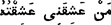
 ‘Whoso loveth me, him I love; and whom I love, him I slay; and whom I slay, verily I am his Bloodwit.’ Mr. Browne says ~his Tradition is constantly cited in the Mahabbet-Náme.
1 As there is a gap between the folios numbered 19 and 20 in the British Museum MS., I am unable to state the precise length of the poem.
1 Throughout the MS., wherever the sacred words ‘thirty-two’ would occur, they are replaced by a symbol something like  . The signification of this symbol is given in a marginal note on folio 3 b.
2 See p. 62. The gloss here is Koran, ii, 29: ‘And He taught Adam the names, all of them.’
3 The gloss here is Koran, vii, 139, where God, in answer to the request of Moses that He would show Himself to him, says: ‘“ Thou shalt not see Me; but look upon the mountain, and if it remain steady in its place, thou shalt see Me;” but when his Lord appeared unto the mountain He made it dust, and Moses fell down aswoon.’ Compare Exodus, xxxiii, 18-23.
1 On the margin are quoted the Hadíses, 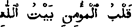 ‘The heart of the believer is the house of God,' and
 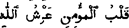 ‘The heart of the believer is the throne of God,’ and
 ‘My earth containeth Me not, neither doth My heaven; but the heart of My believing servant containeth Me.’
2 This Tradition, in which God is the speaker, is quoted on the margin:  ‘Seek Me in the broken hearts and by the crumbling tombs.’
3 The margin bears this Hadís: 
 ‘Ye shall see your Lord even as ye see the moon on the night when it is full, on the Resurrection-Day.’ And equally clearly can ye see your Lord in the human face, — is the Hurúfí inference.
1 i. e. the detached letters which stand at the beginning of certain chapters of the Koran. There are fourteen of these letters, and they occur in fourteen different combinations.
2 Of course the ‘uncreated Word of God’ really means the Logos, i. e. the Divine Thought and Word regarded as two aspects of one entity; but ignorant people took the phrase literally and understood by it the Koran, whence the notion held by some that that book is uncreated and eternal.
3 Koran, liv, I. There are two explanations of this passage. The one is that the unbelievers having asked for a sign, the Prophet pointed his finger at the moon which straightway appeared split asunder, — a legend which, though not generally believed, is often referred to by the poets. The second and more usual explanation is that it refers to one of the signs which are to herald the Last Day.
4 Abraham is credited with the establishment of various practices, such as paring the nails, using a toothpick, and parting the hair, which Muhammed is said to have followed, declaring them to have been the customs of that patriarch.
1 The Koran, xi, 59, is quoted on the margin: ‘There is no beast but He taketh it by its forelock; verily, my Lord is on the right way.’ To the Hurúfí the ‘forelock’ suggests the hair; the ‘right way,’ the parting.
2 ‘The Four Books,’ i. e. the Pentateuch, the Psalms, the Gospel and the Koran.
1 pp. 9- 14.
2 
1 Sewád-i A ῾zam, ‘the Most Great Blackness,’ the annihilation of selfhood: the ‘dazzling darkness,’ that effulgence of the Godhead which veils It from sight.
2 As said Juneyd of Baghdad, a great Súfí saint who died in 298 (910-1): 
 ‘No one attaineth to the degree of Truth until a thousand righteous men bear witness that he is an atheist.’
1 ‘The Two-and-Seventy Sects’ is a current phrase for the sects of Islam. It arose from the following saying traditionally attributed to the Prophet:  ‘My people shall be divided into three-and-seventy sects, and all of them shall be in the Fire save one sect.' On being asked which that one sect would be, the Prophet answered:
  ‘That to which belong I and my Companions.’ Naturally, every sect in Islam identifies itself with this one, which is called the Firqa-i Nájíye ‘the sect that will be saved,’ in contradistinction to the Firqa-i Hálike ‘the sect that will perish,’ which embraces all the other seventy-two. The phrase ‘the two-and-seventy sects’ thus properly means only the heretical sects of Islam, though it is frequently employed as embracing all, heretical and orthodox alike. The Prophet is likewise said to have foretold that the Jews would be split up into seventy-one sects, and the Christians into seventy-two.
2 Ism-i A῾zam, the ‘Most Great Name (of God),’ the mightiest Power in existence. It was graven on the Seal of Solomon, who by virtue thereof controlled all crentures and all the forces of nature. It is described as that Name which sums up and includes all the other Names; and by some is said to be Allah, i. e. ‘The God.’
1 See p. 261, n. I. Fenárí was the first, Fakhr-ud-Dín the second Muftí of the capital; the latter, who was a pupil of the famous Seyyid Sheríf-i Jurjání died in 865 (1460-1), and is buried at Adrianople.
2 The story is repeated by Ἅlí and by Ríf῾at Efendi in his history of the Sheykhs of Islam, entitled Devhat-ul-Meshá᾽ikh or ‘The Tree of the Sheykhs.’
1 In the original, Hulúl, i. e. ‘the immanence of God in creation,’ a general Súfí idea but strained by the Hurúfís and the sect called Hulúlíye to mean more especially the immediate Theophany presented through the fair, whence they deduced the lawfulness of contemplating such (while according to the canon, women should be veiled in public), to which the Hurúfís at any rate, added the obligation to worship such as being incarnations of the Divinity.
2 The Uch Shurfeli Jámi῾ or ‘Mosque of the Three Galleries’ (the ‘galleries’ here meant are the external galleries on a minaret whence the mu᾽ezzin gives the call to worship) is one of the oldest mosques in Adrianople, having been built by Murád II. It has four minarets, which are reputed to be the highest in the world.
1 The name Musalia or ‘Oratory’ is given to a large open enclosed space outside a town, where worship is performed on occasions when the congregation would he too large to be accomodated in any of the mosques.
2 See p. 357, n. I.
1 
2 The ‘lean-souls’ i. e. the orthodox persecutors of the Hurúfís. The meaning of the quatrain is that as the beautiful-souled, and they only, are martyred in the cause of Love, the true Lover will not shun martyrdom.
3  This Persian quatrain, attributed to Fazl-ulláih in the printed edition of Latífí, is given (more correctly) on page 8 of the printed Díwán of Nesímí under the heading:
  ’of the words of the glorious Seyyid, he who is known as Khudávendgár, i. e. as ‘The Master.’ I cannot say whether this was a title of Fazl-ulláh.
4 Latífí probably refers to the endeavour to exterminate the qalenders which Sa῾d-ud-Dín says was made in 897 (1492) in consequence of the attempted assassination of Báyezíd II by one of their number.
5 Ἅlí has transferred Latífí’s account of Temennáyí to his History; but Hasan Chelebi and Riyází make no mention of him. I cannot answer for Ἅshiq, as the leaf is lost from my MS. of his Tezkire on which the notice of Temennáyí would have occurred.
1  The qalenders used often to pluck out the hair of the head and face. This ‘tittle-tattle,’ i. e. this trivial world. ‘A snare,’ the beard etc. on which men like Fakhr-ud-Dín are wont to pride themselves. The comparison of hair to a snare (because of the threads of the latter) is common.
2 
3 Habbet-ul-khazrá, ‘grain of green,’ probably some seed with hashish-like properties which those qalenders used for its intoxicating effects.
4 
5 That which contains the Istiwá-Náme and the (possible) Ἅrsh-Náme (anciens Fonds Pers. 24). The MS. of the Mahabbat-Náme (Sup pl. Pers., 107) was transcribed in 895 (1489-90). The Cambridge MS. of the Jávidán-Náme-i Kebir is undated, but Mr. Browne believes it to have been copied in the fifteenth century.