
11.
He would dispense his instructions to his hearers gradually, in a manner commensurate with their powers of assimilation…. In view of the fact that exercise both strengthens and sharpens the mind, Bernard would bend every effort to bring his students to imitate what they were hearing. In some cases he would rely on exhortation, in others he would resort to punishments, such as flogging….
—JOHN OF SALISBURY, describing the teaching
methods of Bernard of Chartres, twelfth century
Along with workmen, housewives, priests, cows, horses, and pigs, the stream of morning traffic includes a scattering of boys with close-cropped hair, carrying hand-copied Latin grammars under their arms. They are on their way to school. As they trudge along, kicking stones and horse manure and calling greetings to each other, they are only faintly conscious of the novelty of their position.
There are no public schools in Troyes. But having taken primary instruction from a parish priest, these boys are now enrolled in the cathedral school. They are the elite of the city’s youth—mostly the sons of the well-to-do. To their inherited station in life they are adding the advantage of education, and they are placing themselves permanently above the level of weavers, peasants, and ignorant tradesmen.
The cathedral school was not originally conceived as a secondary school. Founded in the seventh century by Bishop Ragnegisile, it remained for centuries merely a training school, turning out clerks for the diocese. The bishop himself did the teaching. Today’s boys still wear the tonsure, as a sign of what is called “a disposition toward an order.” The chancellor of the cathedral teaches theology and confers teaching licenses, but most of the instruction is in the hands of the schoolmaster and his assistant canons, who teach a distinctly secular course.
In the schoolroom the pupils sit on the floor, all ages together. Instruction is predominantly oral and in Latin, though beginners are allowed to lapse into the vernacular. The schoolmaster lectures, and students take notes on oblong wooden tablets coated with black or green wax, using a stylus of bone, ivory, or metal. The whitish scratches it makes can be erased by rubbing with its rounded end. The scholars soon acquire a Latin shorthand: Sic hic e fal sm qd ad simlr a e pducible a do, g a e et silr hic, a n e g a n e pducible a do means Sicut hic est fallacia secundum quid ad simpliciter, A est producibile a Deo, ergo A esi. Et similiter hic, A non est, ergo A non est producibile a Deo (“Thus here is the second fallacy, which is simply, A is created by God, therefore A exists; and similarly this, A does not exist, therefore A is not created by God”). In drill, pupils repeat in chorus after the teacher and go on repeating an exercise until they have learned it by heart. Since books have to be copied by hand and writing materials are expensive, memory and oral exercises are indispensable.
The schoolmaster reads aloud, explaining and underlining as he goes, pointing out figures of speech, rhetorical devices, well-chosen words, adjectives that suit the nouns they modify, metaphors that give speech a beyond-the-ordinary meaning. Though discipline may be mild, the attention of the students does not wander, for each of them must recite tomorrow part of what he has heard today.
The lecture, the main teaching session of the day, takes place in the early afternoon. Following it, there is a period of free discussion, then drill, and finally a lesson chosen for moral and religious edification, closing with the Sixth Penitential Psalm and the Lord’s Prayer. The next morning is devoted to the “repetition,” recalling and committing to writing things learned the previous day. At this time the pupils are also required to imitate the Latin masters they are studying by writing compositions of their own, in verse and prose. They are expected to commit to memory every day a selection from Ovid or Vergil, or another Latin author. These will be helpful in writing letters or compositions, which are traditionally crammed with quotations.
A letter from Gerald of Wales to the archbishop of Canterbury quotes in five pages three times from the Book of Wisdom, twice from St. Jerome, once each from Proverbs, Psalms, Vergil, and Ovid, and seven times from Horace. A letter written by Nicolas of Clairvaux1 to the bishop of Auxerre, whose see was renowned for its wines, runs:
In the words of the Gospel, they have no more wine. (John 2:3). Do not send me the wine of sorrow (Psalm 59:5), but the wine which rejoices the heart of man (Psalm 103:15), whose color is excellent, the savor very fine, and whoseagreeable odor (Exodus 29:18) testifies to its quality. It is in these three elements that it manifests its perfection, and the cord with three strands does not easily break (Eccl. 4:12).
The wines of our region are turbid and do not come from those plants which grow in your region in a state of blessedness; their juice has not passed from one nation to another, and from one kingdom to another people (Psalm 104:13)…. Send separately to the abbot and to me; the Jews do not deal with the Samaritans (John 4:9).
Theoretically, the curriculum consists of the “seven liberal arts.”2 But schools rarely teach all seven of the arts, and the emphasis is very unequal. These “arts” are “liberal” because their purpose is not moneymaking and because they are worthy of a free man. There are seven mainly because people are fond of the number seven, one of the keys to a numerologically ordered universe. In the sixth century Boethius divided the liberal arts into the trivium and quadrivium (“three roads” and “four roads”). The trivium comprises the literary subjects: grammar, rhetoric, and logic; the quadrivium the scientific: arithmetic, geometry, astronomy, and music.
The bishops’ schools of the sixth to ninth centuries offered little more than what was indispensable for clerks—Latin, enough arithmetic and astronomy for the computation of Easter and other movable feasts, and music for the chant. Monastic schools taught a similar curriculum. Like the episcopal schools, they were internal—that is, they trained their own personnel. When they occasionally received children of princes and nobles, it was rather as pages than as regular pupils. Parish priests, too, trained their own successors.
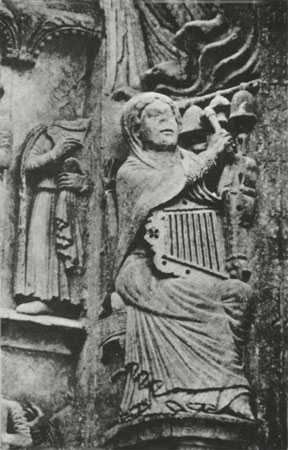
“Music,” one of the Seven Liberal Arts, is among the sculptured figures of the Royal Portal of Chartres Cathedral. She holds a psaltery in her lap, has a vielle, an early version of the violin, beside her, and plays a set of bells.
After Charlemagne’s time the bishops’ schools began to expand and to take outside pupils, boys from the town and boarding scholars. Gradually they came to eclipse the monastic schools. This urbanization and secularization created an educational revolution during the eleventh century. In the hundred years that followed, the cathedral schools became international centers of adult scholarship as well as training schools for the diocesan clergy. The emphasis was on grammar and rhetoric, with theology, philosophy, and canon law as added disciplines. The most famous school was at Chartres, where, under the direction of the great schoolmaster Bernard (not to be confused with St.-Bernard of Clairvaux) there was a revival of classical literary humanism.
Now, in the thirteenth century, the function of higher education has been largely absorbed by the universities. Where universities are within easy reach, the cathedral schools restrict themselves chiefly to grammar, rhetoric and the rudiments of logic. In remote districts, cathedral schools teach a curriculum similar to that of the universities.
The grammar of the cathedral school embraces not only linguistics but writing, spelling, composition, speech, and general literature, including poetry and history. Pupils must master the elements of Latin by memorizing the Ars Minor of Donatus, a fourth-century authority. Ten pages of question-and-answer supply a knowledge of the eight parts of speech. From this the student proceeds to the same author’s Ars Grammatica, and then to Priscian’s Grammatical Commentary, a sixth-century work. Donatus and Priscian wrote for pupils to whom Latin was a native language, and are not ideally suited for northwest Europe in 1250. Two new manuals in verse are beginning to replace them, Alexander of Villedieu’s Doctrinale3 and the Grecismus of Eberhard of Bethune (so-called because it includes some Greek etymology).
Twelfth-and thirteenth-century writers have developed an extraordinary fondness for versifying, and almost every species of literary production appears at one time or another in verse. Historical chronicles are often written in verse. There are verse formularies for letter writing. Sermons sometimes lapse into poetry or rhythmic prose. There is a versified Bible (the Aurora of Peter Riga). Even legal documents are sometimes rhymed.
In grammar, the student is exposed to a series of authors, pagan and Christian, with little critical evaluation or regard for chronological order. Anything written in a book has a certain sacredness, all the established authors are authorities, and all are timeless, from Aesop to Horace. Some, like the late Roman elegiac poet Maximianus, are surprisingly profane and even erotic, but they are nevertheless studied for their rhetorical artifices. Sometimes the pagan spirit of Roman poetry arouses qualms. Guibert of Nogent confesses in his autobiography that early in his monastic life he took up verse making and even fell into “certain obscene words and composed brief writings, worthless and immodest, in fact bereft of all decency,” before abandoning this shocking practice in favor of commentaries on the Scriptures. St.-Bernard himself wrote verse in his youth at Cîteaux, and was guilty of great proficiency. By the end of the twelfth century, verse writing was forbidden to members of the austere Cistercian order, but many abbots and bishops continue to write love poetry.
All the scholars observe that grammar helps in understanding the Holy Scriptures. The Bible, they point out, is rich in figures of speech, and a study of the literary art assists in appreciating it. Like St. Jerome, they compare secular learning to a heathen slave girl; the Hebrew who wishes to marry her must cut her hair and nails; similarly, the Christian who loves secular learning must purify it from all errors so that it will be worthy to serve God.
The authors who are so revered fulfill many needs. They dispense information about everything from medicine to history. Ovid is prized for his moral sayings. Collections of “sentences,” or apothegms containing wise saws from the writings of antique and medieval authors, are popular.
After grammar comes rhetoric, the second of the arts in the trivium, literally the “craft of speech.” In democratic Athens and Rome speechmaking was a major element in public life. In the Middle Ages political oratory has little place, and judicial rhetoric is only beginning to reappear with the revival of Roman law. Yet students practice both these forms of eloquence as school exercises. Of more practical use is the course in letter writing.
Logic, or dialectic, the third subject of the trivium, teaches clear thinking. It leans heavily on Aristotle. Disputation is a teaching method and a pastime. On examination and speech day at a cathedral school, the students may hold competitions in syllogisms, fictitious arguments, harangues, and epigrams.
The scientific part of the curriculum, the quadrivium, is not much influenced by the Greek science that scholars and translators are bringing in from the Moslem world. The pupil at the cathedral school absorbs relatively little true scientific knowledge. He may be given a smattering of natural history from the popular encyclopedias of the Dark Ages, based on Pliny and other Roman sources. He may learn, for example, that ostriches eat iron, that elephants fear only dragons and mice, that hyenas change their sex at will, that weasels conceive by the ear and deliver by the mouth.
The most popular subject in the quadrivium is astronomy, a mixture of science and astrology. Arithmetic involves, as earlier, the computus, a body of rules for determining the date of movable feasts. The scholar may also learn the use of the abacus, the computer of the ancient and medieval world. He learns something of the properties of numbers, especially ratio and proportion, and the propositions (without the proofs) of Euclid’s first book of geometry. As part of his geometry course he may acquire some rudiments of geography, studying a map of the world4 that shows the circular earth composed of three continents equal in size—Asia, Africa, and Europe—separated by narrow bands of water. East is at the top, Jerusalem at the center. In various places on the map one may marvel at dragons, sirens, men with dogs’ heads, men with feet turned backward, men with umbrella feet with which they protect themselves from the sun while lying down. It is not a map for finding one’s way, but for illustration and edification. More practical and less picturesque maps exist—mariners’ charts produced by sailors armed with the newly introduced compass and astrolabe, accurately delineating coastlines, capes, bays, and shallows, and locating ports of call and places for watering and victualing so that a navigator can find them easily. But the schoolboy and his teachers know nothing of such maps.
The science of the thirteenth century, in fact, resides mainly outside the schools. Furriers, trappers, hunters, and poachers could correct much of the natural history in the encyclopedias. The craftsmen who are building the cathedral know geology, engineering, geometry, arithmetic, and mineralogy, and have an intimate acquaintance with nature. The capitals of their piers are decorated with leaves of plantain, ivy and oak, arum, ranunculus, fern, clover, coladine, hepatica, columbine, cress, parsley, strawberry, snapdragon, and broom—all observed with care and re-created with precision. The notebook of the great architect-engineer Villard de Honnecourt is filled not only with columns and vaults, but with animal and even insect life—a lobster, parrots, a snail’s shell, a fly, a dragonfly, a grasshopper, not to mention a bear, a lion, a cat, and a swan. Even the gargoyles with which the cathedral workers give an aesthetic justification to their drainspouts reveal a command of animal anatomy.
Many of the businessmen fathers of the cathedral school-boys are aware of a truly remarkable new piece of learning, a historic advance in the most basic of all sciences, mathematics. Introduced into western Europe from Moslem North Africa, not by a scholar, but by an Italian businessman, it is nothing less than the use of Arabic numbers. Leonard Fibonacci, a Pisan, has written a treatise called Liber Abaci popularizing the new system and summarizing the arithmetical knowledge of the Arabs. The numerals (actually Indian in origin) are spreading through the Italian business community. The key to the Hindu-Arabic system is the zero, which permits the position of the digit to indicate its value as unit, ten, hundred, or thousand. Rapid and accurate computation can be done, something difficult with clumsy Roman numbers. The businessmen of Troyes still prefer their calculating boards, but they are familiar with the new notation through their contacts with Italian businessmen and moneychangers at the fairs.
The cathedral school offers no French grammar, composition, or literature, no languages except Latin—not even Greek. It teaches no history, except a bit incidentally in the grammar course, and no science, except a little natural science that emerges from a study of the “authors.” Music is taught only as a theoretical science. There are no courses in social science, physical education, or art.
The use of Latin throughout the schools gives a wide currency to ideas and makes sources of culture accessible to everyone, even though students probably never learn to read it as proficiently as their native French, English, or German. Latin is a cultural catalyst, but it is also an impediment to self-expression and communication.
There is no university in Troyes, which is not surprising, since there are only five in northwest Europe5—at Paris, Orléans, Angers, Oxford, and Cambridge. There are three more in the south of France, eleven in Italy, three in Spain. Of these twenty-two, the two oldest, at Bologna and Paris, are by far the most important. Their precise origins are lost in the twelfth century, but they are true archetypes, for the Greeks and Romans had no universities.
A bright alumnus of the cathedral school at Troyes who wishes to continue his education may journey to Paris, only a hundred miles away. If he does, he will join some two or three thousand young men in the Latin Quarter, who every morning grope their way out of their lodgings to join the crowd of clerical gowns and tonsured heads hurrying to the Street of the Straw, so-named from the floor covering on which students sit all morning. At noon the scholars break for dinner, meeting again in the afternoon for another lecture or a disputation. When the day is over they may turn to studying or copying by candlelight, or, since all forms of athletics, and even chess, are prohibited, to gaming, drinking, and whoring. Although scholars usually enter the university at fourteen or fifteen, their private lives are almost entirely unsupervised. There are no university buildings.6 Classes are held in the masters’ houses. Student lodgings, schools, and brothels are cheek by jowl, and sometimes masters and students conduct disputations on the second floor, whores and pimps on the first.
The favorite sport of university students is fighting—with each other, with the townspeople, with the provost’s guard. Some of their riots make history, for the University of Paris is by 1250 an institution of formidable stature. A democratic anomaly in the heart of a feudal monarchy, it enjoys remarkable power and prestige and extraordinary privileges. Though it has a charter from the king of France, it is thoroughly international, with some of its most celebrated scholars from Italy, Germany, and England. Pope Innocent III was a master at Paris; Thomas Aquinas is studying there in 1250.
Though the University of Paris is famous for its faculty of theology,7 the learning it transmits to most of its students is more secular than that of the cathedral schools. Aristotle is the supreme text and master. After six years’ study a student may face the examiners, and if he passes receive a license to teach. Ultimately he may take orders and become a church official, or a scholarly luminary at this or another university. He may go on to study medicine or law, both lucrative and prestigious professions. He may become a copyist. Or he may enter the service of some prince or baron. For a young burgher of Troyes, the count of Champagne’s service is most attractive. He can rise to become bailiff, or keeper of the Fair, with splendid emoluments, not to mention opportunities for graft. Education pays, in the thirteenth as in other centuries.