
12.
Sire cuens, j’ai vielé
Devant vous en vostre ostel,
Si ne m’avez rien doné
Ne mes gages aquité:
C’est vilanie!
[Sir count, I have played the
viol before you in your house, and
you have given me nought, nor paid my
expenses: ’Tis villainy!]
—COLIN MUSET
A number of students in the twelfth century followed none of the conventional paths. Instead they undertook the footloose and precarious existence of wandering scholars, drifting from one school or one patron to another, passing their days in taverns, living by their wits. Some of them, the so-called “Goliards,” contributed to the world’s literature a stock of Latin verse of a new kind—lyric, frankly pagan, satirical, and irreverent.
But many of the poets who have created a literary revival in the past century and a half write in the vernacular, especially in one of two varieties of French—Provençal or northern. An important center for the latter is Troyes. Count Henry the Generous and his bluestocking countess, Marie, daughter of Louis VII of France and Eleanor of Aquitaine, patronized a number of poets, of whom the most famous was Chrétien de Troyes. Chrétien’s verse tales of the Round Table not only are of high literary merit, but serve as the chief source of all Arthurian romances.
Another sort of Champenois literary production came out of the Fourth Crusade. Geoffroi de Villehardouin, marshal of Champagne and native of the neighborhood of Troyes, helped sack Constantinople and afterwards wrote an account of his adventures whose naive vigor and honesty won him a niche in literature as well as history. Neither a clerk nor a poet, but a plain soldier, Geoffroi wrote in vernacular prose, and so won the distinction of creating the very first masterpiece in French prose.
The present count of Champagne, Thibaut IV, is a poet. Guarded through his minority by his capable mother, Blanche of Navarre, Thibaut grew up to marry, one after the other, a Hapsburg, a Beaujeu, and a Bourbon princess, by whom he had eight children. To these children he added four more, products of his numerous love affairs. But the enduring passion of his life was a chaste one, owing to the inaccessibility of its object, the queen of France. This lady, Blanche of Castile, wife and widow of Louis VIII and mother of Louis IX (St.-Louis), was a dozen years Thibaut’s senior. Nevertheless Thibaut’s penchant for Blanche was such that he was suspected of poisoning her husband when the king died suddenly. The injustice of the accusation provoked Thibaut to join a couple of baronial troublemakers, Hugo of La Marche and Peter of Brittany, in a sort of antiroyal civil war. When on sober second thought Thibaut changed his mind, Hugo and Peter turned their spite against him and invaded Champagne, setting haystacks and hovels ablaze. Stopped by the walls of Troyes, they were forced to turn around and go home when a relieving force arrived, sent by Queen Blanche.
Partly as a result of the war, Thibaut was constrained to sell three of his cities—Blois, Chartres and Sancerre—to the king of France. At the last moment he felt a reluctance to hand over Blois, cradle of his dynasty, and carried stubbornness to the point of courting a royal invasion. But forty-six-year-old Blanche of Castile dissuaded thirty-three-year-old Thibaut in an interview of which the dialogue was recorded, or at least reported, by a chronicler:
Blanche: Pardieu, Count Thibaut, you ought to have remembered the kindness shown you by the king my son, who came to your aid, to save your land from the barons of France when they would have set fire to it all and laid it in ashes.
Thibaut (overcome by the queen’s beauty and virtue): By my faith, madame, my heart and my body and all my land is at your command, and there is nothing which to please you I would not readily do; and against you or yours, please God, I will never go.
Thibaut’s fancy for Blanche needed sublimation. Sage counselors recommended a study of canzonets for the viol, as a result of which Thibaut soon began turning out “the most beautiful canzonets anyone had ever heard” (a judgment in which a later day concurs). The verses of Thibaut the Songwriter were sung by trouvères and jongleurs throughout Europe. A favorite:
Las! Si j’avois pouvoir d’oublier
Sa beauté, a beauté, son bien dire,
Et son très-doux, très-doux regarder,
Finirois mon martyre.
Mais las! mon coeur je n’en puis ôter,
Et grand affolage
M’est d’espérer:
Mais tel servage
Donne courage
A tout endurer.
Et puis, comment, comment oublier
Sa beauté, sa beauté, son bien dire,
Et son très-doux, très-doux regarder?
Mieux aime mon martyre.
[Could I forget her gentle grace,
Her glance, her beauty’s sum,
Her voice from memory efface,
I’d end my martyrdom.
Her image from my heart I cannot tear;
To hope is vain;
I would despair,
But such a strain
Gives strength the pain
Of servitude to bear.
Then how forget her gentle grace,
Her glance, her beauty’s sum,
Her voice from memory efface?
I’ll love my martyrdom.]
Thibaut is a prince; Chrétien de Troyes was (probably) a clerk; Geoffroi de Villehardouin was a noble. But there is another native Troyen writer, in 1250 just embarking on his career, who is a plain burgher. “Rutebeuf” (Rough-ox) he calls himself, and his verses have little in common with the polished elegance of Chrétien or the tender passion of Thibaut. Rutebeuf describes real life—mostly his own.
Dieus m’a fait compagnon à Job,
Qu’il m’a tolu à un seul cop
Quanques j’a voie.
De l’ueil destre, dont mieus veoie,
Ne voi je pas aler la voie
Ne moi conduire…
Car je n’i voi pas mon gaain.
Or n’ai je pas quanques je ain,
C’est mes domages.
Ne sai se ç’a fait mes outrages;
Or devendrai sobres et sages
Après le fait,
Et me garderai de forfait.
Mais ce que vaut? Ce est ja fait;
Tart sui meüs,
A tart me sui aperceüs
Quant je sui en mes las cheüs.
C’est premier an
Me gart cil Dieus en mon droit san
Qui pour nous ot paine et ahan,
Et me gart l’ame.
Or a d’enfant geü ma fame;
Mes chevaus a brisié la jame
A une lice;
Or veut de l’argent ma norrice
Qui me destraint et me pelice
Pour l’enfant paistre,
Ou il revendra braire en l’estre…
[God has made me a companion for Job,
Taking away at a single blow,
All that I had.
With my right eye, once my best,
I can’t see the street ahead,
Or find my way…
I can’t earn a living,
I enjoy no pleasures,
That’s my trouble.
I don’t know if my vices are to blame;
Now I’m becoming sober and wise,
After the fact,
And will keep from doing wrong,
But what good is that? It’s done now.
I’m too late.
I discovered too late
That I was falling into a trap.
It’s the first of the year.
May God who suffered pain for us
Keep me healthy.
Now my wife has had a child;
My horse has broken his leg
On a fence,
Now my nurse is asking for money,
She’s taking everything I’ve got
For the child’s keep,
Otherwise he’ll come back home to yell…]
Thibaut and Rutebeuf are not only widely sung and recited, but published. By 1250 books are multiplying spectacularly, even though every single book must be copied by hand. During the Dark Ages book copying took refuge in the monasteries, but now it is back in town. Schools and universities supply a market for textbooks, and copyists are therefore often located in the neighborhood of the cathedral or university, but they do more than copy texts. They also serve as secretaries, both for the illiterate and for those who want a particularly fine handwriting in their correspondence.
A copyist sits in a chair with extended arms across which his writing board is placed, with the sheets of parchment held in place by a deerskin thong. His implements include a razor or sharp knife for scraping, a pumice, an awl, a long narrow parchment ruler, and a boar’s tooth for polishing. He works near the fire, or keeps a basin of coals handy to dry the ink, which is held in an oxhorn into which he dips a well-seasoned quill. The oxhorn fits into a round hole in the writing board, with a cover.
The copyist begins by scraping the parchment clean of scales and incrustations, smoothing it with the pumice, and marking out lines and columns with ruler and awl. Then he sets to work. Some of his productions may be ornate works of art—Latin psalters or French romances, in gold, silver, and purple ink, with initials overlaid with gold leaf. Bound in ivory and metal covers mounted on wood, these elaborate volumes are fabulously expensive. By far the greater number of books consist of plain, legibly written sheets bound in plain wooden boards, perhaps with untooled leather glued over for extra protection. Students often bind several books together under the same covers. Even these cheaper books are expensive, owing not only to the cost of parchment but to the enormous labor involved in their production. It takes about fifteen months to copy the Bible. Books are valuable pieces of property, often pawned, and rented out as well as sold. Students are the chief renters. When a student rents a book he usually does so in order to copy it. He pays rent by the pecia—sixteen columns of sixty-two lines, each with thirty-two letters, renting for a penny or halfpenny. An industrious student can create his own library, but it is a work of long night watches. Across the bottom of the last page of many a book is written Explicit, Deo Gratias (“Finished, thank God”). Some students end with a more jocular flourish: “May the writer continue to copy, and drink good wine” “The book finished, may the master be given a fat goose” “May the writer be given a good cow and a horse” “For his pen’s labor, may the copyist be given a beautiful girl” “Let the writer be given a cow and a beautiful girl.”
Books are kept not on open shelves but in locked chests. Students who borrow are cautioned not to scratch grooves in the margin with their fingernails or to use straws from the lecture floor as placemards. A Jewish ethical treatise warns that a man must not express his anger by pounding on a book or by hitting people with it. The angry teacher must not hit the bad student with a book, nor should the student use a book to ward off blows.
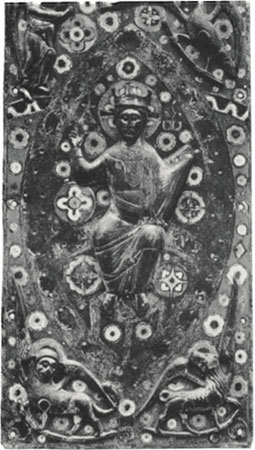
Book cover, thirteenth century. The more elaborate productions of medieval copyists were usually bound in ivory and metal covers mounted on wood; sometimes, as in this example, they were decorated with champlevé enamel. But most books were bound in utilitarian wooden boards, sometimes covered with leather. (Metropolitan Museum of Art, Gift of J. Pierpont Morgan, 1917)
Despite the cost, books enjoy a wide circulation. An opponent of Abélard noted that “his books cross the sea, pass the Alps…are carried through kingdom and province.” Normal, or legitimate, book circulation is reinforced by a black market. Many scholars borrow books and surreptitiously copy them. John of Salisbury lent a book to a friend at Canterbury, and later referred to him as “that thief at Canterbury who got hold of the Policraticus and would not let it go until he had made a copy.” St.-Bernard wrote a would-be borrower, “As regards the book you ask for…there is a certain friend of ours who has kept it a long time now, with the same eagerness you show. You shall have it as soon as possible, but although you may read it, I do not allow you to copy it. I did not give you leave to copy the other one I lent you, although you did so.”
Copyists are not always accurate. Authors sometimes conclude their books with the injunction: “I adjure you who shall transcribe this book, by our Lord Jesus Christ and by His Glorious coming, Who will come to judge the quick and the dead, that you compare what you transcribe and diligently correct it by the copy from which you transcribe it, and this adjuration also, and insert it in your copy.”
Works are seldom composed on parchment. Authors usually write on wax tablets and have their productions copied by scribes. If the work is written in the vernacular, it may be dictated to a scribe, who writes first on wax and copies over on parchment.
Even the most luxurious of the illuminated manuscripts show minor defects. The illuminator does not always leave space for the picture caption, which must be crowded in somehow, often impinging on the text. Against such a contingency, the captions may be lettered in red. Sometimes the illuminator leaves space for a caption which the copyist overlooks. Blank sections of columns—most books are lettered in double column—show where a copyist finished his assigned section in less space than had been allowed. Now and then words skipped by a careless copyist are inserted in the margin. Sometimes the artist turns such an error into a joke. A verse omitted from the text is added at the top of the page, and the figure of a scribe in the margin tugs at a rope tied to the first letter of the misplaced line, while a second man leans out from the proper space on the page, ready to receive the rope and pull the line into place.
The style of lettering has undergone an important series of changes through the Middle Ages. At the end of the Roman period, Roman square capitals developed into the more casual “rustic” style, out of which slowly grew a small-letter alphabet. The “Caroline minuscule,” evolved during Charlemagne’s reign at Alcuin’s school at Tours, crowned this achievement with an alphabet that clearly differentiated between capitals and small letters, not only in size but in form. At the present moment a new, more elaborate style is sweeping northern Europe: Gothic or black-letter, with stiff, narrow angular letters executed with heavy lines that look black on the page.
Many kinds of books are available from thirteenth-century booksellers,1 and wealthy individuals, as well as universities, are acquiring libraries.2 Among the Latin classics there are the antique poets and the more recent didactic poets, the new scientific writings and translations, books of law, such as Justinian’s Code and Digest and the Decretum of Gratian; medical books—Galen and Hippocrates, works of theology and philosophy, “vocabularies” (dictionaries of important terms), books of “sentences” (aphorisms), chronicles, encyclopedias, and compilations.
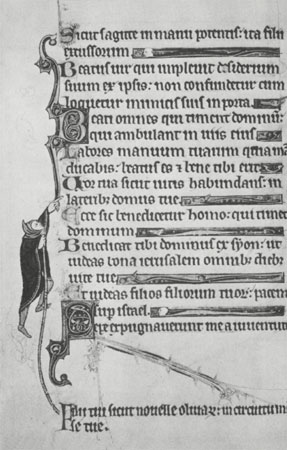
Manuscript copyists employed ingenious and sometimes humorous devices to correct omissions. A page from an illuminated Book of Hours shows a figure hauling an omitted line into place. (Walters Art Gallery, Baltimore)
But these weighty volumes in Latin are getting serious competition in French. More and more people want something to read, or especially something to read aloud—and can afford to pay for it. Saints’ lives, biographies, dits (poems on such everyday subjects as the cries of Paris street peddlers), paraphrases of the stories of antique writers, moralizing poems—all these are popular. The rather tedious Roman de la Rose is in great vogue—an allegory by Guillaume de Lorris in which a Lover strives to win his Lady, encouraged and frustrated by various personifications, such as Welcome, Shame, Danger, Reason, Pity. Many works are written more to amuse than correct—such as the Bible of Guiot, by a jongleur from Provins, or the Lamentations of Matthew.
A series of verse tales known as the Roman de Renard has been popular through the twelfth and thirteenth centuries, not only in France, but in Flanders and Rhenish Germany. They are copied over and over by scribes and clerks, in numerous variations. The main characters are Renard the fox, Ysengrin the wolf, Tybert the cat, and King Noble the lion. In a favorite Renard story the fox, stealing chickens from a monastery farmyard, looks into a well and, seeing his own reflection, takes it for his wife Hermeline. Climbing into one of the two buckets that serve the well, he descends, to find nothing but water and stones at the bottom. He struggles in vain to escape. Meanwhile Ysengrin the wolf happens on the well, looks in, and sees his reflection, which he takes for his own wife, Lady Hersent, with Renard at her side. Renard tells him that he is dead, and the well is Paradise. If Ysengrin will confess his sins and climb into the other bucket, he can also achieve the celestial realm, where there are barns full of cows and sheep and goats, and yards full of fat chickens and geese, and woods abounding in game. When Ysengrin jumps into the bucket at the top, he descends while clever Renard ascends and escapes. In the morning when the monks come to draw water, they pull the wolf out and beat him. There is no moral; in the Renard stories wickedness more often triumphs than justice.
Most popular of all are the fabliaux,3 the humorous short stories in verse, sometimes written, sometimes recited. These stories, the product of authors of various social classes, are enjoyed by all kinds of audiences. Some have folk tale origins, some are drawn directly from life. Their common ingredient is humor, often bawdy. Certain characters recur: the merchant, usually older than his wife, cuckolded, swindled, beaten; the young man, often a student, who outwits the husband; the lecherous priest who is his rival. The women, treacherous, lustful, and faithless, may be beaten by their husbands but always manage to get the better of them.
Finally, there are the romances, normally in verse, but sometimes in a combination of verse and prose, or even entirely in prose. Best known of the composers of these courtly tales, after Chrétien de Troyes, is Marie de France, who composed many of her romances (which she called “lays”) on Arthurian themes. The authors of many thirteenth-century romances are unknown, but their work is characterized by a high degree of sophistication and realistic detail. Love stories like Galeran or The Kite deal with star-crossed lovers, united in a happy ending; picaresque tales like Joufroi carry a knightly hero through various adventures amorous and military, none of which is treated very seriously.
One of the best is the Provençal romance Flamenca. At her wedding feast, Flamenca’s husband, Archimbaud of Bourbon, sees the king, as he leads her from a tourney, familiarly embrace her, accidentally touching her breast. Archimbaud misinterprets the gesture and is devoured by jealousy. He tears his hair and beard, bites his lips and grits his teeth, eschews society, can finish nothing he starts, understands nothing that is spoken to him, babbles nonsense, and watches his wife all the time. Word spreads about his affliction, and soon all Auvergne is resounding with songs, satires, and sayings on the subject. He grows worse. He ceases to bathe. His beard resembles a badly mowed wheat field; he tears it out in tufts and puts them in his mouth. In short, he is like a mad dog. A jealous man is not wholly sane.
Flamenca’s life becomes cruel. Archimbaud has her shut up in a tower with two young servants, Alis and Marguerite, and spies on them by a peephole in the kitchen wall. They are only allowed to leave this prison to go to church on Sundays and feast days, and then Archimbaud forces them to sit in a dark corner, closed off by a thick screen as high as Flamenca’s chin. Only when they stand for the reading of the Scripture can they be seen, and instead of letting them go to the altar for communion, Archimbaud has the priest come to them. Flamenca is not permitted to take off her veil or gloves. Only the little clerk who brings her the book for the Kiss of Peace can see her face.
Two years pass. As it happens, next door to Archimbaud’s house is a bathing establishment4 where he takes his wife on occasion to distract her, always searching the premises first and then standing guard outside. When Flamenca is ready to leave, she rings a bell and her husband opens the door, as usual overwhelming her with reproaches: “Will you be ready to leave this year or the next? I was going to give you some of the wine the host sent me, but I’ve changed my mind. I won’t let you go to the baths again for a year, I assure you, if you drag it out like today.” The servants insist that it is their fault; they bathed after Madame. “You like water better than geese,” declares the jealous one, biting his nails.
Enter the hero of this piece, a knight named Guillaume de Nevers, handsome, with curly blond hair, a high and broad white forehead, black arched eyebrows, laughing dark eyes, a nose as straight as an arrow shaft, well-made ears, a fine and amorous mouth, a slightly cleft chin, straight neck, broad shoulders and chest, powerful muscles, straight knees, arched and graceful feet. This fine fellow has studied in Paris and is so learned that he could run a school anywhere. He can read and sing better than any clerk; he can fence; he is so agile that he can put out a candle with his foot when the candle is stuck in the wall over his head. Furthermore, he is rich, and he has the tastes of a gentleman—tourneys, dances, games, dogs, and birds. He is generous, too, and always pays more than the asking-price, gives away his profits from tourneys, is liberal with his men. He is more expert at making songs than the cleverest jongleur.
This paragon has never been in love, but he has read the best authors and knows that he must soon have this experience. Hearing of Flamenca’s beauty and her misfortunes, he decides that she shall be his lady, and goes to Bourbon full of delicious hopes.
He puts up at the bathing establishment, so that from his window he can gaze up at the tower where Flamenca is imprisoned. He goes to church and impresses everyone by reciting a prayer in which he says the sixty-two names of God, in Hebrew, Greek, and Latin. Flamenca arrives, and when she uncovers her head to receive the holy water, he has a glimpse of her hair; at the reading of the Gospel, when she rises to cross herself, he sees her bare hand and is seized by emotion. A moment later, when the acolyte brings her the breviary to kiss, he sees her mouth. Asking for the book when the service is over, he kisses the same page.
That night in a dream Guillaume discovers what he must do. The next day he rents the entire bathing establishment, explaining that he needs solitude. Everyone else moves out; then he orders workers to dig a tunnel between his apartments and the room where Flamenca bathes. Next he flatters the priest into sending his clerk to Paris to study, and undertakes to serve in his place. Now, Sunday after Sunday, a dialogue takes place. When Guillaume brings Flamenca the breviary to kiss, he sighs, “Alas!” The following week she replies, “Why do you sigh?” The next week, Guillaume tells her, “I am dying.”
During that week the tunnel is finished. On Sunday she answers, “Of what?” On Rogation Day, he says, “Of love” the following Sunday she asks, “For whom?” On Pentecost he replies, “For you.” She replies a week later with an ambiguous, “What can I do about it?”
He admires her cleverness and promises “fair Lord God” that he will give all his income in France to the Church and the bridge-building brotherhood if He will let him have Flamenca—he will even give up his place in Paradise.
The dialogue continues. “Cure me,” Guillaume demands; on St.-Jean’s Day she ripostes, “How?” and, in taking the book, brushes his fingers with hers. On Sunday he answers, “I know a way.” Flamenca’s servants advise her to reply, “Take it”—though she is not sure it is honorable to give in so quickly.
The next day Guillaume tells the host and hostess that they may move back to their bathing establishment. In church Guillaume and Flamenca regard each other tenderly, and he says, “I have taken it.” Another month is occupied by the following exchange: “How then?” “You will go.” “Where?” “To the baths.” “When?” “Soon.” She hesitates, in spite of the urgings of her maidens. At last she announces to them, “I will answer yes, for I see that otherwise I could not go on living.” Then she faints. Archimbaud runs in with cold water and throws it in her face, and she persuades him that she is ill and needs to visit the baths. The following Sunday, she says a single word: “Yes.”
As usual, Archimbaud conducts the three women to the baths and they bar the door after him. At that moment Guillaume raises the stone at the end of the tunnel and appears, candle in hand. He invites the ladies to pass into his apartments through the tunnel. With characteristic thought-fulness, he has brought two friends, Ot and Clari, for the maidens Alis and Marguerite. For four whole months the six lovers continue to meet. They live in perfect happiness.
Flamenca is now self-confident. She approaches her husband and demands that he restore her liberty on condition that she promises to behave as well as she has up to the present moment. He agrees, washes his head, forgets his functions as turnkey, and becomes once more the man of the world. As a result Flamenca is soon surrounded by ladies and knights, and finds it impossible to visit the baths without at least seven ladies accompanying her. She sends Guillaume away…5