
8
As previous chapters have brought to bear, medieval canon and Roman civil law had a close relationship. Canonists studied Roman civil law as part of their training, while Romanists (jurists of Roman law) acquired a working knowledge of canon law in order to make a reasonable living. Together canonists and civil lawyers were integral to the development of the norms and procedural process associated with the ius commune, which, in turn, allowed the two, formally distinct, legal systems of canon and civil law to borrow procedural practices, ideas, and doctrines from one another when useful or appropriate. Church law and civil law complemented and competed with each other; the two laws oftentimes operated within the same geographical region, dealt with the same legal issues, and served much of the same population. The end result was a slippage between the two courts. Secular courts might validate a marriage that took place in a church court while hearing a case regarding property, and a church court might uphold a marriage contract made in secular court by enforcing the payment of the dowry.1 Jurists of the twelfth- and thirteenth-century English common law tradition turned to canon law for clarification of familial relationships, particularly in inheritances cases. They borrowed from the canonical tradition the methods of counting degrees of consanguinity, and they adopted consanguinity trees as the visual representations of how those degrees were counted.2
1 F. Pedersen, “A Matter of Choice: Spiritual and Secular Jurisdiction in Two English Marriage Cases in the Early Fourteenth Century,” in Law and Learning in the Middle Ages. Proceedings of the Second Carlsberg Academy Conference on Medieval Legal History 2005, eds. H. Vogt and M. Münster-Swendsen (Copenhagen, 2006), 223–234.2 S. Worby, “The Influence of the Learned Laws on Common Law Kinship: An Introduction,” in Law and Learning in the Middle Ages, eds. Vogt and Münster-Swendsen 207–222. See, for example, C. Beattie and M. Frank Stevens, eds., Married Women and the Law in Premodern Northwest Europe (Woodbridge, 2013) for essays exploring the access married women had to legal recourse in cases with financial implications (e.g., property, contracts).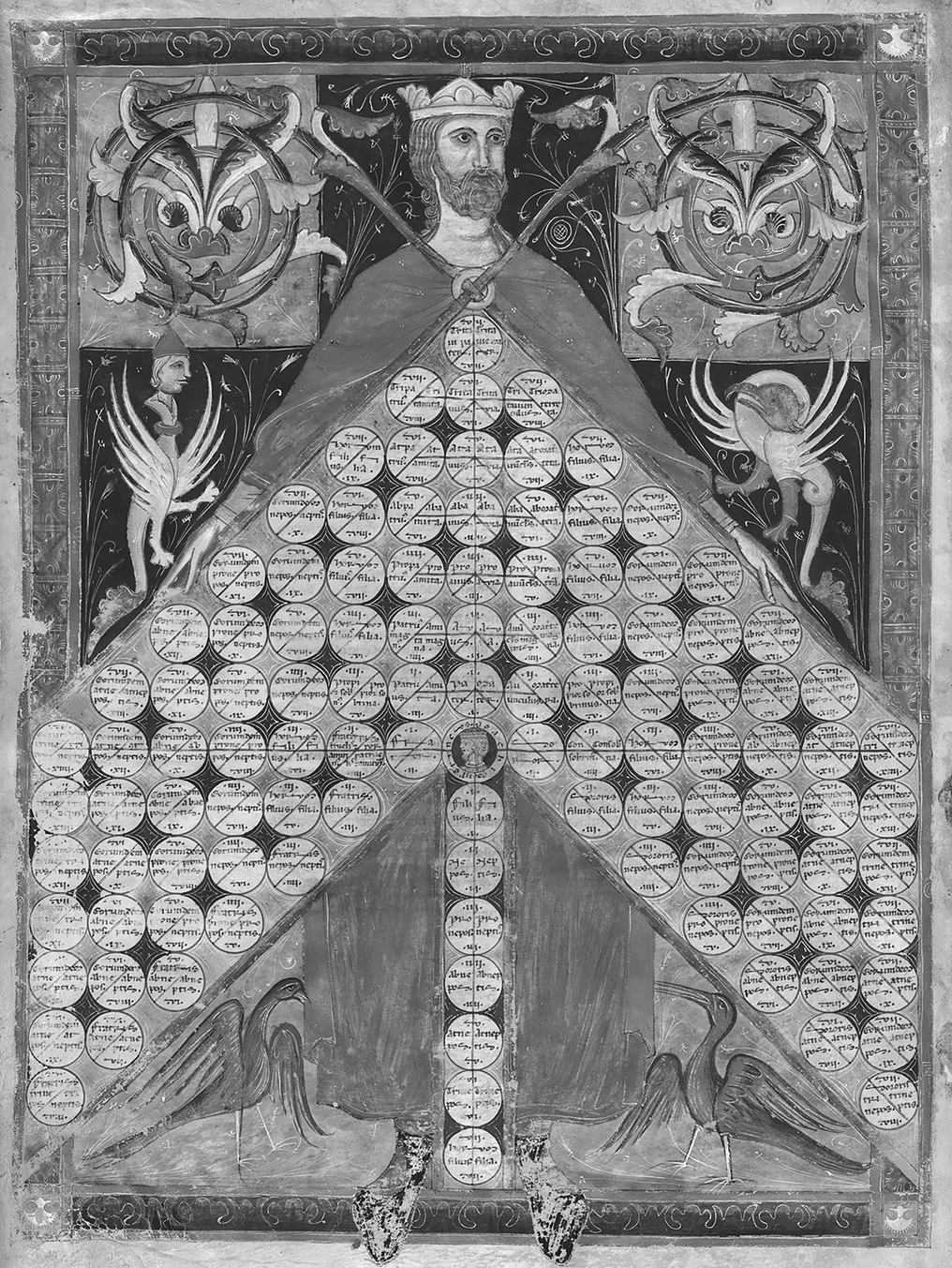 Figure 8.1 Table of Consanguinity (ca. 1270–1300) from Gratian’s Decretum © Cleveland Museum of Art via Creative Commons
Canon law permeated the entire medieval social order, repeatedly touching the lives of practically every person from cradle to grave, regardless of social status or occupation. Its fasting regulations controlled what people ate and when they ate it. Its tax system demanded contributions from every peasant and workman, while its usury laws made life difficult (although not necessarily unrewarding) for money changers, merchants, bankers, and financiers. Its feasts, festivals, and holidays shaped patterns of work and play. Both Christian worship and beliefs provided the context within which individuals prayed and thought. From baptism to burial, canon law was a major presence in everyday life from top to bottom of the social scale.3
3 The interplay of law and society is often referred to as “new legal history”. This scholarly approach places law into dialogue with political, economic, social, and religious developments. See, in particular, A. Musson, Medieval Law in Context: The Growth of Legal Consciousness from Magna Carta to the Peasants’ Revolt (Manchester, 2001), 3; D. Sugarman, “Writing ‘Law and Society’ Histories,” The Modern Law Review 55 (1992): 292–308. For how particular facets of the law—such as sanctuary, compurgation, commerce, wills, and defamation—developed in canon law and the ius commune in England, see R. Helmholz, The Ius Commune in England: Four Studies (Oxford, 2001); and The Oxford History of the Laws of England: The History of the Canon Law and Ecclesiastical Jurisdiction from 597 to the 1640s (Oxford, 2004).
Deviation from accepted religious beliefs and marriage are two excellent case studies in which to explore canon law’s impact on the lives of people. Canonical collections, inquisitorial manuals, and marriage treatises clarified the current legal thought and pushed it in new directions. The institutional Church and the creation of the “other” are best illustrated through the manner in which Jews and Muslims, despite being outside of the Church, were on the receiving end of the canon law. The papal inquisition is probably the most famous example of how the institutional Church and its legal apparatus involved itself in the lives of people who chose not to follow orthodox belief and practice. The papacy also took an active role in marital relations and the Apostolic Penitentiary heard more than its fair share of petitions requesting dispensations for one form of impediment or another. However, the law was not simply imposed on people. As marital law reveals, people had a level of legal understanding and used the law to reach a desired outcome.
Canonists had traditionally been clear about the limits within which law operated. Borrowing from the Roman juristic tradition, they adopted as a basic premise the principle of the third-century jurist Modestinus, who asserted that “[l]aw has the power to order, to forbid, to permit, and to punish.”4 Laws, furthermore, must deal with future actions and events, not past ones. Stated another way, laws had no retroactive force: they could not order, forbid, permit, or punish actions, no matter how wicked or undesirable, that occurred before the law was created.5 A law could also not revoke prior transactions, except under exceptional circumstances, when the matter had not been completed at the time of the law’s creation and when the legislator expressly stated that the new law applied to ongoing transactions.6 Finally, despite existing legal restrictions on Jews,7 early canonists had generally accepted the premise that canon law was binding only upon Christians. Jews and other non-Christians under Christian rule, for example, were not obliged to observe canonical marriage rules that forbade persons related by blood or by legal ties (in-laws, for example) to marry one another.
4 Dig. 1.3.7; see, for example, Grat. D.3 d.p.c.3; Die Summa magistri Rolandi nachmals Papstes Alexander III, ed. F. Thaner (Innsbruck, 1874), proem., p. 3; Summa “Elegantius in iure divino” seu Coloniensis, eds. G. Fransen and S. Kuttner (Vatican City, 1990), 1.24a, 1:6.5 This again was a Roman law principle, see Cod. 1.14.7; Also Summa “Elegantius in iure divino”, 1.26, 1:7, as well as X 1.2.2.6 X 1.2.13.7 For a well-rounded study of the legal tradition between the sixth and the fourteenth centuries, see Jews in Early Christian Law: Byzantium and the Latin West, 6th–11th Centuries, eds. J. Tolan, N. de Lange, L. Foschia, and C. Nomo-Pekelman (Turnhout, 2014); and W. Pakter, Medieval Canon Law and the Jews (Ebelsbach, 1988). The former is very good for the uncertain extent to which laws were enforced and obeyed and the latter, despite its title, devotes considerable space to Roman and secular law. For legal texts, see A. Linder, The Jews in the Legal Sources of the Early Middle Ages (Detroit, 1997).
During the high and later Middle Ages, however, the limits of the law became more nebulous. With the latter half of the twelfth century, canonists began to scrutinize more intently the legal relationship between Christians and Jews. While traditional norms found in St. Paul, St. Augustine, Gregory the Great, and Roman law continued to shape juridical thinking toward the Jews (who were tolerated so long as they served Christian aims), the way in which texts were framed seemed to push the limits of the law to further marginalize Jews. While Gratian’s Decretum prevented the forced conversions of Jews and protected their religious services, bishops should coax Jews to conversion. Those Jews who did convert had to remain Christian and could be forced to do so if need be.8 The Anglo-Norman glossators John of Tynemouth and Simon of Southwell reinforced this position in their gloss of C.23 q.8 c.11 (Dispar nimirum), which protected Jews against Christian attack. Canonists applied the concept of conditional force, such as the threat to kill the individual unless he converted, to argue that that the convert had conditionally consented and thus the conversion was valid. Returning to Judaism made them guilty of blasphemy. The Decretum also repeated the “old law” that Jews could not possess or employ Christian servants and Jewish slaves who converted to Christianity were freed, and it repeated provisions that Jews could not hold public office and therefore could not have jurisdiction over Christians. Jews also could not bring a lawsuit against Christians in court. Finally, the Decretum repeated provisions separating Jewish converts from other Jews, forbidding interreligious marriages, mandating that Jews who did marry Christian women must convert, and removing Christian children from Jewish parents and relatives. The Ordinary Gloss of the Decretum justified removing Christian children from Jewish parents by maintaining that baptism had dissolved the patria potestas (father’s legal rights) though the children continued to retain their inheritance. With this said, Jewish children were not to be removed from their Jewish parents as it would, according to Huguccio, violate the rights of parents. Converted Jews who continued to fraternize with Jews could be handed over to Christians—though canonists were clear to articulate that they were not to be slaves—and the Jews with whom they were fraternalizing could be publicly flogged as corporal punishment if the bishop or lay prince instructed it.9
8 Grat. D.45 c.3–c.5.9 Grat. D.54 c. 13–c.15; C.17 q. 4 d.p.c.30, c.31, and d.p.c.31; C.2 q.7 c.24–c.25; C.28 q.1 c.10–c.14. Gratian had included texts dealing with the legal status of the Jews late in the compilation of the Decretum. See K. Pennington, “Gratian and the Jews,” BMCL 31 (2014): 111–124; A. Sapir Abulafia, “Responses to Genocide: Coercion and Marginalization in ‘Gratian’s Decretum with Particular Reference to Jews and Muslims’,” in A Cultural History of Genocide, Vol. 2: The Middle Ages, ed. M. H. Eichbauer (London, 2021), 101–122; eadem, “Gratian and the Jews,” Jaarboek Thomas Instituut te Utrecht 36 (2017): 9–39 [journal is continued as European Journal for the Study of Thomas Aquinas (2019–)].
Thirteenth- and fourteenth-century canon law sharpened the negative connotations while further subjecting Jews to its policies. The Fourth Lateran Council serves as one such example.10 The council prohibited Jews from extorting excessive usury from Christians, which canonists interpreted as exceeding the legitimate amount set out in the statutes of towns and cities. It also imposed indirect excommunication on Jews who had taken over houses and other properties from Christians (be it from defaulting on loans or other ways) and failed to pay the tithes and offerings traditionally owed by Christians on this property. It required Jews and Saracens living in Christian lands to wear distinctive clothing in public to avoid comingling with Christians; precedents for distinctive dress were found in Roman law (matron v. prostitute), monastic custom (habit of novice v. professed), and normal life (men dress v. female dress). Jews and Saracens were also prohibited from appearing in public on Christian days of public penance and lamentations and prohibited intermarriage; public authorities were tasked with the enforcement of these provisions. The council reiterated… yet again… provisions preventing Jews from holding public office and against converts who continued to affiliate with their previous faith.11 The Second Council of Lyon (1274) had addressed Christian moneylenders in northern Italy and in cities and territories of northern Europe by calling on secular and religious authorities to refuse lodging to foreign usurers and to expel such usurers from their lands, yet this provision would, over time, be applied to Jews. The first canonist to do so was John of Legnano (d. 1383). While juridical opinions would waffle as whether it was appropriate to apply this decree to Jews, Jewish usurers in practice tended to be subjected to the same canonical rules as their Christian usurers by the fourteenth century.12
10 I. M. Resnick, “The Jews’ Badge,” Jews and Muslims under the Fourth Lateran Council: Papers Commemorating the Octocentenary of the Fourth Lateran Council (1215), eds. I. M. Resnick and M.-T. Champagne (Turnhout, 2018), 65–79; J. Goering, “Lateran Council IV and the cura Judaeorum,” in The Fourth Lateran Council: Institutional Reform and Spiritual Renewal. Proceedings of the Conference Marking the Eight Hundredth Anniversary of the Council Organized by Pontificio Comitato di Scienze Storiche (Rome, 15–17 October 2015), eds. G. Melville and J. Helmrath (Affalterbach, 2017), 243–253.11 COGD II/1, pp. 198–200: c.67 (X 5.19.18 and Gloss. ord., ad s.v. Quanto), c. 68 (X 5.6.15), c.69 (X 5.6.16), c.70 (X 5.9.4).12 COGD II/1, pp. 350–353: c.26 (VI 5.5.1); G. Battista Ziletti, ed., Criminalium consiliorum atque responsorum tam ex veteribus quam iunioribus cel eberrimis iurisconsultis collectorum, 2 vols (Venice, 1560) is an excellent source for consilia. R. W. Dorin, “‘Once the Jews have been Expelled’: Intent and Interpretation Late Medieval Canon Law,” LHR 34 (2016): 335–362. For efforts at pastoral care of the Jews, see R. Rist, “The Medieval Papacy and the Concepts of ‘Anti-Judaism’ and ‘Anti-Semitism’,” in Authority and Power in the Medieval Church, c. 1000–c. 1500, ed. T. W. Smith (Turnhout, 2020): 79–107; Goering, “Lateran Council IV and the cura Judaeorum,” in The Fourth Lateran Council, eds. Melville and Helmrath, 250–252.
Canonists began to consider imposing the law on Muslims quite late in the twelfth century. Gratian’s Decretum, which does not have a subsection on the subject, contains only five references to Muslims.13 Bernard of Pavia, however, devoted a specific title to Jews and Muslims in his Compilatio prima.14 Nevertheless, canonists tended to see Jews and Muslims through different lenses. They tended to view Jews through a lens of faith; on account of Jews’ continued faithlessness, there existed a need to safeguard social separation and Christian dominance. They tended to view Muslims, in contrast, as external invaders and a military threat, a perception which held sway until the Council of Vienne (1313–1314) when Muslim belief and practice came under consideration.15 When glossators came to consider the law’s applicability on Muslims, they seemed to do so in relation to the laws governing the Jews. Essentially, they would adapt policies pertaining to Jews and apply them to Muslims. The Glossa ordinaria of Gratian’s Decretum wove Muslims into glosses on canons focused on the Jews.16 The anonymous author of Summa Permissio quaedam noted in comments on C.23 q.8 c.11, which protected Jews against Christian attack, that there was no difference between Jews and Saracens as such: Christians should wage war against any non-Christian who persecute and expel Christians, but not against those who were peaceful. The Glossa ordinaria of Gratian’s Decretum echoed this point: if Muslims did not persecute Christians, they could not be attacked, and Christians were even permitted to partake of their meals. Christians, however, were not permitted to partake in meals with Jews.17
13 Three references are found in C.23 q.8, and two references are found in the Distinctions (D.50 c.38 and D.56 c.10).14 I Comp. 5.5 (X 5.6) is entitled De Iudaeis et Sarracenis et eorum servis (“Concerning Jews and Muslims and their Slaves”).15 R. Szpiech, “Saracens and Church Councils, from Nablus (1120) to Vienne (1313–14),” in Jews and Muslims under the Fourth Lateran Council, eds. Resnick and Champagne 115–137.16 Grat. C.11 q.3 c.24, C.23 q.8 c.11, C.28 q.1 c.13, and C.28 q.1. c.14.17 A. Sapir Abulafia, “Engagement with Judaism and Islam in Gratian’s Causa 23,” in Jews and Christians in Medieval Europe: The Historiographical Legacy of Bernhard Blumenkranz, eds. P. Buc, M. Keil, and J. Tolan (Turnhout, 2015), 35–56; eadem, “Gratian and the Jews,” 9–39, here 18–19; D. M. Freidenreich, “Muslims in Western Canon Law, 1000–1500,” in Christian-Muslim Relations: A Bibliographical History, Vol. 3 (1050–1200), eds. D. Thomas and A. Mallett (Leiden, 2011), 41–68, here 53.
By the beginning of the fourteenth century most had come to accept that the pope, as Vicar of Christ, possessed the power to make laws that applied even to non-Christians. The papacy, as Innocent IV bears witness, saw its charge as ultimately responsible to Christ for the souls of all human beings irrespective of faith. To that end, the pope was obliged to ensure that non-Christians obeyed natural law and had the opportunity to learn the truth of Christianity. If non-Christian rulers failed to enforce natural law or refused to allow Christian missionary activity in their territories, the papacy could justly authorize the use of force in support of their efforts to carry out its charge. Innocent IV, however, also insisted that non-Christians could own property as it was an element of the natural law. Hostiensis, on the other hand, rejected this view. On account of the incarnation, those who failed to accept Christ’s faith lost any legitimate right to government and property.18 Boniface VIII’s decretal Unam sanctam (1302)—which is interpreted most often within the context of the struggle between the pope and King Philip IV the Fair of France—reiterated the papacy’s claim to jurisdiction over all, which would include non-Christians: “we declare, we proclaim, we define that it is absolutely necessary for salvation that every human creature be subject to the Roman Pontiff.”19 The application of laws over non-Christians would vary by place, however. In Iberia, the Fourth Lateran Council’s restrictions against the Jews being fully applied to Muslims did not come to fruition until the fifteenth century when they were included in secular collections, such as the royal ordinance of Valladolid (1412), Cortes of Toledo (1480), and the Sentencia de Medina Del Campo (1465).20
18 D. M. Freidenreich, “Muslims in Western Canon Law, 1000–1500,” in Christian–Muslim Relations, eds. Thomas and Mallett 41–68, here 50. The differing positions of Innocent IV and Hostiensis provided the framework for juridical debate of the property rights of non-Christians.19 Extrav. comm. 1.8.1.20 A. Echevarria, “The Marks of the Other: The Impact of Lateran IV in the Regulations Governing Muslims in the Iberian Peninsula,” in Jews and Muslims under the Fourth Lateran Council, eds. Resnick and Champagne, 183–198.
Eventually, Jews and Muslims came to became indistinguishable from heretics: all three were considered among the unfaithful. Heretics (along with blasphemers and the sacrilegious), like Jews and Muslims, fell under canonical jurisdiction.21 One could be deemed a heretic for a number of reasons: (1) doubting the articles of the faith, (2) simony, (3) having been excommunicated, (4) misinterpreting the Scriptures, (5) creating new false opinions, (6) depriving the Church of Rome of its privileges, and (7) not obeying the precepts of the Apostolic See.22 Heresy condemnations included not only those outside established orthodoxy, such as the Cathars, but also those from within the establishment, such as the theologians Abelard (d. 1142) and Joachim of Fiore (d. 1202), and political dissidents such as Emperor Frederick II Hohenstaufen (d. 1250) and Marsilius of Padua (d. 1342).23 Reponses to heresy came in the form of papal decretals, inquests by bishops, and mendicant engagement in preaching and hearing confessions.24
21 D. M. Freidenreich, “Sharing Meals with Non-Christians in Canon Law Commentaries, circa 1160–1260: A Case Study in Legal Development,” Medieval Encounters 14 (2008): 41–77; S. K. Stantchev, ‘“Apply to Muslims what was said of the Jews:’ Popes and Canonists between a Taxonomy of Otherness and Infidelitas,” LHR 32 (2014): 65–9622 R. Maceratini, “Innocenzo III, il Concilio Lateranese IV e Lo Status Giuridico dell’Eretico nella Glossa Ordinaria al Decreto di Graziano ed in Quella di Accursio al Codice di Giustianio,” Vergentis no. 3 (2016): 19–58, here 44–45. These positions were outlined on the gloss of Grat. C.24 q.3 d.p.c.25 s.v. inter schisma et heresim.23 The literature on these topics is great. For an introduction, see the essays in Religion, Power, and Resistance from the Eleventh to the Sixteenth Century: Playing the Heresy Card, eds. K. Bollermann, T. M. Izbicki, and C. J. Nederman (New York, 2014).24 See M. Frassetto, “Precursors to Religious Inquisition: Anti-heretical Efforts to 1184,” and L. J. Sackville, “The Church’s Institutional Response to Heresy in the 13th Century,” in A Companion to Heresy Inquisitions, ed. D. S. Prudlo (Leiden, 2019), 41–72, 108–140, respectively.
Pope Lucius III’s decretal Ad abolendam (1184) and Innocent III’s decretal Vergentis in senium (1199) escalated the legal process against heretics. Ad abolendam called for ecclesiastics notoriously convicted of heresy to be deposed from their order and despoiled of their benefice. Essentially, in losing his status within the Church, he could, if necessary, be delivered to the secular arm for punishment. He, however, may avoid such an outcome if he renounced his errors and submitted himself to his bishop for correction. If a layman, he was to be handed over to the secular arm for punishment unless he abjured his heresy, made satisfaction, and immediately returned to the Catholic faith. Those suspected of heresy were to provide full evidence of their innocence according to the level of suspicion against them and according to their status or else they were subject to the same sentence as those convicted. Those found to have relapsed after having abjured themselves were to be delivered to the secular arm without any further hearing and their goods confiscated for the use of the Church. A bishop was to be suspended for three years from his episcopal dignity and administration if he were negligent or slow to prosecute heresy. All secular leaders should swear an oath to assist the Church in rooting out and prosecuting heretics, otherwise they should be deprived of their status, sentenced with excommunication, and their goods confiscated for the use of the Church.25 The decretal Vergentis in senium excommunicated, heretics and brought the crime of heresy under the umbrella of Roman law’s crimen laesae majestatis (treason). They were regarded as infamous ipso iure (by the law itself) on account of one’s actions; a sentence of condemnation was not necessary. Their property was confiscated, a ruling that impacted their children even if they were not guilty of the error committed by their parents. Condemned heretics were banned from holding public office, giving testimony in court, making wills, or inheriting. Innocent also applied these provisions to those who supported, defended, and harbored heretics.26
25 I Comp. 5.6.5 (X 5.7.9).26 III Comp. 3.4.1 (X 5.7.10). See also G. M. Cantarella, “L’evoluzione della normativa antiereticale di Innocenzo III dalla Vergentis in senium (1199) al IV concilio lateranense (1215),” Bullettino dell’Istituto storico italiano per il Medio Evo 106, no. 2 (2004): 207–240; Maceratini, “Innocenzo III, il Concilio Lateranese IV e Lo Status Giuridico dell’Eretico nella Glossa Ordinaria al Decreto di Graziano ed in Quella di Accursio al Codice di Giustianio,” 31–32. Macerantini notes the Romanist Accursius’s side-stepping of Vergentis despite possessing a copy of the decretal collection Appendix Concilii Lateransis.
We saw in Chapter 7 that inquisitorial procedure played an important role in trying transgressions for which there were not eyewitnesses, such as murder or sexual misconduct of the clergy.27 The Fourth Lateran Council called for inquests into clerical excessus (misconduct) based on clamor or fama (public report) in cases where scandalum (scandal) was a risk even though there was no accuser.28 Yet, as we also saw, inquisitorial procedure neither began with the Fourth Lateran Council nor was it developed to prosecute heresy. It grew organically in the second half of the twelfth century from the needs of courts to prosecute crimes in general. It neither restricted due process, nor did it privilege heresy over other crimes, nor did the procedure used in ecclesiastical courts differ significantly from that used in secular courts. In short, inquisitiones were legal inquiries that tried crimes and clerical misconduct. Inquisitiones hereticae pravitatis would be legal inquiries into heresy spearheaded by the papacy.29
27 For an introduction to the use of inquisitorial procedure in non-public crimes, see H. A. Kelly, “Inquisitorial Due Process and the Status of Secret Crimes,” in Proceedings San Diego 1988, 407–414. For an excellent introduction to “deviant” beliefs, see C. Caldwell Ames, Medieval Heresies: Christianity, Judaism, and Islam (Cambridge, 2015).28 CODG II/1, pp. 171–172: c.8 (X 5.1.24). In his study of the parallels between c.8 and Robert of Courson’s Summa penitentiae, which dealt with the ordo, accusation, infamia, fraternal correction, and scandal in his penitential, John Sabapathy maintained that the community played a vital role in asserting publica infamia as the community was tasked with responsibility to hold clerics accountable. While a community’s perception of scandal was important, a community could be wrong; a realization that c.8 reflects by requiring a superior to investigate rumors of misconduct from reliable sources, but with exceptional care. See “Some Difficulties in Forming Persecuting Societies before Lateran IV Canon 8: Robert of Courson thinks about Communities & Inquisitions,” in The Fourth Lateran Council, eds. Melville and Helmrath 175–200.29 H. A. Kelly, “The Fourth Lateran Ordo of Inquisition Adapted to the Prosecution of Heresy,” in A Companion to Heresy Inquisitions, ed. Prudlo, 75–107; L. Kéry, “Kirchenrechtliche Grundlagen des öffentlichen Strafrechts,” ZRG Kan. Abt. 91 (2005): 128–167; L. Kéry, “‘Inquisitio – denunciatio – exceptio’: Möglichkeiten der Verfahrenseinleitung im Dekretalenrecht,” ZRG Kan. Abt. 88 (2001): 226–268; H. A. Kelly, “Inquisition, Public Fame and Confession: General Rules and English Practice,” in The Culture of Inquisition in Medieval England, eds. M. C. Flannery and K. T. Walter (Cambridge, 2013), 9, 13–14; K. Pennington, “Introduction to the Courts,” in HCP, 3–29, here 10–18; K. Pennington, “The Fourth Lateran Council: Its Legislation, and the Development of Legal Procedure,” in The Fourth Lateran Council, eds. Melville and Helmrath, 41–54, here 51–53.
A group of loosely-related ecclesiastical courts that specialized in cases of doctrinal deviance, the papal inquisition comprised of inquisitors to investigate claims of heresy. Pope Gregory IX appointed Conrad of Marburg (d. 1233) as the first special prosecutor of heresy and he served the chief inquisitor in Germany. The pope would send Robert le Bougre, a Dominican friar, to northern France.30 By the end of the 1230s, Dominican and Franciscan inquisitors could be found in Lombardy and in central Italy investigating the Waldensian heresy.31 As the thirteenth century progressed, inquisitorial courts appeared in Sicily and southern Italy, Armenia, Morocco, and Norway. The contours and effectiveness of inquisitorial courts varied in the thirteenth century, as efforts in southern France demonstrate.32 Furthermore, episcopal engagement with inquisitorial activities also varied.33 In response to such a diffused structure, the papacy undertook a more centralized role in the operations of inquisitorial tribunals in the fourteenth century.34 In sum, we need to take care to distinguish between “inquisition” as a type of procedure and “inquisition” as a body that prosecuted heresy. Furthermore, we must remember that there was not one “inquisition” that prosecuted heresy. Scholars, for example, separate the fifteenth-century Spanish Inquisition—the fairly well-organized inquisition begun by King Ferdinand and Queen Isabella—from the ecclesiastical tribunals of the papal inquisition.35
30 V. Bivolarov, Inquisitoren-Handbücher: Papsturkunden und juristische Gutachten aus dem 13. Jahrhundert mit Edition des Consilium von Guido Fulcodii (Wiesbaden, 2014) provides an extensive list of papal decretals and jurists’ consilia written between the years 1230/31 and 1292 addressing inquisitorial practice. A collection of translated documents pertaining to the inquisition can be found in J. H. Arnold and P. Biller, trans., Heresy and Inquisition in France, 1200–1300 (Manchester, 2016). For an introduction to the early modern Italian Inquisition, which was founded in 1542 and lasted in different manifestations until the 1790s, see C. F. Black, The Italian Inquisition (New Haven, 2009).31 See, for example, J. Moore, Inquisition and Its Organisation in Italy, 1250–1350 (York, 2019).32 On the efforts of Pope Honorius III (d. 1227), see T. W. Smith, “The Interface between Papal Authority and Heresy: The Legates of Honorius III in Languedoc, 1216–1227,” in Authority and Power in the Medieval Church, ed. Smith, 135–144. For the structural constraints inquisitors faced in southern France, see J. Given, Inquisition and Medieval Society: Power, Discipline and Resistance in Languedoc (Ithaca, 2001).33 See R. Välimäki, “Bishops and the Inquisition of Heresy in the Late Medieval Germany,” in Dominus Episcopus: Medieval Bishops between Diocese and Court, eds. A. J. Lappin with E. Balzamo (Stockholm, 2018), 186–206; Bivolarov, Inquisitoren-Handbücher, 262. For the shifting attitudes on heresy trials in the fourteenth and fifteenth century, see R. Vose, “Heresy Inquisitions in the Later Middle Ages,” in A Companion to Heresy Inquisitions, ed. Prudlo, 141–171.34 On the efforts of Boniface VIII, see VI 5.2.16–17. On the efforts of Pope Clement V, see Clem. 5.3.1–2.35 For a helpful overview, see D. S. Prudlo’s introduction in A Companion to Heresy Inquisitions, 1–8; more fully see E. Peters, Inquisition (Berkeley-Los Angeles, 1989), 122–154; R. Kieckhefer, “The Office of Inquisition and Medieval Heresy: The Transition from Personal to Institutional Jurisdiction,” JEH 46, no. 1 (1995): 36–61. As R. Vose raises (see n.33 above, pp. 167–168), the rise of a strong centralized monarchy played a key role in shifting the power of heresy inquisitions away from ecclesiastical tribunals; see also H. Rawlings, “The Spanish Inquisition and Converso Challenge (c.1480–1525): A Question of Race, Religion or Socio-Political Ascendancy?” and W. Thomas, “The Metamorphosis of the Spanish Inquisition, 1520–1648,” in A Companion to Heresy Inquisitions, ed. Prudlo, 175–197 and 198–227, respectively.
Inquisitorial manuals, in theory, shed light on structural operations and serve as important windows into the processes and procedures of heresy trials. Their production coincided with the wider tradition of textual output which included procedural manuals, penitential and guidelines for hearing confessions, literature on how to write sermons, and administrative and financial record keeping. These portable manuals played an important role in creating a framework for investigating heretical belief, gathering information, interrogating suspects, noting similarities and differences between groups, and preserving that information for use in different places and at different times.36 The earliest inquisitorial manual, the Ordo processus narbonensis, dates to 1248 or 1249 and was written by the inquisitors for Toulouse, Bernard de Caux and Jean de Saint Pierre. It was revised and expanded between 1262 and 1277.37 The first version of the French De inquisitione hereticorum was written in 1271 and set forth how to interrogate suspects. Bernard Gui’s Practica inquistionis heretice pravitatis (ca. 1323) is a five-part manual for practitioners which included information on legal formulas pertaining to summons, to decisions, to abjurations, and for use in sermons and at sentences; on the law of inquisition and how to behave as an inquisitor; on the conduct of interrogations, description of various heretical sects and questions to determine if the suspect was a follower.38 Nicholas Eymerich’s Directorium inquisitiorum (1376) was written for Dominicans in the kingdom of Aragon, though it had a wider transmission, and is divided into three parts: a theological and legal justification for suppressing heresy through the inquisition; sources of canon law and glosses relevant to heresy and heretics set forth in 58 quaestiones; and a description of how to call a general sermon (sermo generalis), organize and conduct an inquisition, advice about the sects, and disposition of cases. Eymerich’s work was central to expanding inquisitorial activity both into cases of witchcraft by seeing suspects as potentially demonically possessed and cooperating with demons, and by applying inquisitorial thought about Jews and Muslims.39
36 L. J. Sackville, “The Inquisitor’s Manual at Work,” Viator 44 (2013): 201–216 with p. 216 providing a list of manuals with manuscripts and an edition if available.37 For an English translation, see W. L. Wakefield, Heresy, Crusade and Inquisition in Southern France 1100–1250 (Berkeley-Los Angeles, 1974), 250–258.38 D. Hill, Inquisition in the Fourteenth Century: The Manuals of Bernard Gui and Nicholas Eymerich (York, 2019), 31–45. For an English translation of Part 5, see J. Shirley, trans., The Inquisitor’s Guide: A Medieval Manual on Heretics (Welwyn Garden City, 2006).39 Hill, Inquisition in the Fourteenth Century, 47–56, 209; M. D. Bailey, “Muslims in Medieval Inquisitorial Thought: Nicolau Eymeric and His Contexts,” Church History 90 (2021): 1–20.
Though geographical variation existed, heresy trials (inquisitio hereticae pravitatis) typically had three phases which highlighted their penitential and punitive purpose of encouraging confession and saving the soul of the heretic, if that was possible, while protecting the community from falling into the same heretical sin.40 Detection of heretics was the first stage. The inquisitor would choose a suitable place to hold the inquisition and then give both a general sermon where he announced a “grace period or indulgence period” (tempus gratiae sive indulgentiae)—a period during which people could come forward and tell truth about themselves and about others in order to escape imprisonment—as well as sermons tailored to specific groups. Once the grace period ended, the second stage began with the inquisitor conducting an investigation (the informatio), collecting evidence, and summoning the suspect for interrogation. During this period, the inquisitor could receive legal advice and assistance from prelates, papal legates, and local lawyers (who could also serve in as supra-judicial advisors). He would also be assisted by at least one notary. Pope Boniface VIII permitted the names of accusers and witnesses to remain anonymous if the inquisitor felt that his own life was in danger.41 The accused could be required to go through a process of canonical compurgation (purgatio canonica)—swearing to one’s innocence and assisted by the number of compurgatores (oath-helpers) required by the judge—on account of his mala fama. If he refused to swear an oath, his heresy was presumed and a sentence carried out. If the suspect failed to prove his innocence, a confession, an admission of heresy, was to be elicited, if necessary, by excommunication or incarceration. Once a confession was achieved, the third phase began: the guilty would abjure the heresy. Some resisted the procedure of abjuration by authoring their own statements of belief, an important act of control as the abjuration was often the only legal document the defendant signed. Both the abjured heretic and court had copies of the document. For the bishop, abjurations proved critical as evidence because without proof of a prior abjuration ecclesiastical courts could not recuse recalcitrant heretics to the secular arm.42 Recalcitrant heretics who did not repent or slipped back into their heresy were moved from the inquisitorial court, which was seen as penitential, to the secular court where the death penalty could be imposed. Dominican inquisitors justified handing heretics over to secular arm by pointing out that God, and the authorities appointed for the task, had long killed apostates. This “first death” was nothing compared to the “second death” of damnation that unrepentant heretics surely received.43
40 A papal appointee, the bishop himself, or the bishop’s officialis could be tasked with conducting heresy trials. What follows leans toward the inquisitor as a papal appointee.41 VI 5.1.1; VI 5.1.2.42 G. Gertz, “Heresy Inquisition and Authorship, 1400–1560,” in The Culture of Inquisition in Medieval England, eds. Flannery and Walter, 130–145; see Bivolarov, Inquisitoren-Handbücher, 290–310 for procedure, 265 for legal assistance provide to inquisitor, and 268 for the role of the officialis.43 C. Caldwell Ames, Righteous Persecution: Inquisition, Dominicans, and Christianity (Philadelphia, 2009), 182–227.
The inquisitorial register that Jacques Fournier, the bishop of Pamiers (and future Pope Benedict XII), kept during his work in Toulouse reflects the effort put into eliciting a confession. His inquisitorial court sat for 370 days between 1318 and 1325 and dealt with 98 cases, mostly against those accused of being Cathars. His registers are a wealth of information as he began by asking a wide array of questions on various topics and sought to draw out as much detail as possible by allowing the accused to answer at length. His line of questions went beyond heretical beliefs to include questions about all aspects of daily life and behavior, which resulted in confessions of everyday people engaged in aspects of witchcraft and sexual immorality.44 As Fournier’s register highlights, confession lay at the heart of the inquisitor’s search for truth. Inquisitorial manuals, confessionals, and pastoral literature provided guidance on how to conduct confession and how to instruct the laity to confess. The timing of the confession was critical. An inquisitor needed to be mindful of whether the confession was given freely by seeking out the inquisitor before the general sermon; whether it was given during or after the Period of Grace which followed the general sermon; whether it was given after a citation or after torture; or if the confession was given before being burned at the stake. In order to obtain the confession, inquisitors employed coercive forms of interrogation, of which imprisonment if important. Bernard Gui, for example, imprisoned 260 out of 637 suspects and in three-quarters of Jacques Fournier’s cases suspects averaged approximately 37 weeks in prison before providing a full confession.45
44 E. Sherman, “Jacques Fournier and Thirteenth-Century Inquisitorial Methods,” Pope Benedict XII (1334–1342): The Guardian of Orthodoxy, ed. I. Bueno (Amsterdam, 2018), 27–56. For translations of Jacques Fournier’s registers, see J. Duvernoy, trans., Le registre d’Inquisition de Jacques Fournier (évêque de Pamiers: 1318–1325), 3 vols (Paris, 1978); G. W. Davis, The Inquisition at Albi, 1299–1300: Text of Register and Analysis (New York, 1974), J. Duvernoy, trans., Inquisition à Pamiers: Interrogatoires de Jacques Fournier évêque de Pamiers, 1318–1325 (Toulouse, 1966).45 See J. H. Arnold, Inquisition and Power: Catharism and the Confessing Subject in Medieval Languedoc (Philadelphia, 2001); Given, Inquisition and Medieval Society, 23–90; I. Bueno, Defining Heresy: Inquisition, Theology, and Papal Policy in the Time of Jacques Fournier, trans. I. Bolognese, T. Brophy, and S. Rolfe Prodan (Leiden, 2015), Table 1 (pp. 31–44) provides a list of the trials conducted for Fournier. The name of the accused, place of origin, dates of trial, number of witnesses, number of interrogations, accusation, whether the person was detained in prison, date of sentence, and the final sentence are provided.
Because confession was central for both the penitential and punitive components of the inquisition, torture to establish facts held a particular place in the process, particularly in places where confession needed some assistance. Torture was introduced into inquisitorial tribunals in 1252 with the bull Ad extirpanda of Innocent IV.46 Azo (d. ca. 1230), who taught Roman law at Bologna, doubted its reliability. The civil lawyer Albertus Gandinus (d. 1310), however, held that torture to elicit a confession was permitted if sufficient proof was present, though a confession from torture could not be the only piece of proof. Eymerich, who saw torture as a central feature of the inquisitorial interrogation, pointed to its viability when certain pieces were in place: (1) when the suspect was neither condemned by his confession nor by evidence nor by legitimate production of witnesses to the point he would have to abjure heresy, but his admissions were inconsistent or there was sufficient proof for the use of torture; (2) when he was denounced as a heretic and he vacillated and was hesitant during questioning; (3) when his fama denounced him as a heretic and there was one witness of fact; (4) when his fama rejected him as a heretic though there was one witness of fact and one or more extremely strong pieces of evidence, or two or more strong pieces of evidence; (5) when there was a witness against him and one or more extremely strong pieces of evidence; and (6) when there were several pieces of evidence against him and there was sufficient evidence even without fama or a witness.47 Eymerich is emblematic of a formalized system of torture that jurists would continue to navigate. There had to be one eyewitness or a sufficient amount of circumstantial evidence to have probable cause. The court had to be certain that a confession could be obtained if torture was employed. The defendant had to be shown the instruments of torture first in the hopes that he would confess. Officials had to regulate torture so as not to bring about death or cause permanent injury, and only sanctioned techniques could be used (e.g., leg-screw, sleeplessness, and stretching on the rack). Finally, a medical expert and a notary had to be present to observe and record the procedure.48
46 Hill, Inquisition in the Fourteenth Century, 92–144, 142–164 explores sermons in more depth; A. Fiori, “Et si haereticus non sit… La condanna dei sola suspicione notabiles,” RIDC 27 (2016): 185–226; Bueno, Defining Heresy, 45–87, Part I focuses on Fournier’s court based on organization of the tribunal, inquisitorial procedures, and categories guiding the identification of heretics; M. G. Pegg, The Corruption of Angels: The Great Inquisition of 1245–1246 (Princeton, 2001).47 Hill, Inquisition in the Fourteenth Century 114–125, esp. Table 1 and Table 2.48 K. Pennington, “Torture and Fear: Enemies of Justice,” RIDC 18 (2008): 203–242, here 221–225; idem, “Torture in the Ius commune,” in Mélanges en l’honneur d’Anne Lefebvre-Teillard, eds. B. d’Alteroche et al. (Paris, 2009), 813–838; E. Peters, Torture, expanded edn (Philadelphia, 1996), esp. 18–39, 49–57, 64–68.
While inquisitorial procedure in Europe may have safeguarded one’s rights and canonical collections such as Gregory IX’s Liber extra and Boniface VII’s Liber sextus covered the basic rules governing inquisitions in the titles “De accusationibus, inquisitionibus, et denunctionibus” and “De haeresis”, not everyone was entitled to due process at the same level.49 Turning again to the Fourth Lateran Council, it had guaranteed the accused the right to be tried only on public crimes widely attributed to fama publica; the right to know and understand the charges against him; the right to know the identity of the witnesses against him; and the right to testify only to what he knew or believed about others (i.e. his testimony could not be self-incriminating by revealing a crime only he knew he committed).50 Heresy trials, however, could involve suspects being coerced to incriminate themselves by revealing under oath secret crimes they committed. Pope Alexander IV (d. 1261) established that an exceptional crime (crimen exceptum)—which included heresy, sorcery, and treason—warranted the suspension of due process and permitted the judge to suspend the accused’s procedural rights.51 In the case of the suspected Beguine Margaret Porete, the Dominican inquisitor William of Paris neither charged Margaret nor explained the evidence that roused suspicion against her.52 In the case of Joan of Arc, the judge Peter Cauchon did not present her with charges but told her only that she was there to answer questions and she was not provided counsel.53 In the case of the accused Wycliffite John Aston, the inquisitor Archbishop Courteney of London produced an anonymous refutation to Aston’s denial of having espoused or taught a heresy, thereby leading to his condemnation. The Repertorium inquisitorum in Valencia (1494) likewise permitted the suppression of witnesses’ names as a prerogative permitted by Pope Innocent IV’s decretal Cum negotium (1254).54 The fight against heresy had resulted in the adoption, but also the later erosion of the rights afforded by the Fourth Lateran council and the ordo iuris in general.
49 P. Hyams, “Due Process versus the Maintenance of Order in European Law: The Contribution of the Ius commune,” in The Moral World of Law, ed. P. Coss (Cambridge, 2000), 62–90, here 71–72.50 CODG II/1, pp. 171–172: c.8 (X 5.1.24); Kelly, “The Fourth Lateran Ordo of Inquisition Adapted to the Prosecution of Heresy,” in A Companion to Heresy Inquisitions, ed. Prudlo, 75–107; item, “Inquisitorial Deviations and Cover-Ups: The Trials of Margaret Porete and Guiard of Cressonessart, 1308–1310,” Speculum 89, no. 4 (2014): 936–973.51 VI 5.2.8; Kelly, “The Fourth Lateran Ordo of Inquisition Adapted to the Prosecution of Heresy,” in A Companion to Heresy Inquisitions, ed. Prudlo, 101–106; E. Peters, “Crimen exceptum: The History of an Idea,” in Proceedings Syracuse 1996, 137–194, here 193; H. A. Kelly, “The Right to Remain Silent: Before and After Joan of Arc,” Speculum 68, no. 4 (1993): 992–1026, here 996–997, 1000, 1005; idem, “Inquisition and the Prosecution of Heresy: Misconceptions and Abuses,” Church History 58, no. 4 (1989): 439–451, here 446, 449.52 Kelly, “Inquisitorial Deviations and Cover-Ups”; see also, S. Field, The Beguine, the Angel, and the Inquisitor: The Trials of Marguerite Porete and Guiard of Cressonessart (Notre Dame, 2012) for full analysis of her trial.53 H. A. Kelly, “Questions of Due Process and Conviction in the Trial of Joan of Arc,” in Religion, Power, and Resistance, eds. Bollermann, Izbicki, and Nederman, 81–101; Kelly, “The Right to Remain Silent,” 1012, 1018.54 H. A. Kelly, “Trial Procedures against Wyclif and Wycliffites in England and at the Council of Constance,” Huntington Library Quarterly 61, no. 1 (1999): 1–28, here 3, 11–13, 17–18; idem, “Inquisition and the Prosecution of Heresy,” 443–445.
In addition to the papacy’s investigation of heresy, the Church’s regulation of familial relations is a second important example of when canon law infiltrated the lives of people. To some extent, marital law developed from consultation and discussion when the facts of a specific case, such as whether a valid marriage had taken place, raised questions about how the law should be applied. A bishop brought his question(s) to the papacy, and the pope entered into dialogue with the bishop to come to a resolution. A case in point is Alexander III’s famous response to questions from Archbishop Romuald II of Salerno (d. 1181/82) about the necessity of consummation to the formation of marriage. The exchange between archbishop and pope reveals a back-and-forth on policy, in this case on the question of whether consent or consummation made a marriage. With its circulation, being taught at the universities, and inclusion in collections, Alexander III’s response became law.55
55 X 4.4.3; A. J. Duggan, “The Nature of Alexander III’s Contribution to Marriage Law, with Special Reference to Licit Preter Solitum,” in Law and Marriage in Medieval and Early Modern Times: Proceedings of the Eighth Carlsberg Academy Conference on Medieval Legal History 2011, eds. P. Andersen, H. M. Sigh, K. Salonen, and H. Vogt (Copenhagen, 2012), 43–64.
Marriage treatises, such as the Summa de matrimonio of Raymond of Penyafort (d. 1275), began to circulate as specialized tools to distill the law, its context, and the particulars of this legal landscape.56 Raymond’s treatise fleshed out the factors that determined the validity of a marriage or a marriage contract, concerns which led him to engage with questions of present versus future consent; the role of consummation; and impediments such as impossibility of intercourse and relationships between the two partners within the prohibited degrees. The basic issue that canonical judges often had to decide was: Are these two people married to each other or are they not?57 The question had roots in the twelfth-century debate of what “made” a marriage: consent or consummation. The Paris theologian Peter Lombard had espoused the view that present consent alone made a marriage valid: that is, consent must be in the present tense—“I take you as my husband/wife”—not in the future tense— “I will take you as my husband/wife.” From the moment one consents in the present tense, there is a marriage even if consummation had not preceded or did not follow.58 The Bolognese canonist Gratian had espoused the view that a betrothal began the marriage, but consummation was necessary to complete a marriage. While a couple entered into a betrothal by giving consent given in future tense to marry, the marriage was ratified with the consent given in present tense and the conjugal debt rendered.59
56 Raymond of Penyafort, Summa on Marriage, trans. P. J. Payer (Toronto, 2005), 2–4. Raymond’s topics include engagements (title 1), marriage (title 2), impediments to marriage (titles 3–18) legal procedure in marriage cases (titles 19–23), legitimacy of children (title 24), dowries and gifts in view of marriage (title 25). He had taken advantage of his work compiling the Decretales (Liber extra) at the request Pope Gregory IX to rework Tancred of Bologna’s treatise on marriage. For more on Penyafort’s career, see José Miguel Viejo-Ximénez, “Raymond of Penyafort,” in Great Christian Jurists in Spanish History, eds. R. Domingo and J. Martínez–Torrón (Cambridge 2018), 50–68.57 J. A. Brundage, Law, Sex, and Christian Society in Medieval Europe (Chicago, 1987) and R. H Helmholz, Marriage Litigation in Medieval England (Cambridge, 1975) remain staples in the field of marital law, esp. here 235–242. See also, G. Le Bras, “Le Mariage dans la théologie et le droit de l’Eglise du XIe au XIIIe siècle,” Cahiers de civilization médiévale 11 (1968): 191–201; G. Duby, Medieval Marriage: Two Models from Twelfth-Century France, trans. E. Foster (Baltimore, 1978); Gaudemet, “Les origins historiques de la faculté de romper le marriage non consummé,” in Sociétés et marriage (Strasbourg, 1980), 210–229.58 Magistri Petri Lombardi, Sententiae in IV libris distinctae (Rome, 1981), vol. 2 / P. Lombard, The Sentences, Book 4: On the Doctrine of Signs, trans. G. Silano (Toronto, 2010), 4.27.3–4, pp. 422–424 / pp. 161–162; 4.27.10, pp. 430–431 / p. 168; 4.28.1.3, p.432 / p. 170; Lombard, Sententiae, 4.28.3, pp. 434–435 / pp. 171–172.59 Grat. C.27 q.2 d.p.c.34 followed by c.35–c.38; Grat. C.27 q.2 d.p.c.45. See also J. Alesandro, “Una Caro and the Consummation of Marriage in the Decretum Gratiani,” ZRG Kan. Abt. 98 (2012): 64–148.
Raymond’s treatise reflected the state of marital law in the thirteenth century: parties had be of the age of reason in order to contract a marriage, that is, fourteen for boys and twelve for girls. Marriage was initiated by consent, completed through holiness before consummation, and finally completed in signification by consummation. Without consent, however, all the other celebrations—even intercourse—negated the marriage.60 A betrothal (sponsalia) entailed a pledge to take someone as a husband or wife in the future and possibly the giving of an engagement ring. It became indissoluble if sexual intercourse followed. If it did not, a vow in future tense could be broken.61 Dissolution of an engagement could occur if: (1) one of the partners entered into a religious life before intercourse, even if the other partner disagreed; (2) one had moved to another region and was no longer available for marriage; (3) one became a leper, paralyzed, or deformed; (4) a case of affinity arose; (5) the partners mutually absolved each other of the engagement vow; (6) one of them fornicated; (7) a woman consented in future and a man consented to another in present tense or in the future tense followed by fornication; and (8) minors reached adulthood and wished to be absolved from engagement bond.62
60 Raymond of Penyafort, Summa on Marriage, tit. 1, pp.13–14; tit. 2, pp. 19–22, 27.61 Both Gratian and Lombard agreed that children had to be seven years old in order to be betrothed. This was considered the age of reason at which point one could understand what was happening and could consent. Marriage, however, could not take place before the puberty, that is fourteen for boys and twelve for girls. See Grat. C.30 q.2 d.a.c.1, C.22 q.5 c.15, C.20 q.1 c.1; Lombard, Sententiae, 4.36.4, p. 475 / p. 206. C. Donahue, Jr., Law, Marriage, and Society in the Later Middle Ages: Arguments about Marriage in Five Courts (Cambridge, 2007), 1, 16–18.62 Raymond of Penyafort, Summa on Marriage, tit. 1, pp. 13–14, 17–18. On the dissolution of a non-consummated marriage, see also D. d’Avray, Medieval Marriage: Symbolism and Society (Oxford, 2005), ch. 4.
Canon law had a number of impediments preventing a marriage,63 but a few are worthy of mention on account of the attention they receive in the sources. The impossibility of intercourse raised concern because the central point of marriage was to have children and prevent incontinence. Natural impotence, which could be either temporary or permanent, included frigidity in a man, constriction in a woman, or failure on account of the age of the child. Accidental impotence included castration and bewitchment. If the impotence was natural but temporary— such as if a marriage was contracted before the husband reached puberty and mature function, the marriage was postponed until he was able to perform. If the natural impotence in a frigid man was permanent, his condition impeded a marriage from being contracted and broke off one already contracted.
63 For more on impediments to marriage, see Raymond of Penyafort, Summa on Marriage, tit. 3–tit. 5, pp. 30–38; tit. 12–tit. 13, pp. 56–58; tit. 18, p.70; Donahue, Jr., Law, Marriage, and Society in the Later Middle Ages, 18–31 also provides a helpful discussion of the various impediments.
Raymond spent considerable time on impediments stemming from consanguinity (blood relations) and affinity (related by marriage),64 adoption,65 and spiritual affinity.66 He reiterated the prohibition of marriage through the fourth degree (i.e., between first cousins), but he also indicated that those had married in the fifth, sixth, and seventh degrees before the Church reduced the prohibited degrees could remained in marital affection if the marriage had been consummated. Raymond was referring to the c.50 of the Fourth Lateran Council (1215),67 which reduced forbidden degrees of marriage from seven to four.68 This canon, along with c.51 on clandestine marriages and c.52 on the computation of the degrees, stemmed from Innocent III’s own experience in dealing with marital cases in which the legal complexities necessitated a change in policy to provide proper pastoral care and address the practical realities. As marriages and remarriages took place, impediments of consanguinity and affinity created a web of forbidden relationships that had become problematic to navigate if a suitable marriage was to be contracted. During Innocent III’s pontificate, about a third of the marital cases dealt with consanguinity and affinity as conjugal impediments to marriage. Of this third, a little less than half of those cases involved impediments of the fourth degree or beyond. These cases almost always resulted in a papal dispensation so the marriage could take place or continue.69
64 Raymond of Penyafort, Summa on Marriage, tit. 6; pp. 39–42; X 4.13 is devoted to topic with the heading “On the person who conjugally knows a blood relative of his wife or spouse”. C. Rolker, “The Hot and the Cold Language: Incest Discourses in the Twelfth and Thirteenth Centuries,” in Proceedings Toronto 2012, 651–665 has sought to put the word “incest” within its context by analyzing the differences between “hot discourse”—the horror of incest—and “cold discourse”—the value of exogamy.65 Raymond of Penyafort, Summa on Marriage, tit. 8; pp. 47–48. Adoption was the taking in of an outside person. So long as the adopted person was under the legal authority of the head of house, s/he is a member of the house and the same rules of consanguinity applied.66 Ibid., tit. 7; pp. 43–46. Spiritual affinity occurred when one received a child from the baptismal font as a godparent. Marriages between yourself and the child as well as between the godchild and natural children were forbidden.67 COGD II/1, p. 190.68 BD 7.28, using the Roman inheritance table, was the first to label all relationships within seven degrees as incestuous.69 C. M. Rousseau, “Harbingers of the Future: Marriage Cases during the Pontificate of Innocent III and Lateran IV,” ZRG Kan. Abt. 103 (2017): 178–203. The Appendix (pp. 200–203) provides a list of marriage cases listed in Potthast, indicating which are within the prohibited degrees.
Innocent III’s reduction of the prohibited degrees at the Fourth Lateran Council from seven to four had origins in the cases that came before the papacy, but these issues were not new to his pontificate. Situations arose when the straightforward application of canonical norms bumped up against local customs or circumstances. Dispensations from the law enabled the papacy to navigate the waters by deviating from accepted policy when needs arose.70 Between 1163 and 1169, Alexander III permitted Archbishop Øystein of Nidaros/Trondheim to allow marriages in fifth, sixth, and seventh degree on an island that was twelve days or more away from Norway until circumstances changed and the dispensation was no longer needed. In 1166, he approved of the prospective marriage of Geoffrey (son of Henry II of England) to Constance of Brittany, both of whom were great-grandchildren of Henry I of England. Furthermore, he instructed John, bishop of Poitiers (d. 1181), not to separate marriages in the third or fourth degree unless they were public and notorious (publicum et notorium) or challenged by someone unlikely to commit perjury. Alexander III also allowed Archbishop Gerard of Spalato (Split, Croatia) to overlook marriages in the fourth and fifth degree. In 1171/1172 he responded to inquiries of Archbishop Stephen of Uppsala (a newly created archdiocese) by stating that couples already married within the fourth or fifth degree should not be separated, but that such marriages were prohibited in the future. Alexander III had distinguished between statuta hominum (statutes of man) versus statuta Domini (statutes of God). He regarded the rules pertaining to the more remote degrees of consanguinity as human, not divine, law and thus they could be modified.71 Between 1000 and 1250, the Rus princes seemed to largely follow consanguinity regulations internally. However, they were not opposed to violating these regulations if a marriage alliance with a Catholic neighbor served a larger purpose. Russian princes generally seemed to have broken consanguinity regulations in the more distant degrees, and they were able to obtain dispensations on the basis of immediate need or for a clear value. Russian marriage alliances with Polish nobility and royalty and with Danish and Hungarian families, for example, were frequently within the sixth degree of consanguinity.72
70 Though he was focused on an overly rigid observance created in the wake of the reduction of prohibited degrees from four to seven at the Fourth Lateran Council, D. d’Avray did note that dispensations were a way to introduce flexibility as a counter measure; see “Lateran IV and Marriage: What Lateran IV did not do about Marriage?,” in The Fourth Lateran Council, eds. Melville and Helmrath, 137–142, here 138–139. For a survey of papal involvement in marital royal marriages as a mechanism for shaping the political narrative, see D. d’Avray, Papacy, Monarchy, and Marriage, 860–1600 (Cambridge, 2015). For translations of marriage litigation of high-profile cases, see idem, Dissolving Royal Marriages: A Documentary History, 860–1600 (Cambridge, 2014).71 A. J. Duggan, “‘Our letters have not usually made law (legem facere) on such matters’ (Alexander III, 1169): A New Look at the Formation of the Canon Law of Marriage in the Twelfth Century,” in Proceedings Toronto 2012, 627–649.72 T. Zajac, “Marriage Impediments in Canon Law and Practice: Consanguinity Regulations and the Case of the Orthodox-Catholic Intermarriage in Kyivan Rus, ca. 1000–1250,” in Proceedings Toronto 2012, 711–729.
Canon law, however, was not simply imposed on people. When court and episcopal visitation records—the earliest of which are from Canterbury in the thirteenth century—are integrated into the conversation of juridical sources,73 we can see the extent to which the laity, both men and women, knew the law and navigated it to seek a desired end.74 Marriage, family, and sexual behavior brought the largest numbers of people into contact with ecclesiastical courts and the Apostolic Penitentiary seems to have spent a significant amount of their time dealing with such cases.75 German applications for dispensation from a marriage impediment demonstrate a knowledge of foundational legal norms, such as “marriages are to be contracted of one’s own free will” (libera matrimonia esse debeant) or “an affinitas superveniens is not a ground for separation” (non dirimit matrimonium).76 It was this navigation that led the laity into dialogue with the Apostolic Penitentiary, which, by the later Middle Ages, was the forum for dispensations in cases involving impediments arising from consanguinity, affinity, and spiritual affinity. For example, the Apostolic Penitentiary received almost 115,000 applications for dispensations from Italy, France, Germany, Britain, Spain, and Portugal between 1455 and 1492. Marital issues account for approximately 37% of the petitions, the largest category of dispensation requests.77 These requests sought not only to dissolve a marriage, but also to validate an existing marriage.78
73 Sources supplementing canon law treatises, collections, and commentary, particularly in England, could include: pleas rolls, bishops’ registers, visitation records, act books for specific years of a bishop (such as those for Canterbury Cathedral), court rolls of abbeys, consistory court rolls, courts of requests, mayor’s court of London, yearbooks of kings’ reigns, king’s court rolls, parliamentary court rolls, and secular legal collections (e.g. Bracton). See S. Butler, Divorce in Medieval England: From One to Two Persons in Law (New York, 2013), 183–188.74 B. C. Kane, Popular Memory and Gender in Medieval England: Men, Women, and Testimony in the Church Courts, c.1200–1500 (Woodbridge, 2019), ch. 2 explores the differing perceptions of testimony given by men versus women and the challenges faced by women with respects to character and behavior.75 L. Schmugge, Marriage on Trial: Late Medieval German Couples at the Papal Court, trans. A. A. Larson (Washington, DC, 2012), 345 has shown that while the bishop’s court held principal jurisdiction, secular courts were not inferior to the ecclesiastical courts in these efforts. In the bishoprics of Basel, Chur, and Constance, adultery, marital abuse, and rape were pursued and punished by secular courts with as much energy as by bishop’s courts. See also P. Daudet, L’établissement de la compétence de l’Église en matière de divorce et de consanguinité (France, Xe–XIIe siècles) (Paris, 1941); and idem, Les origines carolingiennes de la compétence exclusive de l’Eglise (France et Germanie) (Paris, 1933).76 X 4.1.29; X 4.13.2; Schmugge, Marriage on Trial, 342. See also W. P. Müller, Marriage Litigation in the Western Church (Cambridge, 2021) found that in areas such as Franco-Germanic and English territories of the north, a large number of cases took on a penitential format as opposed to following the procedures of the ordo iudiciarius. In southern territories, such as in Italy and Iberia, public notaries played a critical role in the arbitration of marriage disputes.77 Schmugge, Marriage on Trial, 12–13.78 The courts of the officiales (known as officialate courts) in Germany, France, and England in the second half of the fifteenth century, for example, dealt heavily with suits seeking to confirm the existence of marriages. Registers of English and French officialate courts in the late Middle Ages show that 80% of the cases sought to affirm a marriage while 20% sought separation. The marriage cases handled before the ecclesiastical courts in Basel, Chur, and Constance reveal a lower percentage, with 60%–65% seeking to affirm a marriage percent while that percentage is even lower in Regensburg at 40%. See Schmugge, Marriage on Trial, 347.
Petitioners used a central objective of canon law, which was the maintenance of existing marriages, to their favor. The papal curia not infrequently heard requests to have a previous judgment of annulment lifted under the pretext that the original judgment would cause “considerable scandals” (graviora scandala) if it continued to stand. It tended to value the continuation of a marriage more so than the lower courts which characteristically valued strict adherence to canon law.79 In the second half of the fourteenth century, German petitions reveal that less than a quarter of the cases involved spiritual affinity. Marital affinity comprised about a third of the petitions. Petitions concerning consanguinity comprised approximately half of the total. Almost two-thirds of petitions claimed that the couple had not known that an impediment had existed at the time of the marriage. In other words, people knew the law of impediments and what the prohibited degrees were.80 Of the petitions from Scandinavia between 1450 and 1530, slightly more than a half were couples seeking a dispensation to marry. Slightly less than half were already married and needed a dispensation to remain so. These petitions almost always requested the legitimization of children. Of those already married, almost three-quarters were ignorant that an impediment existed when they married and less than a quarter knew beforehand and were asking for absolution and a dispensation after the fact. Almost half of the petitions on behalf of those already married concerned consanguinity and about a third concerned affinity. Of the petitions involving either consanguinity or affinity, almost three-quarters were for dispensations for marriages in the fourth degree and slightly more than a third for cases in which a marital impediment existed on both sides of the family.81
79 Schmugge, Marriage on Trial, 348.80 Ibid., 64–79 esp. Graph 4 and Graph 5. Of the cases involving spiritual affinity, 15% of the petitions cited affinity arising from baptism and 3% of the cases cited affinity arising from confirmation.81 K. Salonen, “Forbidden Marital Strategies: Papal Marriage Dispensations for Scandinavian Couples in the Later Middle Ages,” in Medieval Christianity in the North: New Studies, eds. K. Salonen, K. Villads Jensen, and T. Jørgensen (Turnhout, 2013), 181–208.
Some cases, clandestine marriages and petitions requesting a separation from a marriage, were prickly issues for ecclesiastical courts. A clandestine marriage was one in which a marriage: could not be proven because of a lack of witnesses or other evidence; could be proven but lacked any ceremony in facie ecclesie (in the face of the church); or was celebrated in facie but lacked some element of the prescribed ceremony, for example, pronouncement of ecclesiastical banns (announcement of a contracted marriage agreement). A clandestine marriage, therefore, was not necessarily one in which the couple absconded to Las Vegas to be married by an Elvis Presley impersonator. Clandestine marriages included those in which witnesses and a cleric were present, but there were no ecclesiastical banns beforehand and no ecclesiastical celebration (sollemnisatio) afterwards.82 In the diocese of Canterbury between ca. 1200 and 1305, most matrimonial cases, which included cases of clandestine marriage, brought before the court were to validate a marriage. These cases were largely brought by women who knew the ins and outs of the law: the role of intercourse and the importance of present consent.83
82 Donahue, Jr., Law, Marriage, and Society in the Later Middle Ages, 4; Schmugge, Marriage on Trial, 92; B. Schnautz Johnson, “The Making of Marriage in Thirteenth Century England: Verb Tense,” Texas Journal of Women and the Law 15, no. 2 (Spring 2006): 271–303.83 Johnson, “The Making of Marriage in Thirteenth Century England,” 285–296 with different cases studies.
It is not hard to imagine why clandestine marriages were a thorn in the Church’s paw. One party, for example, might have a change of heart and run off with a wealthier or more attractive partner, whereupon the deserted spouse brought legal action to demand that the wayward partner return. The first party might then deny that they had ever exchanged marital consent, while the other insisted that they had. Such cases were referred to as “pre-contract cases” and proof in such situations presented judges with formidable problems. The Church was then left in the position of determining which marriage was valid: the one asserted to by the deserted spouse who brought legal action to demand that the errant partner return or the marriage to the upgraded spouse? Furthermore, without ecclesiastical banns published beforehand, the Church could not ensure the absence of factors impeding the marriage (e.g. consanguinity and affinity). Compounding matters, secular law needed assurances that property rights could be determined with some semblance of certainty. The Fourth Lateran Council would try to curtail clandestine marriages and prohibit priests from witnessing such marriages. All intended marriages should be pronounced publicly in church by the priest so that any existing impediments could be brought to light. Such marriages that did occur, however, were not invalidated, and, in effect, the council ended up not solving the issue of clandestine marriages because they remained valid if contracted.84 Petitions to the Apostolic Penitentiary for a pardon of clandestine marriages suggest that: (a) such marriages occurred in cases when a marriage impediment was present, particularly those bound by a spiritual kinship; and (b) many couples in a clandestine marriage had children. Only in a small number of cases was the clandestine nature of the marriage used as an excuse for divorce.85
84 IV Lateran, c.51 (COGD II/1, p. 191); D. d’Avray, “Lateran IV and Marriage,” in The Fourth Lateran Council, eds. Melville and Helmrath, 137–142, here 140–142.85 Schmugge, Marriage on Trial, 338–340.
When petitions for divorce did arise, they came in essentially two forms. The first was a divortium quoad vinculum (separation from the bond), which essentially granted a divorce with permission to remarry. This form of divorce was granted only when there was an impediment to the marriage; essentially it amounted to an annulment. The second was a divortium a mensa et thoro (separation from table and bed) which was a divorce but without permission to remarry so long as both partners were alive.86 Raymond of Penyafort treated separation from the perspective of a woman approaching the court to have a marriage enforced.87 In divorce petitions claiming fornication (or sodomy),88 a wife could not be accused of adultery by a husband if: he was convicted of fornicating; he offered her in prostitution; she believed her husband to be dead and married another; she thought she was fornicating with her husband; she was oppressed by force; or he reconciled with her after adultery and she did it again.89 Court records reveal that when it is possible to see who brought forward the claim, the plaintiffs were predominantly women. For example, approximately three-quarters of the plaintiffs in the dioceses of Brussels and Cambrai were women. Yet, as English records demonstrate, while divorce occurred throughout the social ranks, a courtroom divorce was best suited to women of means: the length and expense of the proceedings, the need for financial support during that time, and protection from vengeful husbands necessitated access to money.90 In dioceses such as Paris, Cambrai, and Brussels, separation cases were second to cases dealing with marriages cases in which future consent, some of which were followed by intercourse, was given. Cases brought before the court in marital disputes should follow the same process as outlined in the ordo iuris: a claim could be brought before the court, either in writing or orally followed by in writing, and witnesses should be called and interviewed.91 Judgments regarding the dowry likewise fell under the jurisdiction of church courts. In cases of divorce, the dowry from the father (known as “profective dowry”) must be restored to the father and the daughter; a woman’s adventive dowry (what she gave to herself) must be returned to her. If the dowry consisted of immovable possessions, it must be returned immediately on the dissolution of the marriage. If it consisted of moveable possessions, such as money, clothing, or animals, it could be returned within the year.92
86 Donahue, Jr., Law, Marriage, and Society in the Later Middle Ages, 33.87 Raymond of Penyafort, Summa on Marriage, tit. 19, pp. 71–74.88 See, in particular, C. J. Reid, Jr. “‘May a Man Marry a Man?’: Medieval Canon Lawyers and Theologians Analyze Same-Sex Unions,” BMCL 31 (2014): 205–236.89 Raymond of Penyafort, Summa on Marriage, tit. 22, pp. 80–83. Raymond acknowledged a final possibility: when an unbelieving husband dismissed his unbelieving wife and she married another, and then both her and first husband converted. In this case the first husband bound to take her back, though Raymond confessed this situation rarely happened.90 Minus the diocese of Canterbury, court records are not readily available until the fourteenth century and become more available in the fifteenth century. Importantly, see Donahue, Jr., Law, Marriage, and Society in the Later Middle Ages which is a fascinating and detailed study of marriage cases in the diocesan archiepiscopal court of York (1300–1500) and the episcopal courts of Ely (1374–1381), Paris (1384–1387), Cambrai (1438–1453), and Brussels (1448–1459); as well as Butler, Divorce in Medieval England.91 Raymond of Penyafort, Summa on Marriage, tit. 20–21, pp.75–79.92 Ibid., tit. 25, pp. 87–89.
Canon law came to recognize different forms of violence against women. Marital violence—coerced nuptials and cruelty within the marriage—as grounds for divorce entered into mainstream thinking with the canonist Panormitanus (d. 1445) at the turn of the fifteenth century, but it was not held as common opinion until the sixteenth century.93 Raymond of Penyafort was clear that violence or fear was an impediment to marriage. Where there was violence or fear, consent could not be given. Violent force—such as capturing or dragging, leading away unwillingly, or bounding—and fear of sexual violation and enslavement, blows, and of death excluded consent. What that said, whatever be the fear or violence in contracting a marriage, if the woman remained for a year and a half with her husband or consented to carnal intercourse, she could not allege fear afterwards.94 Raymond’s view was grounded in his stress on the need for consent to a marriage. Thirteenth-century legal texts, such as Bracton, Eike of Repgow’s Sachsenspiegel (“Saxon Mirror”, 1225), the Statutes of Westminster (1275 and 1285), and Phillipe Beaumanoir’s Coutumes de Beauvasis (1283), all noted the lack of consent as an impediment.95
93 Donahue, Jr., Law, Marriage, and Society in the Later Middle Ages, 522–523; Butler, Divorce in Medieval England, 149.94 Raymond of Penyafort, Summa on Marriage, tit. 11, pp. 54–55.95 H. Kümper, “Did Medieval Canon Marriage Law Invent Our Modern Notion of Rape?: Revisiting the Idea of Consent Before and After 1200,” in Law and Marriage in Medieval and Early Modern Times, eds. Andersen, Sigh, Salonen, and Vogt, 127–138.
While the Church recognized violence against women as lack of consent, raptus (rape) was a delicate matter. Thirteenth-century court cases from Bologna demonstrate that trials for rape hinged not on whether the alleged victim had been enticing or lying, but rather on her status. A study of cases of claiming raptus suggest that women were not targeted simply on account of their wealth, though such cases did occur. Rather many victims could be poor, unmarried women, which posed a threat to an assailant. Because the accusatorial procedure process was fairly inexpensive in its initial stages, women could file a claim against the assailant, thus opening the door to brokering an out-of-court settlement such as a fine or marriage. Women considered inhonesta (disreputable) could not file a claim of raptus because it was believed that such women could not be raped. Bolognese cases further reveal a decline in rape accusations with the switch to inquisitorial procedure where the court brought the case.96 The overlapping meanings of raptus (rape) added further complexity to such cases. In addition to a non-consensual, forced act of ravishment (rape and forced marriage), raptus also meant consensual abduction (elopement) and consensual adultery. For example, the statutes of Westminster (1275 and 1285) used raptus to denote abduction as well as sexual assault. When rapuit and raptu were paired with abduxit or abductione, the terms almost always referred to elopement and not to sexual assault against her.97 Raptus, in the sense of consenting to be with someone, was used as a tool to curb illicit marriages such as clandestine marriages.
96 C. Lansing, “Accusations of Rape in Thirteenth-Century Bologna,” in Violence and Justice in Bologna, 1250–1700, ed. S. Rubin Blanshei (Lanham, 2018), 167–185. Lansing studied sixty accusation cases from 1286, 1287, and 1289 and twenty-three contemporary sentences from inquisition trials.97 On this subject see, C. Dunn, Stolen Women in Medieval England: Rape, Abduction and Adultery, 1100–1500, (Cambridge, 2013), here 14, 19, 25–28, 37.
As we have seen throughout this chapter, canon law exercised considerable power over the lives of ordinary people, irrespective of whether people were a part of the Christian church. The shape this law took stemmed from cases, questions, and fears presented to both bishops and the papacy. Inquisitorial manuals and marriage treatises are hallmarks of how canon law could impose itself on the lives of people. Yet as marriage litigation demonstrates, the laity were not passive recipients of the law. They knew the law and used it to their advantage. Couples sought dispensations from the papacy in cases of consanguinity and affinity in order to have their marriage, and their children, recognized as legitimate. Women, in particular, made use of the court system that, in this case, gave them the ability to bring cases on their behalf. They used the courts to have their marriages enforced, or, in the cases of divorce, to have their property returned. They sought redress in cases of force. Canonical texts, manuals and treatises, and court records reveal a world of written law and the legal practice shaped by academic lawyers, but also one in which the laity engaged and navigated.