49
626–858/1228–1454
Southern Yemen and Tihāma, with their capital at Ta‘izz
|
⊘ 626/1229 |
al-Malik al-Manṣūr ‘Umar I b. ‘Alī b. Rasūl, Nūr al-Dīn al-Ghassani |
|
⊘ 647/1250 |
al-Malik al-Muzaffar Yūsuf I b. ‘Umar I, Shams al-Dīn |
|
⊘ 694/1295 |
al-Malik al-Ashraf ‘Umar II b. al-Muzaffar, Abu ‘1-Fath |
|
Mumahhid al-Dīn |
|
|
⊘ 696/1296 |
al-Malik al-Mu‘ayyad Dāwūd b. Yūsuf I, Hizabr al-Dīn |
|
⊘ 721/1321 |
al-Malik al-Mujāhid ‘Alī b. Dāwūd, Sayf al-Dīn |
|
⊘ 764/1363 |
al-Malik al-Afdal al-‘Abbās b. ‘Alī, Dirghām al-Dīn |
|
⊘ 778/1377 |
al-Malik al-Ashraf Ismā‘īl I b. al-‘Abbās |
|
⊘ 803/1400 |
al-Malik al-Nāsir Aḥmad b. Ismā‘īl I, Salāh al-Dīn |
|
⊘ 827/1424 |
al-Malik al-Manṣūr ‘Abdallāh b. Aḥmad |
|
⊘ 830/1427 |
al-Malik al-Ashraf Ismā‘īl II b. ‘Abdallāh |
|
⊘ 831/1428 |
al-Malik al-Zāhir Yaḥyā b. Ismail II |
|
842/1439 |
al-Malik al-Ashraf Ismail III b. Yaḥyā |
|
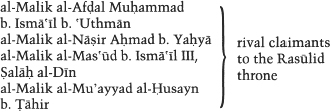
845–58/1442–54 |
al-Muzaffar Yūsuf II b. ‘Umar |
|
846/1442 |
|
|
846/1442 |
|
|
847–58/1443–54 |
|
|
855–8/1451–4 |
|
|
858/1454 |
Ṭāhirid capture of Aden |
Obliging historians and genealogists concocted for the Rasūlids a descent from the royal house of the pre-Islamic Ghassānids and, ultimately, from Qahtān, progenitor of the South Arabs. But it is more probable that they came from the Menjik clan of the Oghuz Turks, who had participated in the Turkish invasions of the Middle East under the Saljuqs, and that the original Rasūl had been employed as an envoy [rasūl) by the ‘ Abbāsid caliphs.
A number of amirs from the Rasūlid family accompanied the first Ayyūbids to Yemen (see above, no. 30, 8), and, when the last Ayyūbid, al-Malik al-Kāmil’s son al-Malik al-Mas’ūd Salāh al-Dīn Yūsuf, left Yemen for Syria in 626/1229, he left Nūr al-Dīn ‘Umar al-Rasūlí as his deputy. In the event, no Ayyūbid ever reappeared in Yemen, so the Rasūlids now began to rule independently in Tihāma and the southern highlands, acknowledging the Ayyūbids and the ‘Abbāsid caliphs as their overlords; Ayyūbid traditions remained strong in the new state, seen for example in their royal titulature. Very soon, the strongly Sunni Rasūlids were able to extend their power and to capture Ṣan‘ā‘ from the Zaydī Imāms, holding it for a few decades, and as far eastwards in Hadramawt and Zufār as modern Sālala in the southern part of the sultanate of Oman. The later thirteenth and fourteenth centuries saw the zenith of Rasūlid political power and cultural splendour. The sultans were great builders in such cities as Ta‘ izz and Zabīd, and were munificent patrons of Arabic literature, with not a few of the sultans themselves proficient authors. From Aden, a far-flung trade was conducted to India, South-East Asia, China and East Africa, and an embassy from Yemen to China is recorded, doubtless stimulated by these trade links with the Far East. But after the death of Salāh al-Dīn Aḥmad in 827/1424, the Rasūlid state began to show signs of disintegration, with indiscipline among the Rasūlids’ slave troops, a series of short-reigned rulers and internecine warfare among several pretenders. Thus when the Rasūlid amir of Aden, al-Ḥusayn b. Tahir, surrendered his city to the Tāhirids (see below, no. 50) and Salāh al-Dīn b. Ismā‘īl III left for Mecca, the rule of the family came to an end after more than two centuries.
Lane-Poole, 99–100; Zambaur, 120; Album, 27.
EI2 ‘Rasūlids‘ (G. R. Smith).
G. R. Smith, The Ayyūbids and Early Rasūlids in the Yemen, II, 83–90, with genealogical tables at pp. 83–4.
idem, in W. Daum (ed.), Yemen: 3000 Years of Art and Civilisation in Arabia Felix, 1367, 139, with a list of rulers at p. 139.