50
858–923/1454–1517
Southern Yemen and Tihāma, with their capitals at al-Miqrāna and Juban
|
858/1454 |
|
|
864/1460 |
al-Malik al-Mujāhid ‘Alī b. Tāhir, Shams al-Dīn, as sole ruler |
|
⊘ 883/1478 |
al-Malik al-Manṣūr ‘Abd al-Wahhāb b. Dāwūd b. Tāhir, Tāj al-Dīn |
|
⊘ 894–923/1489–1517 |
al-Malik al-Zāfir ‘Āmir II b. ‘Abd al-Wahhāb, Salāh al-Dīn |
|
923/1517 |
Conquest of the Yemen by the Egyptian Mamlūks |
|
(924–45/1518–38 |
Persistence of some Tāhirid princes in fortresses of the highlands of Yemen; five of them are mentioned, from Aḥmad b. ‘Āmir II to ⊘ ‘Āmir III b. Dāwūd) |
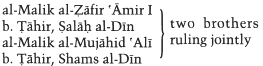
The Ṭāhirids were a native Yemeni, Sunnī family who rose to prominence in the last days of the Rasūlids (see above, no. 49) and took over the Rasūlid lands in southern Yemen and Tihāma on the demise of that dynasty. Four sultans ruled jointly or succeeded each other, maintaining the administrative traditions of their former patrons. They also inherited the Rasūlids‘ role as great builders: in such towns as Zabīd, the religious centre of Yemeni Sunnism, they erected mosques and madrasas; in Aden, the principal port of Yemen and bastion against the Egyptian Mamlūks and the Portuguese (it was first besieged by Afonso d‘Albuquerque in 919/1513), they built commercial premises and fortifications. In highland Yemen, they extended their power against the Zaydī Imāms and captured Ṣan‘ā‘. But the Egyptian Mamlūks wished to control Yemen as a base for operations in the Indian Ocean against the Portuguese, and after 921/1515 Egyptian attacks began, leading to the Mamlūks ‘occupation of much of Yemen and the end of the Tāhirids. Only a few Tāhirid chiefs seem to have survived in the highland zone until the Ottoman governor Süleymān Pasha executed the last one, ‘Āmir III b. Dāwūd, in 945/1538.
Lane-Poole, 101; Zambaur, 121; Album, 27.
G. R. Smith, in W. Daum (ed.), Yemen: 3000 Years of Art and Civilisation in Arabia Felix, 137–9, with a list of rulers at p. 139.
Venetia A. Porter, The History and Monuments of the Tahirid Dynasty of the Yemen 858923/1454–1517, University of Durham Ph.D. thesis 1992, unpubl., I, with genealogical tables at pp. 295–7.