
• 3 •
After more than four centuries of Muslim rule, Jerusalem was once again in Christian hands. But for how long? The victories of the First Crusade were impressive, yet they remained isolated conquests far from home and deep in Muslim territory. Pious idealism had brought these courageous knights to the Holy Land and convinced them of the inevitability of their success, but it would take more than that to sustain and extend a new kingdom planted on foreign soil. What was needed was a strong ruler, ready troops, and abundant supplies. The crusaders lacked all three.
BIRTH OF THE LATIN KINGDOM OF JERUSALEM
Pope Urban II never directly addressed the problem of the government of Jerusalem. Back in 1096, when the crusaders were first leaving Europe, he expected that any conquered lands would be restored to the Byzantine Empire. Since then, most of the crusade leaders had repudiated their oaths to Emperor Alexius I. They would not hand over their hard-won conquests to the man who had left them to die at Antioch. Who, then, should rule? Many assumed that the patriarch of Jerusalem or perhaps a papal legate would govern the city, just as the pope governed Rome and the Patrimony of St. Peter. Should not the church rule in Christ’s Holy City? The crusade, however, had had no papal legate since the death of Adhemar, and the Greek Orthodox patriarch of Jerusalem had died in exile a few days before the conquest. Although the crusading clergy insisted that a new patriarch be chosen before the election of a secular ruler, the barons could not come to any agreement on the matter, so it was postponed.
The crusaders did not have the luxury of arguing for months over control of Jerusalem as they had done at Antioch. With a powerful Egyptian army on the march, they needed a ruler to organize the defense of the city and its lands. In council, the leaders decided to offer the crown to Raymond of Toulouse, still the wealthiest and most powerful of the crusade leaders. As commander in chief, Raymond had distinguished himself as a pious and effective leader. In addition, his troops were already in control of Jerusalem’s citadel, the Tower of David, and it would be difficult to dislodge them. Raymond responded coyly to the offer, saying that he would not be king where Christ alone reigned. Given his material and strategic position, the count of Toulouse was indulging in a bit of cleverness, piously refusing a crown that he knew would be pressed on him again. Yet he was too clever. After his refusal, the council offered the crown to Godfrey of Bouillon. Godfrey was well liked by the rank and file, who knew him as a gallant and courageous warrior and the commander who had first led his troops into Jerusalem. Godfrey also refused the crown but took the city, saying that he would act as defender against the infidels. Later, he appears to have accepted the title Advocatus Sancti Sepulchri, “Protector of the Holy Sepulcher.”
When Raymond heard the news, he was incensed. He refused to remove his troops from the Tower of David. This was of serious consequence since Godfrey could never truly control the city without its military stronghold. The other leaders begged Raymond not to provoke a war among Christians when the Muslims were amassing against them. At last, the count of Toulouse agreed to put the citadel under the control of the bishop of Albara until a church council could decide the matter. But the instant Raymond left the city, the bishop betrayed him, handing over the Tower of David to Godfrey. Disgusted, Raymond abandoned Jerusalem, taking with him all of his troops. He made a pilgrimage to the Jordan River, leaving Godfrey to fend for himself. However, when later he heard reports that a large Egyptian army was encamped near Ascalon, Raymond relented, bringing his forces back to join the other crusade leaders.
The Fatimid commanders expected the crusaders to hole up in Jerusalem, so they were caught completely by surprise when the Christian forces swept down on their camp at Ascalon on the evening of August 11. The sultan’s soldiers were still asleep when the blare of the knights’ horns and the rumble of hoofbeats woke them to the impending disaster. The entire Egyptian force was destroyed. For the moment, the conquest of the Holy Land was secure.
After the battle at Ascalon, most of the soldiers of the First Crusade boarded vessels for home. Each received a hero’s welcome. The stories of these brave men marching two thousand miles across hostile terrain to redeem the land of the Savior stirred the imaginations of generations of Europeans. The exploits of the leaders, particularly Godfrey of Bouillon, were immortalized (and exaggerated) in numerous epics and songs. Godfrey became the symbol of perfect Christian chivalry for centuries. Yet all of that was of little use to him in 1099. With the departure of most of the crusaders, Godfrey had the difficult task of extending control over a Muslim countryside with a mere three hundred knights and about two thousand foot soldiers. Of the original crusade leaders, only Tancred, the cousin of Bohemond of Taranto, remained in Jerusalem. By force of arms, Tancred carved out lands for himself in nearby Tiberias, which he held as a fief from Jerusalem.
Godfrey’s reign was significantly complicated by the arrival of Daimbert, archbishop of Pisa and papal legate, who soon also became patriarch of Jerusalem. Daimbert firmly believed that Jerusalem and the Holy Land should be ruled by the church, something that Godfrey was naturally less willing to accept yet hard pressed to resist. At stake was the nature of the forming crusader state. But Godfrey was to play no further role in that drama. On July 18, 1100, the Protector of the Holy Sepulcher died.
Godfrey’s death was welcome news for Daimbert, for he believed he could now take full control of Jerusalem. The patriarch was not in the city when Godfrey died, however, and Godfrey’s friends and comrades were not willing to hand over Jerusalem so easily. They summoned Godfrey’s brother, Baldwin of Edessa, to assume the throne. Baldwin gave the County of Edessa to his cousin Baldwin of Bourcq and prepared to travel to Jerusalem. Before leaving, though, he heard news that Bohemond of Antioch had recently led an expedition to secure his northern frontier and was captured by the Danishmends. Antioch was without a ruler and therefore vulnerable. Immediately, Baldwin marched to the city and secured it before heading south to Jerusalem. On Christmas Day of 1100, in the Church of the Nativity in Bethlehem, a reluctant patriarch crowned Baldwin I (1100–1118) the first king of Jerusalem. Shortly thereafter, Daimbert was removed from office. His plan to place Palestine under ecclesiastical rule fizzled. Henceforth, the patriarch of Jerusalem was an important bishop in an important city, but no ruler.
THE CRUSADES OF 1100–1101
The departure of crusaders after the conquest of Jerusalem was partially offset by a steady stream of new crusaders arriving from the West. Most of these new arrivals were those who had earlier taken the cross but, for one reason or another, were delayed in their departure. Some constituted sizable forces. The only two European states to join the crusade officially, sending expeditions at government expense, were the republics of Pisa and Venice. For these maritime powers, preparation for the crusade was not simply a matter of assembling soldiers, supplies, and money: it required the construction of fleets. The northern Italian sailors were not unfamiliar with the ports of the Near East, and they knew well that the Franks could not hope to conquer and hold the ports without a powerful navy. Ships take time to build, so neither state was ready to depart in 1096. Pisa launched a very large war fleet of 120 vessels in 1098. Venice was further delayed by a ducal election, but in July 1099 Doge Vitale I Michiel (1096–1101) led a massive crusader fleet of more than two hundred ships from the Venetian lagoon. The arrival of the Venetians increased Christian manpower in Palestine tenfold, giving Godfrey an effective force to extend his conquests. Michiel and Godfrey decided to attack the rich port city of Acre, but Godfrey’s untimely death complicated the situation. Instead, the Venetians captured Haifa for the Franks and then returned home.
News of the sweeping successes of the First Crusade stirred many thousands of previously hesitant knights and soldiers to take the cross and thereby to share in the glory of the holy enterprise. Others had embarked on the original expedition but returned home before its completion. Stephen of Blois, the most famous deserter, was bitterly rebuked by his wife, family, and vassals when he showed up in France. He and other deserters were ordered by the pope to fulfill their pilgrim’s vow to travel to the Holy Sepulcher. The sheer numbers of people who departed on crusade after the conquest of Jerusalem has led Riley-Smith to refer to the movement as the “third wave” of the First Crusade. It is more traditionally known as the Crusade of 1101. These new crusaders departed with a sure knowledge that God would work miracles for them just as he had done for the valiant soldiers who restored Antioch and Jerusalem to Christendom. They were to be disappointed. The First Crusade benefited from the Muslims’ confusion about the nature and scope of the enterprise, as well as their inexperience with Frankish heavy cavalry. This new wave of crusaders could not rely on those advantages.
One of the largest groups of new crusaders came from Lombardy in northern Italy and was led by the archbishop of Milan. It left in the fall of 1100, passing through the Byzantine Empire and crossing into Asia at Constantinople. At Nicomedia, the Burgundian army of Stephen of Blois, as well as Raymond of Toulouse, met the Lombard crusaders. The new crusaders had heard of the recent capture of Bohemond and were eager to lead a mission to rescue this hero of the First Crusade. Speaking from experience, Raymond and Stephen strongly argued against a march into northern Anatolia, but the Lombards were determined. In mid-July 1101, they met a combined army of Turks on the field of battle. The Christians were destroyed; only a handful survived, including Raymond, Stephen, and the archbishop of Milan. None of the other new armies of crusaders met with any more success; all were crushed in Asia Minor before they could reach Antioch. In the failure of these expeditions, the largest that Europe had yet launched, the astounding success of the First Crusade seemed even more miraculous.
The failure of the follow-up crusades was a bitter disappointment to the barons and knights of the East. Without additional conquests, the newborn kingdom of Jerusalem could not survive. Overall, their strategy was to consolidate Christian conquests while further expanding to the south and east. If Ascalon could be taken, the Sinai desert would lie between the crusaders and the armies of Egypt. If Aleppo and Damascus were conquered, the Turks would lose their base of operations for an attack on Jerusalem or Antioch. The rich ports along the Mediterranean coast would also have to be captured if they were to cut off Turkish access to the sea. It was a tall order and one that would have to be filled with a bare minimum of men.
CONSOLIDATION IN THE NORTH
From Bohemond of Antioch’s point of view, Aleppo was the greatest danger to the Christians. Shortly after he was released from captivity in 1103, he allied with Baldwin of Bourcq, the ruler of Edessa, and Joscelin of Courtenay, Baldwin’s most powerful vassal, to wage war on their nearby enemy. The campaign was a disaster from the start. Almost the entire Christian army was killed, and Joscelin and Baldwin were captured. Bohemond managed to escape back to Antioch, but the northern states were in a dangerously weakened condition. Quickly, King Baldwin of Jerusalem dispatched Tancred to act as regent in Edessa and defend it against attack. The real threat, though, came from a different quarter.
Despite his oaths, Bohemond had not moved to restore Antioch to the emperor in Constantinople. Tired of waiting, Alexius sent armies to take it by force. They captured Cilicia, but nothing else. Nevertheless, war between the Byzantines and Normans had once again been joined. Leaving Tancred as regent of Antioch, Bohemond swiftly sailed to Italy, where he prepared to invade the Byzantine Empire at Durazzo. In 1107, Bohemond led his Norman troops across the Adriatic, just as he had done with his father in 1082. But much had changed since then. Through careful administration, Alexius had restored the Byzantine army and navy to a respectable level. With Venetian assistance, the Byzantines easily repulsed Bohemond. In defeat, he was forced to accept the Treaty of Devol, stipulating that the Norman leader was to retain Antioch but only as a vassal of the Byzantine emperor. He was also to restore the Greek patriarch of Antioch, who had been ousted in favor of a Latin prelate. Humiliated by his defeat, Bohemond never returned to the East. In 1111, he died in Apulia, in southern Italy.
After returning to Palestine from Constantinople, Raymond of Toulouse made preparations to conquer some land for himself. He chose the strategic port of Tripoli. On a hill outside the city, which he renamed Mount Pilgrim, Raymond built a large castle to undertake the siege and to protect the city after its conquest. Tripoli was a true prize. Not only was it a vital port, but its location also made it the natural membrane between the French in the south and Normans in the north of the new crusader states. The siege was a long one, and Raymond, who was already an old man, did not have time to wait. He died on February 28, 1105, already styling himself count of Tripoli. Immediately after his death a dispute broke out over the inheritance of the still unconquered county. There were two contenders: Raymond’s cousin William, who had accompanied him on the crusade, and his son Bertrand, who had recently arrived from Toulouse. All the major princes, including King Baldwin and Tancred, as well as Baldwin of Bourcq and Joscelin, both of whom had recently been released from captivity, traveled to Tripoli to decide the issue in council. They followed the judgment of Solomon, splitting the inheritance between William, who would be a vassal of Antioch, and Bertrand, who would owe his allegiance to Jerusalem. With that decided, the Christian princes joined forces to attack Tripoli, which surrendered on July 12, 1109. Thus, the last crusader state was formed. As it happened, however, the struggle over Raymond’s inheritance was moot. Shortly after the city’s conquest William died of an arrow wound. The entire County of Tripoli went to Bertrand, who held it as a fief from King Baldwin.
The capture of Tripoli was a great success for Baldwin I, not merely because of the addition of Tripoli to his feudal holdings but also because it was a clear demonstration of his royal power to settle disputes and lead Christian forces to important victories. Already he had won respect and approval by his conquests of the coastal cities of Arsuf and Caesarea in 1101. With the assistance of a Genoese fleet, he captured Acre in May 1104. After the fall of Tripoli, he continued his drive to capture the coast by marching north to Sidon and Beirut. There, with the help of a fleet of Norwegians led by King Sigurd, he captured both cities in 1110. In less than ten years, Baldwin had conquered the entire Palestinian coast, with the exception of Tyre and Ascalon.
Over the next decade, the Christians of the Latin East lost many of the original crusade leaders. In December 1112, Tancred died, only one year after Bohemond. Because Bohemond’s son was still a minor, the regency government of Antioch went to Roger of the Principate. Bertrand of Tripoli had died a few months earlier and was succeeded by his son, Pons. After extending his power farther to the south, King Baldwin I of Jerusalem led a small force into Egypt. He ventured as far as the Nile delta before turning back because of illness. He died on the return journey, on April 2, 1118. The true founder of the kingdom of Jerusalem, Baldwin had transformed a tenuous arrangement into a solid feudal state. With brilliance and diligence, he established a stable monarchy, conquered the Palestinian coast, reconciled the crusader barons, and built strong frontiers against the kingdom’s Muslim neighbors. The kingdom of Jerusalem clearly was not going away soon.
No precedent had yet been established for selecting a new king of Jerusalem. Was succession to be hereditary or by an election of the barons and clergy? Baldwin, who was childless, named his brother, Eustace of Boulogne, as his successor, but Eustace was in Europe and not overly enthusiastic about the inheritance in any event. Instead, the barons elected Baldwin of Bourcq, the ruler of Edessa. Baldwin II (1118–31) was an extremely pious man with a keen intelligence. He immediately handed over the County of Edessa to his former vassal Joscelin of Courtenay. In so doing, he hoped that the situation in the north would stabilize, but it did not. The following year, Roger of Antioch led his forces against Aleppo. On June 27, 1119, on the battlefield henceforth called the “Field of Blood,” the Turks crushed the Christian armies. The enormous loss of life was a severe blow to the crusaders, whose numbers were small in the best of times. Antioch and Edessa were again in danger. Baldwin issued an urgent plea to the pope requesting aid.
In the aftermath of the disaster, King Baldwin II was named regent of Antioch, which greatly enhanced his power and prestige but did not endear him to his local vassals. Much of the king’s energy was now expended on the volatile situation in the north. In 1122, Balak of Aleppo launched a powerful attack against Edessa. Again the Turks defeated the Franks, although they failed to take the city itself. In the melee, Balak captured Joscelin. Immediately, Baldwin marched against Balak in an attempt to free his comrade. He too met defeat. And so it was that in April 1123 the ruler of Aleppo added the king of Jerusalem to his collection of captive crusade leaders.
THE VENETIAN CRUSADE OF 1122
Baldwin’s request for help from Europe did not go unanswered. Pope Calixtus II (1119–24), preoccupied with the Investiture Controversy, passed the request on to the Republic of Venice. Again led by their doge, the people of Venice constructed a large fleet of 120 vessels filled with more than fifteen thousand men. Marked with the sign of the cross and carrying the papal banner, the armada left Venice on August 8, 1122. On the way, the Venetian crusaders decided to settle a score with the new Byzantine emperor, John II Comnenus (1118–43). The latter had refused to honor the trading privileges that Alexius granted to the Venetians after Byzantium’s war with the Normans. During that war, the Venetians had conquered the island of Corfu for Byzantium, and they now meant to have it back. The fleet spent the winter of 1122–23 unsuccessfully besieging the island’s defenses. In early spring, word of Baldwin’s capture reached the doge, so he ordered the fleet to sail immediately for the Levant. When the Venetians arrived in May, they learned that a large Egyptian fleet had abandoned a blockade of Jaffa and was returning to its base at Ascalon. Swiftly, the doge ordered his fleet to intercept the Muslim armada. The Venetian sailors brilliantly surrounded the enemy and destroyed them. Heralded by the devastation of the Fatimid navy, the men of the Republic of St. Mark arrived in Palestine for a second time. Next, the fleet sailed for Tyre, completely encircling it. With help from the Franks on land, the Venetians continued the siege for more than a year. Tyre at last surrendered on July 7, 1124.
The conquest of Tyre took place without Baldwin II. When Balak of Aleppo died later in the year, the king was released from captivity. The problem of his regency of Antioch resolved itself the following year when young Bohemond II arrived to claim his inheritance. The new heir had a rare moment of opportunity. The death of Balak had plunged Aleppo into a power struggle both internally and with Mosul in Mesopotamia, making it exceedingly vulnerable to attack. Thus, one of the major objectives of the rulers of Antioch was in easy reach. The inexperienced and headstrong Bohemond wasted the chance, preferring instead to wage war against his fellow Christian, Joscelin of Edessa. In the process, he weakened both states and gave the Muslims time to settle their disputes. By 1128, Imad ad-Din Zengi had succeeded in taking control of both Aleppo and Mosul, making him the most powerful Muslim the crusaders had yet faced. Zengi was a clever man, full of guile and ruthless ambition. He was determined to expand his territories into Syria and Palestine by whatever means necessary and against any foe, Christian or Muslim.
Bohemond II’s poor leadership of Antioch ended in 1130, when he was killed fighting the Byzantines at Cilicia. He left a two-year-old daughter, Constance. Once again, the regency of the principate fell to King Baldwin II, who was very ill at the time. On August 21, 1131, the king died. A short time later, Joscelin also died, after bravely defending the increasingly defenseless Edessa. With the passing of these men went the last of the original crusaders. They were the warriors of Christ who had marched to the Holy Land and carved out a Christian state. They were the pilgrims who took the crusader’s vow and restored Jerusalem to Christian rule. They were the heroes of a generation of knights, typifying the selfless virtues of a noble and chivalric Christian knight. The next generation of leaders in the crusader states were different. Many of them were born in Outremer, “beyond the sea”; it was their native land.
THE MUSLIM RESPONSE TO THE CRUSADES
One might expect that the Muslim reaction to the crusader conquests in the Near East would be a general call for jihad. Yet that is not what happened—at least not generally. In part this was a result of the seriously fractured nature of the Dar al-Islam at the time. Aside from the two opposing caliphs in Baghdad and Cairo, there were innumerable petty rulers across the region seeking to advance themselves at the expense of their neighbors. An effective jihad presupposed a unity that Muslims in the region simply lacked. There was also a profound lack of understanding among Muslims concerning the crusaders and their aims. Muslims tended to view the western Europeans as mercenaries or allies of the Byzantine emperor. Indeed, some Muslim chroniclers simply referred to the crusaders as “al-Rum,” or Byzantines. Because most Muslims did not consider events outside the Islamic world to be of much importance, it is not surprising that they viewed the arrival of the crusaders as a direct result of Muslim actions. The Christians were not a force unto themselves, they believed, but were instead a symptom of Muslim disunity. Ibn al-Athir is typical when he sums up the crusader conquests thus: “The sultans disagreed, as we shall relate, and the Franks seized the lands.” Why the Franks had come so far to take these territories was scarcely considered by Muslim writers. They were merely opportunistic adventurers, a judgment of God against a quarreling people.
As far as we know, only one contemporary Muslim observer had a general idea about the crusaders’ identities and an effective strategy to defeat them. Al-Sulami, a Damascene legal scholar and preacher, completed his work, The Book of the Holy War, in 1105, only a few years after the crusader conquest of Jerusalem. Al-Sulami understood clearly that the newcomers were not Byzantines. Indeed, he calls them “Ifranj,” denoting the Frankish people of central Europe. He knows that Jerusalem was their ultimate goal and warns his fellow Muslims that they will soon expand their territories:
Even now they are continuing the effort to enlarge their territory; their greed is constantly growing as they see the cowardice of their enemies who are happy to live away from danger. Moreover, they hope now for sure to make themselves masters of the whole country and to take its inhabitants captive. Would to God that, in His goodness, He would frustrate them in their aspirations by re-establishing the unity of the [Muslim] community.1
The Christians may have won impressive victories, but al-Sulami perceptively notes that they are inherently weak, hobbled by “the small amount of cavalry and equipment they have at their disposal and the distance from which their reinforcements come.” This weakness, he insists, “is an opportunity which must be seized quickly.”
Yet for all of his insights, al-Sulami attributed no more agency to the infidels than did his fellow Muslims. The crusaders were not holy warriors, but simply the product of Muslim infighting.
Examining the country of Syria, they [the crusaders] confirmed that the states there were involved one with another, their [the Syrians] opinions diverged, their relationships rested on secret desires for vengeance. Their [the crusaders] greed was thereby reinforced, encouraging them to apply themselves [to the attack].
Not surprisingly, then, the remedy for the Christian invasion was Muslim unity:
The sovereign . . . must devote himself to his relations with the sovereigns of other countries, Syria, the Jazira, Egypt and adjacent regions, for terror [of the crusaders] can reconcile the old hatreds and secret hostilities of the inhabitants of these countries as well as turn them away from their rivalries and mutual jealousies.
Despite al-Sulami’s urgings, the coming of the crusaders did nothing to heal the deep divisions that continued to rend the Muslim Middle East. Instead, the new Christian powers became simply new players in the chaotic political and religious landscape. Continued Muslim disunity allowed the Christian states to flourish. Indeed, in the newly forming crusader kingdom, Christians and Muslims would live side by side for almost two centuries. Yet they would continue to take very little interest in each other’s intellectual or religious backgrounds. Conversions sometimes occurred, but they were rare indeed. Most Latin Christian inhabitants knew nothing at all about Islam—or at least nothing accurate. By the same token, most Muslims in the region remained oblivious to Catholicism or Christianity in general, which they often referred to as “polytheism.” Yet, despite these religious barriers, there remained a fair amount of cultural exchange between the two groups.
Indeed, a new culture was forming in the Latin East, one that combined elements of Christianity and Islam, Europe and Syria. As time went on, those who lived in the crusader states were no longer itinerant crusaders but permanent residents. To defend their homes, they were willing to negotiate with and even befriend their Muslim neighbors. Yet to sustain their state, they required assistance from Europe. As time passed, a gulf opened between the new crusaders, who arrived from the West to fight Muslims, and the local residents, who would have to live with the Muslims after the pilgrims returned home. A new people arose who stood between two cultures, never fully belonging to either. Fulcher of Chartres describes it thus:
I pray you, consider and reflect on how God has in our times changed West into East. For we, who were occidentals, have now become orientals. The man who was a Roman or a Frank has, in this land, been turned into a Galilean or a Palestinian. He who was once a citizen of Reims or of Chartres has now become a citizen of Tyre or Antioch. We have already forgotten the places where we were born; many of us either do not know them or have never even heard of them. One among us now has his own houses and retainers, just as if he possessed them through hereditary or family right. Another takes as his wife, not a woman of his own stock, but rather a Syrian or Armenian, or even, occasionally, a Saracen who has obtained the grace of baptism. . . . Men address one another in turn in the speech and idiom of various languages. The several languages of various nations are common here and one joins faith with men whose forefathers were strangers. For it is written: “The lion and ox shall eat straw side by side.”2
Usama, an Arab writer and courtier, agreed that “there are some Franks who have settled in our land and taken to living like Muslims.” Indeed, Usama could differentiate easily between European residents of the crusader states and the visiting crusaders who arrived from Europe. “Everyone who is a fresh emigrant from the Frankish lands,” he writes, “is ruder in character than those who have become acclimatized and have held long association with the Muslims.” His aversion to the newcomers was well justified. He was once berated by a recently arrived Christian for praying toward Mecca, rather than in the Christian manner toward the East. The Frank became so angry that he physically grabbed Usama and tried to wrestle him into an eastern direction. But several of the Knights Templar, who lived in Jerusalem and knew Usama well, rushed to his aid, pushing the zealous Frank out of the way and apologizing to the shaken Muslim, saying, “He is a stranger who has arrived in these days from the country of the Franks.”3
Usama was also quick to point out where the two cultures parted company. One of these was in the divergent attitudes of Christians and Muslims toward women. Usama writes:
The Franks are without any vestige of a sense of honor and jealousy. If one of them goes along the street with his wife and meets a friend, this man will take the woman’s hand and lead her aside to talk, while the husband stands by waiting until she has finished her conversation. If she takes too long about it he leaves her with the other man and goes on his way.
From the Muslim point of view, this sort of behavior was not only immoral but could only lead to adultery. Indeed, European women were routinely condemned as wanton vixens because of their clothing and various freedoms. Usama underscored this when he told of his own experience in Nablus with a Christian wine seller. The man was frequently away on business and allowed his wife to come and go as she pleased.
Now this man returned home one day and found a man in bed with his wife.
“What are you doing here with my wife?” he demanded.
“I was tired,” replied the man, “and so I came in to rest.”
“And how do you come to be in my bed?”
“I found the bed made up, and lay down to sleep.”
“And this woman slept with you, I suppose?”
“The bed,” he replied, “is hers. How could I prevent her getting into her own bed?”
“I swear if you do it again I shall take you to court!”
And this was his only reaction, the height of his outburst of jealousy!4
THE MILITARY ORDERS
It was during the reign of Baldwin II that the first military orders were formed. In them, monastic discipline and martial skill were combined for the first time in the Christian world. In a real sense, the military orders brought the idea of the crusader to its logical conclusion. Here were fighting men who went beyond the quasi-monastic nature of the crusader’s vow by fully accepting a lifetime of service to Christ. Hugh of Payns, a knight of Champagne, founded the first of the orders. He and eight of his companions traveled to the Holy Land with the desire to devote their lives to Christ and turn their swords to acts of pious chivalry. The patriarch of Jerusalem, Gormund, administered to them the three monastic vows of poverty, chastity, and obedience, as well as a fourth vow to protect pilgrims on their way from the port of Jaffa to Jerusalem. Baldwin II gave the company rooms in the former mosque of al-Aqsa, which the crusaders called the Temple of Solomon. From their new headquarters they derived their name, the Knights Templar. Back in Europe, Bernard of Clairvaux, a famous churchman, lent his considerable rhetorical skills to the advancement of the new order. With his help, the Templars received a rule and formal papal acceptance in 1128. Bernard brought waves of recruits to the order through his preaching and writing on the “new chivalry,” a knighthood dedicated to God. Soon, these armored men, donning white tunics emblazoned with a red cross, could be seen throughout the crusader states and across Europe (photospread illustration 2). Their duties in the East rapidly expanded as subsequent kings assigned them strategic areas to safeguard. The castles they built were enormous fortresses, dwarfing anything that could be found in western Europe. On both sides of the Mediterranean they built monastic houses and round churches modeled on the Church of the Holy Sepulcher. Those in Europe were meant to raise funds for activities in the East, but they also provided services for pilgrims. In time, these services included the ability to deposit money in a Templar convent in Europe and collect it in the Levant, minus a service charge. This convenience put the Templars in the unlikely business of banking, thus sowing the seeds of their ultimate demise. Yet those days were far distant. In the twelfth century, the Knights Templar were a truly international order of warriors, independent of episcopal control, who devoted themselves to monastic discipline and military service.
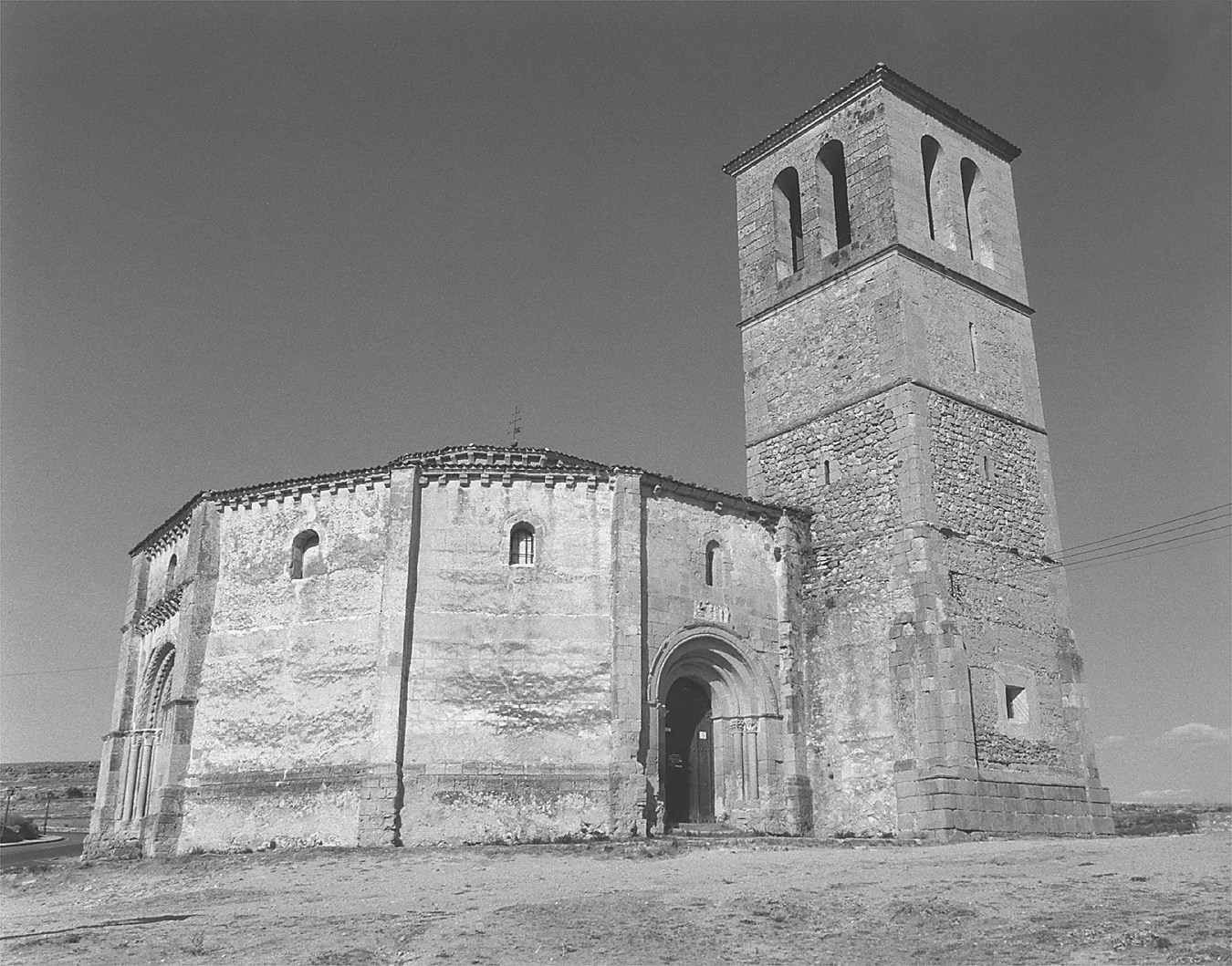
Figure 2. Templar Church of the True Cross in Spain. Templar churches in Europe were often modeled on the Church of the Holy Sepulcher in Jerusalem. Photo by Alfred J. Andrea.
Another military order active in the crusader states was the Knights of the Hospital of St. John, or the Hospitallers. Unlike the Templars, the Hospitallers did not start out as a military organization—far from it. Shortly after the capture of Jerusalem, monks from the abbey of St. Mary of the Latins founded the Hospital of St. John, an institution dedicated to the care of sick pilgrims. Their special concern was for the “holy poor,” whom they treated with every kindness and offered every luxury. With the surge in pilgrim traffic to Jerusalem in the first decade of the twelfth century, the need for the hospital grew. Soon it had more than two thousand beds and an army of men and women who selflessly cared for the sick and dying. Accommodations were extravagant. Few of the poor who came to the hospital had ever slept in a proper bed, let alone consumed the meats, vegetables, and wines that were the standard fare. In all this, the hospital staff remembered the words of Christ: “Whatsoever you do to the least of these, so you do unto me.” In 1113, the Hospitallers became a religious order separate from the monastery of St. Mary of the Latins, but they did not become involved in military affairs until much later. In 1136, King Fulk gave control of a fortress near Ascalon to the Hospitallers, but they probably hired mercenaries to man it. Other responsibilities followed. During the course of the twelfth century, additional castles were turned over to them, forcing the Hospitallers to create a military arm of their order. By the beginning of the thirteenth century, their military responsibilities overshadowed, yet never fully extinguished, the care of the poor and sick.
With the Templars and Hospitallers, the crusader states had a permanent, reliable presence of expert soldiers dedicated to the defense of the Christian East. In a place where large crusades came and went, the military orders provided stability otherwise impossible to maintain.
THE RISE OF ZENGI
Baldwin II had made careful preparations for the succession of the crown of Jerusalem. Although he had no son, he married his daughter Melisende to the powerful lord Fulk of Anjou. The kingdom was to go jointly to Fulk, Melisende, and their two-year-old son, Baldwin. Fulk took the royal title in 1131, but authority over the kingdom was shared between him and his wife. King Fulk (1131–43) also inherited the regency over Antioch. For too long, this important city had been ruled by regents and absentees. With the alarming rise of Zengi, the atabeg of Mosul and Aleppo, it was necessary to find for Antioch a solid ruler. At Fulk’s command, Bohemond II’s younger daughter, Constance, now nine years old, was married to the thirty-four-year-old Raymond of Poitiers, the son of Duke William IX of Aquitaine. Raymond arrived from Europe in 1136.
Ominous tidings continued to come from Zengi’s growing state. Zengi was a ruthless despot and powerful warrior. He was not well liked, especially among his Muslim neighbors. Imad al-Din al-Isfahani described him as “like a leopard in character, like a lion in fury, not renouncing any severity, not knowing any kindness.” To the relief of Raymond of Antioch, Zengi was preoccupied with Muslim Damascus. Repeated sieges failed, but they took a hard toll on the city. Zengi was momentarily distracted when the Byzantine emperor John II unsuccessfully attempted to capture Aleppo in 1138. The following year, Zengi prepared again to attack Damascus. Weakened by previous assaults, the city seemed certain to fall. Desperate, the emir of Damascus turned to the Christians. King Fulk also had no desire to see Zengi extend his power to the borders of the Latin kingdom, so an alliance between Christian Jerusalem and Muslim Damascus was forged. Fulk mobilized his troops to assist in the defense of his Muslim neighbors. Foiled by the alliance, Zengi turned his attention to affairs in Mesopotamia. For the moment, the threat was averted.
Like his predecessors, Fulk knew that the security of the crusader states depended on strong borders. Capturing Damascus would provide a solid defense on Jerusalem’s eastern flank, but a firm alliance with the city was the next best thing, at least from a strategic point of view. New crusader arrivals from Europe were routinely shocked that the king of Jerusalem made peace with Muslims of any stripe, particularly when they controlled a city made holy by the life of St. Paul. To the north, Aleppo and Mosul continued to pose a danger, but there was nothing to be done about it while Zengi held them in his grip. To the south, Ascalon remained a thorn in the side of the Christians. Egyptian troops could land there at will, raiding the countryside and causing enormous damage. Without a fleet at his disposal, Fulk had no hope of capturing Ascalon, so he made provisions to isolate it. A ring of castles was constructed around the city between 1136 and 1142. Some of these were given to Fulk’s vassals or friends, others to the Hospitallers. These were not the only castles built or improved during Fulk’s reign. Across the landscape arose powerful fortresses, strategically positioned to defend commerce and property. The most famous of them, Krak des Chevaliers, commanded the important roads running from Hama and Homs to the coast of the Mediterranean. In 1144, it was given to the Hospitallers, who spent the next century expanding and strengthening it. Even in the best of times, Latin Christians were a minority in the East. Mammoth fortifications like these were essential if they were to defend their kingdom.
In November 1143, King Fulk, while hunting, was thrown from his horse and killed. Queen Melisende retained control of the kingdom. Her eldest son, Baldwin III (1143–63), was still only thirteen years old. Melisende was an able ruler, yet the kingdom needed more. Already the crown’s vassals were testing their independence; with a woman and a minor on the throne, that trend would only accelerate. More worrisome was the continued ill will between the prince of Antioch and the count of Edessa. The two were within a hair’s breadth of open war. Jerusalem needed a strong king to end these quarrels and enforce discipline.
The death of Fulk did not go unnoticed by Zengi. With his operations in the East concluded, he was now in a position to begin a major offensive against the Christians. Through brute force, Zengi had become powerful enough to lead some Muslims to wonder whether he might be the one to unify the region against the crusaders. By 1143 Zengi was being referred to by Muslim writers as a mujahid, a jihad warrior. This was something new, and Zengi was quick to recognize the advantages of waging a holy war. With a woman ruling in Jerusalem and Christian leaders fighting among themselves, he saw that the time was ripe to begin the attack. His first object was Edessa, which he lay siege to in late November 1144. The city was well fortified, but Joscelin was absent, keeping his best troops at nearby Turbessel. The count of Edessa begged Raymond for reinforcements to break the siege, but the prince of Antioch refused. Queen Melisende dispatched a relief force, but it was too little and too late. On Christmas Eve, Zengi’s Turkish and Kurdish army breached the walls of Edessa and captured the city. The first of the crusader states was the first to fall. The buffer state that had disrupted communications between Muslims and provided a strong flank for Antioch was gone, putting the northern territories in grave danger.
News of the fall of Edessa had a profound effect on Christians and Muslims alike. The Christian aura of invincibility was shattered. A new generation of Muslims who had thought of the crusader states as permanent entities now began to think again. Zengi, of course, was the biggest winner. His power was suddenly unmatched in the Muslim world. Behind his rhetoric of jihad, he planned to push the Franks off the map, sending them back to distant Europe. His official title, atabeg of Mosul, was now replaced with “king” and “conqueror.” The caliph in Baghdad called him “the adornment of Islam.” Yet the apex of his power was also its end. On September 14, 1146, Zengi was murdered in his bed by a slave who was angry for having been scolded for drinking Zengi’s wine. The forming kingdom quickly unraveled.
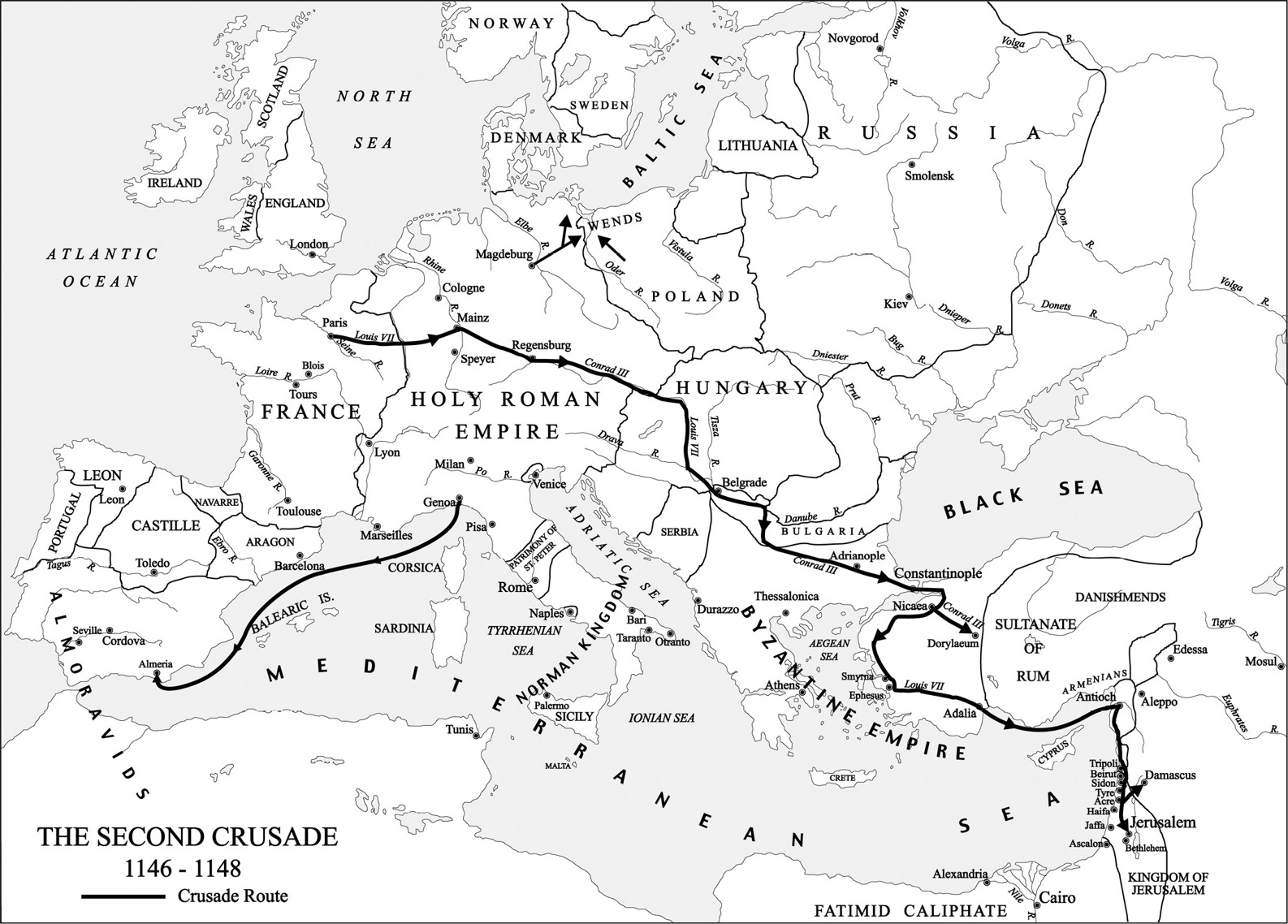
THE SECOND CRUSADE
In Europe, the fall of Edessa and the rise of Zengi was stunning news. The barons of the crusader states did not exaggerate when they reported that all of the Latin East, including Jerusalem itself, was in mortal danger. They were desperate for help. No major crusading effort had been undertaken in Europe since just after the conquest of Jerusalem. With the Holy City in Christian hands and the crusader states in stable condition, there were few clear objectives around which a grand enterprise could crystallize. In the intervening four decades, an entire generation of Europeans had been born and raised on the epic stories of the First Crusade. It was now the stuff of legend. There was scarcely a Christian knight who did not know by heart the exploits of Godfrey of Bouillon and long for the opportunity to imitate them. Here was the spark that could reignite the fire of crusade.
On December 1, 1145, Pope Eugenius III (1145–53) issued the papal bull Quantum praedecessores. It was reissued in a modified form on March 1, 1146. As the title suggests, the bull looked back to the glorious victories of the First Crusade and called the knights of Christendom to take up the cross of Christ, following him to the land of his birth and resurrection. After a narration and exhortation, Quantum praedecessores laid out the crusading privileges that henceforth became standard in the West. These included protection of property as well as suspension of interest and debt collection. Eugenius was eager to see the new crusade preached in France and Italy, but he plainly did not want the Germans to take part. The pope needed German emperor Conrad III (1138–52) to support him in his quarrels with the Normans in southern Italy; he did not want his allies leaving him in the lurch to fight in distant Palestine. The devout and pious King Louis VII of France (1137–80) had for some time been considering the idea of leading an expedition to the East, although his barons and advisers continued to dissuade him. Even after the formal declaration of the crusade, the king’s chief counselor, Abbot Suger of St. Denis, urged him to remain at home.
The Second Crusade was born by papal pronouncement, but it drew breath from the words of Bernard of Clairvaux. Bernard had already developed and embraced the idea of a “new chivalry” as a means of doing God’s work while purifying Christian society. He now put his substantial prestige behind the new crusade. In a very real sense, it was his crusade. He and his Cistercian brothers fanned out across France preaching the cross. Because Jerusalem was the seat of a Christian kingdom and had been so for nearly half a century, the exhortations used by the preachers of the First Crusade were no longer appropriate. Soldiers could not be asked to forsake all to reclaim the lands of Christ when those lands were still in Christian hands. Instead, Bernard and his brothers portrayed the crusade as a means of redemption itself:
Again I say, consider the Almighty’s goodness and pay heed to his plans of mercy. He puts himself under obligation to you, or rather feigns to do so, that he can help you to satisfy your obligations toward himself. . . . I call blessed the generation that can seize an opportunity of such rich indulgence as this, blessed to be alive in this year of jubilee, this year of God’s choice. The blessing is spread throughout the whole world, and all the world is flocking to receive this badge of immortality.5
In his mercy, Bernard proclaimed, Christ called those who lived their lives by the sword to use their martial skills to fight for him in the East. Of course, Christ could restore Edessa, indeed all the world, to his rule if he so chose. But instead he gave a rare gift to his children: the opportunity to show their faith by taking on the mantle of the cross. In return, he would shower victory, glory, and salvation on them forever. For Bernard, there was no question about the outcome of the crusade. Just as God had performed miracles for the heroes of the First Crusade, so now he was eager to do the same for a new generation of pious Christians.
Louis VII received the crusader’s cross from Bernard himself, as did his wife, Queen Eleanor, the heiress of the Duchy of Aquitaine and niece of Raymond of Antioch (photospread illustration 3). The king and queen of France were an odd couple—Louis austere and pious, Eleanor cultured and extravagant. By all accounts, Louis loved Eleanor deeply, but the crusade was to be a strain that the marriage ultimately could not bear. At an assembly of Louis’s nobles, Bernard administered the crusader’s vow to so many that he ran out of cloth crosses and was forced to tear them out of his own habit. With the crossing of the king and his barons, the crusade quickly picked up steam across France. Bernard did his best to keep enthusiasm levels high, traveling across northern France preaching tirelessly.
In one sense, Bernard was repeating the role played by Peter the Hermit during the preaching of the First Crusade. He was keenly aware of this and eager that the similarity not extend to Jewish massacres or a premature and ill-equipped crusade. Repeatedly, Bernard stressed that the Jews were not to be persecuted:
Ask anyone who knows the Sacred Scriptures what he finds foretold of the Jews in the Psalm. “Not for their destruction do I pray,” it says. The Jews are for us the living words of Scripture, for they remind us always of what our Lord suffered. They are dispersed all over the world so that by expiating their crime they may be everywhere the living witnesses of our redemption. . . . Under Christian princes they endure a hard captivity, but “they only wait for the time of their deliverance.”6
Like Peter, though, Bernard found that his best efforts were not enough. Radulf, a fellow Cistercian monk, had begun preaching in northern France against the Jews. By the time that the renegade reached the German Rhineland, his words were sparking massacres of Jews in the same cities that had suffered similarly fifty years earlier. Bernard’s repeated letters to the people of the Rhineland to cease their persecutions fell on deaf ears. Finally, he went there himself. When he caught up to Radulf, Bernard bitterly rebuked him and sent him back to his convent. Although he was able to put a stop to the persecutions, Bernard could not quell the enthusiasm for the crusade that had now spread into Germany.
Bernard knew well that Eugenius wanted Germany kept out of the crusade, but now that it was plainly involved, Bernard intended that it go all the way. Emperor Conrad III resisted Bernard’s first attempts at enlistment, but he was weakening. At Christmas Mass, Bernard directed his sermon to the emperor, asking him to imagine the Last Judgment when he would approach the throne of Christ. There the Savior would recount the many gifts he had bestowed on Conrad during his life: kingship, wealth, wisdom, courage, and strength. Then, remembering that the emperor refused to take up the crusader’s cross, Christ would ask him, “Man, what should I have done for you that I did not do?” Conrad collapsed in tears. When he looked up again, he replied simply, “I am ready to serve Him.” So too were hundreds of German nobles, who took the cross along with their king.
Bernard continued his preaching in Germany. On March 13, 1147, a large body of German (mostly Saxon) crusaders requested that they be allowed to fulfill their crusading vow by waging war on the pagan Wends living east of the Elbe River. This was a logical request, given that Bernard preached a war of redemption rather than armed pilgrimage. If God offered salvation to soldiers who fought for his causes, why should those causes be restricted to the Levant? That was how Bernard saw it, anyway. He immediately forwarded their request to the pope, whom he convinced to accept the plan. The Wendish Crusade, as it is called, is really just another manifestation of the Second Crusade. Although its destination and objective were different from those of the campaign to the East, the motivation, as described by Bernard and the other Cistercian preachers, was identical. The Saxons who fought the Wends did so to win the same salvation as their colleagues who marched to Syria. There was, however, one important difference: the objective of the Wendish Crusade was not to displace infidels but to convert them by the sword. Bernard himself forbade the crusaders from accepting peace from the Wends unless they were baptized as Christians:
We utterly forbid that for any reason whatsoever a truce should be made with these peoples, either for the sake of money or for the sake of tribute, until such a time as, by God’s help, they shall be either converted or wiped out.7
Here was a true Christian holy war.
The Second Crusade went in three directions at once. Aside from the movements to the east and north, there was also a major offensive in the southwest. Eugenius issued a separate bull authorizing a crusade in Spain against the Muslims. Lords in northern Spain and southern France joined with the Genoese to continue the long struggle to remove Islam from the Iberian Peninsula.
The pope’s Norman enemy, Roger II of Sicily, saw opportunity in the forming crusade. As an ally of the king of France, Roger offered his fleet to transport the French forces to their destination in the East. Along the way they could further the cause of Christendom by conquering what was left of the Byzantine Empire. Just as the virtuous deeds of Godfrey of Bouillon had been exaggerated by poetic license in the West, so were the putative transgressions of the Byzantine emperors. Sly, cowardly, double-dealing: these were the adjectives that best described a Byzantine for most Europeans who had never met one. Roger was not as concerned with the Byzantine attitude toward the crusader states as he was about the chance to at last make good on the century-old Norman desire to capture Constantinople and her empire. There was a strong anti-Byzantine party in the French court that urged Louis to accept the Norman offer. In the end, though, the desire to take the overland road made famous by the pilgrimage of Godfrey was too great. Louis declined Roger’s offer.
In Constantinople, Emperor Manuel I Comnenus (1143–80) was plainly irritated by the Second Crusade. He had painstakingly organized an anti-Norman alliance with the Germans, the papacy, and Venice. Now his plans lay in ruins. He was also not eager to disrupt his peaceful relationship with the Turkish sultan of Rum. Given the conduct of past crusades, it was clear to the emperor that the westerners had no intention of returning captured territories to the empire. He therefore made a truce with the Turks to forestall any Muslim attacks on Byzantine territory. Strategically, this was sound policy, but for the crusaders it was additional evidence of the apostasy of the Greeks. Rather than fighting the enemies of Christ, the Byzantines made deals with them.
The first band of crusaders to depart was a diverse collection of northerners, including Flemish, Norman, and English soldiers. They left Dartmouth on May 19, 1147, and sailed south along the coast of France and the Iberian Peninsula. While passing Portugal, they heard reports that King Alfonso I was conducting a siege of Muslim-held Lisbon and that he hoped the crusaders would assist him. Some opposed any delay in reaching the Holy Land, but the majority favored helping Alfonso when the king promised they could plunder the city after its capture. After a three-month siege, Lisbon surrendered to the crusaders on October 24, 1147. In the spring, the crusade fleet continued on its way, laden with riches.
Conrad and his German armies left Regensburg in May 1147. They arrived at Constantinople in September. Manuel was displeased by the Germans’ unruly passage through his empire but eager to salvage his relationship with Conrad. The German emperor remained aloof, eager to cross over into Asia Minor. In the city’s suburbs, the German troops and noncombatant followers repeatedly attacked Byzantine citizens, their businesses, and their homes. At last, Manuel sent the army across the Bosporus to meet the Turks.
Conrad should have waited for the French to join him, but he did not. After arriving at Nicaea, he decided to make his way to Antioch across central Anatolia along the same path that the First Crusade had traversed. And just as had occurred fifty years earlier, Conrad’s troops met a Turkish army near Dorylaeum. But the result was not the same. Surrounded by Turkish light infantry, Conrad’s forces were virtually defenseless. The carnage was horrible: almost the entire German army was killed. Conrad and a few other survivors struggled back to Nicaea, where they decided to await the arrival of the French.
Louis VII and his crusading army left France on June 11, 1147. They arrived at Constantinople on October 4. Some members of the royal court continued to advise the king to join forces with Roger II of Sicily and attack the capital city in a land-sea operation, but Louis would not hear of turning his holy army against a Christian empire. Manuel invited the king and queen into Constantinople, where they were housed in a lavish palace and treated to every luxury and entertainment that the wealthy and cosmopolitan city could offer. Louis was pleased and Eleanor enchanted, but the party soon ended. The French forces were ferried across the Bosporus to continue their pilgrimage.
Louis met Conrad at Nicaea, where the two kings discussed their situation. After his defeat at Dorylaeum, Conrad commanded only a tiny force. If the crusade were to succeed, it would rest with the French to make it happen. For obvious reasons, the rulers decided not to venture into central Anatolia again. Instead, they made preparations to march along the Aegean and Mediterranean coasts of Asia Minor, thus remaining in Byzantine territory as long as possible. Leaving Nicaea, the crusaders marched to Smyrna and then Ephesus, where Conrad fell gravely ill. At Manuel’s invitation, the German emperor sailed to Constantinople, where he was nursed back to health by the emperor and empress themselves. Relations between the two men were thus repaired. When he was healthy enough, Conrad sailed directly to Palestine from Constantinople.
Although the French army remained in Byzantine territory, its progress was anything but easy. The Turks continually harassed the army and raided the cities on which the crusaders depended for provisions. Disagreements between the Greeks and Latins broke out regularly, often ending in bloodshed. Manuel ordered his troops to protect Byzantine citizens, which meant that the French spent more time fighting Christians than Muslims. Rumors spread quickly that Manuel was purposely attempting to weaken the crusade so that it could be crushed by his friends, the Turks. Letters that Louis sent home make clear that the king believed that the Byzantines were no small part of the problems that beset his forces. At last, the crusade made it to Adalia. Antioch remained distant, and the king learned of the dire risks involved in marching farther along the coast into Turkish territory. He therefore contracted for a fleet of Byzantine vessels to transport his army safely to Antioch.
This was easier said than done. Although Byzantine and Italian ships were summoned throughout the region, there simply were not enough of them to carry so many people. Someone would have to stay. Louis put the clergy on the first boats. When the second group of vessels assembled and it was clear that no more were coming, he prepared to board along with his wife, court, closest friends, and assorted high nobles. The king provided the bulk of the army, including all the foot soldiers, with money and what little provisions he could muster, and ordered them to march to Antioch. Early in 1148, while marching east, the French soldiers were massacred by the Turks at Laodicea. Only a handful of survivors made it to Antioch to meet their king.
The Christians in the East were heartened by the death of Zengi, but they remained in difficult straits. Joscelin II had already made one attempt to recapture Edessa and failed. Zengi’s son, Nur ed-Din, now the ruler of Aleppo, subsequently ordered the massacre of all Christians in Edessa. Raymond of Antioch and Joscelin remained on bad terms. All parties waited expectantly for the enormous Christian army led by the kings of France and Germany. Instead, Louis and his court arrived at Antioch with but a remnant of the crusade armies that left Europe. The rest lay dead on the fields of Anatolia.
There was no longer any question of trying to recapture Edessa, the original purpose of the Second Crusade. Nevertheless, Louis had a good contingent of knights and money and could therefore still do much good for the Christian states. Raymond warmly welcomed the monarch and especially his own niece, Queen Eleanor. The prince explained to Louis the current state of affairs, pointing out that Nur ed-Din did not have the resources of Zengi because Mosul was under the control of his brother. Now was the time to strike against him by leading an army against Aleppo.
Louis and Raymond were men cut from very different cloth. The austere and pious king neither liked nor trusted the handsome, swashbuckling, and sophisticated man of Aquitaine. He particularly resented the spell that the count seemed to cast over Eleanor, who naturally enough admired her cosmopolitan uncle. When Louis proved reluctant to assent to Raymond’s plans, the prince made his case to the queen, who agreed with him completely. Rumors began to circulate that Raymond’s relationship with Eleanor was something more than avuncular. The final straw came when Eleanor proclaimed that if Louis did not lead his men against Aleppo, as Raymond requested, she would seek an annulment of their marriage on the grounds of consanguinity, taking rich Aquitaine with her. Heartbroken and angry, Louis placed the queen under house arrest and immediately left Antioch bound for Palestine.
Conrad had meanwhile arrived in Jerusalem with an army of mercenaries. When Louis joined him, the French forces were increased by the late arrival of crusaders from Provence. On June 24, 1148, the two kings convened an assembly at Acre of all the barons and leading clergy of the kingdom of Jerusalem. It was the largest such group ever assembled. Together, they commanded a powerful force. The question was what to do with it. Many options were debated, although the original purpose of the crusade, the recapture of Edessa, was not among them. Aleppo was the obvious target, but it received minor consideration. Louis probably was not eager to see Raymond’s plan endorsed by the assembly when he had already rebuked it at Antioch. At last, they settled on an attack on Damascus.
Jerusalem and Damascus were allies, of course, but that was easily dispensed with. It had not escaped the notice of King Baldwin III, who had just reached the age of majority, and the other Palestinian lords that Nur ed-Din had recently married the daughter of the atabeg of Damascus. Many Christians felt that it was only a matter of time before Nur ed-Din captured the city, putting Jerusalem in grave danger. Still, it was a risk. In an attempt to shore up a firm defensive line against Nur ed-Din the knights of Palestine would have to chance creating a new and nearby enemy. For the recently arrived crusaders, there were no such qualms. They did not understand how a treaty with infidels could have been made in the first place, and they saw no reason to honor it now.
On July 24, 1148, the siege of Damascus began. It lasted four days. In a supremely foolish move, the Christian army gave up a highly defensible position to attack a weaker portion of the city’s defenses and thereby found themselves in an untenable location. They had no choice but to retreat, intensely humiliated. The greatest Christian army ever to assemble in Outremer bungled its way to Damascus and back again, gaining nothing except the enmity of an ally. For the Muslim world, this was the strongest evidence yet that the Franks could lose, and lose big.
Conrad left in disgust on September 8, sailing first to Thessalonica and then to Constantinople. There he again became the houseguest of the emperor. Now fully reconciled and indeed good friends, the two men made their plans to destroy the Norman kingdom of Roger II. King Louis remained in Palestine until Easter of 1149. Although Abbot Suger repeatedly wrote to him requesting his prompt return, the king remained, trying to find some good that he could do after doing so much harm. Still under armed guard, Eleanor was more determined than ever to end her marriage as soon as she reached Europe. That too kept Louis in Palestine, as he tried to convince her to change her mind. Throughout, he blamed Manuel and the Byzantines for his misfortunes, and he meant to make them pay.
The Second Crusade was over. By any measure, it was a disaster. Not only did it fail to recapture Edessa, but by its blundering attempt to take Damascus it strengthened the Christians’ greatest enemy, Nur ed-Din. It is no exaggeration to say that crusader states would have fared better had the crusade never been launched. When Louis returned to Europe, he proclaimed his firm intention to once again take up the cross and, with his Norman allies, crush the real enemy of Christ, the Christian Byzantine Empire. The pope did not support the plan, so it came to nothing, but the perception that the Byzantines were part of the problem rather than the solution became widespread. Instead of promoting Christian unity, the crusades were driving East and West farther apart.
No one was more disappointed than Bernard. The crusade built on his prestige and reputation had been an unmitigated fiasco. The question all of Europe asked, Bernard continually asked himself: Why? Why would God call his knights to the East to be butchered by the infidels? Why would he bring dishonor and blame on Christian kings seeking to do his will? Why would he allow their pious efforts to harm that which they had come to save? For his answer, Bernard looked no further than the Old Testament. The armies of Christendom failed because of the sins of Europe. God withheld victory from his knights to chastise them and all Christians. The fault lay not with Bernard or the pope, but with every sinful man and woman who brought down the wrath of God. If crusades were ever to succeed, he argued, Europe must purify itself.
NOTES
1. Carole Hillenbrand, The Crusades: Islamic Perspectives (Edinburgh: Edinburgh University Press, 1999), 73.
2. Fulcher of Chartres, Historia Iherosolymitana, in Brundage, The Crusades: A Documentary Survey, 74–75.
3. Hillenbrand, Crusades, 333.
4. Francesco Gabrieli, Arab Historians of the Crusades, trans. E. J. Costello (New York: Routledge, 1969), 77.
5. Bernard of Clairvaux, in Brundage, The Crusades: A Documentary Survey, 92.
6. Ibid., 93.
7. Ibid., 94–95.
