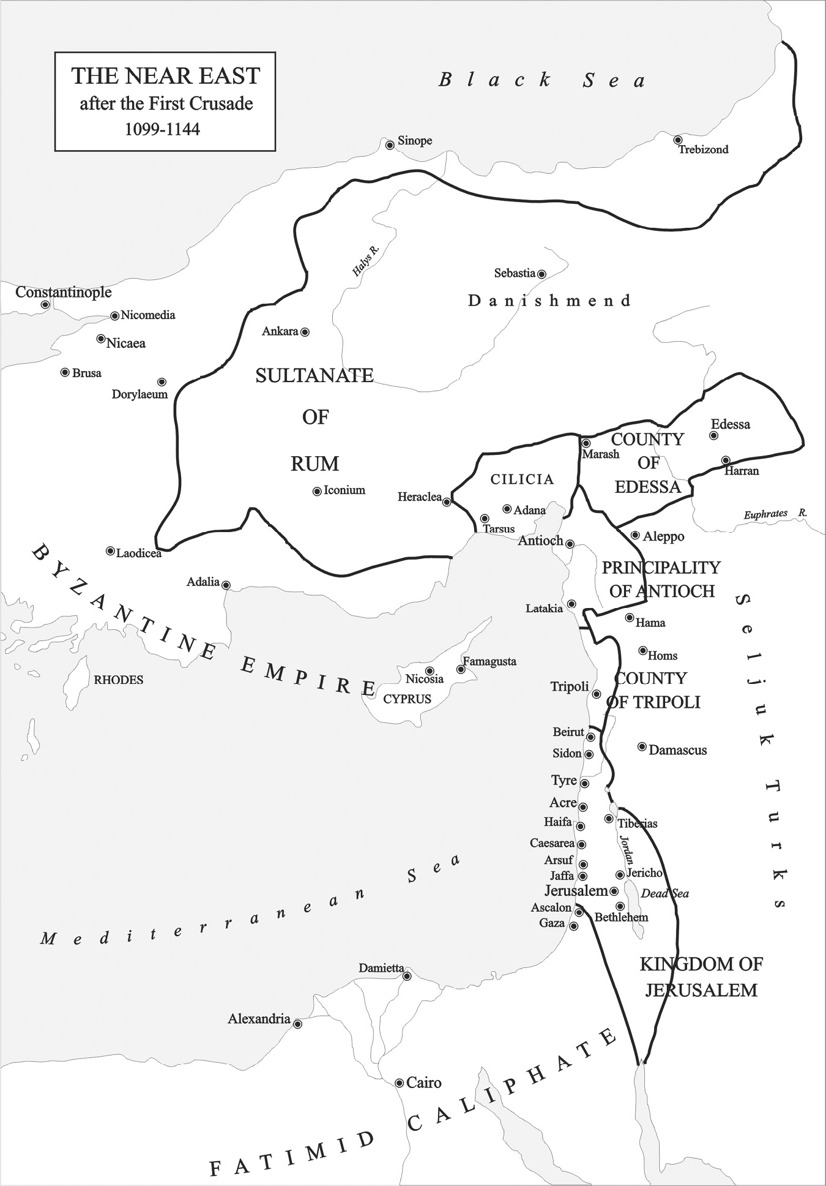
• 2 •
Pope Urban II set August 15, 1096, as the departure date for the armies of the crusade. Hurried and costly preparations were under way, not only on the estates of Western knights but also in the cities of the Byzantine Empire, where citizens needed to gather provisions for the thousands of soldiers who would march across their lands. The First Crusade was shaping up to be the largest and most ambitious military operation launched from western Europe since the days of the Roman Empire. The costs in resources and manpower were enormous.
THE PEOPLE’S CRUSADE
Many in Europe wondered at the careful preparations for the holy enterprise. In the medieval worldview, it was right that made might. Just as David felled Goliath with only a sling and his faith, so God continued to bless his faithful with victory when they fought for just causes. This widespread belief would receive a vigorous shaking during the course of the crusading movement, but those days were still in the future. In 1095, optimism ruled. As thousands rushed to follow Christ to the place of his resurrection, there was little thought of the possibility of defeat, particularly among those who understood warfare but a little. To many, the extensive preparations of the church and nobility for the crusade seemed not only superfluous but almost faithless. If Christ’s soldiers marched to the Holy Land, would he not scatter the infidel Turks as he had the Philistines long ago?
This view was shared by one of the most popular crusade preachers, Peter the Hermit. Riding from town to town on his donkey, this ragged holy man mesmerized audiences with fiery and emotional sermons. Miracles followed Peter wherever he went. Demons were exorcised, sicknesses healed, and confirmed sinners turned to God. It was widely believed that Peter carried with him a letter sent from heaven in which God exhorted all Christians to move quickly against the Turks so that he could take vengeance upon them. Peter’s preaching drew thousands into the crusade. Many powerful lords took the cross after hearing Peter or even simply hearing of him. The preacher’s message, like his letter, was for all people, rich and poor, old and young, male and female. His sermons were not just an exhortation to go to the lands of Christ but an invitation to follow Peter himself. As a result, this charismatic man bore in his train a throng of people, predominantly French but of every social status. In April 1096, he left France for Cologne, where he preached to the Germans, also with great success.
Peter the Hermit’s crusade preaching had become a crusade itself. Although there were knights and lords who followed the preacher on his march, the army (if it can be called that) consisted mainly of those who required little preparation to depart for an indefinite period of time to parts unknown. In other words, the large majority of his followers were relatively poor, and a great many were armed with only the crudest implements. Some were women and children. The crusade marched across Europe, a storm of religious enthusiasm impelled by simple faith and Peter’s own spellbinding personality. It could not be slowed, let alone stopped. Long before the official departure date of August 15, Peter and his masses left western Europe on their long trek to meet the enemies of Christ (photospread illustration 1).
Peter the Hermit’s ragtag army was not the only group that left early. The French lord Walter Sansavoir (not Walter the Penniless, as he is often misnamed) led another large and ill-disciplined army of minor knights and enthusiastic peasants ahead of Peter the Hermit. Walter agreed to wait for Peter at Constantinople, where their combined forces would enter Turkish Anatolia. The march of these two armies across Hungary, Bulgaria, and Greece was not without violence. Emperor Alexius I had not expected crusaders so soon, so his government had not yet prepared the markets necessary to feed so large an army. As it happened, few of the crusaders in this “first wave” of the crusade, as Jonathan Riley-Smith has called it, could afford to purchase food anyway. Foraging, theft, riots, and violence were the result. Matters could have been much worse had the emperor not moved quickly to make provisions available and had Peter and Walter not done their best to keep their rowdy followers in check.
Walter Sansavoir arrived in Constantinople in mid-July 1096. Peter the Hermit came a few weeks later, on August 1. Alexius was eager to meet them, particularly Peter the Hermit, about whom he had heard much. The emperor was clearly impressed with Peter’s sanctity, but he expressed amazement that the preacher had come to Byzantium so quickly. Would it not be wiser, he asked, to wait until the main body of crusaders arrived before crossing into Asia Minor? Alexius succeeded where Urban did not, convincing Peter and Walter that it would indeed be better for them to tarry at Constantinople. Their followers were not so easily swayed. They had made a long journey through many trials and were now within sight of Turkish lands. Why should they wait until the stragglers caught up with them? Was God not calling to them even now to crush his foes? Would he not punish delay and cowardice? As subsequent events make clear, this was a crowd eager for glory, and they saw no reason to share it with those who mocked them when they left Europe with nothing but a prayer and a song. There was also the practical consideration of provisions. The crusade was camped in Constantinople’s suburbs, where food was readily available in the markets, but the poor could not purchase it, and the rest did not think it right that they should have to impoverish themselves while waiting month after month for no good reason. Walter and Peter’s pleas for patience fell on deaf ears. When they judged local food prices too high, the mob began pillaging the suburbs for what they wanted. At last, Alexius allowed Peter to take his crusade to the Turks. It had done enough damage to the Christians.
On August 6, the “People’s Crusade” was transported across the Bosporus. At last, the throng was on the Turkish frontier. No one seems to have come up with a plan for marching through Anatolia, a deficiency that was now all too apparent. Disputes about the proper course of action broke out, some of them violently. Regional sympathies began to tear the mob into two competing crusades, one of Germans and some Italians and the other of French. Rather than advance, they took to raiding. When the French crusaders led a surprise attack on the suburbs of Nicaea and returned with plenty of loot, the Germans were beside themselves with envy. They quickly launched their own raid but were met by the Turks, who were now alive to the danger. They easily routed the Germans, capturing the entire army. Those who renounced Christ and converted to Islam were sent to the East; the rest were slaughtered. The Turks then sent a forged message to the French, purportedly from the Germans, telling them of the riches of their captured citadel. With alacrity, the French headed off, despite the warnings of those better informed. Deep in Turkish territory, they learned too late the truth. In their rush, the French had blindly walked into an ambush. The entire army was wiped out.
Peter the Hermit avoided the massacre. He had earlier returned to Constantinople to discuss tactics with the emperor. There he received the news of the elimination of his crusade. Of all the thousands who had followed the beloved preacher from France to Asia Minor, Peter himself was virtually the only survivor. There was nothing for him to do but enjoy the emperor’s hospitality while awaiting the arrival of the main body of the crusade.
ANTI-JEWISH POGROMS
The “People’s Crusade” was not the only misfire of the movement. When Peter the Hermit made his way across Germany, in his wake sprouted a number of smaller crusade armies determined to catch up to the famous holy man. Some made it, but most did not. Instead, the lure of Jewish riches distracted some from their original purposes. Protected by the German crown and local lords, Jews were abundant in the thriving cities along the Rhine. They became a rich target for avaricious crusaders. The most infamous of the anti-Jewish crusade leaders was Count Emicho of Leiningen. On a rather pronounced detour, he and his followers marched down the Rhine, plundering and massacring Jews in the cities of Speyer, Worms, Mainz, Trier, and Cologne. Some local bishops did their best to protect the Jews, but many were killed all the same. In Mainz, Emicho’s men stormed the palace of the bishop, where the Jews had taken refuge. Albert of Aix described the terror:
They killed the women, also, and with their swords pierced tender children of whatever age and sex. The Jews, seeing that their Christian enemies were attacking them and their children, and that they were sparing no age, likewise fell upon one another, brother, children, wives, and sisters, and thus they perished at each other’s hands. Horrible to say, mothers cut the throats of nursing children with knives and stabbed others, preferring them to perish thus by their own hands rather than to be killed by the weapons of the uncircumcised.1
Much has been written concerning the motivation behind these massacres. One must accept from the outset that just as there were many participants, there were also many reasons formulated for the attacks. For some, it was a matter of penury. Like the followers of Peter the Hermit, they lacked the funds to make it to the East. Here were Jews, they reasoned, many of whom had grown wealthy through the sin of usury. Why not take their ill-gotten gains and use them for this holy cause? Others considered the conversion or destruction of the Jews to be a first order of business. Why should Christians march two thousand miles to expel the enemies of Christ when there were so many dwelling here in their very homes? Undoubtedly the image of the crucified Christ employed by crusade preachers led some to look not to the Muslims but to the Jews, who, the Bible records, were responsible for the Crucifixion. As one of the crusaders explained to a Jewish rabbi:
You are the children of those who killed the object of our veneration, hanging him on a tree; and he himself had said: “There will yet come a day when my children will come and avenge my blood.”2
As it happened, none of these anti-Jewish “crusades” made it to the East. Most simply evaporated when resistance in the cities became too severe. Count Emicho pressed on to Hungary, where he continued his belligerence. There, his army was crushed.
To Constantinople
The main body of the First Crusade began to depart in mid-August 1096, just as the pope had requested. The plan was for the various armies to make their way to Constantinople, where they would combine their forces with the Byzantines for the march east. Among the greater lords was Godfrey of Bouillon, a member of the family of the counts of Boulogne. Godfrey was a second son, yet one with substantial resources. Henry IV had made him Duke of Lower Lorraine in 1087, and he had worked hard to consolidate and expand his other holdings. Once he took the cross, however, his efforts were transformed from consolidation to liquidation. To raise the sums necessary to transport himself, his brother Baldwin of Boulogne, and a sizable retinue of knights to the East, Godfrey sold off a number of properties and settled many ongoing disputes to his disadvantage. Although he made considerable financial sacrifice, Godfrey clearly planned to come home after the crusade. He did not relinquish his claim to Lower Lorraine, nor to a nucleus of other rights and properties with which he could rebuild power upon his return. He traveled to Constantinople via Hungary. King Colman had already had his fill of crusaders destructively crossing his lands, but Godfrey gave over his brother Baldwin as hostage for his army’s good conduct. His troops made their way in an orderly manner to Constantinople, where they arrived on December 23, 1096.
Godfrey was not the first crusader to make it to the great city. Hugh of Vermandois, the brother of the king of France, left Europe at the same time but took a more direct route and a much smaller force. For Emperor Alexius, the crusade presented both a challenge and an opportunity. On the one hand, he was pleased that his request for aid had met with such success. Thousands of Christian soldiers were now mobilized to fight the enemies of Byzantium. On the other hand, these Western barbarians were not altogether trustworthy. He was understandably concerned that the empire not exchange a Muslim enemy for a Christian one. When Hugh arrived, his men camped in the suburbs, while he was invited to the marvelously rich imperial palace in the city. There, Alexius engaged in the time-honored Byzantine practice of overawing foreigners with the fabulous wealth of the ancient empire. Hugh was impressed but not distracted. Like other crusade leaders, he was curious about the role the emperor planned to play in the expedition. Alexius bestowed rich gifts on Hugh and professed his desire to add imperial forces to the crusade’s numbers and to lead personally the armies against the infidel. Before he transported foreign armies across the Bosporus, though, Alexius felt only justified in asking them to show their good faith. He politely requested that Hugh swear an oath that any lands the crusade should capture that had previously belonged to the empire should immediately be returned to the emperor. He also asked for an oath of loyalty to himself while the crusade remained in his domains. Since the crusaders had never planned to go beyond the far-flung borders of the old Roman Empire, this oath would effectively give all conquests to Alexius. Hugh stalled, not certain what other magnates had planned and not wanting to go out on a limb himself. In the meantime, the emperor kept him in sumptuous luxury in the city but refused to allow him to return to his troops. Under great pressure, Hugh at last relented and took the emperor’s oath.
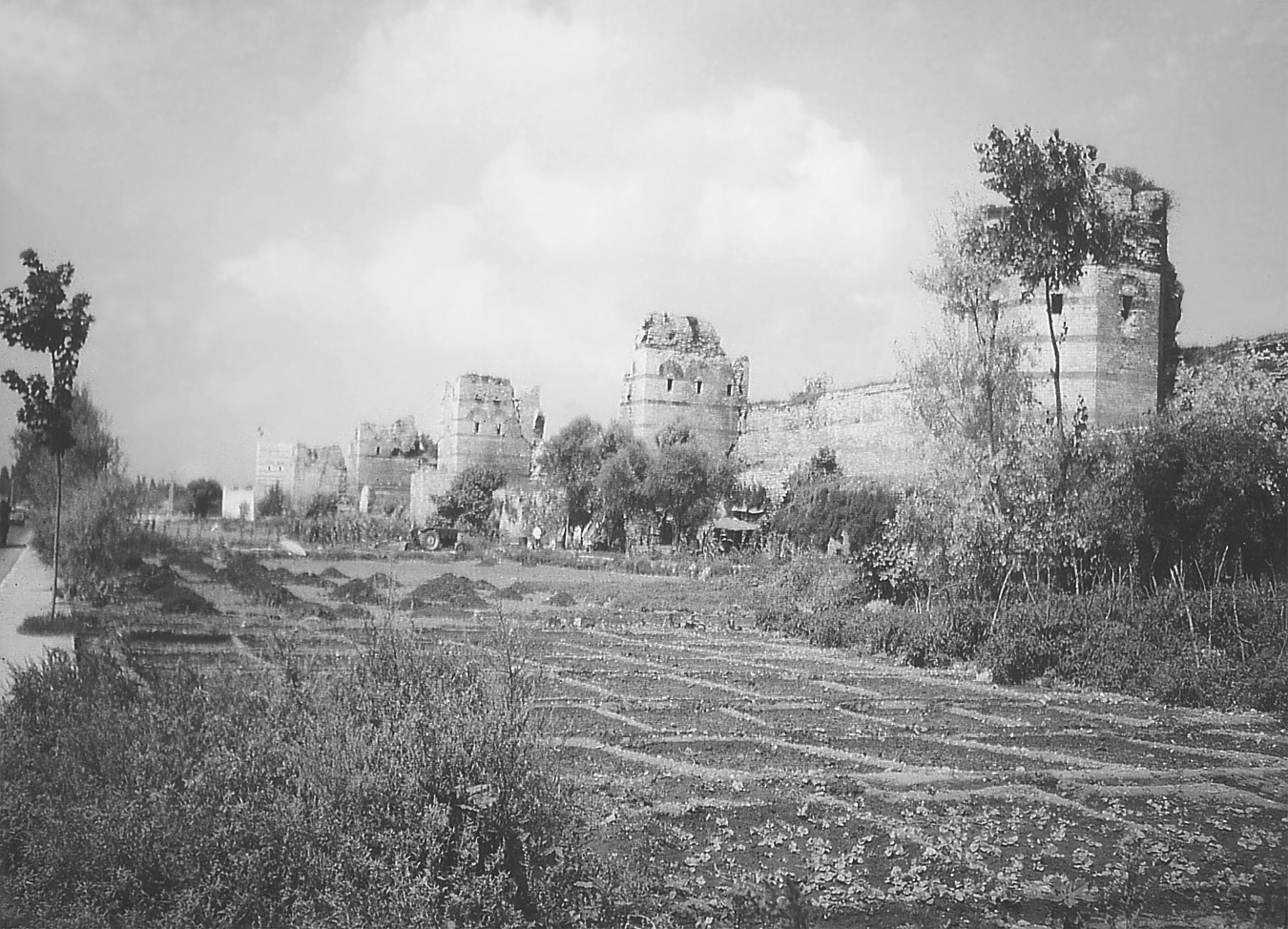
Figure 1. Land Walls of Constantinople. The area near the walls, now under cultivation, was a moat during the Middle Ages. Photo by the author.
Shortly after Godfrey arrived in Constantinople’s suburbs, he received a similar invitation to the palace of the emperor. From Hugh, Godfrey knew the emperor’s intentions, and he did not much care for the particulars of the oath. He declined the invitation, but the emperor was not so easily put off. Alexius sent word that he would not transport Godfrey’s army across the Bosporus until Godfrey had sworn loyalty and given his word that reconquered territories would not be stolen from the Roman Empire. When Godfrey remained aloof, the emperor cut off provisions to his army. In retaliation, the crusaders pillaged the suburbs, forcing Alexius to reopen the markets. For three months, the army stubbornly waited, all the while demanding to be taken to Asia. Exasperated, Godfrey finally ordered his troops to attack Constantinople itself. In January 1097, the crusaders assaulted the mammoth Theodosian land walls near the imperial palace of Blachernae. Godfrey’s troops, however, were far too meager to seriously threaten the largest and best defended city in the Western world. In retaliation, the emperor ordered a sortie of imperial soldiers to attack the crusaders. After his forces were roughly pushed back from the walls, Godfrey at last decided to come to terms. On January 20, he took an oath to Alexius and he and his men were promptly transported across the Bosporus.
The forty-year-old Bohemond of Taranto got a later start than Godfrey. Bohemond was the son of the Norman leader Robert Guiscard. Before his death in 1085, Guiscard had left his lands east of the Adriatic Sea to Bohemond, and those to the west in southern Italy to his younger son, Roger. In 1082, that seemed a fair division, given that Robert and Bohemond had captured Durazzo and were in the process of the conquest of Greece. But by 1085 an allied force of Byzantines and Venetians had erased most of the Norman gains just before Robert Guiscard himself died of plague. Bohemond was left with practically nothing. Since then, he had managed to cobble together a lordship for himself in southern Italy, but it was not impressive. More than any other crusading leader, Bohemond was ambitious for personal gain. He had once believed that he would rule in Thessalonica or perhaps even Constantinople. Although his hopes had been dashed, he still looked to the east as an opportunity for power and wealth.
For the Byzantines, Bohemond seemed to present the most dire threat. Because Bohemond was a crusader, Alexius was obliged to make smooth his trip from Durazzo to Constantinople, a journey that Bohemond had fought his way across a little more than a decade earlier. The Byzantine citizens along the via Egnatia, the old Roman road that led to the eastern capital, could not help but look on the hated Normans with suspicion and dread. Bohemond, however, had his eyes on greater things. He carefully monitored his men, making certain that they were on their best behavior. He wanted to make clear to the emperor that his crusading army was no threat at all to the Byzantine Empire.
Bohemond arrived at Constantinople in early April 1097, not long after Godfrey’s forces had been ferried across the straits. The Norman leader gratefully accepted the emperor’s invitation to meet with him in the palace and listened intently when Alexius asked him to swear the same oath that Hugh and Godfrey had already sworn. From the emperor’s perspective, the timing of the crusading leaders’ arrival at Constantinople could not have been better. One by one, he was able to negotiate with each of them in isolation. As one leader agreed to take the oath, it made it more difficult for the next leader to refuse. Bohemond was not opposed to taking the oath in any event. It seems likely that the Norman prince suggested that Alexius appoint him commander in chief of the imperial forces in Asia, something that would have given Bohemond effective control over the entire enterprise. But Alexius was not willing to go that far in this friendly reconciliation. Instead, he replied cordially and in a noncommittal fashion, and Bohemond took the oath. His troops were then taken across the Bosporus to join the other crusaders assembling in Asia Minor.
By far the most powerful magnate to take up the cross was Raymond, Count of Toulouse. This fifty-five-year-old warrior had spent most of his life extending his power over thirteen counties in southern France—almost the entire region. His wealth, lands, and armies were greater than those of most kings, including the king of France. Moved by the preaching of the crusade, Raymond decided to finish his life in the service of God. He divested himself of all of his properties, giving them to his son, and with his wife prepared for the departure east. Raymond was among the first nobles to take the cross; indeed, he was probably informed of the crusade by Urban II before the Council of Clermont. It was probably the pope’s desire that Raymond serve as a commander in chief, or at least principal leader, on the holy enterprise. To signify this, Urban appointed Adhemar, bishop of Le Puy, as papal legate to the crusade and instructed him to accompany the army of Raymond. It was a great army, far larger than any other single lord could muster. Raymond left in October 1096, but he had a difficult journey through the Veneto and Dalmatia before arriving in Durazzo. For the remainder of his journey, he was given a Byzantine escort, whose mission it was to protect the local population from his army. There was more than one skirmish between the escorts and crusaders, and some pillaging did occur. At last, Raymond arrived at Constantinople on April 21, 1097.
By now, Raymond had heard of the progress of the other crusading lords and was aware of the oath that they had sworn to the emperor. He probably also heard of Bohemond’s attempt to take control of the crusade. Raymond was not like the other crusade leaders. More mature and powerful, the count of Toulouse would not so easily be manipulated by this cunning emperor. When asked to take the oath, Raymond responded that he had come to serve God; he would not take another as his lord. The other crusading magnates across the Bosporus urged Raymond to relent so that they could get under way. He refused. Raymond clearly saw himself as the leader of the Latin (i.e., Catholic) forces. He did not want to be forced to accept Bohemond as commander in chief if Alexius decided to appoint him as such. Instead, Raymond proposed that if the emperor himself would take the cross and command the crusade, then he would gladly take his oath. Alexius replied that nothing would make him happier, but that he could not leave Constantinople at present. In the end, a compromise was reached. Raymond swore to respect the property and person of the emperor, a lukewarm oath not uncommon in southern France. With that, Raymond and his forces were transported across the Bosporus. The crusading army, what Riley-Smith has called the “second wave,” was assembled.
From Constantinople to Antioch
The crusade’s first objective was the city of Nicaea. The capital of the Turkish sultanate, Nicaea was an important strategic location for any further advances into Asia Minor. The heavily fortified city rested on the shores of a lake, making a complete investment of the city impossible until Byzantine vessels were sent overland to close off the city’s ports. Having easily dispatched the crusade of Peter the Hermit, Sultan Kilij Arslan, who was not in the city, did not at first take this second army very seriously. He may even have heard that Peter was present and therefore assumed the caliber of forces to be poor. He learned differently, but too late. By the time he brought his army to relieve the city, the crusaders had established their siege. In a pitched battle on May 21, the crusaders decisively defeated the Turkish forces. In the mayhem, Kilij Arslan fled, leaving behind his wife, family, and treasury in the city.
With the defeat of the relieving forces, the Turkish garrison opened negotiations with Alexius for terms of surrender. The emperor guaranteed the life and property of all inhabitants and assured them that the Latin crusaders would not be allowed in the city. In the dead of night, the ports were opened to the Byzantine vessels. When the crusaders awoke, they found the imperial banners flying over the city walls. Alexius thanked the westerners for their assistance and bestowed rich gifts on their leaders. Many of the crusaders felt cheated. They had sworn to restore property like this to the emperor, and they were now robbed of the opportunity to break their oath. Surely a little plundering was justified, many grumbled, if only of the Muslim inhabitants.
On June 26, the crusading army departed Nicaea, bound for Antioch. Between the two cities lay the sun-baked expanse of Anatolia. Summers in Asia Minor are oppressively hot. What little food was in the fields had been destroyed by the retreating Turks. The crusaders decided to split their forces into two groups. The first was led by Bohemond and a few other lords. The second, which traveled a day behind, was commanded by Godfrey and Raymond. The wisdom of this deployment was demonstrated a few days later when Kilij Arslan attacked the first group, apparently believing that it was the entire force of the crusade. Bohemond lacked the manpower to defeat the sultan, but he could defend himself for a day while word was sent to Raymond and Godfrey. On June 30, the second group arrived, catching Kilij Arslan completely by surprise. He and his troops fled in panic, leaving behind their provisions and tents.
For the next four months, the crusaders made their way across Anatolia under horrible conditions. The heat was brutal, water scarce, and food scarcer. Repeatedly, the enterprise seemed doomed, yet in each case something allowed it to continue, if only just a little farther. For the crusaders, these were the miracles that God performed for those who marched to the land of his Son. Finally, on October 21, 1097, they caught sight of the great walls of Antioch. The crusaders were a large but pitiful force. A cleric, Fulcher of Chartres, recorded:
Truly, either you would laugh or perhaps shed tears out of compassion, when many of our people lacking beasts of burden, because many had died, loaded wethers, she-goats, sows, or dogs with their possessions. . . . We saw the backs of these small beasts chafed by the heavy loads. Occasionally armed knights even used oxen as mounts.3
Meanwhile, Baldwin of Boulogne and Tancred, the cousin of Bohemond, had split off from the main body of the crusade to acquire assistance from Armenian Christian cities farther to the southwest in Cilicia. They were warmly welcomed, and both men soon found themselves caught up in local politics. Baldwin then headed east into greater Armenia, where he received a similar welcome. The capital of the region was the city of Edessa. It was ruled by Thoros, who was officially a vassal of the Turks but in reality acted independently. He did not expect that situation to continue for very much longer without help, so he offered to adopt Baldwin as his successor. Baldwin accepted and entered Edessa among cheering throngs of citizens. Shortly thereafter, a coup toppled Thoros, leaving Baldwin as the sole ruler of Edessa, where he settled permanently. The new County of Edessa was the first of the crusader states. It was to provide a valuable buffer against Turkish attacks on Antioch and other Christian lands. The means of Baldwin’s acquisition nevertheless was a clear warning that relations between Byzantines and crusaders would not be smooth. Despite his oath, Baldwin made no attempt to restore Edessa to Alexius I in Constantinople.
One of the greatest cities of the ancient Roman Empire and one of the patriarchal sees of Christianity, Antioch was an imposing sight for the wearied crusaders. Its fortifications were massive, consisting of long walls studded with four hundred towers. The population was predominantly Greek and Armenian Christian, although it was garrisoned and ruled by Muslim Turks. The crusaders probably numbered around forty thousand souls, but they were incapable of completely investing the city for a siege. Raymond suggested an immediate attempt to take the city by storm, but Bohemond argued against it. The Norman leader clearly hoped to find a way to claim Antioch for himself, just as Baldwin had done at Edessa. If a direct assault were successful, the city would likely fall under the control of the most powerful lord. That would be Raymond. In any event, Bohemond did not think it possible to take the city so easily, and neither did a majority of the nobility. They decided to wait out a siege.
The winter of 1097–98 was a particularly cold and difficult one. Forty thousand people require a great deal of food, and there was little to be had. Foraging parties already had exhausted nearby lands, so they were sent ever farther in search of provisions. The leaders were often less concerned with the blockade of the city than the acquisition of supplies. Hunger, starvation, and disease descended on the soldiers. Many knights who had not lost their horses during the grueling journey were now forced to slaughter them for meat. This was a decision made only as a last resort, for the horse was not only the symbol of a knight’s social station but also his principal means of combat. Fulcher of Chartres described the pitiful conditions:
At that time, the famished ate the shoots of beanseeds growing in the fields and many kinds of herbs unseasoned with salt, also thistles, which, being not well cooked because of the deficiency of firewood, pricked the tongues of those eating them; also horses, asses, and camels, and dogs and rats. The poorer ones ate even the skins of the beasts and seeds of grain found in manure.4
Some soldiers turned to cannibalism, making use of Turkish casualties. Many more simply died of starvation.
When it seemed that the situation could not get any worse, news from the East made it so. In 1098, the Arab Fatimids of Egypt launched an attack against the Turks in Palestine, capturing Jerusalem and the surrounding region. Many of the Turks displaced from Palestine made their way to the greater Turkish lords in Damascus, Aleppo, and Mosul. The atabeg of Mosul, Kerbogha, combined these troops with others from Mesopotamia and began a march to relieve Antioch. When news reached the crusaders of the coming of Kerbogha, it created a panic. Decimated by hunger and disease, the crusade was in serious danger of being crushed between the Turkish forces and the walls of Antioch. Throughout the preceding winter months, many had been comforted by the visions of various holy men, who saw saints and angels conspiring for the victory of the followers of Christ. Now that seemed foolish. So far from home, they were in desperate danger. Desertions reached an epidemic level. Even Peter the Hermit, the famed preacher who still bore his letter from heaven, slipped out of camp and ran for home. He was easily captured and returned. With profuse tears, he begged the crusaders to forgive him for his loss of faith, and they did.
All was not as bleak as Peter the Hermit believed. Bohemond had for some time been attempting to corrupt a captain of the guard in the city, and he had finally met with success. For a price, this captain was willing to allow Bohemond and his men to enter under cover of night. The Norman leader called a meeting of the crusading lords. Without revealing his plans, he asked them to agree that if he and his men could take Antioch unassisted, then by rights the city should belong to him. All the barons were quite willing to agree to this—all, that is, except Raymond. The count of Toulouse reminded his fellow leaders that they had sworn oaths to restore this land to the emperor if it could be conquered; they had no right to promise it to a Norman adventurer. It is striking that although Raymond alone had refused to take the oath to the emperor, he alone insisted that it be honored. In part this was due to his own reluctance to let Bohemond acquire such a prize, but it was also motivated by what appears to have been a warm friendship that had materialized between Raymond and Alexius. At last, however, Raymond agreed that if Bohemond could take the city, he should have it until such time that the emperor could make his claim in person.
On the night of June 3, 1098, Bohemond and his men scrambled over the walls and opened the gates for their comrades. The crusaders spilled into the dozing city, capturing it in a matter of hours. Only the citadel held out. Antioch was in crusader hands.
Instead of heading straight for Antioch, Kerbogha had first stopped off at Edessa in an unsuccessful attempt to wrest the city from Baldwin. He remained there for three weeks, a crucial delay that allowed the crusaders time to hole up in Antioch. Had the sultan not stopped, he would have caught the Christians outside the walls, just as they feared. When he finally arrived, Kerbogha completely invested Antioch. Now the former besiegers were the besieged. There was little food in the city, so starvation remained a severe problem. And the forces of Kerbogha were truly awesome. Fear, hunger, and despair wracked the city. Some deserted and escaped; others were captured by the Turks and cruelly tortured and mutilated in view of their comrades on the walls.
Stephen of Blois and some four thousand crusaders were in nearby Alexandretta when Antioch was taken. When they returned they discovered that although their comrades had captured the city, the Muslim forces camped outside as well as those still in the citadel seemed certain to destroy the crusade. In Stephen’s estimation the situation was simply hopeless. With great sorrow he abandoned the enterprise and began his journey home.5 On the way he learned that Emperor Alexius was marching to Antioch with a sizable army. Fearing that the Byzantines would be ambushed by the victorious Turks, Stephen made a special trip to rendezvous with the emperor at Philomelion. There he related the heartbreaking news of the arrival of Kerbogha and the sure destruction of the crusade at Antioch. He urged Alexius not to continue on to what was certain doom. Alexius thanked Stephen for the warning and ordered his men to return to Constantinople. Stephen went back to France.
Back in Antioch, the crusaders were thunderstruck when they heard of the retreat of the much-needed Byzantine troops. They derided both Stephen and Alexius as faithless cowards. Those lords who had previously sworn to return their conquests to the emperor now repudiated those oaths, insisting that they would render nothing to such a traitor.
It is not surprising that in such desperate straits, the visions that were always a part of the crusade increased in frequency. One visionary, Peter Bartholomew, proclaimed that St. Andrew had told him the whereabouts of the Holy Lance, the implement used to pierce the side of Christ. Raymond was convinced by the story, but the papal legate, Adhemar of Le Puy, was openly skeptical. How could the Holy Lance be in Antioch, he asked, when he and others had seen it in Constantinople? News of the vision spread quickly, though, and sparked other visions corroborating the first. On the night of June 14, a meteor streaked across the sky and appeared to land in the camp of the Turks. The signs of heaven seemed clear. The next morning, Peter Bartholomew solemnly led Raymond and a procession of clergy into the Cathedral of St. Peter, where the visionary pointed to the spot where workmen should dig. Dig they did. Hour after hour passed with no sign of the relic. Raymond had lent his prestige to this search and he was clearly irritated that it was revealing nothing. Finally, when the diggers were ready to quit, Peter Bartholomew himself jumped into the pit and began scrounging with his bare hands. After a few minutes, he cried in triumph and was pulled out of the hole holding something that looked like a worn lance head. Raymond rejoiced at the find, which he quickly attached to a spear pole and carried around the city. Adhemar and others suspected that Peter Bartholomew had planted the relic, but nothing could stem the excitement that swept the crusade. Morale rose throughout the ranks. In the Holy Lance, they believed that Christ himself had given a sign of their impending victory.
Kerbogha’s troops were numerous and his position strong, yet within his forces there were internal divisions between jealous emirs, divisions that became more acute as the siege dragged on. In time, these factors might lead to the breakup of the besieging army; however, the crusaders lacked the supplies to wait for that. Their only hope was to sally forth from the walls of the city and defeat the Muslim forces in a pitched battle. Because Raymond was bedridden with illness, it fell to Bohemond to lead the Christian forces against Kerbogha. On June 28, the assault began. Kerbogha watched as the crusading forces marched out of the city gates, banners flying, drawing up their ranks. Some of the emirs urged him to attack the Christians immediately, while they were still exiting the city, but the Turkish commander wanted to wipe out his enemy with a single blow. He may have believed that desertions and starvation had more seriously harmed the crusaders than was the case. Perhaps he also considered the reports of a very large army coming all the way from western Europe to be exaggerated. Whatever the reason for his decision, Kerbogha was plainly astonished when he saw the size of the forces assembling before him. Quickly, he sent an emissary to discuss a truce, but the crusaders would hear none of it. They advanced in good order amid a torrent of arrows. When it became clear that a bloody and difficult battle was ahead, many of the Turkish emirs, who resented Kerbogha in any event, withdrew from the field. Their departure sparked a crescendo of panic in the Turkish forces, scattering them into the countryside. The crusaders quickly defeated the remaining forces. The extraordinary reversal in fortunes seemed truly miraculous to the crusaders. Muslim observers too noted the surprising outcome. The Syrian chronicler Ibn al-Qalanisi wrote: “Thereafter the Franks, though they were in the extremity of weakness, advanced in battle order against the armies of Islam, which were at the height of strength and numbers, and they broke the ranks of the Muslims and scattered their multitudes.”6
With Kerbogha and his forces neutralized, the city’s citadel surrendered to Bohemond. Antioch and its region were now safely in Christian hands. Against all odds, the crusaders had won a smashing victory, but not alone. Many of the combatants and those watching from the walls attested to the presence of armies of angels and saints, as well as the spirits of their fallen comrades, fighting alongside Bohemond’s troops against the forces of the Turks.
The victory at Antioch placed the crusaders materially in their best position since leaving Constantinople. They now controlled a large port city and a strategic region stretching from Antioch to Edessa. The rich gains, however, were also the cause of internal strife. Raymond had opposed Bohemond’s efforts to acquire Antioch from the beginning, but it was becoming increasingly difficult to do so now. The Norman leader had single-handedly captured the city and led the sortie that liberated it. From the point of view of most crusaders, Alexius and the Byzantines had forfeited their rights to Antioch when they turned their back on it. Since then, Alexius had declined an offer to garrison Antioch and lead the crusaders to Jerusalem. Surely, then, Bohemond deserved to have the city. Raymond disagreed. Even putting aside the oath the leaders had sworn to the emperor, Raymond stressed that they had also taken an oath to God to travel to Jerusalem and deliver the land of his Son. No crusader should be allowed to renounce that sacred vow for temporal gain. Raymond, therefore, insisted that Bohemond and his troops remain with the crusade as it headed south. Bohemond clearly did not want to do that, and so the crusade stalled.
It was not an inopportune moment for it to stall. Summer had begun, and none of the soldiers were eager to march south into Syria’s scorching desert heat. It was decided, therefore, to remain at Antioch until November 1. During the summer, a plague descended on the city, taking the life of the papal legate, Adhemar of Le Puy. This was a significant blow. Adhemar had been the voice of reason and common sense in the councils of the lords. When rivalries threatened to explode, it was always the papal legate who cooled heads. Along with Raymond, Adhemar opposed giving the city to Bohemond or to any crusader. Now the count of Toulouse stood virtually alone in that view. Nevertheless, Raymond was as determined as ever that the crusade would not leave without Bohemond and that Antioch should not be given to the Norman leader. In council, the lords decided to send a letter to Pope Urban II informing him of the death of his legate and asking him to come to Antioch to take the city himself and lead the army to Jerusalem. No one seriously believed that the pope would agree, but it did help to put the question off a bit longer.
November 1 came and went, and the crusade was no closer to leaving Antioch. The rank-and-file crusaders, exasperated with their leaders, demanded that they put aside their squabbles and prepare to march south. On November 5, the leaders met together in the Cathedral of St. Peter. After fruitless arguments, spokesmen for the army strode into the church and informed the lords that if they did not come to an agreement, the men would tear down the fortifications of Antioch. At last, Raymond agreed to a compromise of sorts. Bohemond could have Antioch provided he agreed to depart with the host and serve the crusade until the conquest of Jerusalem. Bohemond willingly agreed. The news was reported to the rank and file, who rejoiced.
All was not in readiness for departure. Over the course of November and December, preparations were made and a few nearby locations conquered. The soldiers were continually assured that their departure was forthcoming, but it became clear that Bohemond and Raymond were again attempting to outmaneuver each other. The Norman leader plainly had no intention of leaving Antioch, regardless of what he had agreed to previously. At last, the army offered to Raymond the title of commander in chief of the crusade if he would lead them to the Holy Land. He consented. The title, though impressive, was ornamental: Godfrey of Bouillon and Robert of Flanders had no intention of taking orders from the count of Toulouse. Raymond did acquire command over other nobles, but only because he paid money for it, not because of his designation as supreme commander.
From Antioch to Jerusalem
On January 13, 1099, Raymond, barefoot and in the attire of a pilgrim, led the army south into Syria. What the army found there were a number of petty emirs willing to pay if their towns were left unmolested. The course of the crusade’s progress through the late winter and early spring was profitable and comparatively easy. The powerful Turkish rulers in Damascus and elsewhere had no interest in defending these rebellious small fry. Besides, Palestine was now in Shi’ite Fatimid hands. Why should the Sunni Turks lift a finger to protect them? On the contrary, many of the Turks watched with glee as the “Franks” (as they called them) bore down on the Egyptians who had so recently taken Jerusalem from them. For his part, the Arab ruler of Egypt had been sending envoys to the crusaders since their march across Asia. He applauded their martial prowess and offered to join with them in their war against the Turks, but his overtures were wasted on the westerners, who made few distinctions among Muslims. Now, as the crusade approached the newly won Fatimid territories in Palestine, the caliph again offered an alliance if the crusaders would remain outside his domains. Clearly, the Egyptians understood neither the purpose nor the motivations of the crusade.
On May 19, the crusade entered Fatimid territory just north of Beirut. Beirut and its coastal neighbors to the south—Sidon, Tyre, Acre, and Haifa—were willing to provide the crusaders with supplies on the condition that they leave the cities and their suburbs unmolested. Because the crusaders were interested only in reaching Jerusalem, they were glad to oblige. Just north of Jaffa, the army reached the inland road to the Holy City. It was June 3. Word had reached the leaders that the Egyptian army was mobilizing. Some argued that to head to Jerusalem now was foolhardy. The city’s fortifications were immense, and a siege during the brutal summer would take a horrible toll on the army. When the Egyptian army arrived, the crusaders would be crushed beneath the walls of Jerusalem. If the Holy Land were ever to be secure, they must first destroy the Muslim power base in Egypt. Only then would Jerusalem fall into their hands. Strategically, this was a sound policy and one that would inspire more than one future crusade, but it did not square with the crusaders’ role as pilgrims. Their task was to make their way to the Holy Sepulcher, not the pyramids. Had God not preserved them thus far? Would he not continue to do so if they remained brave and did not lose faith? The decision was made to march directly to Jerusalem.
Bethlehem, the birthplace of Christ, a city entirely Christian, hailed the crusaders as liberators on June 6. That night, the army was amazed to see a lunar eclipse—a clear sign from God, they felt, that the Muslim crescent was waning. The following day, the crusaders climbed the hill they later named Montjoie (Mount of Joy) and gazed at last on the imposing spectacle of the Holy City, Jerusalem. Behind its monumental walls and spiring heights they could see the many domes of the city’s rich mosques and churches. At last, they had arrived at their destination.
Even for a well-supplied army in the best of times, Jerusalem was a difficult nut to crack. These were not the best of times. The size of the city made a full-scale siege impossible, which was just as well since the news of the forming Egyptian army meant that the crusaders had no time to wait out the city’s defenders. The Fatimid governor of the city had seen to the necessary preparations for the crusaders’ arrival. He expelled all Christians, lest Jerusalem fall by the same treachery that sealed Antioch’s fate. He was also careful to poison most of the wells around the city, thus forcing the crusaders to devote manpower to bringing in water from the Jordan River. If Jerusalem were to be taken, it would have to be soon.
It was decided to launch an all-out attempt to capture the city by storm on June 13. Yet despite the crusaders’ brave efforts, the city’s defenders repulsed the attack with little trouble. The crusaders lacked sufficient scaling ladders and siege machinery to threaten seriously Jerusalem’s towering walls. Without such equipment, the city simply could not be taken. Just then, almost miraculously, six Genoese and English vessels carrying building materials sailed into Jaffa. Praising God, the crusaders quickly set to work building catapults, ladders, and wooden castles on wheels that could be rolled up to the walls of Jerusalem. It was long, slow, and horribly hot work. Water was a constant problem. Tempers flared. Early in July, the crusaders received the news that the Egyptian army was on the march. It would arrive at Jerusalem within the month. Once again, their situation was desperate.
As had happened at Antioch, it was a vision that restored the spirits of the host and turned events around. On July 6, Peter Desiderius, a priest of Raymond’s retinue, announced that he had seen the spirit of Adhemar, the late papal legate. Adhemar rebuked the crusading leaders for their quarreling and ordered them to turn their attention to the Holy City that they had sworn to liberate. He further assured them that all was not lost. If the army would fast, do penance, and lead a procession around the city, Jerusalem would fall nine days later. Immediately, a fast was proclaimed throughout the host. On July 8, the Muslim defenders on the walls of Jerusalem watched with astonishment as the army of the Franks became a barefoot, unarmed pilgrimage. Singing prayers and bearing relics, most prominently the Holy Lance, the army of the First Crusade walked around the walls of Jerusalem, coming at last to the Mount of Olives. There, Peter the Hermit delivered a sermon, inspiring the assembled thousands just as he had done on the plains of France so long ago.
With the siege machinery in readiness, the assault on Jerusalem began on the night of July 13–14. The hope of the crusaders lay in their great wheeled castles. All of July 14 was spent trying to bring them against the city’s walls. By evening, Raymond’s tower had reached Jerusalem’s fortifications, but fierce resistance kept his men from gaining a foothold on the wall itself. Early in the morning of July 15, Godfrey also succeeded in bringing his tower against the wall, successfully defeating the defenders in that region. His men of Lorraine fought their way to the Gate of the Column, opened it, and allowed the main army to enter. In a flood, the crusaders rushed into the city. By the standards of the time, adhered to by both Christians and Muslims, the crusaders would have been justified in putting the entire population of Jerusalem to the sword. Despite later highly exaggerated reports, however, that is not what happened. A great many of the inhabitants, both Muslims and Jews, were killed in the initial fray. The best modern estimates put the number of dead between three and five thousand people. Yet many others were allowed to purchase their freedom or were simply expelled from the city.7 Later stories of the streets of Jerusalem coursing with knee-high rivers of blood were never meant to be taken seriously. Medieval people knew such a thing to be an impossibility. Modern people, unfortunately, often do not.
The dream of Urban II had come true. Against all odds, this struggling, fractious, and naïve enterprise had made its way from western Europe to the Middle East and conquered two of the best-defended cities in the Western world. From a modern perspective, one can only marvel at the improbable course of events that led to these victories. Medieval men and women did not marvel; they merely thanked God. For them, the agent of the crusade’s victory was God himself, who had worked miracle after miracle for his faithful knights, delivering unto them the land of Christ.
NOTES
1. August C. Krey, The First Crusade: The Accounts of Eye-Witnesses and Participants (Princeton, NJ: Princeton University Press, 1921), 55.
2. Solomon Bar Simpson, “Chronicle,” in Shlomo Eidelberg, The Jews and the Crusaders: The Hebrew Chronicles of the First and Second Crusades (Madison: University of Wisconsin Press, 1977), 25.
3. Martha E. McGinty, trans., repr. in Edward Peters, ed., The First Crusade: The Chronicle of Fulcher of Chartres and Other Source Materials (Philadelphia: University of Pennsylvania Press, 1971), 48–49.
4. Ibid., 55.
5. The assessment of Stephen’s actions is based on John H. Pryor’s excellent analysis of the events: “Stephen of Blois: Sensitive New-Age Crusader or Victim of History?” Arts: The Journal of the Sydney University Arts Association 20 (1998): 26–74.
6. Ibn al-Qalanisi, The Damascus Chronicle of the Crusades, trans. H. A. R. Gibb (London: Luzac, 1932), 46.
7. Benjamin Z. Kedar, “The Jerusalem Massacre of July 1099 in the Western Historiography of the Crusades,” Crusades 3 (2004): 15–75.