
CHAPTER XIV
ON August 27 of the following year, Stephen Langton preached at St. Paul’s in London. There was nothing remarkable in that fact in itself, for the archbishops were more often in London and Westminster than in Canterbury, but two things made the service noteworthy. First, John was in France, fighting the last and least creditable of his campaigns for the recovery of his lost possessions and did not know what was going on at home. Second, the cathedral was filled with all the great people in the country, bishops and noblemen of high degree, plain knights, and even some of the rich citizens of London; and such a gathering could not have been brought together unless there was something very important in the wind.
While waiting for John to yield, Stephen Langton had spent much of his time in the study of canon law. He had become convinced of the cruelty and injustice of the feudal system as well as the need for curbs on the power of rulers. The course he followed on reaching England makes it abundantly clear that he had resolved in advance to use the power of his high office to relieve the burdens of the people.
He stood up before his august audience on this warm August day, and his eyes kindled when he saw that not one of the men he wanted present had failed him. He preached with his accustomed clarity, taking his text from the Psalms, My heart trusted in God and was helped and my flesh rejoiced. What he said has not been recorded, but it is certain that the message he delivered was a spiritual one and that the political situation was not referred to openly. Later in the day there was a secret meeting. Where it was held is not known, but it must have been in the London house of one of the great barons. Stephen Langton was the speaker and, as he rose, an air of solemnity could be seen on every face. Everyone there knew that what they would do that day would later be construed as high treason.
The dramatic point of this historically important speech came when the primate produced a document, which was yellow with age and badly tattered. Did they remember, he asked, that a charter had been signed by Henry I in the early stages of his reign? Few of his hearers had known of the charter, which is not surprising, for a century had passed since it was signed. Still fewer recalled that one hundred copies had been made for distribution to all parts of the country, and none had heard that these copies had disappeared, presumably on the order of the King himself when his mind changed.
It was true, went on the archbishop, that an effort had been made to call back or destroy all copies. One, however, had not been located at the time and so had continued in existence, and after a diligent search had now been found. He held up the yellowed sheet with a reverent hand, knowing it to be the most important state document in the world at that moment. Where it had been found, he did not tell; which was unfortunate, for had he done so part of the mystery at least would have been cleared up.
The archbishop then proceeded to read the copy of this first written safeguard of English liberties. It must have been with special care that he intoned one brief clause:
“And I enjoin on my barons to act in the same way toward the sons and daughters and wives of their dependents.”
A casual enough reference on the surface, this, particularly as it deals with the need for reform in matters of estates and inheritances. Its importance lies in the fact that this was an acknowledgment that common men had rights as well as the nobility and that these rights should be incorporated in the laws of the land. These twenty-two words would help greatly in the fight for freedom over the slow-moving centuries. It was, therefore, a solemn moment when he read them from the paper in his hands and saw acceptance in the eyes of the rich and powerful barons.
When the reading had been completed, the cardinal voiced the belief that this might serve as the basis for the rights to which the consent of the King must now be obtained. His audience seemed in complete agreement. When he held the thin sheet above his head and cried, “Swear it!” every voice in the room joined in with conviction.
In the meantime John was being badly beaten in France. He had formed a coalition against Philip, consisting of the Emperor Otto of Germany and Reginald of Boulogne. As he was still under the ban of excommunication and the other partners to the coalition had also been cursed by bell, book, and candle, their union might very aptly have been called the Unholy Alliance. It was a most futile alliance, at any rate. John made no headway at all in his Poitevin campaign, and his German allies were decisively defeated at the battle of Bouvines, both Otto and Reginald being captured. This brought to an end the Unholy Alliance.
John came back to England, the nickname of Softsword his for life. He whined at the lack of support he had been given and said that now he would make the people of England feel the weight of his anger. He not only imposed a new scutage on all who had not followed him to France, which meant practically everyone, but he searched old records to find proof of arrears. He discovered among other things that Dorset and Somerset had not paid their full share of Richard’s German ransom twenty years before, and he collected what was due. He even proceeded against two men who had been fined by Richard for supporting him, John, while the King was in Palestine, and who had not paid!
His bitter humor manifested itself in smaller ways. The Court of Exchequer was moved from London to Northampton. This bit of petty revenge proved costly in the long run, for the anger of the Londoners was so great that they opposed him from that moment on. He issued orders that all hedges were to be leveled, with the result that beasts of the forest found their way into the fields of the peasants and ate up the crops. Any method he could think of to vent his spleen he put into operation at once; and soon the murmur of the people could be heard from all parts of the land like the steady roar of the sea.
John brought back a force of routiers under the command of as callous a crew of cutthroats as the Middle Ages had ever produced: Engelard de Cigogni, Andrew de Chanceas, Geoffrey de Martigni, Guyon de Cigogni. With these he started out to punish his rebellious barons, razing such castles as fell into his hands and burning the countryside. Stephen Langton followed him to Northampton and sharply protested against this violence.
“You break your oaths to the people,” he declared.
John broke into one of his whinnying tempers. “Rule you the Church!” he cried. “Leave me to govern the State.”
Knowing that the King had said publicly there were three men he hated “like a viper’s blood” and that he, Stephen Langton, himself was one of the three, the archbishop still had the courage to protest further. He followed the royal trail to Nottingham and threatened to excommunicate every man who obeyed the King’s orders. This brought John to his senses and he ended the purge, returning to London.
On Christmas Day there was a meeting of the barons at Bury St. Edmunds, and it was decided to make a definite demand for a charter based on that of Henry I. A delegation waited on John on Twelfth-night and laid the stipulation before him. He was surprised and dismayed at this proof of their unanimity. After considerable delay and much hedging, he finally said he would give an answer by Easter, and that his sureties in the meantime would be the archbishop, William Marshal, and the Bishop of Ely.
Having thus gained for himself several months in which to strengthen his position, he announced his intention of going to the Crusades. No one seems to have believed him, even though he took to appearing in public in the white robe with a cross on the sleeve. He swore homage to Innocent a second time, sealing his paper of submission with gold instead of wax. With great care and cunning he set about fortifying his castles and bringing in more mercenaries.
The barons were not backward in preparing for the struggle which lay ahead. Two thousand knights and their squires assembled at Brackley after Easter. A document termed “The Articles of the Barons” was sent to the King at Oxford with word that on this they would base their demands. The King brushed the paper aside. “Why don’t they ask my crown at once?” he cried. “Do they want to make me their slave?”
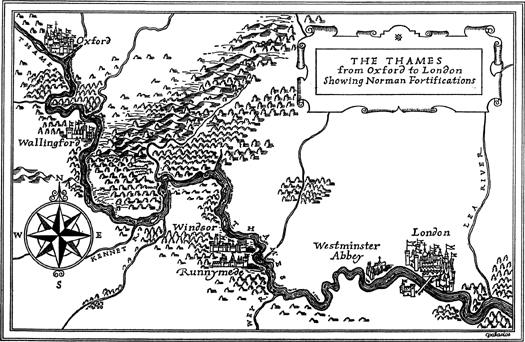
The time had passed for promises and threats, however. The barons were in the field in great strength, and it was clear that they meant to have their way. Realizing that he was not strong enough to oppose them, he temporized by making a number of absurd suggestions, as for instance that the matter be left to the Pope to decide as suzerain of England. The barons broke off negotiations. They elected Robert Fitz-Walter as their leader in the civil war which now seemed inevitable. After a defeat at Northampton, the barons marched on London and were received warmly by the citizens. This success convinced John that he would have to grant their terms. He sent word to them to meet him on June 15 at a field called Running-Mead on the Thames within close range of Windsor.
2
John had been in every respect an oppressive king, swayed only by his own desire and will, disregarding his coronation vows and the dictates of decency and statesmanship. All the kings from the time of the Conquest, however, had been ruthless and dictatorial. William Rufus and Richard had been worse in the demands they had made on their subjects. Why, then, did the nation remain quiescent under the others and burst into such fiery resentment over the actions of John?
There were two reasons. The first was that John inherited the resentment of a century, that he reaped where his predecessors had sown. The breaking point was reached when he came to the throne and proceeded to put his own diabolical ingenuity into the performance of familiar tyrannies.
The second reason was personal, the universal contempt in which he was held and the horror aroused by his cruelties. It was one thing for a great knight like Richard to toss aside his vows and make a travesty of government and justice, it was a vastly different matter when the prince, who had humbled England abroad and had made a personal enemy nearly every day of his life, followed the same course. A hero will be forgiven much, a coward and rascal nothing. The silence with which the people accepted the tyrannical acts of Richard Coeur de Lion added, of course, to the prompt and violent resentment they showed to John Softsword.
That John faced a solidly organized baronage was the result largely of the personal hatreds he had stirred up among them. Two of the most active leaders were Eustace de Vescy and Robert Fitz-Walter, and history supplies stories to account for the deep enmity they showed.
Eustace de Vescy was lord of the great castle of Alnwick in Northumberland. He had been with Richard in Palestine and was a brave and honorable knight. His wife was a lovely young woman of high spirits, and it was inevitable that the roving eye of the King would rest on her with admiration. The fact that she was devoted to her husband and that no hint of scandal had ever attached to her name served to fan the flames of desire in the amorous King. Noticing that the husband wore a ring of unusual design which he had brought back from the East, the royal philanderer borrowed it on the pretext of having one made like it. He then sent the ring to the wife of De Vescy with a message purporting to come from her husband that she was to meet him that night at a certain house in London. From this point on the story might well have inspired a tale in the Decameron. The chatelaine of Alnwick was not taken in by anything as transparent as this. She went to her husband and told him what had happened. Eustace de Vescy realized what was back of it and decided to trick the King. He hired a lusty wench to play the part of his wife and, when the King came during the night and insinuated himself into the bed which he supposed was occupied by the lady of Alnwick, he did not find it empty.
Some time later Eustace de Vescy was at the royal supper table. John decided to enjoy his triumph in the usual manner. Combing his hands through his black beard and letting his dark eyes rove about the board with an amused gleam, he said to his guest, “Your lady is a delightful companion in the darkness of the night.”
A silence fell on the room. Men kept their eyes down out of pity for the husband whose shame was thus being publicly proclaimed. Eustace de Vescy was noted for the violence of his temper as well as for the warmth of his love for his wife. The Northern baron seemed quite self-possessed, however, and answered in an easy tone.
“What grounds have you for saying that, my lord?”
“Grounds of experience,” declared John with a loud laugh. “How else could I know?”
The baron allowed himself at this point the luxury of joining in the royal laughter.
“No, my lord,” he said. “It was not my wife. Sometimes, my lord, a harlot is encountered in quite unexpected places.”
John’s rage at this open flouting was so great that the lord of Alnwick had to flee the country. He remained in exile for several years and was frequently in contact with Stephen Langton at Pontigny. The making of peace with Rome gave him freedom to return, and back he came, to play an active part in the humbling of the King who had tried to dishonor him.
A different kind of story is told to account for the undying enmity of Robert Fitz-Walter. He was the owner of Castle Baynard on the Thames and the father of a beautiful daughter called Maud the Fair. John saw Maud the Fair and decided she must be added to his list of victims, willing or otherwise. The girl would not listen to his suit, however, and John resorted finally to force. He had her seized and lodged in the White Tower and there paid her assiduous court. When her father raised a storm, the royal troops seized Castle Baynard and Fitz-Walter was banished from the kingdom. In the meantime the ardor of the royal lover was being dashed by the most contemptuous of rebuffs. Finally he had his prisoner removed to the round turret on top of the keep, which was unheated and probably the most bleak habitation in the whole of England, hoping that the rigors of existence there would soften her will. Finding that she still repulsed him, he had an egg sent her which had been filled with poison. The girl ate the egg and died in great agony, alone in her dismal cell atop the Tower of London.
One may suspect the authenticity of the story about Eustace de Vescy and his wife and the willing trollop who played the trick on the King, but the story of Maud the Fair can be dismissed as untrue for good and sufficient reasons. Robert Fitz-Walter had a daughter named Matilda, but she was married when quite young to Geoffrey de Mandeville, the son of the head justiciar. The young husband got into trouble with the law over an accidental killing. When he was cited to appear on a charge of murder, his father-in-law declared that “he who dares to hang my daughter’s man will see two thousand laced helmets before his door!” The son-in-law was not hanged, but Robert Fitz-Walter drew on himself for his bold defiance an order of banishment. Later Maud the Fair died and John married off the widower to his own discarded wife, Avisa, and charged the bridegroom a fee of eighteen thousand marks for his services!
The fact that such highly spiced anecdotes were told in the chronicles of the day and were generally accepted and believed is an indication of the reputation the King had achieved for himself. He may not have tried to seduce the pretty chatelaine of Alnwick in just this way (but he tried, we can be sure of that!), and it is certain that he did not poison the fair Maud in the turret on the keep, but it is abundantly clear that no woman of the court was free from his attentions and that he did not hesitate to dishonor his most powerful subjects when a wife or daughter filled his eye. The hatreds engendered in this way provided embittered leaders for the forces of discontent.
While John was thus disturbing the felicity of the most influential men in the kingdom, he was having trouble with his own lovely wife. After seven years of childless marriage, the beautiful Isabella presented the King with a son on October 12, 1207. The boy was named Henry and he was to live a long life and earn for himself a front place among the worst of kings. Another son followed who was called Richard and became the richest man in the world and was elected Holy Roman Emperor. Three daughters were then born in rather quick succession, the eldest being christened Joan. This little princess was promptly betrothed to Isabella’s jilted lover, Hugh of Lusignan! The match never came to anything for a very unusual reason which will be explained in its proper place. Joan, who was beautiful and angelic in character, was married instead at the tender age of eleven to King Alexander of Scotland to patch up a quarrel with that monarch. Because of this the lovely little Queen was called thereafter Joan Makepeace.
Such a steady succession of children should have been proof of domestic felicity in the royal family, but there seems instead to have been a rift which increased with the years. Isabella’s reason for marrying John had been ambition. She had never loved him and she was such a sparkling beauty that every man looked at her with admiration. This provided all the ingredients for trouble, and it is perhaps not surprising that the Queen’s eye began to develop a roving tendency also. It is recorded that John became convinced of an affair she was carrying on with a man of the court and that he adopted a characteristic way of having his revenge. One day the Queen found the body of her lover dangling at the head of her bed, the cords of the rich hangings knotted about his neck, his face black and swollen, his tongue protruding from his mouth.
At one stage she was placed in restraint as Eleanor had been. It was, however, for a short period only. John never seems to have recovered from his infatuation for his Queen, who was called the Helen of the Middle Ages.
It will be seen that the private life of the King was not of a kind to win back any of the favor which the infamy of his public career had lost. Hatred and contempt for this man who ruled over them led the barons inevitably to the field which has come down in history as Runnymede.
3
History supplies no report of the weather which prevailed along the Thames on Monday, June 15, 1215, but a beneficent Providence would not have provided anything but a day of bright sunshine for this momentous occasion. Let us assume, then, that the sky was bright and clear, the sun so brilliantly warm that the gray of the water was shot through with gold, and that the wide meadow along the river was lushly green with patches and dots of yellow.
But if the day was bright, there was nothing but blackness in the soul of John. For a month he had been at Windsor, following a visit to London, where he had found the citizens a unit in refusing to back him in his struggle with the barons. He had been trying to discover a way out of his difficulties but without success. How had it happened that after his surrender to the Pope, a brilliant right-about-face which had brought him the support of the Pontiff, his fortunes had dipped so suddenly? He could not understand it. When the interdict was raised, it had seemed to him that the domestic situation was well in hand. He had felt safe in dealing arbitrarily with the barons, who were a quarrelsome lot and incapable, seemingly, of continuing long in one camp or fighting together in one cause. But some malign influence had held them together, after all, and thus had brought him to his present desperate pass. Well he knew who had wielded that influence, the insistent, meddling cardinal at Canterbury. Langton should never have been allowed to come back to England.
On his arrival at Windsor it had been crammed with his supporters. They had filled the First King’s House and the Marshal’s Tower and even the huge round Norman keep. Their iron heels had resounded in Beauclerc’s Passage which ran under the King’s House, and they had crowded the jousting grounds between conferences with a willingness for combat which they did not show in the King’s cause. Gradually their number had decreased. It was nothing new for John to watch his support dwindle, but each desertion this time had thrown him into a deep and sullen dismay. When the day came that only seven knights remained at Windsor, he gave in and sent word to the Army of God and Holy Church, as the barons called themselves, that he would meet them again.
Runnymede, to give it the modern spelling, was an extensive meadow on the south bank of the Thames near Staines where Oxford Street crossed the river. Here the barons had chosen to camp. Its selection had been deliberate, for this sometimes marshy stretch of land had been used by the Druids for ceremonial purposes and later by the Anglo-Saxons for speech-motes. Opposite it was a wooded island of some size, now called Charter Island.
On the appointed morning and at the time set, John rode out from Windsor and proceeded to a position on the north bank opposite the island. His pride was galled by the smallness of the train which followed him. Stephen Langton was at his right hand as surety for his appearance. The King would have been happy without him! On the other side rode Pandulfo, whose seat in the saddle was as bad as most clerks’ and who jounced and groaned at the rapid pace set by the King. Behind the papal agent was Amaury, Grand Master of the Templars. William Marshal, whose stout old heart made it impossible for him to desert a king to whom he had sworn fealty, rode behind. His presence was a comfort, and yet it had seemed to the King that Pembroke wore a worried frown as they set out. There had been no doubt of the uncertain mood of the usually loyal half brother, William Long-Espée. The Six lioncels of Salisbury flapped proudly in the breeze, but under them the hero of the sea battle at Dam wore a doubtful scowl, as though he did not like the way things were going. Beside the son of the Fair Rosamonde rode a cousin of the King, the Earl of Warenne. There were, farther back, a few bishops and a few knights.
It was a miserable train for a king as arrogant as John.
As they drew near the appointed place, the sound of cheering reached their ears, mingled with the neighing of horses and the loud, clear blast of trumpets. Coming into sight of the shore opposite the island, they saw it was filled with armed horsemen, the sun shining on helmets and breastplates and on lances held erect to display the proudest pennons in England: the colors of Bigod, of Bohun, of Percy, of Lacey and Mowbray and De Vere. The King reined in suddenly, his face red with mortification. Here for the first time he saw with his own eyes the tangible evidence of the unanimity of the barons in opposition to him. They had refused to follow him on his continental forays. It had taken hatred of him to bring them out thus in full force!
Robert Fitz-Walter had ridden down close to the water’s edge. Beside him was Eustace de Vescy with the cross argent on his shield and Saire de Quincey, whose arms showed eight points azure. The latter was the shrewdest member of the combination and is supposed to have been responsible for the final draft of the Charter. The three leaders watched the small party across the river with anxious eyes, wondering in what mood they would find the savage and unpredictable King.
Every proud name in England was represented in the army behind them. Henry de Bohun was there, which would have amazed his ancestor, Humphrey With-the-Beard, who had been one of the stanchest supporters of the Conqueror. Close by stood a proud baron who was in much the same position, Richard de Percy, whose great-grandfather’s nickname had been William With-the-Whiskers and who had been equally unswerving in his devotion. Robert de Vere was probably the proudest participant, being hereditary lord chamberlain of the kingdom. Geoffrey de Mandeville was the wealthiest man there because of the land and riches brought him by Avisa. An unexpected adherent was the oldest son of William Marshal. His appearance was not due to the rather common practice of straddling the fence of allegiance, one member of a family going one way and another serving in the opposite camp. Young William was an enthusiastic partisan of the popular cause and had refused to take his father’s advice.
There was only one man in that glittering cavalacde who had no arms or quarterings to show, William de Hardell, mayor of London. He was the first mayor to secure his elevation by popular election and the first also to introduce the trappings which would add so much to the dignity of the post, such as the ridings to Westminster. A bluff and hearty man, he sat his roan charger with ease and pride, being fully conscious of the fact that he represented more real power than any landed baron there.
Most of the men at Runnymede had Norman names, but few if any of them lacked English blood. Few of them owned land in Normandy, few had crossed the Channel. Their thoughts were all of England. They swore Saxon oaths, they worshiped at Saxon shrines. And their concern that day was to compel the granting of a code of laws based on those of the Saxons and modeled on a charter which had been drawn up more than a century before on the insistence of a lovely Saxon princess.
The negotiations were conducted on Charter Island where a fine pavilion had been raised for the purpose. It was clear from the first that the fight had gone out of the King. He agreed to the general content of the document, the forty-eight articles and the Forma Securitatis, before the end of the day. It is not true, however, as has often been assumed, that it was written and signed there and then. It took four days of hard work on the part of Saire de Quincy and Stephen Langton to draft it to the satisfaction of all.
They realized, when the royal signature had been scrawled at the end, that it had been surprisingly easy. John had been listless, subject to sudden bursts of impatience, but always ready to concede a point when the barons insisted. It should have been easy enough to guess from his attitude that he was marking time and that, if his fortunes improved, he would not hesitate to break his word later. Langton was shrewd enough to see what was back of the King’s complaisance and to make up his mind to a watchful course thereafter.
The leaders had not expected the negotiations to last so long and certain difficulties arose. Not enough food had been provided for as extended a stay, and after the first day the army contractors were out in all directions, bargaining for beef and mutton, and paying handsomely through the nose. At the opening it was a matter of pride for the barons to keep in their saddle in heavy steel under the blazing sun while their leaders sat around in the cool blue-and-gold pavilion and debated with the obese and glowering King of the realm. The second day it became tiresome. The knights dismounted, took from their heads the heavy steel covering called the chapel-de-fer, bawled to their squires to slosh them with cold water, and demanded to know among themselves what this cullionly King was doing. The third day many of them had discarded steel and were attired in coats of cuir-bouilli, a variety of leather which had been boiled in water until it had almost the resistance of metal but was both lighter and cooler. Some had even come out from their stifling tents without the awkward thigh coverings which made walking so difficult.
On the fourth day it was suspected that nothing in the way of armor would have been found if the rich brocaded surcoats of the knights had been stripped off.
It might have been hard to hold them all through four days of talk, in which they had no part, if the leaders had not been wise enough to arrange for a victory tournament to be held at Stamford after the signing of the Charter.
4
This is the Great Charter, Magna Charta, as it is generally called:
John, by the grace of God King of England, to the archbishops, bishops, abbots, earls, barons, justices, foresters, sheriffs, prevosts, ministers, and all his bailiffs and his lieges, greeting. Know ye, that we by the grace of God, and for the saving of our soul, and the souls of all our ancestors, and of our heirs, and for the honour of God, and the safety of holy church, and for the amendment of our government, by the advice of our honoured fathers, Stephen, archbishop of Canterbury, primate of all England, and cardinal of Rome; Henry, archbishop of Dublin, William, bishop of London, Peter, bishop of Worcester, William, bishop of Chester, Benedict, bishop of Rochester, and master Pandulph, sub-deacon of our Lord the apostle, and of our friend brother Anner, master of the order of knights templars in England; and by the advice of our barons, William, earl marshal earl of Pembroke, William, earl of Salisbury, William, earl of Warren, William, earl of Arundel, Alan of Galloway, constable of Scotland, Warin Fitz-Gerard, Peter Fitz-Herbert, Thomas Basset, Alan Basset, Philip d’Aubenie, Robert de Ropelee, John Marshal, and John Fitz-Hugh, and by the advice of other lieges:
Have in the first place granted to God, and confirmed by this our present charter, for us and for our heirs for ever, That the churches of England shall be free, and shall enjoy their rights and franchises entirely and fully: and this our purpose is, that it be observed, as may appear by our having granted, of our mere and free will, that elections should be free (which is reputed to be a very great and very necessary privilege of the churches of England) before the difference arose betwixt us and our barons, and by our having confirmed the same by our charter, and by our having procured it moreover to be confirmed by our lord the apostle Innocent the third. Which privilege we will maintain: and our will is, that the same be faithfully maintained by our heirs for ever.
III. We have also granted to all the freemen of our kingdom, for us and for our heirs for ever, all the liberties hereafter mentioned, to have and to hold to them and their heirs of us and our heirs. If any of our earls, our barons, or others that hold of us in chief by knight-service, die; and at the time of his death his heir be of full age, and relief be due, he shall have his inheritance by the antient relief; to wit, the heir or heirs of an earl, for an entire earldom, C. pounds; the heir or heirs of a baron, for an entire barony, C. marks; the heir or heirs of a knight, for a whole knight’s fee, C. shillings at most: and where less is due, less shall be paid, according to the antient customs of the several tenures.
IV. If the heirs of any such be within and in ward, they shall have their inheritance when they come of age without relief, and without fine.
V. The guardians of the land of such heirs being within age, shall take nothing out of the land of the heirs, but only the reasonable profits, reasonable customs, and reasonable services, and that without making destruction or waste of men or goods.
VI. And if we shall have committed the custody of the land of any such heir to a sheriff, or any other who is to account to us for the profits of the land, and that such committee make destruction or waste, we will take of him amends, and the land shall be committed to two lawful and good men of that fee, who shall account for the profits to us, or to such as we shall appoint.
VII. And if we shall give or sell to any person, the custody of the lands of any such heir, and such donce or vendee make destruction or waste, he shall lose the custody, and it shall be committed to two lawful, sage, and good men, who shall account to us for the same, as aforesaid.
VIII. And the guardian, whilst he has custody of the heir’s land, shall maintain the houses, ponds, parks, pools, mills, and other appurtenances to the land, out of the profits of the land itself; and shall restore to the heir, when he shall be of full age, his land well stocked, with ploughs, barns, and the like, as it was when he received it, and as the profits will reasonably afford.
IX. Heirs shall be married without disparagement; insomuch, that before the marriage be contracted, the persons that are next of kin to the heir, be made acquainted with it.
X. A widow after the death of her husband, shall presently and without oppression, have her marriage and her inheritance; nor shall give anything for her marriage, nor for her dower, nor for her inheritance, which she and her husband were seized of the day of her husband’s death; and she shall remain in her husband’s house forty days after his death; within which time her dower shall be assigned her.
XI. No widow shall be compelled to marry if she be desirous to live single, provided she give security not to marry without our leave, if she hold of us, or without the lord’s leave of whom she holds, if she hold of any other.
XII. We nor our bailiffs will not seize the lands or rent of a debtor for any debt so long as his goods are sufficient to pay the debt: nor shall the pledges be distrained upon whilst the principal debtor is able to pay the debt. But if the principal debtor have not wherewith to pay the debt, the pledges shall answer for it: and if they will, they shall have the lands and rents of the debtor till they have received the debt which they paid for him, if the principal debtor cannot shew that he is quit against his pledges.
XIII. If any persons have borrowed money of Jews, more or less, and die before they have paid the debt, the debt shall not grow whilst the heir is under age; and if such debt become due to us, we will take no more than the goods expressed in deed.
XIV. And if any die, and owe a debt to the Jews, his wife shall have her dower, and shall be charged with no part of the debt; and if the children of the deceased person be within age, their reasonable estovers shall be provided them, according to the value of the estate which their ancestor had; and the debt shall be paid out of the residue, saving the services due to the lord. In like manner shall it be done in cases of debts owing to other persons that are not Jews.
XV. We will impose escuage* nor aids within our realm, but by the common council of our realm, except for our ransom, and for the making our eldest son a knight, and for marrying our eldest daughter once: and for these purposes there shall but a reasonable aid be required.
XVI. In like manner shall it be done within the city of London: and moreover, the city of London shall have all her antient customs and liberties by land and water.
XVII. We will moreover and grant, that all other cities, and boroughs, and towns, and ports, have, in all respects, their liberties and free customs.
XVIII. And as for coming to the common council of the kingdom, and for assessing aids (except in the three cases aforesaid) and as for the assessing of escuage, we will cause to be summoned the archbishops, bishops, abbots, earls, and the greater barons, each in particular by our letters; and moreover, we will cause to be summoned in general, by our sheriffs, and bailiffs, all that hold of us in chief, at a certain day; to wit, forty days after at least, and at a certain place; and in our said letters we will express the cause of the summons. And when the summons shall be so made, business shall go on at the day assigned, by the advice of such as are present, though all that are summoned do not appear.
XIX. We will not allow for the future, that any take aid of his freemen, but only to ransom his person, to make his eldest son a knight, and to marry his eldest daughter once; and for these purposes there shall but a reasonable aid be given.
XX. None shall be distrained to do greater service for a knight’s fee, or for any other frank-tenement than what is due by his tenure.
XXI. Common pleas shall not follow our court, but shall be held in a certain place.
XXII. Recognizances of novel disseisin, mordancester, and darrein presentment, shall be taken no where but in their proper counties, and in this manner: We, or our chief justice (if ourselves be out of the realm) will send two justices through every county four times a year; who, with four knights of every county, to be chosen by the county, shall take the said assizes in the county, at a day when the county-court is held, and in a certain place: and if the said assizes cannot be taken upon that day, so many knights and free tenants of them that were present in the county-court that day, shall stay, as may give a good judgment, according as the concern may be greater or less.
XXIII. A freeman shall not be amerced for a little offence, but according to the manner of his offence; and for a great offence he shall be amerced according to the greatness of his offence, saving his contenement; and so a merchant saving his merchandize; and a villain in like manner shall be amerced saving his wainage, if he fall into our mercy: and none of the said amercements shall be affeered, but by oath of good and lawful men of the vicinage.
XXIV. An earl and a baron shall not be amerced but by their peers, and according to the manner of their offence.
XXV. No clerk shall be amerced but according to his lay-fee, and in like manner as others aforesaid, and not according to the quantity of his churchliving.
XXVI. No ville nor any man shall be distrained to make bridges over rivers, but where they antiently have, and of right, ought to make them.
XXVII. No sheriffs, constables, coroners, nor other our bailiffs, shall hold the pleas of our crown.
XXVIII. All counties, hundreds, wapentakes and tithings, shall be at the antient farms without being raised, except our own demesne mannors.
XXIX. If any that holds of us a lay-fee die, and our sheriffs, or other our bailiffs shew our letters patents of summons for a debt which the deceased owed to us, our sheriff or bailiff may well attach and inventory the goods of the dead, which shall be found upon his lay-fee, to the value of the debt which the deceased owed to us, by the view of lawful men, yet so as nothing be removed till such time as the debt, which shall be found to be due to us, be paid; and the residue shall go to the executors to perform the testament of the dead: and if nothing be owing to us, all his goods shall go to the use of the dead, saving to his wife and children their reasonable parts.
XXX. If any freeman die intestate, his goods shall be divided by the hands of his near kindred and friends by the view of holy church, saving to every one their debts which the dead owed them.
XXXI. None of our constables, nor other our bailiffs shall take the corn, nor other the goods of any person without paying for the same presently, unless he have time given him by consent of the vendor.
XXXII. Our constables shall distrain no man who holds by knight-service, to give money for castle-guard, if he has performed it himself in proper person, or by another good man, if he could not perform it himself for some reasonable cause: and if we lead him, or send him into the army, he shall be discharged of castle-guard for so long time as he shall be with us in the army.
XXXIII. Our sheriffs, our bailiffs, or others, shall not take the horses nor carts of any freeman to make carriage, but by leave of such freeman.
XXXIV. Neither ourselves nor our bailiffs shall take another man’s wood for our castles, or other occasions, but by his leave whose wood it is.
XXXV. We will hold the lands of such as shall be convicted of felony but a year and a day, and then we will restore them to the lords of the fees.
XXXVI. All wears shall, from this time forward, be wholly taken away in Thames and Medway, and throughout all England, except upon the seacoast.
XXXVII. The writ called Precipe henceforth shall be made to none out of any tenement, whereby a freeman may lose his court.
XXXVIII. One measure of wine shall be used throughout our kingdom, and one measure of ale, and one measure of corn, to wit, the London quart. And there shall be one breadth of dyed cloths, russets, and haubergets, to wit, two ells within the lists: and concerning weights, it shall be in like manner as of measures.
XXXIX. Nothing shall be given or taken henceforth for a writ of inquisition of life or member, but it shall be granted freely and shall not be denied.
XL. If any hold of us by fee-farm, or by soccage, and hold likewise land of others by knight-service, we will not have the custody of the heir, nor of the land which is of the fee of another, by reason of such fee-farm, soccage, or burgage, unless such fee-farm owe knight-service.
XLI. We will not have the wardship of the heir, nor of the land of any person, which he holds of another by knight-service, by reason of any petit serjeantry by which he holds of us, as by the service of giving us arrows, knives, or such like.
XLII. No bailiff for the time to come shall put any man to his law upon his bare word, without good witnesses produced.
XLIII. No freeman shall be taken, nor imprisoned, nor disseized, nor outlawed, nor exiled, nor destroyed in any manner; nor will we pass upon him, nor condemn him, but by the lawful judgment of his peers, or by the law of the land.
XLIV. We will sell to none, we will deny nor delay to none right and justice.
XLV. All merchants may, with safety and security, go out of England, and come into England, and stay, and pass through England by land and water, to buy and sell without any evil tolls, paying the antient and rightful duties, except in time of war; and then they that are of the country with whom we are at war, and are found here at the beginning of the war, shall be attached, but without injury to their bodies or goods, till it be known to us or to our chief-justice, how our merchants are entreated which are found in our enemies’ country; and if our’s be safe there, they shall be safe in our land.
XLVI. It shall be lawful for all men in time to come, to go out of our kingdom, and to return safely and securely by land and by water, saving their faith due to us, except it be in time of war for some short time for the profit of the realm. But out of this article are excepted persons in prison, persons outlawed, according to the law of the land, and persons of the country with whom we are at war. Concerning merchants what is above-said shall hold as to them.
XLVII. If any hold of any escheat, as of the honour of Wallingford, Nottingham, Boloin, Lancaster, or of other escheats which are in our hand, and are baronies, and die, his heirs shall owe to us no other relief, nor do us any other service, than was due to the baron of such barony when it was in his hand; and we will hold the same in like manner as the baron held it.
XLVIII. Men that dwell out of the forest, shall not appear before our justices of the forest by common summons, unless they be in suit themselves, or bail for others who are attached for the forest.
XLIX. We will not make sheriffs, justices, nor bailiffs, but of such as know the law of the land, and will keep it.
L. All that have founded abbies, whereof they have charters from the Kings of England, or antient tenure, shall have the custody thereof whilst they are vacant, as they ought to have.
LI. All the forests that have been afforested in our time, shall instantly be disafforested; in like manner be it of rivers, that in our time and by us have been put in defence.
LII. All evil customs of forests and warrens, and of foresters and warreners, of sheriffs and their ministers, of rivers and of guarding them, shall forthwith be inquired of in every county by twelve knights sworn of the same county, who must be chosen by the good men of the same county. And within forty days after they have made such inquisition, the said evil customs shall be utterly abolished, by those same knights, so as never to be revived; provided they be first made known to us, or to our chief justice if we be out of the realm.
LIII. We will, forthwith, restore all the hostages, and all the deeds which have been delivered to us by the English, for surety of the peace, or of faithful service.
LIV. We will wholly put out of bailiffwicks, the kindred of Gerard de Aties, so that from henceforth they shall not have a bailiffwick in England; and Engeland de Cigoigni, Peron, Guyon, Andrew de Chanceas, Gyon de Cygoigni, Geffry de Martigni and his brothers, Philip, Mark and his brothers, Geffry his nephew, and all their train. And presently after the peace shall be performed, we will put out of the realm all knights, foreigners, singers, serjeants and soldiers, who came with horse or arms to the nuisance of the realm.
LV. If any be disseized or esloined by us, without lawful judgment of his peers, of lands, chattels, franchises, or of any right, we will, forthwith, restore the same; and if any difference arise upon it, it shall be determined by the judgment of the five and twenty barons, of whom mention is made hereafter in the security for the peace.
LVI. As to all things whereof any have been disseized, or esloined without lawful judgment of their peers, by King Henry our father, or by King Richard our brother, which we have in our hands, or which any other has, to whom we are bound to warrant the same, we will have respite to the common term of them that are crossed for the holy land, except such things for which suits are commenced, or inquest taken by our order before we took upon us the cross. And if we return from the pilgrimage, or perhaps forbear going, we will do full right therein. The same respite we will have, and the same right we will do in manner aforesaid, as to the disafforesting of forests, or letting them remain forests, which the Kings, Henry our father, or Richard our brother have afforested; and as to the custodies of lands which are of the fee of other persons, which we have held till now by reason of other men’s fees, who held of us by knight-service; and of abbies that are founded in other men’s fees, in which the lords of the fees claim a right, and when we shall be returned from our pilgrimage, or if we forbear going, we will immediately do full right to all that shall complain.
LVII. None shall be taken nor imprisoned upon the appeal of a woman, for the death of any other than her husband.
LVIII. All the fines and all the amercements that are imposed for our use, wrongfully and contrary to the law of the land, shall be pardoned; or else they shall be determined by the judgment of the five and twenty barons, of whom hereafter, or by the judgment of the greater number of them that shall be present, or before Stephen, archbishop of Canterbury, if he can be there, and those that he shall call to him; and if he cannot be present, matters shall proceed, notwithstanding, without him; so always, that if one or more of the said five and twenty barons be concerned in any such complaint, they shall not give judgment thereupon, but others chosen and sworn shall be put in their room to act in their stead, by the residue of the said five and twenty barons.
LIX. If we have disseized or esloined any Welchmen of land, franchises, or of other things, without lawful judgment of their peers, in England or in Wales, they shall, forthwith, be restored unto them; and if suits arise thereupon, right shall be done them in the Marches by the judgment of their peers; of English tenements according to the law of England, and of tenements in Wales according to the law of Wales; and tenements in the Marches according to the law of the Marches: and in like manner shall the Welch do to us and our subjects.
LX. As for all such things, whereof any Welchmen have been disseized or esloined, without lawful judgment of their peers, by King Henry our father, or by King Richard our brother, which we have in our hands, or which any others have, to whom we are bound to warrant the same, we will have respite till the common term be expired of all that crossed themselves for the Holy Land, those things excepted whereupon suits were commenced, or inquests taken by our order before we took upon us the cross; and when we shall return from our pilgrimage, or if, peradventure, we forbear going, we will presently cause full right to be done therein, according to the laws of Wales, and before the said parties.
LXI. We will forthwith restore the son of Lewelyn, and all the hostages of Wales, and the deeds that have been delivered to us for security of the peace.
LXII. We will deal with Alexander, King of Scotland, as to the restoring him his suitors and his hostages, his franchises and rights, as we do with our other barons of England, unless it ought to be otherwise by virtue of the charters which we have of his father William, late King of Scotland; and this to be by the judgment of his peers in our court.
LXIII. All these customs and franchises aforesaid, which we have granted to be kept in our kingdom, so far forth as we are concerned, towards our men, all persons of the kingdom, clerks and lay, must observe for their parts towards their men.
LXIV. And, whereas, we have granted all these things for God’s sake, and for the amendment of our government, and for the better compromising the discord arisen betwixt us and our barons: we, willing that the same be firmly held and established for ever, do make and grant to our barons the security underwritten; to wit, That the barons shall chuse five and twenty barons of the Realm, whom they list, who shall, to their utmost power, keep and hold, and cause to be kept, the peace and liberties which we have granted and confirmed by this our present charter; insomuch, that if we, or our justice, or our bailiff, or any of our ministers, act contrary to the same in any thing, against any persons, or offend against any article of this peace and security, and such our miscarriage be shewn to four barons of the said five and twenty, those four barons shall come to us, or to our justice, if we be out of the realm, and shew us our miscarriage, and require us to amend the same without delay; and if we do not amend it, or if we be out of the realm, our justice do not amend it within forty days after the same is shewn to us, or to our justice if we be out of the realm, then the said four barons shall report the same to the residue of the said five and twenty barons; and then those five and twenty barons, with the commonalty of England, may distress us by all the ways they can; to wit, by seizing on our castles, lands, and possessions, and by what other means they can, till it be amended, as they shall adjudge; saving our own person, the person of our Queen, and the persons of our children: and when it is amended, they shall be subject to us as before. And whoever of the realms will, may swear, that for the performance of these things he will obey the commands of the said five and twenty barons, and that, together with them, he will distress us to his power: and we will give public and free leave to swear to all that will swear, and will never hinder any one: and for all persons of the realm, that of their own accord will swear to the said five and twenty barons to distress us, we will issue our precept, commanding them to swear as aforesaid.
LXV. And if any of the said five and twenty barons die, or go out of the realm, or be any way hindered from acting as aforesaid, the residue of the said five and twenty barons shall chuse another in his room, according to their discretion, who shall swear as the others do.
LXVI. And as to all things which the said five and twenty barons are to do, if, peradventure, they be not all present, or cannot agree, or in case any of those that are summoned cannot or will not come, whatever shall be determined by the greater number of them that are present, shall be good and valid, as if all had been present.
LXVII. And the said five and twenty barons shall swear, that they will faithfully observe all the matters aforesaid, and cause them to be observed to their power.
LXVIII. And we will not obtain of any one for ourselves, or for any other, any thing whereby any of these concessions, or of these liberties may be revoked or annihilated; and if any such thing be obtained, it shall be null and void, nor shall ever be made use of by ourselves or any other.
LXIX. And all ill-will, disdain, and rancour, which has been between us and our subjects of the clergy and laity since the said discord began, we do fully release and pardon to them all. And moreover, all trespasses that have been committed by occasion of the said discord since Easter, in the sixteenth of our reign, to the restoring of the peace, we have fully released to all clerks and laymen: and so far as in us lies we have fully pardoned them: And further, we have caused letters patent to be made to them in testimony hereof, witnessed by Stephen, archbishop of Canterbury, Henry, archbishop of Dublin, and by the aforesaid bishops, and by Mr. Pandulphus, upon this security and these concessions. Whereby, we will and strictly command, that the church of England be free, and enjoy all the said liberties, and rights, and grants, well and in peace, freely and quietly, fully and entirely to them and their heirs, in all things, in all places, and for ever as aforesaid. And we and our barons have sworn that all things above written, shall be kept on our parts, in good faith, without ill design. The witnesses are the persons above-named and many others.
LXX. This charter was given at the meadow called Running-Mead, betwixt Windsor and Stanes, the fifteenth day of June, in the seventeenth year of our reign.
JOHN
5
It will be seen that the Great Charter went beyond that of Henry I in its specific mention of the rights of Englishmen. Consider Clause XLIII —the numbering was done later and will not be found in the original document—which says with a precision never before attempted that “no freeman shall be taken, nor imprisoned … but by the lawful judgment of his peers, or by the laws of the land.” The parliamentary principle, which had been slowly and imperfectly evolved by the Anglo-Saxons, was affirmed in Clause XV, “We will impose no escuage” (generally called scutage, a helmet or war tax) “nor aids within our realm but by the common council of our realm …”
The rights of common men were dealt with in a more forthright manner than the brevity of Henry’s Charter had made possible. Clause XXIII says: “A freeman shall not be amerced for a small offence … and none of the said amercements shall be affeered but by oath of good and lawful men of the vicinage.”
If Saire de Quincey was responsible for the form of the Charter, he deserves more credit than he has ever been given, and a permanent place among those who have contributed to the liberties of mankind.
When all is said and done, however, the greatest thing about the Great Charter is that it was won by force from a hostile king. When John set down his signature at the bottom of this historic document, he was recognizing the right of the people to make demands and to have a hand in drafting the laws under which they lived and worked and had their being. The clauses are in most respects an amplification of the old laws, but they grow in stature and significance because the laws are here reduced to concrete form and sworn to as a covenant between ruler and people.
*Taxes for the helmet, or war.