
CHAPTER VI
HENRY’S troubles came upon him when his power was at its height. In 1171 his third son Geoffrey was married to Constance, the heiress of Brittany, and assumed the title of duke of that rugged corner of France, with its rocky shores and tumultuous streams, jutting out between the Sleeve (as the French always called the Channel) and the Bay of Biscay. Now all of northern France was included in the Angevin empire, as well as the west and some of the south. Henry was titular head of the Norman dynasty in Sicily and through his marriage to Eleanor occupied the same suzerainty to the Aquitainian kings of Antioch. England stood higher in the Christian world than at any time before. In London there were always special ambassadors (though that term for them had not yet been coined) from other countries to negotiate military or trade agreements. Englishmen were playing prominent parts on the Continent. As a final step in fitting the futures of his children into his dream of empire, Henry arranged a marriage for John with the heiress of Maurienne.
This mountainous province, lying south of Lake Geneva and extending almost to the Gulf of Genoa, was of much greater importance than its relatively small size would suggest. It controlled the approaches to Italy. With a foothold here, the English King would be able to gaze across the Alps at Frederick Barbarossa with a sense of equality. Nay, at the moment the elements in Germany opposed to their red-bearded Emperor were secretly negotiating with Henry to take his place, and so the English ruler had every reason to see himself as another and greater Charlemagne.
The little heiress of Maurienne would not live long enough to play any part in the designs of the ambitious King, but this was in the future and no premonition of it placed a damper on the good spirits of the scheming fathers when they met in the city of Limoges to settle the details of the match. Henry had brought his whole ménage with him: Eleanor, young Henry and his French wife Marguerite, the younger French princess, Alice, who was to marry Richard when she was old enough, and, of course, the youthful John, who undoubtedly derived a sense of importance from the role he was playing.
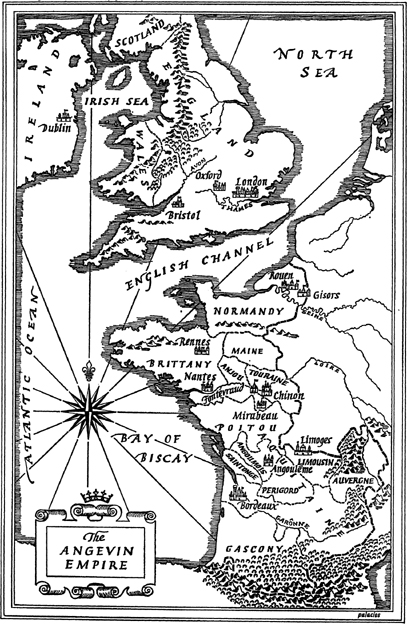
Limoges had never seen since the days of the Roman occupation, when it had been a large place, such an assemblage of the great of the earth within the walls of the Château, as the more ancient half of the city was called. In addition to the English royal family and the nobility of Aquitaine, who always flocked around when Eleanor appeared, there was the Count of Maurienne and a train of Italian noblemen and, to the excitement of everyone, Raimund of Toulouse. This important and elusive feudal figure had come to pay homage for the first time to Henry for his rich and extensive domain which included all of the southwestern corner of France. The arrival of Raimund was the capstone in Henry’s arch of glory, for now at last his sway extended from the farthest north corner of the British Isles to the southernmost part of France.
Limoges was to see the beginning of one of the strangest situations in history. This ancient city, the capital of Limousin, had grown up on the banks of the Vienne and was built solidly of stone, which gave it a notable air of permanence in the eyes of the visitors familiar with the precarious state of wooden London. It was of a great quaintness and charm, a cluster of fine slate-topped spires and much rich-stained glass. Here the bellows of the apprentices blew hot fires for the making of the new champlevé enamel, and here came the pilgrims, who had never heard of St. Thomas the Martyr, to pray at the tomb of St. Martial, filling the narrow streets with their processions on donkeys. The visitors had been taken in at the castle of the viscounts of Limousin, and they were even sleeping up under the battlements.
It was in the hall of the castle that Raimund of Toulouse paid homage to Henry. He was a man of proud and unstable humors, as were most of the rulers of south Gaul, and his decision to acknowledge the suzerainty of the English King instead of the French was a matter of policy, from which at this particular moment he expected to reap some benefit. He swore the usual oath, which contained a promise to reveal any information he might have of machinations against the King. When he came to this part the tall count paused with deliberate intent.
“It becomes my duty,” he said in a whisper meant only for the ears of the King, “to warn you. Make safe your fortresses in Poitou and Aquitaine. Distrust your wife and sons.”
The hands of the new vassal were in Henry’s when he said this. The King’s hands tightened their grip instinctively, but he said nothing to indicate he had heard. The ceremony was carried through and the incident seemed to have ended there.
Supper that night was a sumptuous affair of many courses with “warners” in between which usually consisted of feathered and roasted peacocks or figures done in pastry. There was, of course, a succession of the finest wines of the south. Seated between Eleanor and Raimund of Toulouse, the King imposed enough restraint on himself to stay in his chair and not get up for his usual jaunts around the room. He had little desire for food and his hand seldom raised the jeweled wine cup to his lips. Although not a man of subtle mood, Henry was conscious of a tension in the room. He stole many side glances at Queen Eleanor, who also appeared to have lost her appetite. Ordinarily she talked easily and beguilingly, and much; but this evening her eyes were lowered and she had little to say. She had passed the fifty mark and was no longer the radiant beauty who had once scandalized Europe, but Henry as usual was aware that she had remained a woman of great charm. Her dark eyes made light of the lines at their corners and they were as animated, or nearly so, as when she and her sister Petronille had been queens of the Courts of Love. Her hair, still dark and still lustrous, was held in a gold net called a crespine, over which she wore a small and severely plain circlet of gold. The tight fit of her upper tunic, under which was a bodice strengthened by bone, showed that she was almost as slender as when he had first seen her.
What Raimund of Toulouse had told him was not new to Henry. He had realized for some time that his sons were turning against him and he knew that Eleanor was the chief cause of it. He had hoped this triumph would quiet them down, that they would perceive at last the greatness of what he was striving for and be content to have shares in it. The rift with Eleanor was, of course, an entirely different matter. He allowed his eyes to stray down the table to where the fifteen-year-old Princess Alice was sitting. She also was feeling the tension in the air. At any rate, he had not heard her low-pitched voice all evening. He could not see much of her now, only the blackness of her hair beyond the gold circlet of her sister Marguerite. Eleanor, who always seemed to know everything which went on, was well aware of the interest he took in Princess Alice.
Distrust your wife and sons, Raimund had said! That suave and scornful man was enjoying the good food and wines with the discrimination of a gourmet and was conversing with an ease which irritated his suzerain. Henry had little liking for men of this particular stamp, intellectual triflers who took their duties lightly and considered the details of administration beneath them. At the moment his anger was all for the Count of Toulouse who had dared put into words what he, Henry, had known for some time. Many, in fact, had known of it, but none had shown the audacity to speak of it.
Unable to contain himself any longer, Henry got to his feet and strolled down the length of the dais. He could now see his son Henry, Li Reys Josnes, as they called him in Normandy, the Young King. Neither as tall nor as goldenly handsome as Richard, the eldest son was still large and regal enough to cut a good figure. Surely he could have no part in this family discontent, his eldest son! It would not matter as much about the others if he could only be sure of the loyalty of Li Reys Josnes.
He stopped beside one of his officers and whispered in his ear. The man, too startled for words, looked up at this strange master, asking himself if this meant the King was going back to his old habit of racing from town to town and making his people live in their saddles. It had been understood there would be a long and pleasant stay at Limoges in order to take full advantage of the presence of Raimund of Toulouse and the Count of Maurienne. Why, then, was the King ordering a start for the north in the morning?
Henry’s decision to leave at once was a wise one, even though it ruffled the temper of the proud Count of Toulouse, who thought himself slighted. If trouble was in the wind, he could face it best behind the strong stone fortresses of Normandy. There was a flurry of packing that night, and in the morning—soon after dawn, in fact—the court moved on, striking up the Vienne for Chinon.
The castle of Chinon was one of the three which Henry’s father had willed to Geoffrey, his brother. Geoffrey being dead, it had come to Henry. Everything seemed to come to Henry: castles and lands and provinces, wives with duchies in their hands for his sons, kings as husbands for his daughters. But the castle of Chinon was, of all the things which had come to him, the one tangible possession which gave the English King the greatest pleasure. It stood in the very center of his continental possessions and seemed to him a symbol of his power. It raised its multitude of towers above a hill which completely dominated the town. From the Tour de Boissy or the stout Tour de Moulin it was possible to look far down the lovely valley of the Vienne. Never before or since, perhaps, has there been such a tangle of battlements and roofs of blue slate and spires of tall chapels as were to be seen at Chinon.
It had one unique feature, a hall circular in shape instead of oblong, arching up into a dome supported by huge beamed nerves. This hall was lighted by very tall and narrow windows set in embrasures, and it was here that the court assembled for supper. The King had heard of desertions during the day, but he was not prepared for what he saw when he entered the hall behind his pipers and drums. There were many empty seats around the board, and the most conspicuous absence was that of Li Reys Josnes!
Henry sank into his chair. He glanced up and down the table. All faces, save that of the Queen, were carefully averted. She returned his accusing gaze steadily and coolly. If she knew the reason for the absence of their oldest son, she was not disturbed by it, nor did she fear how he might deal with the situation.
The Young King, he was informed when he girded himself to the repugnant task of asking questions, had ridden away from the main party just as they turned in at Chinon, followed by the members of his household and his bodyguard of young knights. The truant had not taken his wife and her attendants, however, because to do so would have caused too much confusion. The French court was at Paris, and it was to this city that Henry was on his way, striking out first for Alençon.
The next night, at a point more than twenty miles north, an earl was missing at the supper table. The night after, three knights. On the third night the chair beside the King was empty! Eleanor had ridden off for the south and, presumably, was hoping to reach Aquitaine, where she could join her favorite son. Henry had done nothing yet, but Eleanor’s departure stirred him to action. He sent off parties of armed men in all directions with instructions to overtake her and bring her back.
The Queen had disguised herself as a man, but her predilection for getting into masculine attire (which suggests she possessed certain advantages) did not bring her better luck than on the first occasion when she rode to the Crusades at the head of her amazonian guards. She was caught within a few hours and brought back, her well-turned legs still in male hose but concealed under a long cloak.
Henry refused to see her. She was taken to her quarters and kept there as a prisoner. When the journey was resumed the next morning, the Queen was surrounded by an armed guard. From that time on she was watched so closely that she might as well have been in a cell with iron chains and anklets.
Arriving at Rouen, the King was greeted with the worst of news. The provinces of the west were in arms against him. A knight of the Limousin named Bertran de Born, who was acknowledged to be the greatest minstrel of the day, had written a sirventes calling on all subjects of their rightful ruler Eleanor to rise against her English husband. The song was sweeping across Aquitaine. Richard and Geoffrey had declared their intention of allying themselves with their brother in a defiance of parental authority. From the French court King Louis issued a blast. “Here at my side is Henry, King of England,” he declared. As for Henry II, the French monarch continued, he was dead as King of England from the moment his son first assumed the crown; and if he still harbored the delusion that he was King, the matter would in good time be righted! Louis had waited many years for revenge on the man who had stolen his wife and taken away so much French territory and now he was enjoying it in full measure.
The Young King was behaving himself in a boastful and juvenile manner which promised little for the day when he might rule England in his father’s stead. He had a new seal struck so he could issue writs and pronouncements in his own name. Armed with this, he was proceeding to give England away in huge parcels in return for promises of support against his father. The King of Scotland was to have Northumberland; the Count of Flanders, Kent; the Count of Boulogne, Lincoln. The English people, innocent bystanders in this family strife, were to suffer a second conquest. In a letter to the Pope the Young King declared that the murder of Thomas à Becket was the main cause of his intent to oust his father. “Such has been the origin of our dissension,” he wrote to Rome. “Hearken to me, then, most holy father, and judge my cause; for it will be truly just if it shall be justified by thy apostolic authority.”
The Great Hall in the royal palace at Rouen was completed when Henry arrived there. It had taken more than sixty years in the building, for Henry I had begun the work. It was enormous and as handsome and stately as the finest of cathedrals. High arched pillars held up a magnificent dome, and the gallery for the minstrels was screened by beautiful stone tracery. Henry had counted on having it ready for the time when his plans would mature. To find it finished now, when everything seemed to be crashing about him, was an ironic reminder that man’s destiny was in greater than kingly hands.
He was a grim and morose man these days. Of all his family, only young Prince John was with him. John had already succeeded in making himself thoroughly disliked by his arrogance, his selfishness, his cruelty to servants as well as animals, but this was not apparent to his father. The partiality for John which the King showed in his final years started from this period.
Henry did not change his ways. He still remained constantly on his feet, but in his pacing about he never paused to have speech with anyone. His head was bent forward, he frowned incessantly, the high color of his cheeks suggested that his mind was filled with a perpetual smolder of anger. When attendance at mass compelled him to sit, he was never quiet. He hitched about in his seat, he muttered and grumbled under his breath. The King who had nearly succeeded in knitting together the glittering fabric of a new empire was the unhappiest man in the whole length and breadth of his dominions.
But he broke up the coalition formed against him. With an army made up largely of mercenaries hastily recruited in Brabant, he caught a division of his foes under the command of the Count of Boulogne and smashed it utterly. The count was killed in the action, and so his reward for supporting the Young King was not the rich county of Lincoln but six feet of French soil. Then Henry led his troops to Verneuil in search of the invading forces of Louis of France. “Go tell your King,” he cried fiercely to French heralds, “that I am at hand as you see!” Louis of France, the fumbling, ineffective, and unready King, who had never been able to get the better of Henry of England, received the message with fear. Although his army was big enough and strong enough to shove the English out of Normandy, he ordered a retreat instead! Henry did not follow. He struck at the west and captured the army of Brittany at Dol. The old lion he was called (although barely into his forties), and he was now roused and roaring, striking here, striking there, always unexpected and always victorious. Louis gave up in despair. Recommending that the disobedient sons make peace with their father, he retreated so far that the campaign could be considered at an end. The sons conferred with their father at Gisors, but the meeting did not bring about a settlement. The handsome face of Richard was as angry at the finish as at the start because his mother was still a prisoner and no promise of her release had been wrung from the King.
Eleanor was packed off to the royal castle at Winchester. She was not confined to a cell, but under the watchful eye of Ranulf de Glanville she was kept within close bounds. Here she remained, with brief intervals of freedom under the closest of observation, for sixteen years while the furious struggle within the family continued, having no direct part in it, but her plight serving as one of the chief causes of its continuance. Richard, the eagle she had brought into the world, could not be reconciled to his father as long as she was kept in captivity.
The struggle was resumed the following year, but Henry’s star went into the ascendant again. The King of Scotland had been captured and the French fleet, assembled for the invasion of the island, had been scattered by adverse winds. The King next struck with all his vigor at the rebellious barons assembled against him in England. Their opposition went to pieces quickly. Before a month was over the King held a council at Northampton, where he had the supreme pleasure of seeing William the Lion stand before him in chains. The now well-tamed barons came there one by one, Mowbray, Bigod, Ferrers, the Bishop of Durham, Gloucester, Clare. They all humbly swore to obey him as their liege lord and to dispute his authority no more.
Then he hurried to Normandy, where Louis was closing in on Rouen with a large army. Poor, feeble Louis, always at the beginning of something and never at the conclusion of it! As soon as he heard that Henry was back and marching down the Seine he turned like a thief caught with stolen goods in his hands and indulged in the most hasty of all his retreats. The three English princes had been marching under the banner of France, and they now came again to Gisors. This tune their submission seemed complete.
Henry’s real triumph, however, had not been over Louis nor over his own three sons. They were all ready in their minds to oppose him a third time if the opportunity presented itself. His victory was complete and final in another quarter. The English baronage had been thoroughly humbled. The King took advantage of his victory over them to reduce their feudal powers still further. They had to give up most of their castles. These proud and wealthy noblemen, who had considered themselves kings within their own spheres, were made to realize that they were no more than subjects. Thus out of evil came good. Feudal power, always a more direct threat to the safety and happiness of common men than kingly tyranny, was the last reminder of the Conquest, for it had been the arrogant barons of Normandy who had introduced it into England.
2
The picture which history draws of Henry II in his declining years is that of a David beset by a trio of Absaloms who had been urged on to rebel against him by his faithless and vindictive wife. The picture of Queen Eleanor, which was knit early into the tapestry, has never been changed. A false wife and a treacherous queen she remains in history.
But was all the right on Henry’s side in this long period of family struggle? Could the four sons (for John, the pampered one, was to join in at the finish) have rebelled repeatedly, sometimes together, sometimes singly, without any justification at all? Was their only motive an unwillingness to wait for their share of his power and possessions?
History has adopted the obvious and conventional view. A son in arms against his father is an unnatural son, fit only to hang by the hair of his head like Absalom and perhaps to die as David’s son did. A woman who has been guilty of adultery in her passionate youth is a bad woman and nothing good is to be expected of her, and certainly nothing good must be said of her. She can never be a decent wife and mother and, if in her later years she becomes tolerant and wise, no reliance is to be put in the evidence of these qualities. A portrait of incontinence can never be altered.
This is not a true picture of what was happening in France during these stormy years. There is much to be said for Eleanor and the disobedient sons.
For one thing, Henry had not been faithful to Eleanor. Nothing else could be expected, of course, for he was a man of lusty appetites and nearly twelve years younger than his wife. The real consideration which had led them to marry, apart from the first passionate attachment between a beautiful and unsatisfied woman and a great, husky youth, had been their mutual ambition. Eleanor felt that what she had contributed to the Angevin empire was of such importance that she was a partner, not a mere wife to wait at his beck and call. Certainly she was not willing to accept the slight he put upon her in the most spectacular of his infidelities. It becomes necessary at this point, therefore, to deal with the amorous performances of the otherwise admirable King.
There is that favorite fairy story of history, his romance with Rosamonde Clifford, who lived in a secret bower in the maze at Woodstock and was poisoned by the wicked Queen. This fable has been told so often and believed so long, and it is such a beguiling story, that one hesitates to destroy it by telling the real facts of the case.
Some of the early historians said the bower was so well concealed in the maze that the only way to find it was to follow a thread of silk which Henry alone knew about. If this had been true, she would have become very hungry, living all alone in her romantic bower, because no servants knew the secret and it could hardly have been expected that the King would come with dishes of hot food in his hands. Another version was that the middle-aged King had been visiting his pretty mistress and that a ball of silk thread became caught in his spur and was still attached to his heel when the Queen saw him emerge from the winding green paths of the maze. She followed the clue back through the paths and discovered the bower and its fair occupant. All versions agree on the outcome, that the wicked Queen immediately visited the girl, taking a dagger in one hand and a glass of poison in the other. When she found the Fair Rosamonde was the loveliest creature in the world, envy hardened the heart of the Queen and she told her rival she must choose which way she would prefer to die. The girl, as brave as she was fair, chose the poison, drank from the cup, and soon thereafter was dead.
And now for the less romantic facts. Henry met Rosamonde Clifford on his first visit to England while his mother was contending with Stephen for the crown. He was about seventeen years of age and she was younger. Her father was Walter Clifford, a vavasor of Herefordshire. The term vavasor has meant different things at different times, but at this period it denoted a man who had more land than a knight’s fee but had not attained the stature of a baron; and so it can be assumed that the girl had been raised in a rather humble way. Her father was fighting on the side of the Empress, and it is probable that Henry first saw Rosamonde at Bristol, which was the base of operations. She was a beautiful girl. No description of her has been left, but the few things known suggest that there was a sweetness and a spiritual quality to her loveliness. Henry fell in love at once.
The chronicles say he went through a pretended marriage service with her and that she did not know who he was. This is far from credible. The son of Matilda, who might someday be King of England, would have found it next to impossible to conceal his identity from the daughter of one of his supporters. Subsequent happenings indicate that she went with her eyes open into the relationship which resulted in due course in the birth of a son. This first son, who was named William and who later bore the nickname of William Longsword or William Long-Espée, was born after Henry had returned to Normandy. When he came a second time and made the Treaty of Wallingford with Stephen, he had already married Eleanor. However, he and Rosamonde resumed their relationship and another son was born, who was named Geoffrey. When Henry came back as King, he placed the girl in a small stone house just outside the wall of the royal park at Woodstock, and here for a short period he paid her visits. Nearly two hundred years later, Edward III, in repairing the palace at Woodstock, gave written instructions that the house beyond the gate in the new wall, known as Rosamonde’s Chamber, should be carefully restored. This, then, was the bower. Just inside the wall, against which the house stood, was the garden maze; and so some small justification exists, after all, for the fantastic shape the story took.
The Fair Rosamonde, however, did not occupy the House Beyond the Gate long. She repented of her way of living soon after Henry’s crowning and retired to the convent of Godstow, where she remained for the rest of her life. That Henry had been sincerely in love with her was made clear by what he did for her and her two sons. He liberally endowed Godstow. He gave lands to the first son. The second, Geoffrey, who seems to have been a great favorite with the King, was reared at court with his legitimate sons. Rosamonde remained at Godstow twenty years, and after her death Henry saw to it that her body was placed in the choir under a silk canopy and that candles were kept lighted and prayers said constantly for her soul. This continued until Hugh of Lincoln, deciding it was not wise to keep alive the story of an illicit romance, had the body interred in the regular burying ground of the convent with a modest stone containing only two words, Tumba Rosamondae.
Henry was deeply attached to his second illegitimate son, Geoffrey. He not only reared him and had him educated well under his own eye, but he saw to it he was appointed Bishop of Lincoln at the age of twenty. Geoffrey had not wanted to take holy orders, and for a time he refused the post, saying repeatedly, “Nolo episcopari!” He wanted to be a soldier, and when Henry was raising an army for service against the Scots, he arrived at camp with one hundred and forty knights he had recruited and equipped at his own expense.
The son of Fair Rosamonde was lucky enough to have an immediate opportunity of showing what a good soldier he would have been. His company was sent to check Roger de Mowbray, who was advancing from the coast with a force of recruits from Normandy. The lavish offers of land that the Young King was making in Paris had put it into the heads of these greedy Normans that all the country was to change ownership again. As the foot troops tramped along the roads behind the belted knights, they looked enviously at the fine green meadows dotted with fat sheep and sang a new song:
“Hoppe Wyllykin! Hoppe Wyllykin!
Ingland is myne and thyne!”
The young bishop led the charge of his mounted troops against these grasping mercenaries. The invaders were unable to withstand the fury of the onslaught and ran away in a great panic, with Geoffrey and his men riding after them and shouting, “Ingland is myne, not thyne!”
It was on this occasion that Henry made clear how much he cared for Rosamonde’s son. He met Geoffrey after the latter’s return from his triumph and threw an arm affectionately around his shoulders.
“Thou art my true son!” he said in a tone loud enough for many to hear. Then in a lower tone he added, “The others, they are the bastards!”
In the year 1181 the question of Geoffrey’s fitness to remain Bishop of Lincoln came to an issue. The Pope demanded that he take holy orders or resign the see. Geoffrey refused and, accordingly, was removed from his high post. Henry thereupon made him chancellor, and he continued to sit in the chair once occupied by Thomas à Becket until the King’s death.
3
Despite the emphasis which has been laid in history on the story of the Fair Rosamonde and the wicked role played in it, supposedly, by Eleanor, it is certain that the Queen was never much concerned over Henry’s affair with the daughter of the Cliffords. If she had known of the existence of the House Beyond the Gate, she had been allowed little time to feel any resentment, for the record shows that Rosamonde entered Godstow shortly after Henry became King. If the Queen had felt any bitterness, it is unlikely that Henry would have reared the boy Geoffrey at court.
It has always been necessary for queens to accept the fact that kings have mistresses. This has been one of the almost inevitable consequences of unlimited power. Henry did not belong in the ranks of the extremely rare exceptions. He had a son by the daughter of one Sir Ralph Blewitt. She was succeeded by a handsome girl at Stepford who was not of the nobility; her name, therefore, is not recorded. In Normandy he enjoyed the favors of a daughter of Eudes of Porrhoet. The greatest beauty in England, a sister of the Earl of Clare, refused the King’s advances, much to his surprise, no doubt.
There is nothing to indicate that any of these matters disturbed Eleanor unduly. The romance which led to serious trouble came much later, and the circumstances of this affair were such that all the sympathy must be given the Queen. Mention has already been made of the second daughter of Louis of France, who was betrothed to Prince Richard. She was sent to England at the age of five to be brought up and educated there. A pretty and bright child, she seems to have been a general favorite at first. Henry saw little of her, it being the rule to rear royal children in households of their own, with tutors and confessors and almoners and whole droves of servants. The little French girl was stationed perhaps at Tower-Royal or at Woodstock, where the air was supposed to be particularly healthful. When he did see her, sitting impatiently at her lessons or romping with children of her own age, he must have been aware that she was an unusually lively child.
She was brought to live at court at an early age, for the most important part of her education was to learn how to conduct herself as a princess or queen, and the King must have seen much of her whenever he returned from his long sojournings abroad. She does not seem to have been a beauty, but the vivacity of her girlhood had matured into traits in which he took a pleasure—a witty tongue, a gift for wearing clothes, a grace in walking and dancing, an equipment of little mannerisms all her own. Richard was seldom in England while she was growing up, and when he did come he showed no interest in the girl he would have to marry someday. His interests were confined to fighting and hunting and drinking. To Richard the fine edge of a well-balanced sword or a horse of high mettle was of much more concern than the light in a lady’s eyes. His father was more observant.
The wedding should have taken place when the princess reached her fifteenth birthday. Henry found some good reason for postponing it, probably the fact that he was under the necessity of traveling continuously about his unsettled dominions. Eleanor, of course, knew the real reason.
Kings had advantages over other men in the pursuit of romance, but they suffered from one serious handicap. They had no privacy at all and so could not conceal their illicit maneuverings. Henry’s dalliance with Alice must therefore have followed along the usual lines. He spent longer hours with his officials in the chancellery, presumably in the preparation or revision of writs. Actually he was engaged much of the time in writing notes to the princess, a habit she found rather provoking, as she was not a good scholar and had the greatest difficulty in deciphering them. The humblest kitchen knave or scullion would know about these notes. The King was addicted to the chase, but sometimes he would develop a sudden desire to return to the castle. He would leave his horse with a groom conveniently stationed at the rear, slip in at a back postern, and hurry on tiptoe along halls which had been cleared in advance, reaching finally a room adjoining the apartments of Alice. He thought he was being clever and that no one guessed what it was all about; but the groom, the custodian of the postern, the servants who kept watch over the halls, and the ladies of the princess talked it over and snickered and speculated. Sometimes he would summon a conference of his advisers and would keep them an unconscionable time in an anteroom while they were supposed to be with him. In the meantime a door would open behind the King, he would hear a rustle of silken skirts and feel a hand touch his sleeve. A voice would whisper, “My sweet lord and King!” And all over the palace that evening there would be gossip and guessing as to how long the princess had stayed with him.
Eleanor did not need to be told. She had known all about such tricks as this before Henry was born. She was one of the first to realize that her husband was being guilty of the serious offense of toying with the affections of his daughter-in-law-elect. This was different from his earlier affairs. The Queen could forget about the Fair Rosamonde, but she could not pass over or condone anything as gross and dangerous as this. She knew with what zest this tidbit would be rolled over gossiping tongues in every court in Europe. She, the once fascinating Eleanor of Aquitaine, would become known as a neglected and deceived wife. This was not to be borne in silence.
Eleanor took her distress over the outrageous conduct of Henry to her sons. Their anger can be imagined, particularly that of Richard, who was the one directly injured. He had not shown any interest in the girl, but he was not willing to find himself decorated with antlers on his forehead even before he was married. All of the sons were fond of their mother, and their sympathies were entirely with her in this unsavory mess. When she was taken back to England a prisoner, their opposition to Henry became irreconcilable.
Curiously enough, the gossip in England at this point was not of Henry and Princess Alice but was all about the Fair Rosamonde. It had happened that the imprisonment of the Queen followed closely on the death of Rosamonde Clifford at Godstow, and the chance to link one event with the other was too good to be missed. It was taken for granted that Henry had remained faithful to his early mistress, that she had assumed the veil to escape the vengeance of the Queen but had been tracked down and poisoned nevertheless. The fact that Eleanor was kept a prisoner so long nourished the legend, and after that it could not be stopped. A ballad was evolved from the story, with all the imaginary trappings of maze and bower and ball of thread, and the wicked Queen and the cup of poison. Improvements were made in the ballad of Henry and the Fair Rosamonde as time rolled on. It was a favorite with minstrels for centuries after, the most often clamored for when a wandering crowder arrived at a tavern with his cithara over his shoulder. The final version was that of one Thomas Delone, written perhaps in the fifteenth century, in which some sweeping innovations appear, including a fanciful description of the House Beyond the Gate.
Most curiously the bower was built,
Of stone and timber strong;
One hundred and fifty doors
Did to the bower belong,
And they so cunningly contrived
That none but with clue of thread
Could enter in and out.
The House Beyond the Gate, to return to earth after this not too poetic flight, was quite small. It was a single-story huddle of gray stone with one door, two or three windows, and perhaps a chimney.
In the meantime Louis of France had caught some echoes of the scandal involving his daughter, and he clamored indignantly for the wedding with Richard to take place as arranged, as a means of stopping the stories. Richard, prompted by a desire to put his father in a false position rather than a wish for his long-promised bride, joined in with the same demand. Henry found reasons for a further postponement.
This went on year after year. Henry showed all the resourcefulness of his one-time friend and chancellor, Thomas à Becket, in the contrivance of excuses. When Louis died in 1180 and was succeeded by his son Philip, the situation had not changed. Alice was still going wherever the King went, and Henry was more openly infatuated with her than ever. He was making covert advances to the Pope in the matter of a divorce from Eleanor. If he had succeeded in this, he would unquestionably have married the French princess at once and let the world say and think what it liked. But the Pope refused to consider the granting of a divorce.
On one occasion, when embarrassed by the embittered attitude of all his sons, Henry made a suggestion which obviously he had no thought of carrying out. He declared that, inasmuch as Richard had been a false and disobedient son, he would not allow him to marry the princess but that John, freed by the death of the heiress of Maurienne, should wed Alice as soon as he grew old enough. This served the same purpose of every suggestion Henry had made in the matter. Letters had to be exchanged and several months were wasted. As the idea found no favor, it was finally dropped, just as the King had intended.
The second Henry was finding himself, in fact, in much the same position as the last of the Henrys in the matter of Anne Boleyn. With a wife on his hands and no legitimate reason for a divorce, Henry VIII went to the extreme of separating England from Rome and then promulgating his own divorce. Henry II lived in an age when such a solution was unthinkable. All he could do was to play for time and hope that Eleanor would die. The few things known about Alice suggest that she had some qualities in common with Anne Boleyn. She was ambitious, clever, an aid to the King in planning the devious excuses which kept her from the nuptial couch of Richard. She must have been deeply attached to Henry or she would never have acquiesced in the highly unenviable position this created for her.
With Eleanor in captivity at Winchester, there was no longer need for the King to cover up his movements. His court became convinced that he and the princess were living together as man and wife, and so the whole world came to believe the same. Henry stood out in this matter against all counsel, all pressure, all the misfortunes which could be traced directly to his ill-advised course.
After Richard became King, Philip tried to force him to carry out the old arrangement and marry Alice. Richard refused on the ground that she had been his father’s mistress and had borne him a son. If such were the case, the child was born abroad, for there are no records of it in England, and must, moreover, have died in infancy. Philip did not dispute the statement. He finally agreed to a cancellation of the betrothal, and Richard married Princess Berengaria of Navarre instead. Philip then gave his unfortunate sister in marriage to a nobleman of France; a sorry conclusion for her, but not as grim an ending as that of Anne Boleyn, who succeeded in making herself Queen and laid her head on the block because of her success.
But this was after the death of Henry. As long as he lived, he refused to give Princess Alice up. She was thirty-two when he died and for seventeen years had been the object of his infatuated attachment.
4
Another reason the sons had for their continuous efforts to free themselves of parental control was the stern and unchangeable nature of that control. Although Henry and Richard and Geoffrey were granted the outward semblance of authority, they were puppets in the fullest sense of the word. Henry always selected the men to work with them. He saw to it that these advisers and administrators had been thoroughly trained in his own ways of doing things. These stern Norman officials were under orders to see that nothing was done of which Henry would not have approved. If one of the sons differed from his advisers and decided to take matters into his hands, they would produce papers which showed they had the power and the son no more than a make-believe authority. If the son appealed to his father, the latter would side with the officials.
In 1168, when the people of Aquitaine had been on the point of rebellion, Henry had sent Eleanor to Bordeaux to assume the rulership of her own duchy. All Aquitaine was delighted. At last their beautiful Eleanor, to whom they had always given their full allegiance and with whose peccadilloes they had been rather pleased than otherwise, was back again. It seemed like a perfect arrangement, and the Queen approached her task with a deep sense of pleasure. But she soon found herself in the position which would later irk her sons. The Earl of Salisbury had been sent with her and also a whole corps of officials from the English Curia and chancellery. When Eleanor wanted to make changes to meet the demands of her people, the earl said no. She was unable to alter any of the laws and regulations which had caused their dissatisfaction. She sent passionately angry appeals to Henry to relieve her of these stern and heavy-handed men. Henry paid no attention. She was frustrated at every turn, and because she was doing nothing for them the people began to lose some of their affection for her, and this galled her high spirit.
The result was that the nobility of Aquitaine staged a palace revolution and murdered the Earl of Salisbury and all his seneschals in one day. The uprising had been badly planned and was soon suppressed. Eleanor was recalled to England, and the old methods of administration were continued thereafter without any change or amelioration.
The laws which Henry had established in England and which he was now enforcing in his continental dominions were better laws for the people than those which had existed before. It was the nobility who objected. They saw their feudal power being pared, they were forced to pay heavier taxes, they found themselves subjects under these new laws instead of rulers. They had for Henry nothing but hatred, these chivalrous knights of Aquitaine and Poitou. But Henry was right and they were wrong.
Unfortunately his sons lacked the insight which Henry possessed in such a great degree. It seemed to the three princes that their father was wrong and the barons who resisted him were right.
5
The struggle between Henry and his sons covered a period of sixteen years. It was very much confused and mixed up. At one time all the princes would be against their father. At other times they were fighting among themselves. At several stages the princes turned on their own allies in Aquitaine and Brittany and put them down with fire and sword.
In 1175 the King and Li Reys Josnes made a tour of England together. They visited the tomb of the Martyr. They made a close inspection of the Welsh Marches. They traveled as far north as York. This joint processional had a purpose, of course: to show the people of England that at last the differences between father and son had been adjusted and that once again there was amity in the royal family. Perhaps at no time in his life had Henry been happier.
In the full flush of this peacemaking he began to apply himself again to judicial reform. He defined more clearly the bounds of the six circuits and for the first time gave the justiciarii itinerantes power to deal with all cases, with questions of property and wardship and inheritance as well as crime and punishment. Henry remained two years in England, one of his longest stays. Around him at this time were the finest minds England had produced, historians, poets, lawyers. The lawyers were particularly noteworthy. The machinery of the state had created a new class, men of the law who had great ability and learning. Their equal was not to be found in any other country.
But in 1177 the trouble started afresh. The princes flew to arms again and Henry hurried back to Normandy. There seemed no way of pacifying his passionate brood. They hated him and they were at odds with one another. “Is it to be wondered at,” asked Richard once, “that we live on such bad terms with one another, having sprung from such stock? From the devil we came, to the devil we must return.”
The lionhearted prince was referring to a story about the Angevins which had been widely circulated and believed. The grandmother of Henry’s father, the handsome and futile Geoffrey, had gone to mass so seldom that doubts had arisen about her. It was observed that she never remained for the consecration. Her husband decided to make a test and took four men to mass with them with orders that the countess was to be kept in her seat by force if necessary. When the moment came she sprang up as usual and they tried to lay hands on her. However, they only succeeded in retaining her cloak. The countess had flown out of the window, leaving behind her a frightened congregation and a strong smell of brimstone!
The third son, Geoffrey of Brittany, had the same fatalistic streak in him which Richard had displayed. “It is our proper nature,” he declared, “planted in us by intention, that ever brother should strive against brother, and son against father.”
There was so much switching of sides and betraying of allies that to recite the whole sequence of events would be repetitious and would, moreover, serve no useful purpose. Henry was not able to fight against his rebellious cubs with his usual spirit. On two occasions he sent envoys to them to discuss peace, but they butchered the unfortunate go-betweens by way of answer. Another time he went to Limoges, and a shaft was launched at him from the battlements of the castle. It came close enough to its mark to kill his horse. With tears streaming down his face the saddened King asked his son Geoffrey, “What hast thy unfortunate father done to deserve being made a mark for thy archers?”
These events were to have a sequel which involved Henry in the greatest sorrow of his life. A message reached him in 1183 that his eldest son was dangerously ill at Château Martel near Limoges and wanted to see him. It looked like a trap. The King could not be sure the message had come from his son and so paid no attention to it.
But the heir of England was even more ill than the message indicated. He was dying. A malignant fever had taken possession of him, and he seemed to be burning away to nothing before the eyes of his attendants. His sins weighed heavily on his mind and he talked incessantly of the need for repentance. Finally, it being clear that the end was at hand, the stricken young man asked that a bed of cinders be made on the floor beside his couch and that a rope noose be tied around his neck. He then ordered his servants to drag him to the bed of cinders by the end of the rope. This was done, and in a very few seconds the heir of England breathed his last.
The King had not loved anyone as much as his son Henry. The news of his death was a loss from which the rapidly aging monarch never recovered. It was clear to all about him that he had received a mortal blow. He brooded continuously, his temper was short, he took no interest in what went on about him. The Young King was dead. Nothing else seemed to matter.
6
All through the harrowing struggle the hand of Bertran de Born could be detected. This famous knight and troubadour, who was not a rich landowner but the lord of a single castle in Périgueux called Hautefort, had it firmly fixed in his mind that the only hope for the people of the west and south was to keep the English and the French at war. As long as Henry and Louis continued to fight, they would not be free to disturb the peace-loving people of Aquitaine and Limousin and Auvergne. To accomplish his purpose he proceeded to sow enmity between Henry and his sons. He was always at the shoulder of the Young King or of Richard, implanting suggestions and ideas which would keep the feud alive. Everything that happened was grist to his mill. He made capital of Henry’s overtures to Rome in the matter of a divorce. He disturbed the minds of the naturally suspicious princes by surmises as to what was behind the appointment to the chancellery of Geoffrey, the bastard son of Fair Rosamonde. Did the King harbor any idea of giving preference to Geoffrey at his death?
When Eleanor was made a prisoner he wrote a song of lamentation which struck sorrow to the hearts of Aquitaine. “Return, poor prisoner!” he declaimed in verse. “Return to thy people, if thou canst. And if thou canst not, weep and say, ‘Alas, how long is my exile!’ Weep, weep again, and say, ‘My tears are my bread, both day and night!’ ”
When the Young King first threw in his lot with Richard and the Aquitainians, a coalition which the machiavellian knight himself had done much to bring about, he wrote his most famous sirvientes, Pois Ventadorns e Combor ab Segur. This song reverberated throughout Aquitaine, and it brought armed men riding in with Eleanor’s colors on their lance tips and a fever in their blood to sever the tie with the Angevin empire. As has already been told, however, the coalition proved an unhappy one. The first hint of reverse sent a cold chill down the spine of Louis, and so the Young King felt compelled to abandon his allies.
Bertran de Born seems to have had a great affection for Li Reys Josnes. He was always ready to forgive his vacillations and prepared to trust him again, even after it became abundantly clear that the English prince was unstable and treacherous. The death of the prince at Château Martel caused him genuine grief which he vented in two beautiful songs. With Richard, however, he was continually on his guard. He it was who coined the phrase Richard Oc e No for that war-loving prince, Richard Yea and Nay.
The activities of the knight of Hautefort were maintained after the death of the oldest son, and they involved him finally in a struggle for his existence against the King and Richard, the latter having decided for some unexplained reason to support his father against his former friends and associates in rebellion. King Henry had been aware of the activities and plottings of Bertran de Born and had marked him for punishment. The chance to deal with the fearless troubadour seemed to have arrived. Henry marched his forces down the Loire and into Limousin and invested the castle of Hautefort.
It was not one of the strong feudal castles which could resist attack indefinitely. Originally no more than a motte and bailey, a central court surrounded by a line of fortification, it was built with some thought to comfort and the possibility of gardens and flowers under the warm southern sun. However, the uncertainty of the times had persuaded the owner to the addition of bastions and to raising the walls. He defended himself, therefore, with such spirit and success that the King was finally compelled to use a malvoisin. It was a “bad neighbor” in every sense of the word, for it was a wooden tower which rose above the level of the walls of the castle and thus turned the tables on the defenders. Bertran and his men were no longer in a position to shoot arrows and hurl stones and pitch on the besieging army from a superior height; instead they were exposed to bombardments from the top of the malvoisin. It was impossible for the garrison to hold out, and the troubadour knight surrendered.
He was certain, when he was summoned to appear before Henry in the lower level of the temporary tower, where the King had settled himself, that he would not have long to live. Accordingly he laid aside his battered hauberk and arrayed himself in his best attire. The men of the south went in much for fine silks and velvets and the most pleasing colors, and the cloak which the vanquished knight wore into the presence of his victorious foe was of a rich blue with trimmings of white and gold. He had curled and perfumed his hair and was wearing rings on his fingers.
The interior of the malvoisin was dark, as there were only a few slits in the wooden walls for light and ventilation. Ladders had been built up into the high belly of the tower, and there were piles of shavings and empty sacks and a peasant’s bed in one corner which the head of the Angevin empire had been using. Richard, his face set and unfriendly, was sitting on a pile of saddles. The King, as usual, was pacing up and down.
Henry came to a stop in front of the captive and ran a bitter eye over the fine plumage of the man who had caused him so much trouble.
“Bertran, Bertran, you used to say you never had occasion for half your wit,” he said. Then he threw back his head and laughed. “The time has come when you’ll need more wit than you ever possessed.”
The knight returned the King’s glance with complete ease. He had made up his mind to death and so was beyond fear. “My lord, it is true,” he said. “I spoke even so; and what I said was the truth.”
The light back of Henry’s eyes could be clearly seen, spelling danger for the man who faced him so easily. “I think your wit has failed you at last,” said the King.
Bertran de Born nodded his head slowly. “Yes. It failed me on the day when the valiant Young King, your son, expired. On that day I lost sense and knowledge as well as wit.”
Henry had known, of course, of the deep affection the knight felt for his son. Silence took possession of the room and then, to the surprise of everyone, it was seen that the King was weeping. He walked slowly to one of the narrow apertures in the dusty wall, his thoughts bitterly concerned with the vision of his beloved son, a rope around his neck, dying alone on a bed of cinders. Suddenly he reached out a hand to the wall but toppled back before he could stay himself. He fell to the floor in a dead faint.
When the King regained his senses, it seemed to him that no more than a second of time had elapsed. Bertran de Born had not moved from his position, and his hand was still on his belt of silver links which he had been fingering when the King collapsed. Richard was still sitting on the saddles, his reddish-gold head bent over deliberately and his hands tightly clasped, as though they desired a chance to close around the neck of this impudent knight. A servant, who had been washing the royal face with cold water, immediately betook himself out of sight when it was apparent that the King had recovered his senses.
Henry got slowly to his feet. He rubbed a hand over his eyes. “Sir Bertran—” he began. His mood had changed completely, and it was clear that all hostile purpose had left him. “You had good reason,” he went on in a sad tone, “and good right to lose your wits for my son. He wished you better than any man in the world.” Better than he had wished his father! Henry knew this. He sighed deeply. “For love of him, I give you your life, your castle, and—and all you have.”
Turning to leave through the open door of the dark shed, the King nodded once to the knight, muttered that he would be paid five hundred silver marks for the losses he had suffered, and shuffled slowly out. Richard followed, with a scowl which made it clear he did not share his father’s willingness to forgive.
The part played by Bertran de Born has been debated down the ages and has been variously interpreted. In his own country, where men knew the need which had driven him, he was regarded as a hero and even a statesman. Too many refused to remember anything save that he had incited the sons to rise against their father. Dante heard the story of the man who sowed dissension and proceeded to insert the troubadour knight in the Inferno. In Canto 28 he describes a headless figure stumbling through the gloom of the nether regions and carrying his severed head in his hands. “Bertran de Born am I,” declared this specter, “the man who gave such evil counsel to the youthful King. Father and son I set against each other.”
The inspired Italian should have looked more carefully into the records of that day.
That the troubadour’s actions were inspired by a patriotic motive was proven during the last stages of the struggle between Henry and his remaining sons. He took the side of Richard, the son who had not forgiven him, against the father who had been so magnanimous! He did this because Henry was still bent on keeping Aquitaine under his own stern control, while Richard had been won over to the idea of letting the gay and carefree people do as they pleased.
7
The death of Louis provided Henry with a harder and much more resourceful opponent. Philip was only fourteen years old when he ascended the throne of France, but he was soon to give proofs of his mettle.
Several references have been made to Gisors as the scene of peace conferences. It had been selected for the purpose because it possessed a remarkable oak tree, a magnificent specimen so large that it took four men to span the trunk with their arms. The branches extended out and touched the ground and thus, like the banyan tree, made a cool and well-shaded arbor where many men could assemble in comfort. On one of the occasions when Henry and Louis had met under the oak tree to settle their differences, the latter had brought his son with him. Henry was conscious from the first moment of the steady regard of the youthful prince, an unfriendly and unblinking look. Not until the parleys had ended did the boy venture to speak. Then, planting himself in front of Henry and pointing an accusing finger, he addressed the King of England.
“My lord,” he said, “you do my father wrong. I perceive you can always get the better of him. I can’t hinder you, my lord, but I tell you now that, when I am grown up, I will take back all of which you have deprived him.”
From the moment he became King, Philip set himself with a fierce determination, which seemed strange in a boy of his years, to carrying out his threat. He made a point of winning the friendship of the three remaining sons of the English King and became particularly close to Geoffrey, the Duke of Brittany. Geoffrey was the most difficult of all the English princes, and so his liking for Philip was certain to cause trouble. The tie was soon broken, however, in a way which caused the tired King still more grief. Geoffrey, who was the handsomest member of the royal family and almost as adept with arms as the mighty Richard, entered a tournament in Paris. He was thrown from his horse and trampled to death.
The tragedy was an even greater blow to Eleanor, who had loved Geoffrey next to Richard. She received the news of his death at Winchester, and it caused her to fall into a long period of deep melancholy. She had been addressing letters to the Pope with complaints of her plight, and in one of them she wrote, “The Young King and the Duke of Brittany both sleep in dust while their wretched mother is compelled to live on, though tortured by the irremediable recollections of the dead.”
Before the French King could set his coalition in action against Henry, Archbishop William of Tyre came through Europe, preaching a new crusade. The Christians in Palestine had not been able to maintain themselves against a great leader who had arisen among the Saracens named Sallah-ed-din, which later was corrupted to Saladin. The royal house of Jerusalem had ended in a girl named Sibylla, and the man she married, Guy of Lusignan, had been declared King. He was not capable of contending against Saladin. Tiberias fell to the infidels, and the capture of Jerusalem itself followed soon after. As a result the Holy Cross was taken by the Saracen forces.
William of Tyre, depicting the cross in the hands of unbelievers, fired the minds of the people of western Europe with the same fervor which Peter the Hermit and Bernard of Clairvaux had created for the First and Second Crusades. Philip and Richard decided they would take the cross and go together. Even in Henry’s old veins the blood began to pound. He could not go himself, but he promised to back the effort with all his resources. A truce was declared which was to last until the concerted attack of the west had wrested the Holy Land once more from the paynim. The Church, naturally, was anxious to keep the peace, and Archbishop Baldwin of Canterbury issued an automatic writ of excommunication against anyone who might initiate strife during a period of seven years. Henry’s approval of this measure had been secured in advance. It was all in his favor, for what he desired above everything was peace with his sons and with France. He had welcomed the preaching of the Crusade as a diversion which might keep these passionate young men busy. Philip and Richard were furious, and the latter said openly he would pay no heed to the writ if events made it necessary for him to break again with his father. Except in moments of intense emotional strain, Richard had small regard for the Church. The irreligious streak which had always been exhibited by the Angevins was particularly noticeable in the prince of the lion heart.
Henry returned to England to raise the funds needed for the army he had promised. He levied a tax of ten per cent on all property and was stern and unrelenting in the collection. He went from city to city himself, talking to his subjects and questioning them as to their ability to pay. He does not seem to have been particularly happy over the need for this sharp assessment. The fervor inspired by William of Tyre was beginning to evaporate, and he did not like to draw so deeply on the wealth of his kingdom. He became irritable, and any suggestion of criticism caused his temper to flare. “If they curse me now,” he retorted to the wife of a baron who had said the people were turning against him, “it is without just cause. If I live to see the end of this, they shall curse me again—and with just cause!”
Soon after this he learned that Philip had disregarded Baldwin’s writ and broken the truce. He had invaded Auvergne and captured many castles. Aquitaine was rising to help him, and it was said that Richard would be in the French camp.
Henry crossed hurriedly to France. The army he took with him was small, and his movements lacked the speed and sureness he had always shown in his campaigns. He had little stomach left, it was clear, for this continuous family warfare. He said repeatedly that he did not expect to see England again.
The Church, fearing that war in France might end the plans for the Crusade, did everything possible to settle the differences. Philip was persuaded to meet Henry under the oak of Gisors. Perhaps his willingness to see his aging rival was due to memory of that occasion when he had threatened the great Angevin monarch. It was time for retaliation to begin. They met, as a result, in a mood of mutual animosity. Old wrongs filled the mind of the French King, while Henry soon realized that he had already conceived a greater dislike for the aggressive youth than he had ever felt for the ineffective father. It was impossible for anything good to come out of such a meeting. The two monarchs argued bitterly for three days and then parted without reaching terms.
Later they met at Bonmoulins, again on the urging of the Church, and here Henry was subjected to the greatest humiliation he had yet experienced in life. He saw his son Richard bow the knee to Philip and swear homage for all the lands he ruled in his mother’s right. It developed later that the Lionheart had thus belittled himself because he had heard Henry was planning to thrust him aside and declare John his successor. Perhaps Henry had been moving in that direction. He had suggested again that the way to settle the long squabble over Princess Alice was to make her Joints wife—a little later. This could easily have aroused suspicions in the mind of Richard.
A troop of French men-at-arms had come into the Council Room and had stationed themselves between the English King and his son. They were not needed, however. Henry was too stunned to make any move. A very sick and weary man, he watched his son and the scornful young King of France walk out together, their arms on each other’s shoulders. It had not taken Philip long to carry out the threat he had made as a boy.
The Crusade was forgotten and war began at once. The French came up to Le Mans where Henry had stationed himself with his small army, burning the towns and laying the country waste. Henry was in no position to meet the thrust. Most of his troops were mercenaries and they were few in number. He had made no effort to recruit a large army in England to oppose this threat to his continental possessions, knowing that the English, even the barons of Norman extraction, were weary of the continual struggle and unwilling to take any further part. He was too old and too ill to triumph over the difficulties which now faced him or to improvise ways of averting military disaster as he had done so often before. No longer was he opposed by a weak opponent. Without making any attempt to protect Le Mans, Henry retreated north. It is said that, looking back at the flames of the city which the French had proceeded to destroy, he cried out bitterly against the God who thus heaped humiliation and misfortune on him in his old age.
The final stages in the life of this remarkable man had one redeeming note only. His illegitimate son Geoffrey had come over to France to be beside him. They rode stirrup to stirrup, and the son did everything in his power to raise the spirits of the sick monarch. He tried to anticipate his wants and to take all responsibilities on his own shoulders.
Richard pursued them from Le Mans. He had set out in such haste that he was without armor. Overtaking the English rear guard, he suddenly realized that he had outridden his own men and that the English marshal was in a position to either kill him or take him prisoner. Reining in sharply, he called attention to the fact that he was without his hauberk.
William the Marshal lacked the resolution of Joab, that stout Hebrew warrior who disregarded David’s orders and drove his darts into the suspended form of Absalom. Much as he would have preferred to end the family strife by killing the prince, he launched his lance instead into the neck of Richard’s horse and turned to ride away.
“I leave you to the devil!” he said.
Keep this knight William Marshal in mind. He will play a great part in later events.
By nightfall the royal party was close to the borders of Normandy, and Geoffrey urged his father to ride on to safety. But the old lion was recovering some of his former resolution. He said no, he would stay where he was for the night and in the morning he would strike back for Anjou. Anjou was his own country, he declared, and nothing could compel him to abandon it. Geoffrey, in a panic, pointed out that to reach his Angevin provinces he would have to ride through territory now in the hands of the French. He would be killed or captured if he attempted anything as foolhardy as that. Henry’s answer to his son was an order to ride on into Normandy himself and to raise whatever forces he could. He was to come back as soon as possible, and in the meantime the King would stay where he was.
Geoffrey followed his instructions and returned with more troops in a few days. He found his father as determined as ever to ride to Anjou. Shaking his head in despair, the young chancellor organized their scanty forces and led the way south.
To the surprise of them all, they succeeded in reaching Chinon, which lies south and west of Tours, without encountering any opposition. This was the last thing the French had expected them to do, and so to the sheer insanity of the move they owed their success.
Henry decided to remain at Chinon. Perhaps he did so because it was in this huge hilltop castle that all the trouble had started. Here his son Henry had left him the first time; here, then, the last act of the tragedy should be played out. He was a different Henry from the keen and far-seeing King who had always known the right thing to do, this silent man who thus sat down in the midst of his enemies and waited for them to strike. A fatalistic mood had taken possession of him. He did not fear them. Let them do their worst!
He had not long to wait. Word reached the castle that Philip was marching down the Loire with his victorious troops. In the south and west the provinces were in revolt. Henry had no more chance of standing out against the clamoring forces of rebellion than had Canute when he faced the tidal waters. Nevertheless, he refused to move. Better to die where he was than to run away!
The triumphant youth who now wore the crown of France summoned the deserted King to meet him at Colombières near Tours. Henry, after much unhappy thought and against the advice of Geoffrey, decided to go. He managed to get into his saddle but soon became too weak to complete the journey. Geoffrey sent word that the King was seriously ill and would not be able to reach the plains selected for the conference.
Philip discussed the situation with Richard and his own military advisers. What was to be done under these circumstances? Should they wait until Henry recovered his strength or should they go to him and tell him the humiliating terms they had decided upon? The eyes of the youthful monarch had a resentful glow as he propounded the problem. He was thinking of those earlier conferences when it had been clear even to a boy that the King of France was being circumvented and forced into distasteful concessions and even hoaxed by the King of England. He did not want to wait any longer for the roles to be reversed.
Richard’s opinion, spoken with no trace of filial anxiety, was exactly what the French King wanted to hear. He was sure that his father was not ill. He, Richard, knew all about the wiles he resorted to, his sly maneuverings, when he faced defeat. Demand that he appear at the appointed place and see how quickly he would come to heel: such was the advice of this dutiful son. It was accepted gladly, and a peremptory message was sent to the sick old man. He must present himself at Colombières the following day.
Henry rose from his couch when this word reached him. His face was a sickly gray, his eyes were dull and full of distress, his hands trembled as he fumbled with his sword. He still had a little of his indomitable spirit left, however, for he muttered as his squires lifted him to the saddle, “I will win my land back in spite of them!” Geoffrey had wanted him to ride in a litter, but the suggestion had been brushed aside impatiently.
Even Philip felt some compunction when Henry arrived at Colombières. The mark of death was on the gray face and the stooped back of his father’s foe. He asked Henry to take a comfortable seat. The English King refused. He remained in his saddle and demanded, with the sharp impatience of physical suffering, that he know their minds at once. So weak that he had to grip the horns of the saddle, he was hearing a boyish voice say, “When I am grown up, I will take back all of which you have deprived him.” The same voice, not yet having achieved a full mature note, was proceeding now to tell him the bitter terms on which he might have peace.
First he must do homage to Philip for all his possessions in France. The sick man straightened instinctively in his saddle when he heard this. He had always refused to recognize Louis as his suzerain. Could he swallow such a bitter pill? He glanced at the circle of hostile faces about him. Pay homage to France? He would do so, he said finally in a low voice, if the oath were so phrased that his honor would not be compromised, nor the dignity of his kingdom.
The words were scarcely out of his mouth when a roar of laughter went up from the followers of the French King. Richard and his men joined in. Henry was startled and glared about him at the guffawing crowd. Ah, if he were only younger! He would teach these jeering fools to show him respect. Then the reason for their amusement flashed into his mind; his answer had been almost identical with that which Thomas à Becket had given him when he demanded the obedience of the servants of the Church. What was it his recalcitrant primate had said? Saving our order. Yes, the meaning was the same. He had not realized it when the words rose to his lips. No wonder they were laughing at him.
A disturbing thought entered his mind perhaps. Was this, then, a part of his punishment? Would the evil he had done pursue him as long as he lived?
The French King was going on with the rest of the terms. He, Henry, must acknowledge Richard as his successor and see that the prince received homage at once from his future subjects. Henry nodded his head to this. Granted.
Princess Alice must be placed in the care of the Archbishop of Canterbury or His Grace of Rouen until the Crusade was over, at which time her future would be decided. There was silence for a moment and then a slow nod of the head. Granted.
Philip and Richard were to hold all the lands they had conquered, Touraine and Le Mans and Maine, as pledges that the terms of the peace would be carried out. Granted.
Henry was to pay France as compensation for the costs of the campaign the sum of twenty thousand marks. Granted.
It must be agreed that the barons of England would force him to compliance if at any time he showed a tendency to repudiate the treaty. Henry’s face flushed angrily. The barons, his own subjects, were to force him to live up to these terms? He said nothing, however. Even this humiliation, he realized, must be borne. Granted!
Finally, he must forgive all his subjects who had thrown in their lot with Richard against him. Granted.
He had given in and accepted these debasing terms without a protest. His spirit was so broken, in fact, that he said nothing when Geoffrey ordered his squires to lift him from the saddle and place him in a litter. He seemed glad he would not have to endure again the agony of the long ride.
When they arrived at Chinon that night, Henry was so weak that he had to be lifted from the litter, the faithful Geoffrey taking him by the shoulders and two squires taking his feet. On a relatively low hill, which was still a part of expansive Chinon, there stood a small chapel. It was not more than six feet wide and perhaps twelve feet long. The sick monarch motioned toward the entrance which was narrow and arched and barely high enough for a man to pass through without bending.
“Here,” he whispered.
They placed a couch in an angle of the walls beside the entrance and laid him there. He sighed heavily and glanced about him with an air which suggested that he never expected to leave.
The King’s eyes were closed when Geoffrey returned with a copy of the terms agreed upon, French Philip having lost no time in getting them there. Henry listened as his son read the clauses aloud. Everything was stated with the bluntness which a victor feels entitled to assume in addressing the loser. Geoffrey read slowly and reluctantly, still finding it hard to believe that the great King had suffered a complete defeat. When he came to the list of those who had conspired with Richard and who must now be forgiven, his voice dropped to a note of disbelief.
“My lord,” he exclaimed, “it is impossible!”
The dying King expressed no interest. When there had been so much treachery and breaking of vows, did it matter about the names on this list?
“My lord,” whispered Geoffrey, “I must tell you that the first name given is—John, Count of Mortaigne!”
The King’s eyes opened. “John?” he cried hoarsely. “John, my heart, my loved son! It can’t be! He for whose sake I have suffered all this! Has he also forsaken me?”
“My lord, the name is here.”
The broken man turned his face to the wall. “Let the rest go as it will,” he whispered. “Now I care not what becomes of me!”
For seven days he lay on his couch, growing weaker with each hour, his eyes fixed on the wall. Once his strong spirit roused from the lethargy of approaching death. “Shame!” he was heard to mutter. “Shame on a conquered king!”
He died with his head on Geoffrey’s breast, after speaking for a moment rationally and affectionately and giving him a ring of great value from his finger. Perhaps he said again, “Thou art my true son.” Certainly the last days of his life had made the truth of that abundantly clear.
The body was removed to the Abbey of Fontevrault, and here Richard came to look on his father as he lay in state before the altar. All the chronicles of the day agree that blood flowed from the nose and mouth of the dead King and that Richard fell to his knees and began to weep, denouncing himself as the cause of his father’s death.
It has always been the way of court officials and servants, when they hear the solemn cry, “The King is dead: long live the King!” to lose no time in bowing the knee of submission to the new occupant of the throne. There have been many instances in history when the body has been left alone while the lickspittle crew rushed to curry favor, and in some cases thieves took advantage of the chance to rob the royal clay.
It is said that the corpse of Henry II was plundered in this way and that the officials responsible for the funeral arrangements found it necessary to resort to sorry expedients; that they used an old and battered scepter and a ring of small value for his finger and even had to take a strip of gold fringe from a lady’s undergarment and twist and flute it into a semblance of a crown, so that the great monarch went to his final rest as grotesquely arrayed as a street mummer.
This is denied in other versions. It is asserted that Henry was properly prepared for his lying in state, that a dalmatic of crimson, powdered with gold flowers, covered him to his ankles, that over this was a mantle of deep chocolate with a gold brooch fastening it at the shoulder in the accepted fashion, and that his hands were covered with elaborately jeweled gloves while his feet were in boots of green leather with spurs of gold.
The second version is the easier to believe. It is certain that Geoffrey remained with the body to prevent any indignities being perpetrated. Nor should any belief be put in the story so often told that the face of the dead King was contorted with the feelings of rage and hatred which had filled his mind while he breathed his last. The medieval custom of exposing the bodies of kings and queens for long periods of time so that all their subjects who so desired might see them was dependent on the making of wax replicas for the purpose. It was done secretly, however, and the people always believed that they had seen the actual bodies. It is related that when the effigy of a much-loved queen was surrounded by four thousand wax candles it began to show the effects of so much heat and had to be hastily removed.
It is probable that the body which lay in state in the Abbey of Fontevrault was not that of the King who had striven so hard to be a good king. All that was left of the real Henry had almost certainly been at rest long before the last of his curious subjects had filed by the bier. The expression they saw on his face may have been of their own beholding or a proof of the art, or lack of it, of the one who fashioned the wax.