
CHAPTER IV
1
ENGLAND was tired of boy kings. There had been Henry III who was eight years old when they placed the crown on his head and who turned out to be a devious and petty man without dignity or courage. Then there had been Richard II who had too much dignity and great courage when aroused but who, after a good start, became a bad king. And now here was Henry VI, an infant of less than a year, with England in the midst of a major war and with two factions at home fighting for control of the government.
Nothing good could be expected under the circumstances. Henry became a gentle and devotional boy, with the qualities which often go with early piety—a little smugness, some stubbornness, and a certain inflexibility. He grew into a saintly man and it was a pity he could not have gone into the church. Certainly he was ill fitted to hold the factions in control, to direct the war in France, and, in the end, to fight a cruel civil war which went on and on, through triumphs and defeats, to end in his mysterious death in the Tower.
The dissensions at home were due, as usual, to royal uncles. Bedford the reliable, in whom the late king had trusted implicitly, was in command of the armies in France. The youngest of the surviving uncles, Humphrey of Gloucester, acted as protector. Although he had won the good will of the people, Humphrey was weak, rash, and selfish. He always put his own interests first and fatally weakened the English cause by antagonizing the Burgundians. The other faction was the Beauforts, descendants of John of Gaunt by his third wife, Katharine Swynford, who took their name from Beaufort Castle in Anjou, where the children had been born. This branch of the family had never been popular although they were handsome, polished, and able. The public dislike for them was due to a feeling that they were interlopers, and in equal degree perhaps to their wealth.
The strongest member of the Beauforts was Henry, the third of the original brothers, who had taken holy orders. He had become Bishop of Winchester and had been appointed chancellor by Henry V, holding that post when the warrior king died. Beaufort had a secret desire (which everyone suspected) to become Pope. If conditions had been different he might have achieved his ambition, having charm, a subtlety of wit, and a great gift for diplomacy, in addition to being the possessor of unusual wealth. But the schism in the papacy had become three-sided and the church was degenerating into a state almost of impotence. The result was a tendency in national churches to conduct their own affairs without much control from Rome or the other centers of the papal triangle.
Beaufort appeared at the Council of Constance, which had been called to discuss unification and reform, wearing the robe of a pilgrim. He played an important part in the election of Martin V as the one Pope and was made a cardinal as a reward. Later he was selected to direct a campaign in Bohemia against the religious reformers. If he had succeeded, he would have been an overwhelming favorite to follow Martin. This left him on the wrong side of the fence in England, where the people were convinced he put Roman interests first.
To counterbalance this weakness in his position, Beaufort had one great asset: he stood strongly for peace with France. This served to open a wider breach with Humphrey, who was openly for war. Humphrey, in fact, seems to have followed closely in the footsteps of the leading malcontent in Richard’s reign, Thomas of Woodstock, in his ambitions and policies and, as it developed, in his sudden end.
The boy king inclined to the Beaufort side from the beginning. He liked his uncle Henry and had small regard for Humphrey. The cardinal, moreover, was always ready to advance money when it was needed. At one time the Crown owed him close to £30,000, a sum so great that it was believed he had been helped by others in raising the money. At several stages the hostility between the cardinal and “good Duke Humphrey,” as the unthinking populace called him, blazed into open conflict. Throughout it all the young king maintained his personal preference for the cardinal and gave his full support to the movement for peace.
When Bedford died in 1435 it was plain to everyone, except perhaps to Duke Humphrey, that there was no longer any hope of a successful prolongation of the war. This gave Cardinal Beaufort the upper hand.
2
King Henry had reached his twenty-fourth year. He was handsome in a quiet way, but without the spectacular good looks which had become almost a hallmark of the family. None of the designing beauties about the court had succeeded in causing the slightest flicker in the royal eye. He dressed simply and refused to bedeck himself in sparkling regalia. Extremes of fashion were not for him and he even refused to wear the fancy shoes of the period. Henry’s concern was more in the educational endowments he was setting up at Cambridge and Eton than in tournaments or masques, or in fact any form of court foolery. He eschewed the swearing of oaths and spent many hours each day over his prayers. A grave, studious, and earnest young man.
The time had come for a royal match to be arranged, and one day a Frenchman named Champchevrier brought a portrait for his inspection. It showed a young girl with the bluest of eyes and with golden hair in ringlets about a heart-shaped face. Someone has described her as a petite créature, and so it may be assumed that she was small and with, perhaps, the first hint of plumpness. The king, studying the canvas with eager interest, decided that she looked vivacious and intelligent as well as lovely.
He was asked if he thought her attractive and replied with his only expletive.
“St. John, yes!” he said.
It was the portrait of a French princess, Margaret of Anjou, who came from one of the most unfortunate and poverty-stricken of families. Her father, René of Anjou, had been captured in a struggle for territory and was paying off his ransom slowly and painfully—painful for those who had to collect the money but not for René, who was an enthusiastic dilettante in the arts and was more interested in his painting and in twanging out new melodies on the strings of a harp. The princess, who was just fifteen years of age, resembled her father in a lively appreciation of the arts, but in no other respect. She had a tongue which delighted everyone with its wit and which could counter with the most deadly riposte. A French commentator wrote of her: “There was no princess in Christendom more accomplished than my lady Margaret.” And behind this entrancing façade there was, unsuspected as yet, a will of iron and a spirit which nothing could curb or extinguish.
Although the Angevin princess would have no dower, and territorial concessions had to be made (Parliament was furious at the need to give up several provinces), the match was arranged. The young Margaret had been staying at the French court and had so entranced the royal family that the king rode some distance with her when she began her journey to England, finally turning back with tears flowing down his cheeks. By the time the party reached England it was realized that the bride-to-be had practically no wardrobe. It would be a great mistake to let the people of England see her in such modest and even shabby clothes.
It happened that Henry was also short of funds at the time and he had to raise money in a great hurry, on the security of the Crown jewels. Margaret remained at Southampton until a dressmaker named Margaret Chamberlayne could get there, in a mad clatter of horse’s hoofs, to make suitable clothes for her. It took some time to complete the work but finally Margaret was ready and was escorted to London, where she met the king for the first time. He thought her more lovely than the portrait. The people of London, forgetting their disapproval, were delighted with the diminutive beauty. This was a natural reaction for, of the royal consorts who had come from France, the impoverished little Angevin was acclaimed by common consent as the fairest of all. Her emblem flower, the daisy, was in every cap in London. Henry, already deeply in love, had the daisy engraved on all the royal saltcellars.
It was soon apparent that the young queen would dominate the king. When they had any differences, which was very seldom, her will prevailed. The king was so enamored of her that he ordered a costly program of decoration in all the royal residences, which had been allowed to fall into shabbiness and disrepair. He made no protest when she displayed her resentment openly over the efforts that Duke Humphrey had made to prevent the marriage. The good duke, in fact, found himself completely out of favor and compelled to stand by glumly while the Beauforts were accorded every favor. The king himself seldom saw his uncle and never did more than toss him a few grudging remarks.
The feud came to a head two years later. Parliament was summoned to meet at Bury St. Edmunds. It was early in February and the blustering winds heaped up snow in the streets, making it necessary to close all shutters and to huddle with candles over inadequate fires. Despite the hardships of travel, the queen accompanied her royal spouse and they arrived in the town with a large armed escort. The nobility had received orders to report in force and the town resounded with the tramp of armed feet. Over all this hung an air of mystery and suspense. Did the king anticipate an attack on his person? Men with blue noses huddled on street corners and asked one another this question.
The answer was supplied on the belated arrival of Duke Humphrey. He came with nearly a hundred horsemen in response to the general order. Half a mile from Bury he was met by royal heralds with orders to go at once to his lodgings in the North Spital of St. Saviour’s. That evening a party of noblemen waited on him and put him under arrest on charges of treason.
The duke was dumbfounded at this. It had never occurred to him, apparently, that the course he had followed could be open to criticism. What he wanted to do himself must always be right and proper. Was he not high in the order of succession? If he found fault with the young king, and if he ran counter to national policy, as he had done in alienating the Duke of Burgundy, how could he be called to account?
At the same time three of his servants were placed under arrest on charges of plotting the death of the king. Three days later twenty-eight more of his men were seized and sent to various prisons throughout the country. Later they were tried, found guilty, and sentenced to death, although the tenderhearted king did not allow the sentences to be carried out. All this was unknown to the duke, who had fallen into a coma. He had been in bad health for some time, owing to early excesses and debauchery, and the shock was too much for him. Five days later it was announced that he was dead.
Considering the slowness of all means of communication, the news of his death swept across England with great speed and, of course, caused rumors of foul play. Was this not a repetition of the death of Thomas of Woodstock? The people do not seem to have blamed the king, whose reputation for saintliness was too well founded for that. They thought of many other reasons for the supposed murder, including the inevitable supposition that the sweet voice of the beautiful French wife, who was known to have been at odds with Humphrey, had whispered in the royal ear.
All the troubled events of the next forty years stem back to this unexplained episode. Certainly it was a major issue in the civil struggle known as the Wars of the Roses.
The body of the duke was displayed in both houses of Parliament and showed no signs of violence. It seems reasonable to suppose that he died from a stroke (it was referred to as palsy in the records) to which he had succumbed quickly.
As Cardinal Beaufort died in the next month, the administration of national affairs was jointly assumed by Edmund Beaufort, now the Duke of Somerset, and the Duke of Suffolk, a grandson of that able commoner and wool merchant, William de la Pole of Hull. The people of England might have been expected to feel some pride that one of their number had thus broken through the barriers of class distinctions, especially as Suffolk did the best that mortal could do with the difficulties created by the war. Instead he was heartily disliked. The evil fortune which pursued the Poles culminated finally in his exile and murder at the hands of sailors on the ship which was taking him from England.
But that is getting ahead of the sequence of events. For a number of years Edmund Beaufort and Suffolk worked together as heads of the administration. Henry was fond of detail and liked to attend meetings of the council, where he would personally dispose of some petitions and minor appointments. It was known that both of the chief ministers took problems of greater importance to the alert and opinionated queen.
After the death of Duke Humphrey, the discontented people had to find a substitute for him and they turned instinctively to Richard of York.
Edward III left five sons: Edward (the Black Prince), Lionel of Antwerp, John of Gaunt, Edmund of York, and Thomas of Woodstock. This Richard of York was descended from Lionel through his mother and from Edmund of York through his father and so had a clearer claim to the throne than the sons of John of Gaunt. It happened that those of the line of Lionel in the previous generation had shown little ambition and little, if any, desire to push their claims. Those stemming from the house of York had been equally unobtrusive. Conspiracies had been hatched in their interests but without their consent or participation.
In his youth Richard of York had been described as having “a perturbed, unruly and audacious mind.” It was clear that he was a man of stouter mettle than his immediate forebears. He was truly Plantagenet in appearance and in the thoughts and ambitions which filled his mind. In his list of titles he almost equaled the late John of Gaunt: Duke of York, Earl of March, Earl of Ulster, Lord of Wigmore, Clare, Trim and Connaught. In his youth it had been impossible to put him under restraint, as was so often done in England with those who stood too close to the throne. He could not be confined to the Tower and refused the right to marry. In fact, he made a most advantageous match, wedding Cicely Neville. His wife, who was beautiful and of an ambitious turn of mind (her envious friends called her Proud Cis), brought him great possessions, so that he had many castles and retainers by the thousands. Richard of York was, in fact, an able leader and in every respect more fitted to rule than the gentle custodian of the throne. If it became necessary to make a change, he was the inevitable choice and in his heart Richard of York wanted the chance to come. He was prepared, if it did come, to move as swiftly and as vigorously as Henry IV had done.
Nothing of these inner feelings showed as yet on the surface. He was appointed to a command in France and acquitted himself well. When the Beaufort influence led to a division of the command with Edmund of Somerset, he accepted the change unwillingly and was soon justified in his attitude by the feebleness with which Edmund conducted his part of the campaigns. Then he was appointed governor of Ireland and spent some years there, realizing that it was a form of exile but striving to rule that sadly misgoverned land as well as he could, and thereby winning the affections of the people.
3
While Richard of York was in Ireland, a rebellion started among the men of Kent, fomented by an old soldier from Ireland who claimed to be descended from the noble family of Mortimer. It developed that his real name was Jack Cade, or Jack the Cnape, the knave (from which comes the expression “jackanapes”). He marched with a large army to London and made a military encampment at Blackheath, guided perhaps by the memory of Wat Tyler and John Ball. Cade’s experience as a soldier on the continent showed in the care he took to fortify his position with ditches and earthworks and in the stern discipline he maintained in the ranks.
The rumor spread through London, and then reached all parts of the country, that Cade was acting in the interests of Richard of York. The king marched to Blackheath at the head of an army of 10,000 men. The rebels declared they sought the removal of certain traitors from the royal council and then withdrew as far as Sevenoaks in Kent. Henry sent part of his force in pursuit under the command of Sir Humphrey Stafford and his brother William, but Cade had left an ambuscade into which the Staffords fell. The royal troops were cut to pieces and both of the Staffords were killed. Flushed with success, Cade came back to Black-heath, having arrayed himself in the “bryganders, gilt nails and all, and the salet and gilt spurs” which had belonged to the slain Humphrey Stafford.
Henry did not display in this crisis the courage that Richard, the boy king, had shown in facing the peasants under Tyler. It seemed to him and his council that the prudent course was to go to Kenilworth and he was at this safe distance when the rebels broke up and betook themselves back to their furrows and benches. Some of those who were brought to trial later declared that the Duke of York had instigated the uprising. Unquestionably this story had circulated in the ranks.
The story finally reached the ears of Richard of York in Ireland. He decided he must return and face the charges against him, but he was too shrewd to go at once to Westminster and put himself in the royal power. The king was gentle and peace-loving, but there was a complete lack of these qualities in those about him. To use a modern expression, Richard decided he must go in a conciliatory spirit but carrying a big stick. Accordingly he wrote to all his friends and liege men, advising them of his plan. As a result of this precaution, he found on landing in Wales that his friends were indeed rallying around him. As many as 4000 men had assembled to meet him, all armed for conflict and all wearing the symbol of the house of York in their bonnets.
The Yorkist leader marched with these loyal liege men at his back by the quickest roads to London. Forcing his way into the royal presence, he not only protested his innocence but vigorously assailed those he deemed responsible for pressing the accusation. One version of the scene between the two men was that the king spoke “as if inspired by the spirit of God” and succeeded in subduing the aroused temper of his Yorkist cousin. The first part may be accepted as true, for Henry had become very sure of himself and he was convinced, moreover, that he stood rather high in divine esteem. But it is almost equally certain that the conclusion drawn as to the effect on Richard was quite wrong. He listened to the fair speaking of the king, but subsequent events prove that he went away from the royal presence convinced he must take extreme steps. The only certain outcome of the meeting was an agreement that Parliament must be summoned at once to consider the situation.
Richard of York then held a consultation with his chief supporters, who included the Duke of Norfolk, the Earl of Salisbury, and other members of the powerful Neville family. Attention should be called to the presence in this group of one of Salisbury’s sons, Richard Neville, who had married Anne Beauchamp, sole surviving child of the great Earl of Warwick. This young man had been created Earl of Warwick when the father of his wife died and so had become one of the largest landholders in this kingdom of immense baronial power. He was to play a remarkable part in the drama of the civil war which soon followed.
As a result of this conference, Richard of York absented himself from court and retired to Fotheringhay to await the parliamentary hearings. The story spread that in this great feudal castle the duke began to bear himself in a regal way and that his wife, Proud Cis, established a fair imitation of a throne room where she received with equal regality.
The sessions of the House, which began on November 30, were chiefly notable for a demonstration of the lack of unity among the members, particularly the nobility. The Yorkist members attended with the family symbol in their hats, the Snow Rose. Those who could not obtain flowers at this late time of the year fashioned roses from white paper which they wore boldly in their bonnets or on their sleeves. The royalist wing was quick to meet this showing of opposition solidarity. They bedecked themselves with the Red Rose, which John of Gaunt had many years before selected as his symbol. The depth of the breach was made clear when Queen Margaret, whose fiery spirit made her partisan, wore a red rose defiantly in her hair and even persuaded the king to make his appearance in the house with the Lancastrian rose on his cloak.
It was this showing of partisan temper which sowed the seeds of conflict in England. The Red and the White! For years men were to fight and die, with the fury which can be aroused most fiercely in civil war, under banners carrying the rival colors.
4
The jostling of the rival wearers of roses did not lead to hostilities at once, as Richard of York was not accused openly in Parliament of participation in the Jack Cade rebellion. Henry then proceeded to go up and down through the counties in a seemingly endless processional. This was his invariable answer to criticism and opposition. He seems to have believed that people needed nothing more than a chance to see him to bring them into line with royal policy. When the slow progress of the long trains of court attendants led to a royal residence, a stop would be made there; otherwise they sought hospitality of the nearest great holder of land. It was an honor to entertain the king but an expensive one. Cattle, sheep, and hogs had to be slaughtered every day, to say nothing of the wholesale raids made on chicken roosts and duck ponds and the mad riding of menials to bring fresh fish every day from the sea. Tuns of wine were broached almost daily and the consumption of beer was an appalling item on the statistics of such a visitation. A fortnight of this, even a week, and the much honored host found himself without a flitch of bacon left.
Then, in the spring of 1453, the word was bruited about that the queen, after nearly nine years of barrenness, would soon present her lord the king, and the nation, with an heir to the throne. Henry, alas, was in no position to rejoice over the prospect. Although he continued his dull and monotonous round of processionals, he was obviously in the worst of health. His advisers, remembering with dread the anarchy created in France by the periodical spells of insanity suffered by Charles VI, watched him with anxious eyes. Had he inherited this Valois tendency through his mother?
Henry’s hopeful travels had taken him to Clarendon and there on July 6 the Valois curse descended on him. The light of reason flickered out in his mind and his body became almost completely impotent. He lay in a coma, unable to speak or hear, or even to move voluntarily a muscle of his body. The intelligence was received by the people with more grief and alarm than news of a military defeat; they had suffered through so many defeats that they were becoming inured, although not reconciled, to them. But what would happen to the nation now?
At first nothing happened. The Crown advisers continued to function under the watchful eye and the sometimes imperious guidance of the queen. The unconscious king was taken to Windsor. He did not suffer from the neglect in which the French king had existed. In fact, he was most carefully tended and fed, even though there was no sign of intelligence in his eyes. He never spoke and certainly did not indulge in the maniacal outcries of his maternal grandfather.
The royal child was born on October 13, 1453. It was a boy and the name of Edward was given him. The country, which should have rejoiced, was disturbed by rumors and baseless canards. It was said that the father of the child was Edmund Beaufort, Duke of Somerset, the minister so obnoxious to the people but so much favored by Margaret herself. Other stories followed, equally false, that the queen’s child had died and that a boy of low degree had been spirited into the palace and put in the cradle of the deceased heir. It was declared that the unfortunate king, if he ever found it possible to speak again, would refuse to recognize the child as his. This wave of calumny resulted finally in a public statement by the Earl of Warwick at St. Paul’s Cross that the supposed heir was the child of adultery and that the claims made for him were a fraud.
Queen Margaret, so gentle and lovely in appearance but so determined and unyielding in spirit, was furious over these vile aspersions. At first she could do nothing about them because Richard of York had not joined in the campaign of slander. But when the first hint reached her from Windsor that the king was showing some improvement under the enlightened care of Dean Kemer of Salisbury, who was accounted the wisest man of medicine in the kingdom, the queen decided to make a test. She took her infant son to Windsor, hoping that the sight of the boy would bring back the king’s reason.
At the door of the sick chamber the queen confided the infant to the Earl of Buckingham and the latter carried him in. He came back shortly and shook his head. Henry was propped up in bed but had given no sign of intelligence. Queen Margaret still believed that her husband could be brought back to sanity and she carried the infant into the chamber a second time. She knelt at the side of the royal couch.
She implored the king to give his blessing to the boy. Henry’s face remained without expression. He had not recognized her and nothing that was said aroused a spark of understanding in the weakened brain.
This failure was a sad blow to the royal party. Parliament convened in February of the next year, faced with the problem of naming a protector for the term of the king’s mental incompetence. Richard of York presided and the tenor of the House was strongly against allowing the queen’s officials to remain in power. Margaret asked to be appointed regent, but the request was set aside.
A report reached Westminster that the king was showing signs of improvement and a deputation of lords was sent down to get firsthand information. The report, however, had been premature. Henry again was sitting up in bed. He was obviously very weak although the attendants said he had partaken of a good meal. There was not a flicker of interest or recognition in his eyes. The lords addressed him earnestly and imploringly but failed to arouse the sick monarch. They returned to London, therefore, convinced that some definite decision must be reached.
On March 27 they elected Richard of York protector for the term of the heir’s minority or until the king recovered his senses. The new head of state proceeded to direct things with a firm hand. The Duke of Somerset was arrested and committed to the Tower. The offices of the chancellery were cleared of all the Beaufort appointees, and Yorkist supporters put in their places. Richard’s brother-in-law, the Earl of Salisbury was made chancellor. When Archbishop Kemp of Canterbury died, his successor was not William Waynflete, Bishop of Winchester and the great friend of both king and queen, but Bishop Bourchier of Ely, who traced his descent back to Thomas of Woodstock. In France the new head of state was able to check the French and to hold Calais and the island of Jersey from attack.
On Christmas Day, King Henry showed the first real signs of returning sanity. Two days later he sent substantial offerings to Canterbury and Westminster, a clear indication that the royal mind was awakening and beginning to function along normal lines. The queen waited for further confirmation and then on December 30 she took the infant Edward to Windsor. This time she did not stand on ceremony but, holding the prince in her arms, hurried to the cabinet of the king.
Henry was sitting up as usual, but this time there was a difference. There was a light in his eyes which turned quickly to recognition. The queen placed their son in his arms.
The king was still very weak and showing signs of having wakened from a long dream. But he seemed to recognize the child without difficulty.
“What name has he been given?” he asked.
“Edward,” replied the queen.
The thin, grave face of the king responded with a smile. “Good,” he whispered. “That is good.”
Soon after, he was able to converse coherently and he told Margaret, to quote from the Paston Letters, that “he never knew him till this time, nor wist what was said to him, nor wist where he had been whilst sick till now.”
Further evidence of the clearing of his mind was provided during the day. He asked the names of his son’s godfathers and commented on the death of Cardinal Beaufort, “one of the wisest lords in this land,” and he was able to sing matins and join in evensong later in the day. Several days later Bishop Waynflete came to Windsor and spoke with the reviving monarch at some length, emerging from the chamber at the finish weeping for joy.
Henry was so much better, in fact, and Margaret so impatient, that he was taken soon thereafter to London. Here he was led before the lords in session to declare the dissolution of the House. Margaret wanted to be free of parliamentary interference in the course of action she had decided to follow. The face of fortune had been turned from the royal pair for a long time, but now it turned to them with a smile. The queen acted with characteristic decision in taking advantage of the change. Her innocent blue eyes emitted sparks of triumph and determination and she did not propose to wait for parliamentary sanction. It is highly unlikely that she disturbed the still inactive mind of the king for advice before she began to wield the broom of change with vigorous hand. Richard of York was dismissed from the protectorate and was even excluded from the council. Archbishop Bourchier, who had been holding the post of chancellor, was wafted through the door of his temporal office. Every Yorkist official, major or minor, was sent away.
The Duke of Somerset was released from the Tower and put in York’s place. Waynflete replaced Bourchier as chancellor. All Westminster was filled with Lancastrian supporters.
Richard was not disposed to accept these summary proceedings. He called his supporters together, particularly the members of the powerful Neville family, and it was decided to dispute the issue by force of arms. An army of 3000 men was assembled in the northern counties and along the borders of Wales, and a march on London was begun.
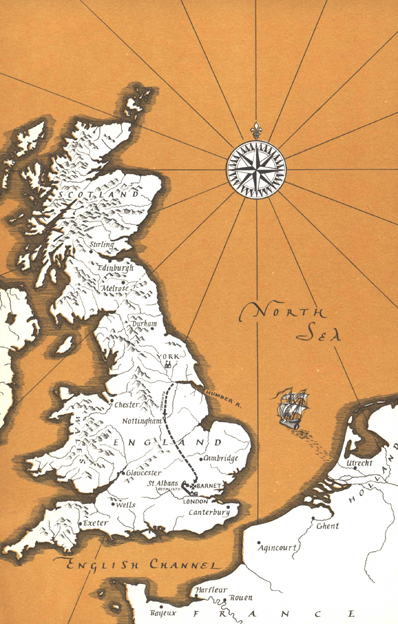
At Ware, a Hertfordshire town about twenty-five miles from London, the advancing Yorkists paused and Richard sent a letter to the king, protesting his loyalty. They were so close to the capital that there would have been small opportunity for the slowly recovering monarch to do much about this avowal. But, as it developed, Somerset intercepted the letter. The same day the royal army, consisting of 2000 men, marched out to meet the rebel forces. They came together at St. Albans, where a sharp battle was fought on May 22.
A very large broom in the hands of a very small queen had precipitated the start of the Wars of the Roses.
5
The first battle of the long drawn-out civil war was a rather muddled affair which showed little evidence of strategic planning on either side. The Yorkists came down the Great North Road in considerable haste, for they realized that sentiment in London favored them. The royalists, appreciating this also, wanted to meet the rebel forces as far away from the city as possible. They struck out at a tangent for Watford, intending to follow Watling Street to Leicester. This left the road to London wide open. But when they reached Royston, the Yorkists learned what King Henry had done. They decided to offer battle and swung westward through Ware and Hatfield to St. Albans, arriving there a few hours after the army of the king.
St. Albans straggled along the southern and western end of a high ridge. St. Peter’s Street ran through the center of town, past Castle Inn and the abbey. Paralleling this on the east was the town ditch surmounted by a palisade, which the Lancastrians had already taken over when the Yorkists arrived. The Yorkist attack had to be launched, therefore, along the two main roads running into town from the east, Shropshire Lane and Sopwell Lane. When they came to the ditch they found the palisade swarming with the soldiers of the king. This brought them to a dead stop.
It happened, however, that the Lancastrian leaders had massed their troops behind the palisades opposite the two main roads and had left a long space between unoccupied. This mistake was responsible for the birth of a legend, the belief held thereafter and presented in many histories, that the young Earl of Warwick was a great general. He had the good fortune to be leading his column up between the two main roads and found no opposition in his path. He took advantage of this by sending his men in to cross the ditch and climb the undefended palisades. There were private gardens on the other side, through which the eager troops plunged, coming to a brick wall which they had to batter down before reaching St. Peter’s Street. The young earl proudly led them out into the center of town, brandishing his sword and shouting, “A Warwick! A Warwick!”
There was no trace of the enemy in that part, so Warwick divided his forces and had them wheel right and left to catch the king’s troops in the rear.
This decided the issue. The Lancastrians had been outnumbered to begin with and the Yorkists had been recruited from men with long experience in the French wars, archers for the most part. The defending army was packed so closely into two pockets that they could not do anything. Under cover of a continuous flight of arrows, Warwick’s men took them in the flanks and proceeded to demolish them.
This battle demonstrated the absurd pass to which chivalry had reduced the art of war. Armor had become so cumbersome and heavy that the knights had to dismount and fight on foot. The result was a complete lack of mobility in tactical operations. The brave knights had to remain where they were and wait for the enemy to attack. If the enemy also fought by the code, it would sometimes happen that the two armies would line up face to face and proceed to fight it out with sword and mace and dagger. But if one side maneuvered about to attack from the most advantageous direction, the stationary knights were badly at a loss, being unable to change their base. When the issue had been decided, the knights on the losing side could not reach the horse lines to mount and be off. All they could do was to turn at bay and face death or capture (which was often the same thing) at the hands of the victorious foe.
The heavy losses sustained by the nobility in the battles of the Wars of the Roses were due to being thus shackled by the code. The archers and foot soldiers, wearing nothing heavier than leather jerkins, could get away from the field and scatter for safety, but the knights were anchored in muddy fields.
King Henry had been in a bellicose mood the night before the battle. “By the faith I owe St. Edward,” he had cried, “I shall destroy them, every mother’s son! They shall be hanged and drawn and quartered!” But when the battle began, he felt in a different mood. He was not a coward but he dreaded bloodshed and would have no part in it himself. In full armor he occupied a tent under the royal standard, which had been unfurled on St. Peter’s Street. When the right half of Warwick’s column came down the road, driving all opposition before it, the royal tent was surrounded after being riddled with arrows. The king was found sitting on the ground beside the Duke of Buckingham, both of them wounded. The king had been hit in the neck by an arrow, the duke in the face. The royal guards had taken to their heels.
“Forsooth and forsooth,” said Henry quietly.
When Richard of York arrived, his face flushed and triumphant, the king issued a brusque order. “Stop this slaughter of my subjects!”
Henry’s wound was attended to, it being slight, and he was led down St. Peter’s Street to the nearest house, which belonged to a tanner. Here he remained until he could be removed safely to the abbey for the night. On the way, they saw on the steps of the Castle Inn the body of the Duke of Somerset, who had fallen early in the battle.
Henry was not treated as a prisoner. Richard of York and the Earl of Warwick knelt before him and asked to be forgiven. The king nodded gravely and said that he bore them no ill will. When sufficiently recovered from his wound, he rode to London with the victors and entered the city in great state.
Queen Margaret, who had remained behind at Coventry with the infant prince, took him with her to the royal palace at Greenwich. With indomitable will, she began to issue calls for assistance to all in England and abroad who were favorable to the cause of the Red Rose. It was at this time that her ill wishers began to call her Captain Marguerite.