
In the wake of the Third Crusade, anxious questions about the value and efficacy of Christian holy war began to surface in the West. The ‘horrors’ of 1187–the Frankish defeat at Hattin and the Muslim reconquest of Jerusalem–had prompted Europe to launch history’s largest and best-organised expedition to the East. Latin Christendom’s greatest kings had led tens of thousands of crusaders to battle. And yet, the Holy City remained in the hands of Islam, as did that most treasured of Christ’s relics, the True Cross. Given the physical, emotional and financial sacrifices made between 1188 and 1192, and the shocking failure, nonetheless, to achieve overall victory, it was inevitable that western Christendom would be moved to think again about crusading–looking inwards, to reconsider and reshape the idea and practice of fighting in the name of God.
TRANSFORMATION IN THE LATIN WEST
Fundamental shifts within Latin Europe also helped to kindle this ‘reformation’ in Christian holy war. Crusading had originally been born and fashioned in the world of the eleventh and early twelfth centuries. But by 1200, many essential features of western society were in flux: accelerating urbanisation was altering population patterns, stimulating social mobility and the empowerment of a merchant class, and centralised monarchical authority was strengthening in regions like France. More significant still were the associated changes in Europe’s intellectual and spiritual landscape. From the start, crusade enthusiasm had been underpinned by the fact that almost all Latins felt an overwhelming need to seek redemption for their sins. But in the course of the twelfth century, attitudes towards penitential and devotional practice evolved, and new ideas about what a ‘good Christian life’ might actually entail began to percolate through the West.
One gradual change saw an increased emphasis on interior forms of spirituality, over external manifestations of piety. For the first time in the Middle Ages, what one truly thought, felt and believed was becoming as, or even more, important than what one said and did in public. In a parallel and related development, Man’s relationship with God and Christ came to be seen in more personal and direct, ‘internalised’ terms. These notions possessed the potential to overturn the established frameworks of medieval religion. A salvific ritual like physical pilgrimage–one of the bedrocks of crusading–made far less sense, for example, if what truly mattered was heartfelt contrition. And if, as many theologians had begun to suggest, God’s grace was omnipresent in everyone and everything, then why was it necessary to travel across half the Earth to seek His forgiveness at a site like Jerusalem? It would be many years before the full transformative force of this ideological revolution was felt in western Christendom, but early signs of influence were evident during the thirteenth century.
Latin Christianity also faced more immediate and urgent challenges around 1200. The first was heresy. Europe had once been a stronghold of religious orthodoxy and conformity, but over the last hundred years the West had experienced an outbreak of ‘heretical’ beliefs and movements of almost epidemic proportions. This ranged from the relatively innocuous rabble-rousing ravings of unordained demagogues to the inculcation of elaborately conceived, full-blown alternative faiths–like that of the dualistic Cathars, who believed in two Gods, one good, the other evil, and denied that Christ had ever lived in corporeal human form (and thus rejected the primary Latin tenets of Crucifixion, Redemption and Resurrection). Alongside those condemned as heretics by the Roman Church were others who strayed desperately close to the line, but nevertheless managed to garner papal approval. These included the Mendicant Friars–Franciscans and Dominicans–who advocated simple poverty and dedicated themselves to bringing God’s word to the people with new vigour and clarity. The Church soon sought to harness the Friars’ oratorical dynamism, not least to invigorate crusade preaching. But the Mendicants’ evangelical enthusiasm also had the power to affect the objectives of a holy war; to weave a strand of conversion into the familiar background of conquest and defence.1
The world of the thirteenth century was to be one of new ideas and fresh challenges, in which crusading might have to fulfil different roles and assume novel forms. The critical question–soon apparent to contemporaries–was what all of this would mean for the war in the Holy Land.
POPE INNOCENT III
One man who wrestled with just this issue was Pope Innocent III–perhaps the mightiest and most influential Roman pontiff in all medieval history; certainly the most active and enthusiastic papal patron of the crusades in the central Middle Ages. Innocent was elected pope on 8 January 1198 and immediately brought a refreshing lease of exuberant vitality to the office. Over the preceding seventeen years, no fewer than five elderly popes had died in succession soon after elevation to the pontifical throne. Innocent, by contrast, was just thirty-seven, brimful with vigour, afire with ambition. In background, he was perfectly suited to his new role. Being born of Roman aristocracy, he possessed excellent political and ecclesiastical connections in central Italy. He had also been educated in Europe’s finest centres of learning, studying Church law in Bologna and theology in Paris.
Moreover, the timing of Innocent’s rise to power was fantastically propitious. Since the days of Pope Gregory VII and the eleventh-century Reform movement, papal authority had been stifled persistently by the combative predations of the German Hohenstaufen Empire. Rome’s predicament only deepened in 1194 when Emperor Henry VI (Frederick Barbarossa’s son and heir) also became king of Sicily through marriage, thereby encircling the Papal State from north and south. But in September 1197, Henry VI died unexpectedly of malaria, leaving behind only a three-year-old son, Frederick, as heir. The Hohenstaufen world was suddenly plunged into a crippling dynastic crisis that would rattle on for decades. This gave the papacy under Innocent III an extraordinary opportunity to act on the European stage relatively unhindered.2
Innocent’s vision of papal authority
Pope Innocent was remarkably confident of the essential–and, in his opinion, divinely sanctioned–authority vested in the papal office. Innocent saw himself as Christ’s earthly vicar (or representative). Earlier pontiffs may have dreamt of achieving meaningful, rather than simply theoretical, dominion over the entire Latin Church; Innocent’s aspirations extended well beyond the ecclesiastical or spiritual sphere. Indeed, in his view, the pope should be the overlord of all western Christendom, perhaps even of all Christians on Earth; an arbiter of God’s will whose power superseded that of temporal rulers; capable of making (and breaking) kings and emperors.
Innocent also possessed a clear vision of what he wished to achieve with this absolute power–the recovery of Jerusalem. He seems to have felt an earnest and authentic attachment to the Holy City; much of his pontificate would be dedicated, one way or another, to securing its reconquest. But like many of his generation in the West, the new pope had been dispirited by the Third Crusade’s limited achievements. In his mind, the expedition’s failure to retake Jerusalem could be traced to two overriding causes, and he had solutions for each.
God evidently was allowing the Franks to be defeated in the Levant as punishment for the manifest sins of all Latin Christendom. Therefore, the work of reform and purification in the West must be redoubled. Europe had to be brought–by force if necessary–to a new state of perfection: unified spiritually and politically under the righteous authority of Rome; purged of the dreadful, corrupting taint of heresy. And the faithful must be shepherded towards lives of virtue; given every possible opportunity to atone for their transgressions, so that they might find a path to salvation. By these means, the Latin world could be cleansed so that the Lord might lift Christianity to victory in the war for the Holy Land.
Pope Innocent also believed that the practice of crusading itself should urgently be amended, and seems to have concluded that functional measures would lead to spiritual rejuvenation. He set out, therefore, to refine the management and operation of holy war, so as to empower participants to act with greater purity of intent. Looking back over the last century, the pope perceived three fundamental problems: too many of the wrong people (especially non-combatants) were taking the cross; the expeditions were poorly funded; and they were also subject to ineffective command. Not surprisingly, Innocent was certain that he knew how to resolve these difficulties–the Latin Church would step forth, reaffirming its ‘right’ to direct the crusading movement, assuming control of recruitment, financing and leadership. The beauty of this whole scheme, as far as the pope was concerned, was that crusaders fighting in a ‘perfected’ holy war not only stood a better chance of driving Islam from Jerusalem; the very involvement of these Latins in a penitential expedition would serve simultaneously to expiate their sins, thus helping the whole of western Christendom along the road to rectitude.
With all this in mind, Innocent sought to launch a new crusade to the Holy Land once he became pope, issuing a call to arms on 15 August 1198. He visualised a glorious endeavour–the preaching, organisation and prosecution of which would be under his direct control–imagining that so orderly and sacred an expedition could not fail to win divine approval.
Summoning a crusade
During the first years of his pontificate, Innocent III set out to recentre the mechanisms and machinery of crusading in Rome, hoping to institutionalise holy war as an endeavour governed by the papacy. In 1198 and 1199 he introduced a raft of innovative reforms, which came to form the backbone of his crusading policy throughout his time in office. Under Innocent, the spiritual reward (or indulgence) offered to crusaders was reconfigured and reinforced. Those taking the cross were given a firm promise of ‘full forgiveness of their sins’ and assured that their military service would absolve them of any punishment due, either on Earth or in the hereafter. Crusaders were required, however, to show ‘penitence in voice and heart’ for their transgressions–that is, external and internal remorse. Innocent’s indulgence also carefully distanced the purificational force of holy war from the physical works of Man: it was no longer suggested that the suffering and hardship endured on campaign itself served to salve the soul; instead, the spiritual benefits gained through the indulgence were presented as a gift, mercifully granted by God as just reward for acts of merit. This was a subtle shift, but one that laid to rest some of the theological difficulties raised by crusading (such as God’s relationship to Man). This formulation of the indulgence became the established ‘gold standard’ within the Latin Church, enduring virtually unchanged throughout the Middle Ages and beyond.
Innocent also tried to create a new financial system that placed the onus for crusade funding on the Church. This included a one-fortieth tax on almost all aspects of ecclesiastical income for one year and a ten per cent levy on papal revenue. The new pope set up donation chests in churches across Europe, into which lay parishioners were expected to place alms in support of the war effort. Crucially, the pope suggested that these monetary gifts, in and of themselves, would bring benefactors an indulgence similar to that enjoyed by actual crusaders. Over time, this notion would remould crusade ideology, and have far-reaching consequences for the whole history of the Roman Church.
Innocent openly acknowledged that the onerous burden of his duties in Rome made it impossible for him to lead a crusade in person, but in 1198 and 1199, he appointed a number of papal legates to represent his interests and oversee the holy war. He also placed precise limits on who was permitted to preach the crusade, enlisting the renowned French evangelist Fulk of Neuilly to trumpet the call. At the same time, the pope sought to impose stringent minimum terms of service on prospective crusaders, declaring that only after a set period of time spent fighting for the cross would an indulgence be earned (this began at two years, but was later downgraded to one year).
This all seemed wonderfully efficient. Yet, despite the verve and assurance of Innocent’s vision, all his multifarious efforts elicited only a muted response: the anticipated hordes of enthusiastic warriors did not enlist (although many of the poor took the cross); the donation chests strewn across the West failed to fill. Innocent’s first crusade encyclical had called for an expedition to start in March 1199, but that date soon came and went without any sign of action, and eventually a second call was made in December 1199. By this time, control of what would become the Fourth Crusade was already slipping through his fingers.
In fact, Innocent’s conception of crusading was fundamentally flawed. Absolutist in tone, it made no provision for interactive collaboration between the Church and the secular leaders of lay society. The pope imagined that he would simply bend the kings and lords of Latin Christendom to his will, as mere tools of God’s purpose. But this proved to be entirely unrealistic. From the First Crusade onwards, Europe’s lay nobles had been utterly essential to the crusading movement. It was their febrile enthusiasm that could spark expanding waves of recruitment through the social networks of kinship and vassalage, and their military leadership that could direct the holy war. Innocent had certainly hoped to enrol knights, lords and even kings in his crusade, but only as obedient pawns, not equals or allies.
Historians used to suggest that Innocent deliberately limited the degree of royal involvement in the crusade, but this is not entirely true. To begin with, at least, he sought to broker a peace deal between Angevin England and Capetian France, and made some attempt at convincing King Richard I to take the cross. But when the Lionheart died in 1199, these nebulous plans somehow still to incorporate the Latin monarchy within the ‘papal crusade’ evaporated. After Richard’s demise, his brother John was too busy battling to assume control of England and the Angevin realm to consider crusading. King Philip II Augustus of France equally made it clear that, until the Angevin succession was resolved, he would not leave Europe. And the ongoing power struggle in Germany precluded any direct Hohenstaufen participation. But even when it became obvious that there would be no crown involvement from these three realms, Innocent did not attempt to consult or recruit secular leaders from the upper aristocracy. He probably believed that the members of this class would flock to his cause of their own natural volition, eager to serve at his beck and call–but he was wrong, and this lapse of judgement would have tragic consequences for Christendom.3
THE FOURTH CRUSADE
Contrary to Pope Innocent III’s hopes and expectations, the Fourth Crusade was shaped largely by the laity, being subject to secular leadership and the influence of worldly concerns. Real enthusiasm and widespread recruitment for the expedition among Europe’s elite warriors only took hold after two prominent northern French lords–Count Thibaut III of Champagne and his cousin Louis, count of Blois–took the cross at a knightly tournament at Écry (just north of Rheims) in late November 1199. In February 1200 Count Baldwin of Flanders followed suit. All three men were drawn from the highest echelon of the Latin nobility, with connections to the royal houses of England and France. Each possessed an inestimable ‘crusade pedigree’ as multiple generations of their respective families had fought in the war for the Holy Land. Yet, although they appear to have been aware of Fulk of Neuilly’s preaching of the crusade, there is no evidence to suggest that they were directly contacted or encouraged to enlist by any representative of the pope. Certainly, like most earlier crusaders, they regarded themselves as answering a call to arms issued and sanctioned by the papacy–but they do not seem to have perceived any special need to work alongside Rome in planning or executing their expedition. This resulted in a worrying disjuncture between their outlook and the idealised notions entertained by Innocent III.
Diversions to disaster
In April 1201, a group of crusader envoys–representing Thibaut, Louis and Baldwin–negotiated an ill-fated treaty with the Italian naval and commercial superpower of Venice. The agreement called for the construction of a vast fleet to transport 33,500 crusaders and 4,500 horses across the Mediterranean in return for the payment of 85,000 silver marks. This massive commission prompted the Venetians to call a temporary halt to their wider trading interests, putting all their energy into building the requisite number of ships in record time.
This scheme was unsound from its inception. The notion of using seaborne transport to reach the Holy Land had been popularised during the Third Crusade, with both the English and French contingents sailing to war. The problem was that sea travel was expensive and, in comparison to an overland march, required a massive initial outlay of hard cash. The fleets used by the Third Crusaders had to be underwritten by royal treasuries, and even then the requisite funds were not easily amassed. Lacking crown involvement or support, the Fourth Crusade inevitably struggled to foot the bill owed to Venice. The 1201 treaty was also predicated on the unrealistic assumption that every Latin who took the cross would agree to travel from the same port on a specified date, even though there was no precedent for this type of systematic departure and no commitment to embark from Venice was included in the crusading vow. The plan might just have worked had the secular leadership coordinated their efforts with the papacy to orchestrate a general muster–as it was, Innocent does not even seem to have been consulted about the deal with Venice. Realising that he was fast losing any semblance of control over the expedition, the pope grudgingly confirmed the treaty. From this point onwards, Innocent gradually found himself trapped between conflicting impulses: the desire to bring the crusade to heel by withdrawing his support; and the lingering hope that the campaign would still somehow find a way to enact God’s will.
The Fourth Crusade’s prospects were dealt a grievous blow in May 1201 when Thibaut of Champagne, though barely twenty years old, fell ill and died. Overall leadership passed to the north Italian nobleman Boniface of Montferrat–who, through his brothers William and Conrad, possessed his own notable ‘crusade pedigree’–but Thibaut’s demise nonetheless weakened recruitment in northern France. When the crusaders began to congregate at Venice from around June 1202 onwards, it quickly became obvious that there was a problem. By midsummer 1202, only around 13,000 troops had arrived. Far fewer Franks had taken the cross than predicted, and, of those who had enrolled, many chose to take ship to the East from other ports like Marseilles.
Even scraping together every available ounce of money, the crusade leaders were thus left with a massive financial shortfall. The Venetians had carried out their part of the bargain–the grand armada was ready–but they were still owed 34,000 marks. The expedition was saved from immediate collapse by the intervention of Venice’s venerable leader, or doge, Enrico Dandalo. A wizened, half-blind octogenarian whose spirited character and unbounded energy belied his age, Dandalo possessed a shrewd appreciation of warfare and politics, and was driven by an absolute determination to further Venetian interests. He now offered to commute the crusaders’ debt and to commit his own troops to join the Levantine war, so long as the crusade first helped Venice to defeat its enemies. In agreeing to this deal, the Fourth Crusade drifted from the path to the Holy Land.
Within months the expedition had sacked the Christian city of Zara on the Dalmatian coast, Venice’s political and economic rival. Innocent was dismayed when he heard about this affront and reacted by excommunicating the entire crusade. At first, this act of censure–the ultimate spiritual sanction at the pope’s disposal–seemed to stop the campaign in its tracks. But Innocent rather foolishly accepted the French crusaders’ pledges of contrition and later rescinded their punishment (although the Venetians, who made no move to seek forgiveness, remained excommunicate). By this time, dissenting voices within the crusader host had begun to question the direction taken by the expedition; some Franks even left for the Holy Land under their own steam. The majority, however, continued to follow the advice and leadership offered by the likes of Boniface of Montferrat and Doge Dandalo.
When the plunder gathered from Zara’s conquest proved insufficient, the crusade turned towards Constantinople and the Byzantine Empire. The ‘just cause’ cited for this extraordinary decision was that the crusaders planned to reinstate the ‘legitimate’ heir to Byzantium, Prince Alexius Angelus (son of the deposed Emperor Isaac II Angelus), who would then pay off the debt to Venice and finance an assault on the Muslim Near East. But there was a darker subtext at work. The Greeks had stifled Venetian ambitions to dominate Mediterranean commerce for decades. At the very least, Dandalo was hoping to install a ‘tame’ emperor on the throne, but perhaps he already had a more direct conquest in mind–certainly the doge was only too happy to usher the crusade towards Constantinople.
Once there, the expedition rapidly lost sight of its ‘sacred’ goal to recapture Jerusalem. After a short-lived military offensive, the existing imperial regime was toppled in July 1203–at only limited cost in Greek blood–and Alexius was proclaimed emperor. But when he proved unable to redeem his lavish promises of financial reward to the Latins, relations soured. In January 1204 Alexius’ grip on power faltered and he was overthrown (and then strangled) by a member of the rival Doukas family, nicknamed Murtzurphlus (or ‘heavy-brow’, on account of his prominent eyebrows). In spite of their own recent estrangement from the late emperor, the crusaders interpreted his deposition as a coup and characterised Murtzurphlus as a tyrannical usurper who must himself be removed from office. Girded by this cause for war, the Latins prepared for a full-scale assault on the great capital of Byzantium.
On 12 April 1204, thousands of western knights broke into the city and, in spite of their crusading vows, subjected its Christian population to a horrific three-day riot of violence, rape and plunder. In the course of this gruesome sack the glory of Constantinople was smashed, the city stripped of its greatest treasures–among them holy relics such as the Crown of Thorns and the head of John the Baptist. Doge Dandalo seized an imposing bronze statue of four horses and shipped it back to Venice, where it was gilded and erected above the entrance of St Mark’s Basilica as a totem of Venetian triumph. It remains within the church to this day.
The Fourth Crusaders never did sail on to Palestine. Instead they stayed in Constantinople, founding a new Latin empire, which they dubbed Romania. Aping Byzantine practice, its first sovereign, Baldwin, count of Flanders, donned the elaborate jewel-encrusted robes of imperial rule on 16 May 1204 and was anointed emperor in the monumental Basilica of St Sophia–the spiritual epicentre of Greek Orthodox Christianity. Across the Bosphorus Strait in Asia Minor, the surviving Greek aristocracy established their own empire in exile at Nicaea, awaiting revenge.
Causes and consequences
Contemporaries and modern commentators alike have been moved to ask what drove the Fourth Crusade to the ancient capital of the Byzantine Empire. It has been suggested that the diversion was the ultimate expression of a festering distrust and antipathy that had been an increasingly prominent characteristic of crusader–Byzantine relations during the twelfth century. After all, elements of the Second Crusade had considered attacking the Greek capital, and the Third Crusade had witnessed the forcible seizure of Cyprus, a Byzantine protectorate. Some have even intimated that the expedition was actually part of a complex anti-Greek conspiracy–that the seizure of Constantinople was the crusade’s deliberate and intended goal from the outset. This is unlikely to have been true–not least because the entire endeavour was characterised by such an evident lack of effective organisation.
In fact, the crusade was set on its course by the poorly framed 1201 treaty with Venice and almost certainly reached the walls of Constantinople through a succession of unplanned, pragmatic decisions and a series of cumulative diversions. There may not have been a grand design at work, but that is not to say that the Latins’ eventual bloody conquest of Constantinople did not suit Venetian interests or further the ambitions of some of the crusade’s leaders.
The expedition also confirmed the abject failure of Innocent III’s grand ‘papal crusade’ project. Events had shown that he was singularly unable to impose his will from Rome. In June 1203, when he first learned of the diversion to Constantinople, the pope had written to the crusade leaders explicitly forbidding any attack on the Christian metropolis, but this prohibition was ignored. Then, sometime before November 1204, Innocent received a letter from the new Latin Emperor Baldwin announcing the Byzantine capital’s capture. Baldwin’s missive evidently offered a heavily sanitised account of events, celebrating the conquest as a great triumph for Christendom and, despite his earlier misgivings, the Pope initially responded with jubilation. It seemed that, through God’s inimitable will, the eastern and western Churches now had gloriously been united under Roman rule, and that with the foundation of the new Latin polity fresh succour might be brought to the Levantine crusader states. Only later did details of the crusaders’ brutish avarice emerge, turning Innocent’s joy to disgust, prompting him to rescind his initial approval and condemn the expedition’s outcome as a disgraceful travesty.4
CONTROLLING THE FIRE
Innocent was appalled by the manner in which the Fourth Crusade spiralled out of control, but before long his innately pragmatic outlook and natural optimism prompted him to renew his interest in harnessing the power of holy war. In the course of the next decade, he repeatedly made attempts to utilise and control crusading. During this period, however, he redirected this weapon of papal policy towards new theatres of conflict and against different enemies. In part this was a response to emerging threats; thus, expeditions were launched against the pagan Livs of the Baltic and the Almohad Moors of Spain. And, despite his deep misgivings about the circumstances of its formation, Innocent also recognised that the newly formed empire of Latin Romania would need protection if it were to play any meaningful role in the wider struggle to recover the Holy Land. Other crusaders, therefore, were encouraged to reinforce Constantinople. The pope also concluded that crusades could play an important and direct role in his drive to purify western Europe itself. In 1209, he launched the so-called Albigensian Crusade against the Cathar heretics in south-eastern France, but the campaigns that followed proved to be shockingly brutal and largely ineffective, being subject to the self-serving acquisitiveness of northern French participants.
A popular outburst of ecstatic piety was witnessed in 1212, when, for reasons that remain uncertain (but may perhaps have been related to the preaching of the Albigensian Crusade), large groups of children and young adults in northern France and Germany spontaneously began to declare their dedication to the cause of the crusades. In the ‘Children’s Crusade’ that followed, two boys, a young French shepherd from Vendôme named Stephen of Cloyes and one Nicholas of Cologne, apparently raised hordes of young followers, promising that God would oversee their journey to the Levant and then lend them the miraculous power to overthrow Islam, recapture Jerusalem and recover the True Cross. As innocents, they claimed, children would be able to fulfil God’s divine purpose in a manner impossible for adults sullied by the taint of sin. Little reliable evidence survives regarding the fate of these ‘crusaders’, but for contemporaries then living in France, Germany and Italy–Innocent III included–their uprising served as a salutary reminder that the call of the cross could still move the hearts and minds of the masses.5
By 1213, Innocent realised that widening the focus of holy war had actually served to weaken the Latin East–distracting the West from the plight of the Holy Land–and thus set about a major rethink of policy. Withdrawing the crusading status of the conflicts in Spain, the Baltic and southern France, he rechannelled the full force of crusading enthusiasm towards the reconquest of Jerusalem, proclaiming a new, grand expedition: the Fifth Crusade. At the same time, he made renewed attempts to assert full papal control over the organisation and prosecution of sanctified violence.
He began by making even more strenuous attempts to regularise the preaching of the Fifth Crusade. Innocent appointed hand-picked bands of clergy to spread the call to arms, and regional administrators to oversee recruitment campaigns. He also encouraged the production of preaching manuals that contained model-sermons, and set out specific guidelines on the conduct of preachers. Although the crusade attracted relatively few recruits from France–the traditional heartland of enthusiasm–elsewhere the response was dramatic. Enraptured by masterful orators like the French cleric James of Vitry or the German preacher Oliver of Paderborn–whose sermons were frequently accompanied by ‘miraculous’ events such as the appearance of shining crosses in the sky–thousands of skilled knights from Hungary, Germany, Italy, the Low Countries and England took the cross.
Innocent’s initiatives in the sphere of crusade finance had more problematic consequences. Until now, he had argued consistently that only trained warriors should be permitted to take the cross, believing that this would create a compact and efficient crusading army. In 1213 he performed what appeared to be a volte-face, declaring that as many people as possible should be encouraged to enlist, regardless of their suitability for the holy war. This opening of the floodgates may have been triggered, in part, by the recent Children’s Crusade, which so patently demonstrated the breadth and depth of western crusade enthusiasm. Nonetheless, Innocent’s scheme had a further twist. Years earlier, when he launched the Fourth Crusade, the pope had suggested that financial donations in aid of the holy war might be rewarded with an indulgence. Now, he refined and extended that notion. Innocent hoped many thousands would enrol in his new campaign, but he announced that anyone taking the cross who proved unable to fight in person could readily redeem their crusading vow by making a cash payment and still receive a religious reward. This extraordinary reform may have been well intentioned–designed to bring the crusade both financial and military resources, and to extend the redemptive power of holy war to a wider audience, but it established an extremely dangerous precedent. The idea that spiritual merit could be bought with money spawned the development of a comprehensive system of indulgences, perhaps the most widely criticised feature of later medieval Latin Catholicism and a key factor in the emergence of the Reformation. These looming long-term consequences were not apparent in 1213, but, even so, Innocent’s innovation elicited scandalised criticism among some contemporaries and, in the course of the thirteenth century, led to grave abuses of the crusade movement.
Nonetheless, the pope would not be turned from his purpose. The call for a new crusade to the Holy Land was broadcast again in 1215 at a massive ecclesiastical council (the Fourth Lateran) convened by Innocent to discuss the state of Christendom. This spectacular assembly–then the largest of its kind–affirmed the elevation of papal power achieved during Innocent’s pontificate. Ever obsessed with the drive to raise funds for the holy war, he renewed the deeply unpopular Church tax, this time at the even more scything rate of one-twentieth for three years, and appointed commissioners to ensure its careful collection.
Less than a year later, on 16 July 1216, Pope Innocent III died of a fever–one probably contracted while preaching the cross in the rain near Perugia (in central Italy)–even before the Fifth Crusade could begin.6 Throughout his pontificate he had embraced holy war and, although the campaigns waged at his behest achieved only limited success, Innocent’s willingness to support and amend the crusading movement did much to reinvigorate a cause that might otherwise have faltered. In many respects he shaped crusading into a form it would hold through the coming century and beyond. It is also true, however, that Innocent’s monumental ambitions far outstripped the reality of papal authority and that his attempts to assert direct ecclesiastical control over crusading expeditions were ill conceived and unrealistic.
OUTREMER IN THE THIRTEENTH CENTURY
During the early thirteenth century, as the papacy sought to shape and to harness the might of crusading, the balance of power in the Near East underwent a series of convulsive changes. In the wake of the Third Crusade and the death of Saladin, Franks and Muslims alike were weakened and distracted by the eruption of convoluted succession crises in Palestine, Syria and Egypt. The Latin Christians struggling to survive in the Levant–nursing hopes of reconquest and expansion–had to embrace new approaches to Outremer’s defence and to their interaction with Islam.
In the summer of 1216, the French churchman James of Vitry had urgent business to conduct in central Italy. Perhaps in his early fifties, James was an erudite cleric and ardent reformer, with a natural oratorical flair. He had already earned renown as a preacher of the Albigensian campaigns and the Fifth Crusade–his sermons may also have helped to stir into life the so-called Children’s Crusade. James would go on to author an extremely valuable corpus of written material relating to the crusades, ranging from letters and historical accounts to collections of ‘model’ sermons. But in 1216 he had been elected as the new bishop of Acre and, before he could travel to the Levant, needed papal confirmation and consecration. James was expecting to meet with Pope Innocent III, but he arrived at Perugia on 17 July, the day after the pontiff’s death. Entering the church in which Innocent’s body had been laid in state before burial, James discovered that, overnight, looters had stripped the great pope’s corpse of its lavish vestments; all that remained was a half-naked, decomposing cadaver, already stinking in the midsummer heat. ‘How brief and vain is the deceptive glory of this world’, James observed when describing the spectacle.
The next day Pope Honorius III was elected as Innocent’s successor and James eventually received his confirmation. That autumn the bishop took ship from Genoa to the East–a perilous five-week journey, during which he endured severe late autumn storms that left the passengers on board able ‘[neither to] eat nor drink for the fear of death’. He arrived in Acre in early November 1216 and, in the months that followed, carried out an extensive preaching tour of Outremer, hoping to rejuvenate the spiritual fervour of its Christian populace in advance of the Fifth Crusade. The Near Eastern world he encountered was one of chronic political instability, in which old rivalries simmered on, even as new powers were emerging.7
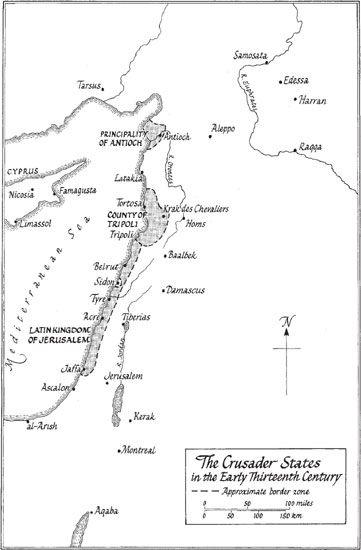
The Crusader States in the Early Thirteenth Century
The balance of power in the Frankish East
In territorial terms the crusader states were barely a shadow of their former selves. Jerusalem and the inland regions of Palestine were in Muslim hands, and the Latin kingdom of ‘Jerusalem’ could now more accurately be termed the kingdom of Acre, its lands confined to a narrow coastal strip stretching from Jaffa in the south to Beirut in the north–the latter having been recovered with the aid of a party of German crusaders in 1197. Indeed, by the time James of Vitry arrived in the East, the Jerusalemite monarchy had adopted Acre as their new capital. Up the coast, the county of Tripoli retained a foothold in Lebanon, while a number of Templar and Hospitaller strongholds extended Frankish dominion some way to the north, but because the Muslims continued to control the region around Latakia there was no land connection to the principality of Antioch, and that once formidable polity had been reduced to a tiny parcel of land centred on Antioch itself.
The vulnerability of each of the surviving crusader states was compounded by a series of acrimonious succession disputes. Henry of Champagne, the ruler of Frankish Palestine appointed at the end of the Third Crusade, survived until 1197, when he died in an unfortunate accident–falling out of a palace window in Acre when its railings gave way. The sole surviving member of the royal bloodline, Isabella (Henry’s widow), was married to Aimery, a member of the Lusignan dynasty, who then ruled until 1205, when he too died–this time from eating too much fish. Isabella followed him to the grave soon after. From this point onwards, the royal title fell to Isabella’s child by her earlier marriage to Conrad of Montferrat, and the Jerusalemite succession spiralled into a bewilderingly complex web of marriages, minorities and regencies that persisted through most of the thirteenth century–a situation that bequeathed a great deal of power and authority to the Frankish barons. In the early decades two leading figures emerged from this turmoil.
Jean of Ibelin (Balian of Ibelin’s son) served as regent for the royal heiress Maria between 1205 and 1210 and became the most important Latin baron in Palestine. Despite having lost their ancestral lands at Ibelin and Ramla to the Muslims, the Ibelin dynasty’s fortunes prospered in this period. Jean was endowed with the valuable lordship of Beirut, and his family enjoyed a prominent connection to Frankish Cyprus.
Ibelin influence was challenged by the newcomer John of Brienne, a French knight from Champagne of middling aristocratic birth. John married Maria in 1210, and then, when she died in 1212, served as regent and effective ruler for their infant daughter Isabella II. Probably around forty years old, John was an experienced military campaigner with a crusade pedigree, but he lacked wealth and royal connections in the West. He spent much of his career seeking to assert his right to the Jerusalemite crown–styling himself as king despite the objections of the local nobility. John also made a further play for prominence in the north in 1214, marrying Princess Stephanie, heiress to the Armenian Christian kingdom of Cilicia.
Under the shrewd guidance of its latest Roupenid ruler King Leon I (ruling as Prince Leon II between 1187 and 1198, and then as king between 1198 and 1218), the eastern Christian realm of Cilicia became a dominant force in the politics of northern Syria and Asia Minor during the thirteenth century. Through a mixture of military confrontation and intermarriage Leon’s Roupenid dynasty became intimately integrated into the history of Latin Antioch and Tripoli. Following Count Raymond III of Tripoli’s death in 1187, the lines of succession in the county and principality became entwined, and a power struggle featuring Frankish and Armenian claimants (even more labyrinthine than that witnessed in Palestine) rumbled on until 1219, when Bohemond IV secured control of both Antioch and Tripoli.8
These protracted internecine conflicts enfeebled and distracted the Christians of Outremer in the early decades of the new century, severely curtailing any moves towards reconquest (and, in fact, similar problems would recur throughout the century). But the damage wrought by these petty squabbles was mitigated, at least in some measure, by the discord that likewise was afflicting Islam.
The fate of the Ayyubid Empire
After Saladin’s death in 1193, the Ayyubid realm that he had constructed over two decades fragmented almost overnight. The sultan had intended the bulk of his territory to be divided between three of his sons in a form of confederacy, with the eldest, al-Afdal, holding Damascus and overall authority over Ayyubid lands. Al-Zahir was to command Aleppo and Uthman to rule Egypt from Cairo. In fact, the balance of power soon shifted in favour of Saladin’s astute brother al-Adil. He had been left in control of the Jazira (north-western Mesopotamia), but his diplomatic guile and skill as a political and military strategist enabled him to outmanoeuvre his nephews. Al-Adil’s rise was also facilitated by al-Afdal’s incompetence in Damascus. There, al-Afdal quickly alienated many of this father’s most trusted advisers and by 1196 was in no position to rule Syria. Acting, officially at least, as Uthman’s representative, al-Adil seized power in Damascus that year–leaving al-Afdal to go into impotent exile in the Jazira. When Uthman died in 1198, al-Adil assumed full control of Egypt and, by 1202, al-Zahir had acknowledged his uncle’s supremacy.
Through the first half of the thirteenth century, the lion’s share of the Ayyubid world thus lay in the hands of al-Adil and his direct descendants, while al-Zahir and his line retained control of Aleppo. Al-Adil governed as sultan, installing three of his own sons as regional emirs: al-Kamil in Egypt, al-Mu‘azzam in Damascus and al-Ashraf in the Jazira. Jerusalem played only a minor role in Ayyubid affairs and certainly did not function as any sort of capital. Despite its spiritual significance, Jerusalem’s isolated position in the Judean hills meant that its political, economic and strategic value was limited. Although al-Adil and his successors made intermittent efforts to maintain and beautify the Holy Places, the city generally was neglected. Similarly, the notion of waging jihadagainst the Franks fell into abeyance, even though the Ayyubids still laid claim to titles imbued with the rhetoric of holy war.
In fact, al-Adil adopted a highly pragmatic approach to his dealings with Outremer, partly because of the more urgent threats posed by other rivals: the Zangid Muslims of Mesopotamia and Seljuq Turks of Anatolia; and the eastern Christians of Armenia and Georgia. Once in power, al-Adil agreed a series of truces with the Franks that ran almost unbroken through the early years of the thirteenth century (1198–1204, 1204–10, 1211–17) and were widely upheld. As sultan, al-Adil also forged ever closer commercial links with the trading powers of Venice and Pisa.
In spite of the relatively temperate nature of Muslim–Latin relations, the Ayyubids probably would have looked to achieve further territorial gains at Outremer’s expense had it not been for a number of additional considerations underpinning the history of the crusader states and the wider Near East.9
The Military Orders
In the course of the thirteenth century, the religious movements that combined the professions of knighthood and monasticism–the Military Orders–assumed increasingly dominant and essential roles in Outremer’s history. The problems that had beset the crusader states from their inception, those of isolation from the West and shortages of human and material resources, only deepened after the Third Crusade. The extension of the crusading ideal into the likes of Iberia and the Baltic, the holy wars against papal enemies and heretics, and the diversion of assets to defend the newly formed polity of Latin Romania all served to exacerbate the predicament of the Frankish Levant. So too did the endemic political factionalism within the surviving crusader states.
Against this background, the Templars and Hospitallers came into their own; and these two well-established orders were joined by a third major group–the Teutonic Knights. This movement was founded during the Third Crusade, when German crusaders set up a field hospital outside Acre around 1190. In 1199 Pope Innocent III confirmed their status as a new knightly order and they enjoyed a particularly close association with the Hohenstaufen dynasty and Germany. In the years that followed, the Teutonic Knights, like the Templars and Hospitallers before them, embraced an increasingly militarised role. By this point it had become customary for Templars to wear a white mantle emblazoned with a red cross, while the Hospitallers bore a white cross on a black background. Teutonic Knights, by contrast, adopted a white mantle with a black cross.
As a result of their increasing military, political and economic power, these three orders became the essential bedrocks of the Latin East, and their fundamental contribution to Outremer’s continued survival was already apparent when James of Vitry arrived in Acre. The influence enjoyed by each of the orders was closely related to the papal support they continued to receive, because this preserved their independence from local ecclesiastical and political jurisdiction, as well as their exemption from tithes. The orders also possessed an incredible capacity to attract charitable donations from the nobles of Christian Europe, acquiring great swathes of land in the West. All three orders also accrued land on the island of Cyprus.
Their popularity and supranational status had long enabled the Military Orders to recruit new members (and thus supply Outremer with manpower) and to channel wealth from the West to the war for the Holy Land–with a levy, or ‘responsion’, of one-third on their income being sent east. By the late twelfth century, the orders had developed such an elaborate and secure international system of financial administration that they effectively became the bankers of Europe and of the crusading movement. In what was essentially the first use of a cheque, it became possible to deposit money in the West and receive a credit note that could then be cashed in the Holy Land.
The Military Orders’ martial role also became ever more embedded. The Templars and Hospitallers could each field around 300 knights in the Levant, plus perhaps 2,000 sergeants (lower-status members). Simply in numerical terms this meant that they often contributed half or more of the total Frankish fighting force in times of war. Their highly trained, well-equipped troops were also willing and able to serve throughout the year and not just for limited periods as with an army raised through a normal feudal levy. Surviving copies of the ‘Rules’ (or written regulations) governing the lives of members indicate just how much emphasis was placed upon strict and absolute military discipline in the field. The Templar Rule, for example, provided detailed guidance on everything from marching to setting up camp and foraging, always with a strong emphasis on rigid obedience to a chain of command and unity of action–the critical prerequisites for success and survival among heavily armoured troops. Transgressions were punished harshly. Offenders might be temporarily deprived of their habit and thrown in irons, or even ejected from the order.
Alongside the undoubted strengths of the three main Military Orders, there were some difficulties and dangers to be faced in the course of the thirteenth century. With the weakening of royal and princely authority in the likes of Acre and Antioch, the capacity for the orders to pursue their own distinct goals and objectives increased, as did the potential for damaging rivalry between the three movements–the Templars and Hospitallers, for example, backed different parties during the dispute regarding the Antiochene succession. The orders’ wider roles in other theatres of conflict, including the Teutonic Knights’ extensive commitments on the Baltic frontier, also acted as a drain on the Levantine war effort.
Over time, groups like the Templars also experienced a gradual decline in the flow of donations from Latin patrons, partly related to shifts in attitudes towards religious life and the waning of interest in Outremer’s fate. Because they stood in the front line of the holy war and were, over the decades, the recipients of such extraordinary largesse on the part of Latin Christendom’s populace, the Military Orders also had to face significant, even swingeing, criticism when setbacks in the struggle against Islam were suffered. On the whole, these latter considerations only came into play after around 1250, and even then the Templars, Hospitallers and Teutonic Knights still retained access to massive reserves of manpower and wealth.10
Crusader castles
Through the twelfth and thirteenth centuries, the Military Orders became intimately associated with the great ‘crusader’ strongholds of the Near East because by 1200 they were the only Latin powers in the Levant who could afford the exorbitant costs associated with building and maintaining castles, and who also had the men needed to garrison these fortresses. With the massive haemorrhage of territory suffered after 1187, castles came to play an ever more vital role in defending the fragmented and exposed remnants of the crusader states. And dwindling numbers of Frankish settlers in the Levant further increased the reliance upon the physical defences offered by fortifications.
No medieval castle was entirely impregnable, nor could a fortress stop an invading army in its tracks. But strongholds did help the Military Orders to dominate portions of territory and defend frontiers; they also served as relatively secure outposts from which to launch raids and offensives, and functioned as administrative centres. In the thirteenth century, however, with far less land under their control than before, the Christians had to depend upon fewer fortresses that either were positioned near the sea (so as to facilitate support) or possessed highly evolved systems of defence. Under these conditions, only the Military Orders could develop and hold castles of sufficient size and strength.
Through the first half of the thirteenth century all three of the major orders devoted vast amounts of money and energy either to modifying and extending existing castles, or, in the case of the mighty Teutonic fortress of Montfort (inland from Acre), to designing and building new fortresses from scratch. From the 1160s, the Franks had begun to construct strongholds with more than one set of battlements–so-called ‘concentric castles’–but this approach reached new heights after 1200. Huge advances were also made in stone-cutting techniques, the ability to erect the sturdier (but architecturally more complex) rounded forms of defensive tower and the employment of sloping walls to prevent sapping. In addition, improvements in the designs of vaulted ceilings enabled the Latins to construct massive storerooms and stables–essential for supplying large garrisons. During this golden age of castle building, the Military Orders constructed some of the most advanced fortifications of the medieval era.*
After arriving in the Levant, James of Vitry, the new bishop of Acre, toured many of these fortresses in early 1217 and described his visits in a letter written that spring. The most impressive fortress included in James’ itinerary was Krak des Chevaliers, on the southern edge of the Ansariyah Mountains, overlooking the Bouqia valley. A Hospitaller possession since 1144, Krak had long been regarded as a formidable stronghold, not least because of its natural defences–being positioned on the end of a steeply sloping ridge. Saladin made no attempt to besiege the site after his victory at Hattin. In the early thirteenth century, the Hospitallers undertook a massive rebuilding programme (probably ongoing when James visited), and, when these alterations and improvements were completed, Krak had been shaped into a near-perfect fortress, capable of housing a garrison of 2,000 men.
Still standing to this day, the castle is arguably the most spectacular monument of the crusading age. Hewn from limestone, possessed of an elegant beauty of proportion, its unparalleled craftsmanship speaks of the same dedication to flawless precision and architectural excellence witnessed in the massive Gothic cathedrals that were constructed in western Europe at this same time. Its elaborate defensive system includes two lines of walls, with an inner moat and an outer circuit of rounded towers and box machicolations (protruding constructions that gave archers and defenders easier lines of fire). The castle is entered through a confined, upward-sloping tunnel, reinforced with numerous murder holes and gateways. And throughout, the quality of masonry is extraordinary–the limestone blocks were cut so precisely that virtually no mortar can be seen.11
Commerce and economy in Outremer
Much as the Military Orders and castles like Krak des Chevaliers helped to sustain Outremer’s defensive integrity, the continued survival of the crusader states can actually be traced, above all, to another factor, beyond the sphere of war: trade. The Franks who settled in the East had maintained commercial contacts with the wider Levantine world through the twelfth century, but after the Third Crusade the scope, extent and significance of these links increased. Over time, the neighbouring Latin and Islamic powers of the Near East developed such close ties of commercial interdependence that the Muslims of Syria and Egypt preferred to allow the Christians to retain their meagre footholds along the coast, rather than risk any interruption of trade and income.
Frankish control of Syria’s and Palestine’s ports–the gateways to Mediterranean commerce–proved vital in this regard. Other wider forces also worked to Outremer’s advantage. Until the thirteenth century, the Egyptian port of Alexandria had functioned as the economic hub of trade between East and West. After 1200, however, the pattern and flow of commercial traffic gradually shifted. The Latin conquest of Constantinople in 1204 affected the distribution of markets and, more critically still, the advent of the Mongols revitalised overland trade routes from Asia. The Latin East was the net beneficiary of these processes, while Egypt slowly lost its dominant position. Alexandria continued to enjoy a lively trade in high-value goods from the Indies, including spices like pepper, cinnamon and nutmeg, and drugs and ‘medicines’ such as ginger, aloe and senna leaves. Egypt likewise continued to be Europe’s main supplier of alum (an essential ingredient for leather tanning). But in most other regards, Outremer became the Levant’s leading centre of trade.
The simple fact that the Latins had been settled in the East for more than a century had given them time to establish and solidify the complex networks of transport and communication needed to exploit this opportunity. And the crusader states’ economic vitality had been further buttressed in this same period by the investment in, and refinement of, the hugely profitable industrial production of goods like sugar cane, silk and cotton, and glassware that could be grown or manufactured in the remaining Latin territories and then shipped to the West and sold.
All of this meant that, in the course of the thirteenth century, Frankish cities like Antioch, Tripoli, Beirut and Tyre enjoyed remarkable prosperity. Without a doubt, though, Outremer’s leading centre of commerce was Acre. After the Third Crusade, Acre became the new capital of Frankish Palestine and home to the realm’s crown residence, the royal citadel. Within the confines of the ‘old’ twelfth-century city, each of the realm’s leading powers had their own compound–from the Templars, Hospitallers and Teutonic Knights to the Italian merchants of Venice, Pisa and Genoa–and many of these became walled enclaves, enclosing multi-storey buildings. The city also contained numerous markets, some of which were covered to offer shelter from the intense heat of summer, and other buildings given over to industry. Acre’s sugar plant had been dismantled by the Ayyubids in 1187, but glass and metal workshops remained, as did a street of tanneries, while a plant producing high-quality soap was situated in the Genoese quarter.
Before 1193 there had been large open expanses within the circuit of the city battlements, particularly in the landward areas to the north and east, away from the busier seaward promontory and docks. Now, Acre rapidly became heavily urbanised and densely populated, and this eventually led to the extension of the main walls northwards to incorporate the suburb known as Montmusard. And despite the fact that the many sections of the city had remarkably advanced sewage systems, this intensive growth meant that the crowded metropolis became subject to quite horrendous levels of pollution, and the associated dangers of illness and disease. Much of Acre’s waste, including that from the royal slaughterhouse and fish market, was poured into the harbour, which became known as ‘Lordemer’ (the filthy sea). By the mid-thirteenth century, the situation had become so extreme that a church in the Venetian quarter had to have its main windows facing the port blocked off to prevent the wind blowing refuse on to the altar.
It was in this bustling capital that James of Vitry made his home after 1216, as the new Latin bishop. He found Acre to be a veritable den of iniquity–what he called ‘a second Babylon’, a ‘horrible city…full of countless disgraceful acts and evil deeds’, and people ‘utterly devoted to the pleasures of flesh’. James was bewildered by the port’s cosmopolitan character. Old French was still the main language of commerce, but along Acre’s heaving streets a plethora of other western tongues–Provençal, English, Italian and German–mingled with Levantine languages, some spoken by visitors, others by eastern Christian and Jewish residents.
Acre was the most important meeting place between East and West in the thirteenth century. This was largely a function of the city’s new role as the Mediterranean’s leading entrepôt–the warehouse of the Levant, to which goods drawn from across Outremer, the Near East and beyond were brought before being shipped to the West. Acre also became a portal for the gradually increasing volume of return trade passing from Europe to the Orient.
An assortment of different goods passed through the city. Raw materials such as silk, cotton and linen fibres came in bales from local production centres in Palestine and the likes of Muslim-held Aleppo, while finished products, like silk clothing manufactured in Antioch, were also traded. Many commodities were both used in Acre itself and exported to more distant markets: sugar cane from Palestinian plantations; wine from Lower Galilee, Latakia and Antioch; dates from the Jordan valley. Soda ashes–produced by burning plantstuffs grown in areas of high saline concentration (like coastal regions) to give alkaline ashes–were used in dying textiles and soap making; they were also essential for glass production, and the glass manufactured locally made use of the excellent-quality sand found in the Belus River.
One marked development in the thirteenth century was the increase in commercial traffic heading from west to east. It became increasingly common for Latin merchants to travel into Muslim territory, trading woollen goods (especially those from Flanders) and saffron (the only western spice to find a market in the Orient) to the likes of Damascus, before returning to Acre with a new cargo of silks, precious and semi-precious stones.
In a normal year, Acre witnessed two periods of intense activity–just before Easter and at the end of summer–when the bulk of ships arrived from the West, bearing hordes of traders and travellers. At these times, the docks were awash with money-changers and touts offering to lead new arrivals to find accommodation or on guided tours of the city. The port already had a long history of functioning as the main point of arrival for Christian pilgrims to the Holy Land, but, with access to Jerusalem and other sacred sites curtailed after the Third Crusade, Acre emerged as a pilgrimage destination in its own right. The city possessed some seventy churches, shrines and hospitals to service the needs of these visitors, and a lively trade in locally produced devotional objects, including painted icons, sprang up. Acre also became the most important centre of book production in the Latin East, with a scriptorium employing some of the finest manuscript artists of the medieval period copying works of history and literature for a wealthy cosmopolitan clientele.12
Sustained by this range of commercial activity, Acre was one of the focal points of life in the Latin East. The city’s history also stands as testament to the fact that international trade was the central pillar propping up Outremer through the thirteenth century.