
Even as the forces of trade and commerce continued to shape life in Outremer, western Europe was preparing to mount another major offensive in the war for the Holy Land, timed to coincide with the end of the latest truce with the Ayyubids in 1217–the campaign conceived and announced by Pope Innocent III before his death, known as the Fifth Crusade. By far and away the most powerful recruit for this expedition was Frederick II of Germany (the grandson of Frederick Barbarossa, the Third Crusader). Born in 1194 as heir to the Hohenstaufen dynasty, Frederick held claims to the mighty German Empire and the opulent kingdom of Sicily. But the precipitous death of his father Henry VI in 1197 left the infant prince somewhat in limbo, and Frederick grew up in Sicily, while other candidates contested the German succession.
Frederick was elevated to the Sicilian throne when he reached his majority in 1208. Judging the young monarch to be a trustworthy and pliable pawn, Innocent III decided to back Frederick’s candidacy as crown ruler of Germany and he was proclaimed as the new king in 1211. His royal status was later reinforced by a crowning ceremony in Aachen (the traditional seat of power) in 1215. At this point Frederick II made two pledges: he took the crusading vow; and he promised not to exercise joint rule of Germany and Sicily, granting the latter to his own infant son Henry (VII). By this means, Pope Innocent believed that he had secured invaluable support for the holy war and safeguarded Rome from the dreaded threat of Hohenstaufen encirclement. The pope died still thinking that this deal would hold, but events would prove that he was sorely mistaken. It soon became clear that Frederick II had every intention of creating a unified Hohenstaufen realm–indeed, he aspired to rule a grand and expansive Christian empire, the strength and scale of which would surpass anything yet witnessed in the Middle Ages. His astounding career would cast a long shadow over the crusading movement.13
In 1216, with Innocent III dead and his successor Honorius III in power, Frederick began angling for his own advantage. His initial goal was to secure the imperial title–something that would require papal involvement in his coronation–without having to cede control of Sicily. To persuade Honorius of this arrangement’s dubious merits, Frederick used his crusading vow as leverage, making it clear that he would only embark on the campaign once anointed as Hohenstaufen emperor. Delicate and prolonged negotiations followed, leaving the tantalising, and potentially disruptive, prospect of Frederick’s involvement hanging over the Fifth Crusade.
THE FIFTH CRUSADE
While Frederick II and Pope Honorius haggled over terms, the first contingents of crusade troops from Austria and Hungary began to arrive in Palestine. In 1217 the Latins prosecuted three inconclusive forays into Ayyubid territory, but these early feints were mere precursors to the main expedition. With the arrival in summer 1217 of Frisian and German crusaders–among them the German preacher and scholar Oliver of Paderborn–the stage was set for a full attack. John of Brienne (now claiming the title of king of Jerusalem), the Military Orders, the Frankish barons of the Levant and James of Vitry, bishop of Acre, all joined the endeavour. By 1218 the Fifth Crusade was ready to set its sights on a new target.
The campaign’s stated aim was still the recapture of Jerusalem from the Ayyubid Sultan al-Adil, but the Franks elected not to march against Muslim Palestine. Instead, in the words of James of Vitry: ‘We planned to proceed to Egypt, which is a fertile land and the richest in the East, from which the Saracens draw the power and wealth to enable them to hold our land, and, after we have captured that land, we can easily recover the whole kingdom of Jerusalem.’ This strategy echoed the plans formulated by Richard the Lionheart in the early 1190s, and, according to some of its leaders, the Fourth Crusade had also intended to strike against the Nile region before the expedition was rerouted to Constantinople. In fact, an Egyptian offensive probably had featured from the start in Pope Innocent III’s conception of this new crusade.14
The Christians’ primary objective was the city of Damietta, about one hundred miles north of Cairo–an outpost that Oliver of Paderborn described as ‘the key to all Egypt’. The crusaders arrived by ship on the North African coast in May 1218, landing on the west side of a major branch of the Nile Delta, where it ran into the Mediterranean Sea. The heavily fortified city of Damietta lay a short distance inland, between the east bank of the Nile and a large inland body of saltwater known as Lake Mansallah. According to Oliver, the metropolis was protected by three lines of battlements, with a broad and deep moat situated beyond the first wall and a circuit of twenty-eight towers reinforcing the second.
Having elected John of Brienne as leader, the crusaders established a camp on the west bank of the river, opposite the city. Meanwhile, al-Adil’s son al-Kamil, the emir of Egypt, marched north from Cairo and positioned his forces to watch over Damietta on the east side of the Nile. The first challenge confronting the Franks was to gain free access to the river. Their way was blocked by a sturdy chain, running between the city and a fortified island, known as the Tower of the Chain, in the mid-stream of the Nile. This chain prevented any ships from sailing upriver (and the section of the Nile between the tower and the west bank had become so silted up that it was impassable). Through the summer the crusaders made a number of fruitless attempts to capture this outpost, using fireships and bombardment. Eventually, the resourceful Oliver of Paderborn fashioned an ingenious waterborne siege tower out of two ships, with drawbridges controlled by a pulley system–what he described as ‘a work of wood the likes of which had never before been wrought upon the sea’–and the Franks used this floating fortress to prosecute a successful attack on 24 August 1218. Cutting the chain, the crusaders assumed control of the river.
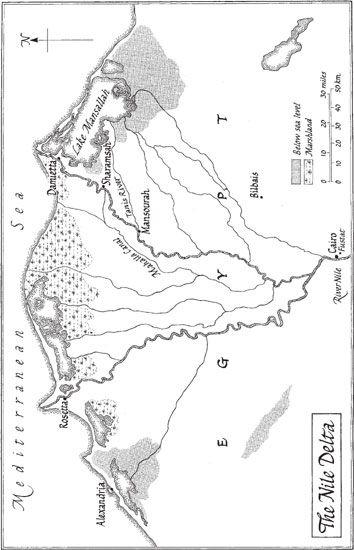
The Nile Delta
The Franks appeared to have the upper hand that summer. Their move to attack Egypt had taken al-Adil by surprise. It also coincided with a distracting, if ultimately ineffective, attempt by Saladin’s exiled son al-Afdal to seize control of Aleppo with the aid of the Anatolian Seljuqs. Having spent the summer stabilising Syria, al-Adil was just marching into Egypt when he fell ill and died on 31 August. When the crusaders heard of his passing, they thought the shock of their recent success at the tower had killed him, and Oliver happily concluded that the late sultan would be ‘buried in Hell’. Al-Adil had been a great champion of the Ayyubid cause, but although his demise weakened Islam, it did not prompt a collapse of Muslim resistance. Al-Kamil was well placed to step into the void left by his father–the only question was whether al-Kamil’s brothers, al-Mu‘azzam in Damascus and al-Ashraf in the Jazira, would lend him their full support. If not, al-Kamil might have to decide where his priorities lay: in resisting the crusaders; or in securing his supremacy over the Ayyubid realm.15
Cardinal Pelagius
From a position of strength in late summer 1218, the Fifth Crusade quickly lost momentum. In large part this was due to a new feature of the campaign. Thanks to the administrative and financial reforms introduced by Pope Innocent III, the expedition was relatively well funded and closely supported by an extensive fleet. This meant that crusaders were able to return to Europe without too much difficulty, even as new troop contingents arrived from the West to replace them. On the face of it, this practice seemed sensible because it allowed for the campaign to be rejuvenated by injections of fresh manpower. In reality, however, it had a detrimental effect upon the morale of those Franks who remained on the front line and hindered the development of the bonds of trust and familiarity between crusaders that had proved so essential to earlier expeditions.
The coming and going of Latin contingents also brought changes in leadership and associated shifts in strategic thinking. As the summer of 1218 drew to a close, a large number of Germans and Frisians sailed for home. At the same time, the Spanish churchman Pelagius, cardinal-bishop of Albano, arrived in the crusader camp along with forces from France, England and Italy. Pelagius–a forceful and stubborn character–came to the siege of Damietta as the papal legate, hoping to realise Innocent III’s ambition for a Church-led crusade. Some modern historians have given the cardinal a withering press, one scholar declaring that he was ‘hopelessly shortsighted [and] uncommonly pigheaded’. It also has been suggested that he immediately assumed overall command of the Fifth Crusade. Neither view is entirely accurate. In fact, Pelagius’ authority and influence grew only gradually and, to begin with at least, he cooperated effectively with other prominent figures like John of Brienne. The cardinal’s ecclesiastical leadership also helped to engender a renewed sense of religious devotion within the army, raising spirits and morale. This would prove to be an important factor amid the trials to come.
In the months that followed Pelagius’ arrival, the Latins faced a challenge confronted by many crusader armies before them: a winter siege. Huddled on the west bank of the Nile, across from Damietta, they endured manifold torments. On the night of 29 November rough seas caused waves to break over the land and flood the Frankish camp, so that crusaders woke to find fish in their tents. Poor diet led to the outbreak of scurvy. Oliver of Paderborn described how ‘corrupt flesh covered the gums and teeth’ of those afflicted, ‘taking away the power of chewing [and causing] a horrible blackness [to darken] the shins’, while James of Vitry recalled seeing crusaders suffering from this wasting disease slip into a deathly coma, ‘like those falling asleep’. All of the Christians were said to have been sick of the sight of sand, wishing only to behold fields of grass. Of course, the populace of Damietta were also suffering, as was al-Kamil in his encampment to the south. In early 1219 he was forced to return to Cairo to head off a coup, but the welcome arrival of his brother al-Mu‘azzam averted the danger and al-Kamil was able to return to the siege before the Franks could take any meaningful advantage.16
Deadlock
The first eight months of 1219 passed in stalemate. The crusaders were sufficiently entrenched on their side of the Nile to be safe from attack, but they lacked manpower and resources either to overcome Damietta’s defences or to drive al-Kamil from the field. The Latins’ position worsened when a further wave of troops returned to the West in May. Throughout much of this period, hopes were high for the imminent arrival of Frederick II. All of the crusaders, including Pelagius, were waiting for the Hohenstaufen ruler to appear at the head of a vast, indomitable army–one that would trample all Ayyubid resistance under foot. The problem was that Frederick was still in Europe, wrangling with Rome over the coronation, and news eventually reached Egypt that he would not be joining the campaign until March 1220 at the earliest. James of Vitry recalled the mood in the army when he wrote: ‘The majority of our men were in the grip of despair.’17
This period witnessed one of the strangest ever visitors to a crusading theatre of war. In summer 1219 the revered living saint Francis of Assisi–advocate of the mendicant principles of extreme poverty and ecstatic evangelism–arrived in the Christian camp. He had made his way to Egypt in the tattered rags of a holy man, believing that he could bring peace to the world (and success for the crusade) by converting the Muslims to Christianity. Crossing the lines of conflict under terms of parley, St Francis implored the bewildered Egyptian troops to lead him to al-Kamil. Taking him for a mad but harmless beggar, they agreed. In the bizarre audience that followed, al-Kamil politely refused Francis’ offer to demonstrate the power of the Christian God by walking through fire, and the saint eventually went home empty-handed.
In spite of this remarkable sideshow, the siege ground on and the late summer brought further troubling developments. The relative success of the Egyptian harvest had always been closely linked to minor fluctuations in the annual Nile flood. That year the river failed to break its banks in many areas and this caused huge increases in the price of grain and food shortages. By September al-Kamil had recognised that Damietta’s exhausted garrison was on the brink of collapse and, therefore, he offered the crusaders terms of truce. In exchange for an end to the siege he promised to return Jerusalem and most of Palestine to the Franks, and may also have pledged to hand back the True Cross. The castles of Kerak and Montreal in Transjordan were to remain in Ayyubid hands, but as compensation the Muslims would pay a handsome annual tribute.
This extraordinary proposition confirmed that the Ayyubids’ real priorities lay in Egypt and Syria, rather than Palestine. The proposal also seemed set to bring the Holy Land back under Christian control, breathing new life into the kingdom of Jerusalem and all Outremer. Yet, at this critical juncture, the first clear sign of dissension among the expedition’s leaders appeared. John of Brienne and the Teutonic Order expressed vocal support for the pact, as did many crusaders. But in the end, the views of Cardinal Pelagius–endorsed by the Templars, Hospitallers and Venetians–prevailed, and al-Kamil’s offer was declined. Legitimate concerns were expressed about the defensive viability of a Frankish kingdom shorn of its Transjordanian fortresses–although, realistically, Kerak and Montreal were just as crucial to al-Kamil’s hopes of maintaining secure lines of communication between Egypt and Damascus. The Venetians may also have been more interested in the commercial potential of Damietta than in Jerusalem’s recovery. But the key consideration behind Pelagius’ decision was the earnest belief that Frederick II’s eventual arrival would facilitate even greater and more decisive gains.
With the close of negotiations, summer’s end brought a further disruptive round of departures and arrivals for the crusader army. In early November 1219, al-Kamil made one last attempt to dislodge the Franks, launching a major offensive, but his troops were driven back. By this point, Damietta’s populace was in a desperate state. On the night of 5 November, some Italian crusaders realised that one of the city’s partially ruined towers had been left undefended. Rushing forward with a scaling ladder, they mounted the walls and soon called more troops forward. Within, the Latins were confronted by a ghastly spectacle. Oliver described how they ‘found [the] streets strewn with the bodies of the dead, wasting away from pestilence and famine’ when houses were searched, enfeebled Muslims were discovered lying in beds beside corpses. The crusaders’ eighteen-month investment had exacted a horrific toll upon the defenders–tens of thousands had perished. Nonetheless, the Franks celebrated their long-awaited success, plundering large amounts of gold, silver and silks. James of Vitry, meanwhile, supervised the immediate baptism of the surviving Muslim children.18
Once al-Kamil realised that Damietta had fallen, he hurriedly retreated some forty miles south along the course of the Nile, to retrench his position at Mansourah. In the event, he had more than enough time to prepare his defences, because, fresh from the flush of success, the Fifth Crusade was paralysed by indecision. The first contentious issue was the fate of Damietta itself. John of Brienne thought to claim it for himself–and later even minted coins affirming his right to the city–but Pelagius wished to hold Damietta (and the lion’s share of the amassed spoils) in the interests of the papacy and Frederick II. A temporary compromise was eventually brokered that allowed John to hold the city until the German king appeared.
More problematic still was the issue of future strategy. The crusade had attacked Damietta as a means to an end, but intractable questions were now raised about the next step. Should the city be used as a bargaining chip to secure the return of the Holy Land on even more favourable terms than those already offered? Or might the Fifth Crusade consider a fully fledged assault on Egypt by marching up the Nile to crush al-Kamil and conquer Cairo?
To grasp victory
In an unprecedented feat of woeful indecision, the Fifth Crusade spent the next year and a half ensconced in Damietta considering these issues–ever haunted by the spectre of Frederick II’s promised arrival. John of Brienne left Egypt, in part to pursue a claim to the crown of Cilician Armenia following the death of King Leon I, but also to supervise Palestine’s defence against renewed attacks from al-Mu‘azzam. As the months passed, however, John began to face widespread criticism for his absence from the crusade.
Back in Damietta, Pelagius assumed control of the remaining Frankish armies and did his best to maintain order. It was around this time that the cardinal had a mysterious book in Arabic–supposedly shown to the crusaders by Syrian Christians–translated and read aloud to the host. The text was purportedly a collection of prophecies written in the ninth century, relating revelations from St Peter the Apostle. The book appeared to ‘predict’ the events of the Third Crusade, as well as the fall of Damietta. It also declared that the Fifth Crusade would be brought to victory under the leadership of ‘a great king from the West’. The whole episode might sound utterly fanciful, but Oliver of Paderborn and James of Vitry took the ‘predictions’ of this tome very seriously. Pelagius certainly used them to justify his continued refusal to negotiate with the Ayyubids and his determined patience in awaiting the advent of Frederick II.19
At last, on 22 November 1220, Pope Honorius III gave in to Frederick’s demands and anointed him as emperor of Germany. In return, Frederick renewed his crusading vow. The coming of spring in 1221, therefore, seemed to herald a new dawn for the Fifth Crusade. That May, the first wave of Hohenstaufen crusaders arrived under the command of Ludwig of Bavaria and, bolstered by these reinforcements, Pelagius finally made the decision to push south and attack al-Kamil’s now heavily fortified camp at Mansourah. Unfortunately for the Franks, the prosecution of this campaign was criminally inept. Even once the choice had been made, the Christians were slow to act, and the advance only began on 6 July 1221. The next day John of Brienne returned to Egypt and joined Pelagius’ and Ludwig’s force. A proportion of the crusader host was left to defend Damietta, but the Latins still mustered some 1,200 knights, around 4,000 archers and many other infantrymen. Their southward march down the east bank of the Nile was also shadowed by a sizeable Christian fleet.
The problem was that Pelagius had little knowledge of the terrain around Mansourah and seems to have been entirely ignorant of the Nile Delta’s hydrology. By contrast, al-Kamil had chosen the location of his new encampment with great care and foresight. Positioned just south of a junction between the Nile and a secondary tributary–the Tanis River–running to Lake Mansallah, the Ayyubid base was practically unassailable. In addition, any attacking army would find themselves penned between two watercourses. The annual Nile flood of August was also fast approaching. This meant that if the crusaders tarried, their assault might be blunted not by Muslim swords, but by the unstemmable waters of the great river.
It was perhaps with a view to engineering just such a delay that al-Kamil now renewed his offer of truce on the same terms advanced in 1219. The postponement of hostilities also served al-Kamil’s interests, because he was eagerly awaiting the arrival of reinforcements under both al-Ashraf and al-Mu‘azzam. But despite some debate–and warnings from the Templars and Hospitallers about the growing concentration of Ayyubid forces in Egypt–Pelagius again declined to negotiate and the crusaders pressed on. It is impossible to judge whether al-Kamil would have honoured any deal settled at this late stage.
By 24 July the Franks had reached the settlement of Sharamsah, just a few days from Mansourah. There they repulsed a Muslim attack and Christian morale seems to have been buoyant. But, because of the imminent flooding of the Nile, John of Brienne counselled an immediate withdrawal to Damietta. His advice was overruled by Pelagius, who now seems to have been convinced that the Latins could grasp victory. In fact, they were marching into a well-prepared trap.
Continuing south, the Franks ignored a small tributary entering the Nile from the west. This was a grave error. The seemingly innocuous ‘tributary’ was actually the Mahalla Canal, a watercourse that rejoined the Nile miles to the south of Mansourah. Once the crusaders’ army passed by with their fleet, al-Kamil sent a group of his own ships up the canal to enter the Nile and block any retreat, even sinking four vessels to ensure that the river was impassable. By 10 August the Christians had taken up a position in front of Mansourah, in the fork between the Nile and the Tanis. Around the same time, however, al-Ashraf and al-Mu‘azzam arrived in Egypt and moved their troops to the north-east, thus blocking any land retreat. Soon after, the Nile flood began.
The Fifth Crusaders’ position rapidly became untenable. With the swelling waters, their fleet proved impossible to control and overloaded ships began to sink. Some thought was given to making a fortified camp and waiting for reinforcement, but by the evening of 26 August the sheer desperation of the situation led to a sudden and chaotic retreat, with only the Templars in the rearguard holding discipline. At this point al-Kamil ordered the sluice gates used to moderate the Nile flood to be opened, inundating the fields and further isolating his enemy–the terrain became so muddy and waterlogged that the Franks were left wading up to their waists. After an agonising day spent trying to trudge their way north, Pelagius accepted the irretrievable reality of the Christian position and sued for terms of surrender on 28 August 1221.
Having twice been offered the Holy City of Jerusalem, the cardinal and his fellow crusaders now had to accept the humiliation of abject defeat. Al-Kamil treated the Franks with marked respect–keen to bring the whole sorry affair to a swift conclusion so that he could finally consolidate his hold over Egypt–but, nonetheless, he demanded the immediate return of Damietta and the release of all Muslim prisoners. The only concession was that the eight-year truce between Latin Christendom and the Ayyubids would not be extended to the newly anointed Emperor Frederick II. On 8 September, al-Kamil duly entered Damietta, reclaiming dominion of the Nile, and in the weeks that followed the Franks left Egypt empty-handed.
FREDERICK II’S CRUSADE
The crushing reversal of fortune suffered by the Fifth Crusaders sparked criticism across Latin Christendom in the early 1220s. Cardinal Pelagius stood accused of ineffectual and misguided leadership–to some his failures in Egypt proved the underlying folly of Innocent III’s idealised vision of a Church-directed crusade. John of Brienne was also censured for neglecting his role as a field commander and for allowing the crusade to languish immobile at Damietta through 1220 and beyond. But perhaps the most forceful attacks were levelled against Frederick II, the great emperor who never did arrive in North Africa, despite all his promises. Even in 1221 he again had delayed his departure–distracted by an outbreak of political unrest in Sicily–and by late summer, with the disaster on the Nile and the crusade’s end, the time for action had passed.20
Frederick had demonstrated that his overriding priority was the defence, consolidation and expansion of the Hohenstaufen Empire. These were not uncommon concerns for a medieval monarch. The same burdens of crown rule had impacted upon the crusading careers of Henry II and Richard I of England and Philip Augustus of France. Indeed, from one perspective, Frederick’s dedication and determined ambition were commendable. But in the wake of the Fifth Crusade, the new emperor came under mounting pressure to make good his vows and enter the war for the Holy Land. This compulsion derived in part from public opprobrium, but it was driven most forcibly by the papacy. Honorius III was desperately concerned to renew the campaign for Jerusalem’s recovery and assuage his own guilt over the Damietta expedition’s dismal outcome. He also recognised that Frederick, now having encircled the Papal States, posed a clear threat to Roman sovereignty. The crusade might be a useful and effective means of controlling this potential enemy.
Stupor mundi
Frederick II was one of the most controversial figures in medieval history. In the thirteenth century he was lauded by supporters as stupor mundi (the wonder of the world), but condemned by his enemies as the ‘beast of the apocalypse’ today historians continue to debate whether he was a tyrannical despot or a visionary genius, the first practitioner of Renaissance kingship. A paunchy, balding figure with bad eyesight, physically Frederick was rather unprepossessing. But by the 1220s, he was the Christian world’s most powerful ruler: emperor of Germany and king of Sicily.
It has sometimes been suggested that Frederick had a distinctly unmedieval and enlightened approach to governance, religion and intellectual life, and that he brought this revolutionary perspective to the business of crusading, transforming the holy war and Outremer’s fate with a wave of his mighty hand. In reality, Frederick was not quite so radical, either as a monarch or as a crusader. Through his upbringing in Sicily–with its own indigenous Arab population and long-established network of Muslim contacts–Frederick was familiar with Islam: he knew something of the Arabic language, retained the services of a loyal group of Muslim bodyguards and even possessed a harem. He also had an inquisitive mind, an avid interest in science and an absolute passion for falconry. But the notion of maintaining a cultured royal court was far from unique. The Iberian Christian kings of Castile were perhaps even more open to Muslim influence in this period. And Frederick was not always tolerant in his attitude to faith and Christian dogma, violently suppressing Sicilian Arab rebellion between 1222 and 1224 and opposing heretics within his realm.
Contemporaries and modern commentators alike have also alleged that the new Hohenstaufen emperor was distinctly disinterested in holy war. Yet, despite his failure to fight in the Fifth Crusade, Frederick would prove, in time, to be driven by an authentic commitment to the crusading cause. His approach to the struggle for dominion of the Holy Land was conditioned, however, by the firmly held belief that he was destined to extend his imperial authority across all Christendom. By leading a crusade, Frederick sought both to fulfil what he regarded as his natural obligation as a Christian emperor and to exercise his equally innate right to recover and rule the most sacred city of Jerusalem.21
Imperial crusader, Jerusalemite king
In the mid-1220s, Pope Honorius III repeatedly sought to bind Frederick to a new crusading pledge. Initially, the campaign was supposed to start in 1225, but by March 1224 the emperor was requesting a further delay because of the ongoing difficulty of maintaining order in Sicily. With the pope’s patience now all but exhausted, a new agreement was formalised at San Germano (in north-western Italy) in June 1225. The treaty contained a number of strict provisions: Frederick was to recruit an army of 1,000 knights and fund their deployment in the Holy Land for two years; in addition, he had to provide 150 ships to transport crusaders to the East and furnish the master of the Teutonic Order, Herman of Salza (a close Hohenstaufen ally), with 100,000 ounces of gold. Most critically, the emperor promised, on pain of excommunication, to set out on crusade by 15 August 1227. Frederick accepted these terms partly because of his own willingness and determination to initiate an eastern campaign, but also to win support within the Hohenstaufen realm for a crusade tax–a levy that was unpopular because many feared, on past form, that its proceeds would end up in the imperial treasury. By agreeing to the Treaty of San Germano, Frederick was signalling categorically that, this time, he would redeem his vows. The move earned him the backing of his subjects, but it also left him tied to a dangerously precise schedule.
By this time the emperor had begun to lay diplomatic foundations for his expedition to the Near East. This brought him into contact with two Levantine rulers–John of Brienne and al-Kamil–both of whom evidently believed that they could manipulate Frederick for their own advantage. They had not counted on his guileful skills as a politician and a negotiator; his remarkable ability to mix pragmatism with resolute force. In the early 1220s John of Brienne still claimed the title of ‘king of Jerusalem’ through his role as regent to his daughter Isabella II, but faced an uphill battle to assert his legitimacy against Outremer’s independent-minded Frankish barons, who by now had become particularly adept at using the laws and customs of the realm to limit royal authority. In 1223 John therefore agreed to a marriage alliance between Isabella and Emperor Frederick, imagining that Hohenstaufen backing would finally cement his own position as king. The union was duly formalised in November 1225 at a ceremony in Brindisi (southern Italy) attended by John and leading members of the Jerusalemite aristocracy. To John’s surprise and disgust, as soon as the wedding finished, Frederick asserted his own rights to direct rule over Frankish Palestine and browbeat the assembled Latin nobles into submitting to his authority. This manoeuvre left John of Brienne disgruntled and disenfranchised, but it also rewrote the rules of crusade leadership–setting the stage for the coming expedition to be directed by an individual who uniquely combined the offices of crusader, Hohenstaufen emperor and Jerusalemite king.
Frederick also established a dialogue with al-Kamil, the Ayyubid sultan of Egypt, around 1226, although it is not clear which side initiated communication. Al-Kamil seems to have been aware of the emperor’s planned expedition and, in order to diffuse any renewed threat to the Nile region, he proposed an unusual pact. Like his father al-Adil before him, the new sultan was far more interested in reaching diplomatic accommodations with the Franks–thereby safeguarding their shared commercial interests–than in waging a bloody and disruptive jihad. Al-Kamil’s position as overlord of the Ayyubid confederation was also under threat in 1226. In the wake of the Fifth Crusade, relations with his brother al-Mu‘azzam, emir of Damascus, had soured, and al-Mu‘azzam had taken the rather drastic step of allying with the Khwarizmians–a band of ferocious Turkish mercenaries, driven out of Central Asia by the advent of the Mongols and now operating from northern Iraq. To balance this danger, al-Kamil invited Frederick to bring his armies to Palestine and, in exchange for a promise of aid against al-Mu‘azzam, offered to return Jerusalem to the Latins. To iron out the details of this groundbreaking agreement, the sultan dispatched one of his most trusted lieutenants, Fakhr al-Din, as an envoy to the Hohenstaufen court. There, he and Frederick treated together on amicable terms, and the emperor even knighted Fakhr al-Din as a sign of their friendship.22
By 1227 Frederick II was primed to lead his crusade: endowed with unprecedented military and political authority, buttressed by a promising Ayyubid pact. His German and Sicilian crusading forces duly assembled at the port of Brindisi that August in preparation for departure to the Holy Land, but then disaster struck. Amid the summer heat a virulent illness (perhaps cholera) began to spread through the army. Faced with the threat of excommunication, the emperor knew he could not afford to delay and so the embarkation began on schedule. Frederick himself set sail on 8 September in the company of the leading German noble Ludwig IV of Thuringia, but within days they too became sick. Fearing for his health, the emperor turned back, making landfall at Otranto (south of Brindisi). There can be little doubt that the panic was real and the delay necessary–Ludwig died from the illness at sea. Frederick declared that he would restart his journey in May 1228 after convalescing in southern Italy, and sent the Teutonic Master Herman of Salza on to the Near East to watch over the crusader host. Conscious of how events might be interpreted in Rome, the emperor also dispatched a messenger to the pope.23
Honorius III had died in March that year, and his successor Pope Gregory IX was a hard-line reformer and a defender of papal prerogatives with little or no sympathy for the Hohenstaufen cause. Already suspicious of Frederick’s motives, Gregory greeted the news with stern action rather than understanding. Seizing the opportunity to curb what he regarded as the excessive power of the empire, he immediately enacted the terms of the San Germano treaty and excommunicated Frederick on 29 September. This was a severe act of censure, particularly given the emperor’s supposed status as a divinely ordained monarch; in theory, at least, it severed Frederick from the body of the Christian community, leaving him to be shunned by the faithful. The pope probably expected Frederick to seek reconciliation and absolution–to submit to Rome and make what would be a tacit admission of papal supremacy.
In fact, Frederick did nothing of the sort. Refusing to recognise his excommunication, he sent Riccardo Filangeri, one of his leading military officials, on to Palestine with 500 knights in April 1228. On 28 June the emperor followed, setting sail from Brindisi with a fleet of around seventy ships. He was taking a massive risk, leaving Sicily, in particular, exposed to the predations of an ambitious and unscrupulous pope–but Frederick now seems to have been determined finally to fulfil his crusading vow. He would arrive in the Holy Land as the most powerful leader ever to bear the sign of the cross, but also as an outcast, cut from the bosom of the Church.
Frederick II in the Near East
Over the preceding months, events had conspired further to diminish Frederick II’s chances for success in the Levant. Two deaths reshaped his prospects. In late 1227 al-Mu‘azzam died from a bout of dysentery, effectively nullifying the emperor’s projected alliance with al-Kamil. Then, in May 1228, Frederick’s young wife, Queen Isabella II of Jerusalem, passed away after giving birth to a son. This infant, Conrad, became the heir both to the Hohenstaufen Empire and–through his mother’s bloodline–to the kingdom of Jerusalem. In legal terms, this development weakened Frederick’s authority in Palestine. No longer would he be acting as the husband of a living queen, but rather as regent to the new child heir.
These significant setbacks hardly caused the emperor to break stride. He arrived on Cyprus on 21 July 1228 and proceeded to reaffirm Hohenstaufen overlordship of the island–a right first established by his father at the end of the twelfth century. Frederick removed Jean of Ibelin (who had been acting as regent for the young King Henry I) from power, accusing him of financial corruption, and secured imperial rights to the royal revenues of Cyprus before sailing on to Tyre and then south to Acre in early September.
Once on the mainland, Frederick’s excommunicate status caused only a limited degree of difficulty. The Latin Patriarch Gerold was distinctly uncooperative, and the Templars and Hospitallers were also slow to support the emperor’s campaign, but this was probably the result of resentment over open Hohenstaufen favouritism towards the Teutonic Order. More troubling was the diminution in martial resources suffered that autumn. Having spent the summer helping the Teutonic Knights with the construction of their new castle of Montfort in the hills east of Acre, a fair proportion of the crusade army had sailed back to Europe. Without recourse to overwhelming military strength, Frederick turned instead to negotiation, reopening channels of communication with al-Kamil and direct dialogue with his representative Fakhr al-Din.
Given al-Mu‘azzam’s death and the resultant shift in the balance of power in the Ayyubid world, al-Kamil was reluctant to honour his promises to the emperor and thereby risk provoking criticism within Islam for having needlessly made concessions to the Franks. At the same time, however, the sultan’s overriding priority was to secure full control over Damascus and not to become embroiled in a costly war with Frederick. To drive home the incipient threat of conflict, the emperor marched his remaining forces south from Acre to Jaffa in early 1229–mirroring Richard the Lionheart’s manoeuvre in 1191. The pressure began to tell, and as talks continued Frederick employed every artifice and argument to secure a favourable settlement and the return of the Holy City. At one point he extended the hand of cultured friendship by discussing questions of science and philosophy, but then shifted to threaten war; he argued that, to the Muslims, Jerusalem really was only a desolate ruin, but that its sanctity to the Christians was overwhelming. Worn down by these arguments, and with his eyes on Syria rather than Palestine, al-Kamil eventually conceded.
On 18 February 1229, Frederick agreed terms with the Ayyubid sultan. In return for a ten-year truce and Frederick’s military protection against all enemies, even Christians, al-Kamil surrendered Jerusalem, Bethlehem and Nazareth, together with a corridor of land linking the Holy City with the coast. Muslims were to retain access to the Haram as-Sharif, with their own qadi to supervise this sacred area, but otherwise they were to abandon the city. For the first time in forty years the Holy Sepulchre would again be in Christian hands–an excommunicate emperor had achieved what no crusader since 1187 could, and all without spilling a single drop of blood.
At first glance, this impressive accomplishment might appear to be an extraordinary break with tradition–an act that overturned the established principles of crusading: the embracing of peace; the rejection of the sword. This certainly is how Frederick’s recovery of Jerusalem has been presented by some modern historians–as proof that the emperor was gifted with a vision and sensibility beyond his times. Such a view relies upon simplification and distortion. While it is true that Frederick was the first crusade leader to secure such valuable gains through diplomacy, negotiation had played a prominent role in earlier campaigns. Indeed, the Hohenstaufen’s methods and objectives bear close comparison to those employed by Richard the Lionheart during the Third Crusade. It is also worth noting that, like Richard, Frederick needed to gird his talk of truce with martial intimidation. He seems to have turned to diplomacy, not from some heartfelt desire to avoid bloodshed, but rather because it was the most expedient means available to achieve his goal.
Once the deal was struck in 1229, events proceeded apace. One Muslim chronicler described how ‘after the truce the sultan sent out a proclamation that the Muslims were to leave Jerusalem and hand it over to the Franks. The Muslims left amid cries and groans and lamentations.’ Frederick entered Jerusalem on 17 March 1229, visiting the Dome of the Rock and the Aqsa mosque in the company of a Muslim guide. In the Church of the Holy Sepulchre he proudly placed the imperial crown on his head with his own hands in a ceremonial affirmation of his unrivalled majesty. To publicise and glorify his achievement, that same day the emperor wrote a letter to King Henry III of England from Jerusalem. In this missive Frederick likened himself to the Old Testament King David and declared that ‘[God] exalted us on high among the princes of the world’. After this fleeting visit, the emperor returned to Acre.24
If Frederick thought his success would be greeted with jubilation, he was wrong. In his own letter, Patriarch Gerold condemned the emperor’s conduct as ‘deplorable’, stating that his actions had been ‘to the great detriment of the cause of Jesus Christ’. In part his anger was incited because Frederick’s unilateral agreement with the Ayyubids had been formulated ‘after long and mysterious conferences, and without having consulted any [native Franks]’. Along with the Templars and Hospitallers, Gerold also complained about the failure to secure control of a sufficient number of castles to defend the Holy City (many of which had previously belonged to the Military Orders) and pointed out that the emperor likewise had done nothing to supervise Jerusalem’s refortification. Beneath the surface of all these attacks, however, was the quickening fear that Frederick would now be in a position to assert his full autocratic authority over the Latin kingdom.
The emperor may well have had a mind to impose his will, but troubling news from the West had begun to reach his ears. In his absence, Pope Gregory IX had launched a blistering invasion of southern Italy, aiming to capture Sicily and thus put an end to the Hohenstaufen encirclement of Rome. Even in light of Frederick’s excommunication, this was a cynical and transparently self-serving ploy–one that later elicited widespread censure in Europe. To make matters worse, the pope sought to encourage recruitment for this campaign by offering participants spiritual rewards that seemed to echo those available to crusaders. Among those who spearheaded Gregory’s cause were the two rivals from the Fifth Crusade, Cardinal Pelagius and John of Brienne, now reconciled.
With the threat to his western empire pressing, Frederick swiftly reached a compromise with the kingdom of Jerusalem’s Latin nobility. Rather than appoint one of his own outsiders, he agreed to install two native barons to govern Palestine in his absence. This was little more than a temporary expedient, but it allowed the emperor hurriedly to depart for Italy. Even so, resentment at Frederick’s high-handed tactics was stirring among a large number of Levantine Franks. Mindful of the heated atmosphere, the emperor tried to slip away from Acre on 1 May 1229 with a minimum of ceremony by taking ship at dawn. But according to one Latin chronicle, Frederick suffered a final indignity when a group of ‘butchers and old people of the street’ spotted him as he made his way down to the docks, and this angry mob ‘ran along beside him and pelted him with tripe and bits of meat’. The Hohenstaufen emperor had recovered the Holy City for Christendom, but he was said to have left the Near East a ‘hated, cursed and vilified’ man.25
A NEW HORIZON
Frederick II returned to southern Italy in time to drive back the forces fighting in the name of Pope Gregory IX. Despite an atmosphere of anger and ill will, both sides recognised that, for now at least, reconciliation was in their best interests. In 1230 the emperor’s excommunication was lifted, Gregory acknowledged the legality of the treaty brokered with al-Kamil in the East and a tense rapprochement was achieved. Meanwhile, in Palestine, the Franks gradually began to return to Jerusalem. For all their earlier complaints, Patriarch Gerold, the Templars and the Hospitallers all re-established a presence in the city, and slow work began on rebuilding its fortifications. With the Ayyubids still locked in an ongoing internecine struggle for supremacy, the terms of the 1229 truce held, and the Latins were left largely unthreatened.
Before long, though, the Christians were embroiled in squabbles of their own. In his rush to return westwards in 1229, Frederick had been forced to compromise his vision of direct Hohenstaufen hegemony of the Holy Land. But with the settlement in Italy, he dispatched Riccardo Filangeri to assert imperial rights over Cyprus and Palestine in 1231. Something of a hard-nosed autocrat, Filangeri proved to be deeply unpopular with much of the native Frankish nobility and clashed heavily with Jean of Ibelin, who now became the figurehead of anti-Hohenstaufen resistance. Through the remainder of the decade and beyond, the struggle to resist imperial authority simmered on–even leading Acre’s local populace to declare their city an independent commune, separate from the kingdom of Jerusalem. Distracted by this hapless bickering, the Latins made little attempt either to consolidate their recent territorial gains or to exploit Ayyubid weakness.
To compound this situation, the barely contained animosity between Frederick II and Gregory IX resurfaced once more in 1239. The emperor was again excommunicated and, this time, the pope called for a fully fledged crusade against his Hohenstaufen opponent–now defamed as an enemy of Christendom and ally of Islam. Another crusade against the emperor was announced in 1244 and this led to open warfare that rumbled on until Frederick II’s death in December 1250. Resolute in its desire to uphold and advance the strength of the Church, the papacy had finally embraced the idea of wielding the weapon of holy war against its political enemies. Similar calls to arms would follow for decades, even centuries, to come. These prompted some outcry, occasionally even vociferous condemnation, but nonetheless many willing recruits took the cross–content to fight on Latin soil against fellow Christians in return for an indulgence. Of all the criticisms levelled at the papacy by contemporaries for this dilution of the ‘crusading ideal’, the most telling was the frequent complaint that the true battlefield in the holy war lay in the East. It is certainly true that, over time, Rome’s redirection of crusade armies–both within western Europe and to other theatres of conflict in Iberia, the Baltic and the faltering state of Latin Romania–served further to isolate and enfeeble Frankish Outremer.
The Barons’ Crusade
These developments did not suddenly lead the papacy to abandon the Latin East. Rather, the Levant became one front among many, and it sometimes fell to secular leaders to prioritise the interests of the surviving crusader states. This was the case between 1239 and 1241 when two relatively small-scale expeditions (sometimes called the Barons’ Crusade) were led by Thibaut IV of Champagne–a member of one of the West’s great crusading dynasties–and by Henry III of England’s brother, Richard of Cornwall. Their campaigns enjoyed a marked degree of success, partly because they adopted Frederick II’s technique of forceful diplomacy, but primarily as a result of the fresh spiral of Ayyubid insecurity caused by al-Kamil’s death in 1238. With various members of the late sultan’s family vying for control of Egypt and Syria, Thibaut and Richard were able to play rival Ayyubids against one another, recovering Galilee and refortifying the southern coastal outpost of Ascalon.
In the wake of these successes, the kingdom of Jerusalem’s Frankish nobility finally threw off the yoke of Hohenstaufen domination, declining to acknowledge the authority of Frederick’s son and heir Conrad in around 1243. Tied up with events in Europe, the best response the emperor could muster was to install a new representative in Tripoli. From this point forward, the Jerusalemite crown shifted to the royal bloodline of Latin Cyprus, but in real terms power rested with the aristocracy.26
By 1244 the fortunes of Frankish Palestine seemed rejuvenated. Large swathes of territory had been reoccupied and Jerusalem, though still only sparsely populated, was in Christian hands. It looked as though the kingdom might return to the position of relative strength and security enjoyed before the ravages of 1187. But in truth, these signs of vitality were illusory and ephemeral. The Latins were actually in a desperately vulnerable state. Having alienated the Hohenstaufen Empire, their martial potency depended almost entirely upon the Military Orders and direct aid from the West in the form of crusades–a stream of support that might well diminish. Above all, the Franks’ recent fortunes were a direct consequence of Ayyubid weakness. Should that Muslim dynasty recover or, perhaps worse still, be replaced by another force, the consequences for Outremer might be catastrophic.
The bane of Palestine
Through the tumult of the early 1240s, one Ayyubid rose to prominence: al-Salih Ayyub, al-Kamil’s eldest son. By 1244 al-Salih had secured his position in Egypt, but, in so doing, lost Damascus to his uncle Ismail. With a view to reasserting his authority over Syria, al-Salih–like other Ayyubid rulers before him–looked to harness the feral brutality of the Khwarizmians, who were now under the command of their chief, Berke Khan. In response to al-Salih’s summons, Berke led his mercenary horde of around 10,000 ravening troops into Palestine in early summer 1244. Seemingly acting of their own volition, the Khwarizmians proceeded to launch an unexpected attack on Jerusalem. At their approach thousands of Christians streamed out of the city, hoping to reach safety at the coast, leaving behind a small garrison of defenders. The refugees suffered terribly as they hurried west. Falling prey to Muslim raiders and bandits in the Judean hills and then being picked off by Khwarizmian outriders on the plains near Ramla, barely 300 reached Jaffa.
The situation back at the Holy City was worse still. The remaining Franks put up some resistance, but they were hopelessly outnumbered and outclassed. On 11 July 1244 Berke Khan’s men broke into Jerusalem and went on the rampage. According to one Latin chronicler, the Khwarizmians ‘found Christians who had refused to leave with the others in the Church of the Holy Sepulchre. These they disembowelled before the Sepulchre of Our Lord, and they beheaded the priests who were vested and singing mass at the altars.’ Having ripped down the marble structure enclosing the Sepulchre itself, they proceeded to vandalise and loot the tombs of the great Frankish kings of Palestine–the likes of Godfrey of Bouillon and Baldwin I. It was said that ‘they committed far more acts of shame, filth and destruction against Jesus Christ and the Holy Places and Christendom than all the unbelievers who had been in the land had ever done in peace or war’. With the work of destruction and desecration complete, Berke Khan led his forces to rendezvous near Gaza (in southern Palestine) with an army of around 5,000 warriors from Egypt.27
The shock of these atrocities goaded the Franks into action. Securing an alliance with Ismail of Damascus and another Muslim dissident, the emir of Homs, they marched south to confront the Egyptian–Khwarizmian coalition. Pooling the resources of the Frankish nobility and the Military Orders, the Christians managed to muster around two thousand knights and perhaps a further 10,000 infantrymen. This host–the largest field army amassed in the East since the Third Crusade–represented the Latin kingdom’s full fighting manpower. Yet, even joined with its Muslim allies, it barely exceeded that of the enemy. There was considerable debate over the best strategy to employ. The emir of Homs, who had fought and bested the Khwarizmians before, counselled patient caution and the establishment of a well-defended camp, suggesting that Berke Khan’s men would soon bore of any delay and disperse. However, the eager and overconfident Latins rejected this sage advice. On 18 October 1244 they launched an attack and battle was joined on the sandy plains near the village of La Forbie (north-east of Gaza).
For the Franks and their allies, the mêlée that followed was an unmitigated disaster. Lacking any clear numerical advantage, they had to rely upon closely coordinated action and a dose of luck–but they benefited from neither. To begin with, the Latins and the soldiers from Homs seem to have fought well, holding their ground. But in the face of an unrelenting Khwarizmian assault, the Damascene troops lost their nerve and fled. With their battle formation broken, the Franco-Syrian allies quickly became surrounded, and, though they bravely struggled on even as casualties mounted, the day ended in defeat. The losses sustained at La Forbie were appalling: of the 2,000 troops from Homs, 1,720 were killed or captured; only 36 Templar knights escaped out of 348; the Teutonic Order lost all but three knights from a force of 440. The master of the Templars was captured; his Hospitaller counterpart was slain. This was a calamity to match that endured at Hattin in 1187–a crushing blow that shattered Outremer’s remaining military strength. In the months that followed, half a century’s worth of gradual territorial recuperation would be all but erased.
In a state of dread, the few Frankish survivors regrouped at Acre that autumn, ‘weeping, shouting and crying as they went, so that it was grief to hear them’. Sending warnings to Cyprus and Antioch, they dispatched Bishop Galeran of Beirut ‘to take solemn messages to the pope and to the kings of France and England [and to emphasise] that if swift decisions were not taken about the Holy Land, it would soon be completely lost’.28 The grievous setbacks of 1244 that produced this heartfelt appeal mirrored those that five decades earlier had sparked the Third Crusade. But in that time the foundations of Christian holy war had begun to shift: customs and practices had changed; enthusiasms had waned or been refocused. Amid this new thirteenth-century reality, one obvious question must have gnawed at the minds of the Levantine Franks: would the Latin West once again mount a mighty crusade to save the Holy Land?