
9
The rival of ‘Edward VI’ for the crown and throne of England was Henry VII. He had been in possession of the crown since 22 August 1485, on the morning of which day, members of Henry’s French and Welsh army had killed the last reigning Yorkist king, Richard III.
Born in 1457, Henry VII was the only child of Edmund, Earl of Richmond and his very young wife, Lady Margaret Beaufort. On his mother’s side Henry was the great-great-great grandson of King Edward III through the following line of descent:
THE ENGLISH ROYAL DESCENT OF HENRY VII
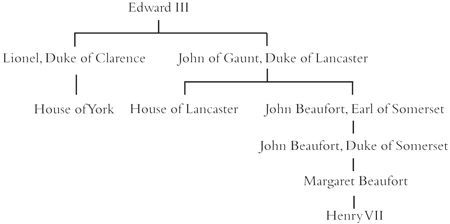
On his father’s side, Henry VII was the nephew of Henry VI. However, that paternal connection did not convey to him any claim to the English throne. His father and King Henry VI were half-brothers only because they shared the same mother. Thus Henry VII was not descended from any of the Lancastrian kings – though through his paternal grandmother he was quite closely related to the fifteenth-century kings of France:
HENRY VII’S PATERNAL ANCESTRY
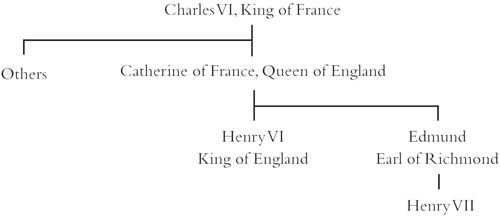
Henry VII’s father is usually said to have been the son of Owen Tudor, and the surname Tudor is accordingly assigned to Henry VII’s royal dynasty. However as this author and others have shown,1 there is some evidence that Edmund, Earl of Richmond may have been the illegitimate son of Edmund Beaufort, Duke of Somerset – and thus the cousin of his wife, Margaret Beaufort. Although the evidence on this point is not conclusive (and never will be, unless the royal Tudor Y-chromosome can be established and matched to the royal Plantagenet Y-chromosome), there is no doubt that Richard III, in his proclamation against Henry VII, cast doubts on the legitimacy of his descent. This point has often been questioned, since the Beauforts, while originally born illegitimate, were subsequently legitimised. However, Richard III may simply have had at the back of his mind his own and his family’s suspicions regarding the dubious paternity of Henry VII’s father.
Henry VII was actually born fatherless, at Pembroke Castle on 28 January 1456/57, because the Earl of Richmond had died three months earlier. What is more, the infant Henry also had very little contact with his mother, since his wardship was assigned to Lord Herbert by Edward IV when he seized the throne. Lord Herbert had then just been promoted by Edward IV to the earldom of Pembroke, which had formerly been held by Jasper Tudor, young Henry’s uncle. It seems that Lord Herbert – now the new Lord Pembroke – hoped in due course to marry young Henry to his daughter, Cecily.
In 1469 the 12-year-old Henry had accompanied his guardian to the Battle of Edgecote, where Lord Pembroke was naturally fighting on the Yorkist side. Since the battle proved a Yorkist defeat, one of its sequels was Lord Pembroke’s execution. Young Henry returned after the battle to the care of the widowed Lady Pembroke, while his mother and her second husband, Henry Stafford, tried to secure the young lad’s return to his own family. This aim was finally brought about by the Lancastrian Readeption of 1470, as a result of which young Henry found himself in the care of the other Earl of Pembroke, his uncle Jasper.
On 27 October 1470 the Lancastrian Readeption also secured young Henry a meeting with his uncle, the restored King Henry VI. At this meeting Henry VI was later reputed to have prophesied his half-nephew’s future accession to the throne. About six months later, when Edward IV ousted Henry VI and reclaimed the crown of England, Henry Tudor fled the country, escaping with his uncle Jasper into exile in the Duchy of Brittany.
Meanwhile Henry’s mother, now married to Lord Stanley (later first Earl of Derby), was by no means an unacceptable figure at the court of her second cousin Edward IV.2 As we have already seen, on grand occasions such as the marriage of Richard of Shrewsbury, Duke of York, Lady Margaret fulfilled a public role as a significant figure within the Yorkist regime. Indeed, later, at the coronation of Richard III, she was the senior attendant of Richard’s queen at their joint coronation. Apart from the fact that he was in the hands of his politically incorrect uncle, there was therefore no official reason why young Henry Tudor should have remained in exile. Indeed, his mother tried hard to secure his return.
Her plans changed, however, when Edward IV died, Edward V was declared illegitimate and Richard III was offered the crown. The Woodville family of Edward IV’s bigamous queen now found themselves in a political no man’s land, and Margaret Beaufort took advantage of this situation to court the former queen. Margaret seems to have proposed to Elizabeth Woodville a marriage between her son, Henry, and Elizabeth Woodville’s eldest daughter, Elizabeth. In due course – possibly owing to the fact that the ex-child-king Edward V had died in the meantime, while his younger brother, Richard, Duke of York, was out of the ex-queen’s hands and inaccessible – the cunning Margaret developed this marriage plan into something much more ambitious: a plan to secure recognition for her son as the Lancastrian heir to the throne (which he certainly was not) and then to promote the young Henry as King of England – with Elizabeth of York at his side as his queen consort.
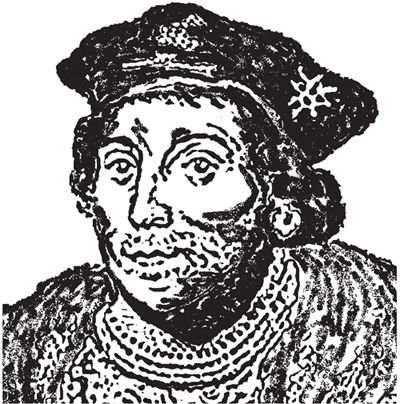
Henry Stafford, 2nd Duke of Buckingham, redrawn from an eighteenth-century engraving.
As part of the Duke of Buckingham’s rebellion, Henry was first proclaimed king in Cornwall on 3 November 1483. But, Henry, who was still on the Continent, found himself delayed by bad weather and other setbacks. When at last he reached the West Country from Brittany, he discovered that Richard III was firmly in control of the situation. Therefore he simply returned quietly to his place of exile.
Early in the following year Richard III attempted to have Henry extradited from Brittany. Henry, however, was forewarned of this plan and fled from Brittany into France. There the regents for Henry’s cousin, the young Charles VIII, saw in this new arrival a wonderful potential weapon for them to use against their hostile neighbour, Richard III. As a result, Henry Tudor suddenly found himself endowed with a backing of French money, and with French ships and fighting men at his disposal. This was the situation which led to his invasion of England in 1485: the invasion which culminated in the Battle of Bosworth, and which produced the unexpected outcome of a new King of England and a new royal dynasty.
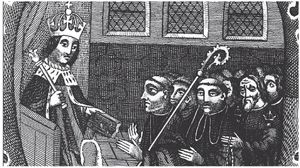
Henry VII with John Islip, Abbot of Westminster, and the Benedictine monks of Westminster Abbey.
Although some of those who had supported the previous regime fought on for a while, others, like Viscount Lovell, felt obliged to flee into sanctuary. Yet others, such as the Earl of Surrey, preferred to try to make peace with the new political reality in order to prevent the loss of all their property. Henry VII’s attempt to win over Yorkists was aided by his marriage to Elizabeth, eldest daughter of Edward IV and Elizabeth Woodville, whose legitimacy he had urgently restored. The couple married on 18 January 1485/86. The new queen was soon pregnant, and the political publicity machine of the new regime swung into action to proclaim that as a result the conflict between York and Lancaster had finally been brought to an end. But not everyone was convinced. Indeed, this was the very context within which the most determined of the Yorkists set out to ensure that Henry VII’s reign would be of short duration. Their plan was that in the longer term ‘King Edward VI’ would be the real ruler of England.
One of Henry VII’s chief advisers at the time of the Dublin King’s emergence was John Morton. Morton had probably been born in about 1420, so that in 1486 he was about 66 years of age.
John Morton was born in Dorset – possibly in Bere Regis, a village whose parish church he later rebuilt. However, his was not a West Country family in its origins: his father, Richard Morton, had come to Dorset from Nottinghamshire. John Morton’s background was socially middling. One of his uncles served as an MP for the town of Shaftesbury on one occasion, and John’s younger brother later became sheriff of Dorset and Somerset. John Morton himself entered the Church, and received his higher education at the University of Oxford.
From 1452/53 John Morton was the rector of Shellingford (Berkshire). At the same time he was emerging as a canon lawyer in the Canterbury Court of Arches. Probably through Archbishop Thomas Bourchier of Canterbury, Morton began to become a prominent figure, being appointed chancellor to Edward of Westminster, Prince of Wales, the alleged (though somewhat dubious) son of Henry VI. At the same time he was accumulating other ecclesiastical appointments in various dioceses.
Morton had grown up under the rule of the Lancastrian dynasty, and had gradually been brought into the direct service of that ruling house. This, together with his legal expertise, probably accounts for the fact that in 1460 he was responsible for drafting the Bill of Attainder against Richard, Duke of York (the father of the future Yorkist kings, Edward IV and Richard III). That and other pro-Lancastrian actions on his part led to Morton’s subsequent exclusion from the pardons issued by Edward IV when he seized the throne.
In fact, Morton was captured after the Battle of Towton, and briefly imprisoned in the Tower of London, from which he escaped. He then left his homeland and joined Henry VI’s queen, Margaret of Anjou, in exile in France. He became a prominent figure at her exiled court, taking an active part both in diplomacy and in Margaret’s attempts to re-establish herself in England in 1462–63. But since these attempts failed, and since Morton himself had lost all his property in England, he appeared to have settled down abroad, where he was soon studying theology at the University of Louvain.
Morton was naturally involved in the Lancastrian Readeption of 1470–71. Ultimately, however, when that failed, he decided to come to some accommodation with the restored Yorkist King Edward IV. Thus he at last received a royal pardon, together with new government appointments. He served for seven years as Master of the Rolls, but also became increasingly involved in diplomacy. During the 1470s and the early 1480s he acted on several occasions as Edward IV’s envoy in France and Burgundy. Meanwhile, in 1478 the pope appointed him Bishop of Ely, with the full approval of Edward IV, who, by this time, had come to rely heavily on Morton’s expertise.
But when Edward IV died, in 1483, Morton once again found himself on the wrong side politically. Following Bishop Stillington’s revelation to the royal council of Edward IV’s bigamy, and the division of opinion which that produced, Morton sided with Lord Hastings, expressing himself to be in favour of keeping quiet about the problem of Edward V’s technical illegitimacy. As a result, when Hastings had his head cut off, Morton was arrested.
Unfortunately, and probably unwisely, Richard III placed Morton in the custody of the Duke of Buckingham. Bishop Morton was undoubtedly involved in Buckingham’s subsequent rebellion, and when Buckingham fell, Morton was attainted. Once again, however, he fled abroad, where he involved himself in the faction surrounding Henry Tudor. Indeed, it was reportedly Morton who warned Henry of Richard III’s attempt to extradite him from the Duchy of Brittany, where Henry was then living in exile.3 As a result of this warning, Henry sought safety with his cousin, the King of France. The result of this was ultimately the offer of French support for Henry’s campaign of 1485, which resulted in the death of Richard III and the establishment in England of a new ruling dynasty. Meanwhile, Bishop Morton had also secured papal backing for the claims of Henry VII.
When Henry VII became king, Bishop Morton found himself re-established at the court in England, where in 1486 he succeeded the ancient Cardinal Bourchier as Archbishop of Canterbury. The Act of Attainder against him was reversed, and he became a member of the king’s council. In March 1486/87, by which time the Dublin King’s claim to the throne had already been made public, Bishop Morton found himself appointed Henry VII’s Chancellor of England. Given his life history and his position in the new Tudor government, there was not a shred of doubt that Morton would now do all in his power to ensure that the Dublin King was defeated. He would also do whatever was needed to ensure that ‘Edward VI’ was reduced to a figure of no consequence.
Notes
Abbreviations
|
CPR |
Calendar of Patent Rolls |
|
ODNB |
Oxford Dictionary of National Biography |
|
PROME |
Parliament Rolls of Medieval England |
1. See, for example, Ashdown-Hill, Royal Marriage Secrets, pp. 70–3.
2. Edward IV’s maternal grandmother, Joan Beaufort, Countess of Westmorland, was the sister of Margaret Beaufort’s grandfather.
3. John Morton, ODNB.