
PART 3
10
According to Adrien De But’s chronicle, on 5 October 1485, when John Morton, Bishop of Ely (who was then on his way back to England) reached Calais, he heard that the recently enthroned king, Henry VII (whom, however, De But prefers to call simply ‘the Earl of Richmond’), had been killed – together with some of his barons – by a sudden outbreak of plague:
Regarding the rightful successor of the new king, however, not a little controversy arose. Some acclaimed the son of the Duke of Clarence, as the true king – a distinguished youth, who had been rescued from slaughter carried out by his uncle, King Richard – though the present writer never heard anything of such [slaughter].1
In any case, in the end, no new English sovereign was proclaimed at this early date, since, as De But went on to say, no confirmation was ever received of the story of Henry VII’s death.
Adrien De But’s short report is very interesting in that it shows how rumours about affairs in England were rife at that time. With the benefit of hindsight, of course, we now know that, in reality, Henry VII had not died of plague within a mere two months of seizing the throne. As for Richard III, the question of whether or not he had engaged in slaughter is still very much a matter of hot dispute and debate! Even so, the evidence we have in no way suggests that Richard had ever contemplated slaughtering his nephew, the Earl of Warwick. As we saw earlier, Richard III had, in fact, promoted the little boy who was living under his protection to government posts.
At the same time it is important to recognise that Henry VII was a very new king, who had come to power as the result of an armed rebellion against his predecessor (who had been killed in the struggle). It is all too easy to assume that everyone knew that Henry would be king for a number of years. But in 1485 and 1486 there was no such certainty. In fact, many people, both in England and in other countries, were probably waiting with bated breath to see who would come forward to contest Henry VII’s recent usurpation.
That this was indeed the case is made plain by the fact that in the course of the following year (1486) the Stafford brothers – Sir Humphrey, who had taken sanctuary after Bosworth at St John’s Abbey in Colchester together with Viscount Lovell, and Humphrey’s brother, Thomas Stafford – raised a rather hopeless and ill-fated rebellion in their native Worcestershire. The Staffords’ attempt was a complete failure. However, at the same time ‘it was noticed that a number of people in Ireland were embarking on a campaign to bring in a new king, the son of the Duke of Clarence (brother of the former kings, Edward and Richard), who by right of his mother was Duke [sic] of Warwick’.2 Moreover, the Mechelen household accounts of Margaret of York, dowager Duchess of Burgundy include an interesting entry relating to the feast of the local martyr, St Rombout (Rumbold), on 24 June 1486. It appears that on the occasion of this significant local celebration Margaret paid for eight flagons of wine as a gift to ‘the son of Clarence from England’.3
This very important surviving record in the dowager duchess’s accounts makes it clear that, in the summer of 1486, a son of the Duke of Clarence – that is to say, one of Margaret’s nephews – was understood to be staying with his aunt at her palace in Mechelen. Of course, the only known son of the Duke of Clarence who was alive in June 1486 was the Earl of Warwick, therefore unless this reference is to an otherwise completely unknown bastard son of the late Duke of Clarence, it seems that it was the Earl of Warwick who was believed to be visiting his aunt in Mechelen. Incidentally, a curious coincidence, in the present context, lies in the fact that St Rumbold was reputed to have been an Irish, early Christian missionary who had been martyred in Mechelen. The Irish link of the saint was potentially prophetic, for ‘the son of Clarence’ may also have come to Mechelen from Dublin. Moreover it was almost certainly the same reputed ‘son of Clarence’ who was crowned in Ireland less than a year later.
Unlike the documents from the Low Countries, most of the surviving evidence in England dating from 1486, and relating to the existence of a Yorkist movement to remove the recently enthroned Henry VII, speaks of people other than the Earl of Warwick who were involved in the scheme. The two most important figures in the surviving English sources are the late Richard III’s close friend Francis, Lord Lovell and the Earl of Warwick’s older cousin, the Earl of Lincoln.
The lack of mention of the Earl of Warwick could possibly be due to chance regarding which writings have survived. However, the boy himself was very young. Thus the lead in planning a coup against Henry VII had necessarily to be taken by older and more experienced Yorkists – the very men who are mentioned in the surviving records. Even so, one passing English reference to Warwick does survive. It can be found in a letter written on 29 November 1486.
The letter confirms that Edward of Clarence, then aged 11 years and 9 months, and under normal circumstances probably potentially unlikely to figure in news from the English capital, had come to be seen as a figure of some importance. The precise whereabouts of the Earl of Warwick at the time of writing are not absolutely clear from the surviving missive. However, the people mentioned in the letter were certainly not all in London. One cannot therefore simply assume that the reference is to a prisoner in the Tower, or a person attending Henry VII’s royal court (that is to say, Henry VII’s official Earl of Warwick). The message may equally well relate to the alternative earl – Margaret of York’s summer guest in Mechelen – who was almost certainly still in Flanders in November 1486.
The letter in question was written by a priest called Thomas Betanson, ‘to his worshipful master Sir Robart Plomton kt’. With his spelling and grammar slightly modernised, this priest, who was then serving the church of St Sepulchre-without-Newgate, wrote:
Sir, as for tidings, here there are only a few. The king & queen are staying at Greenwich; the Lord Percy [son and heir of the fourth Earl of Northumberland] is at Winchester; the Earl of Oxford is in Essex; the Earl of Derby and his son are with the king. Also there is but little talk here of the Earl of Warwick now, but after Christmas they say there will be more talk of [him].4 Also there are many enemies on the sea, & divers ships taken, & there are many of the kings house taken for thieves.’5
In fact this letter, which apparently links the Earl of Warwick with the enemies on the ships, and which expects to hear more of the earl after Christmas, seems inherently unlikely to refer to the boy who was either at Henry VII’s court, or who was already a prisoner in the Tower of London. It is therefore probable that it refers to the other Earl of Warwick – the boy who was in Flanders at the time when the message was written. In other words, the implication would appear to be that the real Earl of Warwick was considered by Thomas Betanson to be the Mechelen ‘son of Clarence’. And, as we have already seen, it is probable that the Mechelen ‘son of Clarence’ was that same child who, in the following year, was to be crowned as ‘King Edward VI’ – the Dublin King.
Much of the other evidence from England regarding the progress of the Yorkist movement during 1486 relates to Francis, Lord Lovell. Francis had an interesting background. As we have seen, he had been a close companion of Richard, Duke of Gloucester (the future Richard III) during his adolescence, when both of them had been under the guardianship of ‘Warwick the Kingmaker’. Lord Lovell was also connected with Eleanor Talbot. It had, of course, been the revelation of Eleanor’s secret marriage to Edward IV which changed the order of succession in the summer of 1483, and brought Richard III to the throne.
Francis, Lord Lovell had remained a faithful servant of Richard III after the latter became king, and their connection had been lampooned in the famous couplet quoted earlier. In 1485, in the face of the threatened Tudor invasion, Francis Lovell had been sent by Richard III to guard the south coast. Possibly he fought with Richard at the Battle of Bosworth, as many historians have maintained. However, it is also possible that, based as he had been in the south of England, defending the coast, Lovell had found himself unable to rejoin his king in time to take part in his last battle. At all events, unlike the king, the Duke of Norfolk,and Richard Ratcliffe, he certainly survived the defeat of August 1485. Francis then took refuge at St John’s Abbey in Colchester.
This important Benedictine abbey, which stood just outside the walls of Colchester on the southern side of the town, had been founded in 1095.6 It possessed very powerful rights of sanctuary.7 ‘There were two types of sanctuary in medieval England.’ Any church could offer some degree of protection, but ‘some abbeys and minsters had special rites of sanctuary … anyone who took refuge in such a sanctuary could remain there with impunity for life’.8 Colchester Abbey had been granted such extraordinary rights of sanctuary in 1109.9 However, these rights appear to have been contested later, because in the mid fifteenth century Abbot Ardeley had appealed to Henry VI to have them confirmed. The abbot’s request was submitted upon the grounds that during the king’s incapacity, the community at St John’s had expended much time and effort in praying for his recovery. As a result of Abbot Ardeley’s petition, on 13 May 1453 Henry VI had issued an explicit formal confirmation of the sanctuary rights of St John’s Abbey.10
Francis Lovell was not originally from the Colchester area, but from Oxfordshire. However, Colchester is close to the Essex–Suffolk border and, as we have seen, Francis had spent part of his youth in the neighbouring county of Suffolk. Thus he was probably well aware of the possible advantages of claiming sanctuary at St John’s Abbey, partly thanks to his brief period of residence in the vicinity, and also thanks to his friendship with the late Duke of Norfolk. John Howard had spent most of his life on the Suffolk–Essex border. The ancestral manor of his father’s family was at Stoke-by-Nayland, in Suffolk, but he had been constable of Colchester Castle, and owned a fine town house in Colchester (now the Red Lion in Colchester’s High Street). His role as Admiral of the Northern Seas had also often taken him to the nearby ports of Harwich and Dovercourt. Howard had himself taken sanctuary at St John’s Abbey in Colchester during the Lancastrian Readeption (1470–1), and the same abbot – Abbot Walter Stansted – who had received Howard in 1470, was still in office at the abbey in Colchester in 1485, when Viscount Lovell arrived at the impressive abbey gatehouse (which survives to this day – see plates 15 and 16) to ask for sanctuary.11
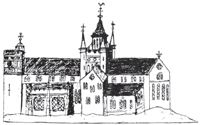
St John’s Abbey Church, Colchester, redrawn by the author from BL, Cotton MS Nero D viii, f. 345.
Francis Lovell remained at St John’s Abbey for several months. But by the spring of 1486, he was on the move again. Just across the border in Suffolk, Lovell’s former guardian – one of the late king’s sisters – had her home and power-base. Elizabeth of York and her husband, John de la Pole, the Duke and Duchess of Suffolk, had their principal residence at Wingfield Castle. However, they also had connections with many other places in the county of Suffolk. The couple are, to this day, commemorated in the surviving fifteenth-century stained glass at the church of Stratford St Mary, a mere 5 or 6 miles to the north-east of Colchester. And, of course, the eldest son of the Duke and Duchess of Suffolk was the Earl of Lincoln. Although his father was trying to be politically correct in the eyes of Henry VII, Lincoln, Richard III’s nephew, was already strongly opposed to the man who had defeated and killed his uncle. Lincoln would have had little difficulty in contacting – and possibly meeting – Francis Lovell while he was still safe in sanctuary at the abbey in Colchester.
Moreover, as we have seen, Francis was not the only Yorkist who had claimed sanctuary at St John’s Abbey in the aftermath of Bosworth. While he was there he had with him an older companion. This was Sir Humphrey Stafford of Grafton in Worcestershire (c.1426–86). Sir Humphrey had inherited his manor in Worcestershire in 1449. He had proved an enthusiastic Yorkist, and he apparently fought with Richard III at Bosworth, after which he had fled to the abbey in Colchester and claimed sanctuary. Incidentally, the fact that Stafford had apparently come to Colchester Abbey from Bosworth Field raises the possibility that Viscount Lovell may also have fought at Bosworth, and that he and Sir Humphrey Stafford may then have escaped from the battlefield together and fled south to Colchester:
Lovell and his companion in sanctuary, Humphrey Stafford of Grafton (Worcestershire), sought to stir up rebellion against the new regime: Stafford in the west midlands and Lovell in Yorkshire. But the leading northern families failed to support the rising, and by the time Henry VII entered York on 20 April Lovell’s forces had dispersed.12
A surviving letter from Warwick the Kingmaker’s sister, Margaret (Neville), Countess of Oxford,13 to John Paston III, written on 19 May 1486, tells us something of Lovell’s subsequent movements. Written at the Earl of Oxford’s estate at Lavenham in Suffolk, this letter warns that Francis Lovell is on the loose in the eastern counties, either seeking to regain sanctuary, or to find a ship to take him abroad. The countess therefore orders John Paston in the king’s name, and in his capacity as the sheriff of Norfolk and Suffolk, to keep a good look-out and do all in his power to capture Lovell.14
Towards the end of 1486, the weather on the European mainland was inclement. ‘In November and December there were many problems with wind, rain and frost … and it was rumoured that the king of England would be deposed in favour of the true heir, the Duke of Clarence’s son.’15 Despite the inclement weather, and with Adrien De But’s second point very firmly in his mind, by January 1486/87 either Lovell had already crossed the sea to Flanders, or he was about to do so.
At about this time, Lady Oxford’s correspondent, John Paston III, wrote to the Earl of Oxford16 with (as he thought) news of Lovell’s departure, naming those whom he believed were accompanying the viscount. However, it seems that the king and Lord Oxford thought they were better informed. On 24 January 1486/87 the Earl of Oxford replied to John Paston III as follows:
To my right trusty and wellbeloved counsellor John Paston, esquire.
John Paston, I commend me to you. And as for such tidings as you have sent hither, the King had knowledge thereof more than a week ago; and as for such names as you have sent, supposing them to be gone with the Lord Lovell, they are yet in England, for he is departing with 14 persons and no more. At the King’s coming to London I would advise you to see His Highness.
And Almighty God keep you.
Written at Windsor the 24th day of January.
Oxford.17
By February 1486/87, King Henry VII was well aware that plots were afoot to oust him from the throne and replace him with the Earl of Warwick. Probably he had also heard that the ‘son of Clarence’ was in Mechelen, staying with his putative aunt, a lady whom Henry called ‘the diabolicall duches’. On the Feast of Candlemas (Friday, 2 February 1486/87):
the king called a Council at Richmond … and, acting on its advice, had the real [sic] Earl of Warwick taken from the Tower and led through the streets of London to St Paul’s. Here the boy held a kind of audience in the church, speaking particularly to persons who it was thought might be likely to participate in the Simnel Plot (Polydore Virgil). That little effect was produced on them is pretty evident from the example of Lincoln, who, immediately after his interview with the young Earl, fled from England and betook himself to the Court of Burgundy.18
And indeed our next surviving piece of English evidence relates not to Lovell, but to the Earl of Lincoln. On 31 May 1487 an inhabitant of York, James Taite, was accused of having said on 30 March of that same year ‘that the Earl of Lincoln wold give the King’s grace a breakfast [give him what he deserved] as it was enformed him by the servant of the said Earl’s’.19 In response to the accusation levelled against him, Taite offered a rather garbled statement about his meeting with servants of the Earl of Lincoln. These servants were leading with them Lincoln’s horse – which, by chance, Taite recognised, because he had stabled that same horse during Lincoln’s most recent visit to York, as part of the entourage of Henry VII.
What emerges from Taite’s statement is that some of Lincoln’s servants were definitely in the vicinity of York in March 1486/87 in charge of their master’s horse. Moreover, it seems that they expected Lincoln himself to join them at some stage. They also knew that he was aiming to take revenge on those who had not (in his opinion) accorded him his due rights. In addition, Taite’s statement reveals that the Earl of Northumberland was not thought to be committed to Lincoln’s plans. However, some of the local gentry – and other local people – apparently were.
James Taite’s statement, in its modernised form, reads:
I, James Tayte, rode to Retford [Nottinghamshire]. And last Lady Day [25 March 1486/87] when I was in Doncaster, on my way home, I met seven horses of strangers. Among them there was a white horse that was being led. And a merchant’s servant pointed out to me that in that horse’s saddle there was gold and silver.
When I heard that, I asked him where he came from, and he said, from London. Then another of the same merchant’s men asked me whether there was any death [plague] within the City or not, and I said, no. Then I revealed to him that I should know one member of their company by his horse. He asked me how it came about that I recognised this horse. I answered that I had seen him in York the last time the King’s good grace was there – for I thought that he was my Lorde of Lincoln’s pony – for with me was he lodged.
When this man told him [the merchant?] what I had said, he came back to me and asked me how I was. And asked me how I knew this horse, and I said he was my Lord of Lincoln’s, and he bade me speak the truth. I knew then by what he was saying to me that it really was my Lord of Lincoln’s horse.
And then I asked him how my Lord of Lincoln was, and asked him where he was. And he told me that, to the best of his knowledge, he [Lincoln] had departed from the King’s grace. And I asked him, whether he had gone to sea – for he has many friends on land. And I also showed him that my Lord had many good friendes in this country as far as I knew. I said all that in order to try to find out more about what he was telling me.
Then he revealed to me – though I shall also see it for myself very soon – that John of Lincoln shall pay back all those who show him no love nor favour.
I asked him whether my Lord of Northumberland and he [Lincoln] were of one mind. He replied that ‘he [Northumberland] is not doing very much, therefore we don’t place much trust in him. But as you shall see, there are very good gentlemen about who will support my Lord [Lincoln]. Can you tell me anything about how far I must go to reach Sir Thomas Mallevery’s place? For we have a letter to give him or send to him’.
Then I asked him if he would be coming to York, and he said: ‘No, I must go to Hull. But if I come to York I will call on you’.
Later I went to Wentbridge, to an inn, and looked for these merchants that were riding on to York. And the good man of the house told me that they were sleeping in their beds. I went back there twice to look for them, and I asked the inn-keeper to tell me where the man was that rode that pony [the Earl of Lincoln?]. ‘Hasn’t he been here’, I said, ‘I’ve been waiting for him for too long’. Then I left him.
After that, between Darlington and Wentbridge, I met a man that was born a servant of my Lord of Lincoln, that had been lying in his bed at Wentbridge. And I asked about that same man [Lincoln?] – since they were sometimes together in company. He said he had sent for him in great haste. He had sent a hired man to find him.
And I came straight to York.
Then these same merchants of London came to York, and a servant of theirs told me that they would meet the Prior of Tynmouthe at the sign of the Boar [the Blue Boar in Castlegate] in York.
And I went to Master Karlill, to tell him all the things I had heard, as I have already mentioned, for my own safety, and in order to keep the oath that I swore to God and the King, simply because he was one of the King’s Chaplains.
This servant of my Lord of Lincoln that had revealed everything to me on the journey, as I was coming from Doncaster, is called Saunder[s?].
And I told Master Karlill that the last time the King was here, two fellows that live near Middleham said ‘Here is good gate for us to Robin of Redesdall over the walls’. This is what I said, and not a word more, I swear. And the same two fellows used to hang about my Lord of Lincoln’s household, and went there for food and drink.20
Meanwhile, in the eastern counties it is not quite clear what John Paston III had been doing, but it seems that his behaviour had by now caused Oxford – and the king – to suspect him of possible involvement in the Yorkist conspiracy. The following letter was sent by T. Balkey to John Paston III,21 probably on 29 April 1487:22
Right worshipful and my especial good master, I commend me unto your good mastership. Sir, it is so that there hath been a great rumour and marvellous noise of your departing from Yarmouth, for some said in a Spanish ship and some said in your ship, and some said against your will ye were departed; of which departing my lord Steward had knowledge and commanded soon after your old servant Richard FitzWater to ride to Norwich and so to Yarmouth to know the truth. And at Norwich I spoke with your said servant, and there he showed unto me that my lord had sent another of his servants unto my lord of Oxford to show unto his lordship of your departing, &c. And furthermore he showed unto me privately that my lord hath imagined and purposed many grievous things against your mastership; for which cause he showed unto me that in any wise your mastership should not come that way. And I shall show your mastership much more at your coming, with the grace of God, who ever preserve your good mastership.
At Norwich the Sunday next after Saint Mark.
Your seruaunt T. Balkey23
Balkey was not the only person who thought that John Paston may have been travelling by sea. Sir Edmond Bedyngfeld sent another letter to John Paston III on 16 May 1487:24
Vn-to my right wurshypfull cosyn John Paston, eswquyer for the body.
Bedyngfeld has received a sealed commission of array from ‘my lorde’ (the Earl of Oxford) in connection with the invasion of Ireland by supporters of the Dublin King, together with a letter, of which he encloses a copy:25
As for you, ye be sore taken in some place, saying that ye intende such things as is like to follow great mischief. I said I understood no such [thing] nor things like it. And it is thought ye intende not to go forth this journey, nor no gentleman in that quarter but Robert Brandon that hath promised to go with them, as they say.26
The writer then goes on to give details of the movements of Sir William Boleyn, Sir Harry Heydon, Hopton and Wysman. Bedyngfeld is interested in ‘what gentlemen intende to go … and be assured to go to-gether’:27
Furthermore, cousin, it is said that after my lord’s28 departing to the King ye were met at Barkwey, which is construed that ye had been with the Lady Lovell; but rather said never well. And in as much as we understand my lord’s pleasure, it is well done we deal wisely thereafter. And next to the King I answered plainly I was bound to do him service and to fulfil his commandment to the uttermost of my power, by the grace of God, who ever preserve you to his pleasure.
Written at Oxburgh the 16 day of May.
Your cousin E. Bedyngfeld29
John Paston III was obviously close to family members of Viscount Lovell, whose mother-in-law, Alice, Lady Fitzhugh, later wrote him a letter in which she describes herself as ‘your loving modir [mother]’, and which talks about how her daughter was trying to find what had become of Lovell (23 February 1487/88).30 Lovell ‘diasappeared after the Battle of Stoke (at which John Paston III was knighted), and is said to have been drowned while trying to escape [Complete Peerage, viii 225]. According to Gairdner “another story” reported that he did escape and lived in concealment for some time after. If this were true it would account for the present letter’s address to John III as knight.’31
The ultimate fate of Francis Lovell remains a mystery. Meanwhile, however, the evidence from the Paston correspondence shows very clearly how uncertain the situation was in England in 1486, and how much gossip and rumour were current. As for John Paston III, in 1486 it appears that, whatever his private sympathies and opinions, in the end he played safe and remained loyal to the government in power.
Nevertheless, both the Earl of Lincoln and Viscount Lovell did take ships from England and made their way to Margaret of York’s palace at Mechelen. As we have already seen from the evidence of the Paston letters, Viscount Lovell probably made his trip to Flanders in January 1486/87. The Earl of Lincoln departed slightly later; we know that on Friday, 2 February 1486/87, (the Feast of Candlemas) he was present at a meeting of Henry VII’s royal council at the Palace of Sheen.32
At this meeting, the royal council received an embassy from the King of France. It probably also discussed the news from Flanders and Ireland about the activities of Margaret of York and the ‘son of Clarence’, and this was also the occasion on which Henry VII made the decision to publicly display his official Earl of Warwick in London:
At that council was the Earl of Lincoln, which incontinently after the said council departed the land and went into Flanders to the lord Lovell and accompanied himself with the king’s rebels and enemies, noising in that country that the Earl of Warwick should be in Ireland, which himself knew and daily spoke with him at Sheen before his departing.33
But, of course, the Earl of Warwick whom Lincoln had been seeing at Sheen was the offficial one – presumably the same one that Lincoln had known earlier, at Sheriff Hutton Castle, during the reign of Richard III, and also the one whom Henry VII would shortly put on show in London in order to prove his whereabouts.
Clearly Henry VII must have been aware of exactly what action Lincoln had taken by the third week of Lent (about 20 March 1486/87). At that time the king set off via Essex into Suffolk. That county was the heartland of the Earl of Lincoln’s family, and Henry presumably felt that, among other things, he now needed to sort out where the rest of the de la Poles stood politically. At the same time he also needed to reassure himself that the county of Suffolk was safe.
Henry VII stayed briefly at Bury St Edmunds, and it is evident that he was preoccupied with the likely rising against him, because while there he ordered the arrest of his wife’s half-brother, the Marquess of Dorset. The arrest of Dorset in the context of this particular political situation is of some interest, because of course, as we saw earlier, it was the Marquess of Dorset who had been the guardian of the official Earl of Warwick under Edward IV, following the execution of Warwick’s father, the Duke of Clarence.
It surely cannot be coincidental that the official Earl of Warwick’s former guardian was imprisoned at precisely this moment – at a time when one boy claiming to be the Earl of Warwick was about to invade England, while another boy, officially designated as the Earl of Warwick, was about to be displayed by Henry VII in London. Moreover, the idea that Dorset’s arrest was somehow connected with the coming invasion – and also with Dorset’s own links with the Earl of Warwick – is reinforced by the fact that immediately after the Battle of Stoke, when ‘Edward VI’ had been defeated, the Marquess of Dorset was set free again.34
Meanwhile Lincoln had joined Lovell at Mechelen, where he met with his aunt, the dowager Duchess of Burgundy. Presumably once Margaret herself had received her newly arrived nephew, she presented him to her other beguiling young guest, his putative cousin, the young ‘son of Clarence’.
Notes
Abbreviations
|
CPR |
Calendar of Patent Rolls |
|
ODNB |
Oxford Dictionary of National Biography |
|
PROME |
Parliament Rolls of Medieval England |
1. ‘Vta octobris, reverendus in Christo pater episcopus Heliensis, referendarius sanctissimi nostri papae Innocentii Octavi, per Dunensem monasterium iter ad Angliam faciens, dum Calisiam ingressus esset, mortem audivit comitis de richemont, nuper instituti regis cum nonnullis baronibus subito pestifera confectione sublatis, aliis contrarium asserentibus. De successore vero novi regis non parva contentio suborta est acclamantibus nonnullis esse verum regem filium ducis Clarentiae, juvenem egregium internecioni quae a Richardo rege avunculo suo exercebatur subtractum : sed quicquam actum sit scriptor hujusmodi necdum de morte novi regis audivit.’ Baron Kervyn de Lettenhove, ed., Chroniques relatives à l’histoire de la Belgique sous la domination des Ducs de Bourgogne, vol. 1, Bruxelles 1870; Adrien De But, Chroniques, p. 649.
2. ‘inire simultates cum nonnullis ad novum regem instituendum,filium ducis Clarentiae,fratris quondam regum Edwardii atque Ricardi,qui quidem filius ex parte matris dux Verwecii in Yrlandia observabatur.’ De But, Chroniques, p. 665.
3. ‘Sone van Clarentie uit Ingelant’, Weightman, Margaret of York, p. 158; A. Wroe, Perkin A Story of Deception, London 2003, p. 81.
4. This sentence, as written, appears to be incomplete.
5. The original version of the text reads: ‘Sir, as for tidings, here is but few. The king & queen lyeth at Grenwyche; the Lord Perce is at Wynchester; the earle of Oxford is in Essex; the earle of Darby and his son be with the king. Also here is but little speche [of the deleted] of þe earle of Warwyke now, but after Christenmas they say ther wylbe more speech of. Also ther be mayny enimies on the see, & dyvers schippes take, & ther be many take of the kynges house for theves.’ J. Kirby, ed., The Plumton Letters and Papers, Camden fifth series, vol. 8, Cambridge 1996, p. 67, n. 46.
6. J. Ashdown-Hill, Mediaeval Colchester’s Lost Landmarks, Derby 2009, p. 28.
7. ‘The important Benedictine Abbey of St John’s was a mitred abbey with impressive rights of chartered sanctuary, identical to those enjoyed by Westminster Abbey’, Ashdown-Hill, ‘Beloved Cousyn’, pp. 42, 151.
8. R.F. Hunnisett, The Medieval Coroner, Cambridge 1961; reprinted Florida 1986, p. 37.
9. J.C. Cox, The Sanctuaries and Sanctuary Seekers of Mediaeval England, London 1911, p. 197.
10. CPR 1452–1461, p. 80.
11. Richard III’s mother, Cecily Neville, dowager Duchess of York, later remembered the Colchester abbey with gratitude and affection, providing for a bequest in her will. Ashdown-Hill, Mediaeval Colchester’s Lost Landmarks, p. 45.
12. ‘Francis Lovell’, ODNB.
13. Margaret Neville, daughter of Richard Neville, fifth Earl of Salisbury, and the sister of Richard Neville, sixteenth Earl of Warwick, ‘the Kingmaker’. She was thus the great aunt of Edward of Clarence, Earl of Warwick. She died between 20 November 1506 and 14 January 1507.
14. ‘To my right trusti and welbeloued John Paston, shrieve of Norffolk and Suffolk. Right trusti and welbiloued, I recommaund me vnto you. And for as moche as I ame credebby enfourmed that Fraunceis, late Lorde Lovell, is now of late resorted into the Yle of Ely to the entente, by alle lykelyhod, to find the waies and meanes to gete him shipping and passage in your costes [coasts], or ellis to resorte ageyn to seintuary if he can or maie, I therfor hertily desire and praie you, and neuerthelesse in the Kinges name streitly chargie you, that ye in all goodly haste endevoire yourself that suche wetche [watch] or other meanes be vsed and hadde in the poortes, crekes, and othre places wher ye thinke nescessary by your discrecion to the letting of his seid purpose; and that ye also vse all the waies ye can or maie by your wisedom to the taking of the same late Lord Lovell. And what pleasur ye maie doo to the Kinges grace in this matier I am sure is not to you vnknowen. And God kepe you. Wreten at Lauenham the xix day of Maij. Margaret Oxynford.’ N. Davis, ed., Paston Letters and Papers of the Fifteenth Century, part 2, Oxford 1976, pp. 447–8, n. 805.
15. ‘Mensibus novembri et decembri superabundabant vix, ventrus, pluvial, gelu, … rumorque factus est de rege Angliae deponendo et filio ducis Clarentiae introducendo tanquam vero herede.’ De But, Chroniques, p. 666.
16. John de Vere, thirteenth Earl of Oxford, born 8 September 1442, died 10 March 1512/13.
17. ‘To my right trusty and welbelouyd councellour John Paston, esquire. John Paston, I comaund me to you. And as for such tithyngys as ye haue sent hider, the Kyng had knowlech therof more than a sevynnyght passed; and as for such names as ye haue sent, supposyng theym to be gone with the Lord Lovell, they be yitt in England, for he is departyng with xiiij personys and no moo. At the Kyngys coming to London I wold advise you to see his Highnes. And Almyghty God kepe you. Writen at Wyndesore the xxiiijth day of January. Oxynford.’ Davis, Paston Letters, pp. 448–9, no. 807.
18. Hayden, ‘Lambert Simnel’, p. 627.
19. ‘that therle of Lincoln wold giff the Kings grace a breakfast as it was enfourmed hyme by the servaunt of the said Erls.’ Raine, York Civic Records, p. 3.
20. ‘I James Tayte rade to Retford, and upon our Lady day last past as I come homeward in Doncastre, I hit with vij horsez of straungers, and there was amongs them a white horse led, shewing me by a merchaunt servaunt that it was that in saddell of that horse gold and silver; than I herd that said soo, and askid hyme fro whynce he come, and he said, froo London; than another of the same merchaunt menaskid me, wheder ther was any deth within the Citie or not, and I said, nay; than I shewed unto hyme that I shuld knowe oone of the company by his horse; he asking me where and howe I shuld knowe this horse, and I said agane that I knewe hyme in York the last tyme the Kynges good grace was ther, for I trowe that he was my Lorde of Lincolne hobye, for with me was he loged; than this man shewyng to hyme my saying, he com bak unto me and asakid me howe I fore, and askid me where I knewethis horse, and I said he was my Lord of Lincolnes, and he bad me say the truthe; and I wist well than that by the same watch word he was my Lord of Lincone horssen, and tha, I asked hyme,howe my Lord of Lincoln fore, and askid hyme where he was, and he told me as far furth as he culd understand that he was departed from the Kinges grace; and I askid hyme, wheder to the see for he hath frendes enogh upon the land, and I shewed unto hymeagane that my Lord had many good frendes in this cuntree as far furth as I knewe, and I said that bicause have more understanding of his communicacion. Then he shewing unto me, thowe shall see not long too, that John of Lincoln shall geve theme all abrekefast that oweth hyme no luff nor favour; I asking hyme that my Lord of Northumberland and he stood in condicion, he said agane he doth bot litill for as therfor we sett litill by hyme, for thou shall here tell that right good gentlemen shall take myLordes part. Can ye oght tell me howe farre I have to Sir Thomas Mallevery place for we must have hyme writing or ells send it hyme? Then I askid hyme if he wold to York, and he said, nay, I must to Hull, and if I come to York I will call upon you. I come than to Wentbrig to an in, and spird for thiez merchaunts that wold ride forward to York, and the good man of the house told me that they were sleping in their beddes and thidre I come twise to spir after theme, and I desired to hostler for to tellme where he was that rode of the hoby, and had not he bene I had there tarid long; than I departid from hyme, and than I metbetwix Daryngton and Wentbrig a man that was bowne to theservaunt of my Lord of Lincolne that lay at Wentbrig in his bedand I toke knowlage of that same man for he was somtyme of his company, for he said he had sent for hyme in grete hast with a man that was with hyme hired for to goo for hyme, and I come streght to York; then thies same merchauntes of London come unto York, and a servaunt of theires shewed me that they shuld mete the Priour of Tynmouthe at the signe of the boore in York; and I come to Master Karlill shewing unto hyme all manre of things that I had hard as afforsaid, because of my discharge and for saving of the othe that I maid to God and the King, and in no one othre wise bycause he was oone of the Kinges Chapleins: this servaunt of my Lord of Lincoln that shewed me this by the way as I come froo Doncaster hight Saunder. And I shewed unto Master Karlill the last tyme the King was here that two felows that dwelt about Middleham said that here is good gate for us to Robyn of Redesdall over the walles; and this I said, and noo word more, litill nor mekill; and the same two felows resorted to my Lord of Lincolne houshold and come thiddre to mete and drink.’ Raine, York Civic Records, pp. 4–5 (original records fols 73–74).
21. See arguments of Davis, Paston Letters, p. 451, for the identity of the recipient and the year of the letter.
22. Davis, Paston Letters, p. 451, n. 810.
23. ‘Ryght wurshipfull and myn aspecyall good maister, I comaund me vonto your good masitership. Ser, it is so that ther hath ben a gret rumour and mervelous noyse of yower departing fro Yermoth, for summe seid in a Spaynessh ship and some seid in yower ship, and some seid ayein your wyll ye were departed; of wych departing my lord Steward hadde knowleche and comaunded a-noon after your old seruaunt Rychard Fitz-Water to ryde to Norwich and so to Yermoth to knowe the trowth. And at Norwich I spoke with your seid seruaunt, and ther he shewed vonto me that my lord hadde send another of his seruauntes vonto my lord of Oxynford to shewe vonto his lordship of your departyng, &c. And furthermore he shewed vonto me prevyly that my lord hath imagyned and purposed many grievous thynges ayein your maistership; for wych cawse he shewed vonto me that in ony wyse your maistership shuld not come that wey. And I shall shewe your maistership moch more at your comyng, with the grace of God, whoo euer preserue your good maistership. At Norwich the Sonday next after Sent Marke. Your seruaunt T. Balkey.’
24. Davis, Paston Letters, pp. 452–3, n. 811. As printed, the letter is said to have been addressed to ‘John Paston II’, but this must be a misprint. John Paston II cannot possibly have been the recipient, since he died in 1479.
25. See Davis, Paston Letters, p. 453, no. 811A.
26. ‘As for you, ye be sore takyn in sum place, seying þat ye jntende swyche thyngys as ys lyke to follow gret myscheffe. I seyd I vndyrstood non swyche nor thyngys lyke yt. And yt ys thought ye jntende nat to go forthe thys jorneye, nor no jentylman jn þat quarter but Robert Brandon that hath promyseyd to go with them, as they seye.’
27. ‘what jentylmen jntende to goo … and be assuryd to go to-geþer.’
28. The Earl of Oxford?
29. ‘Furþermore, cosyn, yt ys seyd þat after my lordys departing to the Kynge ye ware mette at Barkwey, whyche ys construed that ye had ben with the Lady Lovell; but wrather seyd neuer well. And jn asmoche as we vnderstonde my lordys pleser, yt ys well doon we dele wysly þer-after. And nexte to the Kynge I answered pleynly I was bownde to do him seruice and to fullfylle hys comawndment to the vttermest off my powere, by the grace off God, who euer preserue you to hys pleser. Wretyn at Oxburgh the xvj day off Maye. Your cosyn E. Bedyngfeld.’
30. Davis, Paston Letters, pp. 455–6, n. 813.
31. Davis, Paston Letters, p. 455.
32. Cavell (Heralds’ Memoir, p. 108, n. 254), incorrectly states that this date fell on a Thursday.
33. ‘At that counseill was therle of Lincolln, whiche incontinently after the said counseil departed the land and went into Flaunders to the lorde Lovell and accompanied hym silf with the kings rebelles and enemyes, noysing in that country that therle of Warwike shulde bee in Irelande, whiche him selffe knew and dayly spake with him at Shene afore his departing.’ Cavell, Heralds’ Memoir, p. 109.
34. ‘Thomas Grey, first Marquess of Dorset’, ODNB.