
11
We have no surviving record of any of the discussions which took place in Margaret of York’s Mechelen Palace between the dowager Duchess of Burgundy and her guests. However, there can be no doubt that meetings and discussions did take place there. In these meetings Margaret must have explored with her nephew, the Earl of Lincoln, and with Viscount Lovell, and others, what exactly they planned to do in order to promote the cause of the ‘son of Clarence’ and the future of the royal house of York.
The ‘son of Clarence’ himself had arrived in Mechelen some months before Viscount Lovell and the Earl of Lincoln. We know that this boy was in the Mechelen Palace by Saturday, 24 June 1486 – the feast day of St Rumbold – since on that day, as we have already noted, Margaret gave him a present of some wine. Apparently it was Margaret herself who had sent for him, but no precise record survives of how, or when, or from where, the boy reached Mechelen.
The two royal candidates for the role of the Dublin King (in bold), with two of his key supporters (underlined).
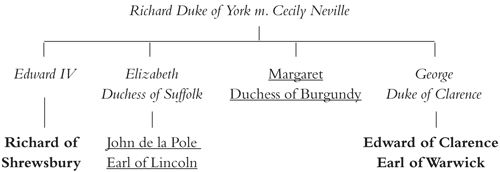
When the ‘son of Clarence’ arrived at Mechelen, the official Earl of Warwick was, of course, in England. At that time he may still have been under the guardianship of Henry VII’s mother, Margaret Beaufort, Countess of Richmond and Derby. During February 1486/87 this boy had been attending Henry’s royal court at the Palace of Sheen. Thus it is clear that the ‘son of Clarence’ who was in Mechelen in June 1486 cannot possibly have been identical with the official earl. And, of course, no one would have been in a better position to know and prove this than the Earl of Lincoln himself, since he had been in the company of the official Warwick at Sheen before he left England to meet the ‘son of Clarence’ in Mechelen.
Actually, as we have already seen, Vergil later confused the situation even further by reporting that there had been rumours in London at about this time that the official Earl of Warwick had died. He claimed that it was:
When Simons learned this, [that] thinking the time had come for his intended crime, he changed the lad’s name and called him Edward, the name of the Duke of Clarence’s son, who was of the same age, so that neither was older than the other, and immediately took him and crossed over to Ireland.1
However, even if Vergil was correct in alleging that there were rumours of Warwick’s demise, in reality the official earl had not died. Moreover, it seems highly unlikely that the boy held by Henry VII as the Earl of Warwick ever left the king’s custody. That means that the ‘son of Clarence’ received by Margaret of York in Mechelen in the summer of 1486 must have come from somewhere else. Given the alternative life history of the young Earl of Warwick presented in Chapter 5, the most likely location would obviously be Ireland.
Bernard André implies that the Dublin King was in Ireland when the Earl of Lincoln endorsed him. Although the surviving evidence makes it quite clear that the ‘son of Clarence’ was already in Mechelen at the time when the Earl of Lincoln made the decision topublicly embrace the boy’s cause, Lincoln had clearly been in touch with his aunt Margaret for some time. It is therefore conceivable that he had heard news about the ‘son of Clarence’ from the duchess before that boy left Ireland for Flanders, and had then shown interest in this candidate for the throne.
André then goes on to say that the boy made his trip to the Low Countries because he had received a letter from Margaret of York inviting him to come and visit her. André’s implication is clearly that the ‘son of Clarence’ went to Mechelen from Ireland. Later André says that he returned from the Low Countries, backed by an army supplied by Margaret, and that he then travelled to England, with his army, to assert his claim there.2
Thus it seems that the ‘son of Clarence’ must have come to Mechelen from Ireland, in which case there are three possibilities regarding his true identity:
a) The boy was delivered to the Earl of Kildare in 1476/77 as the Earl of Warwick, and was then brought up under Kildare’s guardianship at his Castle of Maynooth in County Kildare. Under the umbrella of this first basic theory there are two possible further interpretations.
i) The boy was the genuine Earl of Warwick, sent to Ireland by his father, the Duke of Clarence.
ii) The little boy was a substitute ‘Earl of Warwick’ created as part of Clarence’s rather confusing plans regarding his son and heir.
b) He was a fraud: a boy trained to imitate the manners of a prince by a scheming priest whose precise motivation remains unknown; a boy who had been brought to Ireland from Oxford only recently.
There is no way of knowing for certain which explanation of the boy’s origin and identity is correct. Nevertheless, whatever his true identity and origin, it appears certain that this child, who had either been brought up in Ireland by the Earl of Kildare, or taken to Ireland by a priest called Symonds/Simons, was identical with the boy who was subsequently crowned as ‘King Edward VI’ in Dublin in 1487.
But in that case we cannot ignore the fact that the Dublin King also had the full support of Margaret, Duchess of Burgundy – and of the troops she had sent to support his claim. What is more, he also had the full backing of the Earl of Lincoln and of Viscount Lovell. Therefore presumably the boy who was crowned in Dublin’s Christ Church Cathedral must also have been one and the same person as the ‘son of Clarence’ whose presence in Mechelen was recorded more or less by accident in June 1486.
The picture that emerges is therefore that the boy crowned in Dublin in 1487 had previously been the guest of Margaret of York in her Mechelen Palace, but that earlier (i.e. before June 1486) he had been living in Ireland. And it is absolutely certain that the Dublin King cannot possibly have been the official Earl of Warwick, since he had been at Henry VII’s court at Sheen in February 1486/87, at a time when the ‘son of Clarence’ (i.e. the future Dublin King) was already at Margaret’s palace in Mechelen.
How can we possibly clarify the true identity of this boy? We have no precise record of how well Margaret of York knew the official Earl of Warwick. She certainly could not have met the official earl prior to her visit to England in 1480, for at the time when she left England for her marriage with Charles the Bold, Warwick had not yet been born. It is not even certain that she met him during her 1480 visit – though the surviving accounts of Edward IV appear to suggest that plans were in place for such a meeting. What is more, even if the meeting actually happened, it perhaps occurred in the context of a large family gathering. Thus Margaret may not have paid a great deal of attention to one particular young nephew among all the various relatives who had come to greet her.
But the question of whether or not Margaret had met the official Earl of Warwick in 1480 seems, in any case, to be irrelevant. After all, the ‘son of Clarence’ whom she received in 1486 came to her from Ireland, at a time when the official Earl of Warwick was in or near London, with Henry VII. It is therefore obvious that Margaret could not possibly have recognised the 1486 ‘son of Clarence’ as the boy she had (perhaps) met at the court of Edward IV in 1480 – because he was not the same person.
Thus it seems that in the early summer of 1486 Margaret of York received at Mechelen a boy she had never previously set eyes on, sent to her from Ireland by the Fitzgerald family as her nephew. Given the fact that the official Earl of Warwick was then known to be in Henry VII’s custody, what on earth persuaded the dowager duchess to accept the identity of this boy from Ireland and endorse him as her nephew?
Even more surprising is the fact that the boy from Dublin was also accepted by the Earl of Lincoln as his cousin, even though Lincoln had spent about two years in the company of the official Earl of Warwick, when both of them had been resident at Sheriff Hutton Castle in Yorkshire.
There seem to be only two possible explanations for the extraordinary behaviour of Margaret of York and the Earl of Lincoln. The first explanation – a very simple one – is that neither of them had any interest in the truth. According to that scenario, even though the boy presented to them was an impostor to whom neither of them was related in any way, they merely wanted to oust Henry VII, and put the house of York back in control of things in England. However, the second possibility is that, for some reason, both Margaret and Lincoln were genuinely convinced that the boy from Ireland really was the ‘son of Clarence’.
The first of these explanations raises very serious questions. Henry VII’s wife, and the mother of the future royal line, was Elizabeth of York, the genuine niece of Margaret and the genuine first cousin of Lincoln. Why displace this real daughter of the house of York (together with all her future descendants) merely in order to replace her with an impostor? Of course Elizabeth, like all the children of Edward IV’s Woodville marriage, had formally been declared illegitimate by Parliament in 1484. Nevertheless, Margaret later supported the claim to the throne of Perkin Warbeck, who said he was Elizabeth of York’s younger brother, Richard, Duke of York. Thus, despite their dubious legitimacy, when the chips were down Margaret clearly considered Edward IV’s Woodville children preferable to any non-Yorkist candidate for the English crown.
And even if the Yorkist line of Elizabeth seemed unacceptable to Margaret, when linked with the bloodline of Henry VII, her obvious solution would have been to replace Henry with an authentic Yorkist claimant. The most obvious contender would then have been the Earl of Lincoln himself. As we already know, this very obvious potential Yorkist solution was plainly evident, even to those contemporaries who believed that the Dublin King was a fake. Indeed it explains why King Henry VII himself found the plot hatched by Margaret and Lincoln utterly mystifying.
It therefore appears that both Margaret and Lincoln must have been convinced – or succeeded in convincing themselves – that the boy in Margaret’s palace really was the ‘son of Clarence’. Since not a shred of evidence exists to suggest that the Duke of Clarence ever fathered a bastard child, as far as is known, his only surviving son in 1486 was Edward, Earl of Warwick. This does not, of course, guarantee that Margaret and Lincoln got it right. In the last century, when a woman appeared claiming to be the Grand Duchess Anastasia Nikolaevna of Russia, some members of the imperial family accepted her and some rejected her. Likewise some of the imperial family’s supporters recognised, and some rejected, the claimant. In the end it became apparent that the woman was an impostor – though she herself may have believed her own claim.
In the same way, a boy brought up by the Earl of Kildare in Ireland, and then sent to Mechelen, may well have believed in his own royal identity. If Kildare thought that his ward was the ‘son of Clarence’, obviously he would have brought him up under that name. This may have created a situation somewhat similar to an intriguing earlier episode in Russian history, when the son of ‘False Dimitry II’ (a pretender to the Russian throne) was brought up as an imperial prince, in spite of the fact that his father had been (and must have known himself to be) an impostor.3
It seems probable that in 1486 Margaret of York and her nephew, the Earl of Lincoln, were confronted, not only by a stranger who looked to be about 9 years old, and who was claiming to be the ‘son of Clarence’, but also by letters from the Earl of Kildare backing that claim. As we saw in Chapter 5, it is possible that the Duke of Clarence had sent his real son to Ireland in 1476/77. If Clarence did such a thing, then in the interests of the little boy’s future, he might have felt obliged to ensure that he also left some proof of the child’s identity. Perhaps Margaret of York and her nephew the Earl of Lincoln were therefore confronted, in 1486, by a claimant who was actually 11 years old (but looked younger), and who was backed not only by letters from the Earl of Kildare, but also by a document of some kind from Margaret’s dearly loved brother, written and sealed by him before his death, nine years earlier. If so, that would have been a document which sought to provide some kind of proof that this boy really was the ‘son of Clarence’.
Whatever it was that made Margaret of York and the Earl of Lincoln accept the claim of the boy from Ireland, once they had made this decision there were various sequels. First, Margaret had to employ armed forces who would back up the claim of the new Yorkist king. She therefore recruited an army for him under the command of an experienced German general called Martin Schwartz. Schwartz, who came originally from Augsburg in Germany, was a shoemaker’s son by birth. He grew up to become a mercenary soldier, and then rose to a position of command. He was reportedly an able, if somewhat arrogant, officer, and he is first on record as having fought for Margaret of York’s husband, Charles the Bold, Duke of Burgundy at the siege of Neuss in 1475.
Nine years later, in 1486, Schwartz was recruited by Maximilian of Austria, the widowed husband of Margaret of York’s stepdaughter, Marie of Burgundy, and the father of her son and heir, Philip of Austria. As regent for his young son, Maximilian needed Schwartz’s help in driving the French out of Flanders. During the 1486 campaign, Martin Schwartz had found himself in command of 200 Swiss mercenaries.
As a result of his earlier service to her late husband, and his recent action on behalf of her stepson-in-law, Martin Schwartz’s name and capabilities must already have been well known to Margaret and her advisers. Thus, in the spring of 1487, following her consultations with her nephew the Earl of Lincoln, with Francis Lovell, and others, Margaret sent for Martin and agreed a new military contract with him. Under the terms of this agreement Schwartz was to supply an army of 2,000 troops, under his own command, for the eventual invasion and conquest of England.4 Obviously the decision was also taken that the forthcoming campaign would be centred initially on Ireland. After all, this was one part of the new king’s realm which was accessible to them without any need for battle.
Once the decision had been made that ‘Edward VI’ would begin his reign in Ireland, it probably followed logically that a coronation for him should be celebrated there. In that way his kingship could be both ceremonially authenticated and divinely blessed, without any need for access to Westminster Abbey. But no previous coronation had ever taken place at Christ Church Cathedral in Dublin. How, then, would this Irish cathedral manage to carry out the planned ceremony, where would it obtain the necessary equipment, and what plans for the coronation needed to be made in Mechelen before the departure for Ireland?
Obviously the first requirement would have been an appropriate order of service. Although it seems highly unlikely that Dublin’s medieval cathedral library would have held copies of the liturgy for a coronation, in itself this would not really have presented a problem. Of course an appropriate book could probably have been obtained by Margaret and dispatched by her from Mechelen. However, even this would not really have been necessary. The point is that the ritual of coronation is, and has always been, based upon the ceremony of consecration, or ordination, of a Catholic bishop – a church service with which the cathedral clergy would undoubtedly have been very familiar, and for which they would certainly have had copies of the Church’s liturgy.5
Both the episcopal ordination ceremony and the royal coronation ceremony are set within the context of a celebration of high mass. The rite of ordination or consecration for a bishop begins after the first parts of a normal mass (the penitential rite and the liturgy of the word). Following the gospel reading, the consecration begins with the singing of the hymn Veni, Creator Spiritus. The bishop-elect is then presented to the congregation and makes his promises. Following the singing of the Litany of the Saints, the bishop is then anointed with chrism (holy oil). After this he is invested with a ring, his head is crowned with a mitre, and he is given his crozier, or pastoral staff. He is then formally seated on his bishop’s chair or throne (cathedra). The normal rite of mass then resumes, but after the communion and the concluding prayers the solemn hymn of thanksgiving, Te Deum laudamus, is sung, before the liturgy concludes with a solemn blessing.6
The basic format of the coronation ceremony is identical with that of an episcopal ordination. The king is first presented to the congregation and takes his royal oath. He is then anointed with holy oil, receives a royal ring, the crown and a sceptre, and is finally enthroned. Actually, the usual coronation ceremonial in England and France had, by the fifteenth century, become somewhat more elaborate. After his anointing, the king was first given spurs and a sword. After receiving his crown he was given not just one sceptre, but two. In England he also then received an orb, though at French royal coronations, no orb was presented. But in Dublin, of course, none of the usual royal coronation equipment of England would have been available. So what ceremonial items would be used at the Dublin King’s coronation?
While the English term ‘coronation’ focuses attention on the placing of a crown upon the sovereign’s head, the French term for this ceremony is sacre, which focuses primarily on the act of anointing. Both aspects are essential parts of the ceremony, and require special equipment. The anointing comes first. Coronations at Westminster or Rheims used special containers (ampullae) of royal holy oil for the anointing ceremony of an English or French king. However, this special royal oil was not used undiluted. One drop of it was extracted from the ampulla and mixed with the church’s own holy oil (chrism), which was consecrated annually by the local ordinary on the Wednesday of Holy Week (the Wednesday before Easter). In Dublin, of course, no royal ampulla would be on hand to provide a drop of special royal oil for the consecration ceremony. Nevertheless, there would be no problem about accessing Christ Church Cathedral’s own store of chrism for the year in question. Therefore the Dublin King could simply be anointed using the cathedral’s supply of holy oil.
The next requirements were spurs and a sword. These could perhaps have been prepared in Mechelen, on Margaret of York’s orders. However, such items would also have been very easy to find in fifteenth-century Dublin. The spurs and swords used at modern English coronations are valuable specimens of the jeweller’s art, but this was by no means an essential requirement. Ordinary spurs and an ordinary sword would have served the purpose equally well.
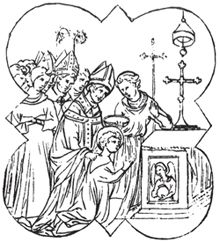
The anointing of a medieval boy-king in preparation for his crowning.
The required coronation ring would also have been relatively easy to supply. In Mechelen, before the group set off for Ireland, and at the expense of Margaret of York, such a ring could easily have been ordered to fit the young royal hand. Alternatively a Dublin jeweller may have been asked to make the ring after the chosen king arrived there. As for the other items of regalia, finding a sceptre would not present too many difficulties. Metal staffs were used for various functions in medieval churches. The staff of a processional cross, or the ceremonial staff of a verger, could therefore be adapted for this purpose. Indeed, in 1804, when Napoleon I was planning his coronation as Emperor of the French, he found that much of the pre-Revolutionary regalia had been damaged or destroyed. He therefore used the staff of the Precentor of St Denis as the basis of one of his sceptres.7
The crown might present more of a problem. Both English and French coronation ritual usually required two crowns: a solemn holy crown for the act of coronation itself, together with a lesser (though often more heavily bejewelled and costly) ‘state crown’ to be worn during the celebrations after the church ceremony. In England the coronation crown was attributed to the canonised pre-Conquest king, Edward the Confessor. In France, no fewer than three sacred coronation crowns were available at this period. One was attributed to the canonised emperor Charlemagne, while two had belonged to King Louis IX (St Louis).8
Of course, Margaret of York could easily have found jewellers in Mechelen to produce a small state crown for the Dublin King-elect. This need not have been overly expensive, and she may well have commissioned such an artefact for him. However, surviving reports of the actual coronation ceremony tell us that the Dublin King was formally crowned with an open gold circlet borrowed from the votive statue of the Blessed Virgin which stood in the Church of Sainte Marie de la Dam (or Sainte Marie del Dame).9 The earliest surviving source for this information about the crown used at the ceremony reports that:
the crown that was used, they borrowed from the statue of the Blessed Virgin Mary, preserved in the church dedicated to her memory, near the gate of the city which is commonly called Dame-gate.10
In 1487 this church stood on Cork Hill, a short distance to the east of Christ Church Cathedral, and just outside Dublin Castle. Little survives today of medieval Dublin, and the gold crown, the image of the Blessed Virgin, and the Church of Our Lady of Dame-gate, have all long since been lost. The site of the church was reused in 1761 by the merchants of Dublin for the building of their Royal Exchange building, which was constructed between 1769 and 1779. In the 1850s the Royal Exchange was taken over for civic administration and became Dublin’s City Hall. However, even today, the main road to the north of the City Hall is called Dame Street.
Why should the coronation crown of the Dublin King have been borrowed from the head of a cult image of the Blessed Virgin? Why not use a new crown made for him at his aunt’s expense in Mechelen? This arrangement has tended to be interpreted by previous writers as a sign that the Dublin coronation was a very muddled affair, hastily concocted without proper planning, and without any of the proper resources. As we have already seen, however, no coronation ceremony would have been possible without some prior planning. Thus the true explanation is probably quite different. Those who planned, and later organised, the Dublin ritual must have been very well aware of the fact that they would not have access to the traditional English coronation crown – the crown of St Edward the Confessor. This holy crown had reputedly been removed from the saint’s head when his remains were moved into his shrine, in order that it could be used for all future English coronations. Faced with the absence of this – or indeed any other – saint’s crown, what more suitable head could the organisers have chosen, from which to borrow a suitable holy crown for the Dublin King’s coronation, than the head of the Blessed Virgin Mary?
Finally, of course, a throne would be needed. Once again that would probably have presented no problem. The word ‘cathedral’ is derived from the Latin term cathedra, meaning the formal chair or throne of a bishop. All cathedrals would have contained such a throne. Therefore it is probable that the ceremonial episcopal chair in Christ Church Cathedral was used for the Dublin King’s enthronement. But in any case, even at a period when chairs were much less common items of furniture than they are today, both the cathedral and its clergy would undoubtedly have had access to such things.
In addition to the equipment needed in order to carry out his coronation, one other item would have been an obvious essential requirement for the use of the Dublin King and his government after the boy had been crowned. They would need a royal seal. It is certain that a royal seal of ‘King Edward VI’ was created – and was used. Indeed, one impression of the seal survives, and was recently rediscovered in the Irish National Library. It is attached to a letter issued in the name of ‘Edward VI’ by the Earl of Kildare.
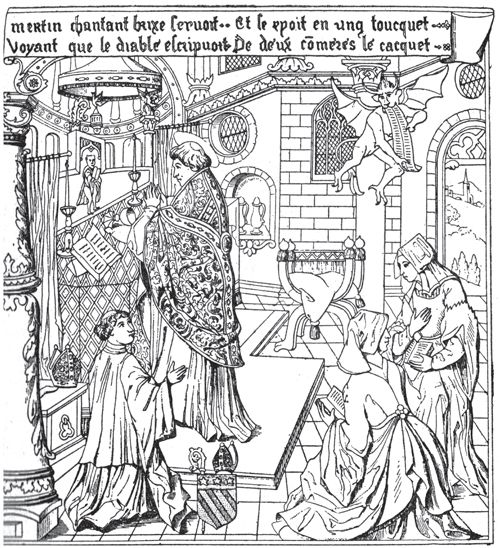
A bishop’s chair such as the one in this picture may have provided a suitable throne for the Dublin King’s use at his coronation.
Sadly, the seal impression is damaged and has not survived intact. Thus, for example, the royal inscription which it originally bore, and which would have confirmed that the Dublin King bore the royal name of ‘Edward VI’, is now broken. As a result the royal name and numeral are lost. However, the obverse of the seal impression does preserve for posterity a unique image of the boy-king himself, seated on his throne. As usual on such items, the reverse displays his royal arms (see plates 26 and 28).
Two interesting points emerge from these images. The crown worn by ‘Edward VI’ on the obverse, and the crown which surmounts his royal arms on the reverse of the seal, are both open crowns (i.e. without arches). This in itself is not remarkable. While it is true that arched crowns were coming into fashion in England in the fifteenth century – and are depicted, for example, on the royal seals of Edward IV and Richard III, and on coins of Henry VII – open crowns were also still very much in use.
However, one feature of the crowns depicted on the seal of the Dublin King is unusual. Both images comprise a circle surmounted by fleurs-de-lis. This was not the usual design for a fifteenth-century English king’s crown. The usual design was similar to that found on the circle of the modern royal crown. That is to say, the ornaments comprise alternating crosses pattée and fleurs-de-lis. It is true that contemporary English coins bore a representation of a king’s head showing a crown with fleurs-de-lis, but that image had been introduced by Edward I in 1279, and had remained unchanged ever since. It did not represent contemporary reality. Moreover, representations of royal crowns on the great seals of fifteenth-century English kings certainly did not show crowns adorned just with fleurs-de-lis. But while fifteenth-century English crowns were not of this design, the royal crown of France – together with the coronets used by French princes of the blood royal – did bear only fleurs-de-lis.
Of course the dukes of Burgundy had been French princes of the blood, and they had used such coronets. Indeed, as the widow of the last duke, Margaret of York was still entitled to a French royal crown of this design in 1486 and 1487. Perhaps, therefore, the royal seal of ‘King Edward VI’ was made in Mechelen during the summer of 1486, on the instructions of Margaret of York. If so, the Mechelen metalworker who fashioned it would almost certainly never have seen an actual English king’s crown. However, he might well have seen the crowns depicted on English coins, and he was probably accustomed to the design of French-style crowns, as worn by the former dukes of Burgundy. Thus he depicted both the Dublin King and his royal coat of arms with just such a French-style crown. In other words, the surviving impression of the royal seal of ‘Edward VI’ constitutes one possible indication that preparations for the reign of the Dublin King were made in Mechelen, prior to his return to Ireland – presumably commissioned and paid for by the boy-king’s self-acknowledged aunt, Margaret of York.
Notes
Abbreviations
|
CPR |
Calendar of Patent Rolls |
|
ODNB |
Oxford Dictionary of National Biography |
|
PROME |
Parliament Rolls of Medieval England |
1. Sutton, Anglica Historia. See Chapter 4.
2. ‘the boy … crossed over to Ireland. … In those days such was the ignorance of even prominent men, such was their blindness (not to mention pride and malice), that the Earl of Lincoln … had no hesitation in believing. And, inasmuch as he was thought to be a scion of Edward’s stock, the Lady Margaret, formerly the consort of Charles, the most recent Duke of Burgundy, wrote him a letter of summons. By stealth he quickly made his way to her, with only a few men party to such a great act of treason. To explain the thing briefly with a few words, the Irish and the northern Englishmen were provoked to this uprising by the aid and advice of the aforementioned woman. Therefore, having assembled an expedition of both Germans and Irishmen, always aided by the said Lady, they soon crossed over to England, and landed on its northern shore.’ Sutton, De Vita atque Gestis Henrici Septimi Historia, pp. 33–4.
3. In a very complicated episode of history, ‘False Dimitry II’ claimed (falsely) to be the youngest son of Tsar Ivan the Terrible. He was then accepted as her husband by the surviving wife of an earlier claimant, known as ‘False Dimitry I’. By her, ‘False Dimitry II’ then had a son, Ivan, who was briefly recognised as the heir to the Russian throne.
4. http://en.wikipedia.org/wiki/Martin_Schwartz_(mercenary), accessed December 2013.
5. J. Goy, Le Sacre des Rois de France, [Reims(?) no date of publication].
6. http://courseweb.stthomas.edu/jmjoncas/LiturgicalStudiesInternetLinks/
ChristianWorship/Texts/Centuries/Texts_1900_2000CE/RCWorship
Texts1900_2000CE/Rite_of_Ordination_of_a_Bishop.htm, accessed September 2013.
7. Lord Twining, European Regalia, London 1967, p. 187.
8. Twining, European Regalia, p. 127, n. 1.
9. Hayden, ‘Lambert Simnel’, p. 628
10. ‘Coronum quae usus est, a statua B. Mariae Virginis, in Ecclesia illius memoriae dicata, prope portam urbis, quam Dames-gate vulgo appellamus, asservata; mutuatam serunt.’ J. Ware, Rerum Hibernicarum Annales regnatibus Henrico VII, Henrico VIII, Edwardo VI & Maria, ab anno scil MCCCCLXXXV ad annum MDLVIII, p. 9.