
17
As we have seen, on Wednesday, 20 September 1486, ‘the son of Clarence’ was in Mechelen with his putative aunt. There, plans were being made for his coronation in Dublin the following year. But on that very same day, in Winchester, the little boy’s 20-year-old putative cousin, Elizabeth of York, eldest daughter of Edward IV and Elizabeth Woodville, and now queen consort of England, had given birth to her first child by Henry VII. The baby proved to be a son. Because his blood claim to the English throne was so weak, Henry VII had recently commissioned research to prove that he was descended from the legendary ancient British king, Arthur. Now, in order to commemorate that rather dubious ancestral link, the king chose to have his new son and heir baptised as Arthur.
Nine months earlier, at about the time of Arthur’s conception, another baby had been born. That birth took place at the bishop’s palace at Alcalá de Henares, just outside the city of Madrid. The baby was a girl. Born an infanta of Spain, descended on both her father’s and her mother’s side from the ancient royal house of Trastámara, this little princess was the youngest daughter of Isabel the Catholic, Queen of Castile, and her husband and cousin, King Ferdinand V of Aragon. The Spanish royal couple were known to their contemporaries, and are remembered by later generations, as ‘the Catholic Monarchs’.1
The infanta was born on 16 December 1485 and was baptised Catherine, in honour of her great-grandmother, Catherine of Lancaster, Queen of Castile. In fact, both Catherine of Lancaster and her half-sister, Philippa of Lancaster, Queen of Portugal, figured among the baby’s ancestors. As a result of her undoubted descent from those two Lancastrian princesses (daughters of John of Gaunt, and sisters of King Henry IV), the baby Catalina de Castilia y Aragón inherited a strong Lancastrian claim to the English throne. It was a much stronger Lancastrian claim than that of King Henry VII.2
Given that Henry VII had already used his own marriage with a Yorkist heiress to improve his very mediocre blood claim to the English throne, this little Spanish infanta, so close in age to his son Arthur, was a very attractive proposition to him for the next generation of royal marriage in his family. As a result of such a marriage, his son would be given the opportunity to add genuine Lancastrian royal blood to the Tudor line.
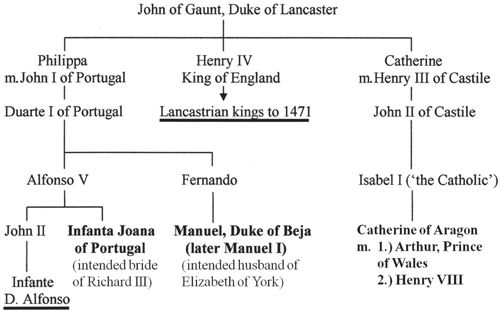
Heirs of the house of Lancaster.
In fact, negotiations for an English royal marriage with a Trastámara infanta – with a similar aim of uniting his own Yorkist blood with the Lancastrian line – had briefly been explored by Richard III in 1485, following the death in 1485 of his first wife, Anne of Warwick. However, Richard would really have preferred a Portuguese princess as his second wife, since the royal house of Portugal were the most senior living Lancastrian descendants. In any case, in the end, lack of time and the course of events which overtook him put an end to Richard III’s Lancastrian marriage negotiations.
But Henry VII now embraced the same idea with great enthusiasm, on behalf of his son. And unlike Richard III, Henry proved to have sufficient time to bring the Spanish marriage negotiations to a successful conclusion. Time was certainly needed, however, because the process did not prove simple. The marriage diplomacy between the English and Spanish courts turned out to be long and somewhat complex.
There were a number of reasons for the delays, and not all of them concern us. One thing, however, which seems to have preoccupied Catherine of Aragon’s parents was their uncertainty in respect of the future of Henry VII’s dynasty. Ferdinand and Isabel were only too aware of the long conflict for the English crown between the Lancastrian and Yorkist lines. Henry VII had not inherited the throne, but had seized it in battle. What is more, that had occurred very recently – in 1485 – just a few years before the marriage negotiations commenced.
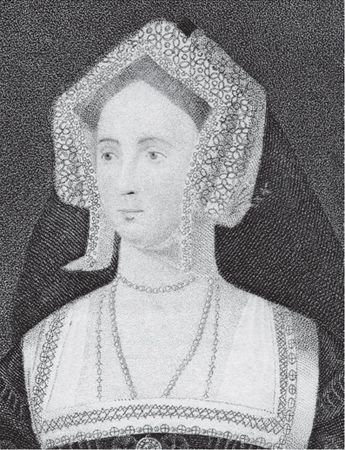
Catherine of Aragon.
Even more serious was the fact that after 1485 Henry VII’s position was apparently still not really secure. Since his proclamation as king, he had been forced to face up to two competitors: first the Dublin King, and later Richard of England – a contender who had been supported at one stage by the Spanish monarchs themselves. If anything similar were to happen again, the future of Henry’s son, and therefore of Arthur’s royal consort, might well be in jeopardy.
It is therefore easy to see what outcome the Spanish monarchs now desired in England, in order for them to be willing to agree to dispatch their daughter, Catherine, across the Channel. They wished to have all contenders for the throne eliminated. In fact, a letter survives, written after the outcome they desired had been put into effect, which makes the Spanish point of view very plain.
The letter in question was sent by their ambassador at Henry VII’s court, Dr Rodrigo Gonzalez de Puebla, to King Ferdinand and Queen Isabel on 11 January 1499/1500, when the decision to send Catherine to England had finally been taken. The letter is very instructive. De Puebla, who had been responsible for all the marriage negotiations in England, informed his sovereigns that:
this kingdom is at present so situated as has not been seen for the last five hundred years till now … because there were always brambles and thorns of such a kind that the English had occasion not to remain peacefully in obedience to their king, there being divers heirs of the kingdom and of such a quality that the matter could be disputed between the two sides. Now it has pleased God that all should be thoroughly and duly purged and cleansed, so that not a doubtful drop of royal blood remains in this kingdom, except the true blood of the king and queen, and above all that of the lord prince Arthur. And since of this fact and of the execution which was done on Perkin and on the son of the duke of Clarence, I have written to your highnesses by various ways, I do not wish to trouble you with lengthy writing.3
This letter makes it clear that the Spanish sovereigns had, for some time, been hoping for the executions of Richard of England and of the official Earl of Warwick. For Ferdinand and Isabel, these deaths were a necessarily prerequisite if they were to dispatch their daughter, Catherine, to England, to marry Prince Arthur. Only if these two important rivals were dead could the Spanish sovereigns feel sure that their daughter’s future in England would be secure.
In the end, of course, their view of things proved to be mistaken in several respects. Their daughter was to encounter unforeseen problems of her own in England. These arose from the death of her first husband, Prince Authur, and from Catherine’s failure to bear a living son by her second husband, Arthur’s brother, Henry VIII. What is more, the execution of Richard of England and of the official Earl of Warwick failed to remove all the possible Yorkist claimants to the English throne. Edmund de la Pole, the younger brother of the late Earl of Lincoln, was still a potential threat. The Earl of Warwick’s elder sister was also living and had a number of children. But apparently the Spanish monarchs did not feel anxious about these Yorkist survivors. Nor do they seem to have been the least bit preoccupied concerning the continued existence of Lambert Simnel.
Notes
Abbreviations
|
CPR |
Calendar of Patent Rolls |
|
ODNB |
Oxford Dictionary of National Biography |
|
PROME |
Parliament Rolls of Medieval England |
1. Los reyes católicos.
2. J. Ashdown-Hill, ‘The Lancastrian Claim to the Throne’, Ricardian, 13 (2003), p. 37.
3. Gairdner, Letters and Papers of the Reigns of Richard III and Henry VII, pp. 113–14.