
16
Most readers of this book probably had some previous knowledge of Lambert Simnel and Perkin Warbeck – though the present study has hopefully offered a wealth of new information regarding the case of Lambert Simnel. But probably many people imagine that Simnel and Warbeck were the only two genuine or fake Yorkist princes who contested the Tudor dynasty’s right to its throne. In fact the true picture is very different. There were further Yorkist claimants to the throne from the de la Pole family in the early sixteenth century, one of whom ultimately became the fourth ‘prince in the Tower’. Their story, which is not directly connected with that of the Dublin King, has been told by Desmond Seward in his book, The Last White Rose.1 But the first of the other pretenders was not a de la Pole, and he emerged in 1498/99, at a time when Lambert Simnel, Perkin Warbeck and the third ‘prince in the Tower’ – the young man imprisoned by Henry VII under the title of the Earl of Warwick – were all still alive.
Not a great deal is known about the 1498/99 pretender. It is also hard to find any real evidence about the supporters of his cause (if there were any), or about the motivation behind his claims. However, we do have a name for him. The young man is reported to have been called Ralph Wilford. It is very important to include this little-known Yorkist pretender in our story because, whatever his personal motivation and true background, like Richard of England and Perkin Warbeck, he too had a highly significant effect on other people in our story. Indeed, Ralph Wilford’s appearance on the scene may have been one of the key factors which ultimately led to the executions, not only of himself, but also of the claimant known as Perkin Warbeck, and of the third ‘prince in the Tower’ – the young man imprisoned under the title of the Earl of Warwick.
Polydore Vergil introduces Ralph as follows – but without recording his name:
There was [a] certain Augustinian monk named Patrick, who, I suppose, for the purpose of making the earl [of Warwick] unpopular, began to suborn a disciple of his (whose name, as far as I know, is not recorded) and drum into his ears that he could easily gain the throne, if he would agree to follow his advice. The student not only did not refuse, but asked [sic] again and again asked him to be quick in putting his design in to practice. For what man is there who fears the law or danger to the extent that he refuses to do or suffer anything in the world for the sake of gaining a crown? Therefore the monk shared his plan and both of them went boldly to Kent, a county on other occasions not deaf to innovations. There the young man first revealed to some the secret that he was Edward of Warwick, lately escaped from the Tower of London by Patrick’s help and art. Then he openly proclaimed this and begged all men’s help. But the sedition lost its leadership before they could bring it to fruition, when teacher and pupil were both enchained, the latter put to death, and the former consigned to eternal darkness of prison because he was a monk. For among the English the clergy are held in such respect that a priest condemned of treason, like ordained priests guilty of other crimes, is spared his life.2
Vergil uses the words ‘monk’ and ‘monastery’ incorrectly on occasions. There were no Augustinian monks in existence. However, the orders of the Church include(d) Augustinian canons regular, and Augustinian friars. It is not clear to which of these two orders Patrick belonged. Since members of both orders would have moved about in the secular world outside their community, Patrick could have belonged to either.
It was Francis Bacon, writing about 100 years after the events, who recorded that the new pretender’s name was Ralph Wilford. Bacon also reported that this young man was the son of a cordwainer.3 His father’s profession is confirmed by the contemporary section of the Great Chronicle of London (written in the late fifteenth century or early in the sixteenth century). This later source also offers more precise dating, for it tells us that Ralph Wilford appeared on the scene between 8 and 24 February of year fourteen of the reign of Henry VII (1498–99):
In this passing of tyme In the bordurs of Norffolk and Suffolk was a newe maumet [puppet] arerid which namyd hym sylf to be the fforenamid earle of warwyk, The which by sly & coverty meanys essayed to wyn to hym soom adherentis, But all In vayn, In conclusion he was browgth before therle of Oxynfford, To whom at length he confessed that he was born In london, and that he was sone unto a Cordyner dwelling at the blak Bulle In Bysshoppsgate street, afftir which confession he was sent up the the kyng & ffrom hym to prison, and upon that areygnyd & convict of treason, and ffynally upon shrove tuysday [12 February 1498/9] hangid at Seynt Thomas watering4 In his shirt, where he soo hyng styll tyll the Satyrday ffoluyng [16 February], and then ffor noyaunce of the way passers he was takyn doun & buried, being of the age of xix yeris or xxti.5
One rather intriguing point arises from the Great Chronicle’s account. This is the fact that Ralph Wilford’s father is said to have resided at the Black Bull in Bishopsgate. This point is of interest because the Black Bull of Clarence had been one of the principle badges of George, Duke of Clarence, father of the genuine Earl of Warwick. Could it be that the Duke of Clarence had owned, or been patron of, the Black Bull in Bishopsgate? If so, might the cordwainer who was the father of this latest pretender have spent the earlier years of his life in Clarence’s service?
Wilford appears to be a surname which originated as a toponym, from the village of Wilford in Nottinghamshire (which now forms part of the city of Nottingham). However, there were undoubtedly men named Wilford living in London at about the right period. In the year 1500–01 one of the two sheriffs of London was James Wilforde.6 There were Wilfords living in the parish of St Mildred Poultry, in the 1540s, in the parish of St Lawrence Jewry in the 1560s, and in the parishes of St Stephen Walbrook and St Mary Woolnoth in the 1590s.7 All these parishes were close to Bishopsgate. There are records of a Bull Inn on the north side of Leadenhall Street, at number 152 (adjacent to the junction with Bishopsgate, at the crossroads with Cornhill and Gracechurch Street) from the seventeenth to the nineteenth centuries.8 However, perhaps more significant are Samuel Pepys’ records of a Bull Inn, formerly called the Black Bull Inn, just off Bishopsgate Street, on the outskirts of the city of London:
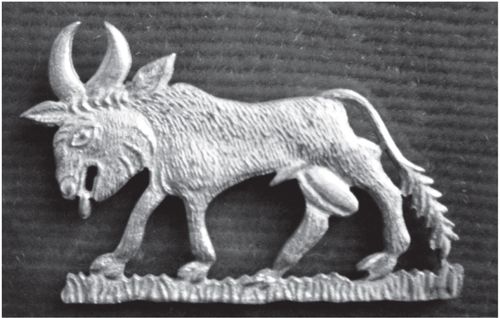
The ‘Black Bull of Clarence’. A livery badge of George, Duke of Clarence.
The Bull Inn was located where Tower 42 (previously known as the National Westminster Tower) now is, and was a recognised starting/finishing point on the main north road out of London. The Bull was one of many similar inns along Bishopsgate, and according to one writer ‘each had its approach through a low archway into a cobble-stone yard with galleries on three sides fenced by wooden balustrades, behind which were rows of bed chambers’. It would probably have resembled the George Inn, 77 Borough High Street, near Borough Market, which is London’s only surviving galleried coaching inn. It is claimed that the first playhouse under a patent of Queen Elizabeth 1st was put up in the Bull yard under James Burbage and Richard Tarleton, in which case it must have been of substantial size and just outside the city wall.9
So how does the unfortunate Ralph Wilford fit into our overall picture? It appears that he was simply a false Earl of Warwick. But if his father had been in the service of George, Duke of Clarence his family may have known – or thought they knew – something about the history of the genuine Earl of Warwick, which suggested that Henry VII’s third ‘prince in the Tower’ was not really the person claimed by the king. Could this have been the inspiration behind Ralph’s pretension?
Unfortunately, it is very hard to grasp what exactly the young man was hoping to achieve. Unlike the Dublin King and Richard of England, Ralph Wilford apparently had no key Yorkist backing for his cause, and lacked the support of the ‘Diabolicall Duches’, who seemed never to have heard of him. Under such circumstances, could Ralph really have expected to make himself King of England? This seems hard to believe. If that was his aim, surely he was living in a fantasy world and had very little grasp of the true situation. After all, both the Dublin King and Richard of England had already made much stronger bids for the throne, and failed.
However, if the story that the de la Pole family had rescued the Dublin King after the Battle of Stoke was true, and they had spirited him off to the Continent, the claim of Ralph Wilford might, perhaps, have been intended as a way of allowing the now 24-year-old ‘King Edward VI’ to make a comeback. Vergil, on the other hand, suggests that the young man’s aim – or that of Friar (or Canon) Patrick – or of those unnamed instigators who were behind the plot – was to render unpopular the official Earl of Warwick, who lay imprisoned in the Tower of London.
Superficially, Vergil’s suggestion may appear an odd. Nevertheless, something significant may lie behind his words. Could those who wished to bring about the death of the official Earl of Warwick have perceived that introducing yet another pretender might make it easier for them to persuade the king? Moreover, by staging a public execution of his prisoner, the king could hopefully put a firm end to any further possibility of ‘Earl of Warwick’ pretenders. Such action would therefore make his position – and that of his dynasty – much safer.
In the final analysis, then, it is even possible that the inspiration behind the pretension of Ralph Wilford secretly came from Henry VII himself, or from his own government. This kind of motivation for Ralph’s claim may seem more plausible when one takes into account the fact that there were reportedly other people around in the late 1490s who felt that they too had a vested interest in making the rule of the Tudor dynasty more secure.
Notes
Abbreviations
|
CPR |
Calendar of Patent Rolls |
|
ODNB |
Oxford Dictionary of National Biography |
|
PROME |
Parliament Rolls of Medieval England |
1. D. Seward, The Last White Rose, London 2010.
2. Sutton, Anglica Historia – my emphasis.
3. Lockyer, History of the Reign of King Henry the Seventh, p. 195.
4. ‘At the junction with the presently named Shornecliff Road (previously Thomas Street) was the bridge crossing of St Thomas-a-Watering over a small brook, which marked a boundary in the Archbishop of Canterbury’s authority of the nearby manors in Southwark and Walworth. The landmark pub nearby, the “Thomas a Becket”, derives its name from this connection. It was a place of execution for criminals whose bodies were left in gibbets at this spot, the principal route from the southeast to the City of London.’ http://en.wikipedia.org/wiki/Old_Kent_Road, accessed December 2013.
5. Thomas, Great Chronicle, p. 289.
6. http://en.wikipedia.org/wiki/List_of_Sheriffs_of_London, accessed November 2013.
7. https://familysearch.org/pal:/MM9.1.1/JS1T-7M7, https://familysearch.org/pal:/MM9.1.1/NPL3-148, https://familysearch.org/pal:/MM9.1.1/NP2W-RJ6, https://familysearch.org/pal:/MM9.1.1/NP2W-RMT and https://familysearch.org/pal:/MM9.1.1/N532-PQ5, all accessed November 2013.
8. http://london.enacademic.com/710/Black_Bull_Inn,_Bishopsgate_Street, accessed November 2013.
9. http://www.pepysdiary.com/encyclopedia/12498/#discussion. See also http://en.wikipedia.org/wiki/Bishopsgate, both accessed November 2013.