
2
Even if we have now dismissed the notion that the Dublin King either was, or claimed to be, Richard of Shrewsbury, it remains the case that the fate of the ‘Princes in the Tower’ is of enormous and very widespread interest. What is more, although no fifteenth-century sources advanced the claim that the Dublin King was the elder son of Edward IV, some modern writers have nevertheless put forward that suggestion. For this and other reasons, more will be said in this chapter about the probable fates of Edward IV’s two sons, bearing in mind that the issue of the alleged survival of at least one of these boys subsequently impinged adversely upon the fate of the official ‘Earl of Warwick’, imprisoned by Henry VII in the Tower of London.
Let us not waste time repeating the well-known stories of Thomas More and other Tudor writers, since these are not contemporary and have no basis in fact. Instead, we should concentrate on the surviving real evidence. In particular one important fifteenth-century documentary source will be cited here, which has hitherto been more or less ignored by historians. Let us begin, however, by briefly considering the suggestion of some modern authors that the Dublin King may either have been – or have claimed to be – Edward V. One obvious point in favour of this suggestion is the evidence considered briefly in the previous chapter, namely the fact that the Dublin King apparently consistently used Edward as his royal name.
In all but one of the surviving fifteenth-century sources, this royal name of the Dublin King is unaccompanied by any numeral. This was by no means unusual at that period. Medieval English coins of Edward III, Edward IV and Edward V, for example, all typically employ Latin inscriptions such as: Edwardus Dei gratia Rex Anglie et Francie et Dominus Hibernie (‘Edward, by the grace of God King of England and France and Lord of Ireland’), or abbreviations thereof. And while official documents sometimes add a royal numeral for these Edwards – accompanied by the necessary Latin clarification post conquestum (because the numbering of England’s medieval Kings called ‘Edward’ took no account of the existence of such pre-Conquest monarchs as Edward the Confessor) – even written documents do not always include royal numbering.
Generally, historians who are aware of extant references to the Dublin King as King Edward have taken the initiative of adding the royal numeral ‘VI’ after his name. Michael Bennett, in particular, did this consistently. But of course, unless specific evidence can be presented to show that the Dublin King really did call himself ‘Edward VI’, it would be unscientific to refer to him in that way.
Presumably most writers who have assigned to the Dublin King the royal numeral ‘VI’ have done so chiefly because it appears logical. One potential problem, however, is that, as we have seen, the accession of Richard III in 1483 was based upon the parliamentary decision that Edward V was illegitimate, and therefore not a valid king. There is also clear evidence of various kinds that during the reign of Richard III, the brief reign of Edward V was not treated as valid. For example, documents issued in the name of Edward V had to be re-issued. In addition, one specific piece of surviving evidence from the reign of Richard III, showing the unique way in which the son of Edward IV was cited at that time, will be presented shortly.
One possible consequence of all this which needs to be considered is the question of whether, if the Yorkist supporters of the Dublin King believed that Richard III had been the rightful King of England, they might have decided to discount the brief reign of Edward IV’s elder son. Had they followed that course, they would presumably have ignored the royal title and numeral of the 1483 ‘Edward V’ as invalid. In that case they might possibly have counted their new, 1487, Dublin King Edward as the true King Edward V. The only possible way to check whether or not this was done is to find some contemporary fifteenth-century evidence of the royal numeral employed by and on behalf of the Dublin King.
The only specific piece of evidence in respect of the Dublin King’s title and royal numeral which survives from the period of his reign consists of a reference in the York city archives, relating to a letter received by the City Council of York from the Dublin King in 1487. Unfortunately the way in which this has been handled in previous publications has merely served to perpetuate the confusion. However, the issue will now finally be resolved.
As published by Angelo Raine in 1941, this York city archives entry was transcribed as follows:
Copie of a letter direct to the Maire, etc. from the lords of Lincoln, Lovell and othre, late landed in Fourneys in the name of ther King calling hymself King Edward the V.1
But while Raine’s official publication states that the letter was from the ‘King calling himself King Edward the V’ (employing the Roman numeral ‘V’), Michael Bennett’s published text of the same letter states that it is a ‘letter of “King Edward the Sixth”’ (with ‘Sixth’ in word form).2 Which (if either) of these two opposing statements is correct? Obviously this point is of the utmost significance, and the conflict between the two modern published versions of the manuscript can only be resolved by referring back to the original.
Fortunately, the fifteenth-century annotation above the manuscript copy of the letter as preserved in York House Book 6, f. 97r, is absolutely clear and unequivocal, and an image of the original manuscript is reproduced below, so that readers can check it for themselves. It reads:
Copie of a lettə [letter] direct to the Maire, &c.
from the Lords of Lincoln + Lovell &
othre Late Landed in fforneys in
the name of þə [ther] King calling
hymself King Edward the vjt.
From this unique York manuscript reference – the only fifteenth-century record now surviving of the Dublin King’s full royal name and number – it therefore seems certain that the boy was referred to by his supporters as King Edward VI. In which case, whoever he was, he was not the elder of the two sons of Edward IV.
In its surviving form, the transcript of the letter itself (as opposed to its heading, written presumably by a York city clerk) contains no reference to the boy-king’s royal name or number. Possibly the actual letter sent from the Dublin King’s camp to the mayor of York (as opposed to the surviving copy of it inscribed in the York archives) was headed simply by the Dublin King’s name (with no number) and titles, as outlined earlier. The original heading may thus have read:
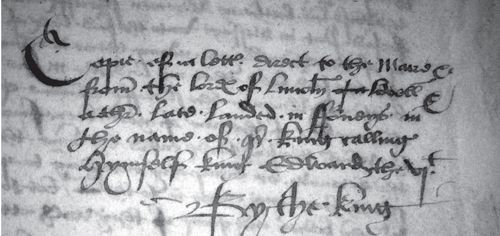
The contemporary heading above the copy of a letter from ‘King Edward VI’, York city archives, 1487 (York House Book 6, f. 97r). Reproduced courtesy of York city archives.
Edward, by the grace of God, king of England and France and lord of Ireland, to the mayor and council of the city of York, greetings
or something similar.3 In other words, even if the manuscript copy of the original letter sent by the Dublin King had been preserved, it might not have provided any further information in respect of the boy-king’s royal numeral.
Presumably those modern writers who had thought that the Dublin King might have been – or have claimed to be – the elder son of Edward IV were either unaware of the evidence from York in favour of the royal style of ‘Edward VI’, or had only seen the erroneous transcript of that document, published in 1941 by Angelo Raine. In favour of their contention, however, they also cited:
a) ‘The consistency in the behaviour of Elizabeth Woodville and Dorset, mother and stepbrother [sic for half-brother] to the little princes, seems to suggest that they believed in the survival of at least one of Edward IV’s sons … it seems possible, then, that the Dublin pretender was claiming to be Edward V.’4
b) Claims that the Dublin king was aged 15 in 1485 (see below) – and was therefore of exactly the right chronological age to be Edward V.5
Smith, for example, asserts that ‘the conclusion that the king from Dublin was Edward V not only fits the events of the so-called Simnel rebellion of 1487, but also explains the differences in the narratives of Molinet, André and Vergil, and in their candidates for the Irish pretender’.6
However, this rather dubious contention needs to be set against the basic fact outlined above, namely that if surviving Yorkists in 1486 and 1487 still considered that Richard III had been the true and rightful King of England, they were possibly unlikely to have counted the elder of the ‘Princes in the Tower’ as his rightful successor. The key difficulty here is that the claims to the throne of Richard III and of Edward IV’s children by Elizabeth Woodville were, and forever are, mutually incompatible. If Edward V was a valid sovereign, then Richard III must logically have been a usurper. On the other hand, if Richard III was a valid sovereign, then Edward V was a bastard with no valid claim to the throne.
Of course, another significant point, which would completely undermine any possibility that the Dublin King could have been the elder son of Edward IV, would be any evidence suggesting that by 1486 Edward V was dead. We have already seen how surviving contemporary evidence appears to imply that Edward may generally have been considered to have died in about 1483. Since at least three other children of Edward IV and Elizabeth Woodville are known to have died young and of natural causes (see the table below), the idea that Edward V may have suffered a similar fate is by no means improbable. However, specific evidence exists which suggests that this may well have been what occurred.
The Children of Edward IV and Elizabeth Woodville
|
Age at death |
Key events |
|
|
Elizabeth |
37 |
b. 11 February 1465/66 |
|
d. 11 February 1502/03 |
||
|
Married Henry VII |
||
|
Mary |
14 |
b. 11 August 1467 |
|
d. 23 May 1482 |
||
|
Cecily |
38 |
b. 20 March 1468/69 |
|
d. 24 August 1507 |
||
|
Married 1. Ralph Scrope; 2. John Welles, 1st Viscount Welles; 3. Thomas Kyme or Keme |
||
|
Edward |
12? |
b. 4 November, 1470 |
|
d. August 1483 |
||
|
Betrothed 1480 to Anne of Brittany |
||
|
Margaret |
8 months |
b. 10 April 1472 |
|
d. 11 December 1472 |
||
|
Richard |
? |
b. 17 August 1473 |
|
d. ? |
||
|
Married Anne Mowbray |
||
|
Anne |
36 |
b. 2 November 1475 |
|
d. 23 November 1511 |
||
|
Married Thomas Howard (later 3rd Duke of Norfolk) |
||
|
George |
2 |
b. March 1476/77 |
|
d. March 1478/79 |
||
|
Catherine |
48 |
b. 14 August 1479 |
|
d. 15 November 1527 |
||
|
Married William Courtenay, 1st Earl of Devon |
||
|
Bridget |
37 |
b. 10 November 1480 |
|
d. 1517 Probably four of Edward IV’s ten children |
||
|
died naturally before the age of 15. |
The average life of Edward IV’s eight children by Elizabeth Woodville whose age at death is on record was 26.6 years.
• To maintain this average, if Edward V died naturally aged 12, then the natural lifespan of Richard, Duke of York should have been about 41 years.
• Edward IV’s age at death was 41 years.
One of the earliest references to the death of Edward V appears in Domenico Mancini’s account ‘concluded at Beaugency in the County of Orleans, 1 December 1483’.7 A member of a religious order, possibly the Augustinian (Austin) friars, Mancini was in the service of Angelo Cato, Archbishop of Vienne, on whose behalf he visited England for some months in 1483. Indeed, some historians believe that he may have arrived in England in the second half of 1482. It was for Cato that he wrote his subsequent account of the state of affairs he had found in England, under the Latin title De occupatione regni Anglie per Ricardum tercium [Richard III’s take-over of the Kingdom of England]. This report was submitted in December 1483. Mancini, who had departed from England in July 1483, reported:
I have seen many men burst forth into tears and lamentations when mention was made of him [Edward V] after his removal from men’s sight; and already there was a suspicion that he had been done away with [sublatum]. Whether, however, he has been done away with, and by what manner of death [mortis], so far I have not at all discovered.8
My highlighting of part of Armstrong’s published English translation of Mancini’s text is because it is misleading. The literal meaning of the Latin word sublatum is not ‘done away with’, but rather ‘removed’ or ‘taken away’. Mancini’s subsequent use of the wordmortis in the following sentence shows clearly that he is talking about death, therefore his text really means:
there was a suspicion that death had carried him off.
In other words, the original Latin text does not imply that Edward had been murdered.9 Mancini merely reports that Edward V’s death was the subject of rumour and gossip during the summer of 1483 – the period when he himself was still in England. This does not establish Edward’s death as a concrete fact. It certainly does not establish the cause of his death (if indeed he had died). In other words, Mancini’s account merely offers contemporary evidence of public speculation on the subject.
However, he names one specific source for his information on Edward. That source is extremely interesting because it was Dr John Argentine, who was young Edward’s physician (medicus), and who clearly visited Edward on a regular basis while he was in the Tower. Indeed, Mancini tells us that Argentine was ‘the last of his attendants whose services the king enjoyed’.10 Apparently Dr Argentine reported to his friend Mancini that Edward made daily confession because he considered ‘that death was pressing upon him’.11 This phrase is usually interpreted as a sign that Edward expected every day to be murdered. Obviously this is a rather slanted view. After all, the source for the information has already been specified as Edward’s doctor, who was visiting him regularly. Surely a more logical interpretation would therefore be that the young boy was seriously ill, and believed that he was dying – rather like his elder sister, Mary of York, who had died at about the same age just over a year earlier.
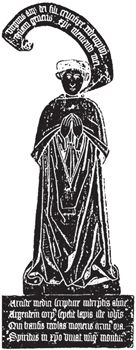
Funeral brass of Dr John Argentine.
It is also interesting that Dr Argentine apparently had not a word to say about the health – or the death – of Edward’s younger brother, Richard, Duke of York. A later account by Jean de Molinet suggests that Richard was in good health at the time of Edward’s putative illness, and tried to encourage his melancholy and depressed elder brother to be cheerful and even to dance. Of course, Molinet’s text dates from about twenty years after 1483. Indeed the author even made mistakes concerning the names of the two sons of Edward IV, so they do not appear to have been of any great importance to him, and Molinet is no more to be regarded as the horse’s mouth on the subject of what happened to the boys than Sir Thomas More.12 Nevertheless, a contemporary letter, written by Simon Stallworth to Sir William Stonor on the 21 June 1483 also reports that Richard, Duke of York was in a cheerful mood at the Tower of London in the summer of 1483:
On Monday last was at Westm. gret plenty of harnest men : ther was the dylyveraunce of the Dewke of Yorke to my lord Cardenale, my lord Chaunceler, and other many lordes Temporale : and with hym mette my lord of Bukyngham in the myddes of the hall of Westm. : my lord protectour recevynge hyme at the Starre Chamber Dore with many lovynge wordys : and so departed with my lord Cardenale to the toure, wher he is, blessid be Jhesus, mery.13
An entry in the Anlaby cartulary (written, however, after 1509) assigns the date of 22 June 1483 for the death of Edward V.14 Unlike Mancini’s, this is a far from contemporary account, and the precise date which it gives may not be correct. It would have been much more intriguing if it had suggested that Edward had died just one month later – on 22 July 1483 – the day following Richard III’s departure from London. Nevertheless, further contemporary evidence that Edward V was thought to have died before the end of September 1483 does exist – though it had been largely overlooked until recent years. It is in the borough records of Colchester, in the collection now generally known as the Oath Book.15 This volume comprises various records, including indexes containing listings of burgesses, wills proved in the borough courts, and enrolments of property grants covering the period 1327–1564. The folios relating to the fifteenth century are in the form of a year-by-year listing of the bailiffs and burgesses, together with a summary of documents registered by the borough during the year in question.
Typical entries in the Oath Book to mark the start of a new civic year simply give the names of the two bailiffs for that year. However, 1483 was the highly unusual year of three kings. The Colchester town clerk at that time – the local lawyer, John Hervy, who had served both John Howard (Duke of Norfolk), and the family of Howard’s cousin by marriage, John de Vere, twelfth Earl of Oxford16 – clearly thought it desirable to add some note of explanation. Thus he supplies specific (if slightly inaccurate) accession dates for both Edward V and Richard III.17 From this one can deduce that in broad terms Hervy knew what he was talking about.
The form of the annual Colchester borough records at this period shows that these were written up retrospectively, at the end of the civic year, which ran from Michaelmas Day (29 September).18 This is clear from the fact that the listing of deeds and wills is normally continuous and in the same hand.19 If a bailiff or a king died in the course of a year, that fact is recorded under the bailiffs’ heading for the year, and before the list of deeds for the year commences. In the present instance, this implies that John Hervy’s ‘three kings’ note for 1482–83 was written on or shortly after 29 September 1483.
The Oath Book was published in the form of a calendar, in English, in 1907.20 This calendar version is the one now most often cited, since it is more generally accessible than the original text. Even the calendar version clearly implies that Edward V died in 1483, since it refers to him quite specifically as the ‘late son of Edward IV’.21
The full original Latin entry in the Oath Book itself runs as follows:
Tempore Iohannis Bisshop & Thome Cristemesse, Ballinorum ville Colcestrie a festo Sancti Michelis Archangeli Anno domini Edwardi quarti nuper Regis anglie, iam defuncti, vicesimo secundo, usque octavum diem Aprilis tunc primo sequentem, Anno regni Regis Edwardi --- ------ [Regis spurii?]22 quinti nuper filii domini Edwardi quarti post conquestum primo, usque vicesimum diem Iunij tunc primo sequentem, Anno Regni Regis Ricardi tercij post conquestum primo incipiente, et abinde usque ad festum Sancti Micheli Archangeli extunc primo futuro quasi per unum Annum integrum.23
[In the time of John Bisshop and Thomas Cristemesse, Bailiffs of the town of Colchester from the feast of St Michael the Archangel in the 22nd year of the reign of the Lord Edward IV, late king of England, now deceased, up until the 8th day of April first following; [and] in the first year of the reign of King Edward [erasure; see note 21] V, late24 son of the lord Edward IV after the Conquest, up to the 20th day of June then first following; [and] in the first year of the reign of Richard III after the Conquest, from the beginning, and thence until the first feast of St Michael the Archangel thereafter as for one complete year.]25
Like all the year headings naming the bailiffs, this record is inscribed in red ink, while the yearly record of burgesses, deeds and wills which follows is in black ink. There is no doubt, therefore, that this note was entered in the record as an entirety, and that the entry was made on or about 29 September 1483.
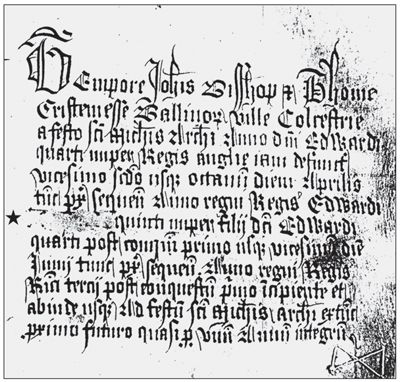
The Colchester record of the ‘year of the three kings’, written in September 1483. The star marks the point at which words were later erased. (Colchester Oath Book, D/B 5 R1, f.107r, modern foliation – old page no. 156). Reproduced courtesy of Essex Record Office.
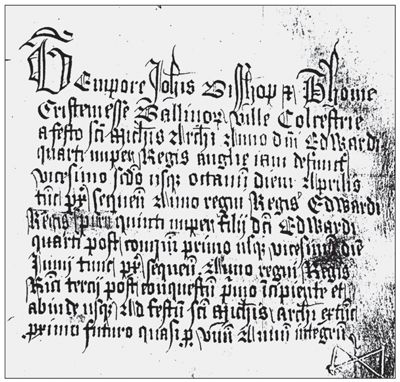
The same document, with the probable missing words Regis spurii (‘illegitimate king’) conjecturally reinserted, to show how they would fit in the gap.
The proposed format of the erased phrase, ‘Regis spurii’, is highly unusual, and is not elsewhere attested with reference to any other supplanted monarch. For example, the terminology employed by the functionaries of Edward IV to describe Henry VI was quite different. He was characterised as rex de facto, non de iure (‘king in fact, but not in law’). However, as we have seen, the situation of Edward V was fundamentally different from that of Henry VI. The personal legitimacy of the latter was never in question. Only his right to be king was at issue. Edward V, on the other hand, was adjudged illegitimate by birth. His exclusion from the throne – for he was excluded, and not deposed26 – depended upon that judgement. It would not be surprising, therefore, to find him referred to in a different and unique manner. In Edward’s case the phrase rex de facto, non de iure would have been utterly inappropriate.
The erasure of the words which seem likely to have characterised Edward V as an illegitimate (i.e. illegal) king, would presumably have been carried out in the autumn of 1485, following the repeal by Henry VII’s first Parliament of the Titulus Regius of 1484. The repeal and destruction of this Act automatically re-established the legitimacy of Edward IV’s children by Elizabeth Woodville.27 In this connection, it is noteworthy that Thomas Cristemesse, one of the two bailiffs for 1482–83, served as a member of Henry VII’s first Parliament. The enactments of this Parliament in respect of the title to the throne were clearly well known in Colchester at the time, and are recorded in precise and accurate detail in the borough records.28 Thus the erasure of offending words implying the bastardy of Edward IV’s children might well have been ordered by the Colchester bailiffs in September 1485, as a politically correct move.29 Even more interesting is the fact that in September 1485, in addition to his role as Member of Parliament, Thomas Cristemesse was approaching the end of yet another term of office as one of the two town bailiffs.30
As for the wording of the original entry in respect of Edward IV and Edward V, the former is characterised both as nuper Regis and as iam defuncti. Clearly, he was known to be dead. In the case of Edward V the entry is somewhat more intriguing. Despite the absence of the word defuncti, the obvious interpretation of the phrase nuper filij Edwardi quarti (‘late son of Edward IV’) seems to be that Edward V was dead (or at least that the writer believed him to be so).31 Thus the Colchester Oath Book record is consistent with Mancini’s reported rumour. Both sources permit the conclusion that Edward IV’s elder son died before the end of September 1483. This evidence also concurs with the general Yorkist belief current in the 1490s, which apparently regarded Edward V as dead, but the fate of his younger brother, Richard, as uncertain.32
Thus, the most likely fates of the sons of Edward IV appear to be that Edward V died during the late summer of 1483, possibly from natural causes. If, however, Edward’s death was not natural, then it was probably orchestrated by someone other than Richard III – someone in a position of power, who simply took the matter into his own hands. As some historians have previously suggested, the most likely contender for such a role is probably Richard III’s cousin, former supporter and ultimate enemy, the Duke of Buckingham. As we saw at the end of the previous chapter, one obvious way of advancing our knowledge regarding the fates of the sons of Edward IV would be to re-examine their famous putative remains in the urn created by Sir Christopher Wren in Westminster Abbey.
As for Richard of Shrewsbury, there is no evidence to suggest that he died in 1483. On the other hand there is specific evidence that Yorkists in the late 1480s and in the 1490s thought that young Richard was still alive. However, his uncle, King Richard III, made no statement as to his whereabouts. The only logical explanation for King Richard’s silence seems to be that the younger boy’s fate had also, in some way, been taken out of the king’s hands. Once again, the most likely contender for the role of orchestrator of the Duke of York’s removal from the Tower of London is the Duke of Buckingham.
What was done with Edward IV’s younger son, if indeed he did survive, remains a mystery. Various fates have been suggested for Richard of Shrewsbury, both in the fifteenth century and subsequently.33 However, it is intriguing that the story later recounted by Perkin Warbeck (who claimed to be Richard of Shrewsbury) was generally consistent with the potential fates of the ‘princes’ as proposed here. Of course, by itself this does not necessarily prove that Warbeck was Richard. But it does very strongly suggest that, if Warbeck was not the genuine Richard, but an impostor, then whoever prepared and trained him for his royal role had inside knowledge of the true fate and whereabouts of the younger of Edward IV’s two sons. Unfortunately there now seems to be little chance of examining the remains of Perkin Warbeck or of using DNA as a way of clarifying whether or not he was whom he claimed to be.
As we have seen, the story of the fate of the two ‘princes’ as recounted by Perkin Warbeck matches, on the whole, the picture which emerges from surviving scraps of contemporary evidence, dating from the time of the curious event known as Buckingham’s Rebellion. The Duke of Buckingham certainly took part in this rebellion, but it seems highly unlikely that he was the orchestrator of the entire movement, which, in the end, comprised at least three different – and mutually incompatible – aims.
When he became king, Richard III rewarded Buckingham for his support by returning to him and his family lands formerly held by the Lancastrian kings. Then on Monday, 21 July, Richard set off on a royal tour of parts of his kingdom. He, the queen and their party rode first from Windsor to Reading. Three days later they were in Oxford. By the beginning of August they had reached Gloucester, and it was there that the Duke of Buckingham last saw his cousin, the king, face to face.
One key factor in the events of July 1483 was that, during Richard III’s absence from the capital, attempts were definitely made in London to access the sons of Edward IV, who, at that point, were still living in the Tower. Whether these attempts were intended to rescue the boys or to kill them, and whether the attempts succeeded or failed, is far from clear, but from the meagre evidence which survives, there is no doubt that such attempts took place.
It is interesting, therefore, that Continental sources tell us that it was none other than the Duke of Buckingham who was responsible for the disappearance of the two boys from the Tower. In his role of Constable of England, Buckingham would potentially have had sufficient authority to send men into the Tower of London. It is possible, therefore, that, taking advantage of Richard III’s departure on his royal tour, Buckingham sent men to the Tower on or about Tuesday, 22 July 1483, either to kill the sons of Edward IV, or to extract them from their place of detention.
Buckingham might well have wanted the boys in his hands as living hostages. Perhaps his plan was to use them later, in some way, for his own advantage. We have already seen that he often seems to have had his own axe to grind. And it could well have been his discovery of Buckingham’s involvement in the mysterious disappearance of the two sons of Edward IV which caused Richard III to describe his cousin as ‘the most untrue creature living’.34
A small beam of light – though it is still a very murky light – is shed upon what took place in London by Richard III’s rapid decision to send John Howard, Duke of Norfolk (the Earl Marshal of England) back to London, either on the 22nd or on Wednesday, 23 July 1483. It appears that Howard had originally intended to accompany the king throughout his royal tour, but in the end he only travelled with the royal party as far as Reading and Caversham. The king then sent him back to the capital on a very important mission, which seems to have been connected with some men who had been apprehended, and who were detained at Richard III’s former London home as Duke of Gloucester – Crosby’s Place in Bishopsgate.
The warrant which Richard III subsequently issued on Tuesday, 29 July, at Minster Lovell, was almost certainly linked with Howard’s mission. It referred to prisoners detained for their recent involvement in some ‘enterprise’. No details of the alleged crime were specified in the warrant. However, we know from other sources that there had been unauthorised attempts both to extract the late King Edward IV’s daughters from sanctuary at Westminster and also to remove his sons from the Tower of London.
A plot by a number of Londoners in favour of the sons of Edward IV was reported by the Frenchman Thomas Basin, who probably wrote down his account early in 1484. Later, the sixteenth-century chronicler John Stow also spoke of a plot to abduct Edward V and his brother by setting off incendiary diversions in the neighbourhood of the Tower of London.
It seems probable that, upon receipt of the king’s instructions from Minster Lovell, the chancellor, Bishop Russell, and the royal council, deferred to the Duke of Norfolk, whom the king had sent to sit in judgement upon those prisoners who had plotted to secure some or all of Edward IV’s children. It appears that the trial of at least some of these individuals took place at Crosby’s Place, during the following month. References to the expenses incurred in preparing Crosby’s Place for such a trial are to be found in John Howard’s accounts for the beginning of August.
So something definitely happened in London on or around 22 July 1483, which involved the sons of Edward IV. There appears to be no way now of establishing for certain whether the person responsible for the plot (probably the Duke of Buckingham) succeeded in securing the persons of Edward V and his brother the Duke of York, but it is certainly possible that he did so. It is therefore significant that the event known as Buckingham’s Rebellion began in the south and south-west of England, and that its initial and openly declared aim was to restore Edward V to the throne.
The supporters of this movement were a very mixed bunch. Some were men who had been loyal to Edward IV, but who had now been dismissed and replaced with his own loyal servants by the new king, Richard III. Others were members of the Woodville family and its supporters. Presumably both these groups felt either a genuine loyalty to, or a self-interest in, Edward IV’s son. Probably they also either did not understand the complex reasoning behind the pronouncement of his illegitimacy, or they did not care about it.
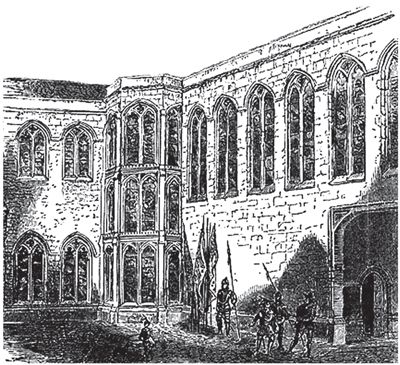
The Great Hall of Crosby’s Place, Bishopsgate (on the right of the picture). Here John Howard, Duke of Norfolk, tried some of the men who had rescued – or attempted to rescue – the sons of Edward IV from the Tower of London in 1483.
At the same time, other people involved in Buckingham’s Rebellion had a very different political background. Some of them were former Lancastrians. These men presumably had a totally different idea of who should now be King of England. Indeed, they were probably behind the subsequent change in the focus of the rebellion – from support for the cause of Edward V, to support for the cause of the Beaufort descendant Henry Tudor.
Moreover, one thing is certain. It was this Lancastrian group which began to spread a rumour that the sons of Edward IV were dead. Of course, this was a story very much in their interest, since it would hopefully persuade the former supporters of Edward V to transfer their allegiance to Henry Tudor.
As for the Duke of Buckingham himself, his place in all this is totally unclear. Possibly he was hoping to make himself protector, with one of Edward IV’s sons on the throne as king. It is also possible that, since Edward V had formally been declared illegitimate, Buckingham may have considered it better to dispose of the elder boy, while retaining Edward IV’s younger son, Richard, Duke of York, as a living potential claimant to the throne. In either case, Buckingham’s longer-term aim might well have been to claim the throne for himself.
However, later Tudor accounts tell us that Buckingham was then won over by Margaret Beaufort, Countess of Richmond and Derby, to give his support to her son, Henry Tudor. Certainly Buckingham wrote to Henry Tudor on 28 September. By this time the sons of Edward IV seem to have somehow disappeared, and the plan – reshaped by such cunning Lancastrians as Bishop Morton of Ely – was now to enthrone Henry Tudor and to marry him to Edward IV’s eldest daughter.
It was not until Saturday, 11 October, that Richard III discovered that Buckingham himself had betrayed him. On Wednesday, 15 October Buckingham was formally proclaimed a rebel and traitor. On Saturday, 18 October Buckingham openly unfurled his rebellious banners. But London was defended against him by the loyal John Howard, Duke of Norfolk. Based on the news received from Howard, Richard III then focussed his personal attention on dealing with the rebels in the south-west. On Friday, 24 October the king led his army to Coventry. Meanwhile Buckingham’s banners had attracted little support. Bishop John Morton therefore abandoned the duke, fleeing first to the fenlands around his own cathedral at Ely, and then taking a ship to the Low Countries. Buckingham, now in despair, disguised himself in peasants’ clothing and tried to conceal himself in Shropshire.
By the end of October he had been captured. He was brought to Richard III at Salisbury, where the panic-stricken duke begged the king to see him, but Richard absolutely refused. Whether, if Richard had agreed to meet him, Buckingham would have been able to reveal to the king the hiding place of Edward IV’s living sons – or the location of their buried remains – we shall now never know. On Sunday, 2 November 1483 Henry, Duke of Buckingham was beheaded in Salisbury Market.
Of course, in the present context, the prime aim of our investigation is not to resolve the issue of the fate of Edward IV’s sons, or to reinvestigate the claims of Perkin Warbeck. Our objective is to examine the true identity of the Dublin King. From our investigation of the story of the sons of Edward IV, fascinating new evidence of what might have happened to the two boys has hopefully emerged. However, no evidence whatsoever has come to light to connect either Edward V or Richard of Shrewsbury with the boy crowned in Dublin in 1487. It is therefore time to move on from the stories of these two ‘princes’ and to explore alternative accounts and evidence relating to the true identity of the Dublin King.
Notes
Abbreviations
|
CPR |
Calendar of Patent Rolls |
|
ODNB |
Oxford Dictionary of National Biography |
|
PROME |
Parliament Rolls of Medieval England |
1. A. Raine, ed., York Civic Records, vol. 2, York 1941, pp. 20–1 (original records, Book 6, fol. 97).
2. M. Bennett, Lambert Simnel and the Battle of Stoke, New York 1987, p. 121.
3. See, for example, J. Gairdner, ed., Letters and Papers Illustrative of the Reigns of Richard III and Henry VII, vol. 1, London 1861, p. 16.
4. G. Smith, ‘Lambert Simnel and the King from Dublin’, Ricardian, 10, no. 135, December 1996, p. 509.
5. Smith, ‘Lambert Simnel and the King from Dublin’, p. 517.
6. Smith, ‘Lambert Simnel and the King from Dublin’, p. 520.
7. Armstrong, Usurpation of Richard III, p. 105. Domenico Mancini (c.1434–1500) was from a Roman family of unremarkable origin, members of which subsequently attained noble status in France through their relationship with Cardinal Mazarin, first minister during the youth of Louis XIV.
8. Armstrong, Usurpation of Richard III, pp. 92–3.
9. See also A. Carson, Richard III the Maligned King, Stroud 2013, p. 169 (or p. 145 of earlier editions).
10. ‘quo ultimo ex suis regulus usus fuit.’ Armstrong, Usurpation of Richard III, pp. 92–3.
11. ‘quod mortem sibi instare putaret.’ Author’s translation.
12. J.-A. Buchon, ed., Chroniques de Jean Molinet, vol. 2, Paris 1828, p. 402. Molinet thought the elder son was called Peter and the younger, George.
13. C.L. Kingsford, ed., The Stonor Letters and Papers, vol. 2, Camden third series, XXX, London 1919, p. 161.
14. Richmond, ‘The Death of Edward V’, pp. 278–80.
15. Described in detail in R.H. Britnell, ‘The Oath Book of Colchester and the Borough Constitution, 1372–1404’, Essex Archaeology and History, 14 (1982), pp. 94–101. The evidence which follows was originally published as J. Ashdown-Hill, ‘The Death of Edward V – new evidence from Colchester’, Essex Archaeology & History, 35 (2004), pp. 226–30.
16. J. Ashdown-Hill, ‘The client network, connections and patronage of Sir John Howard (Lord Howard, first Duke of Norfolk) in north-east Essex and south Suffolk’, PhD thesis, University of Essex 2008, p. 226, section 4.15.4.
17. The actual accession dates were 9 April (Edward V) and 26 June (Richard III). It may be that 20 June 1483 was the date on which news of the prior marriage of Edward IV and Eleanor, and the consequent illegitimacy of Edward’s Woodville offspring, first reached Colchester.
18. The bailiffs were elected on the Monday following 8 September (Feast of the Nativity of the Blessed Virgin Mary) and assumed office on the Monday following 29 September (Michaelmas Day). (Britnell, ‘Oath Book’ p. 96.) In 1482 the election took place on Monday, 9 September, and the bailiffs took office on Monday, 30 September.
19. Occasionally one or two additions have been made, in different ink, at the end of a year’s record, but before the start of the following year.
20. Britnell describes Benham’s published version as ‘edited in translation’, but recognises that it fails to ‘adequately represent the detail of the manuscripts’. Britnell, ‘Oath Book’, pp. 94; 99, n. 2.
21. W.G. Benham, ed., The Oath Book, or Red Parchment Book of Colchester, Colchester 1907, p. 134.
22. At this point there has been a subsequent and very heavy erasure of probably two words. From the surviving traces, the erased words may originally have read ‘Regis spurii’ [illegitimate King] (see reconstructed image). Such a phrase used with reference to Edward V probably would have been erased after the accession of Henry VII.
23. Colchester Oath Book f.107r (modern foliation – old page no. 156). Britnell notes (‘Oath Book’, p. 94) that the present binding of the Oath Book is late seventeenth century. Fols 85–144 contain fifteenth- and sixteenth-century material, but have no contemporary page or folio enumeration. The ‘old’ page numbering noted here presumably dates from the seventeenth century, when this material was gathered together and bound. The folio enumeration is in pencil, and is modern.
24. It is difficult to find a different English translation for nuper. ‘Former’ would sound odd in this context. However, the Latin word does not necessarily imply that Edward V was dead.
25. John Bisshop and Thomas Cristemesse were prominent Colcestrians of the time. John Bisshop had served as bailiff on several previous occasions. Thomas Cristemesse had not held this office before, but he was to hold it again later, and interestingly he was also subsequently elected to represent Colchester in the first Parliament of Henry VII.
26. By ‘deposing’ I mean removing a king from his throne, but without denying that he had been king up until that point. By ‘excluding’, on the other hand, I mean declaring that someone had never legally been king at all.
27. The destruction of all copies of the Act of 1484 was specifically commanded by Henry VII. The repeal and destruction of this Act was important to Henry because he planned to marry the eldest daughter of Edward IV and Elizabeth Woodville, and to represent her to the nation as the Yorkist heiress. It was therefore imperative for him to re-establish the legitimacy of Edward IV’s children by Elizabeth Woodville. By so doing, however, he in effect reinstated Edward V as the rightful king. Henry VII’s action in repealing the act of 1484 thus implies that Edward was already dead. Indeed had either ‘prince’ been living when the Act was repealed, Elizabeth of York’s heiress status would have been questionable.
28. W.G. Benham, ed., The Red Paper Book of Colchester, Colchester 1902, p. 60 & passim.
29. The erasure could possibly date from slightly later, but it seems certain to have been made before Henry VII visited the town in 1487.
30. His second year of office ended on Monday, 3 October 1485 (being the Monday following Michaelmas Day).
31. It could perhaps be argued that the town clerk meant to imply that Edward V (reference to whose name could not entirely be avoided, since documents existed dated to the first year of his reign) was legally – but not necessarily physically – dead. However, this is not the obvious interpretation of the words used.
32. Hicks’s assertion that ‘by autumn [1483] they [Edward V and Richard of Shrewsbury] were generally assumed to be dead’ (M. Hicks, Richard III, Stroud, 2000, p. 242) must be rejected in the light of the subsequent response to Perkin Warbeck.
33. See, for example, D. Baldwin, The Lost Prince: The Survival of Richard of York, Stroud 2007.
34. Postscript from Richard III’s letter to his chancellor, 12 October 1483, quoted in P.M. Kendall, Richard the Third, London, 1956, p. 269.