
3
No fifteenth-century writer ever attempted to identify the Dublin King with Edward V, the elder son of Edward IV. With the exception of Bernard André, none of them seriously attempted to identify him with Edward IV’s younger son, Richard of Shrewsbury, Duke of York – or with an impostor claiming to be Richard. It is true that Polydore Vergil (perhaps influenced by André’s account) does suggest that the boy’s puppet masters considered at one point the possibility of a Richard of Shrewsbury imposture. But Vergil then goes on to say that they rapidly abandoned the idea.
Before considering Vergil’s account in detail, let us first turn back to the Burgundian chronicler Jean de Molinet, who wrote in, or just before, 1504. In respect of the sons of Edward IV, Molinet proved to be not very accurately informed – and perhaps not very deeply interested. However, in the case of the Dublin King, one of whose key supporters was Margaret of York, Duchess of Burgundy, the Burgundian background of Molinet makes him a potentially very interesting source. It is fascinating, therefore, to discover that Molinet reported that:
one little branch, engendered by a Royal tree, had been nurtured amongst the fruitful and lordly shrubs of Ireland … this very noble branch is Edward, son of the Duke of Clarence, who, based upon the advice and moral deliberation of the nobles of Ireland, and with the support of a number of barons of England, his wellwishers, decided after due debate to have himself crowned king, and to expel from his royal throne the Earl of Richmond, who was then in possession of the crown of England.1
Two interesting points emerge immediately from Molinet’s statement. The first is that the boy who was crowned as the Dublin King was ‘Edward, son of the Duke of Clarence’, in other words the genuine Earl of Warwick. As we shall see in due course, Molinet is not the only contemporary Burgundian chronicler who reported that the Dublin King was the real Earl of Warwick. The second point made by Molinet is that this Yorkist princeling had been ‘nurtured amongst the … lordly shrubs of Ireland’. This gives the impression that the boy had been in Ireland for several years at least. We shall review the implication underlying that notion in detail, and also review other Burgundian and Irish sources which back up Molinet’s version of events, in the next chapter.
About ten years after Molinet penned his version of events, Henry VII’s leading historian, Polydore Vergil, wrote his account, which runs as follows:
[There was] a popular rumor that Edward’s sons survived and had secretly fled somewhere, and that Edward Earl of Warwick, the son of the Duke of Clarence, had either been murdered, or soon would be. These rumors, although quite false, encouraged Richard Simons [sic], so that he fancied the time would come when Lambert could plausibly assume the guise of one of those royal boys and claim the kingdom, being assured that he would not lack helping hands, since most of the hatreds arising from factions are everlasting (for he measured others according to his own standard). And so, led by this hope, he took his Lambert to Oxford, where he studied letters and with wonderful zeal began to acquire royal manners, the goodly arts, and to memorize the royal pedigree, so that, when the need should arise, the common people might admire the boy’s character and more readily believe this lie. Not much later a rumor went abroad that Earl Edward of Warwick had died in prison. When Simons learned this, thinking the time had come for his intended crime, he changed the lad’s name and called him Edward, the name of the Duke of Clarence’s son, who was of the same age, so that neither was older than the other, and immediately took him and crossed over to Ireland. There he secretly met with some of the Irish peerage whom he had learned by rumor to be disaffected towards Henry, and when they had taken an oath of secrecy he told them that he had saved from death the Duke of Clarence’s son and had brought him to that land, which he heard had always uniquely loved King Edward’s name and stock. This matter gained their ready credence and was then revealed to others, and was taken as Gospel truth to the point that Thomas Fitzgerald, the island’s Chancellor, was especially deceived by this show of truth and offered the boy his hospitality, as if he were born of the royal blood, and began to help him with all his might.2
Four significant questions arise from Vergil’s account. These questions will be highlighted now, and then re-examined in subsequent chapters. The first question concerns Vergil’s statement that the priest, whose name he gives as Richard Simons, took Lambert Simnel to Oxford. The implication is that Simnel (and therefore presumably his family) were not inhabitants of that city.
Second, Vergil states that there were rumours of the death of the Earl of Warwick. From its context in his account the implication would appear to be that these rumours were in the air in about 1486. However, no other evidence survives to support this allegation.
Vergil’s third questionable point is his statement that Lambert Simnel and the Earl of Warwick were of the same age. This definitely appears to be an error, for the contemporary official statement in the Rolls of Parliament gives Lambert Simnel’s age in 1487 as 10 years,3 whereas the Earl of Warwick would have been 12 years old at that time. In fact, Vergil seems sometimes to have been in a muddle about the ages of both boys, since he specifically (but incorrectly) suggests at one point that in August 1485 Warwick was aged 15.
Since there were no such things as birth certificates in the fifteenth century, no one can possibly have seen written evidence of Lambert Simnel’s age. Thus, the figure of 10 years given in Henry VII’s parliamentary records was presumably an estimate, based on the boy’s height and appearance. That makes the age estimate, and the two-year difference between it and the real chronological age of the Earl of Warwick, potentially rather interesting. This is a point which will be explored in greater detail in the next chapter.
Finally, Vergil states explicitly that Lambert Simnel was only taken to Ireland (by Richard Simons) after rumours began to circulate of the death of the Earl of Warwick in prison – i.e. presumably in 1486. This conflicts with Molinet’s evidence (see above), which clearly implies that the Dublin King had spent at least part of his childhood in Ireland, where he had been brought up in noble houses. Of course, there is also another obvious difference between the accounts of Molinet and Vergil. Whereas Molinet states explicitly that the Dublin King was Edward of Clarence, Earl of Warwick, Vergil says that he was not Warwick, but merely impersonated him.
From what has already begun to emerge about the childhood of the Earl of Warwick, it must already be apparent that, whereas initially it appeared that his might be one of the possible alternative stories of the childhood of the Dublin King requiring consideration, in fact the true picture is rather more complex. For the childhood of Warwick seems to have at least two possible versions. First, there is what might be termed the authorised version of Edward’s life – the version officially endorsed by three successive kings: Edward IV, Richard III and Henry VII. According to this version of Edward’s story he was brought up in England, passing, after the death of his father, through the hands of various high-born English guardians.
However, after recounting that officially recognised story – and before we can begin to review the account of the Dublin King’s possible childhood identity as Lambert Simnel – we must also consider an alternative version of the life of Edward, Earl of Warwick. According to this second version, Warwick may have left the land of his birth at a very young age, and been brought up across the sea, in Ireland. Before considering that alternative account, however, let us first resume and conclude the authorised version of Warwick’s life.
Warwick’s father, George, Duke of Clarence, born in 1449, had been the middle of those three sons of Richard and Cecily, Duke and Duchess of York, who survived the vicissitudes both of a medieval childhood and the Wars of the Roses to attain adult status. His elder (and indeed, much older) brother was Edward, Earl of March – later Edward IV. His younger brother, who was quite close to George in age, and with whom he spent much of his childhood, was Richard, Duke of Gloucester (Richard III). Of these three brothers, George was, in worldly terms, the least successful. He never attained the throne of England – or indeed any throne – despite the fact that his ambitions included the possibility of attaining an independant realm of his own in the Low Countries.
Politically, George was very close to his much older cousin, Richard Neville, the Kingmaker, Earl of Warwick. As a result – and despite the initial opposition of his brother, Edward IV – George eventually married the Kingmaker’s elder daughter and co-heiress, Isabel Neville. By Isabel, George had four children, two sons and two daughters. However, his first daughter died within hours of her birth, and his youngest son also died very young. In his father’s eyes, that final little baby boy – together with his mother, the Duchess of Clarence – were probably poisoned at the instigation of his enemy, Elizabeth Woodville, the bigamous second wife of his brother the king, and the mother of the two boys who had displaced George from the prospect of succession to the English throne.
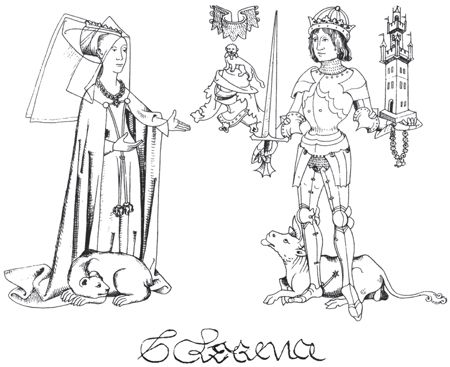
George, Duke of Clarence and his wife, Isabel Neville, Duchess of Clarence – the second possible parents of the Dublin King.
One ironic outcome of the marriage of the Duke and Duchess of Clarence is the fact that this fifteenth-century couple has a large number of living descendants in the world today. Their second daughter, Margaret, Countess of Salisbury, born at Farleigh Hungerford Castle in Somerset, lived long, and, by her marriage to Sir Richard Pole, produced a number of children. Had Henry VIII not decided to have her head cut off on 27 May 1541, Margaret’s life would have been even longer. Every known living descendant of George and Isabel is also a descendant of their daughter Margaret.
However, it is the third child – and first son – of George and Isabel, born at Warwick Castle on 25 February 1474/75, who is the focus of our attention in the present context. This little boy’s two godfathers were his uncle, Edward IV, and John Strensham, Abbot of Tewkesbury. It was in honour of the senior godfather, the king, that the little boy was baptised Edward. The king then went on to create him Earl of Warwick.4 Edward is one of the boys at the centre of this book, for in the opinion of many of those who attended the coronation of the Dublin King in 1487, that king was none other than Edward of Clarence, Earl of Warwick. Indeed, even the majority of those who do not accept that identity nevertheless believe that the Dublin King at least claimed to be Warwick – even if he was, in reality, a poor boy from Oxford.
Christine Carpenter’s bizarre statement about his title notwithstanding,5 in fact, despite the attainder and execution of his father, the young Edward always retained the rank of Earl of Warwick. This was because it had not come to him via a paternal line inheritance. Rather, it had been specifically granted to him by the king in right of his maternal descent. On his mother’s side the little boy was the Kingmaker’s grandson. As we shall see presently, the surviving household accounts of Edward IV prove incontrovertibly that the little boy always continued to hold the Warwick title, and that his tenure was completely unaffected by his father’s attainder and execution.
The precise movements of the Duke of Clarence following his wife’s death are a matter which we shall need to review in greater detail in the next chapter. For the moment, however, it is sufficient to note that when the duke was arrested, in the summer of 1477, his son, the Earl of Warwick, would have been only 2½ years old. Presumably the little boy was then residing at Warwick Castle, which had been his parents’ main home since 1471. Like all children of his rank he must have had a staff of nurses and other servants to care for him. He had probably seen little of his mother, who had died when he was less than 2 years old. It is also somewhat doubtful how well he will have known his father, given his very young age at the time of the duke’s arrest. When Clarence was executed, on 18 February 1477/78, Warwick was a week away from his third birthday. His awareness of what had happened must therefore have been very slight.
Because his father’s execution had left him an orphan, in 1478 the boy required a guardian, and in 1481 his wardship was assigned by the king to the latter’s own stepson, Thomas Grey, Marquess of Dorset, son of Elizabeth Woodville by her first marriage. Although Edward IV had stood as godfather to the little boy, it is not certain that he had actually attended the baptism in person. It is therefore also not certain whether he had ever set eyes on his nephew. Even if he had seen him at the baptism, however, that would have been when the boy was less than a month old. Edward IV’s personal ability to recognise that same nephew three years later must therefore be open to question.
Since the Marquess of Dorset held the governership of the Tower of London, it seems likely that, having been assigned to his guardianship, the little boy was brought to London, where he then probably spent the greater part of the years from 1478 until 1483 at the Tower – ironically the very building in which his father had been executed. Whether the Marquess of Dorset had ever seen the Earl of Warwick before the little boy was given into his charge is completely unknown.
Having accepted the child who had been delivered to them by the servants of the dead Duke of Clarence, Edward IV and his family in London naturally treated the little boy as a relative; as a member of the royal family, and as a person of potential future importance. The king’s surviving household accounts include the following entries:
To th’Erle off Warrewyk to have for his were and use, iiij peire of shoon double soled and a peire of shoon of Spaynyssh leder single soled, by virtue of a warrant under the Kinges signe mannuelle and signet bering date the second day of Juyn in the xxti yere of the moost noble reigne of our said Souverain Lorde the King [2 June 1480].6
To th’Erle of Warrewyk to have of the yifte of oure said Souverain Lorde the Kyng for his use and were, a peire of shoon single soled of blue leder; a paire of shoon of Spaynyssh leder; a paire of botews of tawny Spaynyssh leder; and ij paire shoon single soled … and unto the Maister off the Kinges Barge ayenst the commyng of the righte high and right noble Princesse Lady Margarete the Duchesse of Bourgoingne suster unto our saide Souverain Lorde the Kyng, a gowne of blak chamelet, by virtue of a warrant under thye Kynges signet and signe manuelle bering date the xxiiijti day of Juylle in the xxti yere of the moost noble reigne of oure said Souverain Lord the Kyng [24 July 1480].7
These accounts show that, following the execution of Clarence, Edward IV continued to take some interest in his nephew, the Earl of Warwick. They also demonstrate incontrovertibly that the young boy definitely did hold the title of ‘Earl of Warwick’, despite the curious comments on this point in his ODNB entry. In addition, the interesting fact emerges that the little boy may well have seen and been seen by his aunt, Margaret, Duchess of Burgundy during her visit to England in 1480. At the time of Margaret’s visit the Earl of Warwick was 5 years old.
In 1483, following the death of his uncle and godfather, King Edward IV, and in the aftermath of the attempted Woodville plot to take over the government of England – and its eventual failure – the little boy’s guardian, the Marquess of Dorset, fled the country to join Henry Tudor. As a result, the young Earl of Warwick was once again briefly left without a guardian. However, his younger paternal uncle, the new king, Richard III, took charge of him. Warwick attended Uncle Richard’s coronation in July 1483, and was knighted on the occasion of the investiture of his cousin, Edward of Middleham, as Prince of Wales, in September of that same year. After his coronation, Richard III established Warwick, together with the daughters of Edward IV, and possibly some other young Yorkist scions, at the Sheriff Hutton Castle in Yorkshire.
This castle was situated 10 miles from the city of York. It had originally been built in the reign of King Stephen, and was christened Sheriff Hutton because its builder was the sheriff of Yorkshire. However, it was subsequently inherited by the Neville family, and Ralph Neville, Earl of Westmorland, the brother-in-law and supporter of Henry IV, ‘rebuilt, enlarged, and strongly fortified the castle’.8 Sheriff Hutton remained in the hands of the Nevilles until Richard Neville, Earl of Warwick was killed fighting on the wrong side at the Battle of Barnet. All the Kingmaker’s possessions were then seized by Edward IV, who granted the castle and manor of Sheriff Hutton to the late owner’s younger son-in-law, his own brother, Richard, Duke of Gloucester.
In 1483, following the death of Edward IV, Richard used Sheriff Hutton Castle initially to imprison Anthony Woodville, Earl Rivers. But this was for a short time only, for Rivers was then sent on to Pontefract, where he was beheaded. According to the mid nineteenth-century account of William Grainge:
After Richard had cleared his way to the throne by the murder of his brother’s children, he imprisoned in this castle, Edward Plantagenet, son of his brother, the duke of Clarence, earl of Warwick, and Elizabeth, eldest daughter of his late brother, king Edward.9
This sentence is full of the most amazing Ricardian mythology, for, of course, Richard attained the throne by judgement that Edward’s children were bastards, and not by murder. Likewise there is no reason whatever for describing Warwick’s residence at Sheriff Hutton as an imprisonment.
Grainge is more useful when it comes to his description of Sheriff Hutton Castle itself. First he quotes Leland, who had seen the castle before it was ruined:
Ther is a base court with houses of office besides the entering. The Castell itself in front is not ditched, but it standeth in loco utcunque edito. I marked in the front part of the first area of the castell three great and high Towres, of the which the Gatehouse was the middle. In the second area be five or six towers, and the statlie stair up to the Haul is very magnificent, and so is the Haul itself, and all the residue of the House; insomuch that I saw no house in all the north so like a princely lodging.10
The fact that this was the most princely of the northern castles presumably provides the true explanation as to why Richard III chose to house (not imprison) his nephews and nieces there.
Sadly, Sheriff Hutton Castle has been in ruins since the seventeenth century:
The ruins stand on a hill, to the south of the village, and consist of the remains of four large corner towers, with a part of the warder’s tower over the entrance on the east side. The towers are of considerable elevation, especially that at the south-west corner, which is one hundred feet in height; square, massive, perpendicular, and plain, without buttresses, or architectural ornament of any kind. In the base of this tower, is a vault or dungeon … Above, is another room, arched in a similar manner, and in a tolerable state of preservation. The rooms above are broken down, and in a state of ruin. The circular stair which led to the top of the tower, has been entirely taken away. … The principal entrance has been on the east side; the not very lofty pointed arch of the gateway yet remains, with four shields carved on stone above it. The inner area of the castle is overgrown with grass … The castle has not been moated in front, and only partly on the northern side; on the southern, are the remains of a double moat, about two hundred yards in length, each division being about five yards wide, and full of water; these meet at an acute angle on the west, with another fosse, partly filled with water from the north side of the castle.11
At Sheriff Hutton Castle the young Yorkists came under the supervision of their older cousin John de la Pole, Earl of Lincoln. A figure of great importance in this story, Lincoln was born in about 1460. He was the eldest son of Elizabeth of York and her husband, John de la Pole, Duke of Suffolk. The Duchess of Suffolk was the middle sister of Edward IV and Richard III. Edward IV had created her eldest son Earl of Lincoln on 13 March 1466/67. Later, the young earl had been knighted, together with Edward’s own sons, on 18 April 1475. On the occasion of Anne Mowbray’s marriage to Edward IV’s second son, Richard, Duke of York in January 1477/78, Lincoln had attended the child bride. Subsequently he had borne the salt at the baptism of Edward’s daughter Bridget in November 1480. In the absence of the future Richard III himself, Lincoln had acted as the chief mourner at the funeral of King Edward IV in 1483. Finally, at Richard III’s coronation Lincoln was given a position of honour, and carried the orb.12 By 1485 he was already a young adult:
Lincoln supported Richard against the rebels of October 1483 and was rewarded the following April with land worth £157, and the reversion of Beaufort estates worth a further £178 after the death of Thomas, Lord Stanley, who had been granted a life interest in the land which his wife, Margaret Beaufort, had forfeited for her part in the rising. In the following month Lincoln was granted an annuity of £177 13s. 4d. from the duchy of Cornwall until the reversion materialized.13
The new king, Richard III, who might possibly have encountered the real Earl of Warwick as a baby, had probably not seen much of him since, because Richard himself had spent the greater part of the intervening years in the north of England, while Warwick, as we have seen, had probably been based in London under the care of the Marquess of Dorset. Therefore in the summer of 1483, by which time Warwick was 8 years old, neither Richard, nor his wife, Anne Neville (who was the younger sister of Warwick’s late mother, the Duchess of Clarence – and therefore Warwick’s aunt by blood as well as by marriage), would have been in any position to personally recognise their nephew when they met him. As in the case of Edward IV and the Marquess of Dorset, five years earlier, the new king and queen must simply have accepted the boy who was presented to them under the Warwick title. Richard then took charge of this boy, and treated him as of noble and royal status. Both Warwick and Lincoln were promoted by Richard III, who saw these royal nephews as potentially important future figures within the Yorkist royal family.
Following the deaths of his own son, Edward of Middleham, and of his wife, Anne Neville (which both occurred in 1484, according to the medieval year reckoning), Richard III found himself with no direct heir. As a result, throughout 1485 (right up until his death at the Battle of Bosworth) he was planning a second marriage, to an infanta.14 His preference was for the Infanta Joana of Portugal. However, a second possible choice was the Infanta Isabel of Spain (an elder sister of Catherine of Aragon). Both of these possible brides were descendants of the house of Lancaster. Clearly, what Richard had in mind was to reunite the houses of York and Lancaster – just as Henry VII later claimed to do.
As far as Richard was aware, he still had many years of kingship before him in 1485. He must therefore have had every hope of producing another legitimate son of his own, as the future heir to the throne. Nevertheless, it is conceivable that, if he failed to produce such a son, Richard had the two earls of Lincoln and Warwick in mind as potential future Yorkist kings. Indeed, it has often been said that he actually named one of them – either the Earl of Warwick or the Earl of Lincoln – as heir to his throne.15 In fact there is no evidence that either nephew was ever formally designated as heir presumptive. Indeed, the conflicting accounts of different writers on this point merely serve to underline the lack of certainty.
It remains possible that, in August 1485, on the eve of what proved to be his final battle, Richard may have made some statement about the succession.16 Moreover, if he did make such a statement, that could perhaps provide a clear explanation for the subsequent conduct of the Earl of Lincoln. Richard’s marriage negotiations with Portugal had made excellent progress, and the marriage with the Infanta Joana would probably have taken place had Richard survived the battle. But the fact is that in August 1485 he had no queen and no son to succeed him. Some statement about the succession under these circumstances would perhaps have seemed logical.
But whatever plans Richard may have had for the future, during his short two-year reign he never got around to revoking the Act of Attainder against his brother, Clarence. This left the Earl of Warwick in a somewhat equivocal position as a potential heir. Logically, whether or not Richard III made any pre-battle statement on the subject, the heir presumptive to the throne prior to August 1485 should have been John de la Pole, Earl of Lincoln because the Act of Attainder against Clarence and his line was still in force.
However, Richard’s own claim to the throne was based not only upon the bigamy of his elder brother, Edward IV, but also upon a wider range of criticisms of Edward, as outlined in the Act of Parliament of 1484. Although Edward IV’s treatment of his brother, Clarence, was not specifically mentioned in that Act, Richard III and his supporters may have perceived the wider criticism of Edward IV as implying that the late king’s actions against Clarence and his heirs were invalid.
It is therefore possible that on the eve of Bosworth Richard III named the Earl of Warwick as heir to the throne. If so, such a decision on the part of his uncle, taken on the eve of his death at Bosworth, could well explain the subsequent conduct of the Earl of Lincoln. It has already been noted that Lincoln amazed Henry VII by backing the claim of the Dublin King (whom Lincoln explicitly recognised as Warwick), rather than seeking to win the crown for himself. In this apparently puzzling situation, most historians offer cynical explanations of Lincoln’s conduct, which they see as certainly intriguing, but probably sneaky. Maybe this tells us more about the mentality of the writers in question than it does about Lincoln. If King Richard III had announced, or stated in his will, just before he was killed, that, in the event of his death, Warwick should be the next King of England, surely that might possibly explain Lincoln’s subsequent loyalty to the Dublin King.
Leaving on one side their respective claims to the throne, in the eyes of Richard III both Lincoln and Warwick were promising bulwarks who could – and hopefully would – support and maintain the royal house of York on the English throne well into the coming century. Richard III therefore had every reason to train and promote them as future key supporters for the throne. Richard III’s son, Edward of Middleham, Prince of Wales, had briefly held the important post of Lieutenant of Ireland before he died.17 After Edward of Middleham’s death, Richard appointed Lincoln to the same post (21 August 1484). Lincoln was also created president of the Council of the North. This was a body established in the summer of 1484 ‘as the successor to the prince’s council, which had itself replaced Gloucester’s ducal council as a way of maintaining Richard’s authority in the north’.18
Like Lincoln, Warwick was also a member of the Council of the North.19 In Warwick’s case (given his youth) his membership was probably largely nominal in 1485, but it certainly indicates Richard III’s intention that this younger nephew, too, should be trained to play some role in the politics of the future.
Following the Battle of Bosworth, in August 1485, Warwick’s situation changed yet again. Having seized power, the new king, Henry VII, sent at once to Sheriff Hutton. Naturally, his first objective was to secure the person of his potential bride, Elizabeth of York, eldest daughter of Edward IV and Elizabeth Woodville. As we have seen, Henry intended to reverse Elizabeth’s bastardy, in order that he might marry her and present her to his people as the Yorkist heiress. But Elizabeth of York did not journey to London alone. She was almost certainly accompanied by her sisters and by some of her cousins.
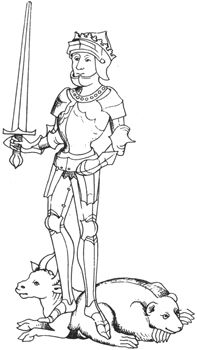
A representation of Edward of Clarence, Earl of Warwick. This is not a true ‘portrait’ since he was only a child when the picture was drawn.
Naturally, all the surviving Yorkist heirs were perceived as potential threats by Henry VII. They therefore had to be rounded up and placed under secure control. Moreover, interestingly, in spite of the Act of Attainder passed against his father, Clarence, which was arguably still in force, Henry VII seems to have perceived the young Earl of Warwick as a particularly strong danger. Could it be that Henry had been informed that, on the eve of the Battle of Bosworth, Richard III had designated Warwick as his heir?
That is one possibility. However, a much more likely source for Henry VII’s fear of Warwick was the new king’s own uncle, Jasper, Earl of Pembroke. In the period 1470 to 1471, during the Lancastrian Readeption, George, Duke of Clarence had sided with the Lancastrians against his own brother, Edward IV. Jasper knew this very well, since he had been in regular contact with George at that time. He also knew the precise consequences of George’s Lancastrianism: one result of the Duke of Clarence’s support for the restoration of Henry VI was that George had been formally recognised by the last Lancastrian king as second in line to the throne, after Henry VI’s alleged son, Edward of Westminster, Prince of Wales. When this information was coupled with the fact that subsequently Henry VI and Edward of Westminster had both died, leaving no surviving children – and with the fact that George himself had also died – legally, the Lancastrian heir to the throne in 1485 was not Henry VII, but George’s only surviving son – namely the Earl of Warwick. In other words, according to the agreement sealed by Henry VI, it was the Earl of Warwick who should now be king. Arguably, this Lancastrian claim would have been completely unaffected by the Act of Attainder passed by the Yorkist usurper, Edward IV, in 1477.
His inherited – and unassailable – Lancastrian claim to the throne therefore made Warwick the most dangerous surving member of the house of York from Henry VII’s point of view. And indeed, it is absolutely clear that in the new king’s opinion, ‘Dynastically the young Plantagenet offered the greatest threat to Henry’s claim to the throne … One of Henry’s first acts after Bosworth was to fetch the earl of Warwick from Sheriff Hutton, and keep him securely guarded.’20 The new controller of the little prince was initially Henry VII’s own very determined and forceful mother, Margaret Beaufort, Countess of Richmond and Derby. She was granted custody of Warwick in 1485, as this later note proves:
24 February 148[5/]6
Henry, by the grace of God, king of England and of Fraunce, and lord of Irland. To the tresourer and chambrelains of oure Eschequier greting. Forasmoche as oure moste dere moder, at our singuler plesure and request of late hadde the keping and guiding of the ladies, doughters of King Edward the iiijth, and also of the yong lordes, the duc of Buk,21 therles of Warwik and of Westmerland,22 to her grate charges, For the which oure right trusty servaunt Maister William Smyth, keper of oure hanaper within oure Chancery, at oure special commaundement, hath paied and delivered unto oure saide moder the somme of cc, Ii., for the which he hath not hadde of us any warrant or othre matier suffisaunt for his discharge in the premises. [The text went on to say that king would now reimburse Smyth].23
Later, as we shall see, Warwick was permanently confined in the Tower of London by Henry VII. In effect, he became the third ‘prince in the Tower’. Indeed, we have already noted that Vergil alleges that there were rumours of Warwick’s death in the Tower in about 1486.24 However, no other sources survive to confirm Vergil’s statement.
Thus the official account of his life tells us that the real Earl of Warwick remained in England from before his father’s death in 1477, until 1485. Could he then have escaped and gone to Ireland? Was the later prisoner in the Tower – who supposedly suffered from mental deficiency, and who was held (and later executed) by Henry VII – the authentic earl? All these are issues to which we shall return later. First, however, it is now necessary to consider an alternative childhood history for the Earl of Warwick. This is a completely different story from the official version. However, it is the story hinted at by the intriguing words of Jean de Molinet.
Notes
Abbreviations
|
CPR |
Calendar of Patent Rolls |
|
ODNB |
Oxford Dictionary of National Biography |
|
PROME |
Parliament Rolls of Medieval England |
1. ‘ung rainceau extraict d’estoc de royale géniture, s’estoit nourri entre les fertils et seigneurieux arbrisseaux d’Irlande … ce très noble rainceau est Edouard, fils du duc de Clarence, lequel, par le conseil et meure délibération des nobles d’Irlande, et en faveur de plusiers barons d’Angleterre, ses bienveuillans, fut délibéré de soi couronner roy, et d’expulser de son royal trosne le comte de Richemont, qui lors occupoit la couronne d’Angleterre.’ J.-A. Buchon, ed., Chroniques de Jean Molinet, vol. 3, Paris 1828, p. 152, author’s translation.
2. D.F. Sutton, ed., Polydore Vergil, Anglica Historia (1555 version), online 2005, 2010 – my emphasis.
3. PROME, 1487 Parliament, Lincoln attainder [November 1487].
4. Bodleian Library, MS. Top. Glouc. d.2, Founders’ and benefectors’ book of Tewkesbury Abbey, fol. 39r.
5. See ‘Edward, styled Earl of Warwick’, ODNB.
6. Nicolas, Privy Purse Expenses, p. 157.
7. Nicolas, Privy Purse Expenses, pp. 158–9.
8. W. Grainge, The Castles and Abbeys of Yorkshire, York and London 1855, p. 238.
9. Grainge, Castles and Abbeys, pp. 238–9.
10. Grainge, Castles and Abbeys, p. 240, citing Leland.
11. Grainge, Castles and Abbeys, pp. 241–2.
12. ‘John de la Pole, Earl of Lincoln’, ODNB.
13. ‘John de la Pole, Earl of Lincoln’, ODNB.
14. J. Ashdown-Hill, The Last Days of Richard III, Stroud 2010, 2013, Chapter 2.
15. See, for example, A.R. Myers, ed., G. Buck, The History of the Life and Reigne of Richard the Third (1646), Wakefield 1973, p. 44.
16. See Ashdown-Hill, Last Days of Richard III, Chapter 7.
17. R. Horrox, ed., British Library Harleian Manuscript 433, vol. 4, London 1983, p. 66.
18. ‘John de la Pole, Earl of Lincoln’, ODNB.
19. Confirmed by the York city register, 13 May 1485, ‘when it was determyned that a letter should be consaved to be direct to the lordes of Warwik and Lincoln and othre of the counsail at Sheriff Hoton ffrome the maire and his bretherne’: L.C. Attreed, ed., York House Books 1461–1490, vol. 1, Stroud 1991, p. 361.
20. M.K. Jones and M.G. Underwood, The King’s Mother, Lady Margaret Beaufort, Countess of Richmond and Derby, Cambridge 1992, 1995, p. 67, citing Campbell.
21. Edward Stafford, third Duke of Buckingham, born 1478, and restored to the title of his executed father following the battle of Bosworth.
22. Probably he means Ralph, Lord Neville, the son and heir of Ralph Neville, third Earl of Westmorland (c.1456–6 February 1498/99). Ralph (the son), born in about 1474, had been given into Henry VII’s custody after Bosworth. However he did not hold the title of Earl of Westmorland in 1486, as his father was still living.
23. SB no. 166, published in W. Campbell, ed., Materials for a History of the Reign of Henry VII, vol. 1, London 1873, p. 311.
24. Sutton, Anglica Historia. See Chapter 4.