
Chapter 2
It is often assumed that people of this period were vastly different from us. This is not a helpful assumption. Then, as now, individuals aimed to live the best lives possible while struggling to make ends meet, fulfilling the expectations of institutions, and trying to satisfy some of their desires. Endowing people in the past with a sphere of autonomy, and even of choice—however modest—is sometimes described by historians as considering their agency. Thinking about agency does not mean ignoring the many factors over which people had no or little control, like the brutal realities of hunger, disease, and violence. We should think of people in the past as possessing self-awareness and the capacity to experience subtle feelings and complex thoughts. Some scholars have identified the ‘discovery of the individual’ in the 12th, or the birth of affective relations in the family in the 18th century. Yet, as we shall see, our sources—ranging from wills to poetry, from visual imagery to testimonies in courts of law—show individuals from across the social spectrum displaying emotions familiar to us: loyalty, jealousy, greed, hope, and passionate love.
This chapter will explore the routines of family and community life in rural settlements and urban centres, in private and in public. Some activities were associated with kinship, others with the search for protection. People sometimes joined others in their efforts—in a trade guild or a religious fraternity—but they also sought out patronage and guidance from individuals who were stronger, richer, or more expert than themselves.
Free, unfree, or only partly free
The capacity to act in the world was affected by an individual’s legal status: free, slave, or serf. Roman law recognized the conditions of freedom and slavery, and slavery remained a European institution throughout our period, though with great variation. The law of the church decreed that Christians could not be enslaved, yet some did indeed live as slaves. Indigenous slavery on large Roman estates persisted at the beginning of our period, and existed alongside the constant stream of slaves taken in battles on Europe’s eastern borderlands. The word slav became synonymous with the word ‘slave’ (sclavus in Latin). The survey of estates conducted by Abbot Irminon of St Germain-des-Près outside Paris c.825 had 7,975 individuals living in 1,378 households, all bound to the estate. These were large households, with an average of 5.78 members. The Domesday Book, a vast survey of English lands, population, and resources, compiled in 1085–6 for William the Conqueror, shows how numerous slaves were on English estates, over 10 per cent of the population surveyed, though the status of slave soon disappears from our sources. Enslavement was used against Muslims and Jews in Catalonia and Aragon in punishment of a variety of political and sexual offences.
Dependent unfree men with skills could rise up the social scale through military and administrative service. In the Holy Roman Empire unfree ministeriales held land and married the daughters of noblemen; they commanded castles and in turn held courts of their own. The Hungarian jobbágiones were allowed freedom of movement and were mobilized in the 13th century in warfare against the Mongols, and in the 15th against the Turks. Another form of servile living was introduced to Europe in the late 14th century when black African slaves were sold for domestic service in Italian and Iberian cities. They were habitually released from slavery (manumitted) after a while, often remaining in domestic service, or working as artisans, musicians, or fishermen.
Those who were not slaves were not all free, for our period sees the development of a status of unfreedom which is not equal to slavery: it is serfdom. There were many routes to such servility: loss of an individual’s land through poverty and debt, or through conquest followed by loss of land. The serf householder was attached to the land he and his family cultivated, and their tenure entailed important obligations which were the mark of servility. Serfs shared the produce of their labour with their lords, they were obliged to execute work at the lord’s request, and they were limited in their right to travel. Serfs were often required to bring their corn for grinding in the lord’s mill and their grapes to the lord’s winepress, and to pay for a licence when they sought to marry outside the manor; a fine beast was paid to secure the passage of the serf’s tenure to its heir. Their lives were hard, and often characterized by writers in our periods as being simple and rude. When bishop Rather of Verona around 930 wrote with guidance to Christians of all conditions, he advised the labourer: ‘be not only fair, but hard-working, content with your lot, cheating no one, offending no one’.
Members of the serf’s household were servile too. An Irish satirical poem of c.1060 expressed abuse of those at the bottom of the social scale, here associated with ploughing: ‘o Domnall, dark and crooked, harsh and wrinkled … You grandson of a ploughman/[who is] filthy like a badger’. Serfs could be freed by manumission, either granted as a favour—as when a serf’s son was freed in order to qualify for training to become a priest—or against payment. Even after manumission a vestige of unfreedom could linger, as in the case of those entitled colliberti on French estates. Serfs sometimes left their family holdings to join an army or to work in a town, and landlords’ officials aimed to locate such fugitives and return them to the land. In periods of demographic growth, like the 12th and 13th centuries, servile folk were able to negotiate and pay manorial officials in order to move to a town. After the Black Death (1347–52) when demand for workers in cities was extremely high, young men and women departed from manors in great numbers, often leaving dependent old and young behind. The erosion of serfdom after 1350 meant that customs which burdened serfs were lightened, but so too were the obligations which secured the tenure of servile families.
Being a man and being a woman
Within these social worlds conventions related to being a man or a woman were highly consequential. Gendered attitudes sought to protect as well as control, to exalt as well as vilify women and femininity, while maleness served as an ideal, the state of humanity in the image of God. The details of this system differed by region, social sphere, and period, but everywhere gender was seen and asserted in rituals and public statements. Clothing, comportment, use of space, all served to display the gendered order of society. Frankish high-born nuns were buried in colourful clothes: Bathild (d. 680) in a red cloak with yellow fringes and Bertila (d. c.704) in a brown tunic with yellow trimming. Even in the harsh conditions of life in Greenland, items of clothing from c.1200 show that men wore garments dyed dark brown and black, women’s dresses were decorated with patches of contrasting colours, and children were dressed in white and grey. Colour-coding is not a modern invention.
Most of the assumptions in secular and ecclesiastical law and much social custom agreed that women were weaker than men in their mental, moral, and physical capacities. The church taught that women and men could hope and strive for salvation, but also that women’s nature tended towards sin. It followed that it was harder for women to deploy human reason—the gift of God—since they were distracted by their carnal nature, above all by their roaming wombs. This weakness of reason meant that they could not be placed in positions of authority over men, their superiors. Even the dedicated religious woman Ida of Barking was exhorted by the monk Osbert of Clare c.1136: ‘Do not let lascivious mirth reduce you to your sex. Conquer the woman; conquer the flesh; conquer desire’.
Such ideas were embedded in the system of ethics and science inherited from antiquity according to which the human person resided in a body which was also home to the soul. The person emerged from the combination of matter and spirit, and each individual was a unique blend of humours, each with its particular qualities: choleric—mostly hot; sanguine—mostly moist; phlegmatic—mostly cold; or melancholic—mostly dry. The grid of natural bodily conditions was understood to be in flux, and the balance at any moment was affected by planetary movements, but also by the routines of eating and bodily care undertaken by individuals. Men were vigorous in their heat, so religious men sought to lessen their distracting masculinity and sexual drive by eating cooling foods, like vegetables, and by avoiding spices. Colder men grew a thinner beard and had smaller testicles; they were more like women. Women, in turn, who sought to become more ‘virile’ and give up their femininity might seek sources of heat to compensate for their natural wet and cold complexions. The spiritual guide to the religious woman Catherine of Siena (1347–80) described her seeking out, in the public baths, the hottest and most sulphurous streams of water.
Family and marriage
Most people spent work and leisure within the family sphere. In both towns and villages the family was a unit of work. On the peasant holding or in the artisan’s workshop, men, women, and children worked together. Households included not only close family members, but also dependants such as needy relatives, servants, apprentices, and even the poor. The household was ordered under the rule of a male head, and in his absence, sometimes, that of his wife.
Marriage was the most pervasive, yet contested, social institution. Roman law defined marriage as a contract, while Germanic custom endowed marriage with the quality of a family enterprise, an alliance between families through their young; alongside marriage it recognized other less binding alliances. To these traditions was added Christian sexual morality, which sought to make marriage a framework for virtuous Christian lives. Discussion began in earnest as Christian thinkers—like Augustine, bishop of Hippo in North Africa (354–430)—grappled with the reality of mass Christianity. His approach was above all theological, an exploration of marriage as a remedy against sin. He opened the way to an understanding of Christian marriage, though some thinkers continued to insist that married life was inferior to the life of heroic chastity.
The conventions and exigencies which operated on men and women were complex and varied. Underlying this variety was an understanding of identity rooted in sexual difference. It directed men to assume responsibility and care for wives, daughters, and sisters, and it also allowed them to control women’s property, and direct their lives. Men habitually used violence in asserting authority, even as they expressed deep grief at the loss of a partner. The Carolingian scholar and courtier Einhard spoke of missing his wife Imma (d. 835) ‘every day, in every action, in every undertaking’. He was consoled in turn by letters from his friend Lupus of Ferrières, praising her since ‘although a mere woman in body, she had achieved in spirit the stature of man’. Richard II (1367–1400), king of England, famously mourned the loss of his wife, for the rest of his life, and even after he remarried.
The Christian idea of marriage as sacramental, monogamous, oriented towards procreation, and for life, was fully codified in the 12th century. Disseminated vigorously through canon law, Christian marriage seemed like an intrusive innovation, and centuries passed before it was accepted by Europeans. This view of marriage was propagated by the Church, led by activist popes—many of whom were trained in the law. It sought to bring the most intimate and consequential aspects of life—family, progeny, inheritance, sexuality—within a Christian ethical and legal sphere. It did so by considering marriage a personal moral act, by making laws to match, and by providing religious instruction to inform laity and clergy alike. As marriage became a sacrament any infringement related to it was claimed as the business of church courts and was regulated by priests and bishops.
Sacramental marriage was an irreversible ritual, a transfer of grace to two freely consenting partners. Experts in church law—canon lawyers—explored all possibilities: What was the minimal age of marriage? How binding was the expression of mere intent to marry? Could Christian marriage be overruled by dissenting relatives? Could a married person leave to pursue the greater virtue of monastic life? And what if a marriage was never consummated sexually? Such questions became the stuff of legal discussion and life dramas; in church courts witnesses described disappointments and sorrows in minute detail. These courts accepted the testimony of women, so they recorded them speaking of heartbreak, broken promises, sexual humiliation, and more.
The church aimed to promote partnerships in conformity with biblical definitions of incest. Religious advisors sought to move rulers towards a Christian sexual morality, but they also understood the limitations to such attempts. Pope Gregory I allowed the missionary to southern England, Augustine of Canterbury (d. 604), to act with leniency with the recently converted English on the issue of licit marriage partners. Charlemagne, avid promoter of Christian learning, had many wives and complex webs of paternity. He was also described as having an incestuous relationship with his sister Gisla (757–810), who later became the abbess of Chelles. The scope of incest waxed and waned. At baptism new spiritual kin were created—godfather and godmother—so they and theirs entered the circles of kin forbidden in marriage. By the 12th century church law allowed marriage only to those separated by seven degrees of kinship. Such strictures were hard to live by. By 1215 the church had relaxed the degrees of prohibited kinship, to four; even that was a rule hard to enforce within small rural communities or within the elite marriage circle open to royals. Ideas about incest remained a subject of fascination. Manuals for confessors instructed priests to probe their parishioners about it with direct questions, and preaching addressed the topic too. Literary works also explored incest, like the German verse poem Gregorius of c.1200, by Hartmann von Aue (c.1165–c.1215), about a saint who was the product of incestuous union.
By the 13th century Christian marriage was taught widely, and so became over the centuries a recognized pathway. To traditional rituals of betrothal and marriage—celebrated by families and within communities—were now added church rituals. There was often the blessing at the church door; and when children came along, there was baptism to bind family and church even closer, and churching of mothers—a form of purification and reintegration of them into the community—after the ordeal—and pollution—of childbirth. For all its uniqueness, in sermons the life of Mary and Joseph was upheld as an ideal.
Christian marriage promoted ideals of conjugality and complementarity. Men and women were different, but could help each other in making a Christian life. The conjugal debt was conceived as a mutual duty to have sex in marriage. It was taught in sermons as an obligation on women to overcome qualms about sexual contact—due to illness, personal aversion, the restrictions of Lent, or menstruation—and respond to their husband’s desire. In the 15th century an influential voice opposed the tyranny of the ‘debt’. The Tuscan Franciscan preacher Bernardino of Siena (1380–1444), wise to women’s dilemmas from hearing their confessions, taught the husband’s right to instruct and correct, and the wife’s duty to obey, respect, and exhort. But he also decried coercive sex as an infringement on the duty of affection. Bernardino’s sermons restated the tenor of Augustine’s words a thousand years earlier, with a Tuscan twist: marriage was for the bridling of desire, and should not be delayed, lest men become used to having sex with each other, a ‘pestiferous’ habit which is hard to break.
Parents and priests encouraged young adults to settle in family units. Whatever their youthful sexual experiences, and these were often within same-sex environments of training and work, most people married. Many even remarried, and in this way produced multigenerational families and complex webs of inheritance and sentiment. Towards the end of our period, religious image and narrative caught up with this social reality. The Holy Family—Mary, Joseph, and the child Christ—was represented within a rich web of relations, in which Anne—Mary’s mother—doted over her many grandchildren, the product of her three consecutive marriages. Parish churches in Germany displayed the family arranged as a sculpted group: the two holy women and the child Christ to the fore, and Anne’s other daughters with their children—Christ’s cousins—around them; at the back were four men: Joseph and Anne’s three husbands (Figure 4). Men and women, young and old saw their own family relationships mirrored in such images.
If sex in marriage was oriented towards producing sons and daughters, then any impediment to intercourse provided a cause for annulment; and if marriage was a sacrament freely entered, any suggestion of coercion could similarly make void the resulting ‘forced’marriage. Anxiety about the ability to establish a family is palpable in many different types of sources. People resorted to magic, medicine, prayer, and pilgrimage in the hope of being able to have children.
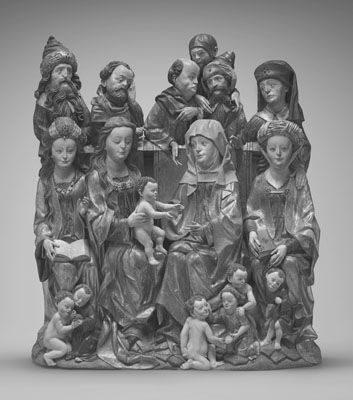
4. A painted sculpture, of c.1485, from a German parish portraying a family with women and children to the fore: the Holy Kinship of the child Christ
Households
With marriage a household was created, and most Europeans formed new homes after marriage. These were units of work: on the family’s agricultural land or in a workshop. Knightly and aristocratic families ran estates as household enterprises from a castle, a fortified manor house, or—as was the case with some Italian families—an urban palace. Women, apprentices, grooms, and servants helped run these households, which were represented by the male head of household in law, finance, politics, and civic ritual.
Royal and aristocratic courts were at once the home to an extended family, a household, as well as the headquarters of a bureaucratic and political enterprise. In the earlier centuries royal courts were almost always on the move. The Merovingian kings of the Franks travelled between their estates with their court about them, supported by the produce and labour of their lands and serfs, as well as by the hospitality which religious houses were obliged to offer to their benefactors. One such courtier—the holder of the all-important role of maior domus, chief steward to the household—Charles Martel (c.688–741), assumed so much power and influence that his sons—Peppin and Carloman—became kings of the Frankish lands after his death. Peppin’s son, Charlemagne, created a capital, the very grandest kind of household, at Aachen. The group of priests and servants which surrounded a bishop and animated his cathedral came to be known as familia—a family household of sorts—and provided its celibate members with the support and care that biological families were usually expected to offer.
Women’s work was central to any household’s wellbeing and it took place in all spheres. The Life of St Gerard, the martyred bishop known in Hungarian as Gellért (980–1046), describes the bishop on his travels hearing the sounds of millstones accompanied by a woman’s voice. His travelling companion explained that she was grinding corn, rotating the mill, yet singing ‘in a sweet and merry manner’. Coroners’ records from 13th century England show that women suffered accidents in the course of agricultural labour: in fields, barns, and when using heavy and sharp metal implements.
Women’s work involved skill and coordination at home, in workshops, and in fields, and they were trained informally by other women. Everywhere women gathered and prepared food, tended to domestic animals, and made textiles. A wall-painting from the Danish church of Kirkerup, near Roskilde (c.1330) shows a woman spinning yarn while balancing two swaddled children on her hips (Figure 5). Spinning, weaving, and sewing garments required the use of specialized tools. Finds from 13th century Greenland include needles, scissors, seam smoothers, and weights for looms. A great deal of specialized knowledge went into assembling of wools and animal hair which were made into yarn, and coloured with natural dyes made of lichen, woad, and even tinted brown by dipping in iron-rich water.
In cities women participated in family artisan workshops, often working ‘front of shop’, selling the finished goods from shops on the ground floor. In the households of notaries, doctors, and merchants daughters learned to read, write, and compute, a useful preparation for adult life within such a household of their own. Women sold homemade goods, and often worked with the byproducts of the family business, like turning tallow into candles. In the later part of our period women worked in textile manufacture from home, often in groups, and also provided a growing workforce of domestic servants, much in demand after the Black Death. Women hawked cheap goods and sold pre-cooked food, since maintaining a private kitchen was the privilege of better-off townspeople. The local legal framework determines how we get to know such women: a brewer of Ingatestone in Essex accused in 1344 of serving unfit ale was represented in court by her husband, who also paid the fine; but in Marseille, the Jewish midwife Floreta d’Ays faced in 1403 a malpractice suit on her own.

5. A wall painting from the Danish church of Kirkerup of c.1330 depicting a mother with two swaddled babies tied to her body, busy at her spinning. Situated near the Expulsion from Eden, it links toil to Eve’s sin
Historians used to think that emotional cherishing of children was the invention of the Enlightenment. This is quite wrong. The household was the focus of nurture and care for the young. From the peasantry to aristocratic elites, all social groups developed ways of training the young for healthy and productive lives. Even modest families travelled to shrines, seeking cure for their children. Frankish grave-goods buried with children include child-size weapons and toys. Complex webs of coercion and encouragement governed attitudes to the young within these patriarchal communities, and so privileged in many instances the old over the young, sons over daughters, and close kin over lesser relations. Women were expected to train children, and as norms of Christian behaviour spread and became better established in Europe, so did the role of mothers and female kin as first educators. The Psalms, the Creed, the widely used prayers Ave Maria and Pater Noster, and edifying religious tales were taught in households in the mother tongue and were integrated into family life.
Tough decisions had to be taken in order to secure the future of the young. By the 10th century most landholding families in large parts of Europe—England, France, and parts of the Empire—recognized the land inherited by the father as patrimony, to be passed on to the heir. The patrimony gave the family its name—this period sees the fixing of such surnames, cognomina—like de Coucy or de Bouillon. Younger sons were apportioned lands perhaps more recently acquired, less central to the family’s prestige. In an extreme case in point, William the Conqueror’s eldest, Robert Curthose, inherited Normandy in 1087—the family patrimony—and his younger brother, the future Henry I, inherited that more recent acquisition—the kingdom of England.
The ideal heir to a family’s name and lands was an adult male, but often this was simply not possible. In these situations women were made rulers of men and held important positions of power. As he prepared for succession, Henry I of England had only an illegitimate son and so he made efforts to secure the inheritance for his daughter Matilda (1102–67). He bound the magnates of the kingdom by oaths to accept her as heir, and thus to secure dynastic and political continuity. Yet, when the time came, this did not work. The English aristocracy preferred a man of lesser birth, who was well-known, -liked, and -tried in battle: Stephen of Blois. England was soon plunged into years of strife. In the 13th century, the counts of Flanders, some of Europe’s greatest dynasts, made their daughters heirs with greater success. Within cities, the statutes of guilds that regulated household workshops allowed guild widows to run workshops until their son/heir reached majority.
Primogeniture—inheritance by the eldest son—came to prevail not only among landed people, but also in more modest households: the inheritance of servile land or of craft workshops in towns throughout Europe. Some regions maintained partible inheritance—parts of Kent, still in the 13th century, Wales, southern France—and confronted the challenges it posed: provision for several heirs always meant that a viable land holding could be reduced within a generation or two to fragments that barely supported any of its holders. Most families combined several strategies for the sake of the young: advantageous marriage, training in a craft, migration, land-clearance, and the acquisition of a new tenancy, professional formation in preparation for careers in law, as clergy, or as bureaucratic servants in great households, cities, or royal courts. As to daughters, they were apportioned a dowry with the aim of attracting a good match, the dowry being a way of sharing the family’s wealth.
Rural settlements
Most people lived in rural settlements and in many forms. There were the densely settled nucleated villages as in southern England, northern France, and Pomerania, where arable farming meant that villagers lived surrounded by the fields they tilled. At the centre of some villages was a green or a square, a public space around a well, and sometimes near the local church. Fishing villages along European coasts shared some distinctive features. Be they in Norway, Ireland, or Sicily, they were often surrounded by sea-marshes and salt-pans; the sex ratio of their population was often skewed, with a super-abundance of women. Some villages were surrounded by protective walls, others encompassed hamlets—neighbouring clusters of farms—spread out and isolated. The layout of rural settlements reflected the landscape, work and livelihood of their inhabitants, as well as the circumstances of original implantation.
It is commonly thought that rural settlements were unchanging features of history, but the reality is more complex and interesting. While some settlements in southern Europe were indeed very old, migration, raiding, transhumance, and conquest all contributed to change in village life. Think of the wooden fabric of the most modest northern European habitation: those who lived in them in the 6th and 7th centuries periodically upped sticks—literally—with their livestock, and abandoned rotting wooden structures to set up elsewhere. Movement characterized the lives of villagers in the Alpine region, where part of the population spent several months a year away from the village, seeking pasture and some protection from severe weather conditions. Hundreds of villages in Castile, from the 13th century, saw seasonal movement of vast numbers of sheep to pasture and back. Transhumance transformed the shape of these communities for months at a time: the movement of some three million sheep from north to south removed men and beasts alike. At the same time, and in consequence, towns and cities along their pathways—the cañadas—saw their population swell.
Rural settlements often centred around a villa held by a churchman or a notable. In Iberia Roman villas endured as economic units and family homes even under Muslim rulers. While grain production was at the core, there was pig and sheep rearing, and crafts in locally grown raw materials like wool and linen. Such settlements formed the core of fortified seats of lordship by the year 1000, made strong by the local lord—seigneur. Castles were built to secure safety and in display of authority. Fortified communities marked the landscape as a refuge in time of war for those who inhabited neighbouring lands. Monteriggioni, north of Siena, was situated for decades at the border between the territories of Florence and Siena; it was surrounded by a ‘crown’ of towers—14 of which still survive—and offered refuge to peasants in the surrounding lowlands whenever those two cities clashed.
By the year 1000, relations between lords and their vassals, manorial landlords and their serfs, offered the basis for political and military organization and for economic development. Relations of lordship and tenure framed the lives of most Europeans, the most powerful and the least. On the basis of these dispositions of landed wealth and natural resources, a whole array of cultural and personal values developed: loyalty, chivalry, justice, liberality, communal responsibility, and more.
In large parts of Europe rural settlements existed within a system of land tenure that has been named since the 17th century as ‘feudal’. This term is often used to characterize the arrangements whereby land was held by men in a hierarchical and nested system: each vassal held land from a lord and in return offered that lord loyalty and advice. Lord and vassal were bound through a ceremony at which the latter offered homage, sealed with a kiss. The land held within this relationship could include a combination of one or more estates; in the highest echelons it amounted to a county, duchy, or even a kingdom—their population, resources, and related jurisdiction. Versions are to be found from the Hebrides to Hungary, from Tuscany to Norway, but its history and manifestations are highly diverse, far more than a sole ‘-ism’ can convey. That is why historians now qualify their use of the term ‘feudalism’ or avoid it altogether.
The historian Marc Bloch (1886–1944) once remarked that every parcel of land could be called ‘mine’ by several persons: those who worked it, those who held the estate from a higher lord, the higher lord, and the king who granted it to that higher lord. Some lands were never turned into fiefs, but were worked under the supervision of the lord’s official, a bailiff who supervised the hired labour as well as the work of serfs. These bailiffs—sirvents, or sergents—ran the estates, interacted with the rural workers in the local idiom, and summoned them to the manor court for infringements; they were never popular members of the rural community.
Serfs were obliged to share not only the crops they grew and the animals they tended, but also their labour, by providing work days to their lord. This was usually exacted in the form of agricultural labour, at sowing or harvest, just when their own holding required urgent attention. Whenever we look at a castle or at earthworks and wonder how they were built with the technology available a thousand years ago, we must remember that lords had access to a great deal of cheap labour from the landless, and to free labour from their serfs. Such labour services could also be exacted as cartage, hewing of stone, mining, and more.
Political change affected the rhythms of life in rural communities. After the Norman Conquest of England castles were built everywhere, at the centre of cities where they displaced tens of habitations at a time, and in strategically important regions, like the Welsh Marches, first in wood and later in stone. As one views these impressive structures it is clear that effective organization of labour and resources went into their making. Lords in charge of vast estates and dependent serfs could raise the required labour, command the required timber for construction, and could allocate portions of income from their estates towards the building. This was the very terrain where Offa, King of Mercia (r. 757–96), had built a dyke supported by earthworks, 300 years earlier. The archaeological remains from fishing villages of the Hebrides reflect the effect of conquest on economic life: before the advent of Norwegian influence and ultimately hegemony in the 10th century, the finds contained a wide range of fish bones—both in middens and in processing deposits; later on there is a clear concentration on cod and hake. The islanders’ fishing habits were influenced by their incorporation into the Norwegian sphere of dominion, whose fish yields made them leaders in the European trade in dried fish. The introduction of grain-drying technology to the Hebrides in the form of kilns is evident in this period, as is that of black oat and rye, both part of a general move towards more intensive arable farming. This economic incorporation may also explain the new prominence of flax—introduced from Norway—whose oil was so useful in the treatment of wood and essential for boat-making.
Religious houses were usually granted estates at their foundation, and received more from benefactors over the centuries in return for prayer. They acted as a collective ‘lord’, and managed lands, often very effectively. Able to accumulate over centuries, untouched by sibling strife and the need to apportion dowries, religious houses amassed considerable wealth and so invested in substantial projects: bridge-building, drying of marshes, woodland clearance, and the construction of stylish buildings. Religious houses literally towered over the countryside, their church often the product of decades of labour by country people—in quarrying stone, preparing timber, construction, and carting.
Food security was affected in every region by a variety of interlocking causes such as weather, safety, and disease. We gain glimpses of the challenges of hunger, from the provisions made by landlords—of grain for food and for sowing—at time of need, as recorded in their accounts. And dearth produced fantasies of plenty, like the Land of Cokaigne, occasionally imagined in poems: a land where it rained meatballs and pancakes, where roasted chickens flew straight into the mouths of the hungry. Local rituals and expert magic were also deployed—despite official disapproval—to avert storms or make life-giving rains fall.
The rural settlement—the village—was the site of important solidarities within families and between neighbours. In the course of the Christianization of Europe, most villages became ecclesiastical units too. The village produced food, and yielded tithes—a tenth of the produce or earnings to the church; the village was home to families whose young required baptism and its dead burial. At the same time, those who owned estates and governed lives—knightly and noble landlords—were increasingly drawn into a close relationship with the church, its laws and its norms, and sought to spread these on their estates. Where neighbours were so co-dependent, reputation was all-important. Rural communities took slander seriously, as an Irish phrase put it, ‘No wise … man should doubt that blood is shed by words’, and slander became a sin punished by canon law, as an act against charity.
The wave of church-building in the 11th century—described so evocatively c.1026 by the monk-chronicler Radulph Glaber (985–1047) as a ‘white mantle of churches’—reflected landlords’ attempts to provide enduring places of worship, built in stone. Such lords also appointed the priests, a right that in the 11th century was energetically disputed by the papacy. The intertwining of the life-cycle and the seasons of the year into Christian ritual made the rural settlement a social framework rich in overlapping relationships and meanings.

6. Frescoes painted by Undicesimo Nicchione of the Seven Works of Mercy in the Baptistery of Parma (c.1370–80): ‘Giving Drink to the Thirsty’ captures both need and the recipients’ gratitude
Collective experiences of work and worship reinforced the bonds of cooperation which were required within any rural community whose members often struggled to survive. Competition existed alongside collaboration. Tensions abounded within and between households: between the young and old, the industrious and the idle, those more or less well-off. There was hierarchy within villages too: with those who owned or held land, and those who did not, with men—who were the tenants of land—and women, who depended upon their male kin. There was also charity and sharing, encouraged by religious instruction (Figure 6).
Cities
Although most people in medieval Europe were attached to work on the land, a significant number were engaged in manufacture and trade, in study, and in the provision of educational and religious services from urban centres. Cities and towns were hubs for the marketing and distribution of agricultural produce, livestock, and raw materials. The marketplace defined the town’s commercial capacity, and so in most European cities the great church stood in the marketplace: in Freiburg the church of St Mary still inhabits the marketplace, and in Cambridge Great St Mary’s stands just at its edge.
Cities were central to life in medieval Europe. The Roman legacy meant that a city like Civitas Moguntiarum, situated at the confluence of the Main and Rhine rivers, remained an important medieval city—Mainz. Its bishops nurtured a buoyant economy—with much vine-growing—and also led in the 8th century the war against the Saxons, and the mission which followed. New cities were created where political realities required them. Magdeburg in Lower Saxony was founded by Charlemagne in 805 after he vanquished the Saxons and forced their conversion. It later prospered as an eastern outpost of the Ottonian Empire. From Magdeburg St Adalbert (d. 981) launched the efforts to convert the Magyars. In the early 11th century its economic importance was recognized by the grant of the right to hold a market. It had already been elevated to the status of archbishopric at the heart of a vast ecclesiastical province.
As economic activity intensified after the year 1000 so did the measures created to secure travel and exchange. Lords secured the freedom of travellers, maintained bridges and roads, and in return exacted tolls. In Italy these common interests between local landholders and cities were identified and forged into a form of joint governance—the commune. In 11th and 12th century communes these interests combined to create political entities as in Genoa, Parma, and Verona. Such cities guarded their liberty, especially regarding their obligations to their overlord, the Holy Roman Emperor.
All over Europe new towns and cities were created by enterprising rulers, bishops, and abbots. In Castile and Aragon royal charters, fueros, were issued aimed at encouraging settlement in cities that had recently been conquered from Muslim rulers. The charter for Cuenca welcomed in 1187 ‘whoever may come to live … whether Christian, Moor or Jew, free or servile’. The kings of France also encouraged urban growth and fostered the vast fairs of Champagne in the 12th and early 13th centuries; the kings of England granted borough status to tens of towns in the 12th century, and the Teutonic Order similarly encouraged city life after its conquest of Livonia in the 13th. But rulers rarely gave up their rights altogether, and continued to exact from cities annual payments, or contributions to their armies.
Those who governed the city sought to create an environment conducive to trade. A safe and healthy city was more likely to attract merchants, who were taxed on the merchandise they imported. Visiting merchants spent a great deal of money in towns and cities on bed, board, and entertainment. City councils regulated prices of food and drink, licensed and supervised sex workers, and guarded access at their gates. International agreements sought to protect such traders as they travelled away from kin and native community. A letter sent by Magnus Håkonsson, King of Norway, to the city of Hamburg in 1264 reassured it that although some Hamburg merchants had been accused of murder while trading in Norway, they were able to prove their innocence supported by the oath of 12 men, and so he set them free. All was well.
The Holy Roman Emperors created in the 13th century the status of Imperial City (Reichsstadt), like Regensburg, Hamburg, or Bremen. Imperial officials no longer conducted the cities’ affairs, which hence were passed on to the local council, usually dominated by great merchants. The city was now obliged to contribute considerable annual payments for the right to manage its affairs, repair its walls, arm its militia, and regulate its guilds and market. Clashes between imperial cities and the Holy Roman Emperor arose over the treatment of Jews, political alliances between the city and the Emperor’s enemies, and on the level of fiscal contributions to the imperial coffers.
Urban centres prospered, diversified, and encouraged creativity. Republican government spawned administration and strategic planning which involved rich merchants above all, sometimes with the participation of traders and artisans. The size of city councils varied from the very small—with seven or eight members—to vast assemblies of hundreds, as in Venice. Time invested in public office was usually given freely, though expenses for entertainment and travel could be reclaimed from the city’s coffers. Urban government had to include many of those who produced its wealth, while protecting the aspirations of its richest and most prestigious members. The struggle over representation was incessant, between the rich merchants (often with aristocratic associates) and guild-members. The voice of labourers and women had no official representation.
Cities saw in the 13th century an extraordinary explosion in financial services. Banking dynasties were established and by 1300 they had branches in major European cities. Their wealth made them ambitious within their natal cities, even as they travelled widely and commanded influence abroad. London alone had agents of at least ten Italian banking families, and their financial support underwrote military ventures by the English crown. Merchant and banking wealth was displayed in the building of great residences in Italian and Flemish cities. Kinship loyalty and mercantile acumen combined to create formidable mercantile lineages. The most famous long-distance merchant of the period, the Venetian Marco Polo (1254–1324), travelled to the Chinese court with his father and uncle, Niccolò and Maffeo. Such travel was a form of apprenticeship by which families trained their young in the secrets of trade. In this extraordinary case, the trip lasted 24 years, and Marco Polo committed his experiences to writing.
All the aspirations and the frustrations of a city’s life are captured in the story of Siena. Siena emerged in the 13th century from a vast hinterland of viticulture, grain- and sheep-farming as a centre for banking and trade. Siena’s precocious textile industry and banking soon followed: wool was turned into fine cloth, metal from surrounding mines into finely wrought weapons and tools. Its merchants and bankers financed and managed the earnings from the seasonal transport of sheep from inland to the coast for sale. When Siena triumphed over Florence and its allies at the Battle of Montaperti in 1260, it entered a period of self-governance—enabled by economic growth. The Sienese rebuilt and extended their cathedral—the Duomo—built the city hall—the Palazzo Pubblico—and decorated the city with religious images.
Siena is situated along a route—the via francigena—which linked northern Europeans to Rome. Sienese business and charitable institutions, like Santa Maria della Scala—which can still be seen facing the cathedral—fed, lodged, and cared for these travellers. The Duomo was originally dedicated to the local saints Ansanus, Savinus, Crescentius, and Victor, but by the 12th century was dedicated to the most beloved of all saints—the Virgin Mary.
Sienese artists were much admired for their distinctive style, evident from the late 13th century. Men like Duccio di Buoninsegna (d. 1319) refined painting traditions influenced by centuries of exposure to Byzantine art—with gold backgrounds, mournful and static Madonnas, forbidding crucifixions. Duccio created a style which responded to the civic religion of Siena, to the emotional devotion prompted by the Franciscan friars, creating a distinctive Tuscan style.
A blend of group solidarity and competition animated Sienese life in this period. All year long its neighbourhoods prepared for the summer city-wide horse races, the greatest palio on the feast of the Assumption in August. The vast palaces along its main thoroughfare were homes to wealthy families like the Saraceni, Piccolomini, and Chigi. Each was involved in Europe-wide affairs, but each also fostered its local identity through networks of kinship and patronage and a great deal of display. A council of nine men ruled the city for almost a century. It rendered accounts annually in public and ornate documents, and even occasionally brought in monks of the region to act as auditors.
Siena’s public spaces help us understand how preaching affected city life. Sienese walls and doorways are still marked with the emblem IHS—Ihesus—a logo invented by the preacher Bernardino of Siena (1380–1444), whose fiery preaching we have already encountered. This was an image for devotion, not to the saints but to Jesus. Bernardino was appointed by the Sienese council to preach the reform of morals especially among its super-rich citizens. He used sarcasm, humour, and terrifying images, to lambast gambling, feasting, rich trousseaux for brides, homosexuality, and witchcraft. His pulpit can still be seen today, white marble under a blazing sun, as hot as the man and his message.
Association, guilds, and ‘republics’
As the example of Siena shows, competing forms of political and social association developed in cities. Though the gap between the richest and the poorest was vast, cities also saw a great deal of cooperation. This was required by the processes of manufacture and social relations: the production of cloth involved several different crafts working in sequence; neighbours combined to improve their quality of life, ensuring the safety of life and limb. The shared responsibility for maintaining churches and city-walls, and for collecting taxes to support all of these efforts, meant that a great deal of collaboration, scrutiny, and discussion characterized city life.
Alongside the social hierarchy endorsed by kingship and the aristocratic cultures of European landed elites, another tradition developed, which was corporate or consultative, sometimes called republican. It was facilitated by the models of practice of ancient Rome, in the concept of liberty, in traditions of public debate, and in Roman law. The term universitas—the very word that begat ‘university’—described the corporate entity of individuals with a common aim.
As a universitas, the corporate body made up of several members spoke in one voice. A good example is the craft guild in which a city’s artisans or merchants combined for the promotion of their economic and political ends. Acting as a guild, they managed to negotiate good prices for raw materials—wool for weavers, wood for carpenters, livestock for butchers—to seek support for beneficial policies with the town council; or to agree the prices of their products or wares. The guild could also set the criteria for membership by the length and nature of apprenticeships, and by exercising control over the quality of its members’ work. Guild members were bound by oaths of secrecy and loyalty against all others.
Each artisan or trader was stronger for being part of such a corporate body, and in turn had to obey its rules, pay a membership fee, and respect the prices set—or rather fixed—by it. Elaborate rituals bound guild members and their families, as did the neighbourhood which resulted from the location of a given craft in a single street. Many European streets are still named after them: ‘rue des forgeurs’ (Smiths’ Street) or ‘via dei Calzaiuoli’ (Shoemakers’ Street) bear testimony to the lives passed there in social, religious, and professional cooperation. Guild members habitually sought to marry their offspring to those of fellow members, thus ensuring the continuity of the occupation and its benefits within the family. The feast day of the guild’s patron saint—St Luke for painters, St Honoré for bakers, St Eligius for goldsmiths—was celebrated, sometimes in a chapel built by and for the guild. On such occasions, religious ritual and social aspiration combined, as they did at the funerals of guild members, which all were expected to attend. So central were guilds to urban life, so crucial was the contribution of guildsmen to urban finances that in many cities guilds formed the basis for political representation, as delegates from each guild combined into the town council.
The model of corporate existence served many different ends. The inhabitants of the Alpine valley of Saanen (in the modern canton of Bern) combined in the 14th century to negotiate the purchase of their freedom and managed their affairs corporately in subsequent decades. A tiny republic developed in Gersau on Lake Lucerne in 1390, and managed its local affairs through consultation among male householders. Beyond the local, political entities occasionally identified shared interests over vast territories and created associations which adopted the term Liga. There was the Lombard League of Italian cities which associated for the purpose of political and military resistance to the Holy Roman Emperor and his allies. It developed in 1167 out of the association of northern cities and came to include members from central Italy too: Verona, Vicenza, Brescia, Milan, Bologna, Vercelli, and more. Memories of the League inspired in the 1990s the Northern league party in Italy, which sought regional autonomy within a federal Italy.
Elsewhere in the Empire association characterized both the urban and the aristocratic spheres. There were leagues of cities such as the Swabian League created in 1331 as an association privileged by freedoms granted by the Emperor, and a bulwark against his enemies. Cities like Augsburg, Ulm, and Heilbronn associated to raise armies and negotiate as a group. Such concerted work required an active bureaucracy with the powers to tax their citizens and conduct diplomacy—and even war—on behalf of member cities. Around 1307 a sworn association of Swiss cities—among them Bern, Fribourg, and Lucerne—joined a group of rural polities to create the Swiss Confederacy of cantons, which continued to grow into the 15th century.
Further north associational ideas became evident somewhat later. A powerful trading association brought together cities of the northern and Baltic spheres: the Hansa. It began as an association of merchants and developed, from 1356, as a league of over a hundred cities, led by the great port cities—Lübeck, Visby, Bergen, Hull—but including river ports deep inland in Germany and Flanders. The League awarded to Hanseatic traders rights in all its member cities. It raised armies, and forced dynasts—such as the King of Denmark in 1370—to allow free passage for its merchants. In the later 14th century the Hansa invested in maritime action against pirates, and negotiated for privileges effectively with the king of England. In this manner the associated cities, whose merchants traded in the 13th century mostly in raw materials of the north—fur, wood, metal ores, amber, rye—also developed a wide range of financial services and perfected the production of luxury goods.
This social and political lifestyle was associational, and autonomous of the dynastic spaces within which it existed. Merchants moved within the Hansa sphere with ease: a Rigan merchant might live, trade, and flourish in Bruges, and a merchant of Lübeck buy a house and raise a family in Bergen, while still maintaining close trading contacts with family members in Lübeck. This was also a cultural zone; parishioners in Bergen and Tallinn (Reval) worshipped in front of altarpieces made by artists from Bruges and Lübeck. The Hansa emphasized the freedom to trade within its sphere, and adopted republican Roman titles—such as Consul—for its officials. Thomas Mann’s masterpiece Buddenbrooks (1901) captures some of the long-standing aspirations and much of the legacy of the Hanseatic social and economic system.
These types of horizontal associations are evident in different parts of Europe. Rulers sometimes promoted them—as we have seen in the case of the Swabian League—but other times feared and resented them. In 1388 Richard II, king of England, ordered a survey of all sworn associations in the kingdom. He saw in them a means by which wealth could be hidden from taxation, and subversive activities be planned in secret. The returns filed in chancery a year later documented a wealth of sworn groupings—the partial survey yielded over 600 responses—for the most part associations with modest religious and civic aims.
Laypeople in search of enhanced religious experience sought to associate in religious groups, variously known as brotherhoods, confréries, hermandades, or Bruderschaften. As a corporation they undertook collective initiatives: they collected membership fees, elected officials, took oaths of loyalty and secrecy, hired chaplains to pray for the souls of dead members, engaged preachers, had plays and hymns composed for their use, and commissioned artists to paint altarpieces for their chapels. Those who set up such initiatives preferred to join others like themselves—in wealth or disposition—whom they could trust. These corporate bodies sometimes used the language of kinship to emphasize the bond of loyalty and discretion between them.
The habit of association was strong in the European tradition. It was chosen by people of all estates as a mode of interaction which was safe and effective: one voice made up of many. Hence nobles associated in elite orders of chivalry, like the Order of St George, founded by Charles I of Hungary in 1326, or the Order of the Garter, created by Edward III in 1348. Less formal association was also available, for a particular purpose, on crusade or pilgrimage. That is just what Geoffrey Chaucer had in mind when he described a mixed group of pilgrims to Canterbury, a brotherhood for a while.