
Chapter 3
In the course of the 14th century the religion born in Judaea, the offshoot of Judaism which for several centuries did not possess a name, became a growing and ultimately defining force—Christianity. Christians were known throughout the Roman Empire, not least for the spectacular, cruel persecutions they suffered under emperors like Diocletian (245–311) and Julian (330–63). Emperor Constantine (c.272–337) made the religion licit, and its tenets were publicly discussed in councils led by him. By the end of the 4th century it had become the official religion of the Roman Empire, replacing the cult of the emperor.
Christianity offered a route to personal salvation within a community of believers, thanks to the saving grace brought to the world by the Incarnation, the birth of God as the man Jesus. The early centuries had seen the emergence of Christian communities in cities around the Mediterranean, founded by apostles, led by bishops, guided in ritual life by priests and deacons. Christianity was alive throughout the Near East, in north Africa, and in large parts of Europe, but its message was universal.
Christian salvation
In Gaul, north Africa, Spain, and Italy, elite men, educated in the classical curriculum, trained for public service and its rewards, became the leaders of Christian Europe. Such men—and women largely within the family sphere—had begun to embrace Christianity in large numbers just as the political order around them was dramatically changing. For centuries the Empire had been sharing territory with barbarian people and their leaders. While defence of the Empire was increasingly handed over to these barbarian leaders, the Roman elite turned in large numbers to Christian leadership: the soldier-saints St Martin or St Germanus, the bishop-saints Ambrose (c.340–397) and later Augustine, each offered a model for Christian lives in the world. Senatorial families provided bishops and public servants. Men like Boethius (c.480–524) and Cassiodorus (c.485–c.585) were aware of the political changes affecting their world, under its new rulers. Through public service—which was the traditional vocation of men of their rank—they sought to defend the Christian ethos and Roman law.
Bishops now collected tax income that had once been paid to imperial governors and with it they fortified their cities against attack, ensured regular water and grain supply, built churches for growing communities, dealt summarily with vestiges of pagan worship, established charitable arrangements, and comforted their flocks at times of hardship. Bishop Vilicus of Metz (bishop 542–568) was praised for his foresight in storing grain and defending his city against invasion. A council of 585 instructed that bishops should not keep dogs, who might discourage those in need from approaching them. Bishops supported the aspirations of Christians by maintaining ritual and explaining beliefs, in the cathedral churches and baptisteries which soon adorned every city.
Classical lore had been produced within a pagan world: its poetry exalted gods and goddesses, its law imagined a god-like emperor as head of state, its philosophies offered routes to perfection that were vastly at odds with those of Christian morality. Between 300 and 600, a process was under way of ‘Christianizing’ that classical tradition. From Spain, we have Prudentius (348–413), lawyer and provincial governor, but also a poet, a Christian poet. He used his exquisite literary and rhetorical training—as befitted a Roman trained in the law—to Christian ends: composing poetry in praise of martyrs, ethical debates about the psychology of sin, and polemics against those who still espoused pagan sympathies. His exact contemporary Augustine attempted a similar—though vastly more ambitious—transformation in his The City of God against the Pagans, written after the traumatic sack of Rome by the Visigoths in 410. In this work of history and theology, Augustine reflected on the Roman past and criticized the pagan world view. He also offered an ethical programme Christian to the core, by which sinful humans might live in the world, while aspiring to the City of God. Augustine’s work was fundamental to theological and political thought in subsequent centuries; its concepts were based on the philosophy, grammar, rhetoric, and poetics of late antiquity.
These Christian leaders used their education and social clout to celebrate and enhance their religion as it reached new peoples. The poet Venantius Fortunatus (c.530–609) provides a good example: he was born to a privileged family in northern Italy, was educated in Ravenna, the Ostrogothic capital, and then travelled north to become a public intellectual in the Frankish court. His poetry was based on the models of Ovid and Virgil, and it extolled Christian dynasts, charismatic abbesses, and devout virgins. Through efforts like his, Christian culture developed outside the clerical sphere and engaged a privileged laity: he composed poems to celebrate royal weddings and hymns for saints’ days. He developed hagiographical writing—about the exemplary lives of Christian saints, like Radegund the princess-turned-abbess of Holy Cross in Poitiers—a distinctive new Christian genre.
Cities revered their saints and martyrs, those who had brought Christianity to their parts, some during the period of persecution, martyrs such as Ferreolus of Vienne or Symphronius of Arles. Saint Genovefa (c.419–c.512)—later known in French as Geneviève—was the well-born daughter of parents who owned estates not far from Paris. She was precocious in her religion, led a devout life from a house in Paris, and from there also encouraged Parisians as they faced attack from the Huns in 451. She was obeyed, admired, and treated as a saint after her death.
The robust and resilient Christian culture of Ireland produced several effective leaders in this period. St Columbanus (543–615), a missionary to recently converted Burgundy, settled with his followers in the ruins of a fort—Luxovlum, Luxeuil—with the support of a Burgundian courtier. A pattern of religious life grew there, which was later emulated by other communities. Here was the work of lay patron and religious enthusiast; here too was the implantation of Christian living within a rural setting, and its effect was felt throughout the region.
The extension of Christianity into areas which had had little contact with the Roman world was a greater challenge. The power of Christian rituals had to be demonstrated as true and efficacious. Like all religions, it had to nurture conversations with the dead, and support social relations. A dedicated elite of—often monastic—missionaries travelled from vibrant centres of Christian life to areas of encounter with pagans. The Life of St Barbatus recounts his conversion of the Lombards of Benevento in 663: he chopped down the tree where their rituals took place, dug up and pulverized its roots. Once Barbatus’ power—and the impotence of the tree—was demonstrated, he was elected bishop of Benevento by his new Christian flock. So St Boniface (c.675–754) travelled from Wessex to Utrecht, to work alongside the missionary Willibrord among the Frisians. On a second journey he travelled to Rome for papal blessing of his mission, and turned to work among the Saxons, in north Hesse at the borders of the Frankish kingdom. The accounts of his life describe feats of confrontation with the sacred symbols of the Saxons, especially when he managed to destroy their sacred oak tree with impunity, a spot where a monastery was later built, at Fritzlar. Like many missionaries he died at the hands of those he sought to convert, on his last mission to Frisia. The Crusaders who attacked in 1168 the temple at Arkona, on the Baltic island of Rügen, removed the statue of the God Svantevit, chopped it up and used the wood to cook their dinner. Or so we are told. . . .
Snorri Sturluson’s Heimskringla of c.1230, a saga which recounts the deeds of the Norse kings, describes how King Olaf (c.960–1000) came to embrace Christianity. As a pagan Olaf visited a prophet who lived on the Scilly Islands, only to hear of his own destiny: to baptize and lead many others to the true religion. This later account none the less captures a tradition about the charismatic intervention that turned Olaf into the missionary king of Norway and Iceland. To rulers, like Olaf, who took great pride in their martial leadership and prowess, Christianity had to appear as a triumphant religion, one which would lead its followers to victory in the world as well as over death. And so, the figure of Christ—as represented in word and image—was made to seem victorious and majestic. On occasion the material culture and liturgy of Christianity could impress and overwhelm. So lively was the biblical scene performed to educate the Livs in 1205 that they ran away, thinking that the violence was aimed against them.
While these efforts to spread Christianity continued in the East and North, a religious culture was developing in its reach and impact on European elites from the courts of rulers in whose domains Christianity was securely established. Between 841 and 843 the Frankish noble woman Dhuoda wrote a book of guidance for her son William, recently called to the royal court of west Francia. The work is a love-offering by a caring and anxious mother, but it also shows how central the psalms were to an aristocrat of the 9th century. With hundreds of citations from the psalms, alongside references to Augustine, Dhuoda speaks of those intimate moments when her son prepares for sleep and recommends prayers for his safety. Dhuoda’s work also shows that reading developed a sensibility and delicacy of feeling. Such skills and insights are here used by a mother for her son, but were equally useful for a judge in court, as for a priest caring for his flock. Just over a century later in a religious house for women, Gandersheim in Lower Saxony, Hrotswitha (935–c.1002) wrote comedies after the Roman Terence and plays and readings about the suffering of Christian martyrs, among them many women. In a religious house for high-born women, she had excellent Latin, and so produced verses in the metre used by Homer in the Iliad. The reach of European Christian culture was such that Hrotswitha and her sisters in Saxony were aware of and felt sympathy for those Christians who had suffered martyrdom in Muslim Cordoba Spain in the 850s; she dedicated a poem to them.
Monastic ideas and practices
The desire to seek salvation through personal hardship and to fight sin in dedicated communities outside the bustle of daily life inspired several experiments in solitary or isolated living, like those of Columbanus. A model for religious life within a community was formulated in the 6th century by the monk Benedict of Nursia (c.480–c.547). The son of a landed Umbrian family, following his education Benedict embarked on a religious quest in solitude, and lived for a number of years in the hills around Subiaco. He founded and guided religious communities in the area, and ultimately led his own monastery at Monte Cassino from 529, along the principles summarized in his Rule. His became an influential vision of Christian perfection, an enduring achievement in religious organization that was soon adopted in hundreds of religious houses all over Europe.
Inspired by earlier experiments in collective religious life, Benedict’s vision recommended a balanced life style for sustainable communities. At the heart of the monastic experience was personal striving in a collective setting. The communal aspect meant that no individual could own personal wealth or belongings, nor sustain ascetic devotions unchecked. At the head of the monastery stood its elected spiritual leader, the abbot; like all fathers he guided but also disciplined and punished. The work of God—opus dei—flowed in a continuous offering of prayer and collective worship. But there were other tasks to be done—labour—in cellars and gardens, to ensure that food was ready to be taken communally, that sick monks were nursed, and above all that monks were not idle.
Life in the Benedictine house was supported by produce and income from agricultural land, endowments created by founders and benefactors as perpetual gifts. Grateful recipients of miraculous cures at monastic shrines added to a house’s wealth. When the lady Ricburgis visited the shrine of St Gertrude at Nivelle in 785, she gained a cure. In return she handed over to the nunnery 12 manors and their serfs, as well as a church of which she was the patron. More modest folk showed their appreciation in other ways. Following cure at the shrine of the boy-martyr William of Norwich, in the 1150s, a 10-year-old boy from the village of Wortham in Suffolk offered himself to Norwich Cathedral priory in service for life.
Administering the monastery involved contact between monks and the outer world: in the supervision of agricultural labour, marketing of produce, entertainment of benefactors, interaction with local bishops, and care for pilgrims in those monasteries which were homes to saints’ shrines. These tasks were usually allocated to experienced obedientiaries, office holders in discrete areas of responsibility, while laymen were employed to execute legal and commercial tasks. The intrusion of worldly activities and concerns into the monastery created perennial tensions; it sometimes required that monks abandon the basic principle of monastic life, stability—stabilitas loci.
All these difficulties were compounded in the case of female religious houses, for nuns depended on men not only in the field, marketplace, and court, but also for divine office and celebration of the sacraments. Some monastic leaders offered pastoral guidance to women. Caesarius of Arles (c.468–542) composed in 512 a rule for the nuns led by his sister. It emphasized strict enclosure; unlike monks, the nuns were never to entertain religious dignitaries, and could dine only with other religious women. The monk Rudolf of Fulda wrote in 836 a hagiographical text, The Life of St Leoba, and sent a copy to the Saxon nun Hathumoda (840–74), so she ‘might have something to read with pleasure and to imitate conscientiously’. In some places ‘double’ monasteries were created side by side. Indeed, both Columbanus, whom we have encountered in Luxeuil, and Brigit of Kildare (c.451–525), founded such double communities. Influence from Gaul inspired similar Anglo-Saxon experiments: under St Hilda at Whitby, and St Etheldreda at Ely. In all these cases, powerful women, royal by birth or marriage, were involved in the foundations, and their authority and charisma allowed them also to assume leadership within them. The tradition of dual religious houses was not sustainable in the long run, although it had its occasional advocates over the centuries—like St Gilbert of Sempringham (c.1083–1190) in England, or Bridget of Sweden (1303–73). Complaints about abuses prompted bishops and popes to establish different pathways for men and women even within a single order: like the Cistercians, Franciscans, and Dominicans in later centuries. On average, women’s religious houses received less generous endowments; hence they were usually smaller and more economically vulnerable.
The Benedictine rule formed the basis for reform initiatives in almost every century. In 910 William, Duke of Aquitaine, granted some woodland to Berno, first abbot of Cluny in Burgundy. Here a religious ‘order’ was born, with daughters under the leadership of the mother house. Its message was one of incessant and elaborate prayer, freedom from all supervision save that of the pope, within architectural settings of enhanced luxury: with carved pillars, luxurious vessels for the celebration of the divine office, elaborate chant. Cluniac houses attracted aristocratic and royal founders and high-born recruits. They offered a monastic experience for the elite, magnificent and sumptuous.
At the end of the 11th century another attempt at reform developed, when a group of monks gathered around St Robert of Molesme (c.1029–1111)—member of a knightly family from Champagne—for an experiment in rigorous monastic living in Cîteaux, in Burgundy. Their vision was not of incessant prayer, but rather of labour. In inhospitable environments, and on marginal lands, the Cistercians sought wilderness as escape from the world. Their quest for seclusion and hard work coincided with the trends of economic growth at that time: the clearing of hitherto uninhabited lands, and the development of more intensive forms of agriculture to feed a fast growing population. Cistercian houses managed thriving farms—granges—under the care of committed brothers and with the labour of lay converts, who were welcomed into the order, in Yorkshire, Tuscany, Wales, Bohemia, and Pomerania. The resulting accumulation of wealth allowed them to develop excellent libraries, and buildings that were well laid out and built. Their innovative recruitment policy, which allowed laymen unschooled in Latin to join as brother-labourers—conversi—made the Cistercian Order extremely fashionable and thus popular in the 12th and 13th centuries.
Leaders of the Cistercian movement—for its houses were closely knit and ultimately became an order—sought to enforce uniformity and rigour in all houses by having groups from established monasteries found new ones. And so, Cistercians from Fountains in Yorkshire founded in 1146 the first Norwegian house, at Lyse, near Bergen. Yet it is also clear that each house responded to local religious styles and enthusiasms. The Cistercians of England were among the first to adopt the feast of the new saint Thomas Becket in the 1170s, those of Kołbacz Abbey in Pomerania dedicated a chapel to St Otto, the region’s patron saint, while in Scotland, Melrose Abbey maintained a chapel to St Bride. Networks of kinship affected recruitment: early in the 13th century at the Danish house of Løgum the Cantor (in charge of the choir) had a brother among the lay brethren. The Cistercian congregation soon numbered hundreds of houses, with their unadorned churches and simple chant. The most celebrated Cistercian thinker, Bernard of Clairvaux (1090–1153), was a mystic, theologian, and polemicist. He captured the ardour of early Cistercian life, when he lambasted the artworks of other monastic orders. While monks attempted to read the holy scripture they were diverted by the images around them: ‘What are the filthy apes doing there? The fierce lions? The monstrous centaurs?’, he asked.
It is hard to identify the motivations which led young people to join the religious life, since our sources are often hagiographical in tone, and celebrate the later life of a monastic saint. Some families solved their problems by placing members in a monastic house; some rulers exiled enemies to them. Up to the 12th century it was possible to offer children to religious houses, as oblates—oblati—literally, offerings. Thereafter adult consent was officially required before joining. Many worldly folk chose to retire in religious houses, doing penance for lives of sin in relative comfort and security. Some of the attraction may have been in that religious houses were centres of extraordinary activity in education, learning, music, art, gardening, medicine, and all these activities offered possibilities for personal development, while fulfilling a religious vocation. Abbess Hathumoda of Gandersheim in Saxony was described by her biographer-monk as wrestling with her demanding role as abbess: ‘She pondered what it meant to be called mother … and desired to be loved rather than feared.’ Abbess Hildegard of Bingen (1098–1179) developed a life of leadership, scholarship, mysticism even as she became involved in ecclesiastical politics.
Religious houses were smallish organizations, whose members all knew each other, and yet were diverse by age and disposition. A monastery had its discrete departments: cellar, kitchen, writing workshop (scriptorium), infirmary, school, choir; and in these drudgery and accomplishment were combined. Collective practices created great intimacy: some 8th century Anglo-Saxon monastic scribes perfected the ability to write in a distinctive and identical bookhand. Like all institutions, these harboured mean-spirited and bossy people, alongside kind and helpful ones. Away from family and friends, monasteries nurtured deep and passionate friendships as well as jealousy and sad frustration.
Each monastery was also part of a larger network of patronage and cooperation. This was clearest in the case of orders, but it worked through regional networks too. The book created by Herrad of Landsberg, abbess of Hohenburg Abbey in Alsace between 1167 and 1185—the Hortus deliciarum (Garden of Delights)—was a wonderful illuminated manuscript of theological, literary, and musical knowledge for her nuns. It was achieved through careful compilation from manuscripts borrowed by Herrad from the neighbouring monastery of Marbach. Intense correspondences bound religious houses and their members: letters were often read aloud by the messengers who delivered them. Monasteries were also bound as associations offering prayers for the dead; St Evroul’s in Normandy was associated with 87 other houses for mutual prayer; St Martial of Limoges, with 37. Parchment rolls containing the names of the dead were circulated between religious houses, prompting reciprocal prayer for the souls of the deceased.
Some of the most important debates about the tenets of Christianity took place within and between monasteries. Some of the earliest discussions of the nature of the sacraments, particularly the eucharist, took place between two monks—Paschasius and Ratramnus—in a single monastery, Corbie in Picardy, in the 830s. In 12th century England monks disputed heatedly the wisdom of celebrating the feast of the Virgin Mary’s Conception, an event which is not recorded in the gospels. Polemics developed between monastic orders as every newly founded order criticized the old and established for laxity and abuse. Important new theological approaches and insights flowed from the pens of monks and nuns: the influential formulation which explained why God had to become incarnate was developed by the monk Anselm (c.1033–1109), an Italian monk who became archbishop of Canterbury, in his Cur Deus Homo. These debates were expressed with the flourishes of classical rhetoric, citation of biblical authorities, and sometimes developed into impassioned personal campaigns.
Monastic houses affected religious culture far beyond the convent walls. Monasteries became centres for religious writing in the vernacular languages, often for the religious care of nuns. They were centres for the production of works of art. For rural Europeans the most visible representation of Christian life—definitely the most impressive—was a monastery. Religious institutions were relatively long-lasting; they maintained the cults of local saints, occasionally offered pastoral care, and made distributions of food on feast days and at times of need. Recruitment to monasteries was usually local, so networks of landholding and local influence were also invested in these religious houses.
Some of the more notable monastic strivers became so famous that their death inspired expectations of miraculous happenings. When Adelheid of Villich (c.970–1015) of Cologne died away from the religious house for canonesses she had founded, the bishop of Cologne was eager to keep her body in his cathedral, as a focus for pilgrimage and cult. Her sisters managed to secure her return for burial in the cloister grounds, as had been her wish. Yet success bred disruptions; as so many religious houses discovered, the needs of pilgrims and their joyous celebrations disrupted the calm sought by their communities.
The relationship between religious houses and local parishes—once these became established all over Europe in the course of the 12th century—was complex. Monasteries enriched the religious routines of the nearby parish through formal and informal influences. Such exchange was imagined in an instructive tale recounted by the Cistercian monk Caesarius of Heisterbach (1199–1240). A priest of the diocese of Trier spent some time in a Cistercian monastery and learned there the antiphon Salve regina, mater misericordie(Hail Queen, Mother of Mercy). This hymn served him well, for when he was caught in a storm some time later and took refuge in a church, he begged Mary to calm the thunder, and was rewarded since he had sung her antiphon so often and with true devotion.
The Church in search of liberty
With the growth of the European economy and the decline of the frequency of disruptive invasions, a more integrated Europe was emerging soon after the year 1000. Recent conversion had brought Iceland as well as Bohemia into the religious and dynastic fold of Europe, Poland as well as Denmark. Migration from the more densely settled west to the east meant that intensive agrarian methods were spread, so more plentiful foodstuff was grown to support growing populations. In many of these activities ecclesiastical institutions—monasteries above all—led the way: they were a relatively stable presence, endowed by members of local elites, and home to recruits from those classes too. Monasteries were sometimes vanguards of political and economic power: when Guifred, Count of Urgel repopulated Catalonia in the late 9th century, he did so with monasteries planted in the plain of Urgel.
Bishops led their surrounding diocese from churches that came to be known as cathedrals, after the bishop’s throne—cathedra. Most European cities had a baptismal church where the lives of local people became Christian. The most prominent cities—old Romancivitates, hence the word city—served as administrative centres for ecclesiastical and secular affairs. Even as other churches and chapels were built at the tombs of saints, these existed in subordination to the baptismal church, the city’s mother church.
Despite the influence of religious houses, the occasional support of landed families, and the sporadic inspiration of holy people, provision in the countryside was patchy, and until the 12th century bore little uniformity across Europe. Aristocratic households had their domestic chaplains, and their members were able to found monasteries and nunneries. Landlords built churches on their estates for their dependants; they appointed priests and furnished the needs of the altar. Bishops played an important role in offering centres for training of the clergy in cathedral schools. Before 1000 it was still possible for married men to become priests and to maintain their families.
However far it may have seemed from some of Europe’s provinces, Rome was an unrivalled Christian centre. Imperial symbolism was still palpable in the rituals of the papacy: vestments, chant, and titles. Popes promoted not only local Roman saints—the martyrs Peter and Paul, Nereus and Achileus—but also the cult of the Virgin Mary, which had developed early and vigorously in Constantinople. In Rome, Charlemagne sought to be crowned in the year 800. Later German kings sought elevation there too. It was indeed such a Holy Roman Emperor—Henry III (1017–56)—who encouraged the conception of the Church in the world as a hierarchical bureaucratic structure with the pope as its head. Popes—as bishops of the unique city of Rome and vicars of Christ on earth—invested bishops with their office and authority, and these in turn supervised the diocese and all its believers like good shepherds. Or so was the ideal.
The vision now emanating from Rome was one of Church hierarchy and discipline, and of freedom from secular powers—libertas ecclesiae, freedom of the Church. Similar ideas had been expressed earlier in the century by the Peace of God movement in northern France, which urged the Church to use its authority to control knightly violence and protect the vulnerable; or by the Pataria in Milan, which protested against the princely clerical dynasties that controlled the prestigious Milanese church. The idea of freedom had been developed in a more limited sense already by the order of Cluny, accountable to Rome alone and to no other secular authority. Pope Gregory VII (c.1015–85) led the reform; he never stopped being the Cluniac monk Hildebrand of his earlier vocation.
The powerful concept of Church liberty, with its roots in Roman conceptions of libertas, was promoted by Gregory VII, and it inspired new theological, legal, and diplomatic activity. Gregory sought to make the Church free in its appointments from imperial and royal intervention so as to allow the holders of ecclesiastical offices to act freely, not as clients of great men. The practice of payment for ecclesiastical office—named simony—and of promoting unsuitable relatives to ecclesiastical offices—called Nicolaitism—was deeply embedded, and papal polemicists set out to achieve a major shift in attitude, by deeming it an intolerable abuse. Gregory VII used legates—ambassadors empowered to act in all parts of Europe—to argue the papacy’s case and apply it in local contexts.
Such a shift in aspirations was bound to become a political struggle over the authority to appoint bishops, to convene Christian courts, to legislate and correct marriage, to define the ethics of warfare and business, and occasionally—of necessity—to correct rulers. It brought Gregory into conflict with the Emperor of his day, Henry IV (1050–1106), and led to the spiritual leader’s use of the ultimate weapon: excommunication of the Emperor from the rituals of Christian life. A dramatic showdown obliged Henry IV to seek reconciliation with the pope in a degrading ritual of penance, at Canossa in 1077. In societies where traditions of sacred kinship had taken root, in which kings were charismatic military leaders who expected loyalty from their men, how was this ambitious new vision of a Christian society guided by its priests to be achieved?
The 12th century saw several similar clashes between rulers and bishops who upheld the ‘liberty’ of the Church—its autonomy in spiritual matters. The struggle between pope and Emperor occasionally resulted in schisms over the choice of pope. In 1159 Europe’s rulers were called to decide which of two popes—both elected by the cardinals in Rome—they recognized: Alexander III or Victor IV. The former, an extremely active legislator and leader, was supported by all but Emperor Frederick I and the imperial bishops. Such dysfunction had very practical results, for during such a schism who was to receive the tithes paid by believers? Appoint bishops? Decide in cases of appeals to Rome?
The papacy’s claims came up against the jurisdiction of royal justice, particularly over the legal status of the clergy. On occasion kings acted against bishops in a combination of principle and whimsy. And so, one of the first native Slav bishops of Poland, Stanisław (1030–79), an educated and effective leader, met his death as a martyr at the command of the king he had served, Bolesław II. At issue were a series of confrontations over ecclesiastical property, but also the right of a bishop to chastise the morality of a king. The rift between Henry II (1133–89), king of England, and his erstwhile chancellor, advisor, and friend, later Archbishop of Canterbury, Thomas Becket (c.1118–70), was caused among other issues by disputes over the right to bring priests to court, and the authority of the pope in England. When Becket was murdered in his cathedral the response to his speedy canonization in 1173 as a martyr was vibrant and widespread: Thomas was an English saint, but his story made sense far beyond the English Channel.
Ultimately, kings and prelates developed an accommodation, for rulers depended on the ritual support and the training only churchmen could provide, while Church institutions depended on the protection and privileges which kings alone could assure. And so by the year 1200 dynastic rulers shared jurisdiction over their people with Church courts. In these a vast array of business was transacted: probate, trials for blasphemy and heresy, as well as the all-important business of marriage that touched the lives of all.
Parish Christianity
After c.1200 Christian beliefs and practices were disseminated widely and regularly to Europeans in some 90,000 parishes. The parish church became a familiar space over a lifetime of worship—frequent or infrequent—where individuals and families celebrated the most important moments of their lives. In northern Europe churches were built in wood, in its south, in stone, and their ornamentation and furnishings depended a great deal on who worshipped within. Priests and communities shared the responsibility for maintenance of church fabric, but if a rich patron took charge then a parish church might acquire magnificent paintings, a bell tower, a fine altarpiece and—after 1000—some statues, and later decorated windows too. Parish churches were beautified with the handicraft of their people: the embroidered cloths for the altar made by women, or the careful maintenance of fabric by men. How well the parish functioned and how much it offered in religious education and spiritual consolation depended on the parish priest, his training and motivation, and on the vigilance of the bishop to whose diocese it belonged. Bishops aimed to provide helpful manuals for the struggling priest, model sermons, and lists of questions to guide confession. Townspeople benefited from variety in religious services—in parishes, guild-chapels, and cathedrals, indoors and out—offered by preachers and religious teachers with sermons and religious drama.
Many of these arrangements were transformed between 1100 and 1200 through concerted efforts of bishops and secular rulers (Box 2). A system of parishes now prevailed, some based on long-standing arrangements for provision of pastoral care. Each
Box 2 The Fourth Lateran Council
Pope Innocent III (1160–1216) spent over two years planning this ecumenical—world-embracing—council. In November 1215, 412 bishops, 900 abbots, and many representatives of secular rulers gathered at the papal palace in Rome, for discussions over the next three weeks (Figure 7). These resulted in some 70 determinations—canons—which addressed central aspects of religious life, with special attention to provision for lay people in the parishes, and the correction of heresy. In the decades that followed bishops legislated on the basis of these canons, in their local synods, and so spread a shared blueprint for Christian life all over Europe. The Council made important and lasting provisions: it made belief in transubstantiation an article of faith and established the requirement of all believers to attend confession and receive communion every year. The Council also required that Jews and Muslims wear a distinguishing mark on their clothing, so as to discourage mixing with Christians; and called for a new crusade to the Holy Land.

7. The English monk-chronicler Matthew Paris depicts the heated discussions at the Fourth Lateran Council of 1215, where a wide programme for Christian life was promulgated
parish was a unit of liturgy and bureaucracy, of discipline and the payment of tithes. Parishes across Europe ranged from small and numerous, such as those of a city like York, to vast and rural, as found in Pomerania and Livonia. Parish Christianity was a combination of ritual, instruction, participation, and contribution by the laity under the guidance of priests, and from c.1250, with the help of lay churchwardens too.
The parish church was many things: a meeting place, a safe-haven, a storage space, and a ritual platform. Important points in the life-cycle were associated with church rituals, and were celebrated within parish churches or near them: birth, coming of age, marriage, and death. The Church’s great treasure—saving grace—was conveyed by priests to parishioners through the sacraments. Baptism erased the stain of original sin (Figure 8), which was passed on to the foetus at conception, and created spiritual companions—godparents—who committed themselves to support the new Christian. At puberty the Christian’s faith was confirmed with a boost of grace conveyed with the touch of blessed aromatic oil—chrism—from the hand of a bishop; from then on the individual combated sin with the aid of annual confession and the penance that followed (Figure 8). Marriage was undertaken for the creation of Christian households and to aid the bridling of sinful desire.
Every adult was obliged to confess annually and perform the penance enjoined by the priest, all in preparation for deserving reception of the bread consecrated at the altar during the mass—the bread which was thus transformed into Christ’s flesh and blood, in a process which came to be named transubstantiation. The Saga of Pál Jónsson (1155–1211), Bishop of Skálholt in Iceland, recounts that he deemed the mass so momentous a sacrament as to replace the need for frequent preaching. At the end of life, as they faced the uncertain journey beyond death, the sacrament of extreme unction was administered, the last boost of grace, offered by a priest at the deathbed. It was preceded by confession and communion, and took the form of anointing with holy chrism.

8. Lorenzo Maitani’s carving on the façade of Orvieto cathedral, (c.1310–20) depicts the scene of Adam and Eve’s temptation
The parish served not only the living, but also their dead. Care for the dead was traditionally the responsibility of families. Frankish and Visigothic laws supported the dignity of the dead by severe legislation against grave robbers. With the rise of the parish, the dead were remembered in all services, and parish priests offered guidance in preparation for death, which could occur at any moment. While holy people went to paradise and 79"?>evil ones to hell (Figure 9), most folk probably understood themselves—and their loved ones—as belonging to neither category. Parish instruction was guided by developments in theology, and saw the introduction around the year 1200 of more precise teachings about Purgatory. This was a place of cleansing—purgation—through suffering and anguish, at the end of which the purged person merited a place in heaven. The length of time spent in purgatory could not be known, and so people were encouraged to gather as much merit as they could—through prayer, good works, and, indeed, prayers on their behalf after death by priests and well-wishers—and hope their suffering would thus be mitigated if not avoided altogether. As in so many cases, the rich could indulge their anxiety and also express their devotion to dead loved ones, by setting up elaborate arrangements for prayer in their lifetime or leaving instructions for such in their wills: in chapels and chantries, and by establishing charitable institutions whose poor generated grateful prayer. Ghost stories often told of a husband returning from the dead to his widow, to admonish her for failing to provide the prayer for his soul set out in his will.

9. Carving of c.1110–50 above the portal of the Abbey of St Foy in Conques, vividly depicting the joy of the elect on the left, and the suffering of the damned, on the right, as they enter the mouth of Hell
The parish encompassed all areas of life, from cradle to grave. Alongside its planning and provision for a ritual life that matched the complexities of human experience, the Church enforced a regime of truth and scrutiny. Throughout the 12th century it developed techniques for searching the conscience in preparation for confession. The more generic and often public penance of the earlier centuries gave way to probing of circumstance and intention in judging an act: who? what? where? through whom? when? how many times? why? The discipline engaged a vast bureaucracy in its church courts, in visitations of parishes, and in special courts charged with seeking out and correcting heresy, the papal inquisition. Heresy, the ‘queen of mistruths’, clearly required treatment by torture, ‘queen of torment’. The use of torture was rare, and disciplines most frequently worked through the fear of banishment from community life. The sanction of excommunication—being set outside communion with Christians—meant that a person thus punished could not receive the sacraments, or participate in church services. It was meant to force people to admit their guilt, repent, confess, and do penance. An interdict was another form of discipline, pronounced against a whole people, usually in order to coerce a ruler to papal will. And so, it was imposed on England between 1208 and 1213, following King John’s refusal to accept the pope’s appointee as archbishop of Canterbury. In 1376, the city of Florence was placed under interdict during its territorial war with the papacy, so the Florentines drilled holes in church walls in order to observe the services being conducted within religious houses.
Beyond the parish
Those who could not afford to join a religious institution could pursue the route of seclusion as solitary hermits in woods, on mountain tops, in remote uninhabited places. This was an option open to men alone, since women’s lives were supervised by men. Yet a few women were able to live in seclusion within their communities, immured close to parish churches, in cell-like dwellings, as anchoresses.
For the more sociable, pilgrimage was an exciting pathway towards cure and penance. While the rich and powerful could travel to those places intimately associated with the Christian story, like Rome and Jerusalem, most people visited their local shrines. Visits to sacred places—be they the tomb of saint or martyr, or shrine for the veneration of a relic—inspired a travel literature which allowed the experiences of the few to reach many more. By the end of the 8th century the Einsiedeln Itinerary described for Frankish audiences several trajectories across the city of Rome, while in later centuries a ‘virtual pilgrimage’ experience was enabled by altarpieces and prayer books which allowed enclosed religious none the less to imagine themselves in the holy places.
The scheme for salvation offered by the Christian Church was based on intricate blending of belief with the practices of daily life. Throughout our period there were those who saw Christian life in the world as too lax, and the Church as too much involved in worldly affairs. Periodic movements of reform sought to remedy this tension. It was sometimes the very individuals most engaged in the world who became its greatest critics. The merchant of Lyon, Valdès (c.1140–c.1218), gave away his riches and preached poverty to the laity with his band of male and female followers, later known as Waldensians. Francis of Assisi (c.1181–1226), son of a rich merchant of Assisi, lived the privileged life of a young man in an Umbrian city, but turned to the gospel of poverty in the midst of commercial wealth and civic ambition. Franciscans created a new—and initially alarming—form of religious life which flew in the face of the emergent parish system. They did not initially receive ordination, or serve a parish, but were free agents whose lives offered an example and their preaching, exhortation. They lived as beggars and preached in the local languages. So remarkable was its possible contribution that this counter-cultural movement was authorized by the papacy as its very own secret weapon in the struggle against apathy. By licensing the Franciscans and seeking their loyalty Pope Innocent III (1160–1216) invited the harshest critics of religious ‘business as usual’ into his tent. Hundreds of friars’ convents were created all over Europe, supported by the laity. Their arrival in Denmark may be typical: a group of barefoot Franciscans entered the town of Ribe in 1232, and the town gave them a house; over the next few years friaries were built in several other Danish towns, and endowed by secular benefactors.
It is not surprising that parish priests and bishops resented this intrusion. If people preferred to attend the services offered by the new arrivals, what was to become of the parish as the focus of religious experience, and as the recipient of laypeople’s support? The parish priest was a consummate multi-tasker: he celebrated the daily office, visited the sick, cared for the needy, managed parish property, instructed the young—while the friars were specialist preachers. The orders of friars supported their members during university study with comfortable residences and libraries, and also trained their members in hundreds of convents all over Europe (Figure 10). They provided Europe with some of its most influential thinkers, among others the Franciscan mystic and theologian Bonaventure (1221–74), and his exact contemporary, the greatest medieval theologian, the Dominican Thomas Aquinas (1225–74), and the greatest scientist of the age—expert in astronomy, optics, and more—the Franciscan Roger Bacon (1214–94), the possible inventor of spectacles. Like most charismatic movements, the friars developed a less demanding lifestyle over time. In turn, satirical treatment lampooned friars and their ways, as did Geoffrey Chaucer in his pilgrim Friar, described as ‘wanton and merry’, full of gossip and ‘fair language’.
In the earlier centuries of our period, much cultural discussion and production took place in monasteries or in courts. With parish religion and the sacramental life-cycle new qualities influenced religious experience. One of the most apparent is the attachment to the Virgin Mary. The imperial cast of majesty given her in 5th and 6th century Byzantium, a style adopted in the court artists of the Carolingian and Ottonian Empire as well as by Anglo-Saxon artists, was transformed over the 12th century into something new: the Virgin Mary as a mother at home, engaged with her son, at work, prayer, and play. Moreover, the humble supplications which monks had developed over the centuries were now spoken in all languages, from Hungarian to Provençal, Icelandic to Catalan. The Mary experience was accessible, and it resonated with life as most Europeans knew it.
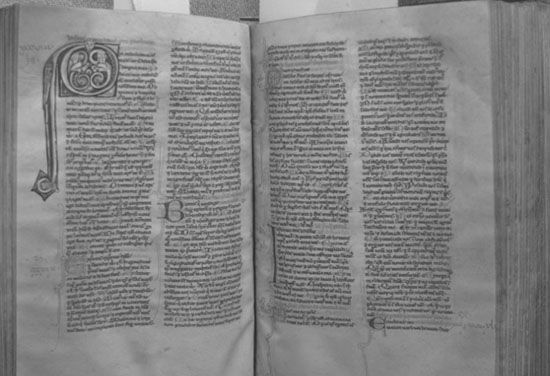
10. Bible, probably from Oxford (c.1250)—a new type of book for the use of scholars, like the Dominicans for which it was made. It is portable, clearly laid out, and easy for reference
The drama of salvation penetrated the parishes in sermons, artworks, and liturgy. The devotion which exalted the crucified Christ and fostered sympathy with the suffering God, born in the monasteries of the 11th century, was now a message for townspeople too, through the preaching of the friars. Francis himself exhibited unique identification with Christ by receiving five telling wounds—mirroring those on Christ’s body, on his two hands, two feet, and on his side—the stigmata. Believers were encouraged to identify with the sorrow of God, and of his grieving mother (Figure 11), and some went so far as to devote their leisure to the re-enactment of this compassion: in religious clubs dedicated to reciting devotional poetry, some accompanied by self-flagellation. As believers were drawn to a heightened sensibility to the Crucifixion during Lent and Holy Week, the difference between Christians and Jews was sensed most viscerally, prompting abuse and violence.
The involvement of lay people in religious activities was particularly noticeable in cities, where there was great wealth, and where the fostering of civic activities was at the core of existence. We have seen how central shared rituals were to a city like Siena. The participation of lay people as religious agents was now widespread, and it allowed women to become more visible too. Among the saints canonized after 1250 there are many more lay people, and many more women. And among those who were just admired in their communities were married women, widows, women of no learning, and visionaries. In the cities of the Low Countries and north Germany groups of women—beguines—combined manual labour in textile or lacemaking with charitable works, forming something like a parish unto themselves within a bustling city. Several assemblages of buildings—beguinages or begijnhoven—like those of Bruges and Ghent still convey the sense of order, modesty, and calm created by these busy religious women. They attracted suspicion and displeasure from some, but several far-sighted bishops and confessors understood how inspiring such women could be.

11. This Sculpted group for Santa Maria della Vita in Bologna c.1462/3, conveying the emotional intensity which became associated with the contemplation of Christ’s Passion, and which Christian audiences were invited to explore
European regions bred their own versions of religious identity. The cities of Flanders and Italy, where the gap between rich and poor was so stark, and where the mutations of worldly fortune were particularly acute, produced a gospel of radical poverty. The region of Languedoc in southern France with its distinctive Occitan culture, as well as some parts of northern and central Italy, received by the mid-12th century a brand of religion which we may call dualist, and it came to be known as Cathar. It espoused a cosmology in which two principles—one material and passing, the other spiritual and lasting—were at war.
Cathars rejected the sacraments which infused matter with grace, and recognized but one ritual act, the consolamentum, received by the most perfect Cathars. Cathars were led by the preaching of ‘good’ men and women, towards disassociation from flesh, sex, and power. The king of France and the pope combined in an attempt to bring Languedoc into the kingdom of France, and Cathars into the Catholic fold, in campaigns that have come to be known as the Albigensian Crusade (1209–29). As the northern army commanded by Simon IV de Montfort (1165–1218) confronted those of the Count of Toulouse, thousands were slaughtered in Cathar strongholds, like Béziers and Carcassonne. The Cathar religion was largely destroyed, but its beliefs still permeated Christian life a century later. The dualist tone of the villagers of Montaillou attracted the bishop of Pamiers’ inquisition between 1318 and 1324, and the resulting trial records contain the most detailed testimonies about these often complex religious beliefs.
Once lay people became involved in the making of religious life, it was impossible to contain the habit of inventive public religion. This was most evident at times of great distress. The response to the Black Death (1347–52) came in the form of many new associations: burial societies, flagellant associations, and novel arrangements for commemoration of the dead. Anyone who could afford it aimed to amplify the provision of prayers for themselves and their loved ones. Initiatives that called for Church reform took many different forms. In Bohemia a sentiment of ethnic identity was channelled into resistance to a largely German-speaking clergy. Inspired by the university theologian Jan Hus (1369–1415) a widespread movement—the Hussites—sought political independence from the Empire, and reform of the sacraments. In consequence, Hus was executed and the Emperor led a crusade against the offending region.
Although a priest was always required for the celebration of the sacraments, lay people—ranging from rich merchants to artisans, including men and women—sometimes preferred to go it alone. Some enriched their lives with books and images to hand, with regular access to a favourite preacher, or through connection with a religious house. In Flemish cities the Modern Devotion bypassed almost altogether involvement with the clergy, as its members concentrated on good works, reading of the Bible and devotional writings, while still remaining active in the world. Demand for devotional images, generated by this knowing laity, encouraged artisans to create the first engravings, and then a few decades later, the first woodcuts, the fledglings of the print revolution. By the early 15th century it was possible to buy strips of religious images, mechanically reproduced engravings, and these were sometimes hung on walls, or sewn into prayers books, especially those of religious women.
In Italian cities the 15th century saw an interest in the religious inspiration offered by children. Religious companies for youths, like the Company of the Archangel Raphael founded in Florence in 1411, displayed the purity and innocence of the young in processions, and enjoyed their musical performances. At the very end of our period the infamous charismatic preacher Girolamo Savonarola (1452–98) managed to infect Florence in the 1490s with religious enthusiasm, and employed youths in penitential processions, aimed at chastising sinners. On Palm Sunday boys and girls processed dressed in white, olive branches in their hair, and crosses in their hands. Renaissance Florence was clearly attuned to some very traditional modes of religious experience, which cannot simply be assigned to practices of the ‘Middle Ages’. Savonarola was hanged and burned as a heretic in 1498, a sign of the volatility and diversity of these styles of religious devotion and their political resonances.