
5
Notker the Stammerer, one of Charlemagne’s biographers, has left us in his ‘Life’ with a remarkable image of distressed greatness. Charlemagne arrives in an unnamed seaside town in Southern Gaul. As he sits eating his supper a fleet of pirates makes an attack on the harbour. At first there is confusion about their identity. Some take them to be Jewish merchants, others believe them to be traders from Africa or Britain. Charlemagne, however, from the build of the ships and their speed through the water, at once recognizes them as Northmen. ‘Those ships are not loaded with goods’ he tells his men, ‘they are filled with savage enemies.’ As the Vikings make their getaway after the lightning attack, the emperor’s men take up the chase but are soon outsailed. Afterwards, writes Notker,
Charlemagne, who was a God-fearing, just and devout ruler, rose from the table and stood at a window facing east. For a long time the precious tears poured down his face. No one dared to ask him why. In the end he explained his lachrymose behaviour to his warlike leaders. ‘My faithful servants,’ said he, ‘do you know why I wept so bitterly? I am not afraid that these ruffians will be able to do me any harm; but I am sick at heart to think that even in my lifetime they have dared to attack this coast, and I am horror-stricken when I foresee what evil they will do to my descendants and their subjects.1
The story is perhaps too good to be true and may only have been Notker’s way of announcing the emperor’s early perception of the dreadful havoc the Northmen would wreak on his legacy. Charlemagne will have been abetted in his pessimism by his close associate Alcuin, for whom the assault on Lindisfarne remained a catastrophic watershed in the history of civilization. Well before his death in 814 Charlemagne had plentiful experience of the new and troubling neighbour on his northern border following the subjugation of the Saxons and occupation of their territory in the 780s. The Danes were, in the judgement of the contemporary eastern Frankish Annals of Fulda, ‘the most powerful people among the Northmen’.2 Of the three Viking peoples it is they who, at all times, most resemble a coherent military power. As the references in the Irish annals to conflicts arising in the middle of the ninth century between the ‘fair’ and the ‘dark’ foreigners make clear, beyond the fact of a shared Heathendom (or more pertinently a shared non-Christianity) and a common language, Vikings from the various regions of Scandinavia were often rivals for territory and property. We know very little about the governmental and social structures of Norwegian society at the time, but of Danish society the comparative thoroughness of the Frankish annalists conveys the impression that towards the close of the eighth century it was ruled by a strong monarchy and extended over a stable region not unlike that of present-day Denmark, with the addition of that part of southern Sweden known as Skåne and the shore of the Vik in the vicinity of the Oslo fjord. Prior to the Carolingian expansion the Danes seem also to have claimed tributary rights over a number of other peoples in their region, including the Saxons and a tribe of Polabian Slavs or Wends known as the Obodrites. This in itself was an indication of local cultural superiority, for like most other Slav peoples the Obodrites were an egalitarian and clan-based society without tribal leaders which, in times of crisis, elected leaders at assemblies known as veche for the duration of the crisis only.3 The comparatively late arrival of the Danes in Ireland may in part have been due to the fact that they were engaged elsewhere, in the first instance watchful and anxious of Charlemagne and his expansionist Christianity.
The Royal Frankish Annals, which chronicle events involving Frankish rulers from 741 to 829, record a number of diplomatic contacts between the Franks and the Danes as they struggled to keep track of the changing status quo. In 782, the year of the massacre at Verden, the Danish King Sigfrid, who was then sheltering his Saxon brother-in-law Widukind from the Franks, sent an emissary named Halptani (Halvdan) to Charlemagne for formal political discussions at which a number of other Saxon leaders were also present.4 Sigfrid is noted as receiving an envoy from Charlemagne in 798 but then disappears from the record. In 799 the first Viking raid within Frankish territories was recorded, an attack on the monastery of Noirmoutier in the Vendée, in the Loire region of western France. It is likely the raiders were Norwegians who had taken the vestrveg from Ireland. In response Charlemagne ordered the building of a fleet specifically to counter the attacks of the Northmen. The ships were to be built and berthed ‘near to the rivers which flow out of Gaul and Germany into the North Sea’. Ports and the mouths of all rivers large enough to give access to foreign ships were also reinforced.5
Sigfrid was succeeded by King Godfrid, who in the course of a short reign developed what often seems like a personal rivalry with Charlemagne. He makes his first dramatic appearance in the Royal Frankish Annals in 804, arriving in Schleswig on the border between Danish and Saxon territory in 804 with his fleet and his entire cavalry for an apparently straightforward exchange of envoys with the emperor. In 808 he attacked his wayward tributaries the Obodrites to punish them for allying with Charlemagne, and destroyed their trading settlement of Reric. Reric’s traders were forcibly relocated within his own territory at Hedeby, a nascent trading settlement at the neck of the Jutland peninsula. The Franks reacted, and in the subsequent fighting Godfrid’s relative Reginold was killed. Still fearing the potential threat from a military alliance between Saxons and Danes, or even a direct attempt to take Saxony by Godfrid, Charlemagne had all the Saxons living close to the Danish border transported into Francia.
Godfrid continued to make his presence felt in the region. Well aware that it was a provocation, at about this time he ordered the reinforcement on his southern border of the Danevirke, a massive rampart some 14 kilometres long that straddled the Jutland peninsula from the marches of West Jutland to the town of Schleswig. Raised some seventy years earlier as a protective measure against Obodrite and Saxon raids, and linked to the horseshoe-shaped defence surrounding Hedeby, its very size remains a witness to the organized nature of Danish society at this time.
According to Einhard, Godfrid was ‘so puffed up with empty ambition that he planned to make himself master of the whole of Germany. He had come to look upon Frisia and Saxony as provinces belonging to him; and he had already reduced the Obodrites, who were his neighbours, to a state of subservience and made them pay him tribute.’6 Einhard even claims that his plans to march on the imperial capital at Aachen with a large army were at an advanced stage when, in 810, he was murdered by one of his own followers.
Godfrid’s joint successors were the brothers Harald, known as Klak-Harald, and Reginfrid, who may initially have been regents for the late king’s young son.7 In 813 an army under these two made its way to the Norwegian Vestfold, ‘an area in the extreme north-west of their kingdom whose princes and people refused to submit to them’.8 It sounds as if the purpose of this expedition was to re-impose a tributary status that had been neglected. The Norwegian archaeologist Bjørn Myhre has advanced a theory that the ritual damage done to the grave-mounds in the great Heathen burial centre at Borre in Vestfold may have been carried out by these two kings on this occasion, to punish the local people and reassert Danish power.9 The rebellion itself may have been another result of the general breakdown in regional stability caused by Charlemagne’s war against the Saxons. A further result may have been the emergence, as a coastal power centre a few decades later, of Avaldsnes on Karmøy, the regional home of the first wave of Vikings who raided west across the North Sea in England and the islands of Scotland and Ireland.
It was unwise to be long away from home in such unstable times. When the brothers returned they faced a large army raised by the sons of the late King Godfrid and were easily driven from the land. Reginfrid was killed in 814 trying to regain the throne, leaving Harald as a diligent and persistent pretender. With the death of Charlemagne a few months later, in January 814, the stage was set for a chaotic century during which his empire slowly disappeared, lashing and plunging like some great leviathan as it sank beneath the waves, goaded towards extinction by the ceaseless jabbing and thrusting of those seaborne northern warriors whose manifestation in southern Gaul had so distressed him. The chaos was compounded by the fact that the Danish royal families too were, for much of the time, engaged in dynastic struggles of their own, in the course of which it becomes very difficult to keep track of a meaningful distinction between, on the one hand, violent activity that might have been part of a coherent ‘foreign policy’ decided upon by a legitimate monarch and his advisers and carried out by a ‘national’ army; and, on the other, those actions - often the work of the same kings - which were nothing more than privateering on the grand scale.
In his attempts to reclaim the Danish crown after the coup by the sons of King Godfrid, Harald began a long association with the Franks. The Obodrites, apparently once again under Frankish control, were ordered by Charlemagne’s successor Louis the Pious to help him, and in 819 the sons of Godfrid - always a corporate identity in the annals - allowed him to join them on the throne. The unstable arrangement lasted only until 823, when the brothers once more drove Harald out. Again Harald applied to Louis for help.
Louis’ response was to send Harald back to Denmark, accompanied by emissaries who were to investigate the nature of the dispute, ‘as well as the condition of the whole kingdom of the Norsemen’, and report back to him.10 The sequence of events thereafter forms the first important narrative thread of Rimbert’s Vita Anskarii, his ‘Life’ of St Anskar, the ‘Apostle of the North’ and the missionary most closely associated with early attempts to curb Viking violence by bringing their Scandinavian communities into the fold of Christian peoples. Encouraged by the successes of Ebbo of Reims, who had preached among the Danes ‘and baptized many converts to the faith during the previous summer’, Louis suggested to Harald that he convert to Christianity.11 Such a move, he assured him, would lead to ‘a more intimate friendship between them, and a Christian people would more readily come to his aid and to the aid of his friends if both peoples were worshippers of the same God’.12 The offer of the political benefits of the adoption of Christianity was one that would be repeated many times by rulers in the Christian world who found themselves under attack by Vikings.
Like his father Charlemagne, Louis used the Church as an instrument of government. At a ceremony in Rome, on Christmas Day in 800, Charlemagne had been crowned first emperor of what would later be called the Holy Roman Empire. Contemporaries perceived this ‘empire’ as identical with western Christendom, though no such geographical entity existed. The symbolic significance of the ceremony was that Charlemagne became the pope’s designated partner in the promotion of Christianity, and the protector of the Church; and that he shared the Church’s vision of Christendom as a single community, ruled, under God, by a single spiritual ruler, with a single temporal ruler as his right hand. The arrangement has been called a dyarchy of pope and emperor.13The political implications of this were well understood in the Europe of the time, by Viking leaders in their Scandinavian homelands as well as by tribal leaders in territories to the east of the empire. In the course of the ninth and tenth centuries the dynasties of Great Moravia, Bohemia and Hungary all requested a missionary presence to help their applications to join what was, in effect, a primitive form of European cultural union, with Christianity as its common spiritual currency. In 821 the exiled Obodrite prince Slavomir submitted to baptism prior to embarking on a campaign to claim his crown, no doubt for the same reasons as Harald signalled his agreement to Louis’ suggestion.14
Anxious not to be outmanoeuvred, the sons of Godfrid sent envoys to Louis in 825 requesting a peace agreement, and this was duly arranged in October. The following year envoys from the Danish kings attended the imperial assembly at Ingelheim to ratify the agreement. But now Harald, in the company of his wife, brother, ‘and a large number of Danes’, arrived at St Alban’s in Mainz and on 24 June submitted to baptism.15 The immediate political rewards for his conversion included a gift of the coastal county of Rüstringen in Frisia, between the rivers Ems and Aller, which was intended as a safe haven for him in times of trouble, and Louis’ renewed promise of friendship and help to recover the throne.
Louis’ political aim had been the pacification of his Danish neighbours under the rule of his Christian ally, Harald. If, as a pious man himself, he secretly hoped for genuine conversion and not merely the cultural accommodation of Christianization then he presently had good cause to doubt the likelihood. Having promised the emperor that they would ‘obey him always and everywhere and in all matters’, Harald’s newly christened Danes found themselves adopted by the nobles of the royal palace, ‘almost as if they had been children’ as Notker writes, a line that recalls the strange enchantment worked by the pre-Lindisfarne pagans on the Northumbrian aristocrats at Athelstan’s court. Each catechumen received a white robe from the emperor’s wardrobe, and from his sponsors a full set of Frankish garments, with arms, costly robes and other adornments. This happened repeatedly, says Notker:
More and more came each year, not for the sake of Christ but for mundane advantages. They used to hurry over on Easter Eve to pay homage to the Emperor, more like faithful vassals than foreign envoys. On one occasion as many as fifty arrived. The Emperor asked them if they wished to be baptized. When they had confessed their sins, he ordered them to be sprinkled with holy water.
On one occasion when there were not enough linen garments to go round, Louis ordered some old shirts to be cut up and stitched together. Confronted with his, one old Dane regarded it suspiciously for some time before complaining to the emperor that he had gone through the procedure some twenty times now and always before been given a splendid white suit for his troubles. This was just an old sack. It made him feel like a pig-farmer, not a soldier. Having taken away his own clothes they’d left him with the choice of wearing this or else going about naked. As far as he was concerned they could keep their Christ, and their old rags too.16
Obviously some rudimentary notion of what it meant to be Christian would have to be conveyed if Christianization were to work as an effective political tool. Anskar was detailed to accompany Harald on his journey back to Denmark, to be his Christian conscience and help him bring the rest of the Danes to Christ. Extreme danger attached to the venture: the Vita Anskarii reports that Anskar and his companion Autbert had to make the journey without servants because none dared accompany them.17 Louis provided the mission with writing cases and tents.
Treated by his Danish travelling companions with indifference or contempt at first, Anskar’s status rose after the bishop of Cologne made him a present of a fine boat with its own comfortable sleeping quarters. It is not clear from Rimbert’s account whether or not the party was actually allowed to enter Denmark. He writes that Harald was stopped at the Danish border, but goes on to describe two years spent by Anskar preaching among the Danes. If Harald did return to power it was a brief and conditional return and not the Christian wedge into Denmark that Louis had been hoping for.
At this point Klak-Harald drifts out of Rimbert’s narrative and his later career is uncertain. The Annals of St-Bertin mention a certain ‘Harald, who along with other Danish pirates had for some years been imposing sufferings on Frisia and other coastal regions of the Christians’, and appear to identify him with Harald, a king without a territory, bound to a cycle of eternal raiding so that he could reward his men for their loyalty to him, so that they would follow him on his next raid, so that he would reward them for their loyalty.18 If this identification is correct, then he is also the apostate leader whose Viking activities in the region around what are now the Netherlands proved so disruptive to Louis’ son Lothar that he tried to buy him off with the gift of the province of Walcheren, in the mouth of the Scheldt estuary, a move that seemed to the annalist
an utterly detestable crime, that those who had brought evil on Christians should be given power over the lands and people of Christians, and over the very churches of Christ; that the persecutors of the Christian faith should be set up as lords over Christians and Christian folk have to serve men who worshipped demons.19
Saxo Grammaticus, in the Gesta Danorum, is more generous in his assessment. Only after describing what looks like a sincere but failed attempt on Klak-Harald’s part to introduce Christianity to the Danes does he turn to condemning him as a ‘notorious apostate’.20 The Annals of Fulda carried a notice of his death on the Danish border in 852 at the hands of a Frankish border patrol, in which he is recalled as a ‘person of doubtful loyalty and a potential traitor’.21 In his pragmatic acceptance of baptism for political ends, Klak-Harald set an example that other leaders would follow for much of the Viking Age, to the endless frustration of their Christian godfathers.
The last decade of Louis the Pious’ life brought him many disappointments, though he was in many ways the author of his own misfortunes. In 814, the year of his father’s death, Louis had made a division of the imperial territory among his sons that favoured Lothar with Bavaria and Pepin with Aquitaine. Three years later he confirmed Pepin in his possession of Aquitaine, gave Bavaria to another son, Louis, known as ‘the German’, and invited his eldest son Lothar to join him as co-emperor. His own father had been seventy years old and within months of his death before Louis had been similarly elevated; for Louis to have followed suit while his son was still only twenty-three was to prove a disastrously precipitate move. His anxious haste to secure the future of the empire was cruelly exposed when his second wife, Judith of Bavaria, bore him a son Charles, later ‘the Bald’, in 823. Under Judith’s influence Louis revoked the agreement of 817 and in 829 brought the child into the equation of his inheritance by giving him Alemannia. The immensely complex civil wars known as ‘the wars of the three brothers’ ensued. Lothar rebelled, and with the support of his brothers by Louis’ first wife, Irmengard, deposed his father. Louis was restored in 830 and attempted to mollify Lothar by giving him Italy in 831. In 832 he took Aquitaine from Pepin and gave it to young Charles, at which his older brothers revolted. Once more the emperor was deposed. Restored in 834, he made his peace with Pepin and Louis the German. Later that same year Lothar, who nursed the greatest grievance against his father, again rebelled. He stood alone this time, and his failure obliged him to retreat to Italy. Louis’ gifts of more territory to Charles in 837-8 were grudgingly accepted by the older brothers. Pepin’s death in 838 should have simplified matters but did not. Louis offered the three surviving sons a fourth partition in 840, dividing the empire between Lothar and Charles and leaving Louis the German with Bavaria. Dissatisfied, Louis rose against his father, but the challenge came to nothing. In an attempt to put an end to the chaos Louis summoned his sons to an assembly at Worms in July 840, but died before it could take place. At Verdun in 843 the brothers signed a treaty intended to bring order to his problematical legacy. Western Francia went to Charles, Eastern Francia to Louis the German, and a middle kingdom, Lotharingia, was created and named for Lothar. Western Francia may be identified roughly with the territory of present-day France, Louis’ share with modern Germany, and Lothar’s unnatural slice of territory, extending from the North Sea to Italy, with almost nothing at all. The arrangement did not put an end to the wars between the brothers.
As well as he was able, Louis had carried on the pursuit of his father’s goal of a Europe united under one, Christian culture. The creation of an episcopal see at Hamburg for the specific purpose of promoting missionary activity among the Scandinavians in the far north was, in this respect, his most significant achievement. In 829, with Anskar and Klak-Harald encamped on the Danish borders pending Harald’s hoped-for return to power among the Danes, messengers had arrived at Aachen from the trading town of Birka in the Mälaren district of Sweden requesting that Christian missionaries be sent to instruct the local people.22 Anskar was recalled and asked to undertake the mission. On the way his party was attacked by pirates and robbed of all their possessions, including a library of some forty books. Anskar continued on his journey and was well received at Birka by the local leader, King Bjørn.
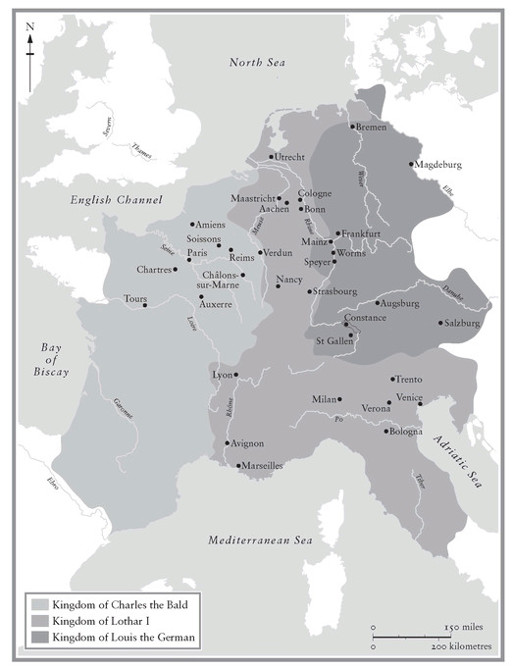
The Carolingian empire following the division between the sons of Louis the Pious after 843.
Rimbert’s near-contemporary account describes Anskar’s mission to the Swedes as successful. He mentions in particular a man close to King Bjørn, a certain Herigar, who was baptized and presently built a church on his own property.23 After two winters in Birka, Anskar returned to submit a report to the emperor. Louis thereupon ‘began to enquire by what means he might establish a bishop’s see in the north within the limits of his own empire’, a place that might be used as a centre for the bishop appointed to make ‘frequent journeys to the northern regions for the sake of preaching the gospel, and from which all these barbarous nations might easily and profitably’ come to Christianity. 24 His advisers replied that his far-sighted father had already made plans for such a see. When Charlemagne
had subdued the whole of Saxony by the sword and had subjected it to the yoke of Christ, he divided it into dioceses, but did not commit to any bishop the furthest part of this province which lay beyond the river Elbe, but decided that it should be reserved in order that he might establish there an archie piscopal see from which, with the Lord’s help, the Christian faith might successively spread to the nations that lay beyond.25
In 831 the see of Hamburg was duly created, with Anskar as its first bishop. Already the time had passed when a Frankish emperor might have been able to impose Christianity on the Scandinavians by force, and the imperial decision to place the monastery of Turholt, in the presumed security of Flanders, at the disposal of Hamburg, ‘inasmuch as this diocese [Hamburg] was situated in dangerous regions, and it was to be feared that it might come to an end in consequence of the savagery of the barbarians by which it was threatened’, shows a recognition of the fact that a dark and dangerous future loomed:26 Walafrid Strabo, the scholar who wrote the verse account of Blamac’s martyrdom on Iona in 825, was a court favourite of Louis, just as Alcuin had been a favourite of his father, and the dreadful story of Blamac’s death would have been familiar enough at Aachen.
For much of the period during which the Frankish empire suffered ‘the wars of the three brothers’, effective power among the Danes seems to have been in the hands of the astute King Horic. He was probably the last surviving of the ‘sons of Godfrid’, and held on to the crown more or less consistently from 814 until his death in 850. He turned out to be considerably more successful than Klak-Harald in juggling the double role of Viking and legitimate king.
A lull in Viking raiding after the 799 attack on the monastery at Noirmoutier was broken in 820 by thirteen Danish ships that attacked the coastal settlements of Flanders. Driven off, they had turned their attention to the mouth of the Seine, where they were once again repelled, with the loss of five of their men. From here they sailed up the coast of Aquitaine, successfully plundered the village of Bouin and returned home ‘with immense booty’.27 The Frisian trading town of Dorestad near Nijmegen, despite the protection of water, palisades and a fortress, was attacked and burnt in 834. So was Antwerp. When Dorestad was devastated for a third time two years later Horic sent envoys to the imperial assembly at Worms soliciting peace and friendship with the emperor. At the same time he formally complained about the murder near Cologne of a previous group of his envoys.
In 837 the exposed territory of Frisia was again attacked and the island of Walcheren plundered, the Vikings appearing ‘with their usual surprise’. Like his father Godfrid before him, Horic was unwilling to abandon the power exercised by Danes in the region before the advent of Charlemagne and in 838 he sent emissaries to Louis the Pious requesting recognition for his overlordship of the Obodrites and the Wilzes.28 His presumption seemed to Louis so inappropriate that the emperor simply ignored it. Yet the same emissaries also brought the emperor news that as a sign of King Horic’s friendship and good will he had captured and killed most of the pirates who had lately been troubling Louis’ territory. Horic’s gesture asked Louis to make a distinction between the activities of a legitimate royal house, and the embarrassing and entirely private doings of a large and unruly group of his subjects.
In 841, with the fortifications built by Charlemagne at the turn of the century to protect his rivers against just such raiding probably destroyed long before by his sons’ and grandsons’ warring, a fleet led by a Norwegian named Asgeir sailed up the Seine and captured and burnt Rouen. Asgeir’s army plundered its way up the Seine and burnt the wealthy monastery at Jumièges. Nearby Fontenelle was also attacked, sixty-eight monks taken prisoner and ransomed. Nantes was hit in 843 by a fleet of sixty-seven Norwegian Viking ships which probably set out from a longphort base in Ireland. The bishop of Nantes was among those killed, in one account while taking Mass. Others were captured to be sold abroad as slaves. From their experiences in Ireland the Vikings had learnt that Church festivals were among the most profitable times to attack, and Nantes was terrorized in late June, on the feast day of St John the Baptist. Nearby Noirmoutier - Francia’s Iona - had been attacked so often that in 830 the emperor gave his permission for it to be fortified. For a while the monks abandoned the island in the summer and returned in the winter when the danger of attack was less. In 836 the monks were forced to abandon the monastery altogether, taking with them the relics of the founder, St Philibert, and retreating further inland. Some thirty years later, the monk Ermentarius described their fear of the wilful blasphemy of the Vikings:
But in truth this is what they feared most: that the faithless men would dig up the grave of the blessed Philibert and scatter whatever they found in it hither and yon, or rather throw it into the sea. This was known to have happened in the region of Brittany to the remains of certain holy men; this we were told by those who had seen it and had fled before the most oppressive rule of these men.29
The Nantes Vikings, meanwhile, made camp on the island and used it as a base from which to terrorize the regions of the Loire and Aquitaine.
In late March of 845 a fleet of 120 ships appeared in the Seine, ‘laying waste everything on either side and meeting not the least bit of opposition’, and presently threatening Paris.30 The Annals of St-Bertin name its leader as Reginfred, a figure sometimes identified with the Danish chieftain, Ragnar Lodbrok, meaning ‘Hairy-Breeches’, whose role as a Viking Age legend we shall examine in more detail later. The army of Charles the Bald fled before this force and in desperation Charles offered them 7,000 pounds of silver to leave. This is the first recorded example of the danegeld payment, a money-with-menaces tactic that the Vikings would later employ with great success in England. In their own way these Vikings kept their word, heading ‘back down the Seine to the open sea’, raiding, looting and burning as they went. As they were heading for home, their ships laden with booty, the annalist recorded a divine retribution that struck them in the form of a severe illness, very likely dysentery.
In the same year, King Horic sent an enormous fleet of ships up the Elbe to attack the eastern Frankish territories of Louis the German. This sounds like a ‘legitimate’ royal enterprise, one king waging war on another; but once the fleet was repulsed the soldiers donned Viking caps and turned their fury on Hamburg. Again there was the familiar slaughter of monks, the burning of churches and monasteries, and the inescapable sense of overkill that characterized Viking violence against manifestations of institutional Christian culture. Anskar was in Hamburg at the time and with characteristically obstinate courage tried to persuade people to resist until reinforcements arrived. But perceiving the futility of it, he gathered what relics he could and fled. Alas for the monks of Hamburg, at the division agreed between the three brothers at Verdun in 843 the see had lost possession of their ‘safe haven’ monastery at Turholt and the monks were left with nowhere to go. Eventually a benefactress gave them a property about fifteen miles from Hamburg, and it was from here that Anskar gradually began the work of reviving the community. Horic, meanwhile, after the failed raid up the Elbe, turned himself back into a legitimate king again. He sent envoys to Louis the German with an offer to release all the captives taken by the invaders of 845, and promised he would try to recover the stolen treasure and return it to its rightful owners.
Some revision of Charlemagne’s original plan would have to be made if the campaign to Christianize the north were to continue. The devastations of 845 made it clear that the Hamburg site was simply too vulnerable. The solution approved by Anskar’s new patron, Louis the German, was to appoint him to the vacant see of the more easily defensible Bremen. After some bureaucratic manoeuvrings, Bremen was presently joined to Hamburg in 847-8 to create the archbishopric of Hamburg-Bremen, though papal ratification of the joint see was not forthcoming until 864. Anskar was its first archbishop; Rimbert, his biographer, was his successor.
Birka, the island town where Anskar seemed to have given Christianity a first frail foothold among the northern Heathens, was for much of the Viking era one of the most important trading centres in northern Europe. Situated in the Mälaren region of south-central Sweden between the territories of the Goths and the Svear, it was founded on royal initiative sometime in the middle of the eighth century and subsequently patterned after the trading centres of the Carolingian empire. One theory is that it came into being after the Islamic expansion of the seventh century had disrupted traditional trade routes between east and west in the south via the Mediterranean. From Birka it was only five days’ sailing across the Baltic to Russia and the great southbound rivers that gave access to markets all the way down to Constantinople. Adam of Bremen tells us that it was also only a five-day journey by sea from Hedeby, the market town created by Godfrid from the remnants of Reric.
Birka’s location on the island of Björkö made it an attractively safe harbour, but its developing importance and wealth rapidly made it a natural target for pirates. A hill-fort and a semi-circular rampart 350 metres long and 3 metres wide was built, crowned by a wooden walkway and turrets that gave a commanding view of the surrounding waters. Similar semi-circular ramparts have also been found at Hedeby, Århus in Denmark, and Ipswich in England. Adam tells us that among its other defences was an enormous underwater stone wall, and archaeologists have found the remains of a barrier of wooden stakes anchored in the clay bed of the lake that forced ships into a narrow approach lane and made it hard to approach the town unseen. Excavations undertaken in the 1930s of the area north-west of the hill-fort and the finds of very large numbers of arrow- and spearheads, chain mail and shield bosses, as well as a section of lamellar armour, thin, flat and layered, confirm that this was a vibrant centre that required the protection of a sizeable military presence. A population of somewhere between 700 and 1,000 was concentrated in the harbour area, living and working in small, square timber-framed buildings with wattle-and-daub walls, and wooden, thatched or turf roofs, two to a plot on each side of a system of plank-laid tracks. The so-called Warriors’ Hall built on the upper terrace of the garrison area was huge by comparison, 19 metres long and 9.5 metres wide, with two entrances and double-vaulted walls which provided good insulation. This hall-house was divided into two tall rooms with a fireplace in each. Locks, keys and chest fittings, spearheads and shield bosses were found along the walls. In the western part of what was almost certainly the town’s main hall, at which the king would be received when visiting, were found, among other things, a dragon’s head made of bronze, slivers of glass from goblets and two sword handles. Some forty comb-cases were also found for the combs that warriors would wear suspended from their richly decorated belts.31
The garrison warriors and probably many of the craftsmen were resident in Birka all year round. Others used the town only during the summer trading months. Raw materials such as iron, furs and horn were worked by craftsmen for local use as well as for export, jewellers had workshops there, as did smiths who made swords for export to the east. Much of the huge quantity of silver from the Islamic world was brought by merchants into the west via Birka. The town was also the centre for a slave-trade that was probably the most lucrative Viking Age business of all. When we reflect that the later African slave-traders made a profit of 600 per cent on the purchase price of slaves in Africa, and that the Vikings did not even buy their slaves but simply captured them, the proceeds of the trade must have been enormous. The islands of Britain were one source, the Slavic regions of eastern and eastern-central Europe another. Mainly the prey of the eastern-orientated Vikings of Sweden, these populations were captured for sale and dispersal on such a scale that their ethnicity became synonymous with their fate and the word ‘slave’ passed into the English language as the generic term. Rimbert writes of the joy of those Christians among the Birka slaves when Anskar’s arrival there in 829 gave them chance to celebrate again the proper rites of their religion. Anskar may even have bought their freedom for them, something Rimbert tells us he did whenever he was able.
The wealth attainable by the town’s most successful inhabitants is obliquely reflected in finds from some of the 3,000 or so graves located on the site. The richest of them, dated to the early years of the ninth century, was the last resting place of an aristocratic woman whose grave-gifts included gold- and silver-plated bead necklaces, silver clasps in the shape of horse heads, bowls, beakers and a glass funnel, and a glass smoother and whalebone plaque for her to iron her clothes with. A key opened a small chest that contained an exquisitely decorated comb.32 A literary reflection of the town’s wealth is found in a story of uncertain date that Rimbert tells in the Vita Anskarii about a deposed Birka king named Anund, who had taken refuge among the Danes. Anund made a deal with a local band of Vikings that he would leave Birka and all its merchants and silver open to them, if they would place their ships at his disposal and help him regain power. The town would be more or less undefended, he said, and at very little personal risk they would become very rich indeed. A fleet of thirty-two ships then descended on Birka, forcing the inhabitants to flee to the safety of nearby Sigtuna. From here they sent a message to Anund, asking his price to return Birka to them. Anund’s demand of 100 pounds of silver was met, and in turn he agreed to keep his part of the bargain. He thus crossed the line again and was a king once more, not a Viking. His Danish allies were furious at this sudden access of decency. They scorned the ransom he had demanded, claiming that ‘each individual merchant in the place had more than had been offered to them’. They threatened to pillage and burn Birka to the ground, and then do the same to Sigtuna. Anund played his double role well. Persuading the Vikings that there was some doubt about their chance of success he suggested they cast lots to see the will of the gods. The results were interpreted, the attack was doomed to fail, and the Vikings departed. So that their journey would not have been entirely in vain they sacked a town on the Slav border as they made their way back to Danish territory. Anund afterwards returned the ransom money to the Birka merchants.33
Birka lay not far from the temple centre of Uppsala, where Heathen culture was at its strongest, and it is no surprise that, at about the same time as Anskar and the other Hamburg exiles were wandering with their relics in search of a new home, the inhabitants of Birka should have turned against Gautbert, the bishop he had left behind to guide them in the ways of the new faith. They killed his chaplain Nithard and several others with him, robbed the bishop and drove him out of the country ‘with insults and abuse’. On this point Rimbert is insistent: ‘This was not done by command of the king, but was brought about by a plot devised by the people.’34 The reaction left the Church without a presence in Birka for some seven years, until 851. Rimbert learnt later of the hostility endured by the converted Herigar. During a general discussion about religion at an Assembly meeting, defenders of the old faith had reproached him for having accepted, alone, a creed that seemed to the rest of them worthless. His greatest crime was cultural treason, that in choosing Christianity he had ‘separ ated himself from them all’.35
All the sweeter, then, for Anskar to have finally baptized a reigning Danish king. In a rare moment of unity Lothar, Louis and Charles had sent envoys to Horic in 847 ordering him to stop his people from attacking Christians and threatening him with war should he fail to do so.36 But Adam of Bremen tells us that the Danish Vikings paid what amounted to a licence fee to their king for the right to raid, and the profession of seaborne violence was by now so profitable that control of it was no longer in Horic’s hands. Pragmatist and survivor that he was, he submitted instead to baptism by Anskar as the missionary was passing through his territories on the way back to Birka. Horic later built a church in Schleswig and permitted the practice of Christianity throughout his territory, without making it compulsory.37
With Horic’s conversion, the Danish dynastic conflict that flared up again not long afterwards acquired, if only incidentally, a religious dimension when it pitted him against his Heathen nephew, Guttorm. Both were killed in circumstances which are unclear and the throne passed to another Horic, known as the Younger. This youth at once began to persecute those who had converted to Christianity under the liberal regime of his predecessor, driving out the priests and closing down the churches.38 The charismatic Anskar travelled to see him, struck up an immediate rapport with him and presently converted him. Rimbert credits Horic the Younger with the building of a church at Ribe, the second in Denmark after the Schleswig church.
Anskar died of natural causes in Bremen in 865 and was canonized a few years later. It was, Rimbert tells us, a matter of regret to him that he had not died the death of a martyr. But, as the record of his fearless engagement shows, the failure was no fault of his. The archaeological record makes no unequivocal statement about the success of his Birka mission. Mere burial and the fact of the east-facing orientation of the buried individual are no longer regarded as an infallible indication that he or she was a Christian, buried thus for a first sign from the east of the Second Coming. Indeed, as the Oseberg and Gokstad burials show, inhumation was practised as often as cremation by Heathen Vikings. In general it would seem that the syncretism characteristic of most cosmopolitan centres typified the funerary practice of the inhabitants of Birka. A richly furnished double burial containing the familiar weapons, jewellery, tools, food and bowls, as well as a single cross pendant and a single Thor’s hammer pendant, is one example.39 The fact that Rimbert singles out two Birka women, Frideborg and Katla, as being notably good Christians may hint that Christianity was especially attractive to Heathen women. The possibility is reinforced when we consider that all ten cross pendants found in Birka, including the one in the double grave, were located in graves in which women had been buried.
It might seem as though Christianity had made little headway in Scandinavia in the ninth century, despite the efforts of Anskar, Ebbo, Gautbert, Herigar and the other priests, missionaries and converts who preached among the Danes and Swedes.40 But, just as the early, sporadic Viking raids prepared parts of the British isles and northern France for future colonization, so might Anskar’s missionary activity have prepared the ground in the Scandinavian homelands for a coming sea-change in religious belief.
*
When, as part of the baptism deal of 826, Louis the Pious handed territory over to Klak-Harald he set a volatile and unpredictable precedent for his sons. Lothar had employed the tactic again in 841 to buy off (probably) the same Harald with Walcheren, though the annalist calls that a gift ‘to secure the services of Harald’. Rorik, a nephew of Harald, inherited the gift and the relationship. In 850 he broke it off and with an enormous number of ships attacked Frisia and the Betuwe region of what is now the Netherlands, between the Waal and the Rhine. Unable to deal effectively with him, Lothar made him a gift of lands including Dorestad, in effect washing his hands of it. Like other trading towns, it had become a favourite target for Viking raiders.
Charles the Bald had made payments to Reginfred to buy off a force besieging Paris in 845 and, as we have seen, other payments in 857 or 858 to a Viking named Bjørn who had fortified himself on the island of Oissel and was using it as a base for raiding in the surrounding countryside.41 Bjørn’s army seems not to have honoured its side of the bargain on this occasion, for in 861 Charles had to pay another 5,000 pounds of silver to a fleet of Vikings, led by Weland, to dislodge them. This they did; but the success of the tactic was only apparent, for the displaced Oissel army then attacked Meaux in an attempt to win back what they had lost. A large part of one or both of these armies then became directly involved in Charles’s dispute with King Salomon of Brittany over the possession of Anjou. Salomon was already using an army of Viking mercenaries, and Robert the Strong, the Frankish commander in Neustria, now offered an army of Seine Vikings 6,000 pounds of silver to join him in fighting against them. The upshot was that, by the Treaty of Entrammes in 863, Charles the Bald recognized Anjou as part of Brittany. He resorted to payments again in 866 and 877, on both occasions because his army proved incapable of matching the Viking armies on the Seine.
A thread that runs through most of the ninth century links some of these Frankish concessions of money, and sometimes land, to the ambition originally attributed by a mocking Einhard to Godfrid, king of the Danes, that he wished to challenge the Carolingian empire itself. Louis the Pious’ support for Klak-Harald, and the intermittent acceptance of his claims by the sons of Godfrid to be joint ruler of the Danes, suggest there was a genuine basis to his claim. Information in the sources about Danish dynasties is sparse from the death of Godfrid until the rule of Gorm the Old over 100 years later. We know that Klak-Harald had a son whom he named Godfrid. If he was following a dynastic naming practice in this, it may imply that the Godfrid whom he succeeded in 811 was his father, so that he was an older and perhaps illegitimate half-brother of the ‘sons of Godfrid’ and that this was the basis of his claim. His son, the second Godfrid, was paid by Charles the Bald in 853 to defect from an alliance with Lothar. Afterwards he raided in Frisia in the area around the Scheldt, and finally threatened the lands around the Seine. An entry in the Annals of Fulda says that Charles also gave him ‘land to live on’.42 He in turn had a son, also named Godfrid, who became heavily involved in the Carolingian power struggle in the 880s that followed the death in 882 of Louis III, a grandson of Charles the Bald and king of the western Franks, and the crowning of Charles the Fat, brother of a grandson of Charles the Bald, as emperor. In the notably chaotic year of 882 a Frankish army was defeated by a force under this third Godfrid. The Annals of Fulda tell us that the Vikings followed after the retreating Franks ‘and burnt with fire all that they had previously left intact, as far as the castle of Koblenz, where the Moselle enters the Rhine’.43 They attacked Trier, drove off or killed the inhabitants, and on 5 April burnt it to the ground. They took control of the monasteries nearby, and also the monasteries at Liège, Prüm and Inden. The greatest insult came when they took ‘even the palace at Aachen and all the monasteries of the neighbouring dioceses’, most of which they burnt.44 The end of the Carolingian dynasty could not be far away when Charlemagne’s capital, the seat of power in what had once been an unassailable empire, could not be protected against the invaders. Charles the Fat appeared willing to head a major attempt to get rid of the menace before it was too late. An army of Franks, Bavarians, Alemans, Thuringians and Saxons, large enough ‘to be feared by any enemy, if it had a suitable leader and one it agreed on’, marched on the Vikings’ fortification of Asselt.45 Things seemed to be going the way of this besieging force when, to the annalist’s disgust, Charles was persuaded to offer terms to Godfrid - ‘the emperor received him as if he were a friend and made peace with him; and hostages were exchanged’. To show their sincerity the Vikings gave what was obviously a familiar signal and ‘hoisted a shield on high after their fashion and threw open the doors of their fortress’. Curious, probably hoping to do some trading, Charles’s soldiers entered the camp, at which the Vikings ‘reverted to their usual treacherousness’, lowered the shield, closed the gates and killed or captured the trapped soldiers. Charles’s position may have been weaker than the annalist knew. Instead of avenging the slaughter the emperor then ‘raised the aforementioned Godfrid from the baptismal font, and made the man who before had been the greatest enemy and traitor to his kingdom into a co-ruler over it’. Godfrid was given the territories and benefices previously handed over to Klak-Harald and his brother Rorik by Louis the Pious. Using money obtained from Church funds Charles also paid his army a large sum of money. To complete their humiliation, the Franks had to look on as the Vikings loaded their ships with booty and hundreds of captives for sale as slaves. Charles’s desperation, the sheer military power of this Viking force, and Godfrid’s high ambition are all reflected in a marriage agreement that formed part of the settlement in which Godfrid was given Gisela, a daughter of Lothar II, king of Lotharingia. But in what looks like a last attempt to realize in full the dreams of power attributed to the first in this line of ambitious God frids he threw it all away in 885, renounced his faith and set off up the Rhine at the head of a great army on a campaign of major conquest. He too, however, like that first Godfrid, was murdered before he had made a real start on his campaign.
It seems obvious now that policies of appeasement and alliance with individual Viking leaders only encouraged them to push harder. The tactics employed by Louis the Pious, Lothar, Charles the Bald and Charles the Fat established clear precedents for the gift of lands around Rouen and the lower Seine made to the Viking leader Rollo in about 911, which eventually led to the creation of the duchy of Normandy. Even so, it is hard not to sympathize with them, in particular with the two Charleses who made the most active use of the policy, or to see what alternatives they had. From about 840 onwards Paris was under more or less constant threat from Viking armies of a size that dismayed Frankish observers into what may sometimes have been exaggeration but what must always have been, on any account, terrifying manifestations. The monk Abbo de St Germain, in his epic Latin verse De bellis Parisiacae, written in the early 890s, gives us a vivid literary reflection of what the Parisians were up against, trebu chets or ‘engines of war’ and all. It also shows how much the western Franks needed a hero and how, with the great siege of Paris in 885, they got one in Count Odo. Prior to the attack, writes Abbo, 700 sailing ships and an undisclosed number of smaller ships packed the Seine for a distance of more than two leagues, ‘so that one might ask in astonishment in what cavern the river had been swallowed up, since it was not to be seen’.46 The engagement that followed was regarded by contemporaries as crucial. In his letter to Charles the Fat, Archbishop Fulk of Reims wrote of Paris as the ‘head and key’ of the western Frankish kingdoms of Neustria and Burgundy. If it fell to the Danish invaders, he predicted, it would spell the end of France.47 The Danes, under the command of Sigfrid, arrived on 25 November and made their demands for tribute. According to Dudo of St Quentin, Rollo, the founder of the duchy of Normandy, was another of the leaders, though most historians doubt this. The demand was rejected. After a scene-setting prelude, Abbo’s account of what followed places us memorably at the very heart of a Viking Age battle:
The second day after the fleet of the Northmen arrived under the walls of the city, Sigfrid, who was then king only in name but who was in command of the expedition, came to the dwelling of the illustrious bishop. He bowed his head and said: ‘Gauzelin, have compassion on yourself and on your flock. We beseech you to listen to us, in order that you may escape death. Allow us only the freedom of the city. We will do no harm and we will see to it that whatever belongs either to you or to Odo shall be strictly respected.’ Count Odo, who later became king, was then the defender of the city. The bishop replied to Sigfrid, ‘Paris has been entrusted to us by the Emperor Charles, who, after God, king and lord of the powerful, rules over almost all the world. He has put it in our care, not at all that the kingdom may be ruined by our misconduct, but that he may keep it and be assured of its peace. If, like us, you had been given the duty of defending these walls, and if you should have done that which you ask us to do, what treatment do you think you would deserve?’ Sigfrid replied. ‘I should deserve that my head be cut off and thrown to the dogs. Nevertheless, if you do not listen to my demand, on the morrow our war machines will destroy you with poisoned arrows. You will be the prey of famine and of pestilence and these evils will renew themselves perpetually every year.’ So saying, he departed and gathered together his comrades.
In the morning the Northmen, boarding their ships, approached the tower and attacked it. They shook it with their engines and stormed it with arrows. The city resounded with clamour, the people were aroused, the bridges trembled. All came together to defend the tower. There Odo, his brother Robert, and the Count Ragenar distinguished themselves for bravery; likewise the courageous Abbot Ebolus, the nephew of the bishop. A keen arrow wounded the prelate, while at his side the young warrior Frederick was struck by a sword. Frederick died, but the old man, thanks to God, survived. There perished many Franks; after receiving wounds they were lavish of life. At last the enemy withdrew, carrying off their dead. The evening came. The tower had been sorely tried, but its foundations were still solid, as were also the narrow bays which surmounted them. The people spent the night repairing it with boards. By the next day, on the old citadel had been erected a new tower of wood, a half higher than the former one. At sunrise the Danes caught their first glimpse of it. Once more the latter engaged with the Christians in violent combat. On every side arrows sped and blood flowed. With the arrows mingled the stones hurled by slings and war-machines; the air was filled with them. The tower which had been built during the night groaned under the strokes of the darts, the city shook with the struggle, the people ran hither and thither, the bells jangled. The warriors rushed together to defend the tottering tower and to repel the fierce assault. Among these warriors two, a count and an abbot, surpassed all the rest in courage. The former was the redoubtable Odo who never experienced defeat and who continually revived the spirits of the worn-out defenders. He ran along the ramparts and hurled back the enemy. On those who were secreting themselves so as to undermine the tower he poured oil, wax, and pitch, which, being mixed and heated, burned the Danes and tore off their scalps. Some of them died; others threw themselves into the river to escape the awful substance . . .
Meanwhile Paris was suffering not only from the sword outside but also from a pestilence within which brought death to many noble men. Within the walls there was not ground in which to bury the dead . . . Odo, the future king, was sent to Charles, emperor of the Franks, to implore help for the stricken city. One day Odo suddenly appeared in splendour in the midst of three bands of warriors. The sun made his armour glisten and greeted him before it illuminated the country around. The Parisians saw their beloved chief at a distance, but the enemy, hoping to prevent his gaining entrance to the tower, crossed the Seine and took up their position on the bank. Nevertheless Odo, his horse at a gallop, got past the Northmen and reached the tower, whose gates Ebolus opened to him. The enemy pursued fiercely the comrades of the count who were trying to keep up with him and get refuge in the tower.48
The siege went on for about eight months. By the time it ended Sigfrid had already accepted a paltry ransom in silver and led his men away. Twice Odo had managed to slip through the Viking lines and urge Charles the Fat to come to the rescue of the Parisians. In the summer the remaining Vikings, weary of the wait, their morale ebbing, made another desperate attempt to breach the walls. When it failed, still more of them gave up, dispersed and set about looting the surrounding countryside. Charles arrived in October with the imperial army and surrounded the remaining force. The stand-off lasted until the spring of the next year, when Charles’s offer of 700 pounds of silver was accepted. Deposed in 887 and dead in 888, Charles was replaced as king of the western Franks by the heroic Odo and for the first time the crown passed out of the hands of the Carolingian dynasty. Over the next century it would pass back and forth between the Robertians, named for Odo’s father Robert the Strong, and the Carolingians, but with the accession of the Robertian Hugh Capet in 987 the great dynasty finally and permanently lost its hold on power. The Vikings did not cause this break-up of Charlemagne’s empire and the demise of his dynasty. Responsibility for that lay squarely on the ceaseless disagreements between Louis’ sons, ‘the three brothers’, but Viking military activity made these disagreements hard to resolve, and the presence, throughout the long crisis, of mercenary groups of skilled warriors, prepared to fight alongside whoever made them the best offer, was a temptation the brothers too often failed to resist.