
6
An entry in the Annals of St-Bertin tells us that, on 18 May 839, a group of envoys from the Byzantine Emperor Theophilus arrived at Ingelheim and presented themselves at the court of Louis the Pious. Their purpose was to confirm a treaty of ‘peace and perpetual friendship and love’ between the two emperors. Attached to their party were a number of men who described themselves as belonging to a group or tribe that called itself ‘Rhos’ or Rus. They presented a message of friendship from their own leader and a letter from Theophilus requesting that Louis give them safe conduct through his territories on their homeward journey north. The letter explained that the reason these men were taking such a roundabout route was that on their outward journey to Constantinople they had encountered a number of dangerous and threatening tribes whom they wanted to avoid on the way back.
Louis distrusted these Rus. He suspected them of spying. On closer investigation, the annalist tells us, the emperor learnt ‘that they belonged to the people of the Swedes’. Since Anskar’s first mission to Birka in 829, the Franks had learnt enough about travelling Swedes to distrust them, and to associate them with the attacks on their territories by other northern pirates. With these in mind, Louis may well have found their claim to be seeking protection from ‘primitive tribes that were very fierce and savage’ an ingenuous one. In his reply to Theophilus he said that he would detain the men at his pleasure, pending a further investigation of them. Should this prove satisfactory he would give them the help requested. Should they fail to pass his tests he would send them back to Theophilus for the emperor to deal with as he saw fit. Disappointingly the story ends there and we learn nothing more about the fate of these travellers. A particular frustration is that we do not know whether they were making their way back to Birka and Sweden, or whether their goal was a settlement already established on the far side of the Baltic, possibly at Gorodische at the northern end of Lake Ilmen.1
This is the first reference in the written sources to that group of Vikings from the eastern side of the Scandinavian peninsula who crossed the Baltic in search of wealth, trading opportunities and new lands to settle. Several explanations have been advanced for the name by which they became known, the Rus. One is that their tribal home was Roslagen, an old name for the coastal stretch north of Stockholm.2 Another relates it to ruotsi, a name by which Finns refer to present-day Sweden and which, in former times, meant ‘men who row’. The early history of the Rus is shrouded in mystery, for the tribes they encountered in these regions were as little literate as themselves, and the scholars and historians of the Islamic caliphate and of the Byzantine empire met them too infrequently to provide a coherent record of their provenance and their doings. But from the material in Snorri Sturluson’s Ynglingasaga it is clear there was a long tradition among Scandinavian kings of piracy and land-taking across the Baltic dating back to a time long before the appearance of the Rus at Louis’ court in 839. Snorri summarizes Sweden’s legendary past as a series of power struggles that usually ended with the flight of the defeated candidate. Some of these dispossessed or landless leaders went west into Norway and became kings there. Others became the kind of hybrid he calls ‘sea-kings’. ‘At that time,’ he writes, ‘kings, both Danes and Norsemen, were harrying in Sweden. There were many sea-kings, who had great armies but had no land.’ One he names was Salve, son of a king from the Naumdal district of Norway, who began his career harrying in the Baltic before an attack on Sigtuna won him the kingship of the Swedes on land.3 The enterprise of such leaders often led them east, to try their luck on the far side of the Baltic. The long and partly legendary succession of the Yngling kings was finally ended by Ivar the Far-Travelled, whose territories, according to Snorri, included all of Sweden and Denmark as well as parts of Saxony and the Baltic provinces. Snorri’s belief that the Caucasus was the ancestral home of the Swedes seems to have derived, in part at least, from stories that connected certain of these early and legendary kings with the region, to which he afterwards added the homophonic ‘proof’ of Aesirand Asia. He tells us of a Swedish king named Svegdir who crossed the Baltic on a sort of pilgrimage in search of ‘the Godheims and Odin the Old’, the home of the gods and Odin.4 He stayed away five years and eventually reached ‘the land of the Turks and Sweden the Great, and found there many kinsmen’. Tjodolf of Hvin described in verse the result of his search. Very drunk and on his way to bed one evening, he saw a dwarf sitting under a large stone. The dwarf lured him inside with a promise that he would meet Odin. Svegdir accepted and was never seen again.
The site of Svegdir’s supposed disappearance was a town in Estland called Stein, and this strip of Baltic coastline between Estland on the Gulf of Finland and the territory of the Couronians bounded in the west by the river Niemen became, for obvious geographical reasons, the first focus of interest for Swedes travelling east. A series of excavations, begun in 1929 by the Swedish archaeologist Birger Nerman near the Latvian city of Grobin, some 15 kilometres inland from the coast, showed that a Scandinavian colony had existed in the Couro nian region of the Aland river for some 200 years, from about 650. Nerman associated this colony with the expulsion of one-third of the inhabitants of Gotland, as a result of the famine described in the Gutasaga. Three burial grounds in particular show signs of Scandinavian burial customs. Many of the graves in level ground were those of women, whom their belt-buckles and so-called disc-on-bow brooches identified as natives of Gotland. Women in such numbers are unlikely to have crossed the sea alone, and it seems probable they were members of a community which had settled in the area. The grave-mounds housed predominantly men, very often accompanied by typically Scandinavian weaponry. In one grave a picture-stone depicting two duck-like birds was found. These picture-stones were unique to Gotland, and evolutions in their shapes and motifs over the centuries date this Grobin stone to the sixth or seventh century. The importing of picture-stones was not unheard of; one that has since been lost was recorded in the churchyard at Norrsunda, Uppland, in 1632. Two others turned up on the island of Oland.5
Saxo Grammaticus, in the Gesta Danorum, describes Viking raids across the Baltic in about 840 and 850 and gives the names of the leaders as Ragnar Lodbrok and Hasting. Hasting is another, like Ragnar, who looms large in the treacherous marches that divide legend from credible fact in Viking Age history.6 His activities may lie behind a series of events described by Rimbert in the Vita Anskarii, in which he may also be referring to the Grobin colony. According to Rimbert, people inhabiting the Courland regions of Latvia rebelled after a long period as tributaries of Swedish rulers. In about 854 a fleet of Danes - conceivably led by Hasting - attempted to reimpose the tribute on their own behalf but was heavily defeated and suffered the ignominy of having its own ships plundered. The Swedes then raised an army to win back the former colony, in the process destroying an army of 7,000 men and devastating the trading centre at a place Rimbert calls ‘Seeburg’, usually identified as Grobin.7 From Seeburg a march of five days brought them to the gates of a second Courland city at Apulia which they besieged for eight days, finally forcing from its inhabitants a large payment in silver and a resumption of the former tributary status.
By the early years of the ninth century female graves from the Grobin settlement associated with Gotland become scarce and later graves are those of seafaring Scandinavian males.8 The change may directly reflect the displacing of the ethnic Scandinavian settler by the transient Viking, whose interest lay in gaining access to the trading markets in the south, at Constantinople, which the Vikings called ‘Miklagård’ - the great city - and along the Volga. The trade entailed long and hazardous journeys and the best chance of survival lay in travelling in company with other men.
At first glance there would seem to have been little in the region to excite the interest of such a trader and pirate. There were no rich Christian monasteries and churches, no towns to raid. The terrain was marshy and densely wooded. In the north it was occupied as far as Lake Ilmen by Slavs who had been slowly making their way north-east from the Carpathian area. The vast and semi-arid zone of the steppes swarmed with nomadic tribes. But three large rivers, the Western Dvina, the Dneiper, and the Volga, rose in this region of the central Russian plateau, and their relative proximity made it possible to move between river basins. They formed the main arteries of a complex system of tributaries, lakes and smaller rivers connected by portages rarely more than 20 kilometres in length that created two long-distance trade routes connecting the Baltic with the Black and the Caspian Seas, the Baltic-Dneiper and Baltic-Volga routes. Together they gave waterborne access to a new world of markets in the south, among the Christians of Constantinople and the Muslims of the expanding Arab world.
The initial stages of the route led the sailors first into the Gulf of Finland, up the stub of the river Neva and then along the southern shores of Lake Ladoga to the river Volkhov. All of their way thus far was navigable by the ocean-going ships in which they had crossed the Baltic. About 20 kilometres down the Volkhov rapids, in the direction of Lake Ilmen, shallows and sandbanks made it necessary to change to smaller ships for the rest of the journey. Some kind of Swedish settlement seems to have been in existence at this staging-post as early as the seventh century, but its development into the significant Staraja Ladoga settlement began sometime in the middle of the eighth century. It functioned as a port and service centre for ships and crews heading south or returning home to Sweden after trading in Constantinople. In the oldest cultural layer of the settlement, established by dendrochronology to date from the 760s, the remains of large timbered houses with central fire-pits have been unearthed, along with articles of identifiably Scandinavian origin - such as the ubiquitous combs - that match items found at Birka. The site of a blacksmith and jeweller’s workshop has been identified from this same early cultural layer, with forge, furnace, metal workshop and a collection of tools including pincers, jewellery hammers, drills and a tiny anvil.9 The find of some twenty wooden toy swords from a cultural level identified as Ladoga’s oldest, dated to between 750 and 830, may suggest that families had begun to settle in the town by this time.10 The burial ground at Plakun, on the bank of the river opposite Ladoga, shows characteristically Scandinavian features, with some twenty mounds containing the remnants of cremations in boats, along with a solitary burial chamber.
Two more settlements were established further south along the river, Gorodische and Novgorod. Gorodische seems to have had no specialized trade activity, its primary function being as a military outpost guarding the approach to Ladoga.11 Novgorod means ‘new’ Gorod, though the settlements appear to have developed simultaneously and were only 2 kilometres apart. It grew up at the northern end of Lake Ilmen and had access by river and portage to the Upper Volga, the Western Dvina and the Dneiper. The neck-rings with pendant hammer that were popular among the devotees of Thor have been found here, as well as amulets with runic inscriptions and a small carved figure identified as a Valkyrie. The Scandinavians called it Holmgård, ‘the island city’, a name that agrees with the description of the settlement given by the tenth-century Arab historian Ibn Rustah as ‘on an island surrounded by a lake. The circumference of this island on which they live equals three days’ journey. It is covered with woods and morasses.’12 He numbered its population in the thousands and summarized their way of life thus:
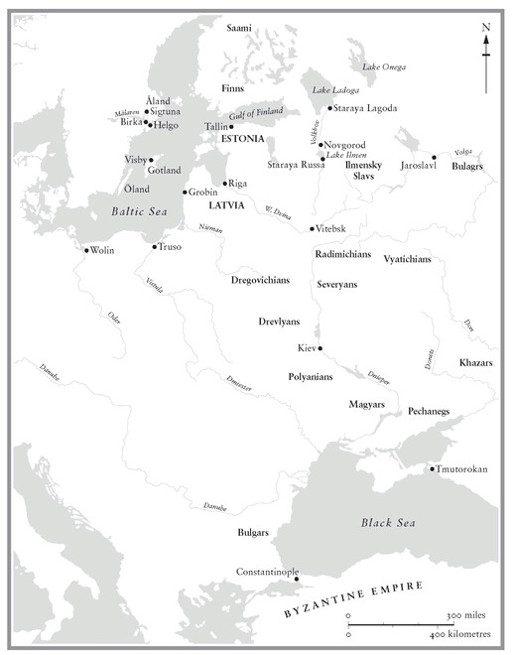
Trading and colonisation east of the Baltic largely involved Swedish Vikings, known as Rus, who gained access from the Gulf of Finland to the river network that led them down to Constantinople.
They have no fields but simply live on what they get from the Slavs’ lands. When a son is born, the father will go up to the newborn baby, sword in hand and throw it down. ‘I shall not leave you with any property’ he says. ‘You have only what you can provide for yourself with this weapon.’13
Amber, arrows, swords, wax, honey, walrus tusks, fox furs, marten furs, falcons and slaves were what the Vikings brought to these new markets in the south. What they took away from them was silver. A serendipitous result of the Islamic taboo against the reproduction of images is that Arabic coins were stamped not only with epigrams from the Koran but also with the denomination and the year of minting. The find at Ladoga of an Arabic coin dated 786 suggests that the silver trade between the Rus and the Arabs was already under way by this time. In the form of buried hoards some 84,000 silver coins from the Islamic world have been found in what is now Sweden. In addition, 65,000 Arabic dirhams have been found on Gotland alone. The vast size of some of these buried deposits indicates the sheer volume of the trade. The Spillings hoard, discovered in 1999 on a farm in the north-east of the island, weighed 67 kilograms and included over 14,000 coins of Arabic origin, as well as almost 500 silver armbands, some three dozen silver bars and a great many spiral silver rings. Viking Age Scandinavians ignored the face value of silver coins and artefacts and valued them by weight and content alone. The bars and armbands had been fused into equal units of exchangeable weight and about 88 per cent of the coins had been cut, turning them into so-called ‘hacksilver’. The hoard was truly enormous. Each Gotland household paid an annual tax to the Swedish king equivalent to 12 grams of silver; if an estimate of the number of farms on Gotland at the time at about 1,500 be correct, then this one hoard alone would have paid the islanders’ taxes for six years.14
The reluctance of the Rus, who turned up at the court of Louis the Pious in 839 to return northwards by the same route as they had travelled south, indicates that the Baltic-Volga and Baltic-Dneiper river routes to Constantinople were not yet secure. They may have been using the long-distance overland trade route travelled by Jewish merchants between the Near East and France, called ar-radaniya in the Arabic sources, that led from the towns of the lower Volga to either Krakow or Prague and then through Germany; but in terms of convenience it could not compare with the potential of the river routes.15 The securing of these routes became an enterprise intimately associated with the formation of the Kievan or Old Russian State by the leaders of the Rus, and the creation of this Kievan polity was the subject of the earliest written history of Russia, the Russian Primary Chronicle, a compilation made in Kiev early in the twelfth century by the monk Nestor, whose own Lives of the saints Boris and Gleb was among its sources, along with the Byzantine chronicle of Georgius Hamartolus, a Life of Methodius, missionary to the Slavs, and various treaties of the Kievan state with Constantinople, some of which are included in what looks their entirety. Like many of the earliest histories of polities that later turned into nations, the Russian Primary Chronicle is a source to approach with caution, but there is general agreement that a basic core of historical fact does underlie the literary improvisations of its compiler(s); the dates given may be inaccurate, but it is accepted that the events to which they refer took place.
After a beginning that locates its cast of tribes in a mythical biblical diaspora, the Chronicle approaches historical time with a reference to an attack by the Rus on Constantinople in 852, on which it does not expand. In 859 a tribe referred to as ‘the Varangians from beyond the sea’ imposed tribute upon a number of other tribes including the Chuds, the Slavs, the Merians, the Ves and the Krivichians. In a situation that has clear parallels to the one described by Rimbert in the Vita Anskarii these tribes rejected the tribute, drove the Varangians back across the sea and set about governing themselves. The task proved beyond them and a period of warfare ensued. In 862 a decision was taken to put an end to the violence by appointing ‘a prince who may rule over us, and judge us according to law’. According to the Chronicle, tribal representatives then crossed the Baltic to Sweden and approached a group of Scandinavians, known as the Rus, ‘just as some of them are called Swedes, and others Normans, Angles, and Goths’, and explained the problem to them: ‘Our whole land is great and rich, but there is no order in it.’ They asked for leaders to be appointed who would emigrate and rule over them. Three brothers named Rurik, Sineus and Truvor, along with their families and retainers, accepted the invitation. Their names have been traced to the original Scandinavian forms ‘Hroerekr’, ‘Signiutr’ and ‘Thorvadr’.16 Soon afterwards two of the brothers were dead and Rurik was in sole charge of the territories. Other than that he made his court at Novgorod, nothing is known of him for certain. Some think it possible he may have been the same man as that nephew of Klak-Harald to whom Louis the Pious gave Dorestad in 837, but this has the disadvantage of making him a Dane rather than a Swede.17‘On account of these Varangians,’ says the chronicler, ‘the district of Novgorod became known as the land of Rus. The present inhabitants of Novgorod are descended from the Varangian race.’18 In all this there are echoes of another story, told by Rimbert, of the siege of Apulia by the Swedes at about the same time. The terms offered by the Apulians included a tribute in silver as well as a promise to the Swedes, ‘henceforth to be subject and obedient to your rule, as we were in former times’. We may suspect that Rurik similarly imposed himself further east in the Ladoga area by force rather than invitation.19
The similarities between this tale of the ‘summoning of the princes’ and the story of the Jute brothers Hengist and Horsa, who came to England in the middle of the fifth century to assist King Vortigern of Kent against the Picts, have led to a widespread assumption that it is a historical topos, introduced to fill a blank space. But before consigning the tale entirely to legend we might recall that, as recently as 1905, a newly independent Norway invited a member of the Danish royal family to come to Norway and be their king, and that the invitation was accepted. Over the centuries sporadic objection has been raised to the whole idea of the Scandinavian origins of the Rus, usually on patriotic grounds.20 Historians of the Soviet era were particularly opposed to it, since it contradicted Marxist theories on the formation of states. But the evidence of Louis’ visitors in 839, and of the names of the signatories of successive trade treaties with Constantinople during the formative years of the Old Russian State, seem to leave little room for doubt. An ongoing process of assimilation had still not obscured these origins in 949 when Bishop Liuprand of Cremona visited Constantinople, where he noted that the city was menaced in the north by dangerous neighbours that included the Huns, the Pechenegs, the Khazar and the Rusii, ‘whom we call Nordmanni’.21
The Chronicle tells us that two of Rurik’s men foraged on down the Dneiper and took control of a small settlement on a hill, known as Kiev, and that on 18 June 860 these two leaders, whose names, Askold and Dir, correspond to Old Norse ‘Hoskuld’ and ‘Dyr’, launched an attack with a fleet of 200 ships on Constantinople. There is some doubt that Kiev was settled quite as early as this, and it is possible that Lake Ilmen and the Gorodische settlement were the likelier starting-point of the operation.22 To a striking degree, the sermons preached by the city’s Patriarch Photios in the wake of the raid echo the words in the despairing and apocalyptic letters written by Alcuin after Lindisfarne. There is even the same claim, contradicted by the evidence of familiarity in the 839 entry in theAnnals of St-Bertin, that the raiders came as a wholly unknown quantity, a ‘savage tribe’ who had descended on civilization ‘out of the farthest north’, an obscure and undisciplined rabble, whose journey ‘from the ends of the earth’ had taken them through countless kingdoms and across ‘numberless rivers and harbourless seas’. Their brutality fully matched that of the Lindisfarne raiders. Women, children, oxen and even chickens who got in their way were indiscriminately killed. Like Alcuin, Photios saw the raid as a punishment, inflicted on the Christians by a god angry with them for their lax morals and depraved ways.23 The report in the Russian Primary Chronicle is less detailed, noting ‘a great massacre of Christians’ that was interrupted by a storm, ‘confusing the boats of the godless Russians’ and driving many of the ships ashore, where their crews were killed. The Chronicle does not use the terms ‘Christians’ and ‘godless men’ with anything like the frequency of the Frankish and Anglo-Saxon annalists, but it is the defining opposition, and as close as it is able to get to giving a reasonable explanation for the terror.
Rurik died in about 879 and the succession passed to his relative Oleg (Old Norse ‘Helgi’), who ruled as a regent for Rurik’s son Igor (‘Ingvar’). Askold and Dir had set up as independent rulers of Kiev and Oleg/Helgi’s first priority was to extend the claims of the Rus kingship proper - as he and his family interpreted their position - over the city. Askold and Dir were killed in battle in 882 and Oleg became the first ruler of a united eastern Slavic Rus kingdom. From this point onward the Russian Primary Chronicletreats the activities of Oleg/Helgi, and in due course of Igor/Ingvar, as those of the leader of a legitimate polity. He pays particular attention to the securing of the trade route along the Dneiper to Constantinople, a task that was closely bound up with the subjugation of the various Slavic tribes that controlled different stretches of the rivers. In successive years following the occupation of Kiev he launched a series of campaigns against the Drevljane, the Severjane and the Radimichi, which, by 885, had completely secured the Dneiper route for Rus traders. These tribes had all formerly been tributaries of the Khazars, a semi-nomadic Turko-Tartar tribe that was the other great power in the region beside the Byzantine empire, which the Rus had to confront. From about the middle of the eighth century the Khazars had dominated the region between the Black Sea and the Caspian and so controlled trade relations between the Islamic world and northern and western Europe. The transference of these tributary rights was an important first step in the Rus’ struggle to wrest regional hegemony of this part of south-eastern Europe away from the Khazars. Around 890 Oleg/Helgi also set about weakening the power in the south-west of the Magyars. Kiev survived an attempted blockade by the Magyars in 898.
The climax of the first years of the Kievan Rus state was an attack on Constantinople in 907. A list of those who manned an invasion fleet said to consist of 2,000 ships included ‘Varangians, Slavs, Chuds, Krivichians, Merians, Polyanians, Severians, Derevlians, Radimichians, Croats, Dulebians, and Tivercias’, a combination of peoples that might suggest this was already a state enterprise, carried out under the auspices of a de facto Old Russian state.24 The Russian Primary Chronicle tells us that Oleg/Helgi
arrived before Byzantium, but the Greeks fortified the strait and closed up the city. Oleg disembarked upon the shore, and ordered his soldiery to beach the ships. They waged war around the city, and accomplished much slaughter of the Greeks. They also destroyed many palaces and burned the churches. Of the prisoners they captured, some they beheaded, some they tortured, some they shot, and still others they cast into the sea. The Russians inflicted many other woes upon the Greeks after the usual manner of soldiers. Oleg commanded his warriors to make wheels, which they attached to the ships, and when the wind was favourable they spread the sails and bore down upon the city from the open country. When the Greeks beheld this, they were afraid, and sending messengers to Oleg, they implored him not to destroy the city, and offered to submit to such tribute as he should desire.25
Oleg/Helgi’s nickname in the Russian sources and in Russian oral tradition was ‘Veschi’, meaning ‘the Wise’ or ‘the Far-sighted’, and the improvisational talent that led him to transform a fleet of ships into wheeled wagons shows the nickname was warranted. So, too, does the fact that a major result of the attack was to force a way for the Rus into the great market place of Constantinople.26
Byzantine written sources contain no direct reference to this raid of 907, a fact which has led some to doubt that it ever took place at all. But the terms of the peace and trade treaty which followed the attack, and which are given in some detail in the Russian Primary Chronicle, show Constantinople, in the persons of the emperors Leo and Alexander, ceding trading terms to the Rus so favourable as to be unthinkable other than as the result of military defeat or the threat of such. Viking enough to know that his first priority must be to reward the loyalty of his men, one of Oleg/Helgi’s first demands was for a sum of twelve grivni of silver to be paid to each of them. Of particular interest are the names of those who led the Rus delegation in the trade discussions that followed. All are Scandinavian, none are Slavic. It was the ethnically Scandinavian members of Oleg/Helgi’s variegated soldiery who retained the highest status: the Karls, Farulfs, Vermunds, Hrollafs and Steinviths. The terms of this agreement of 907, and of what looks like its ratification in an expanded, second treaty of 912, fully endorse the suggestion that the Rus’ long-term aim, from the taking of Kiev and its elevation to Oleg/Helgi’s capital to the subjugation of the local tribes, had been all along the opening up of Constantinople to Rus traders and travellers.
The Byzantine leaders made an immediate start on the attempt to civilize their new trading partners:
The Emperor Leo honoured the Russian envoys with gifts of gold, palls and robes, and placed his vassals at their disposition to show them the beauties of the churches, the golden palace, and the riches contained therein. They thus showed the Russes much gold and many palls and jewels, together with the relics of our Lord’s passion: the crowns, the nails, and the purple robe, as well as the bones of the Saints.27
Further west such a display might have invited disaster: here it was a sign of the strength and self-confidence of the Byzantine empire. At the formal ratification of the treaty of 907 they might have realized the process of conversion would have to take its time: while the joint emperors Leo and Alexander kissed the cross, the Rus swore by their weapons and by Perun, a Slavic incarnation of Thor associated with thunder and lightning and generally held to have been the chief god in the old Russian pantheon.28
In practical terms the treaty presented elaborate rules for the provisioning, housing and trading practices of Rus merchants visiting the city, and paragraphs dealing with matters such as the return of runaway slaves and the proper treatment of shipwrecked seamen and their property. There were also rules governing the employment of Rus who wanted to work as mercenaries for the emperors, and how the estate of such men should be disposed of in the event of their dying intestate or childless. This is the earliest reference to what later became known as the Varangian Guard, an elite military force that would presently school some of the Viking Age’s most ambitious leaders. The treaty of 912 refers to itself as an affirmation of the ‘long-standing amity which joins Greeks and Rus’, and seventy years prior to this the Rus traders at Louis’ court had indeed seemed to be on friendly terms with Constantinople. Yet the scepticism with which Louis the Pious had treated his visitors may indicate that their status remained ambivalent in the main European arenas. It may be that one reason Oleg/Helgi went on the offensive was precisely to insist upon the parity and respect due to a great power that was granted him in the treaties of 907 and 912.
The manner in which Oleg/Helgi allegedly met his death in 913 is about all that belies his reputation as a far-sighted leader. After a seer had prophesied that his favourite horse would be the death of him Oleg/Helgi let the animal live, but never rode it again. Five years after the great attack on Constantinople he was told that it was dead. In delight at having outwitted fate he visited its skeleton and stamped on the skull, disturbing a snake which slithered out of the bones and gave him a fatal bite. The story is echoed in the thirteenth-century Icelandic Saga of Orvar Odd in which a hero, confronted by a similar prophesy, attempts to cheat fate by killing and burying the horse. After a long and eventful life he returns home. The earth that covered the horse has all been washed away. Out walking one day he comes across the skull and idly prods it with the point of his spear. A snake emerges, gives him a fatal bite, and the prophesy is fulfilled. Over 300 years old at the time, Orvar Odd had either forgotten about the prophesy or simply didn’t care any more.
Oleg/Helgi was succeeded by Igor/Ingvar, Rurik’s son according to the Russian Primary Chronicle, though the almost forty-year gap between Rurik’s death and Igor’s succession leaves it open to doubt. The Chronicle treats Igor in the same way as Oleg, as the leader of a polity rather than an adventuring Viking. As such, the same three political and military aims were ascribed to both rulers: the building of towns and fortresses; the formulation of laws; and the subjugation of the Slavic tribes and regulation of the tribute system of taxation. As noted before, many of these tributary relations had been wrested from the Khazars. The Khazars practised an advanced taxation system of fixed tribute which both Oleg and Igor seem to have adopted unchanged. The Drevljane, who had never been Khazar tributaries, were among those who paid the Rus in kind, a black marten fur apiece in their case, though others paid in different kinds of furs and some in wax. Tributes were collected annually in the autumn, when the Rus ruler and his retinue left Kiev and journeyed down the western bank of the Dneiper, turning at Smolensk and making their way back up the eastern bank through the lands of the Radimichi and the Severjane. But these remained dangerous and uncertain relationships. A year or so after Igor came to power, the Rus were attacked for the first time by the Pechenegs, a tribe of nomads whose presence made every excursion to the lower reaches of the Dneiper a hazardous undertaking.
In 941 Igor launched an attack on Constantinople, landing with his men on the shores around the city where they tortured, burnt and spread terror in familiar Viking fashion: the chronicler mentions a practice of binding prisoners’ hands behind their backs and driving iron nails into their heads. Monasteries and churches were burnt and a large amount of plunder taken. Three Greek armies in action elsewhere were recalled and Igor’s men surrounded. Greek fire was used against them and the Rus fled back up the river in disarray.
Three years later they were back. This time the joint emperors, Romanos and Constantine Porphyrogenitos, offered them terms, a tribute in gold and silver equal to that given to Oleg some thirty years earlier. Another trade treaty was negotiated between the two powers, long and detailed in its regulation of the intercourse between Rus and Greek traders. Over three-quarters of a century after Rurik’s arrival and the foundation of the Kievan state, almost all the sixty Rus envoys and traders from Kiev who signed the treaty still bore Scandinavian names. Many of the Varangians were Christian by this time and swore their oaths to uphold the treaty before God in a Christian church. Igor himself remained devoted to the thunder god and, on the morning of the oath-taking ceremony, he and the other non-Christian Rus made their way to a hill on which stood a statue of Perun, laid aside their weapons, shields and gold ornaments and took their oath there. A year later he was dead, killed by the Derevlians when he tried to increase their tribute.
For some seventeen years after Igor/Ingvar’s death the Rus were led by his widow Olga/Helga, acting as regent for her infant son Svyatoslov. Little is known about her. She may have been Oleg/ Helgi’s daughter and the marriage to Igor/Ingvar in 903 Oleg’s way of focusing the claims of the ruling family. The fact that her son was the first member of the Kievan ruling family to bear a Slavic name perhaps argues for the possibility that she was a Slavic princess. The chronicler speaks well of her, but the stories told of her years in power are heavily coloured by legendary material. Perhaps as a result of her husband’s death on a tax-gathering expedition, she reformed the tax system. The state was divided into districts, each in the charge of a local agent responsible for tax-collection, and the Khazar practice of uniform taxation was adopted. The reform amounted to a centralization of the financial administration of western and northern Russia.29 Olga/Helga also finds favour with the chronicler as the first member of the Rus ruling house to accept Christianity, which she did at Constantinople in 957. The Byzantine emperor, who was her godfather at the ceremony, apparently offered to marry her afterwards, but was rejected.
By the time of her death in 969 Svyatoslov had been ruler of the Kievan state for about seven years. It was he who finally broke the power of the Khazar Khaganate, invading in 965 and 968 and destroying the fortress at Sarkel on the Don and devastating the Khazar capital Itil, at the mouth of the Volga. In 971 he led another attack on Constantinople. Diplomatic practice in the empire regarded treaties as valid for some thirty years, and this latest in the Rus’ thirty-year cycle of campaigns may have been connected with a desire to secure improved terms for themselves as the approaching deadline loomed. This time the imperial forces got the better of him. Svyatoslov and his men took refuge in the garrison town of Dristra, on the south bank of the Danube, and successfully brought matters to an impasse. Svyatoslov ignored a challenge from the emperor to meet him in single combat and offered to strike a deal: in return for grain, a safe-conduct and a confirmation of the right of Rus merchants to trade in the city, he offered to release his prisoners and return to Kiev. The Byzantine historian Leo Diakonus was present at the subsequent meeting on the banks of the Danube and has left us a portrait of Svyatoslov as vivid as any photograph:
The emperor arrived on the banks of the Danube on horseback. He was wearing golden armour and accompanied by a large number of riders. Svyatoslov crossed the river on a kind of small Skyrian boat; he manned the oars just as his followers did. Svyatoslov looked like this: he was of medium height, neither too big nor too small. He had thick eyebrows, blue eyes and a short nose. He was not bearded but wore a long drooping moustache. His head was shaven apart from a single lock of hair on one side of his head, this being a sign of his aristocratic status. His neck was thick, his shoulders broad, and all in all he looked quite magnificent. There was something wild and bleak about him. From one ear hung a large, gold ring with two gems and a ruby in the middle. He wore white, the same as the others, the only difference being that his garment was cleaner.30
Svyatoslov conducted his side of the negotiations from his seat in the boat, a firm indication that this was a discussion between equals.31 Not long afterwards, on the long journey home to Kiev, he lost his magnificent head. Having twice invaded the territories of the Bulgars, he had incurred their hostility and they tipped off the Pechenegs that the Rus leader, with a fairly small band of followers and a large amount of treasure, was moving up the river through their territory. The Pechenegs blocked the falls along the Dneiper and the Rus were compelled to make camp. After a hard winter, with little or no food, they tried to move up the falls again when spring came. Under their leader Kurya the Pechenegs attacked. Svyatoslov was killed and beheaded, his skull hollowed out, bound in gold and turned into a drinking bowl.
Like his name, Svyatoslov’s personal style was Slavic. With that single lock of hair he would not have looked out of place among a company of Ukrainian Cossacks 600 years later. Assimilation was the inevitable fate of the Rus warrior elite, stylistically and linguistically. In the De administrando imperio (‘On the Administration of an Empire’), from the middle of the tenth century and attributed to Constantine Porphyrogenitos, there is a chapter describing the route taken by Rus warrior-traders on their way to Constantinople that includes the Scandinavian names they gave to the falls they came across as they sailed down the Dneiper. None survived into modern Russian. The emperor’s account of the journey gives a fascinating picture of the dramatic realities of life for these Rus that puts flesh on the dry bones of their trade treaties with Miklagård.
From Constantine we learn that they would arrive at Kiev in longships and there transfer to boats built locally by Slavs, which they would fit out according to their needs. Often equipment from old ships which had been broken up was used. Leaving Kiev in June, the trade fleet set off on the long journey down the Dneiper. At Vitichev they joined up with more Rus ships. The first of several major hazards encountered was the Essupi rapids. Here some were set ashore and the rest organized into three groups, one at the stem, one amidships, and one at the stern, and the passage of the ship through the rapids directed from the shore by means of long poles. Two more rapids were negotiated in the same way. The fourth rapid was ‘the huge one, called in Russian Aifur’:
All put ashore, stem foremost, and out get all those who are appointed to keep watch. Ashore they go, and unsleeping they keep sentry-go against the Pechenegs. The rest of them, picking up the things they have on board the ships, conduct the wretched slaves in chains six miles by dry land until they are past the barrier. In this way, some dragging their ships, others carrying them on their shoulders, they get them through to the far side of the rapid. So, launching the ships back on to the river and loading their cargo, they get in and again move off.32
After passing seven rapids and reaching the ford at Krarios they passed through terrain that made them easy targets for the arrows of Pecheneg warriors. Those who survived landed on the island of St Gregorios, where they would make a sacrifice of thanksgiving to their gods beneath the boughs of a huge oak tree:
They sacrifice live birds. Also they stick arrows in a circle in the ground, and others of them provide bread and meat, bits of anything anyone has, as the practice demands. Also they cast lots about the birds - to sacrifice them, to eat them as well, or to let them live.33
Proceeding to the river Selinas, they sailed to its mouth and the island of St Aitherios, where they rested again and carried out repairs to their ships before heading on to the Dniester. At the point where they picked up the Selinas again they were once more liable to be harassed by Pecheneg warriors running alongside on the river banks. When, as sometimes happened, one of the ships was driven ashore and attacked by the Pechenegs the rest of the fleet unhesitatingly went to its aid.
‘After the Selinas,’ writes Constantine Porphyrogenitos, ‘they are afraid of nobody and are able to complete their journey in peace.’ He names seven of the rapids that must be forced on the journey down the Dneiper in both Rus and Slavonic, and linguists have identified Scandinavian original forms for all the Rus names given: Essupi, Ulvorsi, Galandri, Aifur, Barufors, Leanti and Strukun. The likely meanings of these are, in modern Swedish: sov inte (don’t sleep), holmfors (island falls), ringande (the howling), alltid farlig (the always dangerous), varufors (steep cliff falls), leende (the laughing) and struken (the racer). Much later on settlements grew up around these falls and portage points, with pilots and other service industries to assist the traders. The portage officials who collected taxes at these places were known in Russian as tiun, from the Old Norse Pjónn, meaning ‘attendant’. The inscription on the squat, reddish Pilgårds stone that was found at Bogeviken on the east coast of Gotland adds a note of individuality to Constantine’s litany of hazardous rapids. Bogeviken was one of Gotland’s most important harbours during the Viking Age, and the stone seems to recall a journey undertaken by a band of Gotland brothers that ended in death for one of them at a place called Rustain. It was, the stone tells us, in the vicinity of the fourth of the Dneiper falls, Aifur, ‘the always dangerous’.34
Because of its position as a large stepping-stone in the middle of the Baltic, Gotland played a central role in Viking Age trade with the east. The islanders presently established a colony of their own in Novgorod, called Gutagård, from where they cultivated the trade route to Hedeby in south-east Jutland, with the island itself an important staging-post along the way. The archaeological remains of some fifty ports or trading places, on both eastern and western sides of the island, have been found and these seem to have been part of a dramatic expansion that started as early as AD 700. Many of them were small settlements at which farmers and fishermen supplemented their income by trading. Others, like Fröjel, Paviken and Bandlundeviken, were large ports where ship-building and repair work were carried out.
The finds indicate that these larger ports had extensive contacts with the outside world. Though it is no proof the Vikings ever traded with merchants from East Africa or the Indian Ocean, a handful of smaller grave-finds on Gotland can actually be traced to these regions, including two rings of ivory, and certain types of sea-shells in female graves dating from the seventh to the tenth centuries that were used as amulets or pendants. Part of a hoard unearthed at Nygårds, in the parish of Väskinde, included a necklace consisting of some 200 beads, of which almost half had been cut from shells originating from the Indian Ocean. It allows for the possibility that Scandinavian traders and warriors, in their search for new markets and novelties with which to enrich their world, may have penetrated as far south as the capital of the Abbasid caliphate in Baghdad.35
And if only a few examples of textiles survive, leaving us largely dependent on later, written descriptions for our knowledge of Viking Age clothing styles, the evidence of the Gotland picture-stones is that some horsemen, at least, had been persuaded of the advantages of wearing baggy trousers gathered below the knees, a comfort imported from the east.36 Another example of the symbiotic nature of the cultural exchange across the Baltic is the stone found at Smiss, in Kräklingbo, with a damaged runic inscription that includes the words ‘. . . eptir Mutifu, son sin . . .’.37 Mutifu has been interpreted by the Icelandic runologist Thorgunn Snædal Brink as a version of the name Mustapha, recalling an Arab settler or perhaps some Gotlander who had converted to Islam.38
The unearthing of hoards of buried silver dirham from the Arab world by builders and farmers remains an almost annual event on Gotland. The finds are not confined to one area of the island but dot the map, and the dates cover the island’s Viking Age and beyond, from about 800 up to about 1140. Occasionally an individual coin is found that provides dramatic confirmation of a detail previously known only from a written source. About the middle of the eighth century the Khazars are reported to have converted to Judaism. Physical evidence for this tribal initiative was lacking until the discovery, as part of the Spillings hoard mentioned earlier, of a coin inscribed ‘Musa rasul Allah’, Arabic for ‘Moses is the apostle of God’. This sounds a direct echo of the Islamic ‘Mohammed is the apostle of God’, with the coin itself being the ‘illegal’ work of a minter who was hoping to benefit from the high reputation enjoyed by Islamic silver coin. The Spillings hoard is dated to about 870 and its discovery has raised doubts about the widely accepted idea that the production of silver coins in the Caliphate went into decline in the 800s.39
During the fratricidal struggle between his three sons that followed Svyatoslov’s death, one, Oleg, was defeated and killed. Another, Vladimir, fled to Novgorod and made his way into Scandinavia, leaving Iaropolk as the sole ruler in Kiev. During his brief reign Iaropolk showed a sympathetic tolerance of Christianity.
Vladimir, meanwhile, had gathered an army of Varangian mercenaries. Once he felt strong enough he recrossed the Baltic and declared war on his brother, who was betrayed and killed in 977. Once inside Kiev, Vladimir’s Varangian mercenaries conducted themselves as conquerors in a captured city and as soon as possible after assuming control Vladimir got rid of them, retaining only a select few and sending the rest on to Constantinople with a private word of warning to the emperor: ‘Do not keep many of them in your city, or else they will cause you such harm as they have done here.’40 He advised him to scatter the force - ‘and do not allow a single one to return this way’.
In his private life, Vladimir lived out the submission to instinct and appetite that marked one of the clearest distinctions between Heathendom and Christianity. He is said to have kept some 800 women for his personal use. We may permit ourselves the conventional raised eyebrow at the figure, but the known fact that he took at least seven wives, including his brother’s widow, indicates that self-denial was not natural to him. Perhaps as a way of neutralizing a threatening Christian presence in the city that had developed as a result of Iaropolk’s tolerance, he set about an active revival of pagan worship in Kiev. Wooden images of the old gods were set up close to his palace: Perun, with a head of silver and a mouth of gold, Dazhbog, Stribog, Simargl, Mokosh, Khors, guttural names redolent of the harsh period of human sacrifice that followed.41 The Russian Primary Chronicle describes a victory celebration after Vladimir’s subjugation of the Iatviagians at which lots were drawn to find a boy and girl to be sacrificed. Ivan, the unlucky youth chosen, turned out to be the son of a former Varangian, Tury, who had returned from Constantinople and converted to Christianity. In his anger and distress Tury is said to have denounced the gods as merely ‘wood which is here today and rotten tomorrow. They do not eat or drink or talk but are made by [human] hands’, an indiscretion for which he may well have joined his son as a sacrificial offering.42 In 981 Vladimir waged war on the Vyatichians and imposed a tribute on them based on the number of their ploughs. In 983 he marched against the Yatvingians and seized their territories. In 984 it was the turn of the Radimichians. With the Bulgars, against whom his father had waged sporadic war, he signed a treaty that was to prevail between the parties ‘until stone floats and straw sinks’.
The disproportionate number of Scandinavian names appended to the treaty between Igor and Constantinople of 945 confirms that the descendants of Swedish Vikings remained a dominant elite in the Kievan state; the text also makes it clear that a significant number of Kievan Rus - like poor Tury - had already adopted Christianity.43 As we saw earlier, Vladimir’s grandmother Olga is depicted in the Russian Primary Chronicle as a saintly figure, ever concerned from the time of her own conversion to persuade her son Svyatoslov to join her. Svyatoslov had resisted, not least because he was afraid that to convert to Christianity would make him an object of ridicule to his retainers.44 Vladimir, however, realized which way the political wind was blowing. A number of Baltic Slav tribes had been baptized between 942 and 968, Harald Bluetooth in Denmark sometime in the 960s, and at about the same time Mieszko of Poland through the influence of his Christian wife Dobrava. Sometime around 980, not long after abandoning their nomadic way of life, the Magyars, too, under their chieftain Geza, accepted baptism.45 Once he had made up his mind that the state needed a new religion, Vladimir methodically set about determining which of the major religions to choose: Islam, which had been the religion of the Volga Bulgars since 922; Judaism, to which the Khazars living south of the Bulgars had converted around 865; the Greek Christianity of his grandmother Olga; and the Roman Christianity that prevailed on mainland Europe and in the west. Representatives of each faith were invited to his court to speak in defence and praise of their faith. Vladimir was attracted by the promise of the seventy-two virgins he would enjoy in the next life, but less enthusiastic about the Islamic injunction in this one against eating pork and drinking wine. ‘Drinking is the joy of the Rus,’ he is said to have objected. ‘We cannot exist without that pleasure.’ Emissaries of the pope arrived from Germany and found their insistence on the importance of fasting similarly unpopular. The Jewish Khazars’ tale of the diaspora seemed to him a poor advertisement for their faith and Judaism too was rejected. By the account given in the Russian Primary Chronicle, the apologist for Byzantine Christianity was given a lengthier hearing than the others, and it was he who succeeded in the end.
Vladimir’s decision harmonized nicely with certain diplomatic initiatives that were being extended in his direction at about the same time by the Byzantine emperor, Basil II. In 987 two of Basil’s generals had revolted. One proclaimed himself emperor. Basil was in real danger of losing control of the region between the Black Sea and the Mediterranean. Early in 988 he swallowed his pride and sent to Kiev, asking for Vladimir’s support in retaking the city of Cherson which had fallen into rebel hands.46 In return he offered him the hand of his sister Anna in marriage. The rider was a familiar one: Vladimir was to agree to be baptized. With little hesitation, it seems, he agreed. Six thousand Rus marched into Byzantine Crimea and put down the revolt, and the rebel stronghold of Cherson was retaken. Given Vladimir’s reputation as a barbarian womanizer, Anna was understandably reluctant to fulfil the imperial side of the bargain, but in a heartfelt plea her brother persuaded her of the importance of the alliance:
Through your agency God turns the land of Rus to repentance, and you will relieve Greece from the danger of grievous war. Do you not see how much evil the Rus have already brought upon the Greeks? If you do not set out, they may bring on us the same misfortunes.47
She took a tearful farewell of her family and crossed the sea to Cherson with her priests. Vladimir seems to have liked what he saw and in February 988 allowed himself to be baptized in the cathedral of St Basil. Once the marriage had taken place, and he was back in Kiev with his bride, he formally returned Cherson to Basil ‘as a wedding gift’.
Vladimir took personal charge of the cultural about-turn that then took place and mounted spectacular displays of the ritual cleansing and humiliation of the old gods. A statue of Perun was tied to a horse’s tail and beaten with rods by a dozen riders as it was dragged through the streets to the Dneiper. It was thrown into the river and driven through the waves until its purification was deemed to be complete and it was allowed to drift ashore on to a sandbank. Vladimir then ordered his people to attend on the banks of the Dneiper for a mass baptism in the waters of the river, adding that ‘whoever does not turn up at the river tomorrow, be he rich, poor, lowly or slave, he shall be my enemy!’
By all accounts Vladimir’s conversion seems to have been more than just an expedient that gave him access to the real political and economic advantages of marrying into the emperor’s family. He built churches and supported the work of the Greek missionaries within the Kievan state. He is said to have been reluctant to take human life after his conversion, to have become a generous giver of alms, and to have given up his mistresses. The choice of Slavic and not Old Norse as the language of the Rus Orthodox Church made the process of assimilation irreversible. It also opened up Rus society to the profound and enduring influence of Byzantine culture.
In his later years Vladimir put his sons in charge of the major towns of his kingdom. Tmutorokan on the Taman Peninsula, controlling the passage from the Black Sea to the Sea of Azov, in the region that Snorri believed to be the legendary home of Scandinavian gods and people, was given to Mstislav. The gift marked the furthest reaches south-east of the Baltic Viking expansion, though in truth the degree of assimilation was so complete by this time that it is scarcely accurate to describe them as Vikings, or even Scandinavians, any more.