
Then King Harald and the earl (Tostig) talked long and frequently together; and at last he took the resolution to proceed in the summer to England, and conquer the country.
Heimskringla (a collection of sagas about the Norse kings)
Soon after Tostig’s spring visit to Norway, King Harold Hardrada began planning his conquest of England. To provide the bulk of his army, he called on one-half of all men in the country who could carry arms. Harald received a similar reception to that of William in Normandy; some believed that England was too great a country to conquer, while others thought that Harald was the perfect man for the job. Either way, Harald was determined to go on with his plans and, by the summer of 1066, his fleet was stationed at the Solund, the westernmost tip of Norway.
August 1066: Ready for War
In Normandy William’s fleet was fully assembled and stationed at the mouth of the River Dives. The only thing left to do was wait for a favourable wind to sail to across the English Channel. Meanwhile, in England, King Harold and the Fyrd remained along the south coast, anticipating the Norman arrival. But with both fleets ready, would it be the Normans who landed first, or would Harold be called to fight his brother and the Norwegians?
September 1066: Problems at Home
On 8 September, after months of waiting, King Harold was forced to disband the Fyrd. No doubt the men were anxious to get back home and attend their fields, with the harvest just around the corner. The fleet sailed back to London and King Harold rode back home to Bosham, West Sussex. There was every reason to believe that it was now too late in the year for the Normans to successfully sail to England. Autumn was well known for its hazardous gales, and perhaps they assumed that changing weather conditions could keep England safe until the spring. Little did they know what lay in the north of the kingdom.
The Northern Problem
At the beginning of September King Harald Hardrada left the Norwegian Solund and sailed to England. He stopped briefly at Shetland and Orkney to pick up reinforcements, and with his 300 ships, headed south to England. After landing at Northumbria, Harald met up with his ally, Tostig, and the pair began ravaging the area, burning Scarborough to the ground. Tostig and the Norwegians had announced their arrival.
Harold was in his home town of Bosham when he was informed of the trouble in the north. On hearing that it was Harold Hardrada who coveted his throne, it is alleged that the king said, ‘I will give him just six feet of English soil; or, since they say he is a tall man, I will give him seven feet.’
Harold immediately called on his housecarls, the elite warriors of his army, and marched to London. Within days of his arrival, Harold was informed of the attack on Scarborough. Without hesitation, he summoned the Fyrd and began the march north.
20 September: The Battle of Fulford Gate
On the same day that Harold left London, the Norwegians sailed up the Humber and prepared to enter the city of York. Since hearing of the burning of Scarborough, the earls Edwin and Morcar had gathered as many men as they could and advanced to York. On 20 September, they marched out to fight the enemy, meeting at Fulford, one mile outside the city gates.
History has not preserved many of the details of this battle. We know that the land was about a quarter of a mile across, with a river to the west and a dyke to the east. Both armies were assembled in a line and facing each other, with the strongest men of each army grouped together near the river bank. The English attacked first and, under Morcar’s charge, repelled the Norwegians. When King Harald saw his men running away, he sounded the horn and displayed his white battle standard, known as the Land Ravager. This passionate show fired up the Norwegian army and they mounted a frenzied counterattack on the English. Some were able to break free and escape along the river; many others were not so lucky. The battle had lasted only an hour but the Norwegian victory was decisive.
The Norwegians Take York
With nobody to stop them, the Norwegians marched to York and took the city. The inhabitants had no option but to surrender. As the city’s conqueror, Harald was entitled to take hostages, which Tostig gathered, and then the men left York to return to their ships nine miles away on the River Ouse at Riccall. For reasons unknown, King Harald and Tostig did not enter the city again. Perhaps they believed that Fulford was enough to conquer the north and that the only thing left to do was head south. In the meantime, Harald continued to demand more hostages, this time from all over Yorkshire, and the English promised to fetch him 500 men. They arranged to meet on 25 September at the village of Stamford Bridge, eight miles east of York.
25 September: The Battle of Stamford Bridge
On that morning, King Harald divided his army; two-thirds would accompany him to Stamford Bridge and the remainder would stay and look after the ships. Confident that any fighting was over, King Harald, Tostig and the army marched to Stamford Bridge, leaving behind much of their armour. As they approached the village, they were greeted by the sight of shining shields and clouds of dust from horses’ feet. Confused at the sight, King Harald asked Tostig whom he thought it might be. Tostig replied that it could be a hostile army but it was more likely men seeking friendship and mercy. What King Harald and Tostig saw that day was not a group of allies, but the army of King Harold. They had ridden tirelessly from London, day and night, and entered the city of the York on the evening of 24 September.
It didn’t take long for Harald to realize that this was the English army and, in urgent need of reinforcement, he sent three men on horseback to Riccall. Seeing that many of the English were mounted, Harald positioned most of his army in a defensive circle. The remainder were positioned to defend the bridge over the river. At this point, King Harold rode out in front of both armies, close enough so that the enemy could hear, and asked if Tostig was present. Harold offered to return to his brother his lands in Northumbria if he would swap sides. Tostig refused and the battle began.
Harald’s expectations of a mounted attack were soon proven wrong. The battle was fought on foot with swords, spears and axes. According to legend, the bridge was manned by one member of the Norwegian army. A beast of a man, he slayed forty Englishmen who tried to take him on. He was only moved when one of the English soldiers drifted silently down the river, possibly in a boat or swill-tub, and was able to spear him from under the bridge. With the giant Norwegian now dead, the English army took control and beat the Norwegians back over the bridge. With his line almost in tatters, King Harald charged out and ran at the English, only to be shot in the throat with an arrow.
King Harald had fallen but the battle was not over. Tostig refused his brother’s renewed offer of reconciliation and picked up the Norwegian battle standard. Reinforcements arrived from Riccall but some of them were so tired from running the distance in full chainmail that they were unable to fight. The others, however, refused to give up. It took the alleged gruesome decapitation of Tostig by his own brother, Harold, to end the battle. The remaining Norwegians fled to Riccall after the fiercest battle that England had ever known.
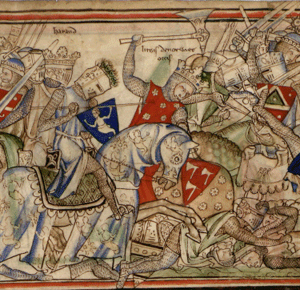
The Battle of Stamford Bridge
In the days that followed, King Harold granted safe passage to his enemies on the understanding that they never returned to England. He restored order to the city of York and gave his army some time for rest and recuperation. On 1 October King Harold held a feast in honour of their victory, and for the first time in his brief reign, may have felt secure in his position as the king of England. Sometime during the feast, however, this feeling was brought to an abrupt end. Harold received word that William and his army had landed in England. It is alleged that Harold’s brother, Gyrth, offered to lead the English army instead as he ‘owed nothing to William’ but the king angrily refused.
28 September: The Normans Arrive
William’s patient wait for a favourable wind had finally paid off. On 27 September the Normans set sail for England and arrived at Pevensey, on the south coast, the following morning. As the duke disembarked, he is alleged to have tripped and fallen. His men interpreted this as a bad omen for the invasion. The duke, however, salvaged the situation by grabbing two handfuls of sand and declaring, ‘See, my lords, by the splendour of God, I have taken possession of England with both my hands. It is now mine, and what is mine is yours.’
As the English army were still in the north and not yet aware of his arrival, the element of surprise allowed the Normans to disembark without any opposition. William’s first decision was to move his army to the more defensible port of Hastings, ravaging scores of villages as they made their way along the south coast.

The Norman fleet
October 1066: Harold Heads South
On 2 October King Harold and his housecarls left York and travelled to London. There, they met up with reinforcements provided by his brothers, Gyrth and Leofwine, who had summoned as many men from their southern and eastern earldoms as possible. From London they marched on to Hastings and arrived on 13 October. Harold’s ability to complete this 240-mile journey in under 13 days was an amazing achievement, but the real test of his kingship was yet to come.
Preparing for Battle
The two armies met at Senlac Hill, just north of Hastings. William had been informed of Harold’s imminent approach and had set up an outpost at Telham Hill. This was a strategically sound position as it marked the natural entry into a peninsula with tidal water on each side. What William wasn’t expecting was that Harold would march through the night to ensure an equally advantageous position. He chose a large stretch of land, marked only by an apple tree, which would force William to march to the ridge and attack uphill. Similar to Telham Hill, Harold’s position was protected on both sides by water but with the added advantage of blocking the main route to London. The twelfth-century writer, William of Malmesbury, says that each army spent the night before battle according to their own ‘national custom’. For the English, this meant an evening without sleep and with plenty of drinking and singing. In contrast, the Normans spent the night confessing their sins and saying their prayers. On the morning of the battle, the English marched out with their axes while the Normans received the sacrament and headed out in ranks of infantry and cavalry.
14 October: The Battle of Hastings
The two armies stood in opposition; the English in one line, under the banners of the Dragon of Wessex and the Fighting Man, and the Normans split into three sections, under the papal banner.
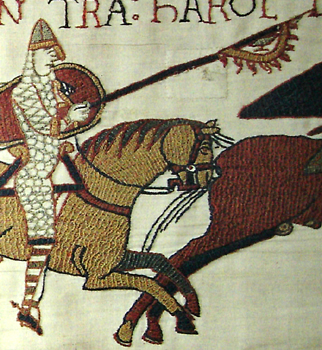
William and the Raven Banner
At around 9 a.m., the Normans made the first attack, raining down on the English countless showers of arrows. But the English were strong; having formed a near-impenetrable shield wall which kept the Normans at bay. William sent in his infantry but the English threw down javelins and stones as the Normans charged up the hill. Even the few infantrymen who did make it to the English lines failed to crack the wall.
A frustrated William sent in his cavalry sooner than he probably should have. Within one hour of battle, the left flank of the Norman army had been completely broken. Under such pressure, the left flank retreated and was soon followed by the remaining two divisions. In the chaos, some of the English soldiers made the fatal mistake of chasing after them and breaking their ranks. Rumour quickly spread that William had been killed. To prove otherwise, William removed his helmet and restored some much-needed morale to the Norman troops. This show of force proved to be a turning point in the battle as William was able to lead a cavalry charge against the English soldiers who had broken rank.
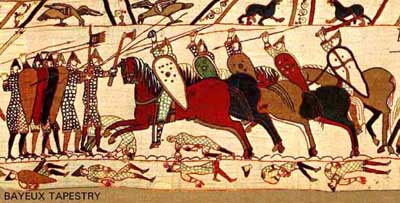
The Normans try to break the English shield wall
Despite such bloodshed, the bulk of the English shield wall was still intact. By the afternoon, William realized that breaking the wall was the key to victory. His new tactic involved a number of feigned retreats to entice the English out of their lines and cut them down as they ran. Harold’s brothers, Gyrth and Leofwine, soon became victims of William’s deadly tactics and King Harold was not long after.
While legend has it that he was struck in the eye with an arrow, others believe he was slain by the sword. The contemporary Song of the Battle of Hastings argues that four Norman knights tore off Harold’s limbs and disembowelled him. Whatever the true cause of his death, the English bravely fought on, but without proper leadership, their cause was lost. The Battle of Hastings replaced Stamford Bridge as the longest and most brutal in English history.