
The victory being secured, the duke returned to the field of battle, where he viewed the dreadful carnage, which could not be seen without commiseration. There the flower of the youth and nobility of England covered the ground far and near stained with blood.
Orderic Vitalis
There is some disagreement over what happened to Harold’s body after Hastings. The Song of the Battle of Hastings states that William had the body wrapped in purple linen and taken back to base camp. Harold’s mother, Gytha, ‘in the tolls of overwhelming grief, sent to the duke and prayed him to surrender to her’ and offering to pay its weight in gold. William refused and said that he would rather ‘put him in charge of the shore of that very port – under a heap of stones’. If this is to be believed, then Harold was buried under William’s instructions with the inscription: ‘You rest here, King Harold, by order of the duke, so that you may still be guardian of the shore and sea.’
Alternatively, it has been suggested that Harold’s concubine, Edith Swan-neck, searched the battlefield for her lover’s body, recognizing him only by an intimate birthmark. From there she took his body to Waltham and buried him in the Holy Cross church. Whatever the truth, this fact has been overshadowed by Harold’s historical reputation as a perjurer; the man who broke his oath of fealty to William and was punished accordingly.
The Process of Conquest
Winning the Battle of Hastings was the first step in the process of conquest. After resting his army at Hastings, William set out on the 350-mile march to take London, the capital city. William knew that he still faced opposition in England so he took an indirect route through some of the south’s most important towns. He sent a detachment of his army to punish the town of Romney for killing some of his men when they had first landed, then marched to Dover. This was an important step because it gave him control of the best Channel crossing, should he need to return to France. The inhabitants of Dover surrendered without a fight, whilst the town was sacked and burnt.
While at Dover a large number of William’s army went down with gastroenteritis. He waited a week there, adding to the town’s fortifications, and then moved on to Canterbury, leaving behind one-third of his men to recuperate. Like Dover, Canterbury wasted no time in surrendering to William. But his plans to march on London had to be halted; William fell ill and his army was forced to encamp in Canterbury for the next four weeks whilst they waited for William to recover.
The Capital Rebels
Their king may have been dead but many of the English were not prepared to be conquered by a foreign enemy. Surviving members of the nobility, including the earls Edwin and Morcar, and of the English Church were in London after the Battle of Hastings. In a scene reminiscent of January 1066, the Witan were summoned and they elected Edgar the Aetheling the new king of England. Although he had not yet been crowned, the nobility and the people of London pledged allegiance to their 15-year-old king, swearing to fight the Normans on his behalf. If they could hold London for long enough to summon the Fyrd and mobilize the navy, there was still a chance of success.
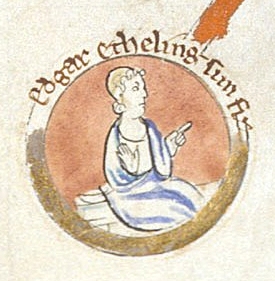
Edgar the Aetheling
As optimistic as the English may have been, William had recovered from his illness and was edging ever closer to the heart of the capital. He easily put out the opposition at London Bridge and proceeded to burn Southwark to the ground. His rampage continued into Hampshire and Berkshire, and by now, there was little left of south-east England that was not under his control. In the face of such force, could the English in London hold out?
William was fully aware of their rebellion. According to one Norman source, William sent Edgar the Aetheling a secret proposal; that William would be crowned king of England but that he would rule according to Edgar’s will. After consulting the Witan, but not revealing the details of this secret proposal, Edgar argued that they should send a false submission to William. This would give them time to prepare their next move.
The English quickly realized that they could not beat William, psychologically or militarily. William had promised to meet any of their demands and had ensured their safety, but had told them that their survival depended on their homage and the throne of England. The English had underestimated their conqueror, and in December, at the Norman camp near Wallingford, they surrendered.
25 December: The Coronation of William I
By mid-December, William felt confident enough to arrange his coronation. His choice of Westminster Abbey held great significance; this was Edward the Confessor’s abbey and emphasized William’s belief that he was the rightful successor to the throne. Presiding over the ceremony was Aldred, the Archbishop of York, and not Stigand, the Archbishop of Canterbury, who had crowned Harold less than a year earlier.
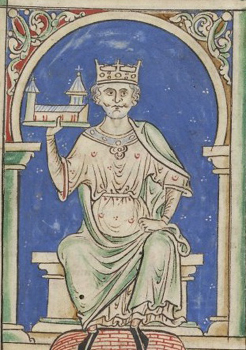
King William I of England, by Matthew Paris (Historia Anglorum)
Wearing full regalia and in the presence of his magnates and the clergy, William swore to defend England’s churches, to make and uphold just laws and to rule his kingdom with justice. William was also anointed with holy oil and the significance of this act should not be underestimated. Not only was he was the first duke of Normandy to ever receive the unction, he was now sending a clear message that God had sanctioned his rule over England and her people.
Immediately after the ceremony, the English were asked to acknowledge their new king. When they shouted in reply to this request, the guards wrongly assumed that William had been attacked and so they set fire to the surrounding area. This was a stark reminder, as this turbulent and bloody year came to an end, that it would take more than a crown to make William the true and accepted king of England.