
Acknowledgments
It is surreal to finish a book during a global pandemic. On the one hand, there is so much uncertainty and anxiety that it is difficult to concentrate. On the other hand, working on a book is an excellent distraction from events swirling around outside. Quarantine in particular is an odd, if useful, forcing mechanism.
Long before the final push to complete the manuscript, this book benefited from the support, feedback, and advice of many communities and individuals. At the George Washington University (GW), Charlie Glaser, Jim Goldgeier, and Elizabeth Saunders believed in my work perhaps before I did. Their patience and guidance then and now has been invaluable.
I was tremendously lucky to receive the support of a Stanton Nuclear Security Fellowship that brought me to Cambridge, Massachusetts, and the Security Studies Program (SSP) at the Massachusetts Institute of Technology. Owen Coté and Barry Posen were generous with their time and their literature recommendations. My development as an academic soared through participation in two groups within SSP: the Strategic Forces Working Group and the International Relations Work-in-Progress Group. At the time, no similar organization existed at GW, and it was with these two groups that I learned how to think—about both my own work and that of others. I am grateful to the members of both groups.
My stay in Cambridge continued through the generosity of the International Security Program’s Project on Managing the Atom (MTA) at Harvard University’s Kennedy School of Government and Belfer Center for Science and International Affairs. What began with a one-year fellowship morphed into two additional years of work. There I found, in Paul Avey, Gene Gerzhoy, Evan Perkoski, Mike Poznansky, Miranda Priebe, Jaganath Sankaran, and Oren Setter, friendship, research advice and support, and collegiality I will keep with me long into the future. My years in Boston also connected me to Jennifer Erickson and Catherine Zweig Worsnop. Their substantive feedback, professional advice, recipe suggestions, and novel recommendations have been unparalleled. I remain forever grateful to the late Marty Malin, as well as Matt Bunn, Steve Miller, and Steve Walt, for letting me stick around the Belfer Center as long as I did. I am writing these acknowledgments a few months after Marty’s passing, and it remains nearly impossible to imagine returning to MTA without him there. But for Marty and his cocollaborators, I would have left academia long ago. Instead, because of the opportunity to spend consecutive years at MTA, I was able to find the perfect-for-me academic job, and I will always be grateful.
That perfect-for-me academic job turned out to be in the Sam Nunn School of International Affairs at the Georgia Institute of Technology. Though I never expected to live in the South, I have been gifted with tremendous colleagues and countless opportunities. Though no one could recall previously holding a book workshop in the department, my colleagues and department chair took to the idea and generously supported the effort without hesitation. Jenna Jordan and Adam Stulberg kindly shepherded the workshop and made sure that the conversation stayed on track. Jenna has read the complete book more times than is reasonable. I am tremendously grateful for her friendship, as well as her time and dedication in helping to make the book better. I am also indebted to book workshop participants—Mälfrid Braut-Heghammer, Matthew Fuhrmann, Scott Sagan, and Todd Sechser—for taking the time out of their busy lives to treat the manuscript with such care. It goes without saying that the substantive feedback and presentational advice of this group of scholars was outstanding. The support, encouragement, and kindness they showed throughout the process were what surprised me. These four scholars model not only the best of the political science discipline but also the generosity and support of exceptional mentorship.
Also at Georgia Tech, Miki Fabry and Larry Rubin offered comments on the manuscript and useful advice for making it stronger and more concise. Getting over the final hurdle would not have happened without the stellar research assistance of Andrew Arrington, Abby Burke, and Jack Crawford. I know they will go on to illustrious careers and will make our world a better place.
To my mind, mentors can be found in many different places. Through Jim Goldgeier and the Bridging the Gap project, I met Naazneen Barma, Brent Durbin, Bruce Jentleson, Jordan Tama, and Steve Weber. Their vision, advice, kindness, and humor have made this journey intellectually richer and much more enjoyable than I would have thought possible. Through Bridging the Gap and by virtue of living in Washington, DC, I found great friends in Jeff Colgan and Michael Weintraub. They are always ready to lend an ear, offer professional advice, find an escape route at a conference, and laugh at whatever shenanigans come our way. This book—along with the rest of my scholarship and, frankly, my sanity—owes a tremendous debt of gratitude to the writing groups that have been a consistent feature of my life. At GW, the Yentas—Shannon Powers and Amir Stepak—kept me laughing and kept me writing. More recently, the RED writing group has become my lifeline. Elizabeth Acorn, Danielle Gilbert, and I have met nearly weekly for the last few years. I hope someone is keeping track of the many publications and professional successes that emerged during this time. Reading each word of this book repeatedly, they have pushed me to clarify and improve at every stage. They have also offered invaluable professional advice along the way. Dani painstakingly edited the final manuscript. Each sentence is tighter and the manuscript that much stronger for her skill and dedication. Honorary RED member Jonathan Pike offered suggestions at critical junctures.
I have also benefited from the kindness of many people throughout this journey. At MIT, Jolie Divon Saraf, Lynn Levine, Harlene Miller, and Laurie Scheffler welcomed me to Boston, and their warmth continues to this day. At Harvard, Susan Lynch made the trains run on time and made sure that we fellows did what we were meant to do. At Georgia Tech, Marilu Suarez literally has the keys to the castle. Since our initial e-mails to schedule my interview all those years ago, Marilu has been the kind of person who treats you like family the moment you arrive and makes sure you have the right school supplies at the start of each new term.
I am also immensely grateful to the librarians whose work and dedication made this book possible. The archivists at the John F. Kennedy, Lyndon B. Johnson, George H. W. Bush, and William J. Clinton Presidential Libraries facilitated and advanced the research for this book in ways that I had not imagined. Even during a pandemic these archivists were able to hunt down pieces of information to confirm references and make the contents more precise. I am also indebted to the staff of the National Security Archive and the State Department’s Office of the Historian and the work they do in making document collections available for scholars’ use and publicly accessible on their websites. The resources they provide in a virtual environment are invaluable to students everywhere, myself included. I am especially grateful to the Austin Public Library for assistance tracking down a particularly obscure reference to substantiate a claim I make in chapter 3. Finally, Jay Forrest and the team of librarians at the Georgia Tech Library were generous with their time and hunted down too many requests to count.
Beyond fellowships, this project benefited from the generous financial support I received over the years. A research grant from the Israel Foundation allowed me to explore the preventive war behavior of Israeli prime ministers over time. Research grants from the Lyndon Baines Johnson Foundation, the Harry S. Truman Library Institute, and the Stanton Foundation facilitated travel to multiple presidential libraries to conduct archival research. University and summer fellowships at GW initially allowed this project to get off the ground.
At Cornell University Press, I am grateful for Roger Haydon and Michael McGandy’s careful guidance for this project from proposal to publication; for series editor Robert Jervis’s thoughtful consideration of the work and encyclopedic recommendations for additional scholarship with which to engage; and to an anonymous reviewer’s kind words, thorough read of the manuscript, and useful suggestions for revision. The publication teams at Cornell Press and Westchester Publishing Services have brought this project over the finish line and have been a joy to work with and learn from. I am particularly indebted to Catherine Cambron, Susan Specter, and Michelle Witkowski for their skill with the manuscript and patience with me. Content from chapters 1, 2, and 3 appeared as “Nuclear Beliefs: A Leader-Focused Theory of Counter-Proliferation,” in Security Studies 26, no. 4 (2017): 545–574. I thank the journal and Taylor & Francis Group for permission to reprint this material here.
Over the years, I have benefited from the support and encouragement of friends and family near and far. The Qs—especially my partners in crime here in the Southeast—Molly Berkemeier and Paige Price Cone—have become coauthors but, more important, friends since a conference brought us together in South Bend, Indiana. The Ron family made my research trips to Israel and my life a wild and wonderful adventure. They welcomed me into their homes and were inquisitive and supportive of the project. Niv in particular provided love, laughter, and cheerleading when I needed it most and Veuve Clicquot for important celebrations. I hope I have done the chapter on Israeli decision-making justice, though any mistakes in the book remain my own.
Raffaella Ceriello and Havi Goldscher have lived with this book idea since 2007 and with me since long before then. Even when I had to leave Boston, Jessica Grivalsky and Stephanie Yovchev’s support followed me to Atlanta. As roommates at times and the best of friends, these dear friends always remember to check in, have never been bored with the subject (or at least have Oscar-worthy performance abilities to feign as much), and have had my back throughout this meandering and opaque academic journey. Julia Macdonald and I have traveled much of this adventure together, from Washington to Boston and to first jobs out of graduate school. She is an excellent coauthor, gym buddy, sounding board, and general partner in crime. I consider myself especially lucky to have met my best friend in Miss Frolich’s first-grade class at Ithan Elementary. It is the rare friendship that can withstand the test of time and survive college, graduate school, jobs, families, and the ups and downs of life. But Michele Krengel is always ready for a cup of tea, a book recommendation, a Skype call, or a walk outside—and surely there will be addenda to this list as time goes on. After all of these years, I am proud and candidly a little relieved to be able to show all of these friends a final product.
Finally, none of this would have been conceivable without the support and encouragement of my family. My parents, Barbara and Henry Whitlark, raised me to believe that anything is possible if you only work hard enough. They never questioned my chosen career path, even when I did. Or if they did, they never let on. They also encouraged in me a love of reading, education, politics, crossword puzzles, and argumentation. They led by example, and I learned from the best. My brother, Michael, has been an unfailing supporter of me and this book as long as I can remember. Even when he was needling me, as only siblings can do, from the other side of the country, his support was clear. His regular check-ins to see if I’d made it below the final word count got me over the finish line. And finally, my grandparents Harold and Norma Proshan (of blessed memory)—around whose dining-room table I learned to think and argue, usually over history and politics—gave me the desire to substantiate my claims with ample research. Their example has guided me from the beginning.
CHAPTER 1
It was the summer of 1963. Averell Harriman, US ambassador to the Soviet Union, was in Moscow. It is not surprising that Harriman was there; the summer agenda of President John F. Kennedy’s administration focused on the ongoing Limited Test Ban Treaty negotiations between the United States and the Union of Soviet Socialist Republics (USSR). But Harriman was not there only to talk about the treaty. Instead, this secret mission had special priority. On the orders of President Kennedy, Harriman was to assess Soviet premier Nikita Khrushchev’s willingness to cooperate in a joint military attack against the People’s Republic of China.
The Cold War was at its height in 1963. US-Soviet relations were perennially poor. The United States and Soviet Union had some thirty-five thousand nuclear warheads pointed at each other. Just five years earlier, the Soviets had threatened to consume Berlin and fold it into the Eastern Bloc. The Cuban missile crisis followed in October 1962, pushing the world to the brink of nuclear war. Allegedly, events caused Secretary of State Dean Rusk to quip, “We’re eyeball to eyeball, and I think the other fellow just blinked.”1
Against this background, President Kennedy was taking all necessary measures—feasibility studies, discussions with allies, and negotiations with sworn enemies—to try to prevent the Chinese from developing nuclear weapons. He believed there would be dangerous security and foreign policy consequences of a communist Chinese atomic bomb. Within the Cold War context, it is remarkable that joint military intervention with the Soviet Union was a very real consideration in the summer of 1963. But that was exactly Harriman’s assignment: to engage the Soviets regarding a joint mission to destroy the Chinese nuclear endeavor before it came to fruition.
Kennedy’s assassination abruptly ended his administration and mobilization against the Chinese. Lyndon Baines Johnson entered office unexpectedly and pledged to adopt the mantle of Kennedy’s vision. While the new president worked for the advancement of civil rights and other domestic programs that Kennedy prioritized, Johnson halted all efforts regarding the Chinese nuclear program. Unlike his predecessor, Johnson possessed no serious concern for Chinese nuclear weapons, and he took no steps to counteract them.
This book explains how two leaders facing the same adversary behaved so differently. It does so by highlighting the role of leaders’ nuclear beliefs—what they thought about nuclear proliferation generally and about particular adversaries’ attempts to go nuclear. This belief-laden decision-making process is relevant earlier in the Cold War, when Harry Truman and Dwight Eisenhower faced Soviet proliferation and confronted the end of the United States’ nuclear monopoly. These historical decisions are also relevant now: within the past decade, multiple world leaders considered or used preventive military force against aspiring nuclear powers. In 2002, George W. Bush justified intervention in Iraq as an attempt to rid the world of Saddam Hussein’s nuclear weapons. Five years later, Israel bombed a nuclear facility discovered in the Syrian desert. Discussions of how to prevent a nuclear Iran have permeated the administrations of George W. Bush, Barack Obama, and Donald Trump. If history is any guide, the issues of nuclear proliferation and the use of preventive military force to forestall it are returning to prominence.
Many scholars discount the roles of national leaders and their beliefs in hard security matters, especially within the nuclear realm. The notion that preventive war, which is traditionally the bailiwick of state-based, realist theories, actually rests on the individual leaders making decisions within states is a new and interesting theoretical development. And what we learn through the exploration of this idea—that JFK might very well have attacked the Chinese nuclear program, alone or with Soviet assistance—is one of the more surprising historical details this book returns to our consciousness.
All Options on the Table is a book about the consequences of nuclear proliferation and how leaders behave to counter it. This book engages the debate between nuclear optimists and nuclear pessimists—those who see the effect of additional nuclear proliferation on the international system as stabilizing or destabilizing, respectively. Pessimists say absent a second-strike capability shared by two nuclear-armed states, proliferation leads to preventive war with one state seeking to arrest the other’s developing program. Conversely, optimists argue that proliferation seldom leads to preventive war or even its consideration. How can both sides be right? The explanation lies with individual leaders: how they understand proliferation and when they will rely on preventive war to counter it. Because pessimists see proliferation as destabilizing, they are more likely than optimists to consider even forceful methods to prevent nuclear programs from manifesting.
Consequently, this analysis offers a dynamic theory of preventive war, demonstrating how in one key empirical area, nuclear proliferation, leaders respond to potential changes in the balance of power between states. Accordingly, this is also a book about global power imbalances and what happens when they emerge. This topic of nuclear proliferation and the decision to counter it is fruitful to explore because in this international political arena, shifts in the balance of power can be especially dramatic. To make my case, I present a new theory and new evidence about when states attempt to redress changes in power distribution.
The Argument and Approach
This book poses one central question: When do states decide to use preventive military force to forestall or destroy an adversary’s nuclear weapons program? Stated differently, the book seeks to understand why some leaders use preventive war, others consider it, and still others never contemplate it as a counterproliferation strategy. I argue that leaders have different prior beliefs about nuclear matters, which influence how these leaders, once in executive office, approach proliferation challenges that arise. The book documents significant leader disagreement about the magnitude of threats posed by nuclear proliferation generally and by specific states’ nuclear programs, which are central to understanding this variation in behavior. The very existence of substantial disagreements has been previously overlooked.
I argue that leaders’ beliefs formed prior to or early in leaders’ tenure in executive office (before the case of interest) are what shape their later preventive war decisions.2 My investigation centers on the interaction of individual leaders and nuclear adversaries and looks at variation in leader behavior across time. This variation is significant because leaders are regularly overlooked as causally consequential. They are assumed to be either idiosyncratic and too messy for systematic analysis or else irrelevant in that they should respond similarly to events given the same structural conditions. Instead, my leader-centric argument proposes not only that leaders have divergent beliefs about critical nuclear issues—proliferation and deterrence chief among them—but also that these beliefs are meaningful for states’ choices to engage in war. This book thus contributes to our growing understanding of the domestic sources of nuclear politics writ large.
To make this argument, I establish a typology of leader beliefs, which is valuable in hypothesizing about likely preventive war behavior and in determining what leaders find threatening, specifically regarding nuclear weapons. Indeed, leaders have divergent beliefs concerning (1) the consequences of nuclear proliferation in the international system and (2) the ability to deter an adversary, once nuclear-armed, from challenging the state’s interests. Leaders less concerned about nuclear proliferation and confident in deterrence should be less likely to intervene to prevent it. Those more pessimistic about proliferation and less confident in deterrence should be more likely to intervene preventively.3 What is most striking about the resulting expectations is what they reveal: simply being concerned about the consequences of nuclear proliferation does not guarantee the use of force. Similarly, not every threatening state attempting proliferation will suffer a preventive intervention. Instead, it is only when a specific type of leader—a proliferation pessimist—confronts a state unlikely to be deterred that force is more likely to result. That this specific combination of factors suggests force should be more likely provides a theoretical understanding of the empirical rarity that is the use of preventive military force.4
To capture the role of leaders and their nuclear beliefs in preventive war decisions, as well as argue against alternative explanations derived from the extant literature, this book explores the preventive counterproliferation behavior of the United States and Israel. The book investigates both the Cold War and post–Cold War periods to demonstrate that the argument travels across time. I examine cases in East Asia and the Middle East to show that there are no regional limitations to the argument’s applicability. The case studies analyze the presidencies of John F. Kennedy, Lyndon B. Johnson, George H. W. Bush, William J. Clinton, and George W. Bush as they confronted the Chinese, North Korean, and Iraqi nuclear programs. Chapter 6 extends the argument from the US context to explore how consecutive Israeli prime ministers confronted the nuclear weapons programs of Iraq, Pakistan, and Syria. Using archival evidence, biographical materials, and government documents, I establish that leaders’ prior nuclear beliefs—formed well before the decision-making period of each case—shape later decisions once in executive office.
Focusing on consecutive national executives is critical, given that simpler structural explanations are insufficient: different leaders within the same polity respond differently to nuclear threats, even when confronting the same adversary within the same approximate time period. Elsewhere, individuals have been shown to matter for other types of military interventions in different empirical contexts, challenging Kenneth Waltz’s rejection of their relevance for international political theorizing.5 Over time, scholars beyond those adopting psychological frameworks have championed a focus on individual leaders.6 This renaissance has made its way to security studies and into the nuclear realm, where one might be the least inclined to expect leaders to be causally consequential.7 This book contributes to the return of leaders to analytical importance in international security and should help catalyze more attention to domestic factors within nuclear politics.
How Leaders Drive Preventive War Decisions
A large literature focuses on how individual-level characteristics influence foreign policy behavior. Perhaps the quintessential early articulation came from Alexander George’s Operational Code, which described a prism through which leaders perceive and diagnose events.8 Central to the operational code is how one views the essential nature of political life, the political realm as essentially cooperative or conflictual, the fundamental character of political opponents, and the best approach to setting political goals.9 Early work gave way to more complex typologies that encompassed dozens of personal characteristics.10 Additional literature emerged, especially following progressions in brain science, to explore the role of cognition, biases, and other psychological characteristics in political behavior.11 Following developments in psychology’s Big Five approach to personality, political scientists sought to explain how the five traits of openness, conscientiousness, extraversion, agreeableness, and neuroticism influence a range of subjects, including ideology and foreign policy behavior such as the use of force.12 Others explored individual characteristics, including age, military service, and education, for their effects on political decision making.13
This research offers useful findings on the relationships between individual-level and personality-based factors and important outcomes of interest. However, these characteristics are generally static. As such, they cannot explain varying behavior by the same leader; that the same president confronting multiple potential proliferants during his administration often pursues different strategies. To offer something more dynamic, I focus on beliefs.14
To demonstrate the limits of these characteristic or personality-based approaches, it is useful to briefly explore, as one of the more compelling alternatives, the role of age in intervention decisions. Even though age is dynamic, it too is problematic. The conventional wisdom argues that younger people tend to be brash and bold, whereas older people tend toward caution and judiciousness. While this idea is plausible empirically, we know that wars are started by older leaders just as they are by younger leaders. Skepticism about the conventional wisdom is instead warranted.
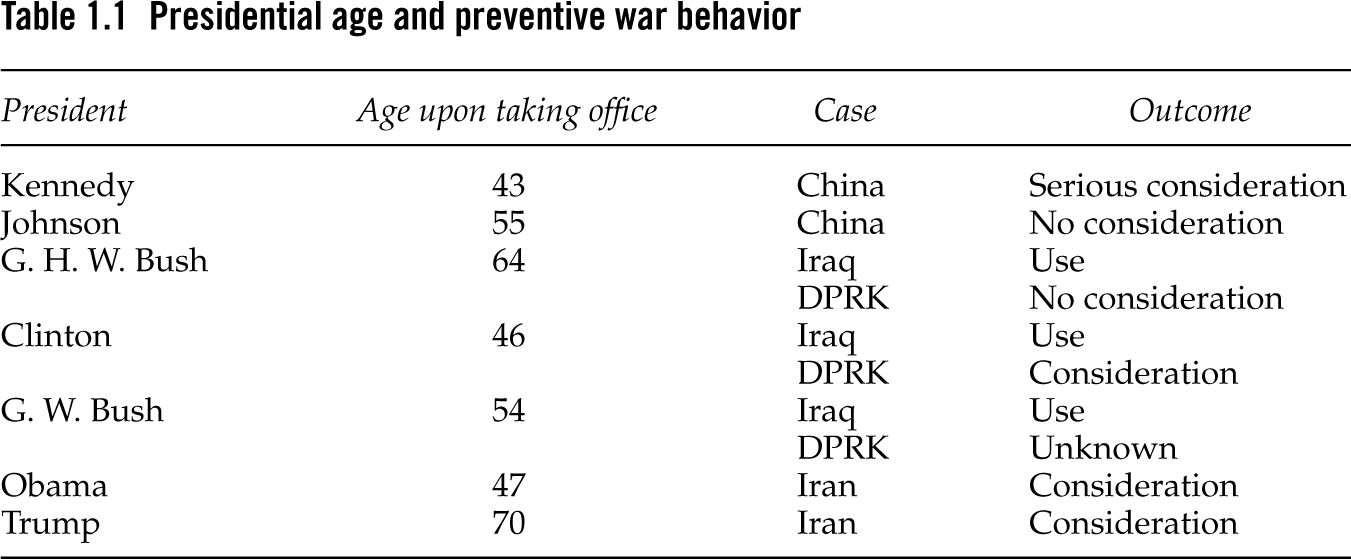
Michael Horowitz, Rose McDermott, and Allan Stam set out to rigorously scrutinize the effect of age on leader behavior.15 Drawing on biological scholarship, they hypothesized against the conventional wisdom, arguing that age, legacy concerns, and shortened time horizons make older leaders more likely to initiate or escalate militarized disputes. These scholars found that as age increases, initiation and the use of force against other states indeed becomes more likely. Horowitz, McDermott, and Stam tested cross-national and cross-time propositions about the impact of age on general proclivities toward all types of military disputes. It is possible that age may also influence the proclivity toward force in the context of counterproliferation. As table 1.1 makes clear, however, age alone offers an insufficient explanation for preventive counterproliferation behavior among US presidents.
First, age is problematic as an explanation for preventive counterproliferation since it is inconclusive. The same individual presidents exhibit different behaviors across relevant cases: George H. W. Bush at sixty-four used force in the Gulf War but did not consider it against North Korea; likewise, George W. Bush at fifty-four used force against Iraq but did not against North Korea, though the details of this later episode remain unknown. Second, the evidence goes against Horowitz, McDermott, and Stam’s findings, as several younger men both considered and used military force. Third, it is not objectively clear when youth ends and when old age begins. One might reasonably argue that all of these presidents, with the exceptions of George H. W. Bush and Donald Trump, were middle-aged when entering office. To the extent that the categories of young and old are social constructions, it is not obvious which presidents we would expect to be inclined toward the use of preventive military force based on age alone.
Nuclear Beliefs and Preventive War
I argue that leaders enter executive office possessing different views about the dangers of nuclear proliferation and about specific threats posed by individual states attempting to go nuclear. These divergent prior views shape leaders’ adoption of divergent counterproliferation policies once in office. Specifically, these views affect the likelihood that a leader will consider preventive military force or use military intervention as a counterproliferation strategy. This is a leader-centric argument for understanding decisions about the use of force, with cost-benefit analyses by various leaders differing because of individual disagreements over the requirements of deterrence and the dangers of nuclear proliferation. Such an argument can be understood in light of existing Cold War scholarship suggesting that leaders have patterned, entrenched, and divergent beliefs on topics fundamental to interventions.16
Borrowing from psychology, and following existing international relations literature, I contend that different people viewing the same evidence can disagree about the nature of a threat posed by a specific adversary and that these beliefs drive variation in counterproliferation decisions.17 That beliefs, beyond individuals themselves, are consequential in international relations and foreign policy decision making is well established. While the formative literature emerged in the 1960s and 1970s to document the relevance of individual beliefs, recent additions to the scholarship continue to advance our understanding of the precise mechanisms of influence and the scope conditions for applicability.18
The leader-centric model aims to refine our understanding of prevention by using beliefs to connect the logic of preventive war to foreign policy decision making. The main alternative explanations against which the leader-centric model is tested largely offer static explanations of preventive force dynamics, including those focusing on regime type, alliance protection, and the balance of power between states. Some argue, for example, that preventive war can be understood by exploring power asymmetries across a dyad. Others articulate a logic whereby two states with dissimilar regime types, a history of disputes, and conflictual foreign policies would likely experience preventive war as a counterproliferation strategy. These alternatives suggest not only that a focus on leaders and their beliefs is unnecessary but also that examining structural or state-level characteristics is key to explaining historical variation in preventive war decisions. Though intuitively appealing, these models provide an insufficient explanation. Instead, my dynamic framework allows individuals to be the key decision makers and offers significant analytical traction. In the leader-driven model, individuals facing the same evidence and same problem are likely to have different beliefs and expectations, which lead to different strategy choices. Where relevant, the cases explore competing structural arguments that might expect leaders to consider or use preventive force only when there is a high likelihood of success. Finally, to the extent that each case raises additional alternative logics, these logics are addressed in each respective chapter.
The preventive logic looms large in international relations and argues that one state is likely to use military force to forestall a perceived decline in power relative to another.19 The motivation stems from the fear of this rising other, the implications of the decline for loss of power and prestige, and the adverse consequences of the other state’s gain in power and leverage. The thinking can be described as a “better now than later” attitude: a state acts now to avoid paying concessions or suffering adverse consequences in the future. The preventive logic emerges from the more ubiquitous commitment problem, which can lead rational states to fight a costly war when, ex ante, a negotiated settlement should be preferable.20
The preventive logic should be salient not only generally when one state will overtake another in terms of relative military and economic power but also when an adversary threatens to cross a critical threshold of military power that would radically and quickly change the balance of power. Nevertheless, the logic is underspecified as it fails to predict where or when force will be used.21 One military achievement that can relatively quickly change the balance of power and is thus potentially likely to result in the preventive use of force is the subject of this book: the acquisition of nuclear weapons.22 We might expect situations in which one state faces a nuclear-seeking adversary to be easily captured by the preventive logic. Instead, we find variation in how and when the preventive logic applies; to date, this variation has not been convincingly explained.23 My argument improves the specification of the preventive logic by refining the mechanisms through which it operates.
Whereas the preventive logic is a prominent feature of the scholarship, the literature exploring preventive war as a counterproliferation strategy is particularly thin.24 This literature is also striking for its almost uniform emphasis on the state as the relevant decision maker. Whereas I highlight the role of leaders and their divergent beliefs in explaining preventive behavior, the existing explanations that focus on the unitary state implicitly argue that the dangers from nuclear weapons are so great that almost any leader facing an adversary pursuing them will think and act similarly. I argue that leaders do not always behave similarly because this context, while grave, is not existential, especially for the United States. Even in Israel, which might face an existential threat, we also find divergent perspectives.
This focus on the unitary state is but one shortcoming of the existing scholarship. Given this theoretical approach, key variables in the decision-making process—most significantly the role of individual leaders—are overlooked.25 There is also major overprediction of the frequency with which preventive war will be used to forestall another state’s nuclear program. This overprediction may stem in part from the theoretical focus on the unitary state as the decision maker, as well as from the methodological choice to conduct statistical analysis or game theoretic modeling.26 By exploring the role of the national executive as well as conducting archival research and case studies, this book advances our understanding of the phenomenon by approaching it from new angles. While all methodological approaches have limitations, taking an archival approach can advance the scholarship beyond what previous studies have provided.
Additionally problematic from a methodological perspective is that relevant scholarship often investigates all types of weapons of mass destruction (nuclear, chemical, biological, and radiological) simultaneously and therefore does not compare similar cases.27 The threat in the nuclear realm differs sufficiently from the threat of either chemical or biological weapons to warrant separate analysis. There are myriad reasons, but chief among them are the ubiquity of chemical and biological weapons relative to nuclear weapons, the relative ease of concealing chemical and biological programs, and the specific risks of retaliation inherent to striking these facilities as compared with striking nuclear installations.28 To maintain an analogous comparison across cases, I exclusively examine the development of nuclear weapons programs and the potential use of preventive war to forestall them.
Over time, the nuclear literature has developed from understanding proliferation dynamics from a state perspective to a new focus on leaders, their perceptions, and their preferences.29 This follows the trajectory within international relations, which despite an initial focus on leaders, shifted to a near exclusive focus on the system and the state, only to slowly return to leaders and their role in state behavior.30 Reflecting this progression and evidence suggesting that leaders are the key decision makers in this context, the next step is focused analysis on the role of leaders.
A focus on leaders is necessary when we recognize that rationalist models assume that the cost-benefit analysis a state undertakes when comparing the costs of war with the costs of doing nothing looks the same from every actor’s perspective. Yet, the “costs of preventive war” is a category incorporating many matters of interpretation that depend on leader beliefs. Under consideration are the concrete costs of the military action, risk of retaliation, and risk of escalation to wider war, as well as the very nature of international security and the requirements of deterrence. Additionally, notions about the costs of doing nothing, consequences of proliferation, utility of the use of force, and nature of the adversary in question—all consequential for the decision—are individually held. Furthermore, behavioral economics and political psychology have both called strict rationalist assumptions into question and frequently demonstrated them to be empirically false.31
Instead, I argue that a leader’s key nuclear beliefs shape each of these factors. What might seem like a straightforward calculation that would produce similar reasoning in different people is actually a subjective estimation that varies by individual, based on earlier life events and salient experiences. An individual leader’s beliefs both about the particular crisis at hand and about the nature of international politics generally factor heavily into the decision to use preventive military force. The leader atop the state apparatus is making these gut-wrenching decisions; to overlook a leader’s role within those decisions would be shortsighted.
Research Design
In order to both offer a theory of preventive war and explore the causal role of leaders’ nuclear beliefs in shaping intervention decisions, this book utilizes the small-N comparative case method. This method achieves high concept validity by delving into the history to identify and measure the indicators of interest. This method also allows for process tracing the causal mechanisms I theorize to be at work in this environment. This study is longitudinal in that it looks at the same dyads over time, to discover how consecutive administrations viewed the same adversary. The study is also cross-sectional in examining multiple administrations within the same would-be preventer states that are contemplating preventive military force against a variety of adversaries. I employ an archival-based research strategy to probe into the historical details of each case under analysis.32
To identify and code leaders’ prior nuclear beliefs, I primarily explored the prepresidential period and asked a common set of questions across leaders to assess their individual threat perceptions. Focusing on the prepresidential period as distinct from the crisis period itself allows for disentangling beliefs from the politics and logistics of each case, which in turn avoids the criticism that beliefs are merely hooks through which leaders sell preferred policy. Process tracing then allows me to follow the formation of leaders’ beliefs through to the executive period to investigate what impact, if any, these beliefs had during the decision-making period. Separating early beliefs from the case episode similarly demonstrates that something more than leaders’ beliefs about the efficacy of a particular strategy is doing the causal work.
The case selection strategy has allowed me to take advantage of a variety of sources in constructing cases. The earliest historical cases permit examination of declassified government documents, as well as memoirs and biographies of deceased decision makers. For post–Cold War cases, beyond available government documents and secondary literature, I used extensive journalistic accounts, published interviews, and contemporaneous materials. For all cases, I also sought evidence that would support alternative explanations. Where I have found such evidence, I note it within the narratives.
Data are drawn primarily from site visits to US archival institutions, including the National Security Archive and the relevant presidential libraries. Because my argument concerns prepresidential and individually held beliefs, I explored leaders’ personal records and materials from their prior positions. To understand a leader’s threat perception generally and regarding specific proliferants, I examined general subject files (that is, “nuclear” broadly defined) and also country-specific files. For the dependent variable in each case, I searched decision-making records from administration officials and secondary sources. At each location, I used available finding aids and sought guidance from resident archivists. They were especially helpful in identifying unlikely information sources, such as materials in a lesser-known personal secretary’s file, which I had not thought to survey. Finally, a complementary approach involved footnote tracing from important secondary sources for relevant archival materials that might tend either to confirm or disconfirm my argument.33
Additionally, I examined pertinent published volumes from the Foreign Relations of the United States and Public Papers of the Presidents collections. As in the physical locations, I explored the available historical records including recorded minutes and transcripts of executive or cabinet meetings; private diplomatic correspondence; government documents including speeches, testimony, voting records, military plans, budget estimates, and declassified intelligence reports; and also memos, letters, and memoirs of relevant actors. As there is a rich secondary literature on the history of nuclear weapons and particular states’ nuclear pursuits, I used diplomatic history and international relations texts on these cases to guide the archival search. There is an abundant journalistic record that I explored in depth. Finally, I examined presidential biographies, diaries, and historical recordings as relevant.
By exploring this combination of diverse sources, I re-create rich historical accounts of the cases under analysis. I triangulate across evidentiary materials both within the archives and between various types of sources.34 Exploiting both official government sources and unofficial personal records, I document how different leaders perceived the threats they faced looking specifically at their beliefs about deterrence and nuclear weapons, the options the leaders felt they had in confronting those threats, and the justification the leaders provided for the policy ultimately implemented. Because I explore the prepresidential records of each leader and examine that leader’s beliefs prior to holding the presidency, I disentangle personal, individually held beliefs from the details of a specific crisis.35 By comparing how multiple administrations viewed the same adversary, I ascertain how different people viewed the same situation; understood their choices; and decided to consider preventive force, use preventive force, or abstain.
The case universe spans the nuclear era, from its early stages in 1942 until 2018. For reasons of data availability that would arise in trying to acquire material on the most recent cases, arguably the most important ongoing case—that of the Iranian nuclear program—is discussed only in the conclusion.
Much of the scholarship on this topic is understandably US-centric, given the ease of access to information in the United States and the country’s role as a leader in nonproliferation and counterproliferation. Because of its regular election cycles, the US context is fruitful for testing an argument about the role of leaders in foreign policy decision making. Especially within the nuclear context, in which the president has outsized influence, the US environment is ripe for analysis. That said, this US-centricity characterizes much of the nuclear scholarship writ large and has led to a potentially problematic bias within the theoretical understanding of the nuclear realm, inasmuch as we have overgeneralized lessons from the US (and Soviet) experience to new nuclear states.36 We should therefore temper our conclusions for other contexts.
By exploring cases primarily within the US context, I hold constant factors that might otherwise confound my argument, including regime type, global position, and regional dynamics. Narrowing the core empirical chapters in this way allows for a “structured, focused comparison” of the role that leader beliefs play in preventive war decision making.37 By examining a single state and its behavior over time, as well as exploring consecutive presidential administrations, I control for the target state and isolate the effect of the individuals themselves. This approach extends a research design employed by Elizabeth Saunders into an empirical area where some may doubt the existence and significance of belief variation across leaders.38
To analyze US decision making, I explore one case from the Cold War and two cases from the post–Cold War period. I do so to assess the specific role of the Cold War in intervention decisions, as it might have influenced strategy selection by encouraging or discouraging the use of force. For the Cold War, in chapter 3, I examine US deliberations about the Chinese nuclear program in both the Kennedy and Johnson administrations. For the more contemporary period, chapters 4 and 5 explore the Iraq and North Korea cases, respectively. These post–Cold War cases are especially useful because they allow me to hold the target states constant and explore multiple administrations’ behavior toward Iraq and North Korea, as well as to examine variation within each administration across adversaries. Stated differently, looking at Iraq and North Korea allows me to examine how both George H. W. Bush and Bill Clinton dealt with both Iraq and North Korea during approximately the same time frame. This examination allows me to understand why force was used repeatedly against Iraq but never against North Korea, even though it presented a similar situation confronted by the same leaders who used force against Iraq. As an additional test of generalizability beyond the Cold War, the book also explores US behavior vis-à-vis Iraq under George W. Bush, both as the newest instance of US preventive war behavior and as a test of the model’s traction in the post–September 11 environment.
Next, I test the argument’s generalizability by applying the theory to Israeli preventive war behavior. Israel is arguably the most important other actor within this empirical space given the frequency with which the country has considered and used preventive force as a counterproliferation strategy. Moreover, given Israel’s similar characteristics to the United States—regional power, status as a Western democracy, semiregular leadership turnover, and a similar national security apparatus—there are reasons to expect similar dynamics in this new environment. These characteristics and others are described fully in chapter 6 along with brief analyses of Israel’s behavior regarding the nuclear programs of Iraq, Pakistan, and Syria. This chapter is important for demonstrating the leader-centric argument’s ability to move beyond the US decision-making environment.
Chapter 7 concludes the book by reviewing the argument and its implications for both the academic literature and the policy community. The chapter discusses how the leader-centric argument applies to the ongoing situation with the Iranian nuclear program as well as contemporary circumstances with North Korea. While North Korea has had nuclear weapons since approximately 2006 and possesses a significant ballistic missile program, the country no longer presents an analogous situation for comparison for the leader-centric framework. I discuss the implications of these and other developments, paying particular attention to events during the Trump administration. For Iran, the focus is on the critical period following the United States’ withdrawal from the Joint Comprehensive Plan of Action in May 2018. I emphasize relevant domestic political developments within both the United States and Israel and evaluate their consequences for the future of this situation. As Israel and the United States are engaging the Iranian nuclear development independently and in concert with one another, a discussion of both states is warranted.