
CHAPTER 2
When do leaders use preventive military force as a counterproliferation strategy? Some national executives use preventive military force to destroy or forestall an adversarial nuclear program in formation, while others consider force but then abstain. Still other leaders never contemplate force in the first place. To address this variation, I argue that leaders and their beliefs are key to understanding state responses to nuclear proliferation and that their role has been previously overlooked. Specifically, leaders enter executive office possessing different views about the dangers of nuclear proliferation generally and about the threats posed by individual states attempting to go nuclear. These divergent prior views encourage leaders to adopt different preventive force policies once in office, when they may use or consider using military force as a counterproliferation strategy. Instead of focusing on the unitary state, as the authors of much of the existing literature have, I offer a leader-centric argument for understanding preventive war decisions. The counterproliferation policies adopted by subsequent leaders in the same polity differ because of individual disagreements over the requirements of deterrence and the dangers of nuclear proliferation.
Understanding Preventive War as a Counterproliferation Strategy
Preventive wars are wars fought now to avoid the risk of fighting under less favorable conditions later. These wars begin “when a state attacks because it feels that in the longer term (usually the next few years) it will be attacked or will suffer relatively increasing strategic inferiority.”1 The preventive logic stipulates that one state is likely to use military force to forestall a perceived decline in power relative to another state, likely acting out of fear of this rising state and concomitant consequences in lost power, leverage, and prestige.2 Even if the rising state is currently peaceful, there exists uncertainty concerning that rising state’s future intentions, given that preferences and interests can change.
In the nuclear arena, a preventive war occurs when one state, facing another state in the process of acquiring nuclear weapons, attacks its nuclear program to attempt to destroy or forestall it and remove the future possibility of fighting a nuclear-armed adversary.3 Thus, a state considers the extent to which military power is shifting in the other’s favor.4 The more the adversary stands to gain in terms of both material capabilities and bargaining leverage, the more likely the declining state should be to try to prevent this outcome. Though prevention to thwart nuclear acquisition should be an easy case to explain, the little extant scholarship lacks comprehensive explanations of the phenomenon, failing to predict where or when the use of force will likely occur.5
Also included in my analysis are preventive strikes, or the use of military attacks to target a limited number of nuclear assets within an adversary’s territory so as to inflict damage on or destroy the nuclear infrastructure, eliminate the ability to produce a nuclear weapon, or both. These strikes are distinct in that they do not occur within the context of a larger war or intervention. Rather, they are often “pinprick” attacks directed at one target or a relatively small number of targets. The 1981 Israeli attack on Iraq’s Osiraq nuclear installation is classified as a preventive strike. By contrast, the 2003 war in Iraq is considered a preventive war in that the US focus on Iraq’s nuclear infrastructure took place as part of a full-scale invasion.
Both forms of preventive military force—wars and strikes—are distinct from wars of preemption, despite regular confusion between the two. Preemption “involves the initiation of military action because it is perceived that an adversary’s attack is imminent and that there are advantages to striking first, or at least preventing the adversary from doing so.”6 The imminence of the adversary’s attack is the key distinguishing feature. The quintessential historical example is the 1967 Six-Day War when Israel launched an attack after receiving intelligence that Syria and Egypt were mobilizing on Israel’s borders for an invasion.7
Finally, the use of preventive military force as a counterproliferation strategy is empirically rare. By contrast, consideration of the use of preventive force occurs with relative frequency. Furthermore, puzzling dynamics surround this consideration: sometimes one executive seriously considers military force, but his successor does not, despite a looming nuclear acquisition. For example, despite John F. Kennedy’s serious consideration of preventing China’s nascent nuclear weapons program, Lyndon Johnson did not seriously consider the issue after Kennedy’s assassination. Consideration of the use of preventive military force requires a sizable investment of time, personnel, leadership, and resources within a state, so it is significant that this consideration takes place frequently. Because the use of force cannot occur without prior consideration, ascertaining the mechanisms linking consideration to actual use of force is a way of understanding when preventive strikes and wars are likely to occur. Negative cases are therefore not only instances in which preventive force is not used; rather, these cases also include both episodes in which preventive force is not considered and those in which force is considered but not deployed.
Alternative Explanations and Hypotheses
What might explain variation in the use of preventive military force as a counterproliferation strategy? Existing international relations literature offers two sets of possibilities: structural considerations and politics at the state level, often within a state’s domestic political environment.
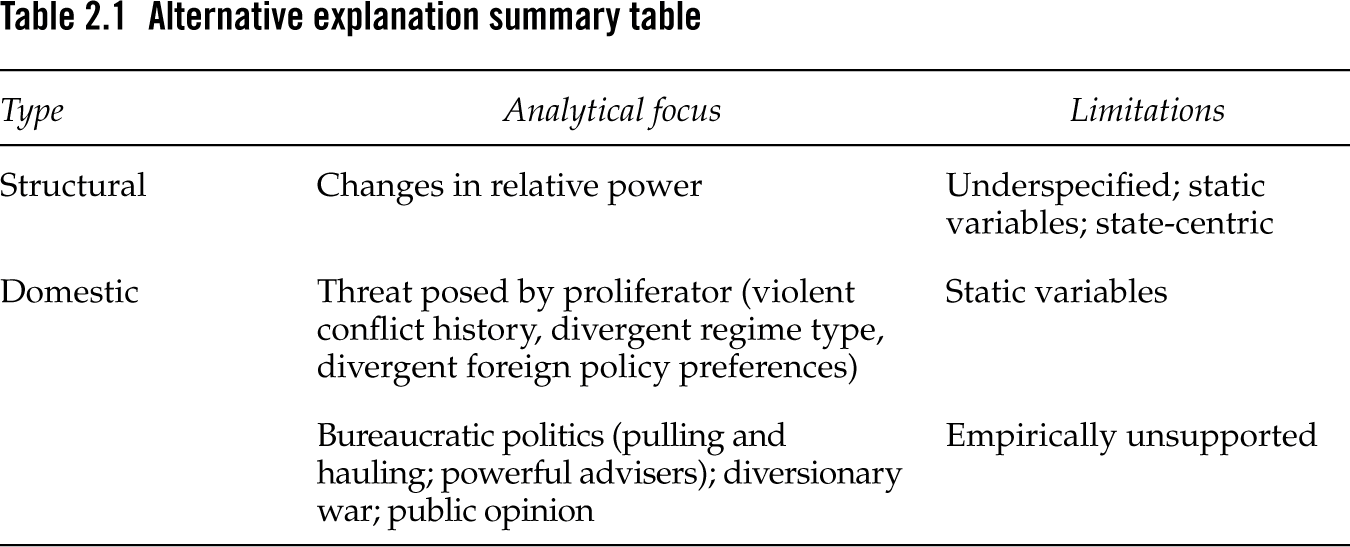
The first class of logics rests at the structural level of the international system and focuses on the distribution of power between states. This literature describes how changes in relative power could cause states to go to war with one another and how power transitions, in which one state overtakes another in power potential, can be especially dangerous.8 Here, the general preventive logic holds that states will go to war when they fear decline. Dale Copeland’s book The Origins of Major War offers a useful example of this type of logic; his “dynamic differentials theory” argues that still-dominant military powers initiate wars when they fear significant decline, especially in a situation of bipolarity, with one major power facing only one other major potential adversary.9 For Copeland and others, the logic implies that states should objectively assess changes in the international system and respond accordingly. Therefore, in the case of a developing nuclear program, one would expect a state to react to the program’s potential to change the balance of power through the use of force. While that expectation is intuitive, this literature lacks precise empirical specifications for when declines precipitate wars and does not explain why some do and others do not.
A small number of analyses from the nuclear literature offer a similar structural focus. Alexandre Debs and Nuno Monteiro argue that nuclear proliferation is likely to succeed if the proliferator is militarily strong relative to its adversaries and protected by a powerful ally.10 Specifically, the higher the proliferating state’s relative power to its foes, the greater the likelihood it will succeed in its nuclear endeavor, given the costs for the adversary attacking it. Additionally, absent a strong relative power position, a security guarantee by a patron will also deter attack by an adversary, again increasing the likelihood of successful proliferation. Elsewhere, the authors investigate the effect of transparent or covert military investments, including attempts at nuclear acquisition, to show, using game theory, how transparency leads to peace.11 By contrast, when acquisition attempts are undetected, other states may be willing to attack militarily rather than suffer a future power shift that would undermine their strategic position. Similarly, Lyle Goldstein emphasizes the power asymmetry between states and argues that militarily superior states are “likely to see a ticking clock with respect to an inferior state’s WMD [weapons of mass destruction] program,” because of sensitivities about shifts in the balance of power and a desire to fight sooner rather than later.12 Superior states are therefore likely to attack given a sizable power imbalance. Such arguments are problematic because slow-moving variables like power asymmetry do not well explain observed variation that transpires over only a handful of years.
While each of these works offers its own take on the mechanisms at play, together they yield an expectation that states make objective assessments of their rivals’ nuclear acquisitions and take measures to balance accordingly. Therefore, any such nuclear development should catalyze a similar state response. Any variation between leader responses should be driven by significant changes in a program’s development and not stem from the leaders themselves. Thus, changes in the distribution of power, especially in the form of attempted nuclear weapons acquisition by a weaker power, should lead the more powerful state to use preventive military force as a counterproliferation strategy.
Alternatively, the explanation for variation in preventive military force as a counterproliferation strategy may operate at the domestic level, exemplifying the second image of international relations.13 First, states may be likely to consider attacking or to attack a nuclear program in formation when they are highly threatened by the proliferator’s acquisition of the bomb. Matthew Fuhrmann and Sarah Kreps find that threats are particularly salient when there is a history of violent conflict within a dyad, when the country attempting to proliferate is autocratic, and when there is a history of divergent foreign policy preferences between the two states.14 The authors present a rigorous statistical analysis and compile the first comprehensive case universe based on an abundance of qualitative evidence. While I concur that divergent foreign policy preferences influence the likelihood of the consideration of preventive military force (these divergent preferences are subsumed into a broader variable regarding the potential proliferator’s deterrability), the other two variables offer little traction because of their static nature. For example, a state’s regime type is unlikely to change in the period under analysis, and yet we see variation in the dependent variable. Stated more concretely, China remained a communist, authoritarian regime throughout the period 1961–1964, yet President Kennedy seriously considered the use of preventive force, while his successor Lyndon Johnson did not.
Second, arguments about bureaucratic politics or public opinion could offer traction in explaining the empirical variation in question, though are less useful as independent alternative explanations because they do not address the counterproliferation environment specifically.15 Theories of diversionary war might also be relevant if some domestic political crisis causes a state’s leader to use preventive military force as a way to distract from problems at home.16 Alternatively, the decision to use preventive military force as a counterproliferation strategy could result from the bureaucratic process of pulling and hauling among cabinet or other relevant national security officials or from the influence of well-positioned advisers.17 This explanation fails to account for variation in preventive war strategy, however; President Kennedy and President Johnson had identical cabinets during the relevant time period yet pursued different policies. Likewise, in other cases, there is no historical evidence of bureaucratic logrolling or bureaucratic debate driving the decision-making process. Finally, if public opinion is dramatically in favor of the use of military force, then a leader might succumb to electoral pressures and order an intervention despite the leader’s individual preferences. Regardless of the precise mechanism, if any of these logics offer traction, we should observe the decision-making process unfold within the state polity, with internal bureaucratic actors driving the deliberations, public opinion leading the executive into action, or a domestic political challenge offering the executive the opportunity to distract the population through external conflict. I explore these and other domestic political arguments as relevant in the case chapters. A summary of these alternatives and their expectations appears in table 2.1.
Explaining Intervention: A Leader-centric Argument
The leader-centric model of preventive war decision making focuses on the heterogeneity of beliefs across individual leaders and in particular how key nuclear beliefs are consequential for preventive war strategy. My claim is that there are categories of beliefs about which leaders will disagree in patterned ways; these beliefs are overlooked in the literature but germane to preventive war decisions occurring under uncertainty. Specifically, beliefs influence how leaders perceive and prioritize the threats they confront, and beliefs lead decision makers to their preferred responses. In this section, I explain the decision to focus on leaders, situate the argument within the relevant literatures, explore the specific disagreement relevant to preventive war, and develop the model and its components in detail.18
International relations has over time recognized that individuals—who were once relegated to the purview of historians and psychologists—play a consistent and important role in directing state behavior. Leaders have been shown to play a central role in shaping causes of war, alliance patterns, and more. This validation has brought individuals back into favor as a causal explanation for important interstate and intrastate dynamics. Although scholars have demonstrated the role of individual leaders in a state’s intervention decision making, this approach has not yet carried over to preventive decision making in the nuclear context.19 Given the large literature finding that leaders are critical for explaining variation in other international outcomes of interest, and the fact that the counterproliferation literature predominantly focuses on unitary actors, my argument advances our understanding of this topic. Furthermore, within the nuclear literature, a significant trend is to recognize the key role individuals play in other aspects of decision making, including decisions on both proliferation and arms control.20 By similarly focusing on leaders, I develop new insights about key nuclear beliefs consequential for understanding the rarity of preventive force as a counterproliferation strategy, and I highlight two discrete pathways that result in no intervention. In this way, I augment the literature on the critical role of individual leaders in foreign policy and international security to address the crucial role leaders play in counterproliferation decision making.
THREAT PERCEPTION AND INDIVIDUAL LEADERS
There are empirical reasons to suspect that leaders may matter in counterproliferation decisions. Specifically, executive dominance in decisions about use of force elevates the importance of leaders in explaining policy outcomes. Leaders are likely consequential for counterproliferation and other nuclear decisions because leaders are at least relatively insulated from traditional political bargaining.21 Consider that foreign policy debates normally include congressional hearings, interagency discussions, and interactions between the executive and legislature as each party advances its interests.22 For example, in procurement decisions, interbranch military politics and local congressional considerations influence what the United States acquires for its arsenal. In this area and elsewhere Congress has a vested interest, controls the budget, and actively participates. Conversely, in the counterproliferation context, because interagency struggles, pork-barrel politics, and congressional authorization are less relevant, intervention decisions should rest more firmly with executives.23
An existing theoretical framework seeks to explain why executives might dominate this process. Elizabeth Saunders theorizes the conditions under which domestic factors should be relevant for nuclear choices.24 Whether executives must co-opt other domestic actors to achieve their desired policy, and the degree of threat uncertainty, should determine which domestic actors are relevant and in what ways. Accordingly, as preventive war decisions require secrecy, we should expect a leader to maintain a tight decision-making circle. Because there are few outsiders to co-opt, and because the threat posed by a proliferator is subjective, leaders could be incentivized to exclude others, as those with divergent perspectives and strategy preferences may seek to undermine a leader’s preferred policy. Thus, both factors encourage a centralized decision environment where the executive is insulated from the institutional apparatus. This centralization may be increasingly true over time; US presidential power has grown significantly, making it especially likely that the executive dominates these matters.25
Despite arguments that expect every leader to think and act similarly when facing an adversary pursuing nuclear weapons, I argue that such a convergence around a central notion of security or national interest does not occur because this context, while grave, is not always existential. Especially for the United States, given its size and power preponderance, a single proliferation development should rarely threaten the state’s existence, making convergence around a single view unlikely.26
I argue instead that different leaders within a single state assess an intervention decision and the supporting cost-benefit calculation in very different ways, meaning there is no one state-level assessment of a preventive situation. Consequently, the leader-centric argument focuses on rational disagreement across individuals along the key input variables in a preventive war cost-benefit analysis. Focusing at this individual level of analysis offers more precision in understanding the use of preventive war historically and moves beyond traditional preventive war arguments that offer indeterminate expectations.27
RATIONAL DISAGREEMENT AMONG INDIVIDUALS
I offer a leader-centric model focusing on variation in leader beliefs regardless of their origin.28 Specifically, I argue that leaders possess divergent beliefs about the consequences of proliferation and the threat posed by an adversary, leading to different strategy preferences. This claim is distinct from claims of computational mistakes, a lack of rationality, or individual bias that might otherwise drive these divergences.29 Because leaders possess divergent prior beliefs about the nature of international threats and global proliferation, leaders also prioritize differently the potential challenges facing their state and appropriate policy responses.30 Thus, leaders draw on their prior beliefs to assess both threats and potential solutions when confronting proliferation. Accordingly, even though they all still conduct a cost-benefit analysis to formulate strategy, leaders with divergent beliefs will pursue different strategies.31
According to the Oxford English Dictionary, a belief is “an acceptance that something exists or is true.”32 Along with worldviews and principled beliefs, causal beliefs, or beliefs about cause-effect relationships, are one type of consequential idea within international relations and foreign policy.33 Inclusion of these ideas followed the cognitive turn in psychology that explored patterns of human thinking to document systematic deviations from rationalist assumptions.34 International relations sought to examine these new insights for their potential application to questions including how decision making affected political outcomes of interest. The new scholarship included analyses of bounded rationality, risk assessments or anchoring behavior, and heuristics that influence information processing, and these efforts generated related scholarship on the use and misuse of analogies and history in decision making.35 Collectively, these works examine “nonstandard” preferences, beliefs, or decision-making procedures.36 These authors’ findings demonstrate that people have formative experiences, develop relevant beliefs, and carry both with them when they take office and use their beliefs to interpret the evidence and situations these leaders later encounter.37
Recently, two related themes have developed in the burgeoning international relations scholarship as outgrowths of the initial pathbreaking studies. First, new work examines heterogeneity of preferences, beliefs, and decision-making processes across similarly positioned individuals, and investigates whether such traits converge with rationalist expectations.38 This scholarship explores different types of beliefs held by individuals, variation in attitudes about factors key to international politics such as resolve, and differences in personal experience.39 Second, new literature studies so-called aggregation issues—whether and how to extrapolate behavior from the individual to aggregate decision making, critical for connecting the dots between levels of analysis in international relations.40
This book follows in the vein of this new literature by focusing on the heterogeneity of beliefs across individual leaders. Instead of offering a nonstandard or nonrational theory of decision making, this book explores a “new” behavioral model for how beliefs could be incorporated into rationalist models.41 Methodologically, whereas some recent work relies on experiments or surveys to understand how individuals behave on average, I use a qualitative approach to explore how specific individual leaders talked or wrote about the beliefs in question. I do so both as a way to understand how key world leaders behaved in critical historical episodes and as a necessity given the difficulty of screening former leaders, a task made especially problematic by the passage of time. Using documentary and historical evidence allows me to examine the body of material left behind by an individual leader and compare across similarly situated people.
It is well documented that leaders’ beliefs are causally important for foreign policy outcomes.42 This is also true for military decisions: “The most important source of willingness to intervene is the perception of a threat to national security, but even within the same state, leaders may differ in how they identify such threats. As different individual leaders survey the landscape of international hazards, they use causal beliefs [about the nature of the international system] … to sort and prioritize the many possible threats they face.”43 I argue that during their formative years, people form substantive beliefs that are useful later when they become state leaders and confront potential interventions. The beliefs provide guidance for achieving leaders’ identified priorities.44 This is an analogous claim to one made by Saunders in her analysis of Third World interventions: she argues that, once in executive office, leaders use their prior beliefs to achieve goals.45 Saunders’s argument, however, centers on whether leaders view threats as emerging from internal state characteristics or external state actions.
My argument builds on the prior literature by drawing on previously formed, persistent beliefs about threats; however, the content of these substantive beliefs is different in the preventive counterproliferation context. The key nuclear beliefs explore the degree to which leaders view nuclear proliferation as negatively consequential for the international system. The counterproliferation environment could be challenging for a theory based on beliefs, as some might expect beliefs to be dwarfed by considerations of the balance of power. Especially because some may doubt the existence of significant divergences in nuclear beliefs across leaders, my test is useful in exploring substantial and unexplained variation in preventive behavior.
As leaders confront an adversarial proliferant, they conduct an expected utility calculation aimed at maximizing state security. They use their individually held nuclear beliefs to weigh the costs and benefits of intervening against the costs and benefits of not intervening, as well as the likelihood of success of each action. Beliefs thus act as the lens through which leaders determine the inputs of their cost-benefit calculations. Beliefs are a leader’s subjective views and relevant perceptions regarding the nuclear context and international affairs more broadly. Included in this cost-benefit assessment might be military and human costs, relative power considerations, domestic and international reputational costs, normative costs associated with the nuclear taboo, legal prohibitions against prevention, or some combination of these.46 Subjectively, these costs are weighed against the potential benefits: the adversary will not go nuclear, and there may be normative gains in upholding a nonproliferation norm or commitment. Among these diverse inputs, two are specifically influential for strategy decisions: the perceived consequences of global proliferation and the perceived threat from the specific proliferant once nuclear armed. Indeed, the historical record bears out that, while these other factors may theoretically enter into the calculation, there is little to no evidence to suggest they matter in the decision. Moreover, given uncertainty regarding the success and consequences of intervention, beliefs are useful for decision making, which might otherwise be stymied by that uncertainty.47
NUCLEAR BELIEFS
The most consequential sources of disagreement across individuals and the most relevant beliefs for this intervention decision are a leader’s view of the consequences of nuclear proliferation and the probability of deterring the proliferator from attack once armed with nuclear weapons.48 These two factors thus comprise the leader-centric theory’s first two independent variables. That people debate these issues and have disagreements over what is threatening is unsurprising, as perceptions of danger are inherently subjective.49 Given divergences in these perceptions, leaders confronting the same proliferant are expected to recognize different threat levels.
The Consequences of Nuclear Proliferation. Academic debates over the impact of nuclear proliferation concern whether additional proliferation results in a higher or lower probability of nuclear use. A voluminous literature documents the main debate perspectives: optimism, pessimism, and relativism.50 Proliferation optimists expect that war will be less likely with additional states in the system acquiring nuclear weapons. Given that the extreme costs of nuclear war make even a nuclear victory a Pyrrhic one, optimists expect the costs to induce caution among all parties. Optimists focus on minimum requirements for nuclear deterrence and their peace-creating nature.51 One particularly colorful optimist, R. Robert Sandoval, articulates the “porcupine theory,” saying that even states with modest capabilities would “walk like a porcupine through the forests of international affairs: no threat to its neighbors, and too prickly for predators to swallow.”52 Likewise, Waltz describes how the very possibility of nuclear use induces caution, meaning that as there are more weapons, the less likely war becomes.53 Though optimists differ on the durability of peace through proliferation, they share a focus on the deterrent value of nuclear weapons in light of the high costs that the presence of the weapons risks imposing.54
Conversely, proliferation pessimists emphasize the risks of additional states’ nuclear acquisition. Some focus on organizational aspects and bureaucratic pathologies that create risks; others doubt that all new nuclear states will abide by Western conceptions of deterrence.55 For Lewis Dunn, new owners of nuclear weapons may see coercive or actual use value in newly acquired arsenals, which is especially destabilizing when coupled with various domestic disturbances that could lead to use of the weapons.56 Scott Sagan explored pathological impediments to rational calculation and coordination, and described how complex organizations possess conflicting goals, are intensely political, and exhibit fierce internal competition; collectively, these characteristics undermine safety and security.57 Together, these views challenge optimists’ deterrence logic, positing instead that additional proliferation is dangerous for the international system.58
Finally, proliferation relativists focus on the proliferants themselves to determine the consequences of their proliferation, examining the type of state, its regime type, and its ideology.59 Prior to becoming Richard Nixon’s secretary of defense, James Schlesinger notably wrote that the consequences of a state’s proliferation depend on the character of the state, not the details of its program.60 He and like-minded others argued that it is the internal structure and characteristics of a state, not its larger environment, that determine the impact of the state’s proliferation.
These same cleavages are especially likely to exist among leaders who must consider the consequences of proliferation for their states’ security. I use only two ideal types—optimist and pessimist—and locate people across this spectrum, incorporating the characteristics on which relativists focus into the categorization. Creating archetypes, I expect a general divide between the two perspectives, with the specific characteristics manifesting depending on what is salient for the individuals themselves.
The Probability of Deterring the Proliferator. Whereas the “consequences of proliferation” variable concerns the international arena, the second variable, the probability of deterring the proliferator from attack once armed with nuclear weapons, looks at the impact of a specific state’s proliferation attempt on the security and foreign policy of the would-be preventer state. Yet in the same way that the consequences of proliferation are contentious, so too is determining how threatening a given state is likely to be once in possession of nuclear weapons. Assessing this threat is necessarily complicated, as nuclear strategy requires understanding the state’s intentions, type, and likelihood of pursuing specific strategies, as well as what is necessary to deter the state once armed with nuclear weapons.61 Similarly, the validity of assumptions about the requirements of deterrence are difficult to prove given the lack of data to analyze, as no nuclear wars have been fought between nuclear-armed adversaries.62 Furthermore, these debates typically do not concern the well-documented cost-benefit logic: rational states are deterred from action when the costs and likelihood of a countervailing threat outweigh the expected benefits and likelihood of achieving the state’s desired action.63 Because the deterrence logic is not contentious, the complication concerns how to translate this logic into policy for a specific problem.64 It is impossible to discern from the outside what exact goals an enemy has or the utility it attaches to achieving them.65 It is therefore difficult if not impossible to know what is necessary to prevent the enemy from trying to achieve those goals and to deter the enemy from action. Moreover, the inherent subjectivity of threat perception adds to the subjectivity and disputability of the threat posed by an adversary.66
In light of the complexity surrounding threat perception and deterrability, I assess a leader’s beliefs about the threat posed by a particular adversary by exploring the leader’s thinking about closely related factors. These factors include (1) the proliferator’s ability to limit the preventer’s freedom of action; (2) the proliferator’s intentions and level of dedication in pursuit of its goals; and (3) what would be necessary to deter the proliferator from undesirable behavior. This assessment explores what a particular leader believed about the goals and aims of the adversary in question and what level of costs the adversary might be willing to expend in achieving them. The inquiry asks whether some sufficient, hypothetical cost might change the adversary’s behavior.67 In sum, these factors indicate how consequential the nuclear acquisition would be for the freedom of mobility of the leader’s own state.
Of related interest is what a particular leader thought broadly about deterrence, including his or her own state’s deterrent capacity, based primarily on the nature of that state’s own nuclear arsenal. Where relevant, the analysis also describes the leader’s views of the potential impact of the nuclear acquisition on other elements of the state’s national security and foreign policy, including but not limited to allies and regional interests. Such factors help complete the picture of how deterrable a leader perceived a specific adversary to be once armed with nuclear weapons.
A well-documented Cold War debate over the threat posed by and the requirements of deterring the Soviet Union lends further credence and empirical support to the argument that leaders will have divergent beliefs about deterrence that will influence subsequent strategies.68 This debate also showcases the previously described variables in play. Given the debate’s contours, despite the period’s unique Soviet focus, similar debates over other states should also manifest.
During the Cold War, even the savviest members of the American political establishment hotly debated the intentions of the Soviet Union and what could and should be done to deter it: “Should [the] Soviets be seen as analogous to Nazi Germany, an implacably aggressive enemy, malevolent and bent on world domination? … Or should the Soviet Union be seen, as a nation led by ‘cautious and rather fearful men,’ a nation capable of aggressive action but concerned above all, with ensuring its own security?”69 Three main perspectives emerged with potential answers: (1) the Soviets were inherently expansionist and sought to dominate the world; (2) they were primarily concerned with their own vulnerabilities and sought security to improve them; and (3) they had conflicting goals, being highly competitive and seeking opportunities to compete while also being subject to rival domestic priorities and international pressures that constrained Soviet actions. Central to this debate was a disagreement over type—that is, the kind of state that the Soviet Union was—and how US foreign policy should be conducted against the country.70 Should deterrence be pursued at every turn to quell aggressive Soviet behavior, or instead should the US, mindful of the possibility that a conflict could spiral out of control, exercise caution?71 The three main views offered competing answers.
Those who viewed the Soviets as expansionist and unalterably committed to achieving global dominance expected them to do so through coercive military means.72 These observers argued that the interests of the United States and the USSR were in profound conflict and that only US military strength would limit Soviet expansion.73 Accordingly, Americans thought the Soviets prioritized expansion, were willing to pay large costs to achieve their goals, and were therefore very difficult to deter.74 Proponents of this view would likely have advocated preventive military force to forestall Soviet nuclear acquisition. Conversely, a second approach saw the Soviet Union as singularly focused on improving its own security against political, military, and geographical vulnerabilities. With their territory having suffered repeated invasions historically, Soviet foreign and military policies aimed above all else to achieve security for the Soviet state.75 Accordingly, this perspective saw the United States and the USSR as sharing considerable mutual interests, principally because the USSR was viewed as neither inherently aggressive nor expansionist but instead, like the United States, seeking nuclear deterrence only to protect the homeland. Furthermore, given the strong deterrent value of nuclear weapons embedded in this view, proponents would have been less likely to advocate for preventive military force against the Soviet nuclear program. A final view of the Soviets argued that their foreign policy was highly competitive, even expansionist, and that they were seeking military superiority. However, this perspective recognized that Soviet foreign policy was also highly constrained by both domestic and international considerations. This view saw the Soviet Union, very much like a traditional great power, as out to maximize the state’s self-interest and ready to exploit any opportunities to do so.76 As a hybrid position, focusing on both expansionist tendencies and the benefits of mutual cooperation, this view is not analytically distinct from the other two.
Beyond the Soviet case, over time many scholars have focused on the tendency of states to balance or bandwagon against one another given shifting distributions of power. Central to the expectations of balancing is one’s perception of what type of state is being confronted. Though spectra of state type abound, the basic division concerns states that are comfortable with the status quo and those that wish to overturn it.77 Charles Glaser, for example, focuses on assessments of what a state wants and the value it places on achieving particular outcomes. In his categorization, there are two relevant dimensions: security seeking and greed. We can predict that security seekers should be relatively less prone to aggression against others. If security seekers pursue nuclear weapons, we expect them to do so to enhance their own security. Conversely, greedy states are likely to be more offensive-minded, outwardly aggressive, and out to overthrow the status quo in order to exercise their motivations and satiate their expansive desires.
Related to the issue of state type is an adversary’s willingness to bear costs in pursuit of its goals, reflecting the stakes involved in the dispute.78 An adversary that is highly resolved, or very willing to bear costs, so values the potential benefits it aims to acquire that it is willing to bear high costs in order to do so. As an example, historian Richard Pipes argued that the Soviets were so committed to expansion and resolved in their efforts that they would be nearly impossible to deter, making them incredibly threatening and dangerous for the United States. He based this assessment on the cost insensitivity the Soviets displayed during World War II, when tremendous population losses did not deter them from continued outward aggression.79
Often high levels of resolve are associated with conflicts over homeland, strategic territory, or objects of cultural significance with either intrinsic or strategic value (or both). As a result, the imposition of very high costs is unlikely to deter the state in question, given the high values associated with these benefits. Reflecting these characteristics, we can hypothesize that states that are highly resolved are less likely to be deterrable and more threatening to the potential preventer. On the other hand, less resolved states are more likely to be deterrable and less threatening.80
Examining what a leader perceives as the proliferator’s intentions and willingness to bear costs allows for an assessment of what the subjective threat estimation was at the time the leader confronted a specific case of proliferation. If one believes an adversary to be expansionist, seeking to overturn the status quo, or out for domination, this adversary should likewise be seen as difficult to deter. Moreover, achieving one’s own goals becomes more difficult when an expansionist adversary is armed with nuclear weapons. Conversely, viewing the other as seeking security should lead to the view that the other is more likely to be deterred and less likely to limit pursuit of one’s own intentions. By extension, the first view should be more likely to advocate for preventive military force to disarm an adversary. The second, seeing deterrence as feasible, should be less likely to do so.
In sum, the first independent variable (IV1) reflects whether a leader believes that nuclear proliferation is generally stabilizing and reduces the likelihood of nuclear use (and so is an optimist) or that nuclear proliferation is destabilizing and increases the likelihood of nuclear use (and so is a pessimist). The second independent variable (IV2) captures a leader’s general and adversary-specific threat perception. I code leaders as either confident or not confident in deterring a given nuclear-armed adversary. To the extent possible given data availability, both independent variables are coded in the prepresidential period. Doing so allows me to temporally disaggregate prior beliefs from the crisis period, avoid tautology, and exclude a purely role-based explanation for desired policy.
The Decision to Intervene
The first two independent variables help determine consideration. When deliberating the decision to order a military intervention, however, a leader relies on additional variables beyond the leader’s own nuclear beliefs. Chief among these variables is the wider international and domestic political environment in which the decision is taking place; an intervention does not occur within a vacuum. This wider context includes domestic political support, or lack thereof, for military endeavors; existing or ongoing military commitments; and the position of other key states in the international system—allies and adversaries alike. Paramount in this contextual consideration, however, is the likelihood of military success, which is the third independent variable for this decision pathway.
THE LIKELIHOOD OF SUCCESS
Should a leader’s nuclear beliefs so require, the leader will task the state’s military and intelligence apparatus with assessing the feasibility of conducting a military intervention against the nuclear program in question. The leader may request a variety of options to consider along with the implications of each option. Depending on the circumstances, these options may require the cooperation of other states in the international community, either to conduct joint missions or for flyover or basing rights for geographically distant targets. Regardless, the relevant agencies and individuals—from the defense and military establishment, as well as pertinent intelligence organizations in conjunction with the military services tasked with the mission itself—will present their estimations of the feasibility of the interventions under consideration. These include the likelihood of successfully destroying or damaging the target, the potential casualty estimates on the part of both the counterproliferator and the potential proliferant, and the expectations of what might happen subsequently. Included in such considerations could be the likelihood of military or political retaliation against the state or its allies both at home and abroad and the risk of catalyzing a full-scale war.
Decision-making records, such as meeting notes and executive or cabinet secretary memos, will reflect such tasking orders and contain drafts of options under investigation. Depending on the duration of a decision-making period, it is possible that the archives will document multiple iterations as time goes on and the analysis is conducted and updated over time. These plans and analyses will reveal the assessment of the relevant agencies about the likelihood of mission success for each option. As multiple units—in the United States, the Department of Defense, the Central Intelligence Agency, and the Joint Chiefs of Staff—often have a role in mission planning, it is likely that there may not be a unified perspective on the outcome and consequences of a mission. Such divergences, should they exist, will be reflected in the case narratives.
Total destruction of a nuclear program has grown more difficult over time given improvements in attempts to conceal, disperse, and protect programs from attack. Today, if parts of an infrastructure are damaged or destroyed, other components may remain for future salvage. External attack may also confirm for the proliferator that nuclear weapons are critical to its defense and survival; subsequently the proliferator may seek to rebuild with particular zeal. Moreover, because destroying a program’s physical components does not destroy the technical and scientific know-how, the proliferating state may choose to reconstitute its program regardless of the extent of the initial destruction.81
Because of these challenges, the decision to use preventive military force is complicated, even when a superior military force renders success highly likely. Given the difficulties of permanently destroying a nuclear program outright, as well as the uncertainty surrounding an attack’s aftermath, the choice to intervene must reflect some decision rule that is applied given there is no obvious or easy solution. It is a leader’s prior beliefs that assist in making this decision. Specifically, a leader weighs, according to their beliefs about proliferation generally and by the specific state in question, the pros of military intervention against the cons: the leader’s perception of the consequences of not intervening and allowing the proliferator to acquire nuclear weapons.82 The strategy selection reflects, therefore, not only campaign feasibility but also individuals’ beliefs regarding the consequences of allowing a particular state to become nuclear armed. Consequently, intervention decisions reflect not just material factors, but individual will and assessment. For example, in 1981, following his perception of the dire consequences of Iraq’s nuclear acquisition, Israeli prime minister Menachem Begin ordered the bombing of Iraq’s Osiraq facility despite expectations of the mission’s high cost and significant risk of provoking a war in retaliation.83
Thus, a leader combines long-held beliefs about the general consequences of proliferation with their subjective assessment of the adversary and how it is likely to act once nuclear armed (the likelihood of deterring the proliferator). In light of the role prior beliefs play, a two-stage decision-making process develops that yields, first, an estimation of the degree to which the particular proliferator is a critical threat to the national security of the state and, second, a decision about what action, if any, will be necessary to confront the proliferator. Beliefs are therefore crucial for consideration; for the actual use of force, feasibility also comes into play.
The decision pathway works as follows: in the first stage, if a leader’s nuclear beliefs deem it necessary, then the leader requests feasibility studies and options. If not, the second stage does not occur, and the case ends. However, in cases that progress to the second stage, a leader uses the results of the feasibility assessments (IV3)—that is, the likelihood that an intervention will succeed—to decide whether or not to proceed. To do so, the leader weighs intervention against not intervening and allowing the state in question to go nuclear. The leader does so by relying on the same prior beliefs (IV1 and IV2) that inform their assessment of the consequences of nuclear proliferation, both generally and by the particular adversary state specifically, and assessing additional material factors including existing military deployments, potential political consequences, and the risk of retaliation. In this way, both ideational factors (prior beliefs) and material factors (feasibility and the wider context) influence the decision to intervene.84 Figure 2.1 illustrates the process.
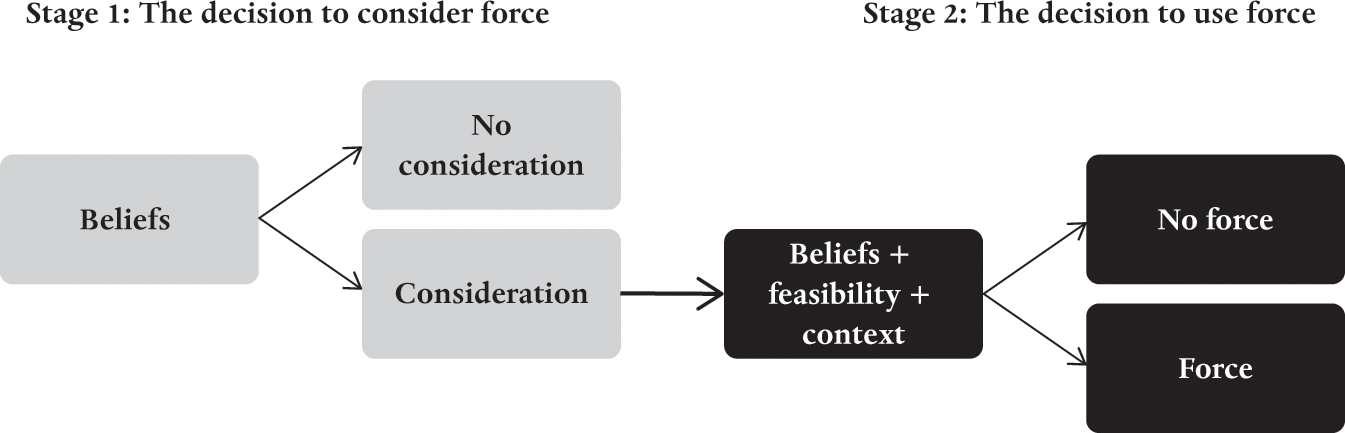
Figure 2.1. The decision-making process following discovery of a proliferation attempt
Thus, beliefs are consequential in both stages of the decision process. First, beliefs establish whether or not consideration of preventive force is likely to occur for a given leader. To consider intervention is a nontrivial investment of time, resources, and personnel, so this is no small matter. Substantively, focusing on consideration is significant; as the empirical universe makes clear, when presented with an adversarial proliferator, not all leaders will consider military force. Second, beliefs frame a leader’s weighting of an intervention’s feasibility, costs, and benefits and help determine when to intervene (or abstain from intervention) and the consequences of either strategy.
Consequently, I conceptualize the dependent variable as trichotomous, taking three potential forms: preventive military force can be used as a counterproliferation strategy; preventive military force can be considered but not used; and no consideration of preventive military force can occur. To qualify as the use of force, the military campaign must be overt, conducted by the military, and state-sanctioned. The use of force generally takes the form of air campaigns, strategic bombings, and surgical strikes.85 To qualify as consideration, this process must be done by the national executive. Consideration will likely occur with key cabinet members and include requests for military options and feasibility assessments for an intervention. Consideration may also include discussions with third parties if a joint mission or overflight rights are relevant for the given case. Note that for the national executive or an opposition party member to make a one-off comment about the use of force is insufficient to be coded as consideration.
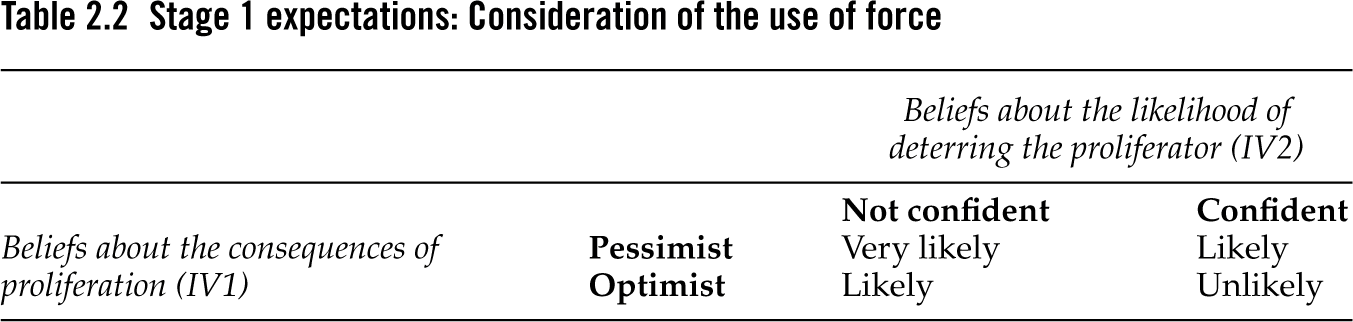
Leaders’ prior nuclear beliefs thus shape the likelihood of both the consideration and use of force. In the first stage, combining the two independent variables yields four expectations for the likelihood of an individual leader’s consideration of forcible options (table 2.2).
Stage 1 Hypotheses:
· If a leader is a proliferation pessimist and is not confident in deterrence, then the leader is very likely to consider preventive military force as a counterproliferation strategy.
· If a leader is a proliferation optimist and is not confident in deterrence, then the leader is likely to consider preventive military force as a counterproliferation strategy.
· If a leader is a proliferation pessimist and is confident in deterrence, then the leader is likely to consider preventive military force as a counterproliferation strategy.
· If a leader is a proliferation optimist and is confident in deterrence, then the leader is unlikely to consider preventive military force as a counterproliferation strategy.
Given the considerable uncertainty associated with even the best military and intelligence estimations of an intervention’s outcome, many have argued that attacking a proliferator’s nuclear program is a poor strategy selection.86 Others maintain that even temporarily delaying another state’s nuclear program is enough to warrant an attempted intervention, since even partial destruction can successfully deter that proliferator from further attempts. In an attack’s aftermath, a proliferator may forgo further effort because of international pressure, experience a regime change empowering a new government opposed to the nuclear pursuits of its predecessor, or change in such a way that the proliferator is no longer hostile to the would-be preventer.87
Moreover, states contemplating prevention have verbalized this logic historically in arguing for preventive military force, despite their inability to be completely successful in permanently destroying an adversarial program. For example, before Operation Desert Fox, Clinton administration officials described the mission’s aim as degrading, not eliminating, Iraq’s ability to manufacture and use weapons of mass destruction. When asked about this distinction, Secretary of State Madeleine Albright offered the following explanation:
I don’t think we’re pretending that we can get everything, so this is—I think—we are being very honest about what our ability is. We are lessening, degrading his ability to use this. The weapons of mass destruction are the threat of the future. I think the president explained very clearly to the American people that this is the threat of the 21st century.… What it means is that we know we can’t get everything, but degrading is the right word.88
This tension highlights the subjective aspects of the decision to use force, given the inherent limitations of a preventive attack and the desire to attempt the intervention nevertheless.89 This tension also emphasizes how during this second stage of deliberations, between the use of force and mere consideration, a leader leverages their prior nuclear beliefs to explain the ultimate strategy chosen. Stated differently, because success can never be completely guaranteed, even in scenarios with a high likelihood of success, a leader’s evaluation of the goals, benefits, risks, and costs associated with the campaign (and those associated with doing nothing) together influence the decision to give the attack order. Consequently, to understand when the consideration of preventive military force occurs, it is necessary to explore a leader’s prior beliefs about the general consequences of nuclear proliferation, the perceived threat posed by a specific proliferant, and whether or not that threat can be deterred. When the threat assessment dictates consideration, the prior beliefs shape a leader’s subjective evaluation of the intervention’s utility. Therefore, the leader-centric model, by examining the role of prior beliefs, predicts what a leader’s proclivity regarding the use of force should be.
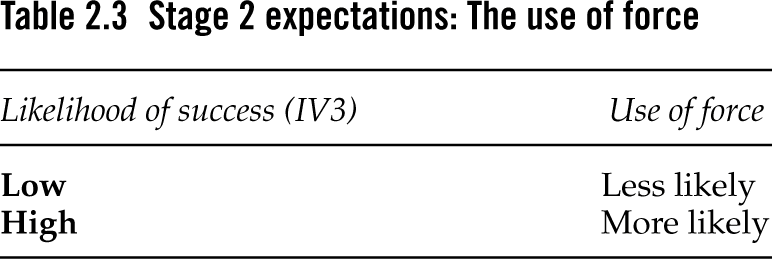
Once the second stage is underway and a leader is considering preventive intervention, expectations for the use of force result from belief-laden assessments of the likelihood of conducting a successful intervention (table 2.3).
Stage 2 Hypotheses:
· If a leader is considering the use of force, and the likelihood of conducting a successful intervention is low, then the leader is less likely to use preventive military force as a counterproliferation strategy.
· If a leader is considering the use of force, and the likelihood of conducting a successful intervention is high, then the leader is more likely to use preventive military force as a counterproliferation strategy.
Perhaps the most striking revelation resulting from these expectations is that being a proliferation pessimist is insufficient to guarantee the use of force. Similarly, not every high-threat proliferant will suffer a preventive counterproliferation attack. Instead, a very precise combination of factors is necessary for the use of force to result. Specifically, consideration is most likely when a proliferation pessimist, not confident in deterring the proliferator, is in office; then, only with an expected high likelihood of success is that leader likely to utilize preventive intervention. Recognizing that without these conditions we are highly unlikely to see intervention helps explain why the use of force as a counterproliferation strategy is extremely rare.
Furthermore, the process reveals two discrete pathways to not using force—first with an optimist, confident in deterrence, who never considers using force; and second with a leader who considers intervention but opts against it. By articulating the decision in full, the theory brings both pathways to the fore. This articulation is crucial both for highlighting how rarely force is used and also for understanding the mechanisms that lead to all relevant empirical outcomes.
Whereas in other substantive areas beliefs may derive from political party or ideology, in this context I argue that relevant beliefs form much earlier in a leader’s life. While there is no one pathway for this process, there are a few likely scenarios. First, leaders’ formative years may shape their worldviews and determine their individual threat perceptions, especially if leaders served in the military. Second, early life, education, or political service may produce defining moments. Likewise, key lessons, critical junctures, or significant events might remain salient from youth through adulthood. Because of the diversity of channels through which they are formed, the beliefs consequential for preventive decision making may vary not only based on party, military experience, or other affiliation but rather across individuals themselves. Indeed, the empirical record supports this claim: both Republicans and Democrats, as well as both veterans and those who did not serve, considered, did not consider, and used force. At first blush, Democrats might appear to view proliferation as more dangerous than Republicans, as Kennedy, Clinton, and Obama considered or used force. Reality is more complex, however; Johnson, also a Democrat, did not. Furthermore, Republicans may have grown increasingly pessimistic about proliferation with George W. Bush’s bombing of Iraq and Donald Trump’s potential contemplation of the use of force against Iran. Party alone appears insufficient to explain the observed variation. I therefore interrogate at the level of the individual, focusing on the prepresidential period as the source for individually held beliefs.90
Arguments concerning the role of leaders’ beliefs raise questions about whether beliefs can change over time.91 My research found little evidence of this during the relevant period of analysis, with a sole exception occurring after catastrophic shocks: after September 11, 2001, the available evidence suggests that George W. Bush’s beliefs shifted. Although he still perceived a threat from the proliferation of weapons of mass destruction, the salience of rogues and terrorists increased exponentially. While noteworthy, the leader-centric theory does not require perfect belief consistency; what is consequential is that prior beliefs are identifiable and salient for later strategy selections.
Of course, leaders may learn in office, especially given their access to more and different information once they assume the presidency. Nevertheless, I find no evidence of an “in-office treatment” as each leader receives intelligence consistent with taking office and no discernible reorientation occurs regarding the relevant proliferation challenges relative to the leaders’ prepresidential positions. While such learning may depend on baseline levels of prior subject matter familiarity, this alone cannot explain the behavior observed, as the leaders explored here vary significantly in their international security knowledge and experience.92
Measurement and Methodology
The first two independent variables employ a dichotomous coding scheme, with coding decisions reflecting leaders’ public and private writings and statements identified by primary and secondary source research. The “general consequences of proliferation” variable is coded primarily in the prepresidential period and reflects whether a leader believes that nuclear weapons are stabilizing and reduce the likelihood of nuclear use (nuclear optimist), or that nuclear weapons are destabilizing and increase the likelihood of nuclear use (nuclear pessimist). Also captured are a leader’s views regarding the potential for nuclear weapons to embolden states, or, because of the stability-instability paradox, encourage lower-level, conventional conflict because of the low risk of nuclear escalation.93 Coding decisions for this variable reflect the balance of evidence yielded by a leader’s prepresidential history: if a leader more often than not associates nuclear weapons with increased danger and a greater risk of conflict between states, then the leader is coded as a pessimist. Conversely, if a leader associates nuclear weapons with improving deterrence and peace between states, then the leader is coded as an optimist.94
To the extent possible, the “likelihood of deterring the proliferator” coding also reflects writings and utterances from the prepresidential period regarding the threats a leader perceived, both generally and regarding the proliferant that the leader would later face in executive office. A leader may be confident in his or her ability to deter a future attack from a now-nuclear armed opponent or may lack such confidence. Coding decisions for this variable thus reflect whether the preponderance of evidence available indicates that the leader perceived nuclear weapons as likely to complicate or facilitate attempts at deterrence. For example, a leader who regularly connected an adversary’s nuclear weapons acquisition with difficulties in achieving the leader’s regional or global goals will be coded not confident in deterring the adversary once armed with nuclear weapons. By contrast, if a leader sees deterrence as disconnected from nuclear matters or believes that the state can deter the adversary regardless of the adversary’s technical capacity in the future, the leader will be coded as confident in deterrence.
Note that history provides unequal amounts of data from the preexecutive experience of the leaders studied. While some leaders have extensive preexecutive political careers and there are a variety of early written sources to analyze, others provide less material with which to work. For this reason, I attempt to code the leader’s beliefs in the prepresidential period, but if this effort is not feasible because of data limitations, then as a secondary approach I explore the early administration period, prior to the specific crisis under analysis.
Coding the independent variables primarily during the preexecutive period is significant because it allows me to temporally disaggregate the prior beliefs from the crisis period, avoiding both tautology and the criticism that beliefs are merely proxies through which a leader sells a desired policy. The use of the prepresidential period to code nuclear beliefs, with the rest of the employed research design, allows me to be more confident in my argument. As Saunders and others have noted, isolating leader beliefs can be a tricky undertaking; politicians say and do things because of crisis decision making, for instrumental reasons, or as post-hoc justifications for other preferences. The prepresidential period offers a general portrait of what the leader found threatening well before the specific crisis emerged.95
In addition, when the historical evidence presents a mixed record, as may very well happen given that humans are not perfect automatons, I assess the weight of the evidence to determine the coding. This task may be especially difficult for leaders who have not left behind a large trail of historical evidence or said or written much regarding nuclear weapons. All scholars working with historical and archival evidence confront similar issues; I introduce mixed evidence forthrightly and describe the coding conclusions even when coding is a close call.
Data for the third independent variable, the likelihood of conducting a successful military intervention, is drawn entirely from the leader’s administration period and reflects the results of feasibility studies, presidential tasking, and administration reports concerning all military options (if any) under consideration during the period in question. This third variable also employs a dichotomous coding scheme and can take a low or high value, depending on the degree of confidence expressed inside the administration reporting. This assessment of high or low confidence in mission success includes estimations of the costs, risks, and implications of an intervention. Intelligence estimates usually describe general expectations instead of offering a specific point estimate (for example, a 43 percent likelihood of success); accordingly, the high-low coding scheme reflects the uncertain nature of the mission and the relevant factors. Coding follows the general assessments from the pertinent military and intelligence agencies regarding the mission’s feasibility, the risks and costs involved, and the expected overall outcome.
Coding for the dependent variable similarly takes place during the administration period. To be coded as the use of preventive military force, a situation must exhibit the state-sanctioned use of surgical strikes, limited military intervention, or full-scale invasion to target the nuclear program of an adversarial proliferant to destroy or forestall that program.96 To be coded as consideration of preventive military force requires high-level discussion of the military option by the national executive and some portion of the cabinet or national security apparatus. Also necessary is a request for feasibility assessments from appropriate bodies regarding the state’s practical ability to conduct the military campaign or campaigns in question. A case may also include high-level discussions with allies or other external actors either for the purpose of conducting joint military action or to request overflight rights, safe passage, or some other practical assistance for the intervention. Should none of these indicators of consideration occur in a given case history, then the case is identified as involving no consideration of military force.
Case Selection and Research Method
This book does not explore the entire universe of cases in which any state could have possibly intervened to target another state’s nuclear program. Doing so would require examining all possible dyadic combinations of states in the international community and nuclear states, plus states that attempted to become nuclear. This conceptualization of the universe would dramatically inflate the relevant population, introducing many more cases into the universe that are simply unrealistic.97 Accordingly, I follow James Mahoney and Gary Goertz’s “possibility principle” to scope out all instances in which the observed outcome is beyond the realm of possibility.98 I truncate the population to situations in which contemplating force was plausible.
However, because I seek to determine what leads to consideration and what leads consideration to become action, I take the potential for consideration as the starting point in the empirical cases rather than including the entire potential universe of cases of attacking or not attacking.99 Drawing on the existing literature, I begin with the universe explored by Fuhrmann and Kreps, which I augment temporally to account for recent cases.100 I then set aside cases in which the use of force could have been contemplated (in that the potential preventer had the necessary military means) but was not because the threat environment did not so warrant. This portion of the population is characterized by either formal or informal alliances, the sharing of civilian or military nuclear technology, or both. My theory would expect these cases of existing political and scientific relationships to lead to no consideration of the use of preventive military force.101 This expectation stems from the special relationship that exists between the states and an elite consensus that no direct threat to national security is posed by the attempted nuclear acquisition. It is not surprising therefore that the United States did not consider force when, for example, Britain, France, or Israel pursued nuclear weapons, as these dyads are distinguished from the rest of the universe by close political or military relationships, technological assistance, or sharing of nuclear expertise.102
Next, I include cases in which one leader considers preventive military force but the proximate leader does not, as this inclusion allows for an analysis of instances in which no consideration occurred, avoids selecting on the dependent variable, and permits understanding the causes of this variation across leaders. Thus, the design allows me to ascertain the conditions under which consideration becomes the use of force and those under which consideration does not lead to use of force; when consideration occurs and when it does not; and finally the precise causal mechanisms of each scenario. Defining the project in this way provides for an analogous comparison across cases, yields an opportunity for both theory building and testing, and supports a precise focus on the exact decision process under investigation.
This book explores the full variation found in the empirical universe—why certain leaders consider and attack adversarial nuclear programs, but other leaders, confronting the same adversarial nuclear program, do not consider the use of preventive force. The book also explains why the same leader uses preventive military force against some proliferants but refrains from doing so against others. By extension, I am not exploring the choice among counterproliferation tools—that is, the choice between implementing sanctions or the use of military force, or using force versus some other alternative. I do so to understand the precise mechanisms of the decision to use force, something previously overlooked in the literature. I deliberately set aside other policy choices within the counterproliferation tool kit, including sanctions, sabotage, assassination, diplomatic pressure, and cyber strategies. While these tools may appear in the cases, they do not operate according to a preventive logic and are thus set aside.103
With these considerations and the previously articulated scope conditions in mind, the universe of dyads of historically antagonistic states where the use of force was at least contemplated as one state confronted an adversarial proliferant appears in the following list (N = 24).
CASE UNIVERSE
· Egypt–Israel (1967)
· India–Pakistan (1982, 1984, 1986–1987)
· Iran–Iraq (1980)
· Iraq–Iran (1984–1988)
· Israel–Iran (2003–2018)
· Israel–Iraq (1977–1981)
· Israel–Pakistan (1979–1987)
· Israel–Syria (?–2007)
· Norway–Germany (1941–1944)
· Pakistan–India (1984)
· South Korea–North Korea (1991, 1993–1994)
· Taiwan–China (1963)
· United Kingdom–Germany (1941–1945)
· United Kingdom–Iraq (1998)
· United States–China (1961–1964)
· United States–Germany (1942–1945)
· United States–Iran (2003–2018)
· United States–Iraq (1990–1991, 1998, 2002–2003)
· United States–North Korea (1992–1994)
· United States–Soviet Union (1945–1949)
· United States–Syria (?–2007)
· Soviet Union–China (1969)
· Soviet Union–Israel (1967)
· Soviet Union–South Africa (1976)
I do not include the United States–Cuba dyad as an independent case because the weapons in question during the Cuban missile crisis were not Cuban but Soviet weapons placed in Cuba. As relevant, the Cuban missile crisis is discussed in chapter 3.
Since my argument centers on leaders and their beliefs, I examine cases that span multiple (at least two) consecutive administrations to isolate individual leaders’ roles in preventive war decision making. By doing so, I can control for the role of the target state and isolate the effect of the leaders themselves. I choose consecutive administrations in order to minimize the amount of time that elapsed for further development of the adversary’s nuclear program, which might otherwise account for different assessments of the program by different administrations. This more limited universe is as follows (N = 9).
CASES WITH MULTIPLE, CONSECUTIVE ADMINISTRATIONS
· India–Pakistan (1979–1981, 1984, 1987)
· Israel–Iran (2003–2018)
· Israel–Iraq (1977–1981)
· Israel–Pakistan (1979–1987)
· Israel–Syria (?–2007)
· United States–China (1960–1964)
· United States–North Korea (1989–1994)
· United States–Iran (2003–2018)
· United States–Iraq (1990–2003)
One might consider including two additional cases on this list, Soviet Union–Israel (1967) and Soviet Union–South Africa (1976). I exclude these cases because during this time period the Soviet Union was governed by a troika of Leonid Brezhnev, Alexei Kosygin, and Nikolai Podgorny. As this was a collective form of leadership as opposed to a consecutive sequence of leaders, the cases are not useful for an analysis intended to isolate the role of individual leaders and their nuclear beliefs.
Because this smaller universe comprises only nine cases, it would be useful to examine each of them in detail. In light of space and other constraints, however, treating all nine in full is not feasible. Instead, one might pursue a comparison of democracies with nondemocracies that would theoretically allow for a test of how regime type determines preventive war decisions. As the smaller universe of nine cases contains only democratic potential preventer states, there is no useful variation on this variable. Moreover, authoritarian leaders should theoretically exhibit variation in beliefs similar to that of their democratic counterparts. Furthermore, my theory suggests that leader type, not regime type, is the crucial explanatory factor. Variation within the United States also calls into question regime-based arguments.104
I therefore focus primarily on the decision making of the United States. Doing so allows me to explore variation in both the independent and dependent variables, control for as much of the changing empirical circumstances as possible within each case, and explore the precise causal mechanisms at work.
The three main case studies explore American behavior vis-à-vis the Chinese, North Korean, and Iraqi nuclear programs and analyze the decision making of five American presidents—Kennedy, Johnson, George H. W. Bush, Clinton, and George W. Bush. To explore the generalizability of the findings from these US-based investigations, and to begin to correct the literature’s US bias, a fourth empirical chapter moves to the Israeli context to assess how Israeli prime ministers behaved toward the Iraqi, Pakistani, and Syrian nuclear programs. The conclusion offers preliminary assessments of recent experiences with the North Korean and Iranian nuclear programs. In this way, I cover eight of the nine critical cases listed to demonstrate the strength of the leader-centric argument.
Making the choice to use preventive military force is a complex and rare decision. The theory offered here is a probabilistic one. It explores how leaders with certain belief profiles are likely to behave, while also recognizing that other factors are relevant to the decision-making process. Indeed, leaders are likely to have different beliefs about the consequences of nuclear proliferation generally and about their ability to deter specific actors once armed with nuclear weapons. It is these nuclear beliefs that are critical to the choice to consider or use preventive force as a counterproliferation strategy. Ignoring leaders and these beliefs obscures critical variation that exists in this important substantive arena. I turn now to the empirical evidence, beginning with how John F. Kennedy and Lyndon B. Johnson engaged the Chinese nuclear program between 1961 and 1964.