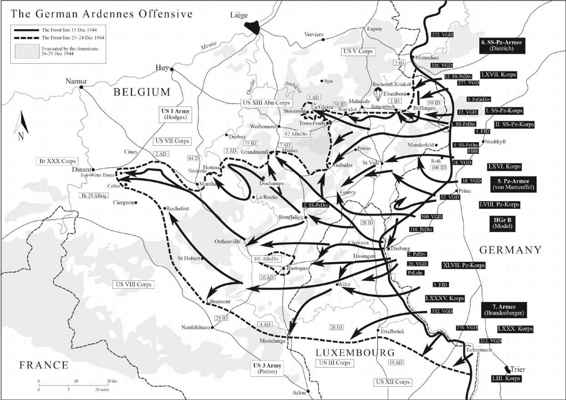
On the evening of 22 December 1944, the advance force of German 2. Panzer-Division paused in the small Belgian village of Hargimont. The palace yard of the partly dilapidated medieval castle Château de Jemeppe, just at the end of the hurst leading down to Hargimont from the east, was filled with German combat vehicles. Similarly, in the narrow village streets, in the fields and in groves around the village—everywhere German combat vehicles of all kinds were parked, nearly one thousand in total. It was like an exhibition of the German Army’s vehicle park at the end of World War II: Half-track Hanomag armored personnel carriers, eight-wheel Puma armored cars, big 11-and 18-ton Sonderkraftfahrzeug 7 and 9 towing vehicles, four-wheel-driven 4.5 ton MAN 4500 trucks, slightly smaller Opel Blitz trucks, Maultier half-track trucks, small Volkswagen Schwimmwagen amphibious cars, various anti-aircraft vehicles, several motorcycle types, captured U.S. vehicles of all kinds, and an abundance of civilian vehicles. On the hills that surrounded the village, Panther and Panzer IV tanks and Sturmgeschütz III assault guns were strategically placed. Inside the dark village, German sentinels, shivering in the freezing December night, sauntered about between parked vehicles. Others manned positions just outside the village, and some of the least fortunate were out on patrol missions in the surroundings. Several others lay asleep in the forcibly requisitioned houses, where many were so exhausted that they did not even wake up to the bangs from the German artillery that sporadically shelled the town of Marche, a couple of miles to the northeast.
Major Ernst von Cochenhausen, the commander of the German advance force, waited for the sunrise when he would resume the advance in what was expected to be the final leg to—and across—River Meuse. Forty-four-year-old von Cochenhausen was a veteran who had participated in the German seizure of the Czech Sudeten area in 1938. He had been wounded already on the fourth day of the war against Poland in 1939, but returned to first-line service and commanded a motorcycle battalion on the Eastern Front. After completion of the regimental commander training, he was in December 1944 transferred to the 2. Panzer-Division, where he became deputy commander of Panzergrenadier-Regiment 304. In this position he led the combat group that was named after himself, Kampfgruppe Cochenhausen. Along with the armored reconnaissance battalion, this constituted the 2. Panzer-Division’s advance force.
On the crest of the hill above Château de Jemeppe, American military vehicles that had been knocked out by German fire a couple of hours ago, were still smouldering. These belonged to a combined task force from two American divisions—the 84th Infantry and 3rd Armored—that was routed on the evening of 22 December, after which the Germans could take Hargimont. This was but the latest of a series of successful engagements between the 2. Panzer-Division and various American forces since the Ardennes Offensive had begun one week earlier.
From their perspective, the men of the 2. Panzer-Division had all the reason to feel proud of the division’s accomplishments in the war. The division had been founded already in 1935, when Hitler reintroduced military conscription and began the reconstruction of the German Armed Forces. The first commander of the division was no one less than Heinz Guderian, the father and founder of the new German Armored Force. The 2. Panzer-Division participated in the march into Austria (Anschluss) in March 1938, and the occupation of the Czech Sudeten area following the Munich agreement in September that same year. In World War II, the 2. Panzer-Division fought with great success on almost all theaters of war—Poland in 1939, the West in 1940, the Balkans in 1941, the Eastern Front 1941 to 1944, and finally the Western Front, including Normandy, in 1944.
The 2. Panzer-Division reached the zenith of its career on 20 May 1940, during the Blitzkrieg in the West, when it became the first German unit to reach the English Channel. Thus, a whole Allied army group was caught in a huge ’sack’ in the north. This settled the fate of France. One month later, France, Germany’s old arch enemy, had to surrender under humiliating circumstances. However, the question the men of the 2. Panzer-Division could ask themselves there in that little Belgian village called Hargimont on the cold night of 22 December 1944, was whether they were not actually on the verge of superceding even the accomplishments of 1940.
During the week that had passed since the opening of the German Ardennes Offensive on 16 December 1944, the 2. Panzer-Division had advanced about sixty miles on miserable country lanes and muddy fields, subduing any resistance which the mighty U.S. Army had confronted them with. ‘Enemy morale seems strongly shaken,’ the divisional commander, Oberst Meinrad von Lauchert, wrote in a report which he compiled on the evening of 22 December 1944. Von Lauchert continued:
‘Since our fight at Noville we have encountered only weak resistance that was easily overcome—except south of Marche today.’
This was the result of a whole series of utterly devastating defeats dealt by the 2. Panzer-Division to its American opponent.
It all started in the wee hours of the night of 1516 December 1944, as specially selected assault troops from the division silently paddled across the German border river Our, and under the cover of darkness and fog crept past the American positions in the mountains on the other side. Meanwhile, tens of thousands of other German troops from fifteen other divisions advanced in the same silent way to assume attack positions along the Ardennes Front. The attack caught the unprepared Americans completely by surprise. Soon the panzer division’s armor was able to cross a hastily completed bridge, and at the small village of Marnach, three miles into Luxembourg, the 2. Panzer-Division smashed the first armored force that the Americans put up against them.
The 2. Panzer-Division’s next task was to secure the crossing of River Clerve at Clervaux, seven miles from the point of departure. This was achieved on the second day of the offensive, in a tank battle in which the Americans lost sixty and the 2. Panzer-Division not more than four tanks. The regiment from the U.S. 28th Infantry Division that tried to stop the Germans here, was completely annihilated, and the regimental commander, Colonel Hurley Fuller, was among the large number of Americans who were taken as prisoners.
In the space of forty-eight hours, the victorious and confident American Army on the Western Front had been thrown completely out of the way, and its demoralized soldiers fled headlong to the west, pursued by German armored columns that seemed to be absolutely invincible. Among the most advanced German troops was Meinrad von Lauchert’s panzer division.
On the third day of the offensive, U.S. 9th Armored Division brought forward its reserve force in an attempt to halt the 2. Panzer-Division. The ensuing combat ended with the American force being almost completely obliterated. Leaving the hulks of forty-five burning Sherman tanks behind, what remained of the American armored unit withdrew. Among those that were killed, was the commander of U.S. 2nd Tank Battalion. That evening, the 2. Panzer-Division stood four miles to the west of its point of departure, and so far it had suffered no more than marginal losses of its own.
The Americans now brought a third division—the 10th Armored from Patton’s Third Army—against the 2. Panzer-Division’s southern flank. But during two days of violent tank battles, even this American division had to see its tanks getting knocked out in the dozens. The final, decisive battle took place at Noville, a small community northeast of Bastogne. When the 2. Panzer-Division stood victorious in Noville, having mowed down another task force of U.S. 10th Armored Division, it might well have been able to capture the strategic town of Bastogne through an attack from the north. But the German commanders had other plans for von Lauchert’s division: It was to form the spearhead of the lightning offensive that sought to establish a bridgehead across River Meuse, forty miles further to the west. The German report of 20 December 1944 stated, ’The enemy is fleeing towards the west.’
What seemed to be a final American attempt to stem the German advance was made at Hargimont in the afternoon on 22 December. It ended with American 3rd Armored Division and 84th Infantry Division having to retreat.
By now German 2. Panzer-Division not only appeared to be completely invincible; on its left flank stood German Panzer Division Lehr, led by the renowned Generalleutnant Fritz Bayerlein. To the right stood German 116. Panzer-Division, the famous ’Windhund’ Division, which just like the 2. Panzer-Division had surged forward like a steamroller, crushing any American resistance in its way. This armored division also had advanced sixty miles in less than a week. A bit further to the east, two more panzer divisions had marched up—the 2. SS-Panzer-Division ’Das Reich,’ and the 9. SS-Panzer-Division ’Hohenstaufen’—along with an infantry division. When the offensive was initiated, these German forces had a combined strength of over four hundred operational tanks, of which nearly two-thirds were of the model Panzerkampfwagen V Panther—far superior to anything the Western Allies could muster in the shape of tanks.
At the sunrise which von Cochenhausen waited for in Hargimont, the 2. Panzer-Division would take the shortest route across the fields on the frozen plateau towards the bridge over the Meuse at Dinant. Indeed, the distance that had to be covered to reach this place was twenty-five miles, but there was nothing but quite weak Allied forces between Hargimont and Dinant, so the Germans could expect to reach their goal during the next day, 23 December. Quite confident, the divisional commander von Lauchert reported to the Corps headquarters on the evening of 22 December 1944:
’We will continue our advance with our main force. […] We will occupy the zone Celles, Conjoux and prepare to cross the Meuse at Anseremme [just south of Dinant].’
Through its rapid crossing of River Meuse at the French city of Sedan in May 1940, the 2. Panzer-Division had played a crucial role in the blighting of the Allied defensive strategy in the West in 1940. This opened the way for the rapid advance to the English Channel, where the British Expeditionary Force was driven out to sea at Dunkirk. Now, four and a half years later, it looked as though the division was about to repeat a similar feat. If only this armored division crossed the Meuse, it would probably force the Allies to a general retreat behind the river; otherwise its units would run the risk of getting cut off. This in turn could lead to a situation where the two German armored armies in the Ardennes Offensive—the 5. Panzerarmee and the 6. SS-Panzerarmee—would succeed in their aim to reach the port of Antwerp. Thus, the whole British-Canadian 21 Army Group, including U.S. First and Ninth armies, would be cut off in the north. In view of the prevailing circumstances, such a German victory would eclipse even the great victory in the West in May and June 1940.
At Dinant on the evening of 22 December 1944, British 3rd Royal Tank Regiment was instructed to prepare a withdrawal to Saint-Gérard, three miles west of the Meuse. The road really seemed to lay open to the German panzers. How was it possible that such a situation could happen at all—in the sixth year of the war, half a year after the successful Allied landing in Normandy, and the following liberation of France? That was a question asked by a whole world.
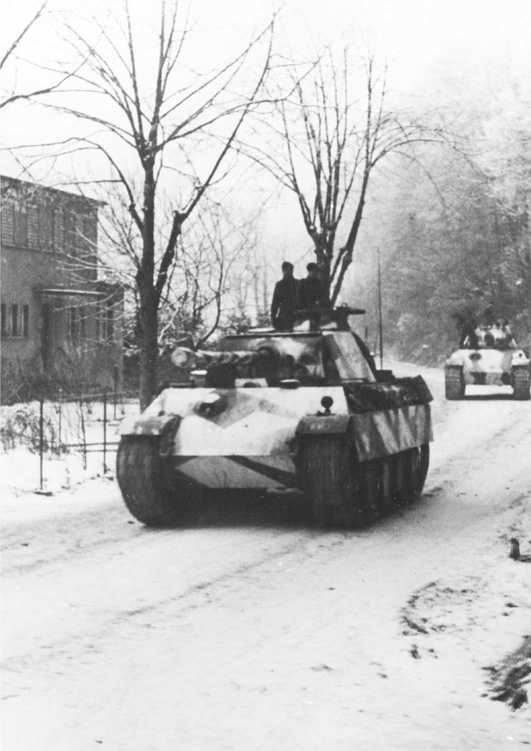
German Panther tanks pass through a small village during the offensive in the winter of 1944/1945. The German attack in the Ardennes came totally unexpected to the Allies. (BArch, Bild 183-1985-0104-500/Dr Paul Wolff)