
CHAPTER 1
"If we continue to advance at the same pace as that of recent weeks we should be in Berlin on 28 September." General John Kennedy, Assistant Chief of the Imperial General Staff in London, 6 September 1944.1
The rain was pouring down as the Soviet assault companies left their positions and hurried forward between the German positions. Supported by tracked tank destroyers they hurled themselves over the German enemy. One German position after another was fought down.
It was late afternoon on Thursday 22 June 1944. Operation ’Bagration,’ the Red Army’s greatest offensive ever—the greatest Allied offensive during World War II—had just commenced, and the Germans were completely unaware of this! The fighting continued throughout the night, when Soviet units specialized in night fighting were deployed. Meanwhile, around one thousand Soviet aircraft came buzzing in over the German lines. Since Belorussian partisans already had completed the task of knocking out much of the German rail lines, the aircrews could focus on German artillery positions and strongpoints in the defense.2 However, to the headquarters of German Army Group Center, Heeresgruppe Mitte—one of the most powerful army groups of the entire German Army, the one which had withstood attacks of the Red Army longer than any other force—it appeared to be nothing but an expansion of the deep armed reconnaissance thrusts that had been carried out by the Red Army during the recent months. According to the textbook, a major attack was initiated by artillery and large tank concentrations, but here was only a rather limited artillery fire, mainly infantry with self-propelled guns, and only quite few medium tanks.
At five in the morning on 23 June, General Ivan Bagramyan, the commander of Soviet 1st Baltic Front, ordered his artillery to open fire. But what followed was not a general, massive fire all along the line, but rather a shelling of selected points where infantry thrusts had been halted in front of German points of resistance. Not even when the Soviets despatched more powerful armored units—including two regiments equipped with the new heavy Josef Stalin 2 tanks—into the gaps that the infantry had opened in the German lines, did the German High Command fully understand what was actually developing.
North and south of the Belorussian city of Vitebsk, less than one hundred miles southeast of the Latvian border, German 3. Panzerarmee was locked into a desperate battle. Wherever the Germans managed to halt their opponent, Soviet ground-attack aircraft or bombers dropped out of the clouds to wipe out the German positions. During the course of 23 June, Soviet 1st and 3rd Air armies carried out nearly seventeen hundred individual combat sorties in the Vitebsk section alone. The German Air Force remained almost invisible—the local Luftwaffe commander still was of the opinion that this was nothing but a Soviet diversion attack.’3
The Soviet preparations for the offensive had been so skillfully masked that the Germans knew nothing of the huge concentration of forces that had been made against Army Group Center: 1.67 million men with 4,000 tanks and assault guns, plus 24,000 artillery pieces and mortars.
Only on the third day of the Soviet offensive, 24 June, did it dawn on the German High Command that the Red Army in fact had launched a major attack aiming at nothing less than the destruction of Heeresgruppe Mitte.4 But by then it was too late. The armored forces of the 1st Baltic and 3rd Belorussian fronts already had achieved deep incursions. At Vitebsk, 38,000 men from German 3. Panzerarmee were surrounded. Farther to the south, at Bobruysk, a major part of German 9. Armee was enveloped.
From the initial hour, the Soviet Air Force controlled the skies, and air attacks played a crucial role to the rapid collapse of Heeresgruppe Mitte. On 2 July, the Red Army’s pincers closed around 105,000 troops of German 4. Armee at the Belorussian capital Minsk. A couple of days later, the 4. Armee’s last resistance had been completely broken. Sixty thousand men marched into Soviet captivity. At this stage, Heeresgruppe Mitte had lost 350,000 of the 490,000 soldiers which had stood at its disposal only a fortnight earlier. During the following weeks, another100,000 men would be added to the German army group’s loss list.
Following the Battle of Kursk in the summer of 1943, the Germans had been pushed back bit by bit by the Red Army, but with the exception of the breakdown on the Crimean Peninsula in the spring of 1944, this had taken place with mainly coherent German front lines. Until Operation ’Bagration,’ the hope had remained that somewhere it would be possible to ’lock’ the Red Army along powerful defensive lines on the Eastern front. The collapse of Heeresgruppe Mitte during the first days of July 1944 gave the German High Command the painful realization that the war against the Soviet Union inevitably was lost.
On 13 July, the Soviet offensive expanded as Marshal Ivan Konyev’s 1st Ukrainian Front attacked German Heeresgruppe Nordukraine in northwestern Ukraine. Here too, the Soviet air supremacy played a decisive role to the outcome of the ground battle. Due to the air support, Konyev’s troops succeeded in surrounding and annihilating a large German force at Brody. By 29 June, the 1st Ukrainian Front had inflicted 198,000 casualties on Heeresgruppe Nordukraine, against its own losses of 37,400 men. While Konyev’s forces pushed the Germans out of the Ukraine and severed the connection between Heeresgruppe Nordukraine and Heeresgruppe Mitte, the battered remnants of the latter German army group fled more or less in panic towards the west. By the end of July, the Red Army had reached the Gulf of Riga, thus cutting off yet another German army group—Heeresgruppe Nord—in Estonia and northern Latvia, while Soviet 1st Ukrainian Front was closing in on Warsaw.
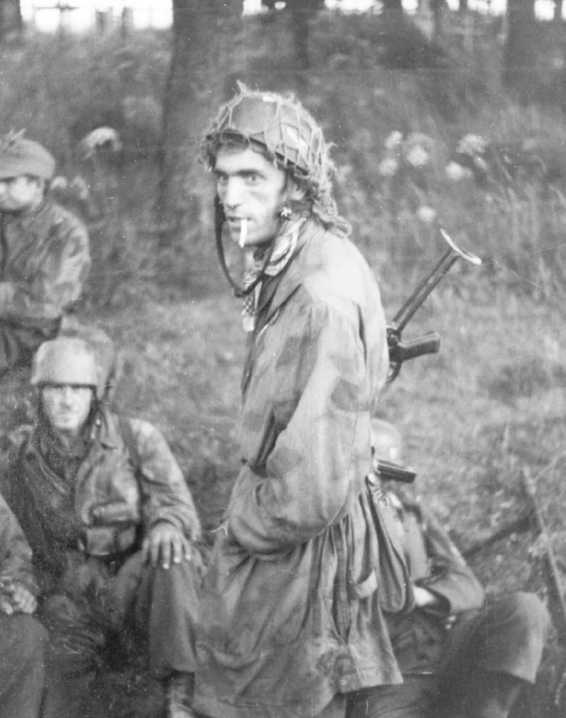
German paratroopers in Normandy in the summer of 1944. At this time, Germany was under heavy pressure on all fronts and it was rather obvious that the war was lost, which also was reflected in the morale of the troops on both the Eastern and the Western fronts. However, this insight on the German side would not last throughout the year. (BArch, Bild 101I-586-2225-11A/Slickers)
Only a rapid deployment of strong German reinforcements—including some that had been brought from Normandy, where the Germans and the Western Allies were locked into positional warfare following the landings on 6 June—could halt the Red Army, just to the east of Warsaw. The connection with Heeresgruppe Nord barely could be reestablished.
These Soviet breakthroughs were the climax of the serious crisis which the Germans had been hurled into after the first days after the Allied invasion of Normandy in northwestern France as it stood clear that the British-American bridgehead could not be eliminated. The heavy artillery of the Allied warships which controlled the area around the landing beaches, the massive Allied air superiority—against around 10,000 Allied fighters and bombers stood an average of slightly more than one thousand German aircraft on the Western Front—as well as the increasing numerical superiority of the Allied ground forces, made it clear beyond doubt that it merely was a question of time before the Germans would have lost their control over France. Throughout July 1944, the German commanders expected a major Allied breakthrough any day.5 By the third week of July, the relation of forces at Normandy was about the same as at Operation ’Bagration’—around 1.5 million Allied troops faced 380,000 men on the German side.6
On 20 July 1944, a group of conspirators struck against Hitler in a final desperate attempt to save a hopeless situation. The result is well-known—the plot failed, and the powerful grip which the Nazi dictator already held on the German Armed Forces was even further strengthened.
On 24 July, the Americans despatched 350 heavy bombers against the German positions at the southwestern corner of the Allied bridgehead in Normandy, where the cornerstone of the German defense consisted of the armored division Panzer Lehr under Generalleutnant Fritz Bayerlein. This bombing cost Panzer Lehr a loss of 350 men and ten armored vehicles, but this was not more than the Germans could take. Bayerlein, who assumed that this was the prelude to yet another American attempt to break through, despatched his reserves. These had barely occupied their forward positions when the Americans on the following day unleashed a new massive aerial assault. This began at 0938 hrs, when fighter-bombers from eight fighter groups from U.S. 9th Air Force struck the German positions along a four-mile wide front. This continued for nineteen minutes, and then no less than fifteen hundred heavy bombers of U.S. 8th Air Force lumbered in and dropped three thousand tons of bombs over the same area. These aircraft had barely disappeared before another seven fighter groups of the 9th Air Force appeared and started to bomb and machine gun the totally devastated German positions. This was in turn followed by a fifty-minute bombardment by five hundred and eighty medium bombers.
These three hours of air attacks had, in the words of Bayerlein, a totally ’exterminating morale effect on the troops,’ who in several cases ’surrendered, deserted to the enemy or escaped to the rear, as far as they survived the bombing.’7 Others ’got crazy or paralyzed and were unable to carry out anything.’8 After the end of the war Bayerlein admitted that ’for me, who during this war was in every theater committed at the points of the main efforts, this was the worst I ever saw.’9
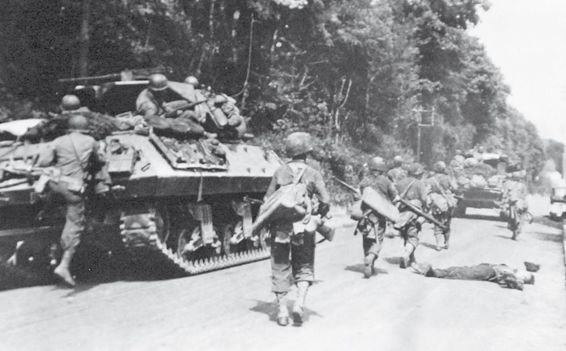
U.S. soldiers, supported by M10 tank destroyers, advance in the vicinity of Avranches in France in August 1944. (The Paul Warp Collection)
With Panzer Lehr ’totally exterminated’ and other German units—like the 116. Panzer-Division—prevented by Allied fighter-bombers from intervening in the battle, the American ground forces finally managed to achieve the operational breakthrough which they had sought for two months. On 30-31 July, the German positions at Avranches crumbled.
Next day, the American units in Normandy were lifted out of the Allied 21 Army Group, which under command of the British General Bernard Montgomery until then had had the unified command of all Allied ground forces in Normandy. Certainly, General Montgomery continued to hold the position as supreme commander of the Allied ground forces in France for another couple of weeks, but now the 12th Army Group was formed under the command of the previous C.O. of U.S. First Army, Lieutenant General Omar Bradley, with the task of directing the operations of the two American armies: First Army, which now was placed under command of Lieutenant General Courtney Hodges, and the new Third Army, which was formed from units brought from First Army. Lieutenant General George S. Patton was appointed to command the Third Army.
The Allied main force—812,000 American soldiers with 2,450 tanks and tank destroyers—was positioned on the western flank.10 The Germans, who had concentrated 645 of their slightly more than 800 tanks at Normandy against British 2nd Army and Canadian 1st Army on the eastern flank, had no chance against Patton’s armored forces once these had started their advance towards the south.11 Displaying a brilliant organizational ability, Patton managed to bring seven U.S. division across a single bridge at Avranches in only 72 hours.12
According to plans, a new tactical air command was formed within the U.S. 9th Air Force, XIX Tactical Air Command under Major General Otto P. Weyland, assigned with the task of providing the Third Army with close air support.13 XIX Tactical Air Command would develop a new American close air support tactic—the Armored Column Cover method, according to which an air controller with direct radio communication with airborne aircraft was assigned to the leading column of the advancing armored units, while fighter-bombers simultaneously were in the air above, ready to strike down on anything the forward air controller would direct them onto.
Patton’s Third Army spread out fan-shaped towards the west, the south, and the southeast from the gap at Avranches, and carried out a lightning offensive while Weyland’s airmen covered its flanks. In reality, Major General Middleton’s VIII Corps of the Third Army hardly encountered any resistance. The ’sweep’ through Britanny in the West was made in an area mainly evacuated by the Germans, where villages and towns had been taken over by the French resistance.14 The remnants of the four German divisions in this area hastily withdrew in order to establish strong defenses of the Atlantic ports of Brest, Lorient, and Saint-Nazaire.
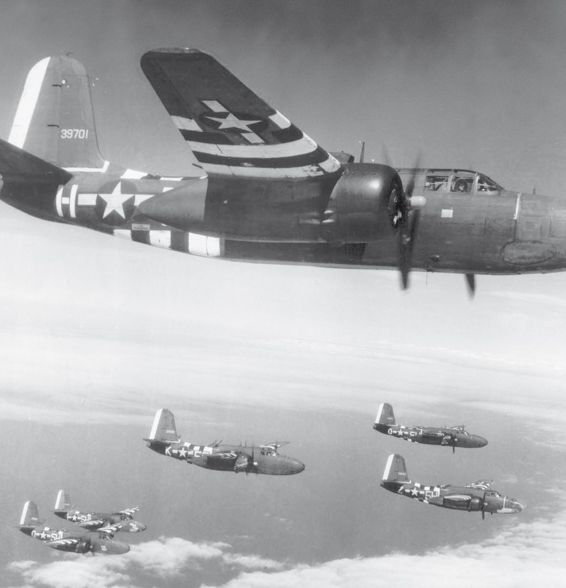
A formation of American Douglas A-20 attack bombers from the 9th Air Force heading for France to support the battle at Normandy. Allied aircraft played a decisive role on the Western Front in 1944. (US Army)
Neither were the Germans able to offer any effective resistance against Patton’s advance towards the southeast, and on 8 August, Le Mans, ninety miles south of the German positions at Caen on the eastern flank at Normandy, was liberated. Thus, Heeresgruppe B, the German army group in Normandy, was threatened to become cut off west of River Seine. Generalfeldmarschall Günther von Kluge, who on 2 July had succeeded Generalfeldmarschall Gerd von Rundstedt as this army group’s commander, suggested a retreat from Normandy to a new defensive line from the Seine’s mouth into the English Channel and further southeast to the Franco-Swiss border.
But Hitler instead ordered a counter-attack against Avranches with the aim of cutting off Patton’s army in the south. Such a counter-attack might have had a chance to succeed, had it not been for the Allied air supremacy. To von Kluge and his generals, it was absolutely clear that the whole operation was doomed beforehand, but in the climate of fear which dominated in the wave of terror that had followed on the failed 20 July Plot, hardly anyone dared to oppose.
Most German commanders agree that what halted the German counter-attack was the Allied aviation. ’They came in hundreds, firing their rockets at the concentrated tanks and vehicles. We could do nothing against them and we could make no further progress,’ wrote the commander of the 2. Panzer-Division, Generalleutnant Heinrich von Luttwitz.15 Next, the Allies attacked from both the north and the south in order to capture the entire Heeresgruppe B in a ‘sack’ at Falaise south of Caen. In the middle of this dramatic battle—on 17 August—Hitler fired von Kluge and brought in Generalfeldmarschall Walter Model as his succeessor.*
When Model arrived in France, 100,000 German troops were trapped in the so-called ’Falaise pocket.’ Their only very narrow line of escape to the east was subject to relentless air attacks; one of the Allied pilots reported the whole area to be burning. 16 However, as one among only a few senior German commanders by this time, Model enjoyed the Führer’s unreserved confidence. He had just arrived from the Eastern Front, where he had contributed to the halting of the great Soviet offensive. Hence, he could allow himself to order his troops to evacuate the Falaise pocket.
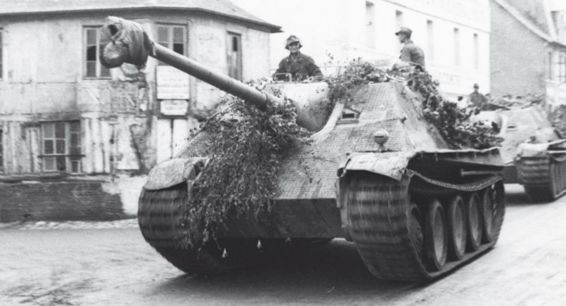
German Jagdpanther tank destroyers from schwere Panzer Jäger-Abteilung 654 pass through a French village during the fighting on the Western Front in the summer of 1944. With its 88mm PaK 43/3 L/71 anti-tank gun, the Jagdpanther was a feared weapon that could knock out Allied tanks at a distance of up to two miles. Although the German panzer force was significantly superior to their opponents’ tanks, the battle was decided to the latter’s advantage through the Anglo-American air superiority. (BArch, Bild 101I-301-1951-06/Kurth)
Even though German tanks were able to prevent the Allied ground forces from closing the ’sack,’ the evacuation was made extremely difficult due to the massive Allied air attacks. Around 50,000 men managed to escape to the east, but the bulk of their heavy equipment was abandoned in the Falaise area—chiefly as a result of the assault from the air.* The entire German strategy in France—which until this stage had consisted of the ambition to drive the Allies back into the sea—now fell apart completely. On 15 August, an Allied force under Lieutenant General Alexander Patch landed in southern France, where it was able to establish a bridgehead without encountering any serious difficulties. Hitler was left with no choice. On 16 August he ordered Armeegruppe G, which until then had held positions in southwestern France, to perform a rapid withdrawal towards the northeast.17 This coincided with Model’s evacuation of the Falaise pocket, which descended into a precipitous retreat from France when Patton’s Third Army on 20 August crossed the Seine south of Paris.
On the same day, 20 August, the Red Army opened its next great offensive on the Eastern Front—this time against Rumania, Hitler’s faithful ally for four years. In spite of fairly equal relations of strength—1.3 million Soviet troops were launched against 900,000 men on the Axis side —the German-Rumanian defenses rapidly disintegrated. Here too, this was to a great extent the result of the Soviet onslaught from the air.18 The new German 6. Armee—which had been assigned with the same number as the army that had been annihilated at Stalingrad in January 1943—was, just as its predecessor, surrounded by Soviet forces; the only major difference was that in this latter case, destruction came quicker. By early September 1944, even this second 6. Armee had ceased to exist. The losses amounted to 200,000 German troops, among whom 115,000 ended up in Soviet captivity. Thus Germany had lost a disastrous 1.27 million soldiers—900,000 of them on the Eastern Front—in just three months.19
The news of the loss of the Rumanian oil fields —which had been responsible for the bulk of Germany’s supply of crude oil—barely had reached Hitler, when two of Germany’s former allies abandoned the Nazi dictator. From Rumania, the Red Army continued into Bulgaria, which on 8 September declared war on Germany. Only four days earlier, Finland—subject to a heavy pressure through the Soviet offensive that had begun in June 1944—had signed an armistice with the Soviet Union. This was a serious blow to the German strategy on the Eastern Front, which had rested on the Finnish ability to tie down considerable Soviet forces. These now could be shifted to the front against Germany itself.
In fact, there was only one war theatre—the Italian front—where the German lines did not completely collapse during the summer of 1944. Here, in spite of a marked numerical superiority, the Allies failed to achieve anything but relatively limited territorial gains through the major offensive that was launched on 25 August. Hence, the Germans could bring forces from the Italian Front to more endangered combat zones. Military historian John Ellis is pitiless in his judgement of the Allied military command in Italy:
’Almost all the Allied generals made a poor showing, displaying a conspicuous lack of either tactical or strategic flair. Often enough they could not even agree between themselves as to what should be done. The whole Italian campaign was badly vitiated from the start by profound American and British disagreements.’20 The Germans of course did not fail to observe these circumstances, and based on this, they drew several vital conclusions. As a matter of fact, the situation in this regard was not much better on the Western Front, where the Allies failed to fully exploit the profitable situation immediately after the German evacuation across the Seine. Generalfeldmarschall Model, serving both as the commander of Heeresgruppe B at Normandy, and as the supreme commander on the Western Front (OB West), summarized Heeresgruppe B’s situation on 29 August: The army group’s eleven infantry division could muster a combined force of not more than the equivalence of the assigned strength of four divisions, disregarding the fact that they had lost almost all their heavy equipment. The eleven panzer and panzer grenadier divisions mustered on average between five and ten tanks apiece.21 Considering these circumstances, Model told Hitler that there was no other option but to retreat back to Germany as fast as possible.
British military historian Basil H. Liddell Hart concludes that the war fairly easily could have been ended in September 1944.22 With nearly three thousand tanks, a million and a half troops, and fourteen thousand aircraft at their disposal, the Allies theoretically had the possibility to annihilate the last remnants of the German Armed Forces in the West in the fall of 1944—but in this, they failed utterly.
The fact that the German Armed Forces in the West not only survived, but also were able to stabilize the Western Front during the first half of September 1944, was—not without reason—described by the German propaganda as a ‘miracle.’ By mid-September 1944, the Allied armies had chiefly become locked into positional warfare along a line that extended across the Netherlands from the sea and to the east, along the (present) German borders with Belgium and Luxembourg, and finally running almost straight to the south along River Moselle.*
The explanation for this abrupt reversal may in no small part be sought in the German High Command. Of course, Hitler was far from the ‘Greatest Military Commander of all Time,’ which one of his henchmen once had called him—for instance, the German disaster at Falaise was caused by Hitler’s misguided attack order—but among his generals were to be found some of the most skillful military commanders of World War II. One of them was Generalfeldmarschall Walter Model, who previously had saved many a desperate situation on the Eastern Front. In January 1942, when the Red Army came close to routing German 9. Armee west of Moscow, Model’s personal interference turned the whole situation. German military historian Paul Carell (Paul Karl Schmidt) wrote:
’Model appeared everywhere. […] He suddenly bolted out of a staff Kübelwagen in front of a battalion command post, he came galloping on a horse through the deep snow in the first line, incited the troops, gave words of praise or criticism, and even, waving his pistol, he led a battalion in a counter-attack against the enemy’s breakthrough-force. This highly energetic general was everywhere. And where he was not present for the moment, everyone felt his spirit.’23
With the bulk of their vehicles abandoned on the western side of River Seine, pursued by masses of Allied tanks, and subject to incessant attacks from the air, the German withdrawal on the Western Front in late August 1944 rapidly degenerated into chaos and panic. In this pandemonium, the fighting spirits collapsed. A few lines jotted down by a German soldier during these days are indicative of the prevailing mood, ’I won’t stay with them very long. I really don’t know what we are still fighting for. Very soon I shall run over to the Tommies if I am not killed before I get there.’24
In the German retreat columns, gallows humor spread the slogan heim ins Reich—back to the Reich, i.e. back to Germany.* The Allied Combined Chiefs of Staff Joint Intelligence Committee in Washington concluded that the German armies would collapse one by one, and that it was ’improbable that any organized resistance under the German High Command could continue beyond 1 December 1944 … it might even end earlier.’25
Without any doubt, when this assessment was made, it rested on solid grounds—however, two factors had not been taken into due consideration: the errors made by the Allied Supreme Command, and the German High Command’s ability to turn a difficult situation. Model carefully selected trusted staff officers and despatched them to the front. In cooperation with military police and field gendarms—the special army force whose main task was to maintain military order by e.g. tracking down deserters—these fought panic among the troops, rounded up dispersed units, and tucked individuals or groups of fleeing soldiers into newly formed front units.
In the meantime, a virtually completely new line of defense was built along the German western border, stretching from the Swiss border in the south to Roermond near the Dutch city of Maastricht in the north. Although the construction of this so-called West Wall—known to the Allies as the ’Siegfried Line’—had begun already in 1936, it still had not been complete when the German armies launched their Blitzkrieg in the West in May 1940. Because of the rapid German victory over France, this defense line fell into decay during the following years, and when the West Wall now again, in late summer of 1944, was needed, it was anything but sufficient. The anti-tank obstacles—the so-called ’dragon’s teeth’—were too small to be able to stop the tanks of 1944, the pillboxes were too thin to withstand the modern air bombs and too small to harbour the larger anti-tank guns which were in use in 1944.26 However, on 20 August 1944 Hitler ordered a strengthening of the West Wall through a ‘people’s posse,’ and before long 211,000 workers had been mobilized for this purpose.27
At the same time, about a hundred garrisons and fortress battalions in the rear area, as well as training regiments and officer cadet schools, were converted into first-line units. The badly mauled Luftwaffe, and the Navy—whose large surface ships mainly lay inactive in port—were instructed to despatch all ‘dispensable men.’ These were grouped into new kinds of infantry divisions—‘people’s grenadier divisions.’* The designation Volksgrenadier-Division was connected with the German-nationalist/ Nazi concept völkisch, which in essence meant a kind of mythologizing of the German people. The inspirer of this was SS Leader Heinrich Himmler, who had been appointed to command the so-called Replacement Army after its former commander, General Friedrich Fromm, had been arrested for having been acquainted with the 20 July plot against Hitler without interfering against it.*
The idea was that these ‘people’s grenadier divisions’ would become a new kind of units, even more loyal to the Führer and with no ties to what was perceived as old and conservative values within the German Army. The Volksgrenadier divisions nevertheless were subordinated to the regular German Armed Forces, Wehrmacht, and were formed around a nucleous of experienced veterans from a division which previously had been practically obliterated. Quite often a volksgrenadier division was numbered according to the old infantry division out of which remnants it was formed. For instance, the 26. Volksgrenadier-Division was formed around a nucleous of surviving veterans from the 26. Infanterie-Division, which had been largely annihilated on the Eastern Front. What was new with these volksgrenadier divisions mainly was that they had been reduced to six battalions apiece instead of nine, which previously had been the standard in German infantry division—giving them an assigned strength of around 10,000 troops instead of 17,000.
Apart from these units, the Luftwaffe had six new paratroop regiments with a total of twenty thousand men at its disposal. To these were added ten thousand men from various air units, and these were despatched to the front as the First Paratroop Army—1. Fallschirmarmee—under General Kurt Student.
On the same day as the 1. Fallschirmarmee was formed, 4 September 1944, sixty-eight-year-old veteran Generalfeldmarschall Gerd von Rundstedt returned to the Western Front to reassume the position of Oberbefehlshaber West (OB West). Two months earlier, Hitler had discharged him from this post, but when the Nazi leader now realized his mistake, von Rundstedt willingly heeded to the call. Thus, Model was able to concentrate fully on the command of the army group Heeresgruppe B.
Overall, however, the German defense in the West in September 1944 was quite fragile. On 10 September, von Rundstedt reported that it would take another five to six weeks of intensive work before the West Wall would be able to withstand a serious attack by a modern military force.28 The fact that the 1. Fallschirmarmee was named an army, although it mustered no more than 30,000 men—the equivalence of a normal army corps—illustrates the situation quite well. In mid-September, Heeresgruppe B was composed of no more than twelve divisions with altogether only eighty-four operational tanks and tank destroyers to defend of a 250-mile-wide front sector—against which Montgomery and his American support units employed over a million troops and 1,700 tanks.29 Most of the German units left much to be desired. Thus, for instance, due to the general lack of available reserve forces, the still incomplete West Wall was manned by second-class soldiers, men who under normal circumstances were given an exemption warrant. These were divided into so-called Magen-Bataillon (Stomach Batallions) and Ohren Bataillon (Ear Batallions); the former were constituted of men with chronic stomache diseases and who received special rations, while the latter were constituted of men with severe hearing defects, given tasks adopted to their handicaps. Thereby, another 70 to 80,000 men could be mobilized for the defense of Germany’s western borders.30 That such a weak force was able to halt the Allied offensive is highly remarkable.
The single most important reason why the British and Americans failed to fully exploit their numerical superiority on the Western Front in the fall of 1944, was supply difficulties. Until September 1944, the forces landed in Normandy only had a single shipping port at their disposal, Cherbourg. Furthermore, there was a severe shortage of transport means on land, this due to several factors, of which the most important was that the rail networks in northern France still lay in shambles after the Allied bombings in the past spring and summer. But on top of that, the Supreme Headquarters Allied Expeditionary Force (SHAEF) under General Dwight D. Eisenhower had failed to bring ashore more than one hundred and sixty truck companies, even though the U.S. Transportation Corps had advised that at least fifty percent more would be needed.31Moreover, fourteen hundred British three-ton trucks broke down in France as a result of faulty pistons.32
In this situation, the supplies to the front ought to have been concentrated on fuel. This would have enabled the motorized units to pursue, envelop and annihilate the withdrawing German armies. But nothing of the kind happened. Instead, the Allies wasted much of their relatively limited transport capacity to replenish their stocks of ammunition, which was fairly superfluous since their enemy by this time—late August and early September 1944—was in a state of disintegration.*
In addition, just like in Italy, the Allied warfare on the Western Front was impaired by rivalry and jealousy between British and the American commanders. While Eisenhower was the Supreme Commander, the Englishman Montgomery—the victor at el-Alamein—commanded the ground forces in Normandy. However, as we have previously seen, in connection with the breakthrough at Avranches, the U.S. forces were removed from Montgomery’s 21 Army group to form the all-American 12th Army Group under Lieutenant General Bradley. Montgomery would remain in command of all Allied ground forces in northern France for another while, but through the creation of the 12th Army Group, the chain of command became vague.
In Montgomery’s opinion, the difficult supply situation made it impossible to carry out a powerful offensive all along the front line. On 17 August 1944, he introduced Bradley to what he called his ’reversed Schlieffen Plan.’ According to this, the two Allied army groups would be held together in a ’solid mass’ of forty divisions which would advance towards the northeast, from the Paris area and across River Seine. The main thrust would be made by 21 Army Group against Pas de Calais and western Flanders in order to secure the port of Antwerp and southern Netherlands. The American 12th Army Group was to form the eastern flank and advance towards the Ardennes and the German cities of Aachen and Cologne. Lieutenant General Patch’s U.S. Seventh Army, which had landed in southern France during Operation ’Dragoon,’ was supposed to advance in a northerly direction towards Nancy in eastern France and the German Saar area, but Montgomery’s and Bradley’s army groups were not supposed to stretch out to the right to reach connection with Patch’s forces, since this would cause ‘an imbalance in the strategy.’ Montgomery’s plan was mainly aimed at establishing ‘a powerful air force in Belgium, to secure bridgeheads over the Rhine before the winter began, and to seize the Ruhr quickly.’33
Although Bradley initially seemed to agree with Montgomery, the tensions between Americans and Britons soon grew stronger. ’From that time onwards,’ Montgomery wrote after the war, ‘there were always “feelings” between the British and American forces till the war ended. Patton’s remarks from time to time did not help. When stopped by Bradley at Argentan he said: “Let me go on to Falaise and we’ll drive the British back into the sea for another Dunkirk”’34 Bradley, on the other hand, wrote in his memoirs about what he called the ‘skirmishing’ which ‘continued through several major showdowns and did not end until the spring of 1945 when Eisenhower finally turned me loose at Remagen for encirclement of the Ruhr.’35 This conflict continued, and to some extent continues even today in the two countries’ respective historiography.
On 20 August, Eisenhower convened a staff meeting in Normandy where it was decided that the command system would be changed on 1 September, so that Eisenhower also would assume command of the ground forces. This would reduce Montgomery’s command to only the British-Canadian 21 Army Group. Furthermore, it was decided that the American 12th Army Group, quite contrary to what Montgomery had suggested, was to advance towards Metz in eastern France, and the German Saar area, in order to link up with the ‘Dragoon’ forces. Montgomery protested vehemently when these decisions were presented to him at his advanced command post that same evening.
On 23 August, Montgomery flew to Bradley’s command post to discuss the matters, and found that his American colleague had changed opinion regarding the plan which had been decided upon at Eisenhower’s staff meeting three days previously. Montgomery then went immediately to Eisenhower’s command post, and told the supreme commander that ‘if he adopted a broad front strategy, with the whole line advancing and everyone fighting all the time, the advance would inevitably peter out, the Germans would be given time to recover, and the war would go on all through the winter and well into 1945.’36
Montgomery also opposed the idea that the supreme commander would ‘descend’ to the battlefield to assume command of the ground troops. ‘The supreme commander,’ Montgomery said, ‘must sit on a very lofty perch in order to be able to take a detached view of the whole intricate problem—which involves land, sea, air, civil control, political problems, etc. Someone must run the land battle for him.’37 This has sometimes been interpreted as a personal power greed on behalf of Montgomery, but he in fact declared that he most willingly would serve under Bradley if it was decided to make him the commander of ground operations. The meeting on 23 August resulted in what could best be described as a compromise. Eisenhower agreed to make Hodges’ U.S. First Army available to Montgomery’s planned concentrated attack towards the northeast, but refused to accept the proposal to halt Patton, whose Third Army was advancing on the Allied southern (right) flank, thus stretching the supply lines both to the south and the east. ’The American public opinion would never stand for it; and public opinions win wars,’ said Eisenhower—to which Montgomery replied, ’Victories win wars. Give people victory and they won’t care who won it.’38
Nevertheless, during a couple of days, the flow of supplies to Patton’s army was reduced to two thousand tons per day, while U.S. First Army, which constituted the southern flank of Montgomery’s advance, received five thousand tons a day.39 As a result, fuel shortage halted Patton’s armor at the French city of Verdun on 31 August—following a lightning advance of 140 miles in just ten days, from River Seine south of Paris, without encountering any noteworthy resistance. Since Patch’s Seventh Army still remained far down in southern France, this enabled the bulk of German Armeegruppe G to slip through from southwestern France, in order to establish defensive positions in Lorraine in northeastern France just in time to counter Patton’s resumed offensive.
In the meantime, the British-Canadian army group and U.S. First Army surged forward in the north, also without encountering much resistance. On 3 September, the news was cabled out that the Belgian capital Brussels had been liberated. But while this took place, German 15. Armee, which Montgomery’s 21 Army Group simply had bypassed in the Calais area in the west, escaped fairly mildly. There hardly is any justification for the British neglect on 4 September, when Antwerp was seized, to block the evacuation routes farther to the west. Instead, these remained open for the Germans, who thus not only were able to evacuate 82,000 troops and 580 artillery pieces of their 15. Armee, but also had the opportunity to establish powerful garrisons on both sides of the Scheldt Estuary, and in several French Channel ports—which served to prolong the Allied supply problems.40
During these weeks in September 1944, which could have decided the outcome of the war, the Allies were left with only three ports for all supplies arriving from the British Isles—Cherbourg, Dieppe and Ostende. Cherbourg, far distant in western France, had been taken already before the breakthrough at Avranches. Dieppe was occupied by 1st Canadian Army on 1 September, but the road from that place and to the front lines was between 250 and 300 miles.
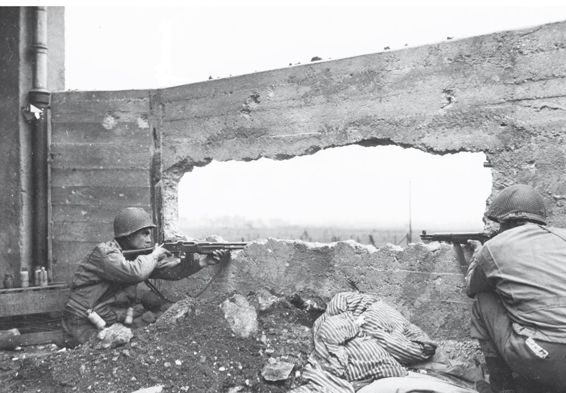
Two U.S. soldiers, Private First Class Lawrence Hoyle (left) and Private Andrew Fachak from the 357th Infantry Regiment, 90th Infantry Division, holds positions near Maizeres Les Metz in France. In September 1944, the Allied offensive on the Western Front had largely stalled. Hoyles holds a Browning Automatic Rifle (BAR). This was capable of both semi-automatic and fully automatic fire, but the magazine held only 20 rounds of ammunition.(NARA, SC 196133/ W. J. Tomko)
The small Belgian fishing community of Ostende, which was captured by the Canadians on 8 September, indeed was located closer to the front, but its port had a very limited capacity. Access to the great international port of Antwerp was, as we have seen, blocked by the German troops who held the Scheldt Estuary. The French Channel ports of Boulogne, Calais, and Dunkirk in the Pas de Calais area were firmly held by German garrisons who had managed to fortify themselves while Montgomery’s forces had just passed by. It would cost the British and Canadians bitter fighting before Boulogne (on 22 September) and Calais (on 30 September) could be captured. In the meantime, the Germans were able to destroy the port installations and block the harbor entrances with sunken ships. Not until the middle of October could the port of Boulogne be taken into use, and the port of Calais was opened to traffic only in November 1944. Neither could the port of Antwerp be taken into service until the Germans, following heavy fighting, had been forced to abandon their positions at the Scheldt Estuary after the first week of November. In Dunkirk, a German force of 10,000 men held out until the end of the war.
The errors committed by the Allied supreme command, as well as the faulties displayed by its troops, was carefully noted by the Germans. These were also quite aware of the growing tension between British and Americans, not least through media in the UK and the USA. To his dismay, Eisenhower found that the modified chain of command, in which he himself succeeded Montgomery as the commander of the Allied ground operations, was received with ’great resentment’ in the British press, which asserted that Montygomery had been pushed aside because of his successes. At the same time, the American press exulted over the fact that the U.S. forces, as they saw it, had gained ’a truly independent basis.’41 (To compensate Montgomery, he was promoted to field marshal on 1 September, the same day as Eisenhower assumed command of ground operations.)
On 2 September, when the British troops reached the Franco-Belgian border southeast of Lille, Bradley and Patton met Eisenhower in an attempt to make him change the priorities at the front. ’My men can eat their belts, but my tanks gotta have gas,’ Patton lamented. Eisenhower agreed to detail one of the army corps of Hodges’ First Army, V Corps, to Patton’s attack towards the east. Two days later, Eisenhower swung completely in favor of Bradley: He now granted Patton’s eastbound advance towards the Saar area a share of the supply that was equal to that of Hodges’ First Army. With the supply lines of both Allied army groups already overstretched, this new decision resulted in Montgomery’s forces being unable to advance for three whole days—which in turn gave Model time to organize his Heeresgruppe B against Montgomery’s 21 Army Group.
Meanwhile, Patton’s Third Army banged its head against the German fortifications around the French city of Metz. Here, at the old Franco-German border (between 1871 and 1919) along River Moselle (Mosel), the so-called ’Mosel Line,’ over forty miles wide, had been constructed by the Germans before World War One. When Patton now resumed his offensive, German Armeegruppe G—which on 11 September was re-organized into Heeresgruppe G—had had time to evacuate 130,000 troops from southwestern France, and these now confronted Patton’s forces in the fortifications of the ’Mosel Line.’ Moreover, two fullstrength German divisions, the 3. and 15. Panzergrenadier divisions, had been released from the Italian Front, and these played a crucial role in the checking of Patton’s attack at Metz.
The Germans were completely astonished at the American approach on the battlefield. Generaloberst Johannes Blaskowitz, C.O. of Armeegruppe G, is not gentle in his review of Patton’s decision to launch a headlong attack straight into the fortifications at Metz: ’A direct attack on Metz was unnecessary … In contrast, a swerve northward in the direction of Luxembourg and Bitburg would have met with greater success and would have caused our 1st Army’s right flank to collapse, followed by the breakdown of our 7th Army.’42 The famous military strategist Liddell Hart remarked laconically, ’Patton’s Third Army began to cross the Moselle as early as 5 September, yet was little farther forward two weeks later—or, indeed two months later.’43
Hodges’ U.S. First Army was no more successful as it in the meantime crossed the German western border further to the north. Its V Corps penetrated into Germany on 12 September and crossed the Our River just north of Luxembourg’s northern border. This sector was defended by German I. SS-Panzerkorps, which on 7 September reported a field strength of not more than 800 troops and one (1) single tank along a frontline of over forty miles.44 Its troops did not even suffice to occupy all the pillboxes of the West Wall in this sector, and in each manned pillbox there were just two or three soldiers, armed with rifles, occasionally a single machine gun or a Panzerfaust.
Although the Americans captured the first line of fortifications in this part of the West Wall, the Germans —to their own astonishment—soon managed to halt the offensive. On one occasion, barely eighty German soldiers, supported by two armored personnel carriers equipped with flame throwers, made a counter-attack which caused panic among the American ranks. The intrercepted radio call from the affected American unit—part of U.S. 28th Infantry Division—revealed quite a lot about the state of the American troops to the Germans: ’King Sugar to anybody! King Sugar to anybody! Help! We are having a counterattack—tanks, infantry, flame throwers!’45
Military historian Peter Elstob wrote, ’After two days of fighting the tired 28th Division’s soldiers had only succeeded in forcing two small breaches through the West Wall. When the Germans counter-attacked, the exhaustion of the long pursuit took its toll and the men who had formerly fought bravely and well fell back in panic before fairly light attacks.’46 While Brigadier General Norman D. Cota, the American divisional commander, had the commander of the 109th Infantry Regiment dismissed for the shortcomings, the Germans carefully analyzed the American setback—and thereby paid attention not least to the fact that this had occurred at a time when rain and a low cloud ceiling had prevented the Allied aviation from providing the ground troops with direct close support. That the attackers had lacked tank support, while the difficult supply situation forced them to reduce the artillery support to twenty-five fired shells per day and gun, reinforced the impression that the U.S. infantry was totally dependent on a powerful fire support in order to act effectively.
’This setback,’ Elstob wrote, ’marked the beginning of the steep rise in “combat fatigue” which later, as the proportion of non-combat casualties rose to twenty-five percent, caused considerable alarm to commanders.’47
Meanwhile, the Allied supply situation deteriorated by the day. The fuel supply occasionally dwindled to just two days of consumption. The shortage in ammunition became even worse. During the first week of October, only one ammunition ship could be reloaded in France, while another thirty-five waited offshore for docking space.48 On 2 October, ammunition rationing was instituted. At the beginning of the second week of October it was obvious that even in spite of this rationing, the ammunition stocks in France would be exhausted within a month.49
In the German camp, combat spirits were boosted through a combination of Goebbel’s propaganda and hopes tied to the new ‘wonder weapons’—top modern weapons which outclassed anything the Allies had at their disposal. By this time, the first among these—the jet propelled combat aircraft Messerschmitt 262 and Arado 234 and the rocket propelled fighter plane Messerschmitt 163—had begun to take part in the fighting, albeit in small numbers.* On 8 September the next ’wonder weapon’ was taken into use—the ballistic missile bomb A 4 (Aggregat 4). This was launched into the stratosphere and thereafter plunged at a speed of one mile per second (3,600 m.p.h.) towards its target. The 27,600lb heavy missile, carrying a warhead containing 2,200 lbs of explosives, hit the ground with a terrible impact. A scientific study made in the year 2010 showed that an A 4 created a sixty foot wide and twenty-four feet deep crater, hurling 3,000 tons of debris into the air.50
Shortly before noon on 8 September 1944, the first A 4 came down in southeastern Paris. Seven hours later, London was hit by two other A4s. This caused consternation in the Allied headquarters, where this type of weapon was already well known—the parts of a test-launched A 4 which had exploded over Bäckebo in Sweden two months earlier, had been handed over to the British by the Swedish government. By this time, the British were just coming to grips with the unmanned rocket propelled robot bombs of the model Fieseler 103—better known as V 1 (Vergeltungswaffe 1,’Vengeance Weapon 1’)—which the Germans had been launching mainly against London since June 1944. Because the V 1s approached at altitudes of around 2,000 to 3,000 feet and at a speed of 400 m.p.h., they could be fought with fighter planes and antiaircraft guns, and by the end of August, 70 percent of all incoming V 1s were shot down over southern England.
But against the A 4 there were no countermeasures. When it was discovered that the A 4s were launched from the German-occupied Netherlands, Eisenhower promptly decided to approve Montgomery’s proposal to air-land the joint Allied airborne army at the Dutch river crossings at Eindhoven, Nijmegen, and Arnhem. The purpose of this operation, codenamed ’Market,’ was to establish a corridor along which British XXX Corps would advance in order to break up the German defenses—Operation ’Garden.’ The attack had the dual objective of capturing the A 4 launching sites and to gain new momentum in the Allied offensive to seize the Ruhr area.
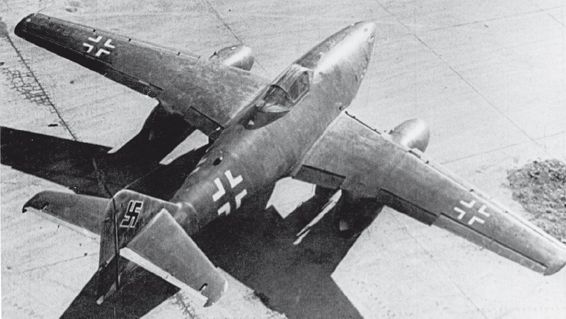
The German jet plane Messerschmitt Me 262 undoubtedly was the best fighter plane of World War II. (Creek)
But the difficulties that already hampered the Allied offensive had not changed, to the detriment of the combined operation ’Market Garden.’ Montgomery informed Eisenhower that if nothing was done about the 21 Army Group’s strained supply situation, it would take nearly two weeks before he would be able to attack. Eisenhower immediately switched back the supply priority to the British-Canadian army group, and then Montgomery set the attack date to 17 September. The British field marshal believed that Patton’s resource-consuming attacks at Metz would be cancelled so that most of the American army group’s supplies could be diverted to Hodges’ First Army, which according to the plan would act in support of ’Market Garden.’ But he had underestimated the creativity of the American generals.
When Bradley on 12 September informed Patton of Eisenhower’s decision, Patton suggested that he would make his Third Army so strongly committed on the other side of River Moselle that it would be impossible to halt it. Bradley gave Patton two days to execute this plan, and in a new twist, Eisenhower declared that the Allied northern flank could not be given top priority until Patton’s army had been thoroughly established on the eastern side of River Moselle. This was in effect a charte blanche for Patton. Australian war correspondent and historian Chester Wilmot wrote:
’By his advance from the Marne to the Meuse and then from the Meuse to the Moselle, Patton had distorted the Allied Front and dragged it too far to the south. Third Army had become a magnet drawing forces and supplies away from what Eisenhower had declared should be the main drive.’51
Hitler’s decision on 8 September to despatch one of his new so-called armored brigades in an attack against U.S. Third Army further bolstered Patton’s position in the rivalry over Allied supplies. With the emphasis on armor and less on support troops in the shape of panzer grenadiers and artillery, Hitler believed that these armored brigades would be more agile than ‘traditional’ panzer divisions. But this structure, contradictory to the basic idea of panzer units, only left the tanks of these armored brigades on their own on the battlefield, without the necessary support. The first attack by one of these armored brigades on 8 September ended with the annihilation of the German unit. Up to 18 September another three armored brigades were hurled into counter-attacks against U.S. Third Army: they were all largely wiped out.*
This not only led the Germans to reconsider the idea of armored brigades; no further supplies were diverted from Patton’s Third Army to Hodges’ First Army —with the result that the latter was unable to support Operation ’Market Garden’ in the Netherlands.
To the British-American airborne army, the situation became quite the opposite to that of the German armor brigades farther south. In the absence of the required armored support—owing to inadequate supplies, only three out of nine British divisions could be deployed during first days of the operation—’Market Garden’ ended in a disaster for the Allied Airborne Army. While eighty percent of British 1st Airborne Division was annihilated, U.S. 101st Airborne Division lost 2,100 troops; in U.S. 82nd Airborne Division, 508th Parachute Infantry Regiment alone sustained 796 casualties, and ’C’ Company, 504th Parachute Infantry Regiment was dealt 50 percent losses.
The A 4 bombardment continued unabated. During the last days of September 1944, up to fourteen missiles were launched each day. From 7 October, Antwerp was added to the targets list for these rockets, which soon were dubbed V 2 by German propaganda. When the 1,000th V 2 was launched on 26 November, 556 had been sent against Antwerp, and 254 against London.
Even though the material crisis was far from overcome for the German Western Front—by the end of September 1944, Heeresgruppe B mustered no more than 239 tanks or tank destroyers and 821 artillery pieces—the acute military crisis had at least temporarily been overcome. On 27 September, Generalfeldmarschall Model reported: ’Combat spirits improving by the day.’ After the war, the operations officer of Heeresgruppe B, Oberstleutnant Günther Reichhelm, recalled that ’the possibilities of capitulation were discussed in the most intimate circles of Army group staff, but had to be dropped because of the existing, excellent morale of both troops and civilians.’52
However, on the Eastern Front, things looked different. With their supply lines strung out, the power of the great Soviet summer offensive in Belorussia and the Ukraine also withered down, and by August 1944 the Red Army had been checked along River Vistula in Poland and at East Prussia’s border with Lithuania. But this could be achieved only when the Germans had brought in very strong reinforcements. At Warsaw alone, they despatched five hundred tanks and tank destroyers at the end of July and early August.53 In early September 1944, the Germans could muster two million men on the Eastern Front, against the Red Army’s 6.5 million troops (three times more than the total strength of the Allied forces on the Western Front). Of Germany’s ten so-called heavy armored battalions (schwere Panzer-Abteilung)—equipped with heavy Tiger tanks—— seven were deployed on the Eastern Front, only one on the Western Front, and two in Italy. Moreover, the German Air Force was incomparably better on the Eastern Front than in the West or in Italy.
When the Red Army attacked Heeresgruppe North in the Baltic States on 14 September, 1.5 million Soviet troops with 4,400 tanks were pitted against 700,000 men and 1,000 tanks on the German side. 54 The Soviets completely smashed the German positions. When they took Tallinn and Pärnu on 22 September, almost all of Estonia had been captured by the Red Army. The Germans launched four hundred tanks in a counter-attack in Latvia, but the ensuing five-day tank battle cost them a loss of nearly 150 tanks and tank destroyers. 55 In early October, the Soviet forces reached Lithuania’s Baltic Sea coast, thus isolating Heeresgruppe Nord in the so-called ‘Courland Pocket’ in the north.
The ‘Courland Pocket’ nevertheless also tied down sizable Soviet forces, which also the fighting in Hungaria and Yugoslavia did—in September and October 1944 the Red Army was working its way through these two countries—why the Soviets for the moment were unable to bring forward sufficient forces to launch an offensive in Poland and against Germany at the Vistula Front. Hitler realized that the only way to avert the looming disaster, was to act during the respite of a few months that he would be granted before the Red Army had managed to gather strength for a new major offensive at River Vistula, and it was quite clear to him how and where he would act. All lessons from the battlefield during the previous three months seemed to be clearly pointing in one direction.
* Two days later, von Kluge committed suicide.
* Allied airmen made huge overclaims during their operations over the Falaise pocket. An examination undertaken a while after the area had been seized by the Allied showed that among 101 examined German tanks and assault guns in the Falaise area, only six had been destroyed as a direct result of air attacks, 44 through ground fire, and twelve through other or unknown causes. Another 22 were found to have been abandoned by their own crews. This has led to the misinterpretation that the Allied aviation after all was not that effective at Falaise, but this is a conclusion which must be refuted. The number of tanks which were made to halt through air activity, which enabled anti-tank gunners to hit them, has never been established. But above all, the efficiency of the Allied aviation at e.g. Falaise constituted mainly not in its ability to directly destroy heavily armored vehicles, but in its capacity to knock out transport vehicles going to and from the front area. The same Allied examination as above also showed that almost half of the other German vehicles (‘soft-skinned vehicles’) destroyed in the Falaise pocket were knocked out through air attacks, and the majority of the remainder were abandoned by their own crews—in the latter case to a large extent as the result of air attacks. It might be safe to assume that the greater part of the 40,000 German troops who were captured in the Falaise pocket, can be attributed to the direct or indirect effect of Allied air attacks against their retreat routes.
* By this time, since May 1940, the Belgian Eupen-Malmedy area was annexed by Germany, whereby Germany’s border with Belgiumran about six miles further to the west than today.
** Heim ins Reich was really the Nazi slogan that meant that all Germans living outside of Germany were to be included in Hitler’s
* Volksgrenadier-Division should not be confused with the Nazi Home Guard Forces, Volkssturm.
** The German Ersatzheer organized troop training and replaced losses in the regular first-line units.
* Both soldiers at the front and military commanders took out their frustration over this situation on the supply organization, known as the Communications Zone (ComZ). Its commander, Lieutenant General John C. H. Lee—who also was Eisenhower’s deputy in the SHAEF and thus the second highest Allied military commander in Europe—was subject to particularly virulent attacks. His initials were scornfully read as ‘Jesus Christ Himself,’ alluding to the sumptuous life which he was supposed to have led on the front soldiers’ expense. A U.S. general wrote, concerning what was apprehended as Eisenhower’s ‘indulgence’ of Lee that ‘Alexander the Great loved flatterers.’ (Hastings, Armageddon, p. 25.) This bitterness—which has continued to be echoed in more recent narratives, where anecdotes and sharp statements made by military commanders have come to play an important role in the description of ComZ— nevertheless disregards from the fact that under Lee’s command, 37 million tons of military supplies were shipped from the USA and Canada prior to the invasion, and after the invasion, 41 million tons were transported to the Continent. In his extensive review of the U.S. maintenance organization in Europe during World War II, U.S. military historian Roland G. Ruppenthal points out that ‘lack of confidence in the Communications Zone was hardly a new phenomenon. Suspicions engendered by the differences over organization and planning in the U.K. period had never subsided, and relations between the Communications Zone and the field commands were never completely cordial. Part of the mistrust undoubtedly stemmed from the traditional and probably unpreventable feeling that rear area troops were better supplied than those at the front, particularly in such items as clothing and food.’ (Ruppenthal, United States Army in World War II European Theater of Operations: Logistical Support of the Armies. Volume II: September 1944-May 1945, p. 349.) Indeed, Lee was a highly controversial character, but in no small part was this due to the fact that he was the first senior commander in the by this time segregated U.S. Armed Forces to challenge the Army’s racial prejudices. Up until this time, the doors to first-line service had been practically shut to African Americans, and no single military commander played a greater role than Lee in tearing down these racist barriers. For instance, he he issued a spectacular memorandum that demanded that ‘commanders of all grades will receive voluntary applications [from African Americans] for transfer to the Infantry.’ (Memo from John C. H. Lee, December 26, 1944. Security Classified Records, Record Group 220: Records of the President’s Committee on Equality of Treatment and Opportunity in the Armed Services. Harry S. Truman Library and Museum. http://www.trumanlibrary.org/whistlestop/study_collections/desegregation/large/documents/index.php?documentdate=1944-12-26&documentid=12-12&studycollectionid=&pagenumber=1&sortorder=. 1 November 2012.) This was not looked upon with favour by many of Lee’s colleagues, but as a result of Lee’s intervention, African- American military units were deployed in the Ardennes Battle, with quite good results—as we shall see later.
* By this time, no more than one regular bomber group actually was operating with Me 262 bombers, I. Gruppe/ Kampfgeschwader (Jagd) 51. Since early August 1944, a couple of Ar 234s had conducted reconnaissance flights on the Western Front and over the British Isles, and a few dozen Me 163s took part in the air defense of Germany.
* The commander of Heeresgruppe G, Generaloberst Johannes Blaskowitz, made the scapegoat for these failures, was replaced on 21 September by General Hermann Balck. When Balck nevertheless later on failed to hold back the Americans from the German border, even he was dismissed, and on 24 December 1944, Blaskowitz was reinstituted as the C.O. of Heeresgruppe G.