Chapter 4

After weeks of stalemate, the German army underestimated the mobile potential of the American armored units. In hopes of preserving the remaining panzers for a counterattack, the German Seventh Army's commander directed their withdrawal toward
the road junction at Percy, unwittingly positioning them to be surrounded. During the last week ofJuly, the 2nd SS Panzer Division and the remnants of the 17th SS Panzer Grenadier Division were cut off, and much of their armored equipment was lost in the encirclement battle with the U.S. 2nd Armored Division around Roncey. Although the Roncey pocket is not as well known as the later Falaise pocket, the Germans' losses here crippled their defenses in the American sector.
While the U.S. First Army was dealing with the remnants of the German Seventh Army, Patton's new Third Army was injected into the crumbling defenses near the coast, racing westward for Avranches, the gateway into Brittany. Allied planning had made the capture of the Breton ports one of its key summer objectives. The 4th Armored Division raced across the base of the peninsula, cutting it off from further reinforcement, while the 6th Armored Division made one of the fastest and deepest advances in U.S. Army history, isolating the key port at Brest.

A column of tanks from the 2nd Armored Division uses the cover of a tree line near Champ du Bouet while awaiting orders prior to the start of Operation Cobra. The lead tank is one of the new M4A1 (76mm)'s and-judging from the vehicle number, E-1-is probably a Company E commander's tank.
In preparation for the start of Cobra, M29 Weasels were used as resupply vehicles loading 4.2-inch smoke ammunition for Company C, 87th Chemical Battalion, U.S. First Army, in the Normandy bocage on 24 July.
The tiny M29 Weasel was sometimes used as an improvised troop carrier as seen here on 24 July, with vehicles supporting Company C, 87th Chemical Battalion.
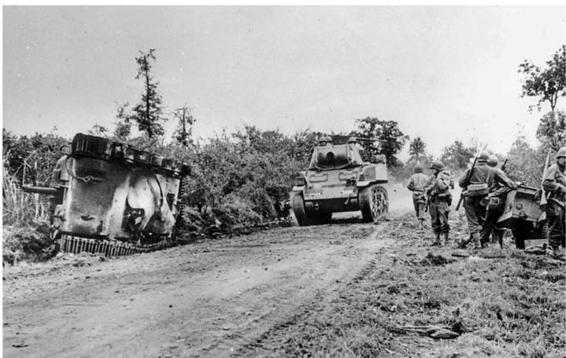
An M2 half-track follows behind an M5A1 light tank through a village near St. Lo on 25 July while moving forward to the start line.

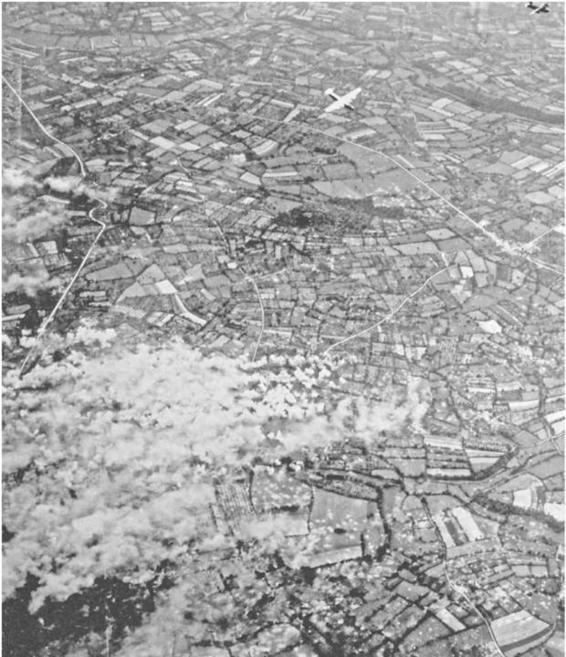
Operation Cobra began at 1300 hours on 24 July with a massive carpet-bombing attack along the D900 St.Lo-Periers highway by 1,495 B-17 and B-24 bombers. This is a rare view of the strike, looking toward the west with the bomb impacts in the lower left covering the area around Chapelle-en-Juger near the intersection of Routes D900 and D972. A pair of B-24 bombers is in the upper right.
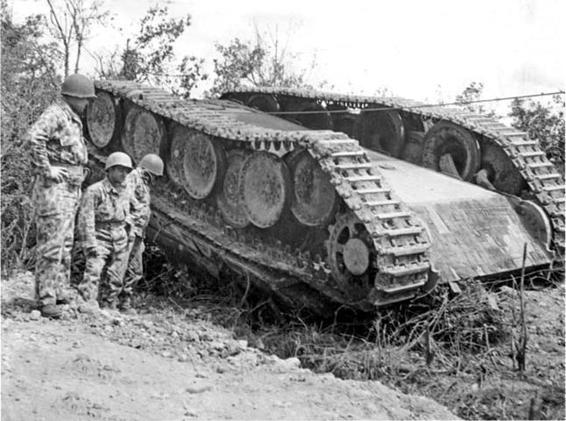
The carpet-bombing that opened Cobra targeted the Panzer Lehr Division, which had fewer than a dozen Panther tanks strung out in a thin defensive belt south of St. Lo. The attack caused heavy casualties among the leading edge of the division, as is evident from this overturned Panther.
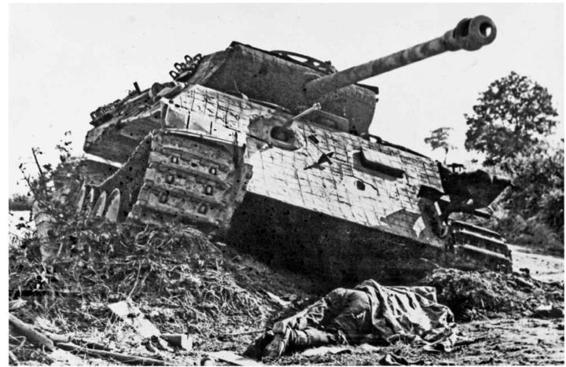
A Panther tank knocked out during the St. Lo breakout. There is a distinct shell gouge on its glacis plate, so this may have been knocked out in fighting rather than by the bombing attack.

U.S. Army engineers sweep for mines around one of the Panther tanks knocked out along the St. Lo-Periers road by the Cobra bombing.
GIs clamber over the Panther for a closer look. It is not clear if this Panther was knocked into the ditch by bombing or shoved off a road by tractors.
A view of the same Panther from the other side reveals that the bomb attack penetrated the upper-right corner of the hull armor.
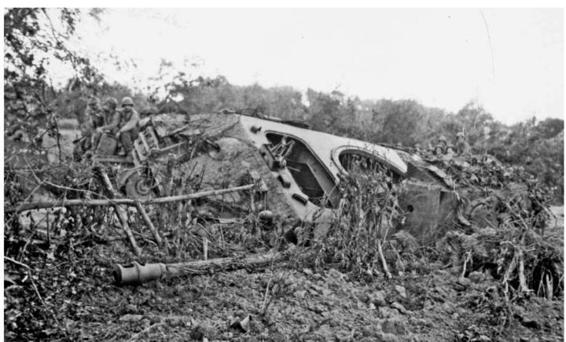
A Panther with its turret knocked off along the St. Lo-Periers road.

This close-up of the Panther with the dislodged turret suggests an internal ammunition fire that detonated inside the vehicle as the plate over the driver's compartment is also blown off. There was an ammunition bin under the center of this panel.
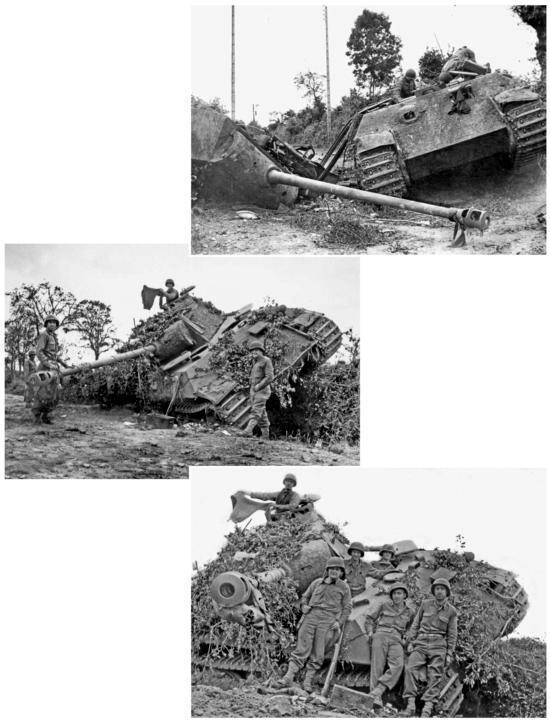
A view of the Panther from the front as GIs inspect the wreckage.
A close-up of the demolished Panther while the GIs pose for the camera.
GIs pose next to a knocked-out Panther of the Panzer Lehr Division along the St. Lo-Periers road. One of the GIs has extracted some clothing from inside the tank.

A GI poses in front of another of the Panzer Lehr's Panthers knocked out at the start of Cobra.
A day after the initial bombing, GIs inspect some of the equipment abandoned by the Panzer Lehr Division along the St. Lo-Periers road after the carpet-bombing. In the foreground is an Sd. Kfz. 251/7 armored half-track fitted with engineer bridging equipment, and behind it is a disabled Panther Ausf. A. A few Panthers survived the initial bombing but were quickly overwhelmed by the ensuing infantry attack.
GIs advance past a destroyed Panther, perhaps the same one as in a previous photo. The irregular surface on the Panther is Zimmerit, a type of cement coating applied to many German tanks from 1943 as an antidote to Russian magnetic antitank mines.
The Panzer Lehr had only about sixteen Panther tanks operational when Cobra started, and by the end of the campaign, it had none. This one is another victim of the preliminary air bombardment.

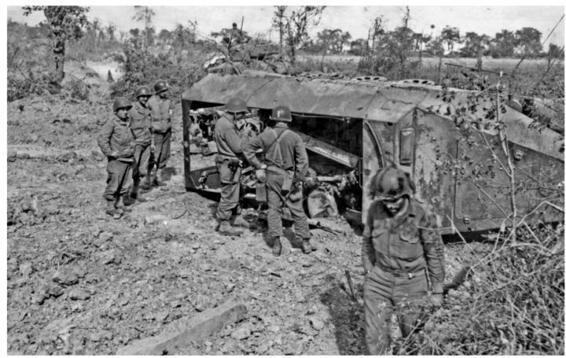
Another view along the St. Lo-Periers road, where the Cobra carpet-bombing has overturned an Sd.Kfz. 251 half-track.

Later on 25 July 1944, the 2nd Armored Division overran other depleted elements of the Panzer Lehr Division, including this Pz.Kpfw. IV with tactical number 841.
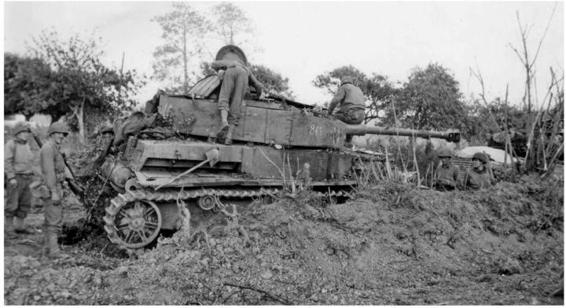
A view of the same Panzer Lehr Pz.Kpfw. IV from the opposite side as a column from the 2nd Armored Division passes by. Of the seventy Pz.Kpfw. IV in service at the beginning of July, the Panzer Lehr had only fifteen left by 1 August.

One of the new M4A1 (76mm)'s is seen breaking over the top of a hedgerow near Pont Hebert during the opening phases of Cobra. A total of 102 of these were split evenly between the 2nd and 3rd Armored Divisions when first delivered on 22 July. It was hoped that the 76mm gun would be the trick in dealing with the Panther, but Cobra showed that it was inadequate when dealing with the wellangled frontal armor of the Panther.
An M4 tank moves down a road in Normandy on 25 July. To the left is an overturned Sd.Kfz. 251, probably one of the vehicles from the Panzer Lehr Division that was hit in the carpetbombing attack.
An M4A1 (76mm) of the 3rd Armored Division fitted with a T2 Douglas device in operations near Reffeuville on 25 July at the start of Operation Cobra.

One of the key pieces of equipment during Cobra was the M1 bulldozer blade, seen here fitted to Apache from Company A, 70th Tank Battalion, near Tribehou on 25 July. Although the Culin prongs are more famous, the bulldozer blades were in fact more effective. Each of the separate tank battalions was provided with five or six tank dozers for the Cobra breakout.

A close-up of a 70th Tank Battalion dozer tank named Here's Dots Mom is seen pushing through hedgerow.
A day after the start of Cobra, an M8 75mm howitzer motor carriage of the 3rd Armored Division passes by the wreckage of an overturned M4 tank near Marigny on 26 July. The M4 has suffered an internal ammunition fire which has blown out floor panels.
German units in Normandy made extensive use of the Sturmgeschutz, a turretless assault gun based on panzer chassis. There were about 190 StuG's operational in Normandy at the start of Cobra, of which about a third were in the Seventh Army's sector facing the U.S. First Army. This is a StuG IV based on the Pz.Kpfw. IV chassis, which was less common than the StuG III in Normandy. This particular vehicle served with SS Panzer Abteilung 17 of the 17th SS Panzer Grenadier Division and was hit by Ninth Air Force fighter-bombers along the Marigny-Montrevil road.

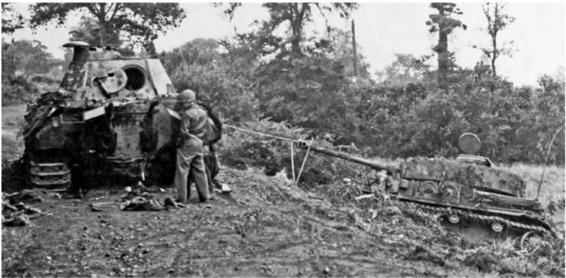
Another view of the destruction along the Marigny-Montrevil road caused by Ninth Air Force fighter-bombers. On the right is a burnt-out Panther, while a Pz.Kpfw. IV lies in the mud off the road.
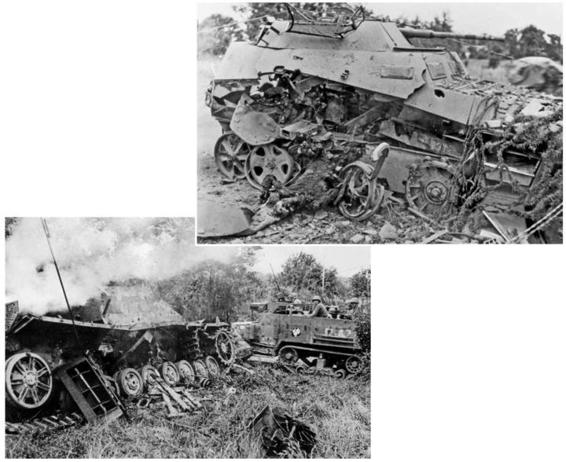
An Sd.Kfz. 250/8 Schutzenpanzerwagen (2cm) knocked out along the MarignyMontrevil road. This was the reconnaissance version of the Sd.Kfz. 250 halftrack family and intended to replace the earlier Sd.Kfz. 222 wheeled armored car.
The onrush of the 2nd and 3rd Armored Divisions on 26 July overwhelmed a number of German armored units in their path. This smoldering StuG IV, probably from the 17th SS Panzer Grenadier Division, is passed by an American M2A1 half-track.
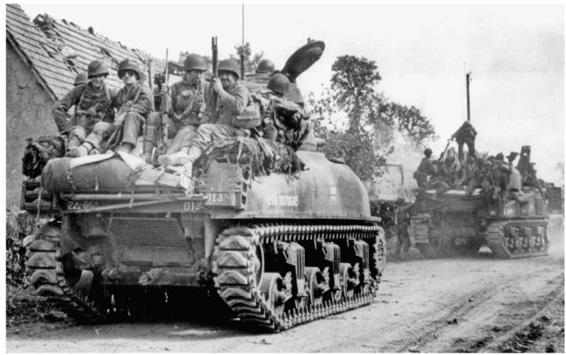
An M4A1 (76mm) (named Duke) of Company D, 66th Armored Regiment, 2nd Armored Division, carries an infantry team into action during Operation Cobra. During the first few days of the campaign, it was the practice in the 2nd Armored Division to carry a team of armored infantry on the tanks to assist in the breakthrough. This tank has the new First Army black and olive-drab camouflage pattern adopted in anticipation of Cobra.
This StuG IV became trapped in a ditch along a hedgerow on the MarignyMontrevil road and was abandoned during fighting on 27 July.


A pair of M5A1's of Company B, 33rd Armored Regiment, 3rd Armored Division, races down a road near Marigny on 26 July. This was part of the Combat Command B spearhead that collided later in the day with a force from the 2nd SS Panzer Division.
An M5A1 light tank moves forward during Cobra. It is finished in the standard First Army camouflage scheme. The tanker manning the .30-caliber light machine gun has stuck an M1 steel helmet over the usual tanker's helmet for head protection. The tanker's normal helmet offered no ballistic protection, and there were many field expedients by American tankers to remedy this problem.
An M4 passes by a Panther knocked out near La Chapelle during Cobra.
An M8 75mm howitzer motor carriage leads a column from the reconnaissance company of the 33rd Armored Regiment, 3rd Armored Division, at Montreuil-surLozon on 26 July. CCB of the 3rd Armored Division was committed that day to support the attack of the 1st Infantry Division.

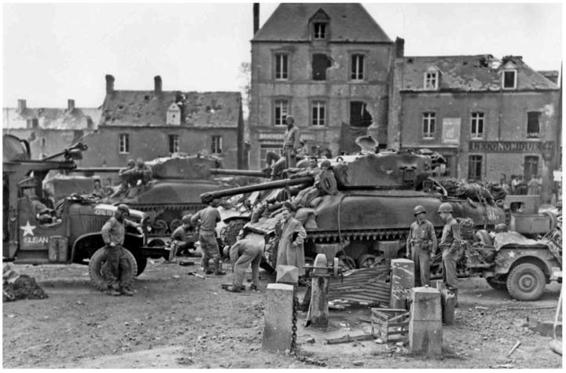
A platoon of M4A1 (76mm) tanks, probably from the 2nd Armored Division, undergoes repairs in the town square of St. Jean de Daye on 26 July. The new 76mm gun was not well received when first issued to American tank units as its high-explosive projectile was not as effective as the type available with the 75mm gun. The 76mm gun was better appreciated in July when tank units began encountering the thickly armored Panther in greater numbers.

The crew of an M8 light armored car (named Danny) scan for German forces after reaching the road junction in Canisy. They are from the 82nd Reconnaissance Battalion that was spearheading the drive southward past the shattered remains of the Panzer Lehr.
CCA of the 2nd Armored Division reached the road junction at Canisy by the late afternoon of 26 July, after part of the town had been set ablaze by an air attack. There was little resistance from the shattered Panzer Lehr Division. This is an M8 armored car of the division's 82nd Reconnaissance Battalion.
An M4 tank, probably from the 712th Tank Battalion, which was supporting the 90th Division during the attack, moves through the contested town of Periers on 27 July, with an M10 3-inch gun motor carriage tank destroyer behind it.
Traffic jams in the French towns south and east of St. Lo were a major hindrance once the breakout began, and MP jeeps were out in force to enforce traffic order, as seen here on 29 July. In the background is one of the new M4 (105mm) assault guns, probably from 37th Tank Battalion, 4th Armored Division, judging from the markings.

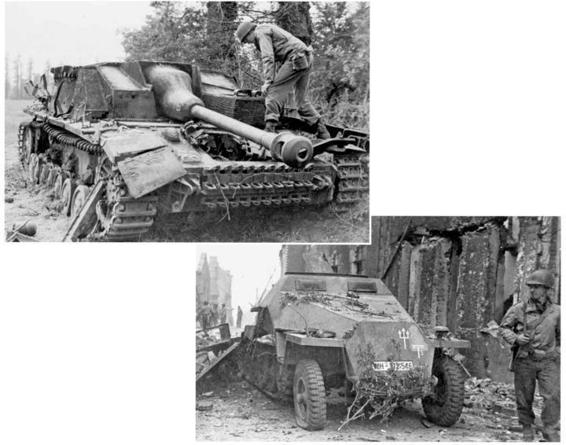
A GI walks past an Sd.Kfz. 251 Ausf. D of a towed antitank gun company of the 2nd Panzer Division.
This StuG IV, probably from the 17th SS Panzer Grenadier Division, was knocked out during fighting near Periers.
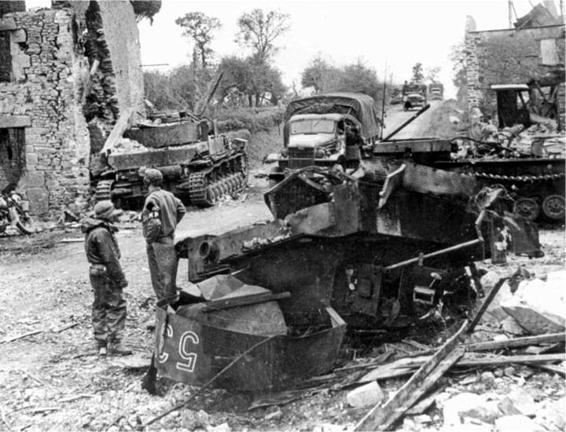
U.S. Army military police direct traffic at an intersection in St. Gilles near the wreckage of two Pz.Kpfw. IV tanks knocked out in the fighting there. The Panzer Lehr had attempted to defend the junction with four Pz.Kpfw. IV tanks and a StuG III, but they were quickly overwhelmed by the 2nd Armored Division.

A Pz.Kpfw. IV knocked out in the Canadian sector between Caen and Vaucelles during the fighting there that culminated in the Falaise pocket in August.
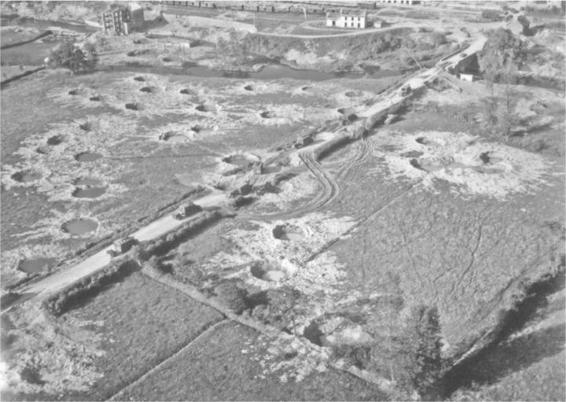
Some idea of the intensity of the aerial bombardment during Cobra can be gathered from this aerial photo, taken days later after the road had been cleared for use by U.S. troops. During the retreat of the 2nd SS Panzer Division, a German column was caught in the open during daylight and hit by medium bombers.
An M4 tank of the 6th Armored Division speeds through Brehal on 27 July, the day armored units of Patton's Third Army were injected into the west flank of the advance to race for the access roads to Brittany.

An M4 fitted with the Culin prongs passes by an M10 3-inch gun motor carriage during the opening phases of Cobra in late July 1944.
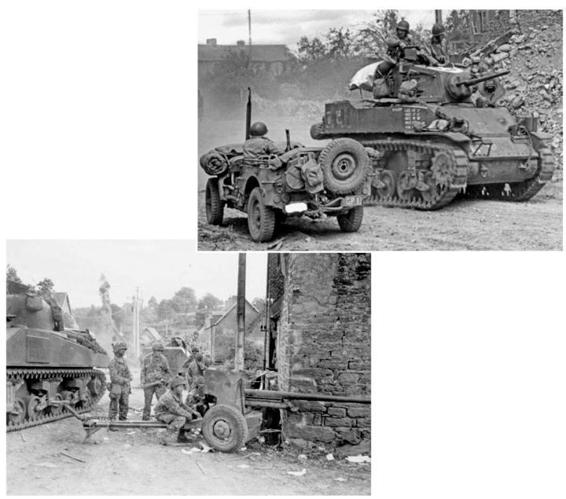
An M5A1 (named Wasp) of a battalion HQ from 32nd Armored, 3rd Armored Division, passes through a shattered town on 27 July. It has the characteristic 3rd Armored Division's brushguard below the bow machine gun. A typical tactical number 3-11 appears on the hull rear, but it seems to have been painted over. An air ID panel is draped over the rear turret stowage.
Lead elements of CCB of the 2nd Armored Division seized the bridges over the Soulle River at Pont Brocard on 27 July, nearly capturing the commander of the Panzer Lehr in the process. Here, a 57mm antitank gun is stationed at a road junction in the town on 29 July as an M4 medium tank passes by. The 2nd was one of the few American units to wear camouflage battle dress during Cobra, a practice that ended in August because of frequent confusion with German camouflage clothing.

On 28 July, the commander of the German Seventh Army ordered a retreat toward Percy to avoid encirclement. The direction of the withdrawal was ill-advised, and the 2nd SS Panzer Division became encircled around Roncey. In a series of engagements with 2nd Armored Division and U.S. P-47 fighter-bombers, the division lost most of its heavy equipment. Some idea of the carnage on the road back from the roadblock can be seen in this photo taken outside St. Denis-le-Cast the next day. The abandoned hulks of a number of Sd.Kfz. 251 halftracks have already been pushed off the road. The second half-track in the column is an Sd.Kfz. 251/7 bridging vehicle from an engineer company of the 2nd SS. Behind it is a burned-out M4 medium tank of the 67th Armored Regiment that was destroyed during the nighttime battles.
A 57mm gun crew of the 41st Armored Infantry of the 2nd Armored Division sets up an ambush position.


A motley collection of German artillery lies abandoned around the Roncey school building. To the left is one of the most modern and powerful antitank weapons of the campaign, the 88mm PaK 43, while to the right is a French artillery half-track towing a Soviet 76.2mm F-22 USV field gun, a weapon widely used by the Germans as an antitank gun.
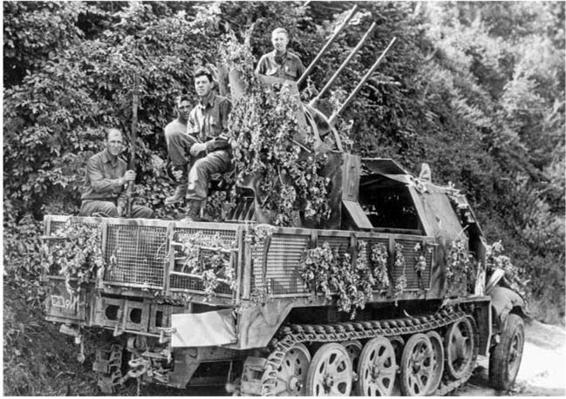
Allied air superiority led the Wehrmacht to pay serious attention to air defense. One of its most effective weapons was the 20mm FIaK 38 mounted on the Sd.Kfz. 7 half-track. This vehicle from the 2nd SS Panzer Division was abandoned in the Roncey pocket and is being inspected by some GIs.

A nighttime attempt to break out of the Roncey pocket failed. At the head of a retreating column from the 2nd SS Panzer Division at the crossroads near Notre-Dame-de-Cenilly was this 150mm Hummel self-propelled gun (named Clausewitz) and Sd.Kfz. 251 half-track, followed by about ninety other vehicles and 2,500 Waffen SS troops. It was finally stopped around midnight on 28 July at a roadblock of Company I, 41st Armored Infantry Regiment, 2nd Armored Division. The ensuing traffic jam along the hedgerowlined road left the remainder of the retreating column exposed to American fire, and a savage battle began in which the column was largely destroyed.
Dry Run, an M26 tractor with M15A1 semi-trailer, is used by the 66th Ordnance Battalion to evacuate a captured Panther Ausf. A. This tractortrailer combination was popularly called the Dragon Wagon.


This M2 half-track of the 41st Armored Infantry Regiment of the 2nd Armored Division was one of those re-armed with a 37mm antitank gun. However, the large gun shield has been removed, probably because it interfered with the traverse of the weapon in the cramped interior of the half-track. The squad is wearing the distinctive and controversial camouflage battle dress, which was largely discontinued after August 1944.

This Pz.Kpfw. IV Ausf. J from 2nd SS Panzer Division was knocked out by a 37mm gun mounted on an M2 half-track of the 41st Armored Infantry Regiment during fighting for St. Denis-le-Gast on 31 July. A tanker from the supporting 67th Armored Regiment points to a hole in the turret side skirts where the round penetrated.

An M3A1 half-track of the 3rd Armored Division passes through the ruins of Roncey on 1 August. In the wreckage is a destroyed Sd.Kfz. 7 fitted with a quadruple 20mm antiaircraft gun and a 75mm Panzerjager 38(t) Ausf. M (Sd.Kfz. 138) tank destroyer. The M3A1 half-track is towing a 37mm antitank gun, a weapon inadequate for antitank defense in 1944.
Another view of the devastation inside the small town of Roncey following the encirclement battle.
Here, a woman from the town walks past the several wrecked Panzerjager 38(t) Marder III, showing some of the same wreckage as the previous photo from a different perspective.
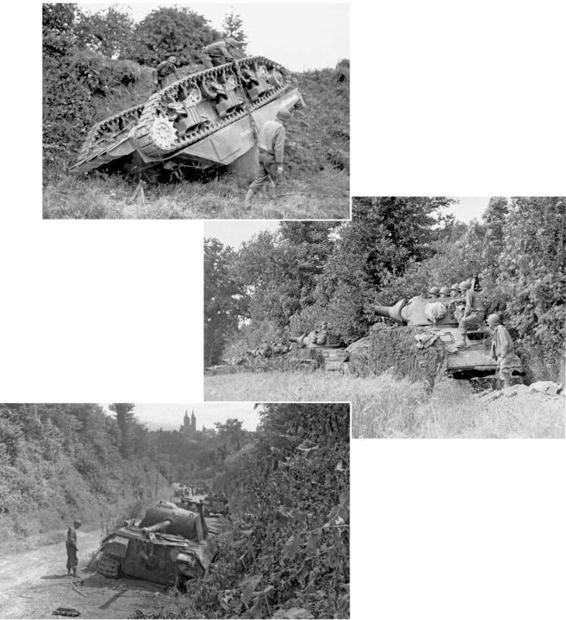
A company of M8 75mm howitzer motor carriages from the 3rd Armored Division takes up firing positions along a tree line near Marigny on 28 July. The censor has covered over the front details of the lead vehicle, obscuring the hedgerow cutter on the bow, which was considered a big secret at the time.
An ordnance team prepares to recover Destroyer, an M4 tank of 2nd Armored Division that has overturned after going over a hedgerow at too steep an angle near Canisy during Cobra. Prior to the operation, one out of every five of the division's tanks was fitted with Culin prongs.
This Panther Ausf. A was found knocked out in a hedgerow-lined road outside Coutances on 28 July.
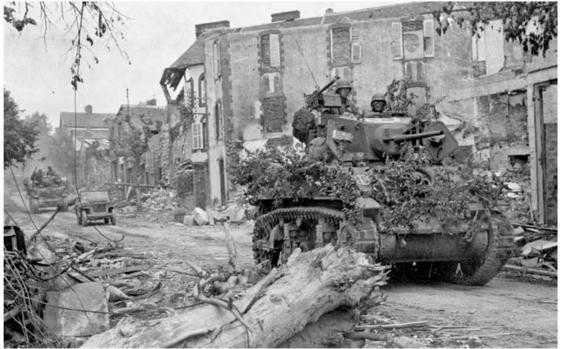
The key road junction at Coutances fell on 28 July to CCB of the 4th Armored Division, which had advanced down the coast against modest opposition. Here, a heavily camouflaged M5A1 light tank passes through the damaged town.
A column of M4 tanks of the 6th Armored Division moves through Coutances on 29 July as they start their race toward Brittany. This was one of two armored divisions of Patton's newly activated U.S. Third Army.

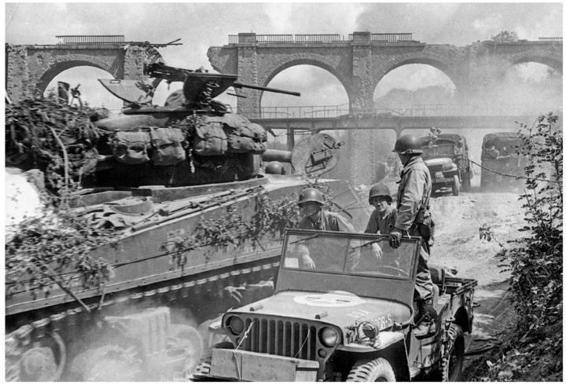
An M4 of the 4th Armored Division passes through Coutances in late July 1944. Both the 4th and 6th Armored Divisions were funneled through the town on the way to Avranches, the gateway to Brittany.
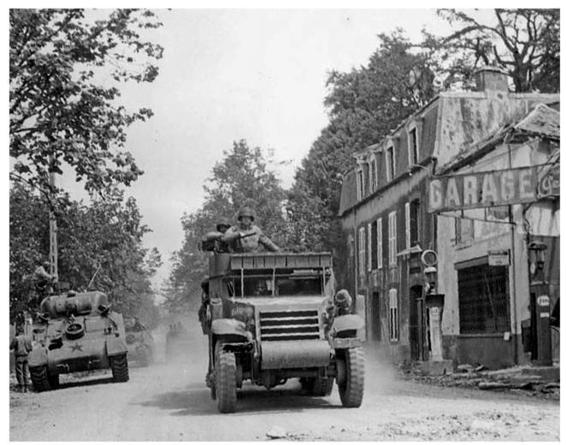
An M3A1 half-track of the 4th Armored Division passes through Coutances in late July 1944.
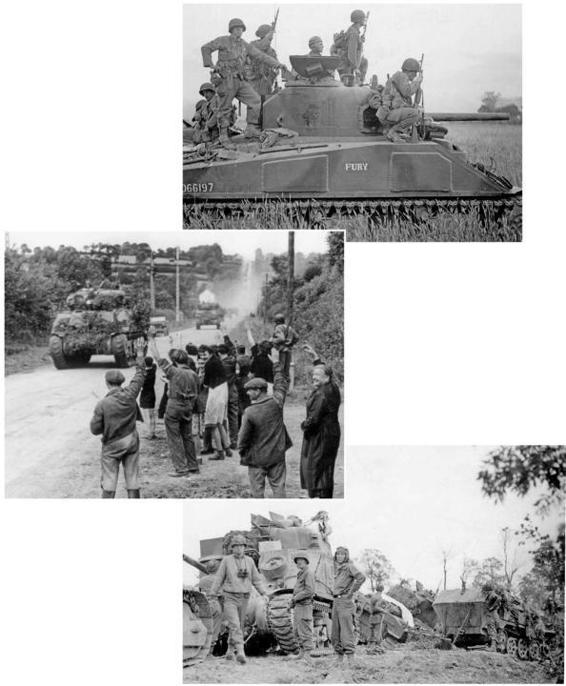
An M4 (named Fury) of the 2nd Armored Division on the move with infantry aboard during Cobra. It is finished in the distinctive First Army camouflage scheme of black over olive drab adopted prior to the start of the offensive.
An M31 tank-recovery vehicle recovers an M4 medium tank bogged down on a country lane. To the right is an abandoned German Sd.Kfz. 251 half-track. Although armored divisions were nominally allotted the newer M32 tankrecovery vehicle, many of the older divisions still used the older M31 in Normandy, which was based on the M3 medium tank chassis.
French townspeople wave enthusiastically as a column from the 4th Armored Division races southward from Coutances in late July. Patton's Third Army pushed down the coastal roads toward Brittany while Bradley's First Army encircled the German panzer formations farther east.
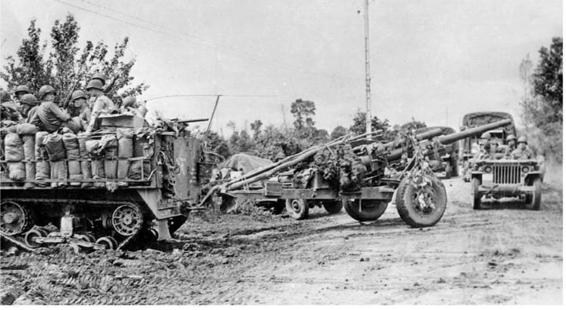
An M3 half-track of the 823rd Tank Destroyer Battalion is seen here towing a 3-inch antitank gun during operations in support of the 30th Infantry Division. The 3-inch antitank gun was used in the towed tank destroyer battalions. Organic antitank companies in the infantry divisions used the 57mm antitank gun through the end of the war.

An M7 105mm howitzer motor carriage towing an M8 armored trailer passes by a cemetery near St. Gilles on 29 July, with the grave of a German SS officer of the 17th SS Panzer Grenadier Division in the foreground. When carrying 105mm ammunition, the M8 trailer could hold forty-two rounds.

A field near Coutances serves as a hasty gravesite for German troops killed in the Normandy fighting. In the background are an overturned Sd.Kfz. 251 half-track to the left and a Pz.Kpfw. IV tank to the right.
An M7 105mm howitzer motor carriage, probably from the 4th Armored Division, leads an armored infantry column through Coutances on 30 July. The crew has rigged a stowage rack on the front holding five oil cans.
A U.S. Army bulldozer pushes a wrecked Pz.Kpfw. IV off the road in the 1st Infantry Division's sector in late July 1944.
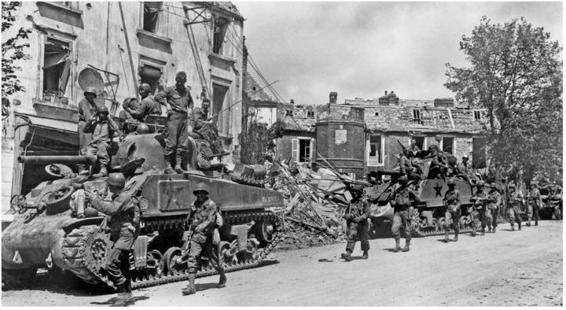
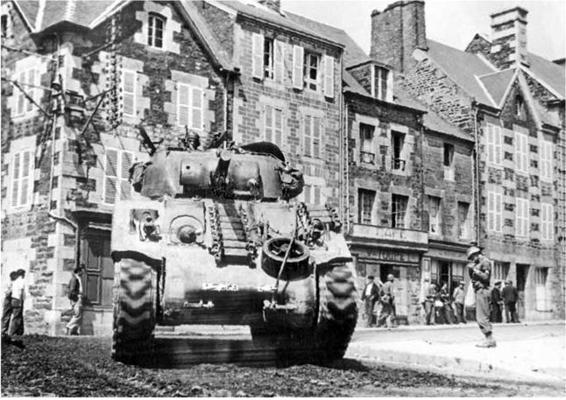
An infantry column marches past a pair of M4 Sherman tanks in the ruins of Coutances after the U.S. Army had gained control of the town in late July. The tank to the right is a new M4 105mm howitzer tank that entered production in February 1944. These howitzer tanks were usually deployed in the HQ of tank battalions to provide added fire support.

A jeep and an M4 medium tank of the 6th Armored Division pass through Brehal on 31 July on their way to Brittany. The white triangle on the hull side of the M4 identifies this tank as part of the 68th Tank Battalion, and the tactical number 62 identifies it as part of Company C, which used the numbers 61 to 78.

A column of M4 tanks from the 15th Tank Battalion, 6th Armored Division, tries to negotiate a large crater in the road caused by mines.
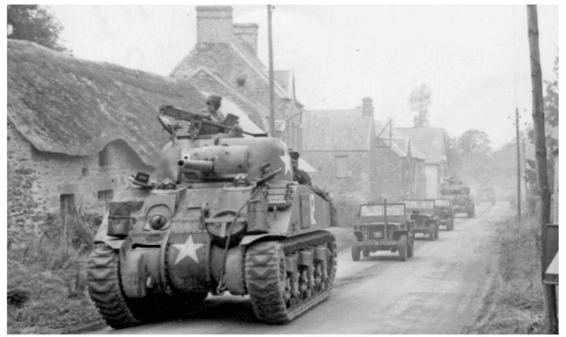
Another view of a column from the 6th Armored Division. Led by an M4 tank, it passes through a village on the way to Brittany. The 6th used distinctive white tactical "speed" numbers painted on the hull side for radio communication between their tanks.
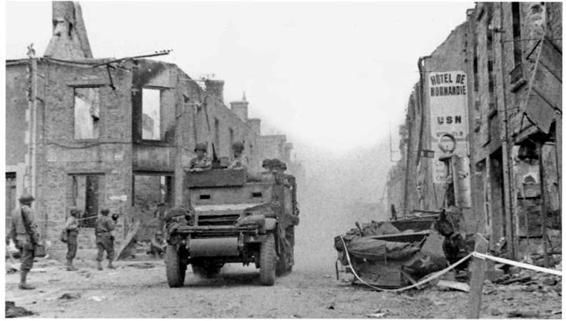
An M3A1 half-track of the 6th Armored Division passes through the ruins of Lessay on 28 July.

An M4 medium tank of the 6th moves through the ruins of Lessay on 28 July. This division was attached to Patton's newly activated Third Army.

An M3A1 half-track of the 6th Armored Division passes through Le Repas on 31 July, with a German prisoner of war on the hood of the vehicle.
An M7 105mm howitzer motor carriage of Battery B, 22nd Armored Field Artillery Battalion, 4th Armored Division, passes through the ruins of Coutances on 31 July on its way to Brittany. The town of Coutances was shattered by repeated Allied bomber attacks and artillery barrages since it controlled Route N171, the main coastal road south out of Normandy and into Brittany.
The clear superiority of the Panther over the Sherman in Normandy led U.S. Army officers to try to develop antidotes. A few captured Panthers were subjected to fire from various types of weapons at a test field near Isigny, trying to determine the Panther's weak spot.
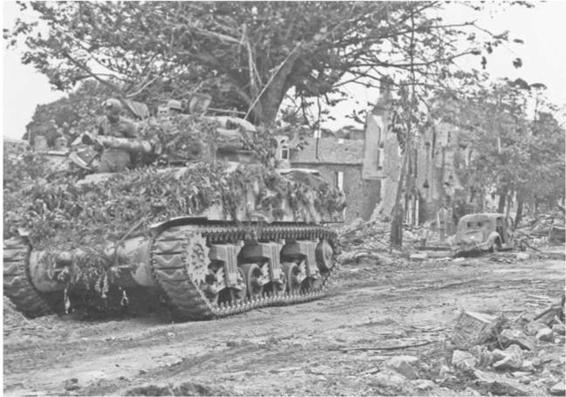
An M4 tank of the 8th Tank Battalion, 4th Armored Division, passes through Coutances in pursuit of retreating German forces on 31 July. The 8th heavily camouflaged its tanks with mud and foliage prior to the breakout efforts near Coutances.

Several M4 medium tanks from the 4th Armored Division burn in a field outside Avranches during fighting there on 31 July. The tank in the foreground has suffered an ammunition explosion in the right sponson which has blown the sponson floor down onto the upper run of track. Although the gasoline-powered versions of the Sherman were notorious for their tendency to burn after hit, these early Shermans were more vulnerable to catastrophic ammunition fires.
An M3 half-track of the 146th Armored Signal Company moves across a new bridge laid by divisional engineers of the 6th Armored Division during operations near La Rogue on 31 July. This half-track has been modified with additional radio equipment as can be seen from the many whip antennas. The vehicles in the background are from the division's 25th Armored Engineer Battalion and the divisional headquarters.
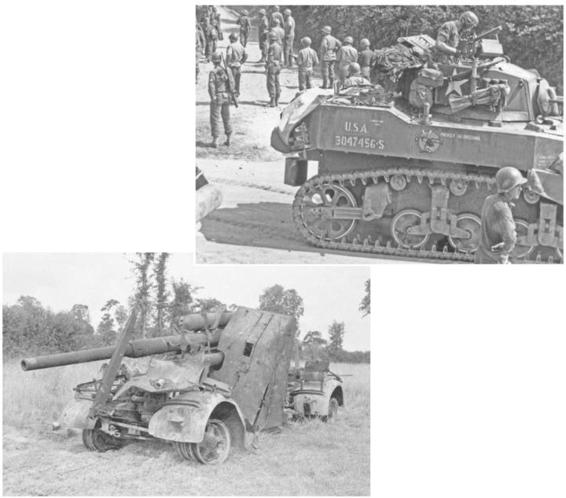
An M5A1 (named Mickey Georgiana) of the 4th Armored Division in Sartilly on 31 July, possibly of the division's 25th Cavalry Recon Squadron. The cartoon markings were seen on a number of division tanks, most commonly with the 37th Tank Battalion.
No doubt the most feared weapon in the German arsenal was the 88mm FlaK 36 antiaircraft gun, widely used in a secondary antitank role. It was not as common as most GIs, who called almost any antitank gun an 88, seemed to think. The smaller and more versatile 75mm PaK 40 antitank gun destroyed far more Allied tanks in Normandy, but most of its victims were credited to the more celebrated 88. This particular gun was captured by American forces on 31 July.
Heavy firepower was provided by nondivisional M1 8-inch howitzer units like the 105th Field Artillery Battalion seen here, supporting the First Army near Carentilly on 31 July. In contrast to the Wehrmacht, which depended heavily on horse-drawn artillery, American artillery was heavily mechanized, like the this M4 eighteen-ton high-speed tractor towing a howitzer named Berlin Buster.