
Chapter 5
Patton quickly appreciated that the mission to seize Brest in Brittany wasted his forces since the Germans would demolish the port prior to its capture as they had done to Cherbourg. He convinced Omar Bradley, the U.S. First Army's commander, to
reorient most of his forces back eastward. His aim was to exploit the catastrophe enveloping the Germans in Normandy and race past their trapped forces toward the Seine River.The British-Canadian pincer aimed at Falaise was slower than anticipated because of determined German resistance, but the U.S. Army was able to charge across France farther to the south, reaching the Seine by the third week of August. The Falaise pocket trapped most of the German forces in France, and even those that escaped had to run the gauntlet a second time to escape across the Seine.
By the third week of August, the northern elements of Patton's Third Army had two infantry divisions supported by the 5th Armored Division on the Seine near Mantes above Paris and had begun crossing the river on 19 August. On the center axis, the 5th Infantry Division and the newly arrived 7th Armored Division aimed for the cathedral city of Chartres and the Paris-Orleans gap. On the southern axis, the XII Corps, including the 4th Armored Division, was operating "deep in Indian country" with hardly any German forces in sight and moving swiftly toward the Champagne region. While little thought had been given to liberating Paris, the City of Lights beckoned.
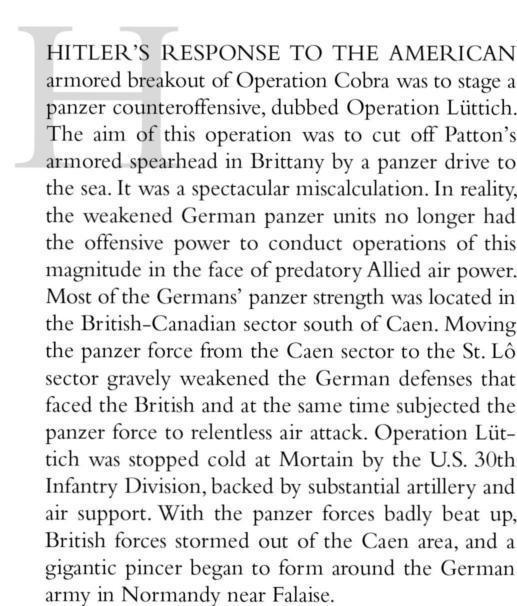
A trio of Sd.Kfz. 251 Ausf. D armored infantry half-tracks knocked out by a Ninth Air Force air strike near Gavray on 1 August.
An M10 3-inch gun motor carriage enters Percy during Operation Cobra on 1 August.
An all-too-common scene in France in the summer of 1944: a burnt-out column of German vehicles. The armored vehicle is a StuG IV, probably from the 17th SS Panzergrenadier Division.

France's premier armored unit was the 2e Division Blindee (2e DB), commanded by Gen. Philippe Leclerc and attached to the U.S. First Army in Normandy. The French came ashore at Utah Beach starting on 1 August and entered the fighting against the 9th Panzer Division around Argentan on the tenth. Here, an M31 tank-recovery vehicle of the 1/RMT comes ashore from a U.S. Navy LCT.
An M8 75mm howitzer motor carriage of the 2e DB is loaded aboard an LST in the United Kingdom for transit to Normandy in early August 1944 during the transfer of the division to combat.
A French M5 or M9 half-track of the 2e DB stalls out in the surf while coming ashore at Utah Beach in early August. The shield on the side suggests it was in use by an antitank unit to tow the 57mm gun, which had the supplementary splinter shield seen on this vehicle. The M5 and M9 half-tracks were built by International Harvester and were alternatives to the M2 and M3 half-tracks. They were not used by the U.S. Army in the ETO, but were supplied to LendLease Allies such as Britain and France. They are externally indistinguishable but had internal stowage differences.


Tarentaise, a French M4A2 of 12e RCC, 2e DB, comes ashore from an LST at Utah on 2 August. The M4A2 was a diesel-powered version of the Sherman and was not regularly used by the U.S. Army. It was mainly produced for LendLease supply to the Soviet Union, but it was also used by the U.S. Marine Corps in the Pacific.
An M4A2 of the 12e RCC, 2e Division Blindee, lands from an LST at Utah on 2 August. By mid-August, the division was committed in the drive to liberate Paris. Notice the SOMUA name plate on the hull, a reminder of the regiment's use of SOMUA S35 cavalry tanks during the fighting in Tunisia in 1943.
Here, the M4A2 tanks of the 2e DB are parked in a field near Utah Beach, shortly after the division had been landed from England on 2 August. The markings on the hull side of the M4A2s reveal them to belong to the 12e Regiment de Chasseurs d'Afrique (RCA).
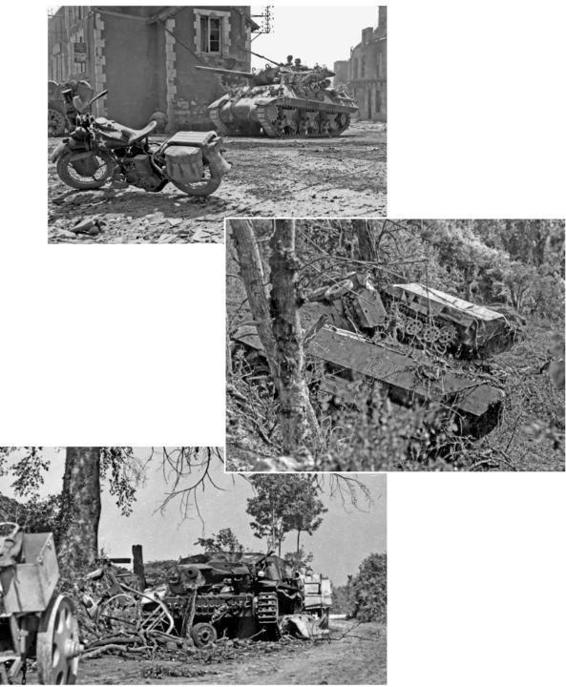
The 2e Division Blindee was organized and equipped like an American armored division, but it kept its French unit designations. This is an M3A3 light tank (named Vexin) of the 12e RCA, one of the division's three tank battalions.
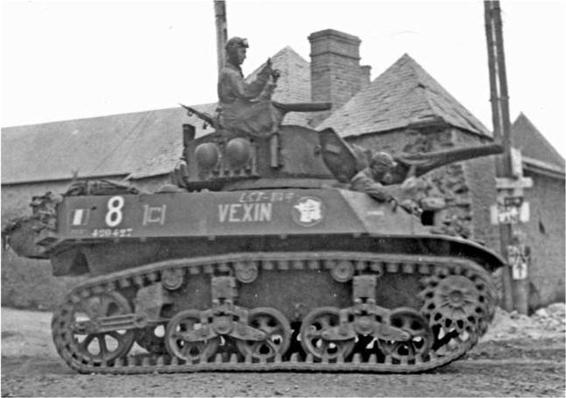

Field Marshal Gunther von Kluge, commander of German forces in the West, attempted to prevent Cobra from spilling over the Vire River by sending the 2nd Panzer Division to Tessy-sur-Vire in late July. The town was finally taken by CCA, 2nd Armored Division, and the 22nd Infantry on 1 August. Some of destroyed German armor left behind included this Flakpanzer 38(t) of Panzer Regiment 3. This was the most common type of German antiaircraft vehicle in Normandy and consisted of a 20mm automatic cannon mounted on a Czech Pz.Kpfw. 38(t) tank chassis.

Another view of a Flakpanzer 38(t) captured by the U.S. Army in Normandy and seen here in an ordnance holding area.
The Jagdpanther was first encountered in Normandy. This was a tank destroyer version of the Panther tank, but armed with an even more powerful 88mm gun. In Normandy, these served in small numbers with a company from schwere Panzerjager Abteilung 654 (654th Heavy Tank Destroyer Battalion). As a result, when the first few were captured, they were the source of considerable interest by U.S. Army technical intelligence. This photo was taken by a technical intelligence team of the U.S. First Army.
One of the dreaded 88mm flak guns, abandoned during the summer of 1944.
The armored cavalry served a vital role in the exploitation phase of Cobra, racing through gaps in the German rear areas. Here, a patrol from the HO troop of the 42nd Cavalry Reconnaissance Squadron (Mechanized) with the 2nd Cavalry Group receives a warm welcome in Brehal on the northern approaches to Avranches on 2 August. This unit was popularly called "Patton's Ghosts" and served with the U.S. Third Army during the Normandy and Brittany campaigns.


The M2 half-track was widely used for towing the 57mm antitank gun until the authorized one-and-a-half-ton truck became available. This combination is seen near the cathedral in La Poeles on 2 August.

A pair of M8 armored cars of Company C, 82nd Reconnaissance Battalion, 2nd Armored Division, pass through the road junction at St. Sever Calvados on 3 August. They have a machine-gun ringmount field modification so commonly seen in Normandy.
An M3A1 half-track passes by an abandoned StuG III assault gun during operations near St. German de Tallevende on 3 August. The 17th SS Panzer Grenadier Division and 2nd SS Panzer Division were trapped in the Roncey pocket north of here during Cobra, and this is probably one of the remaining vehicles from the divisions.
GIs of the 35th Division pass by the wreck of a Pz.Kpfw. IV of Panzer Regiment 3, 2nd Panzer Division, in Pontfarcy on 3 August.
Another Pz.Kpfw. IV of Panzer Regiment 3 of the 2nd Panzer Division knocked out in the fighting near Pontfarcy in early August.


Some idea of the devastation in the Falaise pocket can be appreciated from this scene with a Pz.Kpfw. IV and a pair of Sd.Kfz. 251 half-tracks.
The intensity of the fighting in early August is evident in this view from the town of Juvigny-le-Terte near Mortain on August 2, where a M4 medium tank still smolders after having been hit and a German StuG III assault gun lies opposite.

The encirclement of the Falaise pocket in late August left large quantities of heavy equipment abandoned along the roads. Here, a GI looks over the devastation near Chambois, with a 15cm Panzerwerfer 42 artillery multiple rocket launcher in the background.
An M5A1 light tank (named Doodle Bug) parked near Chateau Contier on 7 August.
The Allied armies closed the Falaise pocket at a junction between the Polish, Canadian, and American units near Chambois. The town is littered with equipment, including a wrecked Pz.Kpfw. IV in the foreground.

A Grille self-propelled howitzer abandoned in France. This consisted of the 150mm SiG 33/1 heavy infantry gun mounted on a Czechoslovakian Pz.Kpfw. 38(t) light tank chassis.
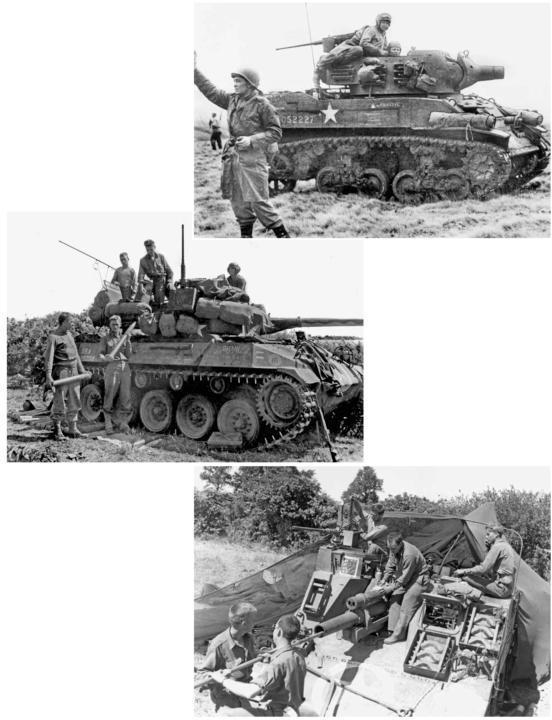
An M7 105mm howitzer motor carriage is seen with its howitzer tube in full recoil during the fighting near St. Pois on 3 August. The censor has obliterated the unit crest on the forward side of the vehicle and the Culin hedgerow cutter fitted to the front of the vehicle.
An M4A1 (76mm) of the 67th Armored Regiment, 2nd Armored Division, passes through Sever Calvados on 3 August during the Normandy breakout.
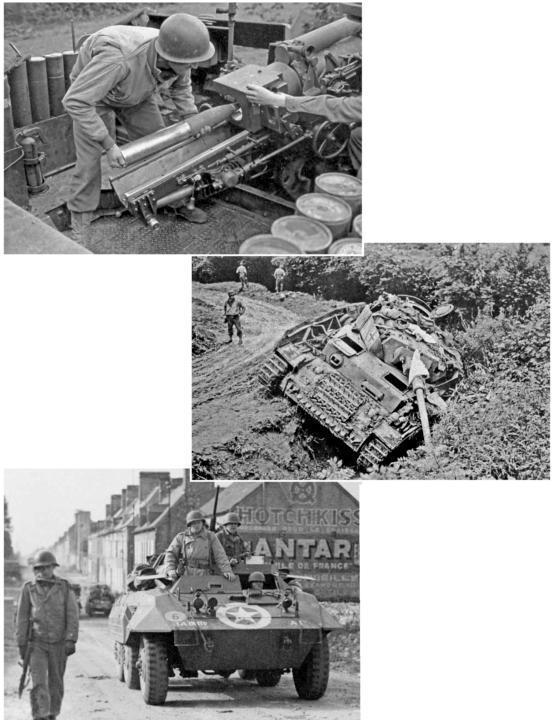
A Pz.Kpfw. IV abandoned by the roadside during the fighting in the bocage in July 1944. Often, abandoned tanks were pushed off roads to clear the path for following vehicles.
An interior view from an M7 of the 6th Armored Division in France shows the fighting compartment. It provides especially good details of the sights and the lanyard for firing the howitzer along the right side of the gun race.
Tank destroyer battalions used M20 armored utility cars in their headquarters and for scouting. This one belonged to the 801st Tank Destroyer Battalion, which supported the 4th Infantry Division in Normandy.

An M4 of the 68th Tank Battalion, 6th Armored Division, passes through the heavily damaged town of Avranches on 4 August during the Cobra breakout. Avranches was the gateway from Normandy into Brittany, and so it saw heavy traffic in early August as the Third Army moved westward.
The Germans threw the fresh 9th Panzer Division into Normandy in the hopes of holding open the Falaise gap. It was beat up in several days of hard fighting on the southern side of the Falaise area by the U.S. 5th Armored Division and the French 2e Division Blindee.This Panther of II/Panzer Regiment 33, 9th Panzer Division, was knocked out by artillery of the 5th Armored Division on Rue de la Poterie in Argentan during the fighting there.
A jeep from the medical detachment of the 704th Tank Destroyer Battalion is parked next to a Flakpanzer 38(t) in France in the summer of 1944. This battalion was attached to the 4th Armored Division.

The 2nd Armored Division entered Barenton on the way to Domfront on 7 August. This is an M4A1 (76mm) of the 66th Armored Regiment, one of fifty-one of these new tanks received by the division in the days before the start of Cobra.
Another view of the Panther knocked out in Argentan with GIs sitting nearby on a break.
An M4A1 fitted with an M1 bulldozer blade is used to clean up debris in a French town. The heavy air bombardment that preceded Cobra caused havoc to French towns in its path, and the bulldozers were instrumental in clearing roads for following waves of troops.

An armored bulldozer is used to clear the streets in the town of Vire on 8 August.
Obsolete French tanks like this Renault FT were used by German occupation units in France, often times for security duty such as airbase patrols. This example was photographed in Normandy on 7 August 1944.

A relatively rare example of one of the older Panther Ausf. D captured by the U.S. 5th Armored Division in the summer of 1944. Few of this version were encountered by the U.S. Army in France, the Ausf. A being more common. Paradoxically, the Ausf D. version was the earlier of the two types, being the version which saw the type's combat debut in the summer of 1943 at Kursk on the Russian front.
A wrecked German Sd.Kfz. 251 halftrack on 8 August. This is an unusual variant, apparently armed with a 20mm automatic cannon.

A camouflaged M4 105mm assault gun of the 8th Tank Battalion, 4th Armored Division, passes through Avranches on its way into Brittany in early August. The 4th and 6th Armored Divisions were the spearheads of the Third Army in its record-breaking drive into Brittany in mid-August.
The combat debut of the M18 in the ETO was with Patton's Third Army in July. This was one of the first M18 tank destroyers knocked out, the vehicle of Sgt. Roger Turcan of Company A, 704th Tank Destroyer Battalion, 4th Armored Division. While advancing north of Rennes in early August, Turcan's vehicle was engaged by an emplaced German antitank gun, which hit the M18 no fewer than seven times, killing three of the crew. Turcan remained with the vehicle, loading and firing the gun until he ran out of ammunition. He was later decorated with the Silver Star for his bravery. This photo highlights the vulnerability of the M18 because of its very thin armor.


Laxative, an M8 75mm howitzer motor carriage of a reconnaissance company of the 2nd Armored Division, moves forward near an M4A1 (76mm) during the fighting near Barenton on 9 August.

Among the Allied units equipped with the M10 3-inch gun motor carriage was the French 2e DB, which played a central role in the liberation of Paris in August. Here, the crew of an M10 (named Le Malin, or "The Wag") of the 3rd Platoon, 2nd Squadron, Regiment Blindee de Fusiliers Marins (Naval Infantry Armored Regiment), take care of stowage on the vehicle before moving out. Although not evident in this view, crews of this unit, drawn mainly from French Navy volunteers, often wore the distinctive French naval cap rather than French army headgear.

A detail view of Laxative shows additional details of the vehicle, including its Culin hedgerow cutter and its tactical markings. This photo was also taken near Barenton on 9 August.
Another view of the often-photographed Laxative, seen at a later stage of the war with some changes in its markings, such as the over-painting of its Normandy tactical numbers.
The crew of an M7 105mm howitzer motor carriage of the 83rd Armored Field Artillery Battalion, 6th Armored Division, swabs out the barrel during the fighting for Brest on the Breton Peninsula on 13 August. Most self-propelled guns carried a large camouflage net to provide cover when used from static positions for long periods of time. The seaport at Brest was the main headquarters of the German Atlantic fleet and had been heavily fortified to prevent its capture by Allied forces.
The crew of an M18 76mm gun motor carriage (named Bataan) of the 603rd Tank Destroyer Battalion loads ammunition for a fire mission near Brest on 12 August. The port was enveloped in August, but the German garrison held out into September, leading to a costly siege.
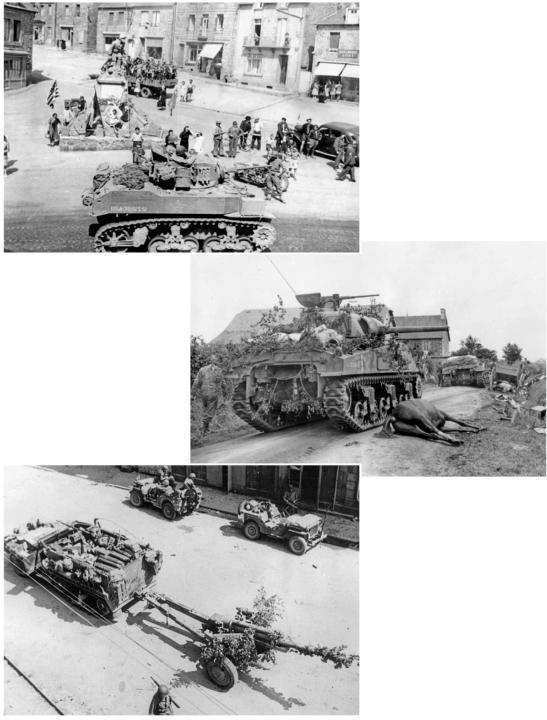
A column of M4 medium tanks of the 3rd Platoon, Company B, 8th Tank Battalion, 4th Armored Division, passes through the Avranches area on the way into Brittany in early August. The 8th Tank Battalion made much more extensive use of camouflage than the division's other two tank battalions.
An M5A1 of CCA, 6th Armored Division, passes through the town square of Rostrenen in Brittany on the approach to Brest. In the background is a memorial to the fallen soldiers of the First World War.
An M3 half-track serves as the tractor for a towed 3-inch antitank gun, seen here near the Citadel in the port of St. Malo in Brittany in August 1944. The M2 halftrack was nominally authorized for towing the 3-inch antitank gun, though M3 halftracks were sometimes substituted.

A 3-inch antitank gun of the 801st Tank Destroyer Battalion being towed by a half-track through a French town in August while supporting the 4th Infantry Division.
A well-camouflaged M10 3-inch gun motor carriage of the 644th Tank Destroyer Battalion passes by a farm cart during the operations near Brest. There were three self-propelled tankdestroyer battalions active in the Brittany campaign: the 603rd, 644th, and 705th, the first two using the M10 and the last using the M18 76mm gun motor carriage.
An M4 tank fitted with a T1 Culin hedgerow cutter moves through Lambezelec on the outskirts of Brest in August. It is painted in the black-overolive-drab camouflage introduced by the U.S. First Army in late July 1944.

One of the German Sd.Kfz. 251 armored half-tracks knocked out in the Mortain fighting. This is an Sd.Kfz. 251/9 version, an assault-gun type fitted with a short 75mm howitzer for close infantry support. The damage was probably caused by a direct artillery hit.
Hitler attempted to smash Patton's race into Brittany by cutting off American forces with a dash to Avranches and the sea. The ensuing Operation Luttich led to heavy losses in the attacking German panzer formations. Here, a GI inspects a wrecked German Sd.Kfz. 251 Ausf. D half-track near Mortain on 12 August. This was the standard armored troop carrier of the panzer-grenadier regiments in Normandy. German units heavily camouflaged their armored vehicles with tree branches in hopes of avoiding notice by roving Allied fighter bombers.
French civilians returning to their homes in Villedieu-les-Bailleul inspect a derelict Panther Ausf. A tank knocked out during the Mortain battle.
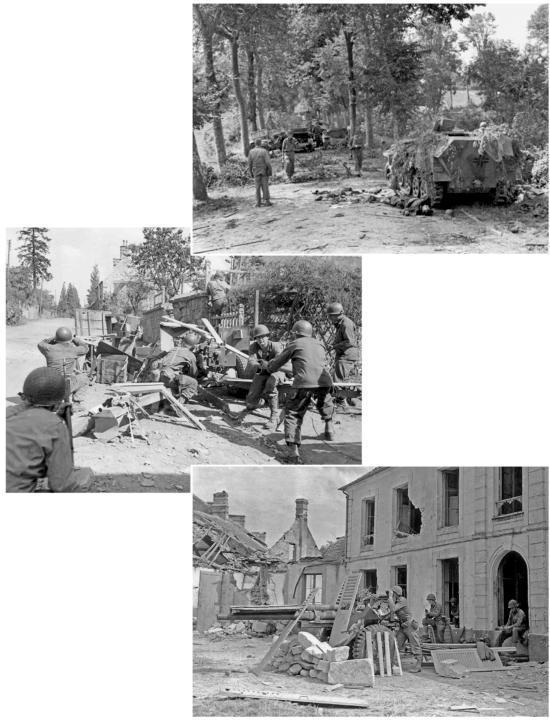
Operation Luttich struck the 30th Infantry Division near Mortain but was unable to make any significant penetrations into the infantry defenses. This is a panzergrenadier column knocked out during the fighting, with an Sd.Kfz. 251 Ausf. D evident at the rear.
A camouflaged 3-inch gun in its defensive position during the fighting in northern France on 19 August. The inadequate performance of the 3-inch gun against the German Panther, as well as its lack of mobility, led American commanders in Europe to insist that it be replaced by a 90mm gun as soon as possible.
A 57mm gun of the 1st Battalion, 39th Infantry, 9th Division, is camouflaged behind wooden debris during the fighting around Cherence le Roussel on 6 August. The battalion received a Distinguished Unit Citation for its defensive actions against the Germans' Mortain attacks.

An Sd.Kfz. 251 Ausf. D is enveloped in flames after a tank-gun hit on the hull front. This German column was hit near Carrouges on 13 August and is probably one of the units of the 9th Panzer Division that fought against the 5th Armored Division near the Foret d'Ecouves in a forlorn attempt to relieve the Falaise pocket.
An M4 medium tank of the 10th Tank Battalion, 5th Armored Division, on the southern fringe of the Falaise pocket on 12 August during the fighting near Habay-la-Neuve.
The arrival of the 9th Panzer Division near Alecon did little to stem the tide of the American advance. Committed piecemeal, it was ground up in several days of fighting with the French 2e DB and the U.S. 5th Armored Division. Here, one of the unit's Panther Ausf. A tanks is recovered by the French 2e DB.
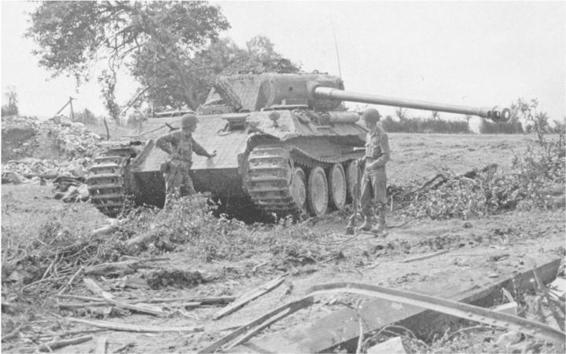
GIs inspect a Panther Ausf. A of I./Panzer Regiment 33, 9th Panzer Division, knocked out on the road between Argentan and Chambois during the fighting in August.
A Pz.Kpfw. IV of the 9th Panzer Division heavily draped with track for extra armored protection, abandoned in Sees in late August during the fighting with the 5th Armored Division.


The 350th Ordnance Battalion, located on the Normandy coast near Isigny, is seen here preparing new tanks to dispatch to units on 12 August. This includes the first batch of the new M4A3 (76mm), which saw its combat debut with the French 2e Division Blindee in the Paris area in the third week of August.
French civilians in the town of Chavisne welcome the crew of an M4 tank with M1 dozer of the 3rd Armored Division on 13 August.
A burnt-out Panther tank pushed off the road somewhere in France on 16 August.

An M8 75mm howitzer motor carriage of the 3rd Armored Division is greeted by the townspeople of Javron as it passes by a statue of Joan of Arc near the town church. It is an early example of the practice of placing sand bags on the glacis plate for additional protection.
GIs play a game of cards in Ferte de Mace on 14 August. Behind them is an abandoned Flakpanzer 38(t). This was one of the more common types of German antiaircraft armored vehicles seen in the Normandy campaign, consisting of a 20mm antiaircraft gun on a Pz.Kpfw. 38(t) chassis.
The burned-out hulk of an M8 light armored car is inspected by curious French townspeople as it rests in the town square of Briey on 14 August. These armored cars were used by cavalry reconnaissance squadrons and so took on the dangerous task of probing German defense in the vanguard of the attack.

As the Falaise pocket became more constricted, it became a shooting gallery for neighboring Allied units. This Sd.Kfz. 250 armored half-track of the reconnaissance battalion of the 2nd Panzer Division was one of a column of vehicles ambushed by M10 3-inch gun motor carriages of the 813th Tank Destroyer Battalion, which was supporting the attack of the 79th Division near St. Aubin d'Appenai on 14 August.
An M5A1 (named Flathead) from the 2nd Armored Division in operation near Domfront on 14 August as the U.S. First Army began its surge toward the Seine.
Troops of the 818th Tank Destroyer Battalion inspect a burning Sd.Kfz. 250 knocked out near Aubin d'Appennai on 14 August.

Another view of the 2nd Panzer Division column, this time an Sd.Kfz. 251 Ausf. D half-track.
A trio of destroyed German Sd.Kfz. 250 light armored half-tracks of the 1st SS Panzer Division by the roadside.
This Pz.Kpfw. IV was found in the Falaise pocket in August. The tactical number is not common and may indicate a tank assigned to the divisional artillery regiment.


A 2nd Panzer Division Panther Ausf. A is examined by U.S. troops after its capture in August. The division's characteristic trident emblem is painted on the turret side in front of the tactical numbers.
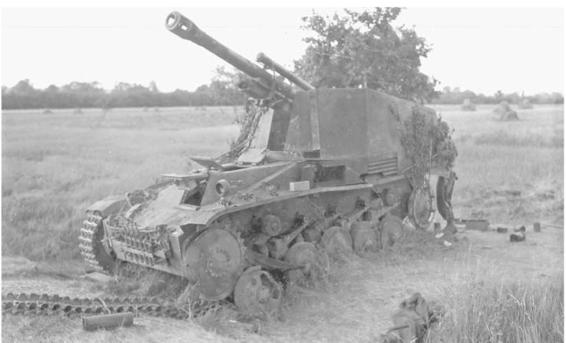
A GI inspects a disabled 105mm Wespe self-propelled howitzer near Morteaux on 19 August. This was the German equivalent of the American M7 105mm howitzer motor carriage and consisted of a 105mm howitzer on the chassis of the Pz.Kpfw. 11 light tank.

In a scene typical of the fighting in the last two weeks of August, an M4A1 (76mm) tank races past a derelict German motorized column. The weakness of the Wehrmacht in the Paris-Orleans gap and the mobility of the U.S. Army overwhelmed the defenses in front of Paris.
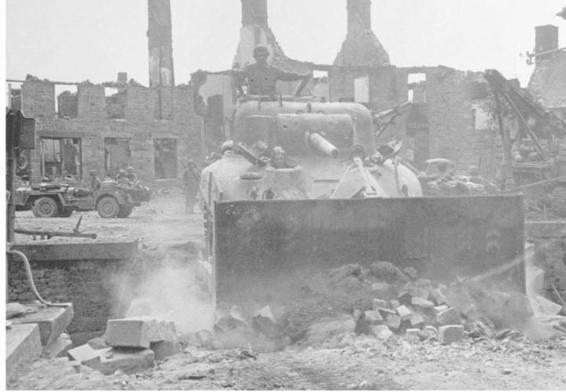
An M4A1 dozer tank is used to clean up the ruins in Lonlay-L'Abbaye on 15 August during the pursuit of the German army toward Paris. To the right behind the tank, an M31 armored recovery vehicle can be seen.

The German First Army had very modest resources when instructed by Hitler to block the Orleans gap from Patton's advance. At the time, it had little more than security units with second-rate equipment to take on this impossible task. This 1940-vintage SOMUA S35 tank was typical of the captured French tanks used by these units, in this case with the panzer company of Security Regiment 1010, lost while defending Montargis against the U.S. 5th Infantry Division in August.

An M31 recovery vehicle is waved forward to pull the burning wreck of a German SOMUA S35 tank out of the road from the same improvised roadblock seen in the previous photo.

An M4 tank of the 5th Armored Division passes by an abandoned 75mm PaK 40 antitank gun during the fighting in Dreux on 16 August, part of the Third Army's advance on the cathedral cities of Chartres and Orleans.
Following the capture of the cathedral city of Chartres, the commander of the 7th Armored Division, Maj. Gen. Lindsay Silvester, drives to the town hall in his M8 armored car to the enthusiastic cheers of the local citizens.
During the exploitation phase that followed Operation Cobra, the U.S. Army began committing fresh armor into the battle. Here, tanks of the 31st Tank Battalion, 7th Armored Division, move forward near Chartres on 16 August. The M4A1 medium on the left (named Battlin' Bitch) is fitted with the Cullin hedgerow cutter. The tank on the right is an M4 105mm assault gun, a relatively new type that appeared in Normandy in July.

Tanks of the 7th Armored Division are seen massed in a field outside Chartres on 17 August prior to moving eastward.
A close-up of Major General Sylvester of the 7th Armored Division in his M8 light armored car in Chartres on 16 August.

Another scene of a 7th Armored Division bivouac outside Chartres, with the cathedral barely visible in the background, on 18 August. In the center of the photo is an M31 B1 tank-recovery vehicle, which was based on the hull of the obsolete M3A3 Lee medium tank.

On 23 August, Gen. Charles DeGaulle visited the recently liberated city of Chartres, and a variety of local dignitaries are seen here at the ceremony. In the background is a Hotchkiss H-39 light tank, first used by the French in the 1940 campaign, captured and re-used by a German unit on occupation duty in France, then recaptured and used by the French FFI resistance forces in the summer of 1944.
Orleans fell to an improvised task force based on mixed elements of the 4th Armored Division and the 35th Division on 16 August. Here, an M10 tank destroyer fires on German troops on the opposite bank of the Loire River with the cathedral in the background.
A ten-ton wrecker lifts the WrightContinental R-975 Whirlwind radial engine from the engine compartment of an M4 medium tank of the 2nd Armored Division in a repair yard near Le Teilleul on 16 August.

A well-camouflaged M16, probably a Patterson conversion, of the 436th AntiAircraft Artillery Automatic-Weapons Battalion (Mobile) is seen near St. Denis on 17 August, with its nickname, NaziNemesis, painted on the front armored shield.
An M10 3-inch gun motor carriage in Dreux, a city on the western approaches of Paris, on 17 August. This vehicle has its tactical numbers on the hull side: the company letter (C) and the vehicle number (32).
A late-production M10 3-inch gun motor carriage crosses a treadway pontoon bridge over the Seine in late August during the race across France. Patton's Third Army first crossed the Seine south of Paris on the night of 19 August, setting the stage for the liberation of Paris.

An M4A1 from the Third Army crosses the Seine on a treadway pontoon bridge on 26 August. The army censor has obliterated the Culin hedgerow device on the front of the tank.
An M7 105mm howitzer motor carriage takes part in a fire mission on 20 August near Avet. This is a 1944 late-production type with the factory sand skirts, new suspension, and other late features, such as the basket on the rear sponson box.
The crew of an M7 105mm howitzer motor carriage loads 105mm ammunition during a lull in the fighting. This howitzer used a semi-fixed round with a conventional brass propellant casing that could be easily removed to change charge increments to adjust the range if necessary. The typical high-explosive round weighed forty-two pounds.

A group of M7 105mm howitzer motor carriages from an American armored division awaits further orders in the rolling countryside of northern France.
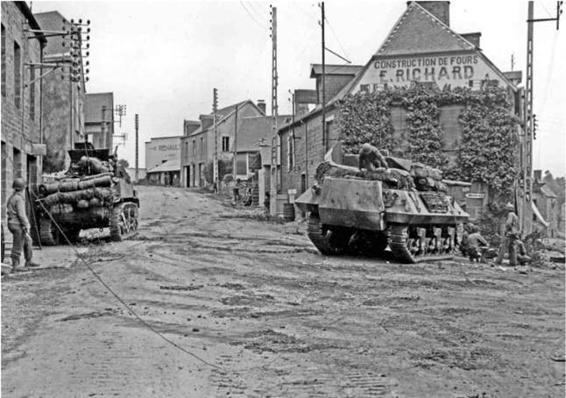
An M10 3-inch gun motor carriage and M5A1 light tank sit at a crossroads in a French village during Cobra. The M10 is still fitted with the wading trunk that enabled it to land from offshore weeks earlier.

A pair of M10 3-inch gun motor carriages moves across a stream in central France in August 1944. Notice that the lead vehicle is still fitted with Culin hedgerow cutters on the transmission housing. In many cases, these were removed after Cobra because of the excess weight and strain on the front suspension.
A demolished Pz.Kpfw. IV with its engine compartment doors open. It is fitted with triple smoke grenade dischargers on either side of the turret front.


The crews of Company B, 759th Tank Battalion, take a rest in the ruins of Montebourg in August. This was the only separate tank battalion in the ETO to be configured in the rare 1943 light tank battalion configuration, with M5A1 tanks in all four companies.

Following the battle for France, the U.S. Army policed up a large number of abandoned German armored vehicles for disposal and technical exploitation, many at a large holding area near Isigny. This photo shows a Hotchkiss H-39, a light truck, and an antiaircraft searchlight. Curiously enough, some of the French tanks that were captured in good condition were recycled and issued to French resistance units that were used to lay siege to German garrisons in isolated ports along the Atlantic coast later in 1944.

A Panther knocked out by the 704th Tank Destroyer Battalion near Raids during August. This unit was equipped with the new M18 76mm gun motor carriage and was attached to the 4th Armored Division.
Another view of a Panther knocked out in Raids by the 704th Tank Battalion while defending a key road junction.

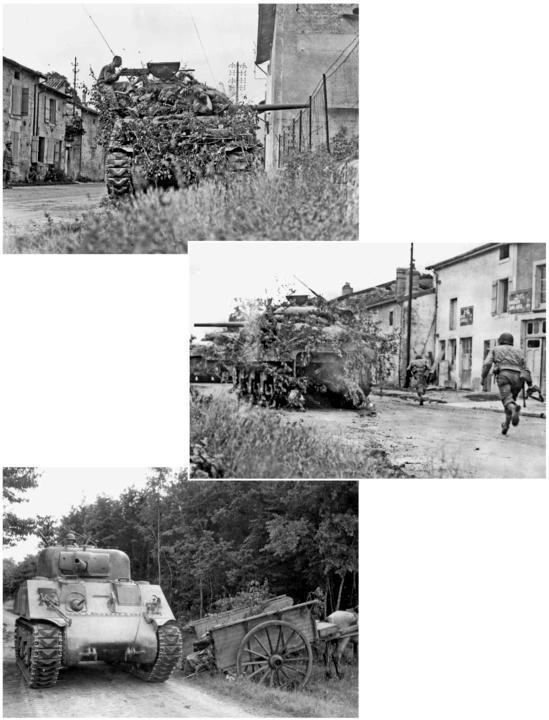
Another view of the scene as tanks of the 8th Tank Battalion engage German troops over the Marne.
During August, Patton's Third Army raced across France as the Wehrmacht retreated in disorder. Here, on 21 August, an M4 tank of the 8th Tank Battalion, 4th Armored Division, fires on German troops across the Marne River trying to destroy one of its bridges.
An M4 medium tank passes by an abandoned Wehrmacht medical evacuation cart during the operations on the approaches to the Seine in August.
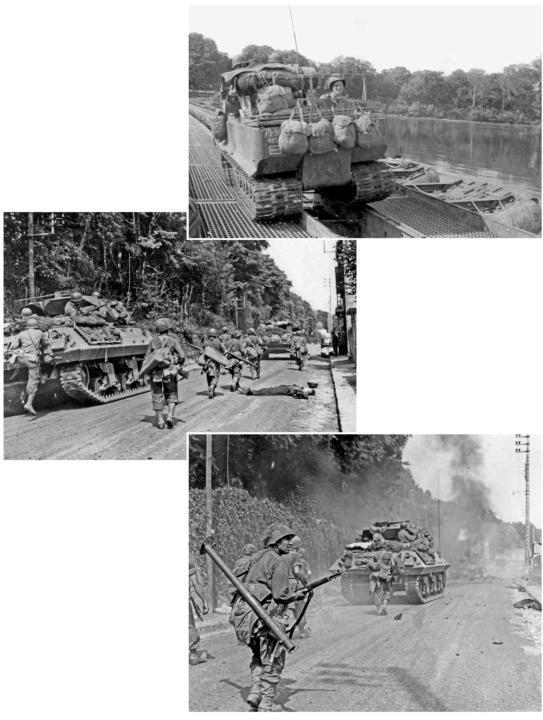
An M29 Weasel of the 904th Field Artillery Battalion, 79th Division, crossing a treadway bridge over the Seine near Mantes during the fighting for the Seine bridgehead north of Paris on 22 August. The vehicle is heavily loaded down with gear and the roll of communication wire suggests that this vehicle was used to lay wire between the batteries.
A wary group of soldiers from the 11th Infantry Regiment accompany M10 3inch gun motor carriages during the advance through Fountainebleu on 23 August. The bazooka man to the left is the same man seen in the previous photo.
An M10 3-inch gun motor carriage company of the 818th Tank Destroyer Battalion moves forward through Fountainebleu while supporting the 11th Infantry, 5th Infantry Division, in the outskirts of Paris on 23 August. The infantry in the center are from a bazooka team, with two GIs carrying additional rockets in a special sling carrier.

A scene farther up the road as an M10 of the 818th Tank Destroyer Battalion begins to engage German targets across the nearby Seine.

An M4A1 medium tank carrying an infantry team advances past a disabled German artillery half-track during the operations by the 2nd Armored Division along the Seine north of Paris around Venon on 23 August.
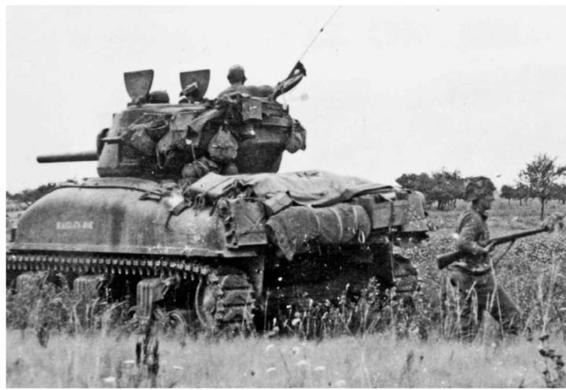
A 2nd Armored Division M4A1 (76mm) in action around Venon on 23 August.
A column of M4 tanks passes a burning farmhouse near Venon during the rivercrossing operations along the Seine on 23 August.


