Chapter 6

The advance began on the morning ofWednesday, 24 August. Although the German forces in the area were not crack troops, the approach route was
heavily urbanized, forcing motorized units to stick to the roads. Most of the main roads were covered by flak batteries protected by small detachments of troops. Leclerc was exasperated by the delays caused by the German defenses throughout Thursday, and he insisted that at least some elements of the 2e DB reach the city center that day. In the early evening, he dispatched a small detachment into the city consisting of three tanks, six half-tracks with elements of two infantry platoons, and some miscellaneous engineer vehicles. Shortly after dark, the massive bells at Notre-Dame began to chime to announce their arrival, soon repeated by all the church bells in central Paris. The German commander of the Paris garrison phoned Berlin and held the telephone up to the sound of ringing bells: "The Allies have arrived." The Paris garrison had been starved of troops to support the Normandy front, and the battle for Paris was quickly over on 25 August 1944.

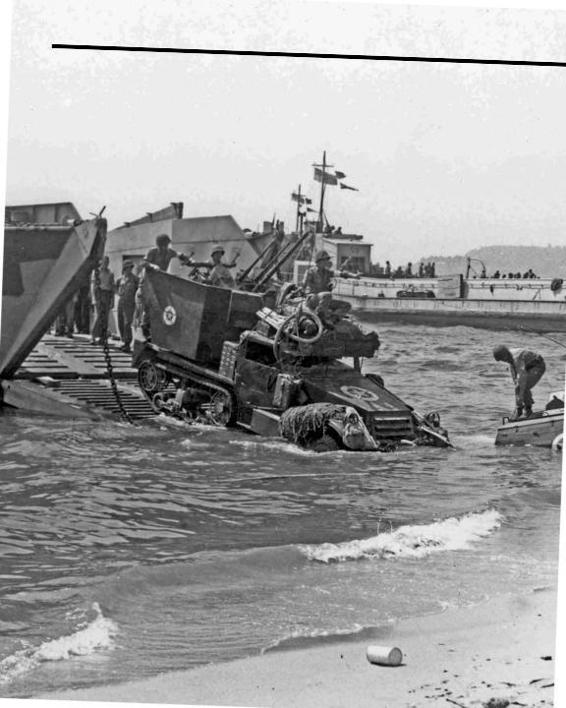
With the Germans in full retreat, Gen. Phillipe Leclerc won approval from Eisenhower to dispatch the French 2e Division Blindee (2e DB) to liberate Paris. French civilians cheers as an M20 armored utility vehicle of the 2e DB heads to Paris.

French tankers of the 2e DB prepare their Shermans to march on Paris. The M4A2 seen here is No. 30, Savoie, of the command platoon of 2/12 Regiment des Chasseurs d'Afrique (12e RCA) commanded by Lieutenant Rives-Henry. It was destroyed in combat a few days later on 11 August.
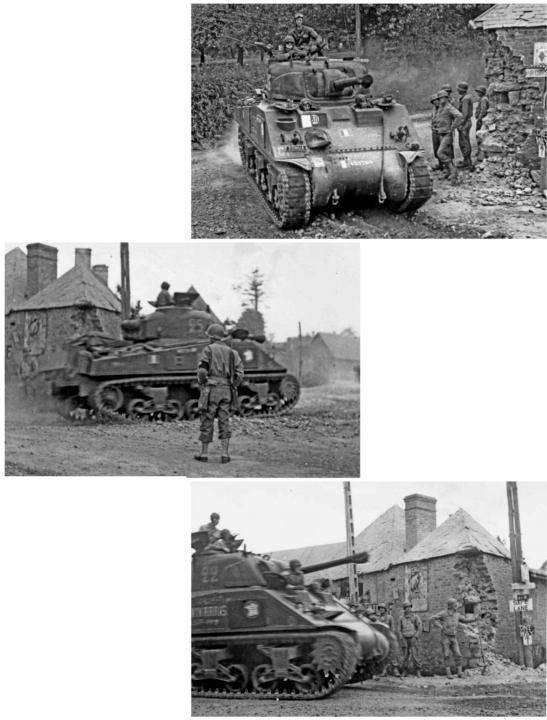
An M4A2 medium tank of the 12e RCA (No. 26, Iseran), commanded by Junior Lieutenant Martin, moving out toward Paris. This unit had served on SOMUA S35 cavalry tanks in Tunisia in the spring of 1943, and many of its Shermans had the SOMUA plaque affixed to the front headlight guard as seen here.
M4A2 No. 22 (named Vivarais) of the 12e RCA, commanded by Junior Lieutenant Guillot, on its way to Paris. This tank was lost to a mine on 15 April 1945.
M4A2 No. 25 (named Morvan) of the 12e RCA, commanded by Lieutenant Douboster, heads out for Paris while an MP looks on. This tank was destroyed in combat a month later on 12 September.
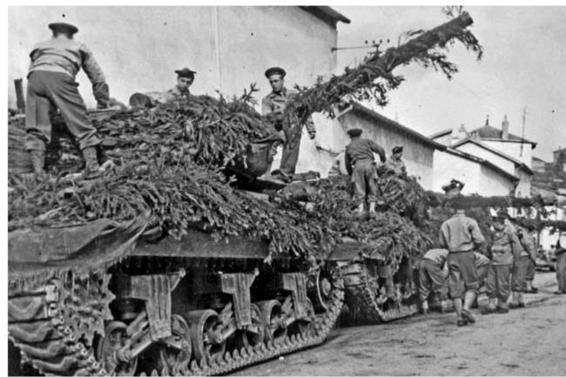
The crews of a number of M10 3-inch gun motor carriages prepare their vehicles to move on Paris. They belonged to the RBFM (Armored Regiment of Naval Infantry) of the 2e DB, which had been recruited from French sailors, which is why they wear the French naval cap.
The tank destroyers of the RBFM move out toward Paris. This unit saw a great deal of fighting in central Paris on 24-25 August, including some of the bestknown engagements in the center of the city around Place de la Concorde and the Arc de Triomphe.


An M8 75mm howitzer motor carriage of the 2e DB heads through a French town on the way to Paris during the third week of August.
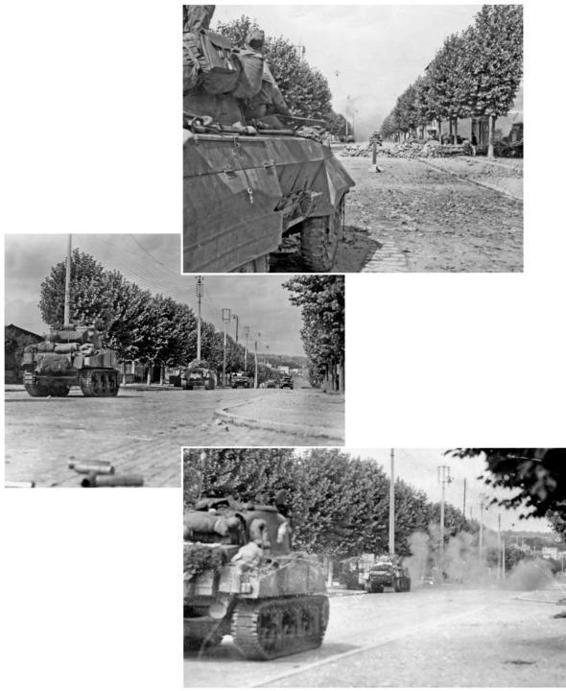
The 2e DB encountered the strongest German resistance along the southern route into the city on 23 August. This M8 light armored car is seen overlooking a German street barricade in Antony in the Paris suburbs.
Another view of the column of M4A2 tanks of the GTV battle group in Antony on the southern approaches to Paris.
Here, on 24 August, a tank column of M4A2 medium tanks of Bilotte's GTV battle group fights its way through Antony, a suburb of Paris about five miles to the southwest.

An M4A2 tank from General Bilotte's combat command advances along the tree-lined banks of the Seine through an improvised barricade on 24 August.
As German resistance faded after the fighting on 24 August, the FFI captured several tanks from the Germans, including this Renault R-35.
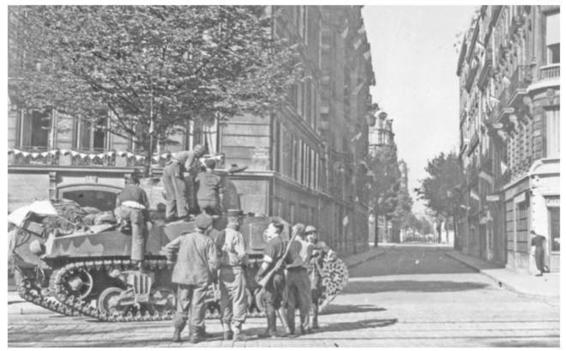
An M4 tank of the 2e DB engages German snipers on a street in Paris on 25 August, assisted by local police and FFI members.

The tanks of Panzer Kompanie Paris were amongst the most feared weapons available to the German defenders since the FFI had few weapons effective against them, except for Molotov cocktails. The capture of these tanks was a major prize, and this shows one of the company's Renault R-40 tanks taken in the final days of the fighting and used during the fighting near the German headquarters in the Hotel Majestic.
A dramatic moment as M4A2 tanks of Leclerc's 2e Division Blindee enter Paris along Avenue Victor Hugo on 25 August.
A crowd gathers near the German headquarters in the Hotel Majestic, littered with wrecked equipment. The burned-out vehicle in the left background was a 47mm Panzerjager based on a Renault R-35 chassis that was knocked out by a French Sherman. In the foreground is a Renault R-40 of Panzer Kompanie Paris, and in the upper right is a Renault R-35.

The Luxembourg Palace was one of a number of buildings used by the German garrison as headquarters. It is seen here on the afternoon of 25 August after the fighting, with an abandoned Renault FT tank in the courtyard. These old French World War I tanks were widely used by the Germans in France for security duties.

This Panther tank was knocked out on the Place de la Concorde in the heart of Paris by a 76mm round from an M4A3 (named Champagne) of the 12e RCA.
A French M5 or M9 half-track patrols through Paris on 25 August, hunting down German stragglers from the Paris garrison.
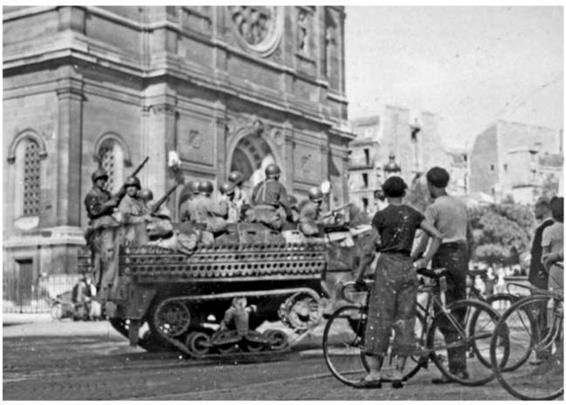

An M3A3 light tank of the 4/501 RCC guards the entrance to the French Senate courtyard during the fighting in this area on the afternoon of 25 August.
A French M10 3-inch gun motor carriage (named Corsaire) of the RBFM takes part in the fighting near Rue de Fleurus on the afternoon of 25 August.

An M10 (named Mameluk) of the RBFM is stationed at a barricade while French civilians talk to the crew on 25 August.
Among the more obscure German armored vehicles captured in Paris was this pair of 20mm FlaK 38's mounted on an armored version of the Sd.Kfz.11 half-track and found in the Senate garden.
While the fighting went on in Paris, there was extensive fighting on either side of the city. This column of M4 tanks of Company C, 17th Tank Battalion, 7th Armored Division, is seen in action near Melun to the southwest of Paris on 22 August, where Patton's Third Army was expanding its bridgeheads over the Seine.
An M8 75mm howitzer motor carriage (named L'Arquebuse) of the 12e Cuirassiers is swarmed by civilians while taking part in the fighting near the Luxembourg gardens, one of the last German strongholds in the city.
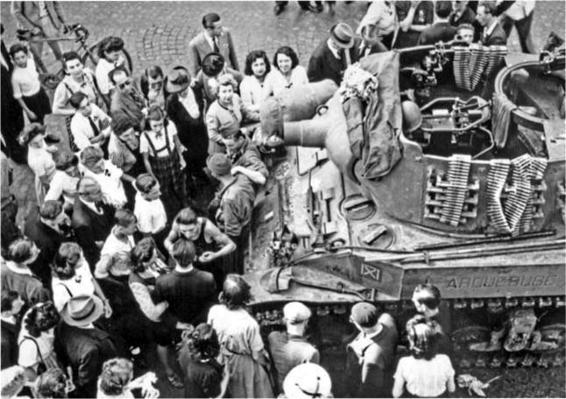

By the afternoon of 25 August, central Paris had largely returned to calm. Here, a column from the RBFM takes a break along one of the city streets.
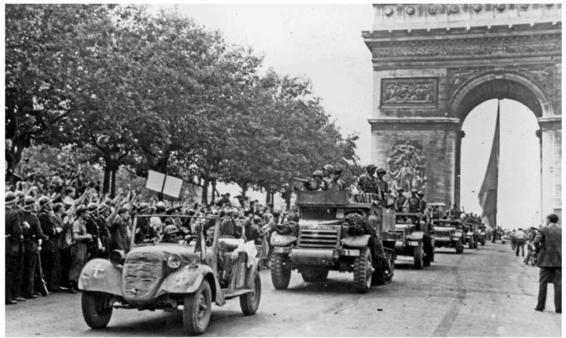
A column of mechanized infantry of the RMT (March Regiment of Chad) of the 2e DB heads down the Champs d'Elysees from the Arc de Triomphe with an FFI automobile leading the way.
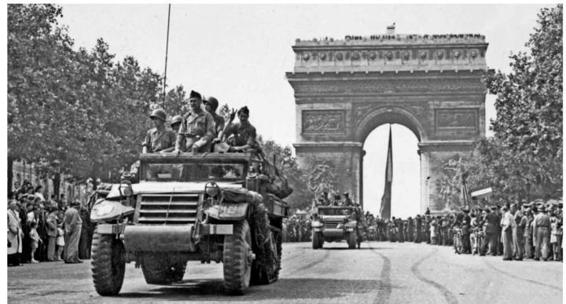
An M5 or M9 half-track (named Neuve) of 9/111 RMT heads down the Champs d'Elysee with the Arc de Triomphe in the background.

A policeman on a bicycle is followed by the first wave of the parade with a patrol of M3A3 light tanks of the security platoon of the GTL battle group at the fore, preceded by a camera truck.

The lead wave of the parade exits from Avenue Champs d'Elysee on to the Place de la Concorde with the M3A3 light tanks in the fore. These photos were taken by a U.S. Army photographer attached to the Office of War Information.
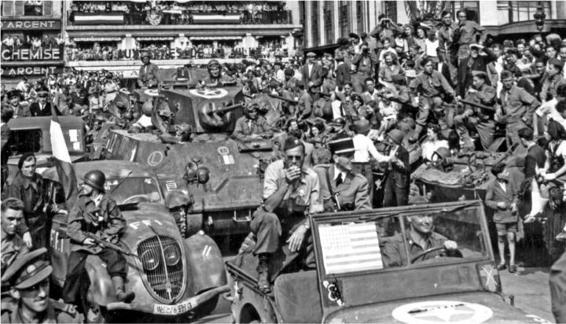
A jeep followed by an M3A3 light tank (named Limagne) of the security platoon of the GTL battle group heads through the joyous crowds during the 26 August parade down the Champs d'Elysee.

When the parade reached the Place de la Concorde, some sporadic shooting broke out in the distance. It remains unclear if this came from German stragglers or trigger-happy and undisciplined resistance members. Here, civilians use the cover of an M3A3 light tank of the guard platoon of the Langlade combat command headquarters.
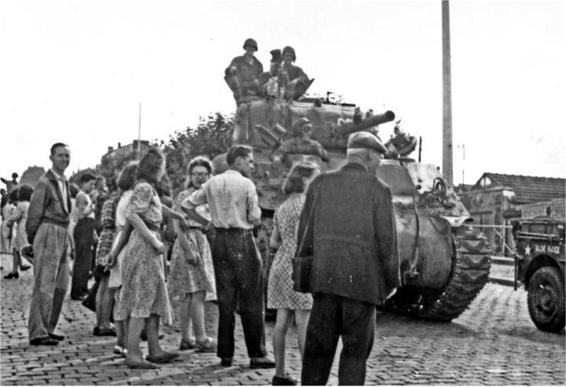
An M4 medium tank, probably from the 70th Tank Battalion, which was attached to the 4th Infantry Division at the time, in the outskirts of Paris.
The first parade by the 2e DB on 26 August was followed by a U.S. Army parade on 29 August, consisting mainly of the 28th Infantry Division but also including elements of the 5th Armored Division and other units from the Paris vicinity. Here, a group of M8 light armored cars line up in front of the Arc de Triomphe.
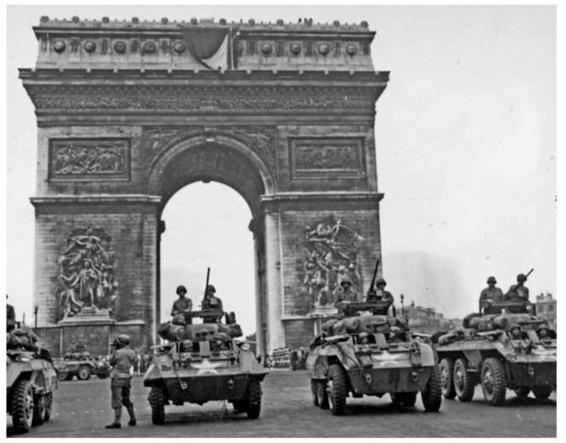

The M8 light armored cars take part in the 29 August parade.

An M3A1 half-track (named Heaven Can Wait) passes the reviewing stand during the parade.

An M4A1 on the left and M4 on the right take part in the parade. The censor has crossed off the Culin hedgerow cutters, which were still considered top secret at the time.
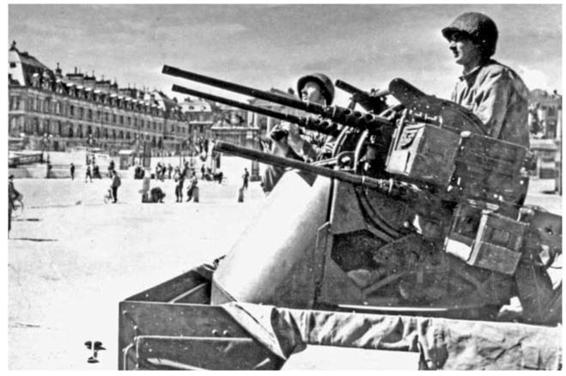
A Patterson conversion antiaircraft halftrack on duty in the Tuilleries gardens in Paris next to the Louvre in late August, shortly after the liberation of Paris.

The fast pace of the race to the Seine put a premium on mechanized cavalry to scout ahead of the main force and protect the extended flanks. Here, an M8 light armored car of the 87th Cavalry Reconnaissance Squadron engages a German ambush near Epernay on 27 August after the 7th Armored Division had pushed out of the Melun bridgehead on the Seine.
An M3A1 half-track crosses a treadway pontoon bridge over the Seine on 26 August.
An M16 antiaircraft half-track moves past a truck column on a French road in late August. The Luftwaffe was unusually active in attacking the Mantes bridgehead area on the Seine north of Paris, leading to a concentration of U.S. First Army antiaircraft units.

A half-track column takes a breather in Saint-Mesme, a town on the northeastern side of Paris. The leading M3A1 half-track is named Ruptured Duck.
An M10 3-inch gun motor carriage of the 813th Tank Destroyer Battalion in France in late August. This vehicle has several interesting technical modifications, including an early example of an armored parapet around the turret opening and a Douglas hedge cutter on the bow.
An M20 armored utility vehicle leads a column from the 813th Tank Destroyer Battalion of Patton's Third Army in the Nancy region in late August 1944. The M20 was a command and utility version of the better-known M8 light armored car, but without the turret.

Another M10 3-inch gun motor carriage from the 813th Tank Destroyer Battalion. As can be seen, units did not uniformly apply field modifications to all their vehicles as this one lacks the hedge cutter and extra armor seen on the previous M10.This particular battalion served in support of the 79th Division at this time.
Yet another variation on the extra fittings on an M10 3-inch gun motor carriage of the 813th. This vehicle has a pair of spare road wheels attached to the glacis plate and also has four metal pipes welded to the lower corners of the superstructure that were used to erect poles to hang camouflage netting over the tank. This feature can be seen earlier in this book on the tank destroyer of another battalion, suggesting it was a feature dreamed up by a Tank Destroyer Group headquarters.


A rear view of an M10 3-inch gun motor carriage of the 813th as it passes the battalion chaplain's jeep. The deepwading trunk fitted at the rear of the vehicle for the original landing in Normandy has been battered, and the rear panel is missing.
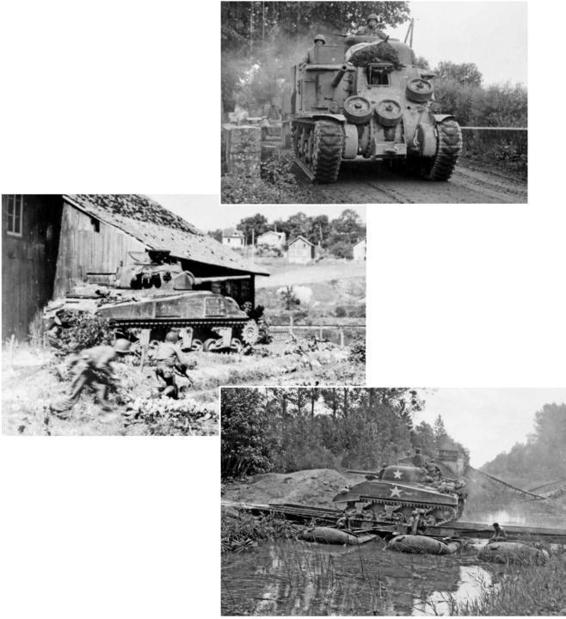
An M31 tank-recovery vehicle of the 813th moving up behind the M10 column in late August.
An M4 (named This Is It) crosses a treadway pontoon bridge over the Marne River. The original bridge had been demolished by the retreating Germans and can be seen in the background.
Infantry from the 5th Infantry Division take cover as an M4 of the 735th Tank Battalion engages a target during the fighting in Montereau on 25 August.
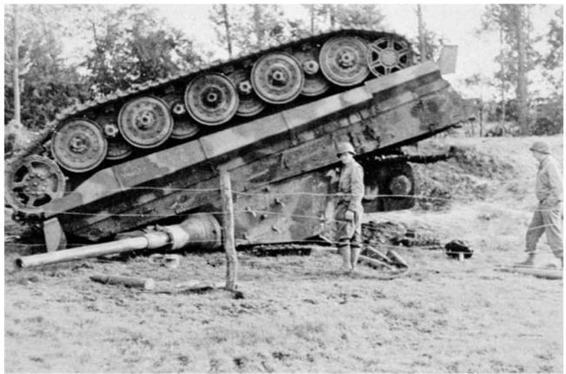
This King Tiger (No. 121) of SS schwere Panzer Abteilung 101 (101st SS Heavy Tank Battalion) was abandoned near La Cappele when it ran out of fuel and was spiked by its crew. American units subsequently pushed it off the road, and it flipped over as seen here. It was later recovered and today is part of the panzer collection at Munster.

A King Tiger abandoned by its crew. The U.S. Army encountered the King Tiger in combat for the first time in the Mantes bridgehead sector north of Paris when the 3rd Company, schwere Panzer Abteilung 503 (503rd Heavy Tank Battalion) took part in counterattacks. A small number of abandoned King Tigers of Panzer Kompanie (Fkl) 316 were found around Chateaudun.
A knocked-out StuG III with its crew buried alongside it, photographed by troops of the 83rd Armored Reconnaissance Battalion, 3rd Armored Division, in late August.
Officers of the 110th Infantry, 28th Division, inspect a disabled StuG III on 28 August.

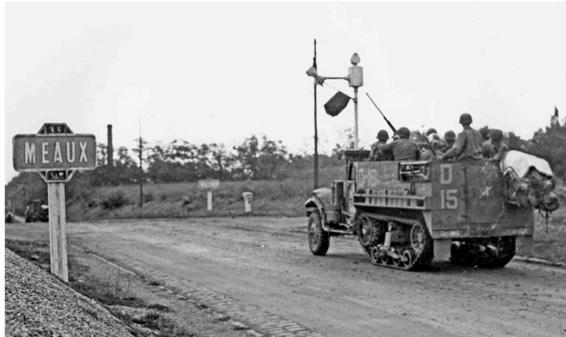
An M3A1 half-track of the 3rd Armored Division near Meaux on 28 August. The large bright-colored cloth panel on the corner of the vehicle is a fluorescent pink or yellow air-identification panel.
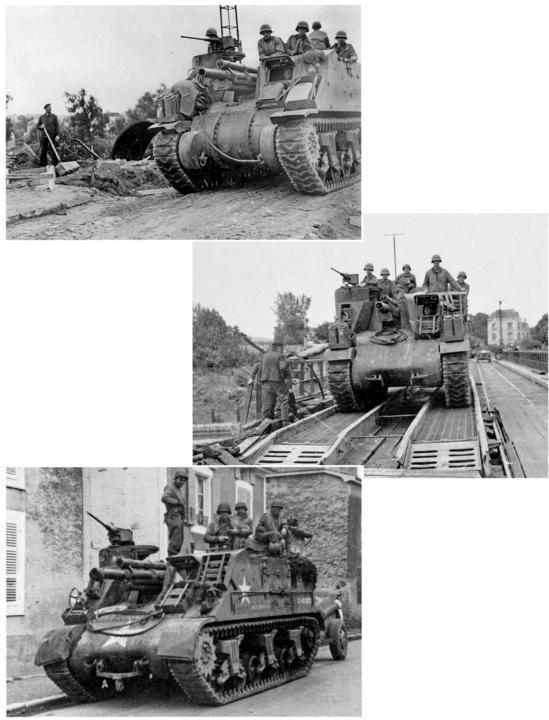
An M7 105mm howitzer motor carriage crosses a treadway bridge over the Aisne River near Soissons on 30 August.
An M7 105mm howitzer motor carriage passes through Soissons on 29 August.
An M7 105mm howitzer motor carriage. Each vehicle usually towed a separate trailer with additional ammunition, as seen here.
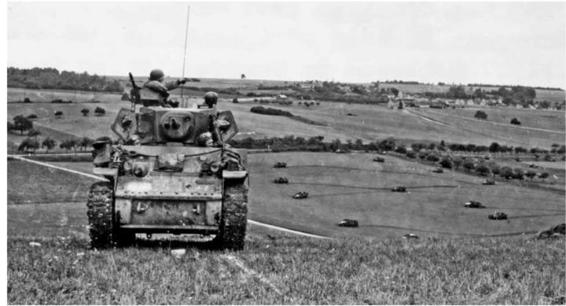
An M5A1 light tank crests a ridge over the village of Buchet on 31 August, with an armored infantry company on M3 half-tracks forming up in the fields below.
M3A1 half-tracks of Company D, 41st Armored Infantry, 2nd Armored Division, pass through the town of Cantigny on 31 August, site of the famous U.S. Army battle of World War I. The lead vehicle, numbered D-9, has the name Daring on the side door.


An M15A1 combination gun motor carriage supporting the 90th Infantry Division in Chateau Thierry, overlooking the Marne River on 31 August. The M15A1 can be distinguished from the earlier M15 by the placement of its .50caliber machine guns below the 37mm gun rather than above. Four days before, the division crossed the Meuse in the wake of the 7th Armored Division and would face a major German tank counterattack a week later between Landres and Mairy.
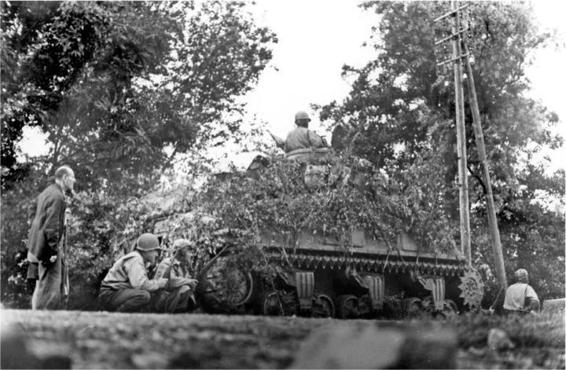
A member of the French resistance and several tank crews take cover behind an M4 medium tank of 8th Tank Battalion, 4th Armored Division, on 31 August while the tank tries to stop German troops from destroying a bridge over the Marne near Rashecourt.

By the end of August, the Allies had accumulated a substantial inventory of captured German panzers. This is one of the collection points near Trevieres. The turretless tank to the left is a Renault R-35 light tank that had been converted into a 47mm Panzerjager tank destroyer but had lost its superstructure at some point. Next to it is one of the Becker conversions for the 21st Panzer Division consisting of Chenillete Lorraine converted to a tank destroyer with a 75mm PaK 40, and beyond it are three Panthers.
This photo from the collection point at Isigny near the Normandy coast shows a couple of Panthers in the foreground, followed by some Pz.Kpfw. lVs behind and some Sd.Kfz. 251 armored halftracks to the left.


Ordnance troops repair a StuG I I I at Isigny in August. Although the U.S. Army did not systematically use captured German equipment, the holding areas in Normandy served as a source of vehicles for newly created Free French units based on FFI resistance groups that were assigned to siege duties around hold-out German garrisons in the Atlantic ports such as Royan, St. Nazaire, and La Rochelle.
A close-up of the Isigny yard shows a variety of captured vehicles. In the foreground is a pair of Munitionschlepper UE(f) fur Raketenwerfer, a German conversion on captured French UE light artillery tractors which added four Wurfrahmen 40 frames to launch 280mm or 320mm artillery rockets.

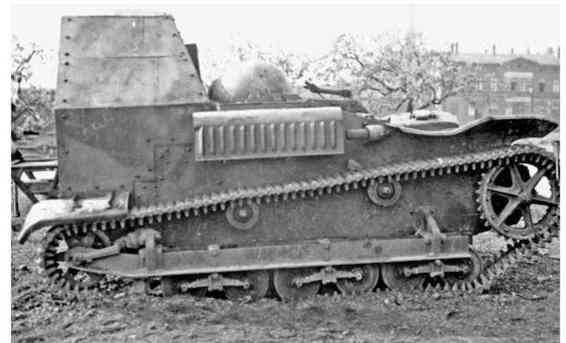
Many captured UE armored tractors were used for security tasks, and in the case of this example, an armored compartment has been added to the rear to provide a machine-gun position on the vehicle.
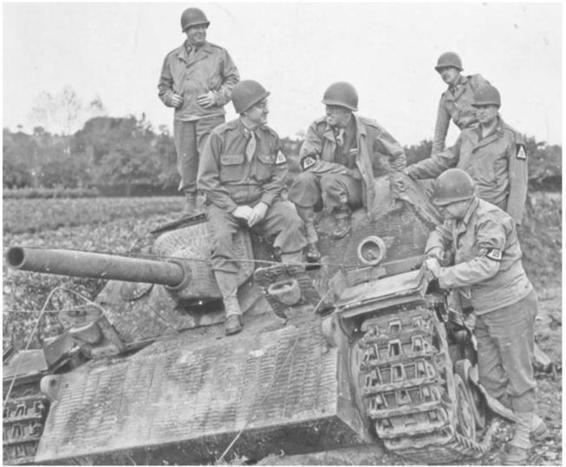
American labor leaders on a goodwill visit to the front sit atop a knocked-out Jagdpanzer IV on 24 August. This is the original version of this tank destroyer with the shorter U48 gun.

The armored protection of the Panther proved to be something of a shock to the Allies when encountered in the summer of 1944. A series of tests was conducted against captured Panthers to determine the effectiveness of various Allied weapons. This is a photo from one of the reports showing the results of trials against three captured Panthers conducted near Isigny in August.