
Chapter Ten
Hitler’s intelligence was well informed of Stalin’s intentions in early 1945. It was calculated that his attack would begin on 12 January with an advantage of 11:1 in infantry and 7:1 in tanks. An evaluation of Stalin’s total strength gave him a superiority of approximately 15:1 on the ground and 20:1 in the air. Stalin launched his Vistula–Oder offensive as predicted, which took the Red Army from the Vistula in Poland to the Oder east of Berlin.
The 2 million men of Zhukov’s 1st Byelorussian and Konev’s 1st Ukrainian Fronts, supported by 4,529 tanks and 2,513 assault guns, simply overpowered the 400,000 troops of Army Group A, supported by 1,150 panzers. After 23 days they had torn open a breach 625 miles wide by 375 miles deep, and swept across the Oder. The 1st Byelorussian Front secured a bridgehead at Kustrin just 35 miles from Berlin.
By the end of the first week of February in Silesia the Germans’ Oder defence had collapsed and the Red Army was beyond the left flank of the Upper Silesian front. On the night of 12 February Soviet troops came together in the Tinz–Domslau area encircling Breslau. The key point in this battle occurred on the 13th, when the 19th Panzer Division in the Kostomloty area held open the autobahn to enable two infantry divisions to escape. That night the 7th Guards Tank Corps succeeded in sealing off the rest of the garrison. By 15 February Soviet forces had surrounded Breslau as the 3rd Guards Tank Army closed the gap to the west.
Striking from Greiffenberg, the 8th Panzer Division made a surprise attack three days later against the southern wing of the Soviets advancing from Löwenburg to Lauban. Although they slowed them, on the 28th Lauban fell to the 3rd Guards Tank Army, allowing them to prepare to move on Görlitz and Dresden. The Germans counter-attacked with elements of the 8th, 16th and 17th Panzer Divisions, knocking out 230 Soviet tanks and halting the advance.
It was not until early March that the Germans attempted to relieve Breslau, gathering seven divisions including four panzer divisions in the Gorlitz area. On the 3rd they attacked the weak 3rd Guards Tank Army, but after fierce fighting the attack was halted with both sides suffering heavy casualties.
Stalin sought to clear the rest of Silesia with the Upper Silesian offensive conducted from 15 to 31 March 1945. Konev launched his main assault with the 4th Tank Army piercing the German lines west of Oppeln and heading southwards for Neustadt. Southeast of Oppeln Soviet forces also broke through the German defences, swinging westwards to link up with the 4th Tank Army. By the 22nd the Soviets had crushed the Oppeln ‘cauldron’, claiming to have killed 15,000 Germans and captured a further 15,000.
In Hungary German troops were trapped in Budapest and the IV SS Panzer Corps was diverted from Warsaw in late December 1944 to rescue them. They did have some opportunity of breaking through as initially they had 70 per cent more troops and 140 per cent more armour than the Soviet 4th Guards Army holding the outer ring. Operation Konrad I was launched on 1 January 1945 and saw the SS strike from the north of the city; attacks were also conducted to the west.
Konrad III, the last part of the operation, commenced on 17 January with IV SS Panzer Corps and III Panzer Corps attacking from the south with the aim of trapping ten Soviet divisions. Again this failed. During the second counter-attack 100 panzers supported by two regiments of motorised infantry tried to punch through the Soviet 5th Guards Airborne Division. Eighteen panzers made it through, only to run into a Soviet anti-tank regiment, which accounted for half the tanks.
Following the loss of Budapest, Hitler, desperate to hold back Stalin in Hungary, ordered ten panzer and five infantry divisions to launch a counter-offensive between Lake Balaton and Lake Velencze, dubbed Operation Spring Awakening. He had a 2:1 superiority in tanks, and the Soviet forces in Hungary were weak in armour, which meant that anti-tank guns would be their main defence against the 900 panzers and assault guns thrown at them. The Soviet anti-tank gunners were particularly contemptuous of the Panzer IV, which they considered obsolete. However, the area chosen for the attack between the River Danube and the northern end of Lake Balaton was criss-crossed by canals and ditches and was unsuitable for mobile armoured warfare.
On the morning of 6 March 1945, after a 30-minute artillery bombardment supported by air attacks, the Germans launched a furious three-pronged attack, with the 6th SS Panzer Army striking in a southeasterly direction between Lakes Velencze and Balaton; the 2nd Panzer Army thrusting eastwards in the direction of Kaposvar; and Army Group E attacking northeast from the right bank of the Davra with the aim of linking up with the 6th SS Panzer Army.
Two days after Spring Awakening opened, the 2nd SS Panzer Division reinforced the offensive with 250 tanks, followed by the 9th SS the next day. The Red Army found itself under attack by almost 600 panzers. Nevertheless, Hitler’s forces were rapidly running out of time and resources – his factories had been all but wrecked by the repeated attentions of the Allies’ bombers. In a final desperate push for the Danube, Spring Awakening’s last reserves, the 6th Panzer Division with 200 tanks and self-propelled guns, were committed on 14 March. They managed to force their way to the Soviet rear defence lines, but got no further.
On 16 March Stalin launched his own counter-offensive west of Budapest, hitting General Balck’s 6th Army and the Hungarian 3rd Army north of Lake Velencze. Motorised infantry rolled through a breach, which 12th SS Panzer Division tried to block, and the Red Army swept southwest towards Balaton. The Soviets sought to encircle the 6th SS Panzer Army and 6th Army.
The inadequately equipped Hungarians on II SS Panzer Corps’ left flank defected with inevitable results. The skeletal Hungarian 3rd Army withdrew westwards and under pressure the 1st SS Panzer Division gave ground, exposing Balck’s flank. Six days later the 6th SS Panzer Army was trapped south of Szekesfehervar and barely escaped.
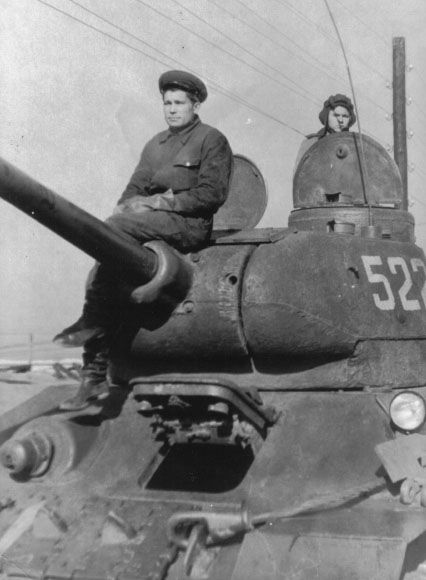
A commissar hitches a ride on a T-34. Although the Red Army did not differentiate between the variants, the Model 1946 entered service during 1945 and saw front-line action in the closing days of the ‘Great Patriotic War’. It could be distinguished from the Model 1945 by its fuller lower turret sides and the new configuration of ventilator domes. (Author’s Collection)
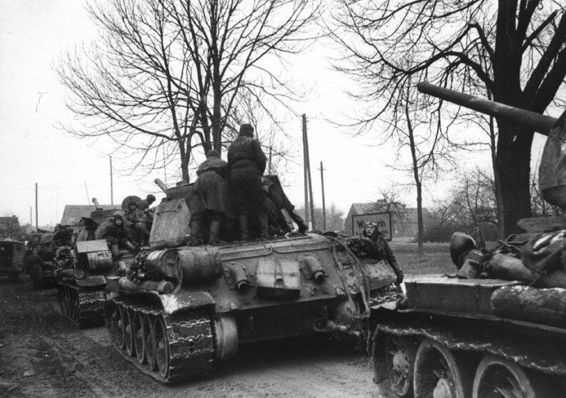
The Model 1945 T-34/85 (which confusingly entered service during 1944) differed from the Model 1944 in that it featured a larger cupola, which extended close to the port edge of the turret, requiring a tiny lip underneath on the turret side. (B19)
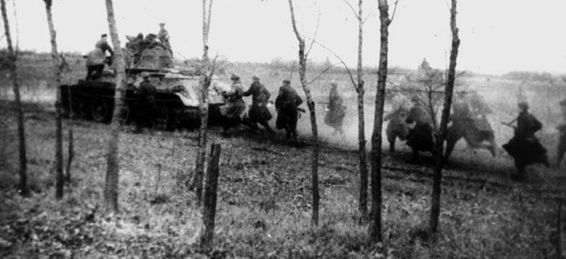
Soviet infantry attacking with tank support provided by T-34/76Ds. By early 1945 the Soviet tide was relentless. Hitler’s exhausted Army Group A had just 1,150 panzers to halt Stalin’s massive Vistula–Oder offensive, which committed 4,329 tanks and 2,513 assault guns to the battle. (A046)
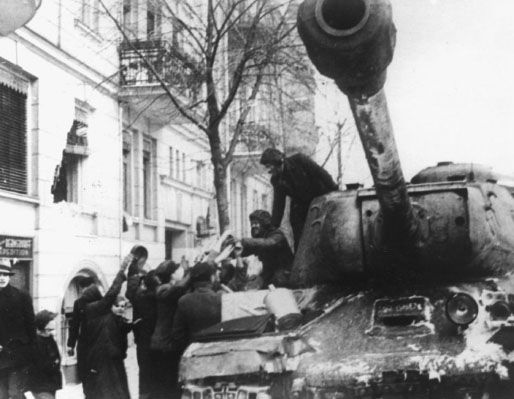
While the panzers could knock out the IS-2, they had no real answer to its 122mm armament, which easily outgunned them. When Stalin’s Oder–Vistula offensive opened on 12 January 1945, German intelligence estimated that Soviet forces had a 3:1 numerical superiority; in fact they had a 5:1 advantage. (AO41)
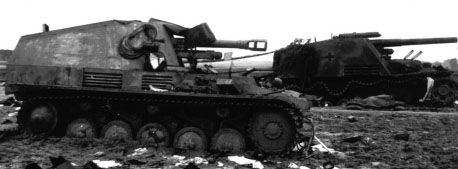
Abandoned Wespe and Hummel self-propelled guns. By the time the Soviet 3rd Guards and 4th Tank Armies’ assault began, the 4th Panzer Army had lost up to two-thirds of its artillery and a quarter of its troops thanks to Soviet field guns and air attack. (RGAKFD via author)
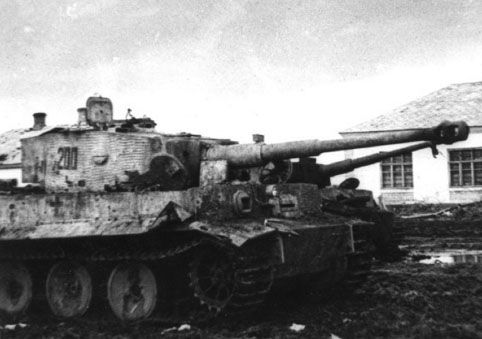
The two panzer corps of the 4th Panzer Army were quickly overwhelmed and forced to withdraw. German Tigers lay abandoned in the mud; once immobilised, there was no way to retrieve them. The corrugating on the turret is Zimmerit anti-mine coating, which was applied as a paste. (BA52)
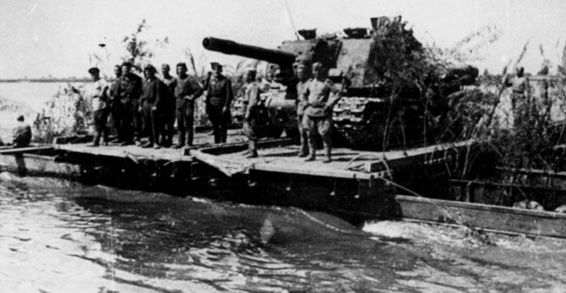
An ISU self-propelled gun on a pontoon ferry. The 2nd GuardsTank and 5th Shock Armies reached the Oder almost unopposed and crossed over, taking Kienitz as early as 31 January 1945. Once over the Oder the only other major defensive barrier before Berlin was the Seelow Heights. (B89)
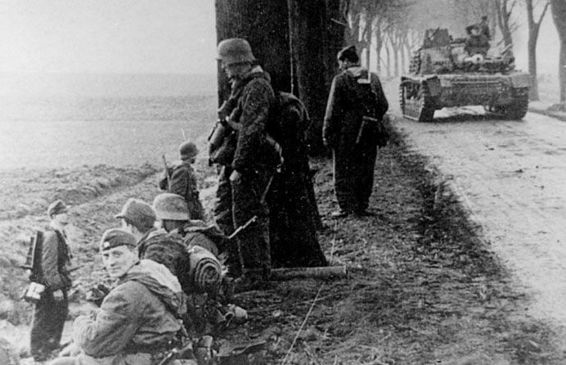
Panzergrenadiers and a supporting assault gun taking a break from the fighting. At Breslau the 19th Panzer Division enjoyed limited local success when it manage to extricate two infantry divisions; the city, though, was promptly surrounded by Soviet armoured formations. (WH968)
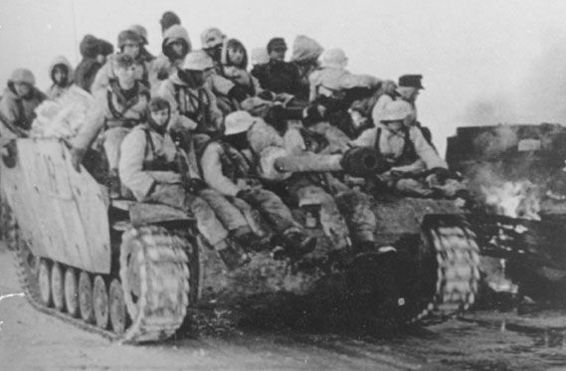
For ten days the tanks and StuGs of the 8th Panzer Division struggled to defend the city of Lauban. This assault gun is clearly overloaded with panzergrenadiers anxious to hitch a lift. (WH335)
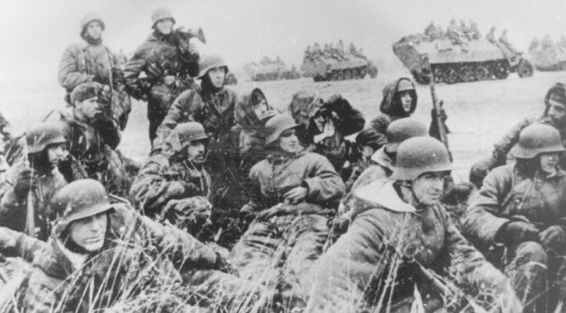
Panzergrenadiers wearing heavy-duty winter parkas moving up for a counter-attack in SdKfz 251 armoured personnel carriers. In early March the panzers attempted to cut their way through to Breslau but without success. Although Hitler’s panzer forces were ebbing away, the defenders held out until the end of the war. (WH327)
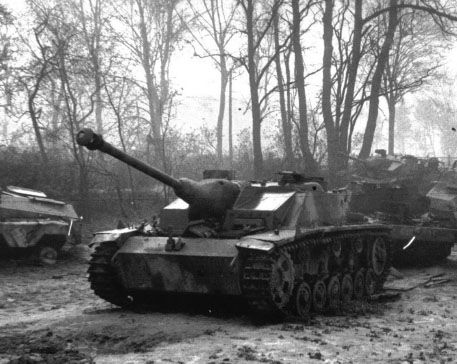
A StuG III abandoned in a Soviet vehicle park with various other captured armoured fighting vehicles. Once Stalin’s tank factories were in full swing, the Red Army had little need to recycle enemy tanks. The Ausf G was the last production series of the StuG, first rolling off the assembly line in December 1942; by March 1945 some 7,720 had been produced. (RGAKFD via author)
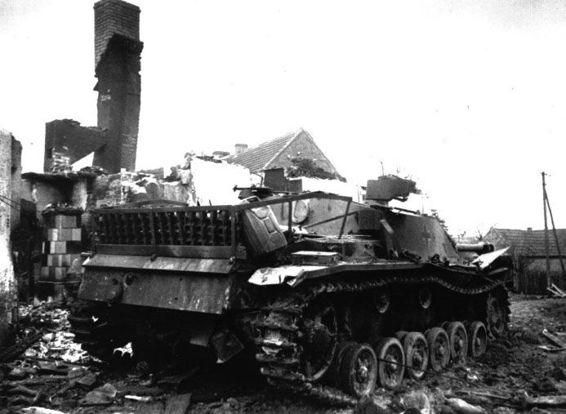
Another wrecked StuG pictured in 1945 by a Soviet combat photographer. In Hungary Hitler refused to abandon Budapest to the Red Army. Operation Konrad tried to relieve the garrison in the New Year of 1945 using SS panzer divisions. When this attempt failed, two more futile attempts were made. (RGAKFD via author)
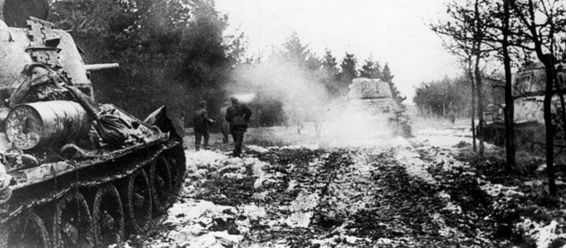
To counter Red Army advances in Hungary, Hitler launched a massive counter-attack in March 1945. Despite a 2:1 tank superiority, this failed to have the desired effect and the Soviet counter-offensive swept his panzer forces away. Stalin was now the master of Blitzkrieg, though in his hands it was a blunt instrument. (AO146)
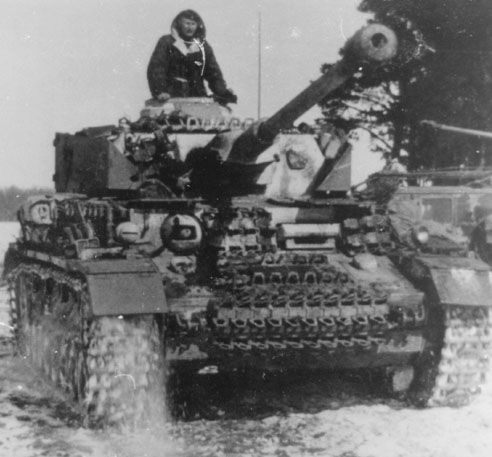
Reportedly 287 Panzer IVs were lost on the Eastern Front during January 1945. It is estimated that the Red Army accounted for 6,153 Panzer IVs or about 75 per cent of all Panzer IV losses during the war. (WH441)