
Chapter Eleven
By early 1945 Hitler’s panzer forces were on their last legs, but remained determined to put up one last fight against Stalin’s coming assault on Berlin. Hitler as ever remained obsessed with launching counter-attacks using formations that were little more than flags on a map. Zhukov arrived in Moscow on 29 March to discuss their plans. His intelligence indicated that Hitler had four armies in the region with no fewer than 90 divisions, remarkably including 14 panzer and motorised divisions. However, from the very beginning the battle was a one-sided affair. In total the Red Army fielded 2½ million troops, equipped with some 6,250 tanks. Zhukov was able to hurl almost a million men of the 1st Belorussian Front against Berlin’s outer defences anchored on the Seelow Heights.
In his path lay about 100,000 exhausted troops of General Theodor Busse’s 9th Army, which formed part of Army Group Vistula. He defended the front that encompassed the Seelow Heights. In total the 9th Army had 14 division with 512 panzers, 344 artillery pieces and 300 anti-aircraft guns. Further south the front was held by the exhausted 4th Panzer Army, tasked with fending off the vengeful 1st Ukrainian Front.
General Weidling, commanding the LVI Panzer Corps, observed the sheer weight of Zhukov’s attack: ‘On 16 April, in the first hours of the offensive, the Russians broke through on the right flank of the 101st Army Corps on the sector of Division Berlin, thereby threatening the left flank of the LVI Panzer Corps.’
Coordination of the Seelow assault, though, proved chaotic, signals traffic overwhelmed the decoders and Zhukov, desperate for results, continually meddled. He needed to take the heights that morning to allow the breakout to encircle Berlin, otherwise Konev would get the credit. He soon discovered he had completely underestimated the strength of the defences.
General Mikhail Katukov, commander of the Soviet 1st Guards Tank Army, was ordered to bludgeon his way through the Germans on the heights. However, throwing the 1st and 2nd Guards Tank Armies into the fight did not immediately have the desired effect. The original plan was that they would exploit the breakthrough, not achieve it. Due to the swampy ground the tanks had to use the roads that were already packed with infantry. This created major traffic jams and provided the German anti-tank gunners with prime targets. Predictably German artillery caught the Soviet tanks in the open. Even when the tanks did reach the escarpment they found the gradient too steep to climb and were knocked out in great numbers. The 65th Guards Tank Brigade, Katukov’s vanguard, found the going tough and the defenders desperately clung on to their positions. Southeast of Seelow the Soviet armour ran into Tigers of the 502nd SS Heavy Panzer Battalion.
Despite the stubborn resistance, Katukov gained a foothold on the heights. The 9th Army weathered three days of preliminary attacks and then spent 24 hours enduring the full force of Zhukov’s assault. They knocked out over 150 Soviet tanks but it was not enough. In just three days the 1st Belorussian Front smashed through the final defences of the Seelow Heights, leaving little in the way of effective defence between the Soviets and Berlin. The Germans lost some 11,000 killed, while the Red Army suffered 30,000 dead. All that remained to defend Berlin itself were about 45,000 troops.
The Red Army assaulted Berlin itself on 21 April 1945. It threw 6,250 tanks into a massive assault to encircle the beleaguered Nazi city; the Germans in stark contrast had just 650 panzers to defend it. According to Soviet figures, there were just 200 panzers facing the British and American forces in the West, while there were 1,500 protecting Berlin; this estimate was wildly inaccurate. Crouching behind their T-34s, ISs and self-propelled guns, the Soviets battled their way along Berlin’s streets as the final battle was played out.
Units of the 3rd Assault, 2nd Guards Tank and 47th Armies were committed to the attacks on the outskirts of Berlin and four days later the city was assaulted from the southeast by General Berzarin’s 5th Shock Army and General Katukov’s 1st Guards Tank Army. Along the northern bank of the Teltow Canal facing Rybalko’s 3rd Tank Army were some 15,000 men with 130 tanks.
During the desperate fighting German troops succeeded in breaking through the Soviet encirclement twice, though on both occasions they were stopped. In the Beelitz area 30,000 men from the German army almost reached General Wenck’s 12th Army, which had been sent from the Western Front to help Berlin. Konev claimed that only 4,000 men got through.
Hitler’s remaining panzers tried to flee on 1 May. The Soviets, suspecting they were carrying fleeing Nazi officials, knocked them out 10 miles northwest of the shattered city the following day. That same day the German garrison surrendered. The Red Army claimed it lost 2,156 tanks and self-propelled guns taking Berlin and that it captured over 1,500 panzers and assault guns. During the course of the entire war the Red Army lost a staggering 96,500 tanks and self-propelled guns.
Stalin’s very last armoured assault of the war was the Prague Offensive, conducted after Berlin had been overwhelmed. Fought from 6 to 11 May it culminated in the liberation of the Czech capital. Army Group Centre, which had been at the very heart of Operation Barbarossa and Hitler’s dream of capturing Moscow, fought to the very last. It did not surrender until nine days after the Red Army had captured Berlin and three whole days after Victory in Europe Day. The last of Hitler’s panzers lay disabled on the streets of Prague.
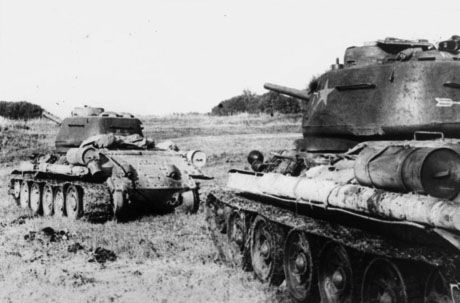
By early 1945 Stalin’s Blitzkrieg had bludgeoned its way across Eastern Europe, capturing Danzig, Konigsberg, Warsaw, Budapest and Vienna. Hitler’s armoured counter-attacks did little to forestall the inevitable in the face of Stalin’s armoured might, spearheaded by these T-34/85s. (BA3)
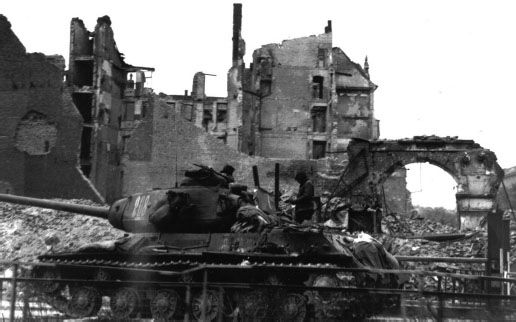
The IS-2 had an improved hull with contour castings and proved to be one of the most powerful tanks to go into service with any army during the Second World War. Nonetheless it did not have it all its own way: in at least one recorded instance in March 1945 a single Panther accounted for four of them – clearly they must have been a highly experienced crew with nerves of steel. (RGAKFD via author)
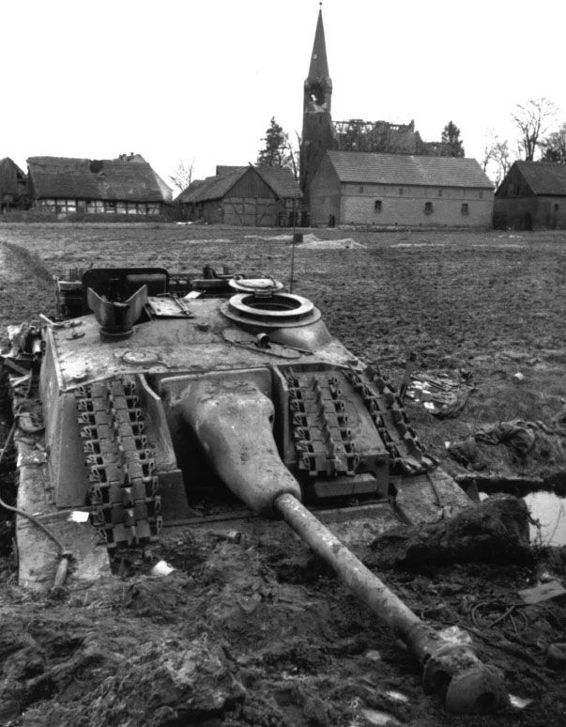
This late production StuG IIII Ausf G is all but buried in the mud and would have presented a difficult target to destroy. By late March 1945 Stalin was poised to assault Berlin itself. The city’s eastern defences were anchored on the Seelow Heights, defended by 512 panzers and assault guns – the equivalent of about five panzer divisions. (RGAKFD via author)
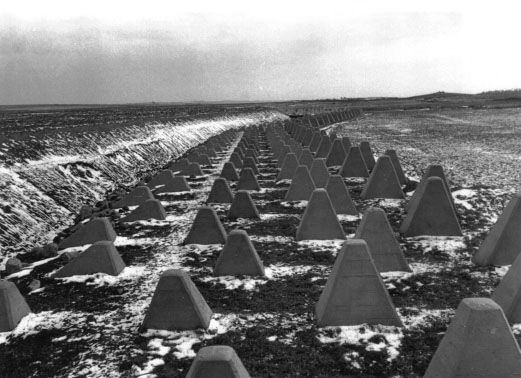
Concrete dragon’s teeth east of Berlin. Such man-made obstacles did little to impede the Red Army’s tanks and the defences on the Seelow Heights were far from complete. (RGAKFD via author)
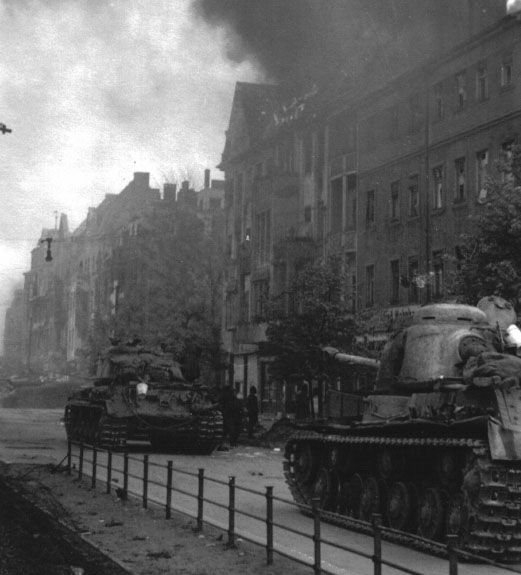
The 2nd Guards Tank Army’s tanks stormed into the shattered suburbs of Berlin on 21 April 1945. Crouching behind its IS-2s (as seen here), T-34 tanks and self-propelled guns, the Red Army fought its way along Berlin’s broad avenues, streets and roads and through its parkland. (RGAKFD via author)
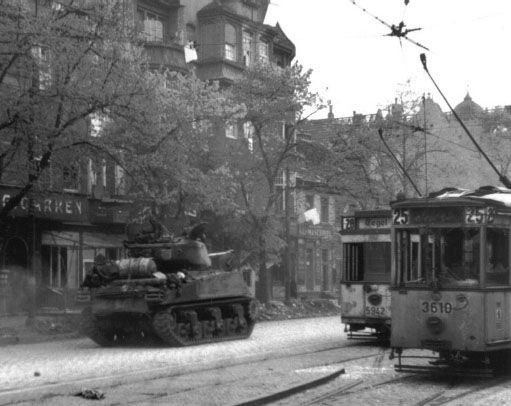
A Lend-lease Sherman rumbles through Berlin’s suburbs. After the war Stalin chose not to acknowledge the role played by British and American tanks in his war effort. (RGAKFD via author)
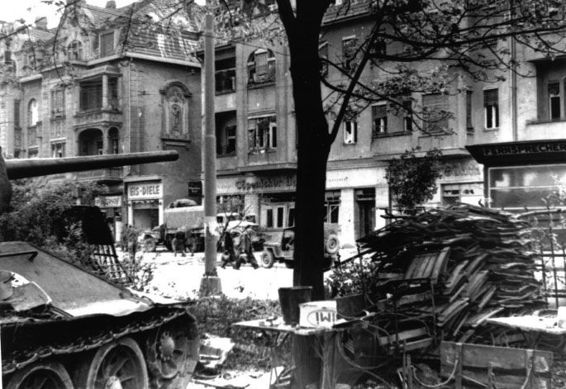
Built-up areas were hardly an ideal combat environment for tanks, but Stalin cared little for such niceties. Here a T-34 takes up position in one of Berlin’s parks; the city’s defenders were well armed with panzerfausts, which meant the tankers had to constantly sweep the street with machine-gun fire. (RGAKFD via author)
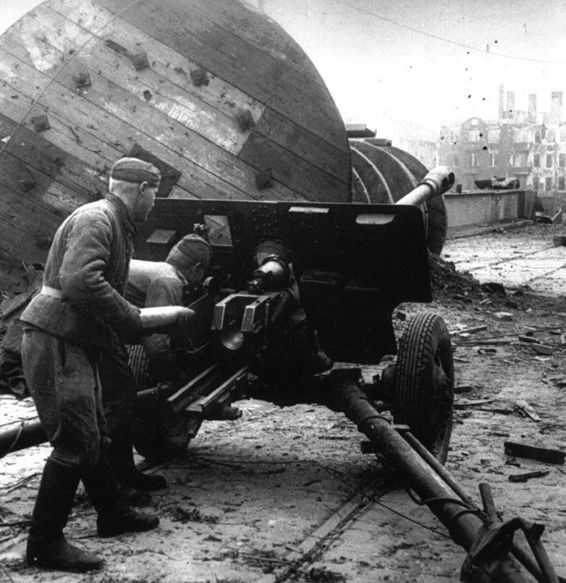
A Soviet 76.2mm anti-tank gun helps take out the last of the panzers on the streets of Berlin. Half a dozen Tiger IIs or King Tigers were involved in these final bitter tank battles defending the government quarter. (RGAKFD via author)
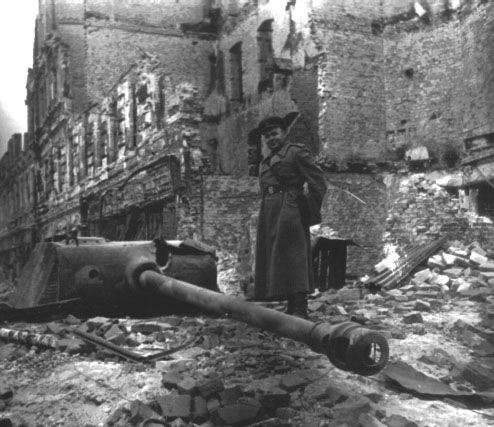
The final resting place for a Panzer V Panther turret; note the lucky (or extremely accurate) shot that pierced the gun mantlet. This would have killed the crew instantly and detonated the tank’s ammunition. Hitler’s last 20 operational panzers were knocked out 10 miles northwest of Berlin on 1 May 1945. (RGAKFD via author)
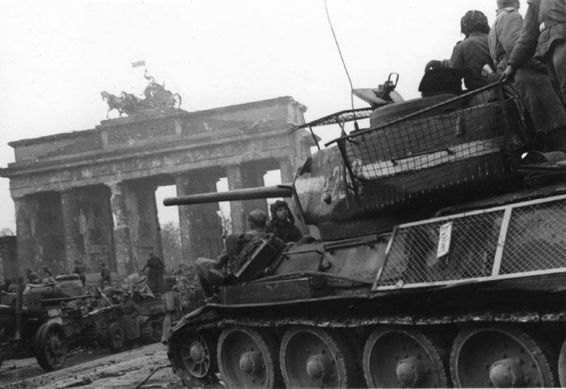
With the Berlin garrison subdued, a T-34/85 crew take in the views beneath the city’s famous Brandenburg gate. (RGAKFD via author)
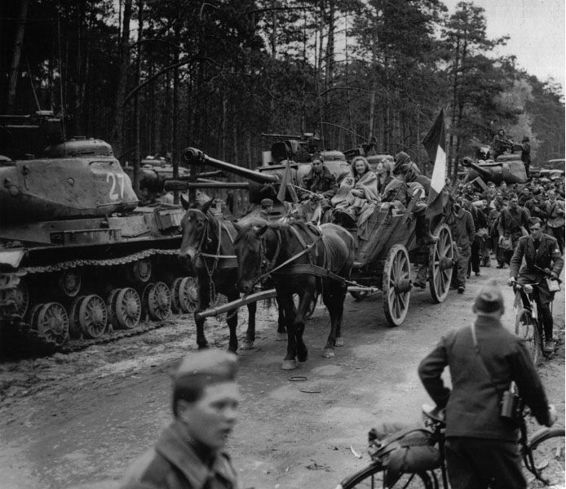
A column of IS-2 Stalin tanks photographed on 8 May 1945 in the woods west of Berlin. Note the French prisoners of war heading home. (Author’s Collection)

The Red Army claimed the battle for Berlin cost it 2,156 tanks and assault guns, showing the ferocity of the German army’s last-ditch defence. Hitler’s panzer forces were no more and the Soviets captured over 1,500 tanks and assault guns. (BA55)
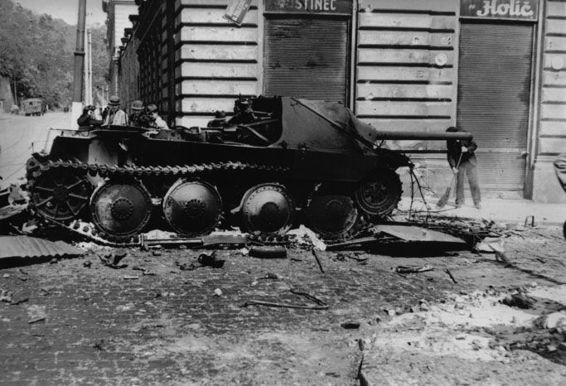
The very last tank battles were fought on the streets of Prague in the closing days of the war. The 2nd SS Panzer Division covered the German evacuation as the Red Army liberated the city on 9 May 1945. This burnt-out Czech-built Jagdpanzer 38(t) was one of the very last victims of the armoured warfare on the Eastern Front. (Author’s Collection)
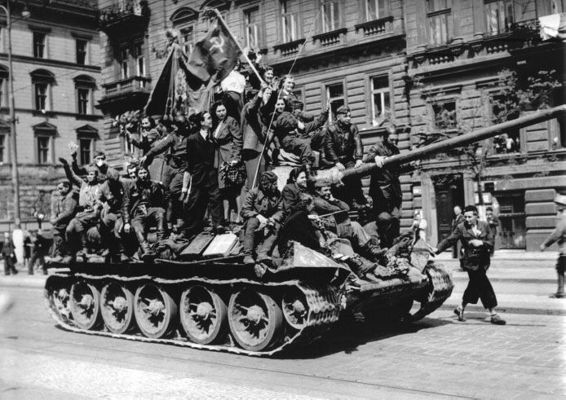
Crowded with Soviet troops and cheering Czech civilians, a T-34/85 rolls through the streets of Prague, giving Stalin his last victory of the war. (Author’s Collection)
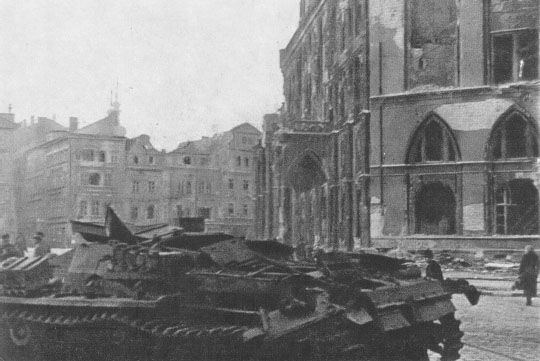
The shattered remains of a StuG assault gun on the streets of Prague. (Author’s Collection)
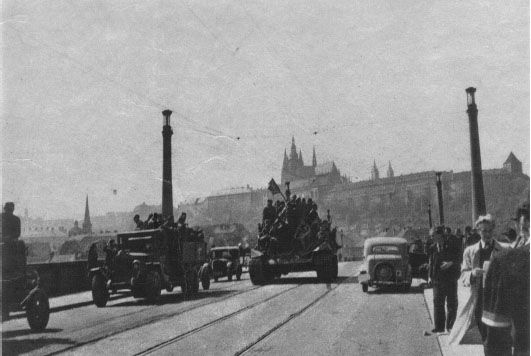
A Red Army column in Prague, including another T-34 covered in Soviet infantry. (Author’s Collection)
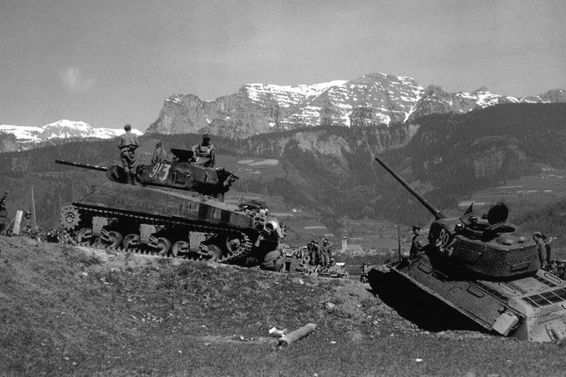
The war’s end. With the final tank battles over, the crews of a T-34/85 and a Lend-lease Sherman admire the mountains in Czechoslovakia. Army Group Centre (which had been in the forefront of Operation Barbarossa), with two nominal panzer armies, surrendered on 11 May 1945. (Author’s Collection)
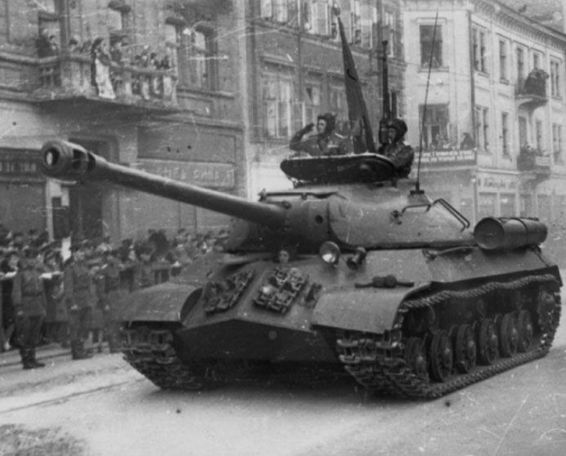
A new generation of Cold War warriors is born. The IS-3 with its frying-pan turret, which appeared in the Allied Victory parade in Berlin in 1945, heralded the new shape of Soviet armour to come. Reportedly a few saw action during the final stages of the battle for Berlin. (RA31)