
Chapter One
In the summer of 1941 Joseph Stalin had a huge tank force of 20,000 vehicles with which to protect the Soviet Union from the menace of Adolf Hitler. Zhukov had been instructed to prepare State Defence Plan 1941; based on the premise that Red Army operations would be in response to a Nazi attack, the idea was to take the war to the enemy in an offensive rather than defensive manner. The overall strength of Stalin’s armed forces in early 1941 was almost 5 million men, 2.6 million of them in the west, 1.8 million in the Far East, and the rest being redeployed or under training.
Of the Red Army’s 303 divisions (of which 88 were still in the process of formation), 237 were in the west. However, Stalin’s reluctance to mobilise for war and the logistics involved meant that when war broke out, only 171 divisions were actually in the field, deployed in three operational belts comprising 57, 52 and 62 divisions, along with his 20 mechanised corps supported by about 1,800 heavy and medium tanks and thousands of light tanks. This meant that only a third of the divisions were actually in the first defensive echelon and the tanks were dispersed where they could be easily destroyed piecemeal by Hitler’s panzers.
To Stalin’s way of thinking, if Hitler did invade he would undoubtedly go for the raw materials of Ukraine, and as a result most of the Red Army’s mechanised corps were with Colonel General M.P. Kirponos’s South Western Front. This had a large number of armoured units, notably six mechanised corps plus two reserve corps. In Lvov (Lemberg), formerly in eastern Poland but now part of Ukraine, was the 4th Mechanised Corps with General Andrei Vlasov. He did not know it, but he was to play a very infamous role in Hitler’s war in the East. His command included the 32nd Tank Division equipped with 300 lumbering KV-1 tanks. When the time came, elements of this division would offer effective if short-lived opposition to the panzers. Further east, stationed in the Ukrainian capital Kiev, was General K.K. Rokossovsky’s 9th Mechanised Corps.
The infantry constituted 75 per cent of the line divisions, and the Soviets could muster four types of rifle division, totalling 178 basic rifle divisions, 31 motor rifle divisions (in theory assigned to the mechanised corps), 18 mountain rifle divisions and 2 independent rifle divisions. Despite being called motor rifle troops, the reality was that many ended up riding on the outside of the tanks. Following the disastrous performance of the Red Army in Finland, the rifle division was reorganised, to consist of three infantry and two artillery regiments plus anti-tank and anti-aircraft support. As all the armour went to the new mechanised corps, each rifle division was left with only 16 light tanks – a fatal weakness by anyone’s reckoning.
It was only at the last minute that Stalin and Stavka, the Soviet high command, acquiesced in the creation of these fully fledged mechanised corps grouping the tank and motorised divisions, but by then it was too late. This process only began in March 1941 and of the proposed 20 mechanised corps (each with one tank and two motorised infantry divisions), fewer than half had been equipped by June. For example, on the eve of war, while the 12th Mechanised Corps was able to muster 84 per cent of its tanks, the 3rd Mechanised Corps could only manage 55 per cent. The latter’s armour comprised mostly inadequate T-26s, there were a few T-34s and just two new KV-1s. The 7th Mechanised Corps had none of its authorised 420 T-34s and just 40 of its 120 KVs. Clearly this was a recipe for disaster.
The key armoured formation in the south, Rokossovsky’s 9th Mechanised Corps, defending the Kiev Special Military District (South West Front from the outbreak of hostilities) was mechanised only in name. Rokossovsky only had a third of his tanks and they were obsolete, with worn-out engines; his motorised infantry lacked even horses and carts. Soviet mechanics must have despaired at trying to maintain the vehicles in their charge. When the time came, Rokossovsky worked miracles and he proved to be exactly the type of general his country needed in its hour of desperation. In the meantime these new formations were on the whole inadequately led, equipped and trained.
To add to the Red Army’s difficulties, after moving into eastern Poland it had abandoned and stripped most of the pre-1939 Soviet-Polish frontier defences. This required the construction of new defences in the western areas of the Special Military Districts. This left those Soviet forces in eastern Poland very vulnerable to attack.
Barring the way to Minsk and Moscow was General D.G. Pavlov’s Western Special Military District or West Front. His command also comprised just six of the 20 mechanised corps, with a total of 12 tank divisions and six supporting motorised divisions. He was in the unenviable position of holding the Bialystok salient, trapped between East Prussia and German-occupied Poland. There is a suspicion that Stalin and Zhukov considered Pavlov’s command something of a sacrificial lamb and that it was the Reserve Front’s job to hold Hitler at the old frontier. Certainly by June 1941 the West Front was far from up to strength.
In the Kremlin General Ia N. Fedorenko noted that there were ‘too few modern tanks and that a number of tanks which were standard equipment in the Red Army were already obsolete’. He concluded that no time should be lost in increasing production of the new T-34 and KV tanks and that funding should be redirected to this end. Marshal G.I. Kulik, who favoured cavalry and artillery, was dismissive, claiming that the balance was right. After that no one spoke further on the issue. On the very eve of the war the chance to shake up their mechanised forces was lost.
Hitler’s Wehrmacht had perfected its ‘lightning war’ tactics in western Europe, Scandinavia and the Balkans. In the face of the Nazis’ tried and tested Blitzkrieg tactics, combining armour with motorised infantry, supported by air and artillery strikes, the outcome was inevitable. Hitler had at most 153 divisions, including reserves, available for operations on the Eastern Front by 22 June 1941; Stalin, though ill-prepared, had almost double that number. In total Hitler could muster about 3 million men; Stalin had 4½ million at his disposal.
Geographically, for Hitler there was the problem of the Soviet front itself, which funnelled out from 1,300 miles to 2,500 miles. These logistical problems were compounded by his lack of reserves; his Replacement Army had less than half a million men, sufficient only for replacements during the intended brief summer campaign. Hitler only had three months’ reserves of petrol and one month’s of diesel. He was gambling on gaining a quick victory thanks to his panzers. Nor did Hitler seem inclined to consider the long-term value or reliability of his East European Axis allies. Equally worrying was the fact that the superiority of the panzers was not that marked, although General Heinz Guderian believed at the beginning of the campaign that the technical superiority of the German tanks would cancel out the Soviets’ massive numerical advantage.
Nonetheless in the spring of 1941 a Soviet Commission’s comments on seeing the panzers led German ordnance officials to conclude, ‘It seems that the Russians must already possess better and heavier tanks than we do.’ The German military really should have come to this conclusion after the Spanish Civil War. It was evident then that Soviet tank design was accelerating and the Soviet T-34 tank was about to make its appearance; it would prove equal to any existing German armour. This design and Soviet industrial might would be Hitler’s ultimate undoing.

In the 1930s much of the Red Army’s armour comprised the BT (Bystrokhodnii) fast tank; the BT-5 (in fact a copy of the US Christie M-1931) is identifiable by its cylindrical turret housing a 45mm gun. The BT was unusual in that it could run on roads at high speeds off its tracks; with a crew of three and a weight of 11.5 tons it could manage 70mph. However, it was time-consuming taking the tracks off and in a country lacking paved roads was not a great asset. (Author’s Collection)

At the time of Hitler’s invasion the bulk of the Soviet fast tanks consisted of the BT-5’s up-armoured successor the BT-7, seen here with the newer conical turret, which went into production in 1935 and was known as Betka (‘Beetle’) by its crews. Most of the BT-2/5/7s still in service were replaced by the T-34 within a year of the invasion. (Scott Pick Collection)
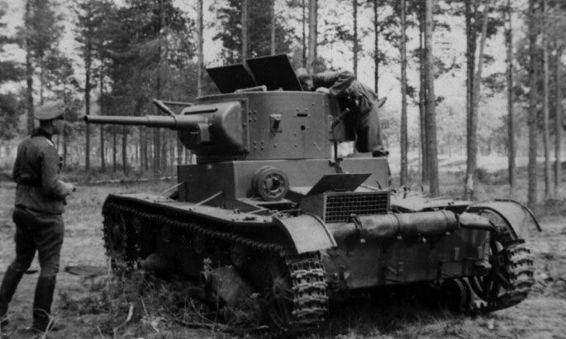
The single-turret T-26B light tank appeared in 1933 (the earlier T-26 had twin turrets) and was armed with a 45mm or 37mm gun. Its weight, though, rose by a ton to 9 tons, reducing its road speed to 18mph. This low speed and poor mobility compared to the BT-5 resulted in production being abandoned in the mid-1930s. (Scott Pick Collection)
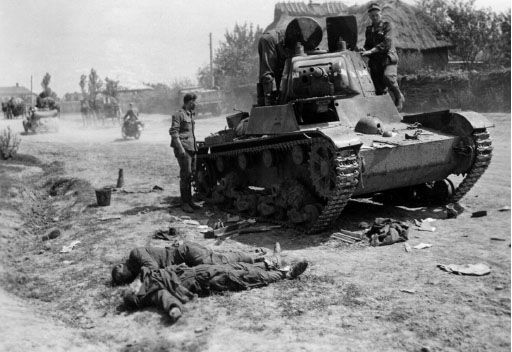
Nonetheless, the T-26, developed from the British Vickers 6-ton tank, is considered one of the best designs of the 1930s. Around 11,000 were built, with over 20 variants, making it the most numerous tank at the time of Operation Barbarossa. While it could not cope with the Panzer III or IV, it remained in service until 1944, taking part in the battles for Moscow, Stalingrad and Leningrad. (Scott Pick Collection)
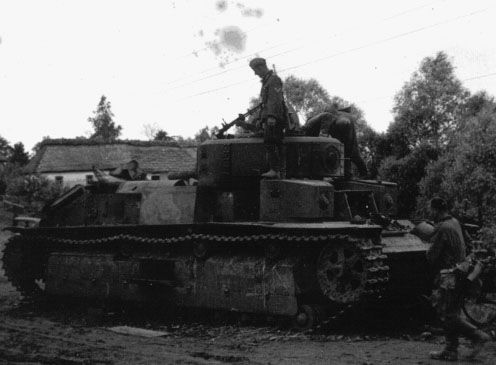
While Soviet medium tank designs were initially slow off the mark, the cumbersome-looking T-28 was in production by 1932; it was fitted with three turrets, one mounting a 45mm gun and the other two machine guns. One of the world’s very first medium tanks, and intended for an infantry support role, the Red Army had 400 at the time of Hitler’s invasion. (Author’s Collection)
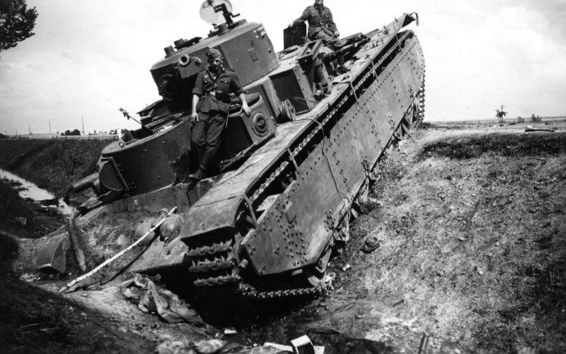
The massive T-35 heavy tank weighed in at 45 tons; it appeared a year after the T-28 and was a similar beast, but only about 60 were ever built. Although only produced in limited numbers, it was regularly photographed by bemused German troops because of its size. Before the war T-35s served in Moscow with the 5th Separate Heavy Tank Brigade performing parade duties from 1935 to 1940. (Scott Pick Collection)

The new T-34/76 medium tank first came off the Kharkov Komintern Factory production line in January 1940. The Model 1940 (T-34/76A) is immediately recognisable by the low-slung barrel of the L-11 76.2mm anti-tank gun below a distinctive bulge in the mantlet (housing the recoil mechanism). It also has a very large, single turret hatch, which was heavy and difficult to open. Russian veterans condemned this type and nicknamed it pirozhok (‘pie’) because of its characteristic shape. This tank went into mass production in June and by the end of the year just 115 had been built. (Scott Pick Collection)
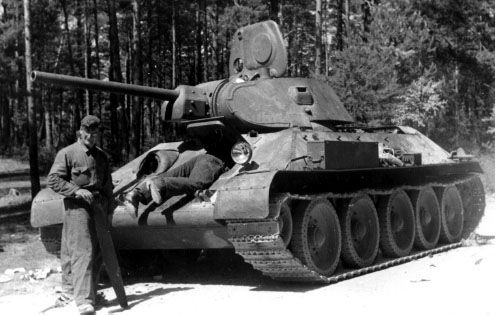
The subsequent Model 1941 (T-34/76B) had heavier armour and was armed with the superior F-34 76.2mm gun mounted higher in the mantlet, but it still had the single hatch. Subsequent models incorporated two smaller, circular turret hatches. This particular one is under scrutiny by German mechanics; the purpose of the bow saw is unclear. (Scott Pick Collection)

From January 1939 to June 1941 the Red Army received over 7,000 new tanks, but the plants managed to put out only 1,861 KV heavy tanks and T-34 medium tanks before the outbreak of war, which was clearly insufficient. This is the KV-2 armed with a 152mm howitzer. (Scott Pick Collection)

The T-34/76 appeared in a number of variants largely identified by their year of production, i.e. Model 1940 (A), 1941 (B), 1942 (C and D), 1943 (E and F) T-34, which were all armed with the 76.2mm gun, followed by the up-gunned T-34/85 and T-44 with the 85mm gun. Russian tankers had little interest in such nuances. The cast turret (as opposed to rolled plate) makes this a late Model 1941 or an early Model 1942. (Scott Pick Collection)

A notable difference in the appearance of the T-34 occurred with the T-34/76D manufactured from late 1942. This was fitted with a hexagonal turret that did away with the rear overhang on earlier models, which acted as a shell trap and was a tempting target for German Teller anti-tank mines. Also the new turret was slightly larger, offering the crew extra space. (Author’s Collection)

The Red Army had thousands of light tanks, including the amphibious T-37/38 and T-40 (seen here). The latter came into service in early 1941. If they had been restricted to reconnaissance roles as intended, they could have played a useful role against the Nazi invasion, but instead Soviet commanders used them as regular tanks and wasted them. (A44)

Some 1,200 tiny two-man T-37 light amphibious tanks were built between 1933 and 1936. These replaced the T-27 tankette and served with the Red Army tank, mechanised and cavalry units in a reconnaissance role until 1942. (Author’s Collection)

This photograph showing a column of whitewashed BA-20 armoured cars escorting a convoy of lorries through a forest was issued by the Soviet Ministry of Information. In the late 1930s this became the most popular and numerous type of armoured car in service With the Red Army. (Author’s Collection)

Notably the BA-20 ZhD variant could be fitted with railway wheels and a number of examples were reused by the Germans to help protect the Soviet rail network from partisans. The spare wheel spigot at the rear acted as a rail tow link so that the vehicle could be towed by a train to act as rear guard with its 7.62mm machine gun. (Scott Pick Collection)

The BA-10 was the only heavy armoured car employed by the Red Army during the Second World War (having superseded the BA-27 and BA-6); it was armed with the ubiquitous 45mm gun and around 1,400 were built. BA-10s saw extensive action during the ‘Great Patriotic War’ and large numbers were pressed into service by the Finnish and German armies. The BA-10M, of which 331 were built, is distinguishable from the BA-10 by the external fuel tanks mounted over the rear wheels. (Author’s Collection)
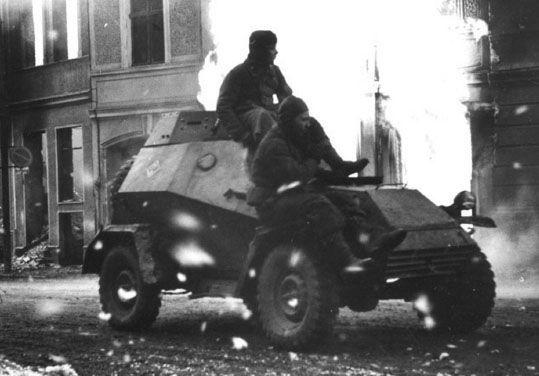
Soviet armoured car development was slow and only one new model, known as the BA-64, went into production after the German invasion in late 1941. The BA-64B was fitted with a one-man turret and appeared two years later. (B25)

The T-20 Komsomolets armoured artillery tractor was designed in 1936 at the Ordzhonikidze Moscow Plant no. 37. They were also built at the STZ and GAZ factories during the period 1937–1941. It was designed to tow light support weapons such as the 45mm anti-tank gun and the 120mm heavy mortar. In response to the German invasion, the chassis was used to create the ZiS-30 self-propelled anti-tank gun using the ZIS-2 57mm gun, though only about 100 were produced. (Author’s Collection)

The T-20 was unsuitable as a weapons or troop carrier. It had an armoured, enclosed compartment at the front for the driver and machine-gunner (in this instance it has done the gunner no good), but the six seats on the back were highly exposed. Nonetheless T-20s were used offensively with predictably fatal results. (Scott Pick Collection)

The standard Soviet field guns were the 76.2mm M1936 and M1939, but after the experiences of the German invasion, the Soviets took the view that any gun capable of direct fire should also be used in an anti-tank role. This resulted in the M1942, which was regularly employed in an anti-tank role and was produced in greater numbers than any other artillery piece during the Second World War. (K194)

The Soviet M1939 85mm anti-aircraft gun was also issued with anti-tank ammunition and successfully adapted to fit the KV and T-34. Like all Red Army designs, it offered few frills and was very functional. (T49)

The key man-portable anti-tank weapons were the PTRD 1941 anti-tank rifle (seen here) and the PTRS that was developed at the same time. The PTRD proved far more robust in the field and was lighter. (T53)