
Chapter Eight
Stalin’s operations had left him in possession of the vast salient around Kursk, flanked by enemy forces centred in the south on Kharkov and in the north on Orel. Belatedly Hitler’s intention was to snip off the salient, employing all available means. Capitalising on his spring victory on the German right, Field Marshal von Manstein’s Army Group South, spearheaded by Hoth’s 4th Panzer Army and General Werner Kempf’s Armeegruppe Kempf, was to attack northwards from Belgorod and Kharkov.
For the battle of Kursk Hitler gathered the greatest force ever assembled on such a small front. Barbarossa had flung 3,332 panzers at the Soviet Union along a 930-mile front; for Citadel Hitler squeezed 2,700 tanks along just 60 miles. Some 63 per cent of all battleworthy armour on the Eastern Front was assigned to von Kluge and von Manstein. While this sounded impressive, with 1,850 front-line panzers, 200 obsolete panzers and 533 assault guns divided among 16 panzer and panzergrenadier divisions and three assault gun brigades, the units were seriously under strength. By 1943 a panzer division had a theoretical strength of up to 200 panzers and 15,600 men. In reality the average strength was just 73 tanks. However, the II SS Panzer Corps’ divisions averaged 166 panzers and assault guns.
Hitler’s generals, though, were hoping that the newly deployed armour would help to counter the Red Army’s growing strength. It offered the opportunity to destroy Soviet tanks at arm’s length and stop them closing in, which would prevent the panzers from being overwhelmed by superior numbers. Indeed, for the first time since Barbarossa Hitler was fielding tanks and self-propelled guns that had a distinctive qualitative edge. He was placing great faith in his menagerie of tanks and fighting vehicles named after wild beasts, notably the Tiger, Panther, Elefant (Ferdinand), Rhinoceros, Bison and Grizzly Bear. It was anticipated that these would tear great holes in the ranks of the Soviet tank corps.
Crucially, though, these vehicles were not yet available in decisive numbers. There were fewer than 90 Ferdinands, about 200 Panthers and about 100 Tigers; over 1,000 older Panzer III and IVs remained the backbone of the panzer forces. Also making their debut were the Hummel, the Nashorn or Hornisse, and the Marder III or Wespe. Again numbers were a problem: all three types had only gone into production in early 1943, with about 100 of each type ready for the summer. To help smash Soviet fortifications there were 66 newly built Brummbar comprising a short 150mm howitzer mounted on a Panzer IV chassis.
Stalin was not only well prepared for Hitler’s massed panzers but he was ready to switch over to his own offensive once they had been stopped. The Soviet defences around Kursk were formidable: by June 300,000 civilians had dug a series of eight in-depth defences stretching back almost 110 miles. Using brute strength, picks and shovels they carved out almost 3,100 miles of trenches. Just to be on the safe side, the reserve Steppe Front had dug its own defences to protect the eastern bank of the Don.
The fields of wheat and corn ripening in the summer sun concealed another deadly secret that would tear machines and men apart with ease. Soviet sappers toiled to sow over 40,000 mines across the length and breadth of the salient. In the killing grounds between the strongpoints they meticulously concealed about 2,400 anti-tank and a further 2,700 anti-personnel mines per mile. Initially, as the panzers and supporting infantry blundered through these, they would be deluged by fire from howitzers and heavy mortars supported by anti-aircraft guns.
Once through the minefields the panzers would encounter ‘pakfronts’ consisting of batches of anti-tank guns supported by anti-tank rifles, machine guns and mortars. The plan was that along expected lines of attack the panzers would meet clusters of guns whose job it was to funnel them into yet more minefields. There was little doubting the quite extraordinary volume of fire that the Central and Voronezh Fronts could call upon – at their disposal were 6,000 anti-tank guns, 20,000 guns and mortars and 920 Katyusha rocket batteries.
Operation Citadel commenced on 4 July 1943, making little headway before being checked. Hausser’s II SS Panzer Corps struck towards Bykovka with 365 tanks and 195 assault guns. The SS took the town, while other units cut the Oboyan–Belgorod road, only to be obstructed by the Soviet 96th Tank Brigade. Similarly a penetration was made on the right flank but the panzers could get no further. The strength of the Soviet defensive positions stopped the Germans breaking through north of Belgorod, which was to cause Hoth problems.
Model advanced just 6 miles before being halted in front of Olkhovatka and Ponyri, losing 25,000 men, 200 panzers and 200 aircraft in the process. Manstein’s forces managed 25 miles, losing 10,000 men and 350 panzers. Stavka was not slow to react and during the night of 8/9 July they hastened to get the 5th Tank Army with 630 tanks and self-propelled guns and the 5th Guards Army to the Prokhorovka region.
Within six days Citadel had run out of steam; for the first time a German panzer offensive had been stopped before achieving a breakthrough. By the 13th von Manstein claimed those forces facing him had lost 24,000 men captured as well as 1,800 tanks. Also that day von Manstein and von Kluge were summoned to East Prussia, where Hitler informed them that Citadel must be called off as the Allies had landed in Sicily, thereby threatening Italy.
At this point Zhukov unleashed his massive counter-offensive, sweeping back the panzers’ hard-won gains and pushing them out of their Orel and Kharkov salients to the north and south of the Kursk bulge. Operation Kutuzov ran from 12 July to 18 August, working to destroy the Germans’ Orel bulge, which overlapped with Operation Polkovodets from 3–23 August against the southern sector of the bulge. This pushed the Germans back, liberating both Belgorod and Kharkov. The success of this operation meant that Hitler’s forces in Ukraine were obliged to withdraw behind the Dnepr and paved the way for the liberation of Kiev.
The battle for Kursk lasted 50 days and according to Soviet sources cost Hitler 30 divisions, including seven panzer divisions. Zhukov recorded their casualties as half a million men and 1,500 tanks. But the Soviet victory came at a terrible price. Casualties for the three Soviet Fronts totalled 177,847 men and 1,614 tanks and self-propelled guns: five times those of the Wehrmacht. However, from this point on Hitler was on the defensive on the whole Eastern Front.

By mid-1943 Soviet tank crews had much to smile about, having recovered from the disasters of 1941 and 1942. During Barbarossa, Hitler’s meagre panzer force had thrown around 3,300 tanks at a 930-mile front; for Citadel at Kursk a 60-mile front was attacked by 2,700 tanks. Nevertheless, the 5th Tank Army was more than capable of bearing the brunt of the powerful II SS Panzer Corps. (AO120)
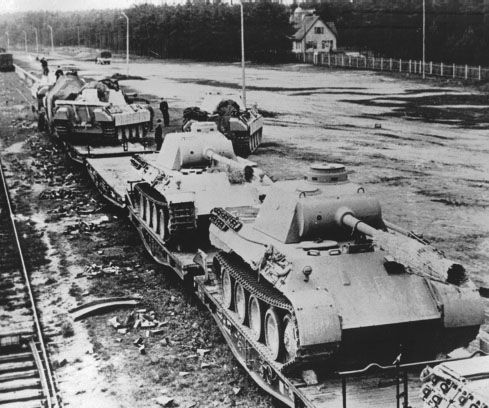
Too much was expected of the new Panzer V Ausf D Panther, which Hitler rushed off the production line to take part in the Kursk offensive. Drawing on the T-34, it combined armament, armour and mobility; equipped with the 75mm L/70 (an improved version of that equipping the Panzer IV), it could knock out Soviet tanks almost as easily as the Tiger. Although the Panther’s frontal armour was on a par with the Tiger’s, its side armour was little better than that of the Panzer IV. Early models proved mechanically unreliable, in part due to being sent into combat much too quickly. (Author’s Collection)

Panther deployment was considered a vital element of Operation Citadel and the offensive was delayed as a result of their mechanical problems, with the eventual start date being just six days after the last Panther was delivered. The T-34’s 76.2mm gun could penetrate the Panther’s side armour at up to 1,000m, but could only penetrate the glacis armour at 300m and could not overcome the turret frontal armour at all. An improved armoured-piercing round was not introduced until October 1943. While its debut at Kursk was inauspicious, the Panthers claimed 267 enemy tanks destroyed. By 10 August 1943 just 43 of the original 250 Panthers were still in operation. (K191)

The Tiger was armed with an 88mm gun that could outshoot the T-34 at a range of 1,500 metres, whereas the latter had to close to 500 metres. Fortunately for the Red Army, fewer than 60 Tigers were available, but nonetheless they proved a great success. The T-34, with a maximum of 70mm frontal armour, was already vulnerable, even at 1,000 metres, to the Panzer IV Ausf F2’s 75mm Kwk40 L/43 gun (which could penetrate 87mm of armour), and the subsequent Panzer IV Ausf G and H were both armed with the Kwk40 L/48. (Author’s Collection)
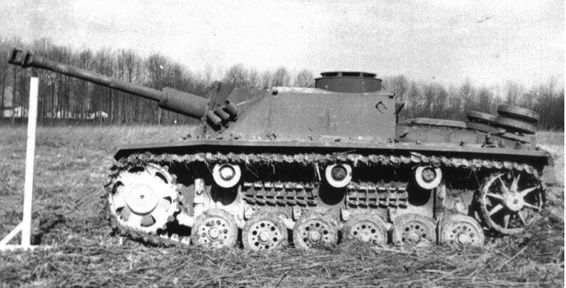
The highly successful Sturmgeschütz 40 Ausf G. For the Kursk offensive the Germans massed 533 assault guns; while some were integrated with the panzer divisions, most operated in independent brigades. (Author’s Collection)

To supplement the StuG IIIs armed with 75mm guns, the 105mm Sturmhabitze 42 appeared in March 1943. This one is based on the Ausf G hull. At the start of the battle for Kursk Army Groups Centre and South had 68 StuH42s providing very welcome fire support. (Author’s Collection)

Limited numbers of the Elefant/ Ferdinand Sturmgeschütz were issued to two Panzerjager units in the spring of 1943, and 90 were available at Kursk. Armed with the powerful 88mm Pak 43/2 anti-tank gun, the type utilised the chassis of the rejected Porsche design for the Tiger tank. The II SS Panzer Corps was equipped with the Ferdinand, but it lacked secondary armament and was very vulnerable to close-range attack. (Author’s Collection)

The Nashorn/Hornisse, which united the 88mm Pak 43/1 L/71 gun with the Panzer Mk IV chassis, was also a capable tank killer for the German tank-hunting battalions, though essentially it was a defensive weapon. It first saw action on the Eastern Front in the summer of 1943. It proved to be one of the most effective anti-tank guns deployed during the war. The ability to engage the enemy at long distances negated the disadvantages of light armour and a high profile, and the weapon was well suited to the open Russian steppe. (WH334)

The Hummel 150mm gun on the Panzer IV chassis (seen here) and Wespe 105mm self-propelled gun utilising the Panzer II chassis both first saw major action at Kursk in 1943. The Wespe proved so successful that Hitler ordered all Panzer II production to be switched to this self-propelled gun. (Author’s Collection)

The Junkers Ju 87 G-2 was nicknamed Panzernacker (‘tank cracker’) because of its 37mm tank-busting guns. Their efforts were greatly appreciated by the panzer crews, although at Kursk it proved to be a sitting duck for Soviet fighters. (Scott Pick Collection)

The Focke-Wulf Fw 190 was a superb fighter and ground-attack aircraft. Using fragmentation bombs in support of the SS Panzer Corps, they played a key role in helping achieve the initial penetration of Soviet defences. (Author’s Collection)

A panzer column with infantry support advancing across the flat Russian steppe – ideal tank country. At Kursk Hitler’s intention was to throw every last panzer into a bid to nip off the vast Soviet salient and then crush those troops trapped in the pocket. Little did he appreciate that Stalin was preparing for a much wider envelopment and that his panzers were advancing into a deadly trap. (Scott Pick Collection)

A column of German StuG IIIs moving up for the attack. Hitler must have been hoping that Kursk would see a repeat of the fighting for the Barvenkovo salient and Kharkov, where the Red Army had come so badly unstuck. Perhaps he naively thought the victories around Leningrad and in the Crimea could also be relived. (Author’s Collection)

T-34s break cover from their camouflaged position; it was at times like this that they were at risk of attack by the Luftwaffe. The lead tank is a Model 1941, followed by a Model 1942. Soviet tank design was largely moribund at this point, the priority being simply to churn out as many tanks as possible. This meant that the Model 1943 that had superseded the 1940, 1941 and 1942 models was not greatly different. (K6)

Only 200 Soviet tanks at Kursk were heavies and the battle marked the swansong of the much maligned KV-1. The Panthers and Tigers picked many of them off at long range. (Scott Pick Collection)

In response to the Tiger Stalin had up his sleeve the SU-152. A redesign of the KV-1 chassis, it was armed with a massive 152mm howitzer that could be used in an anti-tank role. Only 12 were available for Kursk, but they claimed 12 Tigers and 7 Elefants destroyed, and as a result the SU-152 gained a reputation as a ‘Beast’ killer. (BA211)
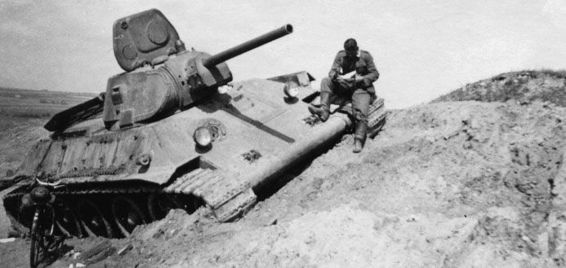
Late on 11 July the Soviet 5th Tank Army dispatched two tank brigades to prevent Prokhorovka falling into enemy hands. A major tank battle occurred there the following day. (Scott Pick Collection)

A column of Model 1943 and 1941 T-34/76s en route to the battle at Prokhorovka. Many were probably destroyed in the fighting. (K17)

The 7.62mm divisional field gun proved its worth during the summer of 1943. (AO153)

The Heinkel He III medium bomber was deployed extensively at Kursk in support of the panzers. However, by mid-1943, like the Stuka, it was vulnerable to enemy fighters. (Author’s Collection)
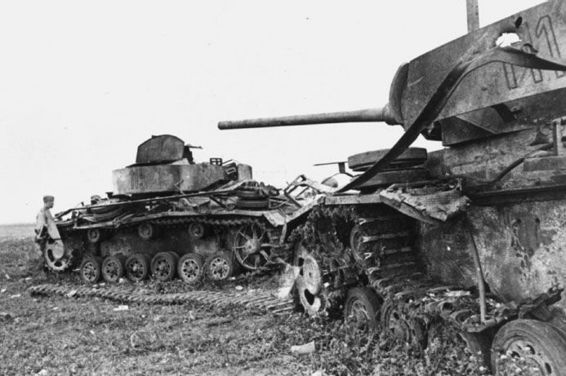
The Panzer III was still in service at this stage of the war, though the newer models were armed with the short 75mm gun, previously fitted on StuG IIIs and Panzer IVs. Outgunned and under-armoured, these Panzer IIIs armed with the 50mm gun were no match for the Soviet steamroller. It looks as if they were caught by artillery or air attack. (K184)

The Shturmovik ground-attack aircraft was greatly feared by the panzer crews. (Scott Pick Collection)

General K.K. Rokossovsky offers his thoughts on this captured Ferdinand. The fact that its armour withstood three direct hits must have impressed the Soviets, but once it had thrown a track it was useless, its crew left to the mercy of the Soviet infantry. (K180)

An overturned British Matilda II; in Red Army service, the type was used in an infantry support role. Britain sent 1,084 Matildas to the Soviet Union, where it was the second most common British tank after the Valentine. The Matilda II was the only British tank to serve throughout the whole of the Second World War. (WH553)