
CHAPTER 1
In 1942, Hitler dreamed of a 3,000-mile fortified coast, a European fortress that would block any attempt by the Western Allies to gain a foothold on the continent. The Atlantic Wall of his fortress was to consist of a line of static coastal defenses running from Norway to the Spanish-French border. It was upon this barrier that the Führer and his military advisors intended to base the German defense of occupied Europe. Construction of the wall began in 1942, with Hitler himself taking an active interest in all aspects of the undertaking, down to the most minute details of pillbox design and concrete casement construction. Concentrating the strongest of these defenses in the areas most threatened by the enemy, and especially the English Channel coast between the Seine and Scheldt Rivers, massive coastal artillery emplacements were positioned overlooking key ports, such as Calais, Dunkirk, and Boulogne. Even if the British and Americans did not come in 1942, Hitler believed that before the war was over, Germany would have to face down an Allied invasion of northwest Europe. The outcome of this battle would be decisive: once the landings were defeated and the invasion repelled, victory in the west would allow the redeployment of German forces to the Eastern Front and perhaps bring an end to the war on terms favorable to Germany.
As the war dragged on and German forces suffered catastrophic defeats in other theaters, Hitler became increasingly convinced that the decisive battle of the war would be fought in the west. By November 1943 he had become so concerned by the threat of an Anglo-American invasion that he issued Führer Directive 51, ordering the reinforcement of German defenses in the west.1
It was at this time that Hitler recalled Field Marshal Erwin Rommel from Italy and appointed him to conduct an inspection of European coastal defenses. During these inspections, Rommel was to report directly to the Führer on the strength of the Atlantic Wall, and upon the completion of this tour, Rommel was placed in command of Army Group B, which included the German Seventh and Fifteenth Armies. As Commander-in-Chief (C-in-C) of Army Group B, responsible for strengthening coastal defenses in northwest Europe, Rommel’s new command was limited to the coastal belt stretching six miles inland from the shoreline. Any measures that involved operational movement, and especially the movement of mobile and armored divisions, therefore required the approval of C-in-C West, Field Marshal Gerd von Rundstedt.
Following his assignment to the Western Theater, Rommel made a series of visits to construction sites where military and civilian personnel were busily installing beach defenses, pouring concrete, and erecting glider obstacles known as “Rommel’s asparagus.” Under his command, units engaged in construction work consumed all of the concrete and steel that could be provided to them, completing thousands of bunkers and other fortifi cations. Rommel also ordered a staggering increase in mine-laying activity during this period, and although he received only five million of the 50–100 million mines requested, the rate of mine-laying under Rommel’s command increased to almost triple that of the previous three years.2
While this construction was in progress, a dispute developed between Field Marshals von Rundstedt and Rommel. At the root of this disagreement—an argument which was to have a significant impact on the German response to the Allied invasion—was the issue of how best to distribute the panzer divisions that would serve as a mobile reserve behind the line of coastal fortifications.3 Von Rundstedt adhered to the traditional view that an effective defense would require German armored forces to be kept well back from the coast and held in readiness for a counterattack once the focal point of the enemy invasion had been determined. Remembering the blitzkrieg successes of 1939–40, von Rundstedt intended to smash through the enemy in the open country beyond the beaches and then push the invaders back into the sea. Von Rundstedt’s ideas were firmly supported by Field Marshal Geyr von Schweppenburg, the commander of Panzer Group West. Rommel, taking the opposite view, argued that von Rundstedt’s ideas were the result of his lack of experience in fighting under Allied air superiority. Drawing from his experiences in North Africa, Rommel firmly believed that the devastating power of Allied air attacks would disrupt the movement of German reserve forces to the front lines and thereby prevent distant panzer divisions from mounting a successful counterattack. He was convinced that the invasion had to be stopped on the beaches as Allied airpower would prevent the movement of reinforcements as required by von Rundstedt’s plan. Instead, Rommel wanted to form local reserves of individual panzer divisions, stationed close behind the beaches and capable of mounting immediate counterattacks in the event of an Allied landing.4 Von Rundstedt, however, believed that Rommel’s dispersion of forces along a thin defensive line would be too easily pierced and would prevent the widely-dispersed armored formations from massing their strength against the Allied landings. Dispersed along the coast, these armored divisions would only be demolished by Allied naval guns and airpower.5
In the months that followed, both commanders remained adamant and were unable to reach an agreement. Frustrated and unable secure approval for his plans by acting within the chain of command, Rommel carried his appeal directly to Hitler. In response, the Führer imposed a solution that satisfied no one: he agreed with Rommel’s plan to distribute panzer divisions along the coastline, but he also saw the merits of von Rundstedt’s argument for the need for a substantial armored reserve. As a compromise solution, on April 26, 1944, Hitler divided the reserve forces between von Rundstedt and Rommel with three divisions each.6 The Führer also established a mobile reserve of four divisions under his personal control, which would be kept well back from the coast under the command of Geyr von Schweppenburg. With the 21st Panzer Division remaining on the Normandy front, the remainder would be held at intervals along the coast or stationed in southern France.
Neither of the two commanders was satisfied by this decision. There were too few mobile reserves to have the shock effect that von Rundstedt wanted and too few stationed near the coast to fulfill Rommel’s plan to stop the invaders on the beaches. All motorized vehicles in the theater were put under the command of Geyr von Schweppenburg’s Panzer Group West, but these required Hitler’s approval for release. Rommel was therefore denied direct control of the panzer divisions of OKW reserve, a control he felt necessary for a quick counterattack that would stop the invasion on the beaches. He had at his disposal only three armored divisions (the 21st, 2nd, and 116th Panzer Divisions) to cover the entire coastline from the Loire to the Scheldt. As events would show, only 21st Panzer stood within immediate reach of the Normandy invasion beaches. Von Rundstedt’s sixty divisions—thirty-five of which were under Rommel’s command and only ten of which were armored—had three thousand miles of coastline to defend. The half-measure adopted by Hitler, arguably the result of his obsession with maintaining divided authority within the Third Reich, would ultimately impede the German Army’s response to the Allied invasion of 1944.7

The day of invasion was fast approaching. On May 15, Generals Dwight D. Eisenhower and Bernard Montgomery were presenting the final plans for Operation OVERLORD to a gathering of Allied commanders at St. Paul’s Cathedral in London. During this presentation, Monty was full of confidence and showed absolute mastery of the plan to invade at Normandy.8
Although the Germans knew the invasion would come, they did not know when or where. Signals intelligence was not helping, providing little besides a series of coded messages regarding the First United States Army Group (FUSAG), a fictitious formation that was supposedly posted in East Anglia. These messages were part of Operation FORTITUDE, the ongoing effort to deceive the Germans and draw their attention away from Normandy. Allied radio signals carried out the dayto-day transmissions of what appeared to be an operational army. The assignment of U.S. General George Patton to lead FUSAG provided plenty of publicity to draw attention to its presence. The Germans were convinced that a leader with such a powerful reputation would lead the main force.9 All German agents in Britain had previously been located by the “Double Cross Committee,” rounded up, and given the choice of execution or turning double agent. A steady stream of misinformation now was being sent by radio transmissions to Germany by agents who confirmed the credentials and preparations of FUSAG. German reconnaissance flights over southeast England gave further weight to what was being intercepted on the radio. Here, the Luftwaffe spotted what were actually dummy camps, aircraft, supply depots, tanks, rail lines, landing craft, and even a fake headquarters at Dover, all of which had been constructed of rubber and wood in the months leading up to the landings. By May, German intelligence had identified seventy-nine Allied divisions in Britain, but in fact the Allies had only thirty-seven real divisions, the remainder being Patton’s “First Army Group.”10 Most of Fifteenth Army correspondingly remained in the Pas de Calais until the first week of August to meet this expected landing that never materialized. Further, FORTITUDE NORTH convinced Hitler that another landing would come in Norway, with the result that twelve German divisions were kept there.11
The pattern of Allied bombing in mid-May probably reinforced Hitler’s belief that the imminent invasion would come in the Pas de Calais rather than Normandy. To keep up appearances, for every bomb dropped on rail lines, transportation centers, and military industrial installations in Normandy, there were two bombs dropped near Calais. Bombing became especially intensive after May 21, when British and American aircraft launched Operation CHATTANOOGA CHOO-CHOO, a systematic attack on rail lines, railway engines, rolling stock, marshalling and repair yards, bridges, and tunnels throughout northern France.12 Between May 7 and May 28, seventy-four bridges and tunnels were destroyed. Synthetic oil plants in Germany became the next targets, with the hope that the German Army would not be able to produce the fuel necessary to operate their aircraft, tanks and industries.
The Allies were able to track the success of their deception scheme through ULTRA decrypts.13 The Germans were not aware that the Allies had captured one of their Enigma transmission machines and had broken their codes. At this time, nearly six thousand encrypters were engaged in a top-secret program at Bletchley Park near London to intercept transmissions from German command posts and headquarters, as well as to send out FORTITUDE transmissions from the Double Cross agents. In May, ULTRA decoded Rommel’s warning to German High Command that the systematic Allied destruction of railways throughout Northern France had begun to disrupt his supply and troop movements. ULTRA also allowed the Allies to confirm that the Germans still did not know where the landings would fall.14
The Allies used these decrypts to pinpoint the existence, location, and movement of German troops and military formations. They intercepted messages showing that the Luftwaffe had lost more than three thousand pilots since the beginning of the year, either killed in action or taken prisoner. They also learned that Rommel had been refused permission to station reserve forces able to cover Brittany and Normandy simultaneously—thus learning that the areas behind the American landing beaches would not be guarded at full strength.15 On May 25, British intelligence passed on two significant messages: first, Rommel’s complaint of May 19 that one SS panzer division had no tanks, was not expecting any, and was short of officers, motor transport, and spare vehicles. Also decrypted was a German Air Force message expecting the landings to go ashore near Dieppe. On May 26, Rommel’s message of two weeks earlier was decrypted, warning that the locomotive situation was so serious that forced labor and even prisoners of war would have to be used at the repair shops. Later in May, ULTRA messages also revealed a considerable transfer of troops to the Cotentin peninsula,16 forcing the Americans to revise their plan for a paratroop drop at La Haye-du-Puits.
As D-Day approached, Allied bombardment became even more intense.17 In March and April, eight thousand British bombers dropped forty-two thousand tons of bombs. This was later stepped up to eleven thousand tons dropped by U.S. bombers in May. Railway marshalling yards and fortifications along the Atlantic Wall were the main targets, but on May 28, the destruction of Chateau Terlinden, a German wireless station near Bruges, made it much more difficult for German intelligence to detect the extra volume of wireless traffic that would immediately precede the landings.18 A second wireless intercept station was also destroyed on the night of the invasion, wiping out communications in the vital Cherbourg area. An air raid over northern France cut the Luftwaffe overland telephone cable between Paris and Rouen, interrupting telephone communications between the headquarters in Paris and air forces around Caen and Rennes for three crucial days leading up to the landings.
Bad weather in the first week of June forced Eisenhower in the early hours of June 4 to postpone the landings set for June 5 to the following day.19 Von Rundstedt, meanwhile, sent a radio signal to Berlin stating that the Allies would need four consecutive days of decent weather in order to carry out a cross-channel assault. With no such four-day period in the immediate forecast, he believed that no invasion could take place in the first week of June. His message was decrypted at Bletchley Park and immediately passed on to Eisenhower. The weather worsened on June 3, with German forecasters predicting three to four days of continued bad weather. Allied forecasting, however, was more precise, owing to the capture of German weather stations in Iceland, Greenland, Spitzbergen, and Jan Mayen Island. On June 4, the Allies were forecasting a brief spell of clearing weather, while at the same time, German naval command in Paris was reporting that an invasion could not be considered imminent. At 9:45 P.M., Eisenhower at Supreme Headquarters Allied Expeditionary Force (SHAEF) made the decision to go.20 Rommel, however, was starting his long drive home to Herrlingen, intending to celebrate his wife Lucie’s birthday on June 6 before continuing on for a meeting with Hitler where he would request two additional panzer divisions, an anti-aircraft corps, and further reinforcements.

WEEKLY REPORT, MAY 15–20, 1944
I Estimate of the situation as a whole
After a decrease in enemy air activity from May 15 until the morning of May 19, probably imposed by weather conditions, heavy enemy air attacks against coastal defenses and rear areas (transport targets, Luftwaffe installations) were resumed from midday, May 19, and continued without respite on May 20.
Enemy air reconnaissance was concentrated on the Channel coast, in particular on both sides of the Canche and Somme estuaries, over Cotentin and the north-western area of Brittany. No results of our own air reconnaissance of the island during the time covered by the report are available, and consequently only an incomplete estimate of the enemy situation is possible.
Continuation of invasion preparations includes air reconnaissance of beach defenses.
Our own defensive power has been increased by completing regrouping in the Netherlands, in the Cotentin, and in the Brittany area, and by increased fortification and mining.
II Report and estimate of the enemy situation
(a) Ground
Concentrations in southern and south-eastern England again confirmed by the location of Montgomery’s H.Q. south of London, and by the transfer of a British division from northern to south-eastern England, and of an American division from Northern Ireland to the south of England. The enemy has carried out reconnaissance of beach defenses north-east of Calais and at the estuary of the Somme. According to the statement of prisoners, coastal reconnaissance extending to from Holland to Normandy has been proceeding for almost the last two months, and probably includes reconnaissance of land minefields with new types of mines. The possibility that the enemy is informed at least about earlier types of beach defenses must be taken into account.
(b) Sea
Since about May 7 it has been noted that a large formation of tank-landing craft has been transferred from western England (Liverpool?) along the south coast as far as Harwich. It is not clear whether this is a practice maneuver or part of the strategical plan.
According to a prisoner’s statement on May 20, there is supposed to be a large number of landing craft in the area between Eastbourne and Brighton. There has been a great deal of mining in the Hook of Holland area. Repeated explosions have been noted to the west of the Dutch Coast, which are probably the results of enemy minesweeping operations.
Strict enemy surveillance of the central Channel by destroyers and motor gunboats is presumably directed against German motor torpedo boats.
(c) Air
Following an improvement in the weather, the enemy Air Force attacked coastal defenses with strong formations on the afternoon of May 19 and 20, and also transport targets and Luftwaffe installations (airfields and radar installations), particularly in the area of northern France behind the line Calais-Dieppe, and in the area of Greater Paris. Considerable damage was caused to three transport installations and to airfields. Attacks continue to have little effect against coastal defenses, and these raids cannot be considered yet as a systematic preparation for a large-scale attack.
(d) Internal situation
Increasingly hostile feeling against the enemy powers amongst the population hit by air raids in northern France. Guerilla activities in Brittany have decreased, and combing-out operations continue.
III In detail
Northern Military District:
A. Coastal defenses (Alterations):

Shown here at a celebration in Berlin, Adolf Hitler was later to be immersed in preparations for the inevitable Allied invasion of Western Europe. On November 3, 1943, he issued Hitler Directive 51, which ordered the strengthening of German coastal defenses and strongpoints along the 3,000-mile Atlantic Wall. Hitler himself designed the pillboxes and concrete casements for many of the fortifica tions.
B. Enemy operations on the coast:
None.
C. Operations of enemy aircraft:

D.

15th Army H.Q.:
A. Coastal defenses (Alterations):
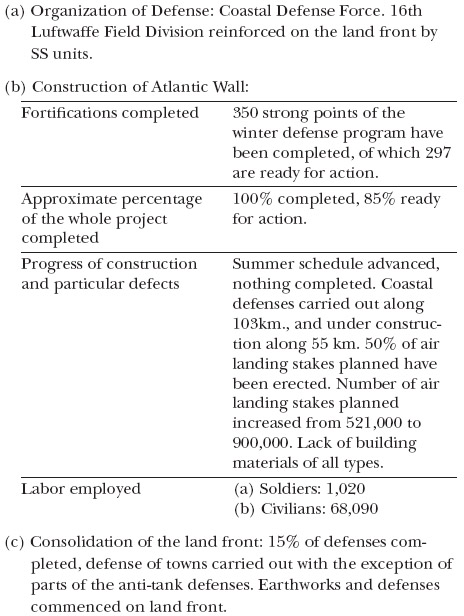
(a) Organization of Defense: Unchanged.
(b) Construction of Atlantic Wall: Construction according to plan. Focal point: beach defenses completed, erection of air landing stakes, partial lack of cement, wire, hoop iron, planks and wooden casing frames at G.H.Q. LXVII A.K.
(c) Consolidation of the land front: Construction completed and ready for action: machine gun, anti-tank, and mortar positions, blockhouses, dummy positions, and further dummy minefields laid. Lack of barbed wire and timber.
B. Enemy operations on the coast:
May 17. Attempted reconnaissance of beach defenses at Les Petites Hommes (to the east of Calais).
May 18. Enemy patrol (2 officers) in rubber dinghy taken prisoner at Cayeux. Task: Reconnaissance of beach defenses.
C. Operations of enemy aircraft:


Field Marshal Gerd von Rundstedt was Commander in Chief of the German Army of the West. With sixty divisions under his command, he was charged with stopping the Allied invasion. A respected strategist, von Rundstedt believed in holding the panzer divisions in reserve so that they could be mobilized immediately once the focus of the Allied invasion was determined. The most likely target was believed to be the Pas de Calais region, where twenty divisions of the Fifteenth Army were posted. U.S. HOLOCAUST MEMORIAL MUSEUM
D.

7th Army H.Q.:
A. Coastal defenses (Alterations):
(a) Organization of Defense: The preparation for defense in Brittany has been strengthened by the arrival of II Para-troop Corps and the 5th Paratroop Division. It has been decided to transfer the reinforcements to Cotentin.
(b) Consolidation report will be sent in later.
B. Enemy operations on the coast:
None
C. Operations of enemy aircraft:

D.

For the Army Group High Command,
The Chief of General Staff,
Speidel
ARMY GROUP B HIGH COMMAND
WEEKLY REPORT, MAY 21–27, 1944
I Estimate of the situation as a whole:
Enemy air activity has greatly increased, but cannot be considered as the final phase of the invasion preparations. Air attacks have, as before, been carried out against coastal defenses and areas to the rear (transport targets, Luftwaffe installations). There has been a striking increase in attacks on radar and locator installations, and especially on bridges.
Enemy air reconnaissance was carried out in the Calais-Cherbourg area and on the west coast of Brittany with no apparent point of concentration.
Our aircraft reconnoitered the harbor areas of Poole, Wey-mouth, and Portland. An examination of earlier results is necessary to gain a clear estimate of the enemy situation.
Our defense has been reinforced by increased constructional operations and mining. The steady deterioration of the transport situation however is having a bad effect on the situation.
II Report on and estimate of the enemy situation:
(a) Ground
Troop concentrations have been confirmed again in southern and south-east England with the new deposition of 1 American and 2 British divisions.
Since 0200 hours on May 27 there has been complete radio silence.
(b) Sea
On May 24 photographic reconnaissance showed that there are sufficient landing craft in Poole, Weymouth and Portland to transport 2⅓ landing divisions. There is only a small number of vessels at Folkestone and Dover.

Shown here carrying out an inspection of Atlantic Wall fortifications and holding his field marshal’s baton, Erwin Rommel was appointed by Hitler as commander of Army Group B on January 15, 1944. He disagreed with von Rundstedt’s views on deployment of the armored reserves. After facing Allied airpower in Africa, he believed it would be necessary to defeat the Allied invasion within the crucial first twenty-four hours. ROYAL MILITARY COLLEGE
Air attacks have been carried out on harbors between Ostend and Fecamp, and also on coastal batteries and radar installations. Only slight damage was caused.
Of 11 naval radar installations damaged, 10 are serviceable again, and 1 can still be repaired. Slight mining activity.
Minelaying is proceeding according to plan on the Dutch coast, but has been made more difficult between Boulogne and Cherbourg owing to losses of torpedo boats, motor boats and barges. The naval depot at Dieppe has been destroyed.
Our E-boat activity has been decreased owing to the weather and mining. Operations by our U-boats off the northern coast of Brittany were unsuccessful because of prompt spotting by the enemy Air Force.
(c) Air
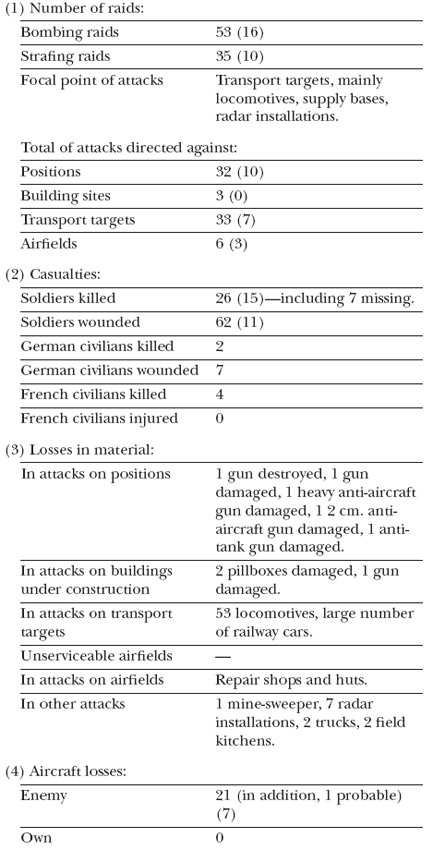
Enemy air activity increased considerably by day, but night operations were hindered in the middle of the week by bad weather conditions in England. Attacks were concentrated in the area between the Somme and Seine estuaries extending to the Paris area, and are still mostly directed against transport (bridges) and Luftwaffe ground organization. Attacks against coastal defenses continue and those against radar and locator installations have increased.
Transport installations have suffered considerable damage; railway stations at Le Mans, Epinal, Chaumont, Orleans, and Montigniers are completely out of action. About 280 locomotives are unserviceable. Several bridges, among them five over the Seine, have been destroyed.
In attacks on airfields there were considerable losses on the ground in 11 cases; 12 airfields are unserviceable.
Attacks on coastal defenses have not resulted in any serious damage. Dummy positions have been attacked several times.
Reconnaissance has been carried out mainly in the area between Calais and Cherbourg, and on the west coast of Brittany.
The quarters and positions of a Landgraf division in the area south of St. Brieue were reconnoitred and attacked.
(d) Internal situation
Considerable feeling against the Anglo-Americans is noticeable amongst the section of the population affected by air raids.
No changes are apparent in the activities of the Resistance organizations. The situation in Brittany remains uncertain.
III In detail:
Northern Military District:
A. Coastal defenses (Alterations):

B. Enemy operations on the coast:
None.
C. Operations of enemy aircraft:


This photo of a soldier standing guard beside a long-range anti-invasion gun of the Atlantic Wall appeared in the German Signal magazine with the caption, “At the frontier of Europe.” Rommel’s series of fortifications was enhanced by bunkers, beach obstacles, “asparagus” at potential landing strips, and five million mines. ASSOCIATED PRESS
D.

15th Army H.Q.:
A. Coastal defenses (Alterations):

B. Enemy operations on the coast:
C. Operations of enemy aircraft:


Soldiers setting up beach obstacles are shown scrambling for cover as an American P-38 passes over on a reconnaissance mission, May 6, 1944. Detailed information on Normandy beach defenses was obtained from photographs like this one, taken near Cherbourg by the U.S. Ninth Army Air Force. U.S. AIR FORCE
D.

7th Army H.Q.:
A. Coastal defenses (Alterations):

B. Enemy operations on the coast:
C. Operations of enemy aircraft:
D.

WEEKLY REPORT, MAY 28–JUNE 3, 1944
I Estimate of the situation as a whole:
The continuation and systematic increase of enemy air attacks and more intensive minelaying in our harbors with improved mining equipment indicate an advance in the enemy’s readiness for invasion. Concentration of air attacks on coastal defenses between Dunkirk and Dieppe and on the Seine-Oise bridges confirm the presumed focal point of a large-scale landing, and the possibility that communications may be cut off on the flanks and in the rear. Air reconnaissance of harbors along the entire south coast of England is urgently required. Constructional work on the defense front is being impeded by a further deterioration in the transport situation and of fuel supplies (shortage of coal). The withdrawal of the 19th Luftwaffe Field Division means further weakening of our defense force in the area south of the Scheldt estuary.
II Report on and estimate of the enemy situation:
(a) Ground
Concentrations in southern and south-east England have been confirmed by the location of 2 British armored divisions and 2 American infantry divisions. Radio communication has been normal again in Great Britain since May 30.
Since June 1 the enemy radio has issued an increased number of code words for French Resistance organizations to be at the ready, but from previous experience this cannot be accepted as a hint that the invasion is immediately imminent.
(b) Sea
Air reconnaissance of Dover revealed an unimportant increase in the number of landing craft. The other harbors on the south coast of England were not reconnoitred.
Increased enemy minelaying from the air has been concentrated on the Hook, Calais, Le Havre, St. Nazaire. Some harbours are closed because of enemy mines. Heavy losses have been suffered owing to improved enemy mining equipment. Our naval forces are temporarily impeded.
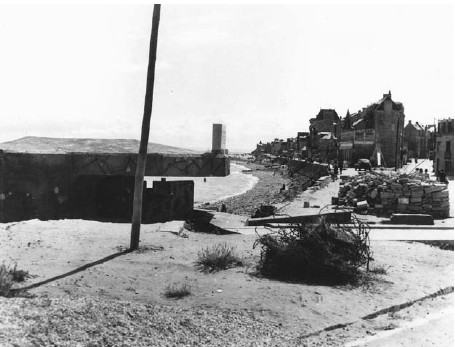
A reinforced concrete gun emplacement guarding the sea wall near St.-Aubin-sur-Mer, looking eastward and photographed in 1946. Rommel wanted to complete 15,000 fortifications by the time of the invasion. By June 6, 1944, 12,247 bunkers were completed and 500,000 beach obstacles in place. CMHQ HISTORICAL SECTION
Some enemy targets have been located off our coast, but no actions have been fought with enemy naval forces. Numerous bombing attacks have been made on naval radar installations resulting in some equipment being put out of action, but all location stations are operating again. Naval D/F station Flanders has been destroyed by bombs.
A number of detonations have been heard up to 15 km. off the Dutch coast, presumably enemy minesweeping activity.
(c) Air
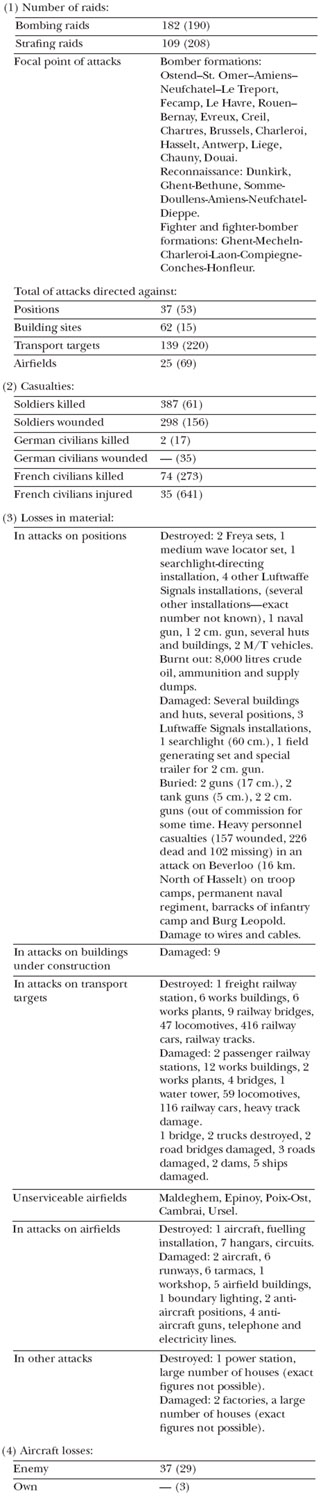
Constant enemy air attacks obviously concentrated on bridges over the Seine, Oise, and to a certain extent over the Aisne, also coastal defenses in the Dunkirk-Dieppe sector and on the northern and eastern sides of Cotentin. Attempts to cripple rail transport continue, with raids on marshalling yards (Brussels, Rheims, Ternier, Troyes, Trappes, Saumur and Angers) and on locomotives. Fewer attacks have been carried out on Luftwaffe ground organization than during the previous week. Supplies for agents continues at the same level. Active enemy air reconnaissance has been carried out in the Dunkirk-Dieppe sector, in the Flers-Caen-Isigny area, and also on the northern and western coasts of Brittany.
Whereas attacks on bridges have led to destruction or serious damage to all crossings over the Seine between Paris and Rouen, damage inflicted on coastal defenses is comparatively small.
Air reconnaissance has been carried out in the area of “Landgraf” divisions.
(d) Internal situation
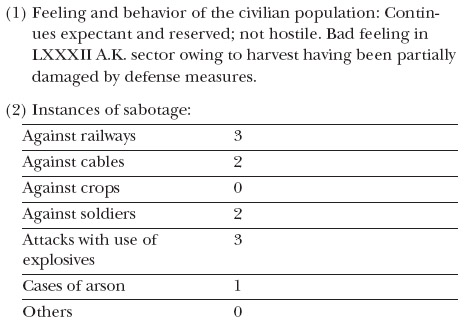
Population in state of expectant tension and reserved as before. French Resistance organizations presumably ready for action again.
III In detail:
Northern Military District:
A. Coastal defenses (Alterations):

C. Operations of enemy aircraft:

D.

15th Army H.Q.:
A. Coastal defenses (Alterations):


The beach at St.-Aubin-sur-Mer looking west as it appeared in 1946. An anti-tank gun position can be seen at the top center of the photo. The Atlantic Wall consisted of fortifications installed mainly by the Todt organization and of many natural obstacles, such as the cliffs shown here. Wherever beaches were accessible to invasion, Rommel worked feverishly to have obstacles and mines installed for both low and high tide.
C. Operations of enemy aircraft:

A Halifax bomber of No. 6 RCAF Group over France, July 1944. The Allied bombing campaign during the three months preceding DDay was a significant part of the invasion preparations. Rail lines, engines, rolling stock, tunnels, bridges, airfields, and Atlantic Wall fortifications were bombed more heavily in the Pas de Calais than Normandy to advance the deception of Operation FORTITUDE . The bombing disrupted German troop movements, reinforcement, and supply lines during the invasion.
D.
7th Army H.Q.:
A. Coastal defenses (Alterations):

B. Enemy operations on the coast: —
C. Operations of enemy aircraft:

D.

G.H.Q., XXXXVII Panzer Corps:
C. Operations of enemy aircraft:

Footnotes
1 Gordon A. Harrison, Cross-Channel Attack , United States Army in World War II Series: The European Theater of Operations (Washington, DC: Center of Military History, United States Army, 1989), 464–67; F. H. Hinsley, et al., British Intelligence in the Second World War: Its Influence on Strategy and Operations , vol. 3, pt. 2 (London: Her Majesty’s Stationery Office, 1988), 33.
2 Blumenson, “Rommel,” in Corelli Barnett, Hitler’s Generals (New York: Grove Weidenfeld, 1989), 310; C. P. Stacey, The Victory Campaign. The Operations in North-West Europe, 1944–1945 , vol. 3, Official History of the Canadian Army in the Second World War (Ottawa: The Queen’s Printer and Controller of Stationery, 1960), 56.
3 Stacey, 55.
4 OKW, “War Diary (1 Apr–18 Dec 1944),” MS# B-034 in World War II: German Military Studies , vol. 10, pt. 4 (New York: Garland Publishing, 1979), 6.
5 Ziemke, “Rundstedt,” in Barnett, ed., 199.
6 OKW, 10.
7 Carlo D’Este, Decision in Normandy (New York: Konecky & Konecky, 1994), 506; Stacey, 61, 70; Max Hastings, Overlord: D-Day and the Battle for Normandy (New York: Simon & Schuster, 1984), 64.
8 D’Este, 90; Hastings, 56.
9 John Keegan, Six Armies in Normandy (New York: Viking-Penguin, 1982), 235.
10 Stacey, 60; Hinsley, 61.
11 Richard Overy, Why the Allies Won (New York: W. W. Norton & Company, 1995), 151.
12 Harrison, 230.
13 D’Este, 122, 167, 237, 416.
14 Hinsley, 60–61, 64, 75, 79–80.
15 Harrison, 257.
16 Hinsley, 81, 86.
17 Hinsley, 115–17.
18 Martin Gilbert, Second World War , new ed. (London: Phoenix Press, 2000), 529.
19 Hinsley, 125.
20 D’Este, 110; Harrison, 274.