
CHAPTER 2
While the final preparations were underway for Operation OVERLORD, it was business as usual in Germany and occupied Europe. The German Air Force High Command sent out a message instructing the First Parachute Army at Nancy to conserve consumption of aircraft fuel as much as possible. Supply of goods was to be made by rail to preserve fuel for training and production. Most senior officers in the Seventh Army were attending a series of war games at Rennes. There was great consternation upon learning of the fall of Rome on the Italian Front.1
Just before midnight on the evening of June 5, it was discovered that the BBC was broadcasting a large number of messages to the French Resistance. The Fifteenth Army in the Seine was alerted, but Speidel did not alert the Seventh Army in Normandy. As Allied paratroops landed in Normandy after midnight, feverish activity at von Rundstedt’s headquarters tried to determine whether this signaled the start of the invasion or whether it was merely a diversion. At 3:00 A.M., General Witt of the 12th SS received a signal from 711th Division: “Enemy airborne landing behind our left wing.” By 4:00 A.M., von Rundstedt had decided that the landings must be dealt with. At dawn, an armada of over six thousand ships put the Allied invasion forces ashore along the coast of Normandy, with landing craft, amphibious tanks, and special-purpose vehicles touching-down on five beaches, code-named Utah and Omaha in the American sector and Gold, Juno, and Sword in the British-Canadian sector. To counter the landings, von Rundstedt requested the release of the panzer reserve from OKW and was enraged by the refusal.2 Hitler was still sleeping and could not be disturbed.3 Keitel was also asleep. Jodl awoke at 6:00 A.M. but was still not convinced that this was the main invasion. A second landing could still come at the Seine. As a result, of the available armored divisions, only the 21st Panzer went into action on June 6, yet even its commanding officer had not received orders to do so. On his own initiative, Lieutenant General Feuchtinger ordered the 21st Panzer Division forward at 7:30 A.M. after the men had already waited five hours beside their tanks.4 Upon moving forward, they found the British in control of the only bridge across the Orne River north of Caen. To get across the river, they were forced to go around the long way through Caen and it was mid-afternoon before Feuchtinger’s panzers were able to mount an attack against the British advance.5
Three German infantry divisions, the 709th, 716th, and 352nd, underwent a massive air and sea bombardment and then bore the brunt of an attack by elements of eight Allied divisions without any support from their higher headquarters. Von Rundstedt finally obtained the release of I SS Panzer Corps at 4:00 P.M., but the main body of that formation took two days to reach the invasion area as a result of air attacks and broken bridges. Göring’s Luftwaffe could only launch 319 sorties against the 12,015 mounted by the Allies, and the Germans were unable to shoot down a single Allied plane.6 On Omaha Beach, however, the well-trained and resolute 352nd Infantry inflicted heavy casualties on the Americans. Upon receiving news of the invasion, Rommel drove back to France, arriving at 10:30 P.M. with orders from Hitler to “drive the invaders back into the sea by midnight.” Rommel was dissatisfied with Feuchtinger’s performance, particularly with the small number of gliders that had been shot down. Feuchtinger, for his part, complained that prior to Rommel’s return he had received no orders and had been forbidden to move without them.7

By June 7, the Allied landings had established a tenuous fifty-mile front, although in some places the bridgeheads were less than a mile deep. The Atlantic Wall turned out to be a less formidable obstacle than originally feared, with the beach obstacles being cleared in a matter of hours thanks to careful Allied preparation and reconnaissance. Yet the outcome of the Battle of Normandy still hung in the balance and would be determined by the ability of either side to build up enough reserves within or against the bridgehead. Should von Rundstedt prove successful in redeploying his full forces to Normandy, the eight Allied divisions now ashore could be overwhelmed. Due to the success of Operation FORTITUDE, however, twenty divisions of the Fifteenth Army remained tied down in the Pas de Calais for another two months, awaiting a second Allied invasion there.8 That left the fifteen divisions of Seventh Army to drive the Allies back into the sea before they could consolidate their hold over the bridgehead.
Overnight on June 7, the 12th SS “Hitler Youth” Panzer Division entered the fray when it was brought forward to oppose the Canadians outside Caen. In this sector, the German 711th and 716th Divisions had born the brunt of the British-Canadian assault. Here, regrouping elements of shattered units and reinforcements pressing forwards created an unstable perimeter to contain the invasion beachhead. Further west, as men and vehicles continued to pour ashore from the sea, the Americans consolidated their positions around Utah and Omaha, and on the morning of June 8, the U.S. First Army established contact with the British Second Army when the two formations linked up near Port-en-Bessin.
On June 10, Rommel wrote of traffic being pinned down and troop movements paralyzed while the enemy was able to maneuver freely. He was unable to get fuel or ammunition to his troops. Rommel wished to concentrate his forces against the American bridgehead near Carentan, but Hitler vetoed this, ordering him instead to attack the British outside Caen. Here, Rommel succeeded in concentrating four panzer divisions against the British and Canadians, with the 21st Panzer, 12th SS Panzer, Panzer Lehr and 2nd Panzer swinging into line to prevent Montgomery from seizing his D-Day objectives. By this time, the Allies had more than doubled their number of troops and vehicles in the bridgehead. They also achieved a significant success on June 11 as ULTRAintelligence pinpointed the location of Panzer Group West headquarters at La Caine. The aerial bombardment that followed receipt of this information was so severe that Geyr von Schweppenburg was wounded and seventeen of his staff officers killed.9 As a result, the German counterattack planned for the next day had to be delayed by twenty-four hours.
Further Allied successes came with the link-up of Omaha and Utah beaches in the American sector, thereby establishing a continuous Allied front along the fifty-mile perimeter. The bridgehead was now firmly established, but Montgomery was still denied entry to Caen, his goal for the first day of battle. Rommel’s four panzer divisions had pinned down the British and Canadian forces, but did not yet have sufficient infantry or armored strength to dislodge them. To the west, the Americans captured Carentan and began fighting their way across the Cotentin to Cherbourg. Here they faced less formidable opposition but more difficult terrain than did the British and Canadians.
On June 17, Hitler flew to the Western Front for a meeting with Field Marshals von Rundstedt and Rommel at Margival near Soissons to discuss the enemy’s plans for breaking through the perilously thin ring of German defenses. Hitler still believed that the main Allied assault was yet to come from the Pas de Calais area and the Fifteenth Army should be held in readiness there. The Führer rejected requests from Rommel and von Rundstedt to withdraw their forces back beyond the range of naval gunfire in order to consolidate German lines. He insisted on a rigid defense of every inch of ground.10
That same day, American tanks had cut off the Cotentin Peninsula, isolating the city of Cherbourg and the German forces stationed there.11 Hitler’s response was that the defenders were to stand fast; “Fortress Cherbourg” was to be held at all costs. Meanwhile, the Great Channel Storm that started on June 16 grew in intensity, reaching its peak three days later. On June 19, hurricane-force winds completely destroyed the American artificial “Mulberry” harbor at St. Laurent and badly damaged the British Mulberry at Arromanches. Once the storm ended, eight hundred vessels of all sizes were stranded, damaged or destroyed12 and the “Gooseberry” breakwaters that formed a component of the harbors had broken open to the sea. The unloading of reinforcements, vehicles, supplies, ammunition, and artillery was badly delayed, rendering the capture of Cherbourg and its vital port facilities now even more essential to the Americans.
The bad weather, interfering with Allied air attacks, allowed Rommel to reinforce his Normandy defenses with an additional four armored divisions: Hausser’s II Panzer Corps (9th SS and 10th SS Panzer Divisions) from Poland, 1st SS Panzer Division from the north, and 2nd SS Panzer Division from southern France.13 The Germans now intended to mass their tanks for a powerful strike in the Caen sector at the same time that Montgomery was readying his next attempt to break through their defenses in that sector. Code-named Operation EPSOM, Montgomery’s third attempt to capture or encircle Caen had been postponed to June 26 owing to bad weather and the seasickness of newly-arrived troops.14 Intended to be a major offensive across the Odon River, Operation EPSOM aimed at seizing the high ground dominating the west bank of the Orne southwest of Caen.
Bad news began to flow into German headquarters from all sides. On June 22, the Red Army’s overwhelming summer offensive opened on the third anniversary of Hitler’s 1941 invasion of the Soviet Union. This was in accordance with Stalin’s agreement at Teheran in 1943 to launch an offensive that would prevent the Germans from transferring additional forces to France once the second front had been opened. Within two days, Germany’s Army Group Center was in full retreat before the tide of Soviet forces. In the west, it took the 2nd SS Panzer Division seventeen days following the invasion to move from its base in Toulouse to Normandy.15 The trip should have taken three days, but the successful destruction of all bridges on the Loire between Orléans and the sea, repeated acts of sabotage by French resistance fighters under British agents, ambushes, air attacks, and lack of fuel caused extensive delays.16

On 25 June, OKW learned that American troops had stormed into the suburbs of Cherbourg. Lieutenant General Karl von Schlieben, the commander of the fortress-city, appealed to Rommel for permission to surrender. Two thousand of his men from the 709th Infantry Division were wounded and could not be treated. Rommel replied that in accordance with the Führer’s orders he was to hold out to the last round.17 Meanwhile, Allied warships waiting offshore began pounding the city with their guns, just as Rommel and von Rundstedt had warned Hitler at their meeting of June 17. On the evening of June 26, despite stubborn resistance on the part of the defenders, Cherbourg fell to the U.S. 9th Infantry Division. In spite of Hitler’s admonition to “continue to fight to the last cartridge,” von Schlieben surrendered what was left of the Fort du Roule garrison, the last point of German resistance on the peninsula. Hitler was furious; he summoned von Rundstedt and Rommel to Berchtesgaden for a meeting on June 29 to discuss the lack of progress in the West and the fall of Cherbourg.18
Added to his troubles, written in von Rundstedt’s weekly situation report, was his worry that FUSAG in Britain was ready to embark. He believed the force was even larger than Montgomery’s 21st Army Group already facing him in Normandy. Three-quarters of a million Allied troops were already ashore. The Americans had almost complete control over Cherbourg and had begun their advance toward St. Lô. Now von Rundstedt had to justify the course of the battle to Hitler. At Berchtesgaden, Hitler was intransigent and refused to accept the opinions of his field marshals that the existing battle lines were untenable.19 He reluctantly agreed to abandon his plans for a major offensive to split the Allied armies and retake the port of Cherbourg, but refused the massive reinforcements, anti-aircraft guns, and aircraft that his field commanders insisted were necessary. Two days later, von Rundstedt asked for permission from OKW to begin planned withdrawals to a new line six miles south of Caen and beyond the effective range of naval artillery. Hitler denied the request: the present positions were to be held and any further enemy breakthrough must be prevented by obstinate defense or immediate counterattacks. It was at this point that OKW Chief of Staff, Field Marshal Keitel, plaintively asked von Rundstedt, “What shall we do?” In response, von Rundstedt is reported to have burst out, shouting, “Make peace you idiots! What else can you do?”20 The next day, July 2, 1944, von Rundstedt received notification that he was being replaced as Commander-in-Chief West by Field Marshal von Kluge.21

ESTIMATE OF THE SITUATION ON JUNE 11, 1944
The course of the fighting in Normandy so far clearly shows that the objectives of the enemy are:
(1) To establish a deep bridgehead between the Orne and the Vire as a base for a later attack with strong forces into central France, probably in the direction of Paris.
(2) To cut off the Cotentin peninsula and to take Cherbourg as quickly as possible, in order to gain a large and serviceable harbor. It seems possible, however, as the situation is developing, that the enemy may abandon the occupation of the Cotentin peninsula if fighting becomes too hard there, and make an early thrust into the interior of France, throwing in all of his resources.
Owing to the obstinate resistance of troops in the coastal defense sectors and the counter-attacks immediately undertaken by the major reserves available, the course of enemy operations has, in spite of the employment of most powerful means of warfare, taken appreciably longer than our adversary had hoped. The enemy also appears to be using more forces than originally intended.
The enemy is visibly reinforcing on land, under the cover of very strong aircraft formations. The Luftwaffe and our navy are not in a position to offer him appreciable opposition, especially by day. Thus the strength of the enemy on land is increasing more quickly than our reserves can reach the front.
Owing to the enemy’s overwhelming air superiority it was not possible to bring up the 1st SS Panzer Corps, the 7th Mortar Brigade, III Flak Corps and II Paratroop Corps (Meindl) quickly into the area between the Orne and the Vire, or to make a counter-attack on the enemy forces which had landed. The 7th Mortar Brigade, III Flak Corps and II Paratroop Corps (Meindl) are still on the way up to the front, the 1st SS Panzer Corps has been forced on to the defensive in hard fighting and is being attacked on its open left flank by superior armored formations.
The Army Group must content itself for the present with forming a cohesive front between the Orne and the Vire with the forces which are gradually coming up, and allowing the enemy to advance. In these circumstances it is unfortunately not possible to relieve troops still resisting in many coastal positions. The Army Group is trying to replace the panzer formations in action with infantry divisions as soon as possible, and to form mobile reserves with them.
In the next few days the Army Group intends to remove the centre of its operations to the Carentan-Montebourg area, in order to annihilate the enemy there and to divert the danger threatening Cherbourg. Only when this has been successfully accomplished can the enemy between the Orne and the Vire be attacked. Unfortunately this operation can no longer be supported by our fighter formations, as there are no longer any airfields near the front at our disposal.
Our operations in Normandy will be rendered exceptionally difficult, and even partially impossible, by the following conditions:
(a) the extraordinarily strong, and in some respects overwhelming superiority of the enemy Air Force.
As I personally and officers of my staff have repeatedly proved, and as unit commanders, especially Obergruppenführer Sepp Dietrich, report, the enemy has complete control of the air over the battle area and up to 100 km. behind the front. Almost all transport on roads, byroads and on open country is prevented by day by strong fighter-bomber and bomber formations. Movements of our troops in the battle area by day are almost completely prevented, while the enemy can operate freely. In rear areas all confined areas are continually exposed to attacks, and it is very difficult to bring up the necessary supplies of ammunition and fuel to the troops.
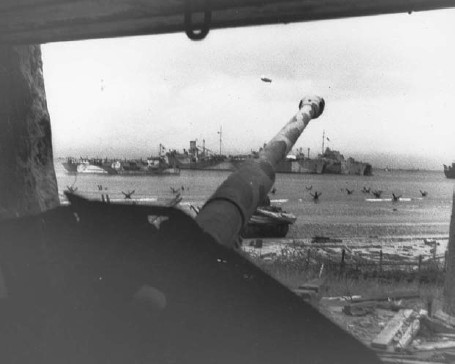
Looking out from a German gun position at Bernières-sur-Mer on June 6, 1944. Allied landing craft can be seen offshore. On D-Day German troops faced constant naval and aerial bombardment. Because of shortages of pilots and fuel, however, the Luftwaffe was unable to match the 12,015 Allied sorties, launching only 319 of their own.
Even the movements of smaller formations, artillery taking up position, deployment of tanks and so on, are immediately bombarded from the air with annihilating effect. Troops and staffs are forced to hide in terrain which provides cover during the day, in order to escape these continual attacks from the air.
On June 9 in the battle area of the SS Corps, numerous enemy fighter-bomber formations circled uninterruptedly over the battlefield and strong bomber formations bombarded troops, villages, bridges, and road junctions as heavily as possible without consideration for the population. Neither our flak nor the Luftwaffe seems to be in a position to check this crippling and destructive operation of the enemy Air Force (27,000 sorties in one day). The army and SS troops are defending themselves as well as they can with the means at their disposal, but ammunition is scarce and can be replaced only under the most difficult conditions.
(b) The effect of heavy naval artillery.
Up to 640 heavy calibre guns were used. The effect is so strong that operation with infantry or panzer formations in the area commanded by this quick-firing artillery is not possible. In spite of this heavy fire garrisons on the coast and the troops sent to counter-attack in the area of Montebourg have held their positions with the utmost tenacity. It must be expected, however, that the enemy warships will intervene further in the fighting on land, especially in the Cotentin peninsula, if the Luftwaffe and our navy do not succeed in destroying them.
(c) The material equipment of the Anglo-Americans with numerous new weapons and war materials is far superior to the equipment of our divisions. As Obergruppenführer Sepp Dietrich informed me, enemy armored formations carry on the battle at a range of up to 3,500 meters with maximum expenditure of ammunition and splendidly supported by the enemy Air Force. This was also the case at Alamein. Furthermore, their great superiority in artillery and extremely large supplies of ammunition are increasingly apparent.
(d) Parachute and airborne troops are used in such large numbers and so effectively, that the troops attacked have a difficult task in defending themselves. If enemy airborne forces land in a territory unoccupied by us, they immediately make themselves ready for defense and can be defeated only with difficulty by infantry attacks with artillery support. Further operations of this type, especially in areas not occupied by our troops, must be expected. The Luftwaffe has unfortunately not been able to take action against these formations as was originally planned. Since the enemy can cripple our mobile formations with his Air Force by day, while he operates with fast moving forces and airborne troops, our position is becoming extraordinarily difficult.
I request that the Fuehrer be informed of this.
Rommel
June 12, 1944
WEEKLY REPORT, JUNE 12–19, 1944
I Estimate of the situation as a whole:
The enemy has brought about 25 divisions and a large number of H.Q. troops of all types into Normandy, and has formed them up into one bridgehead from the Orne to Montebourg. He has carried out his plan to cut off the northern part of the Cotentin peninsula, in order to take possession of Cherbourg. Between the Orne and the Vire the enemy, with 2 noticeable concentrations, continued his attempts to create a jumping-off base for the attack into the French interior, especially in the direction of Paris.
(a) between Tilly sur Seulles and Caumont,
(b) on both sides of Route Nationale 172 to take possession of the St. Lo area.
Despite his great superiority, especially in air power and naval artillery, the enemy has gained no successes in repeated large scale attacks with ruthless employment of men and material, and has even lost ground in the Caumont area.
The slowly progressing mopping-up operation between the Dives and the Orne has suffered losses from the fire of naval artillery and the operations of the enemy Air Force. According to intelligence and reliable captured documents the enemy has reached none of his distant objectives, but has been forced to employ far greater forces than was originally planned.
It must be expected that the enemy will bring up new forces,—2 British army corps have already been identified— and will prepare a general offensive between Tilly sur Seulles and St. Lo in a southerly or south-south-easterly direction, with concentration of forces, and after extensive preparation by the Air Force and artillery of all types. At the same time the 1st American Army, covered in the south, will prepare for the attack on Cherbourg, in order to gain the port, which is of decisive importance to the enemy.
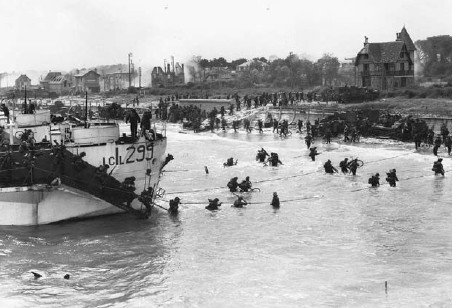
The Canadian 9th Infantry Brigade comes ashore at Bernièressur-Mer on the afternoon of June 6, shortly after the beachhead was secured. The soldiers are disembarking from LCI 299 (Landing Craft, Infantry) using ramps built by engineers. By evening they would be in the line of fire advancing toward their divisional objective at Carpiquet.
In front of the 15th Army sector the focal points of air attack appeared clearly again as the Channel front on both sides of Cap Gris Nez and on both sides of the Somme. According to enemy regrouping and strategic and technical opportunities, a large-scale enemy landing on the Channel front on both sides of Cap Gris Nez or between the Somme and Le Havre must be expected. The general offensive out of the Normandy bridgehead and a new large-scale landing may be made simultaneously, both having the Paris area as the objective.
The enemy has suffered severe casualties in the battles in the bridgehead and has so far lost more than 500 armored vehicles and over 1,000 aircraft.
An estimate of the effect of the long-range weapon is not possible at present, owing to the short time in which it has been used and to the lack of reliable data.
Internal Situation
The population is friendly in the theater of operations, and sabotage and other resistance activities which broke out again in the first days of the invasion have decreased noticeably.
Details will be submitted after receipt of reports from the armies.
Rommel,
Field Marshal
WEEKLY REPORT, JUNE 19–26, 1944
I Estimate of the situation as a whole:
The battle for the fortress of Cherbourg has been the main feature of the weekly report. After the enemy cut off the Cotentin peninsula on June 18, and our own troops, according to orders, had to make a costly retreat to Cherbourg, the enemy attempted to force the capture of Cherbourg by encirclement from the west, employing his superior forces, which included 5 infantry divisions, 1 armored division, and many H.Q. troops. On June 21 he succeeded in reaching the 50 km. long Cherbourg land front practically at the same time as the retreating von Schlieben battle group.
After a brief interval for preparation, during which constant air attacks were made and greatly superior artillery was brought up, the enemy drove 4 wedges into the outer defense ring on June 23. The unequal heroic struggle of the gallant defenders of Cherbourg continued without any possibility of ground, air or naval support until the evening of June 25, while the enemy with the superior equipment of his three services systematically reduced the garrison. At present a few pockets of resistance are still holding out in the city area of Cherbourg and on the Jobourg peninsula.
This has proved that such an extensive fortress cannot be held without sufficient troops and without air and naval support. The fortresses are not equal to the massed enemy Air Force and naval artillery, without corresponding counter-action on our part. Even the strongest fortifications were demolished piece by piece.
The other two local enemy concentrations were on both sides of Tilly sur Seulles and in the St. Lo–Carentan area. While the defensive success of June 17 resulted in a slackening of the enemy offensive in the latter area, an attack was made on both sides of Tilly sur Seulles on June 25; after intensive bombardment from land and air on a 7 km. front, the enemy succeeding in breaking through to a depth of 5 km.
Once again the enemy suffered heavy losses in these battles—as he himself admits—including more than 750 armored vehicles since June 6. Our own losses are however also extraordinarily high. Exclusive of the Cherbourg garrison, the following casualties were suffered from June 6 until June 25:

Heavy losses, especially in panzer divisions, and lack of replacements are causing great anxiety owing to the large decrease in strength caused by the daily bombardment from land and naval artillery and from the air.
Enemy operational plans are judged to be as follows. The enemy has sent 27–31 divisions and a large number of H.Q. troops into the bridgehead and further reinforcements are to be expected. In England another 67 large formations are ready, of which at least 57 could be used for a large-scale operation. Enemy distribution of forces in the bridgehead, naval movements, intercepted radio orders to reconnoitre the Touques and Risle sectors and other intelligence reports indicate a thrust in the area to the north and north-west of Caen in the direction of Paris.

This gun position formed part of a strongpoint at St.-Aubin-sur-Mer, including on 50mm anti-tank gun and several machine guns. Earlier naval bombardment had failed to destroy the resistance nest and its 100 defenders of the 716th Infantry Division. This gun was eventually suppressed by the Canadian North Shore (New Brunswick) Regiment. By the evening of June 6, the 716th had suffered 80 percent casualties. U.S. AIR FORCE
This thrust could be linked up with a large-scale landing between the Somme and Le Havre, and this is indicated by agent’s reports and increased enemy air reconnaissance. The effect of the long-range weapons may also compel the enemy to make a landing in this area. The combined objective of both these operations will be the area around Paris, whose rail communication to the east was completely cut off by the enemy Air Force on June 25.
After the release of enemy forces in the Cherbourg area for other operations the enemy may regroup to the south and after about June 30 may attack between Carentan and Portbail towards the south, in order to gain possession of the line St. Lo–Coutances and thus secure the necessary road communications from Cherbourg harbour to the eastern part of the landing area.
The increasing supply crisis at the battle front deserves special attention. Owing to lack of space, the breakdown of the railway system, and incessant enemy air attacks, it is impossible at present to guarantee a regular flow of supplies for our own operations.
In Detail:
Situation at sea
(1) Enemy activity in the landing area
Large-scale use of battleships, cruisers and destroyers for coastal bombardment, especially off the Orne estuary. Increased patrol of sea areas off Cherbourg, the Channel Islands, and the northern coast of Brittany by groups of cruisers and destroyers, concentrated in the area between Ile de Batz and Les Sept Iles.
(2) Enemy minelaying activity
No recognizable area of concentration.
Situation in the air
Fighter, fighter-bomber, and close combat formations concentrated on the support of ground troops in the battle area— especially around Cherbourg—and in rear areas, while heavy bomber formations concentrated on special buildings. The enemy’s great superiority also allowed him to continue attacks on airfields and transport targets.
While only isolated attacks were made in the Northern Military District, the V-1 launching sites in northern France and Belgium were attacked incessantly. During the day 4-engined aircraft made up to 1,450 sorties, twin-engined aircraft 300. Attacks against Luftwaffe ground organization and railway installations caused considerable damage in some instances. Increased air reconnaissance was carried out on both sides of Dieppe and in the area between Fecamp and Etretat.
Regular fighter sorties up to the line Paris-Rennes caused an almost complete stoppage of road transport during the day. Owing to very strong fighter defense urgently required, support for Cherbourg and air reconnaissance of the Caen-Bayeux area was rendered impossible.
Considerably increased air attacks were carried out against our defense forces in the whole Channel area by day and night. Our sea transport can only operate in special weather conditions which exclude the possibility of fighter-bomber attack. Air attacks were continued against ports on the mainland and islands in the Channel Island area. Continuous fighter-bomber attacks were made against naval radar stations in Brittany.
Internal situation
Those sections of the population affected continue to feel embittered at the ruthless Anglo-American methods of warfare, especially with regard to air force operations, otherwise the majority of the population is reserved.
Inhabitants of the Belgian coast demand evacuation. The launching of the new weapon in the struggle against England aroused interest, and in some instances, satisfaction. Terrorist and sabotage operations are continually sustained by reinforcements of men and material from outside.
In the entire area of the Army Group the number of young men, alone or in groups, on the roads has further increased, so that there are grounds for suspicion of extensive recruiting for Resistance organizations. According to counter-intelligence reports, especially large numbers are arriving in the Cambrai area.
In Belgium and in the border area between Belgium and France the signs of a systematic Resistance organization under energetic leadership are increasing: former members of the Wehrmacht are being recruited by call-up notices, and a supply organization is being built up. The number of acts of sabotage is increasing.
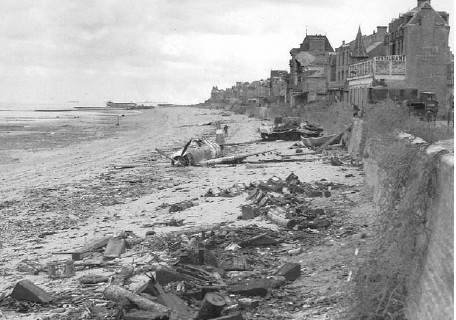
Looking east, remains of the battle at St.-Aubin-sur-Mer can be seen on the beach: a U.S. Army Air Force Thunderbolt that made an emergency landing, a duplex-drive tank put out of action during the landing, and a beached craft in the background. U.S. AIR FORCE
In Brittany continual reinforcement with well-trained, well-equipped men and experienced leaders (partly French parachute troops trained in England) by air and probably by sea has led to the formation of powerful fighting groups. Concentrations in areas Callae, to the north of Vannes, and in the more remote surroundings of Pontivy and Guincamp.
Northern Military District:
A. Coastal defenses (Alterations):
B. Enemy operations on the coast:
None.
C. Operations of enemy aircraft:

D.

15th Army H.Q.:
A. Coastal defenses (Alterations):
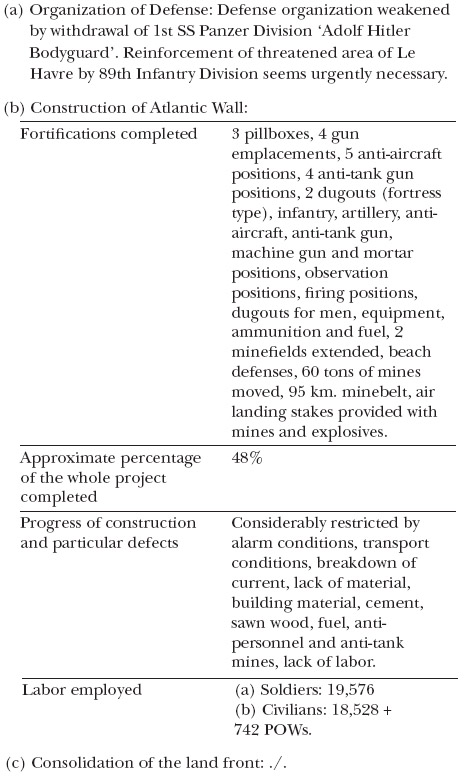

Flanked on either side by steep cliffs, this German gun battery at Longues-sur-Mer defended against the invasion by engaging in duels with U.S. and British warships, but German gun emplacements on the channel lacked fire-control systems to engage moving ships. The cruiser HMS Ajax silenced the battery after firing 114 shells from its six-inch guns. The Longues battery, captured by the British 50th Infantry Division on June 7, included three large bunkers that still contain their original 150mm guns.
C. Operations of enemy aircraft:
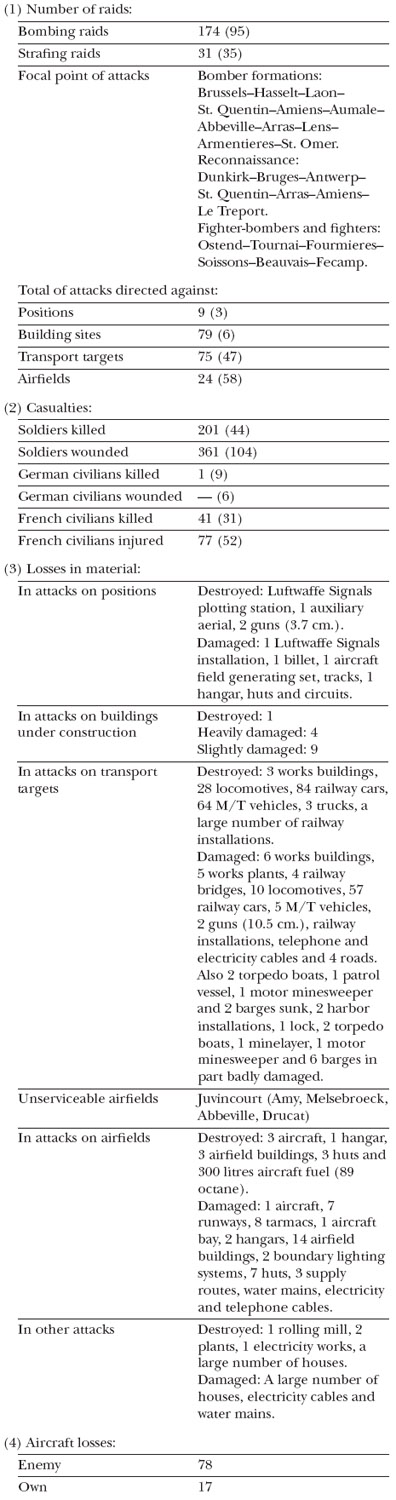

The bunkers of Courseulles-sur-Mer can be seen in the background of this photo taken in 1946. The Courseulles strongpoint included a 75mm gun, 88mm gun, and three 50mm anti-aircraft guns, in addition to 12,000–14,000 mines that had been laid on the beach between Courseulles and Bernières, a distance of about two miles.
D.
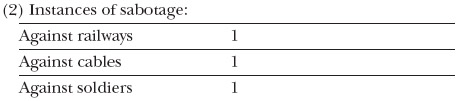
7th Army H.Q.:
A. Coastal defenses (Alterations):
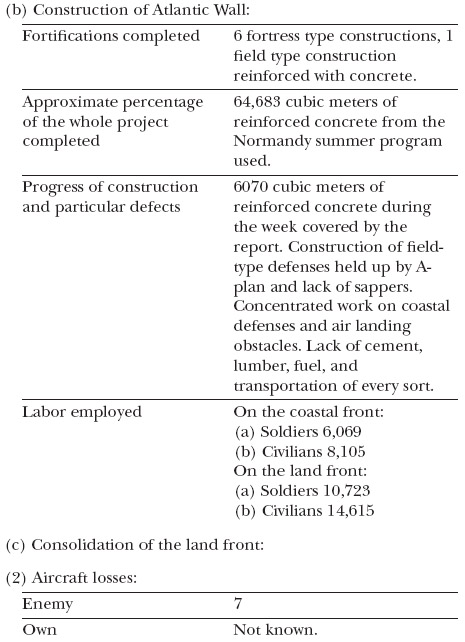
For the Army Group High Command,
The Chief of General Staff,
Speidel
WEEKLY REPORT, JUNE 27–JULY 2, 1944
I Estimate of the situation as a whole:
The most substantial event of the week was the large-scale enemy attack to take possession of the area around Caen, in order to win a base for further operations in the direction of Paris.
The enemy commenced the attack on June 25, with a bombardment from land, sea and air, sent in 5 infantry divisions, 1 armored division, 3 armored brigades, and a considerable number of H.Q. troops—especially artillery—and was able to force a breakthrough 9 km. deep and 9 km. wide.
The breakthrough was held up at first by the heroic resistance of the 12th SS Panzer Division, the Panzer Training Division, units of the 1st SS Panzer Division the 2nd Panzer Division and the 2nd SS Panzer Division and was finally stopped by a well-timed counter attack by the II SS Panzer Corps which was supported by the concentrated fire of army artillery and 2 mortar brigades. In the course of the week the enemy suffered especially heavy casualties, losing more than 150 armored vehicles (amounting to more than 900 since the commencement of the invasion) and was no longer able to make a concentrated attack.
A continuation of our attempt to mop up the breakthrough area was repeatedly frustrated with heavy losses by day and night by the concentrated fire of the superior enemy naval and land artillery and of the Air Force. Our lack of artillery ammunition of all calibres made itself very noticeable.
After bringing up fresh forces (the enemy’s reinforcements aggregate at least 2–3 divisions per week) and regrouping, a resumption of the attacks in the breakthrough area must be expected—various signs indicate an attack east of the Orne. The enemy objective is still a thrust at Caen.
While the heroic struggle of isolated pockets of resistance in Cherbourg ended on July 1 with the annihilation of the Keil battle group on the Jobourg peninsula, the enemy attempted to force a breakthrough in the St. Lo area with forces already brought down from Cherbourg, the main concentration of the attack being on both sides of Villers Fossard. After severe battles lasting three days, the enemy was repulsed everywhere.
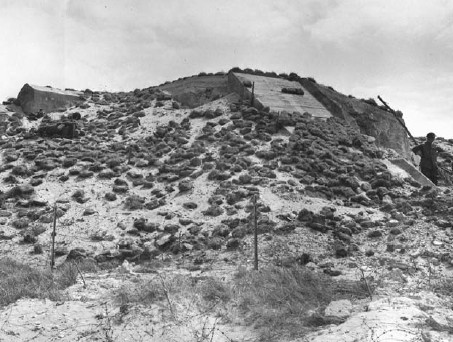
One of the main bunkers at Courseulles-sur-Mer, show on June 10, 1944. Rommel’s strategy for defeating the invasion failed when the unclear chain of command, Rommel’s absence, and Keitel’s refusal to awaken Hitler on D-Day resulted in a series of delays. Only the 21st Panzer Division was able to engage the landing forces on June 6, and the deception of Operation FORTITUDE kept OKW convinced that the main thrust of the attack was yet to come in the Pas de Calais.
Reports of heavy enemy losses are piling up.
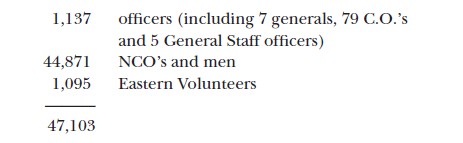
Our own losses from June 6 to July 1 amount to: —

Enemy strength and operational plans
At present in the landing area the enemy has approximately 33 divisions and strong H.Q. troops; in Great Britain another 64 large formations are standing by, 54 of which could be transferred to the mainland.
After the capture of the Caen area—by encirclement on two sides, if possible—and fresh consolidation, the enemy intends to commence the advance on Paris. At the same time he will attempt a concentrated attack on the St. Lo–Coutances area with forces released from the Cherbourg area totalling 10 infantry and 2 armored divisions, in an effort to consolidate his land base. Signs of this operation are apparent.
There are no fresh data concerning the objectives of the American 1st Army Group in Great Britain. A landing on both sides of the Somme as far as the Seine must be expected in view of strategic cooperation with the Montgomery Battle Group for the thrust on Paris and the elimination of the long range weapon.
A separate plan will follow regarding our plans.
II Situation at sea
Very heavy artillery fire from British, American and French battleships, cruisers and destroyers is concentrated on knocking out Cherbourg, covering landings off the Orne estuary, supporting the land battle at Caen, and silencing the coastal batteries.
Vessels are continually unloading along the invasion coast and active convoy movements are taking place in the Channel. There are heavy shipping concentrations in the Thames and also at Harwich. Several actions have been fought with enemy escort boats and destroyers, in which we incurred heavy losses; an enemy destroyer was sunk by one of our patrol vessels.
Our escort vessels have been greatly handicapped by small numbers and by weather conditions, and have carried out only minelaying operations. Successful results of our mining operations have been observed. Minesweeping operations have been made off the Scheldt, St. Malo, and the Biscay ports.
Increased fighter-bomber attacks on our small naval craft are being made by day and night. The enemy Air Force is maintaining constant surveillance of all our shipping movements.
III Situation in the air
Fighter, fighter-bomber, and close combat formations are concentrated on the battle area. Every movement made by enemy ground troops (especially in Cherbourg and south-east of Tilly) is strongly supported. Widespread reconnaissance was transformed into active attack almost immediately, and movements were practically impossible. Attacks were directed against troop concentrations, movements of every description, positions, bridges, transport installations, ammunition dumps and recognized Staff Headquarters. Heavy bomber formations operated mainly against special buildings in the V-1 launching sites. Operations were on a smaller scale than last week owing to the weather. Further attacks against airfields and transport installations.
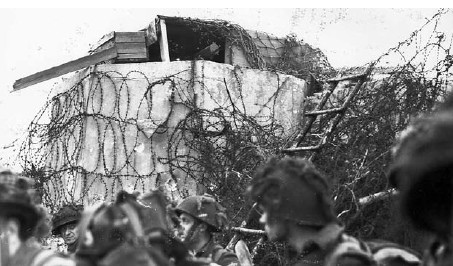
A close-up view of a concrete machine-gun position, which was captured by soldiers of the Regiment de la Chaudières at Bernières-sur-Mer. Having won the first stage of the battle, Canadians are shown gathering behind the sea wall.
Reconnaissance of rail and road transport was carried out from the battle area as far as the line Paris-Tours-Nantes. Active reconnaissance over the area Nieuport-Velenciennes-Hesdin-Somme estuary, and continual surveillance of the north and west coast of Brittany was maintained.
IV Internal situation
Attitude of the civilian population reserved; in Normandy the friendly attitude towards the Germans noted at first is giving way to definite reserve, and in many places to increased aversion. The number of refugees in the battle area is increasing, among them especially large numbers of able-bodied men. Cases of betrayal of our troop movements are increasing.
Resistance movements and sabotage
The central leadership of a large number of Resistance movements and terrorist groups in the Netherlands is known; little activity so far. Increasing development of Resistance organizations in Belgium and in the frontier area of northern France. Only minor acts of sabotage in Normandy; the Resistance movement has been crippled by the capture of almost all of its leaders.
In spite of successful mopping-up operations and capture of arms and ammunition dumps in Brittany, there has been an increase in sabotage activities towards the end of the week. It is presumed that the enemy’s next objective is to bring the terrorist groups, already joined by parachute troops, up to the standard of regular troops by supplying them with weapons and uniforms (in one case 1,000 uniforms were discovered).
V In detail:
Northern Military District:
A. Coastal defenses (Alterations):
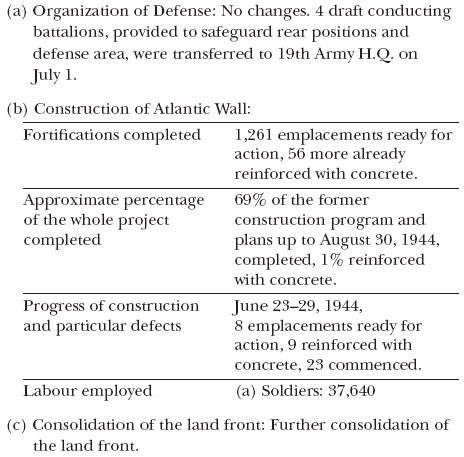
B. Enemy operations on the coast: ./.
C. Operations of enemy aircraft:

D.

15th Army H.Q.:
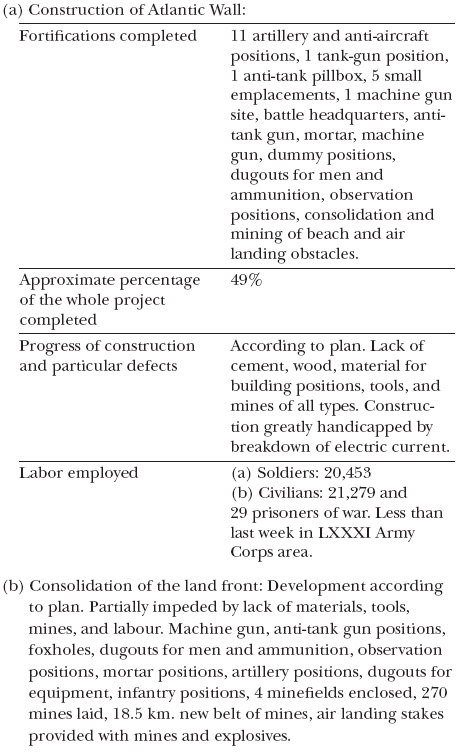
A. Coastal defenses (Alterations):
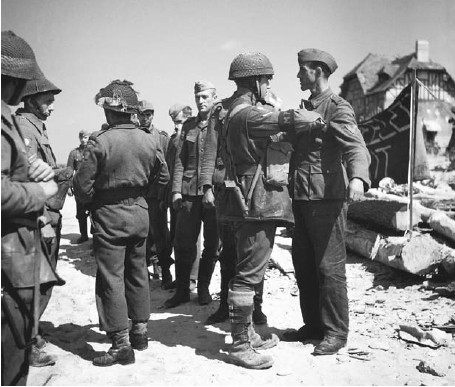
After the successful Allied landing June 6, a British MP searches German prisoners of war. As Rommel had predicted, if the invasion were not stopped within the first twenty-four hours, Army Group B would be unable to prevent the Allies from securing a bridgehead.
B. Enemy operations on the coast: ./.
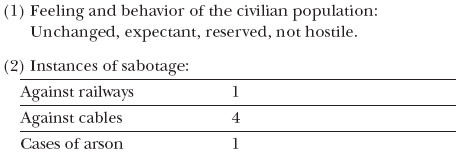
C. Operations of enemy aircraft:

D.
7th Army H.Q.:
Breton Coast:
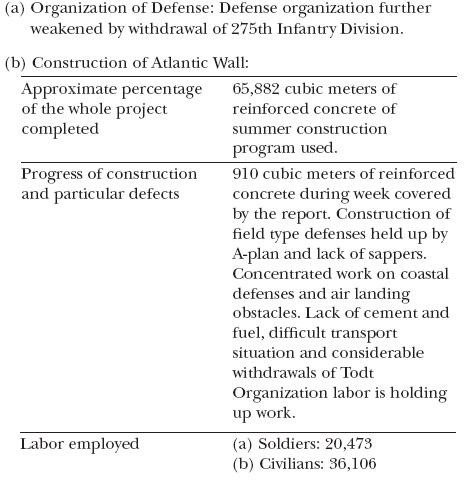
A. Coastal defenses (Alterations):
For the Army Group High Command,
The Chief of General Staff,
Speidel
TO C-IN-C. WEST, JULY 1, 1944
With a view to obtaining unified command of the Wehrmacht and concentration of all forces, I propose to take over command of the headquarters and units of the other two services employed in the Army Group area or cooperating with it.
(1) Luftwaffe
At present there is no question of strategic air warfare. Close cooperation between flying formations and the flak corps and the heavily engaged army can be guaranteed only by the strictest command from one headquarters. Duplication of orders leads to military half measures.
(2) Navy
There is no longer any question of extensive naval strategy. Local tactical operation of the few vessels still at our disposal must be carried out in close cooperation with the movements of the army. The defense of Cherbourg has shown that a unified command and channel of communications are more effective. Finally, the supply situation, especially as regards to transport, demands unified guidance and issue of orders by the Quartermaster General West.
Rommel
Footnotes
1 Hinsley, 308–11.
2 Stacey, 122; D’Este, 118.
3 Stacey, 122.
4 Russell Weigley, Eisenhower’s Lieutenants: The Campaign of France and Germany, 1944–1945 (Indianapolis: Indiana University Press, 1990), 128.
5 Stacey, 124.
6 Keegan, 143.
7 D’Este, 126, 138.
8 Ziemke, “Rundstedt,” in Barnett, ed., 200.
9 Terry Copp, Fields of Fire: The Canadians in Normandy (Toronto: University of Toronto Press, 2003), 75; D’Este, 167.
10 Hinsley, 175; D’Este, 152.
11 OKW, 41.
12 Copp, 80.
13 D’Este, 233.
14 Stacey, 145.
15 Gilbert, 543.
16 D’Este, 233.
17 Keegan, 160.
18 Stacey, 149; Hastings, 175.
19 Martin Blumenson, Breakout and Pursuit , United States Army in World War II Series: The European Theater of Operations (Washington, DC: Center of Military History, United States Army, 1989), 26.
20 Stacey, 149.
21 OKW, 52.