
CHAPTER 3
Field Marshal von Kluge arrived at OB West headquarters on July 3, full of confidence and convinced that he would turn the tide of the battle. He proclaimed that Rommel would now learn to take orders and berated his subordinate in front of other officers for his defeatist attitude.1 It was well known that von Kluge held Hitler’s respect and had direct access to the Führer. Stung by von Kluge’s harsh criticism, Rommel sent his new C-in-C a lengthy memorandum of the problems encountered by German forces defending Normandy. It was not long, however, before von Kluge began to see these difficulties for himself. Visiting the front, he became aware of Allied air superiority. He witnessed the devastating effects of naval artillery fire in the coastal areas and was shown the destruction wrought by Allied guns with their seemingly unlimited supply of ammunition.
The unpleasant reality of the situation was further reinforced when von Kluge returned to his headquarters at St. Ger-main to find a new directive from Hitler concerning the conduct of German operations in Normandy.2 In this memo, the Führer predicted a second Allied landing and ordered the Fifteenth Army to remain in the Pas de Calais. Panzer Group West was to be renamed the Fifth Panzer Army and Eberbach stepped in to take over from Geyr von Schweppenburg, with orders to pull back from the front and make ready for a counter offensive. Hitler did not want to hear about the enemy’s artillery strength and “inferior” Allied infantry was to be overrun by surprise night attacks conducted without artillery preparation. Normandy was to be held at all costs, and although there were no reinforcements available, every part of France had to be defended against possible further landings. Under Hitler’s directive, the well-equipped 11th Panzer Division was scheduled to move from the First Army in southwest France to the Nineteenth Army on the French Mediterranean coast. Three times in July, von Kluge requested that the division be transferred to Normandy, where it was desperately needed, but he was refused on all occasions. Von Kluge’s reports on the lack of reinforcements and staggering casualties met the same response as had those of Rommel and von Rundstedt.
The heaviest fighting over the next few days was at Carpiquet, where the 8th Canadian Infantry Brigade attacked the town and airfield on July 4. The fighting around Caen was intensifying, and although the inexperienced 16th Luftwaffe Field Division was brought up to replace the 21st Panzer Division, von Kluge and Rommel decided that the Panzer Lehr would have to be shifted to the American front where the U.S. Army was advancing toward La Haye-du-Puits.
On July 7 the British began their assault on Caen, with 468 heavy bombers dropping 2,562 tons on the city between 9:50 and 10:30 P.M.3 Operation CHARNWOOD opened with a massive artillery barrage at 4:20 the next morning, using every gun in the Second British Army, as well as offshore naval guns. The 16th Luftwaffe Division’s defenses collapsed before the 3rd British Division, while the 59th British and the 3rd Canadian Divisions advanced along a ten-mile front against the 12th SS, driving towards their goal of capturing the city and securing bridgeheads across the Orne River. When the Germans began to withdraw from Caen, the 12th SS mounted a rear-guard action to cover the retreat. The battle at Caen ended on July 9 with heavy casualties on both sides. Major General Kurt Meyer halted the 12th SS withdrawal in the suburbs on the south bank of the Orne, once again preventing Montgomery from achieving his full campaign objectives.
In bocage country to the west, the Americans had advanced only five miles in six days and were now encountering fierce opposition as they moved toward Périers. The bocage, or hedgerow, country in this area favored the German defenders. Each massive stone hedge, overgrown with trees and thickets, formed a natural defensive position from which German gunners fired unseen at advancing infantry. Tanks and infantry could move only from row to row, and were quickly exposed if they tried to use the narrow roads. As the British and Canadians occupied Caen on July 10, Bradley decided to pause and rest his American formations in order to replace the forty thousand casualties suffered to date.4 On the Russian front, the Soviet Operation BAGRATION, launched on June 22, was realizing tremendous success against Army Group Center. Germany’s line of defense in Russia had been shattered, and the Soviets now launched an offensive against Army Group North, tearing a fifty-mile gap through the German lines in two days of bitter fighting.
By July 11, the Panzer Lehr Division came into action against Bradley’s troops in the St. Lô area. Suffering heavy casualties, the Americans were becoming bogged down in the hedgerows of St. Lô and flooded marshlands of Carentan. Bradley called on Montgomery for help, requesting a ten-day respite in order to rebuild and resupply for an American breakout. Monty agreed to launch a British attack to cross the Orne and began planning Operation GOODWOOD, his next effort to break through the German lines outside Caen. A few days later, an ULTRA decrypt confirmed that the Germans were still awaiting a landing by Patton’s FUSAG, which they believed would be sent across the Straits of Dover and used to cut off the German forces in Normandy. Churchill sent the decrypt to Roosevelt on July 15 with a notation that “Uncertainty is a terror to the Germans.”5
The continuing success of FORTITUDE, now five weeks after the D-Day landings, is also confirmed in a memo written by Rommel on July 15. He wrote to von Kluge that Army Group B had lost ninety-seven thousand men since June 6 but had received only six thousand replacements. Seventeen tanks had been sent to replace the 225 lost. Overwhelming Allied air and artillery superiority was smashing the German army in Normandy to pieces. He further noted that no new forces could be brought up to the Normandy front except by weakening the Fifteenth Army on the Channel or the Mediterranean forces stationed in southern France. Rommel asked von Kluge to forward the report directly to Hitler. The next day, Rommel also sought Hitler’s permission to withdraw the twenty-eight thousand German troops stationed in the Channel Islands. Hitler refused.6
On July 17 Rommel set out for his daily tour of the front. After visiting the 276th and 277th Infantry Divisions, he continued on to Sepp Dietrich’s Headquarters, where he met with Dietrich and Meyer. Expecting a British attack within twenty-four hours, Rommel wanted Meyer’s 12th SS to support the 272nd Infantry Division. His daily tour completed, Rommel left in his staff car, but on his way back to La Roche–Guyon, he was spotted and attacked by two Spitfires. In the ensuing car crash, Rommel suffered severe head injuries. Unconscious and covered with blood, he was taken first to a shelter and then to the hospital at St. Germain. He would never return to the battlefield. Von Kluge was placed at the head of Army Group B in addition to his posting as C-in-C West.7 He moved from OB West headquarters at St. Germain to those of Army Group B at La Roche–Guyon.
As Rommel had predicted, the Allies renewed their offensive the next day. Montgomery’s Operation GOODWOOD, the largest offensive yet launched against German lines, was sent across the Orne on July 18, led by the British VIII Corps with the Canadian II Corps supporting the right flank. Across the river, the 1st SS Panzer Leibstandarte Division was dug in at Bourguébus Ridge southeast of Caen. To the west, Bradley’s American forces entered St. Lô that same day. Both attacks soon broke down into heavy fighting, with the British attack being brought to a halt by elements of the 21st Panzer Division. Eberbach had anticipated Montgomery’s offensive and deployed the forces of the I SS Panzer and LXXXVI Corps in four defensive belts nearly ten miles deep, with a fifth belt acting as a reserve.8
Heavy losses in both men and tanks were sustained on both sides. For two days of bitter fighting, Canadian and British forces fought their way to the third belt of defense, but the German gun line on the crest of Bourguébus Ridge remained intact. On the afternoon of July 20, just as Montgomery’s troops were preparing to assault the ridge, a prolonged downpour turned the battlefield into a sea of mud, ending the siege with gains and losses for both sides. The battle had exhausted the German panzer divisions and prevented their transfer to the American sector south of the Cotentin. To meet the British and Canadian assault at Caen, two panzer divisions that had been moving to the American front were recalled. The Germans, however, still held vital ground at Verrières Ridge. Rommel’s defensive zone held firm but constant air attacks dropping twelve thousand tons of bombs were taking their toll. The demoralization of senior German commanders at this time is reflected in the Army Group B situation reports: “The extraordinary vigour and the colossal material superiority of the enemy in the fighting east of Caen on July 18 and 19 are indicated by the fact that he fired 103,000 artillery shells on the left flank of the 86th Corps and the 1st SS Panzer alone, and according to his own reports, dropped in our positions 7,800 tons of bombs from 2,200 two and four-engined bombers.”
The bad weather of July 20 also affected the battle in the bocage. The Americans had to postpone their proposed breakout from St. Lô, code-named Operation COBRA, until the twenty-fifth. American and German casualties were extremely high in this sector, particularly for the German 352nd Division, which was still holding the line after its stubborn defense of Omaha Beach. This division almost ceased to exist after St. Lô, where its casualties contributed to the total of 116,000 suffered by the Seventh Army since June 6. To replace these losses, only ten thousand reinforcements were received, drawn from the Ersatzheer (Replacement Army) in Germany. Of the nearly six hundred tanks destroyed, only seventeen replacements had arrived. The strength of the perimeter drawn around the Allied lodgment in Normandy was stretched close to the breaking point.
As the weather brought a halt to the fighting around Caen and St. Lô, a group of German army officers made an attempt to assassinate Hitler in his Wolf’s Lair headquarters in Rastenburg. On July 20, Colonel von Stauffenberg placed a bomb under the conference table where Hitler, Keitel, Jodl, Warlimont, and eighteen others studied the war plans before them. He then left the room on the excuse of having to take a phone call and was outside the building when the bomb exploded. Believing Hitler to be dead, von Stauffenberg was on his way to Berlin to join General Beck and other highly placed army conspirators in establishing a new government. Convinced that Hitler was destroying the fatherland and an entire generation of its young men in his obsession to fight an unwinnable two-front war, their goal was to negotiate a separate peace with the British and Americans. Unknown to von Stauffenberg, in his absence the briefcase containing the bomb had been pushed farther back against the supports of the heavy oak table, which then shielded Hitler from the blast.9 The Führer emerged with one hundred splinters from the map table in his legs, but he was alive.
In Berlin there was much confusion, as it was initially unclear whether or not Hitler had survived the assassination attempt. Most of his field commanders stayed loyal not so much from their personal oath but more from the fact that Germany was still fighting and their knowledge that the Allies had committed themselves to an unconditional surrender. At Army Group B headquarters, von Kluge delayed. Word came from Berlin that Hitler had survived an assassination plot, along with additional instructions that any orders from Generals Fromm and Hoepner and Field Marshal Witzleben were to be disregarded. Von Kluge was aware of the plot,10 but he delayed before accepting the conspirators’ orders, which were sent out from Berlin in the mistaken assumption that Hitler had been killed.11 He called Beck in Berlin, then Rastenburg, and finally von Stauffenberg, who again assured von Kluge that the Führer was indeed dead. For two hours von Kluge discussed the momentous developments with Blumentritt, his chief of staff. The military governor of France, von Stülpnagel, arrived at La Roche–Guyon to ask for von Kluge’s endorsement of the plot. Then he received a call from OB West headquarters at St. Ger-main confirming Keitel’s message that Hitler was alive and that orders were to be taken from no one but himself or the SS chief, Himmler. To Blumentritt, von Kluge confessed, “Today I am without hope.” A little later, he dictated a congratulatory message to the Führer, condemning the murderous attempt against his life and assuring him of “our unalterable loyalty.”
The next morning, von Kluge wrote a letter to Hitler to demonstrate his innocence and distance himself from the conspirators. He attached Rommel’s letter written on July 15, two days prior to his accident. Von Kluge had earlier hesitated to forward this letter due to its outspoken criticisms, but in light of the July 20 plot, he probably did not want to be found holding onto “defeatist” correspondence from a possible conspirator who believed that “the unequal struggle is nearing its end.” Yet by July 22 it appears that the realities of the Normandy situation once again became foremost in von Kluge’s thoughts, as he called Jodl to say that the whole Normandy front was a disastrous mess and ask whether Hitler fully appreciated the tremendous consumption of German forces over the last few weeks. He continued that his infantry could not last much longer, that there were too few troops with which to hold the line. A few hours later, he received Hitler’s response: “Stand fast.”
The Führer later wired his commanders: “Anyone who gives up an inch of ground will be shot.” Addressing the Normandy commanders specifically, he added, “Anyone who speaks of peace without victory will lose his head, no matter who he is or what his position.” Through the Gestapo, Hitler already knew of the connection between Rommel, von Kluge, and the conspiracy. Far from weakening the Führer’s position, the assassination attempt had actually left him more powerful than ever as it provided the opportunity to maintain closer watch over his generals. Any freedom to question his judgment was now gone, as criticism would indicate a connection to the conspiracy. The Waffen-SS was raised to equal status with the Wehrmacht, Luftwaffe, and Kriegsmarine.
More than 150 conspirators were executed or committed suicide in the aftermath of the of the July 20 plot. Those who survived now found themselves fighting against increasingly difficult odds. In the first days of August, Hitler ordered an allout counterattack near Mortain, both as a test of the German army’s loyalty and as a bid to produce a strategic reversal of the military situation in the west. Hitler’s Operation LÜTTICH would use all available armor to drive into the flank of the American spearhead emerging south from St. Lô, smashing through the interior of Brittany and the bocage country and on towards the sea.

WEEKLY REPORT, JULY 3–9, 1944
I Estimate of the situation as a whole.
During the period covered by the report, the 2nd British Army and the 1st American Army, using unusually large masses of men and material in a large-scale attack, attempted to break through in order to conduct operations in open country.
The prelude was a local attack on July 3 concentrated on a 7 km. front in the area in front of Caen, which resulted in the loss of Carpiquet after heavy fighting. On July 8 the enemy launched a concentrated attack on Caen with at least three infantry divisions, several armored brigades, and strong H.Q. troops, after having bombarded the whole area during the previous night with naval land and artillery of all calibers (80,000 rounds) and with continual air attacks (approximately 2,500 tons). After two days of very heavy fighting the enemy, who suffered particularly heavy losses of men and material (the 12th SS Panzer Division alone knocked out 103 tanks) succeeded in smashing the bridgehead and taking Caen. The enemy was not successful in effecting a breakthrough, however, as a secure defense had been built up in time on the Orne.
On July 10 the attacks were continued, concentrated on both sides of Verson, and are still in progress.
Fighting on the rest of the Panzer Group West front was only in the nature of local holding operations.
On the 7th Army front with 4–5 infantry divisions and strong armored forces, the enemy launched a north-south thrust on July 3 between Prairies Marécageuses de Gorges and the west coast. In spite of ruthless employment of men, massed artillery, and air forces, the enemy was prevented from breaking through. An area of approximately 5 km. in depth had to be relinquished to the enemy in the course of the week; fighting continues on the line Plessis-Mobecq-Bretteville.
From July 4 the enemy extended his attacks to the Vire. After having succeeded in establishing bridgeheads over the Vire and Taute, he attempted to break through into the area St. Lo–Periers–Coutances. In heavy battles he was prevented from making a decisive breakthrough. The 2nd SS Panzer Division and the Panzer Training Division were brought up to the battle area, and some units took part in the fighting. The 5th Paratroop Division is being brought up.
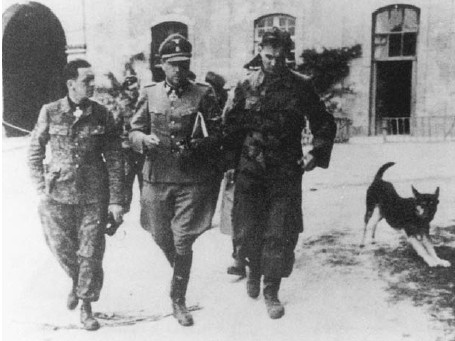
In early June, Colonel Kurt Meyer (left), commander of the 25th Panzer Grenadier Regiment, talks with other 12th SS officers, Brigadier General Fritz Witt (center) and Lieutenant Colonel Max Wünsche, in the courtyard of the Abbaye d’Ardennes. The 12th SS “Hitler Youth” Division came into action on June 7 and consisted of sixteen- to eighteen-year-old men who had been specially selected for their determination and devotion to Hitler.
The enemy has once more failed to reach his breakthrough objectives this week, and has suffered heavy casualties. The 101st and 82nd American Airborne Divisions have already been withdrawn owing to heavy losses, but have been replaced by fresh divisions.
From June 6 to July 9 the enemy lost 1,297 armored vehicles and 266 aircraft through the action of army and SS units.
Even when compared with the heavy enemy losses, our losses are also considerable. From June 6 to July 7 they amount to:—

Enemy strength and operational plans.
It is estimated that the enemy has at present 35 divisions and strong H.Q. troops in the landing area. In Great Britain a further 60 large formations are standing by, of which 50 could be transferred to the Continent at any time.
According to indications, and data, the plans of the Montgomery Army Group are just as we expect. After taking the whole of the Caen area and throwing adequate bridgeheads over the Orne the enemy intends to commence the thrust on Paris, in the course of which a large-scale landing must be expected in the 15th Army Zone by the 1st American Army Group to cooperate with the Montgomery Army Group and to eliminate the long range weapon.
According to a captured order, the American 1st Army’s primary objective is the extension and consolidation of their land base by the occupation of the St. Lo–Coutances area and later the line Vire-Avranches. The strategy of attrition of both armies can be recognized by the use of masses of material and ammunition.
To improve our freedom of action, while at the same time preventing a breakthrough, Army Group B will attempt to withdraw panzer formations and replace them by infantry divisions.
Owing to lack of transport space and the delaying effect of air attacks, the supply position is very critical as regards ammunition and fuel, in spite of some slight improvement in transport up to the front.
II Situation at sea:
More intensive surveillance of the sea area off Le Havre and Cap d’Antifer by strong groups of enemy destroyers and escort vessels. Numerous naval actions.
Increasing control of the Channel Island area and the northern coast of Brittany by enemy destroyers and other naval forces.
Widespread use of battleships, cruisers and destroyers in bombardment of the coast and in support of the enemy attack on Caen.
Considerable enemy supply and reinforcement traffic; a temporary decrease was noticeable after our small naval craft had been sent into action.
Numerous fighter-bomber attacks on our defense forces. Air surveillance of the whole Channel coast, including coastal and outer routes between Brest and La Pallice. 3 fighter-bomber attacks on naval radar stations in the area of Cap d’Antifer and on Ile d’Oussant.
Enemy mining activity slight in comparison with last week.
III Situation in the air
Very heavy enemy air activity, only temporarily held up by weather conditions.
Fighter and fighter-bomber sorties were concentrated in the battle area in support of ground troops. Continual attacks against positions of every description, ammunition and supply dumps, and against movements far to the rear. Isolated fighter-bomber sorties as far as the Loire. Strong fighter forces covering the battle area and making operations by the Luftwaffe difficult.
Twin-engined formations directed attacks against transport installations (stations, trains, bridges, ferries and crossroads) and against troop concentrations.
Heavy bomber formations strongly supported by fighters attacked construction sites and special installations in the V-1 launching sites, marshalling yards and airfields.
Reconnaissance was made of rail, road and water transport as far as the line Rheims-Orleans-Angers-Rennes. Constant surveillance was noticeable in the Ostend–Lens–Amiens–Le Tré-port area and of the north and west coast of Brittany.
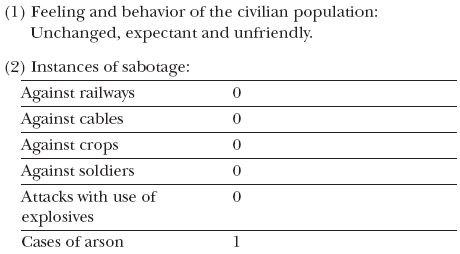
IV Internal situation;
Attitude of the civilian population still reserved and expectant.
Resistance organizations and sabotage:
It has been confirmed that British and French parachute groups have been landed in areas outside Brittany to reinforce and direct the Resistance movement. Still relatively slight activity in the Netherlands. In Belgium and the frontier area of northern France: a marked increase of partisan activity. The British radio is sending an increased number of code words to Resistance groups.
The number of attacks and acts of sabotage, which has been exceptionally high since the end of June, has risen still further in the last few days. Heavy sabotage of electric cables during the night of July 6–7.
Normandy: partisan activity has spread to areas formerly free of terrorists (Pont Audemer), and also in the battle area (Caen). Roads in rear areas have been covered with small mines.
Brittany: increasing sabotage of railway installations and long distance electricity cables. Attacks on small detachments of troops and freight trains reveal planned preparation and military direction (concentrated in the area Guingamp-Lannion); however no large-scale military use of partisan bands has been made. Concentration area of terrorist supply in southern Brittany, with up to 40 machines in one night.
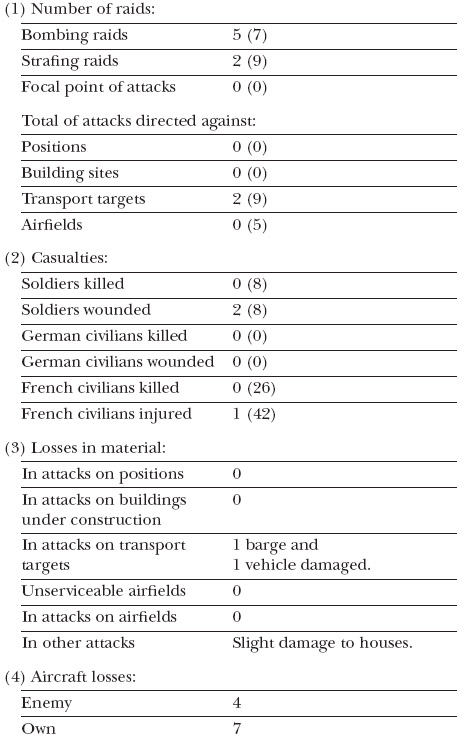
In detail:
Northern Military District:
A. Coastal defenses (Alterations):

B. Enemy operations on the coast: ./.
C. Operations of enemy aircraft:

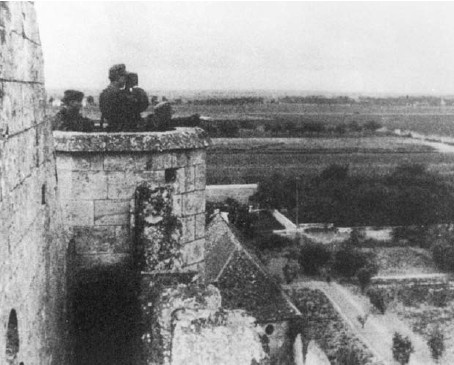
An observation post at the Abbaye d’Ardennes. Meyer established his headquarters here after the 12th SS made a slow advance to the front, its vehicles and 20,000 men impeded by Allied air attacks and blocked roads.
D.
15th Army H.Q.:
A. Coastal defenses (Alterations):

B. Enemy operations on the coast: ./.
C. Operations of enemy aircraft:

D.

7th Army H.Q.:
A. Coastal defenses (Alterations):

For the Army Group High Command,
The Chief of General Staff,
Speidel
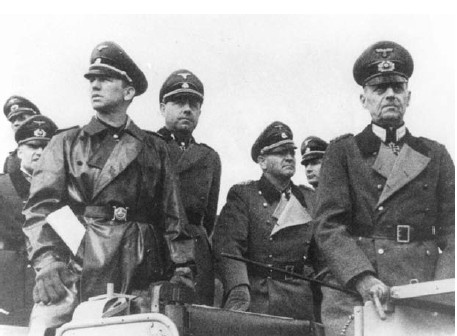
Field Marshal Gerd von Rundstedt, Major Hubert Meyer (staff officer of the 12th SS), Lieutenant General Sepp Dietrich (commander of the I SS Panzer Corps), Brigadier General Fritz Witt of the 12th SS, and Colonel Kurt Meyer of the 25th Panzer Grenadiers are shown, right to left. General Witt was killed on June 12 and replaced by Kurt Meyer, who at age thirty-three became the youngest divisional commander in the German forces. Dietrich later took command of the Fifth Panzer Army during the escape from the Falaise Pocket and, later, the Sixth Panzer Army during the German “Miracle in the West” in the autumn of 1944.
WEEKLY REPORT, JULY 10–16, 1944
I Estimate of the situation as a whole.
The 2nd British Army has not achieved its aim of breaking through and operating in open country after the capture of Caen, when further attacks broke down owing to heavy losses. A counter-attack by our troops on July 11 was successful, and the former main defense line south of the Odon (south-west of Caen) was retaken; after this the enemy remained quiet, except for local infantry and considerable artillery activity. Regrouping and preparations on an increasing scale were observed towards the end of the week. In the early hours of July 16 the enemy commenced local attacks between Maltot and Vendes, and these are still in progress. An offensive by the 2nd British Army to break towards the south-east can be expected from the evening of July 17.
On the 7th Army sector the enemy attempted to break through and force the capture of St. Lo area in battles which are intensifying daily. Once more the enemy failed to reach his objective, but sectors 3 km. to 5 km. in depth to the north-east and north-west of St. Lo had to be yielded to him. After a defensive success on the northern front LXXXIV Army Corps fell back without enemy interference to the Seves-Lessay sector during the night of July 13/14. The enemy has not yet completely closed up on the main defense line.
Enemy attacks concentrated on the St. Lo area are continuing on the same scale.
During the period between June 6 and July 16, the enemy suffered the following losses through the actions of the army and SS units
1,705 tanks and 293 aircraft
Our own losses from June 6 to July 7 amount to:

Replacements since June 6:
8,395 men brought up to the front
5,303 men warned for transfer to the front.
The replacement situation gives rise to some anxiety in view of increasing losses. Some remedy must be found before units are depleted.
Enemy strength and operational plans:
Enemy supply of men and material continues without interruption, and it is estimated that there are approximately 37 divisions and strong H.Q. troops in the landing area. According to the distribution of enemy forces the following minimum artillery strengths are estimated, exclusive of naval artillery:

In Great Britain a further 56 large formations are at ready, of which 46 can be transferred to the Continent.

One of the Panzer Lehr Division Panther tanks destroyed at Bretteville-l’Orgueilleuse during heavy fighting on the night of June 8/9. It was taken out by fire from a PIAT (projector infantry anti-tank) in a hard-fought, but ultimately unsuccessful effort to drive the Allied forces back into the sea.
The known operational plans of the Montgomery Army Group still appear to remain the same.
The 2nd British Army is clearly concentrated in the area of Caen and to the south-west, and plans to make a thrust across the Orne towards Paris. The local attacks between Maltot and Vendes, which commenced on July 15 may be regarded as the preliminary to the offensive to break through over the Orne expected from July 17.
The 1st American Army will continue its plan to extend its land base up to the line Domfront-Avranches, using heavy concentrations of men and materials.
1st American Army Group: There are no fresh indications of the objectives of the 1st American Army Group. A large-scale landing must be expected in the area of the 15th Army, for strategic cooperation with Montgomery’s Army Group, where the main weight of the enemy operations appears to be concentrated, and for the elimination of long distance weapons. Agents’ reports of an intended landing in southern Brittany contradict the distribution of forces reported in Great Britain.
Army Group B will continue its attempt to prevent all efforts to break through. The replacement of panzer formations by infantry units has not yet produced the desired result. Compared with the modern Anglo-American units, the infantry divisions are so inferior in equipment and strength that most of the reserve panzer groups had to be sent into action again.
II Situation at sea:
Close patrol of the sea area off the landing area and Cap d’Antifer–Le Havre by enemy destroyer and MTB groups.
Numerous naval actions. According to a reliable source a number of enemy vessels have struck mines.
Extended and reinforced enemy patrols (including heavy cruisers) off the coast of Brittany as far as Lorient, concentrated on Brest. Surprise appearance of enemy destroyer group off the Ile de Croix.
Fighter-bomber attacks were carried out against our defense forces along the whole Channel coast and also on the Atlantic coast as far as St. Nazaire.
Extensive supply movements by transports, freighters and LSTs in the landing area. Supply by small craft is decreasing.
Air reconnaissance of Cherbourg found only landing craft and low-tonnage steamers in the outer harbor, which must be presumed cleared. Large-scale unloading unlikely. Large-scale unloading activity in the landing area confirms the view that 17 days after the fall of Cherbourg there is no possibility of unloading in the inner harbour.
Enemy mining activity in the Channel has diminished, and is slight on the Atlantic coast.
III Situation in the air:
In spite of being hindered by bad weather conditions, strong fighter and fighter-bomber forces were almost continually active over the battle and rear areas. Considerably fewer sorties were made by heavy bomber formations owing to heavy attacks on Germany. Heavy bomber formations directed their attacks mainly against V-1 launching sites, transport installations and airfields. Most of the attacks by twin-engined bomber formations were directed against railway installations.
By day and night fighter and fighter-bomber formations attacked supply routes and positions of every description in the main defense zone as well as covering the battle area. Repeated attacks were made on bridges, ferries and railway targets as far as the line Paris-Tours-Vannes.
Reconnaissance aircraft maintained constant surveillance of rail, road and water transport as far as the line Chalons s.M.–Orleans–Angers and the coastal area of Brittany.
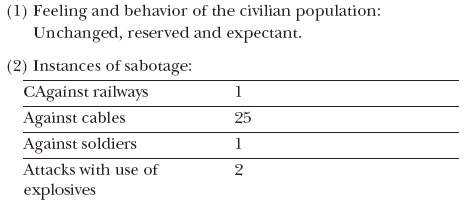
IV Internal situation:
The attitude of the civilian population continues expectant, and to some extent unfriendly. In the Belgian coastal area some of the population volunteered for work on defenses following measures to evacuate the coastal combat area.
Resistance organizations and sabotage:
Slight increase in sabotage activity; progressive development of Resistance organizations, but no large-scale operations as yet.
Attacks on economic and municipal officials, Dutch police and National Socialist Party members.
Belgium and Northern France: sporadic sabotage of cables during the night of July 11/12, otherwise no increase in sabotage. Indications of progressive mobilization of Resistance movements in the interior.
Normandy: increased laying of small mines on roads. Isolated arson attempts on vehicles.
Brittany: no numerical increase in acts of sabotage. Attacks are well planned however and reveal leadership by trained men. The supply system has been hardest hit by numerous explosions on railway tracks, and by attacks with explosives on locomotive depots and ammunition trains.
Destruction of railway bridges, especially in northern Brittany. Several attacks on power supply. Numerous attacks on members of the Wehrmacht. Areas of concentration: Lannion-Plouarot and Pontivy-Loudeac-Carhaix.
The further development of Resistance organizations has not been appreciably hindered by our intervention, and planned development of fighting groups must be expected. Main area where terrorist bands are being formed is to the south of Pontivy. Enemy losses: 168 dead (including 16 parachutists), 117 prisoners (including 4 parachutists).
Northern Military District:
A. Coastal defenses (Alterations):

B. Enemy operations on the coast:
None.
C. Operations of enemy aircraft:

On July 1, 1944, von Rundstedt asked permission from OKW to begin a planned withdrawal to a more defensible line south of Caen, but his request was denied by Hitler. Convinced that von Rundstedt had lost faith in ultimate victory, Hitler replaced him with Field Marshal Günther von Kluge, although Rundstedt was later appoitned C-in-C West and oversaw the German recovery in the West and the Ardennes counter-offensive. U.S. HOLOCAUST MEMORIAL MUSEUM
D.
15th Army H.Q.:
A. Coastal defenses (Alterations):

B. Enemy operations on the coast: ./.
C. Operations of enemy aircraft:


A reinforced concrete bunker at Carpiquet shown after its capture by Allied forces in July 1944. In a fierce three-day battle for the airfield, Canadian infantry, British armor, RAF typhoons, and fire from the battleship HMS Rodney were matched by German counterattacks with several 88s and more than twenty dug-in tanks.
D.
Panzer Group West:
Further consolidation of the land front in 711th Infantry Division sector. Considerable lack of building materials and transport difficulties are holding up work. For other details, see report on situation as a whole.
7th Army H.Q.:
A. Coastal defenses (Alterations):

For the Army Group High Command,
The Chief of General Staff,
Speidel
WEEKLY REPORT, JULY 17–23, 1944
I Estimate of the situation as a whole:
On July 17, the 2nd British and the 1st American Armies began their large-scale attack from the Caen and St. Lo areas in an attempt to force a strategic breakthrough. In spite of their powerful air support and their superior artillery, this plan failed.
On July 18, after a heavy preliminary bombardment from land and sea artillery, and intensive bombing from over 1,000 aircraft, the attack in the area of Panzer Group West was begun from the bridgehead east of the Orne, launched with 4 infantry divisions, 3 armored divisions and 2 to 3 armored brigades. As a result of the intensive bombardment the enemy succeeded in breaking through across the line Touffreville–Colombelles to the south. With our last reserves we engaged the enemy in bitter fighting along the line west of Troarn–south of Frenouville– St. Andre–Bougie. The weather caused a slackening off in the fighting towards the end of the week, although heavy fighting for local targets continued.
The enemy launched a concentrated attack against St. Lo in the 7th Army area on July 17. The bulges in the front line were taken back to the line north of St. Lo–Rampan–Le Mesnil Eury and thus prevented a breakthrough. St. Lo was abandoned to the enemy during the night of July 18/19, and the front was stabilized immediately south of the town. The enemy did not renew their heavy attacks here either, because of the heavy losses they had suffered.
We can expect the enemy’s large-scale attacks from Caen, St. Lo and west of the Vire to be resumed as soon as more favourable weather conditions permit the unhampered use of the enemy air forces.
Units of the army and SS destroyed 2,117 enemy tanks and 345 aircraft between June 6 and July 23.
During the period June 6–July 23 our own losses were:

Since June 6, 10,078 men have been brought in as replacements.
The disbandment of the 165th Reserve Division released 8,000 men for the infantry battalions which were sent to the front. Replacements for the SS panzer divisions are urgently needed.
Enemy strength and operational plans:
The enemy has at least 40 divisions and strong H.Q. troops in the landing area, and is still bringing in further troops and materials.
There are still 52 large troops formations in readiness in Great Britain, and of these about 42 could be transferred to the mainland.
The operational intentions of the Montgomery Army Group seem to be unchanged.
The British 2nd Army will attempt to force a breakthrough in the general direction of Falaise, thus preparing for a thrust on Paris.
The 1st American Army will endeavour to gain its first target, which is the extension of the land base as far as the line Domfront-Avranches.
We have no further reliable information as to the aim or the time of starting of the attack by the 1st American Army Group. With enemy forces being continually transferred to the Normandy front it is unlikely that there will be further landing operations at points very far distant from there, but the 15th Army sector from the north of the Somme to the Seine is still in great danger.
The more territory Montgomery gains to the south of the bridgehead, and the quicker he wins it, the less likelihood there is of the forces still in England effecting a new landing at another point. It is much more probable that in this case the British and Americans will feed all the reserves available into the bridgehead, and any fresh landings will probably only be affected by air landing troops south of the present bridgehead, so that they could then use their air landings on an operative basis.
Army Group B will continue the endeavour to prevent a further breakthrough. Some of the pressure at the battle front has been slightly eased by the appearance of the 326th and 363rd Divisions and the 116th Panzer Division, and now mobile forces can be released.
II Situation at sea:
Enemy destroyers and motor torpedo boats have been guarding the sea area off the landing beaches, and thus prevented our motor boats from attacking the landing fleets. Enemy naval forces are bombarding land targets in Normandy.
Supply traffic very active, coming from the recognized supply bases, Thames estuary, Portsmouth, Weymouth, Plymouth area, Bristol Channel, each sending one convoy daily to the bridgehead. Small convoys are arriving daily (L.C.T.).
The closing to French fishing fleets of the sea area Cap de la Hague–Alderney–St. Peter Port (Guernsey) to the south as far as the Breton coast, as reported on July 23, 1944, suggests enemy action to forestall the sending of supplies to the Channel Islands. There is a possibility of leapfrog landings on the west coast of Cotentin.

A captured German pillbox on the Courseulles beach, shown on July 14. Formerly house a German 88mm gun, it was now being used as an Allied anti-aircraft post. The beach area was now used for receiving the vital supplies and reinforcements needed to sustain the invasion until the opening of Antwerp at the end of November.
There have been numerous small sea battles between our protective naval forces and enemy motor boat fleets off the coast between Dunkirk and Le Havre.
Most closely watched sea area around Brittany is off Brest.
Enemy mining activity continues to be slight.
III Situation in the air:
The enemy air forces were hindered by bad weather conditions, especially in the second half of the week.
Fighter and fighter-bomber formations gave strong support to the ground troops, covered the battle area, and attacked our troop movements in the rear areas. Fighter-bomber attacks against transport targets and airfields were carried as far afield as Brussels, Orleans and Nantes. Medium bomber formations turned their attention mainly against railway installations. They also attacked the Seine crossings and airfields.
Heavy bomber formations concentrated mainly on traffic centres north-east of Paris (Vaires Meaux, Laon, Tergnier, Ham, Chaulnes) and in the northern France-Belgium area (Maubeuge, Courtrai, Ghent, Alost) and also buildings and installations in V-1 launching sites and Luftwaffe ground organizations. About 2,200 heavy bombers were used to support the attack from the Orne bridgehead.
There has been complete air reconnaissance on the invasion front. Special points for this were Lille, St. Omer, both sides of the Somme, the Channel Islands, and the coasts of Brittany. Reconnaissance in depth against rail, road and sea traffic as far as Antwerp, Troyes and Angers.
IV Internal situation:
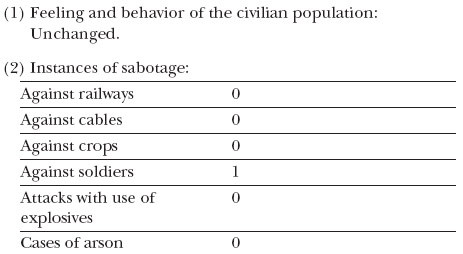
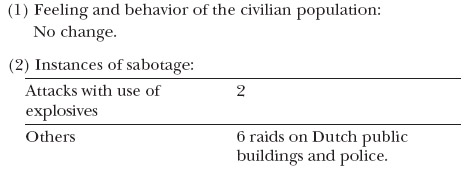
Behavior and attitude of the civilian population:
Unchanged—quiet and expectant.
Sabotage activity and Resistance organization:
Slight local decline in sabotage activities. We can expect further extension of the resistance organizations, especially in Belgium and north France, and in southern Brittany.
In Holland there have been further attacks on Dutch official buildings (including post offices) in the hope of obtaining rationed goods and stealing large sums of money.
Belgium and north France: increase in airborne supplies to secret agents (especially around St. Omer). On July 22, terrorists attacked the French national bank at Abbeville, stealing 39 million francs.
In Normandy, sabotage to cables, and small mines have been laid in the supply roads. In Brittany, the slight easing up of sabotage activities is, according to captured documents, a result of orders from the headquarters of the whole Resistance movement. Many supplies have been dropped in southern Brittany, so that in spite of present conditions, we can expect the arming and equipping of the Resistance movement to continue, and they will probably go over to a coordinated offensive. 88 terrorists have been shot and 65 taken prisoner.
V In detail:
Northern Military District:
A. Coastal defenses (Alterations):

B. Enemy operations on the coast:
None.
C. Operations of enemy aircraft:
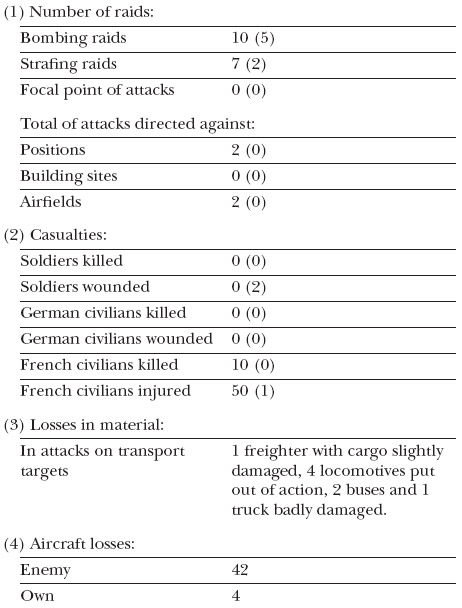
D.
15th Army H.Q.:
A. Coastal defenses (Alterations):
B. Enemy operations on the coast:
3.
C. Operations of enemy aircraft:

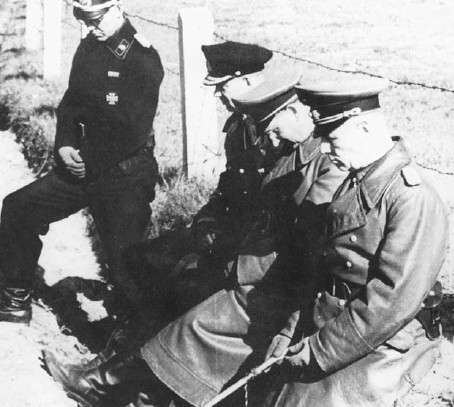
After repeated memos asking for more reinforcements and tanks, Rommel was severely wounded when his car was strafed by Allied aircraft on July 17 near Vimoutiers. Von Kluge now took temporary command of Army Group B, in addition to his post as C-in-C West, and Rommel returned to his home in Herrlingen. He was forced to commit suicide on October 14 after Hitler learned of his association with the July 20 conspirators.
D.

Panzer Group West:
Main defense line, field type, built along the whole front.
7th Army H.Q.:
A. Coastal defenses (Alterations):
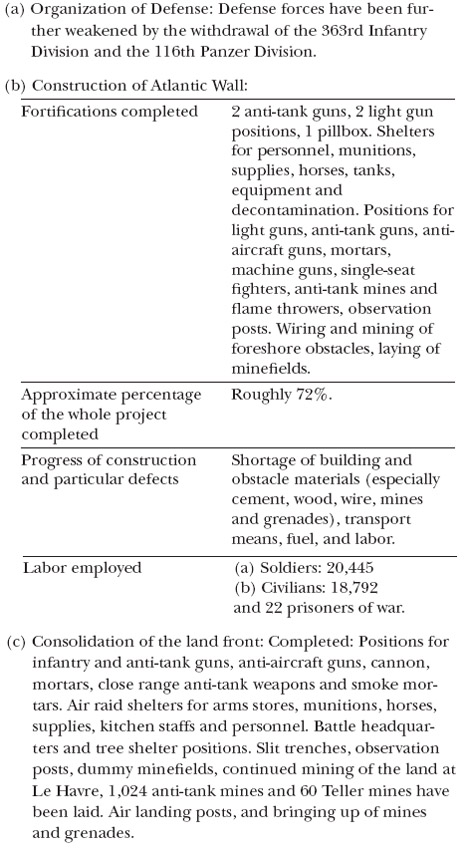
(a) Organization of Defense: The defense of Brittany has been further weakened by the removal of the 275th Infantry Division.
(b) Construction of Atlantic Wall: Available materials all used up. Coastal barriers have been strengthened by the erection of 484 cubic meters of steel reinforced concrete. No more supplies possible at the moment.
For the Army Group High Command,
The Chief of General Staff,
Speidel
ANALYSIS OF THE SITUATION, JULY 15, 1944
The position on the Normandy front is becoming daily increasingly difficult, and it is rapidly approaching its crisis.
Owing to the fierceness of the fighting, the enormous amount of material in the enemy’s possession, especially their artillery and armor, and the undisputed mastery of the air obtained by the enemy air forces, our losses are so great that the battle potential of our divisions is rapidly deteriorating. Reinforcements from home come in very small quantities, and take weeks in arriving because of the bad transport situation. We have lost about 97,000 men, including 2,360 officers— which means an average loss of 2,500 to 3,000 men per day— and we have received until now 10,000 men as replacements, of which 6,000 have already been sent to the front.
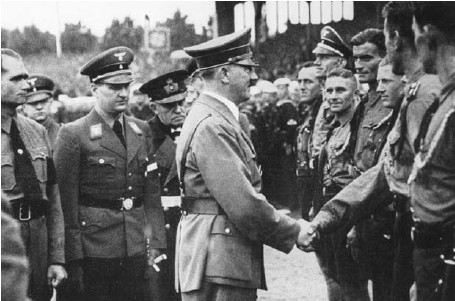
Hitler survived the attempted assassination of July 20 at the Wolf’s Lair when the heavy wooden table shielded him from the blast. He emerged more distrusting of his field commanders, and in the first week of August, he overruled the advice of von Kluge and ordered a major counterattack against the Allies. When Operation LÜTTICH failed, Hitler blamed his “weak generals”—especially von Kluge—for the failure. After being implicated in the July 20 plot, von Kluge committed suicide on August 19.
Also the losses in supplies for the troops have been extraordinarily high, and it has not been possible to provide more than very meagre replacements, as for example 17 tanks up till now to replace about 225.
The divisions which have been newly brought in are not used to battle conditions and with their small consignments of artillery, anti-tank weapons, and means of engaging tanks in close combat they are not able to offer effective resistance to enemy large-scale attacks for any length of time, after being subjected to concentrated artillery fire and heavy air raids for hours on end. It has been proved in the fighting that even the bravest unit is gradually shattered by the well-equipped enemy, and loses men, weapons and territory.
The destruction of the railroad network, and the great danger of enemy air attacks on all the roads and paths for 150 kilometres behind the front has made the supply position so difficult that only the absolutely essential things could be brought up, and above all artillery and mortar ammunition was at a premium. These conditions are not likely to improve, as convoy vehicles are decreasing as a result of enemy action, and with the enemy capturing airfields in the bridgehead it can be expected that their air activities will increase.
No forces worth mentioning can be brought in to the Normandy front without weakening the 15th Army on the English Channel, or the Mediterranean front in southern France. The 7th Army front alone requires most urgently 2 fresh divisions, as the forces there are worn out.
The enemy are daily providing new forces and masses of materials for the front; the enemy supply lanes are not challenged by the Luftwaffe and enemy pressure is continually increasing.
In these circumstances it must be expected that the enemy will shortly be able to break through our thinly-held front, especially in the 7th Army sector, and push far into France. I should like to draw attention to the attached reports from the 7th Army and II Parachute Corps. Apart from local reserves of Panzer Group West, which are about to be sent to the Panzer Group’s sector, and which in the face of the enemy air forces can only march during the night, there are no mobile reserves at all at our disposal to counter any breakthrough on the 7th Army front. Our own air force has hardly entered the battle at all as yet.
Our troops are fighting heroically, but even so the end of this unequal battle is in sight. In my view we should learn a lesson from this situation. I feel it is my duty as C. in C. of the Army Group to point this matter out.
(signed) Rommel
Appendix
(1) G.O.C. 7th Army reports orally on July 14:
“Our strength has sunk to such a low level that the local commanders can no longer guarantee their holding out against enemy large-scale attacks. Battle group of II Parachute Corps reports in addition that of the 1,000 men given to the 6th Parachute Regiment, 800 have become casualties in a very short time. The main reason for this was their lack of experience. Troops must first be trained by experienced soldiers behind the lines. However, the present conditions cannot be altered just yet, as we have no more reserves”.
(2) Reports from 7th Army H.Q. dated July 15, on losses in personnel amongst the units under the command of G.H.Q. II Parachute Corps:
“3rd Parachute Division up till July 12—4,064 men
Battle group 353rd Infantry Division (2 battalions) till July 12—485 men
Battle group 266th Infantry Division (3 battalions) till July 12—316 men
Battle group 343rd Infantry Division (1 battalion) till July 12—184 men
Since the battle strength of the units is sinking noticeably every day, as a result of the superior equipment of the enemy and their uninterrupted artillery fire, even the best troops are no longer in a condition to drive off for any length of time any attempts at a breakthrough”.
(3) I should like to call your attention to the radio message from the battle group of II Parachute Corps on July 12 which was heard by C. in C. West.
REVIEW OF THE SITUATION, JULY 19, 1944
The enemy were unsuccessful in their attempt to force an operational breakthrough during the 2½ weeks of continuous fighting in western Normandy. They did however manage to achieve many local penetrations and to surround isolated pockets of our troops, which meant that our line had to be gradually withdrawn, and we were forced to surrender St. Lo.
The general course of the front line is not favourable, as the left wing is considerably in advance of the rest. The countryside helps our troops only in the northern sector.
Up till now we have found 13 to 14 enemy divisions, of which 2 are armored divisions. Of these, 6 infantry and 2 armored divisions are being used at the point of concentration of the attack, as are also several armored units and very heavy land artillery. As the enemy are only just starting their operations on the mainland, they have not yet marked out any boundaries for the bringing up of further supplies and reinforcements. The enemy have sufficient forces in the Normandy theater of operations to launch another large-scale attack very soon.
We have discovered that the enemy are regrouping on the northern front, and are moving their artillery to the southeast, bringing up more divisions (5 infantry and 4 armored divisions), and also they have started their attacks again on the transport routes behind our lines. There are further signs in their rear that they are preparing soon to begin a new attack to the south and south-west, concentrated on both sides of the Vire and Taute. Enemy attacks on both sides of the boundary of Panzer Group West will probably be continued.
We must also be prepared for a new onslaught with airborne landings, possibly combined with sea landings.
Our own troops are being hard pressed as a result of the heavy losses incurred in the defensive fighting. The battle potential of the infantry is being especially undermined by the artillery and mortar fire, which the enemy is putting up in hitherto unknown quantity, using a tremendous amount of ammunition (20:1), even for small reconnaissance raids, and for the large attacks this is increased to a 30 hour long pounding. Thus in prolonged fighting the potential of the infantry drops from that of a regiment to that of a company. Because of the losses incurred in the previous fighting, the infantry at the front line has become so depleted in many places that after similar artillery preparations, the enemy are bound to break through our lines. The defensive actions and counter-attacks which would then be necessary would quickly use up all the weak reserves in the division and corps. The Army’s reserves at the moment consist of 3 battalions of the 275th Infantry Division.
The heavy artillery bombardments have led to a great loss in arms and equipment, which has been especially noticeable in radio equipment, artillery, cannon and machine guns.
The effect on morale of facing an enemy equipped with such superior weapons is especially bad when the commanders are killed and the units become mixed up in the desperate attempts to close up the gaps.
The use of the newly brought in battle group of the 275th Infantry Division and the 5th Parachute Division, cannot do much to help the difficulties of the 7th Army. These troops have had absolutely no training in field work or as a unit. Apart from the commanders themselves there are no experienced leaders or staffs in two regiments of the 5th Parachute Division. If they were to be used immediately in the danger areas, there would immediately be a crisis, and extremely heavy losses.
As a result of the increased interruptions on the railway lines and the insufficient motorized transport, the present impossible supply situation will only be improved if several munitions and fuel convoys can arrive. If the supply convoys cannot come, then we can expect the supply situation to deteriorate.
To strengthen the defense the Army should put the units and formations in order as far as the situation allows, and regroup the artillery at the danger points.
The following measures are absolutely essential:
(1) Bringing up as an army reserve a mobile formation, completely ready for battle, to be used west of the Vire or to safeguard the boundary with Panzer Group West, (possibly also as defense against airborne or sea landings).
(2) The continual bringing up of reinforcements. At least 2 infantry battalions should be brought up every month, to reinforce each division, otherwise even the weak forces we have at our disposal up till now cannot be maintained.
(3) The strengthening of our front by the introduction of 1 to 2 mortar brigades, more heavy artillery, and replacing the cannon, trench mortars and machine guns which have been rendered useless.
(4) Increased supplies of munitions and fuel should be ensured to be brought in express trains, and the supply lines should be guarded by fighters and anti-aircraft guns, especially at the Loire bridges, which are a vital artery for the Army.
(5) Combating the particularly heavy artillery fire, and the raids by bombers and fighter bombers, by sorties of our own fighters, so that the attack on the morale of our troops can be effectively eased, if only for a time.
(signed) Hausser
July 21, 1944
My Führer!
I forward herewith a report from Field Marshal Rommel, which he gave to me before his accident, and which has already been discussed with me.
I have now been here for about 14 days, and after long discussions with the responsible commanders on various fronts, especially the SS leaders, I have come to the conclusion that the Field Marshal was unfortunately right. Especially my conference yesterday with the commanders of units at Caen, held just after the last heavy battle, forced me to the conclusion that in our present position—considering the material at our disposal—there is absolutely no way in which we could do battle with the all-powerful enemy air forces, to counter their present destructive activities, without being forced to surrender territory. Whole armored units which had been sent into the counter-attack, were attacked by terrific numbers of aircraft dropping carpets of bombs, so that they emerged from the churned-up earth with the greatest difficulty, sometimes only with the aid of tractors. And so they were really too late when they arrived.
The psychological effect on the fighting forces, especially the infantry, of such a mass of bombs, raining down on them with all the force of elemental nature, is a factor which must be given serious consideration. It is not in the least important whether such a carpet of bombs is dropped on good or bad troops. They are more or less annihilated by it, and above all their equipment is ruined. It only needs this to happen a few times and the power of resistance of these troops is put to the severest test. It becomes paralyzed, dies; what is left is not equal to the demands of the situation. Consequently the troops have the impression that they are battling against an enemy who carries all before him. This must make itself evident to an increasing extent.
I came here with the fixed intention of making effective your order to make a stand at any price. But when one sees that this price must be paid by the slow but sure destruction of our troops—I am thinking of the Hitler Youth Division, which has earned the highest praise—when one sees that the reinforcements and replacements sent to all areas are nearly always hopelessly inadequate, and that the armaments, especially artillery and anti-tank guns and the ammunition for them, are not nearly sufficient for the soldiers’ needs, so that the main weapon in the defensive battle is the good spirits of our brave men, then the anxiety about the immediate future on this front is only too well justified.
I am able to report that the front has been held intact until now, due to the glorious bravery of our troops, and the determination of all commanders, especially the junior ones, although land has been lost daily.
However, in spite of all endeavours, the moment is fast approaching when this overtaxed front line is bound to break up. And when the enemy once reaches the open country a properly coordinated command will be almost impossible, because of the insufficient mobility of our troops. I consider it is my duty as the responsible commander on this front, to bring these developments to your notice in good time, my Fuehrer.
My last words at the Staff Conference south of Caen were: “We must hold our ground, and if nothing happens to improve conditions, then we must die an honourable death on the battlefield”.
(signed) von Kluge, Fieldmarshal
TO ARMED FORCES HIGH COMMAND
In addition to my report to the Führer on July 21, I enclose the following summary of the situation by G.O.C. 7th Army, SS General Hausser.
I wish to add the following to measures suggested at the end of it.
|
to (1) |
Panzer Training Division to be relieved by the 363rd Division, which is coming up to the front, and placed under the command of the Army. Length of time: 14 days. 2nd Panzer Division on the Army boundary to be relieved by the 326th Division. It cannot yet be decided whether they can be sent to the 7th Army or to the area of concentrated fighting around Caen. |
|
to (2) |
According to a message from Army G.H.Q. this will be impossible at the moment. |
|
to (3) |
The 7th, 8th and 9th Mortar Brigades are stationed at the centre of the present bitter fighting around Caen. Additional heavy artillery cannot at present be brought up, as the 14th Artillery Brigade amongst other units is being diverted to the east. |
|
to (4) |
Replacements of equipment are desired, although we cannot expect the amount required. |
|
to (5) |
We are attempting to engage the enemy, but with the enemy air superiority at the vital points on the front this has not yet been possible. |
(signed) von Kluge, Fieldmarshal
Footnotes
1 D’Este, 327; Lamb, “Kluge,” in Barnett, ed., 405.
2 Terry Copp and Robert Vogel, Maple Leaf Route: Falaise, Antwerp & Scheldt (Alma, ON: Maple Leaf Route, 1987), 41–42.
3 Stacey, 158.
4 Blumenson, 175.
5 Hinsley, 216.
6 Gilbert, 556.
7 OKW, 55.
8 D’Este, 377.
9 D’Este, 399.
10 Blumenson, 147.
11 Müller, “Witzleben, Stülpnagel, and Speidel,” in Barnett, ed., 63.