FOREWORD
I am delighted that I have been asked to write the foreword to this book.
Over the years, a great deal has been written about the battle of Arnhem in 1944. This has been mainly about the attempted capture of the bridge over the Rhine by the parachute battalions. Little attention by the media has ever been given to the men of the Air Landing Brigade. Those who too wore the red beret, but were given the task of defending the perimeter of the battle in an attempt to keep open the last ferry across the Rhine in the area of Oosterbeek. This was just as an important part of the battle as that for the bridge, for had the armour of the relieving forces not had this ferry and an area on the North side of the river to deploy in, their task would have been much harder.
As we all know the division was withdrawn before the armoured units arrived. It is to Brigadier Frank Steer that a great deal is now owed in writing this book which highlights the very intense battle which went on in the area of the suburb of Oosterbeek and in which many men lost their lives and many others were wounded. As an example, in my own company at the end of the battle there were only nine men left and one officer badly wounded who were still fighting on. The rest of the 110 strong company had either been killed or wounded. This was typical of the position along the whole perimeter. There were many acts of heroism in this area, most of which are unrecorded because men were killed or taken prisoner.
So, I commend this book and the tour of this part of the Arnhem battlefield to you.
Reverend Canon,
Alan Green
Leicester, May 2002.
In writing this guide to the landing areas used by the 1st British Airborne Division in its attempt to take the Arnhem Bridge, and in seeking to describe some of the fighting in and around Oosterbeek, a small town to the west of Arnhem, I have been fortunate to obtain the support of a number of authors, friends and colleagues. The result, I hope, is that visitors who have had limited opportunity to study this most complex operation will be able to have an enjoyable and informative visit to the area and gain a broad, clear understanding of this part of the battle.
Authors on Arnhem now face the fact that many of the participants who contributed to earlier works with their anecdotes are to a great extent no longer in a position to do so. Therefore, whilst I have been able to include original source material from my own studies of logistics at Arnhem, I have been to a great extent dependent upon fellow authors or their relatives to quote or use material from their works on the battle. They have given their permission willingly and without caveat and I am enormously grateful to them:
Christopher Hibbert from Arnhem; General Sir Anthony Farrar-Hockley from Airborne Carpet: Operation Market Garden; Stuart Eastwood, Charles Gray and Alan Green from When Dragons Flew – An Illustrated History of the 1st Battalion The Border Regiment 1939-45; Ron Kent from First In! Parachute Pathfinder Company; Robert Sigmond from Off At Last – An Illustrated History of the 7th (Galloway) Battalion The King’s Own Scottish Borderers 1939 – 1945, John Fairley from Remember Arnhem; Robert J Kershaw from It Never Snows in September; John Waddy from A Tour Of The Arnhem Battlefields; Harry Bankhead from Salute To The Steadfast – From Delhi To Arnhem With 151/156 Parachute Battalion; Niall Cherry from Red Berets and Red Crosses; Peter Wilkinson from The Gunners at Arnhem; Stuart Mawson from Arnhem Doctor; and Mrs Pamela Urquhart From Arnhem by Major General Roy Urquhart. Without their agreement a work of this sort, so dependent on the experiences of those present to be meaningful, would simply never have got off the ground.
Drs Adrian Groeneweg OBE, vice-chairman of the board of trustees of the Airborne Museum Hartenstein was as ever on hand to provide guidance, support and help. He has been a friend and teacher for many years and his unfailing preparedness to help and advise is a constant refuge for those who wish to learn more of, and learn lessons from, the events of September 1944. He knows he has my immeasureable thanks.
Dr Robert Voskuil was also unstinting in his assistance to my endeavour. Both were kind enough to spend time on my drafts and kind enough not to be too unkind about my errors, for which I am more than grateful. Robert Voskuil, as well as helping me with photographs from the late-war or immediate post-war period, went out of his way to obtain a number of the modern pictures that appear in the book. He also took the time to prove the route, checking that my directions made some sort of sense. I am encouraged that he found them both easy to follow and relevant. Robert Sigmond, always a source of wisdom and knowledge, provided additional material, and in particular photographs of KOSB soldiers. Jook and Hanna van Slooten’s home was always a haven of peace and laughter where a weary researcher could find solace, a warm welcome and an endless supply of quite excellent tea. Jook’s help and guidance with local information and proof reading were invaluable, and I am grateful to him and Hanna also for checking the routes and confirming the detail of some of the distances quoted.
I would like to thank the Trustees of the Airborne Forces Charities Trust for their kind permission to reproduce the painting, Arnhem 1944 by Lea, on the front cover.
I am immensly grateful to Alan Green for reading the draft of this book and for providing the foreword. He, after all, was there and knows what it was really like, far better than any of us who try to represent events now half a century old. We have walked his battle ground together and he has my respect in great measure; as have all those who were at Arnhem. His approval of what I have tried to encapsulate in this small guide to one part of Operation MARKET GARDEN means more than I can express in words.
To all of those who helped, my thanks and the hope that I have taken proper account of all your points. If I have been unsuccessful then any mistakes are my responsibility and mine alone.
Brigadier Frank Steer MBE
Kent, 2002.
GLOSSARY
|
ACC |
Army Catering Corps |
|
CO |
Commanding Officer |
|
COMPO |
Composite Rations |
|
Coy |
Company |
|
CWGC |
Commonwealth War Graves Commission. |
|
DAA |
Divisional Administrative Area. |
|
DUKW |
A two and a half ton, 6X6 amphibious vehicle. D – 1942; U – Amphibious; K – 6x6 Drive; W – Tandem. |
|
DZ |
Dropping Zone. |
|
HQ |
Headquarters. |
|
KOSB |
King’s Own Scottish Borderers. |
|
LZ |
Landing Zone. |
|
Mortar |
Infantry battalions’ artillery. Bomb range around 3,000 yards. |
|
NCO |
Non-Commissioned Officer. |
|
OFP |
Ordnance Field Park |
|
PIAT |
Projector Infantry Anti-Tank. |
|
RAF |
Royal Air Force. |
|
RAMC |
Royal Army Medical Corps. |
|
RAOC |
Royal Army Ordnance Corps. |
|
RAP |
Regimental Aid Post. |
|
RASC |
Royal Army Service Corps. |
|
RE |
Royal Engineers. |
|
RV |
Rendezvous |
SIZE AND SHAPE
To help understand the story there follows a short description of the size and shape of the military formations mentioned in the book:
Corps:
A grouping of divisions, typically between two and four. Size between 30,000 (a light airborne corps) and 50,000 (a full all-arms structure) men with, in the latter case, some 25% of the total strength comprising corps level units (logistics, artillery, engineers). Commander – Lieutenant General.
Division:
A grouping of brigades, typically between two and four, together with a number of divisional level units (logistics, artillery, engineers) making up some 25% of the total strength. Size between 10,000 (airborne) and 25,000 (all-arms) men. Commander – Major General.
Brigade:
A grouping of battalions, usually three, plus a very limited number of brigade level units making up perhaps 10% of the total strength. Size between 2,500 (airborne) and 5,000 (all-arms) men. Commander – Brigadier.
Battalion:
A grouping of companies, three or four. Some 40% of a battalion would be in the support element (heavy weapons, logistics, engineering, administration). Size between 700 and 900. Commander – Lieutenant Colonel.
Company/Squadron:
A grouping of three or four platoons/troops. Size between 100 and 120, although some specialist units would be smaller. Commander – Major
Platoon:
A grouping of sections, almost always three. Size between twenty-six and thirty-five. Commander – Lieutenant or Second Lieutenant.
Section:
A group of between 8 and 10 men, commanded by a corporal.
ADVICE FOR VISITORS
A visit to the scene of the battle fought between 17 and 26 September 1944 by the 1st British Airborne Division in its attempt to reach and hold the road bridge over the Lower Rhine at Arnhem in the Netherlands, takes the visitor to a number of villages lying a few miles to the west of Arnhem itself: principally Oosterbeek, Renkum, Wolfheze and Heelsum. Lying in the eastern part of the Netherlands and not far from the German border, it is a delightful part of a delightful country.
The countryside around the villages has changed very little since 1944. Of course, there are more buildings, and the huge advances in public facilities and transport that are a mark of Dutch investment in their country are clear for all to see. However, the lie of the land remains as it was: largely open farmland interspersed with areas of forest and heath land; and trenches can still be found in the woods through which some of the fighting took place. It is a wealthy area, as it was before the war. The houses tend to be large, with imposing gardens interspersed by chain link fences and hedges that presented enormous problems to friend and foe alike during the battle.
The weather is variable, with similar maritime influences to our own climate. However, on a really hot summer’s day wisdom does suggest cream and a hat to ward off the sun. The ground is flat and the soil sandy and well drained, with only a few small hills to walk up. This tour does not, therefore, require robust walking boots, but comfortable cross-country shoes will be helpful. There are a reasonable number of watering holes on this tour, so in the event of rain it should be relatively easy to find shelter. However, a light waterproof is also a good idea in case you stray a little way from the car, although provisions, such as flasks of tea are, really, unnecessary.
Health insurance, accompanied by an E111 (available from post offices on production of a national insurance number), is strongly recommended.
To get to the area the alternatives involve either ferries or flying. As to ferries, Dover to Calais is the shortest crossing, using either P&O Stena or Sea France. The P&O Stena sailings are very much more frequent, but it is worth checking both company’s tariffs to see what special deals they are offering. Driving sensibly and given good traffic the centre of Arnhem, just 6 to 8 miles to the east of the battlefield tour area, is under four hours from Calais, and all the motorways are toll free. The timing allows for one stop, on the Dutch/Belgian border at Breda. To get to Breda, follow the E40/A16 from the port of Calais to Dunkirk, on to Ostend and then to Brussels. In the area of Ghent you reach the junction with the E17 and turn north towards Antwerp. Once at the Antwerp Ring Road the signs for Breda are obvious and you follow them to your comfort stop at the motorway rest area. On departure from Breda, drive north on the motorway A58 and then the A27/E311 in the direction of Utrecht until its junction with the A15. Turning onto the A15/E31 follow it east, signed Nijmegen. Once beyond Tiel and before Nijmegen there are two choices, and the one you select may well depend on where you may be staying. If you are lodging in the town of Arnhem you should follow the signs to Nijmegen and Arnhem and go into the town across the motorway bridge into Arnhem. For those staying in or around Oosterbeek, however, turn north at the junction with the motorway A50 signed Apeldoorn and at the second junction, having just crossed the Rhine, turn off and follow the signs for Oosterbeek.
For those in the north and east of the UK, Harwich or Hull may be better departure ports, travelling to the Hook or Rotterdam/Europort respectively. From either of these ferry terminals the A15 is easy to find and follow and the driving time is under two hours.
By air, there are flights to Schipol, Amsterdam’s airport, from most UK main and regional airports. Once there either hire a car, or take the train from the station at the airport, and with one change it takes you to Arnhem. Please note, however, three of the four tours in this guide require a motor car, so hiring in some form will be necessary if you choose to fly or take the train.
Driving in The Netherlands carries few surprises. Roads are wide and good, but do beware at roundabouts where they have some differences on rights of way although the general rule is that all traffic, including bicycles and horse riders from the right, has right of way. Guidance, if unsure, can be obtained from your motoring organisation. The Oosterbeek area has a number of dense woods, and where roads pass through them you are invited to use dipped headlights as a warning to oncoming motorists; and driving lit up everywhere is officially recommended.
As a pedestrian do watch out for the cycle tracks. They usually stand out, being of red tarmac surfacing, but not always. However, there is a tendency by the uninitiated to use them as footpaths or pavements, which they are not. The cyclist has right of way, although they will usually try to warn with a bell. However, do take care to look both ways when venturing near one.
As to maps, any standard continental road atlas available at main bookstores or through the motoring organisations will suffice as a guide to get you there. Once in the area any bookshop or petrol station will sell good quality local area street and road maps that will be more than adequate for a good and detailed tour. If you are unsure about your purchase covering the whole area of the battle simply ask and the shopkeeper or garage attendant is almost certain to be able to advise.
During your visit to the Netherlands communication will not be a problem. If those you address in English cannot speak the language then they are probably not Dutch. You will find the people of Oosterbeek, Wolfheze, Renkum and Heelsum have a very special relationship with their British guests, and especially those who were either present at the battle or members of their families. You will be received with friendliness unequalled anywhere in the world – it is a truly remarkable experience, and is built on a relationship that promises to endure for a long time to come.
As to accommodation, Arnhem is a good place in which to stay as a base for this tour. As a guide, the Haarhuis (0031 26 4427441; email haarhuis@bart.nl) is a four star Best Western Hotel, whilst the Old Dutch (0031 26 4420792) is a smaller, but very comfortable, establishment just up the street. Both are directly opposite the railway station – and following the road signs to ‘Station’ makes them very easy to find. They are conveniently positioned for the centre of the town with its plethora of bars, pubs and restaurants, all offering excellent service and good value for money.
If, however, you wish to be closer to Oosterbeek and the landing areas then the West-End Hotel is a good choice. The address is:
Amsterdamseweg 505, 6816 VK Arnhem.
Email: receptie@westend.valk.com,
telephone 0031 26 4821100 or fax 0031 26 4821614
For those wishing to camp or caravan then there is a well-signed site in Oosterbeek near the sports ground and it is shown in all good caravan site guides. Details of other accommodation, and information on other related issues, can be obtained from the Tourist Information office in Oosterbeek: Telephone 0031 26 3333172 or Fax 0031 26 3332990. They can also put you in touch with the Arnhem office, which has better resources.
There are four tours described in this guide, one on foot and three by car, and it is perfectly possible to complete them all in one day, albeit a long day. However, a visit to the Airborne Museum Hartenstein, which was the headquarters of the 1st British Airborne division during the battle, is a must and preferably at the start of your tour. The museum, though, is only open between 10.00 am and 5.00 pm Monday to Saturday between 1 April and 1 November, and 11.00 am to 5.00pm for the rest of the year. On Sundays and public holidays timings are 12.00 midday to 5.00 pm. Timing is, therefore, difficult, but if it can be visited the day before that would be best. It has a wonderful range of exhibits and its diorama of the battle offers a very clear explanation of what happened and will assist greatly in understanding what was a very complex operation. Attention span in museums differs widely from person to person, but a minimum of an hour should be allocated to the Hartenstein for a proper overview of events. Each of the tours in this guide commences at one of the car parks near the museum.
The Hartenstein is easily reached by turning south off Utrechtseweg just 100 metres west from the crossroads with Stationsweg and Pietersbergseweg in Oosterbeek. Just as you turn left off Utrechtseweg there is a large church on the left where the car park is usually reserved for coaches. With a car take the first right and park behind the Kleyn Hartensteyn Café from where it is a 200 metre walk to the museum.
Your tour will be more fruitful if you can read this guide before departure. It will help put into context what happened and will serve as a useful reference as you drive into and around the area. Arnhem was a hugely complex battle, with a number of key events overlapping, and with two battles really taking place: one in Arnhem itself and the other in Oosterbeek. This guide does not set out to cover every single aspect of what happened, or cover every event in detail. It seeks to offer visitors an overview, and to allow them to obtain a real feel for events without becoming overburdened with a plethora of detailed information which only the most well-informed could assimilate, and which is covered in the many books on this battle.
Once on the spot in Oosterbeek this guide will describe what happened, using, wherever possible, anecdotes from veterans. After all, it is they who were there and without their input a work of this sort is without colour. Wherever ranks are used they refer to those held during the battle and do not reflect any advancement which might have been subsequently achieved in a post-war military career.
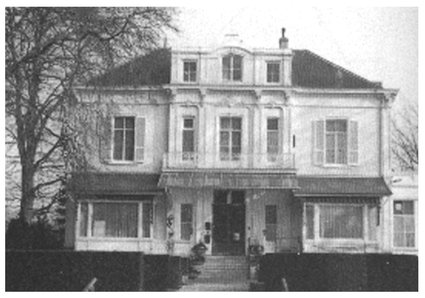
The Airborne Museum ‘Hartenstein’.
Try, if you can, as you read the text in the privacy of your home or out on the battlefield, to imagine a gallant, and now very old, gentleman wearing a blazer, his regimental tie and a red beret, his medals displayed proudly above his left breast pocket, speaking gently as he tells you of a time of unimagined horror and inexplicable courage – and forgive him, please, the tear in his eye as he remembers what happened in those dark days and those who were with him then in body, and who remain with him in spirit.
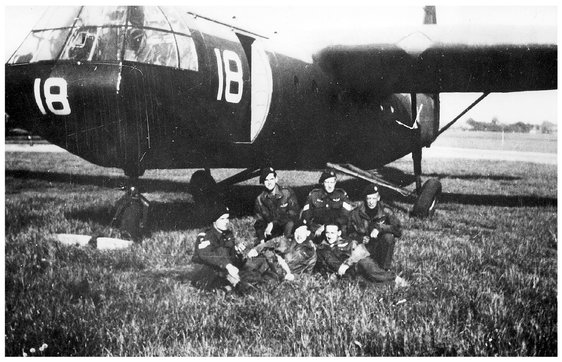
A Horsa Glider. Courtesy Museum of Army Flying.