
The Terrain at Bannockburn
The Carse of Stirling, of which the Carse of Balquhiderock formed a part, was in 1314 a large area of flat, low-lying, boggy ground with areas of sodden peat. It was bordered to the north by the River Forth and to the south by a steep bank or escarpment, marked by the 20m contour at its base, which follows an almost straight line south-east from Stirling. Above this bank to the south-west the terrain is dryer and firmer, the ground undulating and wooded and rising gradually across two or three miles towards the higher and rougher moorland and hills around the headwaters of the Carron and Bannock Burn 500m above the carse. In addition to the springs that rise above the escarpment, all the surface water from the hills drained down into the flat peaty carse, which as a result was intersected in the 14th century by a large number of sluggish streams with deep peaty pools and overhanging crumbling banks, known by the Celtic word ‘pols’. The entire Carse of Stirling was known at the time of the battle as ‘les Polles’ and would have presented a serious obstacle to a large army with its baggage train. The Carse of Stirling is mainly well-drained farmland today, the pols have largely disappeared, though the place names of the area betray their former existence.
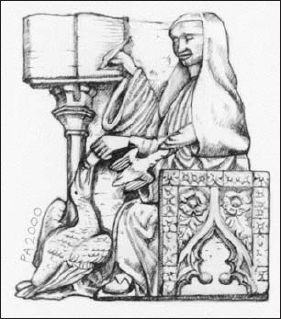
Medieval scribes, like this one at his lectern, are the source of much of our information. The imagination of the carver of this misericord in Worcester Cathedral has strayed into the realms of the fantastic, judging by the goings-on of his menagerie, a trait exhibited by some of the chroniclers themselves. (author’s drawing)
The choice of route for the English army, approaching Stirling from the south-east, was thus extremely restricted. The only practical way was along the corridor of firm undulating country between the high moorland to the west and the boggy carse to the east. The ideal route was thus along the high road that ran through the middle of this area. Straddling the road was the wooded New Park, which was really a northerly continuation of the Torwood but was separated from it by the open, partly cultivated land of the Bannock Burn valley. The park had been fenced in by Alexander III in 1264 and was called New Park to distinguish it from the earlier King’s Park below Stirling Castle. East of the New Park were the lands of the estate of Balquhiderock, which consisted partly of the cultivated Dryfield and partly of carseland. The Dryfield extends for about half a mile between the woodland of the park and the bank that falls steeply away to the boggy Carse of Balquhiderock, which lies between the Bannock Burn and the Pelstream Burn. Both these burns cross the Dryfield between high, steep banks, entangled with undergrowth and trees. The gorge of the Bannock Burn retains some of these features and remains impressive to this day. In 1314 the inhabited location above the gorge of the Bannock Burn was known as Bannock and later Bannockburn. There are divided opinions as to whether the battle took its name from this settlement or from the burn of the same name.
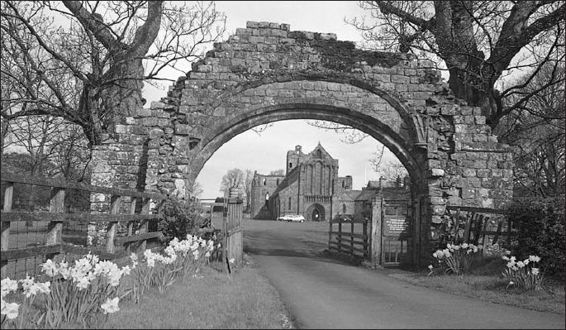
Edward I stayed at Lanercost Priory during the winter of 1306/07 and it was here that the dying King condemned Thomas and Alexander Bruce to death as one of his last and most vindictive acts. The Chronicle of Lanercost preserves an eyewitness account of the battle of Bannockburn, probably from a Cumbrian knight who fought there.
Contemporary Sources
There are three important English accounts of the battle; that in the Vita Edwardi Secundi by the well-informed Monk of Malmesbury may have been written as early as 1315. The Chronicle of Lanercost, an Augustinian Priory near Carlisle, includes an account that was probably written down at the time from information given by a Cumbrian knight who fought in the battle. In the Scalacronica of Sir Thomas Grey we have an account of Bannockburn from the author’s father who fought in the battle. Though the chronicle was not compiled until 1355, the story of the battle must have been told to the author many times when he was a lad before he eventually set it down in writing. Of lesser importance are the Annales Edwardi Secundi of John de Trokelowe, written in about 1327, and Geoffrey le Baker’s Chronicle of 1341. Both books describe the battle but are further removed from events, lack conviction and add little to the earlier accounts. The Canon of Bridlington, writing in the 1330s, has little of additional interest to add either.
From the Scots viewpoint the main source for Bannockburn is John Barbour, Archdeacon of Aberdeen, who completed his epic biographic poem The Bruce in 1376. It contains a lengthy and convincing description of the battle, which agrees in many respects with the accounts we have from the English sources. Barbour may have written 60 years after the battle, but for his account he drew on written sources that are now lost and on tales he had heard over the years from surviving veterans, though the only one he names is Sir Alan Cathcart, who told him of his adventures with Edward Bruce in Galloway. These are in fact the methods of any historian, ancient or modern. Barbour fills out the bare bones of the story with detail that brings the events to life but he has been accused of dramatic invention because his details are not corroborated by the other sparse accounts written nearer in time to the battle. The accounts in the Vita, Lanercost and the Scalacronica are all incomplete and exasperatingly sparing of detail. Even the most valuable source, the Vita is unbalanced by Malmesbury’s fascination with the doings of Gloucester and his untimely demise. Whatever weight we choose to attach to John Barbour’s account inevitably colours our view of the battle of Bannockburn.
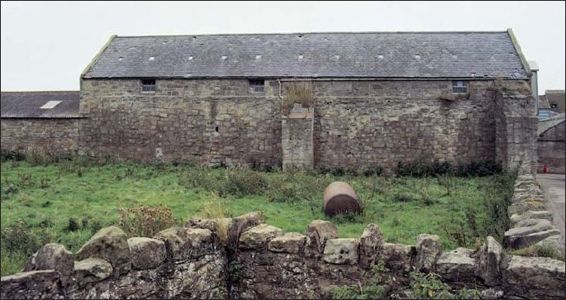
The Scalacronica of Sir Thomas Grey of Heton on the Till, was written while he was languishing without a ransom as a prisoner in Edinburgh Castle. Only a broken remnant of Sir Thomas’s castle now remains to remind us of the turbulent centuries of warfare on the Border. (photo Peter Ryder)
Scots deployment – Saturday 22 June
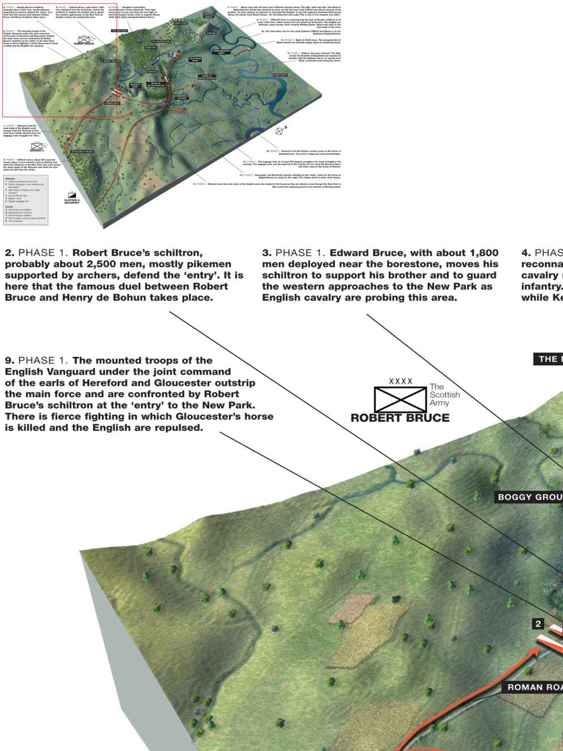
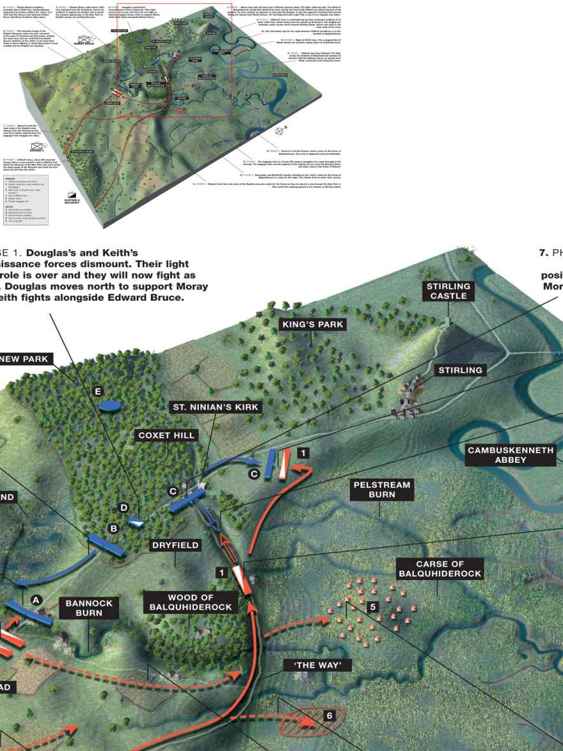
The New Park was an enclosed, wooded hunting preserve about a mile from north to south by two miles from east to west. The park was set back half a mile north of the Bannock Burn at the point where the main road, along which the English were expected to advance, entered the woods. It was here, at the ‘entry’ to the New Park, that King Robert halted and drew up his rearguard in the open woodland. The Earl of Moray with the vanguard was to the north of the King’s division at St Ninian’s Kirk and Edward Bruce’s division was positioned astride the road somewhere between the two. The Scots still retained their marching order for withdrawal, yet, hidden by the woods from the English, they were ideally positioned to oppose their advance, whether this came from the front or from the flank; in the event it came from both directions. The ‘small folk’, carters and camp followers, were sent away to a valley some way off, possibly one of the hollows below Coxet Hill, where they were safely out of the way as Bruce needed only his fighting men beside him as the English drew near.
Bruce ordered that a series of concealed pits or ‘pottis’ be dug, a foot in diameter and knee deep with a wooden stake in the bottom, to honeycomb the ‘open field beside the road, where he thought the English would have to go if they wanted to move through the Park to the castle’. Evidently they were on either side of the road, where a frontal attack on the entry to the New Park might be expected. Curiously, apart from the fact that they were dug, there is no mention in any reliable source of their having any effect on the course of the fighting. Aerial photographs, taken during a particularly dry summer show what may be these pits across the Roman Road south of the entry. Recently, several sharpened wooden stakes that were found at Milton Bog in 1923 were re-examined and it is thought that they may be stakes from the bottom of the pits. It is hoped to carbon date them soon to confirm their age.
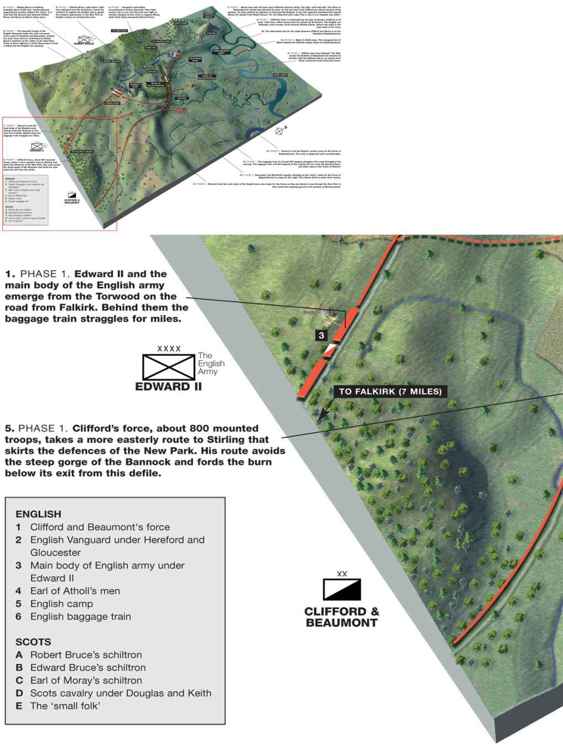
Early on Sunday morning the Scots, still in the positions they had taken up the previous day, heard mass and in good heart awaited events. Douglas’s and Keith’s cavalry reconnoitred the advance of the English army from Falkirk. Sir Philip Moubray, the castellan of Stirling Castle, presumably with a safe-conduct from Robert Bruce, rode out to meet the King as he advanced by way of the Torwood. Moubray told Edward that now that the English army was within three leagues (6 miles) of Stirling Castle and had arrived before St John’s Day, i.e. 24 June, the terms of his agreement with the Scots meant that the castle was now relieved, honour was satisfied and he need advance no further. It was probable that the Scots would retire without a fight and it might be well to await events advised Moubray, who was a Scot himself. He knew that Bruce was dangerous and warned Edward of the strength of the Scottish position in the New Park, where the woods had been made impassable by blocking the narrow pathways. Whether or not this cautious advice fell on deaf ears matters little as the forward troops, advancing impatiently drawn on by the withdrawing Scottish scouts, had taken on an independent momentum and were now beyond Edward’s ineffectual control.
Meanwhile, Robert Bruce was concerned when he heard Douglas’s report of the strength of the oncoming English and told him not to cause alarm, but rather to tell the troops that the English came on in great disorder. In fact this was true, the leading troops were pressing forward eagerly, leaving much of the army straggling and strung-out over many miles to the rear. The leadership similarly was in disarray as King Edward, in a foolish gesture of favouritism towards his nephew, the young Earl of Gloucester, had appointed him not only constable of the army on this occasion but also joint commander of the vanguard with Humphrey de Bohun, Earl of Hereford. The older and more experienced Hereford was by right the hereditary Constable of England. As neighbouring lords of the Welsh Marches, there was a long-standing and bitter rivalry between the De Bohuns of Brecknock and the Clares of Glamorgan. By advancing Gloucester’s pretensions to command, with a contempt for military considerations, Edward undermined Hereford and left the English van without decisive direction.
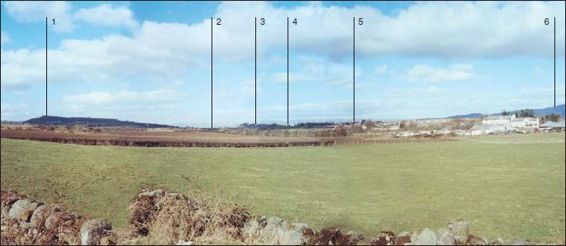
Panorama of the Bannock Burn valley looking north towards Stirling Castle from the English line of advance. The course of the Bannock Burn is marked by a line of trees in the middle distance.
1. Gillies Hill.
2. Ben Lomond.
3. Coxet Hill.
4. Flagpole and rotunda on site of the borestone.
5. Stirling Castle.
6. Ochil Hills.
(from NS799893)
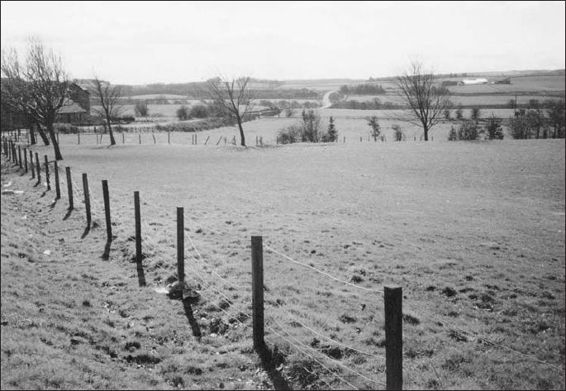
The Bannock Burn valley from the Scottish position in front of the entry to the New Park. The course of the Bannock Burn is marked by a line of trees in the dip in the middle distance. (from NS796904)
Bruce versus Henry de Bohun
The afternoon shadows were lengthening when Edward and his entourage halted to decide whether the army should take up quarters for the night or fight that day. The vanguard knew nothing of this delay but rode on towards the New Park. As they emerged from the Torwood they saw the Scottish mounted reconnaissance force withdrawing before them and spurred their mounts forward in pursuit towards the entry to the New Park. To the fore was the Earl of Hereford with his strong retinue of knights and men-at-arms, among whom were his brother Gilbert and his hot-blooded nephew Henry. As the leading groups of horsemen crossed the open valley of the Bannock Burn, the Scots pikemen began to emerge from the woods ahead and form up to oppose their advance. Henry de Bohun was a good bow-shot to the fore and, as he drew rein before the Scots, he sighted a knight mounted on a spirited grey palfrey, arraying his pikemen with an axe in his hand; the double tressured lion of his surcoat and the glint of gold from the crown encircling his bascinet identified him as the Bruce. De Bohun, sensing that his moment of glory had come, wheeled his charger and spurred towards the king with an arrogant taunt on his lips. Bruce set his horse towards his challenger, who bore down full-tilt. As they closed Bruce swerved his nimble horse aside to avoid de Bohun’s lance and, standing in his stirrups, struck him such a blow with his axe that it cleaved through the English knight’s helmet and bit deep into his brain. The axe shaft shattered with the impact and De Bohun crashed from the saddle, dead before he hit the ground. His gallant squire was killed standing over his fallen master as the eager Scots pressed forward, emboldened by King Robert’s portentous feat of arms. The ranks of pikemen formed an impenetrable, bristling hedge of steel-tipped pikes against which the charge of the horsemen of the English vanguard, far outstripping their infantry support, foundered in bloody confusion. Gloucester, at the head of his troops, was dragged to safety as his horse was killed under him in the thick of the fray. Then, as Edward Bruce’s division debouched from the woods in support of the battling rearguard, the English fell back. With a great shout, the Scots surged forwards and the English horsemen turned and fled, beaten and in disorder. The Scots pursued them but the well-mounted English escaped with little further loss. Bruce recalled his men and withdrew to the safety of the wooded New Park. Those Scots lords with the King who dared speak out, remonstrated with him for the risk he had taken in accepting de Bohun’s challenge, which could have been fatal to their cause. The Bruce made no answer but bemoaned the loss of his good battle-axe.
The Vita gives a rather less heroic account of the duel. ‘ … Henry, seeing he could not resist the multitude of the Scots, turned his horse with the intention of returning to his companions; but Robert opposed him and struck him on the head with an axe … his squire trying to protect or rescue his lord was overwhelmed by the Scots.’
Clifford Repulsed
As Gloucester and Hereford’s horsemen pressed on along the main road towards the entry to the New Park, a strong mounted force under Sir Robert Clifford spurred to the fore and rode north towards Stirling, aiming to skirt round the New Park and win through to the castle, past the Scottish left flank. Estimates of the strength of this mounted squadron vary, but it was far more than a patrol or raiding party, it was undoubtedly a formidable fighting force. Barbour says there were 800 horse under four bannerets, including Clifford, Sir Henry Beaumont and the Yorkshire knight Sir Miles Stapleton. Sir Thomas Grey, whose father, Sir Thomas Grey the elder of Heaton on the Till, rode with Clifford’s cavalry force, tells of only 300 horsemen and, as he was there, we must incline to his figure. It may be that Clifford’s force was intended to carry out a reconnaissance in strength to see if the army could reach Stirling without passing through the New Park. However, this is not confirmed by contemporary writers. Grey offers no explanation. Barbour says that Clifford’s task was to ‘go to the castle, for if they could indeed reach there, they thought it would be rescued’. According to the Lanercost Chronicle, Clifford, ‘wished to ride round the wood to prevent the Scots escaping by flight’. It seems that the English at this stage were still confident that the Scots did not intend to fight a pitched battle outside Stirling. We cannot be sure what Clifford’s intentions were, it is possible that his advance was as independent of the King’s direction as that of Gloucester and Hereford. However, we can be sure that there was neither liaison nor co-ordination between these advance units of the English army, and both may have started out under the delusion that they were pursuing an enemy in full retreat.
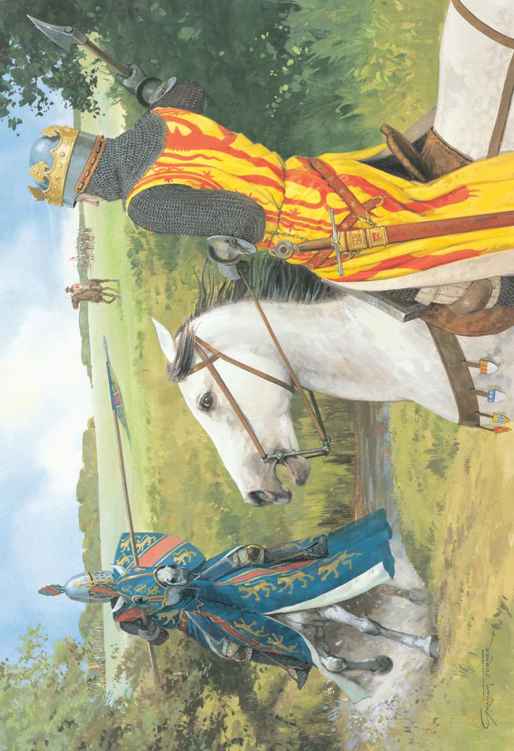
Henry de Bohun, hot-blooded nephew of the Earl of Hereford, was at the forefront of the English vanguard as it emerged from the Torwood. Catching sight of Robert Bruce arraying his pikemen, De Bohun spurred his charger towards the Scottish King. Scorning flight Bruce turned his grey palfrey towards his challenger and as De Bohun thundered towards him nimbly swerved aside. Standing in his stirrups he brought his battle-axe crashing down on the helmet of his opponent. The blow cut through the helm and bit deep into the brain of the impetuous young knight, killing him instantly and shattering the shaft of the axe. De Bohun’s squire was killed defending his fallen master’s body. The Scots lords chastised their king for taking such a risk, but Bruce remained unrepentant, lamenting only the loss of a good axe. (Graham Turner)
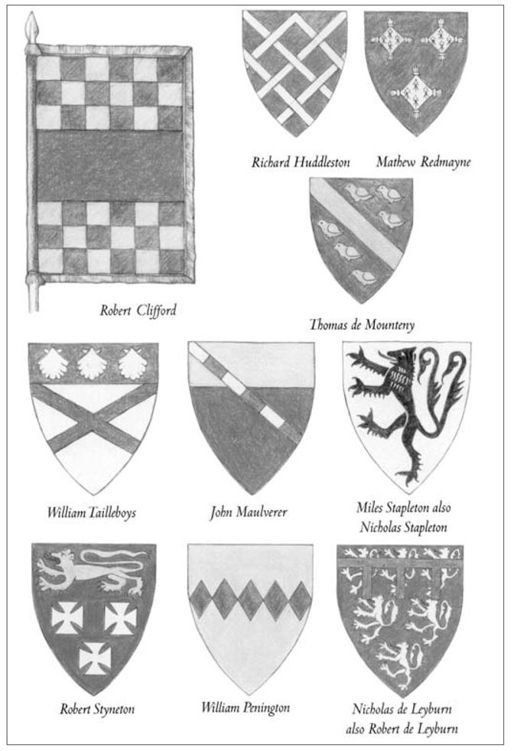
Arms of the knights of Sir Robert Clifford’s retinue at the battle of Bannockburn. (illustration by Lyn Armstrong)
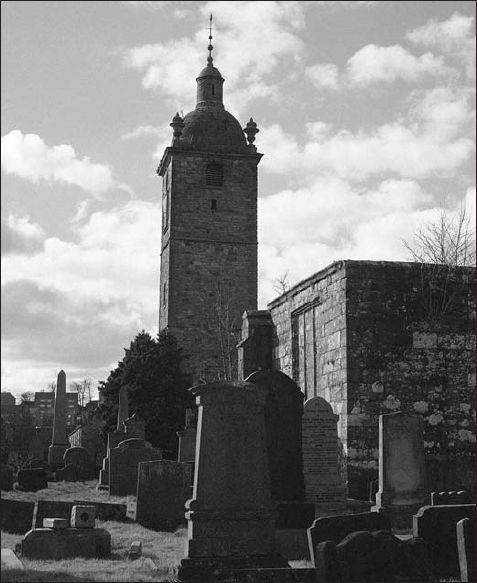
St Ninian’s Church today; little remains of the original building that was badly damaged during the ‘45 Rebellion when Jacobite ammunition stored inside exploded.
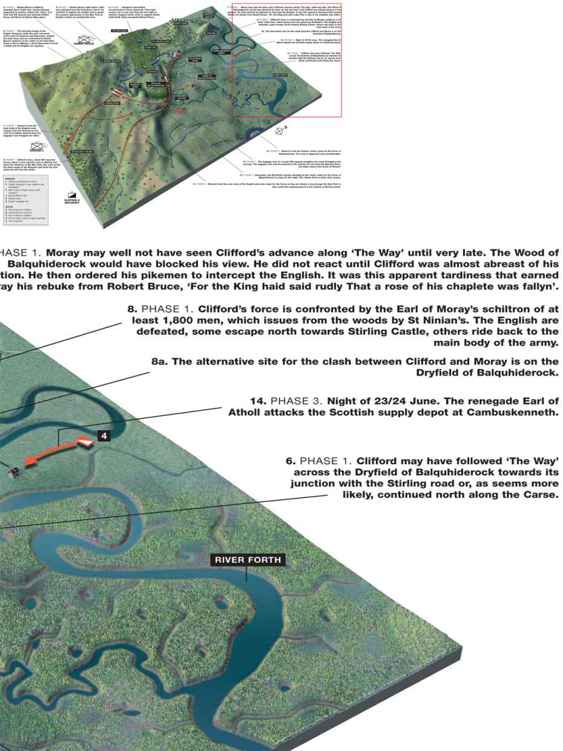
Clifford’s force, as both Grey and Barbour emphasise, rode in the open fields, well clear of the trees of the New Park, towards Stirling. The route they took was most probably along the track known as ‘the Way’, which skirted the escarpment along the flat carse and led to a ford where the Bannock Burn issued from its gorge on to the Carse of Balquhiderock. They rode past St Ninian’s Kirk, below which the boggy Pelstream Burn flows into the carse. They were unopposed and must have thought their way to Stirling was clear. However, the Earl of Moray’s division was posted near St Ninian’s to guard the main road north against a flanking movement such as this by the English. Bruce made no dispositions to cover an advance further out on the carse, so presumably he considered the terrain there impractical. Clifford had passed below Moray’s position before the earl responded, earning King Robert’s displeasure who told the earl bluntly that ‘a rose had fallen from his chaplet’. Moray was annoyed and angry with himself and set about restoring the situation, and with no more than 500 hastily assembled men he hurried to confront Clifford. At the sight of the Scots pouring from the New Park into the open, the English drew rein and at Beaumont’s insistence, confidently allowed them room to come on, away from the shelter of the woods. Moray saw the danger of envelopment by the English cavalry and turned his rear ranks about so that his formation bristled with spears to both front and rear. Sir Thomas Grey remonstrated with Beaumont on account of his overconfidence but was peremptorily rebuked with an accusation of cowardice. Stung by this taunt, Thomas spurred his mount recklessly between Beaumont and Sir William Deyncourt and charged into the thick of the enemy. Deyncourt followed rashly and both his horse and that of Sir Thomas Grey were pierced by the pikes. Thomas was dragged inside the schiltron and taken prisoner, but the unfortunate Deyncourt was killed along with his young brother Reginald. The rest of the horsemen came on together with more deliberation, surrounding the Scots, but were unable to break into their tight, disciplined formation. The Scots piked the horses that came near them and killed the riders as they fell, while others darted out from the ranks to stab horses and bring down the knights. Without the support of archers, Clifford’s horsemen were unable to break up the Scottish schiltron and in frustration ‘they threw swords and maces so fiercely among them that there was a mountain of weapons amidst them’. Barbour says that James Douglas at this point asked King Robert’s permission to go to the assistance of the hard-pressed Earl of Moray, but his request was refused. Then, without explanation, Barbour tells us that Bruce changed his mind and that Douglas and his men, presumably still mounted at this stage, hurried to the aid of the outnumbered earl. Yet, if we are to believe Sir Thomas Grey, it was the English who were outnumbered! When the English saw this new threat near at hand they fell back and Douglas, seeing that Clifford’s attack was faltering, chivalrously held his men back to allow Moray to complete his victory.
THE FIGHTING ON 23 JUNE
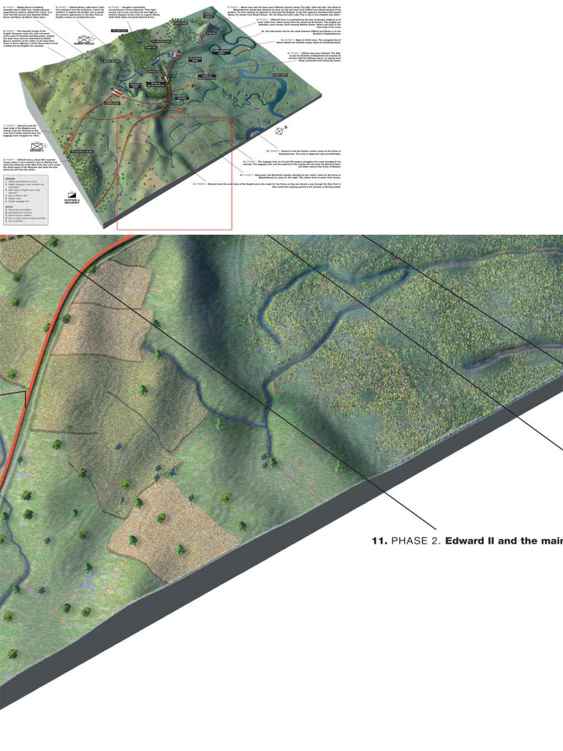
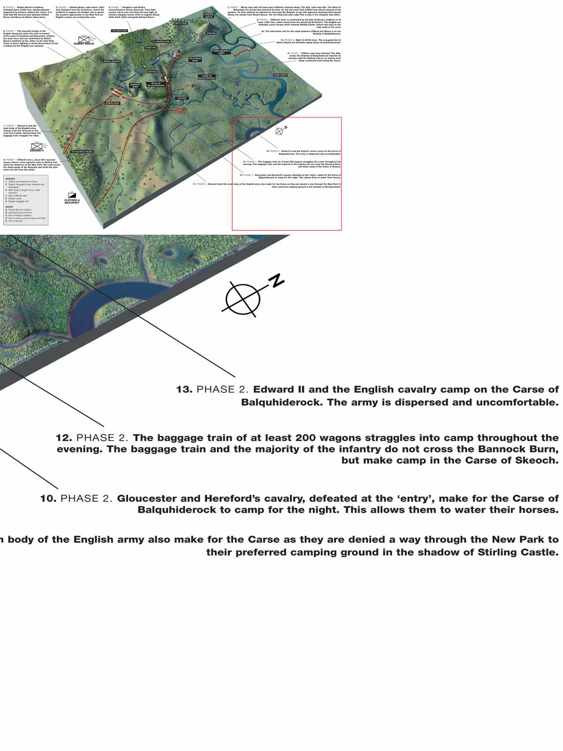
Sunday 23 June 1314, early afternoon to evening, viewed from the southeast showing the first contact between the armies. The Scots are deployed as if for withdrawal. Gloucester and Hereford attempt to force a way through to Stirling at the ‘entry’ to the New Park. Clifford and Beaumont skirt the New Park along ‘the Way’, which runs along the Carse below the escarpment, where their progress is blocked by the Earl of Moray and his pikemen.
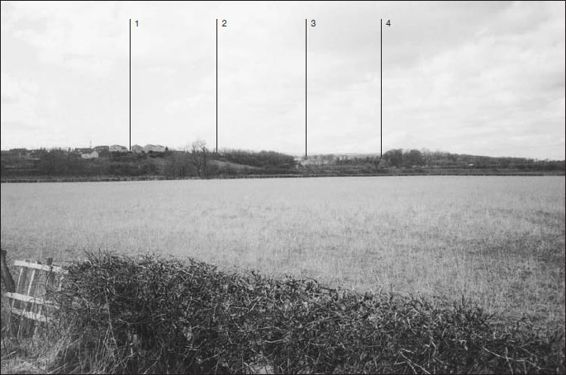
View from the Carse of Skioch across the Caledonian Railway towards the re-entrant of the Bannock Burn valley, showing the slope of the steep escarpment that rises from the carse.
1. Bannockburn.
2. The escarpment.
3. Re-entrant of the Bannock Burn.
4. The Dryfield of Balquhiderock.
(from NS820910)
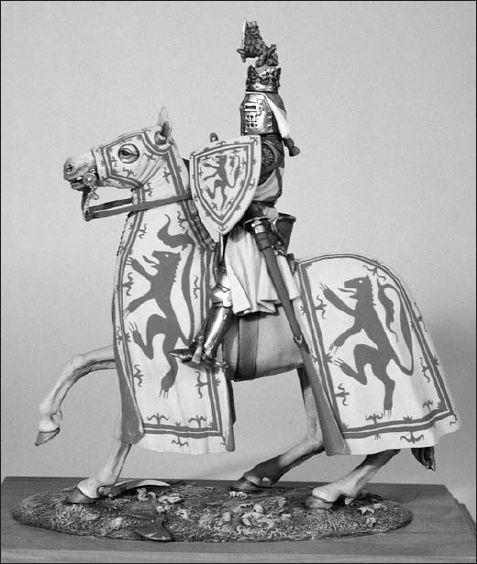
Robert Bruce, King of Scots, at the battle of Bannockburn. (model by the author)
Some survivors of Clifford’s force rode headlong towards Stirling Castle and others, including Clifford himself, fled back the way they had come to the main body of the English army. The Monk of Malmesbury tells us that Clifford was killed the following day along with Gloucester, Payn Tibetot and William Marshall. Clifford was, after the Earl of Gloucester, the most prominent of those killed at Bannockburn. He had a retinue of 50 knights and men-at-arms of whom the names of 13 are known to us, of these only Sir Miles Stapleton seems to have been killed in the battle.
Results of the first day’s fighting
The defeat of Clifford’s cavalry brought the fighting of 23 June to an end; it was late in the day and no further attempt was made to break through to Stirling Castle. This setback, following close upon the repulse of the Earls of Hereford and Gloucester, spread gloom and discouragement throughout the ranks of the English army. The importance of the large-scale action that resulted in the defeat of the English vanguard has been overshadowed in contemporary accounts by the celebrated tale of the confrontation between Robert Bruce and Henry de Bohun. The duel has an exact counterpart in the single combat described by Geofrey le Baker before the battle of Halidon Hill, where again the outcome foreshadows the result of the battle.
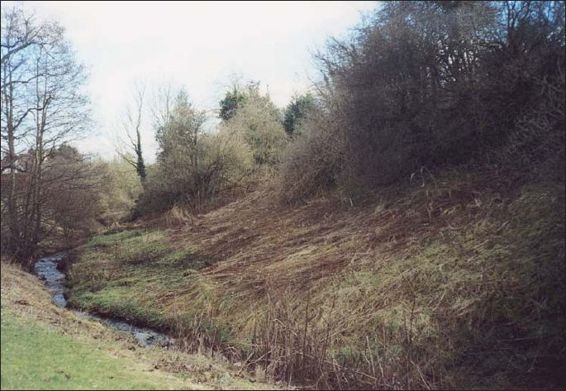
The Pelstream Burn crosses the Dryfield in a steep-sided channel overgrown with trees and a tangle of undergrowth. Enough remains among the building development today to remind us that in 1314 this would have presented a formidable obstacle. (from NS797916)
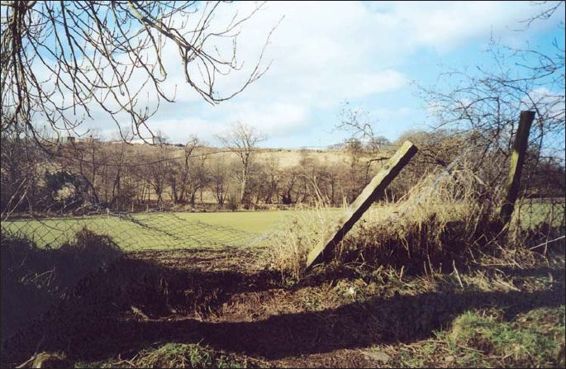
The steep escarpment, rising from the gorge of the Bannock Burn to the Dryfield of Balquhiderock above, is still untroubled by the surrounding encroachment of suburbia. (from NS812908)
Sir Thomas Grey, our eyewitness, though he was in the hands of the Scots by the evening of the 23rd, says that the events of the day had damaged the confidence and resolve of the English. It is possible, however, that the discouragement of the English has been overstated in the light of the following day’s defeat. Only a fraction of the English host had been in contact with the enemy and most had not even seen the Scots. Many, according to John of Trokelowe, were bitter against the Scots because of their repulse and vowed to be revenged on the morrow.
Moray’s victory not only stopped the English opening a route to Stirling Castle but also, and more importantly, it demonstrated the effectiveness of the Scots pikemen against the English horsemen. It is highly likely that Edward II’s plan was for his army to camp in the shadow of Stirling Castle in the King’s Park on the night of the 23/24 June. He had expected the Scots to either retreat before him without a fight or to be easily brushed aside. Now, with the day drawing to a close, his plans were thwarted and awry. Two of his formations had been mauled and repulsed by the Scots and his route to Stirling and his planned camping-ground was blocked. The English army needed a place to set down for the night, as the men were hungry and exhausted by the long march and the horses needed to be watered. It was decided to put all the cavalry and possibly some part of the infantry across the Bannock Burn on to the Carse of Balquhiderock where the horses would find a plentiful supply of water and the men could rest for the night.
The carse was not where the English had planned to spend the night; Grey calls it an evil, deep marsh with streams and there is no doubt that at the time of the battle it was a wetter and boggier place than today. Barbour says that because there were ‘pows’ or sluggish streams in the carse they broke down houses and roofing and carried off wood to make bridges by which to cross the streams. He places this activity after dark, which is not until midnight at this time of year in the north. The English spent a wakeful and anxious night; the horses bridled and the men armed, alerted by the aggressiveness of the Scots to the possibility of a night attack. Edward II must have appreciated the awkwardness of his position and realised that there was a possibility of continued fighting on the following day, but there was nothing at this late hour he could do to improve the situation. It is likely that the main body of the English infantry did not cross the Bannock Burn on to the congested carse but spent the night in the area south of the burn, bivouacking in some disorder as they arrived late in the evening from the direction of Falkirk.
Meanwhile, as the English floundered on the carse, Robert Bruce called his officers together for a council of war. He was much encouraged by the successes of the day, his plans were intact and his army flushed with victory. Yet his deep-rooted caution urged him to withdraw to the rugged fastness of the Lennox, where the country was too wild for the English to follow. Harsh experience had taught Bruce to avoid pitched battles and inclined him towards the less knightly yet effective policy of irregular warfare. The divisions of the Scots army were still positioned as for a withdrawal when, during the hours of darkness, a Scots knight in English service, Sir Alexander Seton, took advantage of the confusion in the English camp to slip away and make his way to Robert Bruce’s headquarters. Seton told Bruce of the disorganised condition of the English and of their discouragement and lack of leadership and pledged his life that if Bruce attacked in the morning he would have victory. Barbour tells us that King Robert turned to his officers to ask if they should fight or not and that with one voice they boldly answered for battle. It must have been at this moment that King Robert decided to risk all on a battle in the morning. Abbot Bernard of Arbroath was present, he had brought the famous Reliquary of Saint Columba with him to inspire the Scots army. He recorded the inspiring words with which Robert Bruce addressed his officers on the eve of Bannockburn and clearly they made a profound impression on all present.
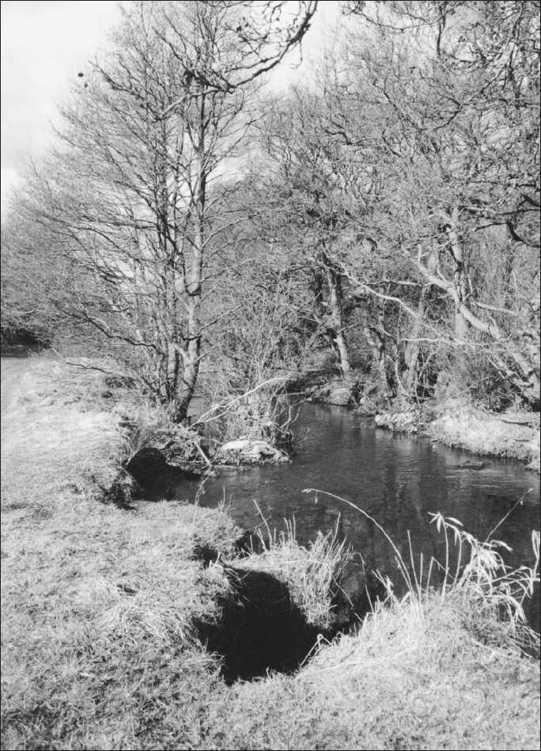
The Bannock Burn near the point where it disgorges into the carse, showing the entangled undergrowth and woodland that would prove an obstacle to both cavalry and formations of infantry. (from NS812908)